



Abstract
The literature on science discourse in K–12 classrooms in the United States has proliferated over the past couple of decades, crossing geographical, disciplinary, theoretical, and methodological boundaries. There is general consensus that science talk is at the core of students’ learning; however, a synthesis of key findings from the expansive literature base is needed. This systematic literature review is guided by a complex systems framework to organize and synthesize empirical studies of science talk in urban classrooms across individual (student or teacher), collective (interpersonal), and contextual (sociocultural, historical) planes. Findings are discussed in relation to contemporary approaches that integrate theories and methodologies to account for the complex phenomena of science discourse, including interacting elements across levels as well as stable and changing patterns that influence students’ access to, and nature of, science talk in urban classrooms. Unresolved questions related to high-leverage, equitable, and sustainable discourse practices; future lines of inquiry that can benefit by drawing from diverse theoretical traditions and mixed methodological approaches; and practical implications for classroom-based strategies to support science discourse are also discussed.
Science discourse, which refers to the representation of phenomena in the natural world through language including text and various modes of spoken and figural representation, lies at the heart of students’ science learning (Gee, 2004; Lemke, 1990; National Research Council [NRC], 2012, 2014). Furthermore, participation in science discourse has an epistemological dimension that represents sociohistorical and cultural ways of seeing the world (Bang & Medin, 2010; Rosebery et al., 1992). Vygotsky (1986) argued that talk is a vehicle for learning; that as thought turns into speech, it does not merely find its expression, but its reality and form. A large body of research shows that providing students with ongoing opportunities to talk in class, that is, engage in rich discursive processes, supports deeper science understanding (e.g., Colley & Windschitl, 2016; Krajcik & McNeill, 2015; Murphy et al., 2017; Murphy et al., 2018; Snow, 2015). The literature also points to the centrality of classroom discourse for students’ engagement in learning, knowledge construction, and scientific literacy (Kelly, 2007; Lemke, 1990, 2004). Furthermore, scholars have suggested that talk and writing perform distinct but complementary functions (e.g., distributing vs. evaluating knowledge, unique affordances and barriers to students contributing ideas) for fostering scientific understanding, and spoken discourse is inextricably shaped by the social context in which it is produced and received (e.g., Bang & Medin, 2010; Cavagnetto & Hand, 2012; Duranti & Goodwin, 1992). Thus, in this article, we review studies that focus on science talk (oral communication) in urban K–12 classrooms in the United States.
Great strides have been made in our understanding of science discourse in classrooms. Within the expansive literature base, science discourse is broadly conceptualized within two traditions that can be distinguished in terms of the degree to which aspects of (1) disciplinary norms and practices versus (2) the knowledge and experiences from diverse communities are underscored as resources for learning science (B. Warren et al., 2001). Within the first tradition, science discourse is conceptualized as the dialectical construction of scientific knowledge and practices aimed to advance understanding about phenomena in the natural world through spoken ideas and claims, data and evidence, and reasoning in classroom contexts (Lemke, 1990, 2004). Here, science discourse is represented by a number of disciplinary discursive conventions and particular assumptions about what counts as knowledge in the field (e.g., Engle & Conant, 2002; Ford & Wargo, 2012). That is, what historically distinguishes discourse in science from other domains is the shared goal of advancing scientific knowledge. For example, scientific argumentation, one form of science discourse that has been widely studied in classrooms, is characterized by the practice of vetting ideas within a community through the process of critically evaluating the strength of evidence and reasoning based on existing theories and accepted scientific knowledge (e.g., Berland & Reiser, 2011; Driver et al., 2000; Manz, 2015; Osborne et al., 2013). This collective goal for generating greater understanding in science differs from argumentation in legal contexts as a contrast, where the process is adversarial, with the goal of winning, rather than considering the strengths and weaknesses of ideas (Cavagnetto, 2010). Ultimately, science discourse supports an informed, scientifically literate citizenry that is able to responsibly understand, critically evaluate, and enact complex ideas in personal and societal realms (DeBoer, 2000).
Science discourse, and science literacy more broadly, has been the subject of several recent education reforms and research initiatives (e.g., National K–12 Framework for Science Education; NRC, 2012, 2014). Notably, science discourse engages many of the Next Generation Science Standards (NGSS; NRC, 2013) science practices such as asking questions that are worthwhile for investigation and connect to a larger, generative idea in science; constructing scientific explanations that are well-reasoned, logical, and based on evidence; developing and revising conceptual models of science phenomena; evaluating and communicating findings to make ideas visible; and arguing for a claim based on evidence and reasoned principles (NRC, 2013, 2014). To this end, the latest NRC (2014) report states that “text and talk in the science classroom constitute two of the primary vehicles by which students gain knowledge and make meaning” and “reading, writing, and well-structured talk are all authentic aspects of engaging in the sense-making process in science classrooms” (NRC, 2014, p. 19). However, despite recent policies, professional development, and curricular efforts, science talk remains an elusive part of K–12 classrooms in the United States (Berland & Reiser, 2011; McNeill & Pimentel, 2009; Sandoval et al., 2019).
This challenge is exacerbated in U.S. urban education contexts serving students from diverse ethnic/racial minority backgrounds who are historically marginalized and underrepresented in science. Scholars studying urban classrooms document inequities in students’ access to high-quality learning opportunities that are explained by a confluence of sociohistorical, geographic, organizational, and political factors (Gray et al., 2018; Milner, 2012; Quinn & Cooc, 2015; Welsh & Swain, 2020; C. A. Warren & Venzant Chambers, 2020). For example, at the classroom level, studies show that from an early age, students in urban schools often receive science education in “final form” or as a set of irrefutable facts and have little opportunity for active sense-making through disciplinary talk (Bae et al., 2018; O. Lee et al., 2007; Manz, 2015). Furthermore, didactic initiate-respond-evaluate (IRE) sequences are prevalent, and learning activities are typically not oriented toward authentic problems that are meaningful to students or connected to the communities they come from (Bae & Lai, 2020; Polman & Pea, 2001; Windschitl et al., 2012). More broadly, systemic inequities in resource availability (e.g., high-quality curriculum, lab materials) and accountability pressures that constrain teachers’ implementation of flexible and inquiry-based science instruction in urban classrooms are well documented (e.g., Hayes & Trexler, 2016; Marx & Harris, 2006; Morgan et al., 2016).
Beyond addressing inequities in opportunity and resources, scholars are also calling for the need to reimagine spaces for science discourse in urban classrooms (e.g., Gutiérrez, 2008; Moje et al., 2001). Within this second tradition, science discourse is conceptualized as a fundamentally intercultural sense-making activity in which students’ experiential ways of knowing, everyday speech, home languages, epistemologies, and cultural values and practices are viewed as resources for advancing their understanding of phenomena in the natural world (Bang & Medin, 2010; Emdin, 2011a, 2011b; Gutiérrez et al., 1999; Gutiérrez & Rogoff, 2003; Rosebery et al., 2016; B. Warren et al., 2001). Importantly, the resources that students from historically marginalized backgrounds bring to classrooms are viewed as assets to mobilize and meaningfully leverage in science discourse activities (Calabrese Barton & Tan, 2009; Gutiérrez, 2008; Moje et al., 2001; Moje et al., 2004; Varelas et al., 2011). For example, students’ social and linguistic norms as well as vernacular styles of youth genres (e.g., banter, community identity; Emdin, 2011b; Varelas et al., 2002) are viewed as productive for science classroom talk activities (e.g., scientific argumentation) to deepen students’ learning. Furthermore, mainstream structures, norms, and practices of science discourse (e.g., formality, detachment) are problematized as too narrow and privileging ways of knowing and talking that uphold dominant values of groups with power (e.g., Western, White, masculine), which has historically excluded the communal, sociocultural and -historical repertoires of knowing and communicating in minoritized communities (Gutiérrez & Rogoff, 2003; Rosebery et al., 1992; Rosebery et al., 2016). It is further argued that mainstream approaches to engaging students in science talk may conflict with, contradict, and/or co-opt minority students’ lived experiences (Brown, 2004; Emdin, 2011a; Moll et al., 1992; Thompson, 2014). Taken together, scholars examining science discourse within this second tradition advocate for expanding academic spaces to create new forms of participation for students that bridge everyday and academic worlds (Figure 1).
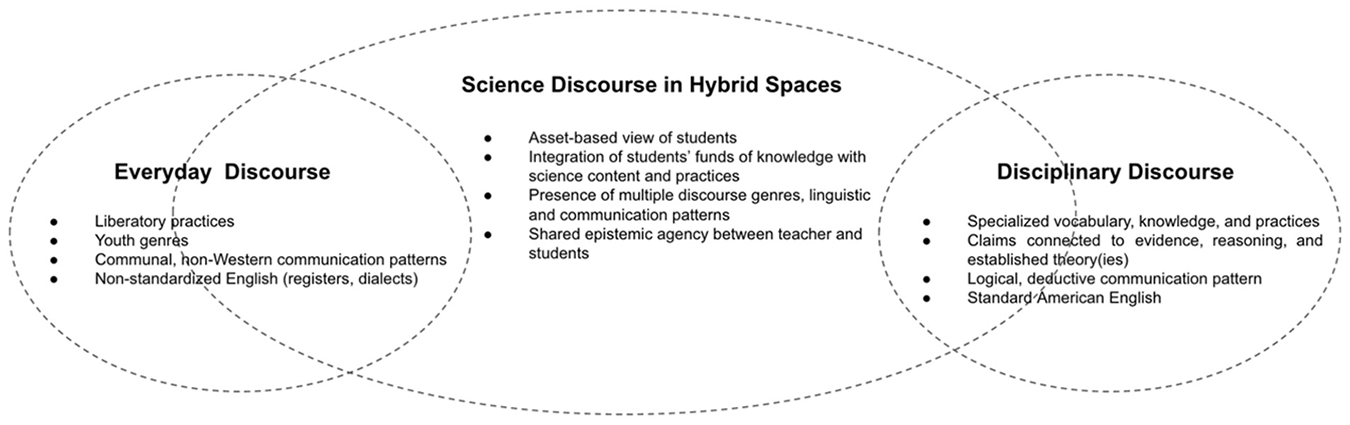
Everyday, hybrid, and disciplinary discourse spaces.
In this vein, we conceptualize urban classrooms as dynamic spaces with complexity and variation in cultural practices and languages, social and economic power, and ethnic/racial diversity (C. A. Warren & Venzant Chambers, 2020), in which there can both be “inequality and possibility” (Green, 2015). The aim of this review article is to examine the literature that spans from more mainstream disciplinary to more intercultural frames of science discourse (also referred to as “science talk” in this article) in urban classrooms. The research question guiding this study was as follows: What are the range of individual, collective, and contextual factors and processes that influence science discourse in urban K–12 classrooms in the United States?
Background
The study of science discourse exists across multiple disciplines, with distinct and overlapping theoretical and methodological traditions. For example, researchers who apply cognitive frameworks typically focus on the underlying psychological mechanisms and individual differences related to scientific language and discourse (e.g., Clarke et al., 2016; O. Lee et al., 2007). Research conducted from a sociocultural perspective emphasizes the co-construction of meaning among the teacher(s) and students in classroom communities (e.g., dynamics in peer-to-peer science talk; Pimentel & McNeill, 2013). Scholars who apply sociolinguistic views of classroom discourse seek to understand how students draw on their repertoire of ways of speaking and acting by reading the requirements, expectations, and norms for participation in a local situation (e.g., Lan & de Oliveira, 2019). Finally, critical studies in education focus on the historical and sociopolitical dimensions in which science discourse resides (e.g., cultural hegemony, institutional racism), foregrounding how daily schooling experiences often neglect the rich backgrounds of students of color and/or students belonging to other historically marginalized groups (e.g., Emdin, 2011a; Varelas & Pappas, 2006). Given the importance of science discourse, coupled with the proliferation of research on science discourse over the past couple of decades, there is a need to synthesize findings across studies to extend our understanding of how various factors and processes across individual, collective, and contextual planes influence the opportunities for and nature of science discourse in urban K–12 classrooms. The findings of this article will inform ongoing efforts to facilitate science talk in ways that are accessible, relevant, and meaningful to all students.
We organize the present review as follows. First, the complex systems approach is reviewed as a guiding framework to understand science discourse as an emergent phenomenon in education, characterized by both stable patterns and idiosyncratic interactions among micro- and macrolevel processes. Second, we provide a brief historical background of major perspectives in the science discourse literature. Third, we review the literature on the individual, collective, and contextual factors and processes that relate to student participation in science discourse in urban K–12 classrooms in the United States, as well as the interactions across levels. Fourth, we discuss theoretical, methodological, and empirical trends within this literature. Fifth, we outline gaps in the literature and discuss future areas of research. Last, practical implications for facilitating science talk in meaningful and accessible ways are provided.
Complex Systems Framework
The complex systems framework was selected because it attends to the dynamic and emergent nature of educational phenomena by accounting for multiple theoretical perspectives and methodologies (Jacobson et al., 2016), as well as interacting components across levels (Hilpert & Marchand, 2018). It thus affords an organizing framework for our synthesis of the science discourse literature that cuts across multiple disciplinary traditions. Specifically, a complex system consists of a collection of interacting components that can include individuals (e.g., students, teachers), conceptual constructs (e.g., motivation, behavior, cognition), and semiotic forms (e.g., words, symbols, discourses; Mitchell, 2009). This framework also accounts for the social (interpersonal), and broader sociocultural and -historical factors and processes (e.g., norms, structures, values) that interact with students’ experiences within specific activity systems (Hilpert & Marchand, 2018). In this review, the complex systems framework is applied to organize how these components interact over time and across levels in relation to students’ participation in science classroom discourse, similar to the approach taken in Walshaw and Anthony’s (2008) review of studies examining teachers’ role in mathematics classroom discourse. The studies included in this review were categorized into one of three levels based on the primary theory(ies) used and construct(s) examined: (1) individual factors (e.g., student- and teacher-level characteristics), (2) collective factors (student-to-student, student-to-teacher interactions), and (3) contextual factors (e.g., sociohistorical structures). In accordance with the complex systems framework, we then discuss how these factors and processes interact across levels in complex, dynamic (stable and situational), and emergent ways.
Historical Background
It is important to consider the ways in which science discourse has been conceptualized as a part of the cognitive, sociocultural, and sociolinguistic theories that are prominently featured in the literature. Here, we briefly summarize the major perspectives that have been used in the field. The work of Halliday (1975) has been widely used to examine language and discourse using a sociolinguistic perspective. Halliday (1975) developed systemic functional linguistics, an approach that examines how individuals make meaning of language through the intersection of personal experiences and ideas, social interactions with others (social semiotics), and text (conceptualized as written or oral language). He proposed that science learning happens as students learn what to say (semiotic resources) and how to say it (formations) through the active use of scientific language with others (Halliday, 1975). Lemke (1990) built on Halliday’s ideas to lay the groundwork for much of the current research on science discourse. Like Halliday, Lemke (1990) deemed science talk as an essential component of scientific literacy. He categorized science talk into (1) an organizational dimension (how individuals interact, e.g., whether teachers provide students with opportunities to speak) and (2) a thematic dimension (ways students use words to create scientific meaning), which stresses the important role teachers play in creating structures that encourage students to “talk” and “think” like scientists.
More recently, scholars have increasingly applied a sociocultural lens to examine science classroom discourse. Seminal work from this perspective include Mortimer and Scott (2003), who developed a multilevel framework to examine authoritative versus dialogic patterns of teacher-student interactions in science classrooms; Lave and Wenger (1991), who examined communities of practices and power distribution in classroom settings; and Gee (2001, 2004), who focused on how students negotiate multiple identities while engaging in science discourse. Additionally, contemporary researchers have begun to combine cognitive and sociocultural theories to better understand both the individual and socially shared aspects of learning (e.g., Greeno, 2006; Murphy et al., 2018). Other significant contributions to current understandings of classroom discourse include research on scientific argumentation (e.g., rebutting and justifying a particular set of scientific ideas; Duschl & Osborne, 2002; Osborne et al., 2013), scientific explanation (e.g., using evidence to describe how and why scientific phenomena occur; McNeill et al., 2016; Sandoval & Reiser, 2004), ambitious science teaching (intellectual engagement that attends to equity; Windschitl et al., 2018), productive disciplinary engagement (Engle & Conant, 2002), and dialogic inquiry (Wells, 1999), all widely considered essential to learning and doing science. Finally, scholars have applied sociocultural and sociocritical approaches to examine how discourses (e.g., language genres, registers, dialects) and ways of knowing from communities of historically marginalized groups can enrich mainstream academic discourses in hybrid or third classroom spaces for productive science classroom discourse (e.g., Gutiérrez et al., 1999; Moje et al., 2004; Moll et al., 1992).
Method
Studies that were considered for this literature review included primary empirical sources related to science discourse in the form of talk in urban K–12 classrooms in the United States.
Search Criteria
Electronic Search
To locate relevant literature, we consulted the PRISMA (Preferred Reporting Items for Systematic Reviews and Meta-Analyses) statement (Moher et al., 2009) and recent systematic literature methodology papers (Alexander, 2020; Pigot et al., 2020) that provide principles and guidelines for conducting systematic reviews. A systematic, electronic search of the literature base was conducted through the following four databases: ERIC, PsycINFO, Academic Search Complete, and Web of Science for peer-reviewed articles published in the past 20 years (1999 to March 31, 2020) using “sci*” AND [“discourse” OR “dialog*” OR “talk” OR “language” OR “argument*” OR “explanation” OR “explain*]. A second search was conducted that also included “sci*” in the title and “science education” in the subject. Utilizing a combination of these terms in the search engines resulted in anywhere from 2,310 to 6,565 hits. After all duplicates were removed, a total of 11,349 research papers were included for screening based on our inclusion and exclusion criteria.
Additional Search Efforts
To ensure that influential work was not overlooked, the first author mined the reference lists of science discourse studies, including several recent reviews related to argumentation (e.g, Cavagnetto, 2010; Manz, 2015) and classroom discourse in other subject areas (e.g., Nystrand, 2006; Walshaw & Anthony, 2008). We used the snowball method (Greenhalgh & Peacock, 2005) to locate any articles that might have been missed by examining the literature reviews of the included studies, and key references to cross-check for articles that would meet the inclusion criteria. In addition, we scanned issues of key science education and education journals, including American Education Research Journal, Science Education, Journal of Research in Science Teaching, Journal of Educational Psychology, Contemporary Educational Psychology, Educational Psychologist, Cognition and Instruction, and Journal of the Learning Sciences for articles related to science discourse in urban K–12 classrooms. This led to the identification and inclusion of eight additional papers.
Inclusion and Exclusion Criteria for Abstract and Full-Text Screening
We exported the title and abstract of each article into Abstrackr (Wallace et al., 2012). Each article was double coded as relevant, maybe, or irrelevant based on whether it met the predetermined inclusion criteria. All split decisions were examined by a third reviewer to determine their inclusion. In addition, articles double coded as maybe were reviewed by the lead author to determine their inclusion, erring on the side of false positives. This yielded 570 studies that possibly met the criteria. We began full-text screenings of these articles to assess whether the inclusion criteria had been met. During the full-text screening process, we were able to exclude a number of articles that appeared to meet the inclusionary criteria based on their abstracts. The full-text screening yielded 69 articles that met the inclusion criteria (Figure 2).

Selection process for systematic literature review.
The following inclusion and exclusion criteria were applied to the selection process: (1) We included articles published in an academic peer-reviewed journal 1 and empirical in nature (including quantitative, qualitative, or mixed methods). We excluded book chapters and meta-analyses because of redundancies in findings, but when appropriate, this information was used to inform the background of this review article; (2) we included articles written in English; (3) we included articles with publication dates between January 1999 and March 31, 2020. We sought studies published in the past two decades that represent published work around the time of the U.S. federal accountability policy shifts under the No Child Left Behind (NCLB) Act in 2001, which have had, and continue to have significant consequences for science curriculum, instruction, and assessment in the United States, particularly for urban schools (Hutt & Polikoff, 2020; Marx & Harris, 2006; Steinberg & Quinn, 2017); (4) we included articles that examined science discourse (science talk, oral communication). We excluded studies that examined gestures and other forms of nonverbal communication and scientific writing or text only (e.g., Baxter et al., 2001), as well as studies that examined discourse in other subject areas such as math or history (e.g., Kohen & Borko, 2019). In addition, we included studies that analyzed student talk, excluding studies that only reported teacher-level outcomes (e.g., McNeill et al., 2016); (5) we included studies that were conducted in the United States and in formal K–12 education settings. This decision was based on unique contexts across countries (e.g., accountability policies, presence or absence of national curriculum) that influence science teaching; (6) we included studies conducted in urban or mixed (i.e., has a subset of characteristics common to urban) education contexts in the United States. Acknowledging that urban education is conceptualized in many ways using several social, geopolitical, and historical descriptors (Green, 2015; Reich et al., 2014), we used the indicators provided by Milner (2012) as well as Welsh and Swain (2020) to include studies conducted within schools in concentrated, metropolitan or large cities in the United States that are characterized by educational inequality (e.g., lack of materials, high pupil to teacher ratios, high percentage of students who qualify for free and reduced-price lunch) and ethnic/racial and/or linguistic diversity in the demographic composition of students, based on the setting and sample description of the study. Studies conducted in rural and suburban education settings were excluded, because of the substantial differences in how science is taught and learned across these contexts due to a series of structural, social, cultural, and economic factors and documented differences in the student population attending rural and suburban schools (Welsh & Swain, 2020). In addition, studies that focused solely on students with disabilities were excluded, as they have additional layers of identity that likely influence how science discourse can be promoted or experienced (Vaughn & Schumm, 1995).
Extraction of Relevant Information and Synthesis of Summaries
The following information from the 69 included articles was extracted, including (1) general information (authors, study title, year of publication, journal), (2) sample characteristics, (3) theoretical framework, (4) research design and methodology, (5) aspect of science discourse examined, and (6) the unit of analysis (summary on Table 1). The papers were summarized by trained research assistants. Each summary averaged a half single-spaced page in length and included the purpose and research questions, background information, methodology, and key findings. The first two authors of this article engaged in a dual deductive and inductive thematic analysis of the summaries by applying the three levels of interactive elements from the complex systems framework a priori (individual, collective, and contextual; Hilpert & Marchand, 2018), and identifying emergent codes from the summaries that were then synthesized into themes (Braun & Clarke, 2006; Suri & Clarke, 2009). To identify emergent themes, a constant comparative analysis was used (Onwuegbuzie et al., 2012), in which the focal constructs and processes (related to the coded unit of analyses and aspect of science discourse examined) were grouped by common topics within each level (individual, collective, and contextual). Finally, in line with the complex systems approach, the emergent themes were then examined in terms of how focal factors and processes interact across levels in complex, dynamic, and emergent ways. For example, although the major themes identified in the first category (e.g., agency, beliefs) focused on individual factors and processes, how these interact with other levels (e.g., opportunities in a classroom to enact agency) were also accounted for in our synthesis of the literature. We discussed the codes, resolved discrepancies, and generated consensus on themes presented in the main findings. This approach supports the synthesis of literature that cuts across disciplines and frameworks, in that the themes emerge from the primary studies rather than a predetermined theory (Thomas et al., 2012).
Summary characteristics of included studies
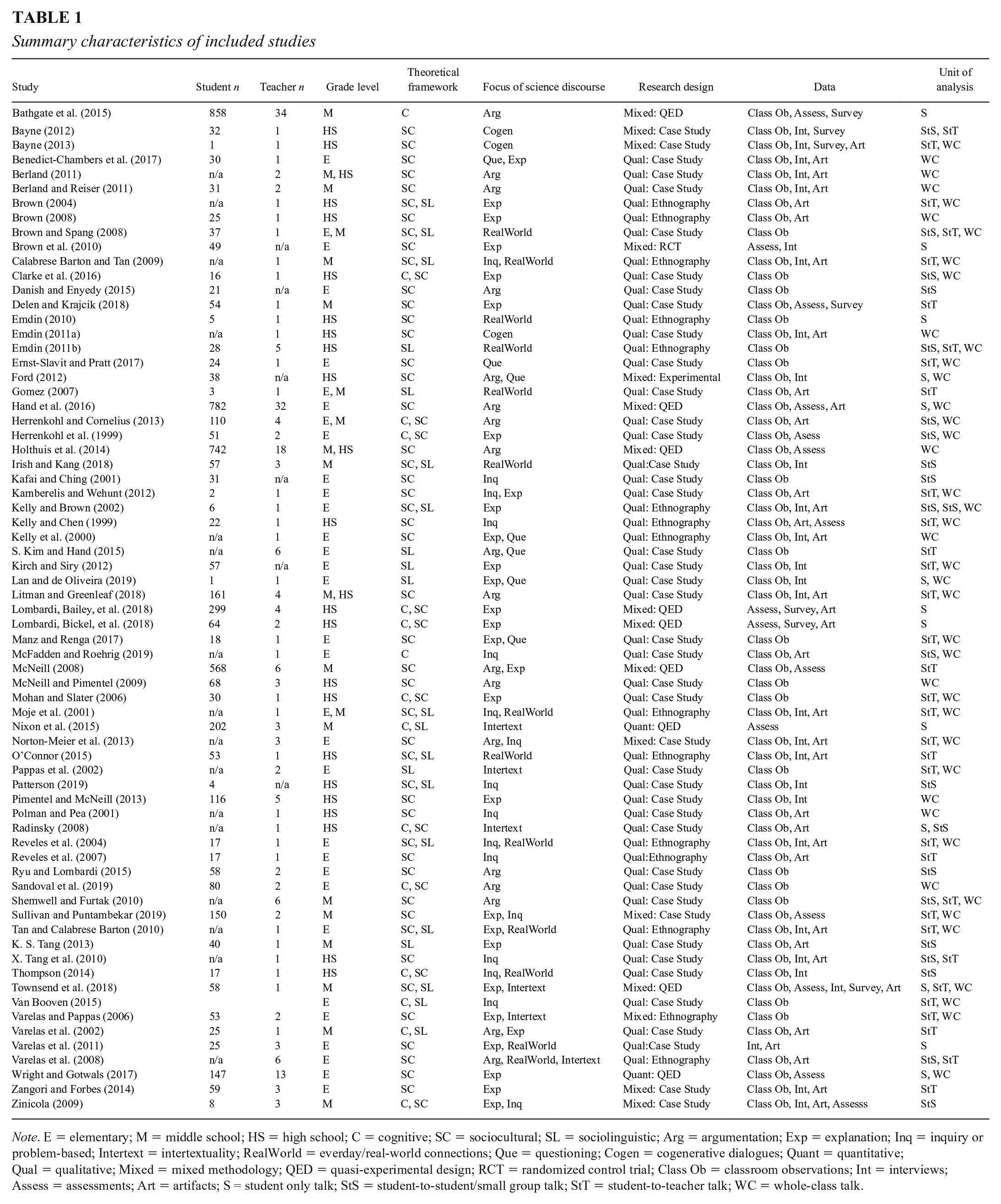
Note. E = elementary; M = middle school; HS = high school; C = cognitive; SC = sociocultural; SL = sociolinguistic; Arg = argumentation; Exp = explanation; Inq = inquiry or problem-based; Intertext = intertextuality; RealWorld = everday/real-world connections; Que = questioning; Cogen = cogenerative dialogues; Quant = quantitative; Qual = qualitative; Mixed = mixed methodology; QED = quasi-experimental design; RCT = randomized control trial; Class Ob = classroom observations; Int = interviews; Assess = assessments; Art = artifacts; S = student only talk; StS = student-to-student/small group talk; StT = student-to-teacher talk; WC = whole-class talk.
Results
The literature on science discourse in K–12 urban science classrooms 2 within the United States is organized by one of the three levels in which the focal constructs and processes associated with science talk fit best, followed by more specific subheadings that represent the emergent themes within each level. These are (1) individual or student/teacher (agency, language, ability, beliefs, and motivation), (2) collective or interpersonal (small group dynamics, curriculum and scaffolds, multiple modes of representation, teacher questioning, productive and dialogic discourse), and (3) contextual or sociocultural and -historical levels (bridging every scientific experiences, languages, and identities).
Findings from studies categorized into the individual level generally focused on the microlevel processes (e.g., students’ observable enactment of agency) within an activity; into the collective level on interpersonal interactions (e.g., peer-to-peer negotiation of talk norms) within a clearly defined discourse context; and into the contextual level on factors and processes at a larger grain size (e.g., out-of-school narratives and lived worlds in relation to classroom talk norms). However, in line with a complex systems approach, we acknowledge that science discourse studied at any grain size resides within a complex (i.e., hierarchical, nested) learning ecology, is dynamic (i.e., can demonstrate either or both stable and momentary patterns) and is emergent (i.e., nonlinear interdependent interactions rise to recognizable macrolevel norms and behaviors; Hilpert & Marchand, 2018). Thus, in each major section of the review (individual, collective, contextual), the focal constructs and processes are discussed in relation to those across levels, and situated in the classroom and/or broader environment in which science discourse is examined.
Individual Student and Teacher Factors
Studies focused on student characteristics as they relate to science discourse included in the examination of individual factors including students’ language backgrounds (Lan & de Oliveira, 2019; Mohan & Slater, 2006), argumentation ability and motivation (Bathgate et al., 2015), personal identity (Bayne, 2009; Thompson, 2014), and/or sense of agency (Bayne, 2012, 2013; Clarke et al., 2016). There was also one study that examined the relationship between teacher-level factors (beliefs) and science discourse (Pimentel & McNeill, 2013). Findings showed that individual factors influenced how the opportunities for science talk were presented, interpreted, and taken up by teachers and students.
Student Agency
Student agency, or the power and volition to act in a field (Ko & Krist, 2019; Miller et al., 2018), emerged as an individual factor that influenced whether and how students engaged in science discourse. For example, findings from mixed-methods case studies conducted by Bayne (2012, 2013) showed that high school students’ sense of agency in their biochemistry classroom resulted in students organizing cogenerative classroom dialogues (i.e., focused discussions among multiple stakeholders, such as student, teacher, and researcher, who hold relevant local knowledge and experience around learning) focused on questioning the prevailing narrative of urban youth and engaging multiple stakeholders in science talk in an emancipatory manner. Black student researchers also demonstrated a nuanced understanding of how the same term can hold different meanings in science discourse. For example, they noted how the term complain could refer to a student engaging in negative behavior (i.e., whining) versus critical behavior (i.e., questioning the purpose of activities; Bayne, 2012). Similarly, Clarke et al. (2016) identified multiple patterns of student-enacted agency in a high school science classroom. These included variations in degree of participation, solicited versus unsolicited contributions, teacher-prompted participation, and the likelihood of future participation (Clarke et al., 2016). Results showed that while all students held agency to participate in the class discussions, students who were high versus low contributors differed in their perceived opportunities to enact that agency. Low contributors were more likely to hold a canonical view of science as a body of absolute knowledge, and this epistemological perspective often hindered their sense of agency because they did not want to say the “wrong” answer (Clarke et al., 2016). In contrast, high contributors viewed discussion as a means to construct understanding and more likely to make unsolicited contributions. Additionally, being called on by the teacher was associated with higher likelihood of future participation (Clarke et al., 2016). Although the studies reviewed in this section focus on agency primarily at the student level (i.e., how a student exerts agency through overt action, compliance, and/or resistance), it was acknowledged that students’ agency is recursively shaped by the structures, resources, activities, norms, and relationships in their learning environments.
Student Language Backgrounds and the Language of Science
Studies focused on students’ language backgrounds drew on systemic functional linguistic theory (Halliday, 1975) to examine the relationships among linguistic features and functions of science discourse, and particularly how students’ non-English native language backgrounds and everyday communication patterns influenced their access to and adoption of scientific discourse practices. These studies underscored the demanding and distinctive linguistic features of science (e.g., words with specialized meanings, lexical content organized in complex noun groups; de Oliveira, 2010; de Oliveira & Lan, 2014) that students are expected to take up in science classrooms. Lan and de Oliveira (2019) showed that not all students come to school with an equal understanding of teachers’ expectations for particular types of academic language or intertextual connections (i.e., relationships among scientific texts). This was especially the case when the teacher prioritized text-dependent questions rather than drawing on day-to-day knowledge and language. Furthermore, when the English Language Learner’s (ELL) contributions to classroom discourse were not aligned with implicit expectations of disciplinary science talk, the teacher and peers often misinterpreted the student’s ideas as irrelevant. For example, in a whole-class discussion of the impact of humans on the environment (based on information from the textbook that followed a human-as-actor discursive framework), the teacher and other students were quick to downplay an ELL student’s contribution in which the animal was the subject of the response based on knowledge of everyday life (e.g., animals hitting cars; Lan & de Oliveira, 2019). Mohan and Slater (2006) similarly examined how science discourse includes content, language content, texts in social practice, and intertextuality through a high school unit on the properties of matter. Their case study illustrated how the teacher enculturated students in the disciplinary ways of talking science through a facilitated discussion of the taxonomy of physical properties (lexical cohesion and items), cause and effect relationships and reasoned decision-making processes (knowledge structure principles), and the social, disciplinary practices of science discourse (e.g., questioning, problem-solving; Mohan & Slater, 2006). Notably, although these studies focused on language(s) in use by a specific individual and/or group of individual students, findings also underscored how speech or talk in science classrooms serves various functions that connect science content, disciplinary and classroom practices and norms, and everyday genres or speech and norms through word-level connections (e.g., morphology of scientific terms), and complex linguistic, semiotic, and intertextual relationships.
Science Ability, Beliefs, and Motivation
Finally, fluency with science content and practices, and willingness or motivation to engage in science discourse, interacted with opportunities to talk science. Bathgate et al. (2015) examined students’ argumentation ability by coding the quality of their justifications (e.g., claim connected to reasoning and evidence) and duality of argument (e.g., integrating different perspectives) about how to assist pink dolphins threatened by extinction. Students’ willingness to engage in argumentation was also assessed by coding students’ reasons for whether they would or would not engage in an argument with their peers (e.g., you can’t change a person’s opinion). Results showed that argumentation ability strongly predicted students’ learning of new content, and willingness to engage in argumentation was a statistically significant moderator of the effectiveness of argumentation ability and science learning (Bathgate et al., 2015). Similarly, Van Booven (2015) illustrated that elementary student-level characteristics, including cognitive processes, language complexity, and science knowledge interacted with teachers’ questioning and feedback approaches (more authoritative vs. dialogic), resulting in varying levels of scientific understanding.
At the teacher level, Pimentel and McNeill (2013) highlighted how high school teachers’ beliefs regarding classroom discussion manifested in the ways in which they communicated expectations about student participation and the epistemological framing in science talk. Findings showed that teachers generally held beliefs that positioned themselves as the main authority and evaluator of the discussion, and in some cases, discouraged students from using information outside of the preselected video for whole-class arguments on climate change. In turn, student-centered discourse moves, such as elaboration of students’ responses and “toss backs” (prompting students to respond to each other’s ideas) were the least common discourse moves (Pimentel & McNeill, 2013). These findings indicate that teacher discourse beliefs and epistemologies are important antecedents to whether student-driven science talk is present or absent in classrooms.
In summary, individual factors and processes (e.g., agency, language background, and motivation) are demonstrated in the literature as important contributors to students’ participation in science discourse. Furthermore, a complex systems lens allows us to understand how these student and teacher factors interact with dynamic (stable and situational) social and contextual features of students’ learning environments (e.g., norms and expectations for participation in talk) to influence how students perceive opportunities for and engage in science discourse (emergent complex phenomena). In the next section, findings from studies that focus on collective, interpersonal aspects of science discourse are reviewed.
Collective Factors and Interpersonal Processes
The literature on collective factors and interpersonal processes as they relate to science discourse is situated in the context of small-group student-to-student, student-to-teacher, and/or whole-class discussions. Within these discourse formats, a smaller number of studies focused on the social interactions between students, while the majority of the studies examined teachers’ discourse moves in student-to-teacher and/or whole-class discussions, documenting how teacher discourse moves influenced students’ engagement in science talk.
Small-Group Dynamics During Science Discourse
Findings from studies of small-group science talk demonstrate the momentary and situational nature of students’ collective engagement in science talk. Examples of this occur across grade levels, with research highlighting a dialectical relationship between individual processes and collective engagement in science talk among third graders (Ryu & Lombardi, 2015) as well as the ways in which middle school students’ individual characteristics interact with their social environment to engagement in discourse (Zinicola, 2009). For example, by applying social network analysis and qualitative coding of students’ talk, Ryu and Lombardi (2015) found that a third-grade ELL student’s epistemic agency (e.g., rephrasing comments) was mediated by the social dynamics (e.g., peers reinforcing or providing feedback on ideas) and availability of cultural resources (e.g., common out-of-class experiences among peers) within a small-group argumentation activity. Similarly, Zinicola (2009) displayed how individual (e.g., gender, students’ ability to reason with abstract ideas) and collective (e.g., rephrasing peers’ ideas for simplicity) factors worked in tandem to influence middle school students’ discourse processes during small-group activities. Findings also showed that as students worked to generate explanations and reach consensus about the ideas underlying scientific phenomena (e.g., balloon inflating and deflating, water heating inside a bottle), the nature (frequency, quality) of their talk varied by situational and task-specific features, such as difficulty, sense of confidence, and level of interest (Zinicola, 2009). These studies highlight how the peer dynamics occurring on the social plane interact with students’ individual characteristics (e.g., language background, confidence) to produce varied affordances for science discourse.
Another common finding across these studies was the importance of establishing roles and norms to structure science talk activities toward goals for productive, disciplinary talk. Kafai and Ching (2001) demonstrated that familiarity with talking science facilitated elementary students’ abilities to encourage their less experienced peers to elaborate on their initial ideas and extend content-focused discussions related to software design. Patterson (2019) also highlighted the role that students played in shaping the social hierarchy of science talk in small groups. Students identified exclusionary behavior (visibility) and encouraged silent peers to share their ideas (presence of voice), claiming responsibility (agency) for maintaining both equitable and productive group work (Patterson, 2019). Findings highlight the potential of delegating authority to students to create equitable learning spaces in group activities, using guiding principles (e.g., “friends don’t let friends sit quietly,” Patterson, 2019) and tools for science talk.
In line with the complex systems framework, studies of students’ collective engagement in science discourse shed light on the complex, dynamic, and emergent processes involved in negotiating roles, norms, and task goals between the individual and collective planes of science talk. Collective factors and processes that were examined in small-group discussions included talk moves that collaborators use to externalize their understanding (e.g., Ryu & Lombardi, 2015; Zinicola, 2009), the presence and visibility of each group member’s voice (e.g., Danish & Enyedy, 2015; Patterson, 2019), and the role of prior knowledge and experience in the leadership positions students assumed and negotiated in small-group discussions (Kafai & Ching, 2001).
Instructional Scaffolds, Curriculum, and Projects That Support Science Discourse
An additional subset of the literature focused on how the use of lesson or curricular materials and scaffolds, student-centered projects, and embedded assessments affected student participation in science discourse. Specifically, several studies investigated how tangible curricular materials (e.g., whiteboard templates, mobile technology) were utilized to promote deeper levels of science learning by assisting students in discourse practices (Brown, 2008; Delen & Krajcik, 2018; Herrenkohl & Cornelius, 2013; Holthuis et al., 2014; Lombardi, Bailey, et al., 2018; Lombardi, Bickel, et al., 2018; McFadden, & Roehrig, 2019; McNeill, 2008). One example is the model-evidence link (MEL) diagram that students used to evaluate a set of evidence related to two alternative scientific models (Lombardi, Bailey, et al., 2018; Lombardi, Bickel, et al., 2018). High school students were prompted to evaluate multiple sources of evidence and examine their plausibility judgments in relation to specific scientific claims. This process of systematically evaluating the strength of evidence (e.g., strongly supports, contradicts, has nothing to do with) in relation to scientific claims was linked to deeper understanding of climate change and fracking (Lombardi, Bailey, et al., 2018; Lombardi, Bickel, et al., 2018). Similarly, Delen and Krajcik (2018) demonstrated that mobile scaffolds supported middle school students’ ability to construct scientific explanations, particularly in providing detailed justifications for data selected to use as evidence, and applying relevant scientific principles when developing reasoning statements. Herrenkohl and Cornelius (2013) showed that templates embedded in SenseMaker boards scaffolded students’ argumentative discourse during small-group and whole-class activities when presenting their evidence, theories, and ideas to their classmates. Similarly, McFadden and Roehrig (2019) showed how written design-specific prompts (e.g., decision checkpoints to consider the trade-offs of different materials) supported elementary students in both innovating and identifying key drivers of their mining extraction designs during joint discussions. Finally, Brown (2008) showed how the use of embedded assessments in a high school science classroom can deepen students’ conceptual understanding of content standards, analytic skills associated with scientific practices, and engagement in discourse practices that socialize students in the discipline of science.
Another subset of the studies focused on curricula and science projects aimed to promote science discourse. These projects included the Science, Oral Language, and Literacy Development (SOLID) Start curriculum for kindergarten students (Wright & Gotwals, 2017), a specialized chemistry curriculum for middle school students (McNeill, 2008), and a technological design project for Hispanic third-grade students (Kelly & Brown, 2002). These studies examined the impacts of implementing reformed-based curricula and instructional projects on students’ discourse abilities. Wright and Gotwals (2017) utilized a quasi-experimental research design and found that kindergarten students whose teachers used the ask, explore, read, discuss, write structure of the SOLID curriculum for 4 weeks outperformed their peers whose teachers used a standard curriculum, demonstrating greater ability to determine evidence-based claims, a larger science vocabulary, and a better understanding of science concepts. Similarly, when investigating seventh-grade teachers’ implementation of a chemistry curriculum that focused on supporting students’ ability to develop scientific explanations and arguments related to substance and properties, chemical reactions, and conservation of mass, McNeill (2008) found that variation in the quality of teachers’ enactment of the curriculum (e.g., how the purpose of argumentation activities were presented, degree of instructional scaffolding) affected the accuracy and depth of students’ science understanding as expressed through class discussion. Using a solar energy design project that required third-grade students to interact in whole-group, small-group, and classroom presentation settings, Kelly and Brown (2002) identified six discourse practices across activities that included responding to and articulating scientific knowledge, negotiating roles and relationships, organizing the work and logistics, articulating and producing the project design and function, presenting and evaluating project design and function, and attributing sources of ideas and credit.
In summary, these studies provide evidence for tangible instructional materials, projects, and assessments that science teachers can use to promote various aspects of science discourse including making evidence-based claims (e.g., Herrenkohl & Cornelius, 2013; Lombardi, Bailey, et al., 2018; Lombardi, Bickel, et al., 2018) and deepening scientific vocabulary and disciplinary ways of communicating ideas (e.g., Brown, 2008; Wright & Gotwals, 2017). The findings also highlight the potential of project-based activities for supporting science discourse, and importantly, how teacher-related (e.g., framing and implementation; McNeill, 2008), peer-related (e.g., group dynamics; Kelly & Brown, 2002), and task-related (e.g., task demands; Kelly & Brown, 2002) factors influence the opportunities and nature of talk in these activities.
Multiple Modes of Representation
There were also a number of studies that focused on MMR, based on the premise that communication in science employs a variety of modes for representing ideas (e.g., visual, linguistic). Three studies of MMR were examined in the context of lessons designed with a set of diverse representations. In these studies, there was a focus on how teachers were trained to make explicit references to and discuss the strength and weaknesses of the representation(s) in relation to the science ideas being discussed (Nixon et al., 2015), how middle school students used semiotic resources systems (spoken and written language, images, and gestures) in small-group discussions to understand the intrinsic surface property, or nano-smoothness, of nanotechnology (K. S. Tang, 2013), and how middle school students used a geographic information system (computer program with database connected to an interactive map) as a visualization tool to understand earth structures and processes (Radinsky, 2008). Nixon et al. (2015) examined the relationship between teachers making explicit MMR connections and middle school students’ science achievement, as measured on standardized end of unit tests. In contrast to expectations, they did not find statistically significant effects between explicit MMR connections and student achievement. Conversely, Townsend et al. (2018) showed that a middle school science teacher’s intentional use of multimodal resources (e.g., computer vocabulary games with visuals and sounds, self-recordings of oral recitation of sentence puzzles) led to statistically significant and qualitatively meaningful gains in students’ use of science vocabulary.
The other qualitative studies focused on the use of multimodal or multisemiotic resources during science discourse (Pappas et al., 2002; K. S. Tang, 2013). For example, Pappas et al. (2002) examined how language served as a semiotic tool via informational books, read-aloud sessions, small-group literature circles, and students’ writings and drawings to explore states of matter. Various forms of intertextuality were identified (e.g., connections across texts, hands-on explorations, generalized events) depending on how the teacher and students interacted with the semiotic tools during discourse activities (Pappas et al., 2002). K. S. Tang (2013) also showed that distinct discourse patterns may be linked to the prominent semiotic mode used. For instance, students’ discussion around a diagram showing a top view versus side view of the different surface features were characterized by an emphasis on the quantity (e.g., number of bumps on the surface) or the depth (e.g., coarse grain surface having deeper holes), respectively. The findings demonstrate mixed quantitative evidence for the effects of MMR on measures of science achievement, but qualitative cases illustrate how different modes of representing science information influences what science ideas students attend to during discourse activities.
Teacher Questioning and Framing of Science Discourse
The studies examining teacher discourse moves positioned teachers along a continuum ranging from expert guides to facilitators of student-driven knowledge construction. In particular, diverse approaches to questioning emerged as a prominent strategy for supporting student-driven participation in science talk (e.g., Benedict-Chambers et al., 2017; Ernst-Slavit & Pratt, 2017; Manz & Renga, 2017). These included questions that were focused on procedures and behavioral expectations (e.g., managerial, Ernst-Slavit & Pratt, 2017; scientific practice, Benedict-Chambers et al., 2017), recall of science concepts or terms (e.g., parlance, Ernst-Slavit & Pratt, 2017; naming observed phenomena or events, Benedict-Chambers et al., 2017; Manz & Renga, 2017; information seeking, S. Kim & Hand, 2015), and reasoning by evaluating claims and comparing multiple ideas (e.g., higher-order questions, Ernst-Slavit & Pratt, 2017; sense-making questions, Benedict-Chambers et al., 2017; compare and contrast questions, Manz & Renga, 2017; elaboration, challenging, S. Kim & Hand, 2015). Below, we present three key findings related to how teachers use questioning to guide students’ sense-making, facilitate student-directed knowledge construction during uncertainty, and a breakdown of the complexity and frequency of different question types in classrooms during discourse.
Questions to probe and guide the content and direction of discourse
Studies that positioned teachers as experts in the classroom focused on how teacher-directed talk moves guided students’ participation in science discourse. In these studies, teachers used their expertise to provide a roadmap for student discourse that was generally aimed at guiding students toward an accurate understanding of a scientific principle or phenomenon. These strategies included questions that probed students to explicate (e.g., describe in more detail), elaborate (e.g., expand, clarify), explain their ideas, and/or revise their original ideas (Berland, 2011; Herrenkohl et al., 1999; McNeill & Pimentel, 2009) as well as conversation frames or scaffolds to indicate the purpose of the science talk activity (Kelly & Chen, 1999; Sandoval et al., 2019). For example, Sandoval et al. (2019) examined how elementary teachers organized a classroom culture for productive argumentation, focusing on whether and how teachers hold their students accountable to each other’s ideas. Findings showed that conversation frames (i.e., statement indicating the purpose of the talk activity) and prompts that indicated the function of discourse (e.g., what to talk about, who to talk with) had a direct impact on whether students focused on persuasion (convincing their peer), providing the canonical right answer (clarifying or summarizing ideas toward a correct statement), or collective sense-making toward consensus versus sharing answers without attempt to resolve contested claims (Sandoval et al., 2019). Similarly, Herrenkohl et al. (1999) documented how an elementary teacher’s use of explicit prompts for elaboration (e.g., “. . . give me an example . . .”), feedback and redirection (e.g., “. . . most of these are predictions but theory has a different feel to it . . . Let’s fill it out a bit”), and guided reasoning (e.g., “So how did your predictions compare to what actually happened?”) during whole-class and small-group discussions helped students focus their attention on listening to one another’s ideas and drawing links between evidence and theory. McNeill and Pimentel (2009) also demonstrated that high school teachers’ use of more open (vs. closed, rhetorical, or managerial) questions to focus students’ attention on evidence and reasoning was associated with approximately 50% more student talk and dialogic interactions during a whole-class argument about climate change. Conclusions across these studies generally converged on the recommendation that teachers can and should intervene in students’ science talk by probing and guiding the content and direction of students’ thinking. These techniques are supported by content area expertise, adequate planning aligned to specific learning goals, and flexible scaffolding of classroom discourse while also monitoring for direction and coherence.
Questions to facilitate student-driven discourse during uncertainty
Other studies positioned teachers as facilitators of student-driven knowledge construction (Kelly et al., 2000; Manz & Renga, 2017; Polman & Pea, 2001). Questioning emerged again as a high-leverage discourse strategy, but the questions positioned students as the agent (e.g., scientist, spokesperson) by drawing students into extended discussions about science content and practices. Based on findings from an ethnographic study of a third-grade classroom, Kelly et al. (2000) present a taxonomy of question types (e.g., requesting description, clarification, and extension of students’ ideas) that created multiple opportunities for students to expand their ideas for experimental designs to test hypotheses and debate anomalous findings from an experiment. Studies also underscored the value of uncertainty during scientific inquiry. For example, Kirch and Siry (2012) focused on identifying expressions of uncertainty in elementary classrooms, by examining students’ use of modifiers (e.g., “maybe,” “might,” “could”) in conversation. They noted that the expressions of uncertainty did not necessarily mean a student is hesitating, but rather that students were providing a potentially sophisticated understanding of the canonical structure of science explanations (e.g., keenness of discrimination among existing facts, calling something into question or being skeptical; Kirch & Siry, 2012). Manz and Renga (2017) focused on how elementary teachers guided evidence construction during such moments of uncertainty during a 6-week plant growth experiment. Their findings showed that teachers applied a range of open-ended questions, ranging from recall questions (e.g., How tall was your plant?) that aimed to direct students’ attention to particular ideas, to student interaction questions (e.g., Can you tell him why you’re not sure you agree?) aimed to have students consider similarities and differences among ideas (Manz & Renga, 2017). Questions aimed to manage the complexity of students’ evidence construction were linked to student talk focused on their evidence, whereas questions aimed to help students make desired claims were associated with students recalling correct answers (Manz & Renga, 2017). These questioning strategies focused on facilitating student-driven talk that enculturated students into the disciplinary practices and norms or scientific discourse.
Question types and student engagement in science discourse
Some studies also examined the frequency of different question types and their links to how students engaged in science discourse. Ernst-Slavit and Pratt (2017) examined the quantity and quality of a fourth-grade science teacher’s questions during a 6-week rocks and minerals instructional unit. The teacher asked varied questions that fell in each of the five categories, but were predominantly higher-order (29%) and parlance (28%) questions (vs. managerial, display, or reflective) that encouraged genre-specific ways of “talking science.” For example, the teacher used questions such as “What’s your evidence for that?” or “Where did you get your ideas?” to extend student explanations by probing and soliciting information (Ernst-Slavit & Pratt, 2017). Parlance questions that focused on learning about the language of science (e.g., “What did we decide a geologist is?”) was also shown to support students’ use of specialized vocabulary (Ernst-Slavit & Pratt, 2017). Similar patterns of varied questioning emerged in other elementary science classrooms, where the teachers asked questions to request information (e.g., ideas, predictions), confirmation, elaboration, challenge, and explanation or description of scientific practices and phenomena (Benedict-Chambers et al., 2017; Kelly et al., 2000; S. Kim & Hand, 2015). These results demonstrate a wide range of simpler (e.g., recall) to higher-order (e.g., elaboration) questions that teachers can flexibly use to encourage student talk in class.
In summary, findings show that ongoing and diverse questioning approaches are effective for creating and structuring opportunities for student-centered talk characterized by sense-making to persist through moments of uncertainty, integrating science content with science practices, using evidence to support claims, and debating multiple ideas related to scientific phenomena. Findings also showed that the format and nature of teachers’ questions depended on the goals for student participation, and in turn, had consequences for students’ access and opportunities to engage in science discourse.
Dialogic and Productive Science Classroom Discourse
Another set of studies focused on science discourse classroom structures or patterns of norms and interactions among teachers and students that are repeated across activities in the classroom (Mehan, 1979). Specifically, scholars focused on how teachers could shift from teacher-directed IRE patterns to more dialogic discourse formats in which the content of the discussion arises from student-generated ideas, that are then elaborated on via teacher and/or peers to further students’ understanding (e.g., initiate, reply, and feedback, Sullivan & Puntambekar, 2019; argumentation for articulation, persuasion, and sense-making, Berland, 2011; Berland & Reiser, 2011; presenting evidence-based explanations, Zangori & Forbes, 2014). Scholars also examined how teachers created and maintained a culture of productive disciplinary talk (e.g., Berland & Reiser, 2011) and applied transformative practices that support diverse student participation in science talk (e.g., Manz & Renga, 2017). Although this shift from didactic to dialogic discourse is conceptually straightforward, findings demonstrate the complexity and challenges associated with creating productive discourse structures in classrooms, as it requires individual, collective, and cultural shifts away from familiar patterns of teacher-controlled talk (with bids for correct answers to students, Sullivan & Puntambekar, 2019; or following the scientific method as a formulaic set of discrete steps, X. Tang et al., 2010) to dialogic, multiperson participation in which roles and norms of talk are continuously negotiated based on the goals of the activity.
Several studies examined how teachers shifted from more didactic to more dialogic patterns of science talk. Findings from case studies of two middle school teachers showed that over the course of a 12-week Force and Motion unit, teachers who participated in inquiry-based professional learning project moved away from prompting students to recall facts (IRE format) and toward acknowledging students’ responses, asking focused and authentic questions that were followed by additional questions that built on students’ answers from previous questions, and explicitly discussing the kind of thinking students were expected to engage in (Sullivan & Puntambekar, 2019). Similarly, Zangori and Forbes (2014) showed that elementary teachers’ approaches to instructional scaffolding (e.g., emphasizing a single correct answer vs. importance of generating multiple explanations) influenced the degree to which students engaged in reasoning (e.g., critically evaluating and selecting evidence to support claims) during the construction of scientific explanations regarding plant growth.
There was also a small body of experimental or quasi-experimental studies that examined the effects of classrooms with discourse-supportive structures (e.g., construct and critique format, Ford, 2012; science writing heuristic approach, Hand et al., 2016) compared with business-as-usual classrooms (e.g., typical science labs). Ford (2012) conducted an experimental study among high school students in physics classes to test the difference between a “dual role” condition (treatment), in which students engaged as both a constructor (i.e., construct steps of an inquiry process to present to peers) and a critic (i.e., critique presenters’ plans), and a business-as-usual (BAU) condition in which students experienced a standard lab condition. Compared with the BAU students, students in the treatment condition demonstrated more sophisticated interpretations of the results from a ramp experiment, referred to data appropriately when positing patterns, and were more likely to challenge the claim made by other students about the article (Ford, 2012). Quasi-experimental studies related to the Science Writing Heuristic (SWH) approach to argument-based inquiry examined communication structures related to questions around “big ideas” in science and investigations designed to generate evidence to answer those questions (e.g., Hand et al., 2016; Norton-Meier et al., 2013). A mixed-methods study examining SWH in elementary classrooms showed that, particularly for teachers who were classified as moderate implementers (i.e., promoted ongoing opportunities for students to engage in argumentation and negotiation), students demonstrated statistically significant superior performance on an end-of-year standardized state test science and language scores compared with students of teachers categorized as low implementers (Hand et al., 2016).
Notably, even within activity structures that aligned with more dialogic forms of science discourse, studies demonstrated variation in how teacher discourse moves and structures in the classroom influenced the aspect of scientific argumentation students’ engaged in. In a comparison of two middle school classrooms, Berland and Reiser (2011) identified different configurations of argumentative discourse structures including those that focus on either articulation of ideas, persuasion, or sense-making. Information seeking dialogue had a stronger focus on sense-making (e.g., neutral questions, treating arguments as stand-alone entities), whereas too much focus on persuasion was linked to consolidating students’ existing ideas rather than developing new knowledge (Berland & Reiser, 2011). Berland (2011) also showed how activity structures influenced middle school students’ participation in argumentation, specifically in terms of their moment-to-moment responses to oppositional episodes in class where disparate ideas were shared and either abandoned or discussed (evaluated, justified with evidence). Additionally, Litman and Greenleaf (2018) examined the instructional focus of argumentation (learning to argue, arguing to learn, or interactive argumentation) and the inquiry space (degree to which argumentation knowledge and skills were predetermined) in science classrooms. Their findings showed that tasks characterized by either learning to argue or arguing to learn were more prescriptive (e.g., teacher-initiated question, student responses, teacher evaluation), whereas interactive argumentation facilitated more student-generated claims, evaluation, and reasoning (Litman & Greenleaf, 2018).
What is clear across these studies is that students are often aware of the “grammar of schooling” or the “grammar of science discourse.” That is, students participate in the type of science talk they understand to be appropriate for a given context, strongly influenced by how teachers frame and structure the discourse activities. Findings also demonstrate how multiple discourse goals and related activities can be accomplished within dialogic talk structures. It is thus important to balance the norms and demands of multiple discourse goals, such as encouraging both critique and sense-making (Berland & Reiser, 2011), guiding students in describing, arguing, and explaining scientific phenomena, and encouraging argumentation that integrate content with elements of effective arguments (Litman & Greenleaf, 2018).
Contextual, Sociocultural, and Sociohistorical Influences on Students’ Science Discourse
As students become enculturated into the discipline of science, they are commonly taught a number of unique discursive conventions and particular assumptions about what counts as knowledge within the discipline and/or the subculture of science classrooms (Gutiérrez, 2008; Moje et al., 2004). Particularly for students from racial/ethnic and linguistic minority groups, learning to participate in science talk often also requires navigating and negotiating various identities, genres of speech, and ways of thinking and acting across lived worlds (Calabrese Barton et al., 2008; Gomez, 2007). The studies reviewed here underscore the social, historical, political, and cultural dimensions of science discourse in urban classrooms. To this end, the studies in this section of the review are prominently guided by sociocritical frameworks. These include a pointed examination of how mainstream science curricula can perpetuate systemic inequities in students’ access to science talk, and the points of cultural mismatch between mainstream science discourse and the culture of minority students’ social worlds (e.g., Brown, 2004; Emdin, 2010; Haverly et al., 2020; Reveles et al., 2004; Thompson, 2014).
Hybrid Spaces: Leveraging Students’ Funds of Knowledge in Science Discourse
Scholars have argued that beyond expanding opportunities within mainstream classroom structures, the norms and practices that maintain the marginalization of minoritized students from participation in science discourse need to be reimagined (Calabrese Barton & Tan, 2020; Gutiérrez et al., 1999). In this vein, studies reviewed in this section also highlight the potential of hybrid or “third” spaces in urban classrooms that forward goals for an equitable culture of science talk (Gutiérrez, 2008; Moje et al., 2001). Hybridity theory offers a framework for creating transformed learning spaces that (1) serve as bridges between students’ everyday and academic lives (e.g., Gutiérrez et al., 1999), (2) allow students to cross between different discourse communities (e.g., Lee, 1993), and/or (3) destabilize and reshape scientific and everyday discourses (e.g., Moje et al., 2001; Moje et al., 2004). In hybrid spaces, students’ home and community-based resources (often referred to as students’ funds of knowledge [FoK], Moll et al., 1992) are treated as assets that can be productively leveraged in discourse activities to deepen students’ science learning (Moje et al., 2004; Rodriguez, 2013). Furthermore, hybrid spaces establish new forms of participation by positioning students as epistemic agents; that is, students sharing authority over the direction of and serving as active contributors to the substance of science discourse in the classroom community (e.g., Ko & Krist, 2019; Rodriguez, 2013).
Bridging everyday and scientific experiences in discourse
Varelas and Pappas (2006), Varelas et al. (2008), Kamberelis and Wehunt (2012), and Pappas et al. (2002) conducted ethnographic studies of elementary teachers’ classrooms to document how teachers made intertextual connections between texts, students’ FoK, and science ideas. In literature circles or lab activities, students’ FoK included examples from media (e.g., science teacher Ms. Frizzle from The Magic School Bus series) and recounting personal experiences (e.g., seeing a tornado, going fishing), and teachers played an important role in acknowledging students’ everyday connections, affording them social significance, and introducing additional ways to express scientific understanding using canonical scientific language (Kamberelis & Wehunt, 2012; Pappas et al., 2002; Varelas & Pappas, 2006). Elementary students’ functional reasoning (e.g., wooden blocks for building, lemonade for drinking) from everyday experiences also supported their understanding of science concepts (e.g., the properties of matter, Varelas et al., 2008). Findings showed that this approach to blending everyday and academic discourses in science talk activities had positive influences on students’ learning, including facilitating a sense of belonging (shared power between teacher and students), expanded social networks, increase in the use of scientific language over time, and deeper understanding of canonical and conventional forms of scientific knowledge over time (Kamberelis & Wehunt, 2012; Varelas & Pappas, 2006).
Similar research has also been conducted in secondary science classrooms. Tan and Calabrese Barton (2010), Calabrese Barton and Tan (2009), and Irish and Kang (2018), and Moje et al. (2001) conducted ethnographic case studies of middle school science classrooms to examine how teachers expanded the points of entry for students to access and communicate their understanding of science. Multiple “figured worlds” were identified, distinguished by the teachers’ construction of physical space and ways of interacting with students. These included storytelling (e.g., student sharing about her friend with skin cancer, air quality in neighborhoods, experiencing a hurricane in the Dominican Republic), real-world examples (e.g., writing and enacting skit with an antismoking theme, salad recipes from home, evidence needed to support a claim in science and in court cases), and diverse science participation (e.g., students taking on roles and responsibilities as caretakers of classroom pets and plants), as well as analogies (e.g., rate of tectonic plate movement to rate of fingernail growth, movement of escalator and lithosphere) that drew from students’ FoK to make the science content relevant (Calabrese Barton & Tan, 2009; Irish & Kang, 2018; Moje et al., 2001; Tan & Calabrese Barton, 2010). Along the same lines, Shemwell and Furtak (2010) questioned whether the prioritization of empirical evidence for evaluating students’ contribution to scientific argumentation is conducive to rich conceptual talk. Findings from their study showed that conceptually implicit (e.g., “the bottle sank because the amount of water displaced was less than the mass”) and explicit (e.g., “the larger bottle is going to float because there’s a lot of air in it”) statements constituted rich contributions to the arguments and productive student thinking.
Bridging everyday and scientific language in discourse
Scholars included here view language as an inherently sociopolitical act. That is, modes of speech associated with particular types of activities are viewed as symbolic of particular cultures and values (Bayne, 2009; Emdin, 2009; Gee, 2004; Gumperz & Hymes, 1986). For example, some researchers argue that instruction and curriculum laden with academic language (e.g., technical vocabulary, complex sentence structures) that represent the traditions and values of science disciplines can create barriers to accessing core science ideas that students would be able to understand otherwise (Kachchaf et al., 2016; O. Lee et al., 2013). Furthermore, using academic language can be perceived as cultural betrayal for many minority students, who see the appropriation of scientific ways of talking as a denial of their social and cultural background (Brown, 2004). For example, Brown (2004) identified four discursive identities among high school students on a continuum ranging from opposition status (e.g., avoiding the use of scientific knowledge and language) to proficiency (e.g., fluently using scientific terminology).
Brown and Spang (2008) conducted an ethnographic study of a fifth-grade classroom serving primarily African American students to examine how the teacher engaged in “double-talk” to bridge students’ everyday language with science terms to promote scientific literacy in the classroom. Findings showed that the teacher connected students’ ways of understanding, activities, and past experiences (e.g., sorting rocks) to science concepts and terms (e.g., classification), and in turn, students engaged in double-talk, pairing more accessible phrases (e.g., “just sits there,” “backbone . . . skeleton in your back”) with the scientific equivalent (e.g., “nonliving,” “invertebrate”; Brown & Spang, 2008). This double-talk supported students’ ability to identify, define, and explain scientific concepts in the context of shared experiences (Brown & Spang, 2008). Brown et al. (2010) also examined the effects of a computer-based intervention in fifth-grade classrooms (i.e., preassessment, content construction, introduction of explicit language, and scaffolding opportunities for language). The results showed that students in the treatment group demonstrated greater instances of correct use of science language and better conceptual understanding of concepts in everyday language (Brown et al., 2010).
Varelas et al. (2002) drew from the concept of assimilation to examine how youth genres (how students make sense and perform in the world) were integrated with the classroom (subject matter) and the science (theory and empirical evidence regarding phenomena in the natural world) genres (Varelas et al., 2002). Scientific theories and ideas related to buoyancy and gravity were expressed through student-generated rap songs (e.g., “The force that pulls down is gravity, it was put there for you and me. Gravity! Buoyancy! Gravity! Buoyancy! The force that pulls up is buoyancy, it was put there for you and me,” p. 589). The meeting of the three genres illustrated in these episodes showed how students’ engagement in science was interwoven with their identities as Black students in the classroom, characterized by a diverse set of social expressions and practices such as banter, excitement, and responding to different understandings (Varelas et al., 2002). Similarly, Emdin (2011b) argued that the modes of communication represented in rap cyphers (e.g., building community, listening and responding to one another, use of gestures, shared rhythms) lend themselves to communicating meaningfully about science in urban classrooms. Findings from a 4-year longitudinal ethnographic study of high school students showed that out of the four levels of transaction in urban science classrooms, with Level 4 representing the seamless integration of school and out-of-school communication, Levels 3 and 4 were minimally present, whereas Levels 1 and 2 (representing out-of-school and traditional discourses, respectively) were more common in urban classrooms (Emdin, 2011b). Findings also showed how students’ attempts to integrate youth genres of speech in classroom science discourse were often unrecognized and/or dismissed by teachers (Emdin, 2011b).
Bridging students’ intersectional identities with scientific identities in discourse
A number of studies examined the interplay between students’ social, cultural, and scientific identities and students’ participation in science discourse. Aligned with sociocultural perspectives, science identity is conceptualized as a dynamic entity (Gee, 2001, 2004) consisting of narratives that guide beliefs and actions; and it is based in culture, language, and the action of others distributed across activities and settings (Brown, 2004; Thompson, 2014). Additionally, within a critical frame, scholars have proposed that the lack of opportunities for students to develop narratives about oneself in science due to limited access to science resources, misalignment between the cultural expressions in school and their cultural backgrounds, and the positioning of minority students as outsiders prohibit the development of minority students’ science identities (Brickhouse et al., 2000).
Studies conducted by Thompson (2014), Emdin (2010, 2011a, 2011b), and Varelas et al. (2011) examined how students’ multiple identities are negotiated in collaborative discourse, as they navigate between their personal and science worlds. Thompson (2014) used “lunchtime science,” a 4-week intervention during lunch, to provide a space for ethnically diverse girls from an underserved high school who were failing science to engage in collective identity work through discourse. The girls supported each other in learning science by engaging in both identity (e.g., laying stories along curriculum, building a sense of belonging) and science identity (e.g., problematizing curriculum and asking questions, having authority to solve problems) work. Findings showed that goals related to learning science paralleled goals related to other identities, such as becoming better friends and family members in home and community contexts. For example, the girls discussed risk factors associated with teen pregnancy and being equipped with knowledge about the scientific evidence behind diets (e.g., folic acids, caffeine intake) during pregnancies (Thompson, 2014). Similarly, Emdin (2011a) used a three-part (3Cs; cosmopolitanism, cogenerative dialogues/cogens, and co-teaching) approach to facilitate student-led participation as a teacher and researcher in a ninth-grade physics classroom. In the cogens and co-teaching activities, the teacher, researcher, and students discussed discourse structures (e.g., how students tended to self-segregate, seating arrangements that contributed to inequitable access to classroom materials) and worked together to teach lessons that attended to the strengths and weaknesses of students in the class. Placing the student in roles that recognized them as an expert supported their ability to learn the subject matter, take on classroom responsibilities, and be recognized by their peers as scientists (Emdin, 2011a).
Other studies focused on how to draw explicit connections between students’ out-of-school identities and science identities during classroom discourse activities. In ethnographic case studies of elementary science classrooms in schools serving a high population of Hispanic students, Reveles and colleagues (Reveles et al., 2004; Reveles et al., 2007) examined how elementary teachers used psychological tools to frame and enact science activities (e.g., getting students to see themselves as scientists and mathematicians, “we’re going to be thinking like mathematicians”; learning to observe, “do a lot of watching and looking”). These discourse moves bridged students’ thinking with disciplinary frames of reference (e.g., how mathematicians generate different ways to solve problems in practice) and developed students’ identities through disciplinary activities (Reveles et al., 2004; Reveles et al., 2007). O’Connor (2015) also documented how a teacher built students’ identities as scientists by pointing out similarities in thinking and talking processes between astronomers and students to demystify scientific disciplines (e.g., telling students that their questions are the same questions astronomers have been thinking about for a long time), positioning students as potential future participants in the scientific community (e.g., possibility for a student to become a volcanologist), and negotiating scientific authority (e.g., pushing students to take on the role of an expert to defend claims, sharing cultural-historical insider knowledge related to the big earthquake and subduction zones in Mexico; O’Connor, 2015). Importantly, these interdiscursive relationships were built over time, as the teacher and students responded to and navigated not only the immediate interaction but also the broader, often hierarchical structures of classroom participation (O’Connor, 2015). Scholars thus argue that pedagogies to support rich science dialogue is important but not sufficient to realize the full potential of minority students’ collective identities that are shaped by sociohistorical events. This literature points to the importance of student engagement in identity-related activities, making explicit links between intersecting markers of students’ identities and those of scientists, and recognizing students when they engage like a scientist across various discourse settings toward productive learning experiences.
Taken together, hybrid spaces that invite students’ everyday, home, and cultural experiences, languages, and identities into the substance of disciplinary discourse can support equitable opportunities for participation in science talk. The studies reviewed here illustrate how students’ FoK encompasses a rich set of cultural resources that can be leveraged by teachers to bridge everyday and academic discourses that are anchored in familial, communal, and societal events relevant to students’ lives.
Discussion
Findings of our systematic literature review document the broad range of theoretical perspectives, methodologies, and findings represented in the science discourse literature to demonstrate how factors and processes at the individual, collective, and contextual levels interact to shape science talk in K–12 urban classrooms in the United States. In this section, we discuss broader findings and trends in the science discourse literature, including (1) the move toward theoretical pluralism, (2) the potential of mixed-methods approaches, (3) unresolved questions and future lines of research, and (4) practical implications for educators.
Theoretical Pluralism in the Study of Science Discourse
For the purpose of organizing and synthesizing the diverse literature base on science discourse, we coded the studies by the prevalent theoretical framework(s) applied 3 and the related focal constructs and processes examined. Our findings showed that in large, sociocultural frameworks and concepts were the most prominent in the literature (82%). These included more specific frames (e.g., transformative communication, productive disciplinary discourse, social construction of knowledge) and concepts (e.g., zone of proximal development, intersectionality) that focused on social, cultural, and/or historical factors and processes that influence students’ science talk. Studies that applied sociolinguistic frames (29%) often drew from concepts of intertextuality (relationships among text and talk) and concepts from sociosemiotic theories of language (e.g., multiple modes of representation). Notably, studies using sociocultural and/or sociolinguistic frames focused on how the aspects of the classroom context influenced science talk (e.g., student roles in small groups, instructional scaffolds) with the goal of strengthening students’ understanding and engagement with the practices and norms of scientific disciplines (e.g., Delen & Krajcik, 2018; McNeill, 2008). Others provided a more critical look that problematized aspects of the classroom and broader enterprise of science teaching and learning (e.g., cultural mismatch between academic and home languages, e.g., Calabrese Barton & Tan, 2010; Varelas et al., 2008). The small number of studies guided by cognitive frameworks (21%) included theories and concepts of learning and motivation (e.g., assimilation frameworks, beliefs, e.g., Bayne, 2013; Clarke et al., 2016), but as discussed next, also drew from sociocultural perspectives to understand how these individual factors and processes manifest in classroom environments.
Our review showed that many of the studies examining science discourse do not fit neatly into one scholarly tradition or theoretical frame. Rather, many scholars examining science discourse make a pragmatic argument for “theoretical pluralism” (e.g., Bell, 2004) on the basis that science discourse is too complex a phenomenon to be understood within the boundaries of a single theoretical perspective. For example, in the literature reviewed, many scholars drew on both cognitive concepts (e.g., internal and external scripts, transfer of knowledge, individual expertise) but also applied sociocultural perspectives to account for situational or contextual features of science (e.g., peer dynamics within learning communities, classroom discourse structures; Herrenkohl et al., 1999; Lombardi, Bailey, et al., 2018; Sandoval et al., 2019). Similarly, scholars who used critical frames drew from both sociocultural and sociolinguistic perspectives to examine how students’ participation in discourse was influenced by cultural and out-of-school experiences (e.g., natural disasters from home countries, pop culture references) and linguistic traditions (e.g., everyday talk, non-English languages; Brown & Spang, 2008; Tan & Calabrese Barton, 2010). Some scholars even applied frames that ranged between theoretical poles of cognition (e.g., engagement, assimilation) to sociocultural or sociolinguistic frames (e.g., negotiation norms of dominant culture in school and minority experiences, intersection of oppressed identities in science; e.g., Thompson, 2014; Varelas et al., 2002). Scholars are increasingly drawing from a variety of theoretical traditions and findings of the studies reviewed here illustrate how this approach can be conducive for answering complex questions about science discourse in urban classrooms.
Using Mixed Methods to Advance Our Understanding of Science Discourse
The prominence of theoretical pluralism in the science discourse literature was, in turn, associated with a wide range of methodologies represented across studies. Qualitative ethnographic or case studies was the most prevalent approach to examining science discourse (73.9%). However, the use of mixed methods was also common in many studies (23.2%). Quantitative approaches represented the smallest set of studies reviewed (2.9%).
The integration of quantitative and qualitative methods supported researchers’ ability to work across theoretical and methodological boundaries. A smaller number of scholars applied mixed-methods approaches that prioritized quantitative methods and utilized qualitative approaches to explain quantitative findings in more depth (e.g., explanatory sequential designs; Creswell & Plano Clark, 2017). For example, in a study examining the effects of MEL diagrams, quantitative changes in students’ plausibility judgments toward accurate scientific conceptions of Earth science topics were analyzed, and qualitative examples of student work were used to illustrate how students reasoned with evidence (Lombardi, Bailey, et al., 2018). Similarly, other studies used experimental or quasi-experimental designs to quantitatively examine differences between treatment and comparison conditions in students’ science discourse and understanding (e.g., making scientific arguments, using evidence to support claims), but also drew on classroom observations, interviews, and/or student work artifacts to provide more detailed accounts of the explanatory mechanisms for these differences (e.g., experiences of frustration during classroom discussions, qualitative differences in the strength of students’ justifications, qualitative differences in implementation levels; Bathgate et al., 2015; Ford, 2012). In other studies, qualitative methods were prioritized and supplemented with quantitative findings to provide descriptive details (e.g., exploratory sequential designs; Creswell & Plano Clark, 2017). For example, McNeill and Pimentel (2009) qualitatively coded transcripts of classroom discourse to identify patterns in dialogic interactions between students and teacher that were presented with supporting excerpts, but also provided quantitative trends (percentages) of utterances that represented teacher versus student talk. Similarly, other studies provided rich qualitative descriptions of the nature of science discourse in classrooms and schools (e.g., student agency, negotiation of roles in small-group talk, bridging of everyday and scientific language in whole-class discussions) and used quantitative data to provide additional descriptive evidence for the emergent qualitative themes (e.g., Bayne, 2013; Varelas & Pappas, 2006).
Our findings highlight the potential of mixed-methods approaches to understand the complex nature of science discourse in urban classrooms. A mixed-methods approach is also aligned to recent calls from scholars advancing complex systems approaches to educational research (Hilpert & Marchand, 2018; Jacobson, 2020), as it opens possibilities for investigating science talk at different levels of analysis and timescales, changes in educational systems, and decentralizing the discourse processes to account for interpersonal, collective, and contextual influences on students’ learning experiences.
Unresolved Questions and Directions for Future Research
We see three major unresolved questions that can be pursued in future research. We present these next, followed by a discussion of how a complex systems approach can support these efforts.
1. What are high-leverage science discourse approaches that create equitable access to student engagement in science talk and what approaches are more context-specific? We recognize that in-depth ethnographic case studies offer rich insight into context-specific practices related to science discourse, both in terms of depth (e.g., analysis of discursive elements between a teacher and their student during classroom discussions) and breadth (e.g., how a teacher builds discourse norms and relationships with students over the course of an academic year). The synthesis of findings across studies reviewed converged on the following discourse principles for equitably and meaningfully engaging students in science talk within urban classrooms: (1) anchoring science discourse in phenomena that are meaningful to students’ lives and communities. Implied in this is the importance of teachers knowing who their students are, including the homes, cultures, and backgrounds of their students’ out-of-school lives; (2) positioning students as epistemic agents of their sense-making; that is, sharing authority in the flow and substance of knowledge construction during science discourse with students; and (3) creating hybrid spaces in urban classrooms that invite, place value on, and integrate students’ everyday discourses and home resources with science talk. As discussed in the implications for practice below, several concrete strategies are also identified in our review (e.g., diverse questioning strategies, use of multimodal representations).
Given the prevalence of qualitative case study and ethnographic approaches in the science discourse literature, we propose that there is an opportunity to incorporate more quantitative and mixed-methods approaches that have implications for generalizable, large-scale applications of promising principles and approaches to facilitating science discourse in urban classrooms. For example, it may be feasible to examine key discourse practices identified across the qualitative case studies using quasi-experimental designs with matched comparison groups. In addition, critical quantitative or “QuantCrit” methodological approaches that emphasize the assets of students of color (e.g., developing culturally relevant measures; Sablan, 2019) offer promising possibilities for applying inferential models to forward our understanding of equitable science discourse practices in urban classrooms. Extending this line of inquiry would support efforts to scale promising discourse practices and provide a better understanding of what discourse approaches work for whom and under what conditions.
2. How can students’ FoK be meaningfully integrated into the activities and classroom culture of science discourse? The findings from this review demonstrate the potential of hybrid spaces (Gutiérrez, 2008; Moje et al., 2004) for positioning students as rightful participants who possess valuable resources (e.g., FoK) for learning science. In addition to student-driven and shared epistemic agency in discourse activities, the reviewed studies highlighted a number of key markers of hybrid spaces including the presence of diverse discursive identities, home and community knowledge, and language forms during science talk activities (e.g., Calabrese Barton & Tan, 2009; Emdin, 2010). Although rich examples of hybrid spaces were illustrated in many ethnographic studies, findings also indicated that science talk characterized by discourse in which students’ everyday and academic discourses are fully integrated is uncommon or inconsistent in urban classrooms (e.g., Emdin, 2011b). Future research is needed to understand when and how teachers and students can move beyond using students’ FoK as superficial “hooks” at the beginning of a unit or co-opting these to fit the science curriculum and move toward building a classroom discourse culture in which students make fluid connections between everyday and scientific ways of knowing and communicating (Emdin, 2011b; Thompson, 2014). Future research is also needed to understand how to shift the ownership of creating, maintaining, and sense-making in these hybrid spaces from teachers to students. Importantly, establishing a classroom environment where students’ ideas are welcomed and valued, and where students are expected to actively participate in the knowledge building process is crucial (Ko & Krist, 2019; Miller et al., 2018). Otherwise, sporadic attempts to make connections between students’ FoK and science are unlikely to establish sustainable hybrid spaces that promote students’ capacity to exert epistemic agency and deepen their science learning.
This vision for a culturally affirming classroom discourse culture stands in contrast to traditional “school science” and in many ways, goes against the cultural grain of schooling in which teachers hold primary responsibility for eliciting, guiding, and placing value on student ideas (e.g., Emdin, 2010; Moje et al., 2004; Rosebery et al., 1992). Evidence from the extant literature provides several explanations for the challenges in creating hybrid spaces. First, teachers may sometimes reproduce their didactic K–12 experiences and have reservations about relinquishing authority to their students due to heightened unpredictability in the flow and direction of the classroom discourse (e.g., Polman & Pea, 2001; Windschitl, 2002). Scholars have also argued that to achieve science discourse cultures that center students’ lived experiences, teachers need to develop critical consciousness of how historicized structures and power relations manifest in classrooms, and how their positionality influences how they interpret and respond to student contributions in classroom discourse (e.g., A. Kim et al., 2018; Milner, 2015; Redding, 2019). Furthermore, as discussed next, teachers’ discourse practices operate within larger education systems and institutional practices.
3. How do institutional structures and policies impact teachers’ ability to enact equitable discourse practices? We recognize that discourse practices in science classrooms exist within larger, nested education systems (schools, districts, regions). Notably, the principles and practices discussed here are based on findings from studies conducted in urban classrooms within the United States and may not generalize to other countries. The decision to bind the reviewed studies this way was based on the complex sociohistorical and political context of urban classrooms in the United States, including historical inequities and historicized power relations along racial and socioeconomic lines (Milner, 2012; C. A. Warren & Venzant Chambers, 2020). Additionally, national education policies, including NCLB and NGSS, have particular consequences for science education in U.S. classrooms (Hutt & Polikoff, 2020; Marx & Harris, 2006; Quinn & Cooc, 2015). Especially relevant to urban schools in the United States is the high accountability pressures associated with statewide standardized testing, coupled with lack of resources, that can create tensions between the mandated curriculum and teachers’ flexible use of culturally relevant practices (Hayes & Trexler, 2016; Morgan et al., 2016). Future research is needed to understand the affordances and barriers presented by salient institutional structures and policies for equitable classroom science discourse practices. Additionally, to better understand cross-cultural differences in science talk, international comparisons of science discourse in primary and secondary classrooms are worthwhile. For example, differences in the role of verbal performance as a medium for learning and variations in cultural expectations and norms for authority figures across countries (e.g., Jones, 1999; J. A. Lee & Kim, 2017) are likely to affect classroom discourse practices across countries and cultures.
Using a Complex Systems Perspective to Understand Science Discourse in Urban Classrooms
Our findings couched within the complex systems framework identifies several points of intersection among elements at individual, collective, and contextual levels, and between stable and changing patterns that can be examined to address these gaps in the literature—for example, at the microlevel, individual student characteristics, including agency, local and disciplinary knowledge, language fluency, and motivation interacts with macrolevel elements such as recognition for student leadership positions (e.g., Bayne, 2013), solicitation of ideas in whole-class discussions (e.g., Clarke et al., 2016), and classroom norms and expectations for discourse (e.g., Berland & Reiser, 2011). As another example, the access to participation in science discourse interacts with macrolevel elements such as the presence or absence of hybrid or collective third spaces (e.g., Tan & Calabrese Barton, 2010), teachers’ ability to bridge students’ FoK with science content (e.g., Brown & Spang, 2008), and the acknowledgment of students’ intersectional identities (e.g., Thompson, 2014).
Trends toward theoretical pluralism and mixed methods lend themselves well to answering the unresolved questions regarding the complex, dynamic, and emergent nature of science talk in urban classrooms. As scholars have noted, we acknowledge that this requires an ontological and epistemological shift toward embracing the interdependent nature of elements across levels and coexistence of stable and changing patterns (Jacobson, 2020). Contemporary work applying complex systems perspectives that provide methodological guidance (e.g., six interdependent steps in the complex dynamic systems approach; Kaplan & Garner, 2020) and empirical examples in education (e.g., Koopmans & Stamovlasis, 2016; Marchand & Hilpert, 2020) can be drawn on to inform these efforts.
Implications for Practice
This final section outlines classroom-based strategies and tools that are aligned to theoretically sound principles and evidence-based practices from the literature reviewed. To encourage students’ agency, motivation, and participation in science discourse, it is important that teachers (1) recognize students for meaningful leadership positions (e.g., feeding classroom pet; Tan & Calabrese Barton, 2010), (2) solicit and continuously probe student ideas, particularly from those who do not contribute spontaneously (e.g., Clarke et al., 2016), and (3) leverage the diverse strengths of students to support their peers (e.g., peer tutor, unique roles in small-group discussions; Ernst-Slavit & Pratt, 2017). To support students’ engagement in the disciplinary practices of science discourse, teachers can (1) provide explicit reasons for the purpose, intention, and goals of a science talk activity (e.g., persuasion, we are trying to convince someone that climate change exists; evaluation, we are trying to determine if the evidence is sufficient to support a particular claim; Berland & Reiser, 2011), (2) ask follow-up questions (e.g., justification, “What are some of the reasons you think that?”; comparison, “Can you tell him/her why you don’t agree?”; Kirch & Siry, 2012; Manz & Renga, 2017), (3) provide scaffolds (e.g., graphic organizers that prompt students to make connections between evidence and claims, platforms for students to exchange ideas; Delen & Krajcik, 2010; Lombardi, Bailey, et al., 2018; Lombardi, Bickel, et al., 2018), (4) provide explicit guidelines for science talk in small-group and whole-class formats (e.g., encourage multiple voices; Patterson, 2019), and (5) use multiple modes of social, material, and ideational representation for the same scientific phenomenon to create multiple access points to key science ideas (e.g., diagrams and pictures, interactive maps, computer simulations, Radinsky, 2008; K. S. Tang, 2013). Finally, to create equitable, hybrid spaces for science discourse, it is important for teacher to (1) regularly identify and integrate students’ FoK (e.g., local knowledge, cultural tools and skills from home; diverse communication forms) to build a repertoire of student-centered narratives about science (e.g., Calabrese Barton & Tan, 2009; Emdin, 2011a, 2011b; Moje et al., 2001), (2) make intertextual connections, links to media, drawing analogies between everyday events and scientific phenomena, asking students for real-world examples from their homes and communities, using narrative communication patterns via storytelling, incorporating community-based problems to solve via scientific investigations, and privileging students’ lived experiences (e.g., Lan & de Oliveira, 2019; Pappas et al., 2002; Varelas et al., 2002), and (3) identify and position students’ intersectional identities as assets in the science classroom by drawing links between their out-of-school identity markers (e.g., ethnic background, primary language spoken) and the academic or scientific identity markers (e.g., communicative, authority to solve problems; Patterson, 2019; Thompson, 2014).
Conclusion
The breadth of literature reviewed here illustrates the complex, dynamic, and emergent nature of science discourse in K–12 urban classrooms in the United States. The phenomenon of science talk is (1) complex in terms of the degree of hierarchy in systems (e.g., students within classrooms, schools within communities, communities within social systems and cultures), (2) dynamic in terms of both stable patterns (e.g., established classroom discourse structures) and sudden changes students’ science talk (e.g., engagement in response to situational triggers), and (3) emergent as processes at the microlevel manifest into macro level phenomena (e.g., interdependent interactions among students’ home and academic identities and languages that manifest in classroom communication patterns). Given the wide agreement that providing students with ongoing opportunities to make sense of science ideas through talk is at the heart of science learning, coupled with empirical evidence showing how student science talk in classrooms is multifaceted and context-dependent, we encourage researchers to embrace the complexity of science discourse by drawing on multiple theoretical perspectives and methodologies. This effort has potential to facilitate greater understanding of how individual, collective, and contextual factors and processes work together to support science discourse, and in turn, inform equitable, effective, and sustainable practices that meet the diverse and intersecting needs of students in urban contexts.
Footnotes

Notes
Authors
CHRISTINE L. BAE is an assistant professor of educational psychology in the Department of Foundations of Education, Virginia Commonwealth University, 1015 W. Main Street, Oliver Hall 4052, Richmond, VA 23220-2020, USA; email:
DAPHNE C. MILLS is a postdoctoral researcher in educational psychology within the Department of Foundations of Education, Virginia Commonwealth University, 1015 W. Main Street, Oliver 4200G, Richmond, VA 23284-2020, USA; email:
FA ZHANG is a researcher of educational psychology at Virginia Commonwealth University, 1015 W. Main Street, Richmond, VA 23284-2020, USA; email:
MARTINIQUE SEALY is a doctoral student in educational psychology at Virginia Commonwealth University, 1015 W. Main Street, Oliver 4200G, Richmond, VA 23284-2020, USA; email:
LAUREN CABRERA is a doctoral student in educational psychology at Virginia Commonwealth University, 1015 W. Main Street, Oliver 4200G, Richmond, VA 23284-2020, USA; email:
MARQUITA SEA is a doctoral student in educational psychology at Virginia Commonwealth University, 1015 W. Main Street, Richmond, VA 23284-2020, USA; email: