



Abstract
Education researchers have long wrestled with the interplay of oppressive structures and individual agency in reproducing, sustaining, and contesting marginalization. In this article, we suggest that Weis and Fine’s construct of critical bifocality may assist researchers in understanding and addressing marginalization in mathematics education. We conduct a conceptual review of existing mathematics education literature that accounts for both structure and agency in theorizing marginalization. By reading this literature alongside Weis and Fine’s 2012 article, we develop four criteria for operationalizing critical bifocality in mathematics education research. The findings from this review highlight the interconnectedness of structures and individual lives, of the material and ideological elements of marginalization, of intersectionality and within-group heterogeneity, and of histories and institutions. Additionally, they offer theoretical and methodological recommendations for researchers studying marginalization in mathematics education.
Critical Bifocality in Research on Marginalization in Mathematics Education
For decades, researchers have documented how mathematics education reproduces inequality in schools. Efforts to redress this have often found themselves in the familiar sociological tangle of structure versus agency. That is, to what extent should interventions focus on structures such as institutions, curricula, tracking practices, standards, and assessments that need to be revamped to increase access to mathematical learning? And to what extent should we focus on individual agents, addressing issues of teacher beliefs, content knowledge, student perseverance, and identity? The answer, of course, is that we need to focus on both, but how do we ensure that our research and practice—whether it foregrounds structure or agency—manages to engage the complexity of their deep interconnections?
In this article, we suggest that Weis and Fine’s (2012) construct of critical bifocality supports holistic analysis of social processes of marginalization that arise from both structural forms and processes as well as individuals’ actions. Although many researchers have investigated how students are marginalized in mathematics education, critical bifocality has not been explicitly taken up in this body of research. 1 We review existing literature on marginalization to identify how mathematics education researchers currently theorize and study the relationships between oppressive structures and individual lives as a way to consider what critical bifocality might contribute to this urgent issue. As we argue, centering constructs that insist on maintaining attention on interrelationships across structure and agency stands to counter dominant cultural logics that privilege individualistic explanations, often blaming marginalized people for their own situation by erasing the contexts of production. Ultimately, our aim is to contribute to more robust theories for understanding marginalization in mathematics education, which, in turn, can lead to more just educational designs at all levels of the system.
We begin by articulating the importance of taking a bifocal approach by identifying limitations of both popular individual-level interventions and purely structural analyses. Next, we outline bifocal approaches that currently exist in mathematics education research and present a case for organizing mathematics education research about marginalization under the conceptual umbrella of critical bifocality. Then, we describe the methods and results of a database search for extant mathematics education research that uses similar ideas. Based on reviewing the articles identified by this search, we identify four principles for researchers interested in critical bifocality and what we have yet to learn. We discuss implications for mathematics education, limitations of this review, and directions for future research. We argue that the concept of critical bifocality can support theoretical and analytical attention to the intricate and complex interweaving of oppressive structures and individual lives, not just one or the other.
Structure and Agency in Mathematics Education Research
Although mathematics education is enacted between individual teachers and students in individual classrooms on a day-to-day basis, it is also enmeshed in structures that produce and reproduce oppression. Mathematics education exists as a microcosm of schooling, which sorts students and maintains inequality (e.g., Domina et al., 2017; Labaree, 2012); in the United States, not only is schooling already highly segregated by race and class (e.g., Richards, 2014), but racial segregation continues to increase rather than decrease (e.g., Hannah-Jones, 2014). The United States is also currently experiencing rising economic inequality, often along racial lines, a trend that cannot be divorced from histories of Indigenous dispossession and chattel slavery that have led to pervasive settler colonialism (e.g., Castagno & Brayboy, 2008; Patel, 2014) and anti-Blackness (e.g., Dumas, 2014) in education research, policy, and practice.
Sociologists have named several practices that, while enacted on a micro level, produce inequality at a macro level. Drawing on Charles Tilly’s work, Lewis-McCoy (2014) illustrates how opportunity hoarding by privileged parents in a suburban school restricts access to resources that could otherwise mitigate the effects of inequality. Lewis and Diamond (2015) explain how discrepancies between race-neutral ostensive and racially inequitable performative institutional practices allow race-based status beliefs to pervade disciplinary routines, academic hierarchies, and parental behavior. Domina et al. (2017) describe how schools create the categories that students are then assigned to, such as a “D student” or “dropout,” and then allocate resources based on these categories. Identifying practices such as opportunity hoarding, how race-based status beliefs become material, and the genesis of categorical inequalities explains how well-intentioned individuals are complicit in and contribute to the very oppressive structures they may seek to dismantle.
In addition to these structural influences from the social and educational contexts in which mathematics education takes place, mathematics education itself is rife with oppression. Scholars have long chronicled how structures like racism and White supremacy (e.g., Battey & Leyva, 2016; Martin, 2009, 2013, 2019; Rubel, 2017; Shah, 2017; Spencer & Hand, 2015), capitalism (e.g., Gutstein, 2009; Stinson, 2004), heteropatriarchy (e.g., Boaler, 2002; Hottinger, 2016; Leyva, 2017; Mendick, 2005), ableism (e.g., Yeh et al., 2020), language discrimination (e.g., de Araujo, 2018), ethnocentrism (e.g., d’Ambrosio, 1985), imperialism (e.g., Bishop, 1990), and combinations thereof (e.g., R. Gutiérrez, 2018) pervade the histories, cultures, and practices of mathematics education as it is typically enacted, systematically privileging some students and disenfranchising others. Scholars have also documented how mathematics educators often adhere to narrow definitions of mathematical activity and mathematical ability (Louie, 2017; see also Boaler & Greeno, 2000; Cobb & Hodge, 2011; Horn, 2007; Nasir et al., 2008). As a result, any participation and participants who do not conform are excluded from being mathematical, regardless of whether their nonconformity can be attributed to individual differences or cultural mismatches (e.g., Parker et al., 2017; Turner et al., 2009).
Why Not Focus on Structure or Agency?
Like much thinking in U.S. education, however, mathematics education research tends to focus on individuals as the locus of intervention, supporting individual responses to structural oppression. For example, to address marginalization in mathematics classrooms, researchers might design programs to influence students’ feelings of competence and belonging; teachers’ attitudes and expectations of their students; teachers’ noticing of students’ mathematical practices; or developing individual teachers’ sociopolitical knowledge. Such interventions target individuals who are easily accessed within classrooms and schools; often have clear, measurable objectives; can be implemented within relatively short time periods; and require comparatively few resources (e.g., a professional development facilitator; pre- and postintervention metrics). Thus, these interventions can be very attractive to researchers, practitioners, and policymakers interested in addressing marginalization in mathematics education while also having strong ecological validity in U.S. schools, which are organized around individual teachers and classrooms (Lortie, 1975), and being congruent with dominant cultural logics of individualism. And, providing marginalized students with increased access and mathematical learning opportunities, or bolstering their sense of identity and belonging, matters immediately for the millions of students currently sitting in mathematics classrooms. After all, practitioners eager to address ability-based marginalization may not be able to single-handedly change hegemonic ideas about who is smart in society, but they can make pedagogical choices that value different forms of mathematical activity and mathematical ability within their classrooms (Horn, 2007).
That said, focusing on individual-level change as a means for minimizing marginalization has several limitations. First, adopting this perspective may imply that the problem is with individual students and teachers rather than with the structures and systems that (re)produce marginalization (see, e.g., Boaler’s, 2002, critique of Carol Dweck’s growth mindset interventions in mathematics education). This implication easily slips into deficit views of student resources and student resilience, suggesting that students are marginalized because they have failed to imagine themselves as mathematicians, have not tried hard enough to ignore exclusionary signals from their teacher and/or peers, or have not sufficiently advocated for themselves. Likewise, teacher-focused interventions frequently make assumptions about who the “default” teacher is; programs aiming to boost teachers’ racial consciousness, for example, are often designed for White middle-class teachers and overlook the lived experiences of teachers of color sitting in the same university courses (Brown, 2014). Relatedly, interventions focused on changing teachers may “overemphasize teacher agency and overlook ways in which such agency is structured by the norms of schools as societal institutions” (Chazan et al., 2016, p. 1079), blaming teachers for circumstances beyond their control or for failing to triumph over the many social, institutional, and ideological forces pressuring them to remain complicit in marginalization despite their sociopolitical knowledge or intentions. Finally relying solely on individual-level interventions requires acting as if “good teachers and schools alone can narrow achievement gaps, and that the demise of segmented class and racial structures will inevitably follow” (Weis & Fine, 2012, p. 173); the endurance of oppression across history provides little support for this theory of change.
More important, individual-level interventions may mitigate harm by preparing students to develop coping skills for difficult situations or building teachers’ repertoires of inclusive instructional pedagogies, but do not in and of themselves challenge systemic racism, sexism, and other forms of oppression. Students will continue to be targeted for marginalization in and outside of mathematics classrooms regardless of the interventions they have experienced, and teachers who have not yet taken up interventions will continue to perpetuate marginalization. Furthermore, such interventions may inadvertently create new hierarchies; for example, privileging forms of mathematics that are not currently privileged may position students as mathematically able who would not otherwise be positioned in that way, but nonetheless privileges some ways of doing mathematics and some students over others and marginalizes those who do not fit. As Freire (1970) noted, liberation does not “lie in the replacement of the former oppressors with new ones who continue to subjugate the oppressed” (p. 39); similarly, merely changing who and what counts as mathematical still may not allow everyone to be mathematical.
Of course, purely structural analyses are limited as well; for one, they often present oppressive structures such as racism as abstract and inevitable—and therefore, vague and near invincible—adversaries. This perspective is depressing for the individual teachers and students who cannot singlehandedly dismantle oppressive structures nor recuse themselves from experiencing their impacts. It also overlooks the role of individuals (and institutions) in maintaining or contesting marginalization over time. Not only do individual students, teachers, and decision makers respond to structural patterns, but they are also active co-creators of such patterns. As a result, purely structural analyses of marginalization—particularly those that focus on the manifestations and consequences of marginalization rather than its creation—ignore important possibilities for immediate intervention and mitigation.
The respective limitations of individual-level and structural analyses, however, do not mean either is futile. As Kris Gutiérrez and Angela Calabrese Barton (2015) have argued in the context of science education, integrating them reframes tensions and injustices in such a way as to make possible the rethinking and reimagining of entire systems of education. Individual-level analyses and interventions that focus on how individuals experience or perpetuate structural oppressions, such as those relying on interpretive lenses grounded in psychological theories (e.g., microaggressions), could be expanded to consider structural influences. For example, a racial bias reduction exercise alone may reduce mathematics teachers’ endorsement of the specific stereotypes discussed; linking those stereotypes to the ideological context of racial projects that create and enforce hierarchies of status and power across contexts (Martin, 2013) could illuminate for teachers how such stereotypes—as well as stereotypes and narratives that were not named in that particular workshop—serve to maintain existing patterns of dominance and marginalization. Researchers or administrators who approach such bias-reduction programming with attention to structural influences would recognize that it is easier for teachers to default to commonsensical ways of thinking and acting that (re)produce marginalization than it is to challenge them, due to cultural norms and scripts and the internalization of deficit ideologies (Kumashiro, 2004). As a result, program designers might also modify the conditions under which teachers work to make the school environment more conducive to disrupting patterns of marginalization: reducing teacher workload, giving them opportunities to reflect and consult with colleagues, increasing teacher compensation, employing accountability measures that are more humanizing than standardized test scores, acknowledging and developing teachers’ professional judgment rather than diminishing their autonomy, and so on (e.g., Diamond et al., 2004). Such systemic interventions have greater potential for impact given their broader reach but can only be imagined and implemented through theories of change that integrate individual and structural understandings of and responses to marginalization.
How Mathematics Education Researchers Have Conceptualized Structure and Agency
Because social phenomena cannot be isolated from their micro-, meso-, and macro-level fields, mathematics education research must attend to the simultaneity and mutual reinforcement of processes operating at different scales in order to more effectively counter them. Scholars have done so using a range of analytic lenses. We roughly group some of the more common lenses in mathematics education research into three categories to provide a brief overview, although detailing the differences and affordances of various perspectives is beyond the scope of this article: (1) analytic lenses rooted in sociocultural theories, (2) those grounded in sociopolitical theories, and (3) those taking a stronger stance on the individual and structural being entangled rather than merely mutually influencing.
Analytic lenses rooted in sociocultural theories often adopt a Vygostkian perspective on interaction, centering how norms, language, and ways of being and acting in individuals’ environments mediate what they do. These lenses therefore typically focus on people’s activity and practices as responses to—and as contributors to—cultural scripts and patterns rather than on their behaviors as reflective of internal traits and characteristics. They highlight the fluid, dynamic, and agentic nature of interaction, in contrast to views that take culture as static, fixed, and fully shared across members of a group. Some common sociocultural lenses in mathematics education research include positioning (e.g., Herbel-Eisenmann et al., 2015), identity (e.g., Esmonde, 2009; Hand & Gresalfi, 2015), figured worlds (e.g., Esmonde & Langer-Osuna, 2013; Horn, 2008), and communities of practice (e.g., Cobb & Hodge, 2002; Gholson & Martin, 2014).
Lenses rooted in sociopolitical theories, on the other hand, typically foreground analyses of power in the context of broader society and history, often with particular attention to possibilities for emancipation from domination and oppression. As Rochelle Gutiérrez (2010) outlines in her influential article about the sociopolitical turn in mathematics education, researchers taking sociopolitical perspectives frequently draw on traditions of critical mathematics education (e.g., Frankenstein, 1983; Gutstein, 2003); social justice mathematics or teaching mathematics for social justice (e.g., Bartell, 2013; Harper, 2019); critical race theory and its offshoots (e.g., Davis & Jett, 2019; Joseph, 2021; Joseph et al., 2021; Larnell et al., 2016); and poststructuralism (e.g., Pais & Valero, 2012). Common analytic lenses in this category include intersectionality (e.g., Bullock, 2018; Leyva, 2017), ideology (e.g., Louie, 2019; Shah, 2017), and culturally responsive mathematics (e.g., Aguirre & Zavala, 2013; Greer et al., 2009); they generally explore how individuals are affected by—and participate in—broad structural patterns of (in)justice and flows of power.
Both sociocultural and sociopolitical theories take the relationship between individuals and structures to be interdependent and bidirectional, such that activity or behavior at one level cannot be understood without accounting for the other. In contrast, some analytic perspectives see individuals and structures as not just inevitably influencing one another but entangled; they are the same phenomenon. As a result, limiting analysis to either how individuals respond to structures or how structures constrain individuals is necessarily narrow-sighted. In her feminist new materialist theory, for example, Barad (2007) writes that entanglement “is not simply to be intertwined with another, as in the joining of separate entities, but to lack an independent, self-contained existence” (p. ix). To date, mathematics education research has rarely taken up new materialism (for an exception, see Boylan [2017], and for an exploration of how this might be done, see de Freitas and Walshaw [2016]). However, cultural-historical activity theory makes similar claims, arguing that individuals cannot exist separate from society, and therefore, activity is the only meaningful unit of analysis (Roth et al., 2012; Roth & Radford, 2011). Derived from similar Vygostkian roots as the aforementioned sociocultural theories, cultural-historical activity theory may be slightly better-known to mathematics education researchers than new materialism.
What Critical Bifocality Can Offer
Sociocultural, sociopolitical, and entangled stances draw from different theoretical traditions and thus spotlight different aspects of the interrelationships between individuals and structures. Another consequence, however, is that researchers using analytic lenses from any one of these perspectives often work in parallel to researchers taking alternate approaches rather than collaborating and learning from each other. We propose that organizing all such work—that addresses the inextricability of individuals and structures—under the umbrella of critical bifocality can support researchers and practitioners in maintaining attention to the linkages between individuals and structures and not just the existence of both.
Weis and Fine (2012) introduced the concept of critical bifocality after observing that ethnographic research often focused either on “structural evidence of oppression or autonomous safe spaces of resistance or individual lives of resilience/despair as divorced from structural constraints” (p. 173). Doing so, Weis and Fine argued, both underestimates and overestimates how individual people participate in inequality. Attending solely to structural evidence of oppression overlooks how individuals experiencing oppression refuse, resist, negotiate, and make sense of their lives. It also ignores how individuals who are not experiencing oppression participate in creating it through processes like opportunity hoarding (e.g., Tilly, 1999). Attending solely to spaces of resistance, on the other hand, falsely assumes that individuals or institutions can create cocoons, so to speak, that are immune to “the seepage of injustice” from surrounding structural conditions; where “contentious dynamics of oppression beyond the group” can be kept at bay (Weis & Fine, 2012, p. 175). And, attending solely to individual lives can reinscribe deficit narratives about people experiencing oppression as being damaged or broken (e.g., Tuck, 2009) and/or uphold the fallacy that fixing the behaviors of individual people or institutions will lead to the collapse of social stratification, the roots of which are in fact deeply woven into and across histories and societies.
For example, Weis and Fine (2012) give denial, disinvestment, and the repossession of resources by the elite as examples of mechanisms by which “circuits of dispossession and privilege . . . realig[n] educational goods once considered public toward limited access” (p. 187). To interrupt the sustenance and exacerbation of inequality, then, it might make sense to identify and interrupt processes of denial, disinvestment, and the repossession of resources, such as disproportionately assigning uncredentialed teachers to schools serving predominantly minoritized students (e.g., Darling-Hammond, 2004), or offering before- and after-school opportunities that primarily benefit White and typically abled students (Zirkel & Pollock, 2016). Only by examining structures and lives together and accounting for their interrelationships when proposing ways to address inequality, Weis and Fine claim, can our educational research and practice have any hope of succeeding. Otherwise, “we are left to advocate merely for more sweet, quiet spots of refuge rather than structural change” (p. 175). Consequently, they call for researchers to focus on “the strategic coproduction of privilege and disadvantage, revealing the micro practices by which privilege and structural decay come to be produced, sustained, reproduced, embodied, and contested” (p. 175).
Critical bifocality, as a principle for “epistemology, design, and the politics of educational research” (Weis & Fine, 2012, p. 174), foregrounds the entanglement of “structure and lives . . . [because] structures produce lives at the same time as lives across the social class spectrum produce, reproduce, and at times, contest these same social/economic structures” (Weis & Fine, 2012, p. 175). Using critical bifocality as a lens for educational research requires centering “at once the linkages and capillaries of structural arrangements and [emphasis added] the discursive and lived-out practices by which privileged and marginalized youth and adults make sense” rather than studying or theorizing structural arrangements in some instances and individuals’ responses in others (Weis & Fine, 2012, p. 176). Weis and Fine (2012) advocate for maintaining this lens throughout one’s work, such that it pervades all aspects of theory, research methods, data analysis, and intervention design. As a term, critical bifocality provides a simple shorthand for identifying the shared underlying questions and dilemmas concerning researchers who use sociocultural, sociopolitical, entangled, and other theories to study, mitigate, and contest marginalization in mathematics education.
Critical bifocality has been taken up in, for example, sociological and anthropological studies of schooling and youth activism, but as we noted earlier, the term itself has not yet been used in mathematics education research. Next, we turn to a review of mathematics education literature to assess how researchers currently focus on such strategic coproduction and what aggregating their work under the umbrella of critical bifocality can contribute to our understanding of marginalization in mathematics education. In other words, how do researchers studying marginalization in P-20 mathematics classrooms currently conceptualize the relationships between oppressive structures and individual lives?
Method
To explore our research question, the first author conducted a review of relevant literature in mathematics education and will narrate this section using first-person singular pronouns. Given our theoretical goals, I followed Kennedy’s (2007) definition of a conceptual review as one that aims to “gain new insights into an issue” (p. 139), as opposed to a systematic review that aims to be an exhaustive search for the answer to a specific empirical question. Thus, I searched the literature with the goal of capturing a manageable snapshot of the mathematics education research that is concerned with not just documenting but theorizing how the interaction between structures and individual lives produces oppression and privilege within mathematics classrooms. Here, I describe the methods used to identify articles and to include and exclude results from the final dataset (see Figure 1 for a representation of the search logic). Then, I describe how I read and analyzed the resultant articles.
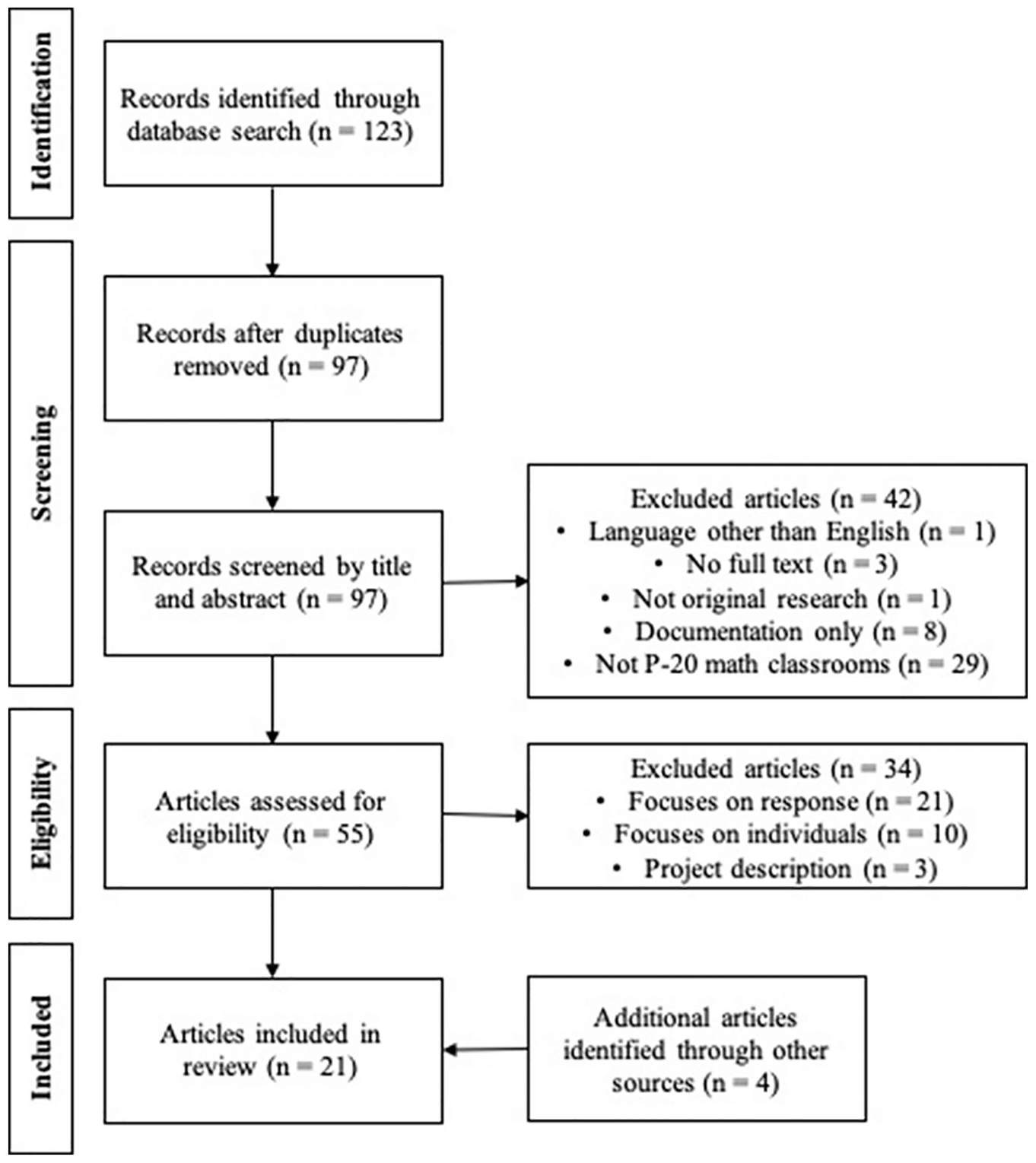
A representation of the search logic and decision rules at each phase of review.
Search Methods
The following searches were conducted in ProQuest’s Education Collection, which includes both ProQuest’s Education Database and the Educational Resources Information Center (ERIC). I limited search results to peer-reviewed scholarly journals because what is published in traditional, mainstream academic publishing outlets represents what is considered standard in the field; therefore, though they may not represent cutting-edge perspectives that may be present in what Alexander (2020) calls gray literature, results in peer-reviewed scholarly journals provide a sufficient, if not comprehensive, snapshot of mathematics education research. No time limit was placed on the search because, although Weis and Fine coined the term critical bifocality in 2012, I sought articles using similar ideas and theories, which have been around for far longer. I searched titles and abstracts because they are usually indicative of what authors believe to be the key ideas of their articles. To include articles focused on the daily interactions of mathematics teaching and learning in classrooms as well as those focused on mathematics education as a practice and as a system, I included “mathematics education,” “mathematics classroom,” “mathematics teaching,” and “mathematics learning” as possible search terms.
Then, to identify articles about the interaction between oppressive structures and individual lives in mathematics education, I added search terms for oppression, marginalization, and inequity: “oppress*,”“marginaliz*,” and “inequit*.” Although I experimented with searches for specific oppressive structures and their accompanying forms of oppression, such as racism, sexism, or ableism, I did not include these in the final search for several reasons: first, we were interested in how oppressive structures in general interact with individual lives, and these interactions are often intersectional across structures such that multiple forms and processes of marginalization occur simultaneously. Second, although structural oppression is common across cultures and societies, specific forms of structural oppression are often highly localized. For example, the United States has different histories with settler colonialism, anti-Blackness, and imperialism than most other countries. Broader search terms, focusing on similarities between different structures and forms of oppression, made results more likely to be relevant to researchers around the world (that said, articles about U.S.-specific racism, e.g., were still included if they were results from the broader search). Finally, identifying every article that has been written about every oppressive structure would have returned a prohibitive number of results for this study. I recognize that these are limitations to this particular literature review but believe that, especially given that many of the included articles nevertheless address specific oppressive structures, this approach provides a reasonable snapshot of the mathematics education literature. The final search string, then, was TIAB(“mathematics education” OR “mathematics classroom” OR “mathematics teaching” OR “mathematics learning”) AND TIAB(“oppress*” OR “marginaliz*” OR “inequit*”). This returned 123 results, or 97 after removing duplicates.
Screening Methods
From this list, search results were excluded if they were not available in full text (n = 3), published in a language other than English (n = 1) due to my own linguistic limitations, or did not provide either original research or an original argument drawn from other research (n = 1; Gouvea [2020] reviewed three empirical articles to recommend them to the journal’s audience). Articles were further excluded if their aims and conclusions were simply to document the existence of inequity (n = 8); for example, Johnson et al. (2020) analyzed student assessment data in an abstract algebra course and identified differences in performance by gender. Next, articles were excluded if their primary focus was on something other than P-20 mathematics classrooms (n = 29); I focused on P-20 classrooms because that is where most mathematics education happens; although some after-school programs and forms of community-based education (e.g., Moses & Cobb, 2002; Turner et al., 2009) have demonstrated powerful mathematical learning for students traditionally marginalized in mathematics education, schooling will continue to provide a vehicle for oppression and an opportunity to resist it so long as school remains a central organizing institution for children in society. Articles eliminated based on this criterion included articles focused on science education (Tolbert & Bazzul, 2017), reading (Hall, 2010), prison education (Ahl et al., 2017), and mathematics researchers (e.g., Hand & Goffney, 2013), among others.
The remaining 55 articles were read for the following criterion: Does this article theorize interactions between individuals and structures instead of just focusing on individuals in the context of structures or on the high-level evidence of structures? In other words, does this article explain how marginalization and privilege are produced as individuals and structures interact, or just presume marginalization to be a preexisting condition of some students’ existences due to structures? Presuming oppression to be a preexisting condition and studying how to mitigate, resist, or otherwise address it produces valuable research and guidance for practitioners seeking to take action. However, the focus of this particular review is on theorizing the ongoing reproduction of oppression; one benefit of identifying these theories, to be sure, is that they will then have implications for anti-oppressive practice, but first, anti-oppressive practices must be grounded in sound theory. For example, if a theory of marginalization is simply that students who are marginalized in society will necessarily be marginalized in mathematics classrooms—although there is truth to this assumption given that oppressive structures such as racism tend to reach into all corners of society—then interventions that do not tackle societal structures will do little to address marginalization in mathematics education, except perhaps creating a “sweet spot of refuge” that evaporates as soon as students leave the classroom. More complex theories of marginalization that explain how the conditions and characteristics of mathematics education contribute to the interplay of oppressive structures and individual lives, however, offer opportunities to chip away at structural change in addition to creating sweet spots of refuge for individual students. For example, Bullock and Meiners (2019) posit mathematics education to be an agent of the carceral state, pushing students who are marginalized by broader oppressive structures in society (such as race, capitalism, or immigration status) out of school and into the juvenile justice system. If this is the case, then interrupting mathematics education’s role in carcerality—in pushing students out of school (Morris, 2016)—has the potential to disrupt the school-to-prison pipeline and challenge the prison–industrial complex.
To limit this review to articles that theorize how marginalization and privilege are produced in mathematics education, therefore, I excluded papers that (1) describe a research project in some way focused on marginalized students without theorizing marginalization or reporting findings (e.g., Oslund and Barton’s [2007] use of zines in math class; Rodin’s [2019] use of role models as classroom helpers); (2) assume students to be marginalized in mathematics education on the basis of their race, gender, ability, language, or other identity characteristic and focus on identifying and evaluating strategies for responding to marginalization rather than seeking to explain the production of that marginalization (e.g., Leonard et al.’ [2010] recommendation of culturally relevant pedagogy; Register et al.’s [2020] call for developing critical STEM consciousness through ethics; Young et al.’s [2018] recommendation of hip-hop pedagogy for marginalized students); and/or (3) emphasize individual solutions such as teachers’ changing their beliefs or teaching strategies (e.g., de Araujo et al.’s [2018] review of strategies for teaching English learners; Lucey and Tanase’s [2012] focus on teachers’ conceptions of mathematics; Williams and Lemons-Smith’s [2009] reminder that teachers need to believe in all students). Rochelle Gutiérrez’s notion of political knowledge for mathematics teaching was included after evaluating it against this criterion, despite its focus on teachers, because it positions teachers as intermediaries whose navigations of the formatting power of mathematics and discourses about achievement in mathematics education shape the identities they make available to their students, rather than simply focusing on teachers as individuals whose beliefs and expectations affect students directly. Although there is value to articles that explore or suggest individual solutions, the purpose of this review is to see how critical bifocality can contribute to our understanding of marginalization in mathematics education research. With this commitment, critical bifocality also reminds us that teachers’ beliefs or pedagogical strategies are not just borne of independent insight but rather come from somewhere. After excluding 34 articles based on these criteria, 21 articles remained.
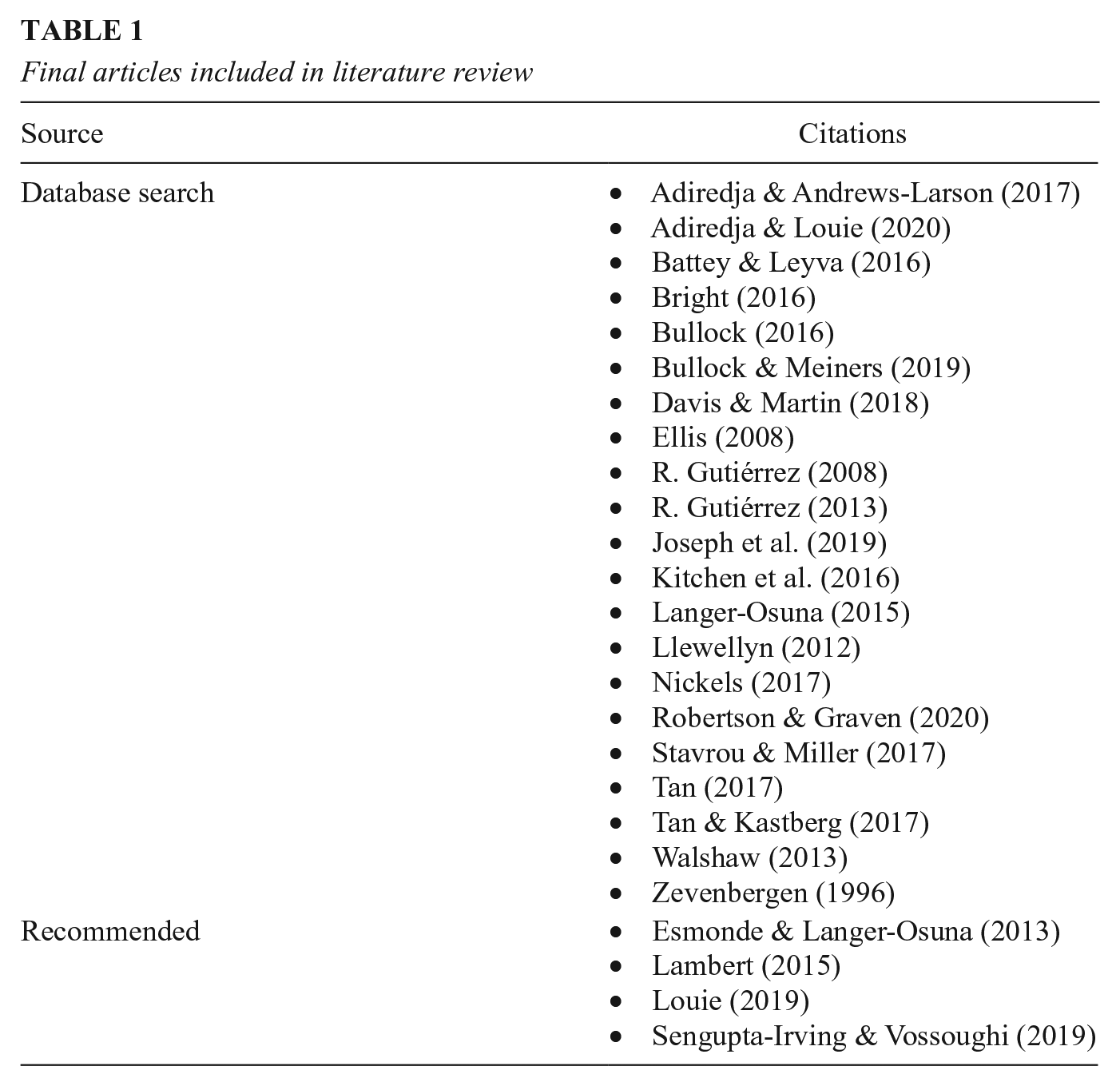
To these 21 search results, I added four articles based on personal knowledge and recommendations from colleagues; these articles were suggested first because they also theorized a mechanism for the (re)production of privilege or marginalization within mathematics classrooms, thereby linking oppressive structures with individual lives. Again, rather than aiming for comprehensiveness, the inclusion of secondary articles was meant to supplement search results by providing unique insights into the frameworks, theories, and arguments that mathematics education researchers have used to understand how structures and lives interact within mathematics classrooms. More important, however, I prioritized empirical research that took something like critical bifocality as an analytic framework for empirical data rather than conceptual papers or essays, which were already amply represented in the search results. And, I prioritized articles that described individuals’ resistance, refusal, or negotiation of marginalization, because such perspectives were underrepresented in the database search results yet represent an important angle for understanding how individuals interact with oppressive structures: as agents rather than passive targets. Finally, I did not include every article that I or colleagues identified. For example, I included Louie’s (2019) article describing how hierarchy discourses circulating within elementary schools perpetuate dominant ideologies about which students can be successful in mathematics; teachers’ uptake of these discourses, despite their aspirations for student agency, maintained a status quo in which some students are considered more deserving of meaningful mathematics learning opportunities. Articles like this explicitly link the macro-level oppressive structures that dictate social stratification with the micro-level, day-to-day reproduction, legitimation, and justification of such stratification. I did not include, however, her 2018 article on dominant ideologies in mathematics teachers’ noticing; it similarly emphasized discourse and ideology, but the 2019 article articulated in more detail how discourse and ideology produce stratification. A full listing of the articles is provided in Table 1.
Final articles included in literature review
Analytic Methods
I began by tracking several descriptive characteristics of the articles, such as the type and location of research, a focal demographic group if one existed, a focal topic if one existed (in contrast to speaking to mathematics education as a whole), and the theoretical perspectives that framed the argument and/or the analysis (both explicitly stated and as inferred based on citations). Additionally, I identified what was given as the mechanism of marginalization in each article: how privilege and disadvantage in mathematics education are strategically coproduced. Then, I closely read each article, in concert with re-readings of Weis and Fine (2012), to determine how they framed and conceptualized the processes by which resources were denied, disinvested, or repossessed—in other words, how individuals and structures interacted to produce and reproduce marginalization in mathematics education.
First-pass coding suggested (1) interactions as a unit of analysis, (2) explanations of the inescapability of oppressive structures, (3) an intersectional and heterogeneous view of group identities, and (4) the strategic coproduction of privilege and disadvantage as key themes that emerged from reading the reviewed articles with Weis and Fine’s (2012) critical bifocality lens in mind. Then, I reread each article again and used a spreadsheet to track what each article could contribute to mathematics education research in terms of advocating for or exemplifying a critical bifocality approach that considers the interactions of structures and individuals and not just individuals in the context of structures, organized according to these four themes. Finally, the second author and I collaborated on synthesizing these findings to frame and craft the argument in this article.
Results
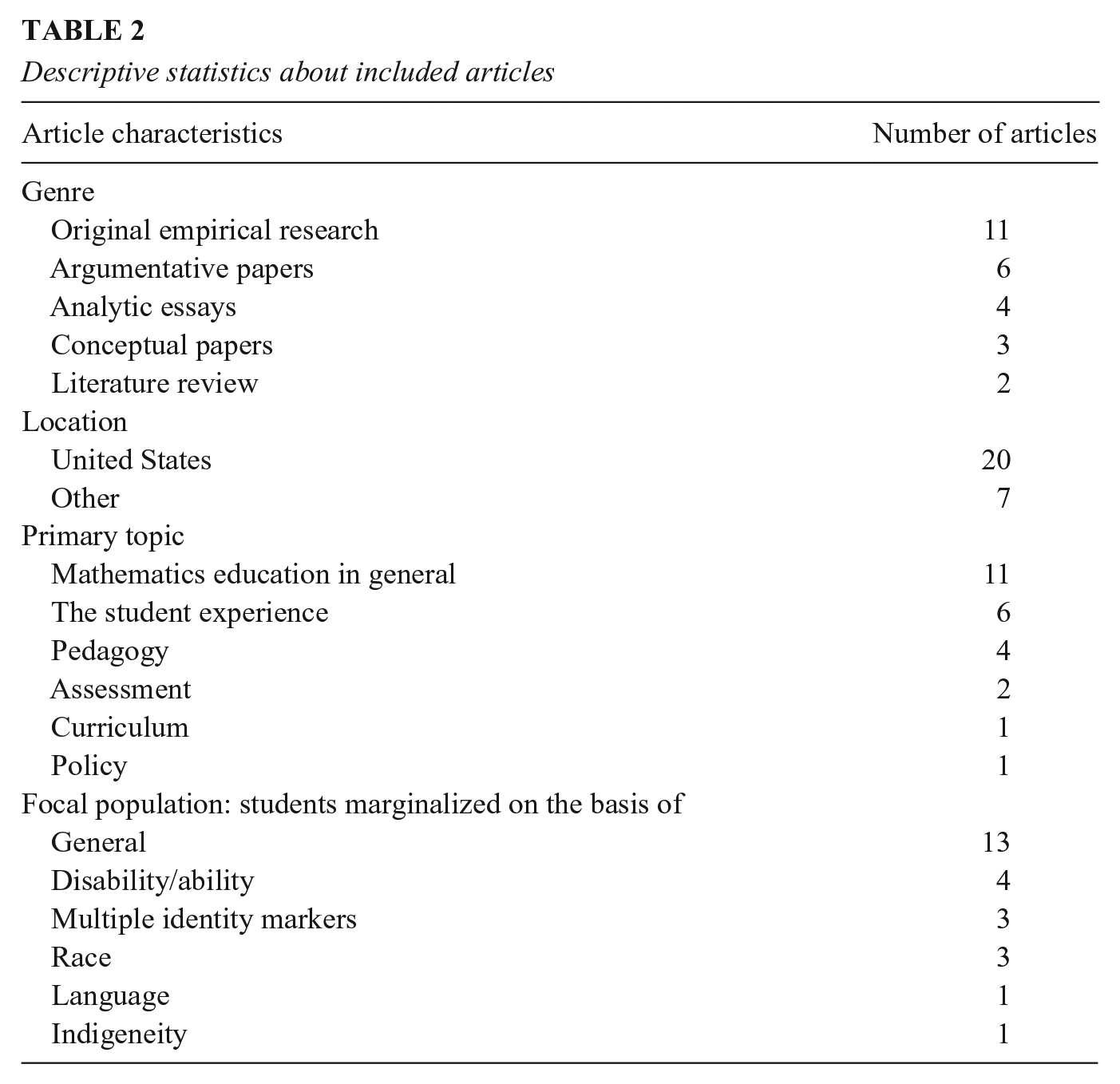
Descriptive statistics summarizing the articles’ genre, location, topic, and focal populations are presented in Table 2. Of the 25 included articles, 11 presented original empirical research (six focused on students’ navigation or coproduction of marginalization, three on teachers, one studied a whole school, and one was a content analysis of narratives found in mathematics textbooks); six were argumentative papers; four were analytic essays; three were conceptual papers that defined and elaborated a construct; and two were literature reviews. Twenty focused on mathematics education in the United States; the remaining seven represented other English-dominant countries around the world. Articles were single-coded for their primary topic, even though many addressed more than one topic; Lambert (2015), for example, analyzed the disabling interactions between students and pedagogies, but was single-coded as “the student experience” because her analysis foregrounded how students constructed self-understandings in response to shifts in pedagogies. Single-coding articles required subjective judgment, and scholars seeking to replicate this analysis may not fully agree with the decisions made here, but the aim is merely to provide a quick snapshot of the breadth of literature reviewed. In that vein, the plurality of articles (n = 11) addressed mathematics education in general; others stressed students’ experiences, pedagogy, assessment practices, curriculum, and policy.
Descriptive statistics about included articles
About half the articles focused on the marginalization of specific subgroups of students within mathematics education, such as Black girls, students with identified disabilities, and students who speak languages other than English at home. The others discussed marginalization within mathematics classrooms as mirroring those who are targeted by oppressive structures in society at large, although they differed on the extent to which they made this explicit. Other scholars focused on marginalization based on students’ mathematics abilities, or rather, their conformity to specific definitions of mathematics ability, which they noted was linked to students’ out-of-school experiences which are shaped by oppressive structures (Zevenbergen, 1996), associated with conceptions of femininity (Llewellyn, 2012; Walshaw, 2013), and subject to racial hierarchies (Adiredja & Louie, 2020). The remainder of this section describes the theoretical perspectives represented in the reviewed articles and, then, how the reviewed articles illustrate four key principles for using critical bifocality in mathematics education research.
Theoretical Perspectives
Tracing the theoretical perspectives that authors of reviewed articles used to frame their arguments and analyses identifies theories that have already been proven useful to scholars thinking about critical bifocality in mathematics education and thus could be adopted by future researchers; it also identifies openings for the integration of theories that have not yet been explored in this context. In terms of theory, 19 of the articles drew explicitly on one or more critical theories; for articles to be classified as such they had to either state their theoretical perspective(s) directly or use a preponderance of citations from one or more familiar theoretical traditions in their argument framing or, in the case of empirical articles, in their description of analytic methods. A wide range of critical theories was present in the reviewed articles, and no single theory or set of theories predominated (see Table 3 for a full listing); authors grounded their work in theories ranging from abolitionist theory (Bullock & Meiners, 2019) and critical mathematics education (Bullock, 2018) to critical race theory (Davis & Martin, 2018) and disability studies (Lambert, 2015; Tan & Kastberg, 2017), representing analytic lenses drawn from both sociocultural and sociopolitical traditions. The remaining seven articles also took critical perspectives in the sense of challenging a status quo in mathematics education (e.g., English-language mathematics teaching in South Africa; the segregation of students with HIV in the United States; educational policymakers’ and researchers’ focus on the purported “achievement gap”) but were less clearly tied to obvious theoretical traditions.
Critical theoretical perspectives represented in articles

In terms of the mechanisms by which marginalization is (re)produced, 10 of the reviewed articles used the related concepts of Discourses, discourses, identities (as fluid and negotiated rather than as static, e.g., Holland et al. [1998]), positioning, and/or figured worlds. 2 This is not surprising given the proliferation of socioculturally based research in mathematics education (Inglis & Foster, 2018; Lerman, 2000) and an increasing interest in examining the Discourses and narratives that shape mathematics education, as can be seen by the relative recency of reviewed articles that illuminate their influence (e.g., Adiredja & Louie, 2020; Battey & Leyva, 2016; Louie, 2019; Sengupta-Irving & Vossoughi, 2019). It is worth noting that the popularity of such concepts in reviewed articles contrasted with their relative absence in many of the articles excluded from this review based on criteria described in the previous section, which often focused on visible identities as indicative or even predictive of whether and how individual students will experience marginalization, regardless of other intersecting identities, contexts, or temperaments. By using sociocultural theories, authors of the reviewed articles avoided essentializing students based on some identity dimensions. In doing so, they built on the ideas that marginalization is reproduced through interaction, not assigned or assumed based on identity markers, and that particular identity markers become salient and become recruited into processes of marginalization in particular contexts (e.g., Esmonde & Langer-Osuna, 2013).
Researchers who want to pursue critical bifocality can certainly theorize from data and/or lived experience as well as from established theoretical traditions. However, established traditions may be useful in that they illustrate how different theories highlight different aspects of structures and of individual lives. For example, critical race theory presumes the inevitability of racism as an ordinary force in society at the macro level, and at the micro level, homes in on the tension between anti-essentialism and the importance of individual counterstories from people of color (Delgado & Stefancic, 2001). Foucauldian theories, on the other hand, tend to attribute agency to structures and position individuals primarily as reactors (Erickson, 2004). The wide distribution of theoretical traditions present in the reviewed articles suggests that different theories have different insights to contribute to the understanding of critical bifocality in mathematics education and also that there may be additional theories that could shed light on yet-understudied aspects. For example, none of the reviewed articles drew on critical postmodern theory, as Stinson and Bullock (2012) suggest mathematics education researchers do for understanding social stratification; posthumanist approaches, as have been used for analyzing justice in science education (Kayumova et al. 2019); or affect theory, as has been used to consider preservice teachers’ participation in marginalization (Chen, 2020). These theories, among others, may represent fruitful fodder for future research.
Next, we describe four principles that characterize research taking a critical bifocality approach to understand the production of marginalization or oppression or inequity in mathematics education (Figure 2): (1) analyzing interactions between structures and lives; while (2) recognizing the pervasiveness of oppressive structures; (3) attending to the intersectionality and within-group heterogeneity of identities; and (4) accounting for the production of privilege. Regardless of the specific theoretical perspectives that the reviewed articles drew on, they consistently followed and elaborated on these four principles. Consequently, we believe that these principles could be useful to both mathematics education researchers seeking to understand critical bifocality in existing scholarship and to operationalize critical bifocality in their own work.

Four principles for operationalizing critical bifocality in mathematics education research.
Principle 1: Interactions Between Structure and Lives
Reading the reviewed articles with regard to how flows of power travel between oppressive structures and individual lives highlights that individuals inevitably interact with structures; they are not just passively acted upon by them. As a result, taking interactions to be the unit of analysis can shed more light on the complex interplay between individuals and structures than if individuals were analyzed for how they affected or were affected by structures or if structures were analyzed for how they affected or were affected by individuals. Although the reviewed articles did not always focus on individuals’ decisions, they generally acknowledged that individuals both engage in and respond to the mechanisms of marginalization they encounter. Articles that did emphasize individual agency discussed how students and teachers resisted being positioned as incompetent through disengagement and other strategies (Lambert, 2015); found supportive spaces and likeminded peers for collaboration (Adiredja & Andrews-Larson, 2017; R. Gutiérrez, 2013; Joseph et al., 2019); and remade available discourses (Sengupta-Irving & Vossoughi, 2019) or identities (Langer-Osuna, 2015). Adiredja and Louie (2020) illustrated how individuals took up and reproduced deficit discourses both in their individual attitudes and in their participation in local communities of practice, and Tan (2017) demonstrated the insidiousness of such narratives by showing how a first-grader—who theoretically would have had far fewer opportunities to be influenced by oppressive structures than older students or adults—likewise took up and participated in reproducing deficit views of a classmate with autism. These articles illustrate how individuals and structures interact to produce the forms and experiences of marginalization that individuals then perceive.
By contrast, several articles in the sample focused on how structures constrain individuals with less attention to how individuals responded. In some cases, individual interaction could easily be inferred but was not explicitly discussed; Bright’s (2016) teachers, for example, would have to decide whether and how to use hegemonic word problems with students. Of course, this is not to suggest that the authors of these articles assumed students to be passively acted upon by structures, particularly because many of these authors have argued otherwise in their other work (e.g., Gholson & Martin, 2014; Yeh et al., 2020). A coherent program of research can foreground different pieces of the structure–individual–interaction puzzle, and empirical articles—such as those discussed in the previous paragraph—were more likely to investigate individual agency. This draws attention to the use of ethnographic methods and interaction analyses for examining the in vivo ways that individuals interact with structures (for examples of how nonempirical work addressed it, see Adiredja & Louie [2020], who made individuals part of the model they developed for how deficit discourses operate, and Bullock & Meiners’s [2019] invocation of how individual students might react to the use of statistics about Black men being incarcerated).
In other words, structures produce lives which produce structures. Individuals are complicit in the production of marginalization, agentic in resisting it, and sometimes both. Kumashiro (2004), for example, explains how re-citing stereotypes, even to refute them, can serve to propagate them and give them more life. Research aiming to use critical bifocality, then, must treat interaction rather than individuals as both the unit of analysis and the locus of intervention. This demands attention to relationships within systems and, therefore, to multidirectional flows of influence and power in creating marginalization, oppression, and inequity, but also resistance and transformation.
Principle 2: Oppressive Structures Pervade
If the first principle highlights how individuals react to structures by accepting, perpetuating, remaking, or resisting them amidst other interactions, then this second principle reminds that individuals can never fully escape oppressive structures, even when teachers strive to create safe, welcoming, and inclusive mathematics classrooms. The articles in this review highlight several reasons for this: oppressive structures recruit individuals, shape available identities and roles, shape the labor people must perform to be seen as competent, lead to the creation of marginalizing institutional practices, and influence interactions between teachers and students.
First, at the risk of assigning too much agency to structures, oppressive structures recruit individuals as conduits for perpetuating oppression. The reviewed articles provide several examples of how oppressive structures permeate students’ interactions with each other: In Sengupta-Irving and Vossoughi (2019), students ask a Muslim girl Othering questions about her hijab, and students make patriarchal assumptions about leadership; in Tan (2017), a typically abled student treats an autistic student like a puppy; in Langer-Osuna (2015), a Black girl is mocked for sounding like a White girl. They also illustrate how teachers become instruments of oppressive structures: Kitchen et al. (2016) report on teachers’ labeling of students as “bubble” or “unsat[isfactory]” based on their test scores; Louie (2017) reports on teachers’ uptake of hierarchy discourse and making different instructional decisions for their “low” students; and Joseph et al. (2019) describe punitive teacher behavior that stems from dehumanizing Black girls. And finally, they demonstrate the existence of actors who might be urged to maintain the status quo: Rochelle Gutiérrez (2013) cites examples of teachers who faced harassment and those who were pressured to change their curriculum when they demonstrated that historically marginalized students could achieve at high levels.
Second, discourses circulating in mathematics education and in society shape the identities and roles that are available to students and, consequently, how students talk about themselves. Adiredja and Andrews-Larson (2017) describe how some students are positioned as being bad at mathematics based on their race, gender, or other identity markers, and Battey and Leyva (2016) provide a framework that demonstrates how Whiteness shapes the legitimacy of one’s intellectual ability, hierarchies of ability, invisibility or hypervisibility, and one’s association with peer groups. Langer-Osuna (2015) concludes that students negotiate identities that coordinate dominant with nondominant cultural capital. Llewellyn (2012) argues that discourses linking femininity with passivity make it difficult for girls to author an agentic role in the context of supposedly student-centered pedagogies. Lambert (2015) shows the influence of gendered narratives and conceptions of smartness on how students talk about themselves.
Third, oppressive structures shape the labor that people need to do to be seen as competent. Battey and Leyva (2016) provide examples of cognitive, emotional, and behavioral labor that mathematics students perform in response to Whiteness in mathematics, such as managing their ways of thinking and their language to fit in, regulating their emotions during mathematics class to fit conceptions of who is allowed to have mathematical authority, and contending with stereotype threat. Zevenbergen (1996) also argues that constructivism dictates the type of work production that is valued in mathematics classrooms, such as progressing from concrete thinking to representational thinking to abstract thinking, and students who do not follow this sequence are seen as inscrutable or unteachable by their teachers.
Fourth, oppressive structures lead to the creation of marginalizing institutional practices that become taken-for-granted, even though they are not strictly necessary. For example, Davis and Martin (2008) describe the common school practices of removing African American students from their regular classes for test preparation and/or turning their regular classes into test preparation as consequences of standardized assessment policies and systems grounded in a history of scientific racism. Similarly, Bullock and Meiners (2019) identify school-based practices of policing, surveillance, and punishment that “positio[n] teachers as armed guards rather than pedagogues” (p. 340) as a result of the interaction between mathematics education and the carceral state.
Finally, another subset of articles did not explicitly discuss how oppressive structures pervade interactions between individuals but provided examples from which additional possibilities can be inferred. For example, it is plausible to assume that teachers treat their students differently when they feel unprepared to teach students with HIV and are responsible for teaching them nonetheless (Nickels, 2017); when they are under political and administrative pressure to increase standardized test scores (Ellis, 2008); see disability as pathological (Tan & Kastberg, 2017); or have colonial perspectives on Indigenous peoples (Stavrou & Miller, 2017).
These illustrations of how oppressive structures pervade individual lives and interactions, in many cases despite individuals’ best intentions, examine “how specific contextual elements operate on actors to produce outcomes” (Weis & Fine, 2012, p. 177, italics original). Relatedly, critical bifocality means that these interactions must be seen as coproduced not just by people and present policies but also by histories and systems. Given the historical and contemporary dominance of racism in U.S. society, for example, it is impossible for any conversational exchange between a mathematics student and teacher to occur outside of its shadows: the bodies having the conversation are racialized and carry histories of racial domination within schooling (Leonardo & Boas, 2013); raciolinguistic ideologies shape how speakers’ language is understood (Flores & Rosa, 2015); what it means to be good at math is intricately tied to racial hierarchies (Martin, 2009); racially coded language circulates in mathematics classrooms (Shah et al., 2021); and access to mathematics—especially advanced mathematics—is often distributed along racial lines (Borum & Walker, 2012), to name just a few factors. So, interactions never exist only in the moment in which they occur or only with the meanings that participants intend. Therefore, mathematics education researchers must account for these shadows in the interactions they study and refuse “representations of individuals as autonomous, self-contained units dangling freely and able to pursue their life choices unencumbered by constraint” (Weis & Fine, 2012, p. 176). Rather than simply situating individual responses in a vague context of racism, ableism, or similar oppressive structures, the authors of the reviewed articles provide specific descriptions and theorizations of the linkages between structures and individual lives, chronicling not only the “local micro-enactments of these dynamics” but also the “circuits” by which they are tied to broader disparities, histories, and patterns (Weis & Fine, 2012, p. 195).
At a practical level, Weis and Fine (2012) caution that critical bifocality demands we avoid studying safe spaces as if they are insulated from and immune to oppressive structures. By extension, we cannot expect mathematics classrooms to ever be cloistered from the reach of oppressive structures. This means that teachers cannot expect or be expected to create fully “safe” classrooms. They must instead anticipate and prepare for the interposition of oppressive structures regardless of the classroom culture they build or the sociomathematical norms they set or the student relationships they develop. Similarly, researchers seeking evidence of mathematics classrooms that do not marginalize students must be alert for disconfirming or, more messily, complicating evidence; although some classrooms may be so toxic as to marginalize just about every student in them, and no classroom can repair or prevent marginalization for every student, it is more likely that classrooms will marginalize some students in some ways at some times, and other students in other ways at other times, with different resonances and effects depending on which identities and histories are invoked.
Principle 3: Intersectionality and Heterogeneity
Third, intersectionality theory states that members of some groups have historically been and continue to be targeted for marginalization more so than others due to the structures—such as racism—that organize our society, and Black feminist scholars remind us that the targeting of groups for marginalization affects individual lives in overlapping and intersecting ways (Collins & Bilge, 2016; Crenshaw, 1991). Rather than using these group memberships to essentialize or assume students’ experiences, however, attending to students’ identities as marked by social categories is “most powerful for deciphering systems that structure the everyday conditions of individuals” (Gholson, 2019, p. 416). In other words, students’ group memberships must be viewed not as labels, but in tandem with analyses of how those groupings are consequential and of how individuals inhabit and contest those structures (see, e.g., Leyva’s [2016] cross-case analysis of similarities and differences in two Latina undergraduate women’s experiences of mathematics). Thus, mathematics education researchers using critical bifocality must acknowledge students’ identities as members of socially constructed groups and as heterogeneous individuals within those groups.
Many of the reviewed articles acknowledged either the intersecting influence of group identities or the diversity and heterogeneity of people within socially marked groups. For example, Kitchen et al.’s (2016) critique of labeling students by test score implies both that (1) labeling students obscures that there is more to students than their test score and that students within each test score label are unique and complex individuals; and (2) such labels likely have different consequences for students with different identities in other ways. This latter implication is especially clear when read in concert with Davis and Martin’s (2008) analysis of how test-focused policies shortchange Black students and Bullock and Meiners’s (2019) assertion that the gatekeeping function of mathematics education—which is often performed through test scores—pushes the very students out of school who are most likely to be targeted by the prison–industrial complex. These examples stand in sharp contrast to some of the articles excluded from the database search results in this literature review, which simply documented the existence of marginalization or inequity based on demographics; even if intersectional identity markers were used, such as combinations of race and gender and disability, demographic reports would be unable to account for within-group heterogeneity.
Other articles encouraged students to be seen as individuals rather than as their labels or disabilities (Tan & Kastberg, 2017) and critiqued existing research for producing essentialized notions of Indigeneity and eliding tribal specificity in attempting to generalize (Stavrou & Miller, 2017). Zevenbergen (1996) gives an example of what happens when this within-group heterogeneity is overlooked. A teacher assumed that a Papua New Guinean student would be a concrete thinker who excelled with manipulatives and struggled with written mathematics and thus would benefit from a particular instructional sequence. When this did not turn out to be the case, the teacher did not know how to teach this student. These examples illustrate that students who are similarly positioned not just by one group membership (such as race or gender) but by multiple, intersecting group memberships, nevertheless experience mathematics education in individualized ways. Sharing more group memberships does not necessarily make students’ experiences of mathematics education more similar, and therefore students cannot be assumed to be the same or be marginalized in the same way purely based on their group memberships.
As with Principle 2 above, the empirical articles shone here, with their richly textured descriptions of students who, in many cases, shared multiple intersecting identity markers but navigated and reacted to those identities differently. Ana and Luis, the two students Lambert (2015) profile, both identified as Dominican and American and were both identified as having learning disabilities. However, Ana disengaged with mathematics so as not to take up the disabled label, but Luis changed his conceptions of mathematics instead. Joseph et al. (2019) deliberately selected a group of Black girls with “varying levels of mathematics engagement” (p. 148) for their interview analysis and presented data illustrating the diversity in the girls’ experiences of mathematics. Sengupta-Irving contrasts Amina and Selma, who, despite both being immigrant girls designed as English learners, not only experienced mathematics differently but also were antagonistic toward each other, participating in hegemonic discourses of smartness rather than the solidarity that a simplistic read of shared identities might assume (Sengupta-Irving & Vossoughi, 2019).
Bullock (2018) read mathematics education literature against models of intersectionality drawn from Black feminist theorists and recommended that researchers go beyond an identity model of intersectionality—looking at how people experience life in the intersections of particular identities—and consider how intersecting identities produce conflict, how institutions assemble and produce intersecting forms of oppression, and how discourses produce dynamism in oppressive systems: “racialization rather than races, economic exploitation rather than classes, gendering and gender performance rather than genders” (Choo & Ferree, 2010, p. 134, as cited in Bullock, 2018). Walshaw (2013) reflects on the potential of this approach, arguing that identities are multiple and fluid depending on what becomes available and what becomes salient in different contexts. These different contexts, however, nevertheless remain saturated by existing hierarchies “which then act upon the local classroom interactions” (Langer-Osuna, 2015, p. 53).
In terms of Bullock’s (2018) charge to examine intersecting forms of oppression—and not just how forms of oppression based on group identities intersect—several articles illustrate how mechanisms of marginalization interact. For example, Llewellyn (2012) describes a teacher’s uptake of competing discourses from mathematics education research and education policy; the conflict between them produces marginalization by excluding most people, including herself, from being able to be real mathematicians. Louie (2019) similarly describes the interaction of discourses—agency discourse and hierarchy discourse—and argues that the prevalence of the latter makes it difficult for teachers to take up the former, even though the former is promoted in professional development. Other articles also describe the consequences of a confluence of discourses and ideologies; Zevenbergen (1996) claims that constructivism brings together individualism and mentalism, and Sengupta-Irving and Vossoughi (2019) examine students’ experiences at the intersection of imperialism, neoliberalism, and militarism. According to these articles, what individuals interact with as they interact with oppressive structures is never just one oppressive structure, or one discourse, but the confluences among them. And, these oppressive structures can target students with similar group identities in different ways, or students with different group identities in similar ways.
In sum, reading mathematics education research for attention to intersectionality and within-group heterogeneity in students’ experiences of marginalization attests to Erickson et al.’s (2008) argument that attending to student subjectivities is crucial for understanding marginalization, and to Weis and Fine’s (2012) invocation of the “linkages, leakages, tensions, and solidarities within and among groups across time and space” (p. 174). It is also therefore a crucial step in addressing marginalization, which requires “conferring the respect on others that comes from presuming that life and people’s lives are simultaneously straightforward and full of enormously subtle meaning” (Gordon, 2008, p. 5). In other words, individual experiences of marginalization are simultaneously heterogeneous within groups and dependent on the intersection of oppressive structures. Because students live intersectional lives and these intersectional lives are individually experienced, researchers interested in critical bifocality must attend to students’ intersectional identities as members of social groups, including group identities that are marginalized but have not been as well-documented in mathematics education research thus far (e.g., religious identities; unhoused students). This is not to say, of course, that specific forms of oppression—such as racism or the patriarchy—should not be studied, but rather, that their manifestations and productions be considered in relation to other forms of oppression as well.
Principle 4: The Production of Privilege
The mechanisms theorized in the reviewed articles were universally bidirectional in that they could account for the complementary production of advantage and disadvantage at once. The authors in the reviewed articles, however, paid more attention to students who were marginalized than to those who were privileged by the operations of these mechanisms: ideological narratives about people; ideological narratives about mathematics; or the production of material inequity. In this section, we first summarize how these mechanisms are theorized to produce both marginalization and privilege, consider additional mathematics education research that specifically focuses on the experiences of people privileged by these mechanisms, and then offer suggestions for what future research might prioritize.
Many of the articles theorized mechanisms relating to the (re)construction, circulation, and propagation of ideological narratives about people, and which people are normal, good, or superior. Deficit discourses, for example, produce some people as incompetent but, by the same criteria, mark others as competent (Adiredja & Andrews-Larson, 2017; Adiredja & Louie, 2020). As standardized assessments are used to label some students unsatisfactory, they are also used to label others exemplary or gifted (Davis & Martin, 2008; Ellis, 2008; Kitchen et al., 2016). Likewise, constructing some people as broken, on the basis of disabling interactions with a society not built for them, constructs others as whole (Tan & Kastberg, 2017). The adultification of Black girls that Joseph et al. (2019) describe as part of the dehumanization process means that White students are seen as more childlike and innocent under the same circumstances (Goff et al., 2014). Not only do these narratives about people naturalize the idea that some people are superior to others but also that some ways of being are superior to others; textbook word problems using contexts about home renovations, for example, normalize heteronormative middle-class consumer capitalism (Bright, 2016), and erasing contemporary Indigenous peoples from mathematics curriculum furthers the settler colonial enterprise (Stavrou & Miller, 2017).
Narratives about people in mathematics education are difficult to separate from narratives about mathematics, because in the context of mathematics education, narratives are often about people-doing-mathematics. Many of the reviewed articles amply address this point, and several examples spotlight how narratives about who is good at mathematics are constructed within mathematics education using the specific cultures, ideologies, and practices of mathematics education rather than just filtering into mathematics education from broader societal narratives about smartness and mathematics. Lambert (2015) illustrates how Ana and Luis were both positioned as competent at different points in the school year by the same pedagogies that positioned the other as deficient, with the variation in pedagogies being driven by their teacher’s shift to test preparation. Llewellyn (2012) articulates a romantic discourse of mathematics education promulgated by education philosophers and researchers—and thus, often, by teacher professional development—and contrasts it with a functional discourse that characterizes mathematics education policy. Louie (2019) identifies agency discourse in mathematics education, which is also frequently promoted in teacher professional development, and explains how it is overtaken by hierarchy discourse despite teachers’ best intentions. Success in mathematics is often seen as a proxy for intelligence, so people who are established—by these discourses about what mathematics is—to be good at mathematics receive the status and opportunities that come with being seen as intelligent (R. Gutiérrez, 2013).
Finally, some of the reviewed articles discussed the production of material consequences as a mechanism for reproducing marginalization and privilege. Denying resources to some students—such as denying access to equally qualified teachers or equal instructional time, tracking students out of college-preparatory math courses and into remedial classes, or pushing students out of school entirely—means more resources are available for others (e.g., Bullock & Meiners, 2019; Davis & Martin, 2008; Nickels, 2017). Sociologists have extensively studied how the already-privileged take advantage of existing resource inequality and create further resource inequality through opportunity hoarding (e.g., Calarco, 2018; Lewis & Diamond, 2015; Lewis-McCoy, 2014; Tilly, 1999).
In contrast to the reviewed articles, which center the experiences of people marginalized in mathematics education, some mathematics education literature directly scrutinizes how oppression is produced and reproduced by those who benefit from it in order to better understand how structures such as patriarchy play out in mathematics education. For example, Kokka (2020) argues that engaging privileged students in social justice mathematics matters because (1) a functioning democracy requires critical consciousness from all members; (2) developing students’ critical consciousness supports critical thinking skills; (3) such students will be in positions to potentially abuse their power or leverage their power to change inequitable systems; and (4), citing Freire, “privileged students are also dehumanized by existing power systems” (p. 779). Relatedly, Esmonde (2014) illustrates how affluent students reified their existing beliefs after doing social justice math tasks. They introduced meritocratic justifications for inequality, which both reiterates oppressive ideologies and gives them the veneer of mathematical certainty.
Some of the critical theorists cited in the reviewed articles would point out that studying the privileged and studying the marginalized are really two sides of the same coin. Foucault, for example, claims that being constructed is objectifying and limiting for any human, even the humans who are being constructed as privileged, and Freire (1970) argues that people positioned as oppressors are themselves dehumanized by being caught up in the violence of oppressive structures. Therefore, what mathematics education researchers are really studying rather than merely the experiences of the privileged or the experiences of the marginalized, is the phenomenon of oppression as something that affects all people.
The constraints of empirical research, however, often require that researchers choose specific participants to focus on. To this end, Black feminist scholars such as Audre Lorde (1984) have written that studying the marginalized is likely to present a more accurate description of society: Those of us for whom oppression is as american [sic] as apple pie have always had to be watchers, to become familiar with the language and manners of the oppressor, even sometimes adopting them for some illusion of protection. (p. 114)
Although attending to the experiences of privileged people may shed light on how privilege is reproduced, attending to the experiences of people targeted by oppressive structures makes visible what is being rendered invisible: the complex personhood of individual lives. In the reviewed articles, Joseph et al. (2019) stress the humanity of Black girls, and Sengupta-Irving and Vossoughi (2019) refer to the concept of dignity to describe a person’s value. Complex personhood, humanity, dignity: these are erased—made not to matter—by the blunt instruments of marginalization.
Discussion: Invisibility and Visibility
Taken together, we suspect that these four principles for operationalizing critical bifocality within mathematics education research—emphasizing interactions rather than individuals, accounting for oppressive structures in individual interactions, affirming how intersectionality matters without being determinative, and accounting for the production of privilege—have the potential to enrich mathematics education research that is aimed at equity and/or justice and ensure that its effects align with its goals. Although critical bifocality is not currently a popular phrase in mathematics education research, we believe that there are researchers who have begun the work of tracing the linkages between structures and lives that continue to (re)produce oppression (and privilege) within mathematics education, and that identifying similar theorizations can support the field’s understanding of the persistence of inequity within mathematics education.
Critical bifocality draws our attention to the invisibility of the practices and processes that strategically coproduce privilege and disadvantage; as Bonilla-Silva (2013) warns about racism without racists, oppression can be perpetuated even without individual bad actors intentionally seeking to oppress others. Highlighting these practices and processes—ideologies, discourses, the availability of particular identities and positionings, problem framings, the production of disability or dehumanization by cultural and contextual elements—challenges some commonsensical ways of thinking about mathematics education that we have encountered in our experiences and that were underscored by the reviewed articles. We represent these challenges using what feminist philosopher Haraway (1988) calls a dichotomous chart in Table 4. Like Haraway, we do so not to represent equivalent, alternative stances, but rather to illustrate “fixed ends of a charged dichotomy” (p. 588) through which different epistemologies and politics flow. For instance, fairness is not meant to be represented as the opposite of disadvantaging and privileging. A society where some people are disadvantaged and others are privileged may still be considered fair, depending on the situations, perceptions, values, and/or politics at play. Thus, we put them in the same row not to equate them but rather to illustrate the tensions between fairness and advantage in discourses and inquiries into how society operates. In this way, the stances on the left side of each row are often invisible, commonsense perspectives, and it takes deliberate work to destabilize them—let alone eliminate them—from people’s actions and interpretations of the world.
Challenges to commonsensical assumptions about mathematics education

The remainder of this discussion is organized by taking up the thread of the fourth principle, above, and examining what and who are made visible or rendered invisible in processes of marginalization. Using critical bifocality as a lens, we argue, elucidates the interconnection of material and ideological mechanisms for (re)producing marginalization and privilege, the role of research methods that pay intimate attention to individual lives as they are lived in intersectional and heterogeneous complexity, and the importance of expanding analytic lenses across timescales and across institutions for understanding oppression as a phenomenon. Next, we explain these claims, followed by limitations of this study and implications for future research.
Marginalization Is Both Material and Ideological
The reviewed articles make clear that marginalization has serious material consequences for students and that there are material contributors to its (re)production. As we discussed, denying resources to some students means more resources for others and more opportunities for resource-hoarding, so long as we live in a capitalist society vested in ideologies that assume scarcity and zero-sum competition (by contrast, e.g., some Indigenous epistemologies are predicated on abundance, prompting actions related to resource management rather than to hoarding; Kimmerer, 2013). This material dispossession prevents targeted people from having the same opportunities as privileged people, which is often a visible form of marginalization.
The reviewed articles also highlight an immaterial—and therefore often invisible but no less consequential—form of dispossession: some groups of people are valued less than and considered inferior to others (e.g., Adiredja & Louie, 2020; Battey & Leyva, 2016). Sometimes this ideological marginalization is based on characteristics that are obviously illogical: the color of someone’s skin, or the wealth of someone’s family. Sometimes, however, this ideological marginalization is based on more subtle characteristics that may appear to be reasonable but nonetheless perpetuate unjust marginalization, such as hardworkingness, memory capacity, proclivity for deductive reasoning, or a test score (e.g., Ellis, 2008; Louie, 2019; Walshaw, 2013). Mathematics education not only recruits societal narratives about superiority and worthiness but also carries its own: Davis and Martin (2008) describe how the racial hierarchy in mathematics education disenfranchises Black students; Sengupta-Irving and Vossoughi (2019) describe the imperialist, neoliberal, and militarist ideologies that frame STEM (science, technology, engineering, and mathematics) education as worthwhile—especially for girls of color—only if they contribute to U.S. global ascendancy. The invisibility of these ideologically rooted mechanisms of marginalization is evident in the plurality of articles emphasizing discourses and identities as the mechanism of production, which give us a beautiful glimpse of how children negotiate, contest, and re-author what is available to them. Their agency, however, does not change the structures that constrain what is available to them: structures that limit some children more than others.
Interventions aimed at mitigating or eliminating the (re)production of marginalization in mathematics, then, need to target both material and ideological mechanisms: both the concrete resources and opportunities that are denied to particular groups of students and the narratives that circulate to justify such denial. Although we are unable to provide a roadmap for how to do this in mathematics education research, Philip (2011) offers an account of how a teacher’s ideologies about students’ individual responsibility for success in mathematics classrooms shift as new pieces about students’ contexts are introduced and old pieces about students’ “essences” are discarded. This suggests that one possible route for instantiating ideological and material change might be in offering new narratives that individuals can take up, as the agency discourse professional development described by Louie (2019) attempts to do, that then affects the material relationships those individuals have with others—how this teacher, for example, might assign grades or react to students’ behavior differently.
Understanding Marginalization Requires Making the Invisible Visible
The invisibility of ideological mechanisms for marginalization has methodological implications for researchers, too. Treating invisibilizing as a mechanism of marginalization—as Bullock (2018) does in her use of figure hiding as a metaphor—draws attention to who is invisibilized: the students disparaged or diminished as a result of ideological narratives. According to Dunbar-Ortiz (2008), “the opposite of truth is forgetting . . . the action you take to tell the truth [is] un-forgetting” (p. 57). Seeking truth, or un-forgetting, means finding the hidden figures: the students who have been invisibilized by mechanisms of marginalization. Therefore, mathematics education researchers interested in studying the phenomenon of oppression should use research methods that attend to participants’ subjective experiences and are attuned to sociohistorical precedence for current circumstances. Such methods—like ethnography (Emerson et al., 2011), microethnography (Streeck & Mehus, 2005), youth participatory action research (Cammarota & Fine, 2008), historiography (Joseph et al., 2021), and counter-storytelling (Solórzano & Yosso, 2002)—can historicize the present, rendering visible the often-invisible roots of inequalities that otherwise might appear to be natural or inevitable.
Understanding Mathematics Education Requires Looking Beyond Mathematics Education
Our systematic read of the mathematics education literature on marginalization suggests that the construct of critical bifocality stands to make visible the interplay of influences on marginalization across time and across institutions. Davis and Martin (2008) root contemporary standardized assessment policies and practices in scientific racism; Ellis (2008) links them to eugenics. Tan and Kastberg (2017) trace current approaches to teaching students identified as having learning disabilities to medical models of “broken minds.” Robertson and Graven (2020) present the histories of both research on multilingual learning and South African language policy to contextualize their case study. As for institutions, Bullock and Meiners (2019) call for disrupting the links between mathematics education and the criminal justice system, and Nickels (2017) shows how discoordination between school and healthcare systems marginalize students with HIV. Stavrou and Miller (2017) look across both time and institutions by citing Aboriginal history in Canada and how policies in education, agriculture, housing, health care, land regulation, and other institutions interface to systematically disenfranchise Aboriginal peoples.
In looking beyond the boundaries of the present and beyond the boundaries of the school, critical bifocality draws our attention to the cumulative and overlapping effects of small things: how negative interactions with one teacher, one policy, or one institution accumulate over time, producing, for example, systemic dehumanization of Black girls (Joseph et al., 2019). They add up to what Rochelle Gutiérrez (2018) terms the “slow violence” of mathematics education, and what Martin et al. (2019) categorize as physical, symbolic, and epistemological violences. Consequently, as Weis and Fine (2012) argued in their invocation of critical bifocality, so-called sweet spots of refuge—however sweet and significant they may be—can never be immune to, nor inoculate students against, the circulation of violence so long as society is organized by oppressive structures. Critical bifocality allows researchers to take snapshots of mathematics education at single moments in time and places this “ethnographic and narrative material . . . into a contextual and historic understanding of economic and social formations” (Weis & Fine, 2012, p. 186) that would be invisible if we focused only on mathematics classrooms and only on the present.
Limitations
We sought to aggregate prior work on marginalization in mathematics education using the construct of critical bifocality. As described in the Method section, we recognize that we had to identify proxies to search the literature because this construct is not currently used; findings, then, are necessarily partial and undoubtedly left out some research that might contribute to our thinking. Still, our review shows that mathematics education research already offers empirical evidence that marginalizing processes engage both structures and agency. By illustrating the utility of critical bifocality as an organizing construct, we hope to support understandings of marginalization in mathematics education as we build a coherent knowledge base and theory for this phenomenon. We suspect that other fields have grappled with structure–agency tensions as well, perhaps even under the lens of critical bifocality. The field of multilingual education, for example, inevitably confronts issues of culture in its very content and purpose; studying how scholars there have approached similar questions could benefit mathematics education.
A notable limitation in this review is the emphasis on conceptualizing and explaining marginalization in mathematics education to inform research and designs; this reading did not closely examine proposed solutions for addressing or mitigating marginalization. The field would benefit from a review emphasizing solutions and actions. Finally, the scope of this review did not allow us to investigate the various affordances and limitations of specific analytic lenses and theoretical choices in detail; such an investigation would be extremely valuable for researchers seeking to frame future studies and manuscripts.
Outstanding Questions
While researchers and practitioners have been wrestling with such questions for a long time, we think the field would benefit from aggregating these ideas under the rubric of critical bifocality, which refutes commonplace cultural logics of individualism and brings three questions into sharp relief. First, we ask, How specific must solutions to marginalization be? Many of the theories of marginalization reviewed here suggest that each student and each classroom of students are different, because they are subject to a different set of individual, cultural, and political histories and forces. Yet, educational interventions are often judged on their ability to scale: the same curricula are designated for use across an entire state; the same teacher professional development is mandated for teachers across grade levels; a groupwork structure is recommended for teaching all students. Generalizability and scalability may be efficient, but they require that interventions be transferable: that a teacher who notices different participation patterns or becomes aware of the history of racism in STEM will be able to leverage this learning even if they change schools or subjects; that students who become able to protect themselves against stereotype threat in one situation will be able to do so in future classes and work environments. Furthermore, scale is useless without attention to how meaning is preserved (K. Gutiérrez & Jurow, 2016), and counterhegemonic meanings seldom travel well. Scaling up may well be a misguided goal, since critical bifocality suggests that macro-level marginalization processes may be invisible at the micro level.
Second, we ask, How can invisible ideologies be shifted to address marginalization? Although specific interventions are unlikely to scale, the dominant ideologies that marginalize students in P-20 mathematics classrooms nevertheless create narratives—such as those about smartness or success—that are so widely accepted as to be commonsensical. Commonsense logics act almost as gravitational forces, reinstating marginalizing processes even amid efforts to work toward equitable solutions (Louie, 2017; Oakes & Rogers, 2007). Without addressing underlying ideologies that naturalize differential outcomes among students, such as meritocracy (e.g., Meroe, 2014) or concomitant implicit biases (Battey & Leyva, 2018), educators and students may not find differential resources and outcomes to be anything other than natural. An important task then becomes identifying how to shift our collective commonsense about what it means for mathematics education to be meaningful for all students, especially those who have historically been and continue to be most marginalized. In light of Dunbar-Ortiz’s (2008) notion of forgetting as a form of erasure, we wonder if mathematics education needs a truth and reconciliation process with its own problematic history. What would it take for stakeholders in mathematics education to create and integrate new narratives of what mathematics is, what it means to be good at mathematics, what it means to do it—all questions that point to legitimacy and belonging? How would such a process be communicated to broader stakeholders in mathematics education?
Finally, we ask, Is mathematics education beyond repair? Mathematics education researchers have recently begun to call for action more revolutionary than reform. For example, a radical reimagination of mathematics education might move beyond dichotomous perceptions of conventional versus better forms of mathematics education and consider living mathematx as a political statement that recenters what has traditionally been lost (R. Gutiérrez, 2017). Or, mathematics education as it is currently practiced may need to be outright refused by those who “believe in the humanity of Black people” (Martin, 2019, p. 471). It is conceivable that interventions for mitigating the consequences of marginalization in mathematics education or for disrupting its (re)production could be orthogonal to or even contradict more revolutionary goals. Helping some marginalized students access the culture of mathematical power (cf. Delpit, 1988) while keeping dominant power structures in place, for instance, may only enhance the plausibility of meritocratic myths that offer a distorted sense of possibility without undoing broader structural inequities. Aiming for radical reimagination or refusal, rather than harm reduction, may promise more sweeping change but be far more challenging to conceptualize, and thus may not be timely for the millions of students currently marginalized in P-20 mathematics classrooms. So, where should we begin?
Conclusion
In order to redress mathematics education’s long history of marginalizing students, we need to collate theories about how marginalization happens. While studying particular forms of marginalization, such as racism, sexism, and ableism, are undoubtedly important, the increased use of intersectional perspectives in mathematics education requires a theory that spans identity categories. Across topics and populations, most explanations have struggled to find the balance between structure and agency in analyzing these processes. By proposing critical bifocality as an organizing construct, this review offers a first pass at aggregating findings across this research. Our aim is to offer the construct of critical bifocality for other researchers to use in their studies. Current work that fits well in this framework examines both structure and agency in analyzing how students negotiate schools and mathematics classrooms and how different tools (such as textbooks or assessments) re-cite oppressive narratives and bring them into individual lives. Teachers, too, should be studied as participants in the negotiation of these meanings (e.g., Horn, 2018; Philip et al., 2016; Sengupta-Irving et al., 2020).
Researchers can also use our four principles as a tool for thinking through the design of their data collection, the framing of their arguments, and their methods for data analysis. Although they do not yet constitute a framework, the proposed principles can help assess whether researchers’ chosen frameworks will support an investigation that accounts for multidirectional flows of power among individuals and structures that affect individuals in different but patterned and all-too-predictable ways. We recommend that mathematics education researchers continue to pursue critical sociocultural and sociopolitical theories, and also to consider postmodern, posthumanist, and affect theories, that take oppressive structures to be inescapable but not incontestable; use methods that illuminate participants’ complex, human, and dignified intersectional and heterogeneous stories in sociohistorical context; adopt explanatory mechanisms that can account for both ideological and material reproductions of marginalization and privilege; and examine the interconnecting tendrils that link mathematics education to other institutions and across time. In conclusion, we argue that adopting the construct of critical bifocality can support researchers theoretically and analytically in investigating, understanding, and seeking to address the complex interweavings of structures and lives that (re)produce, negotiate, and contest oppression, marginalization, and inequity in mathematics education.
