




Abstract
Advances in technology, science, and learning sciences research over the past 100 years have reshaped science education. This chapter focuses on how investigators from varied fields of inquiry who initially worked separately began to interact, eventually formed partnerships, and recently integrated their perspectives to strengthen science education. Advances depended on the broadening of the participants in science education research, starting with psychologists, science discipline experts, and science educators; adding science teachers, psychometricians, computer scientists, and sociologists; and eventually including leaders in cultural studies, linguistics, and neuroscience. This process depended on renegotiating power structures, deliberate funding decisions by the National Science Foundation and others, and sustained, creative teamwork. It reflects a growing commitment to ensure that all learners are respected and that all students learn to address the complex scientific dilemmas they face in their lives. This chapter traces the evolution of research on science education in the United States with a focus on 5- to 17-year-olds. It highlights trends in the view of the learner, the design of instruction, the role of professional development, and the impact of technology. The chapter closes with recommendations designed to realize the full potential of these advances.
Advances in technology, science, and learning sciences research over the past 100 years have reshaped science education. Opportunities are now rife to align science instruction with the needs of citizens (National Science Foundation [NSF] Taskforce on Cyberlearning, 2008), especially given the growing urgency of the need for science literacy for all (Dewey, 1897; National Research Council [NRC], 2005, 2007; American Association for the Advancement of Science (AAAS; 2013a). These opportunities arise against the backdrop of expanding and multidisciplinary scientific knowledge, America’s increasing cultural diversity, substantial changes in science education policies, and the systemic nature of science and education. Research in science education has increasingly integrated insights from diverse fields (e.g., science disciplines, psychology, technology, sociology; cultural studies) while also developing new research methods and more multidisciplinary organizational structures.
Through discussion of selected research, we analyze the shift within science education research from separate fields to integrated programs, with a focus on science learning in and out of school among 5- to 17-year-old students in the United States. We identify four periods (see Table 1 for a timeline of notable events over the past 100 years). The first period, from 1916 to 1960, starts with Dewey’s (1916) call for inquiry learning and ends with the United States’ initial response to the launch of the Sputnik satellite by the Soviet Union. This period is characterized by separate investigations from different fields of inquiry (such as psychology, physics, chemistry, biology, engineering, and psychometrics) into questions relevant to science education. The second period (1960–1980) is marked by the funding of new curriculum materials in response to Sputnik. It ends with the founding of the Cognitive Science Society. During this period, science education research is largely conducted by discipline experts who draw on the writings of Bruner (1960) as they construct curriculum materials. These discipline experts interact with science education researchers to evaluate their programs and with teachers to enact the materials. The third period (1980–1995) starts with the emergence of personal computers and a diversifying population and ends with the first international comparison test in science (Third International Mathematics and Science Study [TIMSS]; see Schmidt, Raizen, Britton, Bianchi, & Wolfe, 1997). During this period, those concerned with science education often formed partnerships and added experts in technology, professional development, and sociology to solve challenges in education. The call of the new NSF director to diversify the workforce led to a focus on meeting the needs of diverse learners. The final period (1995–2016) starts with the founding of NSF centers and includes the development of the field of the learning sciences. During this period, researchers integrated insights from new disciplines now seen as essential (such as linguistics and cultural studies) and broadened the contexts they considered (including out-of-school opportunities). Events over the past 100 years stimulated regular reformulation of the nature of science education as themes continuously emerged and reemerged, and ultimately became integrated into the complex whole of our current understanding of science education (Figure 1).
Notable Events in the History of Science Education

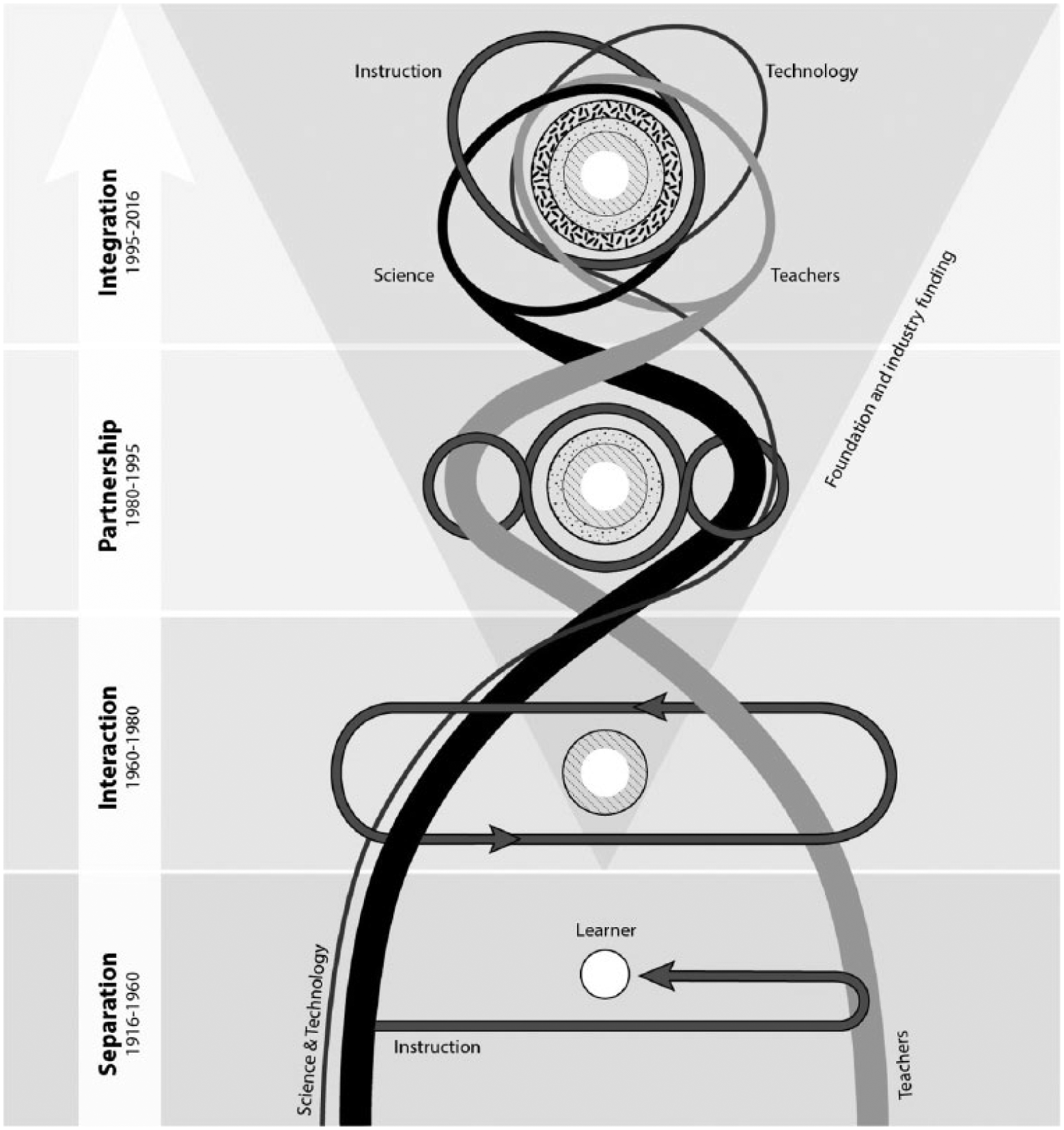
The Changing Relationships Between Science Learners, Teachers, Instruction, and Technology
We explore the trends over the past 100 years from four perspectives: The view of the learner, the nature of instruction, the view of the teacher, and the impact of technological advances. We end by reflecting on remaining challenges for the upcoming years and offer recommendations based on our review.
View of the Science Learner
This section explores how the view of the science learner evolved over the past 100 years as researchers integrated perspectives from multiple disciplines. We focus on studies and perspectives that have had particular influence on the design of curriculum and instruction, teacher education, and technologies that support science education.
1916–1960: Multiple Perspectives on the Learner
Natural scientists typically viewed learners as absorbing information and designed lectures, demonstrations, and experiments to transmit information. Behaviorists reinforced the transmission view by studying stimulus–response connections and investigating memory and retrieval of information (e.g., Thorndike, 1912). Skinner’s (1938) work on operant conditioning (building on Watson, 1913) emphasized reward for desired behavior and inspired programmed texts (Pressey, 1926). Cronbach (1963) argued that psychology research had minimal effects on science curriculum design; however, teacher preparation programs required psychology courses emphasizing behaviorism, and student assessments generally measured recall of details. Meanwhile Dewey (1916), a philosopher, distinguished acquiring facts from using the methods of science and called for emphasizing scientific reasoning in science instruction.
Research on human reasoning informed by the emergence of the first transistorized computers in the 1950s led to what has been called the cognitive revolution (e.g., Broadbent, 1958; Gardner, 1985; Proctor & Vu, 2006). Computers provided cognitivists with a helpful analogy for the human mind as an information processor, a view of thinking and human behavior that remains popular today.
Meanwhile Piaget (1930) studied how his own children developed scientific insights and posited a theory featuring developmental constraints. He described a stage of concrete operations where children do not initially conserve mass or volume but, rather, believe that balls of clay are bigger when deformed into a pancake and that there is more orange juice when it is poured from a wide to a narrow cylinder. By studying physical systems such as pendulums, balance beams, and shadows, he distinguished concrete from formal operations, showing that older children could control variables (Inhelder & Piaget, 1958/1972). In his genetic epistemology, Piaget (1952) articulated mechanisms of assimilation and accommodation culminating in equilibration to describe how children respond to new information and advance across stages. Flavell (1963) synthesized Piaget’s developmental perspective, increasing its accessibility to educators.
1960–1980: Interacting Perspectives on Scientific Reasoning
In the 1960s, in response to the Soviet launch of Sputnik, the NSF funded natural scientists to lead curriculum reforms. Interactions with psychologists were spurred by an influential conference held at Woods Hole, Massachusetts, and captured in Bruner’s (1960) The Process of Education. Bruner emphasized the generalizable science processes involved in problem solving, refuting developmental constraints, and asserting that any topic can be taught to learners of any age (Bruner, 1960, inspired by Polya, 1943).
The cognitive revolution continued in parallel with the development of curriculum materials. Vygotsky (1978) described the zone of proximal development as the progress that students make when given hints or social supports while solving difficult problems. Science education researchers documented the limits of science teachers’ knowledge of disciplinary topics and conceptions of the nature of science (Kimball, 1968; Lederman, 1992).
Psychologists studied the development of logical reasoning, including ability to conduct and interpret controlled experiments, using tasks that did not require disciplinary knowledge. For example, Siegler and Liebert (1975) asked learners to determine how to set four binary switches to make an electric train run. In actuality, the train was operated by a researcher who would activate the train only when all 16 possible configurations had been tested by the learner. Students’ prior knowledge of trains could not inform their hypotheses. Instead, they needed combinatorial reasoning to solve the problem. This experiment separated the role of prior scientific knowledge from the strategy of testing combinations. These studies were intended to characterize learners’ development of logical strategies such as isolating variables or using combinatorial reasoning. However, lack of knowledge of the context could deter students from attempting a task that appeared to require specialized knowledge. In addition, logical strategies like combinatorial reasoning might benefit from instruction as well as development (Case, 1985; Duckworth, 1987).
Other investigators compared decontextualized versus context-rich isomorphic tasks. For example, the four-card problem (Wason, 1968, Wason & Johnson-Laird, 1972) asked students which card(s) they needed to turn over to test whether cards that had a number on one side and a letter on the other confirmed or falsified an abstract logical rule: If a card has a vowel on one side, then it has an even number on the other side. An isomorphic contextualized problem involved determining which people needed to be queried to determine whether people in a bar falsified the rule that one has to be older than 21 years to drink alcohol. The contextualized problem was much easier, yet did not completely clarify the role of domain knowledge in learners’ reasoning processes (Tweney & Doherty, 1983).
Differential psychologists sought to identify components of reasoning, such as spatial abilities (French, Ekstrom, & Price, 1963). Spatial reasoning (essentially, the ability to interpret, generate, and recall spatial images) was thought to be important for scientific reasoning because many scientific phenomena cannot be observed with the naked eye. Psychologists (Liben, 1974; Sherman, 1967; Waddington, 1966), psychometricians (French et al., 1963; Lohman, 1988), and science educators (Linn, 1977; Pribyl & Bodner, 1987) studied spatial reasoning in abstract and scientific contexts. Cronbach and Snow (1977) studied aptitude treatment interactions to determine ways to create instruction that resonated with student characteristics. These studies revealed multiple dimensions of spatial reasoning. They showed that some spatial reasoning tasks correlated with scientific performance but did not establish the direction of causality, as both science topics and spatial reasoning were amenable to instruction.
1980–1995: Respecting and Building on Disciplinary Knowledge
In the early 1980s, psychologists and science education researchers delved into the relationship between learners’ disciplinary knowledge and scientific reasoning. They explored multiple topics and varied problem contexts, such as testing hypotheses, designing experiments, and evaluating evidence. They generated evidence for a constructivist view of learners as actively making sense of the experiences they encountered. This view had roots in Piaget’s (1952) genetic epistemology and Vygotsky’s (1978) zone of proximal development.
Researchers found approaches to scientific tasks to be more consistent with learners’ prior knowledge than with logical reasoning (e.g., Driver & Oldham, 1986; D. Kuhn, Amsel, & O’Loughlin, 1988; Linn, Clement, & Pulos, 1983; Schauble, Glaser, Raghavan, & Reiner, 1992; Tschirgi, 1980). Learners’ reasoning approaches depended on numerous factors such as whether the learner was asked to describe a relationship between variables or to achieve a specific outcome (e.g., Schauble, Klopfer, & Raghavan, 1991; Vollmeyer, Burns, & Holyoak, 1996). Researchers demonstrated that prior knowledge could both foster and inhibit use of logical processes. Likewise, teachers’ prior knowledge could foster or inhibit their use of inquiry teaching strategies (Blumenfeld et al., 1991). These studies underscored the interdependence of domain knowledge and scientific reasoning and provided a foundation for subsequent perspectives on integrating disciplinary knowledge and scientific practice. Detailed case studies of learners acquiring scientific ideas and generating explanations for phenomena clarified the nature of scientific knowledge and provided evidence for a constructivist view of learning (e.g., Baird, Fensham, Gunstone, & White, 1991). Other research cast doubt on the developmental constraints popularized by Piaget (Metz, 1995).
At the same time, Piaget’s descriptions of student reasoning motivated researchers to look carefully at the concepts that students articulated. This resulted in a cottage industry focused on identifying student alternative ideas in a broad range of disciplines (Pfundt & Duit, 2009). Teachers elicited students’ range of explanations (van Zee & Minstrell, 1997). Some noted parallels between student ideas and ideas developing in the history of science (Wiser & Carey, 1983). Others noted characteristics of these ideas. For example, diSessa (1988) referred to student ideas as knowledge in pieces. He postulated a conception of phenomenological primitives (p-prims), deeply held ideas about science originating in everyday experiences. DiSessa illustrated how learners’ failure to coherently explain everyday phenomena could be attributed largely to their incorrect application or overgeneralization of productive observations about science. For example, learners’ understanding of force and motion in the everyday world are difficult to apply to environments without friction or gravity.
These studies supported multiple views of conceptual change. Some investigators described how learners abandon one idea in favor of a new one (Strike & Posner, 1985). Others depicted learners as holding coherent scientific theories that needed to be contradicted (S. Carey, 1985; Chi & Slotta, 1993; McCloskey, 1983; Vosniadou, 1994). DiSessa (1988) argued for supporting students to build on their intuitive ideas and spurred investigation of facets (Hunt & Minstrell, 1994) and knowledge integration (Linn, 1995; Linn, Songer, & Eylon, 1996; Songer & Linn, 1991). Studies of knowledge in pieces, facets, and knowledge integration continue to inform the design of innovations in classroom-based science instruction, assessment, professional development, and technology design.
Psychologists showed that memory demands (referred to as cognitive load) could inhibit reasoning enough to justify designing instruction that managed learners’ short- and long-term memory (Chandler & Sweller, 1991; Sweller, 1988). Studies on learning from pictorial information accompanied by text (e.g., Mayer, 1989), audio narration (Mousavi, Low, & Sweller, 1995), or learning from computer-generated animations (e.g., Hegarty, Kriz, & Cate, 2003; Tversky, Morrison, & Betrancourt, 2002) demonstrated the importance of managing cognitive load.
Researchers sought to help students manage cognitive load and identified metacognition or awareness of one’s own progress in learning as crucial (Flavell, 1971). In particular, learners’ ability to self-monitor (Palincsar & Brown, 1984), self-explain (Chi & VanLehn, 1991), engage in intentional learning (Scardamalia & Bereiter, 1994), behave autonomously (Linn et al., 1996), and reflect back on what has been learned (Collins & Brown, 1988) or taught (Sweitzer & Anderson, 1983) gave rise to new possibilities for teaching, and for designing science instruction and teacher education. Metacognition represented a set of potentially generalizable learning skills necessary for lifelong learning. Metacognition informed new research on students’ science epistemologies, such as students’ view of the nature of scientific models (Grosslight, Unger, Jay, & Smith, 1991), the nature of scientific knowledge (S. Carey & Smith, 1993), and the purposes of scientific experiments (Schauble, Glaser, Duschl, Schulze, & John, 1995).
When standardized science tests such as the National Assessment of Educational Progress were first administered, in 1970 (Jones, 1988; Welsh, Kucinkas, & Curran, 1990), they revealed that students from families of low socioeconomic status and from some cultural groups were underperforming relative to White males. These results were often attributed to deficits of the learners. Yet many studies refuted the deficit idea, showing that question context (e.g., sailing vs. baseball) influenced the performance of cultural groups on items with similar reasoning requirements (Holland & Wainer, 1993). Professional development programs helped teachers guide students to connect their knowledge from everyday experiences to inquiry (Roseberry, Warren, & Conant, 1992).
Differential psychologists explored possible contributors to the deficit, including spatial reasoning. Research revealed correlations between science learning and various measures of spatial ability and also demonstrated the benefit of short exposure to spatial reasoning tasks to remediate performance (Lohman, 1988). Researchers also documented differences in exposure to spatial tasks and dramatic impacts of short training opportunities (e.g., Baenninger & Newcombe, 1989; Linn & Petersen, 1985; Maccoby & Jacklin, 1974). This research illustrated the importance of opportunity to learn and disputed the idea of inherent deficits.
1995–2016: Integrating Perspectives in the Learning Sciences
In the mid-1990s, science education’s model of the learner was still largely derived from studies conducted in psychology laboratories rather than classrooms. New research methods led to fruitful, complex studies in classrooms. These studies revealed the important role of the learning context. For instance, students could simultaneously believe that in the real world, moving objects slow down to a stop, but in the physics classroom, objects remain in motion until acted on by an external force. These investigations brought together researchers from diverse fields such as psychology, sociology, technology, education, and design, as well as school-based teachers and administrators who all shared interests in learning and instruction. In addition, individuals from new, relevant fields, including sociocultural studies and neuroscience, contributed ideas that were integrated into investigations of learning. The complexity of learning, along with the advantages of combining multiple perspectives, gave rise to the learning sciences discipline. Those attracted to the learning sciences sought to explain learning in authentic settings, such as everyday problem solving, and to identify ways to build on the cultural commitments of all learners.
New methods for research were needed and emerged. A. L. Brown (1992) and Collins (1992) proposed increasing reliance on design-based research methodologies, which intertwine the design of learning environments and learning theories, use iterative cycles of design and enactment, result in relevant implications for practitioners, occur in authentic settings, and connect learning processes to learning outcomes (Design-Based Research Collective, 2003). Research extended beyond the classroom and into informal settings (NRC, 2009). Connections to diverse stakeholders at the district and community levels began to emerge (Fishman, Penuel, Allen, Cheng, & Sabelli, 2013).
Several new aspects of the learner model became increasingly prominent as learning studies occurred in authentic settings. Collaboration and the community-based practice of science, long observed in professional settings (T. S. Kuhn, 1962), became a central research theme in studies of classroom-based learning (A. L. Brown & Campione, 1994; Scardamalia & Bereiter, 1994). Learning in collaborative settings requires students to acquire an increasing awareness about the ideas of their peers (Clark & Jorde, 2004; Linn & Hsi, 2000) and to respect their peers’ ideas in addition to those of their teacher (Cohen, 1994). Moreover, studies found that learners’ cultural backgrounds and gender influenced collaborative behaviors (e.g., Bagno & Eylon, 1997; Burbules & Linn, 1991; Howe & Tolmie, 2003).
Research also uncovered the importance of motivating students by illustrating the relevance of science to students and building on the concerns of the students themselves. Researchers on motivation (e.g., Pintrich, Marx, & Boyle, 1993) made arguments for integrating affective and cognitive views on learning. Studies examining the intersection of science and language (e.g., B. A. Brown, 2006; O. Lee, 2005), culture (Polman & Pea, 2001), and identity (Barton, 1998) shed light on ways to increase the accessibility and relevance of science for learners from diverse backgrounds. Studies on learners’ participation in community-based science (Bouillion & Gomez, 2001; Fusco, 2001), in addition to valuing and leveraging the ideas of others, helped focus learners on relevant community problems, further contributing to broadening participation in science.
Finally, learning sciences research strengthened connections across science knowledge, science practice, and other learning perspectives. For example, comprehensive programs often supported by NSF centers, such as ThinkerTools (B. Y. White & Frederiksen, 1998) and the Web-based Inquiry Science Environment (WISE; Linn & Eylon, 2011) were able to integrate science practices, metacognition, and science visualizations in the discipline of physics or physical science. Sandoval (2005) explored relationships between science inquiry and students’ practical epistemologies. Research reviews have integrated classroom-based research studies focusing on specific practices of science, such as (a) argumentation (e.g., Bell & Linn, 2000), (b) explanation (e.g., Sandoval & Reiser, 2004), (c) modeling (e.g., Wu, Krajcik, & Soloway, 2001), (d) visualizing (e.g., McElhaney, Chang, Chiu, & Linn, 2015), collaborating (Kyndta et al., 2013), and (f) conducting experiments (e.g., Lehrer, Schauble, & Petrosino, 2001). These studies demonstrate the tight link between the practice of science and advances in students’ conceptual views of science. These studies informed the science-as-practice perspective (Duschl, 2008), the Framework for K–12 Science Education (NRC, 2012), and the Next Generation Science Standards (NGSS; NGSS Lead States, 2013).
In summary, research on the science learner has progressed from separated disciplines to integrated research programs. Initially, psychologists studied learning from the standpoint of memorization and had minimal influence on either science educators or science discipline experts. The launch of Sputnik spurred interactions between science discipline experts who led reforms to the curriculum and psychologists, as well as science teachers, as discussed in the next section. In the 1980s, these interactions were often converted into partnerships where experts from multiple disciplines gained respect for each other, fostered in part by new NSF-funding programs requiring collaborations between discipline experts and science educators. This accompanied a weakening of the distinction between science reasoning or methods and scientific ideas. A plethora of empirical work focused on students’ conceptual understanding, new reasoning tasks that sought to separate disciplinary and reasoning processes, and connections to spatial reasoning, as well as cognitive load. Starting in the mid-1990s, true integration of perspectives became more common. The audience for science education became more diverse, and the goals of educating all students to address personally relevant problems became more important. Sociocultural research perspectives were incorporated and respected as the field sought to prepare all students to tackle problems throughout their lives. This integration was in part stimulated by NSF funding for centers that involved multidisciplinary collaborations. Other factors included a focus on conducting research in classrooms, the emergence of computer technologies that could help monitor student progress, and research showing the importance of incorporating cultural perspectives into education research.
Much work is still needed to achieve a full integration of the perspectives relevant to the challenges facing science education today. We discuss some of these opportunities as we consider the historical development of science instruction in the following section.
Science Instruction
The trend from separation to integration of research on science instruction reflects the impact of NSF funding policies, along with shifts in the power structures among the participants. Science education was initially led by natural scientists, who often sought to prepare individuals like themselves. NSF funding for curriculum materials and for teacher institutes in the 1960s put natural scientists in charge. Funding for research on teaching and learning, starting in the 1980s, and for NSF centers, starting in 1995, called for collaborations where leadership was shared across natural scientists, psychologists, science educators, and often technology experts, as well as teachers. Importantly, in 1980, Erich Block, the eighth director of NSF, called for diversifying the workforce by broadening participation in science education, initiating a trend that is reflected in NSF guidelines for all funding today.
As researchers from distinct fields began to interact, form partnerships, and eventually integrate their perspectives, they reconceptualized science instruction. Initially, the science curriculum was designed to transmit science knowledge. As high school education became almost universal and science requirements for graduation expanded, the audience for secondary science courses broadened from an elite group of men (who were often admitted on passing entrance examinations) to a culturally diverse population who regularly questioned the value of their science courses. Instructional designers interacted with psychologists studying learning or child development, classroom teachers reported on student responses to the curriculum materials, and science education researchers documented the complexities of preparing teachers. They formulated views of instruction that recognized the role of the learner in making sense of science. New frameworks emerged to address the challenge of preparing diverse students to grapple with scientific problems they encounter in their lives. These instructional frameworks include communities of learners (e.g., A. L. Brown & Campione, 1994), science as practice (e.g., Duschl, 2008), and knowledge integration (e.g., Linn & Eylon, 2011).
This section articulates some of the persistent (and unresolved) dilemmas in science instruction and highlights how education researchers built on expertise from multiple research disciplines to integrate views of instruction.
Persistent Challenges in Science Instruction
During the past 100 years, some instructional challenges have resisted resolution. Perhaps the most prominent challenge concerns selecting topics to include in the curriculum. Each branch of science has representatives lobbying for the importance of topics from their field. From Philip Morrison’s argument that “less is more” in the 1960s to the TIMSS analysis of the curriculum as “a mile wide and an inch deep” (Schmidt et al., 1997), the superficial coverage of topics has been unavoidable for curriculum designers and those setting standards. A related issue concerns controversial topics, such as evolution, that have been debated, banned, and voted out of the curriculum in some districts (Berkman & Plutzer, 2010; Pew Research Center, 2009), often when powerful interest groups have falsely portrayed uncertainty about a specific finding as doubt about established phenomena such as global warming or the health risks of smoking (Conway & Oreskes, 2010). Students have little chance to develop coherent understanding when confronted with more than 60 distinct topics in a single year. In contrast, the Japanese science curriculum is both frugal—often covering only eight topics in a year—and more coherent (Linn, Lewis, Tsuchida, & Songer, 2000).
Another persistent challenge concerns how to sequence science topics in the curriculum to ensure that students have the prerequisite knowledge, are developmentally ready to learn the material, and can integrate new ideas with prior knowledge. The National Society for the Study of Education devoted its 1932 yearbook to sequencing the science curriculum. Yet earth scientists complained that their discipline was neglected (E. B. Lewis, 2008). Bruner’s (1960) spiral curriculum was designed to allow students to build on their prior coverage by revisiting topics. Analyses of this approach demonstrated that most textbooks failed to build on prior instruction and instead retaught the topic at the same level of detail (Schmidt et al., 1997). Efforts to address this challenge have resulted in the placement of complex topics at progressively earlier points in the curriculum. For example, the California standards (1998) placed the periodic table in Grade 3, far in advance of when students are most likely to grasp its basic meaning.
Few empirical studies support a specific sequence. Bruner’s (1960) claim that students can learn any topic at any age further eroded support for specific sequences. Bruner’s claim revealed the need to specify a topic’s level of detail or abstraction to analyze its role in a sequence. Simplifying a topic, even to the extent of neglecting key ideas, might pave the way for future understanding (Feynman, Leighton, & Sands, 1995; Linn & Muilenburg, 1996). Recently, researchers have sought evidence to distinguish among alternative enacted topic sequences to determine which are more effective learning progressions (e.g., Duncan, Rogat, & Yarden, 2009).
1916–1960: Separation of Curriculum and Instruction
Between 1916 and 1960, psychologists studying learning had little interaction with science education. A review of research in science education concluded that most research studies involved some form of survey of curriculum or of student reasoning (H. Smith, 1963). Vocabulary analyses revealed that texts frequently used words beyond the level of the students, possibly because textbooks were often written by natural scientists with the goal of transmitting scientific knowledge. For example, Millikan, a Nobel laureate, wrote with H. G. Gale (1906), many college texts as well as A Laboratory Course in Physics for Secondary Schools. Science assessments embedded in the textbooks typically called for memorizing and retrieving science information.
The audience for secondary science education was initially White and male, and many high schools had entrance examinations for admission prior to the growth of the high school in the 1930s (Goldin, 2008). Few non-White students attended beyond elementary school, and high schools were not available for non-Whites in the segregated South. In cities, immigrants were less likely to enroll than others. The emergence of high schools created a need for science teachers and a market for science textbooks. Schools often had a single science teacher who taught all science topics.
Surveys of syllabi and textbooks concluded that there was a great diversity of goals and topics taught across schools (H. Smith, 1963). Dewey (1916) called for replacing the emphasis on nature study in elementary education with attention to science methods. Others emphasized identifying key scientific concepts necessary for all learners. One high school biology teacher, Ella Thea Smith, who had trained as a botanist, wrote her own biology textbook after becoming frustrated by the mainly phylogenetic biology textbooks, such as Truman J. Moon’s Biology for Beginners (Moon & Mann, 1933), that had separate sections on botany, zoology, and human physiology (Ladouceur, 2008). E. T. Smith’s (1938) book, the first of its kind with a female lead author, was eventually published as Exploring Biology. It emphasized appreciation of nature and of natural cycles and processes across topics in biology.
During the separation period, researchers studied science reasoning and documented the plethora of student ideas about each science topic. They found that elementary students had multiple ideas about curricular topics such as magnetism, the moon, and atomic energy (Haupt, 1948; Young, 1958), consistent with Piaget’s (1930) findings for conservation and experimentation. Surveys showed a disparity between the ideas of girls and boys that was attributed to cultural differentiation and expectations for the sexes starting at an early age (H. Smith, 1963). Curriculum developers rarely paid attention to these rich insights, focusing instead on transmitting information.
1960–1980: Interaction Led by Natural Scientists
With the Sputnik launch came a wake-up call to improve science education in the United States. Physics, biology, and chemistry professors secured substantial funding from NSF to create new curriculum materials and initiated interactions with science teachers, psychologists, and science educators.
New curriculum materials focused on preparing students to think like the scientists who designed them. Designers embraced Bruner’s (1960) claim that it was possible to teach any topic to learners of any age. Chase and Simon’s (1973) finding that the development of expertise requires 10,000 hours, reinforced the idea of pushing complex topics down into earlier grades (Goldstein, 1992). Not surprisingly, designers created instruction that was too difficult for most students and textbooks that could not be covered in the time allocated (Curtis, 1963). The main response to the difficulty of the texts was to create versions with reduced demands rather than seek ways to make the instruction effective for a broader range of learners. In addition, the designers often criticized the teachers for not successfully teaching the material in the texts (Welch, 1979).
Designers of elementary curriculum materials were more likely to interact with researchers on learning than were designers of secondary materials. For example, the Science Curriculum Improvement Study incorporated theoretical principles from the work of Piaget (Karplus, 1964). These curricula included instructional frameworks, such as the Science Curriculum Improvement Study learning cycle, involving exploration, invention, and discovery to guide use of kits of materials.
Classroom laboratory experiments involved more discovery than was typical with prior materials, yet were also focused on abstract ideas and principles. For example, Zacharias, the designer of Physical Science Study Committee, was particularly enthusiastic about the study of wave motion and admonished teachers to test their wave tanks in September so they would be ready for use (Goldstein, 1992). Designers, recognizing the visual nature of science, created filmstrips to illustrate scientific phenomena that were difficult to observe (Chemical Education Material Study, 1963).
Research using surveys and analyses of national tests compared performance of subgroups of students. Analysis of National Assessment of Educational Progress data from 1970 to 1980 interpreted findings that women took fewer science courses and were less successful than men as indicating a deficit in women (Mullis, Jenkins, & Lynn, 1988). Another approach explored aptitude–treatment interactions to find ways to support all learners (Cronbach & Snow, 1977). For example, research showed the advantage of instruction that strengthened areas of weakness such as spatial reasoning to help all learners.
During the interaction period, researchers compared student reasoning between typical and new curriculum materials (e.g., Wollman, 1977). Evaluations of the NSF-funded curricula often showed advantages over typical instruction (Bowyer & Linn, 1978; Linn & Thier, 1975). A meta-analysis of these studies supported the value of asking students to generate explanations by showing that the innovative curricula did no harm to students’ performance on state tests that primarily measured recall. In fact, these curricula led to higher scores on assessments with which they were aligned (Shymansky, Hedges, & Woodworth, 1990). Most interpretations of the results ascribed the effectiveness of the innovative curriculum to general features (e.g., hands-on activities) that were not sufficient to guide future design. A few studies offered more mechanistic accounts of the results, such as by demonstrating the value of generating explanations, consistent with psychology laboratory studies that identify an effect of generating explanations on learning (e.g., Slamecka & Graf, 1978).
1980–1995: Partnerships to Improve Science Instruction
The education directorate at NSF was established in 1975 and began a small research program around 1980. The Research in Teaching and Learning program, led by program officer Ray Hannapel, required proposers to form partnerships involving science educators, science discipline experts, and teachers. In 1984, taking advantage of the IBM PC (1981), the Commodore 64 (1982), and the Macintosh (1984), Andrew Molnar became director of the Applications of Advanced Technologies program. Applications of Advanced Technologies was the first NSF effort to support partnerships between researchers and developers. Molnar called for high-risk, high-gain initiatives. These research programs supported investigations of learning in and out of school and encouraged researchers to challenge the deficit model and address opportunity and inclination to learn.
In a review, Eylon and Linn (1988) delineated four emerging research traditions that engaged partnerships (concept learning, development, individual differences, and problem solving). Although most of the research was conducted in laboratories rather than classrooms, these traditions all offered some support for instruction that encouraged students to make sense of their multiple, often conflicting ideas. Work on concept learning continued to reveal the multiple, diverse ideas each student held about scientific phenomena (e.g., diSessa, 1988; McCloskey, 1983) and gave rise to conflicting instructional implications. Some viewed learners as holding fragmented ideas they could be motivated to sort out (e.g., Linn, 1995; J. P. Smith, diSessa, & Roschelle, 1993). Others saw students as having naïve, coherent theories that required refutation (Vosniadou & Brewer, 1992).
Researchers extended this focus to document how students’ developing beliefs about their own learning were intertwined with beliefs about the epistemology of science (Hofer & Pintrick, 1997). Focusing on autonomy, intentionality, and agency, researchers recognized the value of encouraging students to monitor their own progress (A. L. Brown, 1987). For example, Chi and collaborators demonstrated the advantage of self-explanations (Chi, Bassok, Lewis, Reimann, & Glaser, 1989). They found that students who spontaneously explained to themselves while learning were more successful than those who did not explain, consistent with the generation effect. Connecting to theories of motivation, studies demonstrated that science materials created to engage students in personally relevant problems could promote autonomy and strengthen science understanding (Linn, 1995; Norman & Schmidt, 1992; Pintrich, 2003).
Research following the developmental tradition often involved designing instruction to resonate with Piaget’s stages and build on student capabilities such as concrete operations (Case, 1985). Other research studied how instruction might take advantage of mechanisms of accommodation and assimilation by varying the context of the problem (e.g., Linn et al., 1983). Emerging research showed the value of students’ learning from others (Scardamalia & Bereiter, 1994).
Researchers focusing on individual differences looked for explanations of differential performance on science assessments. They considered stereotype threat: where students’ perceptions of the risk of conforming to stereotypes for their social group may raise anxiety and depress performance (Steele, 1997; Steele & Aronson, 1995). They found that spatial reasoning, important for science, was amenable to instruction, rather than an impediment to success (Harle & Towns, 1963; Linn & Petersen, 1985).
Researchers focusing on problem solving compared experts and novices. A key study of categorization of physics problems noted that students focused on superficial features, while experts categorized problems using abstract principles (Chi, Feltovich, & Glaser, 1981). This work suggested the importance of instruction that guides students to distinguish superficial from substantive problem features.
These studies suggested synergies between science reasoning and science ideas. Students advanced their reasoning and developed their identity as scientists by reasoning about their ideas. They needed science ideas to engage in complex reasoning. Thus, researchers argued that learning, including learning about how to guide one’s own learning, was situated in the discipline (Lave & Wenger, 1991). Careful observation of apprenticeship programs revealed the importance of learning by distinguishing one’s own ideas from those of more successful students (Collins, Brown, & Newman, 1989; Vygotsky, 1978). Furthermore, partnerships with social psychologists showed that students could develop an identity as a science learner by integrating their ideas about compelling dilemmas in science contexts (Markus & Nurius, 1986).
Partnerships of science educators, psychologists, discipline experts, and science teachers contributed to the emerging science of learning. The Journal of the Learning Sciences was founded in 1991, providing an outlet for detailed analysis of complex learning and promoting multidisciplinary collaboration. Early issues reported laboratory studies of students’ learning from self-explanations in physics (Chi & VanLehn, 1991) and from insights into causal reasoning through the study of electrical circuits (Schauble et al., 1991). Studies during this period contributed to instructional frameworks that supported guiding students, both individually and collaboratively, to construct their own understanding (A. L. Brown & Campione, 1994; Scardamalia & Bereiter, 1994). These frameworks, when tested in classrooms, offered preliminary design principles to guide those creating instructional materials. For example, the knowledge integration framework articulated design principles in four categories: make science accessible, make thinking visible, enable students to learn from each other, and promote autonomy (Linn, 1995).
1995–2016: Learning Sciences and Science Education
The integration period featured efforts to take advantage of the culturally complex and broadening audience for science education and to bridge the widening achievement gap in America’s cities. Determining ways to offer meaningful instruction to all learners motivated the integration of research on linguistic diversity (O. Lee, 2005), epistemological beliefs (Sandoval, 2012), and student identity (McNeill, Lizotte, Krajcik, & Marx, 2006; Sfard & Prusak, 2005). This effort accompanied a new understanding of the integral place of science in societal issues (Driver, Leach, Millar, & Scott, 1996; Millar, 1996; Millar & Hunt, 2001; Osborne, Duschl, & Fairbrother, 2002). Furthermore, contemporary problems, such as climate change, water shortages, energy depletion, and virus outbreaks, established the need to refocus science education on preparing students to become intentional, lifelong science learners.
Researchers recognized that the culturally diverse audience, along with the complex, systemic nature of science education, necessitated new research methods. Such methods needed to capture the multiple, interacting factors in science instruction and to gather evidence for principles that could guide instructional designers. Methods from sociocultural studies, such as ethnographies and microgenetic analyses, were adopted to characterize the role of social and cultural activities in learning in and out of school (diSessa, Elby, & Hammer, 2002; Engle & Conant, 2002; Hmelo, Holton, & Kolodner, 2000). Design research inspired by architecture, engineering, and computer science guided iterative refinement studies conducted in classrooms (Alexander, Ishikawa, & Silverstein, 1977; A. L. Brown, 1992; Collins, 1992; Cobb, Confrey, diSessa, Lehrer, & Schauble, 2003; Design-Based Research Collective, 2003). Design research conducted in realistic instructional settings with diverse learners allowed investigators to extract principles or patterns to generalize the process (Kali, 2006). It supported the simultaneous evolution of theory and design, and drove the intentional alignment between technology and research-based pedagogy. A theory of intentional learning, for example, evolved from Computer Supported Intentional Learning Environments (CSILE) to Knowledge Forum (Scardamalia & Bereiter, 2006); a theory of knowledge integration evolved from the Knowledge Integration Environment (KIE) to WISE (Linn, 1995; Slotta & Linn, 2009), and theories of learning-by-teaching with teachable agents emerged (Leelawong & Biswas, 2008).
Design research methods benefited from advances in technology that could capture fine-grained impacts on student learning and explore alternative approaches to personalizing instruction. Technology-enhanced learning environments can log student data, capture interactions with modeling environments, and record student collaboration. This rich evidence can inform customization of instruction (Gerard, Spitulnik, et al., 2010), design of personalized guidance (Gerard, Matuk, McElhaney, & Linn, 2015), and design of tools to help teachers diagnose student needs (Hoadley, 2002; Koedinger, McLaughlin, & Heffernan, 2010; Matuk, Linn, & Eylon, 2015). Integration of results from technology-enhanced learning environments strengthened understanding of classroom learning (this topic is discussed primarily in the section “Technology and Science Education”).
A major contributor to the integration of new fields was the funding of NSF centers. The Center for Integrating Learning and Technology was founded in 1997 to build a community of cognitive scientists, computer scientists, natural scientists, engineers, classroom teachers, educational researchers, industry leaders, and policy analysts to stimulate the development of technology-enabled solutions to critical educational problems. Starting in 2000, the NSF funded Centers for Teaching and Learning. These centers combined advances in assessment, insights into learning, and innovations in curriculum to build the intellectual infrastructure needed to ensure high-quality STEM (science, technology, engineering, and mathematics) instruction for all students. The Centers for Teaching and Learning enabled participants from diverse fields to collaborate on large-scale efforts to strengthen science education. In 2002, NSF initiated the Mathematics and Science Partnership program that engaged school districts in large-scale collaborations. Then, in 2004, NSF funded Science of Learning centers that integrated knowledge across multiple disciplines to advance learning and instruction.
Syntheses have refuted deficit arguments and begun to clarify the factors contributing to disparities in performance for cultural groups. For gender, declining gaps in opportunity to learn science narrowed the gap in performance on standardized assessments, resulting in Hyde’s (2005) argument for gender similarities. These similarities on assessments underpin the argument that disparities in access to science careers reflect cultural stereotypes rather than capability (e.g., D. I. Miller, Eagly, & Linn, 2014; Nosek et al., 2009). Explorations of cultural contributions to performance further clarify both the value of diverse cultural experiences and the factors that lead to patterns of career choice (e.g., Carlone & Johnson, 2007).
Important syntheses captured the interactions among researchers seeking to integrate insights into science instruction (DeBoer, 2014; Duschl, 2008; Lederman & Abell, 2014; Linn & Eylon, 2006; Songer & Kali, 2015). In addition, a series of NRC reports characterized the emerging integration of the field, including How People Learn (Bransford, Brown, & Cocking, 1999), America’s Lab Report (NRC, 2005), Taking Science to School (NRC, 2007), Learning Science in Informal Environments (NRC, 2009), and Equity and Diversity in Science and Engineering Education (NRC, 2012). Furthermore, a growing body of reviews and meta-analyses have captured the integration of insights into effective designs for learning environments (Donnelly, Linn, & Ludvigsen, 2014), scaffolds needed to realize the benefits of scientific visualizations (McElhaney et al., 2015), promising uses of automated guidance in science (Gerard, Matuk, et al., 2015), fruitful ways to promote scientific reasoning (Zimmerman, 2007), and valuable supports for collaboration in all disciplines (Kyndta et al., 2013).
Here, we highlight several salient themes focusing on results that inform our understanding of how to design instruction for a broadening audience: (a) the value of inquiry instruction for promoting identity, (b) the advantages of embedded assessment to develop science practices, and (c) the strengths of peer collaboration to promote lifelong learning.
Value of Inquiry Instruction for Promoting Identity
The NGSS (NGSS Lead States, 2013), initiated in 2011, clarified the definition of inquiry by specifying learning practices such as developing models and designing solutions. They also underscored the importance of knowledge integration by identifying cross-cutting themes and core ideas. Research showed that inquiry can improve science understanding and promote students’ identities as science learners (Furtak, Seidel, Iverson, & Briggs, 2012). Detailed analyses of student use of inquiry practices characterized how students with varied perspectives on a science challenge benefit from inquiry (Metz, 1997). Scientific models and simulations embedded in inquiry units can support exploration of phenomena that are too small (atoms), fast (reactions), vast (solar system), or complex (climate science) to observe directly (McElhaney et al., 2015). Careful analysis of successful instruction resulted in more precise recommendations for scaffolding inquiry learning than had emerged in prior research (Quintana et al., 2004). Research-based design guidelines for curriculum designers were synthesized from comprehensive research (Engle & Conant, 2002; Kali, Linn, & Roseman, 2008).
Inquiry instruction has potential to make culturally diverse students feel valued in science courses by encouraging them to test their own ideas (Chiu et al., 2013; Shear, Bell, & Linn, 2004). Research illustrates how inquiry can respect and build on student ideas (diSessa, 2000; Duschl, 2008; Linn & Eylon, 2011; Minstrell & Kraus, 2005). Inquiry activities can garner respect for student ideas by asking students to explain their thinking (Lombrozo, 2010; Rosebery et al., 1992). Thus, engaging students in inquiry takes advantage of their funds of knowledge, can help students distinguish among their ideas, and has the potential for developing intentional learners who identify as science reasoners (Rodriguez, 2013).
Yet some investigators argue for direct instruction based on the view that student ideas have a unified-theory-like character that is not amenable to inquiry instruction (Chi & Slotta, 1993; Gopnik & Wellman, 2012; Vosniadou, 2013). Research comparing inquiry and direct instruction suggests that direct refutation of a science idea motivates students to avoid the intuitive idea in science class but revert back to it on a delayed posttest (e.g., Vitale, McBride, & Linn, 2016). Instead, it is valuable to guide students to distinguish among ideas, consistent with research on desirable difficulties (Bjork & Linn, 2006).
Advantages of Embedded Assessment for Developing Science Practices
Standards and assessment policies gained influence on science education starting with TIMSS (PIRLS International Study Center at Boston College, 1995). International comparisons showed that the United States was behind other developed countries and faulted the proliferation of content standards (Schmidt et al., 1997). Yet the remedy was often to add more tests (Hanushek & Raymond, 2005). High-stakes tests, along with standards that necessitated fleeting coverage of science topics and classroom pacing guides, constrained teachers and schools (Deboer, 2000; Harris et al., 2015; Shavelson, 2007). Multiple-choice assessments reinforced an inadequate model of learning and teaching grounded in memorization (Harris et al., 2015; Hauser, 2004; Sternberg, 2007) and discriminated against language learners and students from nondominant cultures by measuring vocabulary development rather than science reasoning (Carnoy et al., 2013).
Assessments embedded in learning activities are a promising alternative to standardized assessments and end-of-unit tests (Linn, 1996; Pellegrino, 2016; L. B. Resnick & Resnick, 1992; Shepard, 2000). For example, students doing project-based learning document their progress during “pinups” to get guidance during learning (Kolodner et al., 2003). Logs of student interactions allow teachers to monitor student progress, personalize guidance (Ruiz-Primo & Furtak, 2006), and base curricular customizations on valuable evidence (Gerard, Spitulnik, & Linn, 2010).
Instruction featuring embedded assessments that incorporate the Universal Design for Learning perspective (Rose, Meyer, & Hitchcock, 2005) can offer multiple pathways to success to meet the needs of diverse students. For example, students who speak a language other than English at home may represent their scientific arguments more accurately by using a concept-mapping tool than an essay (O. Lee, Penfield, & Maerten-Rivera, 2009; Liu et al., 2014).
Role of Design in Productive Collaboration
Collaborative activities succeed when students consider their peers’ ideas and use evidence to negotiate meaning. Structuring interactions is important for fostering generative interactions among culturally diverse students (A. L. Brown & Campione, 1994) and stimulating sustained engagement in science (Engle & Conant, 2002). Inquiry environments can guide students to use scientific evidence to distinguish among alternative ideas held by their peers (Clark & Sampson, 2007; Sato & Linn, 2014; Scardamalia & Bereiter, 2006; Tasker & Herrenkohl, 2016). In a study using the WISE Idea Manager, students who were asked to select peer ideas that differed from their own showed better learning outcomes than students asked to select peer ideas that reinforced their own (Matuk & Linn, 2015). Structuring argumentation by role playing, jigsaw activities, reciprocal teaching, or sentence starters (e.g., “I found that . . .”) can promote self-regulation during collaboration but may reduce student motivation to participate by constraining contributions (Dillenbourg, 2002; Kollar, Fischer, & Slotta, 2006). Using technology tools like natural language processing or logs of student interactions to identify ineffective collaborative moves, and providing immediate guidance shows promise for guiding students to learn from each other (e.g., Diziol, Walker, Rummel, & Koedinger, 2010; Rosé et al., 2008).
In summary, research on science instruction has generated promising insights and illustrates ways to meet the needs of increasingly diverse science students. In particular, these studies collectively highlight the promise of engaging students in inquiry instruction featuring interactive models and collaborative activities. Inquiry projects can respect student ideas while also encouraging learners to consider alternatives. They can take advantage of scientific visualizations and provide students with opportunities to generate their own explanations and other scientific artifacts. They offer opportunities for continuous, embedded assessment and personalized guidance. Inquiry projects can promote collaboration in small groups or among whole classes. They can focus on societal issues in local communities and on global problems that resonate with students’ interests and experience. By fostering students’ identities as scientific thinkers and problem solvers, inquiry instruction imparts practices that have lifelong advantages. Emerging design guidelines can help teachers who are customizing instruction and designers who are creating new units to take advantage of research on science instruction.
Science Teacher Learning
One hundred years of empirical research has contributed a rich understanding of science teacher learning. Science teacher education has broadened from an early focus primarily on classroom management and pedagogy, to adding specialized science content courses, incorporating cultural and linguistic perspectives, and integrating practices that respond to the variety of student ideas. Our understanding of the teacher as learner has advanced from a view of the teacher as a repository of information, to appreciation that teachers come to the profession with a variety of beliefs about teaching science that are individual and unique, complex, and at times conflicting, based on their prior experience and backgrounds. Teachers face the challenge of combining ideas about the discipline with ideas about how to teach science topics such that they respect and address the alternative conceptions held by their students. The locus of teacher learning has shifted from learning outside of practice (teacher education courses, summer workshops focused on curriculum delivery) to learning within and from practice (guided reflection on classroom video, embedded assessments to inform instructional customizations, learning communities within schools).
Persistent Challenges
During the past 100 years, some science teacher education challenges have persisted. One of the most prominent is the gap between the call for professional development for practicing teachers and the incoherent response. Teachers have called for professional development since 1910. The focus of professional development reflects the instructional focus of each era. In early years, the call was for greater disciplinary and instructional sequencing support (Burnett, 1942). This shifted, with the NSF-funded curricula in the 1960s, to a focus on inquiry teaching strategies (Welch, Klopfer, Aikenhead, & Robinson, 1981). From 1980 to 1995, teachers called for continued support in professional communities (V. E. Lee & Smith, 1996; Little, 1993), particularly to adapt strategies for increasingly diverse learners (National Center for Education Statistics [NCES], 1999). From 1995 to the present, calls for professional development have focused on incorporating student ideas and inquiry practices into instruction (Gerard, Varma, Corliss, & Linn, 2011).
Research demonstrates significant advances in science instruction due to participation in sustained and coherent professional development programs. Outcomes include increased gains in student science learning (e.g., Garet, Porter, Desimone, Birman, & Yoon, 2001), greater numbers of students from groups historically underrepresented in science choosing a science major at the start of college (Bottia, Stearns, Mickelson, Moller, & Valentino, 2015), and reduced teacher turnover (Ingersoll, 2001). However, professional development offerings for teachers have been consistently infrequent and disconnected from what we know about how teachers learn. Researchers have identified, from 1960 to today, teachers’ deliberate reflection on artifacts of teaching and learning as an effective mechanism for teacher learning in professional development (e.g., Gerard et al., 2011; Penuel, Fishman, Yamaguchi, & Gallagher, 2007; Sweitzer & Anderson, 1983). Yet most professional development programs neglect opportunities for teachers to test ideas in a classroom and reflect on students’ work.
The second persistent challenge concerns science teachers’ qualifications and preparation. Throughout the past 100 years, scholars and the general public have called attention to an insufficiently prepared science teacher workforce. In one study, 80% of teachers reported that their job was to bring specialized knowledge to students but that they avoided some science topics due to insufficient knowledge (H. Smith, 1963). Just as today, education leaders noted the high number of secondary teachers working outside their college majors or minors. Furthermore, many complained about inadequate course sequences in science teacher credential programs (Burnett, 1942) and a high teacher turnover rate with vacancies filled by out-of-discipline or uncertified teachers. The response to this problem has largely been to increase the required science courses in preservice education and to invest in science teacher recruitment. These approaches have yielded some positive results. They do not address the challenging problem of preretirement science teacher turnover due primarily to reported dissatisfaction with teaching (Ingersoll, 2001).
A third persistent challenge is the misalignment between effective teaching strategies and the high-stakes student assessments. Teachers have long been held responsible for ensuring both that students have mastered the impossibly long list of topics delineated by standards documents and that students engage in inquiry practices to develop integrated understanding and ability to engage in lifelong learning (Davis, Petish, & Smithey, 2006; Eylon & Linn, 1988; Schmidt et al., 1997). The government and public evaluation of teachers rests on their students’ ability to recall details on multiple-choice questions. This has resulted in emphasis on practice tests and memorization and undermined efforts to improve science teaching (Shepard, 2000). Since the 1950s, as curriculum designers pushed for inquiry, teachers have reported positive statements about the value of inquiry but felt the need to teach the facts that show up on tests (Marx & Harris, 2006; Welch et al., 1981). Today, technology could enable continuous assessment and automated scoring of generative item types. Yet pacing guides determining how much time to devote to each topic and multiple choice tests that motivate school leaders to require practice tests remain the norm.
1916–1960: Separation of Science Discipline and Pedagogy
In the first era of science teacher education, pedagogy and disciplinary knowledge were treated as separate entities. The teacher was seen as a classroom manager and deliverer of specialized science knowledge, the student as absorbing the information. Research on science teacher preparedness and student science learning foreshadowed recognition of the connections among disciplinary expertise, pedagogy, and student thinking in teacher knowledge.
For both elementary and secondary teacher education, typical courses included educational psychology (emphasizing memorization), history of education, classroom management, and curriculum (Burnett, 1942). The emphasis on pedagogy was due in part to the recent development of teacher preparation colleges as distinct entities from liberal arts colleges. This separated education from science faculty. Some secondary teacher education programs included specialized methods courses. In most states, teachers were required to have some level of college education, but no science major was required.
In the 1920s, newly developed and somewhat undefined science teacher credentialing spurred research surveying the courses provided in teacher education programs. One report noted that more than 60% of the science teachers in California secondary schools lacked college science training in the subject they taught. Subsequently, there was a call for more specialized science courses in teacher preparation programs (H. Smith, 1963). Because science teachers at this time often taught multiple disciplines (chemistry, biology, physics) within a school, there was substantial disagreement as to whether teachers should receive general preparation in all sciences; or education in biology, the most common high school course, and a course in the specialization of their interest; or all courses within a specialization (Curtis, 1930). Meanwhile, teachers were largely determining what science content to teach based on their individual interests and science experiences, administrative pressures due to requisite student achievement expectations (e.g., reading in K–1) and the school community demographics (Piltz, 1958). The National Association of Research in Science Teaching formed in 1928 to provide teacher leadership in instructional decisions.
The period ended with conflict over what science teachers should teach and some encouragement for teacher preparation programs to pursue preparation courses on inquiry. States pushed for more science disciplinary courses in preservice teacher education, yet research indicated that increasing specialized science courses was insufficient to strengthen classroom science teaching (H. Smith, 1963). One study analyzed teacher–student interactions in biology classrooms. Researchers reported a relatively low percentage of student verbal participation, especially student-initiated contributions, and a high percentage of direct verbal teaching procedures employed by most of the teachers. Others reported parallel findings in a study of physics teachers (Bruce, 1969). Researchers found science teaching practices were more closely related to student achievement outcomes than were teachers’ preservice education science course experiences (Perkes, 1968).
A distinction hence emerged between whether to prepare teachers to teach science facts or critical thinking skills. Leaders drew on Dewey’s (1916) vision for teaching the ways of learning science, rather than teaching science as a body of facts, to alter science teacher preparation. Atkin (1958) found students learned when hypothesizing based on original guesses and experimentation. Based on this finding, he drew the implication that science teachers must be prepared to create an environment that gives students the “right and privilege” to be wrong. This foreshadowed study of interactions between students’ prior knowledge and science teaching practices in the next period.
1960–1980: Interaction With Teachers and Evaluators
Natural scientists leading NSF-funded curriculum projects interacted with science teachers and evaluators. Teachers were initially treated as implementers of the NSF reform–oriented curriculum and later recognized as dynamic learners. This shift was due to consistent empirical findings that teachers did not implement curriculum as prescribed. Rather, how teachers implemented the inquiry curriculum materials depended on the interaction of the teacher with multiple factors, including context, beliefs about learning, and prior experiences (Welch, 1979). Surveys such as the Test on Understanding Science, developed by the Educational Testing Service, were used to identify supposed deficiencies in teachers’ knowledge of the nature of science and the disciplinary content. Researchers claimed secondary science teachers’ knowledge was equivalent to that of high school students or nonscience majors in college (R. L. Carey & Strauss, 1970; Kimball, 1968; P. E. Miller, 1963).
The natural scientists developing the NSF curriculum lamented that teachers were not well enough prepared to effectively teach inquiry (Welch et al., 1981). The NSF funded intensive residential summer institutes to prepare teachers to implement the materials. Teachers came to universities in the summer to learn contemporary science, mathematics, or engineering from science experts. To promote the student-centered approach to inquiry, teachers took the role of students, engaging in investigative practices to test the curriculum materials. Thousands of teachers participated in these institutes. This effort built communities of teachers who appreciated the value of collaboration and who formed strong relationships with expert scientists. An influential community of science teachers formed, who became leaders in a variety of organizations, including the National Science Teachers Association and the American Association of Physics Teachers (Dow, 1991).
Research involved surveys of teachers’ knowledge of science topics and the nature of science, comparison studies of deductive versus inductive teaching methods, and investigations of the impact of professional development on inquiry teaching behaviors. Strengthening teachers’ observations of and reflection on the relationship between their teaching practices and students’ behaviors was an effective professional development approach to improve inquiry teaching (Sweitzer & Anderson, 1983). The focus on curriculum implementation spurred research on teaching practices. Studies of inductive versus deductive teaching methods (e.g., Boulanger, 1981; Egelston, 1973) showed an advantage for inductive teaching methods at the high school level. Yet surveys showed teachers used primarily deductive or direct instruction. This was most apparent in the use of lectures and recall questions. The curriculum stimulated some new practices, such as teachers using less direct guidance when students struggled (Egelston, 1973).
While at first many had viewed teachers as holding fixed knowledge on content and pedagogy, this view became contested as leaders began to realize that, for inquiry to take hold, teacher learning about practice was necessary (Lederman, 1992). The professional development institutes had focused on preparing teachers to implement the new materials by having them play the roles of students. They neglected opportunities for teachers to create and test new teaching practices with the materials and to distinguish effective strategies (Welch, 1979). Likewise, classroom field experiences, where teachers could test ideas, were included in only some teacher education programs (Sunal, 1980). Meanwhile, consistent evidence suggested that teachers’ deliberate examination of their teaching practices relative to student behavior could foster new inquiry teaching practices.
Education researchers used comparison studies to investigate the influence of professional development activities on teacher behavior. Studies of feedback given to teachers after a lesson found, for example, that a supervisory conference coupled with classroom video (of the participating teacher) brought about change in teaching methods. The combination of video and conference was more effective than either a conference or analysis of video alone, or analysis of student data from systematic observations (Sweitzer & Anderson, 1983). A review of 71 studies found that providing teachers with training in systematic observation of class behavior led teachers to change their practice (Balzer, Evans, & Blosser, 1973). Findings were echoed by research on preservice activities such as microteaching. Microteaching was designed to give teachers practice using new teaching strategies with real students. Teachers prepared a short lesson, videotaped their instruction with a small group of students, viewed the video with a mentor who helped the teachers diagnose ways to improve their practice, and then retaught the lesson with a new group of students. A meta-analysis documented a substantial advantage of microteaching (with real students) over a control experience on teacher learning outcomes (Sweitzer & Anderson, 1983). A comparison study of a preservice program with field experiences including microteaching versus programs without, demonstrated that field experiences led teachers to use significantly more and higher quality inquiry teaching behaviors (Sunal, 1980).
Use of curriculum and likewise the summer institutes dissipated by the late 1970s and in spite of the expenditures of millions of dollars and the involvement of some of the most brilliant scientific minds, the science classroom was not very different. Stake and Easley (1978) conducted case studies of 11 sites using the NSF science materials and noted that the teacher is key to change. While the institutes supported implementation of materials, they neglected support for teacher customization to fit the materials with their teaching and to adjust their teaching to enhance the materials. Nevertheless, the research findings on professional development and teacher education from this era situated teachers as dynamic learners, rather than solely as deliverers of instruction. This emerging view, coupled with the recognition that teacher learning was key to instructional improvement, stimulated the beginning of a paradigm shift to take hold in the next era.
1980–1995: Partnerships Featuring Teacher Communities and Research Collaborations
Starting in the 1980s, appreciation for the relationship between teaching practices and student science learning was at the heart of teacher education efforts. Spurred by Shulman’s (1986) articulation of the importance of pedagogical content knowledge (PCK), research focused on identifying the forms of science teacher knowledge that support inquiry instruction, the connections between understanding of inquiry teaching practices and disciplinary knowledge, and the influence of those connections on student learning (Magnusson, Krajcik, & Borko, 1999; D. C. Smith & Neale, 1989). Research involved listening to students’ ideas, particularly how their ideas differed from the accepted scientific views, observing teacher strategies, and refining the strategies.
Rich qualitative methods were used to reveal how teachers’ integration of ideas across dimensions (e.g., content, instruction, assessment, and learning) was vital to effective science teaching. Clinical interviews, classroom observations, concept maps, and discourse analysis were used to compare PCK between expert and novice science teachers (e.g., Blumenfeld et al., 1991; Clermont, Borko, & Krajcik, 1994) and between teachers who taught familiar versus unfamiliar science topics (e.g., Carlsen, 1993). Teachers identified as having strong PCK were more likely to elicit students’ alternative ideas and to build on and challenge students’ ideas using varied conceptual representations (Clermont et al., 1994). van Zee and Minstrell’s (1997) ethnographic study of an award-winning physics teacher illustrated the dynamic relationship between a teacher’s questions during inquiry lesson and the articulation and refinement of students’ varied ideas.
A view of the teacher as constructing knowledge within practice by paying close attention to student ideas shifted the locus and structure of professional development. Rather than workshops that provided practice in a new curriculum devoid of students’ ideas, programs brought students into the workshops, recognized the importance of contextualized learning, and sought to develop metacognition about teaching practices (e.g., Palincsar & Brown, 1984). Professional development emphasized opportunities for teachers to practice new project-based science or inquiry science–teaching methods in real classrooms, to reflect on their experiences with colleagues and curriculum designers, and to discuss strategies to address the identified challenges (Baird et al., 1991; Krajcik, Blumenfeld, Marx, & Soloway, 1994). Teacher education followed suit. Whereas, initially, natural scientists had believed that a degree in science was essential for secondary teachers, researchers now believed teachers needed guidance to convert accumulated science content knowledge into effective, personalized instruction and to develop teaching strategies that encouraged students to distinguish their specific alternative conceptions from ideas communicated in the curriculum.
Eliciting and building on the ideas that individual students bring to the classroom, particularly students from nonmainstream backgrounds, gained importance (O. Lee, 2005). As researchers recognized the situated nature of students’ learning, a majority of science teachers reported they were not adequately prepared to teach English language learners (NCES, 1999). Teachers requested guidance on how to situate science instruction in students’ everyday experiences and informal language. The Chèche Konnen Project, one of the most researched science education programs, focused on shaping science curriculum around students’ interests and around questions they developed from their everyday experiences outside the formal classroom environment (Rosebery et al., 1992). The teacher’s role was to facilitate collaborative student investigation of these questions. Teachers in partnership with researchers identified how to elicit students’ questions and observations, and how to incorporate these ideas as resources for science learning. Longitudinal studies demonstrated the benefits of this teaching approach for linguistic minority students’ science learning (O. Lee, 2004).
1995–2016: Integration of Science Teaching, Student Learning, and Professional Development
Integrating teacher and student learning characterized this period. Cognitive frameworks used to investigate student learning were applied to teacher learning (e.g., modeling-based inquiry, knowledge integration) and provided rich evidence that teachers integrate ideas about teaching, about the discipline, and about students’ alternative conceptions to build expertise (Davis, 2003; Mishra & Koehler, 2006; Schwartz & Gwekwerere, 2006; Talanquer, Tomanek, & Novodvorsky, 2013). Research distinguished the opportunities for teachers to analyze student learning in relation to teaching practices and lesson design as the key professional development mechanism (Gerard et al., 2011). Coherence among teachers’ goals, school-wide goals, professional development activities, and research methods were essential to sustaining a community of teacher learners using innovative teaching practices (Garet et al., 2001; Penuel et al., 2007; Wilson & Berne, 1999). NSF-supported centers and partnerships combined disciplines (teacher learning, student learning, curriculum design, technology, cultural studies) and contexts (universities, school districts, science departments) to develop professional development models that integrated teaching, student learning, and school context.
Teacher Learning and Professional Development
Empirical work supported a view of teachers as learners who, like students, build connections among ideas to form an integrated perspective. Studies revealed that science teachers bring beliefs to their science teaching that are individual and unique, complex, and at times conflicting, based on their prior experience and background (Crawford, 2007). Longitudinal studies of teacher beliefs suggest that teachers often develop inquiry-oriented beliefs about instruction during their preservice program but return to a more didactic orientation during their first year in the classroom. This is most often due to a lack of social and intellectual supports for inquiry teaching in the school context (Crawford, 2007; Davis, 2006; Fletcher & Luft, 2011).
Integrating student work into teacher professional development programs has enabled teachers to test and refine their own hypotheses about learning and instruction, which can lead to sustained shifts in teachers’ beliefs and practices toward an inquiry teaching model. This resonates with findings about the value of reflection on practice from previous eras (Krajcik et al., 1994; Sweitzer & Anderson, 1983). A synthesis using meta-analysis of professional development in technology-enhanced science demonstrated the value of supporting and encouraging teachers to practice new approaches, gather evidence of the impacts of the new approach from students’ work, and reflect on such evidence to distinguish effective strategies (Gerard, Linn, & Liu, 2012). Professional development programs that engaged teachers in using evidence of student work to distinguish among ideas led to significantly greater teacher and student learning outcomes than programs that focused on giving teachers new ideas but lacked activities for teachers to contrast and connect their new ideas with their initial views. Programs that lack opportunities for distinguishing ideas have little impact on the mismatch between teachers’ beliefs and what they do in practice.
Professional development models developed and refined in this era shared a common goal of guiding teachers to reflect on students’ work from a lesson, distinguish the relationship between their teaching strategy and their students’ learning, and refine their approach. Research programs incorporating expertise on curriculum, assessment, teaching, and learning built different versions of this deliberate use of evidence to guide refinement of practice. Lesson Study used collective, iterative teacher development of a science lesson on a predetermined learning challenge (e.g., pendulums), observation and videotaping of a teacher implementing the designed lesson, and collective reflection on the video, observations, and student work artifacts (C. Lewis, Perry, & Murata, 2006). Educative materials embedded generative student assessments, rubrics, and customization prompts into the curriculum to elicit student ideas that could be used to adapt instruction (Bismark, Arias, Davis, & Palincsar, 2015; Davis & Krajcik, 2005). Inquiry learning environments built flexible authoring tools and visualizations of student assessment information to allow teachers to see a record of student thinking and modify the instruction accordingly (Fishman, Marx, Best, & Tal, 2003; Matuk et al., 2015). Each structure supported teachers to build links between new instructional practices and classroom field experiences. Without this link, teacher beliefs in inquiry remained tenuous (Crawford, 2007). Programs rely on access to generative assessments and rubrics that can give teachers insights into student learning and alignment of assessments with curriculum.
Research shows that successful professional development has goals that resonate with those of the participating teachers and has a duration of one or more years (Garet et al., 2001; Penuel et al., 2007; Wilson & Berne, 1999). Activities that are “packaged and disseminated” to teachers are unlikely to take root in teachers’ repertoires. Professional development programs aim to develop sustained partnerships among stakeholders. This has involved identifying research questions of interest to both the school and research partners (Coburn, Penuel, & Geil, 2013; C. Lewis et al., 2006); ensuring there is a partner teacher or science leader within each school (Diamond & Spillane, 2004; O. Lee et al., 2009); and providing professional development for administrators as well as teachers (Gerard, Bowyer, & Linn, 2010).
Teaching and Inquiry Learning
Recent research illustrates how teachers integrate inquiry practices and content. Research on the degree of guidance needed to allow students to autonomously engage in science practices and develop coherent understanding has found teachers’ roles to be crucial, echoing the case studies of the NSF curricula (Stake & Easley, 1978). A review of 37 comparison studies on inquiry instruction conducted between 1996 and 2006 found that teacher guidance for inquiry added value over unguided student inquiry (Furtak et al., 2012). Teachers’ guidance enabled students to more fully experience reform-oriented inquiry activities, whereas student-led inquiry often leads to “deceptive clarity,” in which students are engaged but formulate superficial understanding (Chiu, King Chen, & Linn, 2012). The teacher creates a balance between helping students integrate ideas and giving students the necessary space to flounder and sort out ideas on their own (Engle & Conant, 2002). Balancing support for autonomy and integrated understanding requires teachers to make careful decisions on when to intervene or stand to the side, who to help and who to let work it out on their own, and how to scaffold students’ reasoning without giving them the answer.
To guide inquiry, teachers must customize their instruction to the specific alternative conceptions held by their students. This requires teachers to engage in continued informal assessment to shape their practices, as well as to gather information on students’ learning from diagnostic activities to inform instruction (Blumenfeld et al., 1991; Shepard, 2000). Building on the research on questioning of the previous eras (e.g., Boulanger, 1981; van Zee & Minstrell, 1997), design research studies showed the value of eliciting students’ ideas and guiding them to integrate those ideas. When teachers explicitly elicited ideas and followed up with adaptive guidance, students learned significantly more science than they did when typical informal assessment approaches were used. Successful practices elicited students’ reasoning rather than only eliciting student ideas to evaluate their accuracy (Black & Wiliam, 2006; Minstrell & van Zee, 2000; Ruiz-Primo & Furtak, 2006, 2007; Williams, Linn, Ammon, & Gearhart, 2004). Yet eliciting student ideas to assess accuracy rather than to provide guidance or improve reasoning remains very common (Ruiz-Primo & Furtak, 2006). This is not surprising, given large class sizes and teachers’ often limited experience with the wide range of alternative ideas presented by students in an inquiry cycle. While this is a persistent challenge for inquiry teaching (e.g., Welch et al., 1981), new technology tools of this era focus on making students’ ideas visible for teachers, so they can spend time adjusting instruction to build on and challenge students’ alternative ideas.
Technology and Science Education
Technology is an important driver of scientific advance, often shaping and contributing to evolving methodologies, models, and theories. Many tools developed for professional or military contexts have been adapted for mainstream use. For science education, technologies have helped evolve views of learning, instruction, teaching, and assessment. Over the past century, the role of technology has shifted from an accessory to a partner integrated into practice.
Progress has been disjointed by several persistent challenges. One concerns the typical resistance to innovations. While some embrace technologies as panaceas to educational problems, others fear they will displace teachers or cast doubt on their value. This was the sentiment during the audiovisual movement in the early part of the 20th century and with emerging automated scoring and guidance technologies more recently. A mixture of wariness and enthusiasm has persisted.
Another persistent challenge is the pattern of initially high expectations for new technologies, followed by disappointment in their failure to meet those expectations. For example, in 1922, soon after film was introduced to classrooms, Thomas Edison predicted the obsolescence of school books because “it is possible to teach every branch of human knowledge with the motion picture” (cited by Cuban, 1986, p. 9). More recently, schools invested heavily in interactive whiteboards amid predictions that they would revolutionize classroom teaching and learning, only to be disappointed by their limited functionality. And, as with any innovation, many efforts to leverage technology for learning fail to achieve their promise (e.g., Cordes & Miller, 1999; Healy, 1998; Oppenheimer, 1997; Stoll, 1995). One reason is that teachers generally need both time and support to integrate innovations into their practice. Another is that integration requires designers to customize innovations for science learning. Without support and customization, new technologies become expensive alternatives to traditional ways of teaching, regardless of the intentions behind the design.
An associated challenge concerns sustained funding for technology infrastructure. Even when technologies take hold and enhance learning, they may be abandoned rather than upgraded or sustained. For example, kits developed to accompany hands-on science in the 1960s often fell into disuse due to lack of funds for replacement supplies. And computers are often donated or purchased with grants that do not include the costs of professional development, curriculum materials, software, upgrades, or technical support. They are often embraced by early adopters who move on when they no longer function.
The divide created by individuals’ and schools’ differential access to technology and technological support is another persistent challenge. At the same time, an important justification for introducing computing into schools is to serve students who lack access in other contexts.
1916–1960: Separation of Technology and Curriculum
In the 1920s and 1930s, teachers lectured at the front of the classroom and led students in rote tasks that emphasized fact recall. Early technologies such as charts, photographs, stereographs, slides, and films were housed in school museums and largely focused on facilitating this process (Saettler, 1968). Similarly, science laboratories featured structured procedures such as for anatomical dissections or chemistry experiments (NRC, 2005). As filmstrip projectors and videotapes entered the classroom, teachers could show educational films and pause to interject with comments and to replay selected segments on demand. Although research could have investigated ways for technology to add value, studies primarily compared typical instruction with film or radio covering the same content and looked at accuracy and efficiency (Rolfe, 1924). Despite the predictions of leading figures of the time (Morgan, 1932), the transformative impacts of technology on education were not realized (Cuban, 1986).
Computers appeared in the 1930s and became increasingly crucial for professional scientists, but were neither affordable nor practical enough for classroom use until the 1980s. Designed on the basis of behaviorist principles, Skinner’s (1958) teaching machine addressed the difficulty for teachers of simultaneously monitoring and managing the progress of their many students. It provided students with immediate feedback on written responses and did not allow them to advance until they had answered correctly. Skinner (1958) argued that, unlike lectures, textbooks, and the usual audiovisual aids, the machine induced sustained activity. Skinner advocated for recall and not just recognition, asking students to compose rather than select their responses. In contrast, Pressey’s (1926) teaching machine required only recognition.
Thus, technologies generally supported a transmission model of the learner, assuming that students absorb rather than construct knowledge. This debate continues today, with many current technologies being used to transmit information.
1960–1980: Interactions Between Curriculum Design and Technology
Electronic technologies proliferated after the Soviet launch of the Sputnik satellite, underscoring the important role of technology in society. Outside of the classroom, advanced technologies were becoming central to the work of scientists, academics, and other industry professionals. Most continued to be largely impractical for classrooms although Scantron Corporation’s scoring of fill-in-the-bubble forms and photocopiers supported existing practices.
Furthermore, television reached most households and increased out-of-school access to science. For example, the Mr. Wizard television show drew 800,000 viewers and led to the establishment of more than 5,000 science clubs (LaFollette, 2008).
The leaders of the NSF-funded curriculum projects commissioned film loops to transmit information that was difficult to explore in high school classrooms. Some, such as molecular motion, were basically demonstrations. Others, such as the collapse of the Tacoma Narrows Bridge, brought a complex event to life. These films remain available today. To support hands-on experimentation, the elementary school leaders designed kits of materials to ensure that teachers could do hands-on experiments. Comparison studies showed overall advantages for the films and kits but did not specify the mechanisms that took advantage of technology (e.g., Shymansky et al., 1990).
The notion of computer literacy emerged as the ability “to ‘do computing’—to conceptualize problems algorithmically, to represent them in the syntax of a computer language, to identify conceptual ‘bugs,’ and to express computational ideas clearly, concisely, and with a degree of organization and readability” (Douglas, 1980, p. 18). Although opportunities to develop this literacy were rare in precollege instruction, a few uses of computer-based instruction were developed (e.g., Suppes & Binford, 1965). For example, the PLATO system for elementary to college students, developed at the University of Illinois, featured an authoring system (the PILOT programming language) and television sets for display. It was purchased by Control Data Corporation and used to deliver instruction remotely. Evaluations found that students enjoyed using the system and that it was as effective as a human teacher (S. G. Smith & Sherwood, 1976).
1980–1995: Partnerships for Learning Technologies
In 1983, A Nation at Risk, a report from the National Commission on Excellence in Education, received widespread attention and called for treating computer literacy as equivalent to the three Rs as personal computers and off-the-shelf programs become available. Pioneers in education began to recognize the potential of computers as learning tools, tutors, and resources (Taylor, 1980). Apple spurred experimentation in the 1980s with the Wheels for the Mind competition for school computers. NSF funded high-risk, high-gain innovations with the Advanced Applications of Technology program. Research focused on science practices supported by refinements of expert tools for students (AAAS, 1993b) and on student constructions using tools like Logo (Papert, 1980).
Authentic Practice
Partnerships of natural scientists, science educators, and technologists explored authentic science practices. For example, the ThinkerTools modelling environment enabled students to explore forces affecting a moving object to understand force and motion (B. White & Horwitz, 1987). Microcomputer-based labs used probes for real-time data collection as a valuable way to help students visualize experimental findings in graphs (Mokros & Tinker, 1987). STELLA, a complex-systems thinking tool, enabled students to design models for population growth and ecosystems (Mandinach & Cline, 1994). The WebQuest model (Dodge, 1995) took advantage of content available on the Web to offer students a curated sequence of websites. The KIE team used the emerging Internet to guide students using electronic resources to engage in scientific debate, design, and experimentation (Bell, Davis, & Linn, 1995).
At first, the potential of computer-supported collaborative learning was limited by Internet connectivity (Kay, 1977). CSILE used a communal database to allow students to explore scientific topics using both text and graphics (Scardamalia & Bereiter, 1994). The CoVIS project engaged students to collaboratively investigate local challenges, such as water quality (Pea, 1993).
Research explored whether these technologies helped students investigate and understand emergent patterns in complex systems in biology, chemistry, and physics. Investigations clarified how these tools helped students connect their observations with their prior ideas to develop explanatory models of natural phenomena (e.g., Clark, 1983, 1994; Gordin, Polman, & Pea, 1994; Kozma, 1991; Linn, 1998).
Many tools developed for education drew directly from scientists’ practice rather than target citizens’ needs and proved difficult to use. Researchers struggled to reconcile what could be taught with what should be taught with technology (e.g., diSessa, 1995).
Constructionism
Papert proposed the revolutionary idea that computers could allow children to construct understanding of powerful ideas, and his ideas spurred uses of technology to construct understanding. He integrated the Logo programming language to communicate with LEGO’s plastic blocks and introduced students to robotics, geometry, and computation through hands-on building projects. DiSessa developed Boxer, an intuitive language intended to entice students to explore personally relevant problems (diSessa & Abelson, 1986). In addition, students who were playing early computer games on Apple computers often found ways to modify the code and became interested in programming. An ongoing debate concerned the value of learning to program, and moreover, whether to learn it separate from or along with science (De Jong & van Joolingen, 1998; Pea & Kurland, 1984).
1995–2015: Integration of Technology and Science Practices
Starting in the mid-1990s, the Internet spread from exclusive use in private and academic sectors to commercial and personal applications. As the cost of devices became more affordable, and Internet use grew, technology was no longer accessible only to wealthy school districts. By 2008, there was an average of one computer for every 3.1 public school students in the United States (NCES, 2014). To support science practices, designers created powerful resources rather than adapting tools of scientists, and technology moved from an accessory to an integral partner in science inquiry, enhancing teachers’ roles and guiding students’ autonomous learning. Design-based research methods led to exciting refinements of technologies for educational contexts.
Access to the Internet facilitated instructional designs featuring NGSS practices such as creating models of scientific phenomena or testing solutions to design challenges. Access to references, encyclopedias, glossaries, hypertext environments, and multimedia made available by the Internet both promoted autonomy and challenged learners to distinguish, critique, and evaluate information. Among other considerations, users came to be considered not as consumers but as participants and cocreators. Furthermore, licensing options, including open source and Creative Commons, explicitly invited widespread user contributions to building and elaborating electronic resources.
Researchers recognized the literacy skills that such environments foster (e.g., Bryant, Forte, & Bruckman, 2005; Steinkuehler & Duncan, 2008). Reports by the NRC (1999, 2002) noted that technological skills quickly become outdated in the rapidly changing technological landscape. Instead, they urged an emphasis on technological fluency. These reports were critical in distinguishing the kind of fluency emphasized in vocational training from fluency that is more universally valuable for all citizens. Today, the learning of science is entwined with the acquisition of computational thinking (Grover & Pea, 2013; Weintrop, Beheshti, Horn, & Wilensky, 2015).
Refining Authentic Practice for Classroom Learning
Web-based learning environments aligned with the NGSS-supported student-initiated investigations by offering coherent experiences that capitalized on scientific technologies and guided students to engage in authentic inquiry practices (Donnelly et al., 2014; Quintana et al., 2004). For example, the WISE, building on the KIE technology, immersed students in science investigations supported by sophisticated models and simulations designed to merge content with practice and to guide students’ autonomous learning (Linn, 1998; Linn & Slotta, 2000). Refinements to ThinkerTools featured scaffolds to guide students through an inquiry cycle that included questioning, prediction, experimentation, modeling, and application (B. Y. White, 1993; B. Y. White & Frederiksen, 1998) and virtual advisors on an Inquiry Island (B. White et al., 2002).
Tools designed for students could promote identity as a scientist by building on students’ diverse perspectives and capturing progress to assist teachers. Knowledge Forum refined CSILE in a Web resource where students could view and build on one another’s ideas and teachers could monitor progress (Scardamalia & Bereiter, 2006). Visualizations embedded in learning environments were designed to illustrate core science concepts such as density, thermodynamics, photosynthesis, or global climate change. The learning environments logged interactions and tracked learning outcomes (Plass, Homer, & Hayward, 2009; Wilensky & Reisman, 2006). Games and simulations could assess students by tracking progress (Barab, Thomas, Dodge, Carteaux, & Tuzun, 2005; Clark, Sengupta, Brady, Martinez-Garza, & Killingsworth, 2015; Kim & Shute, 2015). For example, students using SimScientists explored a complex ecosystem by performing actions that enabled the software to assess their reasoning strategies (Quellmalz et al., 2007). Students using Newton’s Playground revealed their understanding of physics principles while solving complex challenges (Kim & Shute, 2015).
Other environments combined the game genre with mobile and augmented reality technologies, as in the multiuser virtual environment EcoMUVE, where learners collect data from local ecosystems such as ponds and forests, supported by virtual tools (Metcalf, Kamarainen, Tutwiler, Grotzer, & Dede, 2011). For out-of-school users, virtual worlds such as Whyville supported learners to collaborate in investigating a virus epidemic in their online community (Kafai, Feldon, Fields, Giang, & Quintero, 2007).
Constructing Artifacts to Learn Science
Explorations of emerging technologies focused on how they might directly address students’ prior understanding and enable them to connect their physical experiences to abstract scientific models. The emphasis on computational fluency as a foundational skill for citizens expanded to include fluency in engineering and design. Student-friendly online platforms such as StarLogo (Wilensky & Resnick, 1999) extended programming to support science modeling and out-of-school use. M. Resnick et al. (2009) developed a large community of learners who used Scratch to explore their creative interests in art and games, alongside exploring important concepts in computing, mathematics, science, and engineering (Brennan, Monroy-Hernández, & Resnick, 2010).
Researchers took notice of the informal science learning that occurred among do-it-yourself communities (Blikstein, 2013). They experimented with school-based fabrication labs, or FabLabs, and makerspaces with the goal of enabling students to develop practices in engineering and experimentation. Using various fabrication technologies, learners could apply advanced science and engineering concepts to projects of personal interest, including videogames (Cooper, Dann, & Pausch, 2000; Millner & Resnick, 2005), and textiles and jewelry (Buechley, Eisenberg, Catchen, & Crockett, 2008; Sylvan, 2005).
Another example featured data-tracking devices. These included wearable personal data-tracking devices to help students understand and communicate patterns in data (e.g., V. R. Lee, Drake, & Williamson, 2015); probeware and handheld devices that helped students explore complex, dynamic relationships (Metcalf & Tinker, 2004); and smart room technologies that embedded phenomena and guidance in students’ own classrooms. For example, RoomQuake (Moher, Hussain, Halter, & Kilb, 2005) engaged students in extended investigations of simulated earthquakes. During these investigations, students used Palm Pilots to collect, interpret, and argue about data in order to identify likely fault lines. More recent explorations of emerging technologies, such as stereoscopy (Price, Lee, Plummer, SubbaRao, & Wyatt, 2015) and virtual and mixed reality (Pan et al., 2015), so far show promise to enhance technology-enhanced inquiry.
Technology as Inquiry Teaching Partner
Technology moved from an accessory to an inquiry teaching partner, enhancing teachers’ roles and guiding students’ autonomous learning. Design-based research documented how school culture, capabilities, and policies affected the integration of technology-enhanced inquiry materials in a science program (Blumenfeld, Fishman, Krajcik, Marx, & Soloway, 2000; Fishman, Marx, Blumenfeld, Krajcik, & Soloway, 2004). Culture concerns the alignment or customizability of the technology-enhanced curriculum with the school goals for science instruction (Cuban, 2001; Penuel, Fishman, Cheng, & Sabelli, 2011); capability refers to the teacher and administrators’ conceptual and practical knowledge of the curriculum (Gerard, Bowyer, et al., 2010; Lawless & Pellegrino, 2007); policy refers to the schools’ infrastructure, including provision of technology and technical support (Diamond & Spillane, 2004; Zhao, Pugh, Sheldon, & Byers, 2002).
Inquiry learning environments can capture student and teacher interactions. Studies show that teachers can use the insights they gather from student responses to embedded assessments in an inquiry environment to customize instruction (e.g., Gerard, Spitulnik, et al., 2010; Herrenkohl, Tasker, & White, 2011; Williams et al., 2004). Herrenkohl et al. (2011), for example, illustrate how two teachers in different schools used the Web of Inquiry, a Web-based inquiry learning environment to facilitate science investigations of solar energy. The teachers adapted their guidance based on student progress in the inquiry cycle, which was made visible by the learning environment. Teachers’ instruction was most salient in helping students distinguish among ideas and make connections across activities.
Automated scoring technologies can support teachers to provide the kind of personalized guidance needed to foster inquiry learning (e.g., Egelston, 1973; van Zee & Minstrell, 1997). Natural language processing techniques and advanced algorithms are used to score students’ written essays and drawings embedded in inquiry projects. The computer assigns individualized guidance to the student immediately based on the automated score (Liu et al., 2014; Liu, Rios, Heilman, Gerard, & Linn, 2016). Distinguishing how to guide students during inquiry, given the wide range of ideas elicited by an inquiry project, has been an enduring challenge for teachers (Welch et al., 1981). When teachers analyze a large number of alternative student responses on the same topic, they can refine their guidance based on student thinking and improve student learning (Sisk-Hilton, 2009). Researchers have designed automated guidance that does not provide the right answer but rather promotes student scientific thinking by emulating expert practice (Chin et al., 2010; Gerard, Ryoo, et al., 2015). A meta-analysis of instruction with automated, adaptive guidance found that automated guidance that promoted self-monitoring was more likely to improve learning outcomes than guidance that only addressed content (Gerard, Matuk, et al., 2015). Self-monitoring guidance, triggered by the automated scoring of logged student navigation data, prompted students to reflect on their approach to the problem and distinguish a more successful strategy, such as revisiting relevant evidence in a project before revising (Leelawong & Biswas, 2008).
Technology advances provide other rich forms of evidence of student learning to strengthen inquiry teaching. Classroom video has been used in professional development, echoing research from the 1970s on microteaching (Sweitzer & Anderson, 1983), to strengthen teachers’ noticing of student science learning behaviors (Roth et al., 2011; Talanquer et al., 2013). Automated scores of student essays and drawings in an inquiry project can be used to alert the teacher to students who score below a predetermined threshold and need teacher assistance (Gerard & Linn, 2016). Others have provided teachers with real-time visualizations of collective student performance and progress (Tissenbaum, Lui, & Slotta, 2011). How to design these tools to capture the information most useful for teachers to refine instruction remains a rich area for research.
In conclusion, technology for science learning and instruction has undergone vast changes over the past 100 years. It has trended toward lightness, compactness, and mobility. It offers more tools for customizability and expression rather than transmission, finally synchronizing with our evolving views of teaching and learning as creative, reflective practices. Technological advances offer valuable supports for broader, autonomous participation in authentic inquiry practices, including (a) support for students’ engagement with disciplinary practices and sensemaking through tools such as interactive simulations and visualizations; (b) scaffolds that break down and guide students through complex inquiry activities; (c) tools for students to monitor and improve their learning, including adaptive guidance, automated feedback, and prompts for refinement; (d) supports for teachers to efficiently allocate their time and to incorporate the rich, diverse ideas students bring to class; and (e) contexts that are relevant to learners and that allow them to build on prior experiences.
At a systemic level, there are the inequities that technology creates and that schools often perpetuate. Rapid advances during the second part of the past century, while beneficial to quality of life in the United States, have also dislocated labor markets and contributed to the hollowing-out of middle-class jobs (Levy & Murname, 2013). Manual labor employment, once abundant for high school graduates in the 1960s, has been mostly eliminated by the computerization or offshoring of routine tasks. Computerization has also changed the nature of work, putting demands on schools that often go unmet. Demands for skills in dealing with complex problems and abstract information—on which humans so far outperform computers—have made emphasis on complex science topics essential. Recent appreciation for learning across contexts, including formal and out-of-school learning, offer opportunities (e.g., Paulsen, 2013).
Conclusions and Recommendations
This chapter articulates progress in research programs intended to advance science education. The syntheses of trends toward the integration of ideas, theoretical approaches, and research findings that enrich how researchers view learners, instruction, teaching practice, and technology all contribute to a more coherent and nuanced understanding of science education. Each area has informed ways of educating the changing audience for science education, from preparing future scientists to preparing society’s citizens. Each area has benefited from advances in the other areas and contributed to coherence in our understanding of how to make science education more effective. Yet there is still much work to be done to realize the potential of science education for all learners.
Progress in science education has required realignment of the power structure to address the complex, systemic nature of science education. In 1916, natural scientists saw themselves as the leaders, and they gained power during the reforms following Sputnik. With leadership from NSF and other organizations has come a growing respect for each of the fields that contribute to science education. Many partnerships that were formed in the 1980s and beyond involved natural scientists, science educators, classroom teachers, technologists, and, at times, school administrators, who viewed each other as equal participants in these partnerships. Recently, these partnerships have broadened to include cultural studies, linguistics, and other relevant disciplines. Yet more progress is needed to respectfully incorporate the voices and perspectives of groups of people who feel disenfranchised, including those representing nondominant groups. Furthermore, renewed effort is needed to bridge the chasm that still exists between research in science education and educational policy.
Moreover, realizing the full potential of these advances involves scaling innovations that succeed in one context to new and broader instructional, cultural, and social contexts. This requires integrating the perspectives of school and community leaders, who often complain that their voices are not heard by developers, researchers, and policymakers (Coburn, 2003).
The increasing cultural diversification of schools, rapid rate of teacher turnover, and demands of preparing students to deal with global issues present complex challenges specific to science education. These challenges stem from variations in family support, differential access to resources, and sensitivity to the needs of diverse learners and their communities. To make good decisions about health, energy, and policy, citizens need sophisticated strategies for guiding their own learning and teachers who are prepared to help achieve this goal. Only by addressing these challenges systemically can we hope to prepare the next generation of scientifically astute citizens.
The future trajectory for science education is likely to involve reconceiving instruction in a way that combines advances in learning, instruction, professional development, and technology to prepare intentional learners and orchestrate an individualized process of relevant, just-in-time learning. Science education needs to enable learners to address personal dilemmas, prepare for emerging employment opportunities in STEM, and participate in informed decisions about community and global issues concerning health, energy, and the environment. This image of the learner will likely involve typical schooling as only one component (out of many) in an ongoing process of science learning. We need to prepare just-in-time learners who have the capability to attend to their own intellectual development by engaging in authentic science practices; drawing on information resources, social networking, and communication; and leveraging as-yet undeveloped educational opportunities.
Though the growing economic disparities in our society present new challenges for equitable access to powerful learning opportunities, the ubiquitous availability of new learning resources has the potential to mitigate the impact of these disparities. Out-of-school learning opportunities offer promise, and active efforts to create open educational resources and online courses are underway. These resources will contribute to the development of a generation of intentional, autonomous, just-in-time learners. We offer the following recommendations to support the continued integration (and implementation) of important research perspectives into science education.
Science Education Research
Progress in science education reflects effective funding decisions made by public and private foundations, as well as by industry. NSF funding—initially for curriculum materials and professional development, then adding support for research and development of advanced technologies for learning, and recently for broadening participation in science—has advanced the field. Future research funding can build on this success by
Creating a generative research enterprise that fosters communication across all stakeholders. This vision can be achieved by promoting research programs that (a) integrate findings from disparate fields; (b) involve diverse stakeholders; (c) take advantage of and refine established and emerging technologies; and (d) include synthesis efforts such as reviews, meta-analyses, and convening activities.
Supporting partnerships for research, design, and entrepreneurship, encouraging iterative refinement, and providing incentives for collaboration. Designers of successful environments that share similar goals can collaborate to build customizable tools that can be flexibly used across contexts and platforms, rather than rebuilding many versions of the same tools. Partnerships between researchers and nonprofit entrepreneurs can help achieve the reach and scalability of successful technologies. Such partnerships could address usability and aesthetic appeal, aspects of design that are consequential to learning processes and outcomes.
Science Curriculum and Instruction
Progress in curriculum and instruction has resulted from a plethora of generative research programs using mixed research methods and studying learning in complex settings. Communication of results has benefited from efforts to create frameworks and design guidelines to inform teachers customizing curriculum and future design partnerships. Future work can strengthen instruction by
Establishing design guidelines for curriculum materials that prepare students to develop integrated, generative science understanding. Guidelines should inform design of instruction that develops students’ ability to self-regulate, set appropriate goals, find and use resources, and leverage fruitful sources of everyday knowledge and skill.
Identifying promising ways to help all citizens develop an identity as a science learner. Such learners should feel capable of and responsible for addressing the scientific issues they encounter in their everyday lives.
Requiring evidence that instructional materials promote coherent science understanding for diverse students (much like testing the impact of new drugs). Teachers and schools require evidence that published curriculum materials, when implemented as designed or customized for their students, will lead to improved outcomes on meaningful criteria. These materials should be evaluated on their ability to prepare learners who can use science to solve personally relevant problems and identify as able to understand and use science in their lives.
Science Teacher Support
Research shows the importance of teacher learning communities and the value of empowering teachers to customize instruction for their learners. To facilitate these communities, it is important to
Modify credentialing requirements to remove dependence on high-stakes standardized tests and, instead, reward teachers for promoting coherent understanding and developing students’ identities as science learners. This would involve creating incentives for teachers to try innovative pedagogical approaches with their students, test the impact of those approaches using assessments aligned with instruction, and refine instruction. This shift would empower teachers to take advantage of novel methods of engaging their students in authentic inquiry and continuously monitoring student progress.
Provide resources to teacher preparation institutions to develop and support sustained teacher research communities among practicing teachers. These communities could include summer internships with educational mentors and a professional learning community or professional development workshops that help teachers align curriculum materials with the interests of their communities and use embedded assessments to inform their teaching.
Science Education and Technology
Curriculum materials have integrated promising technologies that can serve as inquiry partners for students and teachers. To sustain this trajectory it is important to
Provide institutional support for teachers to adopt, integrate, and sustain the use of established learning technologies in their classrooms. This support would include reliable technology infrastructure and instruction (starting at the preservice level) on how to use technology effectively to promote intentional, autonomous, just-in-time learning.
Promote research in which designers focus on leveraging technology’s unique affordances to create authentic, integrated, and relevant learning experiences for diverse students. Emerging areas such as mobile technologies, virtual and augmented reality, and interactive rooms show promise for achieving these goals, but they require research from multiple perspectives to provide a strong evidentiary basis for widespread adoption.
Footnotes
Acknowledgements
This material is based on work supported by the National Science Foundation under NSF Projects 1451604, DRL-1418423, 1119270, 0822388, 0918743, and Department of Education project DOE R305A11782. Any opinions, findings, and conclusions or recommendations expressed in this material are those of the authors and do not necessarily reflect the views of the National Science Foundation.