



Abstract
This chapter reviews scholarship using intersectional analyses to assess how Latina/o and Chicana/o youth navigate imbricated systems of privilege and oppression in their educational trajectories. Scholars have explored the navigational tactics Latina/o and Chicana/o students use to negotiate their intersectional identities and the institutional practices that amplify or negate experiences of privilege or disenfranchisement. Others have articulated distinct forms of overlapping oppression, such as racist nativism, gendered familism, privilege paradox, and citizenship continuum. Researchers have also developed a methodology for intersectional analysis that combines both quantitative and qualitative elements, as well as a conceptual model that maps out the micro, meso, and macro levels of intersectionality to account for both structure and agency within multifaceted dynamics of power. This chapter notes the reliance on race- and gender-based frameworks, on interviews and focus groups, and on college-age or graduate students for intersectional analysis on Latina/o and Chicana/o students. Together, the chapter reveals the complexity of capturing the multitiered planes of privilege and power that intersect in dynamic ways to disenfranchise and empower Latina/o and Chicana/o students.
Multiple forms of systemic and hierarchical oppression have made Latina/o and Chicana/o 1 youth one of the most disenfranchised groups of students in America’s educational system (Covarrubias, 2011; Núñez, 2014b; Ramirez, 2011). Latina/os are part of the largest, youngest, and fastest growing demographic group in the United States 2 and have been the second largest group of school-aged children since 2014, at nearly 13 million (Hussar & Bailey, 2013; Krogstad & Fry, 2014). Regrettably, educational attainment of these groups has not maintained parity with their increasing presence, buying power, and political clout, necessitating attention to persistent imbalances in the quality of schooling for Latina/o and Chicana/o communities, particularly compared to their White counterparts.
Scholars have documented the disparities in retention, achievement, funding, teacher quality, college preparation, and graduation rates for Latina/o and Chicana/o students that serve as pitfalls along the educational pipeline, often by delineating these inequities along the single dimension of race (Contreras, 2011; De Jesús, 2005; Delgado Bernal & Alemán, 2017; Gándara & Contreras, 2009; Gándara, Larson, Rumberger, & Mehan, 1998; Yosso, 2006). However, a growing number of researchers have begun to employ intersectionality, a theoretical framework that allows them to identify the processes, actions, and impact of concurrent forms of marginalization and empowerment on Latina/o and Chicana/o students.
This chapter reviews scholarship that employs intersectional analysis to assess how Latina/o and Chicana/o youth navigate the imbricating systems of privilege and oppression that manifest in their educational trajectories. Within this corpus, scholars have primarily explored the tactics that Latina/o and Chicana/o students use to navigate their intersectional identities, as well as the ways institutions function to amplify or negate experiences of intersectional oppression (Abrica & Martinez, 2016; Cabrera, Rashwan-Soto, & Valencia, 2016; Castro & Cortez, 2017; Knight, Dixon, Norton, & Bentley, 2006; Leyva, 2016; Muñoz & Maldonado, 2012; Pérez, Rodríguez, & Guadarrama, 2015; Ramirez, 2011, 2014; Urrieta & Villenas, 2013; Zavala, 2014). A few have used this approach to develop constructs such as racist nativism (Pérez Huber, 2010), gendered familism (Ovink, 2013), privilege paradox (Rashwan-Soto & Cabrera, 2011), and citizenship continuum (Covarrubias & Lara, 2014) to classify the distinct forms of intersectional oppression experienced by Latina/o and Chicana/o students that are fueled by one or more axes of power. Other scholars have developed a quantitative intersectional analysis methodology to disaggregate educational attainment data for various Latina/o subgroups along the educational pipeline (Covarrubias, 2011; Covarrubias & Lara, 2014; Sólorzano, Villalpando, & Oseguera, 2005), to challenge unidimensional understandings of this trajectory. Lastly, researchers have proposed methodological or conceptual models that seek to discern the impact of and relationships between the multiple systems of power affecting the academic pathways of Latina/o and Chicana/o students (Covarrubias & Veléz, 2013; Núñez, 2014a, 2014b). Together, this body of work uncovers the complexity of capturing the multitiered planes of privilege and power that intersect in dynamic ways to disenfranchise and empower Latina/o and Chicana/o students.
This chapter comprises five sections. The first section will highlight the injustices and inequities that plague the educational experiences of Latina/o and Chicana/o youth, reiterating the impetus for much of the scholarship reviewed here. The second will summarize the characteristics of intersectionality as engaged by scholars within the education field. The next section will detail the parameters used to identify and delimit the literature reviewed here. The fourth section fleshes out how intersectional analysis can inform understandings of how overlapping socially constructed categories of identity and compounding matrices of marginalization affect the ways Latina/o and Chicana/o students experience the policies, practices, pedagogy, and procedures used by educators and administrators. While there are a few points of alignment with a previous literature review of intersectional scholarship in education conducted by Núñez (2014a; included in this chapter), this analysis identified three foci that contour the intersectional scholarship about Latina/o students: (1) the multiple responses Latina/o students engage to traverse the complex power relations that shape their educational experiences, (2) the institutional practices by schools and their stakeholders that foster advantages or disadvantages for Latina/o or Chicana/o students, and (3) the structural, historical, and ideological relations of power at play that concurrently actualize the experiences of Latina/o and Chicana/o students. Importantly, these focal areas are not discrete categories, as much of the research addressed more than one of these spheres simultaneously. Findings also include a discussion of the topics and groups studied and the theoretical and methodological frameworks used. Two contributions of this intersectional research are the development of a methodological approach for intersectional analysis that fuses quantitative and qualitative elements, and the advancement of a conceptual model for intersectional analysis. The concluding section highlights the strengths and opportunities intersectional analysis offers to scholars committed to transforming the unfavorable educational conditions that many Latina/o and Chicana/o students endure.
Educational Inequities Faced by Latina/o and Chicana/o Students
According to the U.S. Department of Education, Latina/o and Chicana/o students comprised about 27% of the 50 million students in the nation’s public schools in 2016 (Hussar & Bailey, 2013), a growing population that has transformed the nation’s K–12 public school students into “majority-minority” (Hussar & Bailey, 2013). In 2014, Latina/o and Chicana/o students also became the largest non-White population enrolled in U.S. 4-year colleges and universities, totaling 2.3 million and representing about 16.5% of college enrollment overall (Fry & Lopez, 2012).
The increasing numbers of Latina/o and Chicana/o students in the K–16 educational pipeline, however, have not yet resulted in educational attainment rates that remedy the inequities plaguing these communities. For instance, while the high school dropout rates in this group have been decreasing, dropping from 32% in 2000 to 12% in 2014 for 18- to 24-year-olds, the latter figure was twice the dropout rate of Black students, and 2½ times the rate of White students (Krogstad, 2016a). College enrollment is on the rise, but 48% of those 2.3 million Latina/o and Chicana/o college students attend community colleges rather than 4-year universities, compared to 36% of Black students and 30% of White students. Latinas/os and Chicanas/os make up more than a quarter of the community college student population. The low transfer rate between community colleges and universities (NCES, 2003; Yosso & Solórzano, 2006) may be one reason why only 15% of Latinas/os or Chicanas/os between the ages of 25 and 29 have at least a bachelor’s degree (Krogstad, 2016a). In contrast, about 41% of Whites in this age group have a college degree, as do 22% of Blacks (2016a). Finally, Latina/o and Chicana/o students remain exceedingly underrepresented in graduate education, earning only 6% of all doctorates awarded in 2011, compared to the 74% earned by Whites (National Science Foundation & National Center for Science and Engineering Statistics, 2012). Because Latina/o and Chicana/o communities make up such an instrumental segment of this nation’s citizenry, educators and researchers should better understand and redress these staggering disparities in educational attainment, as they have repercussions for the entire nation. These youth are a promising resource that can contribute to the U.S. economy and civic life that is not being developed. Intersectional analysis is a tool that can offer both clarity and remedy.
Intersectionality and Intersectional Analysis Defined
An intersectional analysis illuminates related and interdependent phenomena. The first concerns identity politics. For scholars who employ intersectional analysis to study Latina/o and Chicana/o students, this means acknowledging the heterogeneity within Latina/o and Chicana/o communities (or any marginal group) as a way to challenge essentialist, monolithic, and undifferentiated representations of this community, while also accounting for the strategic, coalitional, collective, and transformational affiliations that members of disenfranchised groups often adopt as an instrument for social justice (Cho, Crenshaw, & McCall, 2013; Collins & Bilge, 2016; McCall, 2005). A second phenomenon examined by researchers engaged in intersectional analysis are the oscillating experiences of privilege and oppression that result from the complex and interconnected domains of power relations within which those heterogeneous subjectivities are situated (Cho et al., 2013; Collins & Bilge, 2016). Specifically, because transecting conditions of power negatively and positively constitute and affect the lives and identities of Latina/o and Chicana/o students, an intersectional analysis situates the myriad Latina/o and Chicana/o subjectivities within larger systems of privilege and oppression, contending that these complex, contingent, and interlocking relationships must be made visible and analyzed primarily to upend structural inequalities. The goal of an intersectional analysis is not to chart out a hierarchy of oppression among the subgroups of Latinas/os and Chicanas/os or between them and other ethnoracial 3 groups (Carbado, 2013) but, instead, to map out the array of subjectivities that result from multiple domains of power Latinas/os and Chicanas/os experience to fashion interventions that strive for social justice and capitalize on their agency, resiliency, and resistance.
Educational sites in the United States function as a microcosm of these transecting power dynamics, often disenfranchising Latina/o and Chicana/o students through a reinscription and flattening of various power differentials. In essence, because educational institutions tend to unequally disseminate resources, status, and power along racial, gender, and class axes, the educational trajectories of Latina/o and Chicana/o students are irrevocably shaped by these forces, which delimit access and opportunities for many Latina/o and Chicana/o youth (Alemán, Delgado Bernal, & Cortez, 2015; Alemán, Delgado Bernal, McKinney, & Freire, 2017; Auerbach, 2002; Ladson-Billings, 2006; Solórzano & Ornelas, 2004). Schools, therefore, are important sites for intersectional analysis as this research reveals the unjust manifestations of marginalization endemically endured by the growing number of Latina/o and Chicana/o students in U.S. schools.
Literature Review Methodology
Unlike Nuñez’s (2014a) broader research synthesis of education literature that explores how multiple social identities and societal contexts shape Latino college access and success, this review narrows the range of scholarship to work that explicitly applied an intersectional analysis to study this particular ethnoracial student population. For this survey, several academic research databases were searched using the keywords “intersectionality” or “intersectional analysis” in combination with variations on the labels used to identify Latina/o communities: “Latina,” “Latinas,” “Latina/o,” “Chicano,” “Chicanas,” “Chicana/o,” “Hispanic,” “Mexican,” “Mexican American,” and “undocumented.” The targeted databases included those that primarily feature education research like EBSCO/ERIC, as well as other collections that contain research from all disciplines, such as JSTOR, Google Scholar, and Academic Search Premier. To narrow the results of these queries, which yielded an initial sample of over 300 articles, the following parameters were used to identify peer-reviewed, published research for review: (1) the research explicitly used an intersectional analysis to make sense of the data under study; (2) the research focused on P–20 students who identified as Latina/o, Chicana/o, Hispanic, Mexican American, Mexican immigrant, or undocumented; (3) the research primarily engaged the education field and literature to ground its research; and (4) the scholarship was published after 2000, in order to look at the most recent scholarship.
In other words, scholars had to do more than mention the word intersectionality and had to also actively employ an intersectional analysis to make sense of how Latina/o and Chicana/o students with positionalities predicated along various social markers such as race, gender, class, sexuality, or religion navigate the interlocking and hierarchical systems of oppression that fashion their educational experiences. For instance, a significant amount of scholarship using critical race theory or Chicana feminism allude to their respective theoretical precepts that acknowledge that racism and sexism occur along the intersection of identities, privilege, and marginalization, but studies that did not specifically analyze the contingent and compound conditions of intersectional subjectivities or untangle the web of advantages and disadvantages Latina/o or Chicana/o students face were excluded from the set reviewed here. Moreover, the conversation the scholars sought to contribute to had to be rooted in the field of education for this review.
The search yielded 19 sources. These include 14 articles published in education journals and 5 book chapters, listed in Table 1. One article, although published in Gender & Society, was included in this chapter because it met the research parameters stated above. Together, this scholarship represents how intersectional analysis has been employed to understand the educational experiences of Latina/o and Chicana/o students.
List of Literature Reviewed
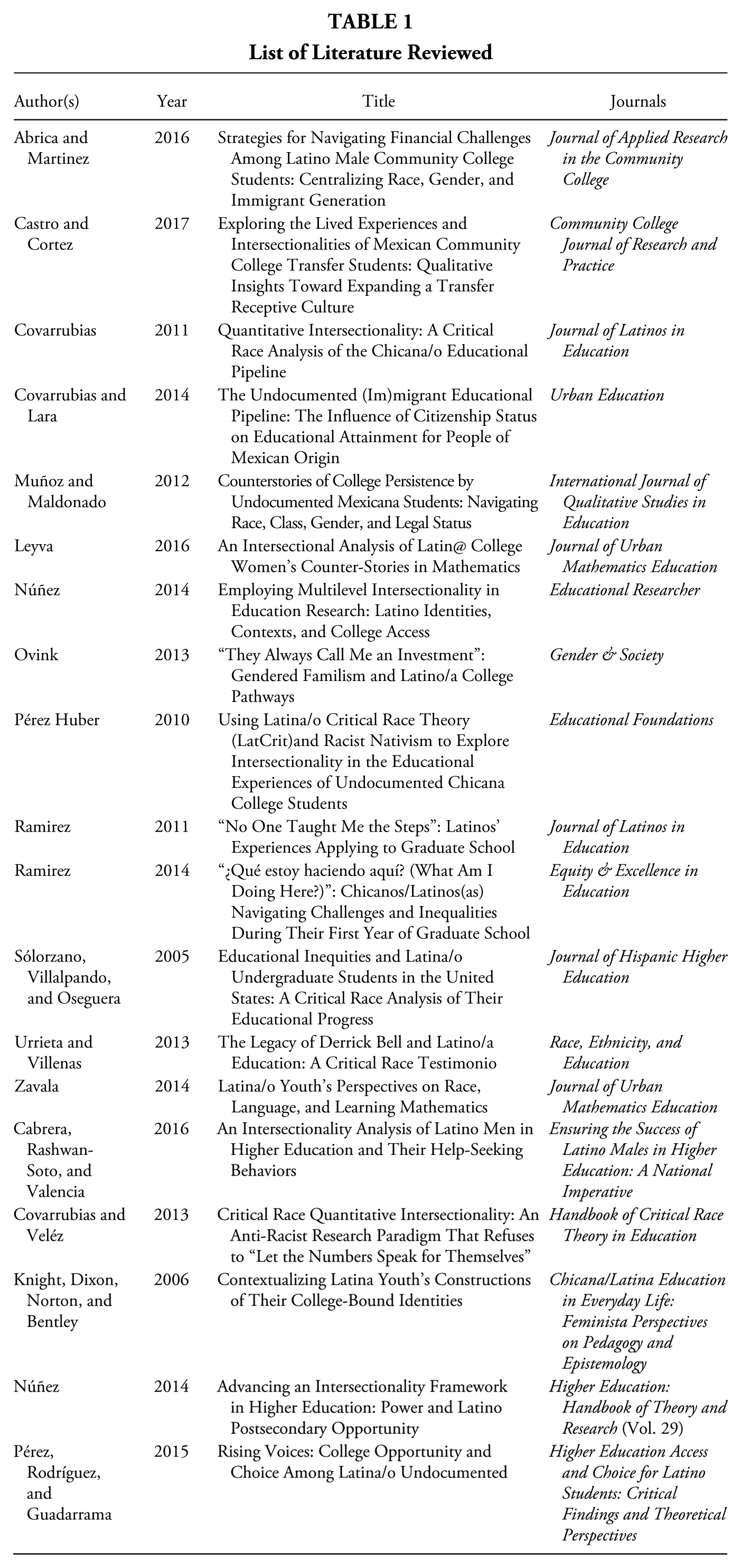
The computer-aided qualitative coding software NVivo was used to help analyze the body of work. Two guiding questions were used to shape the initial coding categories:
How have intersectional analyses produced knowledge about the ways Latina/o and Chicana/o students experience educational sites, trajectories, policies, and practices?
What are the theoretical and methodological implications of the concept of intersectionality when used to study the educational experiences and realities for Latina/o and Chicana/o students’ education?
For the first round of coding, excerpts from every article or chapter that corresponded to these two categories were flagged, creating two broad sets of data: knowledge produced and theory/method. These initial groupings were then further refined. All the excerpts identifying the knowledge produced about Latina/o and Chicana/o students were reexamined to discern patterns that would help categorize the findings and focus of each article. NVivo was once again used for this second level of coding. Items categorized included findings about the day-to-day challenges Latina/o or Chicana/o students navigate, the coping strategies they engaged, and the matrices of power at play engendering the circumstances under study. This grounded theory approach resulted in the three aforementioned focal areas: individual coping strategies, institutional practices, and structural causes. The second set of codes flagged the theoretical frameworks used and the methods employed, revealing commonalities in these approaches. It also identified items such as the particular population studied (Latina females, Latino males, undocumented, high school youth, working class, etc.), the educational site scrutinized (high school, community college, university), purpose of study, and distinct educational issue (college going, college access, college choice, educational attainment, community college transfer, etc.) to help better understand the purview of intersectional analysis regarding Latina/o and Chicana/o students. The section below outlines these findings.
Foci of Intersectional Analysis: Individual, Institutional, Structural
Several insights emerged from the extant research applying an intersectional analysis. These are discussed below in four sections. The first section discusses the ways scholars have documented the various strategies Latina/o and Chicana/o students use to negotiate the ebb and flow of power that can both privilege and subjugate. The second section highlights research that attempts to make visible the institutional machinations that can benefit or harm Latina/o or Chicana/o students depending on context and positionality. A third section examines scholarship that deconstructs the structural, historical, and ideological components of the imbricating matrices of power that scaffold both the layered identities and the educational opportunities of Latina/o and Chicana/o students. The final section reviews the methodologies and theoretical frameworks informing and driving the intersectional analysis reviewed here, underscoring the development of a methodological framework drawing from quantitative and qualitative approaches, and a conceptual framework as distinct approaches for intersectional analysis of Latinas/os, Chicanas/os, and other students of color.
Coping Strategies
A significant amount of the current research using intersectional analysis maps out the navigational or coping strategies Latina/o and Chicana/o students engage to mitigate experiences of disenfranchisement and/or capitalize on instances of privilege via their educational journeys. Together, these studies reveal the contradictions in the array of tactics used by Latina/o and Chicana/o students to navigate these conditions, as not all students countered intersectional forms of oppression in an antihegemonic manner, even when they intuit the injustices they endure. For example, Knight et al. (2006) analyzed a bricolage of texts produced by three young girls for the dominant ideologies about their identities and educational capabilities, as well as the ways the girls acquiesce or challenge them. The authors found that the girls exhibited a multitude of identities that are fashioned and repositioned among overlapping oppressive structures—which include sexist interpretations of their bodies, capitalist expectations about their labor, and nativist understandings about their Latinidades. 4 Muñoz and Maldonado (2012) examined narratives of resistance shared by undocumented Latinas, noting the ways these strategic discourses allow them to develop positive self-images that allow “them to hang on to their academic aspirations, to persist in college, and to envision and pursue the possibility of success” (p. 293) but also at times reinscribe dominant narratives. For instance, the authors found that many undocumented students take pride in knowing Mexican history and traditions, challenging how this knowledge is discounted in the United States. Nonetheless, their participants echoed their Anglo U.S. peers in minimizing racism as merely resulting from an individual’s ignorance rather than being institutional and systemic.
In studying the ways Latino college students overcome financial difficulties, Abrica and Martinez (2016) plotted three different persistence strategies—conditional, meritocratic, and transformational—based on the level of critique against racial oppression or meritocracy. For example, participants who invested in developing business plans and acquiring financial capital to solve their money woes “expressed limited racial understanding and emphasized the need to be associated with Whiteness,” whereas those who identified campus resources as a way to offset these financial challenged more readily offered “a critique of racial oppression and deeper racial understanding,” (p. 66). Leyva (2016) found that Latina STEM majors often held success-oriented beliefs that both marginalized and empowered their understanding of themselves as capable math students. In her quest to understand “the mathematical agency of Latina/o students,” Zavala (2014, p. 62) found that both Spanish-dominant and English-dominant high school–aged Latina/o students “most-often adopted a colorblind stance” (p. 66) about their own mathematics identity, stating that race did not matter in their own learning but drew from racialized narratives to make sense of the overachievement of Asian students in math. However, at times, they recognized that their immigrant status and years in the United States affected their mathematics experiences, revealing a contradictory and uncritical assessment of the power dynamics in a math classroom.
A couple of studies suggest that some coping strategies used by Latino/a students can be fueled by a critical consciousness. Ramirez (2014) used the notion of transformational resistance (Solórzano & Delgado Bernal, 2001) to describe the ways Latina/o and Chicana/o graduate students circumvent overlapping instances of racism, sexism, ghettoization, and classism they encountered during their first years. Ramirez paid particular attention to the struggle students with working-class Latino backgrounds faced socializing to the middle-class White milieu of graduate school—as initially both race and class markers made them feel as if they did not belong in a graduate school program. To counter these feelings of isolation and alienation, students formed “peer support networks,” accessed “faculty mentorship and support,” established “academic counterspaces” (Yosso, 2006), joined “Chicano/Latino(a) and women’s organizations on campus,” and/or avoided “interactions on campus with individuals perceived as hostile and toxic” (Ramirez, 2014, p. 179). Lastly, professors Urrieta and Villenas (2013) reflected on the intersectional forms of power they faced during their respective educational journeys, as well as the privilege and marginalization they face as a result of their faculty positions. For instance, as students, Urrieta and Villenas both experienced racism against their indigeneities and Latinidades, classism as a result of their working-class origins, and Eurocentrism and colonialism as products of whitestream educational institutions. As professors, they now leverage their multiple identities in ways unavailable to them before, but they are not impermeable from various forms of subjugation. For example, Villenas had to learn to balance being a middle-class professional with a newborn child at a conservative institution with no parental leave, while Urrieta battled racial micro aggressions as a result of the privileged White students who challenged his authority, abilities, and antiracist pedagogy and curriculum. Given the range of coping strategies Latina/o and Chicana/o students employ revealed by intersectional analysis, educators could use these finding to imagine pedagogical interventions that teach Latina/o and Chicana/o students socially conscious and self-preserving coping strategies for navigating the structures of power that shape their educational trajectories.
Institutional Practices
A second major theme in the intersectional research reviewed here is a focus on the educational practices, policies, curricula, or pedagogy that marginalize or empower Latina/o or Chicana/o students. In particular, these include the types of academic preparation, resources, or campus climate that Latina/o and Chicana/o students navigate as they pursue higher education. Intersectional analysis with this particular focus makes visible the ways institutional practices can either enfranchise or disenfranchise Latina/o and Chicana/o students, allowing scholars to draft recommendations that institutions can adopt to enable Latina/o and Chicana/o students to succeed.
For example, in her work with Latina/o and Chicana/o graduate students, Ramirez (2011) identified the institutional barriers hampering Latina/o and Chicana/o student success that result from the transections of racism, patriarchy, classism, ethnocentrism, and nativism. These include a lack of information about graduate school, the biased GRE entrance exam, and the absence of mentoring from counselors and faculty. As an implication of her research, she advocated that institutions design supportive programs that account for the “multidimensionality of Latino college choice process” (p. 220) to mitigate these constraints. When analyzing the college decision-making process for undocumented Latina/o students, Pérez et al. (2015) found that Latina/o students often lack college-going preparation because a lack of citizenship channels their parents into the low-wage labor market and relegates them to underfunded and underresourced schools. The underresourced schools many Latina/o and Chicana/o students attend function to limit college-going options for undocumented students, but, Pérez noted, these conditions can also serve to positively motivate undocumented students to pursue college as a way to give back and better the quality of life for their family members and larger community. Moreover, the authors noted that undocumented students seek affordable options for college that allow them to remain close to familial support. As members of families who endure the convergence of racism, classism, nativism, linguicism, and xenophobia in their daily lives, a close-knit support system is a survival mechanism to navigate these conditions, and a key consideration for Latina/o and Chicana/o students who are encouraged to pursue higher education. Lastly, Castro and Cortez (2017) interviewed Mexican-origin community college transfer students to shed light on how the transfer-receptive culture—that is, “the collective practices and norms of an institutional environment as well as the discursive habits and narrative logics that drive institutional thinking” (p. 89)—of the receiving university hinders the acculturation process for this group of students. The authors argue that the onus should be on the institution—not on the student—to change by tailoring a transfer-receptive culture unique to its needs.
Structural Forms of Oppression
A third focus of the intersectional analyses reviewed here specified the forms of intersectional oppression frequently experienced by Latina/o and Chicana/o students. One of the contributions of this research is the vernacular scholars have proposed to distinguish the ways larger hierarchies of power shape Latina/o and Chicana/o students’ experiences: the privilege paradox, the citizenship continuum, gendered familism, racist nativism, and internalized racist nativism. These concepts are fleshed out below.
Cabrera et al. (2016) investigated the structural causes for the increasing underrepresentation of men of color in higher education. Because this issue lies along the fault lines of both advantage and disadvantage, intersectional analysis allowed the authors to interrogate Latino masculinity as a power dynamic balanced on both colonization and patriarchy, problematizing the benefits Latino men may derive through this gendered identity. The term privilege paradox refers to the contradiction that Latino students would be “systemically marginalized via their racial/ethnic identity, much like all other non-White racial/ethnic groups” yet synchronously “systemically privileged relative to women in terms of their gendered identity” (Cabrera et al., 2016, p. 75). This study elucidated the intersectional tension that men of color experience as a result of their ethnoracial identities and hegemonic Western and colonial ideas of masculinity, pressures that work in tandem to impede Latino males from seeking help to navigate hostile campus climates, resulting in the decreased numbers of Latino males pursuing higher education.
In their work disaggregating the educational attainment rates of undocumented Latina/o students from documented (U.S.-born or naturalized) Latinas/os (a study and methodology more fully discussed in the next section), Covarrubias and Lara (2014) found that the closer Latina/o students are to idealized notions of U.S. citizens, that is, “American-born, English-speaking, Christian, mostly White” (p. 98), the more likely they are to graduate from high school, enroll in college, graduate from college, and pursue graduate or professional degrees. They advance the idea that a citizenship continuum operates systemically to “wield[s] its own power and exert[s] its own impact” (p. 97), privileging some Latinas/os and disadvantaging others. They argue that the notion of citizenship operates concurrently with the hierarchical systems of race, gender, religion, sexuality, and so on and requires more theorizing to better account for the challenges it holds for those students.
Ovink (2013) tracked the college-going behaviors of Latina/o high school youth and found that gender and racial/ethnic cultural beliefs intersected to influence the respondents’ attitudes, behaviors, and college-going pathways. She found that many Latina/o students trust that a college education will lead to social mobility for themselves and their family members. However, Latinas desired greater economic means for their current family unit (parents, siblings, cousins, grandparents, etc.), while Latinos hoped to achieve mobility for their future families (wife, children). Moreover, for Latinas, a college degree ensured autonomy and independence, preventing financial dependence on men, whereas Latinos already assumed a sense of independence and freedom as college-going students. In addition, Latinas indicated that romantic relationships distracted from educational success, but for Latinos, romantic relationships often kept them persisting toward their degree. According to Ovink, these differences “revealed the intersectional influence of Latino/a and gender beliefs—or gendered familism—on life course decisions and college pathways,” (p. 271). Ovink’s concept—gendered familism—complicates familism, or “a social pattern that privileges family interests above those of the individual” (p. 267), often associated with Latino/a groups, as a factor affecting the college-going choices of Latina/o and Chicana/o students. With her intersectional analysis, Ovink differentiated the effects of a Latino cultural norm, systemic patriarchy, and Eurocentric ideals of educational attainment for Latinas/os and Chicanas/os.
Lastly, two additional conceptualizations of interlocking forms of oppression are the constructs of racist nativism and internalized racist nativism (Pérez Huber, Benavides Lopez, Malagon, Velez, & Solorzano, 2008). Racist nativism names the convergence of these two interrelated ideologies of power to assign values to real or imagined differences, in order to justify the superiority of the native, who is to be perceived white, over that of the non-native, who is perceived to be People and Immigrants of Color, and thereby defend the right of whites, or the natives, to dominance. (Pérez Huber et al., 2008, p. 43)
Pérez Huber (2010) applied an intersectional analysis to discover how racist nativism becomes “layered with class and gender at particular moments in” the educational trajectories of undocumented Latina college students (p. 82). She offered examples of racist nativism—such as when her participants recalled particular painful moments when they felt unsafe, outnumbered, frightened, and/or targeted as a result of anti-immigrant discourses espoused by authority figures in school settings. When this rhetoric is infused with commentary about Latina women purposely seeking to have “anchor babies” and draw on social services, it exemplifies they ways racist nativism traverses with gender and sexism. Furthermore, Pérez Huber argued that a “racist nativist class structure” relegates the college-educated parents of these undocumented women to low-wage labor market, erasing the “educational capital” the women’s parents attained and consigning their children to schools that lacked “educational resources and quality teachers, decaying school facilities and limited college access” (p. 87). Also, because undocumented Latinas often have work to pay their college tuition, they are often unable to participate in programming on campus that could aid in their persistence, a systemic disadvantage Pérez Huber claims is rooted in the convergence of class and racist nativism.
Lastly, Pérez Huber theorizes internalized racist nativism to account for the ways members of Latina/o communities adopt racist nativist logics. She argued that the normalization of a racial hierarchy predicated on White supremacy in both mainstream media content and the U.S. educational curriculum results in many Latina/o and Chicana/o students internalizing these beliefs and perpetuating them by repeating racist nativist language or ideas—such as calling other classmates “beaners,” teasing about the arrival of la migra (Immigration and Customs Enforcement or border patrol), and mocking accented English.
In this set of intersectional analyses, attention to the structural power dynamics seek to name multilayered forms of marginalization. Together, these concepts— privilege paradox, citizenship continuum, gendered familism, racist nativism, and internalized racist nativism—offer a specificity to the experiences of subjugation and empowerment that result from these interconnecting sources of power, arming Latina/o and Chicana/o students with a language that allows them to identify, understand, and, if necessary, subvert these circumstances. This scholarship also points to other cultural forces that have yet to be fully explored, namely, colorism, transnationalism, postcoloniality, diaspora, neoliberalism, capitalism, globalism, and imperialism. For instance, many waves of immigration from Mexico and Latin America are the result of neoliberal and imperialist policies (Gonzalez, 2011). Also, many generations of Chicanas/os have suffered displacement in a land that was once their homeland, as a result of continued colonization (Gonzalez, 2011). As these repressive conditions and doctrines have shaped and continue to shape the experiences of Latina/o communities across the North American continent, it is only appropriate to begin unmasking the ways in which they intersect in the lives of Latina/o and Chicana/o students.
Highlighting these three nodes individually allows an efficient means to expose the primary contours of intersectional analysis regarding Latina/o and Chicana/o students, but it does not intend to create rigid boundaries or divisions within this corpus of research. Additionally, by paying attention to the theoretical and methodological frameworks employed by scholars applying this approach, additional findings are revealed. The next section attends to these characteristics.
Theoretical and Methodological Frameworks
Assessing the characteristics of the 19 articles and 5 book chapters synthesized here revealed patterns in this scholarly work, as well as opportunities for additional applications of intersectional analysis. These patterns reveal the following: (1) that the diversity, or intracatergorical intersectionality (McCall, 2005), that comprises the Latina/o community has yet to be represented in this sample; (2) that the entirety of the P–20 educational trajectory has yet to be studied through this lens, as most studies focus on high school (Knight et al., 2006; Leyva, 2016; Ovink, 2013; Pérez et al., 2015; Zavala, 2014), college (Abrica & Martinez, 2016; Cabrera et al., 2016; Castro & Cortez, 2017; Muñoz & Maldonado, 2012; Pérez Huber, 2010), or graduate students (Ramirez, 2011, 2014); (3) that the theoretical frameworks have remained rooted to a race-based or gender-based orientations; and (4) that qualitative methods—primarily interviews—are the most frequent methods for this work. Indeed, two different frameworks—a methodological approach called CRQI, or critical race quantitative intersectionality (Covarrubias, 2011; Covarrubias & Lara, 2014; Covarrubias & Veléz, 2013) and a conceptual model named the multilevel model of intersectionality (Nuñez, 2014a, 2014b)—have been proposed to help broaden the methods and research designs used in intersectional analysis. These frameworks and the insights they offer will be discussed below.
Although intersectionality is often critiqued as research that merely subdivides marginal groups rather than transforming unjust social conditions (Carbado, 2011; Cho et al., 2013), the particular groups studied in this corpus of work instead illustrate the value of this nuanced analysis and, in fact, leave room for additional gradations for study. In particular, three articles focused exclusively on undocumented Latina/o students (Muñoz & Maldonado, 2012; Pérez et al., 2015; Pérez Huber, 2010), four studied only Latinos (Abrica & Martinez, 2016; Cabrera et al., 2016), and another three only examined the educational experiences of Latinas (Knight et al., 2006; Leyva, 2016; Zavala, 2014). The intersectional analysis Covarrubias developed to disaggregate educational pipeline data (Covarrubias, 2011; Covarrubias & Lara, 2014; Covarrubias & Veléz, 2013) exemplified the ways Latinas/os and Chicanas/os can be subdivided into groups that account for their generational status, citizenship, income level, and gender, yet few other scholars examined groups along additional axes, including sexuality, phenotype, or language abilities. In addition, very few other Latinidades (beyond Mexican, Mexican Americans) have been studied along class, language, gender, or sexual orientation. Given the common application of intersectional analysis to recognize how all these aspects of identity affect educational experiences, it seems warranted for there to be additional work along these key identity markers. Intersectional analysis would also be a useful tool to examine the experiences of other types of Latina/o or Chicana/o students, such as elementary or middle school Latino students, English-language learners, students who have been pushed out of high school or into alternative tracks, or high-achieving high schoolers.
The limited number of issues studied through an intersectional lens also points to prospective areas to research. Only one article focused on the experiences of Spanish-speaking Latina/o high school youth in their mathematics classrooms (Zavala, 2014). The rest of this research was focused on higher education. For example, this work examined either the college selection process (Knight et al., 2006; Ovink, 2013; Pérez et al., 2015; Ramirez, 2011) or Latina/o and Chicana/o students’ various experiences navigating a college environment (Abrica & Martinez, 2016; Cabrera et al., 2016; Muñoz & Maldonado, 2012; Ramirez, 2014) or college math courses (Leyva, 2016). Another article examined the transfer process from community college to a 4-year university (Castro & Cortez, 2017), and one investigated the intersecting layers of power structures shaping the K–20 educational trajectories of its participants (Pérez Huber, 2010). A final article applied intersectionality to understand how two scholars of color experienced, learned about, researched, and navigated being both marginalized and privileged as first-generation college students, graduate students, junior faculty, and tenured professors (Urrieta & Villenas, 2013). College-going and persistence have been most often studied, but many other possibilities remain: inquiries regarding how Latina/o or Chicana/o students of all ages might come to understand and/or use the tool of intersectionality toward increased educational success, whether colorblind ideologies in K–8 public school curricula allow for students to embrace multiple identities, whether working-class third- or fourth-generation Chicanas/os who are not fluent Spanish speakers and do not have strong ties to Mexico or Latin America find saliency between their identity and educational achievements, or how queer Latina/o or Chicana/o students navigate both racist and heteronormative educational policies.
Fittingly, critical race—or gendered—theoretical frameworks were often combined with intersectional analysis in this body of work. Twelve of the articles evoked critical race theory (Covarrubias, 2011; Covarrubias & Lara, 2014; Covarrubias & Veléz, 2013; Leyva, 2016; Muñoz & Maldonado, 2012; Pérez Huber, 2010; Urrieta & Villenas, 2013; Zavala, 2014) or critical race theoretical constructs like social capital or community cultural wealth (Abrica & Martinez, 2016; Pérez et al., 2015; Ramirez, 2011), counterstories (Leyva, 2016; Zavala, 2014), transformational resistance (Ramirez, 2014), micro agressions and racial battle fatigue (Cabrera et al., 2016), and a transfer-receptive culture (Castro & Cortez, 2017) guided by the tenets of critical race theory (Jain, Herrera, Bernal, & Sólorzano, 2011). A few also coupled intersectionality with Latino critical race theory (Leyva, 2016; Muñoz & Maldonado, 2012; Pérez Huber, 2010; Urrieta & Villenas, 2013; Zavala, 2014), Chicana feminist epistemologies (Knight et al., 2006; Pérez Huber, 2010; Urrieta & Villenas, 2013), or other multiracial or multicultural feminist theories (Knight et al., 2006; Ramirez, 2011). Leyva (2016) drew on poststructural theory and its conceptualizations of discourse and power to help him analyze the counterstories he collected. Clearly, there is an opportunity to draw on queer theory, class theories, or disability theories as additional pivot points for intersectional analyses of the educational experiences of Chicana/o and Latina/o students.
Similarly, the methodologies employed for intersectional analysis are primarily qualitative in nature. Twelve out of the 19 articles analyzed for this section relied on interviews (Abrica & Martinez, 2016; Cabrera et al., 2016; Castro & Cortez, 2017; Leyva, 2016; Muñoz & Maldonado, 2012; Ovink, 2013; Pérez et al., 2015; Pérez Huber, 2010; Ramirez, 2011, 2014; Zavala, 2014). Some of the interviews were conducted over a period of time—revisiting the same participants at different points along their trajectories (Abrica & Martinez, 2016; Ovink, 2013; Pérez et al., 2015; Zavala, 2014)—while the rest were only interviewed once. Two incorporated testimonio methodology 5 as part of their data collection and analysis (Pérez Huber, 2010; Urrieta & Villenas, 2013). A few interviews were coupled with focus groups (Abrica & Martinez, 2016; Leyva, 2016; Muñoz & Maldonado, 2012; Pérez et al., 2015; Zavala, 2014) and a written questionnaire or reflections (Leyva, 2016; Ramirez, 2014). One analyzed a mélange of student-produced text and data to understand the various critical literacies Latina youth engage to make sense of their college-aspirant identities (Knight et al., 2006). Given the overreliance on interview data, it is likely that other forms of qualitative and quantitative approaches—such as ethnographies, textual analysis, or even survey data—might provide additional approaches to intersectional analysis of the experiences of Latina/o and Chicana/o students.
Notably, several scholars employing an intersectional analysis advanced a distinctive quantitative methodology as a way to expand the scope and breadth of intersectional scholarship (Covarrubias, 2011; Covarrubias & Lara, 2014; Covarrubias & Veléz, 2013; Sólorzano et al., 2005). The next section provides an overview of these efforts.
A Quantitative Approach to Intersectionality
Scholars have sought to construct a comprehensive picture of the ways various Latina/o and Chicana/o subpopulations navigate schooling to earn high school, college, and graduate degrees. Driving this strand of scholarship is an emerging quantitative intersectional analysis methodology that functions to disaggregate data initially used to craft an educational pipeline of U.S.-based Latina/o and Chicana/o communities (Sólorzano et al., 2005; Yosso & Solórzano, 2006).
Sólorzano et al. (2005) first proposed the educational pipeline based on an analysis of Census data used to visually illustrate the points along the K–20 academic trajectory that push out Latina/o students, and result in lower retention and persistence rates in comparison to the educational achievement of other racial and ethnic groups. The initial project delineated separate pathways for Chicana and Chicano students in addition to mapping out the pathway for both male and female Chicano students—suggesting an intersectional analysis—and it proved to be a critical cornerstone for scholarship critiquing the practices and policies within educational institutions that adversely affect the educational attainment rates of Latina/o and Chicana/o communities.
Covarrubias (2011) and others (Covarrubias & Lara, 2014, Covarrubias & Veléz, 2013) have built on this pivotal work to launch a thread of intersectional analysis that problematizes the Census umbrella terms for Latina/o and Chicana/o communities because of the way these labels conflate third-generation U.S.-born Chicanas, first-generation working-class Latina/o immigrants, middle-class naturalized Mexican American citizens, and undocumented Mexican male students into a skewed and homogenized depiction of these communities. Instead, Covarrubias and his collaborators (Covarrubias, 2011; Covarrubias & Lara, 2014; Covarrubias & Veléz, 2013) have developed CRQI, a framework and methodology to disaggregate Census data and identify academic pathways that are contingent on the unique intermingling of race, gender, class, and citizenship for people of Mexican origin. Informed by the tenets of critical race theory, its working definition is the following: An explanatory framework and methodological approach that utilizes quantitative methods to account for the material impact of race and racism at its intersection with other forms of subordination and works toward identifying and challenging oppression at this intersection in hopes of achieving social justice for students of color, their families, and their communities. (Covarrubias & Veléz, 2013, p. 276)
The goal of this approach is to heighten the understanding that while Latina/o and Chicana/o communities have been burdened by a “racial tax” (Carbado, 2011, pp. 1608–1609) that underwrites the privileges afforded to Whites, other forms of oppression—such as class, citizenship status, colorism, or linguicism—acting in conjunction with endemic racism affect different segments of Latina/o and Chicana/o communities distinctly. In their explication, Covarrubias and Vélez (2013) lay out five principles for conducting CRQI. The first premise is that intersectionality is a tangible, measurable element constituted through the confluence of socially constructed identity categories “by which society and its institutions disseminate resources, status, and power, often privileging one group over all others, but arranging all in existing interlocking hierarchies” (p. 277). CRQI, then, seeks to quantify the condition created by these mechanisms.
The second tenet is rooted in work by Zuberi (2001) and Zuberi and Bonilla-Silva (2008) that problematizes the origin and trustworthiness of statistical methods in the social sciences. Specifically, Zuberi (2001) argues that . . . the white supremacist, Eugenicist movement in the U.S. after emancipation led to the development of the modern fields of statistics, genetics, demography and psychology, in order to affirm and rank racial categories. The data, its analysis, methods, and dissemination were flawed and biased from the beginning. (p. 277)
Therefore, transparency and a mindfulness about these histories should guide the “collection, computation, analyses, and reporting of” numerical data and statistics (p. 277).
Third, the experiential knowledge of the researcher conducting CRQI should help ground the analysis of the numerical or statistical data at hand. Whether it is channeled as a form of cultural intuition 6 (Delgado Bernal, 1998) or resulting from experiences of activism, these memories and ways of knowing should guide the analytical process. This principle aligns with the critical race theory tenet that asks scholars to center the experiences of those at the bottom (Matsuda, 1995); however, Covarrubias and Vélez (2013) urge that when studying intersectionality, scholars remain cognizant that “the bottom” does not pivot on a single axis of domination, like race, but rather is a fluctuating and relative space depending on the context, history, and power relations at play.
The fourth and fifth tenets replicate core precepts of critical race theory, such as the call for praxis and inter- and transdisciplinary work. As such, CRQI scholarship similarly aims to improve the educational conditions of the Latina/o and Chicana/o students it studies. Lastly, scholars should draw from a multitude of disciplinary traditions to shore up the transformative and explanatory value of CRQI findings.
CRQI framework proposed above seeks to add an additional tool for intersectional analysis in order to map out undulations of various hierarchical and systemic power structures. While still an emerging framework, it seeks to bridge the qualitative work that comprises the majority of critical race theory scholarship with quantitative research, in a way that aligns with critical race theory’s core tenets and critical stance on objectivity, yet resists a reliance on race, racialization, or racism as the single factor engendering subordination. For instance, while the original pipeline (Sólorzano et al., 2005; Yosso & Solórzano, 2006) indicated that overall, about 56 out of 100 Chicanas/os graduate high school each year, Covarrubias’s (2011) found that annually, only one third of noncitizens earn a high school diploma and one half of Mexican-born naturalized citizens graduate from high school, while over three fourths of U.S.-born Mexican-origin students do. Thus, Covarrubias was able to quantify how the intersecting dimensions of race and citizenship status create distinct educational pathways for documented, naturalized, and undocumented Latinas/os.
This analysis (Covarrubias, 2011) also revealed the interplay of gender and class, with race and citizenship status and college degree completion. As a whole, more Chicanas enroll in college and earn college degrees than Chicanos, but when disaggregated by citizenship status, naturalized Chicanas and Chicanos enroll and complete college at the same rates. When controlled for class, Covarrubias’s (2011) intersectional analysis revealed that for all Mexican-origin students, educational attainment increases as class status increases. For example, 40% of Latina/o and Chicana/o students in the lowest income quartile graduate from high school compared with 84% of Latinas/os and Chicanas/os from the highest income quartile. Sadly, only 3 out of every 100 Latina/o and Chicana/o students in the lowest income quartile will earn a bachelor’s degree, while 30 out of every 100 Latina/o students in the highest income quartile will graduate from college.
In a follow-up study, Covarrubias and Lara (2014) used the same data set to take a more nuanced look at the educational achievement rates for the undocumented Latina/o and Chicana/o student population. They used the five existing Census citizenship categories to more accurately identify what portion of the Mexican-origin sample comprised undocumented Latina/o and Chicana/o students. Since four of the categories account for formalized citizenship (born in the United States, born in Puerto Rico, born abroad to U.S. citizen parents, and naturalized citizens), Covarrubias and Lara focused on the noncitizen category. They found that “U.S.-born Mexicans show significantly higher high school, college, and graduate school attainment rates, and higher enrollment rates in higher education than foreign-born and noncitizen” Latinas/os and Chicanas/os (p. 87). For Latina/o students who have citizen as a birthright and for those who are able to earn it through naturalization, reaching key educational transitions such as graduating high school was much more probable.
These findings also complicate the dominant narrative of the DREAMers, high-achieving undocumented Latina/o students who have proved their worth by excelling in school (Abrego & Gonzales, 2010). Certainly, highly educated undocumented students have effectively mobilized to claim a voice and space in the current sociopolitical discourse about immigration, and consequently have become idealized in mainstream discourse. However, Covarrubias and Lara (2014) illustrate that though DREAMers embody a small percentage of the undocumented student population (15 out of every 100) their dominant presence in the public discourse might inadvertently obscure the needs of the majority of the undocumented Latina/o student population.
These contributions to the literature using intersectional analyses are predicated on an understanding of “the complexity of intersectionality” and caution scholars that they need to avoid uncritically essentializing the Latina/o and Chicana/o experience, and instead consider how they might “expose more multifaceted relationships” (Covarrubias, 2011, p. 101) of power and privilege that simultaneously allow and limit access to education for this diverse ethno/racial community. Moreover, this methodology has also been employed for an intersectional analysis of Asian American students (Covarrubias & Liou, 2014), which holds promise for continued contributions from this model.
Multilevel Model of Intersectionality
The conceptual model proposed by Nuñez (2014a, 2014b), the multilevel model of intersectionality, attempts to capture the micro, meso, and macro levels of intersectionality to counter critiques that this “buzzword” merely heightens attention to difference and experiences across different social identities, “rather than [analyzing] the systems of power and oppression that shape these experiences” (Nuñez, 2014b, p. 85). Advocating the potential of intersectionality to both account for the “role of structure” and to capture individual experiences within multifaceted dynamics of power, Nuñez fashioned a template for such a task. Informed by Anthias (2013), Nuñez’s model has three nested levels, depicted as three concentric circles, with the first level at the core, the second encircling the core, and the third subsuming the other two. The first level of the multilevel model of intersectionality expresses multiple dimensions of identity salient to Latina/o and Chicana/o students, including immigrant status, class, and gender. Nuñez classified most intersectional research as typifying this level of analysis. None of the scholarship for this review would have been placed in this category.
The second level is divided into four quadrants—organizational, representational, intersubjective, and experiential—that represent the institutions, discourse, relationships, and sense-making that one’s multiple identities engage with. Organizational, for example, encompasses governmental laws and initiatives, school district– or school-level educational policies and practices, or procedures that regulate and track the mobility, access, and opportunities for Latina/o students. The representational quadrant refers to mass-mediated discourses that frame and perpetuate stereotypical and discriminatory narratives and imagery about the educability of Latina/o and Chicana/o communities that influence decision making about their educational paths. The intersubjective quadrant signifies the individual level judgements about Latina/o and Chicana/o students by teachers, administrators, classmates, and staff that fashion particular educational trajectories. The experiential quadrant refers to the ways Latina/o students process, reconcile, and/or internalize both positive and negative messages about their academic abilities. This last two quadrants correspond with two foci identified by this review: the focus on student coping strategies align with the experiential quadrant Nuñez describes, while the institutional practices that engender occurrences of intersectionality coincide with her intersubjective quadrant. Nuñez (2014a) posits that these four quadrants are meant to serve as departure points for analysis, and encourages researchers to “conceptualize these arenas differently, or identify other domains” (p. 90). She casts studies that engage this plane of analysis as resulting in a deeper understanding of “how individuals make meaning and perceive power structures in shaping educational experiences according to their multiple identities” (p. 50).
Lastly, the third level of this model denotes the historical and sociopolitical contexts that constitute the current conditions Latina/o and Chicana/o students endure, such as the “broader interlocking systems of economic, legal, political, media, and social power and classification that evolve over time in specific places, as well as social movements to challenge these systems” (Nuñez, 2014b, p. 89). Attention to this level allows researchers to note the social processes that engender the often fluid social categories of identity, such as the term we now understand as Latina/o; the role economic fluctuations have played in influencing the lived experiences of Latina/o and Chicana/o students, including their educational opportunities; or the legacy of the Chicano Civil Rights Movement that resulted in the formation and challenge of a Chicano Studies curriculum for Latina/o and Chicana/o students. The set of intersectional analysis reviewed here that contributed the concepts such as privilege paradox, gendered familism, and racist nativism best relate to this level in Nuñez’s model.
Nuñez (2014a) acknowledged that this model is “what sociologist Max Weber would call an ideal type,” and thus, unrealistic to enact singlehandedly. Nonetheless, she hopes that even if researchers do “not address all of the levels empirically” in their individual projects, “they can draw on literature that addresses other levels to help contextualize and interpret results” (p. 49), or that the model might inspire scholars “to attend simultaneously to social identities and contextual power structures” (p. 53). As of this review, no scholar had adopted this model for his or her research. However, the multilevel model of intersectionality illuminates the intricacies highlighted by intersectionality analysis by visually charting the processes that constitute interlaced positionalities and power structures that Latina/o and Chicana/o students weather in educational systems. While navigating the map Nuñez offers may require technologies and an acuity that have yet to materialize, this model is a useful guidepost for expanding the niche of intersectional research, and useful for bearing in mind the full spectrum of intersectional analysis.
Discussion/Conclusion
Several important contributions surfaced from the intersectional analyses reviewed here. This research revealed important focal points of interlocking oppression and privilege: at the level of the individual, at the level of institutional policy and practice, and at a structural level. Studies at the individual level disclosed contradictions in the coping strategies Latina/o and Chicana/o students used to manage the varied power relations they experience. Findings from research grouped at the institutional level detected barriers—such as financial aid policies limited to citizens—that are created by institutional policies and practices that disproportionately affect the educational trajectories of Latina/o and Chicana/o students because they are implemented within stratified systems of privilege. Findings from the set of intersectional analyses that examined the larger network of power dynamics resulted in a more precise understanding of these imbricated forces, with concepts such as racist nativism, internalized racist nativism, gendered familism, citizenship continuum, and privilege paradox. Researchers wishing to employ intersectional analysis should be careful to avoid homogenizing ethno/racial communities, and avoid assuming that all Latina/o and Chicana/o students are equipped with the critical awareness to navigate the barriers resulting from intersectional oppression. They can also rely on this literature to document the legacies of hierarchical ideologies like racism, sexism, and classism.
Revelations about educational pathways that are unique to Latina/o and Chicana/o subgroups resulted from a specialized quantitative methodological approach, CRQI, for disaggregating data. A second conceptual intervention, the multilevel model of intersectionality, illuminated the full spectrum of study available through intersectional analysis, and suggests a wide-scale approach to better assess these constitutive and interconnected processes. Moreover, this chapter uncovered the lack of diversity in the various Latina/o and Chicana/o populations studied with this framework. There was a concentration of intersectional analysis aimed at studying higher education but very little examining Latina/o and Chicana/o students in elementary and junior high or middle school. Race-based or gender-based theoretical frameworks are most often coupled with an intersectional analysis, leaving opportunities for other critical theories to ground such analyses. Lastly, the predominance of qualitative methods—primarily interviews—leaves room for other methods to be explored. As such, the groups studied, the issues addressed, the theories engaged, and the methods employed are indicative of an emerging field of work with considerable untapped potential.