




Abstract
This chapter reviews recent qualitative studies on personalized learning in middle/secondary school settings to analyze the role of culture in how this concept is enacted and researched. Personalized learning is posited as a pedagogical approach that aims to revolutionize schooling and challenge educational inequity by foregrounding learners’ agency in what and how they learn, tailoring pedagogy and its purpose to learners’ unique interests, needs, and abilities. Given the strong emphasis of the approach on the uniquenesses of the persons who are learning, our analysis interrogates the discourse on culture in studies on personalized learning and extrapolates how this discourse informs problem formulation, design and logic, sources of evidence, analysis and interpretation, and implications for practice. This review reveals a disconnect between the relevant literature on culture in learning and omissions of researchers and research participants’ cultural positionalities and identities. This appears to affect the quality of educational evidence, inhibiting a deep understanding of the implementation of the personalized learning approach for different communities of learners. We assert that research into practices that intend to meet the needs of diverse learners should center learner and researcher cultures and positionalities as part of a theory of change that permeates the entire research process.
To address the call by Review of Research in Education to interrogate assumptions of quality in research (Tocci et al., 2019), this chapter analyzes recent qualitative research on personalized learning (PL). PL is a pedagogy that centers learner agency, often using technology to tailor learning to students’ interests, needs, and abilities (Basham et al., 2016). As such, PL aims to disrupt traditional ways of schooling with a particular interest in the needs of diverse learners (S. D. Lee et al., 2019). Disrupting traditional schooling is crucial because of ongoing obstacles and injustices within the U.S. education system, which has historically served the needs of the dominant culture while marginalizing many culturally diverse Learners of Color (Hollins, 2015). Some of these inequities include policies that frame differences as deficits, inequitable access to college preparatory and advanced placement courses, racial disproportionality in school discipline policies; and limited access to instructional technology (Office for Civil Rights, 2019). These inequities have resulted in academic underperformance in schools that most often serve Black and Brown children (U.S. Department of Education, Institute of Education Sciences, 2019). While frequently framed as an achievement gap between Learners of Color and their White peers, such inequities are better described as an education debt owed to these Learners (Ladson-Billings, 2006).
Recently, the evidence-based paradigm has taken hold in social science research and practice (Farley-Ripple et al., 2018). Proponents of this paradigm position rigorous, high-quality, scientific, and evidence-based research as objective research methods with universal applicability regardless of context or researcher positionality (Bal & Trainor, 2016; Farley-Ripple et al., 2018; Reese, 2016). As a result, standardized and universal practices offered as technical solutions to the problems in underperforming schools have proliferated the educational landscape. These solutions often liken teaching to efficient business management and pose culture-neutral, “scientifically managed strategies” (Nash & Panther, 2019, n.p.) as quick technical interventions to problems rooted in deep structural inequities (Coffee et al., 2017). These fixes create an illusion of educational progress, but after systematically failing to deliver on their universal effectiveness toward educational equity, the search for new quick solutions continues.
To reenvision this system, and repay the education debt, scholars have invested in theorizing and analyzing comprehensive teaching methods that resist the reproduction of inequities, and forefront the importance of culture in school learning (Hollins, 2015). For example, culturally relevant (e.g., Ladson-Billings, 1994/2009), culturally responsive (e.g., Gay, 2010; Hollins, 2015), and culturally sustaining pedagogies (e.g., Paris & Alim, 2017) center learners in their sociocultural complexity while engaging questions of justice and equity. In addition, the research informing this work draws attention to the ways in which the intersectional power dynamics inherent in research processes themselves can inflict damage to the researched (Tuck, 2009).
Within this context, a promising educational approach called Personalized Learning has emerged as a new buzzword in education (Netcoh, 2017). PL aims to center the unique persons who are learning throughout the education process. Interested in the potential of this approach to critically center the heritage knowledge and agency of Learners of Color in what and how they learn as well as how they demonstrate mastery, we engaged in a critical content analysis (Utt & Short, 2018) of recent qualitative PL research. We asked the following research questions: (1) How does this research draw on available knowledge about culture in school learning and education research? (2) How does the role of culture in this research relate to the quality of educational evidence for culturally diverse communities of learners?
Based on that review, this chapter demonstrates how our ways of researching may affect implementation of pedagogical practices that aim to redress inequities within the existing education system. We argue that in research design and reporting, as defined by the American Educational Research Association (AERA) standards for social science research (AERA Task Force on Reporting of Research Methods, 2006), studies investigating pedagogical practices that aim to meet the needs of culturally diverse learners should center considerations of learners’ cultures and intersectional identities. Furthermore, we call on education researchers to engage in critically conscious research that involves iterative critical reflexivity about the power dynamics associated with their own and their participants’ intersectional identities.
Pedagogical Buzzwords and Researcher Responsibility
Influenced by the current evidence-based paradigm and state and national policy, lobby groups, institutions, corporations, and communities (Denzin, 2010; Nespor, 2006), pedagogical buzzwords like best practice, high leverage practices, science of reading, grit, word gap, achievement gap, culture of poverty, and trauma-informed teaching abound. While the pedagogical hype may position itself as a way to address educational inequity, seductive solutions that are researched through positivistic, deficit paradigms may cause further harm. For example, a decade of studies have critiqued the objective and culture-neutral framing and methodology of Hart and Risley’s (1995) research on the word gap between children and families from lower and higher socioeconomic status (Abraham, 2020; Adair et al., 2017; Baugh, 2017; Dudley-Marling & Lucas, 2009; Dyson, 2015; Kuchirko, 2019). Among its methodological flaws, the reporting and design of the original word gap research did not take the cultural lens of communities and researchers into account. Yet, this concept continues to dominate discourse and is widely cited in governmental reports and nearly a hundred thousand academic articles. Thus, it may serve as a cautionary tale of “objective” and culture-neutral research that propels educational hype. In this context, the opposite of critically conscious research is not objective research; it is research that is critically unconscious. Researchers have a responsibility to be accountable to the communities for and with whom they do research and to consider how pedagogical buzzwords like PL might forward damage-centered (Tuck, 2009) ideas about communities that have historically resisted systemic inequities.
Personalized Learning
Personalized learning is an educational approach that is quickly being labeled “the new buzzword for teaching practices” (Netcoh, 2017, p. 383). The promise of this technology-supported innovation to shake up standardized ways of teaching diverse learners, along with powerful educational (e.g., U.S. Department of Education) and financial endorsements (e.g., Gates Foundation and Chan Zuckerberg Initiative), have spurred rapid adoptions of PL in schools (DeMink-Carthew et al., 2017). Proponents of PL position this method as a way to battle critical flaws of the education system that has enabled “the achievement and attainment gap,” which “disproportionately affect[s] children and youth of color and those living in poverty” (S. D. Lee et al., 2019, p. 6). Clarke (2013) sees PL as a feasible way to reform education in response to growing population diversity and affordances of technological advances for learning. As noted, personalization is often envisioned to meet the needs of diverse learners.
PL entails basing education on learners’ agency and choice to inform what they learn, how they learn, and how they can demonstrate their learning, tailoring schooling experience to learners’ interests, needs, and abilities (Basham et al., 2016). While there is no agreed upon definition of PL, literature highlights its common features that share a collective goal of personalizing education based on student agency, such as PL pathways, instruction paced to students’ unique needs, student creation of learning activities, personalized assessment, student-designed pathway to mastery, “life ready” focus, skill and competency based focus, cross-curricular learning, and authentic learning outside the walls of school/connected to community (Basham et al., 2016; Clarke, 2013; Kim, 2012; Patrick et al., 2013). Different learning environments design and implement PL drawing on a combination of these characteristics. For example, Basham et al. (2016) identified various structures for student voice and feedback, highly self-regulated learners, transparent and actionable near-real-time data, and integrated purposeful supports as common features across several PL schools.
PL is intricately associated with technology to achieve this level of personalization (Kim, 2012; U.S. Department of Education, Office of Educational Technology, 2017). Huggins and Kellogg (2020) and Basham et al. (2016) call PL a promising technology-enabled practice needing robust research. However, technology is only a tool in PL environments, requiring more than just digital solutions (Basham et al., 2016; Clarke, 2013). Proponents of PL point out that understanding the whole person, their motivation, and goals in learning beyond processing and storing information is still lacking in the majority of online learning solutions (Martinez, 2001). In other words, PL overlaps with technology in education and online learning but is not synonymous. Interestingly, the role of technology has become more central to how this approach has been implemented in schools, at times to the detriment of the overarching core of PL vision (Rajendran et al., 2019). For example, a learner can be given a choice of which technological application to use to achieve a teacher-directed objective, which will be later assessed using standardized assessment practices (Pane et al., 2015; Walkington & Bernacki, 2019). It is important to note that several PL features exist outside of this approach. For example, individualization, competency-based learning, and experiential learning have been widely applied in schools and researched outside of PL scholarship (e.g., Clarke, 2013; Hansen et al., 2008). Thus, PL cannot be understood as a sum of its parts that are applied without the overarching purpose to nurture student agency that directly affects pedagogy and its purpose.
Basham et al. (2016) suggest that without research-based understanding, PL will be “haphazardly referenced, partially implemented, eventually demonized, and then viewed as an unrealistic fad in education” (p. 127). Fulfilling the goal of critically conscious education research, PL scholarship can affect practice and engage policymakers including the U.S. Department of Education and large Silicon Valley–based philanthropies investing in PL research.
The quality of PL research, and attention to how such research takes into account the culture of learners and researchers, then becomes paramount if it is to fulfill its promise of meeting the unique needs of all learners, especially those whose differences have been traditionally ignored or erased by the education system. Qualitative inquiry can be a means to fulfill this promise, as it seeks to understand and describe particular complex contexts (Berliner, 2002), affording an intimate look at the researched pedagogies’ cultural underpinnings. Since PL is gaining implementation hype, the research community has a responsibility to conduct research informed by the cautionary tales of “objective” research such as the word gap (Hart & Risley, 1995). However well intended, that kind of research powers the turn toward standardization and accountability (Tuck & Wang, 2014).
In the next section, we first reinforce the role of culture in education and discuss philosophical underpinnings of research in the social sciences. We then analyze the extent to which PL studies draw on that literature and how this awareness translates to assumptions of quality in education research. Finally, we draw implications for further PL qualitative research as well as policy recommendations for increasing research quality in general.
Culture in Educational Learning and Research
In this section, we reaffirm the role of scholarship on culture in education as relevant to research that aims to address educational inequities, highlighting the existing pedagogies that center, honor, and sustain cultures of learners. We also foreground the importance of critically conscious research that is aware of the subjective nature of scientific truth and its implications for knowledge production in unjust societies. This recognition is relevant to research on pedagogical innovations aimed at communities often researched through unjust subjectivity.
Centuries of research has taught us that people learn differently based on their home culture (Au, 1979; Cole, 1996; Cooper, 1892/1988; Gay, 2010; Genishi & Dyson, 2009; Hollins, 2015; Ladson-Billings, 1994/2009; Paris & Alim, 2017; Rogoff, 2003; Smitherman, 2000; Vygotsky, 1980; Woodson, 1933). Carol D. Lee (2017) calls for educators to develop fundamental understandings about the role culture plays in school learning—as fundamental as the study of content and human growth and development. Answering this call, this section outlines three key ideas about the role of culture in education: (a) Children learn differently based on cultural communities, (b) all cultures are not created equal in educational curriculum and policy, and (c) there are well-researched culturally situated curricula and pedagogical practices that reflect the constructive resilience of communities that have been resisting dominant ideologies in schooling.
Children Learn Differently Based on Their Cultural Communities
Humans participate in cultural communities in ways that evolve across lifetimes and in relationship with other communities (Gutiérrez & Johnson, 2017). Vygotsky’s (1980) sociocultural theory describes learning as reflecting the systems and properties of cultural communities. Critical perspectives on sociocultural theory extend its ideas into the sociopolitical realm, taking up concerns about power differentials in cultural communities (Gutiérrez & Johnson, 2017).
Hollins (2015) linked sociocultural theory to theories of information processing, illustrating the way culture frames information processing by selectively focusing attention, influencing schemata needed for encoding, and shaping meaning and perception (Hollins, 2015). Attention can be shaped by cultural practices; a child who has experiences with people who have a certain hair and eye color will give more attention to those features when describing or identifying people. The ability to encode information, or store information in long-term memory, is influenced by schemata, or the structure organizing chunks of information (Hollins, 2015; Schunk, 2012).
The meaning attached to information input is based on perceptions of patterns and relationships between phenomena. Pattern perception may be different based on cultural frames of reference and different ways of knowing. For example, high-context cultures (Hall, 1989) may form meaning based on holistic or top-down processes, while low-context cultures may rely on a sequential bottom-up process of constructing meaning (Hollins, 2015). Reading instructional approaches offer examples of these processes. Phonics-first instruction through systematic, sequential, mastery-based instruction is an example of a bottom-up process. Approaches that engage children holistically in talking, listening, reading, writing, and speaking in ways that connect to the home culture are examples of a top-down process (Hollins, 2015). These examples are illustrations of how culture mediates cognition (Gregory et al., 2004).
Cultural Mediation
Hollins (2015) describes culturally mediated instruction as applying culturally mediated cognition, culturally appropriate social learning spaces, and culturally valued understanding in curriculum. In authentic culturally mediated instruction, “schooling practices are an extension of the enculturation process found in the child’s home and local community” (p. 157). Culturally mediated instruction requires that teachers develop an understanding of students’ ways of knowing and being (Hollins, 2015).
However, since culture is syncretic, it is important for teachers to understand that it cannot be reduced to a set of static characteristics (Cole & Engeström, 1993). Within this cultural-historical perspective, culture cannot be conflated with race and ethnicity (Gutiérrez & Rogoff, 2003). Exiguous understandings of culture contribute to exiguous understandings of learning (Gutiérrez & Johnson, 2017). Yet narrow conceptions of learning are prevalent in analytic frames of education research as well as educational policies and curricula.
All Cultures Are Not Created Equal in Educational Curricula and Policy
School curriculum, instruction, assessment, and policies have historically been unjust, excluding and denying the languages and cultures of some students in favor of Western language and cultural values. For example, 19th-century antiliteracy laws in many states made it a criminal offense to teach Black, interracial, and enslaved persons to read or write (Monaghan, 1998). Legal policies enacted by the American Bureau of Indian Affairs Indian Boarding Schools systematically worked to “erase languages, parenting practices, and belief systems and replace” them with Western models (Long et al., 2016). Laws enacted in Texas and many other states banned Latinx people from speaking Spanish in public until the Bilingual Education Act of 1968. At the current moment, as wealthy parents clamor to place their children in public school dual language programs, Spanish heritage language speakers are told to speak English (Rosa & Flores, 2017).
Since there is truly no “cultureless” learner, when schools deny learners’ cultures via language-erasing or other similar practices, they default to the assumption that all students are White. In doing so, schools center the panoptic White gaze (Morrison, 1998), which seeks only to measure how students and teachers compare White middle-class standards (Paris & Alim, 2014). Schools thereby function as sites where children are enculturated into the rightness of English monolingualism and Western values (Lomawaima & McCarty, 2006). Denying and limiting education prevents access to the tools of power in society (Duncan-Andrade & Morrell, 2008; Nocon & Cole, 2009).
Culturally Situated Curricula and Pedagogical Practices
Nash et al. (2020) describe culturally situated curricula and practices using a metaphor of a family tree, invoked to suggest the way heritage and community-based, culturally relevant, responsive, and sustaining pedagogies directly link to a lineage of asset-based pedagogies, legal reforms and sociopolitical movements, and a multifaceted root system of Black, Latinx, and Indigenous scholarship and pedagogies. Delving deeply into the anatomy of the family tree, we consider literature about culturally situated teaching pedagogies such as culturally relevant, responsive, and sustaining pedagogies.
Culturally Relevant Teaching
Based on a 1992 study investigating the characteristics of effective teachers of African American students, Gloria Ladson-Billings (1995) offered that culturally relevant teaching nurtures students’ (a) competence in their own and at least one other culture, (b) critical consciousness regarding injustices, and (c) academic achievement. Culturally relevant teaching empowers students to critically question the role of educational process and content (Ladson-Billings, 1992). Teachers can rise above the damaging impact of dominant culture (Ladson-Billings, 1994/2009) by investigating and questioning unequal power dynamics (Ladson-Billings, 1995). Ladson-Billings asserts that the results of culturally relevant teaching cannot be defined narrowly by achievement represented by student test scores, but instead should be measured by student empowerment, maintenance of culture, and a high-quality learning community (Ladson-Billings, 2014, 2017). In fact, with others Ladson-Billings (2006) has called for reconceptualizing academic achievement gaps as education debts (Carter & Welner, 2013).
Culturally Responsive Teaching
Geneva Gay (2018) developed similar ideas about culturally responsive teaching, as that which increases achievement, critical consciousness, and knowledge of self and culture (Gay, 2018; Howard & Terry, 2011). Culturally responsive teaching concerns itself with students who are often pushed to the margins in schools and whose discursive styles are outside the dominant culture (Rueda, 2011). Gay (2018) argues for a pedagogical paradigm “that teaches to and through [students’] personal and cultural strengths” (p. 24), instead of expecting culturally and linguistically diverse students to assimilate into the dominant culture. Culturally responsive teaching starts with creating culturally congruent curriculum, instruction, and assessment. Exemplifying culturally responsive teaching, educators scaffold African American students’ understanding of literary text through cultural modeling (C. D. Lee, 2001) of linguistic discourse patterns.
Teachers’ worldviews influence their classroom practice. For example, Gay (2002) explains how symbolic curriculum in bulletin boards and other classroom displays teaches students about whom and what is valued and important. In order to be fully effective, teachers must be caring (Gay, 2018; Irvine, 2003; Nieto, 2004) and investigate their own cultural frames of reference as well as the cultures, and ways of being of their students (Grant & Asimeng-Boahene, 2006; McAllister & Irvine, 2002; Nieto, 2009).
Culturally Sustaining Pedagogies
Culturally sustaining pedagogies (CSPs) extend from the branches of culturally relevant and responsive teaching. Yet CSPs require teachers to “be more than responsive or relevant” (Paris, 2012, p. 95). A key distinction from culturally relevant and responsive teaching is CSPs focus on sustaining practices—not merely getting to know students or teaching a culturally relevant lesson, but institutionalizing this kind of teaching as the norm. CSP involves teachers in (a) critically and meaningfully centering dynamic community knowledge, (b) building on community input and agency, (c) historicizing instructional content, (d) fostering capacity to deal with internalized oppression, and (e) curricularizing these features in learning (Paris & Alim, 2017).
However, these pedagogical characteristics are not enough; teachers must also resist and replace policies and practices that are based on White, middle-class norms (Paris, 2012). Paris and Alim (2017) encourage educators to critically question their own teaching and the institutions in which they work.
If the goal of teaching methods such as PL is to personalize learning for unique diverse learners, then research on these learning strategies ought to draw on this well-established knowledge base about culture in school learning. In this way, educators and researchers can work to disrupt inequitable schooling practices and center multilingual and multicultural heritage and community practices and historicized texts through culturally situated pedagogies.
Knowledge Production in Unjust Societies: Culture in Education Research
In addition to integrating what is known about culture in school learning, pedagogical solutions positioned as a way to address educational inequity need to be studied through critically conscious research, which makes the role of culture transparent and explicit “in the logic of inquiry” from study inception to outcomes (AERA Task Force on Reporting of Research Methods, 2006, p. 33). Critically conscious researchers are aware of the potential implementation harm empowered by paradigms that delimit what counts as objective, scientific, rigorous, or high quality. At the same time, Denzin (2010) calls for researchers to engage in paradigmatic dialogue that honors knowledge production through collaboration that links diverging paradigms. Furthermore, this dialogue considers important questions about the subjective nature of scientific truth, who is producing knowledge, why, and what truths emerge from the research process.
Subjective Nature of Scientific Truth
Struggles with the concept of reality, which is socially constructed based on the philosophical and conceptual undercurrents of the time, are as old as humankind (Lincoln & Guba, 1985). Scientific knowledge is dialectical and responsive to the time and space of its construction (Kuhn, 1962). Scientific truth(s) are value-laden and situated in sociohistorical contexts and thus cannot be solely determined by objective criteria (Bal & Trainor, 2016; Farley-Ripple et al., 2018). These contexts are often political (Gieryn, 1995) and thus reflective of societal power dynamics: those admitted into the given field and those who might be systematically excluded. As Sandler and Apple (2010) point out, the social sciences often devalue the knowledge produced within racially and culturally marginalized communities while at the same time privileging knowledge constructed about those communities. As a result, populations constructed as minority, at-risk, urban, poor, gritless, and language deficient in the research milieu experience the effects of somebody else’s truths. Thus, many research studies, produced by outsiders looking in, are guided by an urgent, albeit damage-centered theory of change that reinforces metanarratives about the supremacy of Western, individualistic values and competitive notions of success (Leonardo, 2010; Tuck & Wang, 2014). In these studies, research is conducted on rather than with communities (Erikson, 2009). Some of the most egregious and widely known examples are highlighted in the Belmont report: Nazis conducting biomedical experiments on Jews imprisoned during World War II, African American men injected with syphilis to investigate the untreated course of the disease, Eugenics-based studies resulting in tens of thousands of African American women and men being sterilized (National Commission for the Protection of Human Subjects of Biomedical and Behavioral Research, 1978).
Tuck and Fine (2007) assert that Communities of Color have long been wary of this kind of damage-centered research. For example, “stories of teeth counting, rib counting, head measuring, blood drawn, bones dug up, medical treatment withheld” are a haunting outcome of research guided by White supremacist beliefs (Tuck & Fine, 2007, p. 159). Damage-centered research (Tuck & Fine, 2007) yields implications unrelated to the root of the problem, but this tradition continues today through studies that assume the inherent deficits/gaps of certain communities and propose hierarchical, simplistic, or cultureless solutions to fix them (Bal & Trainor, 2016).
Who Is Producing Knowledge?
In the social sciences, knowledge production connects to an implicit or explicit theory of change that permeates the entire research process or cycle, from conception to data collection and analysis, to implementation and dissemination (Tuck, 2009). If knowledge production is subjective, then the subject of the research process takes on a different kind of significance. Academia has been metaphorically called an “ivory tower” to critique the highly intellectual, impractical, and self-absorbed pursuits and epistemologies of its members. Considering the racial and ethnic composition of the professoriate, this metaphor takes on a new meaning (Reese, 2016). Delgado Bernal and Villalpando (2002) emphasize how the academy values and produces research that depicts deficits of People of Color while simultaneously labeling knowledge production by Researchers of Color as less rigorous. Their research echoes other studies that show that when Scholars of Color investigate culture, race, or racial inequities, it is often perceived as unscientific, racialized, and biased (Bal & Trainor, 2016; Barclay, 2012; Fenelon, 2003).
A recent preponderance of such studies is influenced by institutionally sanctioned definitions of rigorous, high-quality, scientific, and evidence-based research (Bal & Trainor, 2016; Farley-Ripple et al., 2018). Definitions of rigorous and high quality were established and influenced by the legal actions and policies of the National Research Council, the No Child Left Behind Act/Every Student Succeeds Act, and the Institute for Education Sciences (IES). IES, established as the research arm of the U.S. Department of Education, made comparisons to the field of medicine to argue for generalizable education research that will lead to cures for the ills inflicting schoolchildren (Mayer, 2006). Globally and nationally, large-scale funders began prioritizing experimental studies (Farley-Ripple et al., 2018; Styles & Torgenson, 2018). Thus, the type of research likely to receive funding and be published has been significantly affected by constructs of rigor and high quality (Trainor & Graue, 2014).
Concerned with the assumptions inherent in these policies, national research organizations responded. The AERA Panel of Research and Teacher Education and the National Research Council Committee on Scientific Principles for Education Research (Towne & Shavelson, 2002) defined scientific education research criteria as that which (a) empirically investigated significant questions, (b) linked research to a conceptual framework, (c) designed methods that were appropriate to the question under study, (d) provided a coherent rationale linking evidence and theory, (e) shared findings across multiple studies, and finally (f) included professional review by the scholarly and community (Cochran-Smith & Fries, 2005; Feuer et al., 2002). They established standards for reporting on research including problem formulation, design and logic, sources of evidence, and analysis and interpretation (AERA Task Force on Reporting of Research Methods, 2006). In addition, the National Research Council emphasized the importance of varying methods and research questions in scientific research (Feuer et al., 2002). Yet, as the IES constrained funding of qualitative studies and prioritized dissemination of quantitative studies easily consumed by practitioners (Bal & Trainor, 2014; McDuffie & Scruggs, 2008; U.S. Department of Education, Institute of Education Sciences, 2013) qualitative studies have become heavily influenced by quantitative constructs.
Why Is Knowledge Being Produced?
Paradigms are human constructions, representing assumptions about epistemology, ontology, methodology, and ethical responsibilities (Denzin, 2010). The current evidence-based paradigm creates a false dichotomy between science and nonscience (Denzin, 2010) and a myopic conflation of science with method (Berliner, 2002). This is nothing new. Guised in the language of standardization, innovation, and accountability, the current evidence-based paradigm is rooted in an age-old philosophy of genetic determinism and White supremacy, constructed by the founders of Western psychology (Bal & Trainor, 2016).
Educational contexts differ depending on the humans in that context; each researcher, each student, teacher, and school is nested in fluid social networks (Berliner, 2002). Still, the dominant paradigm informing psychological and education research reduces learners to a compilation of skills, abilities, and interests and complex human contexts to independent variables of race, disability, and class, and free or reduced-price lunch (Bal & Trainor, 2016). Within this paradigm, researchers rarely critically reflect on their positionality and consider how it might cloud their interpretations or dehumanize their participants (Paris & Winn, 2013).
An additional issue in knowledge production within the current paradigm is the Anglocentricity of education research (Share, 2008). The majority of peer-reviewed journals are published in English. In a study examining articles in the peer-reviewed article database SCOPUS, Van Weijen (2012) found that 80% of the 21,000 articles from 239 countries were published in English. Prospective authors for whom English is not the primary language are given explicit recommendations to pay editorial fees to obtain submission up to journals’ standards (Van Weijen, 2012). This requirement virtually cuts off whole continents and countries of scientific thought.
What “Truths” Emerge?
There is a critical need to understand these persistent challenges and to design culturally situated and sustainable education research and practices that interrupt the conditions reproducing inequities (Bal & Trainor, 2016; Paris & Alim, 2017). Researchers who continue to conflate scientific rigor with singular methods, who document deficiencies of marginalized communities in search of interventions, only fuel unethical, damage-centered metanarratives (Tuck & Wang, 2014). Such research slows or halts knowledge generation in nondominant and marginalized cultural communities and may even result in communities accepting other people’s damage-centered truths (Tuck & Wang, 2014). In other words, researchers applying an operant damage-centered theory of change refuse to see people as part of dynamic cultural communities, and to see dignity in people’s everyday lives, constraining “the nature and possibilities of their practices” (Gutiérrez & Johnson, 2017, p. 249). Furthermore, the hierarchical, simplistic, or cultureless solutions that arise from damage-centered research are unrelated and disconnected from the root of the problem (Bal & Trainor, 2016). Tuck and Wang (2014) suggest that researchers should refuse the proliferation of such “truths,” fundamentally questioning what truths can emerge when communities are viewed as deficient and in need of interventions. To conclude, given the subjective nature of knowledge production and its long history of harm, research into pedagogical practices that aim to disrupt traditional schooling, such as PL, ought to consider who is producing knowledge, how, and why that matters.
Review Methodology
Interest in PL has been gaining momentum in recent years (Zhang et al., 2020). Spurred by this momentum as well as our own intellectual curiosity, which frames pedagogy at schools where Author 3 has taught, we set out to develop a deeper understanding of this approach. Since PL is often promoted for Learners of Color and those living in poverty regardless of race whose home culture may be outside of the dominant school culture (e.g., S. D. Lee et al., 2019), we were particularly interested in the way culture—ways of knowing and being in the world—was represented in recent PL research. In heeding our own council that researchers and “researched” are not cultureless, we will first describe our own positionalities and how they influenced this review.
Authors’ Positionalities
All four authors of the chapter are abled cisgender women. Racially, one author is Black and three are White. Culturally, two authors identify as European American of British, Irish, and mixed descent, one as Black American, and one as Russian. Linguistically, the team speaks English and Russian. Religiously, our team represents Baha’i, Orthodox Christian, Baptist Christian, and nonreligious worldviews. In terms of socioeconomic status, while two of us grew up in low socioeconomic status contexts, we all currently represent the middle class. Three authors were born in the United States and one is a first-generation immigrant. Three authors have children who attend/have attended public and charter schools in the United States (four Black multiracial, two White European American, and one White Russian American). Two authors are graduate students (PhD and MA) and two are university professors. Professionally, we have researched culture in school learning as it pertains to the experiences of refugees, urban contexts which primarily serve Learners of Color, and taught and parented at who have taught in pre-K–12 urban and urban-like schools that mainly serve Learners of Color (Howard & Milner, 2014).
Our lived experiences affect and bias our research curiosity, influence what we may notice and what we may miss, and shape how we may interpret what we see. For that reason, it was critically important to be continually aware of our positionalities, individual strengths and biases, as well as the power dynamics within the team. For example, the cultural diversity on the team allowed for deeper understandings of culture, resisting erasure of its significance in learning.
Selection Criteria
Our selection criteria were largely informed by relevance to our research questions and to teachers (like Author 3) implementing PL in their schools. Initially, we based our search on the following criteria: “secondary school settings,” and “personalized learning” in articles published in 2015 to 2019 within Academic Search Premier, Education Source, EBSCO, ERIC, Google Scholar, JSTOR, and MegaFILE databases. This search revealed more than a thousand non–peer-reviewed and peer-reviewed articles including a prevalence of reports on corporate funded research.
We then narrowed our selection criteria to peer-reviewed academic journals. This excluded a great deal of non–peer-reviewed scholarship meant for developers of educational technologies. We then mined these 200 titles to make sure all focused exclusively on middle/secondary grades and not college, early childhood, or elementary settings. From this sample of about 60, we focused on studies explicitly mentioning “personalized learning” to ensure that PL was the central phenomenon under investigation. Given PL’s challenges with definitions and implementation (Basham et al., 2016; DeMink-Carthew et al., 2017), we excluded articles that used related words such as “personalizing” or “personalization” or related practices like “individualization” “competency-based learning” or “experiential learning” “goal setting.”
To winnow this pool further, we then applied the term “qualitative research methodology.” Given our specific research curiosity about the role of culture in PL, we determined that qualitative studies, which seek to understand and describe particular complex contexts were most likely to yield descriptions of culture (Anfara et al., 2002; Berliner, 2002). Since an overwhelming majority of research on PL is conducted using quantitative or mixed methodologies (Zhang et al., 2020), our sample was dramatically narrowed by excluding quantitative and mixed-methods research. While mixed-methods studies incorporate qualitative methodologies, they often serve as a way to elaborate on quantitative data (Creswell and Plano Clark, 2017); thus these studies were excluded. This criterion winnowed our selections to 10 articles for close textual analysis. The table in Online Appendix A, available in the online version of the journal, provides detailed article descriptions including article purpose, context, participants, and researcher positionalities.
Method
In our review, we asked the following broad research questions:
How does qualitative PL research draw on available knowledge about culture in school learning and education research?
How does the role of culture in this research relate to the quality of educational evidence?
Drawing from qualitative critical content analysis methods (Utt & Short, 2018), we used literature as highlighted above, on culture in school learning and in research, as frameworks for interrogating explicit and implicit messages about culture in PL. We noted the presence or lack of discourse on culture, and the purposes of this discourse in study design and reporting. While content analysis is concerned with explicit patterns in text, critical content analysis drew our attention toward implicit or missing considerations of culture, intersectional identities, and power dynamics (Annamma, 2017).
Analysis
Following critical content analysis guidelines (Utt & Short, 2018), and the AERA Standards for Reporting on Empirical Social Science Research in AERA Publications (AERA Task Force on Reporting of Research Methods, 2006), data analysis unfolded in several phases. First, the research team read each article as a whole. Second, we closely read each article to extrapolate units of text for thematic analysis. Guided by our research questions, we selected text units that signaled culture. Specifically, we used keywords such as “culture,” “diversity,” “race,” “ethnicity,” “gender,” “language,” “SES,” “religion,” “ability,” “immigrant,” “refugee,” “urban,” and so on. Upon extrapolation of the relevant passages (i.e., our units of analysis), we engaged in collaborative meaning making of each granular instance, taking intensive researcher notes. We asked, “Which words did the researchers choose/did not choose to signal human and context differences?” “What meaning did researchers assign to the words they chose?” “What purpose did these words serve?” Table 1 illustrates implicit, explicit, or absent references in the reviewed articles.
References to Culture in Reviewed Studies on Personalized Learning
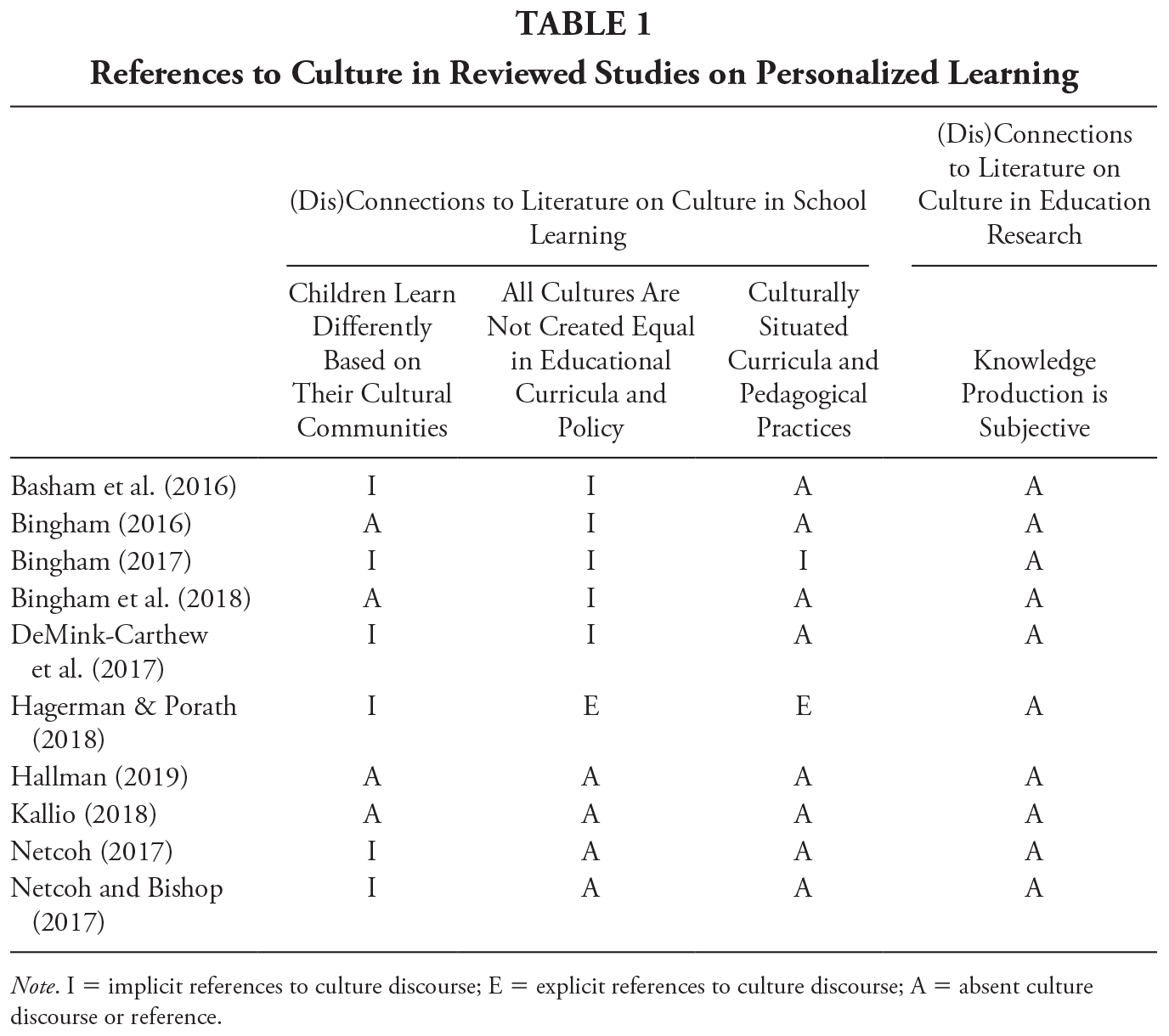
Note. I = implicit references to culture discourse; E = explicit references to culture discourse; A = absent culture discourse or reference.
We then reread articles as a whole, recontextualizing the relevant text units within the rest of the text, considering where in the research reporting culture appeared, disappeared, or was absent all along. For example, it was important for us to know how often and in which ways our keywords were present/absent in introductions versus methods versus implications of studies. Drawing on our theoretical frameworks, we engaged in interpretation, giving special attention to the problem formulation, design and logic, sources of evidence, analysis and interpretation (AERA Task Force on Reporting of Research Methods, 2006) within each article, and, finally, across all articles in the study, to capture themes related to our research questions. In this phase, the analytical questions we asked included, “Where and how do researchers mention/omit human and context difference in their research reporting?” and “What purpose do human and context differences/their absence serve in problem formulation, design and logic, sources of evidence, analysis and interpretation?”
Below, we present results and draw implications for practice and policy. Doing so, we acknowledge that our chapter does not intend to blacklist existing scholarship—there is no “perfect study.” In addition, we are not analyzing researchers but studies. Consecutive studies by the same researchers may represent evolving understandings by authors, peer reviewers, and editors, which is the purpose of education research.
Culture in Personalized Learning: Findings From Qualitative Literature
Our analysis of qualitative PL research reveals a disconnect from the relevant literature on culture in school learning and a lack of consideration of the cultural underpinnings of education research. Culture is largely implicit or absent within research design, analysis, and reporting, thereby inhibiting a deep understanding of the affordances and implementation of PL for different communities of learners. To illustrate these insights, we divide the findings into two major parts. The first part details (dis)connections to existing knowledge on culture in learning and education research. The second part showcases telling examples of how these (dis)connections translate to quality of research evidence for learners from different cultural backgrounds.
(Dis)Connections to Literature on Culture in School Learning and Education Research
The primary purpose of each reviewed article was to analyze the PL implementation (Online Appendix A). Since PL is frequently marketed for culturally and otherwise diverse learners, understandings of culture’s role in learning and research should be highly relevant to these studies. Contrary to this expectation, below we detail the prevalence of disconnections from this knowledge base.
Children Learn Differently Based on Their Cultural Communities
In our review, we looked for explicit, implicit, or absent connections to the body of knowledge of how children’s learning is rooted in their culture.
Explicit connections—Show an awareness of how cultural heritage and experiences mediate thinking (Hollins, 2015), for example, how learners have unique ways of learning and knowing based on their cultural background (Rogoff, 2003). Such references would also signal culture as an asset in learning (Gay, 2018).
Implicit connections—Signal that learners learn differently based on ambiguous notions of “diversity.” They may reference gifted learners or learners with disabilities, for example, or broadly declare that unspecified learner diversity needs addressing.
Absent connections—No recognition of learner differences.
As evidenced in Table 1, we found that most studies in our review implicitly acknowledge that some learner differences exist, without discussion of how culture may uniquely shape what students know (Basham et al., 2016; Bingham, 2017; Hagerman & Porath, 2018; Netcoh, 2017; Netcoh & Bishop, 2017). For example, Basham et al. (2016) mentioned that little is known about PL for learners “with disabilities and other diverse learning needs” (p. 128) or those with “wide learning variability” (p. 127). The “diverse learning needs” and “learning variability” may include the need for culturally responsive instruction or may serve as an umbrella term for anything and everything and actually not mean culture.
All Cultures Are Not Created Equal in Educational Curricula and Policy
Pedagogical approaches, including PL, are not implemented in an ideological vacuum. Thus, we also analyzed the articles for explicit, implicit, or absent connections to the body of knowledge that helps us understand how power dynamics impact educational curricula and policy (Long et al., 2016).
Explicit connections—Recognize that intersectional identities of children and teachers affect educational experiences (Rosa & Flores, 2017). They signal that the education system reinforces the ways of knowing of children whose identities are construed as the dominant norm (Duncan-Andrade & Morrell, 2008).
Implicit connections—Acknowledge the presence of educational inequity but do not acknowledge the systemic issues that structure and reproduce inequity.
Absent connections—Do not mention educational inequity.
One of the 10 reviewed studies explicitly acknowledges systemic educational inequity (Hagerman & Porath, 2018). Four studies make no and five studies make implicit references to this issue (see Table 1). Implicit references include the urgency of addressing the “achievement gap” or “improving the academic achievement” of “all” “gifted/accelerated students” (Basham et al., 2016; Bingham, 2016; Bingham et al., 2018; DeMink-Carthew et al., 2017), “underserved” or “at-risk” students (Bingham, 2017; DeMink-Carthew et al., 2017). We coded these references as implicit because, while inequities reflected in gifted and talented representation and academic achievement outcomes fall along racial lines (Office for Civil Rights, 2019; U.S. Department of Education, Institute of Education Sciences, 2019), the articles do not mention race, thus missing the systemic nature of these disproportionalities.
Culturally Situated Curricula and Pedagogical Practices
Ladson-Billings (2006) and others contribute a century’s worth of scholarship that argues for culturally situated pedagogies that are relevant, responsive, and sustaining (Gay, 2018; Paris & Alim, 2017). As such, we searched for references to culturally situated curricula and pedagogies in our review of articles.
Explicit connections—Recognize existing pedagogical practices respond to learner cultural difference and recognize educational inequity as a systemic issue; or signal how pedagogical practices honor, extend, and sustain learners’ cultural heritage and funds of knowledge (González et al., 2006).
Implicit connections—Signal that cultural pedagogical practices exist.
Absent connections—Do not mention culturally-situated instruction.
Recognition of this body of knowledge was absent from all but two reviewed studies. Bingham (2017) signals that culture influences pedagogy, discussing a theoretical framework that acknowledges culture, but offers a culture-neutral discussion and analysis. In the one explicit reference, Hagerman and Porath (2018) cited Cochran-Smith’s (2004) pedagogy for social justice as a way to address educational inequality in PL.
Knowledge Production Is Subjective Nature of Knowledge Production
Many have argued that knowledge production is subjective (Kuhn, 1962). In this review of PL, we analyzed studies for acknowledgement of this phenomenon.
Explicit connections—Readily reveal cultural and racial identities of participant(s) and researcher(s), elucidating how knowledge produced within marginalized communities is devalued while outsider knowledge is privileged (Sandler & Apple, 2010); describe how the positionality of all co-creators of knowledge in the specific study may affect the research processes and reported findings. Acknowledge the subjectivity of research and power dynamics among participants, researchers, participants, and the research team (Reese, 2016; Tuck, 2009).
Implicit connections—Declare one or more aspects of researchers’ and participants’ identity (e.g., race, culture, language, gender identity, religion, and/or socioeconomic status) without discussing how they are relevant to research processes and knowledge production.
Absent connections—Omit researcher(s) cultural and racial identity and positionality; partially detail identities of one group of participants, but not others (e.g., learners, but not teachers) with no description of their research influence. Use of proxy words for participants’ diversity like “free and reduced lunch” or “English Language Learners.”
Awareness of knowledge production as subjective was absent in all 10 studies. No studies discussed the researchers’ or the research team’s cultural and racial identity or positionality. Basham et al. (2016) utilized markers like “diverse student needs” or “disability” as proxies for student identity as well as learner demographics. Three studies (Bingham, 2016; Netcoh, 2017; Netcoh and Bishop, 2017) mentioned teachers’ race, while four referenced the teachers’ gender identity (Bingham, 2016; Hagerman & Porath, 2018; Netcoh, 2017; Netcoh & Bishop, 2017).
In the second finding, we highlight where these explicit, implicit, or absent connections appear or how they could have appeared in the studies. We share the purposes the connections served, drawing connections to the quality of research evidence and its implications for learners.
Consequential (Dis)Connections to Literature and Quality of Education Evidence
This part of the findings mirrors AERA’s quality standards for design and reporting on social science research, including Problem Formulation, Design and Logic, Sources of Evidence, Measurements and Classifications, and Analysis and Interpretation (AERA Task Force on Reporting of Research Methods, 2006). Each section briefly defines what constitutes quality in each standard according to AERA. Then, we provide examples of the ways in which (dis)connections to knowledge about culture in learning and education research emerged in the reviewed studies, influencing their affordances for diverse communities of learners. We illustrate the consequences of such research reporting with regard to educational equity.
Culture in Problem Formulation
Problem formulation “answers the question of why the results of the investigation would be of interest to the research community and how an investigation is linked to prior knowledge and research” (AERA Task Force on Reporting of Research Methods, 2006, 2006, p. 34). Quality research reporting is expected to offer clear statements of the purpose, urgency, and scope of the study, foregrounding scholarship directly related to the topic investigated. Problem formulation choices have a direct bearing on every component of the study’s design and how its findings are shared publicly.
Across studies, problem formation lacked explicit connections to relevant scholarship on (1) how children learn differently based on their cultural communities, (2) that all cultures are not created equal in educational curricula and policy, and (3) that there are culturally situated curricula and pedagogical practices (see Table 1). As a result, studies unintentionally framed PL as urgently needed to address the needs of cultureless and raceless learners and rendered any cultural affordances of PL invisible.
Urgently addressing the needs of cultureless and raceless learners
Studies we reviewed readily foreground the need to study PL for its potential to meet diverse learners’ needs. However, since none of the studies explicitly draw on literature that recognizes learners’ cultures as fundamental in shaping how students learn, think, and what they know (see Table 1), the references to learner diversity become token nods to acknowledging that some ambiguous differences exist without explicit explorations of how.
PL research we reviewed regurgitates common definitions of PL, which positions persons as mainly composed of their interests, skills, and abilities. For example, Netcoh (2017) forwards PL as “responsive to students’ unique interests, needs, and abilities as learners” (p. 383) and can respond to “students’ capacities and curiosities” (p. 383). Similarly, Hagerman and Porath (2018) describe a PL classroom as “learners with diverse personalities, needs, goals, expectations and ambitions” (p. 33). Hallman (2019) highlights how in PL instruction facilitates differentiation, echoing the language of differing ability.
Notably, cultural diversity is missing from conceptual descriptions of learner differences, suggesting that learner differences alongside culturally situated aspects of identity such as race, gender, ability, language, religion, citizenship, and socioeconomic status are not the focus of framing personalization for research. Thus, PL is framed as urgently needed to meet the needs of diverse learners whose culture and race are a nonissue in implementing educational solutions. In situating the research, there is no acknowledgement or discussion about how damage-centered (Tuck, 2009) education research has systematically discriminated against learners’ race, language, immigration status, ethnicity, and so on, since its inception. Since the overwhelming majority of the studies (8 out of 10) fail to acknowledge such educational inequities, PL becomes framed as universally applicable regardless of who the learners are and who teaches them.
Unknown cultural affordances of PL as a pedagogy
All reviewed qualitative research on PL elevates the value of autonomy and independence regardless of students’ culturally situated differences. By citing scholarship that reproduces understanding of PL as universal, the studies do not seem to offer insights into potential cultural affordances of PL. Autonomy and independence are framed as central components of PL when foregrounding its merit for meeting the “diverse” needs of learners. Learner “choice,” “interests,” and “preferences” then seem to be proxies for cultural affordances.
Due to largely absent awareness of scholarship on culturally responsive, relevant, or sustaining pedagogies in problem formulation (Table 1), it might be challenging for readers to envision how to implement PL to honor, extend, or sustain cultural backgrounds, heritage, and ways of knowing among learners. Readers do not know what aspects of PL might situate or mediate culture. Such framing limits how PL can be studied. While problem formulation affords space to infuse topics studied within theoretical frameworks that analyze critical and sociocultural understandings of learning and learners, the PL studies tend to decline this opportunity.
When the problem formulation assumes concepts such as interest, ability, or autonomy as culturally neutral, this reaffirms their status as doing the diversity work vicariously. In some cases, readers might be less likely to question these assumptions. Below, we trace how these themes in problem formulation affect subsequent aspects of research reporting.
Culture in Design and Logic
Quality design and logic guides readers through a cohesive inquiry of the phenomenon established in problem formulation, showing how each step is logically connected to the next (AERA Task Force on Reporting of Research Methods, 2006, 2006). A clear logic of inquiry allows readers to see the connections between the initial statement of the problem, review of literature, research questions, context, methodology, analysis of evidence, and interpretation of outcomes (AERA Task Force on Reporting of Research Methods, 2006, 2006).
Since PL is formulated as vicariously addressing learners’ differences through student choice in ideologically sterile contexts, intriguing things happened in the design and logic of the studies. Specifically, diversity and its importance to the study of PL vanished somewhere between the problem formulation and implications. In addition, participants’ demographics make appearances in the methods of the papers, without informing study design, analysis, or conclusions.
Disappearing diversity in the logic of inquiry
While learner diversity is central to framing the need for PL implementation research (e.g., in article introductions), its significance vanishes through subsequent reporting. None of the studies offer implications for Learners of Color and their teachers when implementing PL (see Table 1 and Online Appendix A). To illustrate this pattern, we can look at Hallman (2019). When framing PL in a neoliberal context, this study acknowledges the importance of educators and educational technology’s “celebration of diversity and . . . standardization” (p. 305). In sharing data collection methods, the intent to explore how “teachers conceptualized themes of standardization, diversity, and technology within their specific teaching contexts” (p. 305) is expressed. However, diversity disappears as the inquiry reporting continues. Perhaps the researcher did not ask about diversity as intended or the participant’s responses took the investigation in a different direction. Either way, this shift might have been acknowledged, reconciling the difference between intent and outcomes.
Similarly, Bingham (2017) frames the problem of PL implementation through a theoretical framework that centers organizations’ contextual diversity. Activity Theory (AT) “assumes that cultural, historical, and social factors influence learning and change” (Bingham, 2017, p. 527). The researcher also acknowledges that “educational researchers have been criticized for not taking into account the influences of the teacher-, classroom-, and school-levels, . . . [and] the influence of cultural, societal, and historical context” (p. 528). However, the rest of the study loses its focus on culture, history, and social factors. The learner population in the school is broadly termed “low-income students of color.” Furthermore, the cultural, racial, or social backgrounds of the teachers and administrators remain unknown. Consequently, the emerging themes such as disciplinary practices related to “No Excuses” schooling, which on a national level leads to disproportionate hyper-surveillance and over discipline of Learners of Color, especially Black and Multiracial learners (Office for Civil Rights, 2019). Digital resources were framed as raceless, cultureless, and classless. Potentially, teachers and administrators were not asked about cultural, historical, and social factors or these factors were not important to their PL implementation. As a result, the researcher may have implicitly adopted the teachers/administrators’ apparently damage-centered (Tuck & Yang, 2014) worldview about student capacity. This reassured the strength of the finding of the importance of increasing control and accountability measures within PL implementation.
Inconsequential learner differences in methodology
Descriptions of learner differences as demographics appear in methodology sections of the five studies that contain this information (Online Appendix A). For example, Basham et al. (2016) and Netcoh and Bishop (2017) offer detailed demographics including K–12 learners’ race, ethnicity, gender, disability, language, and socioeconomic status. However, these differences do not seem to inform the full logic of inquiry through design, analysis, or findings. Put another way, while readers might learn that students in the study were not a demographic monolith, researchers do not share how these differences shaped their research processes. For example, the readers have no way of knowing how researchers might have used their knowledge of learner differences in designing or interpreting interview questions. As such, documenting learner differences appears to be an inconsequential formality, which is only logically possible if the pedagogical approach researched is framed as universal.
Culture in Sources of Evidence
Evidence connotes empirical materials that researchers collect or identify in response to their research questions (AERA Task Force on Reporting of Research Methods, 2006, 2006). Quality reporting on sources of evidence requires careful descriptions of the participants. In addition, researcher–participant and participant–participant relationships can also influence the data collected. Therefore, the researcher positionality should be addressed when authors describe sources of evidence in their research.
None of the studies we analyzed explicitly or implicitly recognized knowledge production as subjective or socioculturally constructed (see Table 1). No studies discussed how researcher and/or participant positionalities might have influenced the research processes and affordances of the sources of evidence. Researchers thus positioned themselves as objective (mysterious, even) and study participants as cultureless.
Cultureless participants
Discussion of nuanced cultural differences (e.g., cultural heritage, immigration status, language variations spoken, religion, gender expression) might shed light on how different learners experience PL, an approach that promises to tailor learning to who students are. Teachers’ identities are also critical to know and consider how they interact with learners in this endeavor. Instead, the framing of participants (learners and teachers) as cultureless and, potentially, generalizable prevails across studies we reviewed. Readers know nothing about learners’ nuanced cultural differences that might be meaningful for implementing culturally responsive, relevant, or sustaining pedagogical practices or any approach that aims to center learners’ uniquenesses (such as PL). Instead, five studies present learners through census-like categorizations of difference, including proxies for diversity such as qualifying for free and reduced lunch, having an IEP, or being classified as an English Language Learner (Basham et al., 2016; Bingham, 2016; Kallio, 2018; Netcoh, 2017; Netcoh & Bishop, 2017). Going even further, Hagerman and Porath (2018) hint at the language of generalizability, saying that their student population “reflected the demographics of the area.” Perhaps, the secondary data readily available through the district reporting influenced the way researchers see learners. For instance, while the “free and reduced price lunch” category is important for federal funding, qualitative research needs to recognize a much deeper meaning of what this category may represent, especially in research that studies pedagogies marketed for learner diversity.
Similarly, nuanced aspects of teachers’ identities are either not shared and or erratically reported in four studies in which they are shared (Bingham, 2016; Hallman, 2019; Hagerman and Porath, 2018; Netcoh, 2017; Netcoh & Bishop, 2017). For instance, some teacher demographics include gender only while others share race, gender, and years of teaching experience but none share teachers’ cultural heritage or linguistic knowledge. Also, readers may be unsure of how/if these were considered in the research process. Classrooms are socially and culturally wired environments in which learners and teachers are interconnected (C. D. Lee, 2017). Yet, in interpretations of findings, how the identities of individual learners may interplay with their classmates and teachers in PL contexts is rarely considered by researchers. For example, Bingham (2016) implicitly acknowledges teachers’ backgrounds in implementing PL, reporting teachers’ gender, race, and years of teaching experience. However, it is unclear how teachers’ identities interacted with learners in a school that “primarily serves traditionally underserved students—low-income students, students of color, and in particular, students at the intersection of these two often marginalized groups” (p. 3).
While PL is supposed to be responsive to individual persons, participant descriptions resemble quantitative methodology’s aspirations for representativeness and generalizability. The census-like categorization of learners collapses meaningful cultural differences into static categories that may promote essentialization and defaulting to the dominant identities. Missing teacher identities and their relation to learners in the classrooms may be problematic, when interpreting PL implementation as an innovative practice that might push against educational inequities.
Mysterious researchers
Among all players in the co-production of knowledge across studies, the most mysterious identity is that of the researcher(s). None of the 10 studies shared researcher identities or grappled with how researcher positionality influences relationships with study participants and impacts research design and reporting processes (see Table 1 and Online Appendix A). However as noted in the sections above, multiple studies reported participant demographics, though inconsistently. This seems to create a double standard between researchers, teachers, and learners in the reporting of human differences in studies. It appears that researchers are more likely to reveal identities of their participants than their own. For example, Hagerman and Porath (2018) reveal nothing about their own identities, something about the teachers (gender), and a lot more about the student population. Similarly, Hallman (2019) reveals the race of her teacher-participant (White) and suggests that this demographic is “representative of the majority of the teachers across the state” (p. 304). However, they choose to not reveal their own race regardless of whether it might be representative of the researchers in the field.
Thus, sources of evidence either do not consider or offer cultureless, census-like reporting of research coproducers’ identities. At best, this creates a murky delineation of how PL is experienced by marginalized learners.
Culture in Measurement and Classification
Measurement and classification usually involves conscious decisions about data selection, reduction, and translation to facilitate analysis and reporting (AERA Task Force on Reporting of Research Methods, 2006, 2006). Empirical investigations usually involve a wide variety of data elements (AERA Task Force on Reporting of Research Methods, 2006, 2006). Reporting of the data classification processes and providing evidence that the data accurately and appropriately reflects the participants, and their contexts are integral to data analysis and interpretation (AERA Task Force on Reporting of Research Methods, 2006, 2006). Anfara et al. (2002) recommend that qualitative researchers create documentational tables to make these processes more transparent.
None of the reviewed studies transparently acknowledged or drew on the idea that knowledge is subjective in the context of PL implementation (see Table 1). As a result, some ideologically dominant participant voices may have unexpectedly shaped findings, while others concealed the cultural and racial identities of participants whose voices were heard.
Dominant voices?
In qualitative research, themes emerge when multiple participant voices reiterate a similar perspective or highlight a shared experience (Anfara et al., 2002). From this perspective, careful attention is necessary to account for balance of voices in emergence of qualitative themes, especially alongside participants’ cultural and racial positionalities. None of the studies we reviewed articulated awareness or attention to balance in positionalities of participants whose voices shaped their reported themes (Table 1). This unintentionally led to themes being supported by dominant voices or to making it impossible for readers to tell whose voices were represented, complicating the relationship between the origin of the data elements and their logical interpretation.
For example, in Netcoh’s (2017) article, student participants are described as one African American, one multiracial, five Asian, and eight White students. Interestingly, while the study offers rich examples of students’ perceptions on PL, the voice of the only African American participant (Kareem) is missing from the quotes supporting the findings. Notably, the eight teacher participants whose voices are fore-fronted are also White. In essence, the major themes on PL in this study are informed by the opinions of White teachers and learners. Therefore, how race is considered in the way PL is experienced and implemented is unclear and so are the potential implications of PL for Kareem. Similarly, Hallman (2019) shares data from a White teacher, Selma, and her interpretations of interactions with students, parents, and the school principal whose racial and cultural identities are not mentioned. According to Selma, the parents and the principal agree on PL’s benefits. At the same time, readers have no way of telling if parents and the principal share Selma’s racial identity and, therefore, reinforce her potentially limiting understanding of the phenomenon for Communities of Color.
Hagerman and Porath (2018) explore how PL affords teaching for social justice in a middle school. The readers are made aware of the school demographics (67% White, 10% African American, 7% multiracial, 7% Hispanic, and 6% Asian students, with 27% eligible for free and reduced price lunch). However, only the gender of the 11 learners (from one grade within this school who self-selected to participate in the study) are known (four males and seven females; Hagerman & Porath, 2018). Their teachers, who play a central role in facilitating PL, are also identified by gender only (two males and two females). Such omissions complicate interpretations of PL’s potential to facilitate social justice. While readers might infer that PL is a powerful outlet for social justice education that can effectively challenge racial discrimination in predominantly White schools, the obscurity of the participating learners’ racial and cultural identities complicates the possibility of such interpretations. Specifically, PL was empowered by students’ choice of “learning about social justice issues grounded in their own interests” (Hagerman & Porath, 2018, p. 29). The topics emerged from a teacher-created list to which students could add to if they preferred their own topic. Researchers share examples of social justice topics students chose to explore such as legalization of medicinal marijuana, climate change, use of biological weapons in conflicts, homelessness, and discrimination alongside disability and gender identity. Yet racial discrimination is missing from the examples, which brings participants’ identities to the forefront. Were there teachers of Color in the classroom? Was racial discrimination on the list of teacher-provided topics? If yes, why did the students not choose it? Were there Learners of Color in the group of 11 students sharing their success stories of learning social justice through PL? Researchers suggest that the students “felt comfortable telling risky and personal stories of their own experiences with discrimination and harassment” (Hagerman & Porath, 2018, p. 32). Would Students of Color feel comfortable sharing personal stories of racial discrimination in a classroom with majority White peers and teachers?
In conclusion, if a phenomenon under investigation is conceived as ideologically neutral in problem formulation and research is missing awareness of the subjectivity of knowledge production, there seem to be implications for measurement and classification. This is intricately connected to how data are selected, categorized, and coded and how the themes might inadvertently reinforce dominant discourses if the “default” identity is that of White teachers or learners. This is because knowledge production relates to implicit or explicit theories of change that permeate the entire research process, from data collection to dissemination (Tuck, 2009).
Culture in Analysis and Interpretation
Quality standards for research reporting also emphasize the importance of warranted conclusions, consideration of disconfirming evidence and counter examples, and availability of plausible alternative interpretations of the findings (AERA Task Force on Reporting of Research Methods, 2006, 2006). When researchers do not acknowledge literature on the subjective nature of research and unintentionally formulate PL as being implemented in ideologically free environments (see Table 1), their reporting may miss critical interpretations of the findings, leaving educational inequity unquestioned.
Predetermined ceiling of critical interpretations
None of the studies we reviewed considered how PL might disenfranchise learners in schools when layered on top of existing inequities. When schools’ racial and cultural context and systemic injustices toward learners enacted in these contexts are not the center of problem formulation, researchers may miss out on potentially critical interpretations of PL implementation. We offer a side-by-side example of how studies uncritically absorbed the teachers’ perceptions of their students’ abilities when it came to student agency and autonomy, the revered tenets of PL as a pedagogy. One study took place in an urban school (Bingham, 2016, 2017) and the other in a suburban school (Hagerman & Porath, 2018).
Bingham (2016, 2017) investigated implementation of PL in urban charter high schools that serve predominantly students of color. These studies report that teachers and school administration reacted to their students’ lack of autonomy and self-regulation by reverting to teacher-centered curriculum or instituting a “No Excuses” policy to control learner behavior and instill discipline. On the contrary, Hagerman and Porath (2018), who studied PL in a suburban middle school serving predominantly White students, discuss how learners were not expected to already have self-regulation, but rather were guided to develop their independence and autonomy as they followed their passion and interests. In Hagerman and Porath’s (2018) study, the PL model centers students’ interests and “promotes collaborative work among groups of students and supports student choice and agency as it fosters independence” (p. 26). In contrast, in Bingham’s (2017) study, the focal high school “didn’t have a culture that could foster student learning and self-paced learning and keep students disciplined and self-regulated” (p. 546). While in one school students were investigating projects they were passionate about and sharing their findings with peers, families, and community members, another school appeared to have mistrust in what students could choose for their own learning and expected students to have autonomy a priori.
In this way the school was more concerned with the students’ ability to self-regulate and self-pace during online curriculum than it was with their interests and passions. The researcher then uncritically interpreted the school’s “No Excuses” policy as a necessary step toward implementing PL. The researcher acknowledged that this policy might have some drawbacks, including erosion of students’ cultural identity, but also cited research suggesting that “‘No Excuses’ charter schools have shown positive results for traditionally underserved students” (Bingham, 2017, p. 543). Alternatively, the school’s policy might have been viewed through a lens that sought to understand choice as related to teachers’ and administrators’ racially motivated perceptions of their students. In other words, over-surveillance, control, and punishment of Black and Brown people (Annamma, 2017) are not recognized as a viable alternative interpretation of the return to teacher-centered teaching and addition of policies to police behavior. In addition, perhaps, the autonomy that teachers noticed lacking in their students could have been a reflection of the culturally irrelevant curriculum and teaching methods that did not consider their culturally situated cognition—features that might have migrated from previous schooling experiences. Uncritical perceptions of autonomy and self-regulation may have influenced researchers’ interpretations and implications for practice.
Limitations
This review of PL research had several limitations. First and foremost, our review may have been limited by our selection criteria, which were narrow to allow for deep critical textual analysis informed by our positionalities and research questions. While we did not find explicit considerations of culture in our sample of qualitative research studies, there may be important work on PL outside of our selection criteria that do take up this phenomena. Since the majority of PL research is quantitative, our focus on qualitative research may have limited our study. Perhaps there are PL quantitative studies that analyze numeric data for the explicit sake of justice for the diverse learners PL is aimed at (Pérez Huber et al., 2018). We also noticed a prevalence of non–peer-reviewed reports that come from research funded by corporations (e.g., RAND Corporation). We excluded them from analysis in this chapter, because they are not peer-reviewed, but it would be interesting to see how culture informs corporate-funded PL research.
Critical considerations of culture in education and education research could also have been a strong consideration of the authors of the studies we did analyze. We were not researching the intent of the authors, but only what appeared in their published work. It might have been a strong consideration in their research process. However, their considerations of culture were not transparent throughout their reporting processes (Anfara et al., 2002; AERA Task Force on Reporting of Research Methods, 2006, 2006).
Implications for Critically Conscious Qualitative Researchers
While the recommendations outlined here are informed by analysis of qualitative PL research, we consider them applicable to researching any pedagogical solutions aimed at disrupting traditional ways of schooling. Learning from the cautionary tales of “objective” damage-centered research studies, qualitative research on PL should transparently consider relevant literature that reflects the role of culture in educational thought and knowledge production. Otherwise, it might become just another pedagogical buzzword creating harm that needs consequent repair. Regardless of research purposes and questions, studies should grapple with the ideas that learners, teachers, administrators, and researchers are cultural beings who are interconnected. Also, PL research needs to take into account that educational context and curriculum is ideological, and that there are already innovative approaches to teaching that draw on critical sociocultural understandings of learners in context (e.g., culturally relevant, responsive, and sustaining pedagogies).
Problem formulation should reflect the complexity of the issues studied. Studies’ framing should reflect authors’ explicit positions on who the persons are and what is personalizable in PL beyond generic “interests, needs, skills, and abilities.” If researchers assume learners’ interests and needs as culturally grounded and skills and abilities as connected to cultural funds of knowledge, these ideas should be fore-fronted. A clear acknowledgment that education in the United States has been systematically tailored to deny and discriminate against specific characteristics of learners such as race, language, immigration status, gender identity, and so on, is crucial. The studies’ theory of change should also allow potential to challenge central components of PL (such as autonomy and independence) as universally understood and valued by learners and their families regardless of their cultural backgrounds.
Design and logic should reflect the complexity of issues raised during problem formulation. We suggest consistently centering complex diversity of research coproducers (who) and research beneficiaries (for whom) in problem formulation along with the rest of the study. Researchers should also consider why participants’ demographic characteristics are included (or excluded) in their methodology beyond the formality of static reporting. Readers would benefit from seeing how participant differences inform study design, findings, interpretations, and implications for practice.
Sources of evidence should consider how participants’ differences are represented to capture nuanced understandings of human difference beyond broad categorizations that typically meet the demands of quantitative data aggregation and generalizability (e.g., census-like categories for race and ethnicity, IEP, ELL, free and reduced price lunch). The research should also re-center the importance of researcher positionality and reflexivity in reporting as well as consistency of revealing identities of all research coproducers (participants, researchers, graduate assistants).
With regard to measurement and classification, we invite scholars to transparently consider whose voices dominate themes in order to strive for a balance of voices or explicit foregrounding of voices of Learners of Color (e.g., Ladson-Billings & Tate, 1995) and other identities that dominant discourses do not represent. To capture the relational complexity of any phenomenon, the categorization and coding of data needs to come from clearly delineated voices based on their positionality. Readers should have the benefit of knowing the culturally situated identities and social positionalities of participants who are cited to support each research findings. Such clarity and ease of information access might offer readers an opportunity to notice alternative interpretations of findings that researchers might miss.
Finally, analysis and interpretation in reporting should discuss alternative interpretations of themes that emerge based on critical considerations of the culturally situated identities of learners, ideological underpinnings of school contexts, and the cultural relevance of the curriculum.
Policy Implications
Here, we propose policy implications to aid research recommendations outlined above. These policy changes would support quality of research design and reporting in studies on pedagogical innovations that aim to address education inequality and preemptively steer the research community away from critically unconscious investigations of educational buzzwords.
Cultural Positionality of Researchers
The AERA quality standards for research reporting clearly point to the need to include cultural positionality of authors in their peer-reviewed work. Despite these efforts, positionality statements are missing in much of the qualitative research. Given the critical implications of subjectivity of scientific knowledge production on representation of Communities of Color, this aspect of research has to be more visible. Perhaps, the research community needs an additional mechanism that serves to forefront cultural positionality at the design stages of research.
Tuck (2009) outlines damages caused to entire communities by systematic misunderstanding and misrepresentation in research by cultural outsiders. Here, the role of institutional review board (IRB) in mitigating risk of misrepresenting communities and their experiences becomes paramount. Currently, the IRB approval processes require researchers to justify how their study design minimizes physical and psychological harms as well as invasion of participant’s privacy. The IRB could add a required justification of mitigating risk of misrepresentation of marginalized communities by inviting researchers to address their positionality and its potential impacts on their study design.
At the reporting stages, peer-reviewed journals can mitigate the prevalence of missing research positionalities in two ways. First, journal editors can offer clear guidelines for peer reviewers that reiterate the importance of providing positionality feedback to prospective authors. Second, for existing research, journals can invite authors to submit addendums to their published work that allow researchers to infuse positionality statements into previously published research.
Bureaucratic and Inconsistent Reporting of Human Differences
Professional organizations that aim to shape education research and safeguard its quality can work with the U.S. Department of Education and school districts to change the standards for collecting and reporting student population data. Since research uses readily available secondary student population data to contextualize their studies, the data could benefit from reflecting more nuanced understandings of human difference and identity work in current research. The level of granularity currently collected and reported by districts is more in line with demographic census data, lacking cultural and learner identity nuance important for quality teaching and targeted school funding. With proper incentives, schools could revise their data collection procedures to capture information about cultural and racial identity, heritage, mother tongues, acquired “foreign” languages, family structure, number of generations, and immigration status, including which cultural heritages they work to sustain. In this way, quantitative researchers can still find ways to aggregate the data into larger categories and qualitative researchers can get a more accurate picture of the student body, to reveal aspects of human identity that are more meaningful for teaching diverse learners.
Finally, the research reporting standards could be revised to require more consistency in reporting identities of coproducers of the knowledge (learners, families, teachers, administrators, researchers, and their research assistants). Currently, research reporting safeguards a clear power dynamic that privileges researchers. The power to conceal aspects of identity that might be relevant to the study increases with age and position of power. Specifically, in the studies reviewed, we often know more about learners, less about their teachers, and even less about the researchers. For example, if learners of the study are reported to be eligible for free and reduced lunch (and this category is justified as meaningful), should descriptions of their teachers and researchers reveal similar information? There is a subtle double standard at work, which somehow allows researchers to critique the dominant race or other relevant identity markers of their teacher-participants yet conceal their own, which may be no different.
Conclusion
Educational practices grounded in the urgency to meet diverse learners’ needs require a depth of analysis and interpretation of how these practices respond to learners’ differences. Without critically conscious design, analysis, and reporting, such research might turn out to be a Trojan horse that centers damage, causes harm, and propagates implications unrelated to educational equity. If research implications focus on the universality of teaching practices regardless of the diversity of learners, then perhaps these practices are not designed to account for complex learner differences. As such, they cannot and should not be positioned as promising for culturally diverse communities of learners.
Finally, we suggest that research that aims to address the needs of all learners should forefront a theory of change that considers learners’ culture and societal power dynamics in educational context and knowledge production throughout the research design and reporting processes. We also propose that reviews of such research take a critical analytical stance to write in culture and problematize discourse about all cultureless, and by default, White, learners. Addressing this gap is necessary to move from defining and describing promising practices to promise fulfillment for “all children.”
Supplemental Material
sj-docx-1-rre-10.3102_0091732X20985081 – Supplemental material for Meeting the Needs of All Cultureless Learners: Culture Discourse and Quality Assumptions in Personalized Learning Research
Supplemental material, sj-docx-1-rre-10.3102_0091732X20985081 for Meeting the Needs of All Cultureless Learners: Culture Discourse and Quality Assumptions in Personalized Learning Research by Ekaterina Strekalova-Hughes, Kindel T. Nash, Bevin Schmer and Karnissa Caldwell in Review of Research in Education

References
Supplementary Material
Please find the following supplemental material available below.
For Open Access articles published under a Creative Commons License, all supplemental material carries the same license as the article it is associated with.
For non-Open Access articles published, all supplemental material carries a non-exclusive license, and permission requests for re-use of supplemental material or any part of supplemental material shall be sent directly to the copyright owner as specified in the copyright notice associated with the article.
