



Abstract
Environmental education seeks to foster meaningful connections to local and global environments through creative nature experiences. Responding to critiques of historical inequities, practitioners are prioritizing equitable access for historically marginalized youth, particularly from Black, Indigenous, and Latinx communities; this identity-centered prioritization, while essential, generates questions of normativity, diversity, relevance, and engagement within identity groups. Drawing on creativity as meaningful person-world encounters characterized by pluriperspective, future-oriented, nonlinear, and open-ended qualities, this chapter uses culturally sustaining pedagogy to explore how environmental education studies (a) operationalize Latinidad and associated constructs, (b) enact creative experiences in environmental education, and (c) qualify the roles of Latinx communities in shaping these creative experiences. We review studies of environmental education with Latinx youth in the United States that explicitly employ culturally sustaining approaches to engage these communities. We bring together these frameworks as a strategy to move beyond discrete notions of Latinidad in environmental education and toward nuanced conceptions of what it means to acknowledge and cultivate environmental literacies in these diverse comunidades.
Environmental education offers an invaluable context for studying creative educational experiences because it emphasizes meaningful encounters between people and their surrounding world. Since its inception in the late 1960s, environmental education has prioritized fostering people’s attitudes and actions in relation to their environment (Ardoin et al., 2020). It began with attention to social justice components of environmental threats; however, scholars and practitioners alike have justly critiqued the field for subsequently marginalizing the needs and participation of diverse communities for the sake of “mainstream” (White, middle-class) environmental concerns (Gould et al., 2018; Stapleton, 2020). Today, environmental educators work to democratize their programs by expanding access and focusing on justice, equity, and diversity. Many of these democratizing efforts have involved Latinx communities, who constitute the largest ethnic minority group in the United States at 18.6% of the total population (U.S. Census Bureau, 2020).
As the field rightly works to expand the access and inclusivity of environmental education, researchers and practitioners must reflect on how these initiatives address the diversity of marginalized communities. Within the frame of this special issue, we consider where creativity is situated in environmental programs that include Latinx communities and how Latinidad itself is defined and operationalized in the studies that met our search criteria. The singular “Latinx” label elides the ever-changing, ever-growing racial, ethnic, national, socioeconomic, and linguistic diversity among a multitude of communities, to say nothing of the rich variety of lived experiences that intersect and transcend these labels (Langer-Osuna & Nasir, 2016; Santiago, 2019b).
In recent years, efforts to promote educational equity have utilized culturally sustaining pedagogy (CSP; Ladson-Billings, 2014; Paris, 2012; Paris & Alim, 2014) as a framework to account for the dynamic and diverse nature of culture and center this diversity in educational settings. CSP functions as a useful lens to understand programs that serve Latinx participants and attempt to democratize creative experiences. In particular, we suspect that environmental education programs of, by, or for Latinx communities that explicitly cite culturally sustaining pedagogy (or the distinct but related terms culturally relevant or culturally responsive) are likely to generate creative experiences. We sought to test this possibility in our review.
We connect strongly with Glăveanu and Beghetto’s (2021) framing of creativity as meaningful encounters between person(s) and the world (Glăveanu & Beghetto, 2021; Schachtel, 1971). In this framework, the characteristics of creative activities are open-endedness, nonlinearity, pluriperspective, and future orientation. In more detail, creative experiences may not have predetermined trajectories or clearly defined means toward results but, rather, are characterized by open-endedness, the willingness to explore emerging directions (not only predetermined outcomes), unexpected openings and ruptures in planned activities (Glăveanu & Beghetto, 2021). Nonlinearity recognizes that people may jump from one phase to another as part of creative expression. Another landmark of creative experiences is a pluriperspective lens, or to be open to multiple approaches, interpretations, and forms of action and the potential relationship between them. Finally, future orientation focuses not only on the present but also on possibilities, requiring engagement with uncertainty and the unknown. Our approach to creativity connects these qualities to the tenets of CSP in understanding that people’s histories equip them with particular resources that influence their creative approaches to meaningful person-world encounters.
Historically, scholars have understood creativity in science-related education fields in ways often presumed to be pragmatic (e.g., design responses), focusing on the outcomes of students’ work or play that can serve to foster solutions to problems (Mainemelis & Ronson, 2006; Yilmaz et al., 2010). Creativity is also closely intertwined with theories around imagination, play, and expression, especially in the arts (Tsai, 2012; Zimmerman, 2009). In this review, we elect to focus on creative experiences as dynamic and as always necessarily situated in particular social, cultural, and historical contexts (Glaveanu et al., 2020); for this reason, we focus on identifying and understanding creative experiences and the actions that foster them rather than a perspective that solely focuses on measuring the outcomes of those experiences. In particular, we consider whether creative educational experiences incorporate the perspectives of Latinx communities who have been traditionally marginalized.
In the following section, we provide a brief overview of our context of environmental education research. We then examine CSP and how it aligns with the criteria for creative experiences mentioned previously. Next, we consider the complexity of the construct of Latinidad in the United States. We then describe our methodology and the studies we identified as meeting our search criteria to answer the following guiding questions: How do these studies operationalize constructs such as Latinidad, Latinx, Latino/a, or Hispanic? What elements of creative educational experiences are apparent in experiences described by these studies? What role do members of Latinx communities play in shaping these experiences?
Our vision is that environmental education should not only provide creative educational experiences to youth but also recognize the creative potential inherent in the heterogeneity and richness of Latinx communities. We argue that by doing so, creativity is conceived as already existing within students and communities rather than needing to be bestowed by educators.
Environmental Education
As outlined in its formal inception through the Belgrade Charter (UNESCO-UNEP, 1975) and the Tbilisi Declaration (UNESCO-UNEP, 1977), the field of environmental education has long sought to foster meaningful person-world encounters that strengthen connections to nature and pro-environmental actions. Drawing from the varying traditions of conservation education, environmental movements, and outdoor/nature education, contemporary environmental education leverages nature-connected experiences to impart knowledges, attitudes, skills, and motivations in service of sustaining local and global environments. Problem-focused, place-based, and future-oriented experiences have commonly formed the means to achieve these ends (Ardoin et al., 2018; Monroe et al., 2019).
However, the policies and programs in environmental education have traditionally reflected White and middle/upper-class narratives while the voices of underrepresented groups have been comparatively silenced (Bonta et al., 2015). For years, scholars have critiqued environmental education for excluding diverse perspectives from environmental conversations, especially those of Black, Latinx, Indigenous, and other marginalized people of color (Lowan-Trudeau, 2017). Similarly, scholars have highlighted the marginality of historically excluded ethnicities, genders, sexualities, body sizes, abilities, and socioeconomic statuses in outdoor and environmental spaces, calling for more broadly conscious and critical environmental education (Maina-Okori et al., 2018; Stapleton, 2020).
To address this issue, there are clear efforts around increasing the equity and critical consciousness of the many elements of environmental education, including its workforce (Gupta et al., 2019); its participating youth, adults, and families (Marouli, 2002); and its programmatic and scholarly assumptions (Agyeman, 2003). Environmental education is often connected to place and place-based education, emphasizing the importance of local histories, ecosystems, and relationships (Ardoin, 2006; Sawyer et al., 2021). Similarly, CSP emphasizes the place- and context-specific nature of the cultures and communities of focus. As scholars and practitioners engage in this critically important work, it is fundamental to reflect on the questions of how, by, and for whom these creative experiences are being democratized.
Culturally Sustaining Pedagogy
We considered various pedagogical approaches likely to generate creative environmental educational experiences for Latinx youth according to the definition of creativity put forth by Glăveanu and Beghetto (2021). For example, we considered culturally relevant pedagogy (Ladson-Billings, 1994, 1995a, 1995b) as an organizing framework because it centers the collective empowerment of marginalized communities and fosters learning experiences that bridge the individual with the world around them (a cornerstone of creative experiences). Ladson-Billings (1995a, 1995b) argues that education should be structured to promote three goals—academic achievement, cultural competence, and critical consciousness—so that students are not only able to survive and succeed in an unjust world but also develop the ability and inclination to pursue justice. Culturally relevant pedagogy was preceded by culturally responsive pedagogy (Cazden & Leggett, 1976), which provided pedagogical suggestions for “using the cultural characteristics, experiences, and perspectives of ethnically diverse students as conduits for teaching them more effectively” (Gay, 2002, p. 106).
Ultimately, we organized our review using CSP (Paris, 2012)—an updated version of culturally relevant pedagogy, also described as “the remix” or “culturally relevant pedagogy 2.0” by Ladson-Billings herself (2014). CSP builds on previous frameworks to (re)emphasize that educators must not only value or use linguistic and cultural diversity but also explicitly sustain—that is, actively teach and cultivate—this diversity (Paris, 2012). Proponents of CSP further argue that to truly sustain students’ cultural and linguistic diversity, educators must understand “culture” not as a euphemism for ethnicity or for static, monolithic notions of identity but as dynamic, ever-changing, and highly heterogeneous sets of practices (Ladson-Billings, 2014; Paris, 2012; Paris & Alim, 2014).
All of these frameworks are part of a long tradition of critical and liberatory pedagogies. Rather than focus on critical pedagogies writ large, however, we chose to focus on CSP and its precursors because of their emphasis on dynamic conceptions of race and culture. These frameworks do this by centering the perspectives, languages, and histories of marginalized communities—specific communities, with specific members, contexts, and lived experiences. Thus, these frameworks seem likely to foster the inclusion of multiple perspectives and to promote open-ended and nonlinear learning experiences.
In the spirit of recognizing the diversity and specificity of marginalized communities, we turn now to an examination of the construct of Latinidad. As scholars in the fields of bilingual, environmental, science, and engineering education who identify as or have worked with members of Latinx communities, our premise is that any research that involves Latinxs requires deep reflection on how these communities define and redefine themselves and how the complexity of Latinidad is reflected in the research.
Latinidad
Although the entertainment industry and mainstream discourse often homogenize and stereotype Latinxs into a sole category (Aparicio, 2019; Lynch, 2018), Latinx identities and experiences in the United States are heterogeneous, contested, and fluid in nature, showing intragroup differences and transformations along many dimensions (Santiago et al., 2021). Prior literature has discussed the complexity of Latinidad across language, national origin, race, class, environmental attitudes, and political activism, among others (Gómez, 2020; Gutierrez & Almaguer, 2016). This section is not an exhaustive review of all the complexities of Latinidad, but is only meant to illustrate some aspects of the diversity of this construct. Following Santiago et al. (2021), our goal is to problematize simplistic notions of Latinidad that do not account for how Latinxs define themselves, the ever-changing nature of Latinidad, and the intersectional nature of identity (Cho et al., 2013).
Latinx 1 is the most recent of the panethnic terms that since the 1970s have aimed to reflect the constantly changing U.S. Latinx population (Aparicio, 2019; Mora, 2014). Like its precursor terms—Hispanic, Latina/o, Latin@—“Latinx” is used as an umbrella term for people of Latin American descent currently living in the United States (Gómez, 2020; Gutierrez & Almaguer, 2016). Although Hispanidad and Latinidad have been used since the 1940s to describe groups of people with connection to Latin American countries, the use of the term “Latinidad” for self-description and collective group action emerged only in the last 40 years (Gutierrez & Almaguer, 2016). Sharing a history of struggle, systemic neglect, and resilience, as well as some colonial and linguistic past (Castillo-Montoya & Verduzco Reyes, 2020; Santiago, 2019b), Latinxs with ties to many regional backgrounds have procured critical visibility and support for their communities by at times embracing this panethnic label (Mora, 2014; Santiago et al., 2021). Yet the Latinx category (and what constitutes Latinidad) is not free of controversy, and scholars have criticized it for its essentializing potential and for eliding linguistic, historical, racial, ethnic, class, and regional differences into a monolithic conception (Santiago et al., 2021).
Latin American origin or descent is a characteristic frequently invoked to shape the conceptualization of Latinidad in the United States. The central paradigm of just three historically major U.S. Latinx groups—Mexican Americans, Puerto Ricans, and Cuban Americans—has been changing with recent influxes of Latinxs from Central and South America (Gómez, 2020; Gutierrez & Almaguer, 2016). Latinxs have highly varied and often-changing experiences of citizenship because the paths toward (and implications of) this legal construct are ever changing and contested in U.S. society. Although the majority of Latinxs are U.S. citizens, they are consistently perceived as foreign in their own land, with their sense of belonging constantly questioned (Oboler, 2017).
Although they can be of any race, Latinx communities have been racialized by U.S. mainstream society by incorporating them into a White-dominant racial hierarchy (Gómez, 2020). For Latinxs, this has resulted in their economic exploitation, racialized policing, and denigration of linguistic practices (Cobas et al., 2015; García, 2009). In addition, the racial diversity of Latinxs has historically been erased; for example, Black, Indigenous, and mixed-race Latinxs have often been excluded from popular images and discourses of who counts as Latinx (Aparicio, 2019; Nolasco, 2020; Santiago, 2019a). Beyond their racial diversity, Latinxs have a constantly evolving relationship to language (García, 2009; Santiago, 2019b). Spanish-speaking proficiency has often been viewed as a proxy for Latinidad, with expectations (from both Latinxs and non-Latinxs) that Latinxs should speak Spanish (Román et al., 2019). Latinxs, however, reflect a vast array of linguistic practices, including monolingual English, monolingual Spanish, all types of bilingualism, and multilingualism in Indigenous languages (Martínez & Mejía, 2020; Perez et al., 2016). Another salient aspect of Latinx diversity is the growing class divisions within it. Facing poverty from structural inequalities and racialized opportunity barriers, Latinx workers are disproportionately part of the working-but-poor class (Ibarra et al., 2018). It is difficult, however, to speak of Latinxs as a singular class formation because they benefit from many divergent economic histories.
The various dimensions that impact Latinx identities do not occur in a vacuum. Thus, according to Dill and Zambrana (2009), Crenshaw’s (1989) intersectionality framework can provide a lens for understanding the multiple, intersectional factors across identity that impact the injustices suffered by Latinxs in the United States. According to Cotera (2017), an intersectional framework has allowed Latina feminist and queer scholars to push against a dominant heteropatriarchal narrative of Latinx movements and to push against White feminist practices that ignore issues of race and ethnicity.
Review Method
We used the software Publish or Perish (Harzing, 2007) to conduct a series of GoogleScholar searches for publications that were relevant to all terms in our review. To identify articles that applied culturally sustaining, culturally relevant, or culturally responsive pedagogies in the context of environmental education with Latinx communities, we searched for texts that contained at least one keyword from each of three sets of terms. We limited our search to the years 1995 to 2020, choosing 1995 as the start point because it is when Ladson-Billings’s landmark work theorizing culturally relevant pedagogy was published and because we could find no articles that met our review criteria prior to that date. All four authors participated in all stages of the literature review process, and each article was reviewed by at least two team members. In cases where an exclusion was uncertain, all authors discussed the publications to resolve the uncertainty. The successive stages of our review process are outlined in Appendix B. In this section, we seek only to explain certain key decisions.
Our first set of search terms, “environmental education,” “outdoor education,” and “nature education,” were used to identify publications explicitly describing environmental education. We chose these terms following conventions of educational experiences focused specifically on environmental attitudes and skills; we excluded entries focused solely on—for instance—adventure education, experiential education, or STEM education without an environmental component. We did so to purposely focus our analysis on a single, parsable field of creative education but acknowledge the considerable parallels and synergies that exist between environmental education and these other domains, and we direct readers to similar work being done in them (Shellman, 2014; Warren et al., 2014). Because our focus was on K–12 student ages, we included articles focused on adult educators if (and only if) these articles met all other review criteria and comprised educators developing or modeling environmental education activities or pedagogies (e.g., Arreguin-Anderson & Kennedy, 2013).
To identify references to Latinidad in its various forms, our third set of search terms included “Latinx” and related terms, including a list of terms that the U.S. Census Bureau has used to denote numerous groups associated with Hispanic or Latinx identities (Gibson & Jung, 2002). The full list of search terms can be found in Appendix A. We excluded articles that focused exclusively on racialized or political identities other than Latinidad (e.g., articles with titles centered on African American youth or members of Indigenous nations). Crucially, we did not implement this criterion to police the boundaries of Latinidad. We recognize that many persons racialized as African American, members of Indigenous nations, and with other racialized or political identities can identify as or be racialized as Latinx, and we are all too familiar with the historical and ongoing marginalization of Afro-Latinxs, Indigenous Latinxs, and multiracial Latinxs. We merely used this search criterion to focus on the ways environmental educators have explicitly conceptualized Latinidad (rather than other racialized or political identities) so that we can understand how such conceptualizations might promote or constrain creative educational experiences. This is an important limitation of our review.
We note that our review process identified yet excluded many excellent and important articles because they did not meet one or more selection criteria (e.g., Armon & Grassi, 2012; Calderon, 2014; Clarke et al., 2015; Delia & Krasny, 2018; Schindel & Tolbert, 2017). Although these articles were not included in our extended review, we strongly encourage interested readers to explore them.
Latinidad and Creativity in Environmental Education Research
Ultimately, we identified eight peer-reviewed articles that met all of our criteria—six describing applications of culturally sustaining pedagogies and two (Carlone et al. 2015; Tzou & Bell, 2012) that provided implications for future users of these pedagogies. After narrowing down our corpus to these eight articles, we engaged in an iterative process of analysis shaped by the arguments of Paris (2012) and Ladson-Billings (2014) that practitioners of CSP must conceptualize culture as heterogeneous and dynamic rather than as homogeneous and static. We suspected that such conceptualizations might, in practice, help foster the open-ended, nonlinear, pluriperspectival, and future-oriented characteristics of creative educational experiences (Glăveanu & Beghetto, 2021). Using our guiding questions (listed at the end of the introduction), we identified key themes across articles; in the following, we discuss these themes and draw implications for practitioners and researchers seeking to authentically democratize creative educational experiences.
Williams and Anderson (2015)
Williams and Anderson (2015) conducted a qualitative study describing the school garden experiences of 16 middle school students classified as English learners (ELs) in Portland, Oregon. This study was part of a school garden program—a collaboration between a middle school in a low-income area and a local university. Data were gathered over a period of 6 months via students’ photographs, free-write responses, semistructured interviews, and a collaborative project. The researchers employed a diversity pedagogy framework that encompasses three tenets: (a) social relationships and safe and inclusive settings, (b) culturally responsive teaching, and (c) experiential and multisensory learning.
Gay’s (2010) culturally responsive teaching was used to discuss how the garden project drew on students’ native languages, prior knowledge of foods, and experiences growing crops. This approach was designed to validate students’ cultural heritage, build school–home connections, and allow students to feel pride in their family backgrounds. These learning experiences were developed to offer an alternative to traditional schooling focused on standardized testing. Notably, one element of culturally responsive pedagogy that was not explicitly mentioned was attention to power and inequity; although the project may have included instances of students thinking critically about social inequities, such discussions were not described in the article.
In relation to conceptions of Latinidad, the five Latinx students who participated in the study were described in terms of their national origins (four from Mexico; one from Nicaragua). These students were depicted as Spanish speakers and classified as ELs by the school. These are important elements of student identity; at the same time, we worry that by attending only to linguistic and national dimensions of Latinidad, this study could be read in ways that perpetuate narrow conceptions of Latinx identity as being foreign-born or speaking only Spanish. We also found ourselves wondering about the ways in which local Latinx communities might have been involved in the design of the garden program or the study.
Williams and Anderson (2015) argued that school gardens are a way of enacting agentic, flexible, and place-based education in which students encounter meaningful activities. The study offered examples of activities that arguably meet the criteria for creative experiences identified by Glăveanu and Beghetto (2021). First, the activities exhibited an open-ended nature, allowing students to explore new directions: tasting new produce and designing their own garden plots. Students also took photographs to document what was most meaningful to them. However, these experiences were always substantially predetermined by the teacher, placing bounds on the open-endedness of the activities. There were apparent instances of nonlinearity, such as students trying various methods of cultivating crops. The learning experiences also appeared to embrace pluriperspectives insofar as cooperative learning enabled students to work with peers from different backgrounds. Of course, simply putting students in groups does not necessarily lead them to share their perspectives, but in this case, the authors reported that collaboration allowed students to decenter their own perspectives and learn from each other while also recognizing the value of their own knowledge and experiences. These activities also appeared to be future oriented because they were based on students’ engaging with the unknown; however, this dimension was the least clearly present in the study. The authors focused on the impact of these types of activities on children’s immediate learning outcomes (i.e., science content learned).
Djonko-Moore et al. (2018)
Djonko-Moore et al. (2018) examined a week-long science education program for 34 urban elementary-age children (12 of whom were identified as Latinx) from working-class communities in Colorado. The program engaged students in a summer camp that included classroom lessons at a community center and visiting a national park and museum. Teacher researchers, project staff, and scientists collaborated to design and implement the program.
To evaluate the effectiveness of this program, the researchers (Djonko-Moore et al., 2018) put Ladson-Billings’s culturally relevant pedagogy into conversation with eco-justice pedagogy (Mueller, 2009), which aims to counteract the oppression of both people and nature. Although the first sections of the article discuss the importance of developing critical consciousness and cultural competence within culturally relevant pedagogy, it was unclear how these constructs were operationalized in the program. Although the authors demonstrated careful attention to the environmental and social injustices suffered by students’ communities, it was not clear whether or how these injustices were directly addressed in students’ learning experiences. It was not explicitly indicated how educators attended to students’ cultural backgrounds and prior knowledge. Among Ladson-Billings’s three goals of culturally relevant pedagogy, then, the dimension most thoroughly discussed was academic achievement (and indeed, the data and analyses in the study focused primarily on student learning outcomes).
The authors reported that all 12 of the Latinx children who participated were ELs (Djonko-Moore et al., 2018). No further mention was made of their national backgrounds, heritages, or generational status, positioning English learning as the key distinguishing factor of these children’s identities. While this analysis may address important learning goals for these students, this framing could also perpetuate the harmful stereotype that all Latinx children are ELs without taking into consideration other aspects of their identity—and indeed, the participants were later referred to as “African American and ELL children” (Djonko-Moore et al., 2018, p. 150). We also found ourselves wondering once more about the extent of community involvement in the study.
The article reported the variety of activities in which children engaged and indicated that students made gains in their knowledge based on test results. Some students also discussed enjoying the field trips in their journals and focus group interviews. However, it was less obvious whether this program created the conditions that Glăveanu and Beghetto (2021) argued are necessary for creative experiences. The open-endedness of the activities was not readily apparent. While students may have had substantial choice or agency in decisions regarding lessons or field trips, this agency was not documented in the article. Although field trips could allow for nonlinearity in that they transcend the boundaries of a traditional classroom, such activities can just as easily follow structured sequences based on traditional notions of schooling and science learning. Regarding the pluriperspectives dimension, the authors indicated that the student participants were of different ethnic, racial, and linguistic backgrounds—and students may certainly have learned a great deal from each other—but this was not alluded to. Finally, future orientation could be inferred from attention to students’ science learning and engagement but was not discussed at length.
Montero et al. (2018)
Montero and colleagues (2018) undertook a qualitative study of student experiences as part of the National Park Service’s Every Kid in a Park and Muir Woods National Monument’s Into the Redwood Forest education program focused specifically on underrepresented youth. The program highlighted its use of inquiry-based learning for encouraging student participation, ostensibly connecting it to culturally relevant pedagogy in its inclusion of cultural-historical content. The qualitative data for this study included interviews with six fourth-grade teachers and 60 students’ journals randomly selected from a larger initial sample.
The study did not describe the demographic information of the interviewed teachers but did describe the process through which classes were selected (e.g., different geographic areas within the Bay Area). Of the eight classes from which student journals were sampled, three were designated EL courses (two being 100% Latinx, one 100% Asian). Additionally, five of the eight classes (including the two EL classes) consisted of 95% or more Latinx students.
One common element among the interviewed teachers and student journals was the program’s benefit in providing a novel, first-time experience for students to be outdoors. Such benefits are positive and key to environmental experiences. However, they can also be limiting in assuming “novel experiences” must inherently flow from pristine wilderness to the settings inhabited by marginalized youth. Similarly, we understand—and worry about—the implicit or explicit assumptions around what kind of outdoor experiences are typically available or valuable to students from different ethnic and socioeconomic backgrounds.
Among the most enriching program elements described by teachers were the bilingual curriculum, materials, and Spanish/English bilingual park rangers. Robust bilingual support was a strong component of relevance for the Spanish-dominant classes. In the context of CSP, we interpret this linguistic scaffolding as an important use of language competency to facilitate authentic connections.
In a contrasting example, many teachers described how curricula on the cultural heritage of the area—notably, the historical presence and practices of the Coast Miwok people—could have been improved. The teachers described how the connections attempted between the park’s ecology, cultural-historical context, and the lived experiences of the visiting students were not always successful. We agree with and expand on the authors’ implicit distinction here between cultural inclusion and direct cultural relevance. With more attention to how the ecological and historical contexts relate to each other and to underrepresented students, the cultural components of the program may have been more generative and relevant.
Within the frame of creative educational experiences, the program described in this study showed future orientation in that it generated positive feelings and wonder in students, prompting them toward an emerging environmental stewardship. We again see the importance of pluriperspective nuance in this study given that the authors described the benefits of providing bilingual materials and rangers. However, the component of the program most explicitly designed to center marginalized perspectives—the lessons on the Coast Miwok—was often the least accessible in actuality. Thus, multiple perspectives may have been present, but it is not clear whether these multiple perspectives were heard in the ways intended by the educators. A culturally sustaining educational experience could more deeply connect the perspectives of the Indigenous people that steward that ecological space with the marginalized lived experiences of visiting students. Such a connection could creatively generate relevance from marginality rather than attempt to provide creativity to the margins.
Tzou and Bell (2012)
In their study of how borders shape environmental education, Tzou and Bell (2012) argued for considering broader histories and social and political structures to understand the (re)production of educational inequalities. The authors argued that “borders” can serve purposes of categorization that enable communication about inequitably distributed environmental hazards—and at the same time, they argued that borders often reify oppressive and inequitable power relations. In this study, borders set limits on possible conceptions of what it means to be (or not to be) environmentally friendly—limits that complicate the meaning and the pedagogical implications of “relevance.” For example, the authors recount how an environmental educator showed students examples of household items common in their community and then proceeded to characterize these items as environmentally unfriendly—ignoring students’ observations that these products were desirable to them. Tzou and Bell argued that scenarios like this one positioned students at the margins of learning activities, creating situations in which learners engaged in acts of resistance.
In analyzing the ways students were sometimes positioned at the margins of environmental education, Tzou and Bell (2012) began to explore the nuances of Latinidad. Mexican history and culture are included among the topics addressed in the environmental education program. Although the authors did not provide an extensive explanation of what it means to be Mexican, they draw on Anzaldúa’s (1999) work and the example of a specific student, Miguel, to identify the richness that Mexican-ness afforded to students and the opportunities it opens to imagine possibilities of being, doing, and knowing in the program.
This is not an article about CSP per se, but the authors drew implications for future practitioners of science teaching, which are also essential for advocates of creative educational experiences. Essentially, they argued that standard, close-ended approaches to environmental education can (purposefully or inadvertently) create a border with “environmental action” inside and youth outside. Such borders are, we argue, intimately connected with close-ended approaches to teaching where “inside” and “outside” are static and predetermined. Tzou and Bell (2012) thus showed how non-open-endedness can foreclose on opportunities for creative experiences. Their analysis also implies an alternative: What might have happened if the educator in the “household items” scenario had taken an open-ended approach by engaging with (rather than ignoring) students’ interjections? The educator could have critically reexamined their own notion of what it means to be environmentally friendly, or students may have pursued unforeseen and potentially valuable lines of thinking. Importantly, students would also have experienced the “cultural relevance” of particular objects or experiences defined on their own terms, not on terms set by an authority figure. Open-endedness can thus create discursive space for multiple perspectives to be heard and to become part of students’ experiences.
Carlone et al. (2015)
Carlone et al. (2015) is not primarily an instantiation of CSP or related frameworks. However, its findings have explicit implications for practitioners of these pedagogies and for proponents of creative educational experiences more broadly. Building on the work of Tzou and Bell (2012), Carlone and colleagues examined the experiences of students enrolled in a summer enrichment program on herpetology, focusing on participants’ identity boundary work—youths’ acts of positioning themselves in relation to particular identities, people, or values.
Although this work is focused on identity boundary work, conceptualizations of Latinidad are not central to the analysis. One-quarter of the research participants identify as Hispanic or Latino, but Latinidad itself is not further explored, and the study population is generally characterized using variations on the term “diverse” (Carlone et al., 2015, p. 1524). The community of participants within the program is described as “familial,” but students’ families appear only indirectly—first in a discussion of how families’ “taking-for-granted notions of ‘who we are’ and ‘what we do’ . . . may not include the outdoors and wildlife” (Carlone et al., 2015, p. 1525) and later when the instructor “provided youth with scientific knowledge about the animals that sometimes contradicted cultural narratives from youths’ families” (Carlone et al., 2015, p. 1537). We admire much in this piece; at the same time, we find ourselves wondering how “cultural narratives” are conceptualized and whether this framing may inadvertently reproduce the same binary that Carlone and colleagues have so effectively analyzed and challenged elsewhere in their writing (see e.g., Carlone et al., 2014).
The authors went on to argue that with support, students engaged joyfully in activities that had initially prompted fear, disgust, or disidentification and that this has important implications for practitioners of culturally relevant pedagogy (Carlone et al., 2015). In particular, they argued that an overemphasis on practices that are “immediately relevant” to students’ lives, interests, or prior experiences may unduly constrain students’ learning experiences. In doing so, they challenge the idea that culturally relevant pedagogy must consist solely of experiences that are, to an outside observer, self-evidently “relevant” to students. This idea is not, in our understanding, a tenet of Ladson-Billings’s framework for culturally relevant pedagogy—as Carlone and colleagues (2015) correctly pointed out, it is merely a premise “commonly implied by much of the literature” (p. 1542). But because this idea does represent a common (mis)interpretation of Ladson-Billings’s framework, it is consequential and worth addressing. Misinterpretations of culturally relevant (and culturally responsive) pedagogies are one of several key factors that contribute to the ongoing marginalization of these pedagogical practices (Sleeter, 2012). In seeking to avoid this misstep and to act on Carlone and colleagues’ recommendations, environmental educators may find it useful to draw on mathematics education researcher Rochelle Gutiérrez’s (2012) metaphor of “mirrors and windows.” Such an approach could foster creative educational experiences by explicitly centering multiple perspectives, including those of students and their communities (“mirrors”) and other perspectives (“windows”) while maintaining an explicit future orientation.
Aguilar-Valdez et al. (2013)
Aguilar-Valdez et al. (2013) explored the complexity of teaching science with Latin@ 2 students through Anzaldúa’s (1999) theory, centering creativity as the primary goal of this work. They acknowledged that calls for “culturally sensitive” instruction could be perceived as “something is lacking or deficient in Latin@ students” (p. 842) and argued that culturally relevant pedagogy (Ladson-Billings, 1995b) provides a useful alternative. Although theirs is not a piece about culturally relevant pedagogy per se, they argued that the “framework provided by Anzaldúa builds on these sociocultural theories [including culturally relevant pedagogy] and leads us in a new direction” (p. 843). That new direction involves Latin@ science education as a process of navigating in-between spaces, or nepantlas, that span dominant and marginalized identities.
Using Anzaldúan’s (1999) theory, Aguilar-Valdez et al. (2013) explored the painful ways that dominant society attempts to break the identities of Latin@ persons into pieces, valuing and assimilating some while devaluing and discarding others. Navigating nepantlas thus becomes a process of understanding this fragmentation and piecing together new mestiz@ identities, imagining and creating possible future selves and—in doing so—constructing Latinidad as complex, dynamic, heterogeneous, and fundamentally future oriented. They also examined how teachers operationalize this complex nature of Latinidad in practice. We note two important threads in this argument—that one teacher in particular learns from students what Latinidad means to them and that at the same time, the teacher does not deploy the concept of cultural relevance to limit the scope of the classroom curriculum or resources. Projecting an educator’s own assumptions or preferred meanings onto students’ lived experiences can suppress open-endedness and pluriperspectives and thus constrain creativity. Therefore, learning from students about the meanings of their own lived experiences is a preferred course. Yet if culturally relevant pedagogy is limited to learning from students about the meanings of their own lived experiences, this too can constrain the perspectives available to students and similarly suppress creative experiences.
Exemplifying open-endedness and nonlinearity, one of the authors recounted having students document natural changes of the moon over time by creating “Journals of La Luna.” Surprisingly, after only a single night of observations (in which it was a new moon), students relied on memory or imagination to produce a wide variety of full, waning, and waxing moon images—“certainly not what I had expected to happen,” remarked the teacher (Aguilar-Valdez et al., 2013, p. 839). Rather than simply amend the assignment instructions, however, the teacher created an opportunity for students to discuss how they came to their results in creative ways.
The teacher also “encouraged the students to write in their native language” (Aguilar-Valdez et al., 2013, p. 839) and provided opportunities to discuss their observations in both English and Spanish. Such encouragement was backed by explicit actions valuing the participation and linguistic repertoires of the students’ families. Parents immediately reported how much they enjoyed the opportunity to participate in their children’s science learning and eventually began to visit the classroom, sharing stories, books, and traditions related to the moon.
As with open-endedness and nonlinearity, this realization of linguistic pluriperspectival experience is situated in a broader context of the teacher’s purposeful engagement with Latinidad. The teacher did not simply assign students to pump their parents for information about the moon, nor did she extend a contextless, abstracted invitation for parents to visit the school. Instead, she created an opportunity (but not a requirement) for parent involvement by urging students to observe the moon while accompanied by a family member. Meanwhile, she had already cultivated a multilingual classroom environment under which Spanish-speaking parents were more likely to feel “included and capable” (Aguilar-Valdez et al., 2013, p. 839). When parents visited the classroom, the teacher supported their participation in telling stories, leading to increased sharing of multiple perspectives. These pedagogical actions created conditions under which the creativity already present in Latinx communities could be realized through educational experiences.
Morales-Doyle (2017)
Morales-Doyle (2017) described the use of justice-centered science pedagogy in an advanced high school chemistry course to support marginalized students’ academic success and engagement with community-identified environmental issues. The piece makes extensive connections between Ladson-Billings’s (1995b) culturally relevant pedagogy and Freire’s (1970/2001) critical pedagogy in establishing its conceptual framework, detailing the social-historical context in which each of these theories developed. In terms of Latinidad, Morales-Doyle described the qualitative study participants in terms of their self-described ethnicities and genders (one African American woman, four Latina women, and four Latino men) and their postsecondary trajectories. He also expanded on the racialized and political context of the participants’ school and neighborhood community, establishing how La Lucha High School (a pseudonym) was founded in response to a hunger strike protesting the district’s neglect of economically marginalized Mexican American and African American communities. We see this as evidence of sensitivity to the social and contextual complexities of race, ethnicity, and other dimensions of identity and community.
The extended case study focused on the student and community stakeholders taking part in youth participatory action research focused on local environmental issues in the context of an Advanced Placement (AP) Chemistry course. The author’s analyses of stakeholder interviews (of students, teachers, and community members), student work artifacts, and curriculum suggest that these practices supported students’ traditionally sanctioned academic achievement while also creating opportunities for students to position themselves as transformative intellectuals in their communities. The author argued for creative outcomes beyond academic achievement and toward identity building (Morales-Doyle, 2017).
Morales-Doyle (2017) consistently referred to the nuanced complexity of social justice science issues in participatory work, highlighting how the environmental racism regarding the nearby coal power plant was not a pressing issue for all community members. Most of the community member participants identified “the lack of economic opportunities, not pollution in general or the coal power plant in particular, as the central concern in Ridgevale” (p. 1044). We argue this understanding of “community issues” as relevant or important to some members of the community, but not to all, aligns well with the pluriperspective dimension of creative educational experiences.
The case study’s focus on the participatory-action priorities of the justice-centered pedagogy revealed a number of open-ended and future-oriented components. In addition, the author explicitly applied culturally relevant pedagogy to position and complexify the assumptions around “academic excellence” that was achieved by the AP Chemistry students in connection to the course’s social justice science issues (SJSI) components (Morales-Doyle, 2017). That is, while acknowledging the problematic nature of learning standards, the author highlighted students’ successes within those sanctioned standards and used them to challenge the assumption that justice-centered pedagogy compromises scientific or academic rigor. Additionally, the work presented how the SJSI curriculum provided ways for students to move beyond academic achievement and toward identities as transformative and credible community intellectuals. In these examples, we see multiple manifestations of creative education, particularly in the pluriperspective and future-oriented resistance to educational status quos.
Arreguín-Anderson and Kennedy (2013)
Arreguín-Anderson and Kennedy (2013) presented qualitative findings from a bilingual preservice teacher workshop centered around linguistic practices in environmental education. Taking a critical Latino theory (LatCrit) approach, the authors explored predominantly Latinx (22 Latinx, 2 White) preservice teachers’ engagement in and perceptions of the first Project WILD teaching workshop offered in Spanish. Using data from workshop evaluations, participant blogs, wiki entries, and media coverage, the authors uncovered a number of elements relevant to Latinx environmental education, including the importance of acknowledging Spanish as a high-status language and the value of leveraging cultural, linguistic, and place-centered strategies to explicitly build cognitive and affective connections for specific students and contexts.
In their findings, Arreguín-Anderson and Kennedy (2013) clarified that “relevance” to Latinx students and communities takes various forms, particularly linguistic, cultural, cognitive, and affective relevance. They distinguished, for instance, between the linguistically relevant practice of translating English-language activities into Spanish and the linguistic and culturally relevant practice of incorporating traditional Spanish-language songs and activities grounded in Latin American, rather than Anglo-American, heritages. The authors even provided samples of Spanish songs that address environmental topics. They note that this synergy of linguistic and affective/cultural relevance helps foster more meaningful experiences with learners’ surrounding worlds. We find this exploration of pedagogical nuance in relevancies a strong reflection of pluriperspective and open-ended enactments of creative practices.
We note that the authors did not discuss culturally relevant pedagogy at length or cite Ladson-Billings’s key articles on the topic. Instead, this work appeared in our searches because the authors deployed the term “culturally relevant” as one of their key findings regarding the benefit of bilingual preparation in environmental programs. After thorough discussion of the piece, we determined it employed key elements of culturally relevant pedagogy, grounding itself as it did in one of culturally relevant pedagogy’s direct predecessors, critical race theory (CRT). Ladson-Billings has written extensively about the importance of CRT in contesting the educational oppression faced by youth of color; indeed, she has explicitly called culturally relevant pedagogy a “critical race pedagogy” (Ladson-Billings, 1997). CRT is rooted in legal scholarship focusing on the centrality of racism in U.S. society (see e.g., Bell, 1980; Crenshaw, 1989). Within the scope of this review, we cannot do justice to CRT in its entirety, nor do we attempt to do so; entire works can be (and have been) written on the application of CRT to environmental justice, education, and to both of these domains for Latinxs specifically (Anguiano et al., 2012; Tate, 1997; Urrieta & Villenas, 2013). In the case of this piece, the combination of CRT and student-centered culturally relevant practices constructively added to the scope of our review, contributing an important dimension of creative and culturally relevant experiential practices stemming from Latinx and linguistic frameworks directly.
Table 1 provides a summary of the key constructs that guided our review of research: (a) constructions of Latinidad, (b) dimensions of creative educational experiences, and (c) the role of Latinx communities in shaping these experiences. Our descriptions focused on explicit elements that appear in these articles according to these three criteria. Therefore, there could be elements in these articles that could be interpreted as implicitly reflecting some of these criteria, but we are naming only those that were clearly identifiable.
Operationalization of Key Constructs in the Reviewed Articles
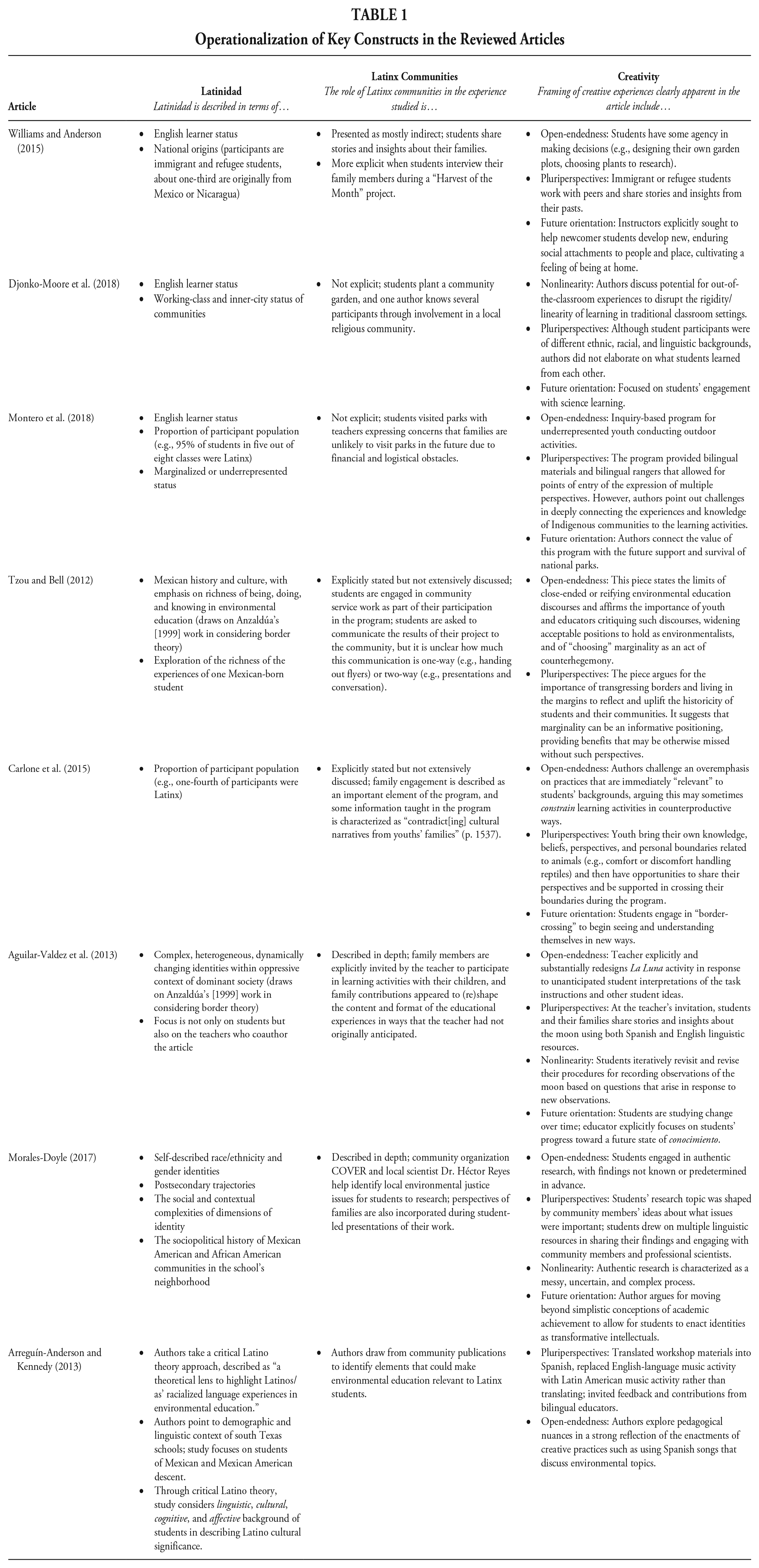
We would like to recognize that several pieces draw on the scholarship of Latinx, Chicanx, and Latin American scholars. For example, Tzou and Bell (2012) and Aguilar-Valdez et al. (2013) used Anzaldúa’s (1999) border theory to discuss being positioned and actively positioning oneself at the margins in environmental education programs. Morales-Doyle (2017) and Aguilar-Valdez et al. (2013) pointed to Paulo Freire’s work on the importance of addressing the realities of power and oppression, which impact the lives of Latinx individuals in the United States and the ways in which they can come to view themselves as agents in transforming oppressive realities through actively discussing environmental justice issues. Likewise, Arreguín-Anderson and Kennedy (2013) used LatCrit as a framework that environmental education programs can use to challenge discriminatory and racialized educational experiences that employ deficit perspectives toward Latinx students based on their skin color, culture, immigration status, and proficiency in the English language. Beyond these analyses, most pieces described Latinx students in terms of their EL status and as being underrepresented and marginalized but did not consider the many other dimensions and complexity of Latinidad.
Regarding the role that Latinx communities (beyond educators and youth) play in the environmental experience studied, these pieces showed a range of descriptions. For instance, in some of these studies, it was not specified whether members of Latinx communities (e.g., students, teachers, parents) were involved in the design of the programs or the studies. On the other hand, some pieces centered Latinx communities by providing a clear description of their involvement in the program or study analyzed. For example, Morales-Doyle (2017) involved Latinx community stakeholders in deciding what topics to address in the environmental education program, Tzou and Bell (2012) provided an in-depth analysis of the experiences of one Mexican-born student in the program, and Aguilar-Valdez et al. (2013) illustrated ways that teachers authentically and successfully invited family participation in students’ learning. These pieces offer models of how Latinx communities could be involved to a greater extent in the design of programs that seek to respond to their realities.
In applying a creativity framework, we noticed that these pieces pointed to the potential of environmental education experiences to be open-ended, pluri-perspectival, nonlinear, and future oriented. Not all of these dimensions were explicitly apparent in each piece (although any of these dimensions may have been present and simply were not explicitly mentioned in the final, published version of each article). Our table indicates elements of creative educational experiences that were clearly identifiable. For example, Djonko-Moore et al. (2018) described the potential for outdoor learning to disrupt the rigidity of learning in traditional classroom settings (nonlinearity), whereas Williams and Anderson (2015) pointed to the opportunities that school garden activities offer to students to express their multiple (pluri)perspectives. In terms of future orientation, Morales-Doyle (2017) and Aguilar-Valdez et al. (2013) clearly identified the power that environmental programs have to empower Latinx students and communities to transform themselves and the world around them, as opposed to approaches that seek merely to include Latinx populations into existing environmental initiatives. Yet it appears there may still be further potential for environmental education programs and researchers to tap into the creative power and richness of the Latinx communities with whom they work.
Different authors used different approaches to access some of the creative potential in Latinx communities. Sometimes, authors built on the research and frameworks of Latinx scholars, such as Gloria Anzaldúa (e.g., Aguilar-Valdez et al., Tzou & Bell); at other times, authors drew on their own insights and experiences as Latinx persons or involved members of local Latinx communities rather than drawing on a broader, imagined Latinidad; and at still other times, authors connected their work to issues of interest to local Latinx communities. Some authors did all three (e.g., Morales-Doyle).
Finally, we found it suggestive that the two articles that seemed to include explicit evidence of all four dimensions of creative experiences—Morales-Doyle (2017) and Aguilar-Valdez et al. (2013)—were also the two articles that appeared to describe the most extensive community involvement in learning activities and had two of the most extensive discussions of Latinx identity or history. While we do not go so far as to claim these characteristics of the studies are necessarily related, it seems at least plausible that attention to the complexity of Latinidad goes hand in hand with extensive community involvement and that community involvement could play a role in fostering creative experiences—not only because community involvement might include sharing of pluriperspectives or attention to the future of the community and the individuals within it but also because extensive community involvement might lead to the iterative reshaping of learning experiences in open-ended and nonlinear ways.
Limitations
By focusing on constructions of Latinidad, we recognize that we are taking what could be interpreted as an anthropocentric approach to our analysis. At the same time, we are focused on humans who have often not been represented in anthropocentric arguments and have (as humans) not been a focus of ecocentric arguments either. Historically, both anthropocentric and ecocentric arguments have sometimes been constructed from dominant (e.g., wealthy, male, Anglo-American) positionalities; this has meant that both have been deployed as a justification for the further marginalization of already marginalized human populations (Dowie, 2011). Similarly, practices such as place-based education have often been enacted from a White, settler-colonial frame that denotes certain places as “pristine” while ignoring Indigenous history and past injustices (Gruenewald, 2003). Interestingly, during the initial coding and selection of articles for our review, we came across recent works by Latinx authors that address these very concerns (e.g., Calderon, 2014), although these were omitted from our review because of our exclusion criteria.
This suggests to us that centering the voices and perspectives of U.S. Latinxs may lead to the development of stronger antioppressive constructions of both eco- and anthropocentrism. For instance, in our review, we saw numerous occasions when Latinx students’ encounters with nature were also implicitly or explicitly encounters with other humans: with teachers, but also with peers, friends, and family. We do not claim this as a finding of our review because Latinidad is fundamentally multiple, complex, and heterogeneous, and thus there is no singular “Latinx perspective” that we could draw on to arrive at such conclusions even if we had explicitly sought to do so. We also were not surprised by students’ frequent connections with peers and family in these studies because utilizing students’ “funds of knowledge” has been a key practice informing the development of CSP (Moll et al., 1992; Paris, 2012) and aligns with writings on Latinidad, collectivism, and relation to the environment (Ybarra, 2016). However, these patterns suggested to us that some of the tension between ecocentric and anthropocentric perspectives may be resolved by a more explicit conception of humans as part of nature, as has been described or suggested by authors such as Dehghani et al. (2013) and Medin et al. (2014). Ultimately, we believe that by studying how Latinx communities are characterized and characterize themselves in environmental experiences, future researchers could embody a pluriperspective approach that seeks to decenter simplistic conceptions of environmental experiences and how humans interact with nature.
Conclusions
Few studies in the environmental education literature have taken up culturally sustaining pedagogy to (co)construct creative educational experiences for minoritized communities, especially Latinxs. Of the scholarship that has done so, much of it focuses on only a few dimensions of Latinidad (e.g., language). Through this review, we seek to make visible the creative possibilities unlocked by conceptualizing Latinidad in more dynamic and complex ways. In particular, we argue there is power in situating learning experiences about nature in the lived realities of Latinx students and their communities. Such approaches may empower youth to become “transformative intellectuals” (Morales-Doyle, 2017).
Seen as a collective whole, the articles reviewed here suggest that how environmental educators conceptualize Latinidad is deeply linked to the ways that CSP can foster creative educational experiences for Latinx students. As other authors have shown, culturally sustaining pedagogies are often misinterpreted as a simplistic maxim for educational activities or materials that include people of color (Ladson-Billings, 2014; Sleeter, 2012). Such practices might create experiences that are arguably pluriperspectival, but in relatively nominal ways—for instance, addressing the diversity of students’ language backgrounds but falling short of validating their perspectives. When educators interpret CSP as the act of being “relevant to” someone or something, this relevance may be positioned in ways that silence students’ perspectives or curtail opportunities for open-ended and nonlinear experiences. “Relevance” can also be restrictive; Carlone and colleagues (2015) argued that experiences that were initially frightening, disgusting, or otherwise irrelevant to students’ experiences could nonetheless provide a forum for students to build new identities for themselves, share their perspectives, and experience empowerment. By moving away from conceptualizing relevance generically to a way that reflects specific communities and individuals, one can better foster pluriperspectival learning experiences and academic success, cultural competence, and critical consciousness.
We argue that Latindad(es) as a lens helps us implement culturally relevant pedagogy in ways that are more likely to cultivate, rather than curtail, creative educational experiences. In other words, when educators explicitly conceptualize Latinidad in nuanced, heterogeneous, and dynamic ways—that is, when we conceive of plural comunidades rather than a singular Latinx community—the educational experiences we create might better elicit the perspectives and experiences of specific individuals and communities. By understanding Latinx communities as plural, dynamic, and diverse, educators are able to cultivate an environment where multiple perspectives are not only invited into educational spaces but actually do enter and reshape these spaces, where educators are not only open to the exercise of students’ and parents’ agency but actually engage in nonlinear and open-ended experiences, and where future orientedness is inherent in the idea that students can see themselves in environmental experiences. Fundamentally, we argue that no text, object, or educational experience can “be relevant” to a singular Latinidad. CSP must always be situated in particular contexts, particular communities, and particular lived realities, and its implementation seems more likely to foster creative experiences when educators consider the complexity of Latinx identities. By explicitly considering the complexity of Latinidad(es), we can better cultivate conditions that allow the creativity inherent in Latinx communities to be realized in environmental education.
Understanding the multiplicities of the Latinx panethnic group not only permits an acknowledgment of their rich histories but also illuminates their collective actions, agency, and resistance (Anderson et al., 2021; Santiago et al., 2021). Historically, Latinx communities have creatively transmitted their languages, environmental knowledge, and cultures in the midst of policies that have devalued these resources (e.g., English-only education mandates; Pacheco, 2012). Educators must also be mindful of intersectionalities across gender, sexuality, class, race, ethnicity, citizenship, and physical ability to give voice to the complex ways in which Latinxs exist and the oppressions suffered by specific Latinx individuals.
In summary, the creativity principles—open-endedness, nonlinearity, pluriperspectives, future orientation—can be applied to the conception of Latinidad itself to reflect the dynamic, shifting, ever-changing nature of being Latinx, a constant process of constructing and reconstructing identity at both the individual and communal levels. The world will continue to be environmentally impacted; if all of today’s youth (not just those identifying as Latinx) can recognize the multitude of creative, cultural forms of environmental literacy, the next generation of environmental educators will be better prepared to teach and act creatively and environmentally.
Footnotes
Appendix
Article Selection Process for Detailed Review

| Selection Iteration | Selection Criteria | N Articles Excluded | N Articles Remaining a |
|---|---|---|---|
| 1 | Initial Google Scholar searches, multiple terms (see Appendix A) | (N/A) | 2,266 |
| 2 | Excluding unfiltered duplicates, other search errors | 63 | 2,203 |
| 3 | Peer-reviewed academic articles in U.S. context | 1,063 | 1,140 |
| 4 | Culturally sustaining, relevant, or responsive pedagogy and Latinx/Hispanic identities or demographics in text | 977 | 163 |
| 5 | K–12 student age specific and in environmental/nature education context (e.g., not just STEM focus, not just community engagement) | 97 | 66 |
| 6 | Explicit framing, application, or implication of culturally sustaining pedagogy/predecessors in environmental education context (e.g., culturally sustaining pedagogy beyond a single mention or only in references section) | 58 | 8 |
Many of the searches in Appendix A generated duplicates that were filtered and reconciled by the authors, culminating in the number of distinct articles included here.

Notes
Authors
DIEGO ROMÁN is an assistant professor in bilingual/bicultural education in the Department of Curriculum and Instruction at the University of Wisconsin-Madison. He also holds faculty affiliations in the Chican@ & Latin@ Studies Program; Latin American, Caribbean and Iberian Studies Program; and Doctoral Program in Second Language Acquisition at the University of Wisconsin-Madison. His research is located at the intersection of linguistics, science education, and environmental studies. Specifically, he investigates the implicit and explicit ideologies reflected in the design and implementation of bilingual and science education programs, particularly about environmental topics to multilingual students. He is a 2020 National Academy of Education/Spencer Postdoctoral Fellow, and his research has been published in the Journal of Multilingual and Multicultural Development, The Journal of Environmental Education, the Bilingual Research Journal, Environmental Education Research, among others.
JUAN MIGUEL ARIAS is a visiting assistant professor of environmental education at Colorado College. Drawing from the fields of developmental psychology, youth/community thriving, environmental education, and environmental justice studies, his current research explores the impacts of environmental teaching practices and programs on their participating youth and communities.
QUENTIN C. SEDLACEK is an assistant professor of STEM Education at Southern Methodist University. His interdisciplinary research focuses on advancing racial and linguistic justice in K–16 STEM education using frameworks from social psychology, linguistic anthropology, and teacher education. His recent work has been published in the International Journal of Science Education and the Journal of Women and Gender in Higher Education.
GRESES PÉREZ is the McDonnell Family Assistant Professor of Engineering Education in Civil and Environmental Engineering at Tufts University, with secondary appointments in mechanical engineering and education. Her research focuses on the interdisciplinary study of language and cognition for students who experience a cultural and linguistic mismatch between the practices of their communities and those in engineering and science. She draws on frameworks from the learning sciences, science education, and engineering education. Her recent work has been published in the Journal of Science Teacher Education and Learning, Media and Technology.