



Abstract
This chapter presents a broad interdisciplinary literature review linking artists’ economic precarity and need for but resistance to entrepreneurial skills, alongside colonial histories, structural racism, and hierarchies of taste in arts organizations. These themes are complemented empirically by engaging data from the Strategic National Arts Alumni Project (SNAAP) to demonstrate indicators of attrition and privilege of arts alumni relative to their participation in the arts workforce. Meaningfully different associations across racial/ethnic groups are uncovered, showing structural exclusion of Black arts alumni in particular, in addition to other intersectional dynamics. This chapter underscores the importance of addressing student debt, the potential of creative pedagogies across the curriculum, and the need for imaginative approaches to renewed public funding of art and artists.
The arts have a particularly acute diversity issue. According to recent reports, 84% of art school graduates are White (Strategic National Arts Alumni Project [SNAAP], 2018). In a separate study of art museum workers, 84% of curators, educators, conservators, and managers are also White (Schonfeld et al., 2015). This lack of inclusion is pervasive across artistic practice, cultural workforce participation, and audience engagement in the arts. 1 Issues of gender and racial exclusion for artists are also historically long-standing. Alper et al. (1996) found substantial differences in pay of male- and female-identified artists from the 1970s to the 1990s and substantial differences in pay by racial/ethnic categorization. 2 Lack of inclusion in the arts, and in creative educational experiences (CEEs) broadly, is especially critical given that creative, integrative, and critical thinking skills are an important differentiator in an increasingly automated world of work (Pascarella et al., 2005; Whitaker, 2016a).
We approach the intersectional (Crenshaw, 1991; Harris & Leonardo, 2018) problems of social, economic, and racial/ethnic inequities in the arts through two unique and rarely combined lenses: the economics of art labor and the career and economic outcomes of college. The framework of intersectionality, pioneered by Crenshaw (1991), shapes our approach as we implicitly argue that dealing with social and racial/ethnic exclusion is a systemic problem (Meadows, 2008) that requires consideration of the many intertwined contributory factors, including via Miller et al.’s (2020) framework of “counternarratives.” Exclusion is difficult to analyze without, as Harris and Leonardo (2018) proposed, employing intersectionality as a research methodology. Harris and Leonardo wrote: One overarching implication of intersectional analysis is that dismantling one form of hierarchy necessitates an equally robust assault on other forms of subordination. Because racism and sexism recruit capitalism, sexuality, methodology, and epistemology to their work, problem-posing proceeds organically. In education research, it means seeking a composite methodology and analytic that speak to this complexity. (p. 18)
Following from this composite methodology, in this chapter, we review the literature along two distinct vectors: of arts entrepreneurship and colonial histories, respectively. In the first, we argue that careers in the art are so economically precarious or underpaid that artists and art workers are necessarily called to be entrepreneurial and that this necessary combination of art and entrepreneurship activates long-standing questions in sociology of the ways in which art and economics are “Hostile Worlds” (Velthuis, 2005; Zelizer, 2001). In the second vector of the literature review, we consider the enduring effects of the histories of the arts, recognizing that art museums arise from histories of colonialism (Impey & MacGregor, 1985; Murray, 1904) and class structure (Bennett, 1995) and continue to have idiosyncratic economic structures (Feldstein, 1991). These histories are reinforced by hierarchies of taste (Bourdieu, 1984), meaning the systems of thought through which greater “cultural capital” or status is granted to art forms such as opera or oil painting than to various genres of more popular music or more widely embraced visual culture and performance. These latter forms of popular culture are sometimes “legitimated” into consideration as art forms (Lena, 2019, p. 19) but often still within these perceived hierarchies of taste (Bourdieu, 1984; DiMaggio, 1987).
By considering these two vectors of arts entrepreneurship and colonial histories, we simultaneously employ the arts as an investigative ground for racial/ethnic exclusion and broaden our definition of the arts to speak to CEEs more generally. This approach to the literature review echoes the description of cultural economics itself as a proto-discipline (Throsby, 1994, 2006) made up of subdisciplines (Ginsburgh, 2001) including: sociology, economics, entrepreneurship, art history, law, finance, and public policy. We draw together literature from these different subfields along with creativity studies and research in higher education on career and economic outcomes. Although we performed systematic searches on key words such as “creativity” and “arts entrepreneurship,” we also relied on our own more idiosyncratic accumulation of and synthesis across a wide body of literature in our respective fields. Although this approach has limitations, it allows us to make a uniquely interdisciplinary argument. Our aim is to engage actively and with nuance in understanding a systemic problem on its own terms, with the objective of informing what solutions can be considered without disciplinary limitation (cf. Akerlof, 2020).
In linking the democratization of CEEs to the arts, we rely on a particularly broad definition of art and, by extension, creativity. In the essay, “The Origin of the Work of Art,” Heidegger (1947) wrote, “Whenever art happens—that is, whenever there is a beginning—a thrust enters history; history either begins or starts over again” (p. 201). Heidegger’s definition of art can be generalized to describe a work of art as “something new in the world that changes the world to allow itself to exist” (Whitaker, 2016a, p. 7). Thus, if one is making a work of art in any field, one is not going from a known point A to a known point B but inventing point B (Whitaker 2016a). This process of moving forward without a template, akin to Sarasvathy’s (2001) concept of “effectuation,” can occur in the direct making of art or in creative work across a wide array of academic disciplines, life experiences, and professional settings. This working definition of art as the process of moving forward without a template dovetails with Beghetto’s (2021) work on creativity as engagement with uncertainty, Glăveanu and Beghetto’s (2020) framing of creativity as engagement with the unfamiliar, and Ulger’s (2020, p. 516) work on assessment that isolates independent or unconventional thinking and flexibility as core attributes of creativity.
This broad “inventing point B” definition of art shares some facets of Csikszentmihalyi’s (1996, 1999) foundational work on creativity as a social and cultural, not only psychological or intrapsychic, process. Yet beyond focusing on creativity as an educational outcome (N. Jackson, 2006) or general life skill (cf. Kelley & Kelley, 2013), we focus on the process of “democratizing” access to CEEs both through broadening inclusion in careers in the arts as traditionally defined and through broadening cross-curricular access to skill building in the creative, critical, and independent thinking that is associated with the arts. Democratizing access to this kind of independent thinking is also vital to democracy itself in that democracy relies on independence of thought (Whitaker, 2016a).
Underscoring the importance of independent thinking as distinct from academic attainment, Deresiewicz (2008, 2014) coined the term “excellent sheep” to describe the ability of high-achieving students to answer any question put in front of them but not to formulate the question. This ability to muster self-direction in navigating uncertainty can be difficult within higher education’s structures of academic review, as Akerlof (2020) argued in the case of economics and as Wisdom et al. (2006) found more generally across judgmental processes of higher education from grading to peer review. Creativity is grounded in a process- rather than outcome-oriented approach and, as such, can be challenging to evaluate. Fundamentally, creativity is distinct from academic achievement. Akerlof (2020), a Nobel Laureate in economics, critiqued his field for its inability to champion interdisciplinary, creative problem-solving, largely because of structures of academic review that favor hard skills over soft skills.
We approach these holistic questions of inclusion in the arts and CEEs—whether via pursuit of arts career pathways or via exposure to skill building in creative and critical thinking—through the logic of the STEM to STEAM movement. The STEAM movement advocates for adding “A” for “art” into STEM educational initiatives in science, technology, engineering, and math (Cave, 2017; Conradty & Bogner, 2018, 2019; Copeland et al., 2018; Henriksen & Mishra, 2020; Maeda, 2013). As an inherently transdisciplinary movement (Costantino, 2018; Daly et al., 2016; Guyotte et al., 2014; Liao, 2016), STEAM reflects this perspective on creativity as cross-disciplinary (Baregheh et al., 2009; Marquis & Henderson, 2015; Paek, 2019). More broadly, STEM to STEAM aligns with the ideals of the liberal arts as the education of the person, including the limitations to automating education itself (Zhao et al., 2015), in contrast to the choice of a preprofessional major as the training of the worker (Pascarella et al., 2005). Notable arts initiatives such as that of Stanford University have presented both honors pathways through the arts (A. Zhang, 2013) and creatively engaged, rigorous but more open and exploratory creative experiences, as in a year-long creativity seminar offered to life science majors (S. McConnell, author interview, July 21, 2015; A. Todhunter author interview, October 6, 2017).
Emphasizing an outcome orientation, rising costs of higher education have intensified the calculus that one’s career justifies one’s investment in education (Carnevale et al., 2019; Jahoda et al., 2014; Ma et al., 2019). Researchers have also connected graduate education to career outcomes among socioeconomically and racially diverse student populations (Blau & Kahn, 2016; Hu & Wolniak, 2010, 2013; Melguizo & Wolniak, 2012; Perna, 2005; Wolniak et al., 2020; L. Zhang, 2008). Concurrently, the intensification of student debt and pressures on governmental funding of the arts have put creative arts at risk (Knight, 2017). As career pathways grow more complex, even fields of science and technology increasingly require humanity, creativity, and innovation—and related exposure to the experimental and process-based methods of inquiry—associated with CEEs (Whitaker, 2016a).
Paradoxically, the advice to first-generation college students to study STEM fields (Verdin et al., 2018) may reinforce their exclusion from CEEs and risk hampering long-term economic mobility. Focusing on STEM may give college graduates the career earnings equivalent of steady bond-portfolio returns, whereas art and creativity may offer a more equity-like earnings structure—with higher volatility and risk (Migdal, 2018) but potential for upside or wealth generation (Oliver & Shapiro, 2006). Thus, exclusion from the arts and CEEs can have a dual effect, constituting not only a first-order exclusion but also a second-order outcome in which lack of access to the arts and CEEs, in turn, disadvantages individuals in the future as automation and standardization paradoxically places a premium on the open-ended and independent forms of thinking instilled in the arts.
With this chapter, we contribute both a broad synthesis of interdisciplinary literature and descriptive empirical evidence, offering new perspectives on intersections of social capital, racial/ethnic inclusion, and economic mobility in students’ college experiences and subsequent career trajectories. Complementing this synthesis of interdisciplinary literature, the descriptive statistical analysis contains measures of college and workforce experiences of undergraduate arts alumni, over half of whom completed their undergraduate education more than 2 decades ago. We pay special attention to markers of socioeconomic privilege (e.g., household income that is greater than an individual artist’s income) and to markers of gatekeeping (e.g., a precollege desire to become an artist followed by a postcollege trajectory outside the arts). In this way, the data we present strengthen our theoretical and empirical understanding of the supports and impediments to democratizing access to CEEs.
The data we engage allow us to study the arts by analyzing art school graduates in the United States over multiple decades. These data enable an unusual ability to see “under the hood of the car” of the college experience. We can observe not only factors such as degree attainment and employment but also the skills that alumni feel that they gained and the kinds of educational experiences and environments they report having encountered during college. Thus, we are able to use the arts to make the case for expanding access to CEEs across other disciplines. If the problems of exclusion are intersectional, the solutions are also broad-based and multimodal.
The significance of this chapter centers on better understanding the pathways to inclusion in the arts, thereby enabling more people to make creative contributions in the arts and other fields, by democratizing access to CEEs both in the arts and across domains. Through our synthesis of the literature, we aim to offer new perspectives in support of generative creativity among individuals from diverse sociodemographic backgrounds. We aim especially to identify multiple pathways to democratizing CEEs. Inclusive creativity benefits everyone.
This chapter is organized as follows. The literature review frames our approach to creativity and synthesizes a broad set of scholarship across art, sociology, economics, creativity studies, and higher education. We then engage data from SNAAP to better understand the literature through descriptive examination of those data. The subsequent discussion section draws inferences from the data in connection to the themes of the literature review. In the conclusion, we offer ways in which we might further democratize access to CEEs and suggest directions for further research.
Literature Review
Democratizing CEEs crosses over a wide array of literatures. We focus on themes of economic precarity of artistic practice, studies of workforce inclusion in the arts, theories of class and taste in the arts, historically colonial and White structures of arts organizations, economics of inequality, and understanding these factors within the literature of higher education. We approach these literatures across two vectors: the first from art to entrepreneurship and the second from colonial histories to continued structural exclusion. The first vector engages complex sociological and political questions of how and whether modes of art and of entrepreneurship can be combined or are Hostile Worlds (Velthuis, 2005; Zelizer, 2001). The second vector from colonial history to persistent exclusion engages with theories around class and taste, particularly drawing on Bourdieu’s (1984) work on hierarchies of taste and the accumulation of cultural capital, that is, status that accrues proportionately to certain forms of cultural consumption.
Economic Precarity of Being an Artist
Being an artist has long been modeled as an economically precarious career (Abbing, 2002; Deresiewicz, 2020; Greffe, 2002) marked by lower earnings (Arts Council England et al., 2018), more uncertain income sources (Creative Independent, 2018), and more independent and freelance work (Woronkowicz & Noonan, 2019). At the same time, artists generally have higher levels of formal educational attainment than the general population. According to the American Community Survey, 62.9% of artists hold at least a bachelor’s degree, compared to 69.9% of “professionals” and 35.5% of the overall U.S. labor force (National Endowment for the Arts [NEA], 2019, p. x). This structural economic difficulty—of income precarity and relative wage compression—requires artists and art workers to engage creatively and entrepreneurially with the economic scaffolding of career trajectory and organizational support. The pervasiveness of entrepreneurial pathways in the arts may arise more from necessity than choice.
This economic precarity can vary across careers within the visual and performing arts and the broader set of creative industries (Caves, 2000, 2003; Howkins, 2013). According to a recent NEA study—which includes not only visual and performing artists but also designers, architects, film directors, writers, and others—in 2017, over 5 million U.S. workers held jobs in the arts and creative industries (NEA, 2019, p. vii). In including this broader set of creative workers, the NEA study also reported that artists’ income is on average 4.4 times the artists’ respective local poverty thresholds (NEA, 2019, p. xi). However, these salaries include substantial variation, for instance, from the average annual pay of dancers and choreographers ($31,200) to that of film producers and directors ($65,000 to $75,000; NEA, 2019, p. xi). This dispersion in salary dovetails with the “superstar effect” observed in art and other markets that cluster around a few standout performers who receive an outsize share of the profits (Adler, 1985; Rosen, 1981).
The economic precarity of artistic careers can be intensified by the ways in which artists are not paid for their time, for instance, in the preparation of museum exhibitions. Beveridge (2005) found that artists forewent $4 million (Canadian) in wages for public exhibition preparations. The U.S. organization W.A.G.E. (Working Artists and the Greater Economy) was founded in 2008 to address this problem by certifying organizations that pay artists exhibition fees above a threshold that is determined on a sliding scale based on an organization’s budget (Soskolne, 2015). This norm toward not compensating artists for labor reflects a focus on the sale of objects in an art market (Gerber & Childress, 2017). That market is, in turn, defined narrowly geographically (Zarobell, 2017) and measured chiefly by the sale of artworks (McAndrew, 2020), in spite of the larger system of “art worlds” that encompasses many actors—dealers, suppliers, critics—beyond artists themselves (Becker 2008).
Not only artists but also art workers experience economic precarity, both in level of pay and in barriers created by early-career internships (Frenette, 2013). Britten and Grist (2019) interviewed 100 U.S. museum workers, of whom 57% described themselves as “working class.” Of these workers who self-described as “working class,” low pay was cited by three-fourths of them as a reason they considered leaving their job (Britten & Grist, 2019, p. 92; Whitaker, 2021b). Jandl (2019) studied the staff of the New Museum of Contemporary Art, in New York City, and their efforts to unionize. She found that the median salary of the museum ($52,000) was above the New York City living wage ($51,000), whereas entry-level pay was closer to $35,000. A recent study of entry-level art workers in Los Angeles found similar pay equity issues—with entry-level wages above minimum wage and below a living wage (Krieger & Mauldin, 2021). The latter report also found substantial pay discrepancy between White art workers and Black, Indigenous, and people of color art workers in entry-level jobs. These issues of inequity across race and gender are discussed more in the following sections of this literature review.
Artist as Entrepreneur and Investor
The economic precarity of artistic practice—and related art labor—leads to the necessity of entrepreneurship. Engaging in entrepreneurial practice within a superstar, winner-take-all market (Rosen, 1981) can best be framed as a form of investment because artists take on costs of production before value is known. Yet in the process of assuming this entrepreneurial or investment-oriented mindset, artists and other art workers encounter a deep philosophical debate between the Nothing But (Grampp, 1989) and the Hostile Worlds (Velthuis, 2005; Zelizer, 2001) views of how art and markets relate. In the Nothing But view, all value can be made legible via markets. In the Hostile Worlds view, the spheres of art and commerce must be kept distinct so that money does not taint or interfere with art.
Some resolutions of these views come about through Hyde’s (1983) idea that all art originates in a “gift.” Art can be commodified or made to operate in markets up to a point but that if a work of art ever becomes fully commodified, then it is no longer art. Zelizer (2001) also offered some resolution by mapping the dynamic relationship of art and markets in her theoretical framework of “circuits of commerce” across intimate and commercial spheres. Gerber and Childress (2017) proposed a holistic approach in which artists can imagine “pathways to autonomy through market activity” (p. 1533). Gerber (2017) framed this engagement with markets within artistic practice as a form of investment. Drawing on ethnographic interviews with artists, Gerber framed “pecuniary” investment as that which is expressly financial (p. 37) while also describing as investment artists’ decisions to take on more contingent, flexible, and lower paid work to support their creative practices. In this context, statistics about artists as substantially more likely to freelance or be self-employed than the overall workforce (NEA, 2019, p. x; Woronkowicz & Noonan, 2019) can be described as acts of entrepreneurial self-investment.
Despite the uneasy or unresolved theoretical relationship between art and markets—and therefore art and entrepreneurship—numerous scholars in arts administration have framed entrepreneurship as necessary to arts education (Bridgestock, 2012; Callander, 2019; Callander & Cummings, 2021; Essig, 2013, 2015; Essig & Guevara, 2016; Paulsen et al., 2020; Robinson & Novak-Leonard, 2021; Toscher, 2019; White, 2013, 2015, 2019). In some cases, this focus on arts entrepreneurship informs career pathways themselves (Toscher, 2019), including Cawsey’s (1995) work on “portfolio careers” and Lena and Henaut’s (2021) work on “polyoccupationalism.” In other cases, the entrepreneurial lens focuses on the arts ecosystem itself (White, 2019; Woronkowicz, 2021), including the systems by which the arts are funded (Wilkerson, 2012). 3
To frame artists as entrepreneurs encounters two other challenges: First, it requires an understanding of “artist” as an identity (Lena & Lindemann, 2014), including conceptualizing the artist as a professional rather than, as Brooks (2002) and Bain (2005) have explored, an amateur or volunteer. Second, it requires some acceptance rhetorically of talking about artists as entrepreneurs. Economic disinterestedness (Wohl, 2021) can be part of artists’ successful self-presentation, meaning that engagement with entrepreneurial processes may be seen to dent one’s artistic persona. Bourdieu (1993) argued that some artists specifically reject economic success to underscore their commitment to art. Whereas Gangi (2015) argued that artists and entrepreneurs are similar, Bonin-Rodriguez (2012) described identity conflicts in which artists specifically do not identify as entrepreneurs, again, along these fault lines described by the Hostile Worlds view (Velthuis, 2005; Zelizer, 2001). Other scholars such as Oakley (2009) have proposed not a rejection of markets but an “assertion of meaning beyond the commercial” (p. 282).
If, as Wohl (2021) and others have argued, the presentation of economic disinterestedness may further artistic success, then it follows that this rejection of economic interestedness doubles as a rejection of entrepreneurial identity. This rejection of entrepreneurial identity may impede the acquisition of entrepreneurial skills. In prior analysis of alumni of higher education arts programs, Frenette and Tepper (2016) found that 75% of arts graduates rate business and entrepreneurial skills as “very” or “somewhat” important. Thus, we see a complicated picture in which artistic value and economic sustainability are sometimes at odds, with artists performing economic disinterestedness or even outright judgment of markets while simultaneously touting and resisting the importance of economic and entrepreneurial training. The result has been a deficit in entrepreneurial training of artists in higher education. Frenette and Tepper found that only 25% of arts graduates say that their college or university supported them to develop this acumen, which echoes M. R. Jackson et al.’s (2003) Investing in Creativity study identifying this shortfall in entrepreneurial training more broadly.
If we recognize this need for entrepreneurial training to navigate structural challenges in arts employment, the question arises as to how this training should be approached pedagogically. In Shane and Venkataraman’s (2000) influential articulation of general entrepreneurship, they focused on new venture creation as the mode of entrepreneurial action. For skill building in the arts, we identify instead Toscher’s (2019, p. 12) focus on entrepreneurship as a set of competencies including mental models, resource skills, self-efficacy, and tolerance of ambiguity and uncertainty. This focus on entrepreneurial skill building echoes Beghetto’s (2021) work on creativity as a process of navigating uncertainty. Entrepreneurship in the arts need not imply the deployment of venture models from the technology industries but can include community activism and organic models of growth and change (Brown, 2017), drawing on themes in the business education of artists toward sustainability (Bhandari & Melber, 2017; Whitaker, 2016b), community practice among artists (Louden, 2013, 2017), creative engagement with solidarity economy movements (Jahoda & Woolard, 2019), and new cooperative models of financial support for artists (Linares & Woolard, 2021).
Entrepreneurial education can also support artists to manage the early-stage risks and uncertainty in valuing creative work (Whitaker, 2018; Whitaker & Kräussl, 2020). Visual artists are typically paid in the primary market—when work is first sold—and do not receive a share of the proceeds when an artwork is resold in the secondary market except in jurisdictions that have resale royalties (DACS, 2016; U.S. Copyright Office, 2013) or for art sales governed by private contracts that grant a percentage of future proceeds back to the artist (Siegelaub & Projansky, 1971; van Haaften-Schick, 2018). Because of the uncertainty around the future value of art (Howkins, 2013; Menger, 1999, 2001, 2014) equity- and royalty-based tools of redistributing proceeds may support artists, but these systems are not yet well developed (Whitaker & Grannemann, 2019). Thus, economic precarity necessitates entrepreneurial thinking to build economically sustainable careers in the arts. That these larger systems of support are not yet well developed invites entrepreneurial attention to the systems themselves.
From Histories of Colonialism to Hierarchies of Taste
Understanding racial/ethnic exclusion and social and economic mobility in the arts requires the context of art museums’ colonial founding stories, class hierarchies in definitions of artistic taste, and the still entrenched role of philanthropy in the arts as inseparable from substantial wealth inequality (Giridharadas, 2018). Following 16th- to 18th-century private collections or “cabinets of curiosity” (Impey & MacGregor, 1985; Lubar, 2018), art museums were largely a 19th-century invention in the United States and the United Kingdom, predicated on civilizing the working classes by exposure to and elevation by the arts (Bennett, 1995). By the 1930s, U.S. museums were openly racially discriminatory, with limited opening hours for Black visitors (Coleman, 1939; DiMaggio & Ostrower, 1990, p. 754). DiMaggio and Ostrower (1990, p. 754) cited a case in which a researcher studying art museums subtracted the local Black population before deriving a denominator for percentage attendance (Rea, 1932).
The source of these museums’ holdings was often inseparable from colonial modes of object acquisition and class-based views of cultural consumption (Bennett, 1995; Coleman, 1939; Impey & MacGregor, 1985; Whitaker, 2009). Although these colonial histories are under active engagement in academic, activist, and policy-focused conversations, these histories are also endemic to the arts. Commissioned by the French government, Sarr and Savoy’s (2018) report on African cultural objects in French and other European museums has brought greater awareness and calls to action for the restitution of cultural objects. Both activist social movements (Decolonize This Place, n.d.) and scholarly efforts (cf. Ansari, 2019; Bishop & Columbus, 2020) have tried to upend these deeply entrenched structures.
These histories of colonialism intersect with hierarchies of taste and related forms of exclusion. In his pioneering study of the French public, Bourdieu (1984, 1993) mapped a hierarchy of cultural consumption with rarified forms such as opera most strongly signifying connoisseurship, taste, and the acquisition of cultural capital. These hierarchies of taste reinforce and interact with complex dynamics of racial/ethnic and social exclusion, especially as definitions of “elite” taste have morphed to include some conditional engagement with forms of popular culture. For instance, Childress et al. (2021) studied the ways in which elites subsume categories of popular culture into their taste-making apparatus but only conditionally—for example, including horror films but only some works within the genre.
In a landmark study of these interactions of hierarchies of taste and racial/ethnic exclusion in the arts undertaken more than 30 years ago, DiMaggio and Ostrower (1990) mapped nuanced and enduring patterns of both participation and discrimination. Following from Bourdieu (1984), DiMaggio and Ostrower (1990, p. 754) studied “high-culture arts organizations,” “standards of taste,” and participation in the arts as “a form of investment in ‘cultural capital’” (Bourdieu, 1984; DiMaggio & Useem, 1978). They found some conflicting patterns of participation that led them to conclude that Black audiences participate in some “high-culture” artistic consumption but that some middle-class or higher status is required to benefit from the acquisition of social capital that exposure to the arts confers (DiMaggio & Ostrower, 1990, p. 773). They also found distinctions in which Black Americans participate more highly both in consumption of art from home via television and in art production. Drawing conclusions that have come to be even better understood since their study, DiMaggio and Ostrower (1990) identified these effects as reflecting structurally discriminatory systems (Landry, 1987). Harper and Hendrick’s (2017) work on racial equity is emblematic of continued research and activism around racial and cultural inclusion in museums.
These intersections of racial/ethnic and class-based exclusion are intensified by increasing economic inequality (Piketty, 2014). Art markets that rely on the sale of art objects (Gerber & Childress, 2017) are especially reliant on high-net-worth and ultra-high-net-worth collectors (Fraser, 2011; McAndrew, 2021). Nonprofit organizations in the arts are also enmeshed in this reliance on concentrations of wealth, through direct philanthropy (Giridharadas, 2018) and through donations of artworks acquired in these art markets (Whitaker & Glick, 2021). This increasing wealth inequality, in tandem with costs of education (Jahoda et al., 2014), can intensify the risks of being an artist in a superstar art market (Rosen, 1981) and may therefore reinforce choice of college and career path away from the arts.
Placing These Theories Within the Literature in Higher Education
We place these observations of taste and colonial history in the arts in a broader literature on social and economic exclusion along college-to-career pathways across disciplines. Mayhew et al. (2016) considered different theories of measurement of the outcomes of higher education to frame their synthesis of a decade’s worth of evidence on how college affects students, focusing on human capital theory and status attainment theory, among others, in relation to career and economic outcomes. These theories, when interpreted together, situate higher education as a process of skill building, where skills are later rewarded by wage differentials and where access to certain college experiences can act to reinforce social inequalities.
Several decades of research on the career and economic effects of college have shown that the experiences and choices students make within a given college environment are more influential, particularly in terms of earnings, than the selectivity or quality of institution attended—even more influential than completing certain graduate degrees (Mayhew et al., 2016; Pascarella & Terenzini, 2005). The experiences that students have—particularly those that align with “high-impact educational practices” that are known to contribute to students’ learning and to be beneficial for students from diverse backgrounds (cf. Association of American Colleges & Universities [AAC&U], 2007, 2018)—also influence career and economic outcomes, but to a much lesser degree than does one’s choice of major (Wolniak & Engberg, 2019). Overwhelmingly, choice of one’s major matters most. Earnings are most strongly affected by majors centered on quantitative or scientific skill development with direct connection to specific occupations such as engineering, computer science, and health sciences (Altonji et al., 2012; Robst, 2007; Wolniak et al., 2008). Art majors are thus disadvantaged in entering labor markets relative to these peers. Countering this evidence is Bille and Jensen’s (2018) finding that artistic education matters in the development of technical skills, social networks, and the ways in which educational credentials have a signaling effect. In addition, Wassall and Alper (2018) found that most artists did not major in art and that most art majors did not become artists or art workers.
The increasing cost of college (Ma et al., 2019) and related burden of student debt affect student choice of art as a major (Lena et al., 2014), and carrying student debt shows some relationship to early departure from, or shorter duration of, artistic careers (Frenette & Dowd, 2020; Lindemann, 2013). B. A. Jackson and Reynolds (2013) showed racial/ethnic differences in student loan factors across college majors. Using data from 1996 to 2001, they found that Black students in particular have a greater chance of college completion if they take out loans but also graduate with higher levels of debt and are more likely than White students to face risks of default due to, the authors argued, family differences in socioeconomic status and type of institution attended (cf. McMillan Cottom, 2017). These factors strongly inform our interest in the intersectional ways in which socioeconomic privilege, race/ethnicity, and exclusion from the arts interact.
Synthesizing across these different areas of literature, we find strong patterns of economic precarity and relative wage compression in being an artist or art worker. In addition, the identity category of “artist” is sometimes at odds with economic and entrepreneurial skill building at the same time that students have asked for more entrepreneurial preparation. It seems clear that entrepreneurial skills are necessary for full-time careers as artists, to the extent artists are commonly freelancers and to the extent that artists and other art workers are also navigating inherently difficult structural economics. Histories of privilege in the arts workforce and of structural racism and elitism in arts organizations contribute to complex patterns of exclusion and to the persistent effects of hierarchies of taste. As we consider democratizing access to creative educational experiences, the economic factors—student debt and low wages—interact in complex and intersectional (Crenshaw, 1991) ways with economic, gender, and racial/ethnic inclusion in the arts.
Understanding the Literature Through Data
To complement the previous synthesis, we draw on 2015–2017 data from SNAAP, 4 a longitudinal study of art school graduates across the United States, covering more than 57,140 records with measures of the career outcomes of undergraduate art school alumni spanning more than 100 4-year colleges and universities. Combining the SNAAP data with data from the Integrated Postsecondary Education Data System, we examine pathways in the arts from college to careers. Because SNAAP defines “art” broadly—including performance, design, architecture, creative writing, film, media arts, illustration, and fine art—these data represent a broad definition of CEEs. The survey has been refined and studied over a number of years (A. Miller et al., 2016; Novak-Leonard & Skaggs, 2017) and published in a series of working papers and recurring reports (cf. Lena et al., 2014; Skaggs et al., 2017; SNAAP, 2018), including a casebook on the uses of the SNAAP data to understand institutional strategies, including curriculum and program development (Noonan & Field, 2022).
For the purpose of this review, we consider the data descriptively to observe the socioeconomic and racial/ethnic composition of arts alumni bodies, with particular attention to differences in attrition from the arts by racial/ethnic group and markers of financial privilege for those who stay in the arts. Complementing the intersectional methodology of the literature review, we employ multiple regression analysis to understand how different collections of variables may contribute to disparate outcomes in who works in the arts and the economic security or precarity of those career paths. For more background on the analysis presented in the following section, we offer an online supplement containing additional tables with detailed statistical information on all variables included in our analyses, as well as a summary of methods. The online supplement is available at https://osf.io/4vpdm/.
Drawing on theory and empirical evidence, we organize the variables into three groups:
We focus our attention primarily on the influences of racial/ethnic identities and socioeconomic markers and secondarily on gender identity and year in which alumni completed their undergraduate education. We examine differences across these groups in their likelihood of employment in the arts and income-based indicators of economic precarity. We compare sample means and perform multiple regression analysis to understand the contributory influences of college experience and career pathways as intersectional with sociodemographics. These statistical associations offer an empirical complement to the two vectors connecting the interdisciplinary body of literature.
The data analysis reinforces other reports on racial/ethnic exclusion with stronger representation for female-identified students and underrepresentation of first-generation students. Based on 2015–2017 SNAAP data (see online supplement, Table S1, https://osf.io/4vpdm/), among alumni of 4-year undergraduate degree programs who reported being employed, 87% identify as White, roughly 5% identify as multiple racial/ethnic background, 4% identify as Asian, 4% identify as Hispanic, 2% identify as Black, and 3% chose “other identity category” (i.e., Native Hawaiian or Other Pacific Islander, American Indian or Alaska Native, and “Other”). 5 The data also show that 61% identify as female, 38% identify as male, and 2% identify as other (with all percentages rounded to the nearest whole number). Furthermore, 31% of respondents are first-generation college students, and the remaining 69% are continuing-generation students, compared to 56% of college students across the United States being first generation (RTI International, 2019). In terms of year alumni graduated from college, these data offer tremendous breadth: Approximately 25% completed their undergraduate education prior to 1988 and 14% from 2013 to 2017.
Descriptive Evidence
As a marker of racial/ethnic exclusion from the arts, we look at those students who “intended to work eventually in an occupation as an artist” at the beginning of college. We compare that number to (a) the percentage of students who ultimately work in the arts after graduation, defined as those who reported working as a teacher of the arts, manager or administrator of programs or people for an arts or arts-related organization or business, and/or as an artist where they create or perform their art and (b) the percentage of students who work in the fine arts after graduation, based on only those who indicated working in a capacity where they create or perform their art (see Figure 1). We limit our study to those graduates in full- or part-time employment. (We include part-time workers because SNAAP data define part-time as up to 35 hours per week.) We observe that roughly 81% of all respondents intended to be artists when they entered college, but only 69% of them reported working in the arts, and only 58% reported working in the fine arts, generally meaning as visual or performing artists. We term this drop-off from precollege intention to postcollege employment an attrition effect. This attrition effect is strongest for Black alumni, about 84% of whom intended to become artists, but 61% of whom remain in the broader arts and creative industries, and 51% of whom work in the fine arts, specifically as artists or performers themselves. 6 Hispanic respondents also show similarly strong attrition effects with roughly 81% intending to be artists, 66% working in the arts, and 53% working in the fine arts after graduation.
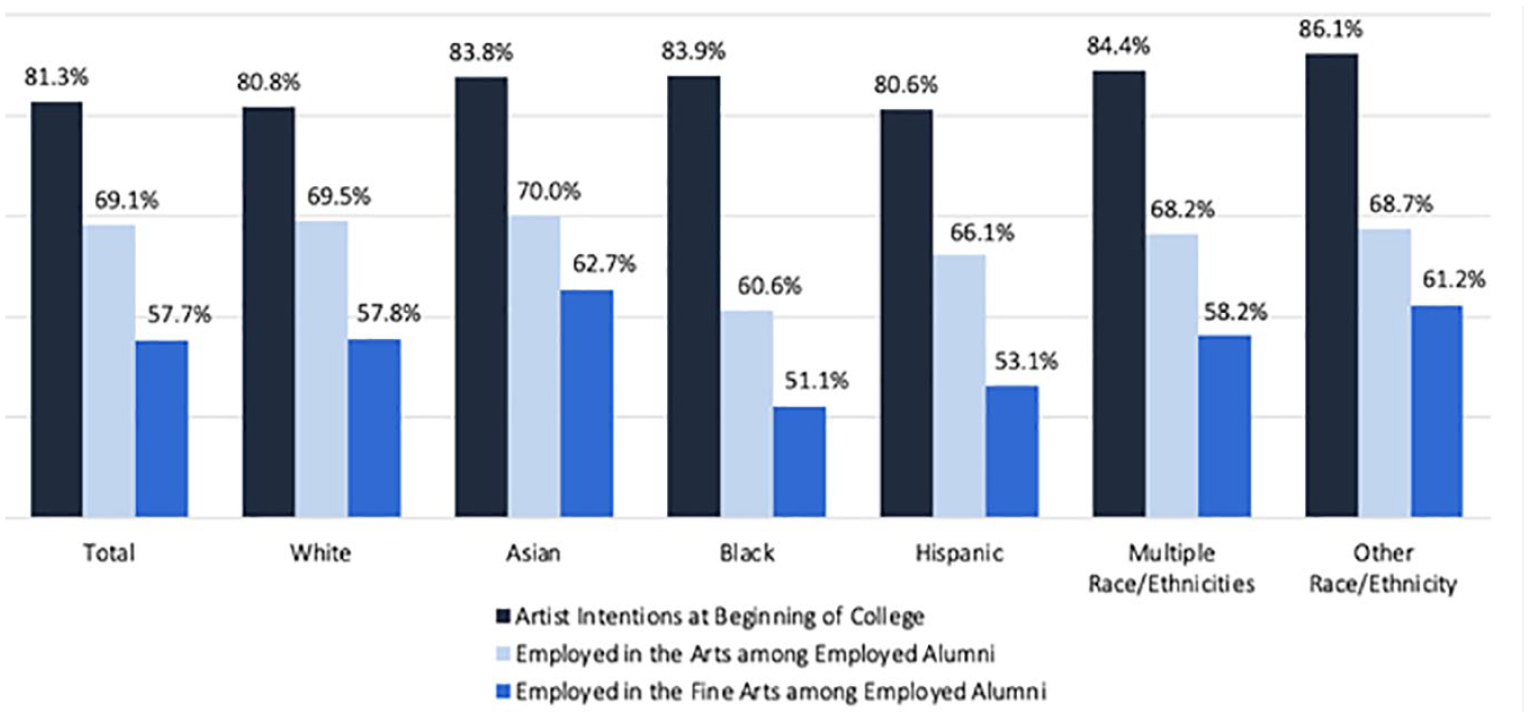
The Attrition Effect: Alumni Intention to Practice Art Versus Employment in the Arts or Fine Arts
To better understand how these racial/ethnic effects are intersectional with socioeconomic markers, we consider income by racial/ethnic identity group. As a proxy for privilege, we look at individual incomes among alumni employed in the arts both in absolute terms and as a percentage of overall household income. We suggest that the lower the individual’s income is as a percentage of total household income, the greater the social and economic safety net one has. We term this lower ratio of individual to household income a privilege effect. We use the mean rather than median wage because within the data, salary was collected in category ranges for which we are using the midpoint value, along with Pareto approximation to extrapolate the top (open-ended) income category (Parker & Fenwick, 1983). Figure 2 shows that we do see this privilege effect most notably for White respondents whose individual earnings make up roughly 71% of household income, compared to about 80% for Black respondents. Figure 2 also shows that household income is substantially higher for White respondents ($61,429) than for Black respondents ($56,111).
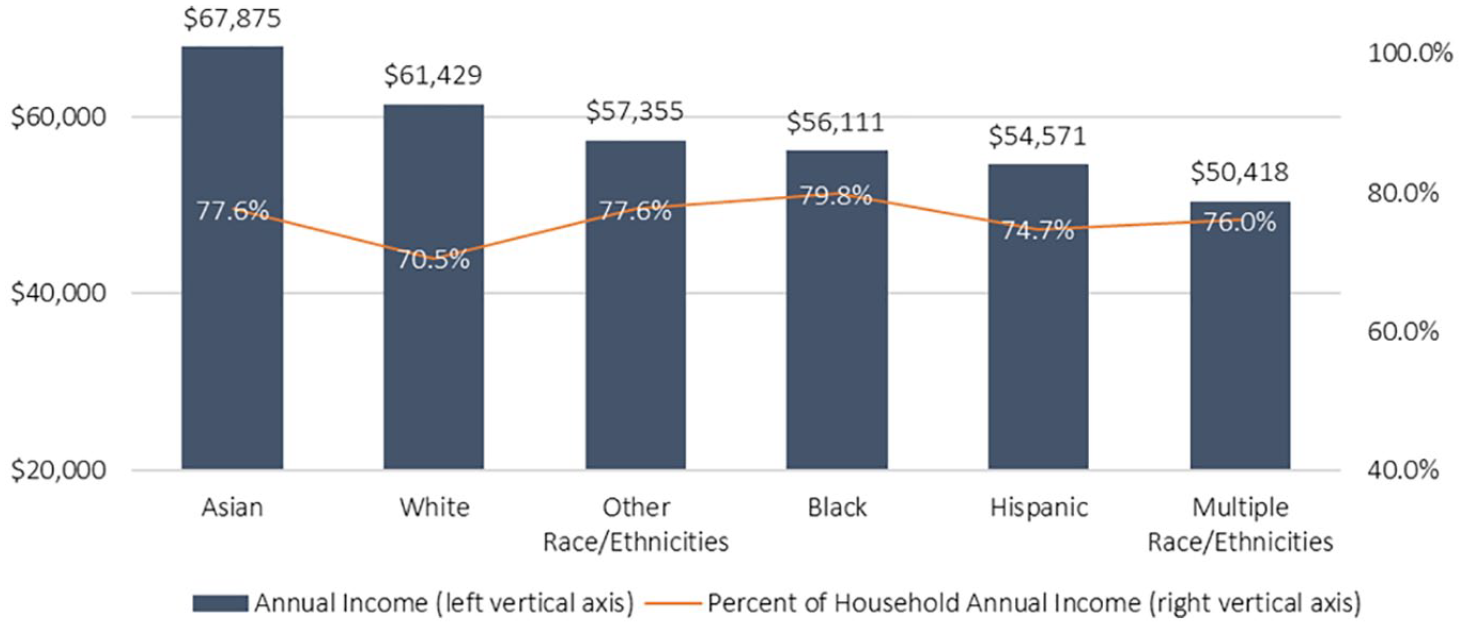
Comparison of Annual Personal Income for Alumni Employed in the Arts and as Share of Household Income
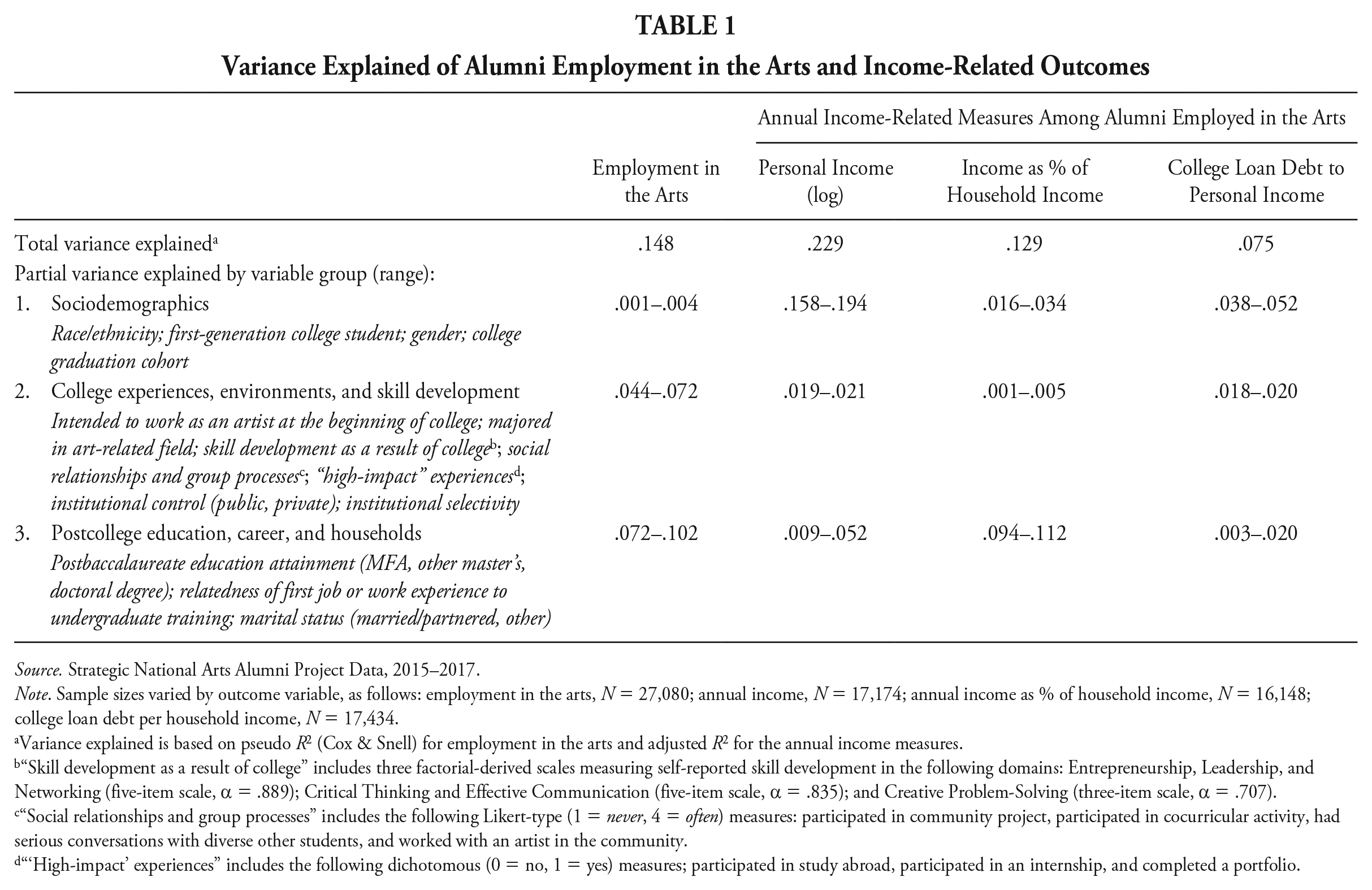
We then combine variables to contextualize income in terms of student debt and other factors that may inform these attrition and privilege effects. We perform multiple regression analysis to generate descriptive evidence of the extent to which different collections of variables account for—or statistically explain—the variance in the outcomes. We term this approach an intersectionality matrix because the analysis shows that many different factors, including college experience, skill development, social relationships and group process, in addition to sociodemographic characteristics, together contribute to postcollege outcomes in the arts. Table 1 shows the relative explanatory influence (i.e., partial variance explained) of each collection of variables in relation to arts employment and annual income-related measures among alumni employed in the arts. The ranges reflect the share of variance accounted for by each set of factors, depending on the sequencing of entering each set into the estimation equation.
Variance Explained of Alumni Employment in the Arts and Income-Related Outcomes
Source. Strategic National Arts Alumni Project Data, 2015–2017.
Note. Sample sizes varied by outcome variable, as follows: employment in the arts, N = 27,080; annual income, N = 17,174; annual income as % of household income, N = 16,148; college loan debt per household income, N = 17,434.
Variance explained is based on pseudo R2 (Cox & Snell) for employment in the arts and adjusted R2 for the annual income measures.
“Skill development as a result of college” includes three factorial-derived scales measuring self-reported skill development in the following domains: Entrepreneurship, Leadership, and Networking (five-item scale, α = .889); Critical Thinking and Effective Communication (five-item scale, α = .835); and Creative Problem-Solving (three-item scale, α = .707).
“Social relationships and group processes” includes the following Likert-type (1 = never, 4 = often) measures: participated in community project, participated in cocurricular activity, had serious conversations with diverse other students, and worked with an artist in the community.
“‘High-impact’ experiences” includes the following dichotomous (0 = no, 1 = yes) measures; participated in study abroad, participated in an internship, and completed a portfolio.
Although the sociodemographic characteristics taken alone do not generally explain the likelihood of working in the arts, they do account for the large majority of variance in personal income and college loan debt relative to personal income—one of the key measures of economic precarity. The large share of variance in personal income accounted for by one’s ascribed sociodemographic characteristics points to social reproduction (i.e., maintaining inequality and reproducing the social order), where educational attainment does little to stimulate social mobility by overriding some of the long-term influences of one’s preexisting, ascribed status (e.g., Bourdieu & Passeron, 1977; Collins, 1979/2019; Lucas, 2001).
Next, we present estimated total and direct effects of alumni sociodemographic characteristics on employment in the arts and income-related measures. The estimated total effects are based on reduced model estimates, where the regression equation only contains the sociodemographic characteristics shown in the table. These findings should be interpreted as upper-bound effect sizes that do not control for or hold constant any other variables. For the estimated direct effects, all three groups of variables (as shown in Table 1) are included (and thus controlled for) in estimating the outcomes. We compare the estimated total and direct effects to identify ways in which sociodemographic characteristics may be mediated through individuals’ access to specific college experiences such as social relationships and group processes, environments, or opportunities to develop certain skills, such as in entrepreneurship or leadership, and subsequent graduate degree attainment, career transition, and household characteristics. In Table 2, the effects on employment in the arts are based on logistic regression in which odds ratios are shown; values less than 1 signify a negative influence, and those greater than 1 indicate a positive influence. For the income-based estimates in the regression analysis, greater levels of economic precarity are indicated by the combination of negative effects on personal income and positive effects on both individual income as a percentage of household income and the ratio of college loan debt to household income.
Estimated Total Effects and Direct Effects of Alumni Sociodemographic Characteristics on Employment in the Arts and Income-Related Outcomes

Source. Strategic National Arts Alumni Project Data, 2015–2017.
Note. Sample sizes vary by outcome variable, as shown in Table 1. Comparison (omitted) groups include: racial/ethnic identity = White; gender identity = male; graduation cohort = prior to 1988. The total effects (TE) are based on reduced model estimates and include only those variables shown in the table. The direct effects (DE) are estimated from the fully specified model that includes all categories of variables shown in Table 1.
p < .05. **p < .01. ***p < .001.
The estimated total and direct effects yield three findings. First, compared to White-identified alumni, all other racial/ethnic groups demonstrate varying forms of disadvantage. For example, those who identify as Black are less likely to be employed in the arts and carry more college loan debt relative to their household incomes. In addition, alumni who identify as Hispanic or multiple race/ethnicities earn between 7% and 10% less than their White-identified counterparts, even after taking into account all other variables. Hispanic-identified alumni also carry more loan debt relative to their household incomes. We see more mixed evidence among Asian-identified alumni, who are less likely than their White counterparts to be employed in the arts once all other variables are controlled for while also earning sizably larger personal incomes, by roughly 15%. They also demonstrate less economic precarity in terms of loan debt relative to household income but greater economic precarity in terms of income as a percentage of household income.
Social class, as represented by first-generation college student status, yields much less demonstrated influence on employment and income-based outcomes than does racial/ethnic identity. However, first-generation alumni carried significantly higher levels of college loan debt relative to their incomes, indicating higher economic precarity relative to continuing-generation alumni.
Both gender identity and elapsed time since college completion show sizable effects. Not only are female alumni less likely than their male counterparts to be employed in the arts, they also experience an earnings gap that is greater than 41%—even after taking into account skill development, graduate degree attainment, marital status, and other confounds. Female alumni also carry greater college loan debt relative to household income and report less income as a percentage of their household income. Furthermore, more recent college graduates experience relatively greater economic precarity, indicating perhaps a survivorship effect for longer graduated alumni and potential effects of higher college costs relative to compressed wages or income unpredictability. Critically, by statistically controlling for several proxies for skill, we are able to isolate differences in postcollege outcomes that appear to be largely explainable by sociodemographics, thus suggesting the presence of systemic bias (Blau & Kahn, 2016; L. Zhang, 2008).
Reflecting Data Back to the Literature
We make three core observations from the data. First, we see a strong attrition effect that high percentages of students of Black and Hispanic racial/ethnic groups veer away from their initial desire to be an artist. At the same time, we see a strong privilege effect in which White alumni on average have proportionately higher levels of household support relative to personal income. Third, when we analyze the alumni cohorts from a multivariate perspective, we see what we can describe as an intersectionality matrix, that is, a set of contributory factors across race/ethnicity, socioeconomics, and gender that all influence careers in the arts and economic sustainability, as represented by income in combination with household support and college loan debt.
These effects together underscore and reinforce the ideas we cite in the literature review with regard to the economic precarity of fine art practice. The data also support strong concern about racial/ethnic and socioeconomic exclusion from the arts. As Frenette and Tepper (2016) underscored, students in the arts have expressed strong interest in entrepreneurial and leadership skills. This interest in entrepreneurial and leadership skills acquisition echoes our argument that economic precarity necessitates entrepreneurial thinking. Thus, the development of creative problem-solving and entrepreneurial skills may both serve arts graduates and be an actionable way to integrate CEEs across the curriculum.
Discussion and Conclusions
The arts suffer from complex problems of racial/ethnic and socioeconomic exclusion that likely take root in colonial histories and taste-making hierarchies that are maintained and exacerbated not only by continuing structural racism but also by structural economic precarity in the arts. Although artists have desired more business and entrepreneurial preparation, that process has been made more difficult because of resistance to business within artistic identities (Bonin-Rodriguez, 2012) and projection of economic disinterestedness as part of artistic personae (Wohl, 2021). Conversely, we also see some skepticism toward the arts and humanities from other domains. For example, as reported in the American Academy of Arts and Sciences’ Humanities Indicators project (Bradburn et al., 2020), 70% of arts and humanities graduates had a favorable impression of the humanities, but only 28% of computer science and engineering students did (Bradburn et al., 2020, p. 45), and only 50% of adults said that teaching art history to children is important (Bradburn et al., 2020, p. 54). Thus, we see a focus on entrepreneurial and creative problem-solving skills as simultaneously serving artists in the navigation of economic precarity and bridging these mutual skepticisms of business on the one hand and arts and humanities on the other, democratizing access to CEEs across disciplines. This dynamic highlights an important area for future inquiry.
Although it would be possible to identify marginal improvement in racial and socioeconomic inclusion over time, we have focused our analysis across all cohorts within the general intersectionality matrix so that our analysis does not mask the continued reality of entrenched systemic challenges in need of holistic attention. Although it is necessary to not assume that racial/ethnic and socioeconomic categories are overlapping, which itself would be a form of implicit bias, we do see interconnected dynamics that are difficult to address in isolation. To address these entrenched systems, we likely need policy entrepreneurship (Heidelberg, 2019) to redesign funding systems (Wilkerson, 2012) with the same level of creativity one might associate with art making. We may see new systems of support for artists develop around digital marketplaces for nonfungible tokens (Franceschet & Read, 2020; van Haaften-Schick & Whitaker, 2022) and more solidarity in unionization of art workers and risk-pooling by artists participating in markets (Whitaker, 2021a; Whitaker & Grannemann, 2019). Yet lack of economic support remains a material limitation to who can have careers in the arts. This economic impediment is reinforced and exacerbated by skepticism of entrepreneurial identity in the arts and by enduring legacies of colonialism and taste hierarchies. Addressing student debt is a substantial part of this conversation around economic sustainability for artists and art workers.
Our literature review shows learning outcomes in entrepreneurship and leadership and in creative problem-solving that easily translate into many other careers outside the arts. The development of entrepreneurial training within the arts can help to form a bridge for the way that CEEs are supported outside the arts, too. As we build those bridges laterally from the arts to other disciplines via a focus on creative problem-solving, we would also benefit from connecting the literatures of creativity studies in higher education to those in the K–12 environment so that we can see how structural inequities and exclusion from CEEs appear at younger ages. Chappell and Cahnmann-Taylor (2013) studied the ways in which minoritized youth fell out of arts education after the No Child Left Behind movement. Zhao and Gearin (2017) made the case for entrepreneurial education in the K–12 curriculum. Rather than frame this dynamic simplistically as a mechanical pipeline problem, we can frame it as an invitation to more holistic analysis. As Gutiérrez et al. (2017) wrote, we can “see ingenuity instead of ineptness and inability, to see resilience instead of deficit” (p. 30). Creativity can itself represent the necessary process of framing the democratization of CEEs more imaginatively, with greater curiosity, nuance, and care.
In the introduction, we mentioned the distinction between the Stanford Honors in the Arts Initiative and the Senior Reflection seminar taught to life sciences majors by the neurobiologist Sue McConnell and the writer Andrew Todhunter. Students in the honors program did projects that were presented to a panel of judges. The students in Senior Reflection came to class in onesie pajamas (listed in the required/recommended section of the syllabus) and engaged in open-ended exploration. This distinction between creativity as achievement versus as process is perhaps the biggest opportunity to refocus access to CEEs, opening space across the curriculum for imagination to coexist alongside analysis, for the onesie pajamas to become the synecdoche of being open to the sometimes messy and unquantifiable processes of creative engagement. At stake is our ability to respond to some of the largest questions of our time, from climate crisis to structural racism to criminal justice reform. To democratize access to creative educational experiences is to enliven society through support of the arts and to support each individual’s ability to make an original contribution, their life an art project as well.
Footnotes
Acknowledgements
We wish to thank Sunil Iyengar of the National Endowment for the Arts; the Strategic National Arts Alumni Project (SNAAP), in particular Angela Miller, Sally Gaskill, Jennifer Novak-Leonard, and Lee Ann Scotto Adams; and fellow SNAAP researchers, including Jennifer Lena, Rachel Skaggs, Alexandre Frenette, Hannah Grannemann, and others. We thank The Indiana University Center for Postsecondary Research for permission to use the SNAAP data. In addition, we thank David Kirkland, Dipti Desai, Jessica Hamlin, Linda Essig, Jason White, Alison Gerber, Joanna Woronkowicz, Doug Noonan, Cheryl Finley, Wendy Woon, Chris Barker, editors Ronald Beghetto and Yong Zhao, and the anonymous reviewers.
We received a fellowship award of $5,000 (total, $2,500 per author) from Indiana University when we were selected as Strategic National Arts Alumni Project (SNAAP) fellows. Indiana University houses the SNAAP database.

Notes
Authors
AMY WHITAKER is an assistant professor of visual arts administration at New York University. Her research focuses on the frictions between art and economics, including novel proposals for artists’ economic sustainability using blockchain. She is the recipient of numerous awards, including the Edith Penrose Award from the European Academy of Management for “trailblazing” research that challenges orthodoxies in one’s field. In addition to numerous peer-reviewed articles, she is the author of three books, including Economics of Visual Art: Market Practice and Market Resistance (2021, Cambridge).
GREGORY C. WOLNIAK is an associate professor of higher education at the University of Georgia’s McBee Institute of Higher Education. His research applies an innovative and interdisciplinary approach to the examination of the socioeconomic effects of higher education and the influence of college student learning and developmental processes on postcollege social status and well-being. He has published extensively on the career and economic influences of the college experience and coauthored the third volume of How College Affects Students: 21st Century Evidence That Higher Education Works (2016, Wiley/Jossey-Bass).