




Abstract
This chapter is grounded in a closer examination of the multiple origins of our theories of learning. Two questions guide our inquiry. First, in what ways has the science of learning and development originated in the lifeways of our ancestors? And second, what are some Global South Side origins of our theories of learning? First, we use two river stories to highlight growing restorative sociocultural and socioaxiological currents in the field. We then offer five origin theories: (a) spiritwork; (b) land is, therefore we are; (c) storying relations; (d) formal and organic intellectuals; and (e) settings grow from settings. We describe each one and potential ways forward for those interested in designing collective thriving grounded in our age-old theories of life.
Introduction: Origin theories of learning
Intertwined within the rich biodiversity of Planet Earth, Indigenous nations and diasporic cultural communities have maintained and regenerated cultural lifeways for millennia. These vibrant lifeways involve dynamic systems of relationships, governance structures, ethics, aesthetics, emplacements, ancestral knowledges, and stories. Despite centuries of dispossession, enslavement, colonialism, and encroaching empire, these communities’ lifeways have actively adapted to changing sociopolitical-ecological systems, ensuring their continuance, thriving, and well-being (Bang, 2020; Cajete, 2000). We have inherited from our ancestors remnants of their lifeways, their life routes, their life paths. We also inherit the profound responsibility to cultivate those lifeways.
Learning is the process through which these knowledge systems are intentionally sustained. The learning of cultural lifeways includes the development of expertise, the transmission and regeneration of ways of being from one generation to the next, scientific inquiry, innovation, and theorization. Because our communities have regenerated lifeways for millennia, it is clear that they know a great deal about learning. With this in mind, we pose the following questions for this review: First, in what ways has the science of learning and development originated in the lifeways of our ancestors? And second, what are some multiple Global South Side origins of our theories of learning?
In this chapter, we collect and closely examine multiple origins of our theories of learning. By “origin theories of learning,” we mean that we see the science of learning and development as a field of inquiry taken up by thinkers across thousands of years of historical time and across wide swaths of geographic space, including Third and Fourth 1 world contexts such as global Indigenous nations, Latin America, Asia, Africa, Oceania, the Middle East, the diasporic communities that descend from these lands, and beyond. We intentionally use “Global South Side” (Nzinga, 2023a) and “Third/Fourth” World throughout this review as an act of aligning this piece with other movements to reclaim these terms, such as epistemologies of the South (Santos, 2014), Southern theories (Connell, 2014), Third World Press (Madhubuti, 1991), solidarities with global south, third-world movements, and the idea of third spaces, which has been important in our field (Gutiérrez, 2008; Valenzuela & Epstein, 2023).
The provocations in this article began from a distinguished panel at AERA 2022 featuring Drs. Carol Lee, Michael Cole, Megan Bang, Angela Booker, Fernanda Liberali, Meixi, and Kalonji Nzinga, all of whom study learning in and with communities sustaining their lifeways across generations in the face of ongoing colonization. Titled “Where They See Subjects We See Theorists: Re-Centering Our Intellectual Ancestors & Relatives in the Canon,” a key focus of the panel was to explore (a) the ancestors of our approach to studying learning and development and (b) current efforts to recenter our ancestors—their theoretical and methodological lifeways in the study of learning as pathways to collective thriving.
As the panelists engaged in dialogue about these topics, one thing became apparent—the literature in the learning sciences systematically excludes Global South/Third World theories of learning. There have been significant efforts to bring these theories into the mainstream of the learning sciences by the panelists, our colleagues, and our forebears. However, we felt it was also important to attempt to review the sources of learning theory that are not formally part of the literature and to think critically about how and why they were omitted. Our panelists draw on a number of sources that shape their learning theory. These sources lie in other academic fields, oral traditions, Global South Side languages, familial relationships, settings, and cultural practices.
It is important to say up front that this review will depart from many norms within the field for synthesizing literature. The purpose of our review is to highlight the theories (and sources of theory) that those types of syntheses often leave out. This chapter is not a place to find a synthesis of the relevant empirical studies that have informed our orientation. We absolutely find those forms of synthesis to have affordances for theory building. There are reviews included in this volume that are generative along those lines. This review of origin theories of learning looks beyond current sources to begin to center theories from across the Global South Side that have been systematically left out. Although this chapter does not uphold many of the norms of a literature review, we believe that this RRE volume is an important venue to engage in a critical examination of those norms.
In the reach for social change and human flourishing, scholars across time have engaged in studying the science of learning to try to uncover human regularities and laws that can be generalized across human communities. Perhaps the word “science” of learning and development makes visible an ongoing tension in the field: How do we account for the “science” of human regularities while also acknowledging the multiple sciences and deep systems of biocultural diversity across time and place? In the last few decades, there has been an explosion of scholarship on the science of learning and development, coming from diverse fields, including neuroscience, psychology, developmental science, epigenetics, early childhood studies, resilience science, the learning sciences, and the social sciences (for examples of a review of important intersections of these fields, see Cantor et al., 2019; Darling-Hammond et al., 2020; C. D. Lee, 2017; C. D. Lee et al., 2020; Osher et al., 2020). Despite this immense growth, the majority of studies continue to emerge from studying Western, educated, industrialized, rich, and developed communities, or what Henrich et al. (2010) termed “WEIRD” populations. The learning theories from our ancestors and intersecting cultural communities have often been left out and/or been relegated to “subjects” of the study of learning rather than the theorists and scientists of learning themselves.
Our ancestors are epistemological, ontological, axiological reference points to build our social science and programs of research. They are important antidotes to ongoing erasure and epistemic violence (Marker, 2006). We ground our review of these origin theories and practices in the science of learning and development, exploring what it means to learn and grow as individuals and collectives, based on responsive intergenerational practices cultivated over thousands of years. Importantly, these foundations provide a glimpse into intergenerational thriving where colonization is not assumed or accepted to be permanent despite being occupied (Simpson, 2017). They are not responses to repeated violence where thriving is only conditioned and imagined within colonial realities. They instead are practices, stories, and teachings that have ensured the collective continuance of communities across time and space in spite of colonial onslaughts and occupations. Furthermore, we articulate why deeply recalling, “re-membering,” and recentering the scholarship of our ancestors and relatives builds on ongoing restorative currents in the field and can support a collective reach toward more lifegiving learning designs (Meixi, Moreno-Dulcey, et al., 2022).
We organize this chapter by clarifying what we mean by origin theories of learning and why we need to go backward in time and outward in geographies to actively presence (as radical acts of Indigenous survivance; Vieznor, 2008) the multiple origins of the science of learning and development. We first use stories of two rivers to highlight the multiple origins of our theories of learning. We then briefly describe some growing restorative sociocultural and socioaxiological currents that we have witnessed in the field. Finally, we begin an exploration of five origin theories of learning, which were contributed and synthesized from follow-up conversations with our esteemed panelists: Megan Bang, Angela Booker, Michael Cole, Carol Lee, Fernanda Liberali, and Shirin Vossoughi. The origin theories of learning offered here are (a) spiritwork; (b) land is, therefore we are; (c) storying relations; (d) formal and organic intellectuals; and (e) settings grow from settings. We describe each one and how each origin theory offers potential ways forward for our field, especially for those interested in designing futures based in collective thriving and understanding how communities continue to design their own futures in light of the persistent challenges and violences of our times. We recognize that this list of offerings is just the beginning. We invite you to join us to continue the vast work of exploring origin theories of learning from our distinct relations, lands, languages, and histories.
What Are Theories of Learning?
Theories are acts of social dreaming (Espinoza, 2008), re-membering (Dillard, 2011; Hampaté Bâ, 1981; Simpson, 2017), and “a location for healing” (hooks, 1994, p. 59). hooks (1994) continued, “Theory emerges from the concrete, from the efforts to make sense of everyday life experiences, from my efforts to intervene critically in my life and the lives of others” (pp. 59 and 70). We posit this review is part of revitalizing our practices and stories as our theories (Brayboy, 2005). Theories of learning are theories of life (M. Bang, personal communication, December 19, 2022).
Theories of learning can also reveal how learning is political and entangled in historical and contemporary processes of European and U.S. colonization and empire (Philip & Sengupta 2020). Singular narratives of progress, the separation of nature-culture relations, extractivist paradigms of consumption and production, and the removal of spirit from reason are often drivers of learning in schools and have contributed to the grave challenges of our time and increasingly uninhabitable worlds (Bang et al., 2012; Deloria, 2012).
Theorizing learning has happened since the dawn of human culture in East Africa. The archaeological and biological evidence suggests that we all evolved from the same community of human beings with anatomically modern brains distinguished by their capacity for dynamic forms of teaching and learning (Bynum, 2021; Tomasello, 1999). That species of homo sapiens has since dispersed around the globe, and everywhere we have gone, we have designed complex learning environments to cultivate and optimize learners’ minds, bodies, spirits, and places. Theorizing learning has happened on every continent and region of the Earth, including Africa, Asia, Oceania, and the Americas. We recognize that these origin theories of learning are ever expansive, shifting, and adapting to new lands, mobilities, and places. We articulate this review as a review of the stories-theories so far (Massey, 2005), ever expanding and open to ongoing co-constructions in the future.
Our current working definition of a theory of learning is an explanatory model that aids us in both description and speculation—understanding how learning works and how it could work toward imagining and social dreaming different futures (K. Brown & Cole, 2001; Espinoza, 2008; Gutiérrez, 2018; Houlden & Veletsianos, 2023; LaPensée, 2017; Mirra & Garcia, 2020; also see upcoming special issue in the Journal of the Learning Sciences edited by Mirra & Garcia and a growing body of scholarship on utopian methodologies, including K. Brown & Cole, 2001; Cortez et al., 2022; Escobar, 2018; Gutiérrez et al., 2020). Learning theories appear in the forms of concepts, stories, experimental results, terminology, metaphors, diagrams, statistics, and practices. A theory of learning explains how the structure and expression of a knowledge, skill, or disposition evolves over time.
Theories of learning are actionable in that designers of learning environments use them to inform what they attend to and how they design. Theories of learning are interrelated with theories of life that undergird them. We see “theory,” then, as continually generated and regenerated through embodied experiences, personal and collective practices, movement, affect, and kinetics that are deeply contextual and relational, with each person being responsible for contributing to and finding meaning for their own lives. Theories of learning include assumptions about what, why, and how one should learn in order to live well and collectively flourish into the future. These considerations are highly determined by the underlying protocols, governance laws, and worldviews of that family and cultural community based in ever-growing dimensions of learning as cognitive, social, cultural, affective, ethical, and political. A basic example is how communities over generations learn to act and participate, where
Each person, according to their calendar, their geography and their customs, will have to make their path, and just like us Zapatista peoples, they will stumble and get up, and what they build will have whatever name they want to give it. (SupGaleano, 2021)
A theory of learning holds some degree of reproducibility while also not determining a fixed end point or human universals. Theories of learning are expansive and could help us theorize about what emerges, how we got there, and how possible horizons move, shift, and expand, especially in ways that we might not predict or imagine (a. m. brown, 2017; Engeström & Sannino, 2021; Gutiérrez & Jurow, 2016; Zavala, 2016).
Complicating Binaries of “East-West, North-South”
As we consider what is missing from these bodies of literature, one important strand of conversation was to complicate ideas of what is “from the West.” In political movements for self-determination such as in Hong Kong, “democracy” is often characterized as imported from the West and not endogenous to the everyday lives, desires, and cultural communities of everyday people. In the same way, Marxist traditions might be considered Western thought, but Marxist ideas hybridized with homegrown Third-Fourth World political thought helped to articulate localized movements for shared ownership and radically distinct social relations. Arguably, in many cases, Eastern thinkers have contributed as much as Western thinkers to stereotypically Western ideas and vice versa. Although the global flow of ideas shapes the “production of locality” (Appadurai, 1996), we hold these complexities when considering what ideas are from the West while also naming the manifestation of the Western power paradigms that influence our daily thoughts and activities and social systems through ongoing colonization, settler relationships, and the intentional theft of ideas from the Global South that uphold the crediting of written knowledges to White, institutionally produced literature and scholarship, of which many of us are a part. Both of us here are writing from and based in institutions located in the “West” but have transnational and diasporic roots and practices that have traveled and been maintained across time and place. We have gathered stories from a wide range of spaces.
Rivers with Many Sources
We start with two river stories that illustrate how colonization has disoriented us and distorted our perception of natural flows. The first river story is that of the sacred Nile. The Ancient Civilization of Kemet or Egypt thrived for 4,000+ years along the Nile River, which extends for 4,000+ miles through 11 African countries. The Nile is one of a handful of rivers on Earth that flow from south to north. However, the Civilization of Egypt predates the current international consensus that north is up and south is down. To the Ancient Egyptians, the region of the Nile that we call “south” was actually Upper Egypt, and the “northernmost” point of the river that empties into the Mediterranean Sea was considered Lower Egypt. Most of the maps of Egyptian civilizations were oriented opposite to the current standard, with the Global South on top. The Ancient Egyptians, who worshiped the Nile, understood that the source of life that powered their civilization flowed downward, from south to north. If at any point the map of the field we are drawing here feels upside down, consider that it may be that the maps you are used to are inverted.
Our second river story is also about an inversion. The Chicago River has not always flowed from east to west. In 1887, White settlers reversed the Chicago River’s course so that it flowed into the Mississippi River rather than into Lake Michigan. When the river flowed according to its natural course, the north and south branches of the Chicago River converged to enter Lake Michigan. The settlers reversed the river because their growing industrial settlements were polluting the Chicago River with sewage, industrial chemicals, and animal wastes. The waste was flowing into Lake Michigan, which was the settler’s source of fresh drinking water. To save their drinking water, and perhaps to mask the defilement they caused, settlers decided to reverse the flow of the river toward the Mississippi River. The canal building associated with this project has been considered one of the most treasured feats of engineering in history. However, one man’s treasure can become another man’s trash. Today, the main stem of the Chicago River flows out west, out of Lake Michigan, to dump into the Mississippi River watershed, which has profound health-threatening implications for all lands and peoples downstream. By assuming a broader ecological perspective, technological advancements and scientific progress can often prove to be regressions or reversals of healthy evolution.
In this sense, the creation and introduction of cognitive studies of learning that separated body, mind, spirit, and place was a violent reversal, a countercurrent. Burkhart (2019), drawing on Deloria (2003), called this a kind of cosmological reconfiguration of our energies. The imposition of the coloniality of power (Quijano, 2000) fundamentally restructured foundational metaphysics that “exists in people (nature of subjectivity) and the land (the nature of space and place)” (Burkhart, 2019, p. 5). Although never complete, these countercurrents displaced and disrupted original understandings of learning and development. Colonial paradigms imposed problematic and racialized narratives of progress, where ideas of development were used to sort, categorize, devalue, and separate (Adams, 1995; Kwanchewan & Prasit, 2009; Marker, 2006; Mignolo, 2007; Quijano, 2000). European colonization was material and intellectual (Hountondji, 2002). The cognitive empire thrived because the Global South Side was exploited as data mines for the accumulation of knowledge and the development of theory in the natural and social sciences solely located in the north (Alatas, 2006; Connell, 2014; Hountondji, 2002; Joseph, 2011; Takayama et al., 2017).
Situated perspectives of learning that developed in the late 1980s were thus critical attempts to restore more holistic understandings of learning. We do not want our age-old learning theories to be positioned as recent “turns in the field” but, rather, ongoing restorative currents and origin theories. Instead, “advances” or “innovations” in the field of learning and development might really be thought of as a return to, a getting closer to the original flows, the natural complexities of human learning and becoming—what many Black, Indigenous, and origin societies and communities have been organizing, designing, and developing for millennia, always in response to new challenges, new opportunities, and new demands of their lands and their times.
At the same time, EuroWestern journals often recount the history of knowledge production in a particular field, but when they do, they begin with theories that came to prominence during the period of EuroWestern hegemony (approximately 1492–present). During most of this colonial period, Global South Side origin perspectives were stolen, denigrated, and/or actively expelled from EuroWestern fields. Due to the recent rise of expansive views of multiculturalism within the last half century, origin world perspectives are increasingly accepted as rich semilegitimate subfields. But within the norms of the literature review, these origin world perspectives are positioned as novel contributions to the domain of knowledge. Even those of us from Global South Side communities who know that our epistemologies have existed for millennia sometimes position ourselves as alternative and otherwise to the norm, as margin to the center, as outliers to the trend, and as counter to the natural flow. By continuing these literature review practices, we place our theories on the peripheral and participate in our own marginalization. By saying things like “the learning theories of Indigenous peoples were first validated in the 1980s,” we delegitimize the thousand-year histories of our ancestors wrestling with questions about how people learn.
If we are to look at the entire history of human learning theory, evidence shows that it was the Western perspective that was in many ways countercurrent to the norm. It was the Western perspective that reoriented the map so that the Global South was on the bottom and reversed the Chicago River to send sewage into the Mississippi. As a result, we are steeped in the traditions of beginning with negation and talk about particular turns in the field as novel “countercurrents” to what has been made norm. For our communities, these “countercurrents” are in fact the natural flows, the sustaining currents that have always held true, what “we have always done” (Simpson, 2017). Western theories have been centered for a long time in “the field,” and yet these perspectives often do not hold true to the lifeways that have been sustaining the planet, given that 80% of the world’s biodiversity lies in Indigenous-managed lands (Schuster et al., 2019).
Despite the ubiquity of learning theory across space and time, current bodies of literature that Western academies conventionally draw on to theorize learning has been marred by a pernicious sampling bias. Traditions of white supremacy and European colonization have often seen the West as centers of knowledge production and subsequently participated in the systematic erasure, theft, and marginalization of theories that come from elsewhere. This sampling bias would cause many to believe that most of the learning theorists throughout human history have been those operating in Western universities or that Western theories of learning are generalizable and can speak for all of human history. Historical records show that there are theories of learning that exist outside the west. In this sense, we argue that many of these theories are extracolonial and anticolonial, meaning they exist outside the epistemologies, axiologies, and ontologies of European colonization. In fact, many of these extracolonial or origin learning theories preceded the formation of the West, some by tens of thousands of years. Others developed in the Global South/Third World contemporaneously with the EuroWestern ones. Others were created by colonized people who built underground, fugitive spaces (Givens, 2021) where they cultivated and preserved traditions of learning design.
Therefore, a sociohistorical approach to learning is not simply looking at contemporary learners and appreciating their diverse ways of knowing. That is really important. But we also must go back into the historical record to recover and deeply study the broad research of learning theorists that have been left out of the canon. We cannot simply posit that people in Senegal or Singapore seem to learn differently. But we must also say that people in those learning environments learn differently because their ancestors theorized learning differently. We are arguing that diversifying the learning sciences means diversifying the canon. It means tracing backward in time and outward in geography.
Why is it important for the current literature of learning theory to represent the diverse origins and adaptations of learning theory? Part of this is about citational politics and how the people we cite communicates which people and cultures we value. The process of citation is a way of tracing how particular ideals developed over time. One way that colonizers have attempted to colonize the minds of various communities is to make those communities believe that the best, smartest, richest ideas come from the colonizer. This is what Ngũgĩ wa Thiong’o (1992) called a “cultural bomb.” He argued that
the effect of a cultural bomb is to annihilate a people’s belief in their names, in their languages, in their environment, in their heritage of struggle, in their unity in their capacities and ultimately in themselves. It makes them see their past as one wasteland of non-achievement and it makes them want to distance themselves from that wasteland. (p. 3)
Therefore, the oversampling of Western learning theories in the canon serves as a cultural bomb, perpetuating the false idea that the West has been a shining ivory tower with the most impeccable innovations in theorizing learning while third worlds have been wastelands. A review that seeks to move beyond Eurocentrism must also challenge the notion that universities as we currently know them are the sole arbiters of theorization.
We also argue that the field tells a deeply distorted history of learning theory when we restrict the characters in that story to formal education researchers. Here, we seek to tell a different story of our field. We have always told our own stories, lived by them, made new stories, and encouraged our young ones, too, to learn and imagine new possible stories to tell. We do not deny that researchers trained in Eurocentric institutions play an important role in the theorization of learning. We, too, have learned there. However, we see various other players, relations, and ancestors as contributing to foundational and contemporary theories of learning. The esteemed education researchers we interviewed often traced fundamental aspects of their theories of learning to thinkers outside of the field of education and even to those outside the academy. Our interviewees also suggested that it was reductive to think about human individuals as the only entities worth citing as theorists of learning. Can communities theorize? What about spaces and places? At their urging, we have expanded how we are thinking about reviewing education research. The five origins theories of learning here thus include formal researchers in this article, organic intellectuals, community relatives, animal and plant teachers, educational settings, and cultural practices. Our exploration of currents here pushes us to rethink the origins of our fields and where we begin in the literature. Just as how computing and the internet originated from Bamana sand divination games (Eglash, 2007), fields like neuroscience, psychology, and the science of learning also have origins before and beyond Eurocentric academies as we know it.
We are also mindful that in river ecosystems, water does not flow in a straight line but must meander, swirl, collect, sift, and move. We living beings depend on these movements, these currents in the flow of a river. Currents keep all of us—fish, plants, dragonflies, rocks, and humans—alive. When we mention tradition or how our communities have always done, we recognize that our medicines do not stand still (Harjo, 2019). Our ancestors would want us to benefit from the knowledges and changes we witness today while also dreaming, creating the conditions, and preparing the world for what our future ancestors would want and need to thrive. Rivers meander and also have natural reversals in response to life and flow at various timescales. They shift with geologic formations (Amazon River), with hurricanes (Mississippi River) and annual monsoon rains (Tonlé Sap River by the Mekong), and even with everyday tidal currents (Hudson River in New York). In the same way, creating collective futures is an everyday and deep-time practice. Every person needs to make decisions and think about how to shift, how to use new applications, tools, and artifacts (e.g., written forms, colonial languages, digital technologies, artificial intelligence) and navigate the ways we sustain spaces of imagination using new forms of living to regenerate new forms of life and living. To be clear, not all change is good, either. Each decision we make is laden with ethical impacts of such shifts, how might particular values and teachings be kept and lost, and our responsibilities in facilitating these shifts for our past, current, and future relatives and kin. But our communities have always cultivated tools of futurity (Harjo, 2019) to build, meander, and grow—and we seek to highlight these in our discussions.
Given the histories and the entangled, nonbinarial contexts from which we write and live, we now outline the methodologies of how this chapter came to be and the kinds of relationalities embedded within this review.
Two Restorative Currents in the Field of Learning and Development
To reiterate, we are making an argument about what is missing from the theory of learning. However, to do this, it is important to give some description of the field and the expanding scholarship that has been working more in line with the natural, original flows. In the following section, we describe two important currents in the field: (a) situative and sociocultural perspectives and (b) sociopolitical and socioaxiological currents that we view as ongoing restorative currents in the broad field of learning and development.
Situative and Sociocultural Restorative Currents
Situative and sociocultural studies in the field of learning and development have increasingly pointed us toward the importance of looking beyond colonial metropoles, outside the West, for sources of learning theory. These studies made it clear that to discover those sources, we must return to our roots. Situative perspectives responded to the preponderance of cognitive studies that tended to focus on the “internal” mental processes that undergird human behavior. The cognitive revolution produced several insights about mental functioning as they tried to approximate the innate biological substrates of human thought (Chomsky, 2005). But in some ways, it was a reversal of ancient wisdom, especially traditions that saw the human mind as deeply intertwined in its ecological surroundings. The situative approaches sought to restore ancient wisdoms, departing from reductive cognitive studies by focusing on the social contexts, historical timescales, localized interactions, and sensemaking within activity systems rather than exclusively individual internal mental processes (e.g., Bang, 2015; Cole, 2008; Greeno, 2012; ojalehto & Medin, 2015).
In the late 1980s and 1990s, situative scholars increasingly questioned the fairness and suitability of cognitive accounts of human learning purely focused on internal mental states devoid of context. One important realization in the field was that when used for nondominant and marginalized populations, cognitive measurement tasks originally designed for Western subjects globally failed to accurately account for these populations’ thought traditions (e.g., Medin & Cole, 1975; Serpell, 1976). Studies uncovered a massive sampling bias within cognitive and psychological research. For example, a robust review of the top psychology journals from 2003 to 2007 revealed that 96% of subject participants came from WEIRD contexts (Henrich et al., 2010). Theories that were developed through studying Western research participants seemed to falter when trying to apply them to human populations in the Global South. Witnessing the racialized and ecologically invalid nature of IQ tests and other cognitive study instruments that did not adequately illustrate the complexities and epistemological diversity within normative psychological studies, various researchers (Boykin, 1977; Cole, 1996; Cole & Griffin, 1983; Medin & Cole, 1975) reiterated the need for cultural psychology and cultural-historical psychology. Epistemologies based in white supremacy mainly served to maintain hierarchies of knowledge and deficit, uncomplex narratives of “the other.”
These scholars drew heavily from the works of Russian scholars such as Lev Vygotsky (1978), Leontyev (Leontyev, 2019), and Alexander Luria (Luria, 1982), seeing learning as a fundamentally social and cultural activity. The mind was “in society,” where speech, tools, subject, and object were unified wholes and generalizable meaning-making happened in the context of social interaction (e.g., Cole & Griffin, 1983; Hutchins, 1996; Vygotsky, 1978). Instead of seeing individuals as enclosed learners, learning is socially and historically situated, cultural, changing, and maintaining regularities through jointly shaped goals and contexts (Bang, 2015; Cole, 1996; Engeström & Sannino, 2021; Lave & Wenger, 1991; Medin et al., 2014, 2017; Nasir et al., 2006; Rogoff, 2003; Saxe, 1999). Participation in cultural historical activity systems thus is part of human development over microgenetic, ontogenetic, and sociogenetic scales where humans are making sense of the world in everyday ways all the time (Cole, 2008; Nasir et al., 2006; Saxe et al., 2009).
These theories of “the culturally situated mind” urged researchers to look at human communities outside the West to find insights about human mental functioning. Research studies of Vai communities in Liberia (Scribner, 1984; Scribner & Cole, 1981), the urban American Indian Community in Chicago and Menominee Nation in Wisconsin (Bang & Medin, 2010), Oksapmin societies in Papua New Guinea (Saxe & Esmonde, 2005), Mayan populations in Guatemala (Rogoff et al., 2014), and African descendants in the United States (Boykin, 1986; Cross, 1995; C. D. Lee, 2001; Spencer et al., 1997) showed that these communities’ “internal” mental processes were each uniquely structured because they tended to reflect the “external” ecologies of culture, language, and belief that had evolved in their communities, reflecting patterns of cultural change and continuity, generalizability, and difference (Gutiérrez & Rogoff, 2003; Rogoff et al., 2014, this issue). These studies validated the traditions of learning design that occurred within Global South regions, highlighting that these communities had very sophisticated structures for teaching and learning. Researchers of color who had often been at the margins of the field found sustenance in these situative and sociocultural theories, often because they validated what their elders and ancestors had said about learning. The chapter “Learning as a Cultural Process: Achieving Equity Through Diversity” in the Cambridge Handbook of the Learning Sciences provided an important summary of these restorative currents to the field (Nasir et al., 2006) and has since grown into a full volume of the cultural foundations in education (Nasir et al., 2020).
Many of these studies showed that research participants from Global South Side populations had systematic practices of thinking and learning. But if participants were observed to be thinking with the aid of cultural tools, it can only be logically derived that their ancestors who created those tools were theorists of learning. By the 1980s and 1990s Black, Indigenous, Global South Side communities were starting to be seen as valid subjects of study, but the theories derived from studying those communities were usually named after the scholar who “discovered” them rather than the community-based historical actors who developed and practiced those theories. There was not often a concerted effort to review the history of theorizing within those communities and uncover the stories of how their/our theories of learning emerged. And there were even fewer attempts made to integrate those uncovered stories into the history of “the field” that is narrated in literature reviews. The field is primarily narrated as beginning in an intellectual silo within the West. This inquiry seeks to trace some of the multiple origins of learning theory and think about some of the implications of telling stories of the scientific evolution of our field that begin elsewhere.
Sociopolitical and Socioaxiological Restorative Currents
Sociopolitical and socioaxiological approaches to learning have begun important restorative work in the field of learning where there seems to be a shift in the field to center ethics of care, dignity, self-determination, and joy—ethical and political reaches of what learning and development could and should be. The past 2 decades have witnessed the growing currents in the field of learning and development that call for an increased attention to power, politics, and ethics in the study of learning. One of the most prominent collections of works is Power and Privilege in the Learning Sciences, edited by Indigo Esmonde and Angela Booker (2016). In this volume, they made visible how “issues of power and oppression require more committed attention in the learning sciences,” not just how power is ever present in these contexts but that they are systematically connected to broader and enduring systems of violence and oppression such as patriarchy, racism, ableism, and colonialism (p. 2). Furthermore, they noted that although power, critical disability, gender studies, and critical race theory have been in conversations in education, these studies have often not been sufficiently incorporated into the study of learning. Origin theories expand our views and instruct us to intentionally wonder and study who and what ancestors, settings, and relations have been left out or not conventionally been named as part of the field of human learning and development and how power has been used to erase these origins and expand our views to other theories of life to ground our ethical and axiological reaches and learning designs.
This decade has seen a groundswell of studies that illuminate the connectivity of transpolitical movements and emphasize the sociopolitical dimensions of learning. The visible heightening of U.S. nationalism in 2016, for example, prompted a collective response to further center and attend to the sociopolitical dimensions of learning with The Politics of Learning Writing Collective (2017). In this piece, the collective explicitly linked the need to develop robust methodologies and empirical analysis of power and politics within social, ecological, and historical contexts of learning with efforts to “substantively address the powered and politicized contexts and consequences of learning in ways that make it possible for children, their families, and communities to create thriving, self-determining lives (e.g., Calabrese Barton, 1998; Kirshner, 2015; Rosebery et al., 2010; Taylor & Hall, 2013)” (p. 95). Furthermore, there was an emphasis on race, processes of racialization and power (McKinney de Royston & Nasir, 2017; Nasir, 2011; Nasir & Hand, 2006; Shah & Leonardo, 2016), the role of empire in learning and ideology (Philip & Sengupta, 2020; The Politics of Learning Writing Collective, 2017), how settler colonial narratives and epistemic racism even within Vygotskyian and sociocultural theories can perpetuate Indigenous erasure and human domination (Bang, 2017), and numerous studies that have investigated power within epistemological normativities in science, mathematics, and computer science education (Bang et al., 2012; McKinney de Royston & Sengupta-Irving, 2019; Morales-Doyle et al., 2020; Philip & Gupta, 2020; Sandoval, 2019; Vakil et al., 2016).
Critical studies such as feminist, queer, Black, Indigenous futurisms, and postcolonial studies should round out our sociocultural theories of learning and help to highlight the political and speculative dimensions of learning and development. Some examples include studying how teachers of color might hinder or advance racial justice through feminist and critical leadership scholarship (Pham, 2022), how teachers are embedded within nested systems of power (Philip et al., 2022), poststructural analysis of race in mathematics (Shah & Leonardo, 2016), queer theory in the learning sciences (Lizárraga & Cortez, 2020; McWilliams & Penuel, 2016) and youth mobilization (Uttamchandani, 2021), critical conversations on computer science education (The Papaya Project, 2022; Tzou et al., 2019; Vakil et al., 2016), the emotional configuration of politicization in youth climate justice movements (Curnow & Vea, 2020), problematizing cartesian constructions of learning and deepening complex histories of place (Marin 2020; Taylor, 2018, 2020; Taylor & Hall, 2013), and how contrapunctual understandings of learning can provide insights to how theories of learning are linked to theories of society (Philip & Sengupta, 2020).
Alongside the dimension of politics and power in learning, studies have increasingly attended to the socioaxiological as an underexamined and yet core dimension of the study and design of learning (Bang et al., 2015; Booker, 2016; Elliott-Groves & Meixi, 2022; Marin et al., 2020; Meixi, 2022; Nzinga, 2023b; Nzinga & Medin, 2018). We draw on Bang et al.’s (2015) work on the axiological in community-based design research to use socioaxiological to refer to the underlying relational, ethical, and aesthetic qualities, assumption, and structures that undergird the theories, contexts, and practices of “what is good, right, true, and beautiful—that shape current and possible meaning, meaning-making, positioning, and relations in cultural ecologies” (p. 29). Furthermore, there have been studies that examine the interrelation of the political and ethical—how each shape and sharpen the other but that the socioaxiological in fact needs to lead the political and intellectual work in order to meaningfully transform inequities through the focus on the hope, beauty, and dreams of what is possible rather than starting from points of negation (Bang, 2020; Bang & Vossoughi, 2016).
To be clear, the political and ethical dimension of learning has long been part of understanding how communities have theorized and studied learning within sociocultural traditions; these dimensions are now just increasingly named, foregrounded, and elevated. For example, Carol Lee’s (2001) work examining her own pedagogical practices within a cultural modeling project illustrated the intellectual rigor within the literary discourses of African American students in her classroom. This particular curricular design not only held a politic of refusing deficit orientations, it also emphasized the axiological dimensions of teaching whole human beings where “loving and respecting young people is the mortar from which good teaching is built” (p. 133). Similarly, Kris Gutiérrez’s (2008) study of sociocultural literacy in third spaces illustrated the importance of designing learning environments with a particular politic that attends to critical historicity in designs, drawing from the literary resources as everyday historical actors. Social design experiments like the Migrant Student Leadership Program and Food Justice program call for meaningful action that should be consequential not just for learning but also for the lives of the learners and actors in society (Gutiérrez & Jurow, 2016; Jurow & Shea, 2015) and relational ethics of care in teaching and research partnerships (Potvin et al, 2021), offering intellectual kinship, social dreaming, and critique (Espinoza, 2008; Gutiérrez, 2008; Vossoughi, 2014).
Methodologically, our design research traditions have expanded to systematically and explicitly design for axiological innovations (Bang et al., 2015), more porous role remediation through participatory design research (Bang & Vossoughi, 2016), social design experiments (Gutiérrez & Jurow, 2016), dignity-centered research partnerships (Espinoza et al., 2020; Riedy, 2022), the study of social movements (Curnow & Vea, 2020), and video and interaction analyses that further emphasize that interactions are never politically neutral and, rather, always include particular ethical and political orientation embedded within historical political contexts (Davis et al., 2020; Espinoza et al., 2020; Gutiérrez et al., 2019; Keifert, 2021; U.-S. A. Lee et al., 2022; Marin & Bang, 2018; Taylor & Hall, 2013; Vossoughi et al., 2020, 2021).
Building on these restorative movements, origin theories of learning help us recognize that these restorative currents do not emerge from a single source (even though many draw on similar intellectual genealogies in our field) but, rather, a vast and rich multiplicity of genealogies and linguistic, land-based, and spiritual traditions that continue to interweave, intersect, and regenerate. An origin theories perspective requires us to reach beyond the current purview of our field’s existing scholarly traditions to better attune to, understand, and see learning from multiple intellectual grounds and perspectives. In the next sections, we describe our methodologies of writing-in-relation and how the five origin theories named here offer beginnings and inspirations for us as a field to see, name, and ground our learning designs from multiple theories of learning.
Methodologies: Writing In-Relation
Our primary method for tracing the multiple origins of the learning sciences was to engage in conversation with various scholars in the field who are engaged in restorative currents. The participants in the study were all scholars in the field of the learning sciences representing a diverse array of cultural backgrounds. Within our methodology, we made space for participants to remember the alternative sources that informed their theories of learning. We designed activities in which participants could recall theory sources tied to their own personal positionality within cultural lifeways. We wanted them to feel comfortable to share sources that are hard to cite within literature reviews, perhaps because there was little precedent, there was some stigma, or the sources were devalued as less scientific. Our participants were well aware of the history and trends in the field and also deeply committed to rigorous evidence as a basis for theory. Therefore, they had informed understandings about what types of theory sources were valued in the field and which ones were more marginal. We engaged in two main processes to facilitate these rememberings.
Exploring the Origin Stories of our Co-Panelists
The 2022 AERA preconference panel hosted by the Cultural Historical Special Interest Group acted as the first dialogue in which our co-panelists began to respond to our research question. We co-theorized with scholars during the panel, engaging in a lively conversation about the ancestral origins of our theories of learning. We then engaged with the transcripts from the 2022 AERA panel to synthesize panelists’ responses to our orienting questions.
This synthesis of ideas was then deepened through Meixi and Kalonji facilitating a series of five hour-long follow-up conversations with the AERA co-panelists. In total, we engaged in five conversations with Megan Bang, Angela Booker, Mike Cole, Fernanda Liberali, and Shirin Vossoughi. In these conversations, we asked about each person’s relational and intellectual journey, loosely guided by the following questions:
Why learning? What relations/traditions have brought you here (learning science and others)?
What constitutes a theory of learning? What constitutes a theorist of learning?
What questions are you asking in your work? Who have you gone to and who are you going to to help answer those questions?
What are the things (ideas, activities, values) that you are reaching to at this time in your life’s work (e.g., educational dignity, relational coexistence, politicized trust)?
Who else is reaching for these ideas/values? How have they inspired you?
What implicit/explicit moves do you make in your work to reach for (e.g., educational dignity, Indigenous relationality) in the learning sciences?
Community Crowdsourcing
Next, we engaged in community crowdsourcing methodologies with groups of critical learning sciences scholars at two events. The first event was with participants that attended the AERA panel. The second event was a community conversation with the Virtual Lab, an intergenerational consortium of critical scholars who study the political and ethical dimensions of learning. Each of these groups was asked to add their responses to a collectively created padlet (see Appendix A), where they submitted the ancestors of their approach to learning. The padlet acted as a crowdsourcing of theories, practices, and relations that have guided scholars’ work and research on learning and development.
Data Analysis
We then reflected on these more intimate hour-long conversations alongside the initial AERA panel recording to create more grounded, coded categories of what might constitute a review of the sources of our learning theory that have been hidden, erased, missing, or underarticulated in narratives of the field’s development. From continual reflection on these conversations, we noticed five recurring themes across personal, familial, and place-based stories—which we articulate here as five “origin areas of our theories of learning.” In each section, we bring in these scholars’ thinking and as possible, interweave them with other scholarship. Although each of these conversations with this broader network could be an entire chapter on its own, there are revelations we are not going to share for intentional, relational reasons. Part of this work is arguing for methodological shifts as related to our positionalities—who we are, how we have come to know, and what we feel has been important in our continued and shared work in the world. Acts of sharing and protecting ideas from the academy are part of the relational and positional piece. Our writing here is thus a reflection of this shared journey.
In terms of our writing process, we engaged in dialogic conversations in the formation of this chapter. Part of the process heavily relied on us reflecting on our journeys, our tensions, struggles, and joys, in real ways. We spent time in each other’s classes. We shared our syllabi. We tried to keep it real and relational for our own benefit and the benefit of our students. We were not just trying to fit into a mold of the field but, rather, to lean into what actually felt real in the theories of our lives (Million, 2008). We tried to speak to the different contexts we have been in, the rootedness of our relations, and the routes and rounds we made while in the assistant professor roles and in these cowriting roles from Columbus, Ohio, to Chiang Rai, Thailand. We discussed painful comments from our family members who were surprised at our participation in universities, the allure of the West, the pain of not being with our home communities, and unequal distribution of resources and power between the Global North and Global South that we materially feel in our salaries and the kinds of grant funding that is possible, the power and currency that we now hold, and our shared desire to hold the intellectual ground of Black, Hokchiu, and Lahu relations and communities. We write this for our students, families, and communities, too. This chapter is an attempt to articulate this interweave of theories and write together and bring in conversations with each other across generations some of the origin theories of learning and development.
Five Origin Theories of Learning
Origin Theory of Learning 1: Spiritwork
Every entity in the universe is alive and imbued with living energy and spirit (Deloria, 1979). We are spiritual beings living a human experience. Therefore, a theory of learning contains underlying conceptions of the sacred purposes of human living and our role within the greater web of life. We intentionally start with spirit but do so with much love and deep caution. We recognize that historically, EuroWestern quests for “logic” and “reason” have forcibly separated and removed spiritual dimensions of life from learning and the academic disciplines. At the same time, regimes of power have done great harm in the name of spirit. They have commodified, homogenized, appropriated, and disfigured spiritual practices in order to create a compliant citizenry and justify unimaginable violence. But, we are spiritual beings living a human experience. We offer this metaphysical truth while simultaneously understanding that spiritual practices look vastly different in each of our communities and territories and even across distinct stages of one’s life.
Sociocultural theories of learning have helped learning theorists notice the ways that all activity is rooted in cultural practices. At the same time, and for good reasons, the representations of culture have often been devoid of spirit. When cultural practices are depicted in scientific journals, we often de-emphasize the spiritual aspects of our epistemologies. Sometimes we do this because we realize that our cultural practices will be delegitimized by Western standards that regard the discussion of spirit as unscientific. Sometimes we do this because the spiritual dimensions of our practices are sacred and we do not want them co-opted or found out by communities who have consistently waged spiritual warfare against us. Sometimes we do this because spirit and religion have been used to justify the subjugation of our people. At the same time, if we are to be real empiricists, flows of air are both chaotic and also highly organized patterns that divide and subdivide again, and “It is at these points of instability that unpredictable and creative events take place. . . . It is out of this instability that a new world emerges” (Burkhart, 2010, p. 38). Body, mind, spirit, and place are interconnected quantum creations of energy, matter, and meaning (Barad, 2007; Deloria, 1979; Meyer, 2013; Somé, 2000). Each breath exchange of carbon dioxide and oxygen among living beings reminds us that spirit and energy exist in every act of living and knowing, not just in separate ceremonial spaces (e.g., Meyer, 2013). This intimate power composes the universe (Deloria & Wildcat, 2001).
The everydayness of spirit is reinforced by Diné, Lakota, and Jalagi (Cherokee) philosophy, where divinity and power are
not restricted to divine acts, but are continuous with common creative events, even of ordinary human creativity. . . . Human creativity is an expression of the exact process and energy that is expressed in the divine creation. Creativity, power, energy, transformation, and movement are closer approximations of a Native sense of the divine than the ordinary English words: “God, holy, sacred, and divine being” and religion is in fact a “way of life.” (Burkhart, 2019, p. 34)
Extending the idea of spirit in the everyday, coming to know carries spiritual continuity (Meyer, 2001). It is a collective process, an “unfolding of relationship with the spirit world” (Simpson, 2014, p. 15). Manulani Meyer, Kanaka Maoli scholar of hermeneutics, wrote that across origin knowledge systems around the world, there are three main mediums in knowing (Meyer, 2013). We know through the body—embodied, direct physical experiences; the mind—the mental and subjective; and the spirit—the ancestral, intuitive, transspatial, quantum that are remembered, received, and transmitted across time. In fact, we by ourselves “cannot bring about the kinds of knowing that endures” (Meyer, 2001, p. 128). Instead, knowledge embodies connection to ancestors across the continuum of past, present, and future, lived and regenerated in relation to origin places and coordinated with plant, animal, seasonal, water-based, and cosmic rhythms (Deloria, 1979; Rock & Gould, 2018). Knowing, then, is akin to a dynamic sinew that runs all the way back to the spiritual forces that continue to be with a community, a living guide for future generations as they continue to receive, perceive, reinterpret, and act in changing socioecological worlds (Meyer, 2001).
The reality is that human communities across the world have developed proverbs, parables, ceremonies, rites, mantras, and other forms of spiritual technologies to cultivate more humble, relational human beings who understand their roles within an interconnected multidimensional universe (e.g., Deloria, 2003). Another example in Shona philosophy is hunhu/ubuntu, which could translate to “I am because we are.” Ubuntu is a moral dialogical reality and foundational ontology that assumes human existence is fundamentally relational, in communion and in dialogue with others such as midzimu (ancestral spirits) and musikavanhu (creator God; e.g., Mangena, 2012; Mukurazita, 2024). The natural and spirit worlds constitute dimensions of knowing and being in human life. The decisions we make as human communities about what and how to know and who and how to become individually and collectively is also moral and spiritual work.
Fernanda Liberali spoke about several spiritual practices that were ancestral to her theory of learning. She mentioned her upbringing in Brazilian Catholic school, where she participated in youth groups influenced by liberation theology. “These youth groups were moved by the liberation movements in South America.” It was her participation in the rituals and theological practices of the Catholic community where she developed key aspects of her theory of learning. It was in this spiritual context where she found the first seeds of a Marxist and Vygotskian understanding of learning that have motivated her engagement as a political educator. Within spiritual practice, we often learn theories of sacred being, what it means to learn and grow ethically. Fernanda also mentioned her more recent participation in African dance traditions. The style of dance she participates in is connected to a system of global spiritual traditions drawing from the Ifa cosmology. The Candomble practices of Brazil emerged from the same root as Santeria in Cuba and Ifa among the Yoruba of Nigeria. She mentioned dancing to the deities Oshún and Obalúayé as an activity that fueled her intellectual and political work. Although intensive study of learning sciences literature and years of empirical research have certainly informed her work (Liberali, et al. 2021), these arts-based spiritual practices added substantially to her theoretical lens.
Shirin Vossoughi helped us understand that spirituality often dwells in places that have been labeled as “secular.” She said that although her father’s practice of socialism was based on an atheistic worldview, there were actually spiritual dimensions to his belief:
Part of what this [socialist practice] created in my dad, which is part of what is created in me, is a deep belief in the possibility of a just society. He grew up Muslim, my grandparents were all devout Muslim and he became an atheist because that’s what you did if you were a communist. And I was raised that way. But pretty quickly in high school and college I realized actually my Dad has a religion, it’s just Marxism. He believed in his bones that we would have a just society and it was only a matter of time and struggle. And so there’s an optimism and a radical hope and possibility to that, that I think resonates with Freirian thought, with some of Vygotskian thought but with also a certain kind of political thought which is to build with Megan (Bang) and Manuel Espinoza’s language not just about the critique and negation but about social dreaming and possibility.
Potential Directions Forward
Engaging with spirit in our study of learning and human development is a tricky subject. Thank goodness we are tricksters. The spirituality of human communities is often practiced in sacred and intimate settings. There are deep histories of Third World communities having our spiritual practices co-opted, appropriated, misread, persecuted, and so on. We have learned many practices of keeping our knowledge systems esoteric and encrypted. Our wisdom is coded in rap songs that they only think they can understand. In many traditions, only elders have the right to speak about certain knowledge forms in a public forum. Not all knowledge is to be shared; there are some things we should not know. Highlighting the spiritual dimensions of knowing here is not an invitation to appropriate the spiritual practices of a people through hungry listening and settler extraction (Robinson, 2020). We respect the secret. At the same time, speaking about the design of our learning environments without the spiritual dimension can obfuscate the fundamental reasons why they are efficacious. They are efficacious because they are spiritually sound and axiologically grounded. Removing spirit from our work perpetuates unhealthy cycles of separating spirit from reason.
How one talks about, speaks to, experiences, and engages with spiritwork is unique to person, place, and history. We cannot prescribe what involving spiritwork has been, should be, or will be like for you. The universe being alive also means “the universe is personal and, therefore, must be approached in a personal manner” (Deloria & Wildcat, 2001, p. 23). One practice we offer up here is Stó:lō scholar Jo-Ann Archibald’s “Becoming Story-Ready” as a practice to get our spirits ready for the work that is about to begin and the stories ahead (Archibald, 2008). Archibald (2008) shares how she had to learn to become story-ready through 4 Rs: respect, responsibility, reverence, and reciprocity—everyday ethics that allowed her to engage in meaning-making with stories. Learning to be story-ready is often left out of our research and learning practices. We often talk about the research question or the data analysis but seldom what it means to prepare our hearts and spirits to receive these stories, to get ourselves ready to learn what they mean. Becoming story-ready is an individual responsibility; it lies within each one of us before we receive a teaching. Becoming story-ready looks different for each one of us, too, as we mature. How we become story-ready today is different from our story-readiness 10 years from now. It requires continual attunement to the ways we come to know—through embodied experiences, through ideas, and through receiving knowledge from the metaphysical world (Meyer, 2013). The teachings we receive—and miss—will differ depending on how story-ready we are. An attention to spirit asks each of us to consider: How might we become story-ready? How are our spirits connected to our own ancestors and the purposes that we inherit and pass on? To study the science of human learning and development, we suggest that continually grappling with these questions can support a more holistic way of understanding life, learning, and knowing. Seeking and cultivating a personal relationship with the living universe is the responsibility that every one of us carries, human and more-than-human, as we come to more deeply understand the expanse of this work.
In considering future directions as a field, we recommend both expansion and caution. Our interviewees recommended being selective with the aspects of our designs we publish for public consumption. It is important as Global South Side scholars for us to participate in learning design and theorization within our local communities without feeling the pressure for it to be reported to academic communities. Paradoxically, the survival of our theories of learning requires some of them being hidden and protected. Givens’s (2021) work on fugitive pedagogies speaks to the ways in which Black folk have always needed to learn in secret. Some of the spiritual aspects of our theories of learning are fugitive in that they must be fleshed out in sanctuary spaces and if ever in public, hidden in plain sight.
At the same time, there are some aspects of our spiritual theories of learning that are exoteric in that they are meant to be understood and made medicine for wide consumption. It is imperative that entire societies of humankind shift our relations with plant, animal, and human relatives, and there are certain exoteric spiritual theories that must be shared widely to intervene in destructive lifeways. Understanding the balance across the spectrum of the esoteric—stories and theories that are private to a family and community—and the exoteric—the stories and theories that are appropriate for all peoples—is something each one of us has to make ethical decisions about when deciding what to share and what to keep. Actively seeking and protecting this balance is an important design principle that can help protect and expand our origin theories of learning and knowing.
Origin Theory of Learning 2: Land Is, Therefore We Are (Bang et al., 2012)
Intertwined in Origin Theory 1, “land is, therefore we are” reiterates a core premise that balanced, reciprocal nature-culture relations are fundamental to human learning and the health of the living world. It reflects many Indigenous intellectual traditions where humans understand ourselves as part of—and have responsibilities to—a vast web of relationships across all living beings. Land is codesigner, teacher, and interlocutor in human learning. This origin theory recognizes (a) the ways particular landscapes and ecosystems, seasonal weather patterns, philosophies, and place-based calendars are directly linked to the development of dynamic human knowledge systems, languages, semiotics, cognition, and material conditions and (b) how ongoing settler violence and repeated human removals from ancestral landscapes and waterways across time threaten both human learning and the very health of land and waters dependent on those knowledges, languages, cultural, and spiritual practices of place. Land, being, and knowing all need each other.
Despite the centrality of Land (intentionally capitalized) in human maturation, a vast majority of studies in human development have structured anthropocentric nature-culture divides rather than nature-culture relations where situated human life is part of larger ecosystems and living relationships with the rest of the natural world (Bang, 2015). Many Indigenous knowledge systems and the learning theories that accompany them are foundationally based on the changing land and waterscapes of that particular place within and despite settler logics (Armstrong, 2018; Bang et al., 2014; Burkhart, 2019; Deloria, 2012; Deloria & Wildcat, 2001; Goeman, 2008; Kimmerer, 2014); land is pedagogy (Simpson, 2014). The placelessness of schools and erasure of land in school curriculum have perpetuated an imbalance of power between humans and other living beings. “Land is, therefore we are” as origin theory draws heavily on Indigenous intellectual traditions that theorize and embody the ways that human development, resiliency, identity formation, mobility, meaning-making, thriving, sociotechonological innovations, and community goals are dialogically and intimately intradependent and interdependent on land and direct experience in the world (Cajete, 2000; Deloria & Wildcat, 2001; Simpson, 2017; Whyte et al., 2018).
The Land here refers to the duality of a
physical geographic space but also to the underlying conceptual principles, philosophies, and ontologies of that space, including waters and sky relations. This duality is not to be construed as dichotomous, oppositional, or binarial but rather expresses the ways Land embodies two simultaneously interconnected and interdependent conceptualizations. Land as an Indigenous philosophical construct is both space (abstract) and place/land (concrete); it is also conceptual, experiential, relational, and embodied. (Styres, 2017, p. 49)
The return to this origin theory of learning has been largely led by Indigenous scholars such as Megan Bang, Ananda Marin, Eve Tuck, and Emma Elliott, who in the last decades have highlighted the centrality of Land-driven designs of learning (Bang et al., 2014; Bang & Medin, 2010), drawing from multiple groups of scholarships that foreground Indigenous knowledge systems and the learning theories that accompany them. Land is central to Indigenous well-being and systems of relationalities (Elliott-Groves, 2019). This work includes studying the complexities of practices such as walking, reading, and storying lands (Marin & Bang, 2018), the reimagination of schooling in Indigenous contexts where families story lands with teachers to design curriculum (see Figures 1 & 2; Meixi, Kongkaew, et al., 2022), decolonizing place with Indigenous knowledges and Black feminist geographies with children (Nxumalo & Cedillo, 2017) and plant personhood in Indigenous epistemologies, ontologies, and axiologies (McDaid Barry et al., 2023), where situated perspectives of the natural world carry vast implications for education and human thriving (Bang, 2015). These studies have illustrated how examining Land relations in learning and human development rounds out our current conceptions of culture, racialization, and place. It makes visible the consequences of desecrating the sacred, where Land is resource, not relative (Wildcat, 2001); where the removal of spirit is used to justify colonial expansion and racialized capitalistic extraction; and where the placelessness of schooling and learning are tools of upholding human supremacy (Bang et al., 2022).

The Saehang Family (Hmong) Walking Their Mango Farm as Part of a Designing With Homelands Iteration at an Urban Indigenous School in Thailand
The centrality of Land, water, and sky for us is directly linked to practices of what Indigenous anticolonialism, including Indigenous anticapitalism and decolonial Indigenous thought, can teach us:
A struggle not only for land in the material sense, but also deeply informed by what the land as system of reciprocal relations and obligations can teach us about living our lives in relation to one another and the natural world in nondominating and nonexploitative terms. (Coulthard, 2014, p. 13)
Human learning and becoming stems from and is rooted in a “grounded normativity”: “Indigenous land-connected practices and longstanding experiential knowledge that inform and structure our ethical engagements with the world and our relationships with human and nonhuman others over time” (Coulthard, 2014, p. 13). These practices are part of complex processes of human maturation (Bang, 2020; Deloria, 2012), common sense in precolonial thought in numerous Global South Side communities and societies.
“Land is, therefore we are” as an origin theory of learning also makes visible how human learning and development is entangled with colonialism and settler colonialism that disrupts a family’s, a community’s, and a people’s ability to stay on their lands, move about their original territories, and maintain their economic, legal, and cultural sovereignty of what happens there (Goeman, 2015). Geographic and cultural regeneration and removal are always at play and are at stake in the everyday affective, political, and ethical possibilities of learning. Foregrounding Land in our studies of human development makes visible how violent histories and contemporary practices of Indigenous land dispossession, ongoing forced removals and enslavements of peoples from their original homelands, severely threaten the regeneration of distinct land-based knowledges and languages (Henne-Ochoa et al., 2020; Hermes et al., 2022). The intimate connection between the politics of land and learning has been severely underexamined (for exceptions, see Bang et al., 2022; Lees et al., 2021; Silova, 2021). For example, capitalistic ontologies that promote land ownership as a concept impact the kinds of human learning and becoming that are possible. State policies and agendas based on an insistence on controlling people and the land that they are on threaten vibrant place-specific knowledge generation and systems of living. These concerns were driving Amadou Hampaté Bâ’s work (1981 and see following) and many others—especially Indigenous women who understood how the physical displacement of peoples and inscribing of settler structures onto socioecological landscapes through Indigenous erasure carry deep implications for the possibilities of human knowing given the co-constitutive nature of a thriving life and the interdependence among humans and the greater living world (e.g., Armstrong, 2007; Bang 2020; Goeman, 2008; Maracle, 2015; Simpson, 2017). From the unprecedented human mobilities due to heightened gentrification that displaces many communities from their neighborhoods in Denver to climate refugees crises to the junta warfare on civilians in Myanmar, we need to continually attend and actively presence the politic and ethic of Land, situated in dynamic socioeconomic, historical, and ontologies that are fraught with power in our studies of human learning and development.
In summary, if our science of learning and development needs to develop new methodologies with implications for thriving, our first return must continue to attend to Land as an active interlocutor, contributor, witness, and evaluator of our theories and design of learning. This means expanding what landscapes mean beyond outdoor learning to include the ways we see land in everything—the lithium in our laptops and electric cars mined from Chile’s Atacama salt flats and Indigenous communities in Santuario de Tres Pozos in Jujuy, Argentina (Silva, 2023); the coltan in our cell phones that comes from the Congo; the neatly cut and tidy 2 × 4 cedar wood beams that hold up houses logged from the forests of Minnesota and Malaysia; the migration and mobilities that structure daily engagement; and how Land and place inform our thoughts and teach us what it means to be human (Deloria, 2012; Wynter, 1984). Cultivating the capacities to thrive as humans given the vast socioecological changes of our times will require far better understandings of learning that go beyond human-centric activity and meaning-making to imagine and design toward more just and sustainable futures.
Potential Directions Forward
All places need relationship. All places are worthy of defense. We are often given an illusion of needing to choose what is sacred when all Land is sacred (Goeman, 2015). If Land is a core tenant of human learning, then we will need more studies and designs to examine the ways every single one of us learns to act and interact, learns our unique and dynamic responsibilities, and lives in ways that honors the places where we live and work. No matter who or where we are, remaking these relationships anew every day is the beginning of healing, continuance, and thriving. All Lands, waters, and skyscapes—even city lots and the cracks in their concrete—deserve a relational us (Budrow and land and water pedagogies class conversation, 2023).
Methodologically, there is a dearth in the ways that lands and mobilities have been systematically studied. Afro-Indigenous scholar Ananda Marin’s (2020) work on ambulatory sequences is an important exception to studying the ways
one can explore learning-on-the-move at the scale of moment-to-moment activity and in particular how lands/waters shapes walking and talking and vice versa. This involves uncovering how participation frameworks are formed through the establishment of relations between whole-body movement, lands/waters, and more-than-humans (plants, animals, natural kinds, spirit relations). Zooming out to explore ambulatory sequences, one can analyze how people learn as they traverse land—or how learning occurs in the rhythms of walking—from stopping to observe and make relations with particular entities and then shifting to walk again, storying relations on the move. By focusing on shifts in participation frameworks across turns of moving, we might better understand how movement facilitates the creation of epistemic ecologies or how people in relation with lands/waters and more-than-humans, coordinate what is worthy of attention and observation, as well as joint meaning-making. (p. 30)
We also must continue to ask: What movements, songs, vibrations, and ceremonies have been cut off from this land? How might we restore those relations and, in turn, ourselves? Growing our methods and methodologies that help us think and design with nature-culture relations across timescales and the ways that the living world structures and builds our material artifacts, tools, and cultural worlds will be an important direction in the field.
In terms of teaching and educational designs, we suggest increased support for teachers and for the offering of classes and instructional pedagogies that move beyond field trip or excursion models out on lands to designs that deeply engage with Land as first teacher rather than a mere backdrop to human activity (Bang et al., 2007). Of course, this runs against the backdrop of routinized class schedules and how institutions—K–12 schools and universities—are not set up to be on Land’s time. For example, classes scheduled to meet at a certain time do not attend to the shifting sunset or sugarbushing activities that begin when the maple tree sap begins to run, which can defy normative human planning and scheduling based on time schedules alone. Largely, our academic structures do not allow for this kind of engagement and responsivity with land-based times and more-than-human activities and shifts. One promising way forward might be to be more creative with our class formats—to ensure the same amount of contact time but condensed in a few weekends. Perhaps it requires building flexibility into our teaching and scheduling classes based on particular land-based phenomena such as when snow is on the ground, in line with the visibility of star constellations, or when the maple sap is running. Although this requires creativity on our part, these shifts might allow our teaching and learning to be more responsive and remember a teaching from Bruce Miller (Skokomish), shared through Roger Fernandes (Lower Elwha S’Klallam): “My teacher Bruce would say: ‘The plants are our greatest teachers. They hold all the knowledge we need to live in the world.’ He [Bruce] would point outside and say, ‘Your greatest teachers are waiting for you’” (R. Fernandes, personal communication).
Additionally, there are growing movements in K–12 systems for land-and-family-based teaching and learning (Bang et al., 2015; Meixi, 2022; Nxumalo & Cedillo, 2017). Learning in Places collective (http://learninginplaces.org/) and CONAFE’s Community education for well-being in Mexico (Educación comunitaria para el bienestar del Consejo Nacional de Fomento Educativo) are two examples of work that illustrate the potentialities on land and family-based teaching on health and well-being through pedagogy and land-based evaluations.
For example, self-determination schooling in CONAFE included community mapping of “slekil kuxlejal taj jlumatik” or well-being in our places in Tseltal (Figures 3 & 4) to design a suite of place-based curriculum appropriate to the elevations and ecosystems of various communities in Chiapas, Mexico (See http://learninginrelation.com). Understanding living well in place combined with Family StoryWalks or Caminatas Comunitarias where walking and boating with families between the Pacific Ocean and mangrove forests supported community self-determination of what, how, and why their children learn (Figures 5 & 6).

Images of “Slekil Kuxlejal Taj Jlumatik” or Commuity Mapping of Well-Being in Our Places in Tseltal in CONAFE Self-Determination Schools, Chiapas, Mexico
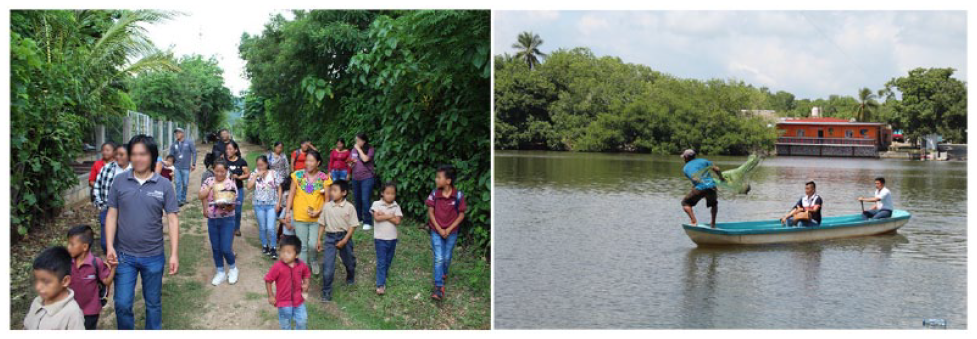
Images From Family StoryWalks or Caminatas Comunitarias in Chiapas, Mexico, Walking and Boating With Families in Highland Areas and in a Community Between Mangrove Forests and the Pacific Ocean
Origin Theory of Learning 3: Storying Relations
Storying relations refers to the centrality of stories in the active recognition, meaning-making, and maintenance of the multiple relations that support one’s theorizing and imaginations of human learning and development. Here, we emphasize that in a social theory of learning, who you are in relation with and how you make sense of those relations impact the development of your theories of learning. The quality of our theorizing is dependent on the moral and ethical qualities of our relations and the responsibilities we learn to carry and uphold to maintain them.
Linked with Land, who holds a multitude of stories, we focus on stories and storywork as sites of relative-making (Archibald, 2008). Storywork—the interrelated processes of storytelling and storylistening—is a foundational practice of human development in many communities yet routinely understudied in the study of human learning and development. Making meaning of our stories allows us to hold multiplicities of thought and experiences and remake our relationships with our own histories, lineages, places, and each other and our more-than-human relatives. In this way, “storying relations” also refers to a collective tending, a stitching together of these distinct relations to move beyond binaries and silos toward more dialogic relations across multiple traditions and stories, complicating and holding creative tensions across ideas of east/west, stories/theories, doing/being, and lineages/horizons. Similar to a river, storying relations makes visible the multiple sources that form a river in its complex wholeness—the geologic carving of the rivers’ flow, the fallen trees that slow the currents, the small streams that resource the river, the intermittent rains, the crayfish, and the minnows. Across our dialogic conversations with the coauthors in this article, the guiding principle of “relative-ness” was central to their theorizing. Developing theories of learning is also an in-relation practice (Tachine & Nicolazzo, 2022).
“Relatives” refers to all of us who are part of a vast and dynamic system of relationships, including humans, plant relations, animal relations, and the spirit world across generations past, present, and future (Armstrong, 2007; Kimmerer, 2014; McGregor, 2009; Whyte, 2017). And the most esteemed theorists of learning (like the ones we interviewed) rely on empirical methods shaped by their relatives and the multiplicity of kinds and qualities of relations they had with them. In thinking with stories and theories of life, Megan Bang shared:
Well, the very first thing that comes to mind for me is how I ended up falling in love with the possibility of maybe learning sciences or human learning and development more broadly is when I first read script/schema theory and I asked Bruce Sherin “So are you saying that all these people all think that the human mind is a series of stories that help explain the world?” and for me in that moment why that mattered so much because I was bringing kind of I would call a fundamental thing. . . . But stories, our stories have always been central, like—that is what crystallized for me. I was like oh! I could see how our ways, I could find it here or I could find my way of wanting to think about things. That’s the very first thing that comes to mind. I mean, cognition lost its way and didn’t really understand that its first instincts about that hey, people learn the story of their experience and they encode it in their mind and they use it to interpret the world. But if you want to think about schema and script that way, that’s Indigenous knowledge. That’s what we think. We pass on stories that help explain how the world came to be. We pass stories on how to be and how to be good humans and all of those kinds of things. . . . I think for me I bring all of these actual experiences in community and the teaching for how to think about life and about being and becoming in right relations. I think part of what that teaching means is that it helps me recognize that being in those right relations—those reciprocal, respectful, intergenerational relations—is not at the center of theories of human learning and development, it does help me do the critical. It does help me understand—What is the theory of life that is driving the theory of learning and human development? For me our teachings are that we are supposed to seek mino-bimaadiziwin, which is the good life. And the good life is not some wealthy capitalistic fantasy, it’s being in service to your people, to showing and affording dignity to all life. It’s being a good human being and fulfilling our roles and responsibilities. And I feel like for me that’s sort of always where I try to theorize learning and development from is, what helps us fulfill that, what actually supports people living mino-bimaadiziwin? . . . All of our stories come from our lessons, from our more-than-human relatives mostly and how humans needed to learn a whole bunch of things in order to come to understand our role and purpose. A theory of learning, maybe it’s also a theory of, you know, purpose.
Megan shared the centrality of stories to human learning and development. Humans learn stories of their experiences and then “encode it in their mind and they use it to interpret the world.” On a communal level, stories learned from more-than-human relatives “help explain how the world came to be.” They help human communities make sense of the world in ways that are collectively curated and passed on to form a society’s sources of teaching and knowledge, what Megan calls their “theories of life.” These theories of life also help us reach for, “do the critical,” and ask: What is the theory of life that is driving the theory of learning and human development?
Megan reminds us that stories often come from one’s relationships with our plants relations, animal relations, natural forms, waters, and spirits relations to teach humans to understand their roles and purposes. Stories emergent from Indigenous systems of relationalities require cultivating communicative capacities with more-than-human beings. Although script theory in a sense reflects a kind of articulation of Indigenous knowledge, these have been theorized from the assumption that more-than-humans did not have intelligence or communicative capacities. Storying relations to the studies of more-than-human worlds opens up possibilities of understanding human life beyond human supremacy but requires cultivating communicative capacities with more-than-human beings. These ongoing restorative currents in cognition (historically theorized devoid of and removed from lands, waters, and skies) are now beginning to be mirrored in the biological and plant sciences to discover plant communication is real, that plants knowing their kin is real, and that cross-species cooperation is routine (e.g., Gagliano et al., 2018; Galviz et al., 2020; Kimmerer, 2014; Simard, 2021; Wohlleben et al., 2016).
It is through these multiple, relational sources of knowledges that stories are theories (Brayboy, 2005; Million, 2014) and Indigenous and natural law (Borrows, 2019). Each story contains a multiplicity of relations. Stories also carry with them particular lineages and archival information. Stories help us remember places, names, events, and emotional reactions to experiences (Archibald, 2008). Storytellers often share who taught them that particular story, how they came to learn it, and the place and people that a story is from. Although the core of the story remains the same, each storylistener has the responsibility to find the teachings of that story for that particular moment in their life and find the work that the story can do in their heart (Archibald, 2008). Storywork ensures a multiplicity of possibilities for sensemaking and strengthened relational commitments (for growing scholarship in stories in human development, see Marin & Bang, 2015; McDaid Barry et al., 2023; Meixi, 2022). Every cultural community has stories as teaching on their theories of life (Bettelheim, 2010). Storying relations helps us gain clarity into particular views of human life where we think about the ends, the purposes of learning and cognition.
Similar to Megan’s location of Indigenous theories in studies of cognition, Shirin Vossoughi shared how she found kinship among various intellectual traditions that have otherwise been considered separate. Storying relations presences a multiplicity of relations and how in their connection they sharpened her theories of learning. In considering families, Shirin Vossoughi and Mike Cole told stories of their families’ Marxist traditions and how those orientations heavily influenced the kinds of observations, ethical stances, and reaches in their study of learning and human development. Here, Shirin illustrates the ways in which her theory of learning was nurtured as she took place in a complex web of relations:
Our relations deeply shape the kinds of scholarship we are reaching for. Mike Cole and I grew up in Marxist households, and if you had told me when I was a teenager that Marx was Iranian, I would have believed you. For good reasons we consider Marxist thought Western and it is, it is fraught with certain kinds of Western epistemologies of human supremacy, and white supremacy, if we think of folks like Cedric Robinson and their critiques. All of that I agree with. But my relationship with Marx, which mediated my relationship with cultural historical activity theory (CHAT) was through my dad and through his experience as a political activist and a political prisoner in Iran, where there was a kind of indigenizing of Marx in the same way that there was in other contexts around the third world that I think is a nuance to how we think about Marxist theory that we don’t always talk about. We think of it as something that was imported into other contexts. And it was. It didn’t fit in some ways. But in other ways it did, and people made it their own. And that’s the version I got as a child. And so, when I got to Vygotsky, when I got to Cole, when I got to these people I felt a kinship from that place that was different than the idea of me as an Iranian person and baby scholar “reaching for Western theory.” So I just think that’s an interesting nuance for me. And one of the nuances around that is that I don’t know how much Marx my dad actually read. I don’t remember us having Marx’s books in the house, though if we did they would have been in Farsi. We had it in like the people he was playing chess with in prison who were sharing these ideas with him but could not have the text because then they would get in worse trouble. And so there’s also like an oral tradition of these political ideas that I think is part of my familial inheritance that is different from the “academic” engagement sometimes, even though there’s overlap there.
Shirin describes the process of coming to know various sociocultural learning theories as a form of felt kinship with those theorists. Although Karl Marx, a formal scholar, played a role in influencing her theory, it would be reductive to primarily cite Karl Marx, the individual theorist, as the origin of her thinking on these subjects. If she were only to cite Karl, she would leave out many of the other relatives she encountered who had refined theories of learning in their own right. Her father is also theorizing learning, and his theories of learning helped mediate her connection with Karl and other educational theorists. She also warns against us fetishizing “the text” as the sole vehicle through which theory is transmitted. She questions whether her father’s educational perspective came from engaging with The Communist Manifesto or whether it came from the ways in which political ideas of class struggle were infused within the everyday praxis of political actors. The conversations Shirin’s father had with his fellow prisoners while playing chess were also forms of theorization. The oral chain of transmission is also critical.
She also complicates the idea that there is some essential distinction between the West and the East. As Global South Side scholars, we are in relation with Western scholars and Western traditions. Some of those relationships are oppressive. Some of them are liberatory. And most of them have both potentialities, like the messy process of Marxist thought being indigenized in communities across the Third World. The problem with the ideological construction of “the West” is that it was essentialized as rational and scientific and democratic and enlightened. We do other forms of damage by essentializing the West as only containing oppressive potentialities. It is important to remember that the West has made intellectual and institutional advancements; in fact, many of them were inspired by those in the Third World. In reality, the West has always been in dialogical relation with the East. The binary itself is a social construction that was developed to reinforce a doctrine of white supremacy. Our intention with this chapter is not to schism ourselves from all Western theories of learning; it is simply to show the ways in which our relations with Global South/Third World theories are just as formative to our theories of learning and that it does violence to erase our relatives from the canon. A robust field of learning scientists recognizes that theorization of learning is inherent to human communities and that Western disciplines have developed systematic biases toward delegitimizing theorization that happens in Third World spaces.
Angela Booker further moves us beyond binarial ideas of relative-ness to highlight the ways our relations create particular ways of being both bound and free. Both the freeness and boundedness of her familial and academic lineages provide distinct grounding orientations to how she develops her theories of learning:
My theory, my first theories of learning come from my parents and grandparents and aunties and uncles, you know, because they are educators. They were very much education-for-liberation kind of folks, you know coming up in the South especially and the conditions through which access to learning was denied and made illegal and punishable, right? Those histories render learning as a liberatory act as sort of the first place that I start to theorize what learning is. And probably deepest within that in my family tradition was a combination of becoming a free thinker and becoming a part of the fabric of community, right? So to be both free and in some ways bound . . . that was the nature of learning. All of those things were also side by side in my upbringing in terms of developing theories of learning and what learning was about. In some ways these were liberatory acts, these acts of learning to sustain one another and to grant each other, you know, dignity and humanity and care. Lineages are meaningful to us, right? We care about them. I want people to know that Shelley was my teacher. You know what I mean? Because I really love and respect their teaching, and we’re obviously different people. As a martial artist, it’s the same thing you know; who taught me and who taught them is something that is meaningful, but it doesn’t constrain the art. It doesn’t constrain how you express your version of the art or how you might go on to teach it. But it is meaningful, right? My kids do capoeira . . . and they come out of a very specific set of traditions right? And then they and then people know each other through those. Oh, I’m with Mestre X as well. I’m with you. The Mestres and those communities come together to support each other, right? But there’s meaning in the lineage. . . . There’s a joy in those lineages. But they do give information, and there are oppressions that become possible through the control of access to knowledge, right? But there are also relationships that can build and ways to practice that come through the lineage you select or are invited into.
Angela reiterates how storying relations helps us make meaning of our lineages, where such meaning-making matters for the kinds of theorizing that is possible. Although lineages can set up particular camps of thought, they do not “constrain how you express your version of the art or how you might go on to teach it.” While we are trying to problematize singular, linear genealogies, Angela reminds us that lineages give us important information and that “there are also relationships that can build and ways to practice that come through the lineage you select or are invited into.” Lineages as a relational lens helps us learn, maintain, and advance particular kinds of roles within a community and how a particular form of expertise supports specific contributions to particular knowledge systems; as a seed keeper, a scholar, or messenger. These roles did not necessarily have hierarchical implications but simply, that each served a different role in the community and all were needed. Origin learning theories of storying relations help us attend to the ways we all emerge from particular yet multiple lineages, how one builds new relations through their lineages, and the creativity that emerges from our boundedness and freeness within these intellectual, relational, and ethical reaches and groundings.
Potential Directions Forward
Foregrounding relations urges us to ask: What kinds of relationships do we need to cultivate? What stories do we need to know, tell, share, remember, and create? One way that we might embrace this origin theory in our work is to include storying relations statements in our manuscripts. Relatives have long been added to the acknowledgments section of an article but are often not cited as origins and fields of knowledge. If I cite my grandmother, then the question is begged, who is she citing? We then have to trace her intellectual lineages back to our roots. If I just acknowledge my grandmother in the acknowledgments, then the story stops there. Beyond positionality statements, storying relations asks us as scholars to identify the multiplicities of our origins, family, and community contexts, and the stories that we come from. Marin has called this our intellectual genealogy (see Marin, 2020, p. 7). These genealogies could continue to complicate binary ideas of west/east and theory/practice and push us closer to naming the multiple origins of our theories and designs in the study of human learning. It is this sense of relative-ness—who one is in relation with, critical historicity, future orientation, and shared energies—that determines one’s “positionality.” These statements can help support the field in seeing the kinship of multiple origin theories at work and change the citational politics of the field to make visible how these origin theories inform the kind of scholarship we write about and why.
Another potential direction for the field is to deliberately design for relations across institutions. One notable example is the Virtual Lab, an interinstitutional and intergenerational consortium of scholars concerned with the ethical and political dimensions of learning. Founders of the Virtual Lab, Shirin Vossoughi, Angela Booker, Paula Hooper, and Maxine McKinney de Royston, first began kitchen-table conversations that then materialized in a larger Spencer gathering in Chicago in January 2019. Shared desires of collaboration with other scholars across institutions drew faculty members to participate and invite their students into this space of visioning and collaboration, of which Meixi and Kalonji here have been a part. Since 2019, the members of the Virtual Lab continue to meet monthly to create and sustain relations, relatives, and intellectual and political community across institutions and genealogies. On one hand, we must recognize the web of genealogies that we come from and always exist within—more-than-human genealogies, land genealogies, academic genealogies, families genealogies. It is within this web of relations that we understand how we are connected with and how these relations can have meaningful consequences for our theories of learning.
Finally, there is an ontological aspect to storying relations as an origin theory of learning. As a kind of ontological design (Escobar, 2018), who and how we are in relation transform the self; changes in the self also directly transform the social situation. Put another way, if our theories are developed in relation, they should have profound implications for the ways we show up every day and live out these in-relation theories. Given the ubiquity of stories and moral teachings that they hold in many societies (Bettelheim, 2010), many of our ancestors had ethical concerns in how we were living, who we were becoming, and how we were maturing—these guided their theories of learning. In-relations theories are thus not purely cognitive and intellectual; we enact, listen, and story with the world.
Origin Theory of Learning 4: Formal and Organic Intellectuals
Our analysis seeks to expand our definition of “learning theorist” beyond academic researchers. At the same time, we still argue that academic scholars have an important role in the ecology of relations and settings that build theories of learning. The training and expertise required of academic scholars of psychology, linguistics, sociology, or anthropology produce certain ways of knowing that empower scholars to observe and analyze learning in refined ways. These scholars are human relatives that have a particular form of clout and/or methodology, a prized way of analyzing their experiences that we value in a particular way. By ignoring the unique skills of these communities, we would be writing ourselves out of a job. We would also be denying the power, privilege, and responsibility that formal scholars have in shaping the discourse and policy around learning. A thorough understanding of the historical record shows that civilizations across the globe created institutions of higher learning and studied disciplines related to the interdisciplinary learning sciences. One example is the mystery school of Ancient Egypt, within which students from across the ancient world traveled to learn mathematics, religion, and ancient wisdom. With this said, the reason we are not studying Global South/ Third World scholars of learning theory is not because they do not exist.
Here we highlight Global South Side researchers whose theoretical stances run counter to currents in the literature in order to ask: Why does someone study learning? How might making visible these purposes illuminate different axiological commitments and pathways of change-making over time and space? How might turning to each other in this study of learning sharpen our individual and shared ethical and political stances and commitments? The creatives, activists, and practitioners identified by our communities contain characteristics of Gramsci’s “organic intellectual,” which Edward Said (1994) described in Representations of the Intellectual:
Gramsci believed that organic intellectuals are actively involved in society, that is, they constantly struggle to change minds and expand markets; unlike teachers and priests, who seem more or less to remain in place, doing the same kind of work year in year out, organic intellectuals are always on the move, on the make. (p. 4)
The methodology we used in this study seeks to draw on the collective knowledge within contemporary communities of Global South Side scholars—formal and organic intellectuals. Some of these communities have assembled organically, and there have also been intentional efforts to create spaces like the Virtual Lab, which makes organized efforts to amplify Third World theories. We present the results of a crowdsourcing activity in which these Global South Side scholars volunteered names of learning theorists that influence their work but are underemphasized in the canon. We also investigate one of those theorists, Amadou Hampaté Bâ, exploring some of the profound insights he offers to the learning sciences. The case study of Bâ’s work illustrates the ways that formal researchers within Third World contexts can be gateways to principles of learning design that are tied to enduring cultural traditions.
Crowdsourcing Global South/Third World Theorists
The results of this exercise included a number of diverse theorists from across geographic space and historical era (see Table 1). The list included academics, public intellectuals, activists, and artists. Despite the diversity of disciplinary expertise among the cited theorists, what connects them is their attention to learning as a fundamental aspect of societal cultivation. Many of the theorists included on this list fundamentally (re)define the goals of learning or what expertise looks like in a particular domain. In many ways, these individuals act as philosophers of education. For example, Edward Said is a Palestinian-American cultural critic and founder of the field of postcolonial studies. His work helps us see the violence in considering the Western subject the prototypic endpoint of ontogenesis. His philosophy elaborates a number of design principles for constructing postcolonial learning environments. Black womanist theorist bell hooks was cited, given her scholarly contributions to the philosophy of education, namely, her three pedagogically focused books, Teaching to Transgress, Teaching Community, and Teaching Critical Thinking.
Compiled List of Intellectual Ancestors and Relatives Compiled at the AERA Cultural Historical Special Interest Group (2021) and With Virtual Lab (2022)

Note. WEIRD = western, educated, industralized, rich, and developed.
Many of the cited theorists did not have disciplinary homes within education. Instead, they studied disciplines adjacent to the learning sciences that have also theorized the human mind and its development, fields like psychology and linguistics. Frantz Fanon was cited as a theorist of psychology whose work makes profound contributions to how we conceive of learning. Fanon (1952/1967) theorized the effects of colonization on the psyche and the various complexes that develop among peoples experiencing colonial domination. Liberatory education addresses and ameliorates the inferiority complexes and neuroses that we have developed as colonized peoples, leading toward socioemotional healing. Similarly, theorists like Gloria Anzaldúa expand the way we think about language, the mediational tool of higher mental functions. Anzaldúa’s work identifies the inherent hybridity within language practices and has been taken up by prominent learning scientists such as Kris Gutiérrez (Gutiérrez et al., 1999).
Many of the theorists listed in the activity were designers of grassroots movements for social change who took learning seriously as a central theory of change. These were often teachers and community leaders that designed learning environments for political education. These theorists were theorizing how to cultivate critical consciousness and equitable praxis within and between learners. For example, community members cited theorists associated with the Highlander School, including Septima Clark and Pete Seeger. The Highlander School trained many community activists associated with the Civil Rights Movement on topics like union organizing, human rights, and freedom music. Other grassroots theorists such as Angela Davis, Fannie Lou Hamer, and Berta Cáceres were cited, all of whom used their community praxis as a laboratory to test and enact their theory.
Common on this list were individuals who centered spiritual and spiritual and axiological principles of learning design. Many of the learning theorists cited seemed to be focused on cultivating ethical learners and learning environments. Spiritual leaders such as Thich Nhat Hanh made the list. Thich Nhat Hanh was a renowned Vietnamese Buddhist monk who taught about cultivating compassion and mindfulness around the world for more than 70 years. Drawing on the Buddhist dharma (teachings), he designed his own pedagogy of engaged Buddhism that charted educational pathways toward being compassionate and responsive to the world’s suffering.
The list of learning theorists also included a number of artists of various mediums. The inclusion of these artists indicated that many community members felt that the written manuscript was not the only container in which theory dwelt. Music, poetry, photography, and performance were all seen as viable repositories of learning theory. Photographer and filmmaker Gordon Parks was mentioned given his work as a photojournalist chronicling the ordinary and extraordinary moments of Black life during the mid-20th century. His work is a commentary on photography as a form of historical memory. The list also included musician Prince, poet Mary Oliver, and soul singer Nina Simone (see Appendix A and Table 1; compiled during the two crowdsourcing sessions at AERA 2022 and the Virtual Lab). We now turn to one intellectual—Amadou Hampaté Bâ—for a deeper analysis of intellectuals as a source of origin learning theories.
Amadou Hampaté Bâ
To illustrate the impact of these Third World theorists, we thought it helpful to provide a more in-depth analysis of one theorist whose work fundamentally shifts the field of the learning sciences. Amadou Hampaté Bâ is one of the most prolific writers of the 20th century on the topic of cultural memory and transfer of knowledge within oral traditions. He was interested in traditional African systems of knowledge and how they were propagated through sophisticated processes of memorization, recitation, and spiritual initiation. Although he is revered by Africanists and cited in the fields of Black Studies and Islamic Studies and by historians of the region, there has been an utter lack of engagement with his work in the learning sciences and education research. In recent years, interdisciplinary theorists of language and literacy have come into vogue in the learning sciences. For example, Russian theorist Mikhail Bakhtin has become popular because of his insights on the sociopolitical nature of language and how those insights reframe how educators regard the objective of language learning. We argue that Hampaté Bâ’s theories about language offer similar insights about the internalization of language within a sociocultural milieu. However, Hampaté Bâ is nowhere near Bakhtin when it comes to recognition in our field. Bakhtin does not have a background in the cognitive sciences or an experience studying schools, nor does he explicitly center learning in his analysis of language; so these are not reasons for his accounts to be more legitimately taken up by learning scientists. We speculate that there are several reasons why Hampaté Bâ’s theory is undercited in the field: (a) Hampaté Bâ is a Black West African scholar who studied learning environments in West Africa during colonial and postcolonial eras in which those communities were imagined by the West to be uncivilized, and (b) his studies focused on the learning involved with oral tradition in languages like Fulani, Bambara, Dogon, and Arabic, which were systematically undervalued by the West.
There is one saying attributed to Hampaté Bâ that crystallizes his contribution to learning theory: “When an elder dies a library burns.” This saying has become a widely used proverb to describe the sanctity of oral history in Africa and beyond. The expression also highlights the vulnerability of these traditions being reduced to ashes if elders do not successfully transmit them and if new elders are not cultivated. As a learning theorist, Hampaté Bâ was most interested in what he called the “chain of transmission,” how cultural knowledge systems were transmitted and regenerated across generations (Brenner, 2010). He completed systematic studies of storytellers, or griots, who acted as historians, ritual leaders, royal advisors, and entertainers preserving the wisdom of the community and often presenting those stories in musical form. Hampaté Bâ studied the ways in which new storytellers were initiated into the tradition, and thus, his central focus was learning (Sanankoua, 2010).
The epicenter of his studies was Mali West Africa, in the homeland of the Mande, the Fulani, and the Dogon peoples, where he meticulously studied these sociogenetic processes of oral transmission. Why should we care about learning theories that emerged from dark-skinned peoples in the Sahara Desert? The language practices that came from this region of the world were responsible for some of the most notable intellectual achievements in human history. The Malian people were responsible for the establishment of the educational center of Timbuktu, which during the 13th to 17th centuries drew thousands of scholars from around the world to study religion, arts, and sciences. The richest man in recorded history, Malian Emperor Mansa Musa, was born and raised in the traditions of the Mandinka (a Mande ethnic group). In 1324, on his pilgrimage to Mecca, he introduced the world to the wealth of the Malian Empire, traveling in a caravan of 60,000 men with 24,000 pounds of gold, donating large sums of wealth in each region he passed through. When Hampaté Bâ was studying the discursive tradition of this region, he was studying the values and concepts that gave birth to vast civilizations.
Why does the West not know much of the Malian Empire and the theories of learning that undergirded their society? One answer to this question is depicted in the 1977 television miniseries Roots, where African American writer/director Alex Haley told the story of his ancestor, Kunta Kinte. After years of research recovering his own genealogical history, Haley discovered the story of his ancestor from the Kinte clan, who also spoke a Mande language. In fact, he spoke Mandinka, the same language as the richest man in recorded history. Kunta Kinte was captured by White slavers, as were many Mande-speaking peoples. Kunta was shipped as cargo across the Atlantic in the degrading episode of mass human trafficking that many of us call the maafa or holocaust. On the Virginia plantation where Kunta Kinte ended up, the film shows one of the most visceral images of brainwashing. Kunta Kinte is determined to preserve his identity by continuing to keep his Mandinka name. However, in the context of white supremacist America, all traces of African knowledge systems must be removed. Kunta must be punished for preserving the chain of transmission. In this momentous scene, a human being who believes that he is White and also believes that he owns Kunta binds his hands above his head, handcuffing him to a whipping post. In front of a crowd of his African community, the slave master commands him: “What’s your name? Your name is Toby. Say it!” Again and again, the defiant slave answers “Kunta,” and each time he is lashed with a whip across his back. Finally, exasperated, with his last breath, he whispers . . . “Toby.”
This unforgettable moment in film history depicts the brutal repression of Kunta’s ways of knowing. Why does the West not know of Third World theories of learning? Because they have been violently extracted from our collective memory. The theories of learning of the Mande (and hundreds of other ethnic groups) are missing from the literature because the West by its own definition is invested in a project of intellectual manifest destiny. Their project to “civilize” and “enlighten” is only made possible by epistemicide (Santos, 2014), the delegitimization and persecution of whole systems of knowledge.
Hampaté Bâ represents a scholar whose work was built on countering that epistemicide. He promoted efforts to increase literacy in his own Fulani language as well as other African languages, working with international power brokers like UNESCO to bring about those ends (Austen, 2010). He encouraged writing as a form of preserving the culture and therefore supported teaching his countrymen to write in Fulani, both in the Roman script and in Ajami, the name given to writing Fulani in Arabic script, which had been done since the 1700s. He worked to preserve the oral teachings by transcribing oral religious poetry in Masina and the secular epic “Silimaka” (Hampaté Bâ & Kesteloot, 1968). Through studying these systems of knowledge, he was able to develop his own theory of learning, which was perhaps most clearly laid out in his work titled “The Living Tradition” (Hampaté Bâ, 1981).
Hampaté Bâ’s theory of learning was similar to socioculturalists like Vygotsky and Wertsch in that he saw the word (language/speech) as the primary unit of cultural learning and the faculty responsible for humans’ intelligence. He saw that many of the West African cultures he studied had a sacred reverence for the word. Hampaté Bâ (1981) recounted the Bambara story of the creation of the first human being (Maa) by the Supreme Being (Maa Ngala). Maa Ngala creates Maa in order to have an interlocutor, someone to speak to. Maa Ngala gives Maa the power of the word and initiates them into the knowledge of the cosmos. Bambara cosmology holds that this first initiation was the beginning of the chain of transmission from which contemporary griots descend. Hampaté Bâ took this creation story to be reflective of the great rigor of Bambara storytellers in memorizing and reproducing the histories of the generation prior. This chain of transmission is analogous to processes of speech appropriation elaborated in Vygotsky’s account of the internalization of higher psychological functions.
What perhaps makes his theory distinctive from Vygotsky and Wertsch is his focus on the vibratory and incantatory aspects of language (Hampaté Bâ, 1981). Because of his location within oral tradition, he focused on language in its vocal form, as producing sound waves with motive force: “Since speech is the externalization of the vibrations of forces, every manifestation of a force in any form whatever is to be regarded as its speech” (Hampaté Bâ, 1981, p. 170). His work foreshadowed various contemporary studies that pay attention to the ways in which instructional talk is inherently musical: from the sing-songy inflection of baby talk to the ways in which classroom teachers use changes in tonality to denote what should be attended to and changes in pace to coordinate turn-taking (Erickson, 2009).
We would be remiss not to acknowledge that Hampaté Bâ attributed the grand majority of his spiritual and pedagogical knowledge to his beloved teacher and spiritual father Tierno Bokar. Hampaté Bâ (1980/2008) described the life, words, and teachings of Bokar in a book titled A Spirit of Tolerance. This text is a vivid ethnography of the Koranic school that Bokar founded and ran in Bandiagara, of which Hampaté Bâ was a student. Hampaté Bâ described the practices and routines of school life and also the pedagogical approach that Bokar used to educate the pupils there. Much of the emphasis of Hampaté Bâ’s ethnography was on how his mentor designed the learning environment to cultivate tolerance in his students. The design principles he identified are axiological in nature in that he is interested in how the allegories and metaphors Tierno Bokar uttered helped students to grasp ethical concepts regarding how to respect and relate to other human beings. The learning sciences is experiencing a restorative current of socioaxiological approaches, and it is critical to notice how centrally this was emphasized in the learning theory of Hampaté Bâ, his mentor, and the cultural milieus that they occupied (Sufi Islam).
So, if Tierno Bokar was the spiritual father of Hampaté Bâ, why are we not instead writing about him in this section about formal researchers? Doesn’t Hampaté Bâ’s learning theory trace back directly to Tierno Bokar? Although Hampaté Bâ is undercited in the field, the reason that Hampaté Bâ’s work is discussed at all in the academy while Bokar’s is not is because Hampaté Bâ wrote his theories down. Hampaté Bâ published dozens of texts across various disciplines. Bokar, on the other hand, delivered all of his teachings orally (Austen, 2010). Some might argue that the only reason Bokar’s teachings survived was because his student Hampaté Bâ faithfully recorded them in written form. This is the tension at hand. The Western academy is deeply biased toward elevating the single author and the written word as the sole proprietor of knowledge. This is quite ironic because Hampaté Bâ argued against this bias in many ways. His chapter, “The Living Tradition” (Hampaté Bâ, 1981), advanced the argument that oral cultures had sophisticated methodologies for building and preserving knowledge. Hampaté Bâ would find absurd the idea that his spiritual father had a less sophisticated theory of learning simply because he did not write it down.
Hampaté Bâ’s story illustrates how being considered a theorist, a scholar, or a researcher is incredibly correlated with access to certain forms of Western cultural capital, and it is biased toward Western systems of knowledge. Amadou Hampaté Bâ was well trained in several cultural systems of thought, including Sufi Islam and the Fulani way of life. If we are taking “scholar” to simply mean learned or expert in an area of study, then the mastery of either of those forms of wisdom could have technically garnered him that title. However, the knowledge system that provided him with the cultural capital to be able to dialogue with “scholarly” audiences was his study of French. Arguably, we would not be calling Hampaté Bâ a researcher or a theorist if he did not speak French. His ability to write in French and curry favor with French colonial officials allowed his work to be published. Ironically enough, although his work argued for the intelligence of African oral language systems, it was his proximity to the colonizer’s language—the French written word in particular—that allowed him to build a “scholarly” reputation. And he truly believed that in the midst of encroaching colonial domination, the survival of the oral teachings of Bokar and thousands of other storytellers was predicated on writing them down. It is unclear the extent to which this belief was true. If these systems had survived for hundreds of years through processes of oral transmission, why not fight for griot schools where students were initiated into oral tradition instead of writing? Hampaté Bâ’s case shows that what we really mean by “scholar” or “theorist” is “one who writes and publishes widely on a topic and is legitimized by dominant educational institutions, namely Western universities and professional organizations.”
Hampaté Bâ’s story perhaps is a specific example of how the binaries of Global South-North, East versus West, First World versus Third World can be complicated. In a similar way, there are real hierarchies between oral versus written forms of learning and knowledge transmission that have imposed false values by which intelligence and being human were measured by the ability to “make a mark upon paper: there ensued a blind worship of written history, of books, of the written word, that has denied the spoken word of its power and sacredness” (Standing Bear, 1978/2006, p. 249). And yet, loving the written word does not make one Western, nor should it cast communities’ own relationships with writing and the written word as colonized. In fact, we place the many forms of words here in loving juxtaposition (Allen, 2012) with an Indigenous collage that “accounts for and accommodates the chaotic, contained and often contradictory lifeworlds that have been left in the wake of continued settler colonialism by creating a space for Indigenous Peoples to navigate them in creative and empowered ways” (Charlie, 2016, p. iii) and remake origin/decolonial/Indigenous worlds with settler materials.
Potential Future Directions
The languages, linguistic resources, personal and academic lineages, and structures mediate our relationships to particular researchers. They allow us to engage with some theorists and not others. Cultural psychologist Michael Cole described the structures and relations that made it possible for him to engage with the works of Lev Vygotsky through Alexander Luria. Those perspectives grounded his enduring concern to refuse deficit assumptions of human cognition, beginning with Kpelle communities in Liberia in collaboration with John Gay:
And quite literally by accident it turned out that Indiana University was the center of a just-started program, an international program with the Soviet Union, an Academic Exchange. Indiana was also a place where you had to pass two foreign languages to get a degree in psychology. . . . So I started to learn Russian. Sheila also started to learn Russian, with the idea being that we would go on the Exchange if we were accepted. And I became a Soviet area expert along with doing psychology and contacted the person there that I wanted to work with, Alexander Luria.
As Cole continued his trajectory, he shared in an autobiographical speech in 1978 about how despite ingrained assumptions within psychology and cognition, Cole and colleagues were intent on designing tasks through understanding the languages and logics of that particular context:
As a recent Ph.D. trained in the traditions of American learning theory, I came bearing an invisible cargo of assumptions about human nature and human cognitive process. . . . The collection of assumptions I brought to Liberia as a result of my graduate education and the diagnoses of my hosts concerning the learning difficulties of Liberian students were very much a part of the times. This was the era America “discovered” the disadvantaged child. In language very much like that applied to Kpelle children in Liberia, American scholars and educators offered explanations for the school difficulties of American minority groups and the poor in the presumably inadequate learning environment of their homes. . . . When we found no difference in learning conjunctive (“and”) and disjunctive (“or”) conceptual rules, we thought we had simultaneously bolstered our view of the relation between language and logic while upsetting a widely held generalization in American psychology that conjunctive rules are inherently easier to learn. . . . I was learning a little about cognitive development, but I could see that anthropology and linguistics were going to be necessary tools if I was going to continue to do cross-cultural work. (Cole, 1978/2022, p. 619)
As we think about future directions, we highlight these stories because of the emphasis on languages and logics. Michael Cole’s program language requirement opened pathways for him to work with Alexander Luria to translate the work of Soviet psychologist Lev Vygotsky into English and bring those ideas into the mainstream of psychology, cognition, and the learning sciences. Certain institutional structures and social contexts enabled him to engage in this form of cross-cultural research and deep exchange—department language requirements, the love and support of his wife Sheila, his left-wing familial politics—which prepared him to anticipate the fruitfulness of studying psychology in the Soviet Union during the 1960s.
We are not advocating that there be language requirements for our disciplines; instead, we see this as a growth area for the field to cultivate, support, recruit, and engage with more Global South/Third World learning theorists. What could the learning and use of non-English languages open up for the field in our study of learning? How can we value and uphold nondominant language values in our classes and our work? Recently, there have been some movements like a Learning Science preconference workshop in 2021 that gathered Global South Side scholars titled, “Towards a Transnational, Decolonial, and Non-WEIRD Learning Sciences: Implications of Perspectives From Beyond ‘the West,’” organized by Gayithri Jayathirtha, Deborah Dutta, Vishesh Kumar, and Suraj Uttamchandani. Our field should continue to build capacity to value the processes of cultural investigation that allow us to explore the learning theories/theorists from Third World scholars, especially those who are exploring theories of learning from their own cultural inheritance.
Origin Theory of Learning 5: Settings Grow From Settings (Vossoughi, 2018)
Settings growing from settings as an origin learning theory invites us to consider the wholeness of a learning environment as a resource for future design (Vossoughi, 2018). Rather than only locating theories within individuals, settings are learning theory proofs, collectively built and created. For current purposes, we use “settings” to mean designed learning environments that bring together the dynamic energies of humans, natural world entities, materials, artifacts, and emergent/ancestral relationships for a particular moment in time. While we acknowledge that lands, human, and more-than-human actors are explicit and implicit active contributors and living agents within a learning space, a “designed space” refers to ones that humans have designed with intentional learning outcomes. Across swaths of time, as people move through and participate across settings (Lave & Wenger, 1991), they also design new ones. Even though design-based research is a core metamethodology of the study of learning (Bang & Vossoughi, 2016; A. L. Brown, 1992; Fishman et al., 2013), designed settings are not only in the realm of “learning scientists” (Zavala, 2016). Everyday historical actors work and negotiate conditions and possibilities of emergent design. “Settings grow from settings” refers to the study of “individuals who experience possible forms of activity and then draw from that experience as a resource for design within a distinct context” (Vossoughi, 2018, p. 1316), what Vossoughi names as “sister-spaces.” This is another way to “see the subject of learning as collective not just individual (how spaces learn from spaces across time)” (S. Vossoughi, personal communication, 2023).
This extends our current views of human participation across space or settings where their development is studied across time, transforming and being transformed by their participation (Engeström & Sannino, 2021, on third- and fourth-generation activity theory; Lave & Wenger, 1990). Settings considers how entire ecologies of learning birth others where a setting becomes an important unit of analysis in the study of human learning as collectives. Foregrounding the dimension of time helps us attend to both the possibilities of design at that moment in history and the temporal dimensions of ontological and sociohistorical change.
Specifically, the idea is that the combined energies of a setting is also teacher, and one’s participation in that space actually influences the kinds of settings they create in the future. Methodologically, this means we also need views of present forms of activity that also account for the historical traces and “views of activity systems past that attune us to the ways they sowed seeds for future action and possibility” (Vossoughi, 2018, p. 1316). These ethnographies of design (Zavala, 2016) that document the grounded emergence of design could be a helpful way forward. When thinking about the science of learning, we have yet to further develop thinking about what a setting achieves together, the impact on our lives and trajectories as scholars across time, how spaces generate other spaces, the web and lineage of settings as we refine, polish, sharpen, and cultivate new spaces based on previous experiences in others. Vossoughi gives the experience of teaching in the Migrant Student Leadership Program in Los Angeles and how her experiences there influenced her work in all the spaces she has been a part of since. Settings growing from settings is interested in the continuous emplacement of designs to distinct historical contexts in collaboration with coparticipants in a designed space while recognizing the varied manifestations and expressions of the enduring sensibilities (or transferred DNA between sister-spaces) across settings as settings mature and grow.
Another example of this work has been not just the end of one setting and the beginning of another, but how settings stay in relation across time. Akin to chiefdoms and kingdoms in Southeast Asia where borders were vibrant meeting places and zones of generativity (rather than delineation and separation; Thongchai, 1994), settings mature and grow through routine and strategic exchange. Meixi, Kongkaew, et al.’s (2022) trans-Indigenous work on “Making Relatives” across the landscapes of Thailand and Mexico illustrates the poetic and political possibilities of staying in relation at these edges. Trans-Indigeneity’s rootedness and routedness (Diaz, 2019) has always existed as a strategy of learning and development. Specifically, a community’s vertical rootedness in deep time and place is forged “(1) in productive relations with histories, narratives, and technologies of travel or geographic reach, here referred to as lateral or horizontal routedness, and (2) in strategic relationship with other equally deep and moving Indigenous peoples and traditions from elsewhere” (Diaz, 2019, p. 3).
One example of settings staying in relation across time is how two schools across Thailand and Mexico sharpened each other’s ideas and practices through practices of relative-ness. For example, Meixi began an apprenticeship among rural public educators and families in Zacatecas, Mexico, studying ways to create humanizing learning communities through a practice called Tutoría. It was these experiences in consensual dialogic practices and relational educational change that she found a way that public education could support community self-determination in otherwise powered, violent, public school classrooms. Returning to Singapore and Thailand, she intentionally maintained relationships with the settings in Mexico and expanded these relationships among colleagues in both places. One way this happened was through practices of walking lands with families in Thailand. By being in conversation across settings, these walks were then reiterated with whole communities alongside teachers in rural public schools in Mexico. The practice of Family Storywalks was sharpened in Mexico, where reimagining of land-based public education through acts of walking became critical to Indigenous resurgence and self-determining schools. Making relatives and in-relation-settings protects and drives the shared intellectual and political work.
Distinct from scalability and sustainability in research-practice partnerships (Fishman et al., 2013; Penuel, 2019, 2020) or design iterations of a context as they travel (Gravemeijer & Cobb, 2006), settings growing from settings considers how settings relate and sharpen each other. Although studies have illustrated the travel of ideas across microgenetic, ontogenetic, and even sociohistorical times scales (Saxe, 2002; Saxe et al., 2009), settings growing from settings highlights the ways that intentionally meeting and relation building across settings can generate new reaches for learning and development. Between these two examples from Shirin and Meixi, settings as seeds and settings coming together to meet and learn from each other at the edges, there are important ways that we are beginning to study learning as a collective act in our designs across time.
Potential Directions Forward
Methodologically, Megan Bang offered the possibility of intentionally spending time and visiting and doing ethnographies of each other’s sites as a potential direction for us to more deeply engage settings across settings:
I think that we need a different space where we’re not after arguments for the field to do some of this work. We also probably need to be in each other’s learning spaces, to feel it and see it for ourselves, probably more than we do. I keep thinking like wouldn’t it be really cool if, like you had small groups that did a day version of ethnographies of each other’s sites. That we came and saw what each other was actually up to with learners, with teachers, with communities, with families and help document it or help see it right in a different kind of way. I just think it would open up things differently if we did that. I worry that the shadow of whiteness—of coloniality—is always around. In this class [Ojibwe theories of learning] I get to ask: “What’s helpful? What will help us rebuild our communities in ways that we want?”
Spending time with each other could open up ways for us to see our own work in a different way and build our collective capacities as a field to engage in work that is not mediated by reporting our work back to White, dominant spaces. Instead, we focus on the question: How do we rebuild our communities in the ways that we want? Perhaps these day-ethnographies, making relatives across settings among Global South, Third/ Fourth World, origin learning scholars, where visiting each other’s places as a way to dialogue without White, institution-driven agendas driving interaction and learning. There’s always this sense that we have to relay our findings back to the mainstream and not with each other in ways that are not authentic. Conversely, immersing ourselves in each other’s settings is a deeply authentic way of us gaining a new theory of learning and that we are designing. That we can learn from settings and not just a written manuscript or individual human thinker is an important origin theory. It reaffirms design as a fundamental human practice that names settings as teachers and settings as elders. Although many of us might be good at articulating at our sites, we might not be good at saying or seeing at our sites after a long participation in it. What relations would strengthen our methodologies across institutions? We suggest that in-relation practices such as these could help us better understand the spirit of our sites and what it means to make and remake relatives across place so that cocreation together stems from decolonial imaginations and enactments of the possible beyond the pressures and demands of settled systems.
Intimately linked with the origin theory of storying relations, settings as holding learning theory also implies that learning that emerges is emplaced in time and space. There is a historicity to a setting, a time period in which a setting exists or existed. As researchers, how might we attune to the critical historicity of the times (socio, ecological, political, personal histories) as a source of learning theory? How are we transformed by a setting that expands the horizons of possibility of design? What might thinking of human development as a collective act open up for us to consider? As a field, we might better study how we grow from settings and how this transforms our future social contexts as a result.
Confluences and Intersections of Our Origin Learning Theories
The five origins of our theories of learning presented here are deeply interrelated and distinctly described. Spiritwork emphasized how protecting and maintaining our spirits is core to being human. The sacredness of life is present in land, our relational responsibilities, and settings yet underfocused in our field. Land is, therefore we are foregrounds lands, waters, and skies as a key location of our origins and our theories of learning, spaces in need of spirit and relation. Storying relations is yet another way to understand the origins of our stories and theories of life are located within particular lineages and the ethical dimensions of balance, reciprocity, and interrelation. Formal and organic intellectuals is one kind of relation that holds specialized positions in helping us understand theories of living and how to reach and learn from those. Finally, settings growing from settings help us consider human learning as collectives and experiences of collectivity holding future possibilities for learning and design. Settings are emplaced in a unique time in history and form lineages that each of us cycle into and out of, always mediated by the relational qualities experienced in that moment in our lives. Finally, together, we suggest that as scholars in the field of learning and development, we must continually attend to, consider, and deliberately include these possible origins of our learning theories within any research designed spaces if we are to better understand the contours of human life and design toward more thriving, healthy futures.
Similar to the two rivers, this chapter encourages those interested in restorative currents in the field to also step back and view the amplitude and magnitude of the multiple origins of our theories of learning. The restoration of traditional flows requires organized storytelling and storylistening efforts that are led by marginalized communities. This means we will need to engage other bodies of literature, including history, anthropology, archaeology, geography, and other fields that are invested in building representations of the past and ongoing futures. It will require solidarity among theorists from Global South Side worlds. Although Global South Side histories have been attacked, marginalized, and concealed, they are not completely lost. There are centuries of theorists who have contributed to our ways of knowing. Resurfacing histories of learning theory requires developing expertise in other languages. Theorists like Amadou Hampaté Bâ were trained in several local languages and employed their knowledge of linguistics to the study of mind and learning. These experts in local knowledge systems might not have the particular forms of training that are in vogue in contemporary learning sciences. However, although their training may have certain constraints, it also has affordances that allow them to perceive aspects of the learning process that are obscured by contemporary methods. We must critically examine what insights these theorists offer regarding mind, consciousness, and learning and learn from their methods. After recovering the stories of our theorizing ancestors, it is also critically important to cite them, even those who did not publish in Western-language journals. Citational practices must evolve to be able to better include the contributions of theorists working within oral traditions or outside of Western/formal academies.
We also caution against overinvestment in an East/West binary. These methods of restoring traditional flows should not be thought of as encouraging the suppression or erasure of theories that emerged in the contemporary Western academy. That would be recreating the conditions of colonization. Exploring biological substrates of cognition, internal structures of thought, and laboratory experimental methods have their role in understanding the mind. In fact, the current situative current in the learning sciences is not the first time scholars based in the West have recognized the need to understand the mind in context. The functionalists of the late 1800s also saw the need for psychologists to focus on local context and prioritize naturalistic observation over laboratory experiments, albeit not necessarily in a culturally competent way. The West is not only characterized by the ethnocentric impulse to see development as a single trajectory on which Europeans have progressed further. The West has also consistently contained elements that see diversity as key to understanding consciousness, partly because some elements of the West have been in deep conversation with the brilliance of Global South Side locales. We’ve always had neuroscientists and astrophysicists in our communities.
These restorative efforts also require solidarity among theorists from the Third World. We must continue to build organizations and institutions that preserve origin theories of learning, such as the Association of Black Psychologists, the Virtual Lab, and the Turtle Island Storytellers. These organizations are the settings in which research programs are built, methodologies are exchanged, and resources are shared. Our participants recommended spending time within each other’s learning contexts, where we can be immersed in the activities that give rise to our theories of learning.
Imagining Forward
Who holds and names the science of learning and development? This chapter asks us all as humans interested in the phenomena of learning to reflect on why and who guides our theories of learning and change-making, place-keeping, and world building and who we name as our scientists of learning. Here is an invitation for you and others to explore, study, and practice your origin theories of learning. We began to articulate five distinct origins of our theories of learning that might broaden our science as we know it. We recognize that this is barely the beginning of a deeper inquiry into our origin stories and theories. We do not just respond to stimuli; we create and participate in meaning-making. We need each other for it. Lands and waters need us for it. Our origin theories of learning that can help us examine our theories of life and how we can learn and become with others to accomplish that life.
At the same time, we want to be clear that the intimate study and gathering of origin theories is not an exercise of knowledge accumulation. Contrary to Western philosophies, knowledge is not meant to last forever. So, why did you read this chapter? What are you reflecting on and imagining forward? How are you storylistening, story sharing, and finding what interdependence means for you through this reading?
Theories of learning emerge from lived experiences likened to what in Mahāyāna Buddhism is called prajñā, or insight on the true nature of a phenomena or wisdom that is fragile and kept and carried with you. This wisdom may not be spoken or written down. Burkhart (2004) likened this to growing corn: “Just as the ear of corn is cultivated and grows, so does it die. It does not live forever. It provides food for another generation that will carry on and grow and live and die” (p. 26). Knowledges with corn is kept in each generation in the growing of it. Corn seeds need to be kept in order to renew that core DNA knowledge, with every growing cycle also requiring constant adaptation in the face of new weather patterns, soil conditions, and human needs. Today, this might reflect similar tensions with new conditions of living in times of climate collapse, increased nationalism, displacements, and unprecedented human mobilities where every community needs to make intergenerational decisions to navigate cultural change and continuity, restorations, and cultural transformations as part of renewing the deep substance of life.
Social change requires learning. What learning theories will this generation attend to and cultivate? Given the profound possibilities and urgent challenges of our time, origin theories provide us with different sets of tools to imagine distinct futures. We suggest this expanded toolkit will be foundational for reimagining learning in increasingly volatile times, to engage in social critique and imagination for these times in human history, as our ancestors have always done.
Footnotes
Appendix
Acknowledgements
We would like to thank our Global South Side (Third/Fourth World) communities, who have provided our lives with contexts and stories for the development of our theories of learning. Additionally, we are immensely grateful to Megan Bang, Angela Booker, Michael Cole, Carol Lee, Fernanda Liberali, and Shirin Vossoughi for offering spiritually and theoretically rich stories that profoundly shaped these origin theories. The works and words of these intellectual mentors are an embodiment of the origin theories we attempt to describe here. We also deeply appreciate the testimonies offered by the Virtual Lab and members of the AERA Cultural Historical Special Interest Group community and the rich data compilation and analysis work by students Xun Yu and Chou Moua.

Notes
Authors
MEIXI is a Hokchiu learning scientist, former middle school math teacher, and sister from Singapore who also holds responsibilities to Lahu community in Thailand. She studies the tensions and possibilities of recrafting public schools with Indigenous families through community-based designs and intergenerational land-based stories. Over the past decade, she has worked with trans-Indigenous educational movements to cultivate healthier human and natural world communities for more just, self-determining, and relational futures across the Mekong, México, and most recently, Minnesota.
KALONJI NZINGA is a cultural psychologist, rapper, and educator exploring how young people’s holistic development is influenced by the cultural lifeworlds and scenes that they inhabit. His work explores how the histories and cultures of our communities are inherited in our bodies, minds, and practices. He has had the privilege to learn from youth across the Global South Side, including East Palo Alto, California; Chicago, Illinois; the Palestinian West Bank; Ghana, West Africa; and most recently, a community-based partnership with Denver’s North High School and Manual High School.