



Abstract
One critical factor in policy implementation is how teachers interpret policy. Previous research largely overlooks how the broader culture shapes teachers’ interpretations. In the current research, we explore how teachers’ interpretations of instructional reforms are associated with the logics of broad societal institutions. Our longitudinal mixed-methods study of 117 teachers at three urban public schools demonstrates that teachers’ interpretations are rooted in market accountability logics, professional bureaucracy logics, and communal sentiment logics. Teachers’ logics partially depend on their school and community contexts. The most substantive differences in teachers’ logics result from individual attributes, namely, race/ethnicity. One implication is that effective policy implementation depends on formulation and framing that address the multiple and potentially competing logics that motivate teachers’ responses to reform.
Institutional logics are “socially constructed, historical patterns of material practices, assumptions, values, beliefs, and rules” drawn from broader societal institutions, such as the institutions of democracy, bureaucracy, the family, and markets (Friedland & Alford, 1991; Thornton & Ocasio, 1999, p. 804). Institutional logics are cultural belief systems that connote specific rules and practices in different social situations. The role of institutional logics in reform is clear when one considers how reforms such as school turnaround, charters and choice, or various accountability measures are sometimes characterized as “market-based,” which speaks to a particular set of beliefs and practices underlying the reforms (Chubb & Moe, 1999; Ladd, 2002). Meanwhile, an alternative set of beliefs and practices underlie what some refer to as “democratic reforms,” such as community engagement policies (Apple & Beane, 2007; Ladd, 2002). Other reforms reflect the beliefs and practices of bureaucratic organizing, including policies that centralize authority or standardize school operations and outcome measures (Meyer, Scott, Strang, & Creighton, 1994). The sets of beliefs and practices infused into the formulation of different reforms are institutional logics. In the current work, we argue that institutional logics play a role not only in policy formulation but also in policy implementation.
Just as the broader cultural context provides policymakers with logics for the formulation of reforms, the broader cultural context provides teachers with logics for interpreting and implementing reforms. At the macro level, multiple, competing logics are often a source of political contestation in policy (Cuban, 1990; Ravitch, 2000). At the micro level, multiple, competing logics among teachers inside schools may be a source of internal turmoil and organizational ambivalence (Bacharach, Bamberger, & Sonnenstuhl, 1996; Hallett, 2010; Piderit, 2000). Therefore, in this study, we investigate the presence, prevalence, and patterns of institutional logics among teachers implementing reform by asking two main research questions:
We answer these questions with a longitudinal, mixed-methods study, which uses open-ended survey items to elicit logics and social network data to examine the effects of teacher communities relative to individual and school effects. Our findings from 117 elementary teachers at three urban public schools in the United States suggest that teachers interpret reform policies by relying on three logics grounded in the cultural belief systems of broader societal institutions. We also find that teacher logics depend on their individual attributes—namely, their race/ethnicity—more than their school contexts or collegial communities. Thus, teachers’ broader social experiences given their individual background characteristics may play a larger role in teachers’ interpretations of reform policies than is widely acknowledged. Recognizing these patterns in teacher logics and interpretations not only extends existing research on policy implementation and teacher interpretations but also suggests how educational leaders might better frame and provide support for reform implementation, especially in cases where reforms may not be consistent with teachers’ accepted beliefs and practices.
Theoretical Framework
Teacher Interpretations of Reform
Early studies of implementation focused on how variations in local context or how the skill and will of implementers influenced how local actors responded to federal and state policies (McLaughlin, 1987). However, later studies of implementation found that even when teachers were fully committed to reform their efforts often did not match policymakers’ intent (see, for example, Cohen, 1990). Therefore, implementation researchers began to focus on teachers’ cognitive understandings of policy (Cohen, Moffitt, & Goldin, 2007; Spillane et al., 2002).
For example, Spillane (1999) found that teachers’ implementation of mathematics policy was related to their interpretations of reform. Furthermore, he found that teachers’ interpretations were influenced by the extent to which the language of reform conveyed messages that matched teachers’ existing understandings of their practice. Research by Louis et al. (2005) demonstrated how reform at three high schools was influenced by teachers’ interpretations given their collective beliefs about classroom autonomy, the cultural ethic of different disciplinary groups, and teachers’ degree of collaboration. Coburn’s (2004) study of reading reforms found that teachers’ interpretations of policy messages influenced how teachers implemented instructional practices associated with the reform. In more recent work, Stillman (2011) found that teachers’ understandings of and response to accountability reforms are tied to the opportunities principals give teachers to engage in the “productive tension” caused by the clash between the messages associated with accountability and messages associated with their teacher preparation programs. Bertrand and Marsh (2015) found that teachers’ interpretations of the primary causes of trends they see in data have important implications for changes in their instruction.
This cognitive lens on implementation highlights the fact that “the process of comprehension is an active process of interpretation that draws on the individual’s rich knowledge base of understandings, beliefs, and attitudes” (Spillane et al., 2002, p. 391). Most often, research drawing on the cognitive lens attributes teachers’ understandings, beliefs, and attitudes to their experiences in schools. For example, researchers have demonstrated how teachers’ interpretations are influenced by their interactions in collegial communities (Spillane, 1999), by their past experiences in the classroom (Coburn, 2004) and in teacher preparation programs (Stillman, 2011), as well as by the norms associated with different disciplines and academic departments (Louis et al., 2005; McLaughlin & Talbert, 2001).
However, teachers’ understandings, beliefs, and attitudes are not only a product of their experiences in schools. Teachers, like all individuals, have experiences in broader societal contexts, such as families, communities, religious bodies, and professional associations. Thus, another source of teachers’ understandings, beliefs, and attitudes is their experience in these broader social contexts. We argue that institutional logics are valuable conceptual tools that can help implementation researchers “bring society back in” to their analyses of educational reforms (Friedland & Alford, 1991, p. 232). In so doing, policy implementation researchers gain a better understanding of why existing school structures and practices so often resist reform (Payne, 2008).
Institutional Logics and Teacher Interpretations
In their seminal work, Friedland and Alford (1991) argued that institutional logics are propagated by five broad societal institutions, which codify actions and interactions among (a) family members or similarly close relations, (b) individuals involved in economic transactions, (c) individuals engaged in bureaucratic or hierarchically authoritative relations, (d) individuals involved in democratically shared governance, and (e) individuals pursuing divine, religious, or inspired callings. In an extension of Friedland and Alford’s work, Thornton and Ocasio (1999) identified a sixth set of actions and interactions among (f) individuals obligated by the standards of an established body of knowledge—in other words, the professions.
Each institution is associated with specific beliefs, values, norms, and practices; this is to say institutional logics, which have been acknowledged by researchers in fields from critical theory to social psychology (e.g., Boltanski & Thevenot, 1999; Fiske, 1992). This existing research suggests that the logics of the family involve loyalty, trust, obligation, pooled resources, and caregiving. Conversely, the logics of the market involve self-interest, rational choice, accumulation, exchange, and competition. The logics of democracy emphasize consensus, participation, collective action, and equal treatment. The logics of bureaucracy privilege order, productivity, planning, and hierarchical roles. Meanwhile, the logics of the professions emphasize expertise, the value of the craft, and the esteem of peers. The logics of religion are concerned with passion, the pursuit of truth, moral principles, asceticism, and faith.
Empirical research on institutional logics indicates that logics are not adopted wholesale in local contexts. Instead, institutional logics are drawn on as “raw material” to rationalize and bring order to work in the particular contexts (Spillane, 2012, p. 121). For example, Russell (2010) has demonstrated how rationales about the purposes and appropriate practices of kindergarten education changed over time with a shift in field-level logics from “developmental logics” to “academic logics” (p. 239). Under developmental logics, the purposes and practices of kindergarten education focus on nurturing human development, which suggests a field-specific translation of the logics of the family. Under the academic logic, the purposes and practices of kindergarten education focus on academic skills and achievement, suggesting a translation of bureaucratic and market logics (Friedland & Alford, 1991).
Whereas Russell (2010) demonstrated how field-level logics shift over time, Davies and Quirke (2007) have demonstrated how different organizational populations in a field rely on different logics. They find that market logics influence school structures and educational quality in some for-profit private schools but not others. Research outside of education demonstrates that multiple, potentially competing logics exist not only at the field level but also within organizations—a phenomenon referred to as institutional complexity (Greenwood, Raynard, Kodeih, Micelotta, & Lounsbury, 2011). For example, studies of institutional complexity in social enterprises demonstrate how they rely on both “social welfare logics” and “commercial logics” (Battilana & Dorado, 2010; Pache & Santos, 2013). Dunn and Jones (2010) illustrated how medical schools craft their missions to address potential tensions between “care logics” and “scientific logics.” In the K–12 education context, Rigby (2014) has demonstrated how “prevailing logics,” “entrepreneurial logics,” and “social justice logics” influence instructional leadership in schools.
If teachers too are drawing on institutional logics to understand and rationalize their work, then one can expect teachers to interpret policy messages in predictable ways, which are patterned on the belief systems of societal institutions. Furthermore, if there are multiple logics available to teachers, then different teachers may invoke logics in different ways. To the extent that successful implementation depends on teachers having shared understandings of reform (e.g., Bridwell-Mitchell, 2015), then different teachers relying on different logics may undermine shared understandings. One result may be what Hallett (2010) referred to as “turmoil” (p. 53), meaning distress related to the displacement of meaning, certainty, and expectations as well as the construction of new meanings that may breed partisan interpretations. Even in the absence of open political contestation, different sets of teachers relying on different logics may result in organizational ambivalence in the sense that school staff are of two or more minds about reform, which must become aligned before the school can move forward with implementation (Bacharach et al., 1996; Piderit, 2000). Given the potential impact of different teachers relying on different logics, it is important to understand the extent to which teachers do, in fact, rely on different institutional logics and for what reasons. We briefly explore three alternative explanations below and then examine these explanations empirically in the methods and findings sections that follow.
Individual Attributes
One reason teachers might invoke particular logics to interpret reform is because their individual attributes predispose them to certain logics. Existing research suggests institutional logics have implications for individual and collective identity because the beliefs, values, and practices comprising logics may resonate with—or run counter to—existing conceptions of self (Lok, 2010). Thus, what is typically understood as teachers’ individual interpretations of reform based on history, identity, emotions, and cognitive schema may, in fact, be a proxy for the logics they invoke given their experiences in broader societal contexts (van den Berg, 2002). If so, then teachers with different experiences in broader societal contexts may draw on different logics. For example, research on African American teachers suggests they have distinct perceptions of teaching compared with White teachers because of past personal and professional experiences, which provide a broader understanding of the political and economic histories of communities of color (Foster, 1990, 1993). Alternatively, teachers with students in the lower grades may have strong beliefs and practices associated with nurturing children, especially if these teachers began their careers in an earlier era (i.e., Russell, 2010). Thus, race, grade taught, or years of teaching experience may be some of the individual characteristics that influence teachers’ logics.
Collegial Communities
A second reason teachers invoke particular logics may be because of their participation in collegial communities. Communities might play an important role in shaping teachers’ logics because translating broader institutional logics and field-level logics into local school contexts involves sensemaking, which is an inherently social process (Weick, 1995). If the translation of logics involves sensemaking, then teachers’ understandings of logics and how logics apply in local contexts might be influenced by interactions in teacher communities (Coburn, 2001; Little, 2006; Louis et al., 2005). For example, research examining teachers who take a critical approach to pedagogy suggests that teachers’ social justice orientation is incubated in networks of similarly minded teachers (Ritchie, 2012). Likewise, Penuel and colleagues (2013) demonstrated that teachers’ adherence to institutional regimes for reading instruction depends on their exposure to local norms for practice in collegial subgroups. Taken together, these findings suggest that teachers in different collegial communities might draw on logics in a distinctive way so that some logics are dominant in some communities and not others.
School Context
A third reason why teacher logics may vary is that teachers are working in schools with certain features, which make some logics more likely to take hold. Organizations tend to be imprinted with prominent features of their environments (Selznick, 1948). Thus, schools may adhere to logics that match the predominant features of their environments. For example, in environments with strong accountability pressures, the most salient logics might be performance logics, derived from the broader logics of markets and bureaucracies (Friedland & Alford, 1991). Alternatively, environments with strong accountability pressures might make the need for professional autonomy more salient so that teachers rely more readily on professional logics (Thornton & Ocasio, 1999). Variations in logics by schools could, as Rigby (2014) suggested, result from differences in school leadership. Variations in logics by schools might also result from different schools promoting different instructional practices, where some practices may align more closely with one set of logics than another. Given the effects of environmental imprinting and school-level features, such as leadership and instructional emphasis, teachers at different schools might rely on logics in different ways.
Research Methods
To elicit teachers’ logics, we built on Thornton and Ocasio’s (1999) argument that “institutional logics comprise a set of implicit rules of the game that regulate which issues, strategic contingencies, or problems become important in the political struggle among actors in organizations” (p. 806, emphasis added). Thus, we assume that the issues teachers identify when describing instructional reforms reveal their underlying logics. Our assumption is consistent with research that suggests moments of crisis elicit the underlying logics for what individuals believe is acceptable and valuable (Boltanski & Thevenot, 1999). Because instructional reforms are often characterized by contentious issues and moments of crisis, we anticipated that teachers’ responses to reform would be particularly likely to reveal logics. 1
Setting, Sample, and Data
The data for this study were collected as part of a larger research project examining how teacher experiences mediate school response to externally imposed instructional reforms. The schools in the larger study were selected from a stratified random sample representing organizational archetypes in terms of high, low, and median performance and strong, weak, and typical accountability pressures (Greenwood & Hinnings, 1993). Sampling schools to represent archetypes was important given our interest in exploring how teachers’ logics vary by schools and our argument that schools’ different operating environments—in this case, given accountability pressures and performance histories—might make some logics more salient than others. This sampling strategy is also consistent with findings that teachers in schools with different performance levels and accountability pressures have different relationship patterns (Finnigan & Daly, 2010). Different relationship patterns may result in differences in teachers’ collegial communities, which may, in turn, result in differences in how communities influence teachers’ logics, which is another question of interest in our work. One limitation of the sampling strategy is that the small number of schools means that our analyses may conflate a variety of school context factors, including school size, structure, culture, leadership style, performance, and accountability status.
One of the three schools, referred to as Endeavor Elementary, is from the strata of schools with the lowest performance and highest accountability pressures. The school was in the lowest quartile of 5-year performance history on state standardized tests. The school was also subject to federal oversight because of its Title 1 status, state oversight because its state operating license was being actively reviewed, and city oversight because it did not receive a waiver from a city-mandated reform initiative. The second school in the study, Paramount Elementary, is from the strata of schools in the highest performance quartile and faced the lowest accountability pressure because it did not receive Title 1 funds, received a waiver from city-mandated reforms, and was well above state operating license requirements. The third school, Everyday Elementary, is from the strata of schools in the middle two performance quartiles and faced typical accountability pressures, meaning that the school was required to meet city and federal accountability requirements. See Table 1 for demographic information on students and teachers from the three sampled schools.
Teacher and Student Characteristics by School, 2005–2006
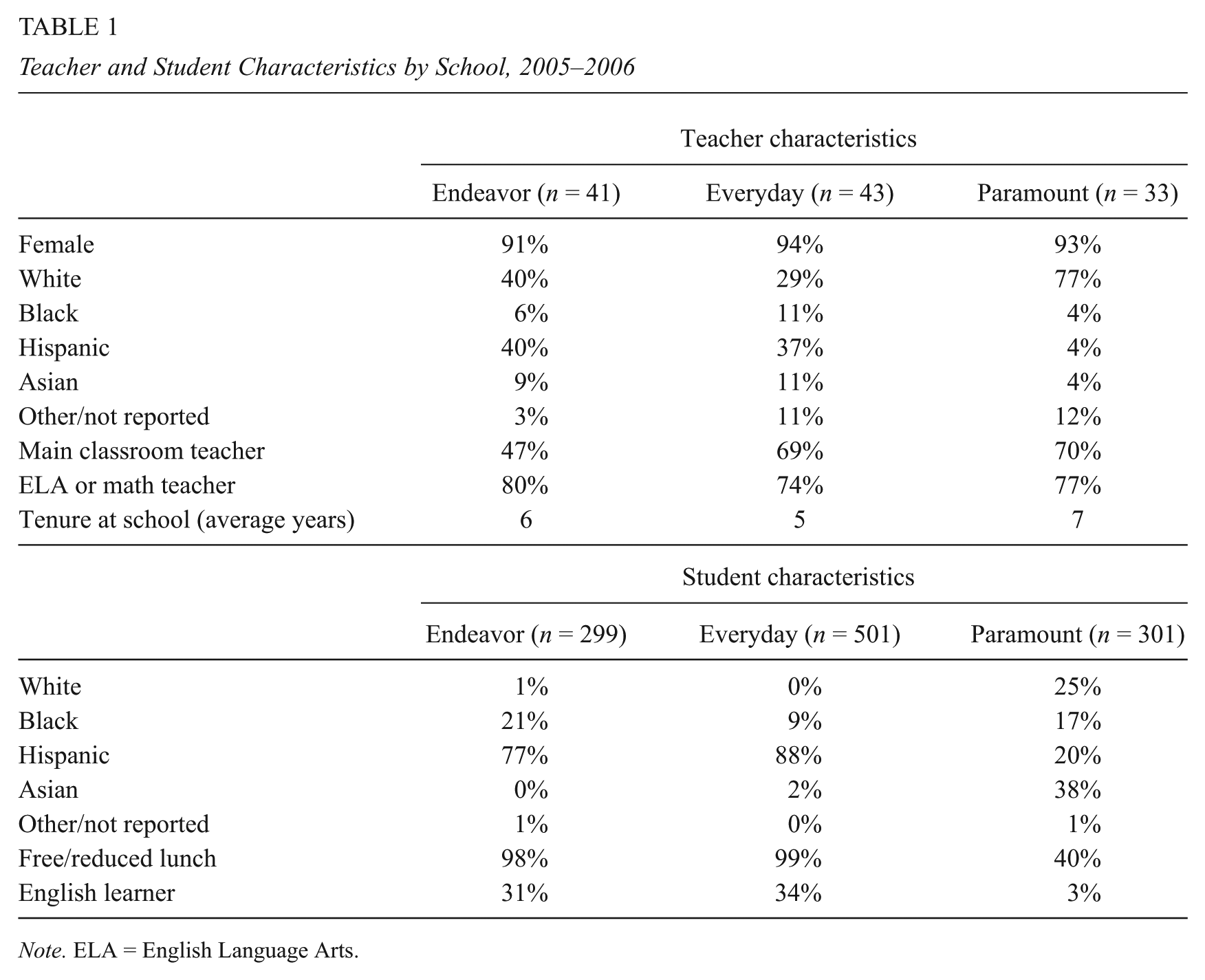
Note. ELA = English Language Arts.
A questionnaire was administered to teachers from the three schools during four after-school meetings in spring 2005, fall 2005, winter 2006, and spring 2006. The response rate for the survey varied across schools and survey administrations from a low of 62.75% to a high of 86.00%, resulting in a total of 216 repeated observations for 117 teachers. The questionnaire included items on teachers’ individual and organizational demographics, such as gender, race, and occupational status as a main or supporting teacher. The questionnaire also asked respondents to report their frequency of interaction with all other teachers at their school, using a scale of 1 (interactions occurred “less than once a month”) to 7 (interactions occurred “multiple times a day”).
A third set of items asked respondents to provide up to five responses to the following open-ended survey item: “If asked by one of your colleagues, what five words or phrases would you use to describe the changes taking place at this school?” The changes mentioned in this ques-tion refer to 19 state-recommended instructional practices on which teachers reported their frequency of use earlier in the survey. The recommended practices, such as data-driven instruction, using multicultural learning material, small group instruction, and rubrics for ongoing assessment, were identified by the researchers from 3 years of policy reports that the State Department of Education compiled after reviewing schools deemed to have a high need for reform. The specific practices selected met four criteria: (a) they were listed in more than 1 year of reports, (b) they were listed for more than one school, (c) they were relevant to teachers in all subject areas, and (d) they overlapped with practices in local policy initiatives.
Measures
Institutional Logics
We used a two-step procedure to determine respondents’ institutional logics. First, we determined which issues respondents raised by randomly sampling 100 of the 1,063 total open-ended responses about the changes at their schools, and then reviewed the text of the responses to inductively code for salient themes (Miles, Huberman, & Saldaña, 2013). This coding procedure resulted in 12 thematic issue categories plus one category representing responses that were indeterminate, meaning the words or phrases were inscrutable or had an emotional connotation but no clear topic by which to identify an issue. Table 2 illustrates the 12 coded issues, their definitions, and examples.
Reform Issues Codes and Definitions
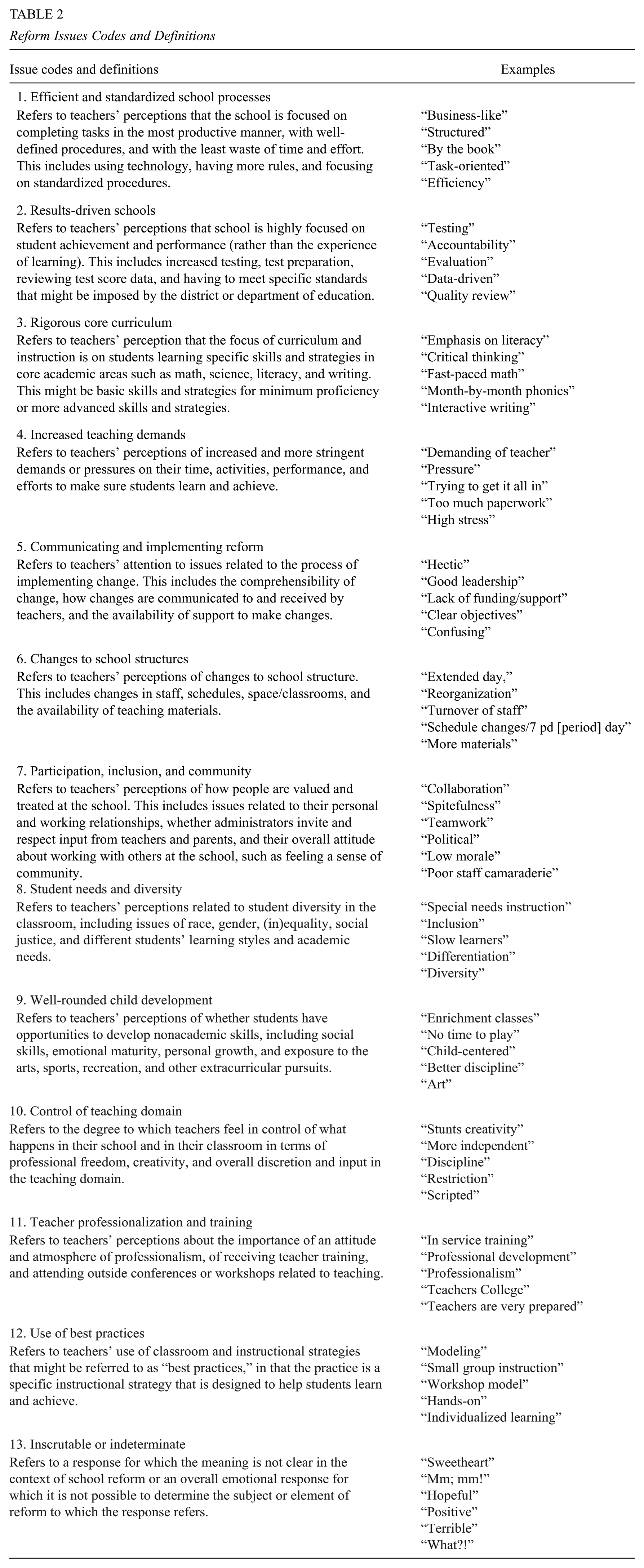
All responses were then assigned to one of the 12 thematic issue categories or the indeterminate category by two sets of independent raters who received training, coding instructions, category definitions, and examples from the researchers. Based on Landis and Koch’s (1977) widely used criteria, initial interrater agreement was substantial and significant (Cohen’s kappa = .664, p < .01). Raters were asked to come to consensus about remaining discrepant codes. It is important to note that the coding procedure focused on the topic of responses and not the valence because it was difficult to discern valence for many responses. Thus, the themes do not indicate whether respondents viewed issues positively or negatively only that issues were salient in respondents’ interpretations of reform. The findings should be interpreted in light of this limitation.
The second step in the procedure was to identify which logics supplied the “set of implicit rules” that generated the twelve observed issues (i.e., Thornton & Ocasio, 1999, p. 806). We used a latent class factor analytic approach to determine these implicit rules (Magidson & Vermunt, 2004). Because each response could be coded as belonging to one of 12 issues, it was possible to construct an m × n matrix, where the rows, m, are teachers pooled across the four time periods and the columns, n, are the 12 issue categories. The cell entries indicate how many times (0–5) a teacher mentioned a given issue in a given time period. With these data, a multilevel latent class approach was needed to identify sets of issues because the assignment of responses to issues results in data with a binomial count distribution with repeated observations for teachers; this distribution violates the assumptions of conventional factor analysis (Child, 2006; Magidson & Vermunt, 2004). We employed a bootstrap method, available in Latent GOLD 4.5, to estimate the p values determining each model’s goodness of fit (Vermunt & Magidson, 2005). We made this choice given potential concerns that the likelihood ratio statistic L2 would not be well approximated by the chi-square distribution due to sparse data resulting from our overall sample size and number of predictors (Magidson & Vermunt, 2004).
The results of the latent class analysis indicated that a three-factor model was an improvement over one-factor, two-factor, four-factor, and five-factor models based on three goodness-of-fit criteria: the Akaike information criterion (AIC), Bayesian information criterion (BIC), and change in the log-likelihood ratio and degrees of freedom. The coefficients for the three-factor model are illustrated in Panel A of Table 3, and the factor loadings are shown in Panel B of Table 3. The coefficients in Panel A indicate that all 12 issues are significantly associated with the factor on which they loaded. The factor loadings indicate that seven issues, including “increased teaching demands,” “student needs and diversity,” and “use of best practices” loaded most highly on Factor 1. The negative sign on some loadings and coefficients indicates that the less frequently respondents mentioned an issue, such as increased teaching demands, the more strongly their responses are associated with the identified factor. Based on the factor loadings and existing theory on institutional logics, we took the identified factors to be indicators of underlying logics. Because we elicited issues related to instructional changes at teachers’ schools, we refer to the identified logics as instructional reform logics.
Latent Class Factor Analysis of Reform Related Issues
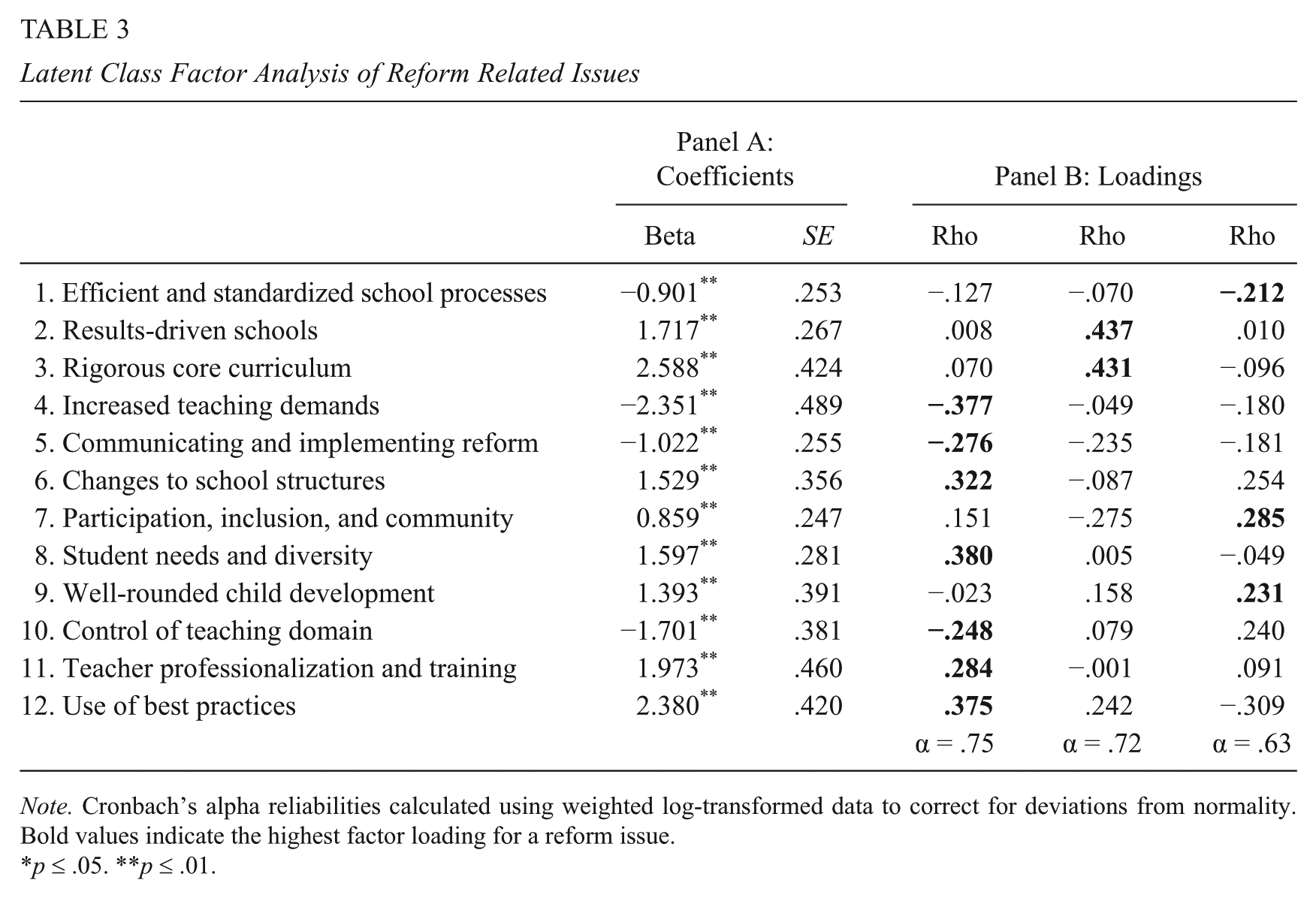
Note. Cronbach’s alpha reliabilities calculated using weighted log-transformed data to correct for deviations from normality. Bold values indicate the highest factor loading for a reform issue.
p ≤ .05. **p ≤ .01.
We determined that Factor 1 in Table 3 reflected a reform logic we term the professional bureaucracy logic because the issues associated with the factor regard not only important tenets of the profession, such as the use of best practices, but also important tenets of bureaucracies, such as changes in organizational structure. We determined that Factor 2 reflected a reform logic that we term the market accountability logic because the main issues associated with the factor regard tenets of recent reforms, which have been described as market-based or accountability-driven. This includes valuing results over inputs/processes and increasing the rigor of the curriculum. We determined that Factor 3 reflected a reform logic that we term the communal sentiment logic because the main issues associated with the factor refer to the importance of community and child welfare rather than efficiency. 2
We took respondents’ scores on each factor as indicators of their references to a given logic (cf. Bridwell-Mitchell, 2013). Factor scores are standardized measures that range from 0 to 1, so they are comparable across schools and survey administrations. For latent class factor analysis, the factor scores indicate the posterior probability of referring to the logics associated with the identified factor (Magidson & Vermunt, 2004). In other words, a respondent’s score on a factor indicates the probability that a respondent references a particular logic, given the pattern of issues they raised about instructional changes at their school.
Teacher Communities
In our work, we use the term community to mean the specific pattern of teachers’ interaction (i.e., who frequently interacts with whom) as in social network research (Datnow, 2012). To identify communities, we used respondents’ reported frequency of interactions with all other members of their school’s teaching staff. Specifically, we construct a single-mode i by j square adjacency matrix for each school at each survey administration. The rows i are respondents and the columns j are all other teachers at the school, the cells xij are values (1–7) for i’s reported frequency of interaction with j. Because missing data can be problematic for identifying clusters in sociometric data, we leverage our longitudinal data to impute missing values for xij using the average reported frequency of interaction between i and j across all the time periods for the study (Kossinets, 2006).
Using the above matrix, we identify communities, k, for school, s, at time, t, using the iterative partitioning routine KliqueFinder (Frank, 1995, 1996). KliqueFinder identifies nonoverlapping cohesive subgroups through a stochastic process that uses a goodness-of-fit index to maximize the log odds that any pair of actors is likely to interact, given that they are in the same subgroup determined by specified criteria. The criteria include the number of ties between respondents (i.e., degree), the extent to which all possible ties have been formed (i.e., density), and the extent to which respondents who indicate that they interact with a contact are also indicated by that contact as having an interaction (i.e., reciprocity). We use KliqueFinder’s postestimation Monte Carlo simulation of results to determine whether the concentration of ties between identified subgroup members is greater than what would occur by chance. We use a categorical variable to indicate each respondent’s community in each time period based on their KliqueFinder assignment to 54 different subgroups.
Teacher Demographics
The demographic co-variates included respondents’ school, occupation, grade and subject taught, years of experience as a teacher, age, gender, and race/ethnicity. School covariates were constructed as three indicator variables, coded 1 for the school where the respondent works, 0 otherwise. Occupation is an indicator variable for respondents being a main teacher (1) or supporting teacher (0). Respondents’ subject area is coded as an indicator variable for mathematics or English Language Arts (ELA) (1) and other subjects (0). Another indicator variable captures whether a teacher instructed students at the pre-kindergarten to second-grade levels (1) or third- to sixth-grade levels (0). These grade divisions are the same as those the State Department of Education used to administer standardized tests. Gender was coded 1 for women and 0 for men. The dummy variables for race/ethnicity were coded 1 for respondents who self-reported their race as Asian, Black, Latino, Native American, or “Other” and 0 for respondents who reported their race/ethnicity as White. We code non-White respondents together because of limited analytical power resulting from the relatively small sample size for individual groups. Teacher experience is respondents’ self-report of the number of years working at their school.
Analyses
The conceptual model of interest is the extent to which teachers’ references to professional bureaucracy, market accountability, and communal sentiment logics depend on teachers’ individual attributes, school features, and community interactions. Respondents’ references to logics were measured at four points in time, resulting in repeated measures on logics for each respondent. In addition, respondents were members of identified communities at one of three schools. This data structure with repeated observations of logics nested in teachers, teachers nested in communities, and communities nested in schools violates the independence assumptions of ordinary least squares regression. Instead, this data structure is appropriately modeled with a multilevel or hierarchical linear regression model. Because teachers belonged to different communities across the four time periods, a cross-classified, multilevel model is appropriate (Raudenbush & Bryk, 2002).
However, in the current work, we were not only interested in determining how teacher attributes, school features, or community interactions explain logics. We were also interested in the community sensemaking mechanism that may result in teachers’ references to logics. This can be examined by considering how much teachers’ logics are associated with their interactions in communities (Friedkin, 2001). To capture these effects, we use a network autocorrelation model (Doreian, 1981; Leenders, 2002). Whereas the standard regression model predicts the dependent variable, Y, as a function of a given set of exogenous variables, X, network autocorrelation models predict the dependent variable, Y, as a function of the exogenous variables, X, and endogenous variables, which are a weighted combination of the dependent variable, y, for other actors (Leenders, 2002; Marsden & Friedkin, 1993). In other words, the network autocorrelation model of interest in the current work examines the extent to which respondent i’s reference to a given logic is similar to her or his community members’ reference to that logic given the strength of their prior interactions and given i’s individual attributes and school characteristics. Formally, the model is specified as

where Yist is the factor score for a given logic for respondent i at school s in time t; ρ is a scalar for the effect of respondent i’s community on i’s reference to a given logic; Wt−1 is a matrix of weights, wji, denoting the frequency with which i and j interacted in the period prior to t;
As pointed out in comprehensive discussions on network autocorrelation, the effects of this model depend on the specification of the W matrix (Leenders, 2002). In the current work, we constructed W as a square matrix of teacher i’s interactions with every other teacher j in the prior time period. 3 So, for example, in models estimated for Period 1 (fall 2005), the cells of W are interactions between i and j in Period 0 (spring 2005). So, if j was not a member of i’s community in the prior period, then the weight in the intersecting cell is 0; if j was a member of i’s community in the prior period, then the weight in the intersecting cell is the sum of i’s reported frequency of interaction with j and j’s reported interaction with i in that period (i.e., resulting in a symmetric matrix of reciprocal ties taking account of both i’s and j’s reports). 4
The network autocorrelation method is an improvement over some other approaches for modeling the social influence mechanisms involved in sensemaking because rather than estimating the average effect of exposure to community opinions (i.e., logics), “it allows the opinion of some alters [to] carry more weight to ego than those of others” (Leenders, 2002, p. 22). This has conceptual implications in terms of assumptions about how influence unfolds in communities and also empirical implications in terms of specifying error terms in the models. However, one limitation is that the network autocorrelation approach does not allow for pooling respondents across time in the W matrix. Therefore, following the example of past work, we conducted separate analyses for each of the time periods (e.g., Mizruchi, Marquis, & Stearns, 2006). For each analysis, respondents were pooled across schools and stacked on the rows so that the submatrix for each school and its respective communities appeared along the diagonal of the full W matrix. We estimated the models with robust standard errors using the maximum likelihood routine for spatial effects models in Stata 12.0 (Pisati, 2001). 5
One additional limitation of our network autocorrelation approach is that we are unable to include control variables for the effects of respondents’ prior logics nor for alters’ prior logics given sample size and collinearity issues. Hence, the network autocorrelation models only examine similarity between respondents’ and community members’ logics given their prior interactions but do not fully address respondents’ possible self-selection into communities (i.e., Shalizi & Thomas, 2011). So, in some cases, the influence effect may be overestimated and result in bias in other estimates (Franzese & Hays, 2007). As a robustness check, we conduct follow-up analyses using cross-classified multilevel models including the two terms. The results from the follow-up analysis, reported in Table A1 in the appendix, are substantively the same as the main results.
Findings
Our first research question asked, “How are teachers’ interpretations of reform associated with institutional logics?” As previewed in the “Research Methods” section, the results of our latent class factor analysis indicate that teachers’ interpretations of reform can be linked to three instructional reform logics. These logics are (a) professional bureaucracy logics, (b) market accountability logics, and (c) communal sentiment logics.
Professional Bureaucracy Logic
Of all the issues brought up by respondents, 50.54% referenced the professional bureaucracy logic. The four strands of this logic identified from the latent class analysis emphasize tenets of bureaucracy, such as organizational structure and technical expertise. The logic also reflects tenets of the teaching profession, which, like professions more broadly, emphasize expertise and core values of the craft. Thus, teachers who referred to the professional bureaucracy logic were more likely to describe changes at their schools as (a) being associated with school structure and organization, using phrases like “extended day” and “schedule changes”; and (b) emphasizing teacher professionalization and training, using words like “professional development,” and “in service training.” Teachers who referred to the professional bureaucracy logic also focused (c) on the use of best practices, using words like “individualized learning” and “workshop model”; and (d) on student needs and diversity, using words like “inclusion,” and “special needs instruction.”
Market Accountability Logic
Of all the issues brought up by respondents, 13.1% referenced the market accountability logic. Teachers who referred to the market accountability logic described changes at their schools as (a) being focused on school results and student performance measured by standardized assessment, using words like “testing” and “data-driven.” Teachers who referred to the market accountability logic also described changes at their school by (b) emphasizing the importance of a rigorous curriculum in which students acquire specific academic skills and knowledge, using phrases like “critical thinking,” “emphasis on literacy,” and “fast-paced math.” Both strands of this logic, which focus on academic outcomes, skill acquisition, and performance are associated with the standards-based accountability movement in the United States, which has been associated, in turn, with market forces.
Communal Sentiment Logic
Of all the issues brought up by respondents, 19.11% were related to the communal sentiment logic. 6 Teachers who referenced the communal sentiment logic were more likely to describe changes at their schools as (a) being associated with participation, inclusion, and community, using phrases like “collaboration” and “poor staff camaraderie”; and (b) emphasizing well-rounded child development, using phrases like “child-centered” and “enrichment classes.” Teachers who referenced the communal sentiment logic were also less likely to describe changes by emphasizing efficient and standardized school processes with phrases like “task-oriented” and “business-like.” These logic strands are arguably connected to valuing child welfare and a community orientation over efficiency concerns, suggesting an association with the logics of the family and democracy (Fiske, 1992; Friedland & Alford, 1991). Given these findings, which suggest that teachers’ interpretations of reform draw on instructional reform logics, we turned to our second research question examining three alternative explanations for why teachers reference certain logics.
School Features
Earlier we noted that the effects of environmental imprinting might result in the logics of markets and bureaucracies being most prominent in schools facing strong accountability pressures; yet, the desire for professional autonomy in such schools might also make the logics of the profession more prominent. Our results indicate that teachers at the school facing the fewest accountability pressures and where students have the highest standardized test scores, Paramount Elementary, were most likely to emphasize market accountability (M = 0.651, SD = 0.37) and professional bureaucracy logics (M = 0.581, SD = 0.42). Conversely, the school that might feel the most pressure to either increase scores to the highest tier or to prevent scores from slipping into a lower tier, Everyday Elementary, is the school where teachers are least likely to reference communal sentiment logics (M = 0.249, SD = 0.29). References to communal sentiment logics are roughly equal at Paramount (M = 0.367, SD = 0.34) and Endeavor Elementary (M = 0.370, SD = 0.30), the latter of which had the lowest performance and strongest accountability pressures. The results of a Wald test for the multivariate comparison of means between the three schools, accounting for unequal variances in logics across the schools, indicates that the difference in logics across schools is statistically significant: professional bureaucracy logics, χ2(2) = 27.47, p ≤ .001; market accountability logics, χ2(2) = 63.00, p ≤ .001; and communal sentiment logics, χ2(2) = 10.45, p ≤ .01. These differences between schools are also significant in each of the three time periods. 7
One question to ask, given the theoretical perspective of this study, is the extent to which the above-described pattern in logics reflects institutional complexity. Consider, for example, that at Everyday Elementary, teachers’ mean reference to each logic is similar—professional bureaucracy logic: M(SD) = 0.280(0.37); market accountability logic: M(SD) = 0.289(0.37); and communal sentiment logic: M(SD) = 0.249(0.29)—with the absolute value of the mean difference equal to 0.258. This similarity suggests the three logics may compete almost equally as rationales for Everyday teachers’ use of instructional practices. In contrast, at Paramount, there is a starker difference between teachers’ references to each logic—professional bureaucracy logic: M(SD) = 0.581(0.42); market accountability logic: M(SD) = 0.651(0.37); communal sentiment logic: M(SD) = 0.367(0.42)—with the absolute value of the mean difference equal to 0.436. This starker difference suggests that Paramount teachers’ rationales for practice may have cohered around a dominant logic, namely, the market accountability logic, for which references have the highest mean. Note also that the standard deviation of teachers’ references to logics is larger at Paramount than at Everyday (the market accountability logic notwithstanding). This indicates that Paramount teachers vary more in the probability that they will reference professional bureaucracy or communal sentiment logics; in contrast, Everyday teachers are more consolidated or consistent in referencing these logics.
We would argue that at Everyday Elementary, the existence of multiple, almost equally competing logics around which teachers have consolidated views suggests a relatively high degree of institutional complexity at the school. And, although our current work focuses on three alternative sources of institutional complexity rather that its consequences, we would argue that institutional complexity at Everyday Elementary is one reason why its teachers report using state-recommended instructional practices less often and with somewhat greater variation than teachers at the other two schools. Teachers’ mean reported use of prescribed practices at Everyday Elementary is −0.131 (SD = 1.23), at Paramount Elementary the mean reported use is −0.060 (SD = 1.12), and at Endeavor Elementary the mean reported use of prescribed practices is 0.057 (SD = 0.92). The results of a Wald test for the multivariate comparison of means indicates that the differences in reported practice use across the three schools are statistically significant in Period 2, χ2(2) = 5.87, p ≤ .1, and Period 3, χ2(2) = 10.75, p ≤ .01, of the study, which directly precede and follow standardized test administration at the schools. The differences are not significant in Period 1.
The descriptive variations in teachers’ references to logics across schools can be examined formally with the set of lagged network autocorrelation models in Table 5; Table 4 provides descriptive statistics for the variables of interest. The results from the three sets of models indicate that school features do have an effect on teachers’ references to logics. These effects are most substantial in Period 2. Teachers at Everyday Elementary (β = −.397, p ≤ .01) and Endeavor Elementary (β = −.297, p ≤ .05) were significantly less likely to reference market accountability logics than teachers at Paramount Elementary, which is the reference category. Teachers at Everyday Elementary also were less likely to reference professional bureaucracy logics (β = −.289, p ≤ .05) in Period 2 compared with teachers at Paramount Elementary. In Period 3, Endeavor Elementary teachers were more likely to reference communal sentiment logics (β = .235, p ≤ .05) compared with teachers at Paramount Elementary. These results suggest that teachers’ references to logics are associated with school features, such as performance history and accountability pressures.
Descriptive Statistics
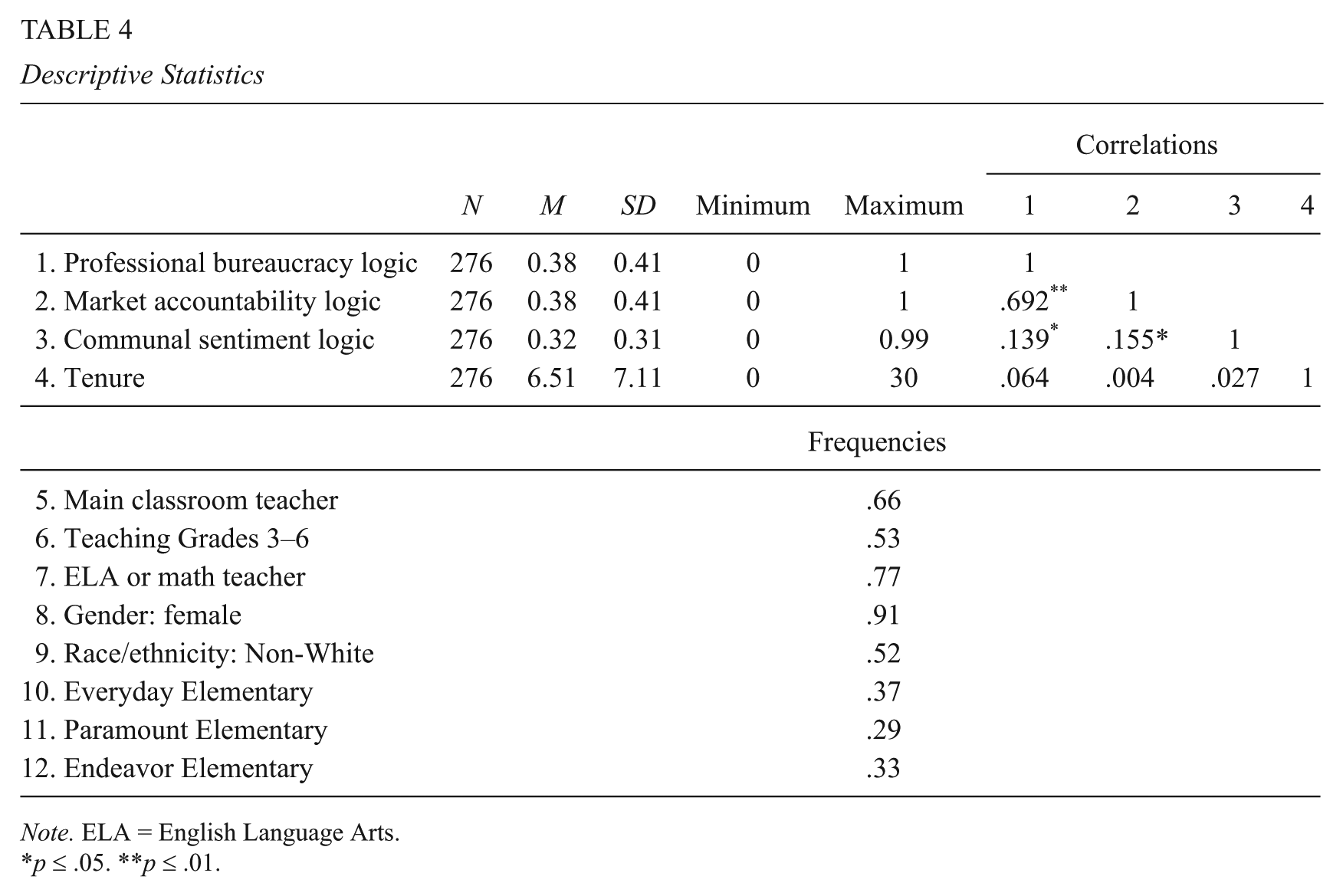
Note. ELA = English Language Arts.
p ≤ .05. **p ≤ .01.
Communities
Descriptive analyses indicated that although references to logics varied across schools, there was also considerable variation in references to logic within schools, given the length of the box, whiskers, and markers representing outliers in Figure 1. One explanation for variation in teachers’ references to logics within schools might be that teachers self-select into communities or have patterned interactions within communities so that teachers in some communities are more likely to reference some logics than others. This is illustrated in Figure 2, which depicts the sociogram of teachers’ interactions in communities at Everyday Elementary in fall 2005 and how communities differed in their reference to instructional reform logics.

References to institutional logics by school.
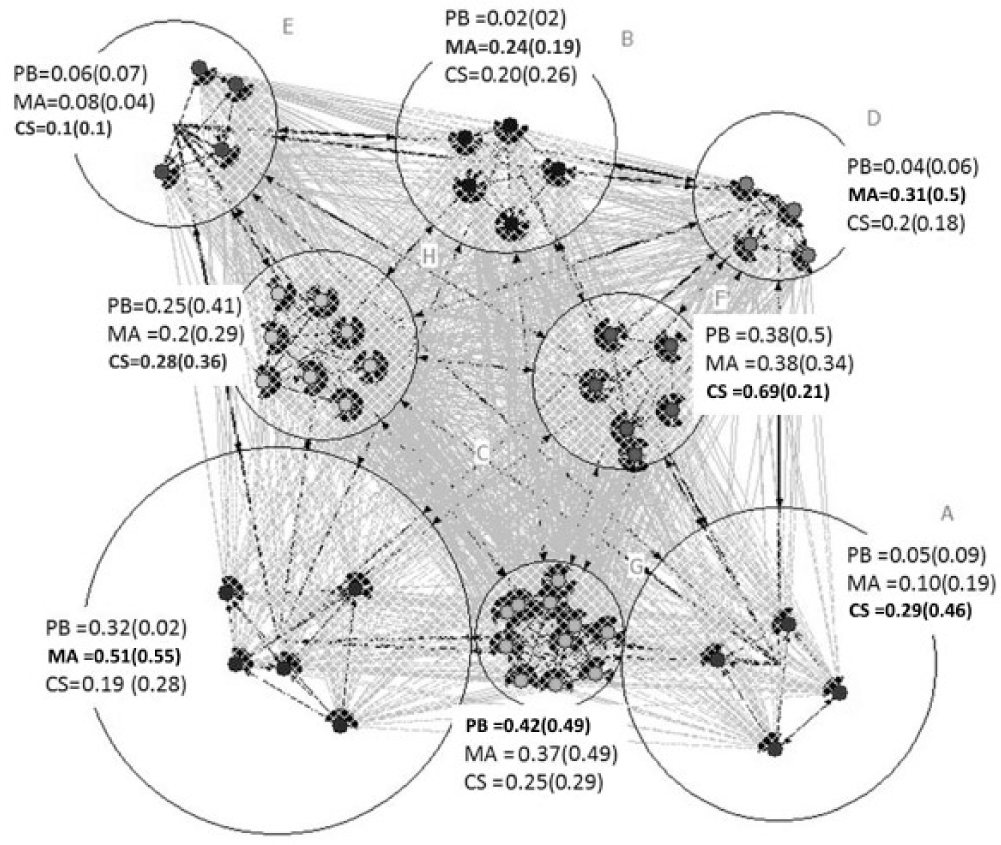
Logic embeddedness in teacher communities at Everyday Elementary (fall 2005).
For example, members of Communities A, E, F, and H were most likely to reference communal sentiment logics (M = 0.29, SD = 0.46; M = 0.1, SD = 0.1; M = 0.69, SD = 0.21; and M = 0.28, SD = 0.36, respectively). Communities B, C, and D were most likely to reference market accountability logics (M = 0.24, SD = 0.19; M = 0.51,SD = 0.55; and M = 0.31, SD = 0.5, respectively). The members of Community G were most likely to reference professional bureaucratic logics (M = 0.42, SD = 0.49). These mean differences between communities are significant for communal sentiment logics, χ2(7) = 34.53, p ≤ .001, but not for market accountability and professional bureaucracy logics. Although not illustrated in the figure, there is similar patterned variation for dominant logics by community at Endeavor and Paramount Elementary in Period 1. This patterned variation by community can also be observed across time at all three schools.
The results for community influence in Table 5 suggest that teachers’ past interactions in their communities are associated with their references to professional bureaucratic logics and market accountability logics. 8 However, the effects of community influence are not consistent across time periods. In Period 1, past interactions with colleagues resulted in teachers’ references to professional bureaucratic logics becoming more similar to their colleagues’ (β = .265, p ≤ .05). The same pattern held in Period 1 for market accountability logics (β = .39, p ≤ .001). In contrast, in Period 2, past interactions with colleagues resulted in teachers’ references to professional bureaucratic logics becoming less similar to colleagues’ (β = −.361, p ≤ .05). Because we suspected that effects for community influence might relate to the varying strength of relationships in different communities, we conducted a follow-up analysis including a measure for community cohesion in the models. However, there were no significant effects for community cohesion, and the overall pattern of results for community influence was unchanged.
Lagged Network Autocorrelation Estimates for Teachers’ References to Reform Logics
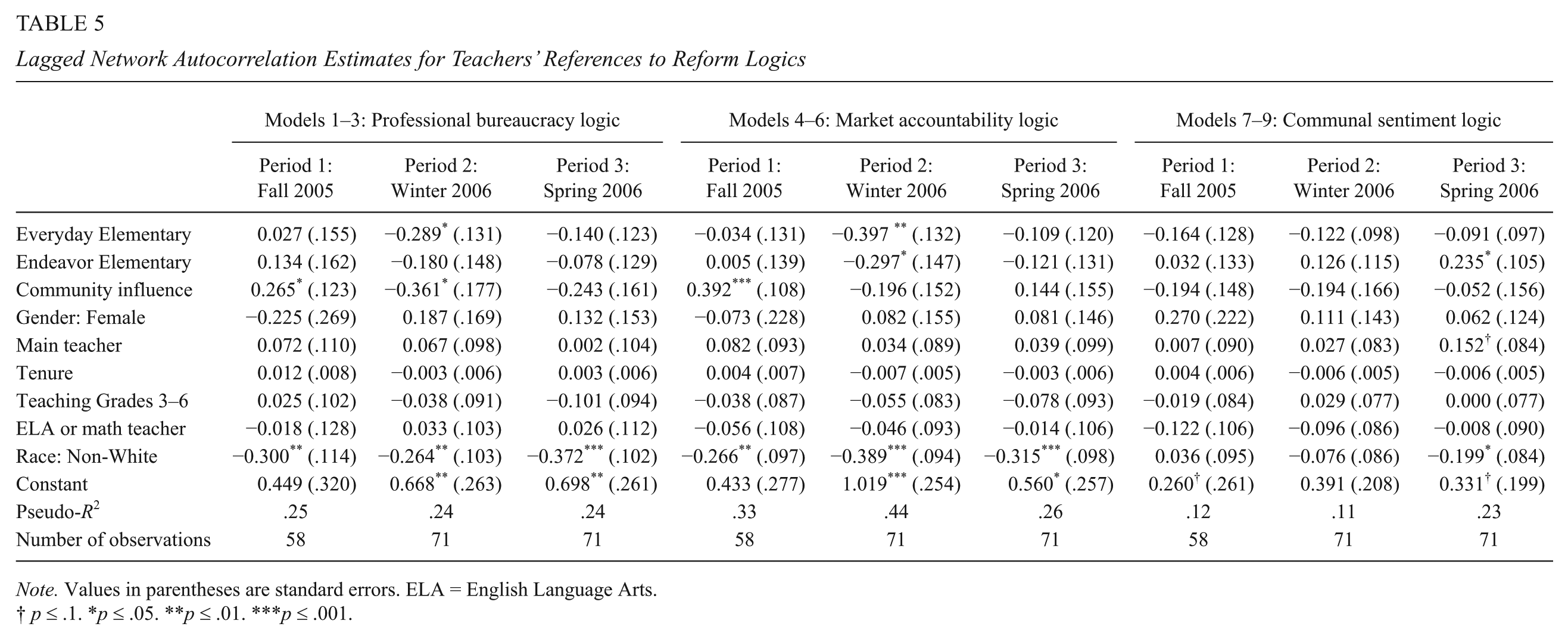
Note. Values in parentheses are standard errors. ELA = English Language Arts.
p ≤ .1. *p ≤ .05. **p ≤ .01. ***p ≤ .001.
Individual Attributes
Although the pattern of effects for school features and community influence vary by logic and by time period, the effects for individual attributes in Table 5 are largely consistent. We expected that teachers with different roles might have different professional identities and, thus, refer to logics in different ways. However, being a main classroom teacher, teaching Grades 3 to 6 and teaching ELA or math had no significant effect on teachers’ references to logics. To the extent that professional history captures the imprinting effects of becoming a teacher in different eras, the results indicate that the length of teachers’ experiences at their school had no significant effect on references to logics. In contrast, teachers’ experiences as members of different racial or ethnic groups did have a significant effect on teachers’ references to logics.
Teachers who indicated they were from a non-White racial or ethnic group had significantly fewer references to professional bureaucratic logics in all three periods (Period 1: β = −.300,p ≤ .01; Period 2: β = −.264, p ≤ .01; and Period 3: β = −.372, p ≤ .001). Teachers who indicated they were from a non-White racial or ethnic group also had significantly fewer references to market accountability logics in all three periods (Period 1: β = −.266, p ≤ .01; Period 2: β = −.389, p ≤ .001; and Period 3: β = −.315, p ≤ .001). In Period 3, teachers who indicated they were from a non-White racial or ethnic group had fewer references to communal sentiment logics (β = −.199, p ≤ .05). It should also be noted that when we examined models that included teachers’ prior beliefs as predictors of their logics (see Table A1 in the appendix), the pattern of effects for race/ethnicity holds. We further explore this and other observed patterns in the results in the “Discussion” section.
Discussion
In this research, we have asked how teachers’ interpretations of reform are associated with institutional logics and how logics vary given teachers’ school, community, and individual experiences. Explaining this variation shows how institutional complexity plays a role in the implementation of reform and suggests why implementation can be so problematic. Our analyses indicate that institutional complexity may be greater at some schools and especially at schools like Everyday Elementary, which may feel squeezed by the pressures of middle-tier performance and so attempt to rationalize their work in a variety of ways. In contrast, at higher performing schools, such as Paramount, reliance on the dominant logic of market accountability might be part of their story of success. Meanwhile, at lower performing schools, such as Endeavor, reliance on the dominant logic of communal sentiment may reflect more traditional beliefs and practices about schooling (Russell, 2010). However, it is important to note that our analysis cannot shed light on the causal direction of the relationship between school characteristics and teacher logics. This is to say that it could just as easily be the case that schools with certain features attract teachers with certain logics or that teachers’ logics are shaped by their experiences in their schools. Disentangling this casual direction may be a useful avenue for future research.
Considerable prior research suggests teachers’ interpretations of reform can be explained by their experiences in collegial communities (Coburn, 2001; Little, 2006; Louis et al., 2005). To the extent that different communities have different dominant logics, this could explain the factionalized micropolitics and turmoil known to plague the implementation of reform (Ball, 1987; Hallett, 2010). However, the current work provides limited support for the effects of community influence on the logics teachers’ reference when interpreting reform. We do find that community influence is associated with teachers’ references to market accountability and professional bureaucracy logics in the first period of the study but these effects are inconsistent or nonexistent in other periods. The episodic effects of community influence may be an artifact of the research design in that we collected data at approximately equal 3-month intervals, but the effects of community influence may occur from day to day, week to week, or month to month. Influence effects over these intervals might be averaged out over the 3-month intervals for data collection.
Still, it may be the case that community influence does mainly have effects at the beginning of the year when teachers are still forming their opinions and reactions to reform. Later in the year, colleagues may be less influential because opinions have already been formed or because teachers’ reactions have already become similar to their colleagues. Alternatively, when teachers learn about their colleagues’ opinions in the first period, teachers may self-select out of communities where colleagues have dissimilar views and into communities where colleagues have similar views. If so, interactions with colleagues in the first period could result in teachers’ references to logics becoming less similar to these colleagues over time. This explanation is consistent with the negative effects of influence on professional bureaucratic logics in Period 2. Still, this explanation is largely an extrapolation from the findings and should be examined in future work that collects qualitative data on the moderators of community influence.
Unlike effects for school features and community influence, we find teachers’ individual attributes—specifically teachers’ self-identified race/ethnicity—to be a consistent and significant predictor of teachers’ references to logics. Non-White teachers were less likely than White teachers to refer to market accountability logics and professional bureaucracy logics in all three periods and less likely to refer to communal sentiment logics in Period 3. One way to explain why White and non-White teachers draw on logics in different ways is that these two groups of teachers may work in different kinds of schools or interact in different kinds of communities. Although it is the case that Paramount Elementary has a significantly lower proportion of non-White teachers, χ2(2) = 330.28, p ≤ .001, and that non-White teachers interact in communities with a significantly higher proportion of non-White teachers, mean difference = −0.465, t(185) = −12.71, p ≤ .001, the analyses control for the effects of community and school as well as occupational factors. This means if one compared White teachers and non-White teachers who worked in the same school for the same number of years, were members of the same community, and were main teachers for the same grade and subject, the White and non-White teachers would still, on average, have different references to logics. This suggests the consequential experiences for teachers’ references to logics have less to do with their experiences in specific schools or communities and more to do with their broader social experiences. This is to say that White and non-White teachers may have different experiences in not only institutions like markets and bureaucracy but also the professions, including having different experiences becoming socialized into the teaching profession (Demo & Hughes, 1990).
As we noted earlier, research on African American teachers has suggested they can have distinct perceptions of the teaching profession compared with White teachers (Foster, 1990, 1993). If this is true for other non-White teachers, then the practices, assumptions, values, beliefs, and rules that are most salient for White versus non-White teachers could be different. From an empirical standpoint, this would mean that when we asked teachers to provide five words or phrases describing instructional changes at their schools, non-White teachers would raise systematically fewer or different issues than their White counterparts. As a result, less of the variance in the issues raised by non-White teachers would be explained by a given factor (i.e., because the factor was largely capturing variance in the greater number of issues raised by White teachers) and issues raised by non-White teachers would have a lower loading on any factor. Thus, non-White respondents would tend to have lower scores on any given factor.
Our follow-up analysis examining this possibility indicated that there were significant differences in the proportion of responses that non-White and White teachers raised for some issues, including non-White teachers raising a lower proportion of issues related to results-driven schools and rigorous core curriculum but raising a higher proportion of issues related to increased teaching demands and communication and implementation of reform. However, the largest difference was in the proportion of responses from non-White teachers coded as indeterminate because the responses were inscrutable or had an emotional connotation but no clear subject or topic by which to identify a theme, proportional mean difference = −0.144 (0.03), z = 4.32, p ≤ .001. This difference is particularly important because responses coded indeterminate were not included in the latent class analysis that identified logics.
To be clear, we did not make the a priori choice to remove the responses of non-White teachers from the analysis. Responses were excluded based on the criteria that they were indeterminate and, as such, we could not determine the thematic issue to which the response belonged (see Table 2 for an illustration of indeterminate responses). Yet, as we discovered in the follow-up analysis, these responses were given more often by non-White teachers. Thus, a larger proportion of non-White teachers’ responses were excluded from the analyses. The follow-up analysis also indicated that although the majority of indeterminate responses from non-White teachers did not have clear thematic issues, the responses did have an affective valence, which could be coded as positive, negative, or neutral/unclear.
For example, the words “positive” and “exciting” represent the 67.83% of indeterminate responses from non-White teachers that were positively valenced. The words “scary” and “unrealistic” represent the 9.44% of indeterminate responses from non-White teachers that were negatively valenced. The words “interesting” and “different” represent the 22.73% of responses with neutral or unclear valence. One conclusion to draw from these results is that non-White teachers are less likely to refer to market accountability and professional bureaucracy logics because other, less easily identifiable issues with emotional connotations are more salient for them. Tension between emotions and cognitions related to an issue may be a source of ambivalence some non-White teachers have about implementing reform (Piderit, 2000). Thus, an important direction for future research may be exploring how and why the issues raised by White and non-White teachers differ and to what extent associated emotions are tied to different underlying logics in teachers’ interpretations of reform (i.e., Voronov & Vince, 2012).
Conclusion
Over the last 30 years, market-based reforms have become increasingly prominent (Chubb & Moe, 1999; Ladd, 2002; Ravitch, 2010). The effectiveness of these reforms depend on assumptions that individuals’ decisions and actions are motivated by beliefs, values, norms, and practices associated with the market, in other words, by market logics. However, as the current work demonstrates, teachers rely on the logics of a number of institutions besides the market. Although the 117 public elementary school teachers in our study do rely on what we describe as market accountability logics, teachers more frequently rely on professional bureaucracy logics and communal sentiment logics, which reflect institutions such as the professions, bureaucracies, democracy, and the family (Boltanski & Thevenot, 1999; Fiske, 1992; Friedland & Alford, 1991; Thornton & Ocasio, 1999). That teachers rely on multiple and potentially competing sets of logics has important implications for research, policy, and practice related to teacher interpretations and the implementation of reform.
A robust body of research demonstrates that teachers’ interpretations of reform influence their instructional practices and engagement with reform (Bertrand & Marsh, 2015; Cho & Wayman, 2014; Coburn, 2001; Hill, 2001; Louis et al., 2005; Spillane et al., 2002; Stillman & Anderson, 2015). However, this existing research has largely overlooked how broader cultural forces influence teachers’ interpretations in potentially predictable ways. Furthermore, although existing research shows that teacher interpretations are related to individual experiences, there has been little attention to how these experiences may be associated with teacher demographics such as race/ethnicity, which shape teacher experiences in the broader society (van den Berg, 2002). In addition, existing research has emphasized the importance of teacher communities to their interpretations (Coburn, 2001; Louis et al., 2005). Yet, observed community effects may not have taken into account teachers’ self-selection into communities based on their fundamental beliefs, values, norms, and practices (e.g., Ritchie, 2012). Thus, our research extends existing work on teacher interpretations and policy implementation by illuminating the role of institutional logics, clarifying the relevant dimensions of individual experience, and demonstrating the relative effects of community and school context on teachers’ interpretations.
With respect to policy, teachers’ interpretations being grounded in institutional logics suggests there are predictable patterns in teachers’ responses to reform, which are rooted in core societal institutions. It may be difficult for teachers to understand or support policies centered in one set of logics if they run counter to the logics on which teachers primarily rely. Indeed, previous research on teachers’ logics indicates teachers are less likely to use instructional practices that violate their logics (Bridwell-Mitchell, 2013). This suggests that when formulating reforms, policymakers need to acknowledge and address the potential tensions between different sets of logics if they hope to minimize resistance to reform and encourage implementation. This also suggests that the most effective methods for responding to policy challenges may not be stronger enforcement or accountability mechanisms but attempts to gain cognitive legitimacy engendered by different logics (Suchman, 1995). Indeed, existing research suggests individuals are more likely to commit themselves to cooperative endeavors when they believe that organizational activities are legitimate (Tyler & Blader, 2005).
The fact that teachers may not understand the rationales for or openly resist policies that run counter to their logics also has implications for how school leaders frame reform policies at the school level. Existing research indicates that how principals frame reform matters for teachers’ responses (Coburn, 2006). Research also suggests that principals who rely too heavily on one set of logics without recognizing competing logics may provoke turmoil at their schools (Hallett, 2010). Thus, it may be helpful for principals to frame policies to address potential tensions between different logics. This might include targeted efforts acknowledging that teachers with different backgrounds may rely on different logics and so may need different inducements and support to implement reforms. Otherwise, the implementation of future reforms may, like that of so many past reforms, be plagued by ceaseless contestation, resistance, and retrenchment.
Footnotes
Appendix
Because data for the follow-up analyses have observations of logics nested in teachers (Level 1), and teachers nested in communities but belonging to different communities over time (Level 2), we formulated a constrained cross-classified hierarchical model using maximum likelihood estimation for xtmixed in Stata 13.1. Following Rabe-Hesketh and Skrondal (2008), Level 1 and 2 observations are nested within schools (Level 3) and within a single artificial super cluster (Level 3). Although some authors recommend that groups with small numbers be included in models as fixed effects, we include the three schools as random effects to illustrate the decomposition of variance across schools, communities, individuals, and observations (i.e., Marchenko, 2006). The composite model is
where Y1−3itsk is the likelihood that teacher i at time t in community k at school s references a given logic. We denote teacher-level covariates with vector
Acknowledgements
We gratefully acknowledge our funding support and the feedback of colleagues who provided thoughtful comments on earlier drafts of this article, including Candice Bocala, Emily Heaphy, David M. Quinn, Jennifer Russell, Patricia Thornton, and members of the American Educational Research Association (AERA) Organization Theory Special Interest Group (SIG).
Declaration of Conflicting Interests
The author(s) declared no potential conflicts of interest with respect to the research, authorship, and/or publication of this article.
Funding
The author(s) disclosed receipt of the following financial support for the research, authorship, and/or publication of this article: This work was supported by a National Science Foundation grant for the study of human and social dynamics (SES-0433280).
Notes
Authors
EBONY N. BRIDWELL-MITCHELL is an associate professor at the Harvard Graduate School of Education. She holds a PhD in organizational theory and management from the New York University Stern School of Business and a master’s degree in public policy from the Harvard John F. Kennedy School of Government. Her research builds on her training in organizational management and education policy to study the microsocial and cognitive dynamics of reform policy implementation and institutional change in U.S. public schools.
DAVID G. SHERER is a doctoral candidate at the Harvard Graduate School of Education. He specializes in research on policy implementation and the social dynamics of K–12 school reform. Before beginning his doctoral career, he was a research analyst at SRI International’s Center for Education Policy.