




Abstract
Student attendance is both a critical input and intermediate output of the education production function. However, the malleable classroom-level determinants of student attendance are poorly understood. We estimate the causal effect of class size, class composition, and observable teacher qualifications on student attendance by leveraging the random classroom assignments made by Tennessee’s Student/Teacher Achievement Ratio (STAR) Project class size experiment. A 10-student increase in class size increases the probability of being chronically absent by about 3 percentage points (21%). For Black students, random assignment to a Black teacher reduces the probability of chronic absence by 3.1 percentage points (26%). However, naive mediation analyses suggest that attendance is not a mechanism through which class size and same-race teachers improve student achievement.
Keywords
However, the extent to which other classroom-level inputs (e.g., class size) affect student attendance is unclear and teachers’ effects on student attendance have yet to be studied in an experimental setting. Moreover, empirical evidence on the effect of observed qualifications such as teaching experience on student absences come almost exclusively from observational data from North Carolina (Gershenson, 2016; Holt & Gershenson, 2019; Ladd & Sorensen, 2017). Replicating these findings in other contexts and with experimental data is important, as replication is a key element of the scientific method that is often missing in education research (Duncan et al., 2014; Makel & Plucker, 2014). Showing that same-race teachers, for instance, boost student attendance for minority students in multiple school settings and in multiple research studies makes it easier for policy makers, school leaders, and diversity advocates to lean on this evidence base when trying to change policy and practice.
We address these gaps in the literature by leveraging the experimental variation in classroom assignments created by Tennessee’s Student/Teacher Achievement Ratio (STAR) Project class size experiment to address two general research questions:
We find that two easily observed classroom-level characteristics, class size and same-race teachers, significantly reduce student absences. This is true whether attendance is operationalized as the count of absences or an indicator for chronic absence. Assignment to a small class size or a Black teacher (for Black students) also reduces the probability of attrition from the student’s initial STAR elementary school. However, we find that a negligible share of the impact of both class size and student–teacher race match on test scores can be explained by improved attendance.
Background
Student Absences Matter
Student absences are important for several reasons. First, arguably, causal evidence suggests that student absences harm achievement (Aucejo & Romano, 2016; Gershenson et al., 2017; Goodman, 2014; Gottfried, 2009, 2010, 2011; Liu et al., 2019). For example, using both nationally representative survey data and rich administrative data from North Carolina, Gershenson et al. (2017) show that a 1-SD increase in absences is associated with statistically significant decreases in reading and math achievement of 0.02 and 0.04 test score SD, respectively. These effects are practically significant as well, on par with those of a 1-SD increase in teacher absences (Herrmann & Rockoff, 2012) or a 0.33-SD increase in teacher effectiveness (Hanushek & Rivkin, 2010). Second, absenteeism predicts high school dropout and risky behaviors such as drug and alcohol use (Allensworth & Easton, 2007; Balfanz & Byrnes, 2012; Henry & Huizinga, 2007; Henry & Thornberry, 2010). Finally, attendance is an objectively measurable correlate of several “Big Five” character skills and highly valued in the labor market (Duckworth et al., 2007; Heckman & Kautz, 2013; Lerman, 2013; Lounsbury et al., 2004). Indeed, researchers often proxy for character skills with attendance (Jackson, 2018; Jacob, 2002).
Given the consequences of student absences and the disproportionate level of absences among socioeconomically disadvantaged students, student attendance has been a growing concern for policymakers. Recent education policy, notably the Every Student Succeeds Act (ESSA), uses chronic absence rates as an outcome for which schools and teachers can be held accountable (Bauer et al., 2018; Gottfried & Hutt, 2019). Such policies implicitly assume that there are school- or classroom-level policy levers available that can increase student attendance. Although a handful of interventions have recently shown promise, the general classroom-level characteristics that might shape student attendance patterns remain underexplored. The current article addresses this gap by investigating classroom-level determinants of student attendance, including class size, peer composition, and observed teacher characteristics.
Determinants of Student Attendance
Student attendance is certainly influenced by numerous factors outside the purview of schools, such as student health, household stability, and environmental pollution (Currie et al., 2009; Gottfried & Gee, 2017; Morrissey et al., 2014; Ready, 2010; Romero & Lee, 2008). This does not mean that schools cannot reduce absenteeism, of course, and a variety of interventions are currently being piloted and rigorously evaluated. For example, light-touch “nudges” that use text messages to communicate with parents about the importance of attendance have been shown to reduce chronic absence (Robinson et al., 2018; Rogers & Feller, 2018; Smythe-Leistico & Page, 2018) and class-specific absences in the middle and high school setting (Bergman & Chan, 2017). Interestingly, Bennet and Bergman (2018) show that because students are often absent together, these interventions can have spillover effects on students’ friends. Indeed, a student’s classmates, and classroom culture, might influence attendance habits (Gottfried et al., 2016).
These school- or district-based policy initiatives can move the needle on student attendance, and so too can school leadership, primarily by improving school climates (Kraft et al., 2016). For example, Hamlin (2020) finds that student attendance is positively correlated with student perceptions of school climate in New York City (NYC) public schools. The intuitive reason is that warm, safe, and welcoming school climates make school a place that students want to be. Particularly, in elementary school, students spend most of their school days in self-contained classrooms, so classroom environments likely play an equally, if not more important, role.
Teachers are among the most important school-provided inputs in terms of driving student achievement and might increase student attendance by fostering a passion for learning, increasing student engagement, building a sense of community in the classroom, changing norms, and stressing the importance of regular attendance (Baker-McClearn et al., 2010; Gershenson, 2016; Kelly & Carbonaro, 2012; Ladd & Sorensen, 2017; Monk & Ibrahim, 1984). Primary school teachers also can affect their students’ attendance by shifting parents’ and other household adults’ attitudes, expectations, and practices regarding their children’s attendance, in similar fashion to the information interventions described above.
Similarly, Dee and West (2011) describe several channels through which class size might affect noncognitive skills such as attendance (e.g., by making it easier for teachers to intervene when there is a problem, communicate with parents, and reallocate instructional time from academic lessons to building social and emotional skills). Krueger (1999) speculates that part of the class size effect on achievement operates through a “school socialization effect,” which could easily apply to attendance as well, and aligns with the channels described in Dee and West.
Indeed, an emerging literature uses value-added models to document teachers’ impacts on student attendance. Using longitudinal administrative data on the population of public primary school students in North Carolina, Gershenson (2016) finds that teachers affect student absences and that they are not always the same teachers who boost test scores. Liu and Loeb (2021) find similar results in middle and high schools in a large urban school district in California. Teacher characteristics, such as teaching experience and student–teacher racial match, have also been shown to reduce student absenteeism (Gershenson, 2016; Holt & Gershenson, 2019; Ladd & Sorensen, 2017). Similarly, Dee and West (2011) show that eighth-grade class size affects school engagement, which is a correlate of attendance.
The current study contributes to this literature in three ways. First, we examine the impact of previously unexplored classroom characteristics on student attendance such as class size and classroom peer composition. Second, we replicate earlier studies of teachers’ effects on student attendance, which relied on observational data, using experimental data in which both students and teachers were randomly assigned to classrooms. We do so in the same spirit as previous research that exploited the STAR experiment to estimate the impacts of kindergarten classroom quality, class size, class composition, teacher characteristics, and student–teacher race match on educational achievement and attainment (Chetty et al., 2011; Dee, 2004; Gershenson et al., 2018; Graham, 2008; Krueger, 1999; Krueger & Whitmore, 2001; Penney, 2017; Sojourner, 2013). Third, we analyze whether and to what extent the influence of class size and same-race teachers on student achievement operates through improved student attendance. Although previous research has proven that small classes and same-race teachers can improve student achievement (Dee, 2004; Krueger, 1999), the causal mechanisms remain unclear. Hence, our mediation analysis aims to determine whether improved student attendance is a key mechanism.
Data and Method
Project STAR
We investigate classroom-level inputs’ effects on student attendance using publicly available data from Tennessee’s Project STAR, a seminal large-scale field experiment in education that was designed to identify the impact of class size on student achievement (Krueger, 1999; Schanzenbach, 2006). Funded by the Tennessee legislature at a total cost of about US$12 million, project STAR randomly assigned kindergarten students and teachers in 79 participating public schools in Tennessee to either small-size classes (13–17 students) or regular-size classes (22–25 students) within their schools in the 1985 to 1986 school year. Project STAR intentionally recruited schools serving relatively disadvantaged populations, so the sample is not representative of the state’s public school population (Schanzenbach, 2006). The experiment continued over the next 3 years, following the 1986 kindergarten cohort to third grade while also refreshing the analytic sample each year by randomly assigning new entrants to the STAR cohort to small- or regular-size classrooms. All told, 11,600 students and 1,330 teachers participated in the experiment. Randomization was achieved, at least in students’ first year in a STAR school, and small classes improved student achievement (Chetty et al., 2011; Krueger, 1999).
While Project STAR was designed to assess the effectiveness of class size reductions, many researchers have recognized that its within-school random assignment of students and teachers to classrooms could be leveraged to study other research questions. For instance, scholars have leveraged the random assignments created by Project STAR to estimate the effects of having an own-race teacher on academic achievement and attainment (Dee, 2004; Gershenson et al., 2018; Penney, 2017), the long-run impacts of classroom quality on educational attainment and future earnings (Chetty et al., 2011), and peer effects on academic achievement (Graham, 2008; Sojourner, 2013). In the same vein, we leverage the experimental variation in classroom assignments created by Project STAR to estimate the student attendance production function. Note that because the randomization happened within schools, we cannot leverage the STAR experimental data to study the effect of school-level characteristics on student outcomes.
Data
Table 1 summarizes the analytic sample separately by student race, gender, and free/reduced-price lunch (FRL) status. Project STAR did not record absences in second grade, so the analytic sample contains only Grades K, 1, and 3. The main dependent variable is a binary indicator of whether a student was chronically absent although we show that our main results are robust to instead using a simple count of annual absences. We define “chronically absent” as 18 or more absences during the school year (i.e., about 10% of school days) because this is the most commonly used definition of chronic absence and is consistent with many states’ definitions (Balfanz & Byrnes, 2012; Bauer et al., 2018). Table 1 shows that 14% of students in the analytic sample were chronically absent and that the average student was absent about 9.5 times. Absence rates are higher for White, female, and FRL students. The average absence and chronic absence rates of FRL STAR students are quite similar to those of similarly aged, low-income students in the nationally representative Early Childhood Longitudinal Study, Kindergarten Class (ECLS-K; Gershenson et al., 2017).
Summary Statistics

Note. SDs are reported in parentheses under the means for non-categorical variables. FRL = free or reduced-price lunch.
Independent variables of interest include Class Size (i.e., the count of students in class), observable teacher qualifications that have been shown to affect student achievement such as Same-Race and Experience (Dee, 2004; Egalite et al., 2015; Wiswall, 2013), and the classroom’s sociodemographic composition. We cannot investigate the impact of having a same-sex teacher because all of the teachers were female. Nor can we study the impact of peers with special education designations, at least in the main analysis, because this information is only recorded in the first 2 years of the STAR experiment; we do investigate this question in the subsample of kindergarten and first-grade entrants, however, as prior research finds that peers with disabilities might harm achievement, noncognitive skills, and attendance (Gottfried, 2014a, 2014b; Gottfried et al., 2016). Only 43% of Black students had a same-race teacher, compared with 95% of White students. The average teacher had about 10 years of experience, and this is similar for both Black and White students, and for FRL and non-FRL students. The peer composition variables show that classrooms are fairly segregated by race and FRL receipt. As for the demographics of the analytic sample, 35% of students in the sample were Black, 47% were female, and 54% were FRL eligible. Nearly all STAR students were White or Black, and no English language proficiency variable was collected, so we cannot investigate heterogeneity among other racial or ethnic groups, or the impacts of linguistic diversity in the classroom, in this data set. Again, the relative disadvantage of the sample is due to Project STAR’s focus on disadvantaged schools.
Student Attendance Production Function
We estimate the causal effect of observed classroom inputs, including class size, teacher characteristics, and peer characteristics, on student absences in a school-by-cohort fixed effects model (FE; Krueger & Whitmore, 2001). The school-by-cohort FE means that estimates are identified by within-school, within-cohort variation in classroom characteristics, which is important because random assignment occurred within schools, and students entering a school in later grades may be systematically different from students who entered the school in kindergarten. This effectively controls for any nonrandom sorting of teachers and students across schools, as well as any school- and grade-specific characteristics such as the way student absences were administratively recorded, school-level leadership, different lengths of academic calendars, and policy changes.
Specifically, the model for student i, in classroom j, school k, and cohort g is as follows:

where x is a vector of observed student characteristics, z is a vector of observed teacher and peer characteristics, C is class size,
Three final points about estimation of Equation 1 merit mention. First, Project STAR randomly assigned student entrants to three dichotomous classroom types: small, regular, and regular plus aide. Actual class size C could (and does) vary within these groups, and that variation might be endogenous (Krueger, 1999). Accordingly, we estimate Equation 1 by two-stage least squares (2SLS), using the randomly assigned “classroom type” indicators as instruments for C (Krueger, 1999). 1
Specifically, our first-stage model is as follows:

where C is the actual number of students in the class, S is a binary variable indicating assignment to a small class in the entrant year, R is a binary variable indicating assignment to a regular class without a full-time aide in the entrant year, and x, z, and
Second, to account for the existence of both nonrandom attrition from the STAR sample and noncompliance in students’ second, third, and fourth years in STAR, we estimate Equation 1 using only data from students’ first years in STAR, when attrition and noncompliance were of no concern (Krueger, 1999). Students’ attrition and noncompliance after their first years in project STAR were substantial, nonrandom, and primarily due to discipline problems or parental complaints (Krueger, 1999; Penney, 2017). 2 We then further restrict the sample to the kindergarten cohort, whose compliance was almost perfect (Krueger, 1999; Penney, 2017), and find similar results. Finally, to test for heterogeneity, we estimate Equation 1 separately by student type.
Finally, recall that the identification strategy assumes that there was within-school, within-cohort random assignment of students and teachers to classrooms. Previous studies document a strong balance between small and regular classrooms and between same- and other-race teachers in observable characteristics, which suggests that random assignment did occur (Chetty et al., 2011; Dee, 2004; Gershenson et al., 2018; Krueger, 1999; Penney, 2017). We replicate this style of balance test in Tables 2 and 3 to verify that there is balance in pretreatment characteristics in our main analytic sample. Specifically, in Table 2, we regress an indicator for assignment to a small class in the entrant year on pretreatment student and teacher characteristics. Columns 1 and 2 include only student characteristics, whereas Columns 3 and 4 include both student and teacher characteristics. Columns 1 and 3 conduct naive balance tests that do not adjust for school-by-cohort FE, whereas Columns 2 and 4 conduct proper within-school, within cohort balance tests. In Table 3, we regress an indicator for assignment to a same-race teacher on student sex and FRL status, separately for White and Black students. Consistent with previous research, all preexisting characteristics are individually and jointly insignificant, suggesting that within-school, within-cohort random assignment was achieved, at least in students’ first year in STAR.
Balance Test Predicting Assignment to Small Classroom
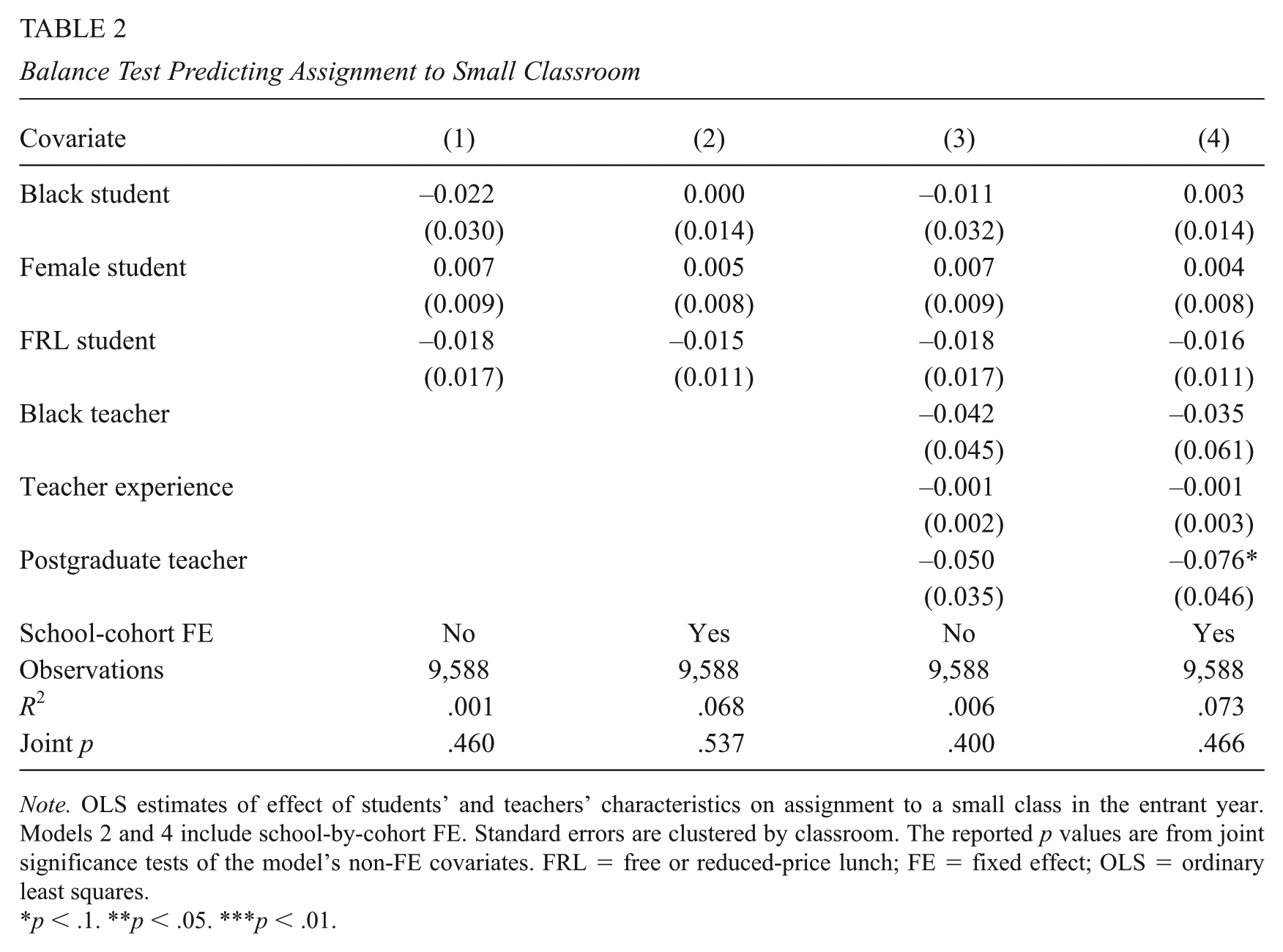
Note. OLS estimates of effect of students’ and teachers’ characteristics on assignment to a small class in the entrant year. Models 2 and 4 include school-by-cohort FE. Standard errors are clustered by classroom. The reported p values are from joint significance tests of the model’s non-FE covariates. FRL = free or reduced-price lunch; FE = fixed effect; OLS = ordinary least squares.
p < .1. **p < .05. ***p < .01.
Balance Test Predicting Assignment to Same-Race Teacher
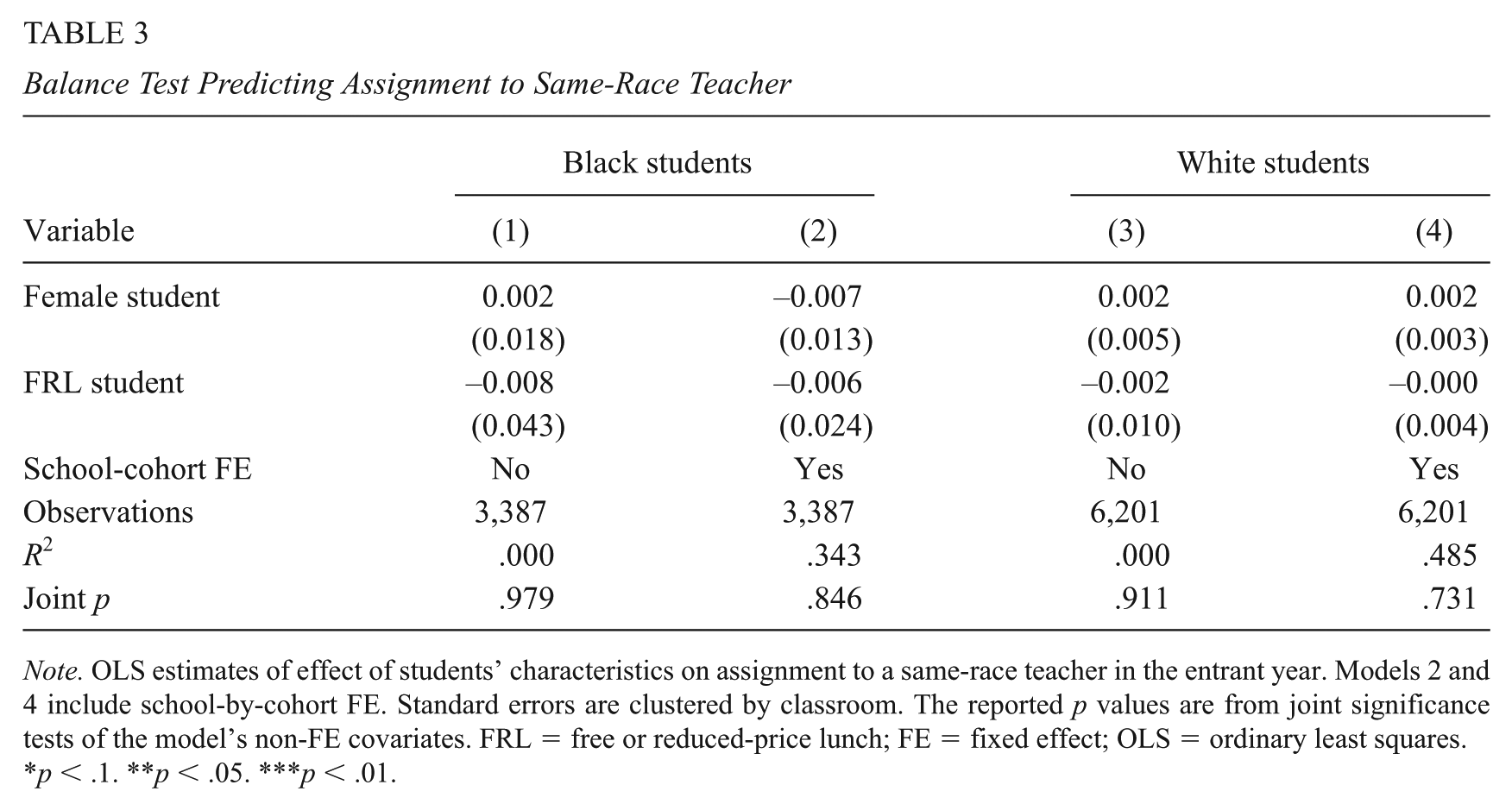
Note. OLS estimates of effect of students’ characteristics on assignment to a same-race teacher in the entrant year. Models 2 and 4 include school-by-cohort FE. Standard errors are clustered by classroom. The reported p values are from joint significance tests of the model’s non-FE covariates. FRL = free or reduced-price lunch; FE = fixed effect; OLS = ordinary least squares.
p < .1. **p < .05. ***p < .01.
Results
Table 4 presents baseline LPM estimates of Equation 1 for chronic absence. Column 1 reports estimates for the full analytic sample and finds that class size significantly increases chronic absenteeism. Specifically, reducing class size by 10 students would decrease the probability of chronic absence by 3 percentage points, or 21%. The other observed classroom characteristics did not have a significant impact on student attendance in the full sample.
LPM Estimates of Classroom Inputs’ Effects on Likelihood of Chronic Absence
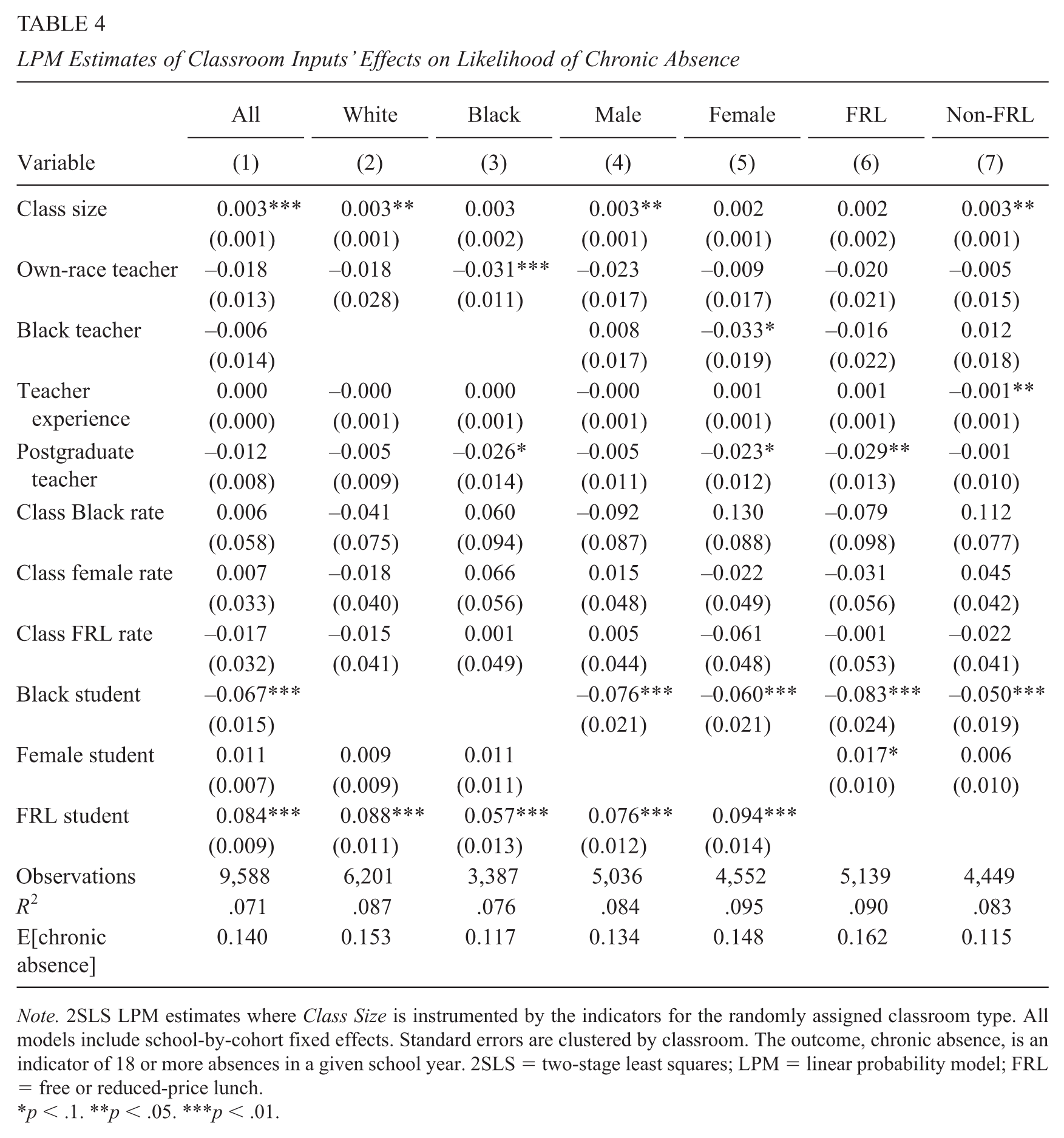
Note. 2SLS LPM estimates where Class Size is instrumented by the indicators for the randomly assigned classroom type. All models include school-by-cohort fixed effects. Standard errors are clustered by classroom. The outcome, chronic absence, is an indicator of 18 or more absences in a given school year. 2SLS = two-stage least squares; LPM = linear probability model; FRL = free or reduced-price lunch.
p < .1. **p < .05. ***p < .01.
Columns 2 to 7 of Table 4 report estimates separately by student race, gender, and FRL status. 3 A few results are worth noting. First, the class size effect is approximately constant for each sociodemographic subgroup, suggesting that class size affects the attendance of students from all backgrounds. Second, Column 3 shows that having an own-race teacher significantly reduced chronic absence rates for Black students by about 3.1 percentage points, or 26.5%. The own-race effects are negative in the other subgroups, but not precisely estimated. That the race-match effect is more pronounced for Black students is consistent with evidence of race-match effects on student achievement in STAR (Dee, 2004) and on achievement and attendance in other contexts (Fairlie et al., 2014; Gershenson & Holt, 2019). Still, this effect is about twice as large as that for non-White students observed in North Carolina (Gershenson & Holt, 2019). Third, like in the full sample, the other observed teacher qualifications do not strongly predict student absences in the various student subgroups. This is consistent with teacher qualifications in the STAR data having weak, if any, effect on student achievement (Krueger, 1999).
Table A1 (see Supplementary Table A1 in the online version of the journal) presents 2SLS estimates of an augmented version of Equation 1 that controls for the student’s special education status in the vector x and (following Gottfried et al., 2016) an indicator for whether student i had at least one classroom peer with a special education designation in the vector z. These regressions are restricted to kindergarten and first-grade classrooms as special education designations are only available in these 2 years. The results for class size and same-race teachers are nearly identical to those reported in Table 4; this is reassuring in that this suggests that omitting the special education variables from the baseline model did not bias the estimates. The effect of having a peer with a special education designation generally has a small effect on the likelihood of chronic absence and is statistically insignificant in all subsamples. This difference from the finding in Gottfried et al. (2016) could be due to a lack of power in the STAR sample, where special education data are only available in 2 years and less than 3% of the analytic sample have a special education designation.
Sensitivity Analyses
This section describes several robustness checks and sensitivity analyses of the main findings, namely that (a) small classes reduce chronic absence among all students, (b) same-race teachers reduce chronic absence among Black students, and (c) other observed classroom characteristics do not systematically influence chronic absence rates. Because these findings are universally robust, we relegate the corresponding tables to Appendix B (see Supplementary Appendix B in the online version of the journal). Each check is essentially a variant of the baseline specification given by Equation 1 and is presented in the format of Table 4.
First, in Table B1 (see Supplementary Table B1 in the online version of the journal), we change the outcome measure of attendance from a binary indicator for chronic absence to a simple count of annual absences. Here, we see that a 10-student reduction in class size leads to about one fewer absence per year, or a 9.4% reduction. Similarly, for Black students, having a same-race teacher leads to about one fewer absence per year, or a 13.5% reduction in annual absences.
Second, in Table B2 (see Supplementary Table B2 in the online version of the journal), we replace the independent variable Class Size with an indicator for random assignment to a small class (so the omitted reference group includes regular classes with and without aides) and reestimate Equation 2 by OLS. Once again, the main findings are robust to this modeling choice as students randomly assigned to a small class are about 2 percentage points less likely to be chronically absent. This effect size lines up with the baseline estimates as the average difference between small and regular classes is about seven or eight students (Krueger, 1999). We group regular classes with and without aides together because previous research finds no effect of aides on achievement (Krueger, 1999). We confirm that this is so in the absences case in Table B3 (see Supplementary Table B3 in the online version of the journal) where the small indicator is replaced by indicators for the two types of regular-size classrooms. These indicators are positive, jointly statistically significant, and statistically indistinguishable from one another in the full sample.
Third, in Tables B4 and B5 (see Supplementary Tables B4 and B5 in the online version of the journal), we reestimate the chronic absence and absence-count models, respectively. We do so using nonlinear logit and Poisson regressions that account for the binary and count natures of the dependent variables, respectively. We use a randomly assigned small-class indicator in place of Class Size, as in Table B2 (see Supplementary Table B2 in the online version of the journal), to avoid the complication of instrumenting for an endogenous variable in a nonlinear panel model. Once again, the same qualitative results are observed: Random assignment to a small class has a significant effect on the attendance habits of students from all backgrounds and having a same-race teacher significantly improves the attendance habits of Black students. For example, whereas proper average partial effects comparable to the LPM estimates cannot be computed because the distribution of the FE is not recovered by the FE-logit estimator (Wooldridge, 2010), approximate scale factors map the FE-logit coefficients on small class and same-race teacher in Columns 1 and 3 into approximate partial effects of 0.019 and 0.037, respectively, which are nearly identical to the analogous LPM estimates reported in Table B2 (see Supplementary Table B2 in the online version of the journal). 4 This implies that the results are not driven by the linear functional form assumed in Equation 1.
Finally, following Dee (2004) and Krueger (1999), we reestimate the baseline model (Equation 1 and Table 4) for only the kindergarten-entry cohort, which was not subject to potential noncompliance or attrition concerns and necessarily did not change schools from the previous year. These results are presented in Table B6 (see Supplementary Table B6 in the online version of the journal) and, once again, the main results prove to be quite robust: they are nearly indistinguishable from those based on all cohorts reported in Table 4. Thus, the main results are not compromised by lack of experimental fidelity in the later years of Project STAR nor by later entrants being systematically different from Cohort 1.
Reconceptualizing Student Attendance
To this point, we have occasionally mentioned the high attrition from Project STAR schools as a nuisance that complicates or precludes certain analyses. However, as Gershenson et al. (2018) point out, attrition is an interesting outcome in its own right. There are at least two reasons to care about the impact of classroom inputs on students’ persistence in elementary schools. First, persisting in the same school throughout the elementary years is arguably a positive outcome for highly mobile, socioeconomically disadvantaged students who constitute the majority of STAR school enrollments as changing elementary schools harms achievement (Schwartz et al., 2017). Second, from the school’s point of view, attrition lowers average daily membership (enrollment), which reduces school funding through its role in the state’s funding formula.
Accordingly, we reestimate Equation 1 using an indicator for attrition as the outcome in place of the chronically absent indicator. These estimates are reported in Table 5 and show a similar pattern as the main results: Overall, a 10-student reduction reduces the probability of attrition by about 2 percentage points (4.7%) and, for Black students, a same-race teacher reduces the probability of attrition by 3.8 percentage points (8%). These results are consistent with previous research that finds attrition from STAR to be endogenous (e.g., Gershenson et al., 2018; Schanzenbach, 2006). This reinforces the notion that teachers and classrooms affect attendance not only on the intensive (daily) margin, but also on the extensive (school choice) margin.
LPM Estimates of Classroom Inputs’ Effects on Likelihood of Attrition

Note. 2SLS LPM estimates where Class Size is instrumented by the indicators for the randomly assigned classroom type. All models include school-by-cohort fixed effects. Standard errors are clustered by classroom. The outcome, attrition, is an indicator of whether a student attrited after the entrant year. 2SLS = two-stage least squares; LPM = linear probability model; FRL = free or reduced-price lunch.
p < .1. **p < .05. ***p < .01.
Explaining Classroom Inputs’ Effects on Student Achievement
To this point, we have leveraged experimental variation in classroom assignments in Project STAR to document causal effects of class size and exposure to same-race teachers on student attendance. These results are consistent with quasi-experimental results obtained in other contexts (Dee & West, 2011; Holt & Gershenson, 2019). They are also consistent with previous research from Project STAR and elsewhere, where these same classroom characteristics are found to affect student achievement (Angrist & Lavy, 1999; Dee, 2004; Fairlie et al., 2014; Krueger, 1999). Given that student absences have been shown to harm student achievement in many contexts, including Project STAR schools (Gershenson et al., 2017, 2019), student attendance may be a mechanism through which class size and race-match effects on student achievement operate. We pursue this idea below.
We conduct a naive mediation analysis in Table 6. The odd columns of Table 6 replicate the class size and race-match effects on achievement of Krueger (1999) and Dee (2004) in our analytic sample. Specifically, Columns 1 and 3 show, in the full sample, significant small-class effects of 0.18 and 0.17 test score SD in math and reading, respectively. Similarly, Columns 5 and 7 show significant race-match effects of 0.13 and 0.10 test score SD among Black students in math and reading, respectively.
Simple Mediation Analysis of Class Size and Race-Match Effects on Test Scores
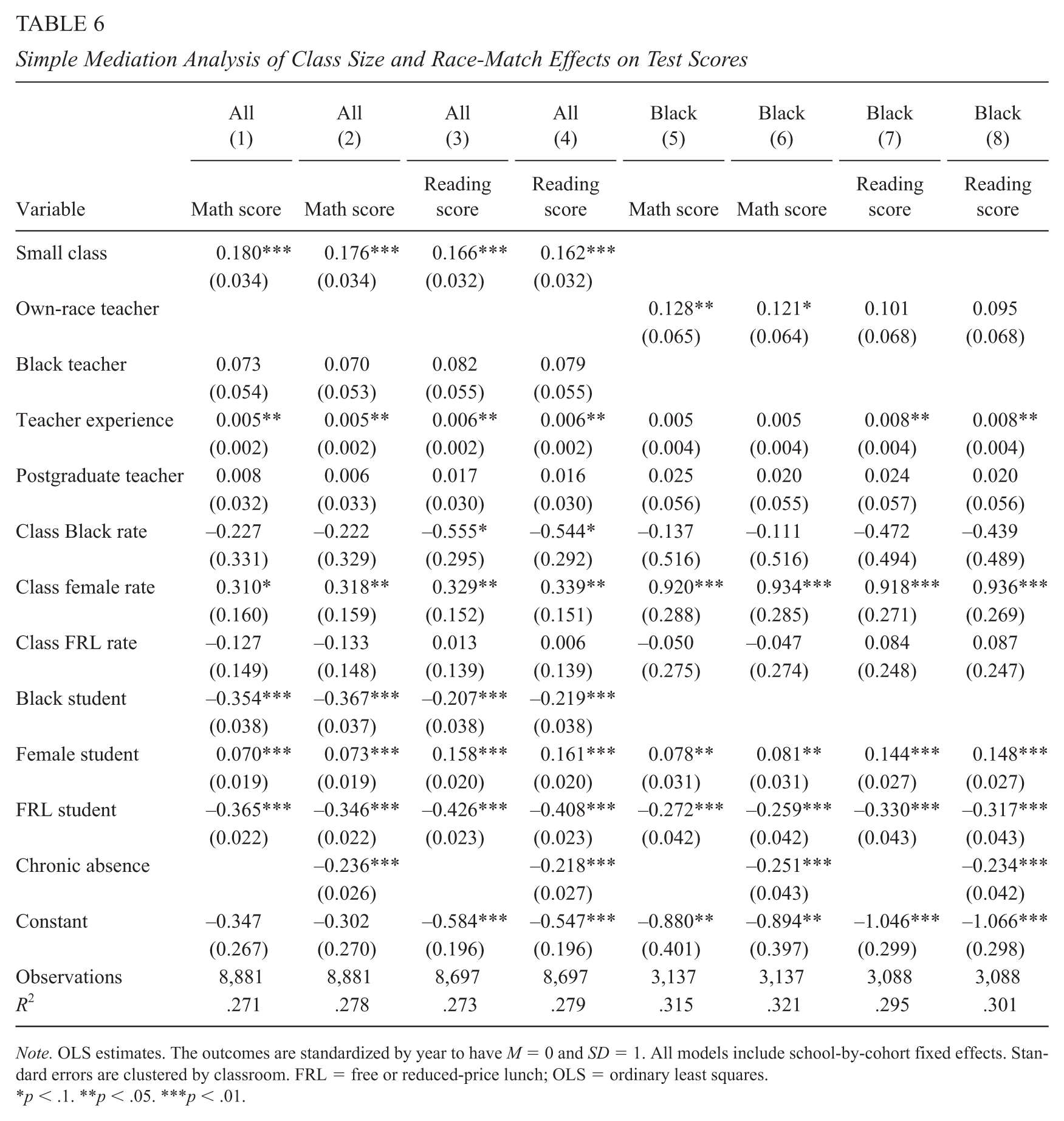
Note. OLS estimates. The outcomes are standardized by year to have M = 0 and SD = 1. All models include school-by-cohort fixed effects. Standard errors are clustered by classroom. FRL = free or reduced-price lunch; OLS = ordinary least squares.
p < .1. **p < .05. ***p < .01.
The even columns of Table 6 augment the odd-column regressions to also control for chronic absence indicators, the potential mediator. The change in the estimated effect of the treatment (small class or same-race teacher) is commonly—if incorrectly—interpreted as the portion of the total effect that was due to the mediator (chronic absence; Imai et al., 2010). Table 6 shows that the estimated coefficients on small-class assignment among all students in Columns 1 and 3 both drop by 0.004 or about 2%. Similarly, the estimated coefficients on the same-race teacher indicators in Columns 5 and 7 drop by almost 0.01 or nearly 6%. Taken at face value, these results suggest that a small but nonzero share of the class size and race-match effects on student achievement are driven by changes in students’ attendance habits.
However, the results in Table 6 are only suggestive as they are naive in the sense that they are prone to bias caused by what Acharya et al. (2016) call intermediate confounders and what Imai et al. (2010) call the failure of sequential ignorability: The mediator (chronic absence) is itself affected by other unobserved mediators such as parental involvement. The mediation estimates inherent in Table 6 likely are biased as increased student and parent engagement are channels through which small classes and same-race teachers likely improve student attendance and improve achievement through nonattendance channels. The randomization of Project STAR does not eliminate this concern because absences themselves were not randomly assigned.
The sequential ignorability assumption cannot be directly tested because it depends on unobservables although, as explained above, it is unlikely to hold in the current setting. However, Imai et al. (2011) propose a useful sensitivity analysis that lets us examine the robustness of the mediation results to the (likely) failure of sequential ignorability. The intuition is similar to that in the bounding procedure of Altonji et al. (2005), although instead of directly estimating the degree of selection on observables necessary to drive the estimated effect to zero, we estimate how badly the sequential ignorability assumption would have to fail to drive the mediation effect to zero. This is accomplished by looking at the correlation between the error terms in two of the models estimated in this article: the baseline Equation 1 (the effect of treatment on the mediator, absences) and the corresponding augmented “mediation” regressions in the even columns of Table 6. Sequential ignorability holds when this correlation is zero.
The correlation needed to drive the true mediation effect to zero (what Imai et al., 2011, call
Conclusion
Student attendance is both an important input and intermediate output of the education production function. Attendance improves academic achievement, predicts a variety of long-run socioeconomic outcomes, is correlated with several types of character and socio-emotional skills, and is highly valued in the labor market. Accordingly, schools are increasingly being held accountable for student attendance. However, the malleable school inputs that affect student attendance are poorly understood. This study provides novel, causal evidence on the classroom-level inputs that affect student attendance. We do so by exploiting the random assignment of both students and teachers to classrooms in the Project STAR class size experiment.
We use publicly available Project STAR data to estimate the student attendance production function. The main findings are that (a) class size reductions significantly reduce the frequency of chronic absence, and the level of annual absences, for students of all sociodemographic groups; (b) having a same-race teacher significantly reduces the probability of chronic absence and the level of annual absences among Black students; (c) other observed classroom characteristics, such as teacher qualifications and classroom sociodemographic composition, do not systematically affect student attendance habits; and (d) class size and race-match effects on attendance explain a negligible share of those inputs’ effects on academic achievement. These results are consistent with quasi-experimental evidence that small classes boost student engagement (Dee & West, 2011) and that teachers affect student attendance (Gershenson, 2016; Holt & Gershenson, 2019; Ladd & Sorensen, 2017; Liu & Loeb, 2021).
The channels through which class size and race-matched teachers likely affect elementary school students’ attendance are similar. For example, small classes may improve student attendance by making it easier for teachers to pay individual attention to each student, communicate and cooperate with parents, and redistribute instructional time from academic lessons to building social and emotional skills (Dee & West, 2011). Similarly, Black teachers may boost the attendance of Black students indirectly by facilitating parental involvement (Vinopal, 2018), building trusting relationships and being “warm demanders” that espouse high expectations in a nurturing way (Ware, 2006), and generally constructing safe, warm classroom environments that their students look forward to attending (Gershenson, 2016; Holt & Gershenson, 2019).
Parents clearly play an outsized role in facilitating student attendance in the early grades, and so a strong, trusting parent–teacher relationship is likely a channel through which the effects of small classrooms and same-race teachers operate. However, it is not the only channel as students’ own interest and engagement in school matters and can affect attendance even in lower grades. The relative importance of these factors reverses in higher grades, of course, and so it would be fruitful for future work to investigate the effects of class size, peer composition, and teacher qualifications on middle and high school students’ attendance. At present, we know that high school teachers vary in their ability to increase student attendance (Liu & Loeb, 2021) and that more experienced middle school teachers increase student attendance (Ladd & Sorensen, 2017).
That changing parental involvement and student attitudes toward attendance are channels through which the effects of class size and teacher race likely operate also highlights that we are identifying total derivatives, or net effects, of these classroom characteristics and not partial derivatives (i.e., ceteris paribus marginal effects) that hold things like parental involvement constant. This distinction is central to debates about the relative merits of reduced form and structural methods in economics (e.g., Todd & Wolpin, 2003). Analyses of experimental data, including of Project STAR, typically identify the former and fall in the reduced-form camp, which, in the current context, is arguably the more policy-relevant parameter. That said, researchers are increasingly bridging the two approaches (Galiani et al., 2015; Todd & Wolpin, 2006). Carefully designed experiments combined with structural models are useful for identifying the exact channels through which educational inputs and interventions affect student outcomes, and this is an exciting opportunity for future research (e.g., Imai et al., 2011).
For policy makers and educational administrators, these results suggest that a limited number of classroom-level policy levers can be used to improve student attendance. At the micro school or district level, these results suggest that schools could strategically assign students with known (or projected) attendance problems to small classes or, for Black students, same-race teachers. Doing so has the potential to improve individual student outcomes and to close within-school or within-district socioeconomic and racial gaps in attendance rates. At a more macro level, these results highlight the importance of teacher diversity and one way (average class size) that certain districts are at a disadvantage. For example, accountability systems that rely on student attendance could adjust their incentives/consequences for average class size.
However, the modest effect sizes and costliness of class size reductions at scale highlight the limits of relying on traditional educational inputs to improve student attendance and close socioeconomic achievement and attendance gaps. Krueger (1999) suggests that the cost of reducing class size by seven or eight students (i.e., by about one third) in Project STAR was about one third of annual educational expenditures per public school student. The U.S. average per-pupil spending in 2017 was US$12,201 (U.S. Census Bureau, 2019), so reducing class sizes by one third would cost upward of US$4,000 per student. Recruiting diverse teachers is also an expensive undertaking as a back-of-the-envelope calculation shows it would cost about US$4,000 in salary to entice a Black female college graduate to enter teaching, not to mention recruiting costs (Gershenson et al., 2018); even spread across a classroom of 20 or more students this amounts to hundreds of dollars per student.
Hence, recently piloted light-touch, behavioral interventions that provide parents with information on both student attendance records and the importance of regular attendance may prove more cost-effective (Bergman & Chan, 2017; Robinson et al., 2018; Rogers & Feller, 2018; Smythe-Leistico & Page, 2018). Such interventions can be targeted and deployed at scale relatively easily and at much lower costs per student. For example, the cost of generating one additional day of attendance is only US$6, using the most effective intervention studied by Rogers and Feller (2018). It would be particularly interesting for future research to investigate the complementarities between such interventions and the traditional classroom inputs studied here.
Supplemental Material
sj-docx-1-epa-10.3102_0162373720984463 – Supplemental material for Experimental Estimates of the Student Attendance Production Function
Supplemental material, sj-docx-1-epa-10.3102_0162373720984463 for Experimental Estimates of the Student Attendance Production Function by Long Tran and Seth Gershenson in Educational Evaluation and Policy Analysis
Footnotes
Declaration of Conflicting Interests
The author(s) declared no potential conflicts of interest with respect to the research, authorship, and/or publication of this article.
Funding
The author(s) received no financial support for the research, authorship, and/or publication of this article.

Notes
Authors
LONG TRAN is an assistant professor in the John Glenn College of Public Affairs at the Ohio State University. His research examines nonprofit and public management, focusing especially on questions related to cooperation and coordination.
SETH GERSHENSON is an associate professor in the School of Public Affairs at American University. His research interests include teacher labor markets, summer learning loss, and the causes and consequences of student and teacher absences.
References
Supplementary Material
Please find the following supplemental material available below.
For Open Access articles published under a Creative Commons License, all supplemental material carries the same license as the article it is associated with.
For non-Open Access articles published, all supplemental material carries a non-exclusive license, and permission requests for re-use of supplemental material or any part of supplemental material shall be sent directly to the copyright owner as specified in the copyright notice associated with the article.
