



Abstract
This qualitative study examines Tennessee Promise students’ (N = 60) perceptions of supports and resources during their first year of college. Students’ reflections suggest that they hold expectations for support from the state beyond scholarship dollars, and that other actors, including faculty, staff, parents, and the state’s nonprofit partner, mediate fulfillment of these expectations. Students’ unmet expectations for the state may impede their college success and signal dimensions of student need not met by current scholarship program provisions. Evidence of these “psychological contracts” has implications for the architecture and framing of Promise programs and the provision of supplemental supports by colleges.
Keywords
Students’ expectations for the scholarship program may extend beyond the advertised provisions of the scholarship. The language used by the scholarship program to describe or justify the financial support of students may lead to students’ development of additional expectations of the program and its managing body, their postsecondary institution, and faculty and staff. I undertook this qualitative study of the perceptions and experiences of first-year, tuition-free scholarship students to develop understanding of the strengths and opportunities in “Promise” program design and framing.
Previous research has found that college students perceive themselves to be in exchange relationships related to their education, or to have “psychological contracts” (PCs) between themselves and entities both inside and at the boundaries of their postsecondary institutions (Bordia et al., 2010, 2015; Knapp & Masterson, 2018; Koskina, 2013; Wade-Benzoni et al., 2006). When terms of PCs are unfilled, or the contracts are breached, the performance of focal individuals, in this case students, often suffers (Coyle-Shapiro et al., 2019). Tuition-free scholarship students’ expectations represent an important area of study because the terms of students’ PCs may reveal students’ unmet needs and suggest potentially important paths forward for providing better supports for student success.
In this qualitative study, I explore the perceptions of first-year Tennessee Promise (TN Promise) students regarding the resources and supports that they receive from the state, postsecondary institutions, educational support organizations, and parents for their postsecondary training. I use psychological contracts theory as an exploratory theoretical frame for understanding students’ unmet expectations for the state and other key actors in a state-sponsored, tuition-free college scholarship program. It is important to understand the experiences of students in tuition-free college programs to build the evidence base for the design and implementation of new and maturing tuition-free scholarship programs across the country. As the Biden administration explores the possibility of bringing tuition-free college to scale across the country, this study provides insights into the student experience that complement emerging evidence on the costs, impacts, and returns to tuition-free college.
I address the primary research questions: Do Promise scholarship students perceive PCs between themselves and key actors on- and off-campus? If so, what are the terms of these exchange relationships? I use qualitative data from student focus groups at three technical colleges, six community colleges, and one 4-year institution in Tennessee to explore the nature and components, financial and otherwise, of PCs that students perceive between themselves and individuals and groups internal and external to their postsecondary institution.
Promise scholarship students interviewed for this study expressed specific expectations for support from the state beyond scholarship dollars, and they described how other actors, including faculty, staff, parents, and the state’s nonprofit partner, mediate their exchanges with the state. This study contributes to the tuition-free college and community college student success literatures by outlining students’ expectations for programs like TN Promise and exploring PCs among students in 2-year postsecondary settings.
Tuition-Free “Promise” Scholarship Programs
Tuition-free guarantees for 2-year or 4-year college are gaining ground across the country. Although “free college” programs are not novel, they have grown increasingly popular since the Great Recession, as student loan debt soared, and forecasts for the future of work suggested that most future jobs will require postsecondary training. Existing programs range in size and scope from city-based, privately funded programs (e.g., Kalamazoo Promise) to state grants for workforce-oriented training (e.g., Indiana’s Workforce Ready Grant), to a 4-year scholarship for in-state residents to pursue a bachelor’s degree and remain in state for work (New York’s Excelsior Scholarship; see Perna & Leigh, 2018, for a detailed discussion of Promise program design).
Promise programs vary along several dimensions, and a key element of their design, both in terms of student experience and implications for societal outcomes, is their disbursement method (Perna & Leigh, 2018). “First-dollar” programs apply Promise funds to a students’ bill before any other grant or award. “Last-dollar” scholarships, by contrast, draw upon all other available funding (institutional, state, and federal aid) before awarding Promise funds. Although both models administer funds to eligible students to cover their tuition and fees, in practice, program architecture has implications for student access to financial aid resources to pay for other costs of attendance. First-dollar awards both provide higher average awards from Promise funds to low-income students and leave the opportunity for the neediest students to receive a Pell grant refund to cover books, supplies, and other costs of attendance. Last-dollar scholarships use federal and other state aid first; if a student’s bill is fully covered by these sources, the student does not receive Promise funds.
Over a dozen states now cover college tuition for some students, and nearly two dozen state legislatures and U.S. Congress have considered “free college” bills in recent legislative sessions (Quinton, 2019; Walter, 2021). Tuition-free programs have been enacted by both Republican- and Democrat-controlled state legislatures, and the Biden administration has named tuition-free college as a critical feature of the President’s American Families Plan (The White House, 2021). Although the defined goal and framing may vary from program to program—whether increasing affordability to facilitate equitable access, incentivizing enrollment to spur economic development, or some combination—the messaging around tuition-free scholarship programs is typically simple, loud, and focused: “Get a college degree for free.”
There is some empirical evidence that suggests that the efficacy of free college programs in reaching these goals is limited (e.g., Deming & Walters, 2017; Murphy et al., 2019) and is dependent upon program generosity (Gándara & Li, 2020). In spite of widely publicized and often generous support, Promise students may still undertake substantial financial burden to enroll, as Promise programs are primarily focused on covering tuition expenses while students remain responsible for supplies, transportation, and expenses to cover their basic needs (Goldrick-Rab, 2016). For instance, recent evidence on perceptions of Kalamazoo Promise students suggests that although KPromise students appreciate and are motivated by the opportunity, they experience financial distress despite the scholarship easing some of the financial burden of enrollment (Collier & Parnther, 2021). These findings underscore that the financial burden of college goes beyond the tuition and fees covered by most tuition-free college scholarship programs and highlights the importance of examining how students perceive, make sense of, and address the costs of attendance beyond tuition and fees.
TN Promise
TN Promise is a broad-access, tuition-free scholarship program with limited eligibility criteria designed to ensure that all college-intending high school graduates in Tennessee have the opportunity to earn a 2-year postsecondary credential tuition-free at in-state colleges. High school seniors who graduate from an eligible Tennessee high school, complete a Tennessee home school program, or, prior to their 19th birthday, obtain a General Education Development (GED) or High School Equivalency Test (HiSET) diploma must apply for the scholarship by a deadline in the fall of their high school senior year or the year in which they will obtain the GED/HiSET (tnAchieves, 2021). Students must then submit the Free Application for Federal Student Aid (FAFSA) by a deadline in the winter of their senior year and begin working with a mentor and attending mandatory meetings in their county of residence. To maintain eligibility, students must enroll in college full-time beginning in the term after high school graduation, continue to participate in the mentoring program throughout their time in college, and perform 8 hours of community service prior to each term.
Tennessee’s last-dollar Promise scholarship is funded by a state endowment comprised of lottery reserve funds and facilitated in partnership with community organizations. tnAchieves, a Knoxville-based postsecondary attainment nonprofit, is the state’s partner in nearly all counties across the state (90 of 95). tnAchieves recruits and trains volunteer mentors and shares information via text and email with students, with a particular communications push focused on the summer months between high school graduation and college matriculation. The TN Promise aligns with policy recommendations to make clear commitments of financial aid to students at an earlier age so that students can focus on academic and social preparation for college rather than concerning themselves with the question of whether they will secure sufficient funding to enroll (Heller, 2006). A tuition-free college scholarship program that is clearly communicated and offered without conditions has the potential to shift the postsecondary-going culture of a state through the widespread development of beliefs in the value and feasibility of college attendance. The state of Tennessee has also dedicated financial resources and employees to bolster supports for FAFSA completion among high school seniors.
However, the commitment on the part of the state government to cover college costs may be misinterpreted, particularly given that such programs are typically widely touted and politically popular. Students who enroll in college under a statewide “Promise” program may expect that college will be wholly “free,” if that word is used in advertisements. Furthermore, the word “promise” may come to be imbued with additional meaning as students learn of the attainment-oriented motivation of such a policy: They may believe the state has committed to doing everything in its power to ensure their success. The terms of the state’s “promise” may come to involve unspoken dimensions that form a PC between students and the state.
Psychological Contracts Theory
PCs arise when individuals (or, in PC parlance, focal individuals) develop expectations outside of a legal contract as they imbue additional meaning and expectations into an implied or explicit agreement (Robinson et al., 1994; Taylor & Tekleab, 2004). PCs theory was initially developed to examine employees’ relationships with their employing organization. Research on PCs has been used to clarify how individuals develop informal expectations and how these exchanges with their employer affect their performance (Coyle-Shapiro et al., 2019; Rousseau, 1995). The terms of exchange may serve as behavioral goals to which individuals aspire to receive expected benefits (Shore & Tetrick, 1994). Fulfilling the terms of a contract contributes to better performance (Turnley et al., 2003), whereas unfulfilled terms may contribute to turnover and neglect of job duties (Kickul, 2001). Even the anticipation of benefits may contribute to citizenship-oriented employee behaviors (Coyle-Shapiro, 2002). The framework has been applied in postsecondary education contexts to illuminate informal agreements perceived to exist between faculty and institutions, graduate students and their advisors, and undergraduate and graduate students and their instructors.
Dimensions of PCs
Recent research about postsecondary education PCs suggests that contract dimensions reflect obligations both within and outside of the traditional role of the exchange partner (Knapp & Masterson, 2018). Role-based terms reflect the definitional components of an individual or group’s role in the exchange that a partner could be reasonably expected to provide. Extra-role terms involve items that go beyond basic role expectations and may not be wanted by or offered to all students. The degree to which a term is role-based or extra-role can vary by focal individual, context, and time (Knapp & Masterson, 2018). For instance, community college students might consider quality education and transferability of credits to be role-based terms of their student–college exchanges, while a sense of campus community and out-of-class support of faculty and staff are extra-role terms of the exchange. If the college launches a campus basic needs center and career placement office, students’ expectations might shift, and out-of-class support from faculty and staff might become a role-based term of the PC for some students.
Parties to the Exchange
PCs might not always be perceived as distinct one-on-one exchanges between the focal individual and another party; exchange relationships may be more complex, multifaceted agreements between three or more parties (Alcover et al., 2017; Koskina, 2013). In complex, multiple-foci exchange relationships, the PC may be distributed between the focal individual and multiple agents with whom the individual develops a network of expectations, promises, and obligations across a complex organization (Alcover et al., 2017). Agents may represent the organization to differing degrees. In a college context, individuals with different roles, authority, and visibility to students might be perceived as representing the organization to different degrees. In addition, a distributed PC might include agents in other organizations who also contribute to an individual’s development and success in the organizational context (Alcover et al., 2017). For instance, individuals affiliated with nonprofit student support organizations, particularly those that collaborate closely with colleges, might be perceived as peripheral parties to a student–college PC.
Existing research on undergraduate student PCs has shown that students may enter exchange relationships with faculty, advisors, and other institutional actors that mediate their overall contract with the college. In some cases, the college or university may be the referent exchange partner even though individual actors, like instructors, are identified as those responsible for fulfilling the perceived obligation. The postsecondary PC literature to date has examined education-related contracts representing a triadic exchange between students, instructors, and the institution (Koskina, 2013) and has demonstrated that terms may be foci-specific (i.e., conceptualized as pertaining to one exchange partner) but that contributions may be owed to multiple foci inside and at the boundaries of the institution (Knapp & Masterson, 2018).
College and University Student PCs
The limited but rich existing research examining PCs in postsecondary education largely focuses on exchange relationships between college faculty and their employing institution. A smaller literature has extended understanding of PCs related to graduate student advising relationships (Blackmore, 2009; Feldman & Theiss, 1982), teaching and learning (Bordia et al., 2010, 2015; Fenech, 2021; Wade-Benzoni et al., 2006), university services (Arena et al., 2010; Prugsamatz et al., 2006), and student experiences and outcomes (Bean & Eaton, 2001; Crisp et al., 2009; Darlaston-Jones et al., 2003; Willcoxson et al., 2011; Yorke, 2000).
In the more limited undergraduate student PCs literature, faculty members are the most explored exchange partners, and the research settings have been 4-year institutions. For instance, several studies have examined students in blended learning environments and their expectations relative to prior experience in similar learning contexts (e.g., Fenech, 2021; Holley & Oliver, 2010; Orton-Johnson, 2009; Poon, 2013; Sivapalan, 2017). These studies draw implications for teaching and underscore the importance of managing student expectations. The evidence base on PCs has also been used to develop guides for pedagogy and practice in undergraduate research settings (Liu et al., 2020).
Although the PCs literature in 2-year college settings is relatively limited, these colleges present an important and distinct setting for studying student exchange relationships. Two-year colleges educate just under half of American college students and serve a more diverse student body than the 4-year college sector (Cilesiz & Drotos, 2016; Community College Research Center, n.d.) and, thus, represent a critical setting for research related to education policy and practice. Many students who matriculate at 2-year colleges do not persist beyond their first semester or earn a credential, but reforms of macro-level opportunity structure and institutional practices, such as a tuition-free scholarship program and supplemental student supports, have the potential to boost student success, particularly when undertaken together (Goldrick-Rab, 2010). However, the PCs literature in 2-year college settings is relatively limited and focuses on faculty, particularly adjunct faculty, and their expectations of their employers (e.g., Danaei, 2019) or the relationships between working students and their employers (e.g., Valentine et al., 2002). Two-year institutions serve a diverse and historically underserved student body using limited resources, therefore understanding tuition-free college scholarship students’ expectations for support in 2-year college settings will yield valuable, novel insights for policymakers and practitioners.
The TN Promise scholarship context presents an intricate system of actors with whom students may develop a complex network of expectations. TN Promise is sponsored by the state and facilitated with logistical and advising support from a nonprofit organization to aid access to services provided by faculty and staff at community and technical colleges. This web of exchange partners may contribute to more complex expectations than were found among students in previous studies (Alcover et al., 2017). Relatedly, the conceptualization of role-based and extra-role dimensions of undergraduate student contracts (Knapp & Masterson, 2018) may be particularly relevant to the present investigation, as there are prominent actors, the state and a nonprofit partner, that are not traditional players in the postsecondary experience and operate outside the bounds of the college setting.
Research Design and Sample
This project examines the perceptions and experiences of TN Promise students to help us understand their expectations for exchange with the state and other proximate actors during their first year of college. To understand these PCs, I use methods adopted from grounded theory research to describe a “unified theoretical explanation” (Corbin & Strauss, 2007, p. 107) for the common experiences of a number of individuals with a process or action (Charmaz, 2014; Creswell, 2013). Grounded theory is an appropriate approach for this study because I focus on exploring individuals’ common experiences to develop theory with implications for policy development (Creswell, 2013; Patton, 2002; Ravitch & Riggan, 2016).
I collected the data for the study via in-person semistructured focus groups with first-year TN Promise students across the state. The focus group protocol was open-ended and semistructured to encourage students to speak openly about their backgrounds, college decision-making process, expectations for and experiences in the first semester of college, and perceptions of resources and information during the college transition (see Supplementary Appendix A in the online version of the journal).
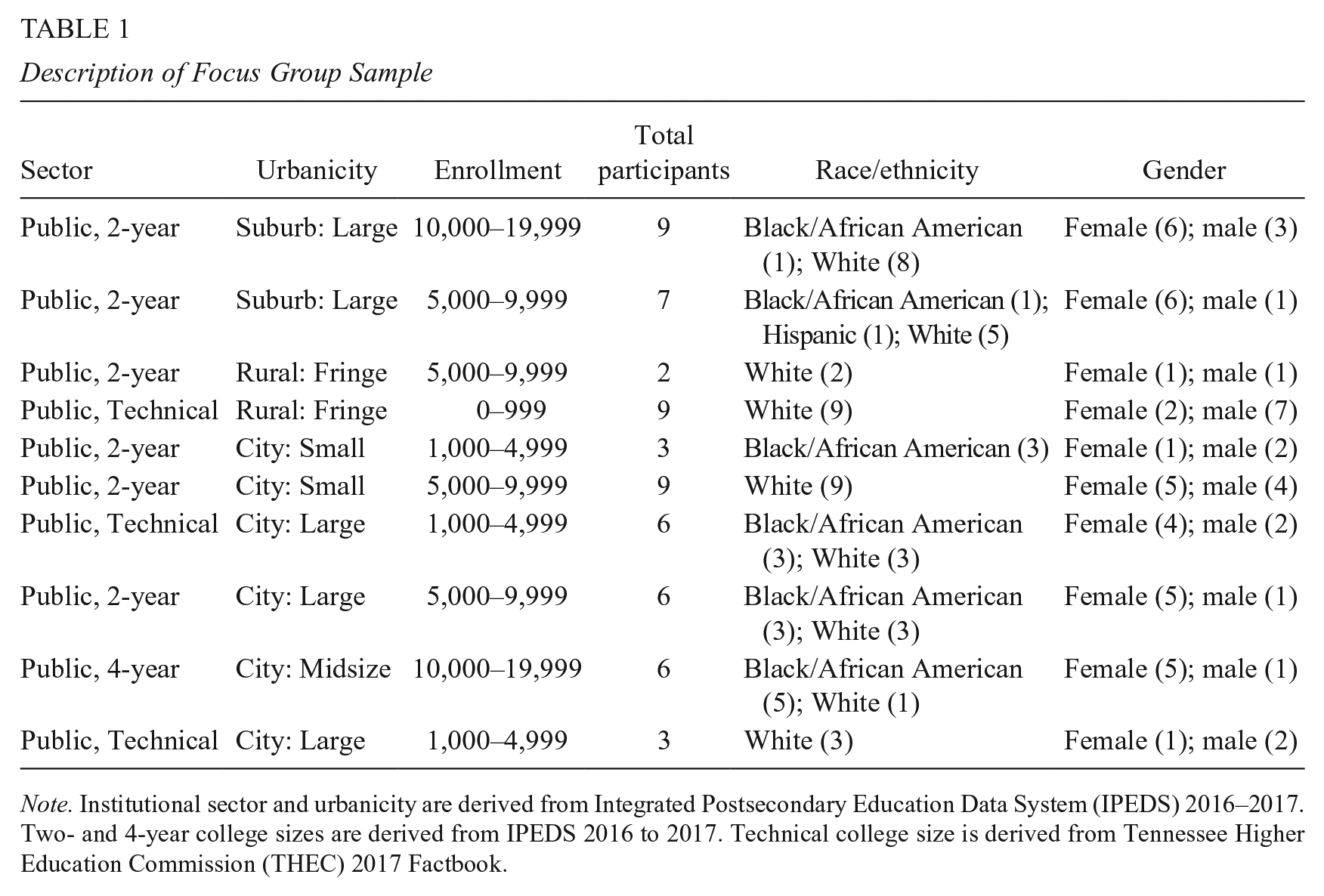
I facilitated 19 focus groups at 12 campuses of 10 public colleges in March and April of 2018. I selected sites to achieve maximum variation in student campus experiences and geographies to explore the potential heterogeneity of experiences of TN Promise scholarship students. As shown in Table 1, I visited three technical colleges, six community colleges, and one 4-year institution that serve students across all regions of the state. Campus staff and tnAchieves assisted with coordinating and advertising the focus groups. All first-year TN Promise students were invited to participate via text, email, and on-campus flyer. I spoke with 60 first-year TN Promise students, 36 female and 24 male students, who largely identified as Black or African American (n = 16) or White (n = 43). Although I did not systematically ask participants to report financial background or first-generation college status, most students shared these details in the context of group discussion by describing their Pell eligibility or family financial circumstances. The plurality who described their backgrounds came from low- to low-middle-income households and shared that they were the first in their families to attend college.
Description of Focus Group Sample
Note. Institutional sector and urbanicity are derived from Integrated Postsecondary Education Data System (IPEDS) 2016–2017. Two- and 4-year college sizes are derived from IPEDS 2016 to 2017. Technical college size is derived from Tennessee Higher Education Commission (THEC) 2017 Factbook.
The institutions at which I conducted focus groups reflected a range of geographic settings, sizes, dominant programs of study, and enrollment concentrations of TN Promise students. They represent three different institutional sectors eligible for TN Promise–funded enrollment and have varying institutional structures, missions, and student populations. Through my visits to these institutions, I aimed to capture the diversity of student motivations, experiences, and perspectives among TN Promise students across the diverse campuses that educate them. Focus groups at the 4-year college allowed me to engage in a form of discriminant sampling, in which I was able to gain additional information from individuals in a different setting (a 4-year college) to examine the degree to which themes and theory hold for different participants under different conditions (Creswell, 2013). I concluded data collection after facilitating focus groups on 12 campuses because iterative analyses confirmed that I had reached informational saturation; no new information and themes were emerging from additional cases.
At each institution, I conducted 60- to 90-minute focus groups with first-year TN Promise students. Prior to beginning focus group facilitation, I toured the campus, gathered documents (e.g., campus calendars, event flyers) and independently observed communal campus areas, such as the campus center, library, and the cafeteria, to get a sense for the campus population, setting, resources, and layout. These unstructured observations lent perspective and context to support my facilitation of the focus groups, but, as is common in grounded theory research, these data were not used in analysis (Creswell, 2013).
Focus groups were scheduled in rooms in centrally located campus buildings during periods when institutional course-taking patterns suggested that most students could potentially attend. I assured participants that their comments and remarks were to be anonymous; the identifiable sources of opinions and perceptions was not tracked. Students were offered an incentive of a meal and one service hour toward their TN Promise eligibility for their participation. 1
Analysis
All focus groups were audio-recorded and transcribed as verbatim transcripts. After each site visit, I gathered field notes and wrote a reflective memo on the visit. I added focus group notes to the transcriptions to integrate initial reflections with the audio-recorded data. I used a structured inductive, open-coding approach that integrated constructivist perspectives (Charmaz, 2014; Strauss & Corbin, 1990). As I approached my analysis, I looked for opportunities to consider the different experiences of the participants and the complexities of their contexts. I did not hypothesize prior to data collection so that the analysis would reveal emergent findings related to PCs. As this finding emerged through coding, I critically explored the breadth and depth of contract-related themes within and across focus groups.
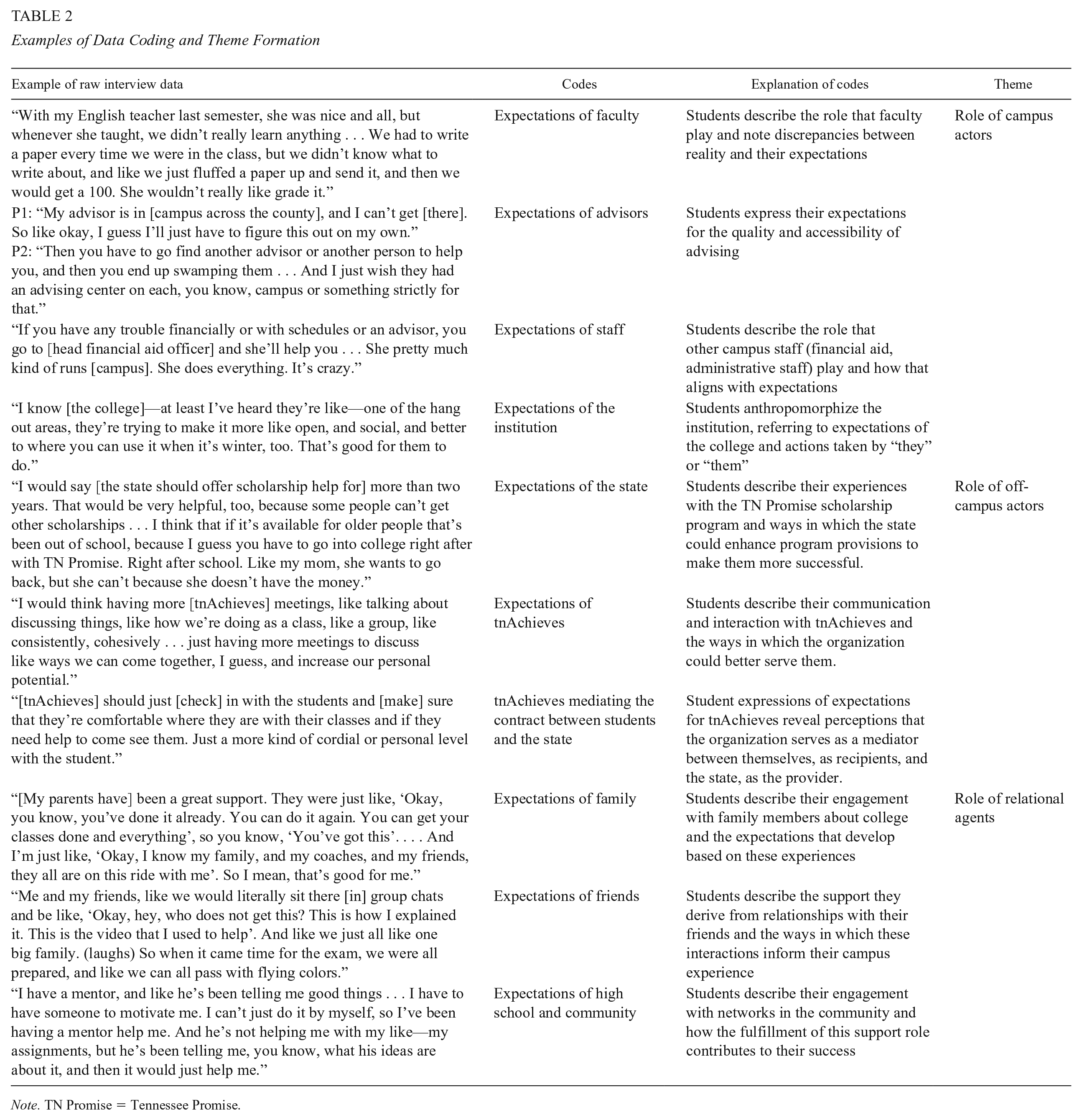
In the first stage of the coding process, I thoroughly read each interview transcript. I developed an initial coding framework derived from conceptual understanding and key elements of the transcripts that were grounded in the literature (constructed codes) and the language used by focus group participants (in vivo codes). I then systematically read and coded each transcript, using constant comparative analysis to identify categories, natural variation, patterns, and themes. I revisited the emergent codes and coding framework frequently during analysis. As I found commonalities around the codes, I employed axial coding to account for connections or clustering between categories. The third level of analysis involved selective coding, in which I developed and interrogated hypotheses that interrelated the categories in the analysis (Corbin & Strauss, 2007). Through this inductive coding approach, I captured participants’ perspectives on their interactions, expectations, and considerations during the college decision-making process, the transition to college, and the first year (Table 2).
Examples of Data Coding and Theme Formation
Note. TN Promise = Tennessee Promise.
I also endeavored to engage in member checking (Lincoln & Guba, 1985). Although I was unable to connect back with individual focus group participants due to the anonymity of my data collection procedures, I shared my analysis at regular intervals with educators, nonprofit personnel, and state agency staff with varying levels of familiarity with the TN Promise context to test the themes against their perspectives and experiences. Based on these stakeholders’ understanding of the realities faced by students during the postsecondary application, transition, and first-year success processes, I clarified the codes, resolved discrepancies, and used comparative analysis to identify categories, natural variation, patterns, and themes that emerged across the transcripts during iterative coding.
Throughout these discussions, I returned to the data to refine and validate the major categories. Once categories were finalized, I wrote memos to explore the way in which the categories spoke to the existing empirical and theoretical literature. I integrated the memos and diagrammed connections between the categories, identifying emergent themes. I converged on a set of themes that were validated by this iterative, triangulated process. I sought representative quotes to illustrate the collective voice of participants (Rousseau, 2001; J. A. Thompson & Bunderson, 2003), as well as counterexamples to explore contrast and nuance in the data.
Positionality
Scholars engaging in social science research should assess how their own positions and experiences contribute to their interpretations of the lived experiences of others (Milner, 2007). I am a White, U.S.-born scholar who attended a residential 4-year college as an undergraduate and trained as a researcher in an interdisciplinary educational leadership and policy program, with a particular focus on higher education theory and practice. I have professional expertise in college and career counseling for high school students, with particular experience working with first-generation college students and their families from the transition to high school through the transition to postsecondary training. I acknowledge that my positionality necessarily influences my research and this project; in my data collection and analysis, I considered the context and system over my personal experience and cultural reference points and engaged with the feedback of critical peers who are scholars, educators, institutional leaders, and state agency professionals.
Limitations
This study has several limitations. First, the nature of the sample and timing of data collection have implications for external validity. Although I selected institutions of varied geographies and sizes and worked with tnAchieves and campus administrators to recruit a range of Promise scholarship students, the sample is purposive. By facilitating focus groups in the spring semester of the first year, I focus on the experiences of students who successfully enrolled in college and persisted to the second term. Consequently, I do not capture the experiences of prospective students who ultimately did not enroll, as well as students who enrolled in college but did not persist to the second semester. Nonetheless, my intentionality in the development and facilitation of the focus group protocol and recruitment of participants gives me confidence in the emergent picture of the overall experiences of TN Promise students. In addition, I relied on retrospective reflection of participants, which requires individuals to recall a myriad of contextual details, of which only those that have been relevant more recently might still be salient. Given the aims of tuition-free scholarship programs as well as existing evidence that failure to fulfill terms of PCs contributes to lackluster performance, future work should make efforts to recruit nonenrolled prospective students and individuals their first semester and undertake longitudinal data collection to capture individuals’ experiences during the transition to college and throughout the first year.
Findings
The findings illustrate the key relationships and expectations that TN Promise students have of stakeholders in their postsecondary success. Students articulated that they were party to exchange relationships with on-campus and off-campus actors. They shared their expectations that faculty, advisors, campus staff, their postsecondary institution, and parents all provide certain supports to promote their postsecondary success. These expectations align with existing literature on college student PCs with role-based terms as well as the nonfinancial support derived from parents and family (Kiyama & Harper, 2018; Roksa et al., 2021). However, unlike prior research, institutions and institutional actors were not the focal entity with whom students perceived themselves to be engaged in an exchange relationship: Participants’ perceptions of TN Promise and reflections on their college experiences revealed their perceptions of role-based and extra-role terms of exchange between themselves and the state. Table 2 describes the contract-related codes and themes that emerged from data analysis and Figure 1 represents the network of exchange partners and terms.
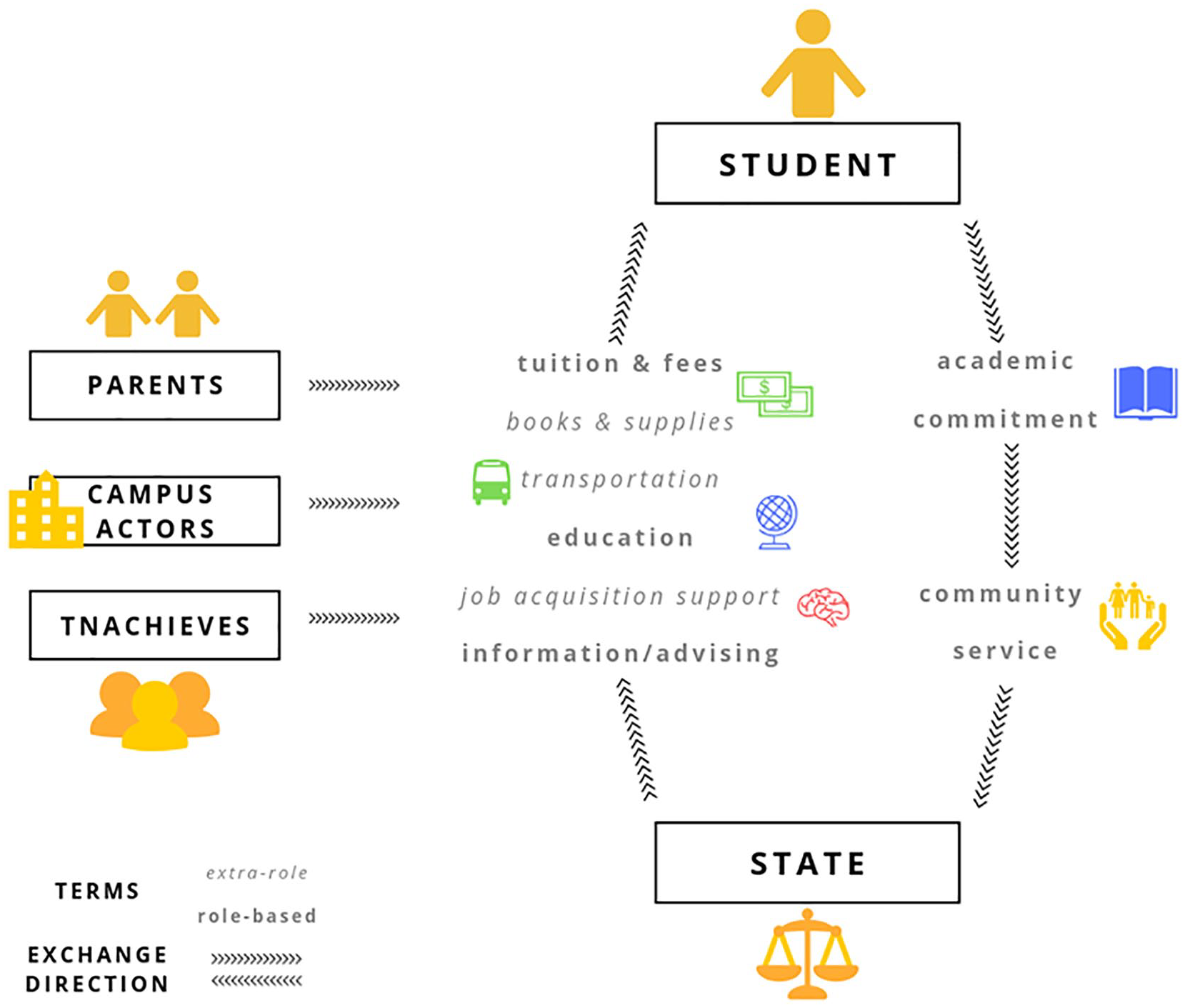
TN Promise students’ psychological contracts with the state and key actors.
Participants’ reflections illustrated that they perceive a PC between themselves and the state that is comprised of both role-based and extra-role dimensions. They articulated that tnAchieves, campus actors, and their personal support networks serve as mediating agents of that exchange (Figure 1). Participants’ comments revealed their conception that the state was the focal entity with whom they were engaged in an exchange relationship and that tnAchieves supports the fulfillment of the terms of their PC with the state by both working with students directly and connecting them with resources at their institutions. Similarly, institutions deliver supports and services that represent terms of the student–state PC. Students also derive support in meeting their responsibilities, to the state and tnAchieves, from their families, namely their parents.
The PCs literature has not previously documented PCs between students and the state or a nonprofit college access organization. In the subsequent sections, I explore the ways in which expectations for these agents may illuminate Promise context-specific expectations for key actors.
Exchanges With the State and Its Affiliates
Across all focus groups, TN Promise students clearly articulated the perception that they are party to a PC with the state. Their descriptions of this exchange reveal the foundational terms of the PC: Students contribute community service and hard work in their coursework in exchange for the cost of college. These role-based terms are in line with the explicitly defined eligibility criteria for the TN Promise, which has requirements for community service completion, enrollment concentration (12 credits per semester), and a minimum cumulative GPA. Participating students demonstrated understanding of these terms as they discussed the architecture of the TN Promise scholarship program. One community college student summed up his interpretation of the Promise exchange by stating, “When you’re making . . . good enough grades, you can get [state] scholarships.” Students also cited completion of community service as a key term of their exchange agreement with the state. A technical college student described the effort necessary for him to maintain eligibility for the Promise: “You do the community service, and that’s it. You’re basically done.” The other requirements, such as maintaining full-time enrollment and satisfactory academic performance, represent important undertakings but may not be perceived as burdensome because of their likely inclusion in any contract students enter when enrolling in college, independent of a scholarship program.
Students’ comments conveyed that full-time enrollment, satisfactory performance, and community service completion are fair terms for their contract with the state. One technical college student summed up scholarship requirements and assessed the terms stating,
I have the TN Promise, which that pays for everything. You must have over a 2.0 GPA. You have to have eight hours of community service every trimester . . . that right there is pretty easy for me, so . . . it’s a good deal.
A community college student made a similar expression regarding the explicit terms of the scholarship, “I mean, the eight hours community service, it makes up for itself because you’re getting free schooling.” Students continually reiterated that the state’s commitment to fulfill the terms of the scholarship made college free. Some, in expressing their interpretation of the fairness of the terms, cited that attending college tuition-free was fair at least partially because it was far beyond what most prospective college students could reasonably expect. One community college student articulated this sentiment, saying,
I feel like since I’m attending here for free . . . all I did was like community hours . . . which I think is not bad at all . . . They are holding up their end of the bargain here, and I feel like it’s really helpful.
Through expressions such as this one, and others that cited that the typical cost of college can be a deterrent to apply or make it difficult to remain enrolled, students demonstrated their appreciation for the terms of their exchange relationship with the state. Although there was some variation in perceived fairness of the scholarship program, particularly among Promise students in associate’s degree programs at 4-year institutions, the overwhelming sentiment was that Promise scholarship dollars are provided fairly.
In fact, students expressed that the appealing role-based terms of the contract made it difficult to turn down. Participants voiced the impression that TN Promise may encourage students who would not otherwise attend college to go, even if they might not be successful. One community college student summarized this sentiment in brief: “If you’re getting two years for free, like, why wouldn’t you?” Students articulated that the Promise scholarship may induce students who are at the margins of enrollment to matriculate at community or technical colleges because they find that the scholarship provides them with greater financial access to postsecondary training.
However, access does not necessarily beget success. Students expressed that, given the expectations for students in the exchange, the TN Promise contract might not be suitable for everyone. One community college student’s description of the terms of the contract captures the sentiment that although TN Promise is open to all, not all students are suited to satisfy the contract:
There’s like a million steps, but the list of criteria to have it was pretty simple. Live in Tennessee. It might be 2.0 or 2.5 GPA to maintain it. And you have to . . . take a minimum of 12 credit hours. You have to go to college right after high school, and you can’t take time off. You have to get your associate’s done quick . . . So, it is only for the motivated.
Students recognized the TN Promise scholarship as a contract they entered with the state on an individual basis and that it might be a more suitable exchange for some individuals than others. Two-year college completion rates are low, particularly among low-income students (Evans et al., 2020). Students who are induced to enroll in college by TN Promise might be less likely to be successful than the average 2-year college student. These individuals may find that the provision of tuition-free scholarship support is not sufficient to guarantee their college success.
In addition to expressing that the explicit terms of the contract are fair, students also expressed that they feel that they are making substantive contributions by fulfilling their contract terms. This was particularly salient as participants discussed their completion of the community service requirement each semester (community college students) or trimester (technical college students). Students expressed that they were contributing to the betterment of their communities and the state through service, as captured by the words of one technical college student:
Because the state’s giving you something for free. Not really for free, because you’re helping out. But I mean, you’ve got to do something. It’s a whole lot better than getting it handed to you basically. You still have to do something prior to helping it like expand—help other people within the state. That’s why they call us the Volunteer State.
This student expressed that through the exchange of community service for college tuition and fees, individuals can help others in their community and embody the ethos of the state.
Extra-Role Terms of the Exchange
TN Promise students also articulated expectations that the state, postsecondary institutions, and tnAchieves support their college success beyond the provisions of the TN Promise scholarship program. When asked about their likelihood of success and the structure of the program, first-year TN Promise students articulated appeals to the state and its partners that included additional financial (books, supplies, transportation costs), academic (additional advising, tutoring, and technological resources), and logistical (e.g., shuttles between satellite campuses) supports. The nature and framing of these requests suggest that TN Promise may have reshaped or made more salient the expectations that students have for the state and their postsecondary institution for active, multidimensional contributions to their successful attainment of a postsecondary degree or credential.
Most frequently, students expressed that the state should cover ancillary expenses or services related to college success. One such expense was transportation to and from campus and between campuses. Students articulated that commuting is expensive and sometimes untenable, particularly in rural counties. One student attending a satellite branch of a rural community college captured this view when she suggested a way for the state to satisfy this expectation:
If [the state] had like—if they could pick you up at one of these schools that they have, that would be useful. Like it can—at least you can get to one of the stops, then you can make it to [the campus across county]. I think that would be really useful.
Other students presented the related solution that the state provide funding for gas to satisfy the expectation of facilitating attendance by subsidizing the commute.
Community college students most frequently recommended that the state pay for textbooks to satisfy the contract term of support for student academic success. Community college students commonly cited semester book expenses of US$400 to US$800, depending on their discipline and enrollment concentration, and the sentiment that the state should cover these costs was commonly expressed across community colleges and 4-year campus-based associate’s degree programs. Coverage of books was seen as a relevant piece of the postsecondary success puzzle and a fair thing for the state to cover, particularly for students who draw on primarily federal and other state funds and get very little from Promise’s last-dollar coffers. One community college student articulated this perception of a more appropriate balance of Promise accounting:
And it’s like—like if Promise is kicking in heavily on your tuition, then yeah, I can see not covering books then. But my Promise is only covering like $282 and not even that now. It’s less than that now. So, it’s like $2,000, man. We can—You know, $500 for some books that, you know, it’s . . . school-related.
Some community college students shared that they were able to pay for their books through Pell Grant refunds and, consequently, felt less keenly that the state should pay for supplies.
Most technical college students agreed with the earlier quoted technical college student: the state “pays for everything.” Many participating technical college students cited their ability to pay for their tuition, fees, uniforms, and tools. Local workforce development offices are an important resource that might make the difference for technical college students; many technical college students reported being able to leverage both funds from Promise (to pay tuition and fees) and awards from local workforce development offices to pay for the uniforms and tools they needed for training. However, technical college students from better resourced backgrounds did not have access to uniform and tools funds from the workforce development offices. Some of these students expressed dismay at the cost of required tools, in particular, and noted their surprise at the high cost of supplies when they thought they would be attending college for free.
Relatedly, some TN Promise students expressed that the state’s fulfillment of the Promise contract was not as generous as expected, particularly those who attended 4-year institutions. Students articulated that they expect clear communication on the terms of the financial dimensions of the agreement as they enter into an exchange relationship with the state. A 4-year college-enrolled Promise student expressed distaste for the opaque presentation of terms: “Clarify that if you are going to a four-year university and you get the HOPE, as well, you are not getting $2,000 extra dollars. Because that was never straightforward. Ever. Like we had to figure that out.” This student’s emphatic comment conveys a strong reaction to a perceived violation of the anticipated financial terms of the PC and a misunderstanding about the disbursement method of TN Promise. Although information about the funding differences at 4-year institutions is readily available online and in students’ TN Promise handbooks (tnAchieves, 2021, p. 15), this student’s perceptions suggest that the simple “free” marketing for the scholarship may be getting in the way of clear communication about how funds are allocated and what students can expect to pay in different settings. This confusion is rooted in the complexity of communicating the technical terms of the contract to a diverse group of students who will ultimately receive financial support on an individual basis.
Differences in the perceptions of generosity of the program may be related to students’ relative financial need. Perceptions of generosity in my sample were related to students’ reports of the magnitude of their federal Pell Grant eligibility. Although students in the sample who came from the lowest income backgrounds identified as “Promise” students because they maintained scholarship eligibility, they were not technically receiving any Promise funds toward their tuition and fees. The last-dollar scholarship did not have the opportunity to kick in because these individuals qualified for the maximum Pell Grant funds, which went beyond the total cost of tuition and fees. In addition to having their tuition and fees covered by Pell, these students also received a refund check from their institution so that they could put remaining federal dollars toward related educational expenses. One community college student articulated her experience, which was echoed in focus groups across the state: “I was able to pay for my books [with the Pell] refund . . . I [was also able] to pay for like other stuff like food and stuff and school supplies that I need.” For those students with a Pell Grant refund, coverage of the cost of books and transportation were key to feeling financially stable and prepared to succeed in college. By contrast, non-Pell Promise students felt that the state had not fulfilled a term of their exchange agreement because they were saddled with high supplies and transportation costs.
Students also communicated that the state’s investment in their postsecondary success should include preparation for college-going and scholarship eligibility maintenance. Across institutional contexts and self-reported income backgrounds, many students articulated that they had little prior knowledge of postsecondary education and that it was difficult to navigate the college and financial aid application processes without that knowledge. Although the partnership between the state and tnAchieves gave them access to opportunities to learn and prepare, it was commonly expressed that more preparation was necessary to bolster success.
Overall, students expressed that they believe that the state’s role in their exchange relationship was not limited to the provision of scholarship dollars. Students articulated beliefs that Promise should support them financially beyond the last-dollar provision of the scholarship, as well as through supports that would contribute to college success and gainful employment. When pushed on how such extra-role terms should be fulfilled, it was clear that students saw other stakeholders, such as campus actors and tnAchieves, as mediating parties to the exchange between themselves and the state.
Institutional Actors and tnAchieves as Mediators of Extra-Role Exchange Terms
Students’ discussions of resources and their experiences indicate that they perceive themselves to be party to an exchange relationship between themselves, their institution, tnAchieves, and the state. Faculty, advisors, and other campus staff mediate campus-based components of the exchange between students and the state. tnAchieves plays its part in facilitating fulfillment of terms of the exchange through in-person meetings, electronic communication from professional staff, and electronic communication with volunteer mentors. One community college student’s description of the roles of these various actors captured the balance of responsibilities:
tnAchieves, they contact me numerous times because they always like keep track, like “Hey, make sure you’re doing community service. These are opportunities that you can volunteer at.” They’re just like making sure that I’m on track with my courses and hours that I’m getting for class . . . And then here on campus I know that financial aid will like talk to me. “Hey, this is a form that we’re missing,” or like other offices, they would like say, “If you would like to help to volunteer here,” or “If you wanted to like join [clubs]” things like that.
This student articulates the division of tasks between on-campus and off-campus exchange partners. By serving in these capacities, tnAchieves and campus actors fulfill terms of the PC between students and the state.
The examination of undergraduate student PCs has historically focused on individuals within the formal boundaries of the institution. Evidence suggests that students’ most salient exchange relationships were with individuals on campus because campus actors were in most frequent contact with students (Knapp & Masterson, 2018; Koskina, 2013). Similarly, in this sample of 2-year college students in a Promise scholarship context, the data demonstrate the importance of campus-based relationships, as students articulate what they expect and receive from faculty, advisors, and staff.
Students’ expressions that on-campus actors are facilitators of a distributed exchange between themselves and the state go beyond existing evidence of the student–institution relationship, which has focused on terms related to classroom and advising center role-based exchanges. For this sample of TN Promise students, campus actors help students to fulfill their contract obligations and deliver on promises made by the state. One example of role-based term fulfillment facilitated by extra-role action is the opportunities that campuses provide for students to complete their community service hours on campus. One group of community college students discussed the abundant on-campus opportunities to fulfill this important term of their contract with the state:
And we have people on campus that can help . . . find places to do [service], too.
Don’t they have that checklist on one of the boards somewhere, and it’s like “Community Service Suggestions”? I saw that somewhere.
You can do them in the library. We have a pantry that like stores food, a garden.
The food pantry, they always need help. So, if you ever need service hours . . .
We have a lot of on campus community service.
Across community college campuses, I observed flyers and heard students articulate that campus offices provide opportunities to perform community service so that students could remain Promise eligible. In this way, these on-campus actors were taking extra-role action to facilitate students’ fulfillment of their role-based obligation of service to the community.
Students expect campus actors to fulfill extra-role terms on behalf of the state. One common example is the expectation of campus actors’ ongoing commitment to helping students find stable employment. Technical college students, in particular, emphasized the role of their faculty members in ensuring that students’ efforts to earn a credential resulted in gainful employment after graduation and into the future. A discussion among three technical college students regarding future contact with their teachers captures this sentiment:
I [can] text my teacher, ask if I need a job. He’ll let me know if there’s a job opening. Or even if I don’t text him, he’ll just let me know what’s going on. I’ll send him how my job’s going and even when I graduate, let him know how it’s going for me, so—
Definitely. [In the future, I’ll] tell him how my career’s going, and see if he can find me a better job.
These two students in different technical training programs articulate the widely held expectation that instructional staff on campuses, particularly technical college campuses, would take an active role in facilitating the fulfillment of the extra-role term of helping students secure postgraduation employment. Technical college students described their instructors’ industry experience and connections, and noted that their instructors would use these connections to help them secure employment. Likewise, community college students across the state articulated the expectation that they would access better employment opportunities and that key actors, particularly staff in campus career services offices, would support them in securing such opportunities. It is possible that these employment-centered extra-role terms were shaped by the state’s framing of TN Promise and by campus narratives about potential supports for students and graduates. This expectation is well aligned with the state’s individual prosperity and economic development motivations and marketing of TN Promise.
Previous analyses have primarily identified family and close friends as the key off-campus exchange partners in undergraduate students’ PCs (Knapp & Masterson, 2018). In addition to the importance of these critical individuals, this analysis supports the notion that tnAchieves, a nonfamilial, off-campus actor, plays a key role in facilitating the student–state PC. Through frequent text and email outreach, tnAchieves has become a proximate actor in students’ college experiences.
Frequency of contact blurred the lines between the responsibilities of tnAchieves and campus actors in facilitating fulfillment of the terms the student contract with the state. The blurring of roles and expectations between tnAchieves and campus actors was salient in an exchange about personalized academic advising:
[tnAchieves] should also like give us classes that we need to take. Proper classes that we need to take for our major.
So, some advising that’s specific to your campus?
Someone advising to like make sure that we are taking the classes that . . . like what we want to try to do later on in life.
The role that these students expect tnAchieves to play is one that is traditionally played by academic and career advisors on college campuses. Undergraduate students are often required to communicate with campus-based advisors at least once per semester, typically as they determine subsequent term course plans. It is possible, then, that tnAchieves is in touch with students more frequently, albeit perhaps with less personalization, than campus advisors. The nature, duration, and frequency of communication from tnAchieves may have blurred the lines between the roles of campus advisors and tnAchieves staff, and that communication frequency has made tnAchieves a more proximate actor for whom students have higher expectations. Consequently, students may perceive that campus advisors and tnAchieves have similar roles in mediating the fulfillment of contract terms.
Nonetheless, there is still some uncertainty about the identity and role of tnAchieves. One community college student’s definition of tnAchieves captured tension between recognized importance and imprecise understanding of the organization: “I don’t really know who they are. I just know they’re the bridge between me and TN Promise.” Although students did not necessarily know the particular boundaries between tnAchieves and the state, they had firm beliefs in tnAchieves’ role in mediating that divide and facilitating their success. One community college student represented a common conceptualization of tnAchieves’ role when he said “There’s two Ss in college, support and studying . . . It’s my job to do the things I need to do [to graduate]. But yet it can also be [tnAchieves’ responsibility] just to sort of guide the pathways.” This student articulated that an important term of the student–state contract is individuals putting forth effort to be successful in the classroom; in turn, key actors, such as tnAchieves, support students’ current and future success.
Like in previous research in other postsecondary settings, this analysis indicates that students perceive that their PC is being facilitated through fairly proximate actors (Koskina, 2013). However, given the distance between students and the focal party to the exchange, the state, TN Promise students identify more proximate actors who mediate the state–student contract. The state is a less salient actor than tnAchieves and college staff, and these more proximate actors provide access to and a face for supports and services in fulfillment of contract terms. Students discussed terms of their exchange with the state that went unfulfilled, articulating frustrations of breach of contract by the state and proposed solutions whereby the more proximate actors, the institution and tnAchieves, could rectify the violation on behalf of the state. For example, after articulating dissatisfaction with the lack of support for the commute to campus or the commute between campuses, many students expressed that “TN Promise” or “Tennessee” should include commute support. When pushed to explain what that might look like, students at multiple community colleges suggested that their higher education institution could run shuttles between campuses or to major stops in the county.
Parents’ Role in Supporting Students’ Fulfillment of Contract Terms
Participants clearly expressed nonfinancial expectations for parental support that would contribute to fulfillment of their responsibility to the state of being successful in college. Consistent with prior literature, Promise-receiving students identified their parents as supportive agents encouraging their college success through emotional support. Although socioeconomically disadvantaged parents may not have the same financial resources and college knowledge and experiences as their higher income peers, they provide valuable support to their children by emphasizing the value of college education and encouraging academic excellence and high aspirations (Roksa et al., 2021). Participants gave examples of parents checking in about their well-being and reinforcing the importance of college, noting that these actions were critical to their postsecondary success. Furthermore, students expressed that they expected parents to help them successfully navigate the logistics of college attendance. Parents were cited as resources that students leveraged to fulfill their responsibilities to complete financial aid application tasks, commute to campus, and keep track of enrollment and aid deadlines.
Although many students expected parents to provide emotional and logistical supports, others expressed a clear disapproval of such expectations. One technical college student captured this sentiment saying, “A lot of people are babied, I think. And the more you’re babied, you’re going to have to put some big boy pants on and get out there.”
Students’ expectations for parental emotional and logistical support amid a dense ecosystem of postsecondary supports in the TN Promise context align with existing evidence on the importance of parental support for college and have implications for Promise program design and implementation.
Discussion
I undertook this qualitative study to develop further understanding of the experiences of TN Promise students and to shed light on strengths and opportunities in “Promise” program design and framing. The TN Promise students in this study articulated expectations that the state, postsecondary institutions, and tnAchieves would support their college success beyond the explicit provisions of the TN Promise scholarship program. First-year TN Promise students articulated appeals to the state and its partners that included additional financial, academic, and logistical supports. These findings suggest that TN Promise may have reshaped or made more salient the expectations that students have for the state and their postsecondary institution for active, multidimensional contributions to their successful attainment of a postsecondary degree or credential. Evidence of these “psychological contracts” has implications for the architecture and framing of Promise programs and the provision of supplemental supports by colleges.
Students’ unmet expectations for the state may impede their college success and signal dimensions of student need not met by current scholarship program provisions. Breaches of these PCs may impede Promise programs’ ability to meet stated policy goals, such as individual degree attainment or economic development, as target students may be less likely to persist and earn credentials. The “terms” of the contracts that students describe may represent unmet needs of scholarship students and suggest potentially important paths forward for providing better supports for student success. For institutions whose students are eligible for tuition-free scholarships, these findings may shed new light on the nature of student expectations; such institutions would do well to respond to students’ expectations and undertake efforts to reshape them to better align with their mission and capabilities, if necessary.
Making Sense of Expectations for the State
The perception of the state as an exchange partner and actor in the tuition-free college experience may be unique to the context of TN Promise, in which state and nonprofit partners are quite active in the dissemination of scholarship information and support of students during the college transition. By continually tying postsecondary opportunity and experience to the state, TN Promise, and the Drive to 55 postsecondary attainment campaign (which aims to equip 55% of TN adults with a college credential by 2025), the state of Tennessee may emerge as a more present and salient actor for TN Promise students than would an equivalent program sponsor for students in other Promise scholarship programs across the country. Additional research on student perceptions of the funder in other state, regional, and local scholarship programs would lend insight into the generalizability of this finding to other contexts.
The expectations expressed by participating TN Promise students underscore the importance of framing, marketing, and clear dissemination of scholarship-related information. Promise programs are generally designed to ease financial burden on students and families, but not fully cover out-of-pocket expenses for scholarship recipients (Miller-Adams, 2015). Although the detailed tnAchieves student handbook and discussion of scholarship details in information sessions stipulate that TN Promise only covers tuition and fees and that books, other supplies, and transportation will likely represent sizable individually borne costs, the overarching impression of TN Promise on the recipients is that it makes college “free.” Furthermore, like the Excelsior Scholarship, which New York State touts as a “tuition-free degree” (New York State, n.d.), messaging around TN Promise highlights that scholarship recipients will not just attend college, but also graduate with a credential. This is important motivational messaging, as most individuals who enroll in community college will never graduate (Goldrick-Rab, 2010; Juszkiewicz, 2020). However, this framing may signal a more comprehensive and long-term commitment than is written into scholarship provisions and eligibility guidelines in actuality and, consequently, contribute to the development of PCs with terms that will be breached.
As we consider the implications of the range of students’ expectations for the state, we might ask whether Promise students truly expect the extra-role terms of their contract to be fulfilled. Prior literature has interpreted student expectations as deriving from the role of students as customers (Koskina, 2013; Longden, 2006; Prugsamatz et al., 2006). In their study of undergraduate students’ expectations for teaching, Sander and colleagues (2000) leverage the customer-oriented literature around ideal, predictive, and normative expectations. Ideal expectations are those terms that the customer would like to occur, whereas predictive expectations are those terms that the customer assumes are probably going to occur. Normative expectations are those terms that the customer comes to expect because of service provision by other similar providers (see Prakash, 1984; A. G. Thompson & Sunol, 1995). In the case of TN Promise students, their expressions of extra-role obligations of the state may be ideal rather than predictive expectations. For instance, when students speak of the provision of campus shuttles or gas money for their commute, they may not believe that this term of the contract is likely to be fulfilled, but rather hold the provision of this service as an ideal for state satisfaction of the Promise exchange agreement. When students articulate expectations that the state will cover the cost of their textbooks, this may again be an ideal expectation. Alternatively, expectations for state financial aid to cover the cost of textbooks may be normative expectations that form as students observe peers leverage a “financial aid check” (i.e., federal Pell refunds) to pay for their textbooks with financial aid dollars. While these findings regarding the terms of PCs between students and the state under TN Promise could be indicative of the importance of the framing and marketing behind marquee financial aid programs, or ideal versus normative expectations, they could also simply be expressions of the substantial financial burden and unmet need faced by low- and lower-middle-income students in tuition-free college environments. TN Promise and other tuition-free scholarships cover only tuition and mandatory fees; students still face substantial costs for college-related expenses on top of cost of living. More than one third of community college students are housing-insecure and more than half are food-insecure (Broton & Goldrick-Rab, 2017). However, due to eligibility requirements for TN Promise and public benefits and demands on their time, scholarship students might be in a bind between retaining their scholarship and securing resources for their basic needs and college expenses. TN Promise requires that students enroll in college full-time (12 credit hours or more per term) to receive scholarship funds. This course load may prohibit students from working as much as they need to cover their outside expenses. Meanwhile, Tennessee requires that individuals work at least 20 hours per week to qualify for SNAP benefits (Tennessee Department of Human Services, n.d.). Furthermore, commuting to college can be costly, time-consuming, and logistically fraught. For example, only 57% of community and technical colleges nationwide are within 0.5 miles of a public transit stop though nearly all community and technical college students commute to campus (Crespin et al., 2021). Students’ expressions of expectations that the state pay for books and commuting costs might not be grounded in misunderstanding or interpretation of scholarship program framing, but purely based on students’ dire need for those and other resources.
The Role of Parents in Promise Scholarship Contexts
Participants expressed expectations for parental support centered on socioemotional and logistical activities. In the previous literature, parental willingness to pay and financial support for college-going emerge as important factors that predict both student enrollment and success (e.g., Flaster, 2018). The perspectives shared by students in this study suggest this may not be as salient for TN Promise students; participants expected their college costs to be covered by the state rather than by their families or themselves. Instead, students expressed their expectations for parental validation and support with logistical tasks, which have been shown to be important predictors of student aspirations and success, particularly among individuals from lower income households (Kiyama & Harper, 2018; Roksa et al., 2021). The American model of college financing has long put the burden of postsecondary training costs on students and families. Promise scholarships can change the college-going narrative, the nature of college financing, and the relationship between students and the state while leveraging familial socioemotional supports for student success.
Implications and Recommendations
I undertook this study to develop understanding of the strengths and opportunities in “Promise” program design and framing. Students in my focus groups expressed expectations for supports from the state that go beyond the provisions of TN Promise. These expectations suggest that program participants have unmet needs and might be more successful if provided with additional resources.
This evidence both has implications for policy and practice and contributes to the growing postsecondary PCs literature. Promise students’ expectations may be shaped by marketing, advising, and their needs for support while enrolled. It is important that students understand the provisions of scholarship programs prior to enrollment; program administrators should align marketing efforts and advising with the provisions of tuition-free scholarships. The nature of tuition-free scholarship programs and the language used to promote them, as well as student perceptions of unwritten exchanges, may contribute to the terms and salience of PCs in a “Promise” scholarship context.
This analysis reveals opportunities for the state to either adjust its policies to meet students’ expectations for Promise or to clarify the boundaries of scholarship provisions to realign student expectations with the terms of the scholarship program. The provision of a book scholarship and transportation subsidy would better align Promise provisions with students’ expectations for these financial supports. Furthermore, these supports would better align with the “free college” moniker of the Promise program and, importantly, lift the burden of book and transportation costs from students. Indeed, Davidson County’s Nashville GRAD program and Knox County’s Knox Promise provide financial assistance and wraparound supports for full-time students pursuing higher education in their respective counties. Nashville GRAD offers financial assistance in purchasing textbooks, transportation, industry certification fees, and emergency needs for community college students or industry certification fees and tools and equipment for technical college students. These provisions provide a blueprint for how municipalities may supplement the provisions of state-level supports to meet the needs and expectations of college students.
Students also expected that they would be able to seamlessly access all necessary coursework once enrolled. Students whose campus did not offer all the necessary or desired coursework (e.g., lab sciences; foreign languages) expressed frustration that this expectation was unfulfilled. To better align provisions with logistical support expectations, the state should work with campus administrators to extend access to virtual coursework or, where that is impossible, institute or expand shuttles between an institution’s campuses. In some circumstances, the extension of existing public transit routes or hours could meet students’ transportation needs. Institutions and college systems may find it helpful to examine student expectations for institutional services and the roles of on- and off-campus entities (Sander et al., 2000). Provision of services in line with these expectations may serve as a lever to improve student investment and performance both by fulfilling terms of the PC and by easing the financial, academic, and logistical burdens of college-going that complicate the lives and studies of postsecondary students.
TN Promise, like most other tuition-free college programs, covers only a fraction of a student’s total cost of attendance by paying for tuition and fees. Students and families with fewer financial resources are less prepared to cover other college costs and, under the last-dollar architecture, receive less Promise scholarship funding due to coverage provided by the Pell Grant and other state grants. One common criticism of the last-dollar architecture on the part of researchers and analysts is that the bulk of program funds are directed to middle- and upper-income students. The state may consider adapting its last-dollar award architecture to accommodate a cost of attendance grant for Promise’s least resourced students. A Promise program could both meet the expectations of students and combat this common critique by adopting a sliding scale grant or a hybrid first-last-dollar approach to support student access to supplies and transportation.
If the program cannot provide the additional capital required to provide book and transportation resources for low-income students, policymakers might consider instituting an income cap to redirect scarce funds from students whose families would otherwise be able to pay for college to those students with the most pressing financial needs (see Poutré & Voight, 2018). In this way, the program would be reoriented toward primary investment in low-income students.
If disinclined to change the architecture of the program to better serve less resourced students, policymakers may consider adjusting the language surrounding “free” college programs to more clearly depict the magnitude of financial undertaking that college will be for students and families. The straightforward messaging and eligibility criteria of TN Promise are a boon for their simplicity: The messaging that college is free may effectively expand access to students who would otherwise believe that college is beyond their reach. However, clarity regarding the parameters of “free” and upfront discussion of the magnitude and frequency of other costs of college are equally as important as lowering initial barriers to access. Shifting language from “free” to “tuition-free” is only a first step in signaling to prospective scholarship recipients that they are likely to be responsible for costs outside of those covered through governmental financial aid. Prior to engaging in the enrollment process, many prospective college students are not knowledgeable about the costs of college or do not fully grasp their magnitude (Dynarski & Scott-Clayton, 2006). Collaboration between the state and school districts should focus on clear, consistent communication with students and families from middle or early high school regarding the costs for which they will be responsible.
Conclusion
The emergent findings demonstrate the existence and content of PCs between students and the state and its affiliate, tnAchieves, as well as more traditional exchange partners such as teachers, advisors, and parents. This study advances the literature by exploring the existence and terms of the student–state exchange relationship and offers evidence that proximate actors mediate the fulfillment of this relationship. These findings have implications for the nature and provision of support services by postsecondary institutions and state and municipal scholarship programs, as well as for the framing of tuition-free “Promise” scholarship programs by their sponsoring entities. Continuing study of students’ PCs in the context of broad-access, tuition-free scholarships is critical to the success of individual students and fulfillment of program goals.
Students’ perceptions of the state and its fulfillment of “promises” made, perceived as PCs, can guide information dissemination and investment in academic and social supports for students during the college transition. The results of this qualitative study reveal that the explicit and implied messages in marketing for TN Promise might be important not only to recruiting students, but perhaps also for retaining and graduating them. As the Biden Administration and Congress explore how a tuition-free college model may be implemented at the national level and new localities and states and localities consider and design tuition-free college programs, this study contains valuable considerations for policymakers regarding the features and framing of tuition-free college programs, as well as for the work of practitioners, including high school advisors, community partners, and postsecondary educators, all of whom are invested in ensuring that students have the resources necessary for success. As architects and community members endeavor to bring postsecondary access and success to their communities and regions, they must keep in mind that the messaging and provisions are not just marketing but also constitute an important informational resource upon which “adolescent econometricians” (Manski, 1993) rely to make informed postsecondary enrollment decisions.
Supplemental Material
sj-docx-1-epa-10.3102_01623737221090265 – Supplemental material for Expectations of a Promise: The Psychological Contracts Between Students, the State, and Key Actors in a Tuition-Free College Environment
Supplemental material, sj-docx-1-epa-10.3102_01623737221090265 for Expectations of a Promise: The Psychological Contracts Between Students, the State, and Key Actors in a Tuition-Free College Environment by Jenna W. Kramer in Educational Evaluation and Policy Analysis
Footnotes
Acknowledgements
I would like to thank Angela Boatman, Will Doyle, Carolyn Heinrich, Lindsay Page, Susan Kemper Patrick, and Peter Nguyen for their feedback and comments on the research design and manuscript. I also owe a debt of gratitude to colleagues at Peabody College’s Social Contexts of Education seminar, the AEFP Annual Meeting, the CTE Research Exchange (CTEx) Annual Meeting, the TN Higher Education Commission, and the PromiseNet Annual Meeting, as well as NAEd and Spencer Foundation dissertation and postdoctoral fellow colleagues and NAEd mentors for their thoughtful engagement with this work at various stages of its development. This research would not have been possible without Krissy DeAlejandro, Jackie McDonald, and tnAchieves, who were engaged collaborators and provided invaluable support in coordinating with TN Promise students and colleges—thank you. All errors are my own.
Declaration of Conflicting Interests
The author(s) declared no potential conflicts of interest with respect to the research, authorship, and/or publication of this article.
Funding
The author(s) disclosed receipt of the following financial support for the research, authorship, and/or publication of this article: This research was supported by the National Academy of Education, the Spencer Foundation, and the Smith Richardson Foundation.

Notes
Author
JENNA W. KRAMER is an associate policy researcher at the RAND Corporation. Her research examines the role and impacts of education policy and institutional supports and practices on college access and success, particularly in the community college sector.
References
Supplementary Material
Please find the following supplemental material available below.
For Open Access articles published under a Creative Commons License, all supplemental material carries the same license as the article it is associated with.
For non-Open Access articles published, all supplemental material carries a non-exclusive license, and permission requests for re-use of supplemental material or any part of supplemental material shall be sent directly to the copyright owner as specified in the copyright notice associated with the article.
