



Abstract
Community teachers, particularly those who are Black and Latinx, are assumed to improve retention and outcomes depending on retention in schools that serve low-income Black and Latinx students. Based on a critical quantitative analysis of data collected on the career trajectories and retention of hundreds of alternatively certified mathematics teachers, the study shows that community insiders exhibit significantly higher rates of retention in district schools than community outsiders and, in particular, those from elite colleges. Utilizing quantitative critical theory methodology, the study helps to move the field beyond race-neutral analyses of teachers’ retention and careers.
Keywords
T
Supporters of community-based teacher recruitment assume that, due to their local ties and cultural affinities, these teachers, and particularly those who are Black and Latino/a, will remain longer than others in neighborhood urban schools that serve low-income Black and Latino/a students (Carver-Thomas & Darling-Hammond, 2017; Gist et al., 2019). Although research shows that teachers are more likely to stay in schools with students who are demographically like them (e.g., Borman & Dowling, 2008; Nguyen et al., 2019), to our knowledge, prior research has not examined how teachers’ status as community insiders or outsiders affects their retention and career trajectories. Large-scale studies of retention do not collect information on U.S. teachers’ connections and commitments to the communities in which they teach. An exception, although about teachers’ career decisions and not retention, is Boyd, Lankford, Loeb, and Wyckoff’s (2005) “draw of home” study that showed that, in the state of New York, new teachers express a preference to teach in schools close to where they grew up or in schools with similar student demographics.
The current quantitative study is designed to address this shortcoming in the field’s knowledge by examining the career trajectories and retention of alternative route mathematics teachers who are community insiders and outsiders. Analyzing longitudinal data on NYCTF mathematics teachers recruited to teach in “high-needs” neighborhood schools in New York City (NYC), we show that, at least in certain program or district contexts, Black and Latino/a community insiders (i.e., operationalized as the graduates of NYC high schools) exhibit significantly better rates of first school and district retention than community outsiders, inclusive of ECGs. Informed by critical race theory (CRT), this study also helps to move retention research beyond race-neutral analyses by shedding light on the racialized nature of their teaching and post-teaching trajectories.
Literature Review
Structural Changes to the Profession and the Historical Exclusion of Minoritized Teachers
For much of the 20th century, most U.S. teachers, inclusive of mathematics teachers, remained in teaching for an entire career (Ingersoll & Merrill, 2011). In part, this was because opportunities for career advancement in K–12 education were largely restricted to middle-class, White, Protestant males (Lortie, 1975). As with others in their age cohorts (AbouAssi et al., 2021), recent generations of teachers expect teaching to be one of several jobs they will have in their lifetimes (Bayer et al., 2009). Social and economic changes in the latter half of the 20th century, including greater opportunities for college-educated women and minorities outside of teaching, were accompanied by changes to teachers’ career trajectories. Currently, many teachers stay in teaching for only a few years, others leave teaching only to later return, others transition in and out of school leadership positions, and still others have long gaps in employment. Furthermore, rather than leave teaching entirely, the new generation of teachers often migrate from school to school in search of a supportive workplace (Simon & Johnson, 2015).
Social and economic changes in the 20th century also altered the composition of the U.S. teacher workforce. For example, the Black teacher population decreased dramatically following the 1954 Brown vs. Board of Education decision as White administrators resisted hiring them to teach in integrating schools (Hudson & Holmes, 1994). This was particularly harmful to Black students as, prior to this decision, Black teachers often were better prepared than White teachers and many either taught in the communities in which they were raised or “when not, they came from communities that were similar in culture and beliefs” (Walker, 2001, p. 769).
Early-entry alternative teacher certification programs, which emerged in the 1980s, have leveraged and contributed to changes to the teaching profession and workforce, having had an outsized effect on the composition of the workforce in low-income neighborhood urban schools. Through providing a fast track to paid teaching, and often also incentives like a subsidized master’s degree, these programs have facilitated the entry of “non-traditional” entrants to teach core subjects like mathematics (Carver-Thomas & Darling-Hammond, 2017; Donaldson & Johnson, 2010), including both community insiders, who tend to resemble the students they teach, and ECGs, who tend not to.
Community Insiders’ and ECGs’ Reasons for Entry
Maier (2012) asserts that ECGs choose to enter teaching through selective programs like TFA because they further credential them as nation’s best and brightest recent college graduates. Elite academic credentials, coupled with a 2-year experience in a neighborhood urban school, seem to enhance their post-teaching prospects of finding high-status, remunerative employment. To be certain, not all ECGs fit this profile (Donaldson & Johnson, 2010; Lovison, 2022). Some stay in neighborhood urban schools citing issues of social justice and altruism such as “seek[ing] to have direct impact on social inequality by helping young children become successful despite all the harsh circumstances that are part of their daily reality in the inner-city neighborhoods” (Tamir, 2009, p. 524).
Black and Latino/a teachers, including many who are community-based, more often enter teaching through alternative certification programs than other teachers (Carver-Thomas & Darling-Hammond, 2017). As with ECGs, many cite issues of social justice and altruism as motivating their entry, although their conceptions may differ. Black teachers tend to view teaching as community work and seek to be role models for their students (Callahan & Brantlinger, 2022; Kokka, 2016). Latino/a teachers similarly tend to be motivated by a commitment to working with and serving as role models for Latino/a students (Valenzuela, 2016). Reflective of this, Black and Latino/a teachers are at least twice as likely as White teachers to work in schools serving majority Black and Latino/a students (Ingersoll et al., 2019).
The Career Trajectories of Community Insiders and ECGs
In explaining teacher turnover, quantitative studies frequently distinguish between personal factors, school factors, and external factors (Borman & Dowling, 2008; Nguyen et al., 2019). Personal factors include teacher characteristics such as race and age, subject-matter qualifications, and the socioemotional benefits of working with students (Nieto, 2003). School factors include student demographics and organizational climate issues such as administrator support and teacher collegiality (Kokka, 2016; Nguyen et al., 2019; Simon & Johnson, 2015). External factors include accountability and other policies (Nguyen et al., 2019; Nieto, 2003) and economic realities such as teacher salaries and regional labor market conditions (Goldhaber & Theobald, 2022). Personal, school, and external factors are interactive; for example, accountability policies can influence school climate (Valli & Buese, 2007).
ECGs seem to leave teaching at higher rates than others for a range of reasons including dissatisfaction with teaching as a career (Donaldson & Johnson, 2010; Kelly & Northrop, 2015). Their turnover also may be driven by the fact that so many are community outsiders who have weak ties to the high-minority neighborhood schools that they teach in or from their having high-status career options (Maier, 2012). Moreover, selective fast-track programs may facilitate their turnover by placing them into difficult, full-time teaching positions with limited training, asking them to only commit to only 2 years of teaching, and doing little to incentivize them to stay (Brantlinger et al., 2022; Donaldson & Johnson, 2010).
Some posit that, due to their local ties and cultural congruence, community teachers will exhibit higher rates of retention than other teachers, particularly in low-income neighborhood schools (Carver-Thomas & Darling-Hammond, 2017; Gist et al., 2019). However, to our knowledge, no quantitative study has examined the retention of teachers who are community insiders and outsiders. Evidence about the high levels of commitment and retention of community insiders comes principally from qualitative studies or small-scale evaluations of individual certification programs (e.g., Brantlinger et al., in press; Brantlinger & Grant, 2022; Gist et al., 2019; Kokka, 2016). There also is a robust literature on Black and Latino/a teachers (e.g., Dixon et al., 2019; Valenzuela, 2016) that shows them to be rooted in the communities they teach, to share similar life experiences with their students, and to be committed to working in low-income Black and Latino/a communities.
Many quantitative retention studies allow for comparisons to be made between the retention of White, Black, and other non-White teachers. These studies suggest that, although there are differences, their retention behaviors and career decisions may not be that different. Nationally representative studies show that White teachers have modestly better rates of retention than Black and other non-White teachers (Carver-Thomas & Darling-Hammond, 2017; Ingersoll et al., 2019), whereas regional studies show that, in certain contexts at least, Black teachers exhibit better retention than White and other teachers (Sun, 2018). White and non-White teachers also have been shown to cite similar phenomena as factoring in their career decision-making. For example, as with other teachers (Simon & Johnson, 2015), Black and Latino/a teachers cite working conditions, particularly administrator support, as exerting a strong influence on their decisions to remain in certain schools (Ingersoll et al., 2019).
However, qualitative and mixed-methods studies (Dixon et al., 2019; Farinde et al., 2016; Frank et al., 2021) show that Black and Latino/a teachers face unique organizational asks and aggressions which factor in their career decisions. Cormier and Scott (2021) present the cases of a female Latino/a teacher tasked with being the school’s Spanish-speaking interpreter and a Black male special education teacher asked to serve as a disciplinarian for Black and Latino/a students in their schools. Both teachers “struggle to balance instruction and forced obligations to serve as racial experts, as racial justice advocates, and in nonacademic positions” (p. 236). Moreover, whereas White teachers are generally presumed to be competent by administrators and policymakers (Cooley et al., 2021), Black and Latino/a teachers find that they need to prove that they are competent to White administrators and colleagues (Dixon et al., 2019) and have comparatively limited opportunities for career advancement (Farinde et al., 2016).
Finally, it frequently is assumed that the career trajectories and retention of mathematics (and science) teachers will differ from those of other teachers because they can find professional and remunerative jobs in the science, engineering, and technology sectors. However, there is little evidence in support of this. For example, drawing on nationally representative data from 1999 to 2000, Ingersoll and Perda (2010) find that, although “the educational system does not enjoy a surplus of new mathematics and science teachers relative to losses” (p. 589), the turnover of these teachers was comparable with that of most other teachers.
Theoretical Framework
Numerous studies have examined how school demographic and organizational contexts relate to teacher turnover (e.g., Simon & Johnson, 2015). A consistent result is that turnover is particularly high in schools that serve low-income, minoritized students. Some research suggests that many teachers leave because of the negative perceptions they have of the students in these schools (e.g., Hanushek et al., 2004). However, organizational theorists (e.g., Ingersoll et al., 2019; Simon & Johnson, 2015) argue that high turnover instead results from “dysfunctional” organizational contexts—dysfunction rooted in generations of systematic social and financial disinvestment in these schools (Baker et al., 2014). Of course, it is possible for teachers to leave in response to both teaching minoritized students and organizational issues (Grant & Brantlinger, 2022). And, while organizational theory is a helpful lens through which to view the sustainability of teaching in certain schools, it lacks an explicit consideration of the ways that organizations, including schools and teacher certification programs, are racialized. As such, we specifically draw on CRT to understand how racialized organizational practices and racial privilege relate to the career trajectories of ECGs and Black and Latino/a community insiders (Ray, 2019).
CRT was developed to critically examine power in society centering on the formative role of racism, positing that racism is foundational to American society and woven into its legal, institutional, and social fabric (Crenshaw et al., 1995). Rooted in critical legal analysis, CRT has been extended to the field of education and its institutions and organizations (e.g., Ray, 2019). In education, CRT asks questions such as: What role do schools, school processes, and school structures play in the maintenance of racial and ethnic subordination of Blacks and other minoritized groups while privileging whiteness and other forms of privilege that intersect with race? CRT posits that racism is an insidious, pervasive, and enduring aspect of U.S. society and institutions and it calls upon scholars and practitioners to interrogate concepts of objectivity, neutrality, colorblindness, fairness, and meritocracy.
There is a small but growing body of quantitative research informed by CRT. Much of it falls under the umbrella of quantitative critical theory (QuantCrit). According to Gillborn, Warmington, and Demack (2018), QuantCrit is a “kind of toolkit that embodies the need to apply CRT understandings and insights whenever quantitative data is used in research and/or encountered in policy and practice” (p. 169, emphasis in original). Crawford, Demack, Gillborn, and Warmington (2018) list the main principles of QuantCrit as follows: understanding the centrality of racism in U.S society; looking for “racism” when reading “race”; seeing the non-neutrality of numbers and statistics; understanding social categories as socially constructed and hence neither given nor natural; valuing insight and voice as data cannot “speak for itself”; and abiding by a social justice orientation.
For the current study, CRT and QuantCrit help us to center the racialized nature of teachers’ career trajectories and to attend to the distinctive social positioning of ECGs and Black and Latino/a community insiders in district schools. They also require us to be socially committed in a manner that acknowledges the fallacy of researcher neutrality that generally is assumed in quantitative research and policy analyses, in this case, allowing us to question whether selective alternative route programs such as NYCTF benefit minoritized students or whether they instead benefit ECGs by providing them with a fast-track resume builder through urban schools (see Brantlinger, 2020; Maier, 2012). As Ray (2019) argues, “seeing racialized relations as constitutive of organizations helps us to better understand the formation and everyday function of organizations” (p. 30). An examination of the ways that teachers are recruited, retained, and rewarded reveals that resources are distributed along racialized lines.
Consistent with QuantCrit, it is important to consider the authors’ positionalities and commitments. The first author is White and middle class. He taught high school mathematics and mentored alternative route teachers in racially segregated public high schools in Chicago. He is interested in the relationship between the ideology of meritocracy and mathematics education, inclusive of who is recruited to teach mathematics in low-income urban neighborhood schools (Brantlinger, 2020). As a Black critical scholar and former high school mathematics teacher, the second author’s research explores how CRT methodologies can disrupt anti-Blackness in mathematics spaces. Specifically, her work attends to the political and technical aspects of using QuantCrit in mathematics education research. As a Mexican American female scholar, the third author’s current research is motivated by her national work as Executive Director of an education policy organization, National Latino Education Research and Policy Project, currently orchestrating a national-level “grow-your-own” Latino/a teacher program that is community-based and university-connected. As a group, all three of us support efforts to develop community-based teachers for urban and other schools. However, we remain open to results that conflict with our commitments, for example, the possibility that the teaching trajectories of Black and Latino/a community insiders do not differ significantly from those of ECGs.
Research Questions
This study analyzes the career trajectories of ECGs and Black and Latino/a community insiders, referred to BLIs in the remainder of this article, who became secondary mathematics teachers through NYCTF in the mid-2000s. Specifically, this study seeks to answer the following research questions:
By addressing these questions, this study will help the field to better understand the relative retention and school staffing benefits of, on the one hand, national campaigns to recruit teachers from elite college campuses and, on the other, local initiatives to recruit teachers with ties to local school communities. It also will advance understandings of why ECGs, BLIs, and others become (mathematics) teachers and what might help them to remain in lower-income neighborhood schools. Moreover, by tracking early-career teachers over the course of a decade, the study sheds light on the professional trajectories of teachers from selective, fast-track programs and the extent to which, as is often claimed (e.g., Higgins et al., 2011), those who leave teaching actually continue to work in the public sector on behalf of, if not in solidarity with, communities like those they worked with in neighborhood urban schools.
Methods
To answer the research questions, this study incorporates retention, survey, and demographic data collected as part of a longitudinal research project on NYCTF mathematics teachers (Brantlinger et al., 2022). Quantitative analyses were used to construct a descriptive portrait of the career trajectories of the ECGs and BLIs who entered paid teaching in 2006 or 2007. This included analysis of variance (ANOVA) tests, t tests, Kruskal–Wallis tests of rank order, and chi-square tests of independence to test for subgroup differences in reasons for entry and career trajectory outcomes. Logistic regression was used to model their first school, district, and professional retention after 5 years. The study also includes results from a qualitative analysis of the teachers’ decisions to stay in or leave NYC public schools.
Sample and Context
Launched in 2000 by the NYC Department of Education (NYCDOE) in collaboration with TNTP, NYCTF was a flagship program, resulting in more than two dozen replica Teaching Fellows programs nationally. At that time, policymakers expressed concern about both teacher shortages and teacher quality and “selective” programs were seen as addressing both concerns (Brantlinger et al., 2022). Over the past two decades, more than 50,000 teachers, including over 5,000 secondary mathematics teachers, have entered teaching through NYCTF. Many Fellows were the recent graduates from very selective colleges and very few of them had attended public schools in NYC as youths.
The study participants became paid teachers of record after successfully completing NYCTF’s 7-week summer preservice program in either 2006 or 2007. This program included 120 hours of university coursework, 40 hours of NYCTF-delivered training, and 40 hours of practice teaching (Brantlinger & Smith, 2013). Following this, they began paid teaching in either a middle or high school in NYC public schools while they continued to take master’s certification courses. NYCTF teachers were restricted to teaching positions in “high-needs” neighborhood schools in different regions throughout the city—which regions depended on their place of residence. The students they taught were from low-income backgrounds with, on average, 78.4% receiving free or reduced-price lunch. Most also were Latino/a and Black; according to NYCDOE, on average, the students in their first schools were 48.5% Latino/a, 37.6% Black, 6.9% Asian, and 6.5% White. Students categorized as Black included African Americans as well as those with family roots in Jamaica, other Caribbean nations, and sub-Saharan Africa. Students categorized as Latino/a included those of Puerto Rican, Dominican, Colombian, Mexican, Ecuadorian, and Salvadoran descent. Survey data showed that approximately 18% of these teachers considered themselves to be Black or part-Black.
Local labor market conditions might have influenced the teachers’ decisions to enter and remain in teaching (see, for example, Goldhaber & Theobald, 2022). They were in their first or second year when the Great Recession of 2008 began. At that time, NYC added jobs until September 2008 and, following that, lost jobs in a range of sectors including those that, like teaching, required a college degree (e.g., investment banking, accounting, law; DeFreitas, 2009). For example, these economic trends seemed to have spurred some of the career changers in the study to enter and remain in teaching until more attractive employment opportunities reappeared (Brantlinger, 2021; Hurst & Brantlinger, 2022).
Data Sources
Nested Samples
The study draws on data from two nested samples, namely, the population of 617 NYCTF mathematics teachers who became teachers of record in NYC public schools in either 2006–2007 or 2007–2008 and the subsample of these 389 teachers who took a career trajectories survey in 2016. The findings integrate retention results from the population with results on the teachers’ career trajectories and decision-making from the survey sample. A missing data analysis showed that first-year leavers were undersampled in the survey sample. An implication was that the results derived from the survey sample about early-career decision-making may not have held for the full NYCTF mathematics teacher population. That said, the survey sample otherwise was representative of this population, that is, in terms of race, gender, college selectivity, social class background, prior career experience, postsecondary degrees, age, and high school location.
Service History and School Data
The NYCDOE provided service history data for 617 NYCTF mathematics teachers, including information about their school assignments, roles (e.g., assistant principal), and employment status (e.g., last day of paid employment). It also included information about their race, categorizing the teachers as Latino/a, Black, Asian, White, Other, or Mixed. For demographic data on students and school climate data, we drew on publicly available information from the New York State Department of Education and NYCDOE.
Career Trajectory Survey
As indicated, 389 NYCTF mathematics teachers completed the “career trajectory” survey in 2016. Depending on their membership in the 2006 or 2007 cohort, this was 9.5 or 10.5 years after they entered teaching. The survey collected information about their college experience (e.g., graduation date, major, their career activity prior to NYCTF, and their social class backgrounds). In terms of the latter, one survey item prompted them to select from one of eight social class categories ranging from working poor to upper class. In this study, these categories were combined into three: namely, working/working poor, middle, and upper-middle/upper.
NYCTF Data and Early Surveys
For missing data on the NYCTF teachers’ high school location, college selectivity, and college major, we drew on data from two earlier surveys of the two cohorts of NYCTF mathematics teachers: one administered at the end of their summer preservice training in 2006 or 2007 and one administered a year after they had entered teaching in 2007 or 2008. Most (598 of 617) of the teachers in the full sample took at least one of the three project surveys.
Survey Validation
The survey inventories were informed by early project research on NYCTF, the literature on alternative certification, and existing teacher surveys. Through regular observations and interviews with nine case study mathematics teachers in the period from 2006 and 2008, project researchers, including the first author, had developed an in-depth understanding of their experiences in NYCTF and NYC public schools (Cooley et al., 2021; Meagher & Brantlinger, 2011). The survey sections and prompts were adapted from existing teacher surveys (e.g., the Schools and Staffing Survey). To validate these items, in the final stages of survey development, the project researchers conducted cognitive interviews with a dozen early-career mathematics teachers not included in the survey sample. NYCTF administrators and faculty at all four NYCTF university partner sites also were consulted for input on the first two surveys. Experts in mathematics education and teacher preparation, including members of the project’s advisory board, reviewed the inventories and subsections on the 2016 career trajectories survey including those relevant to this study.
Career Trajectories Survey Administration
Beginning in the fall of 2015, we contacted secondary mathematics teachers from NYCTF’s 2006 and 2007 cohorts. We had received emails for most of the teachers from the NYCTF administrators or from the teachers themselves on earlier project surveys. We found missing emails using search engines and social networking sites. The contact emails included a detailed description of the research project and a link to the online survey. The teachers were paid US$150 for survey completion with the caveat that they could choose to respond or not respond to any part of the survey without needing to explain their nonresponses.
Measures
Teacher Subgroups
The teachers were sorted into four distinct subgroups using data on their race/ethnicity, college selectivity, and high school location. To begin with, about a third were categorized as ECGs; namely, those teachers who graduated from the 85 undergraduate institutions of the 250 total that were ranked as most selective on Barron’s 2007 undergraduate institution rankings (College Division of Barron’s Education Series, 2007). Next, the remaining (nonelite) teachers were categorized as either Nonelite Outsiders or Insiders using data on their high school locations in relation to NYC. Nonelite Outsiders were those who had graduated from neither a NYC high school nor a very selective college. They served as a comparison group. The remaining 22% of teachers were then categorized as (Nonelite) Insiders. However, due to an interest in the racialized nature of teachers’ career trajectories, this group was split into two, namely, BLIs and White-Asian Insiders. The Black Insiders and Latino/a Insiders were grouped together, in part, because about 90% of the teachers began teaching in schools that with majority Black and/or Latino/a student populations. The Asian Insiders were grouped with the White Insiders because these two groups were similar on many of the study measures including college selectivity, college major, social class, and entry age and because both subgroups were less likely than the BLIs to share racial identities and cultural backgrounds with their students. A small proportion (16%) of ECGs were NYC high school graduates and therefore could have instead been included in an Insider subgroup. Our decision to label them ECGs reflected policy initiatives designed to recruit the “best and brightest” teachers from selective colleges to teach in neighborhood urban schools irrespective of where they attended school themselves (Brantlinger, 2020; Kelly & Northrop, 2015). As discussed later in the section titled Early-Career Retention, we conducted a post hoc analysis to determine how this decision affected the results. We also note that, although we understand that the ethnicity/race categories used to construct the teacher subgroups are reductive, we use them for the following reasons: these were the ethnoracial categories that the district used, the teacher subgroups needed to be of sufficient size for reasons of statistical power and also clarity of the study results, and, consistent with QuantCrit, we were interested in the racialized nature of teachers’ career trajectories.
First School Demographics and Climate
We developed four student-level measures from New York State Education Department data, namely, the percentage of students who received subsidized lunch, were Latino/a, were (non-Latino/a) Black, and attended school daily. All four were mean centered. We constructed three school climate measures, namely, supportive leadership, teacher collegiality, and school safety, respectively, from nine, five, and eight Likert-scale items from the NYC learning environment teacher survey (Nathanson et al., 2013). These measures averaged the perceptions of all teachers in a school (i.e., not just the study participants) and, as such, addressed common source or single survey bias. The climate measures were standardized, and internal reliability was high (Cronbach’s α = .87–.95). All seven measures of the first school context were non-time-varying based on data from the teachers’ first year in their first NYC public school.
Retention Measures
We created dichotomous variables for the teachers’ district and school retention before and at 1, 2, and 5 years using the service history data. Five years is a common referent for teacher “mastery” (see Boyd et al., 2006). Considering first- and second-year retention was important as, like other selective alternative route programs, NYCTF asks participants commit to teaching in the district for a minimum of 2 years. For the dichotomous 5-year retention variable, a cut point of 4.9 years was used to convert the continuous service history measures to dichotomous variables of first school and district retention. There was a naturally occurring break at 4.9 years; no teacher had a service history total between 4.7 and 4.9 years. Thus, this cut point distinguished teachers who left after completing 4.7 years or less from those who essentially stayed for a minimum of 5 years. Something similar held for the 1- and 2-year retention measures used in the analysis. To clarify, these measures referred to retention in any paid role in the district although virtually all the participants began as secondary mathematics teachers. Retention in the profession was created from teachers’ self-reports of the number of years they were in K–12 education.
Reasons for Entry Measures
The 2016 survey included a 24-item “reasons for entry” inventory. The items used a 5-point scale that ranged from “1 = not important at all or not applicable” to “5 = extremely important.” Items included on the inventory were informed by an analysis of the teachers’ responses to an open-ended item included on the first survey of the 2007 cohort only that asked, “What are the main reason(s) you entered the Teaching Fellows Program and teaching?” Two-hundred sixty-nine teachers, more than 90% of this cohort, completed the survey, with only one leaving the item blank. Their responses ranged in length between two words (e.g., “job downsizing”) to two sentences. The 2016 survey included all the “reasons for entry” themes named by at least three of the teachers named and additional reasons for entry included on other surveys (for more information, see Callahan & Brantlinger, 2022).
To reduce the number of items to a smaller number of psychometrically desirable subscales, we conducted an exploratory factor analysis using a Varimax rotation and that selected the number of factors based on eigenvalues above 1. This process generated four reasons for entry measures that, based on the item loadings, were labeled: altruism, meaningful job, alternative certification, and job benefits. Although like altruism measures used in other studies our altruism measure refers to teachers’ motivation to give back to society, to help students in high-needs urban schools, and to mentoring students of color (Callahan & Brantlinger, 2022). Well aligned with existing measures of teachers’ extrinsic motivations for entry (Baeten et al., 2014; Watt & Richardson, 2007), the job benefits measure refers to teachers’ being motivated by tangible or monetary incentives including salary, health care and retirement benefits, and summer vacations. Well aligned with existing measures of intrinsic motivations (Baeten et al., 2014; Watt & Richardson, 2007), the meaningful job measure refers to a teacher’s desire to find meaningful work or to try out teaching as a career. The alternative certification measure captures the extent to which a teacher’s entry was driven by the perks of entering paid teaching through a fast-track alternative route program and, specifically, entering teaching through a “selective” program like NYCTF (see Brantlinger et al., 2022).
Career Trajectory and Reasons for Staying or Leaving Measures
The survey included two tables which allowed the teachers to report the roles (e.g., mathematics department chair) they held annually in NYC public schools and possibly also other school districts or K–12 organizations. Teachers who had left K–12 education prior to 2016 were prompted to report on any subsequent occupations—including fields, job titles, dates, and salaries. In addition, open-response items from the 2016 survey prompted the teachers to provide the reasons that they either remained in a district school or had left the district. We used open coding to code their reasons for leaving and staying.
Analyses
Using Stata software, we began the analysis by producing descriptive statistics for the four teacher subgroups. To examine our first research question about whether members of the four teacher subgroups who took the 2016 survey reported entering for similar or different reasons, we analyzed their interval-ratio scores on the four reasons for entry subscales using ANOVA. We then used Kruskal–Wallis tests to examine whether their ordinal scores on the individual reasons for entry items differed by subgroup. In cases where these tests were significant, we conducted post hoc tests comparing the reasons of entry responses of one teacher subgroup with those of the other three subgroups combined.
To answer our second research question about the full sample of teachers’ retention in district schools, we began with a descriptive analysis of their rates of first- and second-year attrition. We tested for group differences using chi-square tests for each of the four attrition outcomes of interest. When that was significant at the .05 level, we conducted two-sided t tests comparing the proportion of teacher leavers from each subgroup with the proportion of leavers in the remaining teacher population. We also employed logistic regression to model the retention of the four different subgroups in their first schools, the district, and teaching at 5 years (again using a cut point of 4.9 years). These models were estimated as follows:

As shown in Table 4, the coefficients β i represent the expected change in the retention outcome (in log-odds units) for each vector of variables: their membership in one of the four teacher subgroups (X1), additional teacher demographic characteristics (X2), and first school contexts (X3). Because 43.9% of the mathematics Teaching Fellows were clustered in the same schools, we calculated the intraclass correlations for the three retention outcomes. These were .221, .150, and .034, respectively, for school, district, and K–12 retention. The first two of which were sufficiently large that we used clustered robust standard errors in all the retention models to adjust for the clustering of the variance within schools. Missing data were eliminated listwise; the models included 97% (or 598) of the 617 observations, with missing data appearing to be random.
To answer our third research question on career trajectories, we analyzed the teachers’ distributions to different types of occupations about a decade after they entered NYCTF by subgroup. We specifically used a chi-square test of independence. As this was significant, we used two-sided comparison tests (t tests) of proportions as post hoc tests to understand whether any of the subgroups’ distributions to different occupational categories differed significantly from the three other subgroups combined.
Finally, to understand the teachers’ career decision-making, we conducted qualitative analyses of their responses to a series of open-ended survey prompts included on the 2016 survey. In particular, the teachers responded to different, but parallel, prompts depending on their status as either district leavers or district stayers. One set of prompts asked the stayers and leavers about the school and district characteristics that they believed explained their retention or attrition, respectively. In this case, open coding was used to develop six codes for the leavers’ responses (e.g., administrator support, classroom management) and five codes for the stayers’ responses (e.g., administrator support, collegial relationships). A follow-up item inquired about the personal attributes that the district stayers believed had contributed to their retention. In this case, open coding was used to develop seven codes (e.g., knowledge of mathematics, relationships with students).
Results
The results are presented in five sections corresponding with the five research questions.
Descriptive Profiles of the Teacher Subgroups
The ECGs, BLIs, White-Asian Insiders, and Nonelite Outsiders differed significantly on several demographic characteristics. Some of this was by design as college selectivity, high school location, and race/ethnicity were used to construct the teacher subgroups. However, as Table 1 shows, they also differed significantly by social class, age, gender, and career status at entry. In terms of their mathematical backgrounds, the subgroups did not seem to be that different as indicated by their rates of science, technology, engineering, and mathematics (STEM) degree and mathematics coursework completion prior to NYCTF.
Descriptive Statistics by Teacher Subgroups
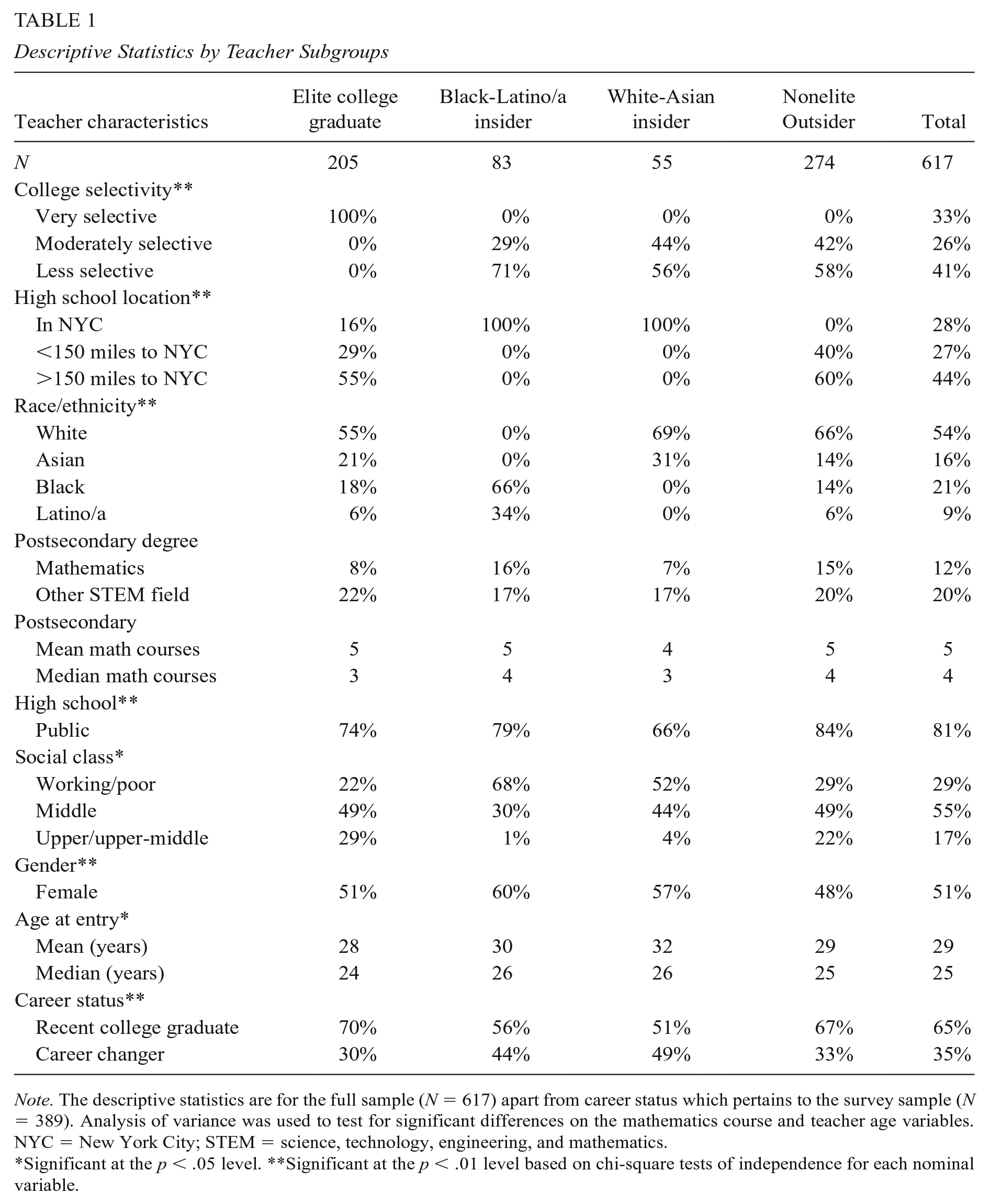
Note. The descriptive statistics are for the full sample (N = 617) apart from career status which pertains to the survey sample (N = 389). Analysis of variance was used to test for significant differences on the mathematics course and teacher age variables. NYC = New York City; STEM = science, technology, engineering, and mathematics.
Significant at the p < .05 level. **Significant at the p < .01 level based on chi-square tests of independence for each nominal variable.
ECGs comprised a third (33%) of the NYCTF mathematics teacher population (Table 1). Recruited from the nation’s most selective colleges, they hailed from all over the United States and, to some extent, the globe (e.g., Chile). Most were community outsiders; only 16% were NYC high school graduates. Compared with all others, a significantly higher proportion of ECGs were graduates of private high schools. Although 22% had completed a postsecondary degree in a STEM field, only 8% had completed a postsecondary degree in mathematics. ECGs were the youngest subgroup typically entering teaching when they were 24 years old and only 30% were considered career changers by NYCTF. Although somewhat racially and ethnically diverse, ECGs were majority White (55%). A slim majority were female (51%). They were significantly more likely to be raised in upper or upper-middle class households than other NYCTF mathematics teachers. As this suggests, ECGs generally came from different social and economic circumstances than the predominantly Black and Latino/a students they would teach in NYC public schools.
BLIs comprised about 13% of the NYCTF mathematics teachers. They were approximately two-thirds Black and one-third Latino/a. A comparatively high proportion attended an undergraduate institution that Barron’s ranked as less selective or nonselective. Although not significantly different from all others, a modestly higher proportion of BLIs entered NYCTF with a postsecondary degree in mathematics. The majority (79%) graduated from a public high school (in NYC). BLIs skewed female and were few years older on average than ECGs and Nonelite Outsiders—but not White-Asian Insiders. Reflective of this, a comparatively large proportion of BLIs (44%) entered with prior career experience. BLIs also were more likely than others to have been raised in a working-class or low-income household. Thus, in many regards, BLIs seemed to resemble the low-income Black and Latino/a students they taught in neighborhood NYC public schools.
White-Asian Insiders comprised just under 9% of the NYCTF mathematics teachers. They were majority White (69%) and minority Asian (31%). The majority of White-Asian Insiders (56%) were graduates of less selective or nonselective colleges. Less than a quarter entered teaching with a postsecondary degree in mathematics or another STEM field. White-Asian Insiders were significantly more likely to have attended private high schools than the other teachers. As with BLIs, White-Asian Insiders skewed female. White-Asian Insiders were significantly older on average than all others and almost half (49%) were career changers. They were significantly more likely than ECGs and Nonelite Outsiders to have grown up in a working-class household—and, in this sense, were like BLIs.
Nonelite Outsiders were the largest subgroup, comprising about 44% of the NYCTF teachers. By subgroup definition, they graduated neither from a very selective college nor from a NYC high school. Most (84%) were public high school graduates. More than a third (35%) entered teaching with a postsecondary STEM degree and they were significantly more likely than ECGs and White-Asian Insiders—but not BLIs—to have earned postsecondary degree in mathematics. They were majority White (66%), tended to come from upper or upper-middle class (22%) and middle class (49%) backgrounds, and were equally split by gender. The typical Nonelite Outsider entered NYCTF when they were 25 years old, and most were recent college graduates (67%).
Reasons for Entry
NYCTF mathematics teachers cited many of the same reasons for becoming teachers irrespective of their subgroup membership. As the descriptive statistics in Table 2 show, the most highly cited reason-for-entry was “want[ing] a job with purpose or meaning” under the meaningful job subscale. The mean score for all four subgroups was well above “4,” which meant that most of the teachers identified this reason for entry as “very important” or “absolutely essential.” Two reasons-for-entry items that all four groups cited at similarly high levels of importance were: “wanting to make a social difference,” under the altruism subscale, and “the subsidized master’s degree,” under the alternative certification subscale.
NYCTF Mathematics Teachers’ Reasons for Entry, Reported by Subgroup
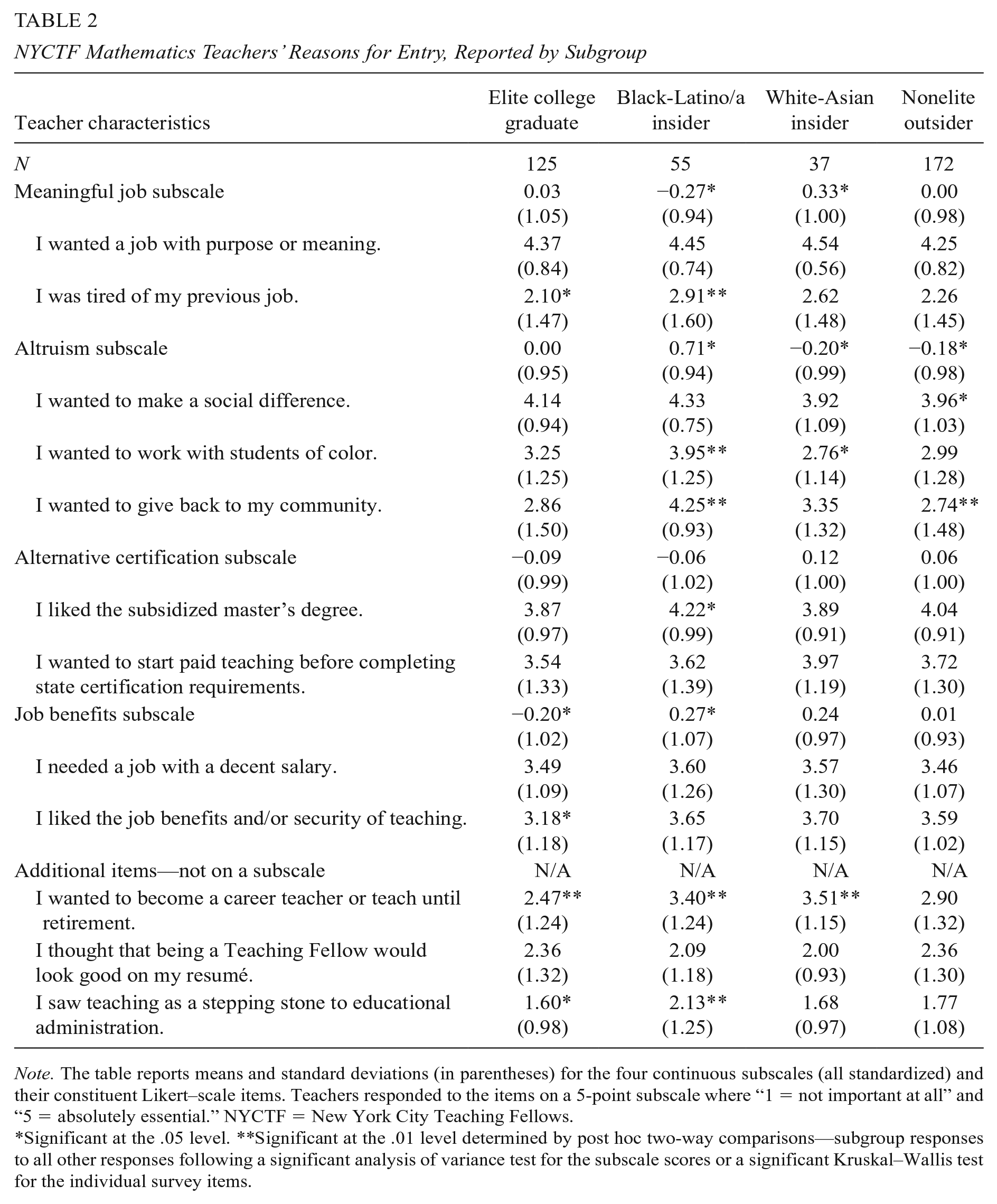
Note. The table reports means and standard deviations (in parentheses) for the four continuous subscales (all standardized) and their constituent Likert–scale items. Teachers responded to the items on a 5-point subscale where “1 = not important at all” and “5 = absolutely essential.” NYCTF = New York City Teaching Fellows.
Significant at the .05 level. **Significant at the .01 level determined by post hoc two-way comparisons—subgroup responses to all other responses following a significant analysis of variance test for the subscale scores or a significant Kruskal–Wallis test for the individual survey items.
As a group, ECGs expressed the least clarity about why they had entered teaching. As Table 2 shows, their scores were at or below the group mean on all four subscales and their mean scores on individual survey items were uniformly low. In terms of subgroup differences, their scores were significantly lower than all others on the following items: “[being] tired of my previous job,” “want[ing] to become a career teacher or teach until retirement,” and “[seeing] teaching as a steppingstone to educational administration.” The only item that ECGs collectively cited as more important than others was, “I thought that being a Teaching Fellow would look good on my resumé.” However, even on this item, their mean score was closest to a “2”—“of little importance.” Given the literature (e.g., Maier, 2012), one might have expected the ECGs to have emphasized resume building more than they did. The ECGs’ apparent lack of clarity about their reasons for becoming teachers might have been a function of their comparative youth and limited career experience (Table 1).
BLIs seemed to be much clearer about why they entered teaching. They were particularly motivated by altruism, scoring significantly higher on the altruism subscale than all others (p < .01); 0.71 SDs higher than ECGs, 0.91 SDs higher than White-Asian Insiders, and 0.89 SDs higher than Nonelite Outsiders. Under the altruism subscale, BLIs indicated that the following reasons were very or extremely important: “wanting to work with economically disadvantaged students,” “wanting to work with students of color,” and “wanting to give back to my community.” The BLIs’ reasons for entry also differed from those of the other NYCTF teachers in other regards. Consistent with the literature on Black and Latino/a teachers (e.g., Carver-Thomas & Darling-Hammond, 2017), they voiced a particular concern with the financial considerations of becoming a teacher, scoring significantly higher on the job benefits subscale than all others. And, under the alternative certification subscale, they cited the importance of “subsidized master’s degree” at a significantly higher rate than others. BLIs also were significantly more likely to have become teachers because they saw “teaching as a steppingstone to educational administration,” suggesting that public education promised to be a site for their upward career mobility.
White-Asian Insiders’ motivations for entry also were unique, scoring significantly higher on the meaningful job subscale (0.33 SDs, p < .05) and significantly lower on the altruism subscale (−0.20 SDs, p < .05). On the altruism subscale, White-Asian Insiders cited “want[ing] to work with students of color” as less important than all other subgroups—a clear difference between BLIs and White-Asian Insiders. A post hoc analysis showed that White Insiders and Asian Insiders alike cited this item at similarly low rates. White-Asian Insiders also reported “want[ing] to become a career teacher or teach until retirement” at a significantly higher rate. A post hoc analysis indicated that this latter result was due, in large part, to the high proportion of career changers in their ranks.
Early-Career Retention
Collectively, as shown in Table 3, the NYCTF mathematics teachers exhibited considerable early-career turnover. A sizable proportion (15.1%) left their first school at some point during their first school year—at least 6 weeks before it had ended. Of those that did, about four in five left the district rather than move to a second district school. About 3 in 10 (30.9%) of the teachers left their first school prior to completing the 2-year commitment to the district, and only a minority moved to a second district school. Table 3 also shows that the subgroups exhibited markedly different early-career turnover rates with ECGs exhibiting significantly higher rates than all others. For their part, both Black-Latino/a and White-Asian Insiders exhibited comparatively low rates of first- and second-year turnover. To be clear, these early-career turnover results do not control for school context and teacher background.
Descriptive Rates of First- and Second-Year Turnover by Teacher Subgroups
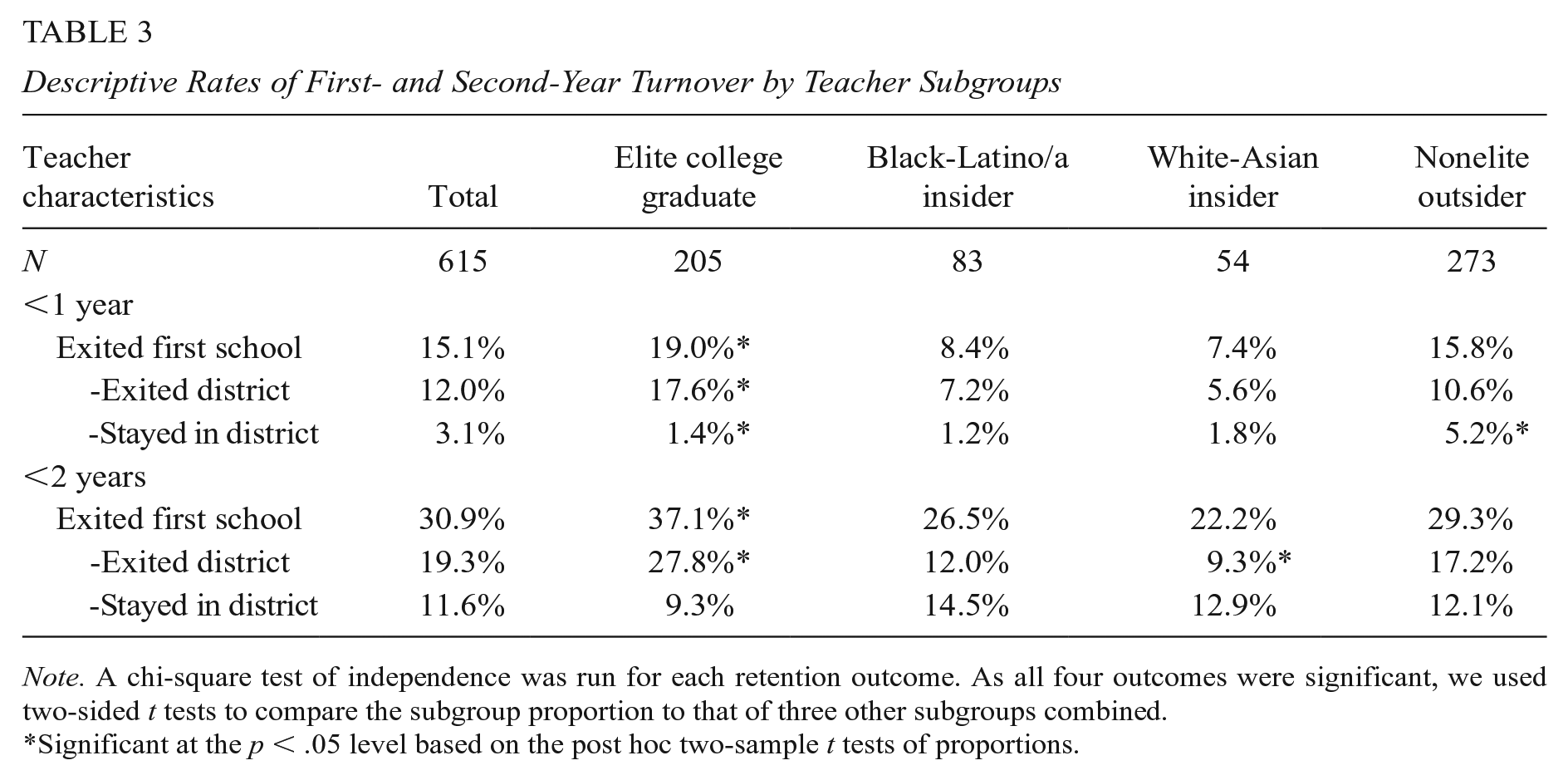
Note. A chi-square test of independence was run for each retention outcome. As all four outcomes were significant, we used two-sided t tests to compare the subgroup proportion to that of three other subgroups combined.
Significant at the p < .05 level based on the post hoc two-sample t tests of proportions.
Table 4 provides models of the NYCTF mathematics teachers’ retention at 5 years with controls for school context and teacher background included. These models estimate the odds ratios for teachers remaining based on each variable. Beginning with the first row, the models estimate that, in comparison with Nonelite Outsiders (the comparison group), ECGs had lower odds of remaining in—and thus higher odds of leaving—their first schools, the district, and the profession within their first 5 years. Specifically, the first model estimates that the odds of ECGs remaining in their first schools for 5 years were about 60.7% the odds of Nonelite Outsiders remaining (p < .05). The second model estimates that the odds of ECGs remaining in the district at 5 years were 52.6% of the odds of Nonelite Outsiders remaining (p < .01). The third model estimates that, 5 years after entry, the odds of ECGs working in any K-12 setting as a teacher or administrator were 50.8% of the odds of Nonelite Outsiders doing the same (p < .01).
Logit Models of Retention in First School, District, and K–12 Education at 5 Years
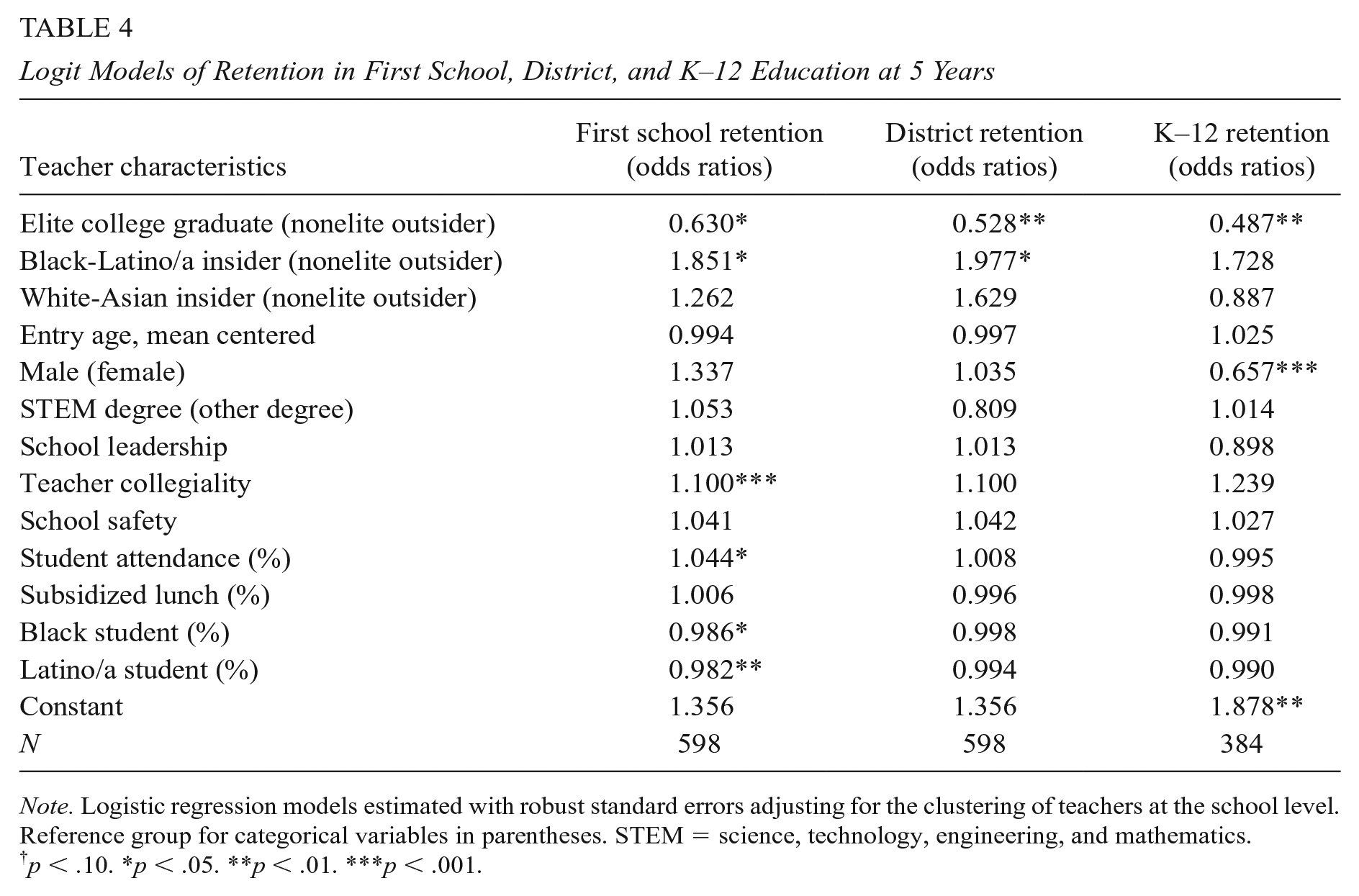
Note. Logistic regression models estimated with robust standard errors adjusting for the clustering of teachers at the school level. Reference group for categorical variables in parentheses. STEM = science, technology, engineering, and mathematics.
p < .10. *p < .05. **p < .01. ***p < .001.
In contrast, BLIs had higher estimated odds of remaining for 5 years in their first schools, the district, and the profession than Nonelite Outsiders. Specifically, the first model estimated that the odds of BLIs remaining in their first schools were 85.1% higher than those of Nonelite Outsiders (p < .05). The second model estimated that the odds of BLIs remaining in the district were 97.7% higher than those of Nonelite Outsiders (p < .05). As Table 4 models used Nonelite Outsiders as the comparison group, as a post hoc step, we used Stata’s linear combination (i.e., “lincom”) command to test whether the retention outcomes of ECGs, BLIs, and White-Asian Insiders differed significantly from each other under the modeled conditions. We found that the (a) difference between ECGs and BLIs was significant at the .01 level for all three retention outcomes, (b) difference between ECGs and White-Asian Insiders was significant at the .01 level for first school retention and at the .05 level for district retention but not significant for professional retention, and (c) difference between BLIs and White-Asian Insiders was not significant for any outcome.
We conducted two post hoc analyses to check the robustness of the 5-year retention results. First, to determine how our classification of the graduates of a very selective college and a NYC high school as ECGs might have affected the results, we reclassified these teachers as either BLIs or White-Asian Insiders and reran the regression analyses. This classification decision seemed to have little effect on the main results as the magnitude and significance levels of the odds ratios of the post hoc models were very similar to those for Table 4 models. In fact, the post hoc models would have modestly strengthened the results about the ECGs’ comparatively low levels of retention, decreasing the odds ratio estimates for their first school and district retention from 0.630 to 0.580 and 0.528 to 0.453, respectively.
Second, we conducted a separate post hoc analysis that ran the district retention model for the subsample of teachers who left their first school within their first 5 years to estimate the first school leavers’ odds of leaving the district by subgroup. Although not reported in Table 4, the odds ratios in the post hoc model were similar in magnitude and significance to those in the district model for the full mathematics teacher population. The restricted model specifically estimated that, among the first school leavers, the estimated odds of ECGs remaining in the district at 5 years were 0.538 times those of Nonelite Outsiders (p < .05) and the estimated odds of BLIs remaining were 1.756 times those of Nonelite Outsiders (not significant). Consistent with this, BLIs were much more likely than ECGs to move to another district school (p < .05) rather than leave the district.
Career Trajectories
The teaching and post-teaching trajectories of ECGs and BLIs were significantly different. As the descriptive statistics in Table 5 show, 10 years after entry, in comparison with all others, a significantly lower proportion of ECGs (31.0%) remained in the district. In contrast, and in comparison with all others, a significantly higher proportion of BLIs (63.6%) and White-Asian Insiders (62.1%) remained in the district in some role. Among those who stayed in the district, comparatively high proportion of BLIs became teacher leaders or school administrators, whereas a comparatively high proportion of White-Asian Insiders remained in a teaching-only role. These modest differences suggest that the Insiders’ career experiences and decisions may have been racialized to some extent or that BLIs and White-Asian Insiders had different career aspirations.
Career Status a Decade After Entry by Teacher Subgroup

Note. Based on surveyed subsample, N = 389. A chi-square test was used on a table that included observed (nonpercentile) data for the indented rows and bottom three rows combined. This showed that the teachers’ distributions to different occupational sectors were nonrandom, χ2 (24, N = 389) = 37.39, p = .040.
Significant at the p < .01 level based on two-sided t tests adjusted using a Bonferonni correction (with an individual subgroup compared with all others for each row).
Many of the NYCTF mathematics teachers who left the district, but particularly the community outsiders, migrated to a public school or other K–12 organization (e.g., private school, international school). By the end of the decade, 18.3% of ECGs (who were mostly community outsiders) and 15.8% of Nonelite Outsiders were working as a K–12 teacher or school administrator outside of NYC public schools whereas this held for only 9.1% of BLIs and 8.1% of White-Asian Insiders. On the 2016 survey, some clarified that they left the district to be closer to their childhood homes or extended families.
A decade after entry, higher proportions of ECGs and Nonelite Outsiders were working in the non-K–12 education sector than BLIs and White-Asian Insiders, although this difference was not statistically significant. Although a few were in leadership positions, ECGs in the non-K–12 education sector generally were working in mid-level positions in educational nonprofit, charter, and philanthropic organizations 10 years after entering NYCTF. Smaller proportions were working as tenure-track professors, full-time instructors, and part-time adjuncts in institutions of higher education. In contrast, very few Insiders of any race had found employment in nonprofit, philanthropic, and other (non-K–12) education sector organizations, except for one Black female who had launched her own education technology company. A few Insiders were working as tutors and adjunct instructors in postsecondary institutions. Among those in the non-K–12 education sector, the Insiders generally seemed to be in low-status positions than the ECGs.
ECGs also were significantly more likely than the other subgroup members to be working outside of education a decade after entering NYCTF. Of those, approximately 20% were in finance (e.g., wealth management consultant, financial research analyst), approximately 15% to 20% were in engineering or architecture, 10% to 15% were in information technology or software development, and 5% to 10% were in research as data analysts or archivists. Smaller proportions were in the health sector, as nurses and doctors, or in the legal sector, as lawyers or legal clerks. In general, and consistent with the “return on investment” of elite college degrees, ECGs who had left teaching were working in higher status occupations and earning higher incomes. In contrast, smaller proportions of BLIs and White-Asian Insiders were working outside of education. Many of those were had found jobs in engineering, information technology, and other technical fields. A few also were in the health sector as nurses or nurses’ aides. In contrast to ECGs, none of the Insiders were in finance a decade after teaching. In general, irrespective of race, Insiders working outside of education were earning salaries that were comparable with those of 10-year teachers. The Insiders either had different career opportunities or had different career aspirations than ECGs.
Reasons for Leaving or Staying
Although they left at different rates, members of the different teacher subgroups reported similar reasons for leaving their last NYC public school and hence the district. (For 52% of the district leavers, the last school was their first district school, for 35% it was their second district school, and for 13% it was their third, fourth, or fifth district school.) The teachers only differed statistically by subgroup on two of 29 items on the reasons-for-leaving inventory. In general, the district leavers reported that they left their last NYC public school due to a mix of organizational issues including dissatisfaction with the principal (32.7%), other school administrators (26.9%), staff dynamics (22.2%), student discipline (32.7%), and school safety (11.4%). About 20% of district leavers cited a “disenchantment with teaching mathematics” as a “very important” or “extremely important” reason for leaving. Some reported leaving their last school due to frustrations with accountability policies, namely, how “student assessments and/or school accountability measures impacted my teaching” (17.5%) and “the influence that standardized tests had on the curriculum” (16.8%). A small proportion of leavers reported leaving due to dissatisfaction with job benefits and their teacher salary (9.8%).
Although generally citing similar reasons for leaving, there were two clear differences by subgroup. First, a significantly higher proportion of ECGs and Nonelite Outsiders cited dissatisfaction, “with the large number of students I taught” as an “extremely important” or “very important” reason for leaving; specifically, 11.1% of ECGs and 9.0% of Nonelite Outsiders did so, whereas 2.9% of White-Asian Insiders and 2.1% of BLIs did so. Second, a significantly higher proportion of ECGs and Nonelite Outsiders also cited dissatisfaction, “with the influence standardized tests had on the curriculum” as an “extremely important” or “very important” reason for leaving; specifically, 17.6% of ECGs and 19.5% of Nonelite Outsiders did so, whereas only 8.6% of White-Asian Insiders and 8.3% of BLIs did so.
Finally, the 2016 survey prompted those teachers who had remained in their first NYC public school for close to a decade to list their school’s organizational attributes that explained their retention. Members of all four subgroups named “administrator support” and “teacher collaboration” as their top two reasons for staying. At the same time, a higher proportion of BLIs cited “teacher collaboration” and “teacher collegiality,” whereas a higher proportion of ECGs cited “teacher talent” and “student diversity” as explaining their longevity in their first NYC public school.
Discussion
In this study, we investigated the career trajectories of four mathematics teacher subgroups who entered teaching through the nationally prominent selective alternative certification program NYCTF. Drawing on CRT and QuantCrit methodology, we concentrated on the retention and trajectories of ECGs and BLIs. The goal was to depict their teaching and post-teaching trajectories, what motivated members of the different subgroups to teach in low-income neigh-borhood urban schools, sustained some in the field, and compelled others to leave. We found that, although there were commonalities, the career trajectories, career decisions, and retention of ECGs and BLIs differed significantly from each other as well as those of the other subgroups. As discussed after the Limitations section, the differences were so marked that there are clear implications for policy, programs, and practice.
Limitations
There were several study limitations. First, the survey data relied on teachers’ retrospective reporting about their career decisions. Teachers’ memories about past events might change, and in addition, some might provide socially desirable responses. Second, NYCTF teachers who left the district during the first year were undersampled on the 2016 survey. Thus, selection bias may have influenced the descriptive results. However, the retention results (Tables 3 and 4) were based on the full NYCTF mathematics teacher population and thus not subject to selection bias. Third, due in part to space limitations, the current study did not examine influence of training and induction on the career trajectories of the teachers although we examine this elsewhere (Brantlinger et al., 2022). Fourth, being specific to NYCTF mathematics teachers, the results may not generalize to teachers from other initial certification programs. However, the results about the early-career retention of ECGs are consistent with extant research on teachers from selective alternative route programs like TFA (e.g., Donaldson & Johnson, 2010) and the results about BLIs are consistent with results—and assumptions about superior rates of retention—in the literature on community-based teachers (e.g., Gist et al., 2019). Fifth, we ran multiple tests of comparisons which meant that Type 1 error was an issue. Thus, some significant differences reported in the descriptive statistics (e.g., Table 2) may have been identified as statistically significant when they should not have been.
Sixth, being quantitative, the study did not produce a robust critical counternarrative that a qualitative CRT study might provide, nor did it give qualitative depth to participants’ voices, nor did it capture the institutional racism that many teachers of color face. That said, the results about ECGs run counter to dominant narratives about how academically elite, and predominantly White, teachers help to address staffing issues and improve the organizational functioning of neighborhood schools that serve low-income, minoritized students (see, for example, Higgins et al., 2011). Further, consistent with QuantCrit, we understand that the subgroup typology used in this study glosses the considerable within-group heterogeneity of those subgroups and, more broadly, that the ethnoracial identity categorizes we used—like those used in many quantitative studies of teacher retention—are dramatic oversimplifications of people’s actual ethnoracial identities. However, given the teacher recruitment presented in the Introduction, this typology is of practical import. Our assumption is that, for the most part, the teachers included in the BLI subgroup would be the most likely to be committed to remaining as teachers in schools that serve predominantly low-income Black and/or Latino/a student populations. This assumption is rooted in prior project research on NYCTF mathematics teachers (e.g., Cooley et al., 2021) and the literature on community-based teachers (e.g., Gist et al., 2019). A related assumption, drawn from Boyd et al.’s (2005) “draw of home” study, is that community outsiders on average seem to be less interested in remaining in NYC public schools for the long term than community insiders.
Implications for Policy and Practice
The costs of recruiting, developing, and replacing alternative route teachers are considerable. In the 2000s, NYC public schools spent approximately $50,000 on the recruitment, training, and induction of individual mathematics Teaching Fellows (Brantlinger, 2020). The search for replacements when NYCTF teachers exited district schools was at least $20,000. Thus, even modest improvements to teacher retention would have saved the district and the public a considerable amount of money, some of which could have been reinvested to improve teaching and learning in the district’s neighborhood schools. As important, teachers who stay can benefit the organizational functioning of low-income schools and the experiences and learning outcomes of students in them (e.g., Sorensen & Ladd, 2020).
A clear implication of this study is that NYC public schools and other diverse urban school districts would be wise to invest in teachers who are rooted in the community or school district in which they teach, that is, to invest in community teachers like BLIs and White-Asian Insiders and to divest in community outsiders like most ECGs. After controlling for first school contexts, the estimated odds of BLIs remaining in the district are at least double those of ECGs remaining in their first schools, the district, and the profession at 5 years (Table 4). An investment in BLIs also seems warranted as financial considerations appeared to weigh heavily on BLIs (Table 2) which is consistent with the literature on the financial barriers that many teachers of color face in becoming teachers (e.g., Carver-Thomas, 2018).
Some argue that ECGs’ high levels of turnover are acceptable under the assumption that they are more effective at raising student achievement than the mathematics and other teachers they work alongside in low-income neighborhood urban schools (e.g., Higgins et al., 2011; Lovison, 2022). But the evidence in support of this is mixed. Taken as a whole, this literature suggests that ECGs who enter through selective programs are not more effective than their colleagues, including many community insiders of color (Boyd et al., 2006; Brantlinger & Griffin, 2019). High levels of early-career turnover of ECGs in the kinds of low-income neighborhood schools many teach in likely have adverse effects on student learning beyond those attributable to individual teachers (Sorensen & Ladd, 2020). Even if those ECGs who stay in teaching were to offset the negative effects on student growth of those ECGs who leave (see Lovison, 2022), there are other outcomes to consider.
As noted, supporters of selective alternative route programs argue that, at least in the short run, ECGs will help to stabilize the teaching staffs in “high-needs” neighborhood urban schools, in particular, by replacing uncertified and substitute teachers with the “best and the brightest” college graduates (see Brantlinger, 2020). However, the fact that, in this study, more than a third (37.1%) of ECGs left their first school before fulfilling their 2-year commitment to the district (Table 3) suggests that they either maintain or exacerbate teacher staffing problems in these schools, forcing administrators to spend valuable time and resources searching for replacements.
Three factors seem to contribute to the ECGs’ high rates of early-career attrition. First, the majority entered teaching in their early 20s, had little prior work experience, and expressed uncertainty about their reasons for becoming teachers (Table 2). Second, as pertinent scholarship suggests (Maier, 2012), this study shows that ECGs have high-paying and high-status career alternatives, which likely makes exiting teaching easy and attractive when they find teaching is more difficult than or is not what they expected. As pass-throughs to future career opportunities, ECGs can capitalize on a short stint in urban school teaching in making their next career moves. Third, recruited nationally from the very selective colleges, most ECGs appeared to have little in common with the students they taught in NYC public schools. Their lack of prior social ties to students and others in the local community likely made their exits from NYC public schools less painful or costly socially than they otherwise might have been.
Proponents of selective alternative route programs (e.g., Higgins et al., 2011; TFA, 2018) argue that ECGs should not be judged solely on their high rates of turnover, positing that their post-teaching trajectories also be considered. They specifically claim that, after teaching, many ECGs move into the broader education and public sectors where they devote themselves to working on behalf of students who attend low-income public schools. There may be some truth to this. A decade after entering NYCTF, some 10% to 15% of ECGs were working in educational nonprofits and philanthropic organizations. However, once in these positions, it is unclear the extent to which their efforts benefit Black and Brown students like those they taught. However, their overrepresentation in non–public school leadership organizations demonstrates that ECGs benefit professionally from their urban teaching experience in a way that other NYCTF mathematics teachers do not. We view this as particularly problematic as educational nonprofits—often launched and run by elite “community outsiders”—hold considerable power in certain educational ecosystems inclusive of urban districts like NYC public schools (Au & Ferrare, 2015; see also Brantlinger, 2020). This is an issue that future research should investigate more deeply as it is an argument that sustains district and philanthropic investment in selective alternative route programs and their elite teacher recruitment efforts (Brantlinger, 2020).
Implications for Research
The study adds to a small number of quantitative studies that draw on CRT and fall under the umbrella of QuantCrit (Frank et al., 2021; Khalil & Brown, 2020). As with that research, this study specifically attempts to move quantitative research on teacher recruitment and retention beyond social- and racial-neutrality. CRT (e.g., Ray, 2019) informs our understanding of NYCTF as a racialized teacher recruitment organization that enables ECGs to capitalize on their racial and social class privilege to monopolize teaching opportunities in low-income, high-minority schools, despite their high rates of turnover. Wielding racial and social class power, ECGs retain the right to “use” these schools as stepping stones to advance their careers and, in some cases, to advance the prospects of the educational nonprofit and other organizations (e.g., NYCTF) that they have launched after finishing teaching (Au & Ferrare, 2015; Brantlinger, 2020). As this study shows, CRT and QuantCrit frameworks provide relevant lenses for other researchers to question policies that are identified or analyzed as if they are race-neutral. Replicating the study design using data from other teacher recruitment and certification programs could also provide valuable insights and support large-scale changes to teacher hiring and retention policies.
CRT and the growing scholarship on community teachers also moved us to focus on teachers with ties to the communities in which they teach which, in this study, were predominantly Black, Latino/a, and lower income. As indicated, a recent exhaustive literature review on community teachers and grow-your-own programs indicate that this study of teachers’ retention and career trajectories is unique in its focus on the relationship between teachers’ ties to the communities in which they teach. As noted, the retention gaps between BLIs and ECGs seem to be rooted, at least in part, by the nature of the ties they have to local communities and schools. At the same time, teacher race and ethnicity also are not unimportant, as the BLIs had moderately lower estimated odds of turnover than White-Asian Insiders after controlling for the climate and student demographics of the teachers’ first schools (Table 4).
Our results also contrast with extant research that shows that, nationally in the United States, Black and other minoritized teachers have higher rates of attrition than White teachers (e.g., Carver-Thomas & Darling-Hammond, 2017; Ingersoll et al., 2019). There are several explanations for this including: First, that nationally representative results may fail to adequately account for local school context, whereas our 5-year retention results came from models that included controls for both student demographics and school climate (Table 4). Second, and related, most NYCTF teachers started in low-income schools with high proportions of Black and/or Latino/a students, whereas nationally, Black and Latino/a teachers are two to three times more likely than White teachers to start in such schools (Carver-Thomas & Darling-Hammond, 2017; Ingersoll et al., 2019). Although White teachers may exhibit better rates of retention nationally, that does not mean that they will exhibit better retention than non-White teachers in schools that are predominantly non-White. Third, rather than simply distinguishing between teachers of different races, our teacher subgroup categories accounted for teachers’ ties to local communities (i.e., as graduates of NYC high schools) and the selectivity of their college in addition to race.
Finally, methodologically, this study illustrates to the value in collecting longitudinal retention and survey data on teachers. By tracking teachers’ career trajectories for a decade, this study was able to shed light on how long different types of teachers stay in teaching and the kinds of occupations that they move into if they leave teaching. Existing retention studies tend to be either cross-sectional, studying the year-to-year retention of teachers or short-term-longitudinal in the sense that they track cohorts of teachers through their first or second years. While both study designs provide valuable insights about teacher retention, they leave gaps in our understanding.
Footnotes
Acknowledgements
The authors thank the EEPA reviewers and Dr Ashley Anne Grant for their constructive editorial feedback on the article.
Declaration of Conflicting Interests
The author(s) declared no potential conflicts of interest with respect to the research, authorship, and/or publication of this article.
Funding
The author(s) disclosed receipt of the following financial support for the research, authorship, and/or publication of this article: This research was supported by the National Science Foundation (NSF) through Grant Number 1535251: Examining the Career Trajectories of Urban Math Teachers from a Selective Alternative Certification Program.

Authors
ANDREW BRANTLINGER, PhD, is an associate professor in the Department of Teaching and Learning, Policy and Leadership at the University of Maryland, College Park. His research focuses on mathematics education in and teacher preparation for urban school districts.
BLAKE O’NEAL TURNER, PhD, is an assistant professor in the Department of Educational Policy and Leadership at Marquette University. Her research illuminates and interrogates antiblackness in mathematics education through the use of critical race theory.
ANGELA VALENZUELA, PhD, is a professor in the Department of Educational Leadership and Policy at the University of Texas at Austin. Her research is in the area of community-based education, grow-your-own pathways, teacher retention, and Indigenous education.