




Abstract
This study examines the extent to which students obtain postsecondary credentials in the
Keywords
In this descriptive study, we use longitudinal, student-level administrative records from Kentucky to examine the extent to which students initially major in as well as eventually obtain postsecondary credentials in the CTE fields they choose in high school. Answering this question is important for at least two reasons. First, college completion and labor market returns vary considerably across fields. For example, among Kentucky community college students, the return to an associate’s degree in health (relative to a high school diploma) is estimated to be about US$4,000 per quarter, whereas returns for associate’s degrees in humanities or business fields are not statistically significant (Jepsen et al., 2014). In addition, there is some evidence that students do not always make informed choices (Long et al., 2015). Emerging evidence suggests that students from lower socioeconomic backgrounds are more likely to sort into programs and colleges with lower labor market returns (Lovenheim & Smith, 2022). If there is a close connection between high school CTE focus and college majors and credentials, it would provide additional evidence for the importance of helping students make informed choices early in their high school journeys. If the connection is weak, it is important to understand why students deviate from their initial choices despite significant commitment in high school.
Understanding the strength of the secondary–postsecondary connection in students’ field of focus also has implications for how quickly content specificity should progress over the course of a program of study. Progress in specificity, beginning with content relevant to all aspects of an industry or career cluster and leading to more occupation-specific instruction, was a new requirement of the most recent reauthorization of the Perkins Act in 2018. However, there is no specific guidance on how the mix of general and specific content should change over time. If most students change their field of focus from high school to college, it may suggest that content specificity should progress more gradually to afford students greater flexibility in the likely event that they switch focus later.
Empirical evidence on the extent to which students follow through on their high school CTE choices in college is limited. Although there is a rich literature on college major choices and education decision-making more generally (Altonji et al., 2012), similar research is relatively sparse when it comes to CTE despite an increasing attention to postsecondary transitions. This literature (e.g., Cellini, 2006; Dougherty, 2016; Neumark & Rothstein, 2006) has largely focused on whether participation in secondary CTE leads students to continue at the postsecondary level, a claim often made by CTE advocates. While this scholarship addresses an important question that continues the historical debates about whether CTE enhances or limits professional options and social mobility (Dougherty & Lombardi, 2016), it does so without differentiating among fields of focus. Recent studies have begun to explore heterogeneity across career clusters that students choose in high school and find large differences in college enrollment rates and annual earnings (Ecton & Dougherty, 2022). Less is known about the extent to which students from a particular high school career cluster go on to enroll in and earn credentials in a college major that aligns with the cluster. Answers to this question can help us understand why the ex ante return (the product of the probability of completing a college major and earnings contingent on completing a major) varies across fields of focus in high school CTE, and our study starts to fill in this gap in knowledge.
Our study is most closely related to a set of publications that used the Education Longitudinal Study of 2002 (ELS:2002; Gottfried & Plasman, 2018; Plasman et al., 2017, 2019) to examine the linkage between high school CTE coursework and college major choices. To our knowledge, this is the first study to use state administrative data to classify high school CTE focus and link this to postsecondary records. As discussed in further detail below, the use of administrative data mitigates multiple limitations of longitudinal surveys including high nonresponse rates, coder errors, and self-report errors.
This study contributes to the existing evidence on the connection between CTE course-taking in high school and college majors in several ways. First, the study provides an important update to the existing evidence with more recent data and a much larger sample. For example, the ELS:2002 followed a nationally representative sample of about 15,000 10th-grade students in 2002 from high school through college. By comparison, this study includes four cohorts totaling 190,000 students who graduated high school between 2013 and 2016. Second, previous studies on the topic have focused on the correlation between the number of CTE credits earned in a particular field in high school and college outcomes. Such a relationship may not be linear, and this study finds that passing a certain threshold—taking at least four CTE courses in high school with at least half of those courses in a single field of focus—is predictive of college major choices. Third, our study examines both declared majors at the start of college and the fields in which credentials were obtained. Studies that focus on earned credentials do not capture students who do not complete postsecondary credentials or how initial college majors may differ from earned credentials. Because 40% of college students do not complete any postsecondary credentials (Shapiro et al., 2018) and because students frequently switch majors in college (Astorne-Figari & Speer, 2019; Holzer & Xu, 2021), these studies exclude important information that could help high school students evaluate how their choices of CTE fields may be related to the chances of completing postsecondary credentials in those fields.
We find that focusing on a given CTE field in high school is associated with initially choosing that same field in college and ultimately obtaining a postsecondary credential in that field, especially in health fields. The secondary–postsecondary connection is the weakest among students choosing occupational fields in high school, who are also the most disadvantaged socioeconomically and academically before high school. Even across very broadly defined fields, however, most students major in and obtain credentials in fields that are different from the field of focus in high school. We also find that close to a third of CTE-oriented high school students (those who took at least four CTE courses) spread high school CTE coursework across multiple fields. This could reflect the career exploration goal of high school CTE programs, although it may also raise concerns about haphazard course choices. Finally, consistent with prior studies, we find that CTE concentration is associated with being more likely to attend a 2-year college and less likely to attend a 4-year college (e.g., Cellini, 2006; Cowan et al., 2019).
In the sections that follow, we first review the existing evidence on the association between fields of concentration in high school and college. We then discuss the data, sample, and methods used in this study, followed by a presentation of our findings. Finally, we discuss the policy implications of our findings.
Secondary–Postsecondary Persistence in Career Interests
The choice of college major has been extensively studied. Economic theories, for example, posit that college major choice is influenced by expectations of future earnings, preferences, ability, and preparation (Altonji et al., 2012). In the framework of a Roy-type model, choosing a college major is a sequential, dynamic decision-making process, which is affected both by the unobserved correlation between preferences for education and the determinants of wages and by whether individuals are aware of (and respond to) the expected labor market payoffs to different paths (Altonji et al., 2012).
This research has produced valuable insights that should be considered in CTE program designs. For example, Baker, Bettinger, Jacob, and Marinescu (2018) found that most community college students in their study sample were unable to rank expected earnings and probability of employment across broad categories of majors. This may suggest that high schools can help students make informed major choices by providing them with information on labor market prospects by profession. However, empirical evidence also demonstrates that expected earnings have very little impact on college major choices and nonpecuniary factors are more important determinants (Beffy et al., 2012; Stinebrickner & Stinebrickner, 2011). In addition, female students appear to be less responsive to information on expected earnings than male students (Ding et al., 2021), which is consistent with an earlier finding that nonpecuniary factors matter much more for women than men when it comes to college major choices (Zafar, 2009).
Less is known about the association between high school curriculum and college major. Much of this body of work focuses on science and math coursework in high school and demonstrates a close relationship between taking advanced coursework in math and science in high school and obtaining a Science, Technology, Engineering, and Mathematics (STEM) degree (Gurantz, 2021; Warne et al., 2019). The relationship is stronger for men than for women (Tyson et al., 2007), and gaps in math achievement as early as in middle school were found to affect students’ entry into a STEM field later (Sass, 2015).
Turning to research on CTE in particular, empirical evidence from a set of closely related studies suggests that high school students who take more courses in a high school CTE cluster are more likely to earn postsecondary credentials in the same cluster. Like this article, these studies are based on regressing postsecondary outcomes on CTE course-taking in high school, controlling for observable student characteristics including demographic information and some measure of prior achievement. For example, Plasman and colleagues (2017) found that each additional health CTE credit earned in high school increased the likelihood of a student earning a postsecondary credential (associate’s, bachelor’s, or postgraduate degree) in health by 11.1 percentage points. The association was weaker for other career clusters but remained statistically significant. Gottfried and Plasman (2018) added evidence on engineering, demonstrating that taking more engineering CTE courses in high school was associated with a higher likelihood of completing a bachelor’s degree or higher in engineering, but not an associate’s degree in engineering. The authors also found that the strength of the association between high school and college engineering was stronger for women than for men.
Plasman and colleagues (2019) also found that CTE course-taking in high school was linked to overall CTE course-taking in the first year of college. However, the relationship varied by areas of focus, and was significant only for 4-year college students. Focusing on declared college majors, Gottfried, Bozick, Rose, and Moore (2016) reported that students who received credit for a STEM course in high school were more likely to major in applied STEM in college than students who did not to major in applied STEM in college. However, the relationship is not statistically significant among 2-year college students, nor is it significant among students with disabilities (Gottfried et al., 2014).
The empirical basis for the connection between the fields of concentration in high school and college majors is limited in four ways. First, a homogeneity of data sources: all prior evidence except for that presented by Gottfried et al. (2014), who used the National Longitudinal Survey of Youth 1997 (NLSY97), 2 is based on ELS:2002. Second, the strength of the existing evidence is moderated by several disadvantages typically associated with survey data. For example, nonresponse is a great challenge for longitudinal surveys. Liu and Burns (2020) noted that just over half of the baseline ELS:2002 sample graduated from high school with complete high school transcripts, which are necessary to categorize high school CTE coursework. The authors found that nonresponse bias could only be reduced but not eliminated by applying nonresponse adjustments. 3 Similarly, Gottfried and colleagues (2014) reported that high school transcripts were collected for 69.4% of the baseline NLSY97 sample. To study college outcomes, data from additional waves of follow-up are required, which likely exacerbates survey nonresponse. 4 Third, classification of high school CTE courses poses another challenge in these surveys. Course classification depends on the judgment of coders. The way in which courses are classified varies depending on whether they are coded using the Classification of Secondary School Courses (Ingels et al., 2007) or the School Courses for the Exchange of Data (Liu & Burns, 2020). The fluidity of course classification suggests that course types (academic, vocational, or enrichment) may not accurately reflect the course types intended by local school districts and states. Finally, a challenge of using ELS:2002 and NLSY97 is that declared college majors were collected through interviews of respondents in both surveys. In addition to errors typically associated with retrospective self-reports, staff coding of verbatim responses may introduce another source of error (Ingels et al., 2007).
Context, Data, and Measures
CTE in Kentucky
Secondary CTE in Kentucky is delivered in both comprehensive high schools and technical centers. CTE curricula are organized by CTE programs that are aligned with career clusters and career pathways recognized by the U.S. Department of Education Office of Career, Technical, and Adult Education and Advance CTE. Kentucky Department of Education (KDE) publishes a set of “best practice courses” for each pathway every year.
In addition to taking CTE courses, students have other opportunities to enhance CTE participation and meet career readiness goals. For example, students can receive credit from both high schools and postsecondary institutions by completing dual credit courses. Students are considered career ready if they receive at least two CTE dual credits in a single CTE program area. Students also can earn articulated credits at participating postsecondary institutions by passing CTE end-of-program (EOP) assessments developed by the state. These EOP assessments, collectively known as the Kentucky Occupational Skill Standards Assessment (KOSSA), are currently available in 30 or so CTE program areas.
Kentucky also offers programs to support students to earn industry certificates. The Tech Ready Apprentices for Careers in Kentucky (TRACK) program is designed to provide students with opportunities to transition into a Registered Apprenticeship program after graduating high school. Kentucky high school students also can earn industry certification or stackable credentials toward certification while in high school. These industry-recognized certificates (IRCs) are regularly verified and updated by KDE and the Kentucky Workforce Innovation Board based on input from the local workforce investment board (WIBs) about job demands for the region.
Data and Measures
We use administrative records from four cohorts of all high school graduates from Kentucky public schools between school years 2013 and 2016. Longitudinally linked data, compiled by the Kentucky Center for Statistics, track these students from the eighth grade through high school and into college.
Secondary school data include student background characteristics such as race/ethnicity, sex, school lunch eligibility, special education status, and limited English proficiency; test scores on end-of-grade and end-of-course standardized tests as well as the ACT, which is mandatory for all high school juniors in the state; and transcript data. We use student characteristics and eighth-grade test scores as control variables in this study. Controlling for pre–high school student proficiency instead of measures of high school proficiency, which are often used in this type of research, is important since postsecondary decisions may occur in middle school or earlier (e.g., Roderick et al., 2006; Swail & Perna, 2002; Wimberly & Noeth, 2005). Moreover, high school grades and test scores are likely affected by the types of courses that students choose to take in high school; therefore, they are not ideal baseline controls to use when comparing CTE concentrators and otherwise similar non-concentrators.
High school transcripts provide the detailed course-taking data required to identify CTE courses reported by each school using Kentucky Uniform Academic Course Codes. Using the first two digits of the course number, we can systematically identify the types of courses as intended (academic, CTE, enrichment, etc.). Using guidance from official KDE documents, we arrange high school CTE courses into four broad categories: applied STEM, occupational fields, health, and business (Kentucky Department of Education, 2019). Whereas the health and business categories are self-explanatory, applied STEM includes subjects that tend to require some STEM coursework such as computer and information sciences, data processing, engineering technology, and agricultural sciences. The occupational category includes the remaining subjects such as criminal justice administration, teacher assistant/aide, social work, childcare, and fire science/firefighting. 5
The definition of a high school CTE concentrator is not uniform. In past U.S. Department of Education reports, CTE concentration was defined as either completing three or more CTE credits in an occupational field (e.g., Hudson & Laird, 2009; Levesque et al., 2008) or taking three or more CTE courses in a career cluster (e.g., U.S. Department of Education, 2014). The current federal legislation, Perkins V, changed its definition of CTE concentrator from completing at least three courses in a single CTE program in Perkins IV to two (Strengthening Career and Technical Education for the 21st Century Act, 2018). State definitions of CTE concentrators at the secondary level also vary, with 15 states requiring three or more credits in a single occupational area, 18 states requiring other credit thresholds, and the remaining states applying other types of definitions (U.S. Department of Education, 2014). Research studies use completion of at least four CTE credits—regardless of field—to define CTE concentration (e.g., Cowan et al., 2019; Theobald et al., 2019) or enrolling in at least three CTE courses in an occupationally aligned programs of study (POS; e.g., Dougherty, 2016).
This study defines CTE concentrators as students who have taken four or more CTE courses in high school regardless of CTE field; as discussed below, results are robust to alternative definitions. In addition, if more than half of a CTE concentrator’s courses were in a particular field—for example, applied STEM—we consider that student to have a focus in that CTE field. 6 Our data in Figure 1 show the distribution of the number of CTE courses taken in high school. For bars that represent four or more courses, we also display fields of focus. We were unable to follow the current federal definition of CTE concentrator under Perkins V because that definition requires information about which career cluster a CTE course falls under, and we do not have that information. 7 However, one advantage of our definition of CTE concentrators is that it includes students who had a clear CTE orientation but were undecided about which field to focus on. In particular, Figure 1 shows that many students made a substantial commitment to CTE in high school but had no focus in any particular field. At a minimum, a CTE concentrator with a career focus under our definition would have taken four CTE courses, with more than two of those courses in the same field—a criterion slightly more stringent than the current federal definition but not necessarily so relative to other definitions described above. At the end of the “Results” section, we explore an alternative definition of CTE, and the results (presented in Supplementary tables) are not substantively different.
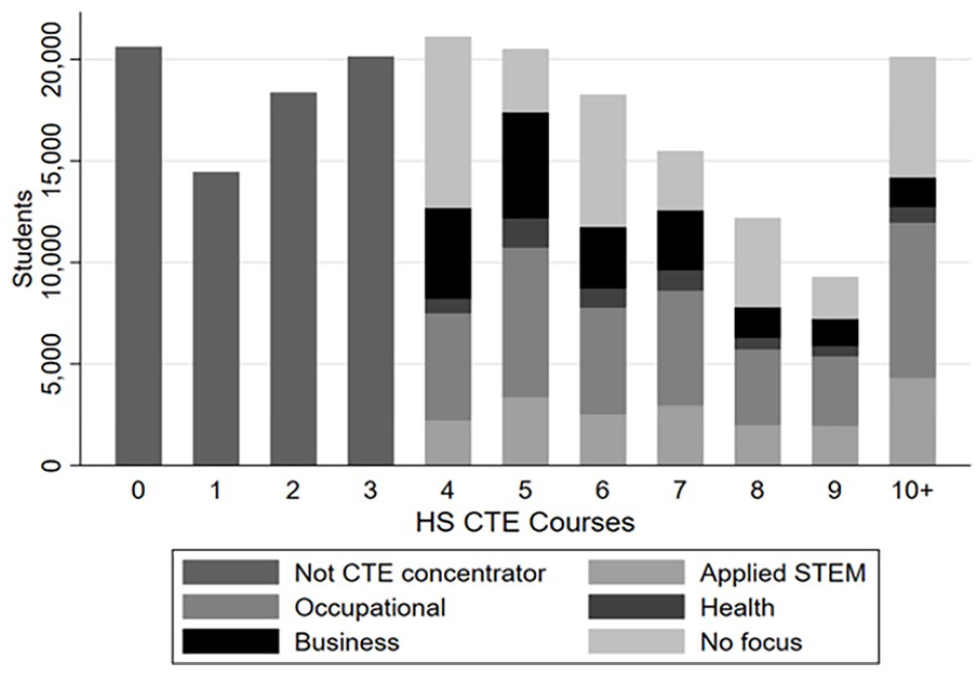
Distribution of high school graduates by the number of high school CTE courses taken and fields of concentration.
College data include all students attending postsecondary institutions, including both public and private 2- and 4-year colleges in Kentucky. A lack of data from students who enroll in out-of-state colleges is a potential limitation. However, National Student Clearinghouse data for the 2013 cohort of high school juniors—the last cohort for which Kentucky received out-of-state college attendance data for its public high school students—suggest that out-of-state enrollment accounted for less than 3% of students around the ACT college readiness benchmarks (Xu et al., 2022), which is the proficiency range in which most CTE-oriented students score. 8 As a result, the lack of out-of-state college enrollment data is not expected to have a material impact on the study findings.
College transcript data include students’ intended field of study and desired credential each semester. We use information collected in the semester when students first enrolled in college to categorize their initial college majors into distinct groups using Classification of Instructional Programs (CIP) codes: applied STEM, occupational fields, health, business, liberal arts, STEM, undeclared, and nondegree. The first four groups are aligned to the categorizations for high school CTE fields. The liberal arts group includes majors such as foreign languages, legal professions and studies, social sciences, and performing arts. STEM includes subjects that are not considered to be high school CTE subjects, such as the physical sciences, mathematics and statistics, biological and biomedical sciences, and engineering. 9
Information on declared major enables us to include students who failed to complete postsecondary credentials. However, declared major represents a stated preference, which does not always correspond to the courses and program in which students subsequently enrolled (Zeidenberg et al., 2015). As a result, in addition to the initially declared college major, we use college data to examine whether students earned credentials (including a certificate, diploma, associate’s degree, or bachelor’s degree) in a particular field of study within 4 years after graduating from high school.
Population Characteristics and Summary Statistics
Sixty-one percent of high school graduates in Kentucky took at least four CTE courses during the study period (Figure 2). 10 Among these CTE concentrators, 33% focused on an occupational field, 16% on applied STEM, 17% on a business field, and 5% on a health field. A large share (29%) of CTE concentrators did not focus on any single field.
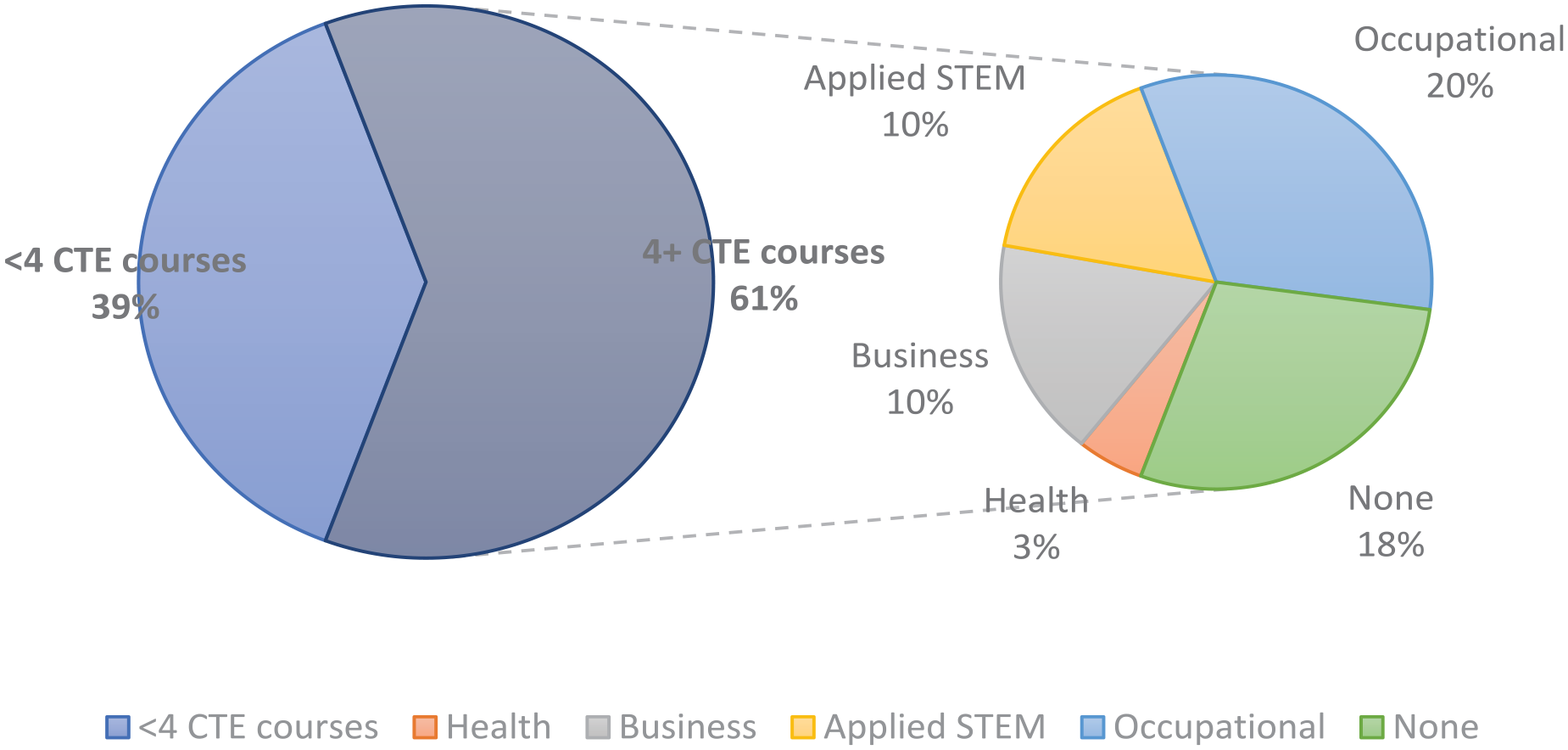
Percentage distribution of high school graduates by number of CTE courses and CTE focus in high school: 2013 to 2016.
Student Attributes
Table 1 summarizes the characteristics of the study population. The first column presents the characteristics of all high school graduates in Kentucky public schools between 2013 and 2016. Note that average test scores are positive because test scores are normalized for the entire population of Kentucky in eighth grade, and the sample used in the article consists of high school graduates. The next two columns present the contrast between high school CTE concentrators and non-concentrators. The remaining columns break out the CTE concentrator population by field of focus in high school.
Student Test Scores, Attributes, and College Outcomes, by High School CTE Concentration: 2013 to 2016
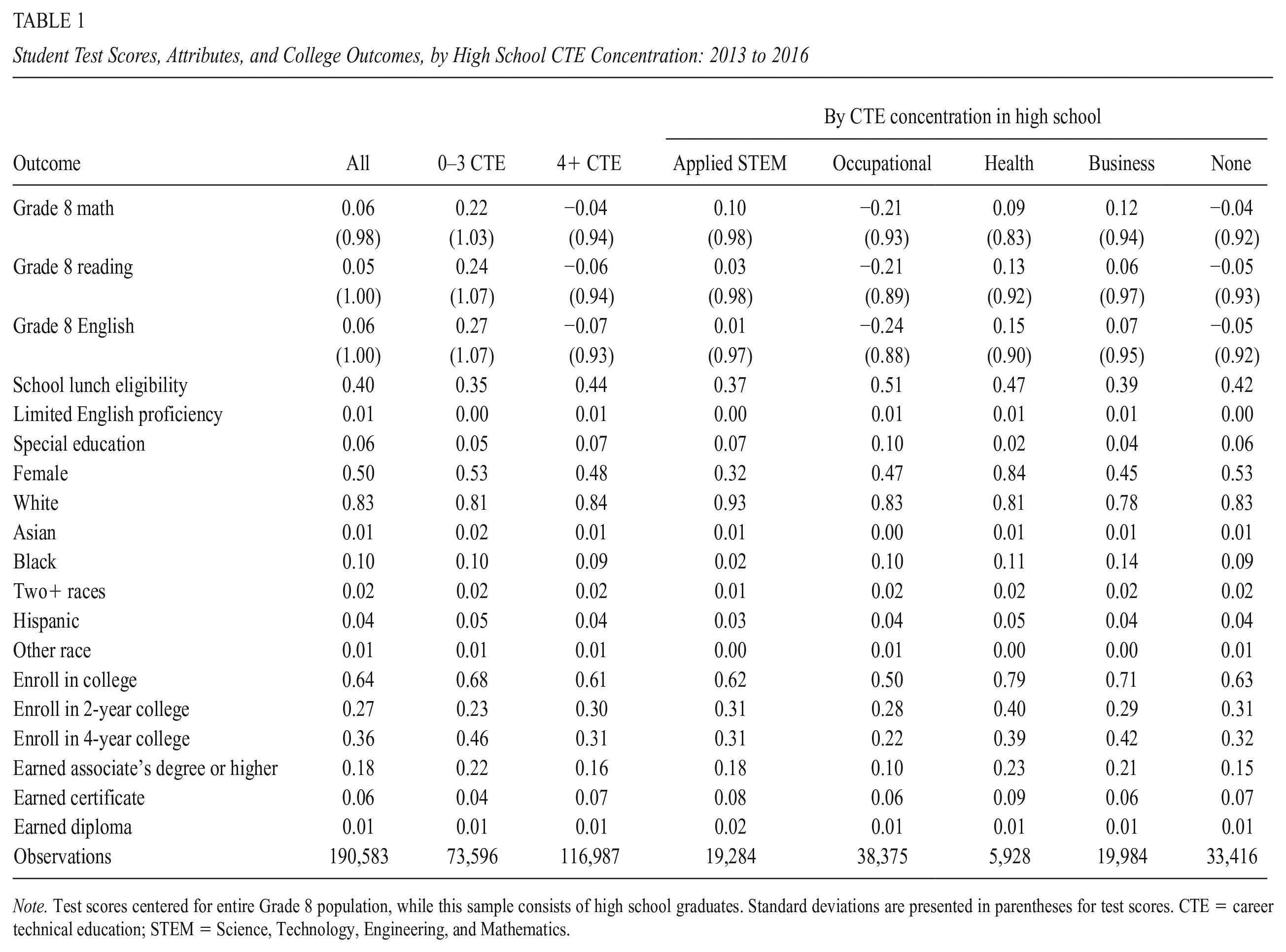
Note. Test scores centered for entire Grade 8 population, while this sample consists of high school graduates. Standard deviations are presented in parentheses for test scores. CTE = career technical education; STEM = Science, Technology, Engineering, and Mathematics.
CTE concentrators in high school score at least a quarter of a standard deviation lower than non-concentrators on eighth-grade state standardized tests in math, reading, and English (Columns 2 and 3). Proficiency gaps of this size suggest that CTE concentrators are at least a year behind non-concentrators academically before starting high school (Lipsey et al., 2012). Compared with non-concentrators, CTE concentrators in our study sample are also significantly more likely to be eligible for free or reduced-price lunch, to have limited English proficiency, to receive special education, to be White, and to be male. These patterns are consistent with Cowan and colleagues’ (2019) findings in Washington state.
Student attributes vary across fields of focus in high school. CTE students who focus on health and business in high school score higher on eighth-grade tests in math, reading, and English than CTE concentrators in other fields, although the test scores of health and business CTE students are still significantly lower than those of non-concentrators. CTE students in health and business also appear to be less likely to receive special education services than CTE concentrators in other fields. CTE concentrators who focus on occupational fields in high school tend to be the most disadvantaged. This group has the highest percentage of students eligible for free or reduced-price lunch (51%) and the lowest pre–high school proficiency, scoring between 0.43 and 0.51 of a standard deviation below non-concentrators on eighth-grade tests. This means that students who choose to focus on occupational CTE in high school are 2 years behind their peers academically before entering high school. We also see evidence of what Katz (2017) referred to as “identity mismatch”—the unwillingness of men to enroll in fields they associate with women and vice versa. Eighty-four percent of students who focus on health CTE are female, whereas among applied STEM concentrators only 32% are female.
As discussed in the “Method” section, although we include controls for test scores and grades prior to high school to account for the sorting of different types of students into different CTE fields, these sample selection concerns mean that the results do not necessarily have a causal interpretation.
College Choices and Outcomes
On average, CTE concentrators are more likely to enroll in a 2-year college (30%) than non-concentrators (23%) but less likely to enroll in a 4-year college (31% vs. 46%). Figure 3 depicts a more nuanced relationship among college enrollment, high school CTE concentration, and eighth-grade test score decile. The y-axis of the figure is the college enrollment rate among high school graduates, and the x-axis is the decile of academic proficiency measured by students’ eighth-grade test scores (averaged across math, reading, and English). High school CTE concentrators are represented by the solid line and non-concentrators by the dotted line. The left panel represents overall college enrollment. As expected, pre–high school academic proficiency is a strong predictor of enrollment in a 4-year college, regardless of CTE concentrator status in high school, although non-concentrators are more likely to enroll in college in every decile except the top. However, the middle and right panels, which show 4-year and 2-year college enrollment separately, show that the overall college enrollment picture masks important trends by type of postsecondary institution.

College enrollment by CTE concentration and achievement decile.
Although non-concentrators are more likely than concentrators to enroll in a 4-year college along the entire distribution of academic proficiency, the differences are the widest among students in the sixth to eighth decile. In contrast, the relationship between 2-year college enrollment and academic proficiency is not linear. For both concentrators and non-concentrators, 2-year college enrollment rates increase with pre–high school proficiency and peak at the fourth decile on the proficiency distribution. Enrollment rates in 2-year colleges decline as eighth-grade test scores increased above the fourth decile, but the decline is more precipitous for non-concentrators than for high school CTE concentrators. Among those who score in the 60th percentile or higher on eighth-grade tests, high school CTE concentrators are more likely to enroll in a 4-year college than in a 2-year college.
Table 1 (Columns 4–8) shows that college outcomes varied by field of focus in high school CTE. About 40% of students who focus in health and business CTE enroll in a 4-year college (compared with about 30% in applied STEM and among concentrators without a focus, and 22% in occupational fields), and more than 20% earn an associate’s degree or higher (compared with 18% in applied STEM and 10% in occupational fields). In fact, the likelihood of earning an associate’s degree or higher is not statistically different between non-concentrators and those who focus on health CTE. Across fields of focus, students who focus on CTE occupational fields in high school are the least likely to enroll in college or earn postsecondary credentials of any type. Overall, 61% of CTE concentrators and 68% of non-concentrators enroll in college during the study period. Among CTE concentrators, those who focus on health and business have the highest college enrollment rates (79% and 71%), and only half of students with an occupational focus enroll in college.
Alignment Between High School CTE Concentration and College Major
Among high school graduates who enroll in college, Table 2 presents the distribution of initial major choices in college and postsecondary credentials obtained (as rows) by CTE field of focus in high school (the organization of the columns is the same as in Table 1). On average, the distribution of initial major choices does not differ substantially between high school CTE concentrators and non-concentrators in fields other than applied STEM, health, and STEM. High school CTE concentrators are more likely to declare a major in applied STEM (10% vs. 6%) and health (13% vs. 10%), whereas non-concentrators are more likely to major in STEM (13% vs. 8%). Liberal arts is the most frequently declared major among both CTE concentrators and non-concentrators.
Percentage of Declared Majors and Obtained Postsecondary Credentials Among High School Students Who Enroll in College, by High School CTE Focus: 2013–2016
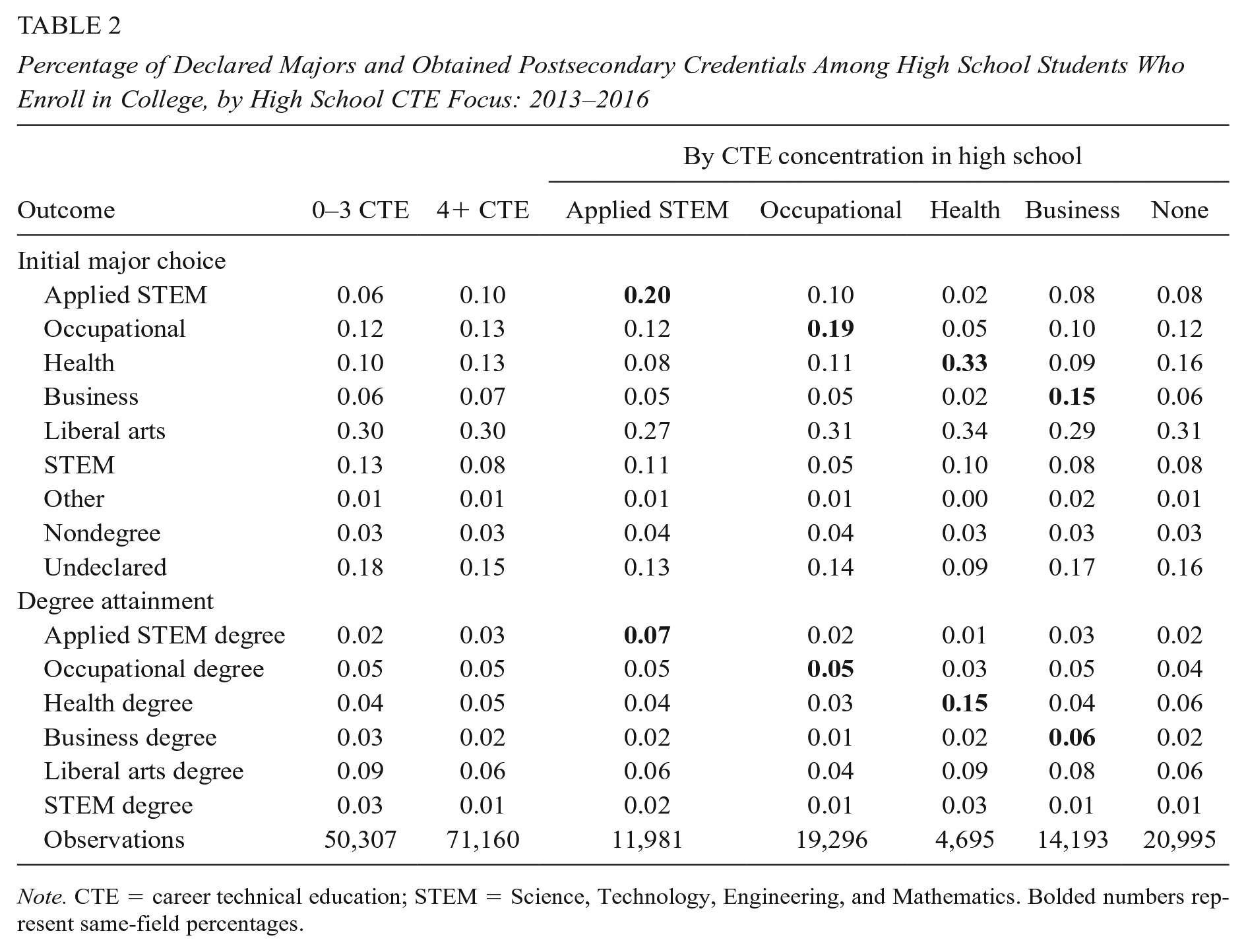
Note. CTE = career technical education; STEM = Science, Technology, Engineering, and Mathematics. Bolded numbers represent same-field percentages.
The association between initial major choices in colleges and CTE focus in high school is the strongest in health. One third of high school graduates who focus on health CTE in high school declare a health major in college, compared with 15% in business and about 20% in applied STEM and occupational fields. However, across all fields, most students declare a college major that is different from the CTE field they focus on in high school, and the most frequently declared college major is liberal arts. This may be expected to have labor market implications because the return to liberal arts, especially at the sub-baccalaureate level, tends to be lower than to other fields (Jepsen et al., 2014; Lovenheim & Smith, 2022). At the same time, we note that in the results below, CTE concentration in high school is associated with being less likely to initially choose liberal arts in college, especially for students who enroll in 2-year colleges.
In general, students in our sample who enroll in college are more likely to obtain postsecondary credentials in the same field as their high school CTE focus. The association is again the strongest in health, with 15% of health CTE students in high school eventually obtaining postsecondary credentials in health. However, most college students do not obtain postsecondary credentials in the field they focus on in high school. Even in health, 18% of high school health CTE students who enroll in college obtain credentials in a nonhealth field. Students who focus on applied STEM, occupational fields, and business in high school are 2 to 3 times as likely to obtain a postsecondary credential in a different field as in the same field. Finally, although 30% of students who enroll in college declare liberal arts as their initial college major, only 9% of non-concentrators and 6% of CTE concentrators obtain postsecondary credentials in liberal arts.
Method
Summary statistics in Table 1 show that students who later chose different CTE fields in high school differ substantially in attributes and pre–high school academic proficiency. It is therefore important to account for student heterogeneity when estimating the association between the high school CTE field and the likelihood of majoring in that field in college, as well as obtaining a postsecondary credential in the field. While we can account for observable differences among students, there are likely unobserved factors that led students to choose a particular field of CTE focus in high school. These same factors could also have affected postsecondary choices and outcomes. We estimate the following regression model:
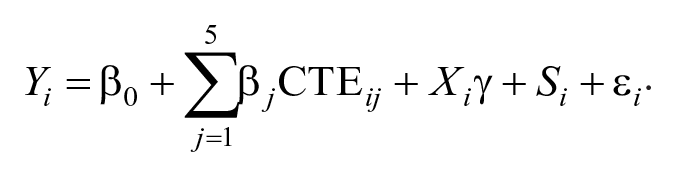
In this model, Yi = 1 if student i enrolled in college, chose a particular major, or obtained credentials in a particular field. CTE ij are indicator variables if student i was a high school CTE concentrator in field j. Xi is a vector of student attributes, including student race/ethnicity; special education status; limited English proficiency status; school lunch eligibility; eighth-grade test scores in math, reading, and English; and school-year means of each of these variables.
In an alternative specification, we also include eighth-grade grade point average (GPA) to account for student heterogeneity that may not be captured by test scores. Because the relationship between test scores and college outcomes is not linear (see Figure 3), we use cubic polynomials of test scores. To test the robustness of estimated associations, we also estimate logistic regression models with no school fixed-effects in an alternative specification. To allow for gender to fully interact with all covariates, we additionally estimate this model separately for female students instead of including it as one of the control variables. Finally, all regressions include high school cohort fixed-effects.
While the available data can capture a great degree of heterogeneity across students by including test scores and course grades prior to high school, these results should not necessarily be interpreted in a causal manner. It is difficult to separate the actual impact of being exposed to a particular CTE field in high school from a student’s interest in that field that led him or her to enroll in those courses in the first place. While we note that Dougherty (2018) found similar results for ordinary least squares (OLS) and regression discontinuity when examining the effect of enrolling in specialized vocational and technical high schools on later high school outcomes, this does not necessarily mean that controls fully account for sample selection in our setting. In particular, the treatment (chosen CTE focus in high school) and outcome (preference for college major) are very closely related in a way that controls may not be able to account for.
Results
College Enrollment Patterns
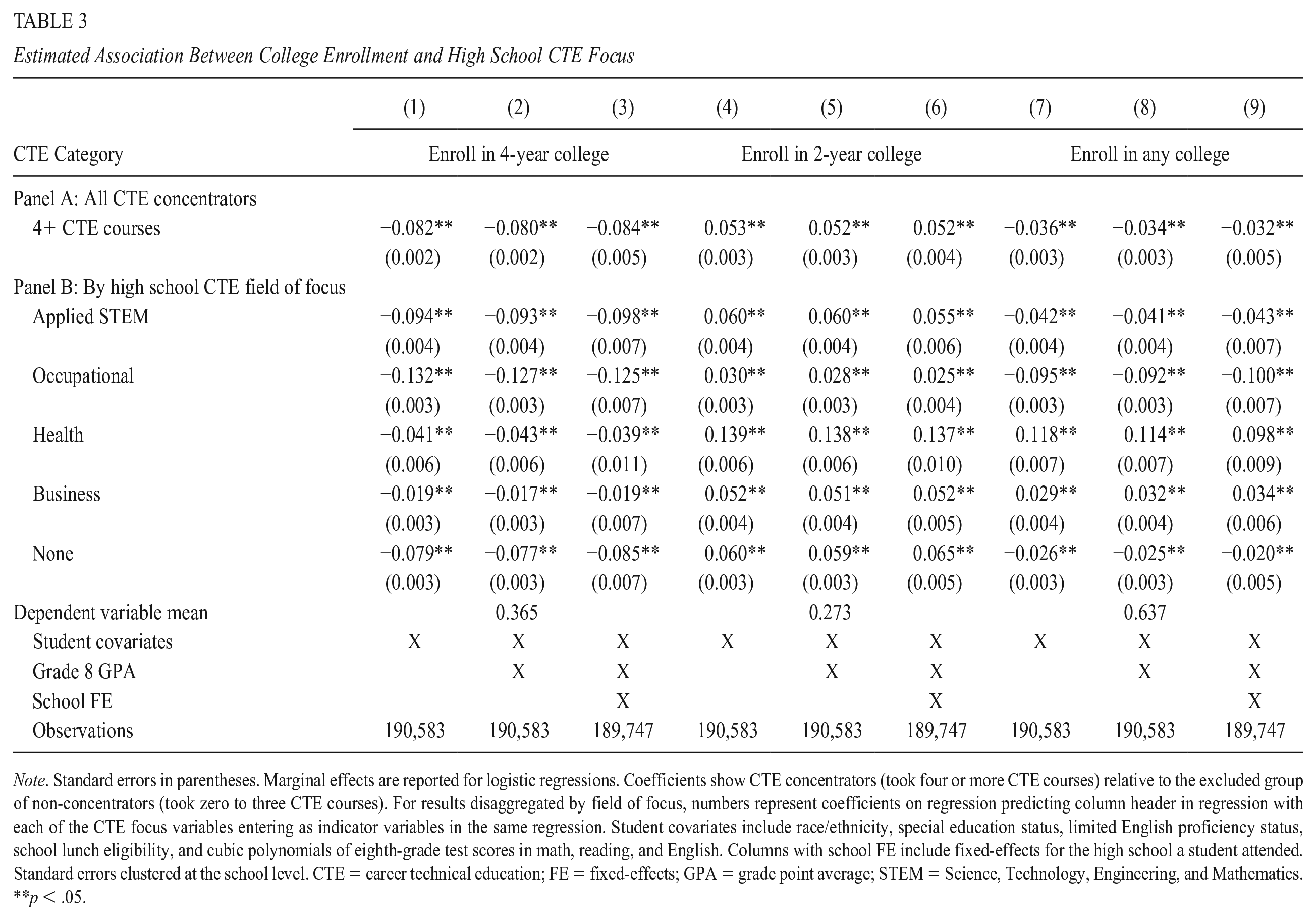
Table 3 reports the estimated association between college enrollment patterns and high school CTE concentration and field of focus. The first three columns report results for 4-year college enrollment, the next three columns report results for 2-year college enrollment, and the last three columns report results for enrollment in college regardless of level. In each set of regressions, we begin by controlling for student attributes only, including cubic polynomials of eighth-grade test scores in math, reading, and English. In the following specification, we add GPA from eighth grade (including an indicator for missing GPA for students who do not have graded courses in eighth grade). Finally, high school fixed-effects are added to investigate the sensitivity of the estimates to school heterogeneity. Although estimates change minimally across these three specifications, we take the school fixed-effects model in the final columns to be our main specification for future tables.
Estimated Association Between College Enrollment and High School CTE Focus
Note. Standard errors in parentheses. Marginal effects are reported for logistic regressions. Coefficients show CTE concentrators (took four or more CTE courses) relative to the excluded group of non-concentrators (took zero to three CTE courses). For results disaggregated by field of focus, numbers represent coefficients on regression predicting column header in regression with each of the CTE focus variables entering as indicator variables in the same regression. Student covariates include race/ethnicity, special education status, limited English proficiency status, school lunch eligibility, and cubic polynomials of eighth-grade test scores in math, reading, and English. Columns with school FE include fixed-effects for the high school a student attended. Standard errors clustered at the school level. CTE = career technical education; FE = fixed-effects; GPA = grade point average; STEM = Science, Technology, Engineering, and Mathematics.
p < .05.
The top panel in Table 3 shows that concentration in CTE in high school is associated with a lower likelihood of enrolling in a 4-year college by about 8 percentage points and an increased likelihood of enrolling in a 2-year college by about 5 percentage points. Overall, CTE concentration in high school is associated with a net decrease of 3 percentage points in college enrollment rate. This pattern of shifting away from 4-year college toward 2-year college is consistent with Figure 3 and with prior literature (e.g., Cellini, 2006; Cowan et al., 2019). Compared with direct comparisons of enrollment rates without controlling for baseline differences in student and school attributes (a 15- and 7-percentage-point difference for 4- and 2-year enrollment rates, respectively; Table 1), baseline differences explain about half of the enrollment gap in 4-year colleges but little about the observed enrollment gap in 2-year colleges. In other words, whether a student concentrated in high school CTE (and unobserved attributes that led the student to focus on CTE) consistently predicts 2-year college enrollment regardless of observed attributes.
In the bottom panel of Table 3, high school CTE concentrators are separated by field of focus, including students who are CTE concentrators without focusing on any particular field. The overall college enrollment patterns remain the same across fields of focus in high school CTE. That is, CTE concentrators in high school are less likely to enroll in a 4-year college and more likely to enroll in a 2-year college than non-concentrators. However, variation in enrollment patterns across fields is notable. Focusing on business in high school CTE is associated with the smallest drop in 4-year college enrollment rate (2 percentage points), and focusing on health is associated with the largest increase in 2-year college enrollment rate (14 percentage points). Focus in occupational fields in high school is associated with the largest drop (13 percentage points) in 4-year college enrollment and smallest increase (3 percentage points) in 2-year college enrollment. In addition, applied STEM has a large negative association with enrollment in a 4-year college (9 percentage points), which may not come as a surprise as applied STEM is an alternative to “pure” STEM, which has traditionally served as an avenue for preparing students for 4-year institutions (Community for Advancing Discovery Research in Education, 2014). Overall, students who focused on health CTE in high school were 10 to 12 percentage points more likely than non-concentrators to enroll in college. Similarly, students who focused on business CTE in high school were more likely than non-concentrators to enroll in college overall (by 3 percentage points).
Initial College Majors
For students who enroll in college, Table 4 reports the estimated association between CTE focus in high school (rows) and major declared at the beginning of college (columns). Each column represents the probability of choosing a particular field of study in college as a function of students’ chosen CTE field in high school. Bolded coefficients (and standard errors) show the estimates of same-field association. All models control for student characteristics and eighth-grade test scores and include high school fixed-effects. Analytic samples include all college students in the top panel of the table and 2-year college students only in the bottom panel.
Estimated Association Between Initial College Majors and High School CTE Focus

Note. Standard errors in parentheses. Effects are reported for school fixed-effects regressions for CTE concentrators (took four or more CTE courses) relative to the excluded group of non-concentrators (took zero to three CTE courses). For results disaggregated by concentration, numbers represent coefficients on regression predicting column header in regression with each of the CTE focus variables entering as indicator variables in the same regression. Bolded estimates represent same-field association. Student covariates include race/ethnicity, special education status, limited English proficiency status, school lunch eligibility, and cubic polynomials of eighth-grade test scores in math, reading, and English. All regressions include school fixed-effects for the high school a student attended. Standard errors clustered at the school level. CTE = career technical education; STEM = Science, Technology, Engineering, and Mathematics.
p < .10. **p < .05.
Overall, college students who are CTE concentrators in high school are slightly less likely than non-concentrators (by less than 2 percentage points) to start college with an undeclared major or in a nondegree program. Recall that about 20% of students start college in a nondegree program or with an undeclared major (Table 2). Thus, the magnitude of the decrease in uncertainty about what to study in college is modest. Compared with non-concentrators, college students who are CTE concentrators in high school are more likely to declare a major in applied STEM, health, and business fields and less likely to declare a major in STEM and liberal arts.
Among all college students, focusing on a CTE field in high school is significantly and positively associated with choosing a college major in the same field. For instance, compared with non-concentrators, concentrators with an applied STEM focus in high school are about 14 percentage points more likely to declare an applied STEM major in college. This represents a massive change in percentage terms, as the baseline for applied STEM majors among non-concentrators is only 6% of the sample (Table 2). The association in field of study between high school and college is the strongest in health (coefficient = 0.24) and the weakest in occupational fields (coefficient = 0.06).
In contrast to evidence of same-field association between high school and college, cross-field association tends to be weak. In some cases, specializing in a high school CTE field sharply reduces the likelihood that a student would enroll in a different field of study in college. For example, focusing on health in high school reduces the likelihood that a student will declare in an occupational major in college by 7.9 percentage points, an applied STEM major by 3.9 percentage points, and a business major by 3.3 percentage points. Relative to the percentage of non-concentrators who declare these majors reported in Table 2, these estimates represent at least a 50% decrease in likelihood.
Another notable finding is that, regardless of the field of focus (or the lack of it), concentrating in CTE in high school is associated with a lower likelihood of declaring a liberal arts major. At first glance, this appears to contradict descriptive statistics reported in Table 2 where we show that in all fields but health, college students are more likely to declare a liberal arts major instead of a major that aligns with their field of focus in high school CTE (Table 2). The regression results reported here imply that non-concentrators are even more likely to declare a liberal arts major than concentrators with similar observable student and school attributes.
Estimates in the bottom panel of Table 4 suggest that the association between high school CTE focus and initial college major is largely the same among 2-year college students. The secondary–postsecondary pipeline of career focus is evident, and the health pipeline appears to be the most well defined, with the least “leakage” into other fields of study.
Postsecondary Credentials
Table 4 demonstrates that students’ stated preferences (i.e., declared major at the start of college) are consistent with the field of focus they choose in high school CTE. In Table 5, we examine whether secondary–postsecondary pipelines of career preferences ultimately lead to postsecondary credentials in the same field (revealed preferences). The columns are arranged by earned credential type, with the top panel reporting results for all college students and the bottom panel reporting results for 2-year college students only.
Estimated Association Between Fields of Obtained Postsecondary Credentials and High School CTE Focus

Note. Standard errors in parentheses. Effects are reported for school fixed-effects regressions for CTE concentrators (took four or more CTE courses) relative to the excluded group of non-concentrators (took zero to three CTE courses). For results disaggregated by concentration, numbers represent coefficients on regression predicting column header in regression with each of the CTE concentration variables entering as indicator variables in the same regression. Bolded estimates represent same-field association. Student covariates include race/ethnicity, special education status, limited English proficiency status, school lunch eligibility, and cubic polynomials of eighth-grade test scores in math, reading, and English. All regressions include school fixed-effects for the high school a student attended. Standard errors clustered at the school level. CTE = career technical education; STEM = Science, Technology, Engineering, and Mathematics.
p < .10. **p < .05.
The first and last columns of Table 5 present the estimated correlation between high school CTE concentration and the probability of completing an associate’s degree or higher or a certificate or diploma. Associate’s degrees or higher are broken out by field of study in the middle six columns. Because the number of awarded certificates and diplomas is small, those credentials are not investigated separately by fields of study.
Although CTE concentrators in high school are less likely than non-concentrators to enroll in college overall (Table 3), they are more likely to attain postsecondary credentials once enrolled (Table 5). Specifically, among college students with similar attributes and pre–high school test scores, CTE concentrators in high school are more likely than non-concentrators to complete an associate’s degree or higher (1.9 percentage points) or a certificate/diploma (by 3.3 percentage points). This pattern holds across the fields of focus in high school CTE. Compared with non-concentrators, students with a health CTE focus in high school have the largest gain in completing an associate’s degree or higher (4.7 percentage points), and students with an occupational focus have the largest gain in earning a certificate/diploma (4.4 percentage points). Again, these are large changes relative to the baseline share of high school graduates who earn college degrees. In the study period, 18% of students would earn an associate’s degree or higher (Table 1), meaning the 4.5-percentage-point increase associated with health CTE in high school is an increase of 25%. 11
More importantly, specializing in a CTE field in high school is associated with increased likelihood of completing a postsecondary credential in that field (the middle columns of Table 5). This is consistent with the same-field association between high school CTE and initial college major shown in Table 4. The correlation with earned degree is the strongest for students who focus on health CTE in high school and the weakest for students in occupational fields. Compared with non-concentrators, college students with a high school CTE focus in health are 12.6 percentage points more likely to earn an associate’s degree or higher in health. Because only 4% of college students who are non-concentrators in high school earn a health degree (Table 2), this represents a threefold increase. Even in occupational fields where the secondary–postsecondary association is the weakest, focusing on occupational CTE in high school is associated with a 40% increase (a 2-percentage-point increase from a baseline of 5%) in the likelihood of obtaining an associate’s degree or higher in those fields. However, the estimated correlations between high school CTE and degree attainment are about half as large as its correlations with initial college majors. For example, relative to non-concentrators, similar students who focused on health CTE in high school are 23.9 percentage points more likely to major in health initially. This suggests substantial attrition to the career interest pipeline as students progress through college.
Estimates for 2-year college students (Table 5, Panel B) are mixed for degree attainment but slightly stronger for completing a certificate/diploma. Taken together, these estimates suggest that the overall gains in degree attainment associated with high school CTE concentration are likely driven by CTE concentrators who enroll in a 4-year college, whereas CTE concentrators who enroll in a 2-year college contribute more to the gains in certificates/diplomas. The association between high school CTE focus area and the increased likelihood of degree attainment in the same area remains apparent among 2-year college students. The association is stronger for occupational fields (0.038 vs. 0.022) among 2-year college students than in the full sample and weaker in business fields (0.023 vs. 0.051). The strongest association is in health (0.129), which in combination with increased rate of 2-year college enrollment (14 percentage points, Table 3) suggests the double advantage of focusing on health in high school CTE during the study period.
Results for Subsamples
Summary statistics in Table 1 show that male and female students tend to choose CTE fields of focus that historically have been dominated by students of their own gender. In the supplemental analyses reported in Supplementary Tables A1 through A3 (females) and Tables A4 through A6 (males) (in the online version of the journal), we investigate whether there are also gendered differences in the secondary–postsecondary pipeline of career interests. For female students, being a CTE concentrator in high school is associated with a 7-percentage-point drop in the 4-year college enrollment rate and a 6-percentage-point increase in the 2-year college enrollment rate (Supplementary Table A1 in the online version of the journal), while these differences are −9 and 5 percentage points for males, respectively (Supplementary Table A4 in the online version of the journal). Thus, the negative association between CTE concentration and college going is stronger for males. This negative relationship is especially strong for males focusing on CTE occupational fields in high school, with a 16-percentage-point drop in the 4-year college enrollment rate and 13-percentage-point drop in the college-going rate. However, focusing on health in high school is associated with a larger increase in college enrollment rate for males (by 15 percentage points) than for females (by 8 percentage points).
Among female students who enroll in college, the association between initial college major and field of focus in high school CTE is largely similar to that for all students (Supplementary Table A2 in the online version of the journal). The only exception is that for females, focusing on applied STEM in high school is a much weaker predictor of enrolling in an applied STEM major in college (0.083 vs. 0.145 for males). The estimated correlations between the field in which a student completed a degree and the student’s field of focus in high school are generally weaker for females than the population averages, except in health (Supplementary Table A3 in the online version of the journal) where the estimated correlation for females is comparable to the estimate for the overall sample (0.120 for females compared with 0.061 for males).
In results available from authors, we also examined a sample of Black and Hispanic students, pooled together for sample size considerations. 12 We find that while the relationship between CTE concentration in high school and 2-year and 4-year college enrollment is somewhat attenuated (about −5 percentage points for 4-year and +4 for 2-year), the relationship between CTE field of study in high school and choice of major and eventual credential attainment conditional on college enrollment is largely similar to the full sample. 13
Conclusion
We offer two key takeaways from this study. The first takeaway is that focusing on a specific CTE field in high school is associated with a significantly higher chance of choosing that same field as an initial major and earning a credential in that field in college. The second takeaway, however, is that most students still pursue postsecondary study in a different field from their CTE field of focus in high school. Across all CTE fields of focus, a high percentage of students enrolled in liberal arts or did not initially declare major in college, suggesting that choosing a focus in high school CTE will not necessarily reduce the uncertainty about what to study in college. Such uncertainty continues to develop beyond initial college major choices, which is reflected in the significantly weaker correlation between obtained credentials and high school CTE focus.
The fields of focus are very broadly defined in this study, and changes in focus between high school and college would be observed even more frequently with more refined career focus categories. These findings are not surprising given the complexity of college major choices, nor are they necessarily negative, as factors that influence college major choices evolve over time. However, switching fields of focus has an opportunity cost, and excessive changes could lead to inefficiency in progressing through and completing a program of study. Findings from this study highlight the challenge that high school CTE programs face in balancing the goal of providing opportunities to explore career interests while facilitating the eventual attainment of postsecondary credentials for students who want to earn them.
Among students who enroll in college, this study finds meaningful variation in secondary–postsecondary connection across focus areas. The health pipeline appears to be the most well defined, in that focusing on health coursework in high school is associated with an increased likelihood of enrolling in and graduating from a health major in college, as well as a significantly reduced likelihood of enrolling in another field of study. By comparison, students who focus on an occupational field in high school tend to have less strong relationships between their high school CTE focus and eventual field of study in college. Although there is a positive correlation between occupational coursework in high school and college outcomes in the same fields, occupational coursework is also correlated with increased rates of enrolling in college and completing credentials in applied STEM.
Many students who focus on occupational fields in high school intend to join the workforce directly after graduating high school. Therefore, the low college enrollment rates associated with an occupational focus in high school and, for those who later enroll in college, the tenuous secondary–postsecondary link are not necessarily negative outcomes. However, emerging evidence suggests a similar lack of alignment between high school CTE focus and employment outcomes among non-college-bound students. For example, Giani (2022) found that most students were not employed in the industry most closely aligned with their industry-recognized credentials (IRCs) earned in high school. Because occupational CTE is the most popular field of focus among high school CTE concentrators, and because students with an occupational focus tend to be the most disadvantaged, evidence of a weak occupational CTE pipeline suggests that a closer examination of its underlying reasons is warranted. For example, in contrast to health, which in recent years has consistently been among the highest-demand occupations (known as “Bright Outlook occupations”), occupational fields could be more heterogeneous and more volatile in market demand. Occupational concentrators therefore may need to overcome the disadvantages they face and be prepared to adapt to labor market conditions. Course offerings that are slower and more deliberate in progression of specificity, and more accurate labor market projections, could potentially help strengthen the occupational career pipeline, which has important implications for equity.
The apparent links between high school CTE and college majors, coupled with evidence of significant leakiness of pipelines of career interests, raise the question about the extent to which students should be steered to a particular field of focus (or whether to concentrate in CTE at all). Addressing this question has added urgency as Perkins V expands federal funding eligibility to the fifth grade and requires progress in content specificity. More evidence is needed for each career cluster so that POS can be designed based on the strength of the secondary–postsecondary linkage in that career cluster. Programs in a career cluster that has a stronger pipeline, for example, can probably encourage students to focus their study in that cluster earlier and progress specificity faster than programs in career clusters with a weaker pipeline.
Programs should also consider evidence produced in the broader literature on college major choices to help students make informed choices of CTE focus in high school. For example, programs could provide students with information about labor market prospects, with such information not only including expected earnings but also the range of earnings within each field and employment probability so that students understand the uncertainty associated with each career choice. In addition, the average labor market outcomes do not always reflect what is the best for each individual student. For example, research demonstrates that nonpecuniary factors such as preferences and assessment of one’s own ability appear to be more important determinants of major choices than expected earnings. CTE programs in high school thus may do well to allow for students to experiment with different fields of focus while at the same time being provided with information about the postsecondary and labor market prospects of each field as well as opportunities to evaluate their own abilities and preferences.
Supplemental Material
sj-pdf-1-epa-10.3102_01623737231164149 – Supplemental material for Linkage Between Fields of Focus in High School Career Technical Education and College Majors
Supplemental material, sj-pdf-1-epa-10.3102_01623737231164149 for Linkage Between Fields of Focus in High School Career Technical Education and College Majors by Zeyu Xu and Ben Backes in Educational Evaluation and Policy Analysis
Footnotes
Acknowledgements
We thank Karen Dodd, April Piper, Aaron Butler, and Hannah Poquette from the Kentucky Department of Education and Barrett Ross from the Kentucky Center for Statistics for their support. The opinions expressed are those of the authors and do not represent the views of the Institute, the U.S. Department of Education, or the Kentucky Department of Education. Any errors are attributable to the authors. We thank James Cowan, Dan Goldhaber, and anonymous referees for helpful comments.
Declaration of Conflicting Interests
The author(s) declared no potential conflicts of interest with respect to the research, authorship, and/or publication of this article.
Funding
The author(s) disclosed receipt of the following financial support for the research, authorship, and/or publication of this article: The research reported here was supported by the Institute of Education Sciences, U.S. Department of Education, through Grant R305A160188 to the American Institutes for Research and the Kentucky Department of Education.

Notes
Authors
ZEYU XU, PhD, is a managing economist at the Center for Analysis of Longitudinal Data in Education Research (CALDER) at the American Institutes for Research. His research focuses on the evaluation of education interventions and policies.
BEN BACKES, PhD, is a senior economist at the Center for Analysis of Longitudinal Data in Education Research (CALDER) at the American Institutes for Research. His research uses administrative data to research topics such as teacher training and teacher performance along with students’ transitions from high school to college.
References
Supplementary Material
Please find the following supplemental material available below.
For Open Access articles published under a Creative Commons License, all supplemental material carries the same license as the article it is associated with.
For non-Open Access articles published, all supplemental material carries a non-exclusive license, and permission requests for re-use of supplemental material or any part of supplemental material shall be sent directly to the copyright owner as specified in the copyright notice associated with the article.
