



Abstract
The numerous advantages of structural equation modeling (SEM) for the analysis of multitrait–multimethod (MTMM) data are well known. MTMM-SEMs allow researchers to explicitly model the measurement error, to examine the true convergent and discriminant validity of the given measures, and to relate external variables to the latent trait as well as the latent method factors in the model. According to Eid et al. (2008) different MTMM measurement designs require different types of MTMM-SEMs. Eid et al. (2008) proposed three different MTMM-SEMs for measurement designs with (a) structurally different methods, (b) interchangeable methods, and (c) a combination of both types of methods. In the present work, we extend this taxonomy to a multilevel correlated traits–correlated methods minus one [CTC(M − 1)] model for nested structurally different methods. The new model enables researchers to study method effects on both measurement levels (i.e., within and between clusters, classes, schools, etc.) and evaluate the convergent and discriminant validity of the measures. The statistical performance of the model is examined by a simulation study, and recommendations for the application of the model are given.
Keywords
Introduction
Since Campbell and Fiske (1959) proposed a correlation-based multitrait–multimethod (MTMM) approach for the investigation of the convergent and discriminant validity of particular measures, MTMM analysis has evolved into a wide array of approaches. In the classical MTMM approach, convergent validity is represented by high correlations among different methods assessing the same trait or attribute, whereas discriminant validity is reflected by low or zero correlations between measures assessing different traits (Campbell & Fiske, 1959).
Current modeling approaches to MTMM measurement design commonly use confirmatory factor analysis (CFA-MTMM) or structural equation models (MTMM-SEMs; Brown, 2012; Eid, 2000; Eid et al., 2008; Eid, Lischetzke, Nussbeck, & Trierweiler, 2003; Eid, Lischetzk, & Nussbeck, 2006). It has been shown that MTMM-SEMs bear many advantages such as separating different components of variance from another (e.g., trait and method effects), testing theoretical assumptions via model fit indices, and/or relating latent method or trait factors to external variables (see Eid et al., 2003; Koch, Eid, & Lochner, in press; Koch, Schultze, Eid, & Geiser, 2014). Most importantly, MTMM-SEMs allow researchers to scrutinize convergent and discriminant validity on the basis of true scores (i.e., free of measurement error influences).
Over the last decades, many SEMs have been proposed for analyzing MTMM data (e.g., Dumenci, 2000; Eid, 2000; Eid et al., 2003, 2008; Kenny,1976; Kenny & Kashy, 1992; Marsh, 1993; Marsh & Hocevar, 1988; Marsh & Bailey, 1991; Pohl & Steyer, 2010; Pohl, Steyer, & Kraus, 2008; Widaman, 1985; Wothke, 1995). Today, researchers commonly use multiple instead of single indicator MTMM-SEMs, given that these models allow researchers to specify trait-specific method factors (Eid et al., 2003, 2008). Thereby, researchers may investigate whether or not method effects generalize across different traits.
Despite the growing interest in analyzing MTMM data, researchers often have difficulties selecting an appropriate MTMM model. According to Eid et al. (2008), the model selection process should be strongly guided by the particular measurement design and the type of method used in the study. Eid and colleagues argued that MTMM measurement designs can incorporate structurally different methods, interchangeable methods, or a combination of both types of methods and proposed appropriate MTMM-SEMs for each of these data structures.
Within this context, structurally different methods are methods that can be considered fixed (i.e., known or predetermined) for a particular target person. When a target is sampled from the population, these methods are given. In contrast, interchangeable methods can be randomly sampled from a target-specific pool of methods (Eid et al., 2008). For example, a person’s self-report is a fixed method once a person is sampled, but multiple colleagues’ reports can be sampled from the population of colleagues of that target. It is important to note that the term “interchangeable” does not mean that the values of the ratings are identical, but that the measurement design naturally implies a multistage sampling procedure. That is, first a target person is randomly sampled from a population of possible targets, and, secondly, multiple interchangeable methods (e.g., multiple peers’ or colleagues’ ratings) are randomly sampled from a target-specific population of interchangeable methods. In this sense, multiple peer ratings for students’ empathy can be conceived as interchangeable or random methods, whereas students’ self-reports are fixed or structurally different methods.
Eid et al. (2008) presented a single-level (classical) CFA model for measurement designs with structurally different methods, a multilevel CFA model for measurement designs with interchangeable methods, and a multilevel CFA model for measurement designs combining both structurally different and interchangeable methods. In case of structurally different methods, Eid and colleagues (2008) argued that it is reasonable using single-level (or classical) CFA models, given that structurally different methods (e.g., parents, teacher ratings, or objective tests) are fix for a particular target person (e.g., student). In contrast, Eid and colleagues proposed using multilevel MTMM-SEMs to properly model the hierarchical nature of MTMM measurement designs with interchangeable methods or with a combination of structurally different and interchangeable methods.
Since the development of this taxonomy, the models have been successfully applied to various data sets (Carretero-Dios, Eid, & Ruch, 2011; Danay & Ziegler, 2011; Geiser, Burns, & Servera, 2014) and have also been described in handbooks (Koch et al., in press). Despite the great use of this taxonomy, not all MTMM measurement designs match this framework entirely. There are many data situations in which neither one of the models is suitable. In developmental studies, researchers often collect data from self-ratings as well as teacher ratings. In these cases, teachers rate all students within their class, making both ratings structurally different on the student level, but nested within the class. Oftentimes, the consistency between these two very different perspectives is of interest (e.g., Williford, Fite, & Cooley, 2015) or these multiple assessments are simply used as a way to ensure construct validity in measurement (e.g., Brownlie, Lazare, & Beitchman, 2012). In organizational research, MTMM designs (termed multirater or 360° assessment) are often used to assess competencies via self- and supervisor ratings (e.g., Hannum, 2007). In these cases, the self-ratings are structurally different from supervisor ratings on the subordinates’ level, but are nested within the working group that is being supervised. In clinical psychology and psychiatry, researchers often use self-reports and clinician-based assessment in conjunction. In this case, all clients belonging to the same clinician are rated by the same clinician. A prominent example is the assessment of depressive symptoms, where the consistency between these two assessment approaches is of focal interest (e.g., Dunlop et al., 2010; Uher et al., 2008).
Common to all of the data situations is that structurally different methods are used and that these methods are nested within higher clusters (e.g., class, team, school, etc.). Table 1 illustrates the data structure of an MTMM measurement with two nested structurally different methods (e.g., student and teacher report) and two constructs assessed by three indicators.
Data Format for MTMM Measurement Designs With Nested Structurally Different Methods

Note. MTMM = multitrait–multimethod; ID = identification variable for the cluster (class, school, etc.); Yijk = observed variables with i = indicator, j = construct, and k method (e.g., k = 1 = students’ self-reports, k = 2 = teacher reports for a particular student); no missing values and no cross-classification assumed.
As shown in Table 1, we assume that only one teacher (or one team leader) rates all students (team members) in his or her entire class (team). Thus, for each student self-report, there is only one teacher rating, and so the class teacher and the student ratings may be conceived as structurally different methods nested within classes. Due to this fully nested data structure, teacher and student ratings may share common variance that is due to the dependencies in the data. Consequently, it would be inappropriate to use single-level MTMM-SEMs, given that the clustering in the data would be ignored under such circumstances.
Ignoring the multilevel structure can lead to serious bias of the χ2 fit statistic, the parameter estimates as well as their standard errors depending on the number of observations at both levels and the level of intraclass correlation (see Julian, 2001). Numerous adjustment techniques have been proposed to correct standard errors (Huber, 1967; White, 1980) and the χ2 fit statistic (Satorra & Bentler, 1994, 2001).
One shortcoming of these adjustment techniques is that the multilevel structure is not modeled explicitly, for example, by specifying latent variables at both levels (i.e., the individual level and the cluster level). Hence, even when using such adjustment techniques, the actual model would still be underspecified and no information regarding interindividual differences within and between clusters can be gathered. Especially, in educational research, it is often of great importance to model latent factors at the individual level (e.g., within classes) and at the cluster level (e.g., between classes). For example, teacher and students’ ratings may differ within and between classes and it might be of particular interest to explain teacher-related method effects at both levels (e.g., within and across classes).
In the present work, a multilevel SEM (ML-SEM) for cross-sectional MTMM measurement designs with nested structurally different models is presented. The model combines classical models of multilevel CFA (ML-CFA; Hox, 2010; B. O. Muthén, 1994) and the CTC(M − 1) approach (Eid, 2000; Eid et al., 2003, 2008). The CTC(M − 1) model can be seen as restrictive variant of the traditional correlated traits–correlated methods (CTCMs) model (Marsh & Grayson, 1995; Widaman, 1985). In the CTCM model, many trait factors and many method factors are modeled as there are traits and methods in the MTMM designs. However, in the CTC(M − 1) model, one method factor for each trait–method unit (TMU) is omitted (see Figure 1). Due to this restriction (i.e., specifying M − 1 method factors), a gold standard or reference method is chosen, to which all remaining methods are contrasted against. This kind of modeling approach has been extensively discussed in the literature of MTMM modeling (Brown, 2012; Geiser, Eid, & Nussbeck, 2008; Geiser, Eid, West, Lischetzke, & Nussbeck, 2012; Geiser et al., 2014; Höfling, Schermelleh-Engel, & Moosbrugger, 2009, Koch, Eid, & Lochner, in press; Pohl, & Steyer, 2010; Pohl, Steyer, & Kraus, 2008; Schermelleh-Engel, Keith, Moosbrugger, & Hodapp, 2004) and has also been acceptably implemented in other branches of statistical modeling, as for example, in missing data analysis (Little, Jorgensen, Lang, & Moore, 2014).
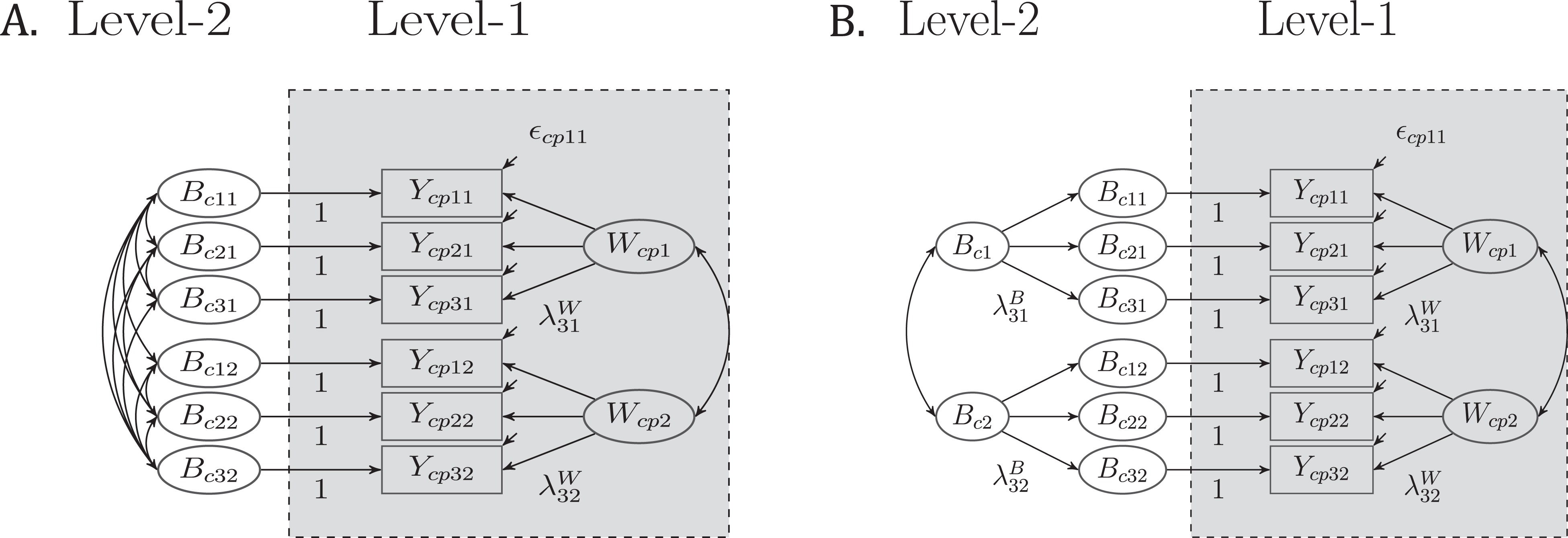
Path diagram of a multilevel confirmatory factor analysis model (see also Eid et al., 2008) with indicator-specific Level-2 factors (see Figure 1A) and with unidimensional Level-2 factors (see Figure 1B) for a multitrait–multimethod measurement design of three indicators and two constructs. Ycpij = observed variable on Level-1 (p = person, c = cluster, i = indicator, and j = construct). Bcj = unidimensional latent factor on Level-2. Wcpj = unidimensional latent factor on Level-1. εcpij = Level-1 error variable. Mean structure is not presented for clarity.
One advantage of the CTC(M − 1) model is that it enables researchers to compare structurally different methods, even when different scales are used (e.g., physiological data, objective tests, questionnaires, etc.). Moreover, the CTC(M − 1) model allows researchers to separate different variance components due to trait, method, and measurement error influences and relate external variables to the latent factors in the model. Nevertheless, the multiple-indicator CTC(M − 1) model by Eid, Lischetzke, Nussbeck, and Trierweiler (2003) is limited to single-level MTMM designs with structurally different methods. The main goal of the present work is to extend the multiple-indicator CTC(M − 1) to multilevel MTMM designs with nested structurally different methods.
For simplicity, we focus on cross-sectional MTMM measurement designs with fully nested structurally different methods and do not discuss all possible extensions of the model (e.g., to cross-classified or longitudinal data structures). We report results of an empirical application as well as of a Monte Carlo (MC) simulation study investigating the trustworthiness of parameters and their standard errors for three typical design factors of two-level data structures: (a) number of Level-1 units within clusters, (b) number of Level-2 units (clusters), and (c) intraclass correlation coefficients (ICCs). The MC study was performed to identify conditions in which the model performs well with respect to these three aspects and to provide guidelines for real data applications.
Multilevel CFA-MTMM Models for Nested Structurally Different Methods
To introduce the new model, we first reconsider the basic steps of multilevel confirmatory factor models (ML-CFA) and those of MTMM-SEM of structurally different methods using the CTC(M − 1) approach (Eid, 2000; Eid et al., 2003, 2008). Then, we show how both approaches can be integrated into a general ML-CFA-MTMM model for nested structurally different methods. In addition, we clarify the meaning of the latent variables and provide formulas for estimating level-specific consistency (i.e., indicator of convergent validity) and method specificity coefficients of the measures.
ML-CFA
According to classical test theory (CTT), each observed variable Ycpij referring to indicator i, construct j, person p, and cluster c can be decomposed as follows:

where τ
cpij
is the person-specific true score for indicator i, construct j in cluster c, and

where Bcij
is defined as conditional expectation of the person-specific true scores τ
cpij
in a cluster given the particular cluster-variable pc
(i.e.,
Substituting Equation 2 into Equation 1 yields the measurement equation of a basic multilevel model:

Note that without further restrictions the above model (see Equation 3) is not identified, because the Level-1 residual variable (Wcpij
, within-cluster component) cannot be separated from measurement error

Equation 4 implies perfectly correlated person-specific deviations from the true cluster-specific mean. Based on this assumption, the indicator-specific within-cluster components Wcpij
can be modeled by a common person-specific factor weighted by a factor loading parameter
In sum, the total measurement equation for the least restrictive and identified version of an ML-CFA model is given by:

Figure 1A represents a path diagram of the ML-CFA model shown in Equation 5, whereas Figure 1B depicts a more restrictive ML-CFA model with unidimensional cluster-specific factors using following replacement:

The model above (see Equation 6) resembles a classical ML-CFA model for multiple constructs (Eid et al., 2008; Hox, 2010; B. O. Muthén, 1994; Schultze, Koch, & Eid, 2015). According to Figure 1B, the model in Equation 6 assumes common factors (Bcj and Wcpj ) at both levels. In case of heterogeneous indicators (i.e., items that measure slightly different aspect of one construct), researchers should use the less restrictive model (see Equation 5) rather than the model represented in Figure 1B.
Single-level multiple indicator CTC(M − 1) models
The CTC(M − 1) modeling framework is especially useful for comparing structurally different methods (e.g., self-reports and other reports) against a reference (gold standard) method (e.g., objective or physiological measures). The basic principle of the CTC(M − 1) approach is that a gold standard or reference method is chosen and that the true scores of the nonreference methods (e.g., self-report and other reports) are predicted by the true scores pertaining to the reference method (e.g., objective or physiological measures). For choosing an appropriate reference method, researchers should generally chose the most outstanding, most valid, and most reliable method based on substantive theory or previous research findings (Geiser et al., 2008, 2012; Geiser, Koch, & Eid, 2014; Koch et al., in press). For detailed guidelines for choosing an appropriate reference method or how to specify a restricted CTC(M − 1) model that fits the data equally well regardless of the choice of the reference, see Geiser, Eid, and Nussbeck (2008).
In line with the principles of CTT, the CTC(M − 1) model can be formulated on the following basic decomposition:


The Equations 7 and 8 state that each observed variables is decomposed into a true score τ
ijk
variable and a latent measurement error variable
In the next step, the true score of the nonreference methods are regressed on the true score of the reference method. That is, the CTC(M − 1) approach implies the following linear latent regression relationship:

The residuals of these latent linear regressions are then defined as latent method variables:

The latent method variables Mijk capture the proportion of true variance of the nonreference method that cannot be predicted by the reference method. That is, the latent method variables Mijk are defined as latent residuals with respect to the reference method of the same indicator i and construct j. As a consequence of this definition, the method variables are uncorrelated with the true score of the reference method and have an expectation (mean) of zero.
To identify and estimate the parameters in the CTC(M − 1) model, it has to be assumed that the method variables are linear transformations of each other. This assumption implies that the method variables are unidimensional across items of the same TMU and are measured by a common latent method factor. Based on this assumption, it is possible to make to following replacement:

Again, the above assumption (see Equation 11) is rather unproblematic given that in most empirical applications the method effects Mijk will often generalize across different indicators.
In sum, the least restrictive variant of a CTC(M − 1) model with indicator-specific latent trait factors can be presented by the following measurement equations:


In the Equations 12 and 13, the true scores τ
ij
1 of the reference method were replaced by a reference measured trait variable Tij
1. That means that both variables are identical and that it is not possible to separate trait- from method-specific influences with respect to the reference method within the CTC(M − 1) model framework. As Geiser et al. (2008); Geiser, Eid, West, Lischetzke, and Nussbeck (2012); as well as Geiser, Koch, and Eid (2014) clarify, a very similar approach is often used and widely accepted in ordinary regression analysis, where c − 1 dummy variables are entered into the model. Similar to ordinary regression analysis, the M − 1 method factors in the CTC(M − 1) model reflect different comparisons or contrasts, namely, the overestimation or underestimation of the true scores measured by a nonreference method that cannot be predicted by the true scores measured by the reference method. Due to this regression analytical approach, the CTC(M − 1) model allows studying method effects that are unconfounded (uncorrelated) with the reference trait (Geiser et al., 2012). Moreover, the CTC(M − 1) approach allows researchers to compare methods that were measured on different scales/metrics (Geiser et al., 2012) and to decompose the total variance of each the nonreference measured indicators into coefficients of consistency, method specificity, and reliability that will be defined below for the more general CTC(M − 1) model. Figure 2A shows a path diagram of a multiple indicator CTC(M − 1) model with three indicators, two constructs, and two structurally different methods and with indicator-specific latent trait factors. Again, a more restrictive variant of the model is presented in Figure 2B, in which unidimensional latent trait factors are assumed (i.e.,
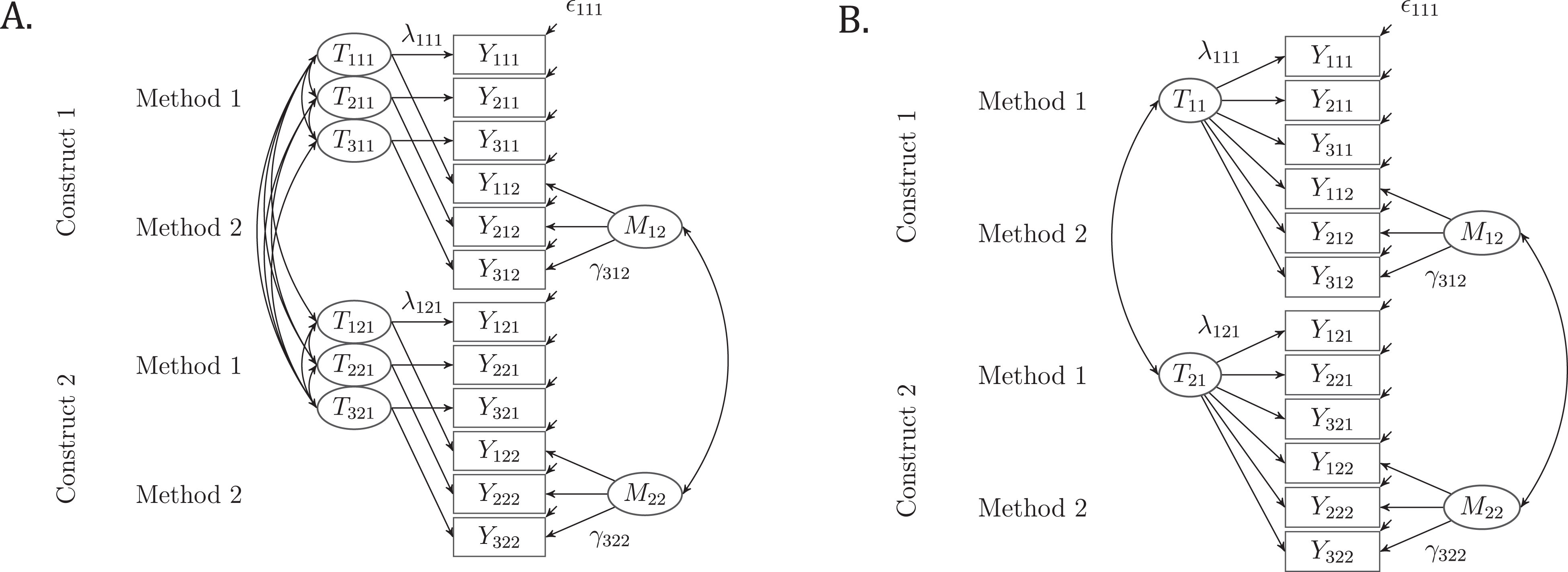
Path diagram of the single-level multiple indicator correlated traits–correlated methods minus one (CTC(M − 1)) model by Eid et al. (2003) with indicator-specific latent trait factors (see Figure 2A) and with unidimensional latent trait factor (see Figure 2B) for a multitrait–multimethod measurement design with three indicators, two constructs, and two (structurally different) methods. Note that in the CTC(M − 1) model one method factor is fixed to zero and only k − 1 method factors are specified. Yijk = observed variable (i = indicator, j = construct, and k = method). Tj 1 = common latent trait factor. Mjk = latent method factor. εijk = error variable. Mean structure is not presented for clarity.
Combining both approaches
Here we introduce the multilevel CTC(M − 1) modeling framework for fully nested structurally different methods. To apply this model, it is assumed that first a cluster (c; school, class, and team) is chosen, and, secondly, structurally different methods (k = {1, …, K}; teacher and student reports) are selected from out of each cluster, implying an MTMM measurement design with fully nested structurally different methods (see Table 1 for the implied MTMM measurement design).
Again, the starting point for defining the new model is the decomposition of the observed variables into a latent between Bcijk component and a latent within Wcpijk component. For simplicity, we assume that the within-cluster effect can be separated from measurement error influences for now1:


Index k was added to denote the method. The reference method (e.g., students’ self-reports) is represented by k = 1, whereas the nonreference method (e.g., teacher reports) is expressed by k ≠ 1. Subsequently, Bcij 1 is defined as conditional expectations of the true scores τ cpij 1 of item i (e.g., “I enjoy studying.”) measuring construct j (e.g., intrinsic motivation) with method k = 1 (e.g., self-reports) given the cluster c (e.g., a particular class). That is, a value of Bcij 1 can be conceived as expected true intrinsic motivation of class c measured by the first item on a students’ self-report questionnaire. Wcpij 1 captures the true student-specific deviations from the expected true intrinsic motivation of the class (i.e., self-rated group-mean-centered intrinsic motivation of a student). For example, a positive value of Wcpij 1 would mean that a particular student overrates his or her intrinsic motivation with regard to the expected true intrinsic motivation of the class. In contrast, Bcijk can be interpreted as the expected true intrinsic motivation of class c rated by the class teacher on the first item (e.g., “The student p enjoys studying.”). Values of Wcpijk capture the true teacher-specific deviations from the expected true intrinsic motivation of the class (i.e., teacher rated group-mean-centered intrinsic motivation of a student). Put differently, the values of Wcpijk (see Equation 15) reflect whether or not the true intrinsic motivation of a particular student is regarded as above or as below the class average by the class teacher.
In accordance with the CTC(M − 1) framework, as a reference (gold standard) method is chosen next. For simplicity, we have selected the self-reports to serve as reference method in the present study. However, it may be also reasonable to select the teacher reports as reference method. Again, detailed guidelines on choosing an appropriate reference method are provided by Geiser (2012). After choosing a reference method, latent linear regression analyses are carried out on Level-1 and -2:


Note that there is no intercept parameter on Level-1 (within level, see Equation 16), because the within components are defined as latent zero-mean residuals. Equation 16 states that the group-mean-centered student’s intrinsic motivation rated by the class teacher can be predicted by the self-rated group-mean-centered intrinsic motivation of that student. A positive factor loading parameter
The residuals of these latent linear regression analyses are again defined as latent method variables at both levels (Level-1 and -2):


The method variables are defined as latent residuals with respect to the reference measured within and between components (i.e., Wcpij
1, Bcij
1), respectively. Therefore, they are uncorrelated with their regressors and have expectations (means) of zero. The within method variables
Following a similar logic, the between-method variables
To identify and estimate the CTC(M − 1) model for nested structurally different methods, unidimensional within method factors have to be assumed:

Again, the above Assumption (Equation 20) is rather unproblematic and implies that within method effects (i.e., true teacher effects within classes corrected for the students’ self-reports) generalize across different indicators. Note that it is not necessary to assume unidimensional between-method factors to identify or estimate the CTC(M − 1) for nested structurally different methods. However, we generally recommend to test the following restriction by using classical model fit and model comparison statistics:

According to Equation 21, it is assumed that the between-method effects are homogeneous across different indicators and thus can be replaced by unidimensional between-method factors
Based on the above assumptions (see Equations 20 and 21), the CTC(M − 1) model for nested structurally different methods with indicator-specific trait factors at Level-1 and -2 can then be expressed as follows:


For simplicity, we replaced Bcij
1 by

The above variance decomposition (see Equation 24) follows directly based on the definition of the latent variables and allows calculating coefficients of consistency and method specificity at Level-2:

The Level-2 consistency coefficient reflects the proportion of the true teacher perspective that is shared by the true students’ perspective across different classes. The square root of the Level-2 consistency coefficient can be interpreted as convergent validity between the teacher and the student reports across different classes.
In contrast, the Level-2 method specificity represents the proportion of the true teacher perspective that is not shared with true students’ perspective across different classes.

Following a similar logic, coefficients of consistency and method specificity can be defined at Level-1 (i.e., within classes). Again, the variance of the true (group-mean centered) teacher reports at Level-1 can be decomposed as follows:

Again, the above decomposition (see Equation 27) follows directly based on the definition of latent variables. The Level-1 consistency coefficient is given by:

The Level-1 consistency coefficient reflects the proportion of the true variance of the teacher reports that can be explained (predicted) by the students’ reports within classes. Again, the square root of the Level-1 consistency coefficient is an indicator of the convergent validity of teacher and student report within classes. The Level-1 method specificity coefficient represents the proportion of the true variance of the teacher reports that cannot be explained (predicted) by the students’ reports within classes.

In sum, the total variance of the observed variables can be decomposed as follows:


Subsequently, coefficients of the reliability (Rel) as well as the intraclass correlations (ICCs) of the observed variables can be expressed by:


The reliability is defined as the proportion of variance of the observed variables that is not due to measurement error influences. The intraclass correlation is defined as the proportion of variance of the observed variables that is due to interindividual differences at the cluster level (Level-2). Note that the intraclass correlation coefficients can also be defined based on the variance of the true score variables (see Table 2).
Variance Components of the Nonreference Methods in the CTC(M − 1) Model for Nested Structurally Different Methods

Note. c = Level-2 unit (cluster), p = Level-1 unit (person), i = indicator; j = construct; k = method (reference or nonreference method); CTC(M − 1) = correlated traits–correlated methods minus one.


Tables 2 and 3 summarize the formal definitions of the latent variables and the different variance coefficients in the CTC(M − 1) for nested structurally different methods.
Variable Definitions of the CTC(M − 1) Model for Nested Structurally Different Methods
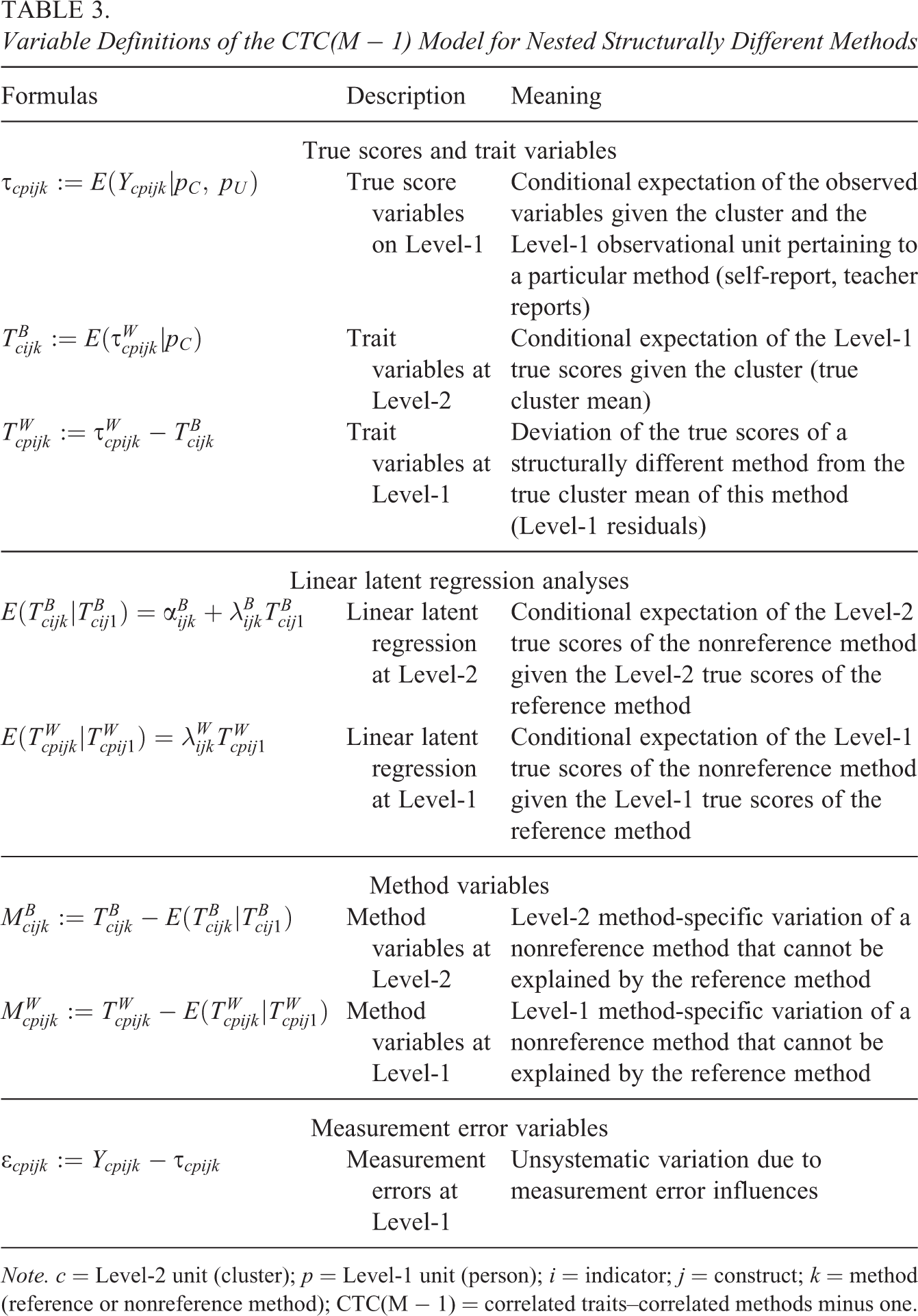
Note. c = Level-2 unit (cluster); p = Level-1 unit (person); i = indicator; j = construct; k = method (reference or nonreference method); CTC(M − 1) = correlated traits–correlated methods minus one.
A path diagram of the CTC(M − 1) model with indicator-specific latent trait factors on the within level (Level-1) and between level (Level-2) is depicted in Figure 3A. Figure 3B illustrates a more restrictive variant of the model with common latent trait factors. We generally recommend to test whether or not common (unidimensional) latent trait factors can be assumed by comparing the fit of both models (see Figure 3A and 3B).
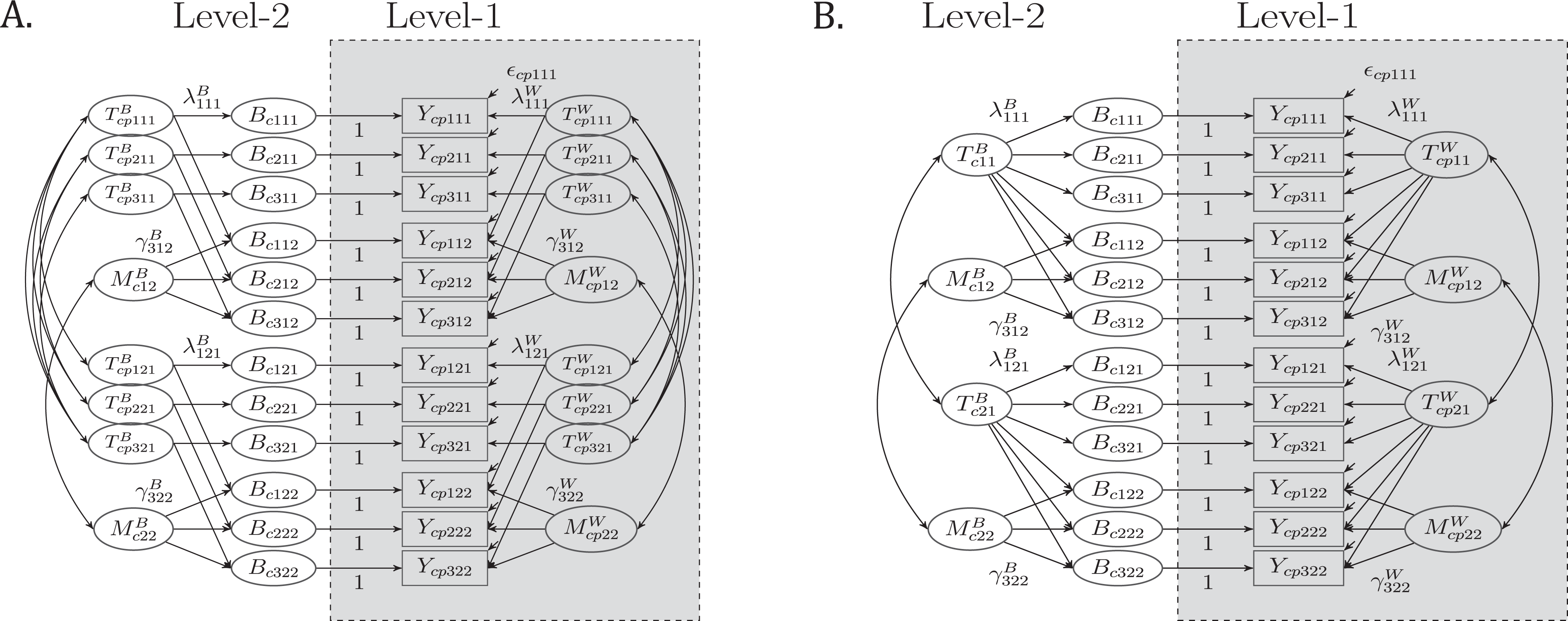
Path diagram of the multilevel, multiple indicator CTC(M − 1) model for nested structurally different methods with indicator-specific latent trait factors (see Figure 3A) and with unidimensional latent trait factors (see Figure 3B) for three indicators, two constructs, and two (structurally different) methods. Ycpijk = observed variable on Level-1 p = person, c = cluster, i = indicator, j = construct, and k = method).
Empirical Application
Participants
For illustration purposes, we fit the new model to data from an educational research study investigating noncognitive characteristics in middle school students (N = 1,644; 50% males). The students’ age ranged from 10 to 15 years. Each student was rated by their class teacher (n = 217 teachers). In addition, students’ self-reports were collected. Due to privacy protections, students’ and teachers’ class membership (class ID) could not be assessed. Hence, it was impossible to account for additional clustering due to cross classification of teachers and classes. For the subsequent analysis, we used the teacher ID as cluster variable. On average, each teacher rated eight students.
Measures
For the assessment of intrinsic motivation and teamwork, short questionnaires were developed and matched for student and teacher ratings. Each short scale consists of 6 items, having a possible range of 1 (never or rarely) to 4 (usually or always). For each short scale, 2 item parcels were calculated as the mean of 3 items.
Statistical Analysis
The model as depicted in Figure 3B was fit to the data first. As can be seen from Figure 3B, we specified common latent trait and method factors at each level. Moreover, we restricted the factor loadings as well as error variances within each TMU to be equal, assuming τ-parallel test halves (parcels). Using this ML-CTC(M − 1) model, we calculated the variance coefficients using the model constraint option in Mplus (L. K. Muthén & Muthén, 1998–2012).
Results
The newly developed ML-CTC(M − 1) model with common trait and method factors fit the data well, χ2(50) = 129.24, p < .001, comparative fit index = .98, root mean square error of approximation = .03, standardized root mean square residual (SRMRL1) = .01, SRMRL2 = .06.
Table 4 provides information of the variance coefficients of reliability, intraclass correlation consistency, and method specificity. The results show that the reliability coefficients of student and teacher reports were acceptably high, ranging between .64 and .89. Interestingly, the reliability coefficients of the teacher reports were greater than those of the student reports. This indicates that both constructs were assessed with a greater accuracy (reliability) by teacher reports than by students’ self-reports. Moreover, the intraclass correlations (ICC) of the student reports were lower (.04) as compared to the ICCs of the teacher reports (.12–.15). This means that teacher ratings differed to a greater extent across clusters than student ratings. However, given that no class ID was included in the data set, these results should be interpreted with some caution.
ML-CTC(M − 1) Model With Unidimensional Latent Trait and Method Factors for Nested Structurally Different Methods: Reliability, Intraclass Correlation, Consistency, and Method Specificity at Level-1 and -2

Note. Ycpijk = observed variables; c = cluster (here teacher/class); p = person (here student); i = indicator (parcels); j = construct (1 = teamwork, 2 = intrinsic motivation); k = method (1 = student reports, 2 = teacher reports). Rel = reliability; ICC = intraclass correlation; L1Con = Level-1 consistency; L2Con = Level-2 consistency; L1Msp = Level-1 method specificity; L2Msp = Level-2 method specificity; ML-CTC(M − 1) = multilevel correlated traits–correlated methods minus one. The coefficients of consistency and method specificity were standardized on the observed variance of an indicator as defined in text.
The Level-1 consistency coefficients (L1-Con) pertaining to the teacher reports (i.e., nonreference method) was between .06 for teamwork and .16 for intrinsic motivation. This means that the convergent validity (i.e., square root of the consistency coefficients) between teacher and student reports at the individual level (Level-1) was higher for intrinsic motivation
The counterpart of the consistency coefficients is the method specificity coefficients. In this study, the Level-1 method specificity coefficients of the teacher reports ranged between .72 and .77, whereas the Level-2 method specificity coefficients were considerably higher (.90–1.00). The great amount of method specific variance at both levels suggests that teachers had a unique perspective on students’ noncognitive characteristics that was not shared with students’ self-reports.
In addition to the variance coefficients, we examined the correlations between the latent factors at both levels. The correlation between the latent trait factors can be interpreted as an indicator of discriminant validity. In this present study, the correlations between the latent trait factors were
Overall, the results of this empirical application should be interpreted with great caution, given that there was no class ID included in the data set which allowed us to account for additional dependencies in the data. To examine the effects of sample size at Level-1 and Level-2, as well as the size of the ICC on the statistical performance of the ML-CTC(M − 1) model in greater detail, we report the results of a simulation study in the next section.
Simulation Study
To examine the statistical performance of the model depicted in Figure 3B, a Monte-Carlo simulation study was carried out. The main goal of the simulation study was to identify favorable and nonfavorable conditions, in which the model can be applied to real-life data and to determine the minimal required sample size for proper parameter estimates. For simplicity, a CTC(M − 1) model for nested structurally different methods with three indicators, two constructs, and two methods was chosen to ensure the minimal requirements of an MTMM-analysis (see Table 1). The simulation was done using Mplus 7.0 (L. K. Muthén & Muthén, 1998–2012) and the R package MplusAutomation (Hallquist, 2011). In total, 4 × 6 × 6 = 144 conditions with 500 replications per condition were simulated (72,000 data sets). All models were estimated using maximum likelihood (ML) estimator implemented in Mplus assuming complete data.
Simulation Design
Three important aspects of multilevel data were varied in this study: (a) the number of Level-1 units (nL1 = 5, 10, 15, 20, 30, and 40), (b) the number of Level-2 units (nL2 = 50, 100, 150, 200, 300, and 400), and (c) the intraclass correlation (ICC for the observed variables = low, medium, large, and extremely large). Results of previous simulation studies have shown that the number of Level-1 and -2 units and the level of intraclass correlation are important factors for proper parameter and standard errors (Hox & Maas, 2001; Julian, 2001; Koch, Schultze, Eid, et al., 2014). Hox and Maas (2001) showed that the number of Level-2 units are crucial for proper parameter estimates and recommended to sample at least 100 Level-2 units for multilevel SEM. In addition, previous findings indicated that the parameters on Level-2 are not trustworthy in conditions with few Level-2 units and low ICCs (Hox & Maas, 2001; Julian, 2001). Recent simulation studies in the field of multilevel MTMM modeling found that an increasing number of Level-1 units (cluster size) can decrease the amount of standard error bias (Koch, Schultze, Eid, et al., 2014). Based on these results, we choose four categories of ICCs: low (ICC ≈ .09–.10), medium (ICC ≈ .16–.19), large (ICC ≈ .25–.29), and extremely large (ICC ≈ .36–.69). According to Hox (2010) as well as Snijders and Bosker (2012), ICCs between .1 and .2 are common in educational studies, whereas greater ICCs (above. 3) are rather found in longitudinal or small group (multirater) studies.
The ICC coefficients were varied by choosing different population values of the standardized factor loadings and measurement error variances (see Equations 30 and 31). In Table 5, the population values of the standardized factor loading parameters and the error variances are presented. Given that previous application of CTC(M − 1) models indicating that the convergent validity (consistency) between structurally different methods are rather low, we decided to use higher method specificity coefficients (i.e., method factor loading values) in this study.
Population parameters used in the MC simulation study
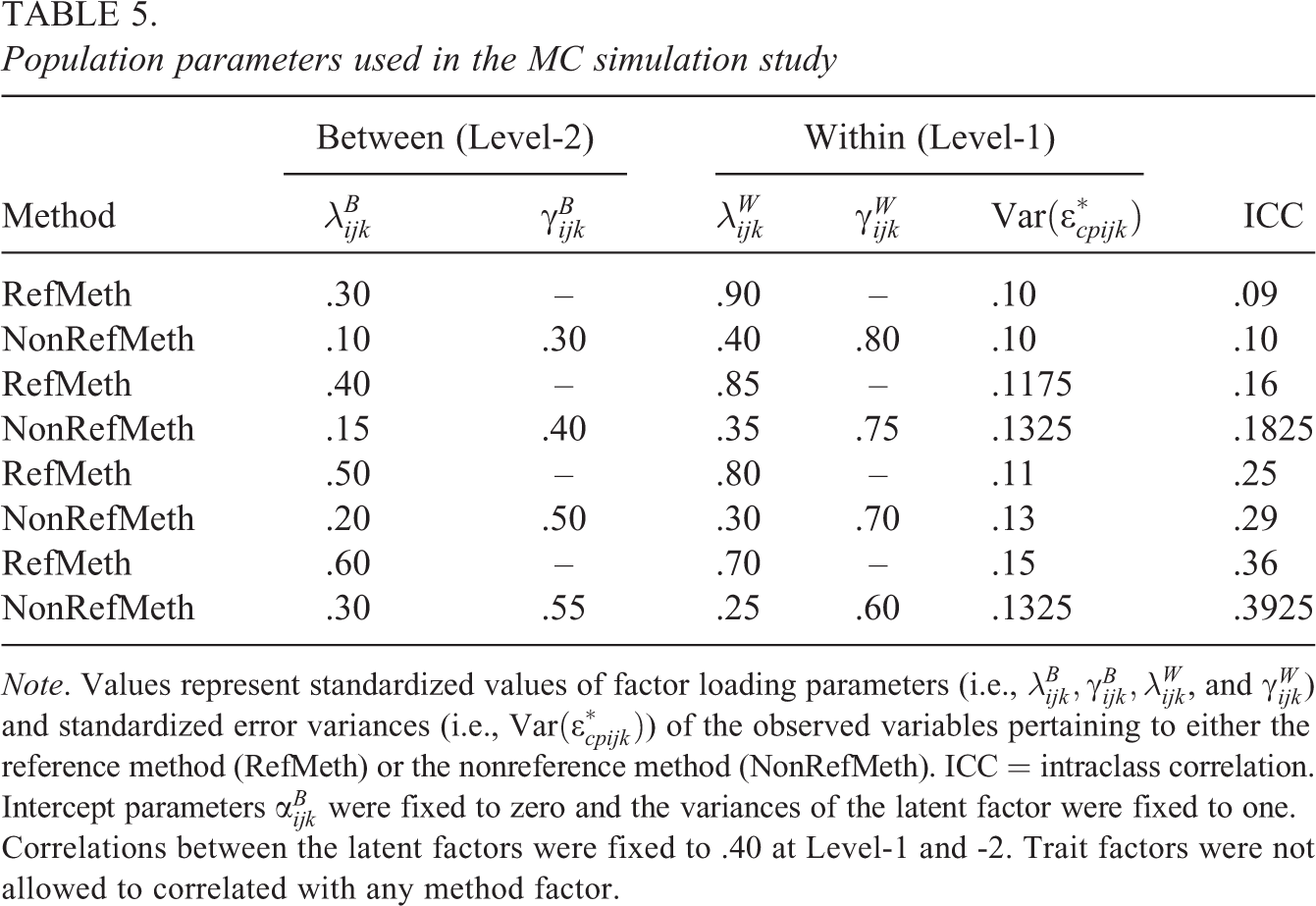
Note. Values represent standardized values of factor loading parameters (i.e.,
Estimation Bias
The statistical performance of the model was investigated with respect to two bias indices: parameter estimation bias (peb) and standard error bias (seb). The following formulas were used to calculate absolute peb and seb (cf. Holye, 2014):

where θ
i
is the true (population) value of the ith parameter and

where
The peb and seb coefficients for each parameter i were then averaged across the following parameter cluster for each level separately: (1) the within trait factor loadings (λ W ), (2) the between trait factor loadings (λ B ), (3) the within method factor loading (γ W ), (4) the between-method factor loadings (γ B ), (5) the within trait factor variances and covariances (ψ W ), (6) the between trait variances and covariances (ψ B ), (7) the within method factor variances and covariances (ϕ W ), (8) the between-method factor variances and covariances (ϕ B ), (9) the within residual variances (θ W ), and (10) the between intercept parameters (μ B ). A criterion of absolute bias below .10 (10%) was taken as the cutoff value for acceptable bias (Geiser, 2009; Eid et al., 2006; Koch, 2013; L. K. Muthén & Muthén, 2002).
Results
All models converged properly after a maximum of 100 ML iterations and 500 expectation–maximization iterations (default in Mplus). However, Mplus reported warnings concerning nonpositive latent variable covariance in 21 (.03%) of all 72,000 (i.e., 500 × 144) replications, ill-conditioned fisher information matrix in 2 (<.01%) out of all replications, problems computing standard errors in 2 (<.01%)
In 3 (2.1%) of 144 MC conditions, the peb exceeded the cutoff value of .10. This was solely the case for Level-2 (between level) parameters such as trait and method factor loadings as well as latent correlations between the latent variables in the low ICC condition with five Level-1 units per cluster. Figure 4 illustrates the relationship between the level of ICC and the sample size on both levels for these model parameters. The maximum peb of .18 associated with a Level-2 method factor loading was encountered in the low ICC condition with 5 Level-1 and 50 Level-2 units.

Peb for different levels of ICC (L = low, M = medium, H = high, and V = very high) and sample size on Level-1 (5, 10, 15, 20, 30, and 40) and Level-2 (50, 100, 150, 200, 300, and 400) for the Level-2 model parameters, L2lamMeth = method factor loadings (γB), L2corMeth = correlation between-method factors (ϕB), L2lamTrait = trait factor loadings (λB), and L2corTrait = correlation between trait factors (ψB). The dashed line represents the cutoff value of .10.
The standard errors of the parameter estimated exceeded the cutoff value of .10 in 14 (9.7%) of 144 MC conditions. Similar to the previous results, seb was especially large for Level-2 (between level) parameters in conditions with low ICCs and few observations per cluster (i.e., five Level-1 units). The maximum seb of 2.44 corresponding to the correlations of Level-2 method factors (i.e., generalizability of method effects) was again encountered in the low ICC condition with 5 Level-1 and 50 Level-2 units. Figure 5 depicts the absolute amount of seb for Level-1 and Level-2 parameters in relation to different ICC conditions as well as the number of Level-1 and Level-2 units. As Figure 5 shows the absolute seb of the Level-2 parameters (i.e., method factor loadings, correlation between-method factors, trait factor loadings, and correlation between trait factors) exceeded the cutoff value of .10 in condition with 5 Level-1 and 50, 100, and 150 Level-2 observations as well as in the condition with 10 Level-1 and 50 Level-2 observations. In the remaining conditions, the seb did not exceed the critical cutoff value .10.
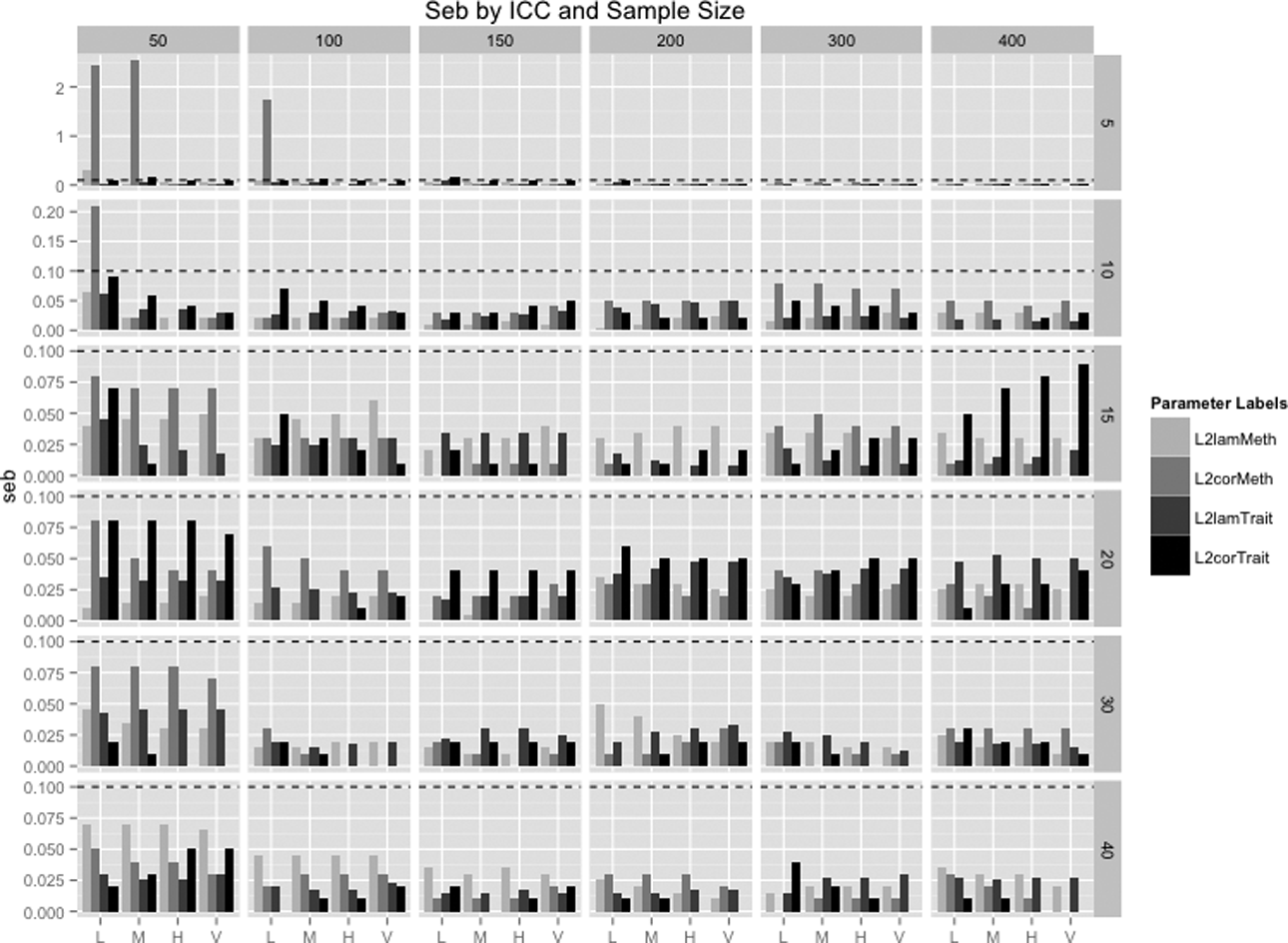
Seb for different levels of ICC (L = low, M = medium, H = high, and V = very high) and sample size on Level-1 (5, 10, 15, 20, 30, and 40) and Level-2 (50, 100, 150, 200, 300, and 400) for the Level-2 model parameters (L2lamMeth = methodfactor loadings (γB), L2corMeth = correlation between-method factors (ϕB), L2lamTrait = trait factor loadings (λB), and L2corTrait = correlation between trait factors (ψB). Note that the limits of the y-axis for the condition with five Level-1 units per cluster were rearranged to fit the figure. The dashed line represents the cutoff value of .10.
To combine the statistical properties of both point estimates and standard error estimates, we additionally report a coverage performance. In line with L. K. Muthén and Muthén (2002), we decided that coverage that remains between .91 and .98 is acceptable or tolerable. In 21 (14.6%) of 144 MC conditions, the coverage exceeded this range. Independent of the ICC, lower coverage was found in conditions with few Level-2 observations (100 or lower). Coverage above .98 were encountered in three cases of the MC condition with 150 Level-2 units and 5 Level-1 units per cluster. Moreover, poor coverage performance was exclusively associated with the estimation of Level-2 parameters. Overall, the maximum range of coverage was between .88 and .99 (M = .94, SD = .01).
To examine whether or not the different aspects of the data (i.e., number of Level-1 and Level-2 observations, level of ICC) have a significant impact on the trustworthiness of the parameter estimates and their standard errors, we performed analysis of variance (ANOVA). For the statistical analysis, we used the raw peb and seb values of each parameter to serve as dependent variables rather than the absolute values of peb and seb as expressed in Equations 21 and 22. The main reason for this was to obtain a normally distributed rather than of a right skewed dependent variable (i.e., raw peb and seb).
With regard to peb, ANOVA revealed that all aspects varied in this simulations study (i.e., level of ICC, number of observations on Level-1 and -2) were significantly associated with parameter bias. In particular, larger peb was significantly related to lower ICCs, F(3, 9,202) = 57.17, p < .001, η2 = .017, and fewer Level-1, F(5, 9,202) = 47.45, p < .001, η2 = .023, and Level-2 observations, F(5, 9,202) = 123.14, p < .001, η2 = .060, but relatively low practical significance (η2).
With regard to seb, ANOVA revealed that the number of Level-1 units, F(5, 9,202) = 16.40, p < .001, η2 = .009, and the number of Level-2 units, F(5, 9,202) = 4.21, p < .001, η2 = .002, were the main determinants of seb. However, with regard to our simulation study, the level of ICC was not significantly related to seb, F(5, 9,202) = 1.83, p = .13, η2 = .00, which is an interesting finding, given that multilevel models are generally recommended to avoid standard error bias if the ICC is greater than zero.
Discussion
Our goal in the present article was to extend the modeling framework proposed by Eid and colleagues (2008) to measurement designs of fully nested structurally different methods. It was argued that many MTMM measurement designs in educational, organizational, and social psychology research incorporate structurally different methods (e.g., self- and other reports) that are nested within higher cluster (classes or teams). In such cases, researchers should use multilevel, instead of single-level CTC(M − 1) models for structurally different methods.
There are three reasons for that. First, the multilevel CTC(M − 1) model enables researchers to model latent trait and method factors at both levels (within- and between-clusters) and thereby allow researchers to directly model the hierarchical nature of the data. Second, the model allows researchers to examine the convergent and discriminant validity of the given measures at both levels and calculate level-specific coefficients of consistency and method specificity. Third, by relating Level-1 and Level-2 covariates to the trait and method variables in the model, researchers are able to investigate potential causes of trait and method effects on both levels (within and between clusters).
Given that the model comprises the CTC(M − 1) modeling framework, it is possible to compare methods against a reference method that is not measured on the same scale/metric. For example, it would be possible to use different questionnaires in combination with physiological or objective measures within this framework. Moreover, the CTC(M − 1) model for nested structurally different method is defined with respect to a concrete random experiment. That means that the latent variables can be defined as random variables.
To illustrate and discuss the meaning of the ML-CTC(M − 1) model parameters, we presented the results of a real data application. The findings of the application revealed that students and teachers show higher agreement at the individual level (Level-1) than at the cluster level (Level-2). Moreover, greater teacher–student agreement was found for the evaluation of students’ intrinsic motivation than of students’ teamwork abilities. Despite some rater agreement, the major amount of variance of the teacher reports were not shared with students’ self-reports, and the discriminant validity was relatively low within and across clusters.
To examine the statistical performance of the model, we presented finding of an MC simulation study varying key determinants of multilevel data structures (i.e., sample size and the level of ICC). The results of the simulation study showed that parameter estimates were biased in conditions with low ICCs (<.10) and few observations at Level-1 (5 per cluster) and Level-2 (50 cluster). Level-2 (between level or cluster level) parameters were most sensitive to bias under such data constellations. These results suggest that the findings of the empirical application should be interpreted with care, although there were more than 200 clusters and more than five observations per cluster in the present application. Moreover, the findings of our simulation study are well in line with previous findings in the field of multilevel SEM (MSEM, Julian, 2001; Hox & Maas, 2001), showing that complex MSEMs require a minimal amount of dependency (clustering) in the data and enough Level-2 units.
In particular, our simulation study showed that the CTC(M − 1) model for nested structurally different methods becomes slightly instable in conditions with a low level of ICC (below .10) and few Level-1 (5 per cluster) and Level-2 (i.e., 50 cluster) observations. Therefore, we recommend to sample more than 10 Level-1 units and at least 50 Level-2 units when applying the model to real data. In data constellations of low level of ICC (below .10) and less than 50 Level-2 observations (clusters), we recommend specifying the original (single level) multiple indicator CTC(M − 1) model using adjustment techniques for the dependencies in the data.
It should be noted that in order to estimate the minimal required sample size, the complexity (e.g., number of parameters) of the model has to be taken into account. The models simulated in this study incorporated just two constructs measured by 3 items and two methods (i.e., 32 parameters on each level, in total 64 parameters). Presumably, a larger number of Level-2 and Level-1 units is needed for the estimation of more complex models with more than two traits and two methods. Nevertheless, the results of this simulation study are rather encouraging, showing that even complex multilevel CFA-MTMM models (e.g., CTCM − 1 model for nested structurally different methods with 64 parameter in total) perform acceptably well in terms of parameter and standard error bias in relatively small samples (e.g., 50 Level-2 × 15 Level-1 or 100 Level-2 × 10 Level-1 units). In cases of few Level-1 units per cluster (e.g., 5), it is recommended to sample at least 200 Level-2 units (i.e., clusters) in order to obtain proper parameter estimates and standard errors.
In case of few Level-1 and Level-2 units and low ICCs (below .10), researchers should be aware that Level-2 (between level or cluster level) parameters are likely to be biased. This becomes especially important whenever researchers seek to investigate the convergent and discriminant validity on Level-2 (i.e., cluster level). In particular, the factor loadings of the Level-2 trait and method factors as well as the standard errors of the correlations between trait and method factors will be biased under such conditions. However, according to our simulation study, the peb and seb can be significantly reduced by an increasing Level-1 and Level-2 observations. Alternatively, Bayesian estimation techniques may also be a possible solution for obtaining proper parameter estimates in data constellations with few observations and low ICC (see, e.g., Hox, van de Schoot, & Matthijsse, 2012; B. Muthén & Asparouhov, 2012). Interestingly, the standard error bias was not significantly associated with the level of ICC, when controlling for sample size at both levels.
Limitations and Future Research
Although the ML-CTC(M − 1) model is an extension of the single-level multiple indicator CTC(M − 1) model (Eid et al., 2003) to MTMM measurement designs with nested structurally different methods, it is limited in some aspects. First, the proposed model is defined for fully nested cross-sectional MTMM data sets. Current modeling approaches for cross-classified (Koch, Schultze, Minjeong, et al., 2014; Schultze et al., 2015) as well as longitudinal MTMM measurement designs (Courvoisier, Nussbeck, Eid, Geiser, & Cole, 2008; Geiser, Eid, Nussbeck, Courvoisier, & Cole, 2010; Koch, 2013; Koch, Schultze, Eid, & Geiser, 2014) need to be considered in future studies to broaden the area of applicability of the model. Second, the new model is defined for continuous observed variables. Thus, the results of the present simulation study cannot improvidently be generalized to cases in which (ordered) categorical observed variables are used. Third, more simulation studies are needed that focus on the robustness of the ML-CTC(M − 1) model. Although the results of the present simulation study showed that the ML-CTC(M − 1) performs surprisingly well under ideal data constellation (i.e., normality, no missing data, equal reliabilities, and equal number of continuous indicators per factor), it is not clear to what extent these findings can be transferred to less ideal data constellations (e.g., nonnormality, percentage of missingness, different numbers of indicators and different reliabilities, misspecification, and categorical data). We therefore encourage researchers to study the robustness of the new ML-CTC(M − 1) model in future simulation studies.
Footnotes
Acknowledgement
The authors would like to thank Lisa Pullman, member institutions of the Elementary Schools Research Collaborative, and staff from the Center for Academic and Workforce Readiness of Success, Educational Testing Service for their support of this research.
Declaration of Conflicting Interests
The author(s) declared no potential conflicts of interest with respect to the research, authorship, and/or publication of this article.
Funding
The author(s) received no financial support for the research, authorship, and/or publication of this article.