



Abstract
In this paper we describe a complete quantum computational model of computation that is based on the production system. The presented description of the model does not require any quantum computation background. By doing so, the reason that quantum computation may be important for pure symbolical artificial intelligence may become clear. The feature universal quantum computer based on this idea will involve programs that are related to the classical artificial intelligence programming languages such as OPS5.
Introduction
In the future, there will be universal quantum computers, which will offer us new possibilities. However, these possibilities are not as ground-breaking as is sometimes believed. In addition to their being “faster” and their ability to generate true randomness, these computers will have identical computing power to a Turing machine. They will be faster because they can simultaneously encode many inputs of a problem and perform the calculation on all inputs in the time it takes to do one of the calculations classically. However, we cannot access the correct solution without additional costs. The costs are related to the number of simultaneous problems that are solved. More precisely, the costs are the square root of the number of problems that are solved in parallel. The algorithm that describes the access to a solution is called Grover’s algorithm [13–16]. Grover’s algorithm speeds up the search in an unsorted list by a quadratic factor. In a list of length n, the access costs of a solution are proportional to the square root of n
Another non-trivial problem is that if we do not know exactly when a computation is finished, we cannot simply assess it. In other words, if we assess (measure) some part of the output, we also change all other possible values and spoil the computation. By assessing the value of a variable, we change the values of other variables. Because of these difficulties, quantum algorithms are described using quantum circuits. However, this method of describing an algorithm is complicated. Knowledge of parts of quantum physics and linear algebra is required. Here, the methods of AI come to our rescue, particularly the production system theory.
It should also be noted that there is an alternative method to describe the quantum computation using adiabatic quantum computation, which is based on the time evolution of a quantum system [10,11], as specified by the adiabatic theorem. It is not clear whether the adiabatic computation is more or less efficient than the computation in a classical computer [31,39]. For some problems, its efficiency can be better than the efficiency of classical computers [19,29]. There is an adiabatic quantum system called “D-Wave”, which speeds up some optimization problems [9,19,37]. This system is based on quantum annealing, which finds the global minimum of a function [6,18]. Quantum annealing attempts to avoid local minima using a quantum fluctuation parameter, which replaces a state by a randomly selected neighboring state. It is related to simulated annealing [17], where the temperature plays a quantum-fluctuation-related role. Adiabatic quantum computers based on quantum annealing do not correspond to a universal Turing machine. Instead, they are related to analog computers, where an algorithm represents a mathematical model of a physical system, and will be not discussed further in this paper.
The main contribution of this short paper is the simplification of the mathematical framework concerning a possible quantum computer and artificial intelligence. With this simplification, the main idea can be introduced to the artificial-intelligence community that has no quantum computation background. By doing so, the reason that quantum computation may be important for pure symbolical AI may become clear. The paper is organized as follows:
We review the production systems; We introduce the tree search and path descriptors; We review the quantum iterative deepening; The quantum production system is presented.
Production system
The production system in the context of classical Artificial Intelligence and Cognitive Psychology is one of the most successful computer models of human problem solving [1,20,25,26]. A production system is composed of a set of rules [7,22]. These rules are also called productions. The set of rules models the human long-term memory and is also composed of the working memory. This memory contains a description of the state in a problem-solving process. The state is described by a string of symbols and called a set of patterns. Whenever the premise of a rule is true, the conclusions of the rules change the contents of the working memory. The working memory models the human short-term memory. During the recognize-act cycle, the current state of the problem-solving process is maintained as a set of patterns in the working memory. The working memory is initialized with the initial state description. The patterns in the working memory are matched with the premise of the rules. The premise of the rules that match the patterns in the working memory produces a set, which is called the conflict set. A rule of this set is selected, and the conclusion of the rule changes the content of the working memory. This process is denoted as firing the rule. Our production systems perform forward chaining, and only one rule is allowed to fire [22]. This recognize-cycle is repeated on the modified working memory until a goal state is attained or no rules can be fired. A problem is described by the rules in the long-term memory, the initial state, and the goal state. A chain of rules, which successively changes the state from the initial state to the goal state, represents the solution to the problem. The search, which is represented by a search tree, is performed from an initial state through the following states until a goal state is attained.
In a pure production system, which was proposed as a formal theory of computation [27], the system halts if no production can fire in a state. It is composed of the set of productions L (long-term memory) and control system C. A pure production system is a sextuple:
Σ is a finite alphabet; W is the working memory and represents state L is the long-term memory and the set of B productions. Production p has the form The precondition is matched with the contents of the working memory. If the precondition is met, the conclusion is preformed and changes the contents of the working memory; δ is the control function of the form
If
Production systems are closely related to the approach of Markov algorithms [23]; similar to these approaches, production systems are equivalent in power to a Turing machine [38]. A Turing machine can also be easily simulated by a production system; thus, a production system is a complete model of computation. The search represented by a search tree is performed from an initial state through the following states until a goal state is attained.
Tree search and the path descriptors
Nodes and edges represent a search tree. Each node represents a state, and each edge represents a transition from one state to the following state. The initial state defines the root of the tree. From each state, either B states can be reached, or the state is a leaf. B represents the branching factor of the node. A leaf represents either the goal of the computation or an impasse when there is no valid transition to a succeeding state. Every node besides the root has a unique node from which it was reached, which is called the parent. Each node and its parent are connected by an edge. Each parent has B children. If
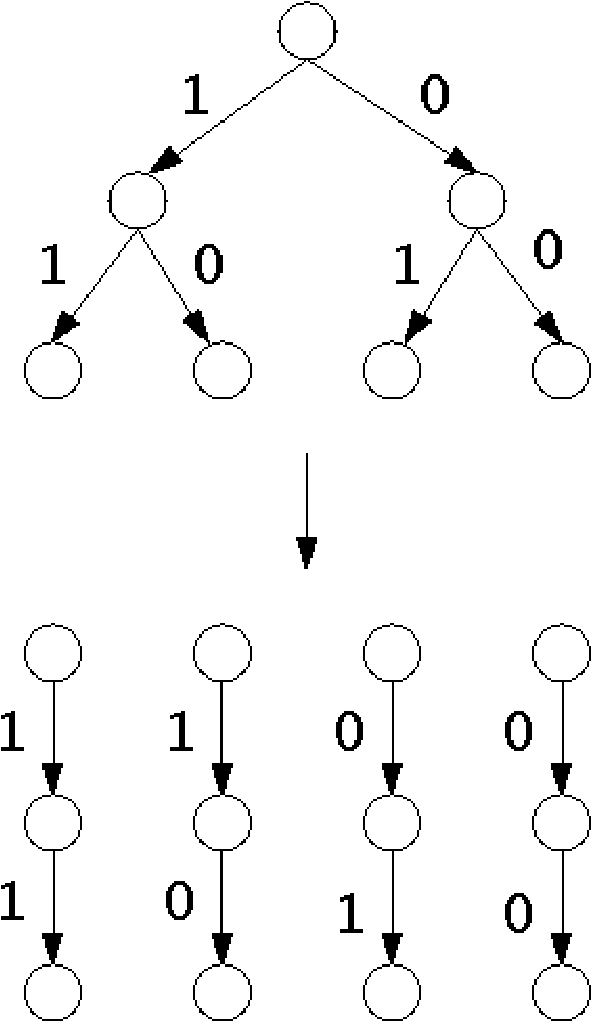
Search tree for
In a quantum computation, we can simultaneously represent all possible path descriptors. There is one path descriptor for each leaf of the tree. Using Grover’s algorithm, we search through all possible paths and verify whether each path leads to the goal state. This type of procedure is called a quantum tree search [33]. For
A quantum production system
A quantum production system is based on the iterative quantum tree search. In an iterative quantum tree search, the limit is gradually increased in each step. For each limit, a quantum tree search is performed [34,36]. A quantum production system is composed of the quantum oracle
Σ is a finite alphabet;
The quantum oracle
t is the depth of the corresponding search tree;
Each path descriptor represents a possible path from the root to the leaf
Grover’s algorithm
A superposition corresponds to a vector of dimension n, where each dimension corresponds to a path description. For example, in Fig. 1, the dimension of the vector is four, and each dimension corresponds to the binary number that represents the path descriptor plus one, starting with dimension one, two and three and four (path descriptor zero corresponds to dimension one). Each dimension is described by a complex number (also called amplitude)
Complete model of computation
The result of the computation is represented by a path descriptor (Fig. 1). After each iterative step, Grover’s algorithm is performed. If no goal is reached, the limit of the search is increased, and the procedure is repeated. If the goal state can be reached, the corresponding path descriptor is accessed by Grover’s algorithm. Because a Turing machine can also be easily simulated using a quantum production system and a pure production system, and because we can map a pure production system into a quantum production system, the iterative quantum production system is a complete computation model [36].
Discussion
The Turing machine is a theoretical mathematical model created by Alan Turing [38]. We relate a Turing machine to a possible definition of a quantum Turing machine and indicate the resulting problems.
Classical Turing machines
The Turing machine constitutes an infinitely long tape that is divided into a sequence of cells. In each cell, a certain symbol can be written and later read by a head. The head can move along the tape and exist in one state of a finite set of internal states. A set of rules specifies a new state given the current state and the symbol being read. The new state determines in which direction the head must move and if it must write or read a symbol. For each state, only one rule describes one action. Formally a Turing machine is a 7-tuple:
Q finite, non-empty set of states; Γ is a finite, non-empty set of tape alphabet symbols;
Turing realized that one could encode the transformation rules of any specific Turing machine T as some pattern of symbols on the tape that fed into a special Turing machine
The elegant way of modeling a computer by a Turing machine leads us to computational complexity theory. Computational complexity theory addresses the questions of which problems can be solved in a finite amount of time on a computer. The definition of computational complexity should not depend upon the currently used computational model. The following is stated in the Church–Turing thesis: Any algorithmic process can be simulated on a Turing machine. The extended Church–Turing thesis, which is also called the strong Church–Turing thesis, states that everything that can be computed in a certain amount of time on any physical computer can be also be computed on a Turing machine with a polynomial slowdown. In other words, any reasonable algorithmic process can be simulated on a Turing machine, with the possibility of a polynomial slowdown, in the number of steps required to run the simulation.
However Richard Feynman observed in the early eighties that it did not appear possible for a Turing machine to simulate certain quantum physical processes without incurring an exponential slowdown. This fact would contradict the strong Church–Turing thesis, which led Feynman to ask whether a quantum system can be simulated on an imaginary quantum computer.
Quantum Turing machines
In 1985, David Deutsch [8] reformulated the Church–Turing thesis based on the observation of Richard Feynman in physical terms: “Every finitely realizable physical system can be perfectly simulated by universal computing machine operating by finite means.” The Turing machine was replaced by the universal computing machine which operates by finite means. Such a universal computing machine that operates by finite means could be modeled by a quantum Turing machine first proposed by David Deutsch [8]. A quantum Turing is a 7-tuple as before
Conclusion
Quantum production system can operate independently of whether the computation terminates; in the case of non-termination, the computation continues forever, and the iterations do not terminate. The quantum production system also provides a maximal speedup of
A quantum computer based on a quantum production system will involve classical artificial-intelligence programing languages, such as OPS5 [7]. OPS5 programs are executed by matching the working memory elements with productions in the long-term memory [12]. Thus, the programmer is not required to contend with quantum gates, nor is he or she required to address the principles of quantum computation. It is equivalent to current programmers who specify their algorithms in high-level languages, such as Java, without the requirement of understanding the nature of electronic circuits or semiconductor devices, such as a transistor.
For more background information see these additional sources [32,35,36] and [40].