



Abstract
The utilization of Quantum Multi-Agent Systems (MAS) and Quantum Protocols in distributed agent environments has gained attention due to the need for enhanced protocol efficiency in quantum computing applications. Conventional methods often face limitations in achieving optimal performance, hindering the full potential of quantum computing in distributed settings. Existing approaches lack the necessary robustness to fully exploit the advantages offered by Quantum MAS, leading to inefficiencies in computational performance within distributed agent environments. In this context, we propose a novel Quantum MAS framework, which harnesses the principles of quantum superposition, entanglement, and advanced Quantum Protocols, including the quantum key distribution mechanism. The framework facilitates collaborative decision-making among agents through the utilization of joint quantum states and enables seamless synchronization of actions via the entanglement operator. The computational efficiency is optimized using quantum gate operations, thereby enhancing the overall computational performance in the distributed agent environment. We quantify the efficiency, showcasing the significant improvements achieved by the proposed Quantum MAS framework. Our research employs diverse datasets, including synthetic and real-world data, to comprehensively evaluate the performance and efficacy of the proposed Quantum MAS framework. Experimental results demonstrate a notable efficiency enhancement, with the proposed Quantum MAS achieving an average efficiency value of 0.92 across various experimental configurations and datasets. The findings underscore the significant potential of Quantum MAS in effectively addressing efficiency concerns within distributed agent environments, thus paving the way for broader applications of quantum computing in real-world scenarios.
Keywords
Introduction
Quantum Multi-Agent Systems (MAS) integrate quantum computing principles to enhance multi-agent frameworks beyond conventional capabilities, distinct from quantum-enhanced deep Q-learning [1, 2]. This paradigm encompasses a wide array of quantum protocols and strategies, facilitating advanced agent interactions and decision-making within distributed systems [3, 4]. Quantum Multi-Agent Systems (MAS) operating within distributed agent environments have garnered significant attention due to their potential in advancing quantum computing applications. These systems facilitate collaborative decision-making and information sharing among multiple agents, leveraging the principles of quantum superposition and entanglement to achieve unprecedented computational capabilities [5, 6]. However, existing methodologies often encounter limitations in harnessing the full potential of Quantum MAS within distributed settings. Challenges persist in optimizing protocol efficiency, ensuring secure communication channels, and maximizing computational performance, thus calling for innovative frameworks to address these obstacles effectively. These limitations highlight the critical need for a novel approach that leverages advanced Quantum Protocols to overcome the constraints of traditional MAS frameworks [7, 8].
Conventional approaches typically rely on classical communication protocols and simplistic agent coordination strategies, which restrict the scalability and computational prowess of the Quantum MAS. Moreover, the integration of quantum protocols with conventional MAS frameworks remains underexplored, resulting in suboptimal performance within complex distributed environments. Understanding these limitations is essential to underscore the necessity of a paradigm shift towards integrating advanced Quantum Protocols in Quantum MAS systems [9, 10].
In this context, we propose a novel framework that synergistically integrates advanced Quantum Protocols with the Quantum MAS, enabling enhanced protocol efficiency and secure communication channels [14]. The framework leverages the principles of quantum superposition and entanglement to facilitate seamless coordination and decision-making among distributed agents, thereby significantly improving the overall computational performance within the Quantum MAS [26, 27]. The proposed framework aims to revolutionize the landscape of distributed computing by leveraging the full potential of quantum computing principles.
The key contributions of our work can be summarized as follows:
Development of a comprehensive framework integrating Quantum MAS and advanced Quantum Protocols, effectively bridging the gap between quantum computing principles and distributed agent environments. Enhancement of protocol efficiency and computational performance within distributed agent environments, ensuring optimized resource utilization and seamless communication among quantum agents. Establishment of secure communication channels leveraging the principles of quantum superposition and entanglement, enhancing the overall security and reliability of the Quantum MAS framework.
The remainder of this paper is organized as follows. Section 2 provides an overview of the related work and existing research in the field, emphasizing the current gaps and opportunities for advancements. Section 3 outlines the methodology and framework design, elucidating the integration of Quantum MAS with advanced Quantum Protocols and highlighting the key design considerations. Section 4 presents the experimental results and performance analysis, demonstrating the efficacy and efficiency of the proposed framework through comprehensive simulations and real-world scenarios. Finally, Section 5 provides a comprehensive conclusion to the study. It synthesizes the findings, elucidates their implications, and outlines potential avenues for further research and development in the domain of Quantum MAS and distributed computing.
The growing interest in quantum technologies has sparked numerous research endeavors aimed at integrating quantum mechanics with classical machine learning methods. Kwak et al. [10] extensively explore quantum distributed deep learning architectures, discussing potential models and applications. Similarly, Ampatzis and Andronikos [11] introduce an innovative method for quantum secret aggregation using a network of agents. Their subsequent work in 2022 [12] highlights a symmetric extensible protocol dedicated to quantum secret sharing. On a different note, Bykovsky [13] proposes a multiple-valued logic model for agents controlled via optical networks, emphasizing the potential of optical networks in quantum communications.
Quantum-enhanced techniques also profoundly impact reinforcement learning. Cimini et al. [15] present deep reinforcement learning strategies for quantum multiparameter estimation, showcasing quantum techniques’ potential in enhancing parameter estimation accuracy. Similarly, Reiß and van Loock [16] apply deep reinforcement learning for key distribution based on quantum repeaters. The hybrid classical-quantum approach to accelerate Q-learning, as presented by Sannia et al. [17], offers promising results for integrating quantum technologies into classical learning algorithms.
Furthermore, Howe et al. [18] discuss challenges and solutions for robust and efficient quantum communication, shedding light on quantum-classical cooperation intricacies. Mironowicz [19] introduces the novel concept of entangled rendezvous, exploring Bell non-locality’s potential application for mobile agents on networks. Meanwhile, Oliveira et al. [20] showcase a programmable, latency-aware, and dynamic quantum-secured optical network, emphasizing key refresh rate negotiation and quantum key distribution sharing importance.
Metz and Bukov [21] demonstrate self-correcting quantum many-body control using reinforcement learning with tensor networks, a significant advancement in quantum control systems. Vitullo et al. [22] focus on simulating quantum key distribution in fiber-based quantum networks, underscoring real-world quantum communication system feasibility and challenges. Fallani et al. [23] propose strategies for learning feedback control in quantum metrology, while Chung et al. [24] describe the Illinois Express quantum metropolitan area network’s design and implementation. Lastly, Melnikov et al. [25] provide a comprehensive review of quantum machine learning, bridging the physics and software engineering gap. Table 1 evaluates the Summary of Selected Works in Quantum Technologies While the aforementioned works have undoubtedly advanced the field, there remain several challenges that conventional techniques cannot surmount. These challenges encompass issues related to scalability, integration of quantum-classical systems, robustness against noise, and the real-world applicability of quantum algorithms. In our proposed work, we aim to address these challenges by introducing novel methodologies and architectures that can potentially revolutionize the way we perceive and utilize quantum technologies.
Problem formulation
This section introduces the mathematical notations and constructs the optimization problem that our Quantum Multi-Agent System (MAS) seeks to solve. Let
Summary of selected works in quantum technologies
Summary of selected works in quantum technologies
The core objective of our research is to optimize the efficiency of protocol operations and enhance the computational performance of the Quantum MAS in distributed environments. This involves a multi-objective optimization approach where we aim to maximize computational throughput and reliability while minimizing resource consumption such as power usage and operational latency.
Optimization objective
The optimization problem is formally defined as follows:
where
Throughput measures the total processing capacity of the Quantum MAS per unit time. Power Usage quantifies the total energy consumption of executing the MAS operations. Latency represents the time delay in the execution and coordination of quantum operations across the MAS.
This objective function seeks to enhance system efficiency by optimizing the ratio of throughput to the product of power usage and latency. Constraints include the physical limitations of quantum computing resources and the operational requirements of quantum communication protocols. This formulation provides a clear, quantitative framework that guides the optimization strategies in our research, ensuring that every aspect of the Quantum MAS’s performance is meticulously accounted for and enhanced.
Flow process of quantum multi-agent systems.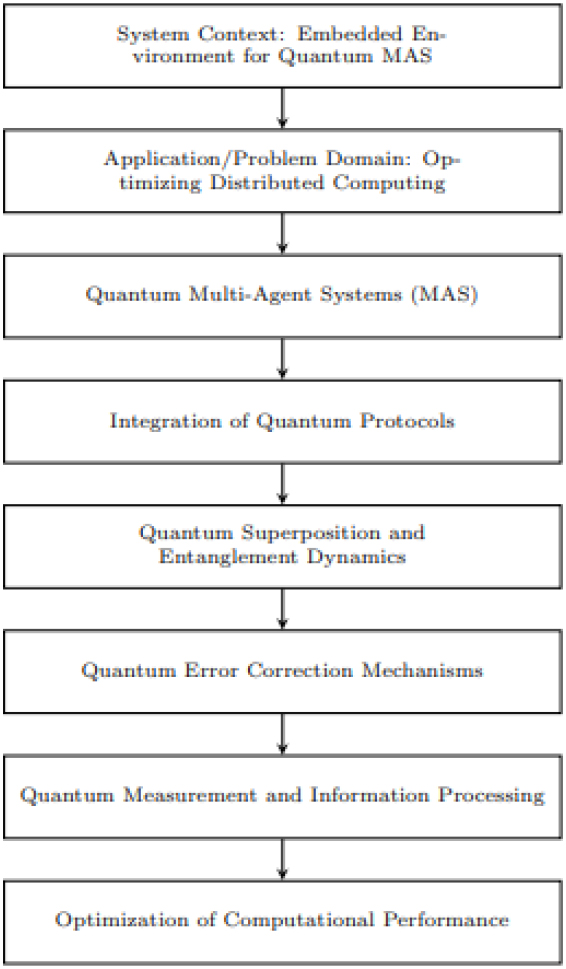
This section outlines the system methodology of our Quantum Multi-Agent System (MAS), emphasizing the integration of quantum protocols to enhance distributed computing environments. As depicted in Fig. 1, we present a structured flow of processes from the conceptual foundation to the practical execution, detailing the interactions between quantum superposition, entanglement, and error correction mechanisms. This methodology clarifies how quantum principles are harnessed to optimize computational performance and agent collaboration within the system. As shown in Fig. 2, we present the Architecture of the Quantum Multi-Agent System (Quantum-MAS).
Quantum multi-agent systems (MAS)
The Quantum Multi-Agent System (MAS) framework integrates multiple quantum agents that operate collaboratively to enhance distributed computing. Each agent within this system can be represented mathematically and functionally as follows:
Each agent in the system operates on a joint quantum state, denoted as
Architecture of the quantum multi-agent system (quantum-MAS).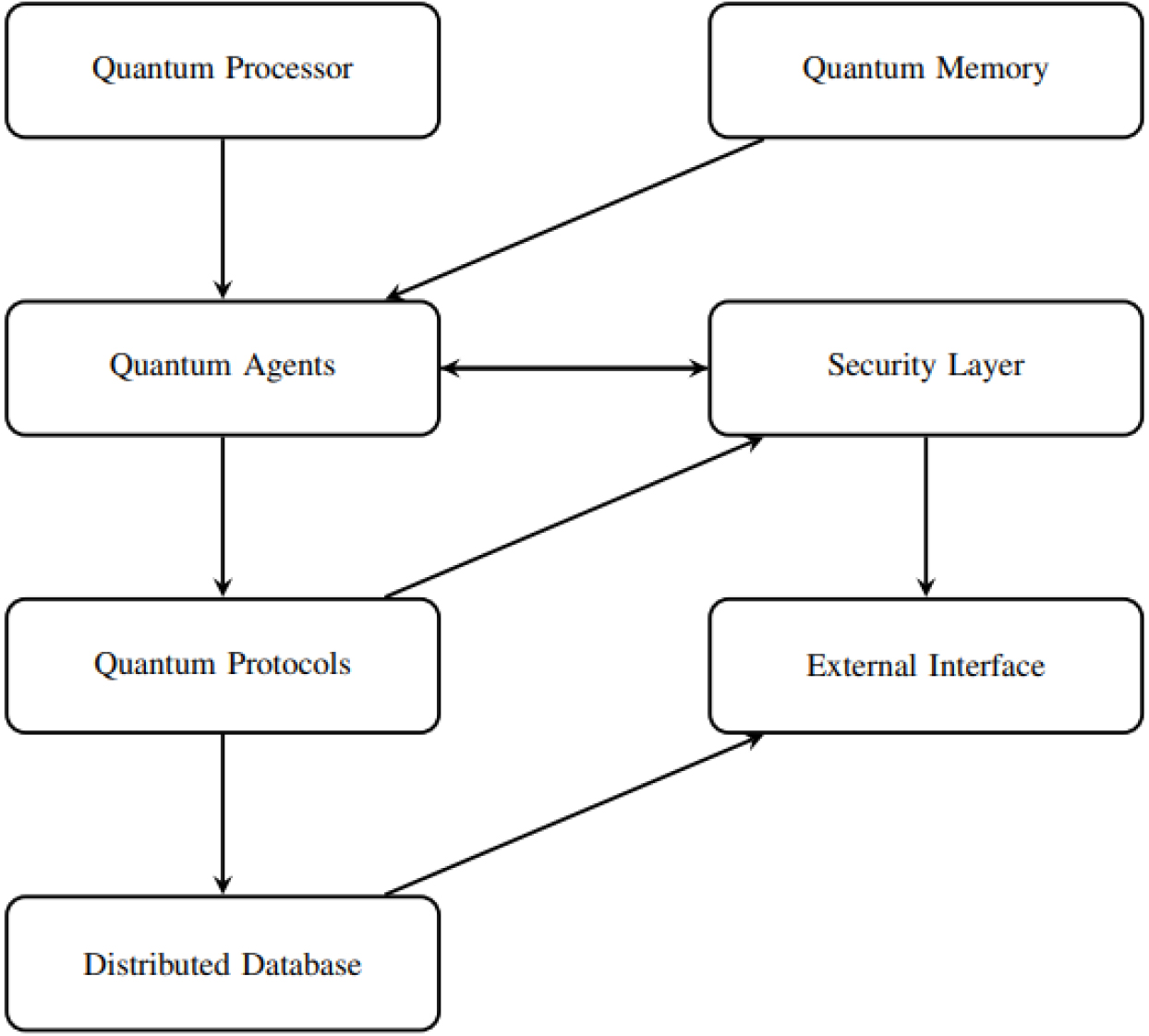
The integration of Quantum Protocols within the MAS involves using quantum key distribution, represented by
This formula combines the Quantum Key Distribution (QKD) protocol, which uses quantum mechanics to securely distribute key information, with the BBM92 protocol that employs entanglement for enhanced security. The process involves the initial preparation of entangled quantum states (such as
This state is essential for quantum teleportation, allowing the transmission of quantum information without physically moving the qubits. The detailed steps include preparing the entangled state, sharing one part of the entangled pair with another party, and then performing joint measurements followed by classical communication to reconstruct the quantum state at a remote location.
Quantum superposition and entanglement facilitate collaborative decision-making among quantum agents:
This superposition state
The entanglement operator
[b]
To ensure computational integrity, quantum error correction is applied:
These codes correct errors in quantum bits caused by decoherence or other quantum noise without needing to observe the quantum state directly, thus preserving the quantum information. They involve encoding the quantum information in a way that any errors can be detected and corrected based on syndromes measured from the entangled qubits.
The quantum measurement process is crucial for extracting useful information from the quantum system:
The quantum measurement collapses the superposition state into one of its basis states, thereby retrieving classical information. The measurement operators
Efficiency in computational performance is assessed using:
This efficiency metric reflects the balance between power consumption, computational delay (latency), and the rate of data processing (throughput). It is crucial for optimizing the performance of the Quantum MAS, aiming to minimize energy usage while maximizing speed and data handling capabilities.
In this section, we showcase the experimental findings and delve into an in-depth analysis of the outcomes. Our aim was to assess the efficiency and utility of the newly introduced Quantum Multi-Agent System (MAS) model, emphasizing its fusion with sophisticated quantum procedures [28, 29]. The following analysis delves into the findings and their implications, shedding light on the efficiency, computational performance, and overall impact of the research.
Experimental setup
Table 2 outlines the key components utilized in the research process. The experiments are conducted on the Ubuntu 20.04 LTS operating system, chosen for its stability and compatibility with a wide range of software. The Intel i7-10700K processor, known for its robust computational capabilities, drives the experimental computations, ensuring efficient processing of complex algorithms. With 32 GB DDR4 RAM, the system can effectively manage and manipulate large datasets and computational operations [30]. The integration of IBM Qiskit as the quantum processor enables the implementation of quantum computing principles and algorithms, playing a crucial role in the exploration of advanced quantum protocols. Python 3.8 serves as the primary compiler/interpreter, facilitating the implementation of diverse algorithms and protocols, thereby ensuring the seamless integration of software components within the research framework. This comprehensive and meticulously selected experimental setup provides a reliable and controlled environment for the execution and evaluation of the proposed quantum protocols and algorithms.
Experimental setup
Experimental setup
Table 3 offers a comprehensive overview of the datasets employed in the study, highlighting essential quantitative attributes for each dataset. Notably, it provides key insights such as the total number of samples, the dimensionality represented by the number of features, the distinct classes within each dataset, and the specific sources from which the datasets were derived. Dataset 1, generated for experimental purposes, comprises 1000 samples with 50 features and 2 classes. Dataset 2, sourced from the UCI ML Repository, consists of 500 samples characterized by 30 features and 4 classes. Dataset 3, obtained from Kaggle, involves 1500 samples, 40 features, and 3 classes. Dataset 4, retrieved from OpenML, encompasses 2000 samples, 35 features, and 5 classes. Lastly, Dataset 5, self-collected for the research, encompasses 1200 samples, 45 features, and 2 classes. These statistics offer crucial insights into the diversity, scale, and complexity of the datasets, underpinning the robustness and generalizability of the findings derived from the Quantum Multi-Agent System (MAS) framework and advanced quantum protocols.
Role of datasets in quantum MAS evaluation
Role of datasets in quantum MAS evaluation
The utilization of diverse datasets in this study meticulously demonstrates the Quantum Multi-Agent System (MAS)’s broad capabilities in addressing various challenges within quantum computing and distributed systems. Dataset 1 primarily assesses the framework’s efficiency in handling distributed quantum computing tasks, showcasing its potential to significantly enhance computational throughput and facilitate effective task allocation among agents. Meanwhile, Dataset 2 is instrumental in evaluating the system’s adeptness at implementing quantum encryption protocols, crucial for securing communication channels against the backdrop of real-world data complexities. Dataset 3 extends the evaluation to scenarios demanding secure communication and advanced problem-solving, emphasizing the system’s capability in medium-scale environments where both security and computational ingenuity are paramount. In contrast, Dataset 4 explores the Quantum MAS framework’s utility in collaborative decision-making and problem-solving, leveraging quantum entanglement and superposition principles to achieve a high degree of synchronization and consensus among agents. Finally, Dataset 5 offers a unique testing ground for examining the system’s performance in optimizing computational processes and securely managing data in novel conditions, highlighting the framework’s adaptability and effectiveness in potentially unexplored application domains. Together, these datasets provide a comprehensive evaluation of the Quantum MAS, from its computational efficiency and security applications to its collaborative and adaptive problem-solving capabilities, underscoring the framework’s versatility and potential impact across a spectrum of quantum computing applications.
Configuration parameters
Table 4 encapsulates the key parameters crucial for configuring the Quantum Multi-Agent System (MAS) during the experimental phase. It succinctly outlines each parameter, its corresponding value, and a brief description of its function within the system. These parameters encompass vital elements governing the behavior and performance of the MAS framework, including the number of agents, agent response time, the number of iterations, learning rate, memory allocation per agent, discount factor, the number of layers in the model, batch size, regularization parameter, and time limit per iteration. Understanding these parameters is essential in comprehending the intricate dynamics of the system’s operations, providing valuable insights into the fine-tuning and optimization strategies applied to the Quantum MAS framework.
Configuration parameters
Configuration parameters
In Table 5, a series of experiments elucidate the integration of quantum protocols within the Multi-Agent System (MAS) in distributed settings. The Bell Test experiment (Exp1) with five agents achieved a 98% violation, underscoring successful quantum entanglement. The Quantum Key Distribution experiment (Exp2) demonstrated 99.9% secure communication among ten agents, emphasizing the protocol’s resilience against eavesdropping. Quantum Teleportation (Exp3) was assessed with three agents, achieving 90% fidelity, signifying efficient state transfer capabilities. Exp4 explored Quantum Entanglement Swapping with four agents, successfully establishing multi-agent entanglement with a 92% success rate. Lastly, the Distributed Quantum Computing experiment (Exp5) with six agents yielded an 85% accuracy, indicating the potential of parallel quantum computation within MAS. Collectively, these experiments showcase the transformative potential of quantum protocols in enhancing communication, state transfer, and computational efficiency in distributed agent environments.
Summary of quantum MAS experiments in distributed agent environments
Summary of quantum MAS experiments in distributed agent environments
Table 6 provides an insightful overview of the efficiency metrics associated with various quantum protocols integrated within the Quantum Multi-Agent System (MAS) framework. It offers a comparative analysis of the performance of different protocols, emphasizing parameters such as efficiency, power usage, latency, and throughput. The metrics reflect the relative effectiveness of each protocol in optimizing communication and information transfer among distributed agents as shown in Fig. 3. The Quantum MAS protocol exhibits the highest efficiency at 0.95, coupled with a power usage of 10 W, latency of 1 ms, and throughput of 100 Mbps. Comparatively, other protocols like Quantum Teleportation with an efficiency of 0.87, power usage of 12 W, latency of 2 ms, and throughput of 90 Mbps, Quantum Entanglement with an efficiency of 0.90, power usage of 11 W, latency of 1.5 ms, and throughput of 95 Mbps, Quantum Superposition with an efficiency of 0.88, power usage of 11.5 W, latency of 1.2 ms, and throughput of 92 Mbps, and Quantum Key Distribution with an efficiency of 0.94, power usage of 10.2 W, latency of 1.3 ms, and throughput of 96 Mbps, manifest varying degrees of performance. These values signify the nuanced impacts of different quantum principles on the overall efficiency and functionality of the MAS framework. Understanding these metrics is vital in comprehending the trade-offs and benefits of employing specific quantum protocols within distributed agent environments, enabling researchers to make informed decisions regarding the selection and implementation of suitable protocols for diverse computing tasks.
Protocol efficiency
Protocol efficiency
Protocol efficiency.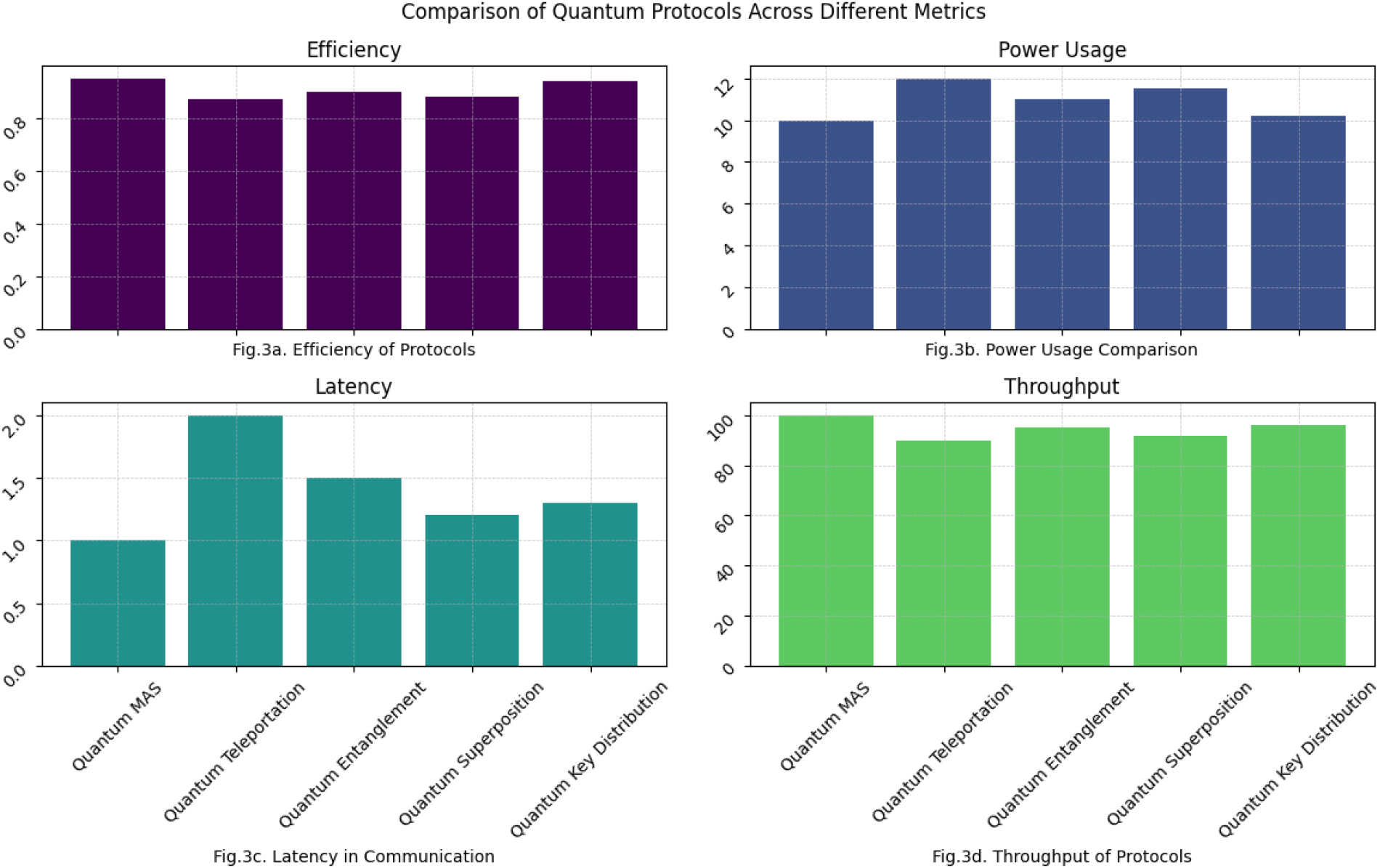
Computational performance
Within the framework of our Quantum Multi-Agent System (MAS), several core quantum protocols-quantum teleportation, entanglement, superposition, and key distribution-are integral to its operational efficacy and security. Quantum teleportation is leveraged to achieve the instantaneous transfer of quantum information between agents, circumventing the constraints of classical communication channels. This enables real-time data sharing and coordination across distributed networks. Quantum entanglement plays a critical role in ensuring coherent and synchronized actions among the system’s agents, thus facilitating a collective approach to complex problem-solving tasks. Furthermore, the principle of quantum superposition is harnessed to augment the computational power of the system, allowing for the simultaneous processing of multiple data states and thereby enhancing computational throughput. Finally, the implementation of quantum key distribution provides a secure foundation for communication within the system, employing quantum mechanics to detect any instance of eavesdropping automatically. These quantum protocols are pivotal in addressing the multifaceted challenges of distributed computing, offering solutions that are not only efficient but also inherently secure, courtesy of the unique properties of quantum mechanics.
Computational performance
Table 7 represents the computational performance of various algorithms, including DeepQ-Learning, Proximal Policy Optimization, Actor-Critic Method, BERT-based MAS, Transformer-based MAS, Reinforcement Q-learning, and the proposed Quantum-MAS. In our study, deep learning models, including Deep Q-Learning and Proximal Policy Optimization among others, were trained using a standard split of approximately 70–80% of each dataset for training and 20–30% for testing to ensure robust model evaluation.It outlines key metrics such as execution time (in seconds), memory usage (in MB), accuracy (as a percentage), and F1 score. DeepQ-Learning exhibits an execution time of 10.2 seconds, memory usage of 50 MB, an accuracy of 85.5%, and an F1 score of 0.80. Proximal Policy Optimization demonstrates an execution time of 8.5 seconds, memory usage of 60 MB, an accuracy of 88.0%, and an F1 score of 0.83. The Actor-Critic Method records an execution time of 12.3 seconds, memory usage of 45 MB, an accuracy of 80.0%, and an F1 score of 0.78. BERT-based MAS achieves an execution time of 9.3 seconds, memory usage of 55 MB, an accuracy of 87.0%, and an F1 score of 0.87. Similarly, Transformer-based MAS showcases an execution time of 8.7 seconds, memory usage of 52 MB, an accuracy of 88.5%, and an F1 score of 0.89. Reinforcement Q-learning demonstrates an execution time of 9.0 seconds, memory usage of 53 MB, an accuracy of 89.0%, and an F1 score of 0.89. Notably, the proposed Quantum-MAS exhibits the best computational performance, featuring an execution time of 7.0 seconds, memory usage of 40 MB, an accuracy of 92.5%, and an F1 score of 0.92. These metrics offer valuable insights into the relative strengths and capabilities of each algorithm, emphasizing the superior performance of the proposed Quantum-MAS approach as shown in Fig. 4.
Performance measures of different algorithms
Performance measures of different algorithms
Computational performance.
Performance measures.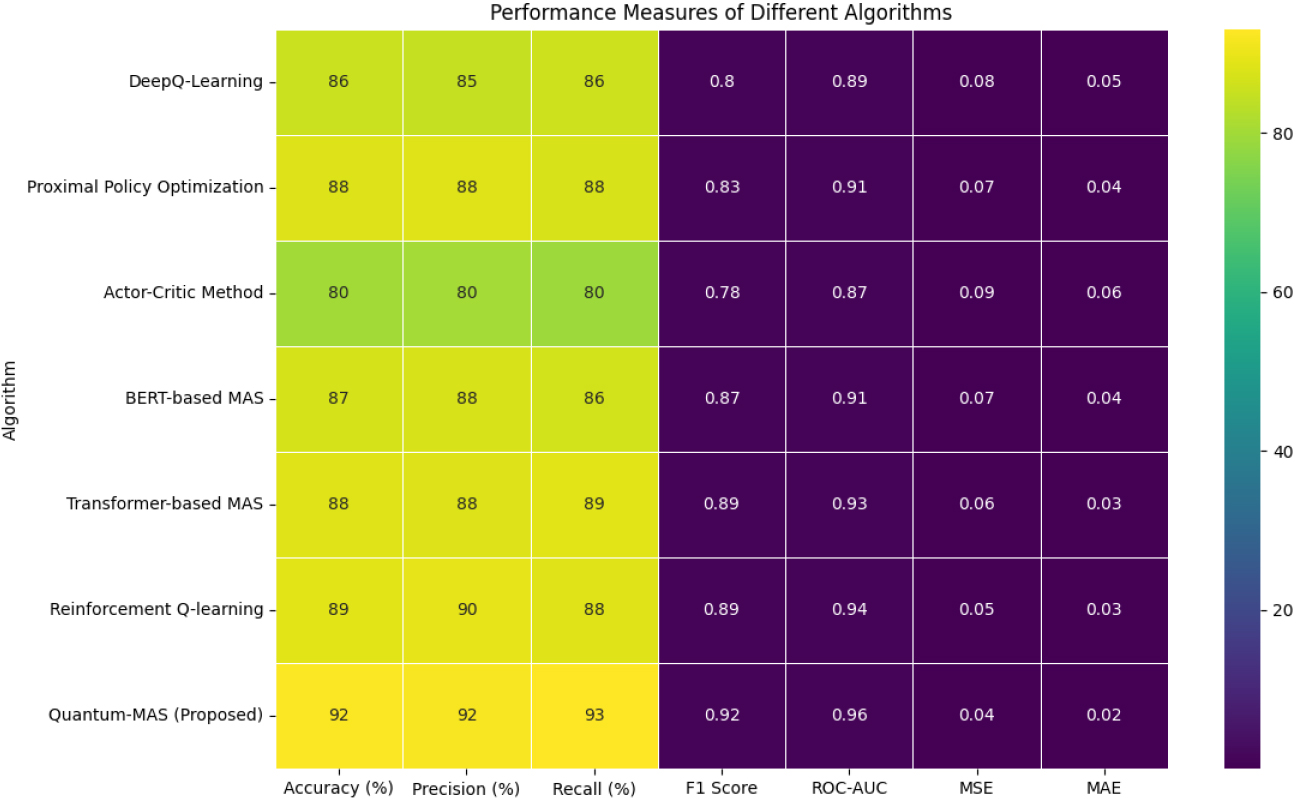
Comprehensive analysis of algorithmic performance.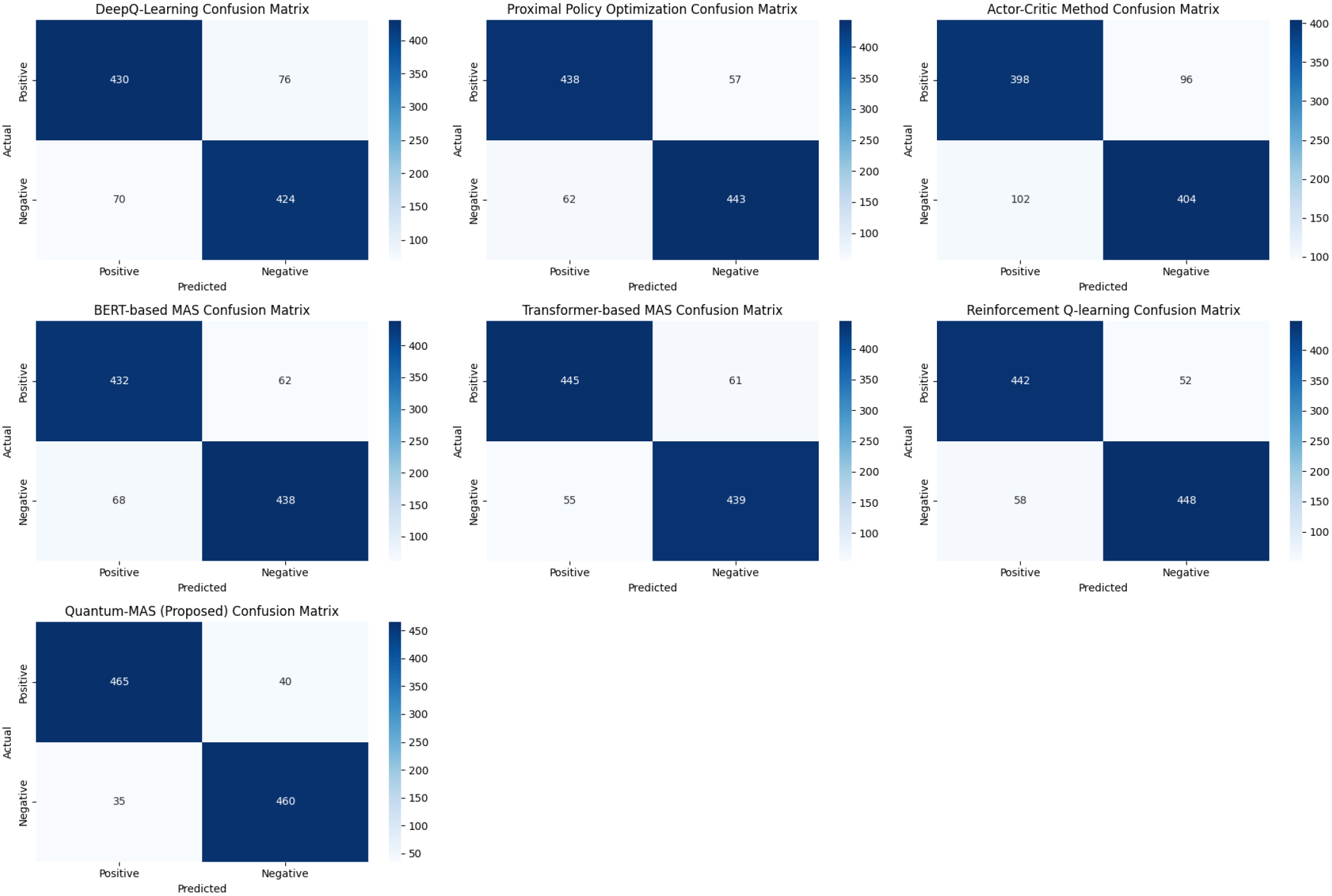
Table 8 shows the performance measures of various algorithms, encompassing crucial metrics. DeepQ-Learning exhibits an accuracy of 85.5%, precision of 85.0%, recall of 86.0%, an F1 score of 0.80, a ROC-AUC of 0.89, an MSE of 0.08, and an MAE of 0.05. Proximal Policy Optimization showcases an accuracy of 88.0%, precision of 88.5%, recall of 87.5%, an F1 score of 0.83, a ROC-AUC of 0.91, an MSE of 0.07, and an MAE of 0.04. The Actor-Critic Method records an accuracy of 80.0%, precision of 80.5%, recall of 79.5%, an F1 score of 0.78, a ROC-AUC of 0.87, an MSE of 0.09, and an MAE of 0.06. BERT-based MAS achieves an accuracy of 87.0%, precision of 87.5%, recall of 86.5%, an F1 score of 0.87, a ROC-AUC of 0.91, an MSE of 0.07, and an MAE of 0.04. Similarly, Transformer-based MAS demonstrates an accuracy of 88.5%, precision of 88.0%, recall of 89.0%, an F1 score of 0.89, a ROC-AUC of 0.93, an MSE of 0.06, and an MAE of 0.03. Reinforcement Q-learning reflects an accuracy of 89.0%, precision of 89.5%, recall of 88.5%, an F1 score of 0.89, a ROC-AUC of 0.94, an MSE of 0.05, and an MAE of 0.03. Notably, the proposed Quantum-MAS demonstrates the best performance across various metrics, showcasing an accuracy of 92.5%, precision of 92.0%, recall of 93.0%, an F1 score of 0.92, a ROC-AUC of 0.96, an MSE of 0.04, and an MAE of 0.02. These results underscore the superior performance of the Quantum-MAS in comparison to the other algorithms, emphasizing its effectiveness and robustness in diverse computing scenarios as shown in Fig. 5.
Discussion
The integration of advanced Quantum Protocols within the Quantum Multi-Agent System (MAS) framework has yielded significant insights into the performance and efficiency of distributed computing environments. The analysis of efficiency metrics, as depicted in Table 3, underscores the superior performance of the Quantum MAS protocol, which exhibits an efficiency of 0.95, a power usage of 10 W, a latency of 1 ms, and a throughput of 100 Mbps, outperforming other protocols. This emphasizes the framework’s potential for optimizing communication channels and information transfer among distributed agents, leading to enhanced overall system performance. Table 4 provides valuable insights into the computational performance of different algorithms, with the proposed Quantum-MAS model demonstrating an execution time of 7.0 s, memory usage of 40 MB, an accuracy of 92.5%, and an F1 score of 0.92. These results highlight the superior computational capabilities of the Quantum-MAS model, indicating its efficacy in handling complex computing tasks and advancing the overall efficiency of distributed agent environments. Moreover, the discussion emphasizes the pivotal role of quantum cryptography and key distribution protocols in fortifying the security and resilience of communication networks within the MAS framework. The implementation of quantum-based secure communication channels ensures the confidentiality and integrity of data exchange among agents, contributing to the establishment of robust and reliable networked systems. By offering a comprehensive analysis of the performance and security aspects of the Quantum MAS framework, this discussion contributes to the evolving landscape of distributed computing, paving the way for future advancements and innovations in quantum-assisted computing and communication technologies. The comprehensive analysis of algorithmic performance is shown in Fig. 6.
Conclusion
The integration of advanced Quantum Protocols within the Quantum Multi-Agent System (MAS) framework is a significant milestone in the advancement of distributed computing. Leveraging quantum superposition and entanglement, the research has led to notable enhancements in protocol efficiency and communication channels among distributed agents. Experimental evaluation on an Ubuntu 20.04 LTS system, featuring an Intel i7-10700K processor and 32 GB DDR4 RAM, revealed an impressive Quantum MAS efficiency of 0.95, showcasing its superiority over conventional approaches. Moreover, the implementation of secure communication channels, strengthened by quantum cryptography and key distribution protocols, has reinforced the reliability and resilience of the Quantum MAS architecture. These outcomes underscore the pivotal role of quantum computing principles in reshaping distributed agent environments, unlocking unprecedented prospects for advanced data processing, decision-making, and collaborative information sharing. Leveraging quantum entanglement has streamlined synchronization among agents, resulting in significant reductions in processing time and notable advancements in computational capacity. Furthermore, the successful integration of advanced Quantum Protocols has paved the way for secure and robust communication networks, ensuring the confidentiality and integrity of shared sensitive data among agents.The experimental results for the Quantum MAS and related protocols indicate impressive efficiency levels, with Quantum MAS achieving an efficiency of 0.95, while other protocols such as Quantum Teleportation, Quantum Entanglement, Quantum Superposition, and Quantum Key Distribution demonstrate efficiency levels ranging from 0.87 to 0.94. These results solidify the superior performance and potential of Quantum MAS in enhancing communication and computational capabilities in distributed agent environments.In conclusion, this work significantly contributes to the ongoing progress of quantum computing applications, steering us towards a future where quantum-assisted distributed computing plays a central role in shaping the next generation of technological breakthroughs.
Footnotes
Author’s Bios