In this paper, we investigate a linear hyperbolic stochastic partial differential equation (SPDE) with rapidly oscillating ϵ-periodic coefficients in a domain with small holes (of size-ϵ) under Neumann conditions on the boundary of the holes and Dirichlet condition on the exterior boundary. When the number of these holes approach infinity, i.e. their sizes approach zero, the homogenized problem is a hyperbolic SPDE with constant coefficients in the domain without perforations. Moreover the convergence of the associated energy to that of the homogenized system is established.
Homogenization is a mathematical theory aimed at understanding the behavior of processes that take place in heterogeneous media with highly oscillating heterogeneities. These heterogeneous materials consist of finely mixed different components like soil, paper, concrete for building, fibreglass, materials used in the manufacturing of high tech equipments such as planes, rockets and so on. This signifies that almost everything around us in real life is a heterogeneous material. The physical problems described on heterogeneous materials such as heat, mechanical constraints, flow of fluids in these media lead to the study of PDEs with highly oscillating coefficients depending on macroscopic scales or boundary value problems for PDEs in domain with fine grained boundaries. The main obstacle in solving these problems arises either from the character of the domain or the presence of high oscillations in the coefficients of the governing equation. To this end, it is expensive to compute solutions to these type of problems. Numerical methods have proved inefficient in solving such problems due to the fact that even the most advanced parallel computers are unable to simulate schemes related to the physically interesting such problems.
The study of homogenization for PDEs in periodic structures has been undertaken by many authors. It was originally based on the idea of asymptotic expansions in powers of the small perturbation parameter in the problem. This approach was fundamental in the celebrated work [8] of Bensoussan, Lions and Papanicolaou; we should also mention the monograph by Bakhvalov and Panacenko [5]. These authors studied wide range of partial differential equations, such as elliptic, parabolic and hyperbolic problems, mainly linear in structure. A great wealth of interesting results were obtained by many mathematicians, thanks to new methods such as Murat–Tartar’s H-convergence, Tartar’s method of oscillating test functions, Nguetseng–Allaire’s two scale convergence, Cioranescu–Damlamian–Griso’s unfolding method. It will not be possible to survey most of these results, some of which may be found for instance in [3,4,16–20,28,29,36,37,39,48,49,59,60]. In view of the prevalence of randomness in almost all natural phenomena, it was not long before homogenization of PDEs with random coefficients started to be investigated. Pioneers in this direction are certainly Kozlov [32], Papanicolaou and Varadhan [42]. Their work influenced many new research; see for instance [11,12,23,30,34,44,57,58]. We also note the closely related work [14,15,33] dealing with stochastic homogenization for SPDEs with small parameters.
It should be noted that the methods which enabled the study of homogenization in the periodic setting have recently been generalized to homogenization problems on nonperiodic algebras, see for instance [38,53–55,62].
As mentioned above, there was a need to consider homogenization of PDEs with random coefficients. However physical processes under random fluctuations are better modelled by stochastic partial differential equations (SPDEs). It was therefore natural to consider homogenization of this very important class of PDEs. Research in this direction is still at its infancy, despite the importance of such problems in both applied and fundamental sciences. Some relevant interesting work have recently been undertaken, mainly for parabolic SPDEs, see for instance [6,26,47,50,52].
The case of hyperbolic SPDEs is widely open till now. The first work done by means of hyperbolic SPDEs is [35], where we obtained homogenization result as well as corrector results by means of the two-scale convergence method. As far as the homogenization of deterministic hyperbolic (PDEs) is concerned, many work have been undertaken by several authors from different perspectives. We refer to [8] where the authors studied the homogenization of the hyperbolic equations based on asymptotic expansions. We also note the monograph of Cioranescu and Donato [19], where similar studies are carried through in the framework of Tartar’s method, which was introduced in [36,59]. Cioranescu and Donato also proved the convergence of the energy associated to the inhomogeneous wave equation to the energy associated to the homogenized problem; the corresponding corrector result was proved in [13], see also [24,25]. Recently, the new field of numerical homogenization is attracting a growing attention of researchers in applied mathematics. Some numerical works have considered wave equations in heterogeneous media using finite element heterogeneous multiscale method [1,2] and the upscaling method [10,31,41]. It would be of interest to investigate homogenization of hyperbolic SPDEs in the framework of these methods in our future work.
In this work we will be concerned with establishing homogenization results for Neumann problem of linear hyperbolic equations with periodically oscillating coefficients in the framework of Tartar’s method, based on his ingenious construction of oscillating test functions. We study this problem in the cylindrical domain where and is a spatial domain with periodically distributed holes (with small size ), when the number of these holes becomes infinite and converges to a domain Q without holes. One of the difficulties in obtaining the homogenization result is that, the spatial domain varies with ϵ. In order to avoid this difficulty we introduce extension-like operators, which enable us to reduce the problem to one in fixed domain. The other difficulty is that, in the deterministic case one needs some analytic compactness results in order to obtain the limit equation. However, these results are not enough in the probabilistic setting. As additional tools, we use the Prokhorov and Skorokhod’s probabilistic compactness results for which tightness of probability measures generated by the perturbed problems is needed. But for the tightness uniform estimates of various norms of the solutions of our original problems have to be established in appropriate probabilistic evolution spaces. Furthermore after the application of Prokhorov and Skorokhod’s processes the presence of the noise prohibited direct adaptation of deterministic arguments due to the dependence of the noise on ϵ.
The structure of the domain.
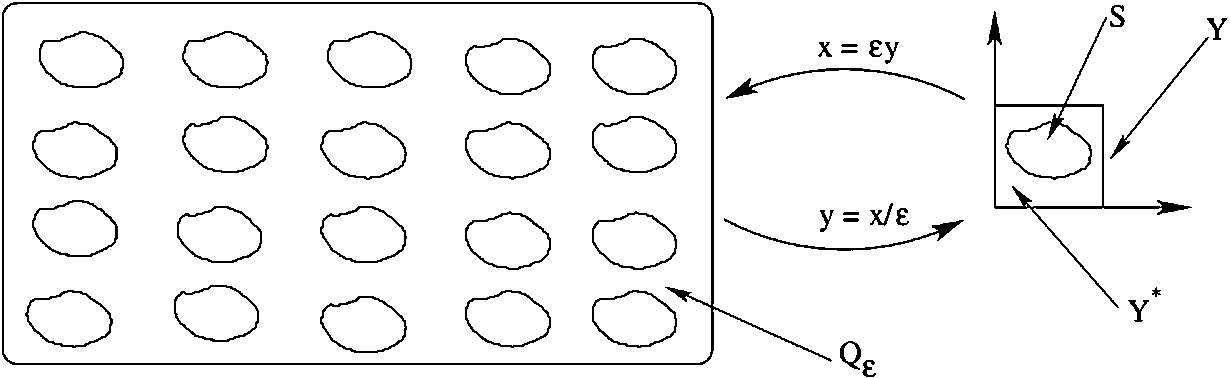
Let Q be a sufficiently smooth bounded and open (at least Lipschitz) subset of , is the reference cell, S a smooth subset of Y, such that and is the set of all translated sets of by , where . Assume that ; denotes the boundary of the set ∙. Now we define the perforated domain with an ϵ-periodic structure by (see Fig. 1)
Let us define by the set , therefore,
We denote by the characteristic function of any open set O in and by the measure of any measurable set ∙ of . For , we define . We also denote by the zero extension to the whole Q for any function f defined on . In this paper we study the asymptotic behaviour of solutions of the initial boundary value problem with oscillating data:
where () an m-dimensional standard Wiener process defined on a given filtered complete probability space ; denote the corresponding mathematical expectation, , , , and an symmetric matrix and .
In order to state some facts we need to introduce the following spaces , , , the subspace of of Y-periodic functions where . Let be the closure of in the -norm, and the subspace of with zero mean on Y. We also define with the norm in the -norm. We denote by the duality pairing between and as well as between and ; denotes the dual of .
For a Banach space X, and , we denote by the space of measurable functions such that and by we denote the space of functions such that is measurable with respect to and for each t is -measurable in ω, we endow the later space with the norm
When , the space
where . When , we endow with the following norm
It is well known that, under the above norm, is a Banach space. We shall often omit ω in the notation of . Our main assumptions are
for all, and α is a positive constant,
, ,
, are Y-periodic, ,
, ,
, .
In the following we introduce the notion of strong probabilistic solution to our problem
We define the strong probabilistic solution of the problem (1) by
such that
, are continuous with respect to time in , , respectively,
, are adapted to the filtration ,
, ,
, satisfies
.
Analogously to the existence and uniqueness result for the Dirichlet problem by Pardoux [43], we have the following result
Suppose that the assumptions (A1)–(A5) hold. Then for fixed, the problem (1) has a unique strong probabilistic solutionin the sense of Definition1.
Our goals are described as follows: First, we show that the sequence of solutions converges as to a solution u of the following stochastic partial differential equation (SPDE)
where is a constant elliptic matrix defined by
and is the unique solution of the following boundary value problem:
for any . Next, we show that the associated energy to the problem (1) uniformly converges to the associated energy to the problem (3).
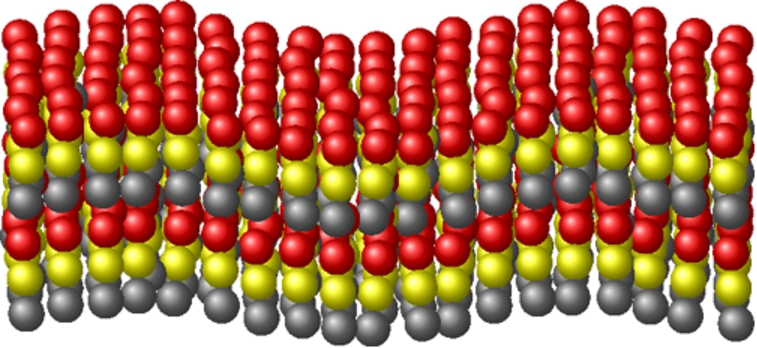
Wave generated in a membrane with a random distribution of inclusions.
Problems of type (1) arise in several physical processes in the presence of random fluctuations, for instance, in the modeling of waves generated in a vibrating string, an elastic membrane, see Fig. 2, and a rubbery solid in dimensions 1, 2 and 3 respectively. To illustrate that; for example let us consider the disturbance generated in bridge cables. These cables are made up of composite materials and vibrate continuously with high irregularity as a response to wind blow. In this case the external force is given by . It is also possible that the disturbance arises via other sources such as birds landing on or taking off from the cable. In this case, the intensity of the disturbance on the cable is moderate. Thus, the force has a more regular behaviour and therefore, the stochastic term may be neglected. In this case, the force is represented by . In fact problem (1) can also be understood according to the well known Walsh interpretation [61]; since the strings of a guitar have the structure of a composite material, when bombarded by particles of dust, the motion of the strings is subjected to random vibrations. Such a process can be modeled by problem (1). Wave equations in heterogeneous media have applications in several other branches of science such as geoscience, physics and engineering [10,27].
This paper is organized as follows. In Section 2, we introduce some preliminaries about the extension operators. In Section 3, we establish important a priori estimates that will be used in subsequent sections. Section 4 is devoted to the proof of the tightness of probability measures generated by the extension of to Q and the Wiener process ; this will enable us to use Prokhorov’s and Skorokhod’s processes for the construction of a sequence of random variables defined on new probability spaces; satisfies the original problem (1) and strongly converges in a suitable space to a triple that solve the homogenized problem (3). Section 5 is devoted to the construction of problem (3) by adapting Tartar’s method of oscillating test functions. In Section 6 we establish the asymptotic relation of the energies, corresponding to the problems (1) and (3).
Preliminaries
The following lemma collected from [19] will be needed in the homogenization result.
Letand u be a Y-periodic function in. SetThen, asfor any bounded open subset K of, wherethe mean value of u over Y.
There exists a linear continuous extension operatorsuch that for some constant C independent of ϵ and anywith
on,
on,
,
,
.
There exists a linear continuous extension operatorsuch that for some constant C independent of ϵ
on,
for any.
Let be the restriction operator such that
This operator obviously exists and is bounded. We define the functional
by
It is clear that and
Readily
Setting , we get the second statement of the lemma. To prove the first statement, we note that
From the definition of the restriction operator , we have
Therefore
This implies that (i) holds. The lemma is therefore proved. □
Assume thatwhereis a constant independent of ϵ andthe extension by zero ofto the whole Q. Furthermore assume thatis an extension operator such thatthen
From (7), there exists , such that
so
But, we also have
On the other hand
Due to (9) and (10), we can pass to the limit in (11) to obtain
Therefore, we deduce from (8), that
□
Uniform estimates of
Here and in the sequel, C will denote a constant independent of ϵ. In this section we establish the a priori estimates announced earlier. In our first lemma, we prove that, both the solution to the problem (1) and its time derivative are bounded in appropriate probabilistic evolution spaces. Likewise in our second lemma we establish a finite difference estimate of the time derivative of the solution in a space involving .
Under the assumptions (A1)–(A5), the solutionof (1) satisfies the following estimate
The following arguments are used modulo appropriate stopping times. Itô formula and the symmetry of A give
Integrating over , , we get
Using the assumptions on the matrix A and taking the supremum over , we have
Taking the expectation on both sides, we have
where
Using Cauchy–Schwarz’s and Young’s inequalities, we have
for any .
Thanks to Burkhölder–Davis–Gundy’s inequality, followed by Cauchy–Schwarz’s inequality, the second term in the right-hand side of (14) can be estimated as
Again using Young’s inequality, we get
for any . Using (15) and (16) into (14)with sufficiently small δ and applying assumption (A5), to obtain
The proof is complete. □
Next we have
Under the assumptions (A1)–(A5) with the replacement of the assumption onby the requirement that, there exist positive constants C,such that for alland for all,satisfies the following estimate:
Assume that is extended by zero outside the interval . We write
Then
Using assumption (A2), we have
From assumption (A5), we obtain
Since
then Fubini’s theorem gives
Thanks to Burkhölder–Davis–Gundy’s inequality, we get
But Cauchy–Schwarz’s inequality gives
Now using the assumption made on , we have
From (19), (20) and (21), we arrive at
□
From the extensions Lemmas 3, 4, estimates (13) and (17) we have that an extension of to satisfying
where the data is extended by zero outside .
Tightness property of probability measures
In this section, we establish the tightness of probability measures generated by the extension of to Q (denoted by for simplicity) and the Wiener process . We start by introducing analytic and probabilistic compactness results. We have from [56]
Let, B andbe some Banach spaces such thatand the injectionis compact. For any, andlet E be a set bounded in, whereThen E is relatively compact in.
The following two lemmas are collected from [9]. Let be a separable Banach space and consider its Borel σ-field to be . We have
(Prokhorov).
A sequence of probability measuresonis tight if and only if it is relatively compact.
(Skorokhod).
Suppose that the probability measuresonweakly converge to a probability measure μ. Then there exist random variables, defined on a common probability space, such thatandandthe symbolstands for the law of ·.
Let us introduce the space where
and
We endow Z with the norm
The above constructed space Z is a compact subset of.
Lemma 7 together with a suitable argument due to Bensoussan [7] give the compactness of and in and respectively. □
Now consider the space and the σ-algebra of the Borel sets of . Let be the -valued measurable map defined on by
Define on the probability measures by
The family of probability measuresis tight in.
The proof follow along the lines of the proof of [35, Lemma 7], see also [7,22,45,46] and [51]. □
From Lemmas 8, 11, the estimates (22) and (23), there exist a subsequence and a measure Π such that
weakly. From Lemma 9 there exist a probability space and -valued random variables , such that the probability law of is and that of is Π. Furthermore, we have
Let us define the filtration
We show that is an -Wiener process following [7] and [51]. Arguing as in [51] we get that satisfies -a.s. the problem (1) on the fixed domain in the sense of distributions.
The homogenization result
In this section we formulate our first main result which is:
Suppose that the assumptions (A1)–(A5) are satisfied with the replacement of the assumption onby. Furthermore letandThen there exist a probability spaceand random variablesandsuch that the convergence (24) holds andandsatisfies the homogenized problem (3).
We shall omit j from the index of the sequence . Let us define the vector functions by
Then satisfies
From the assumptions on and estimate (13), we obtain
Then up to a subsequence still denoted by , the extension of satisfies
Using the definition of this vector in problem , we see that satisfies
for any and . Integrating the first term by parts twice and using property (2) of Lemma 3, we have
We pass to the limit, in the two terms on the left-hand side and in the first term on the right-hand side of (35), using convergences (10), (24), (33) and (25), then we get
In the following we show that
Using integration by parts, we have
In the first term on the right hand side of (38), we pass to the limit using convergences (24) and (28) and obtain
the second term can be written as
The first term on the right hand side of (40) will converge to zero using convergence (24) and the assumptions on , v and ϕ. Indeed
Now using convergence (29), we can pass to the limit in the second term on the right hand side of (40) to obtain
Similarly, we treat the last term in the right hand side of (38) by writing
Using the assumptions on , v and ϕ, we have
Hence the first term on the right hand side of (42) converges to zero by (24). Now using convergence (28), we can pass to the limit in the second term on the right hand side of (42) to obtain
From the convergences (43), (41) and (39), we obtain (37). Therefore we have
for all and . Using integration by parts, we obtain
in the sense of distribution. We will have the homogenized SPDE, if we can show that
In order to show (46), we use the argument of the elliptic Neumann problem, see [21]. Let
where is defined in Lemma 2 and is defined by the cell problem (4). Using Lemma 1 and the definition of , it is an easy task to show that
We also introduce the following vector function
Since the vector is Y-periodic, Lemma 1 gives
Also from (4), we have that
We test this equation with for any and , integrate in t over and in x over Q to get
Using as a test function in (35), one has
Now subtracting (51) from (52), we obtain
We pass to the limit in all the terms in (53) excluding the stochastic integral using convergences (10), (24), (25), (33), (48) and (49), to obtain
Concerning the stochastic integral, we have
Thanks to Burkhölder–Davis–Gundy’s inequality, (48) and the assumptions we show that the first term in the right hand side, converges to zero -a.s. Indeed we have
Since converges strongly to in we get
By the same steps as in the proof of (37), we show that
Therefore we obtain the corresponding limit equation to (53)
We rewrite it as
Replacing by as test function in (44), we get
Comparing equations (55) and (56), we obtain
for any and . This implies that
Since λ is an arbitrary in , we deduce (46).
It remains to check that the initial conditions and are satisfied. Notice that equation (34) is valid for , such that , , and . Therefore we have
We pass to the limit in this equation and get
But
Thus
Comparing this with (45) tested by , we deduce that
Choosing , such that , and as test function in (34) we obtain ; using similar arguments.
We note that the triple is a probabilistic weak solution of (3) which is unique. Thus by the infinite dimensional version of Yamada–Watanabe’s theorem (see [40]), we get that is unique strong solution of (3). Thus up to distribution (probability law) the whole sequence of solutions of (1) converges to the solution of problem (3). Thus the proof is complete. □
Convergence of the energy
This section is devoted to the second main result of the paper, concerning the convergence of the energy.
Let us introduce the energies associated with the problems (1) and (3), as follows
By Itô’s formula, it follows that
and
Thus, we can write the energies as follows:
The vanishing of the expectation of the stochastic integrals is due to the fact that and are square integrable in time (see assumption (A5) and estimate (13)).
We want to prove that the energy associated with the problem (1), uniformly converges to that of the corresponding homogenized problem (3). For this purpose we need to assume some stronger assumptions on the data. The main result of this section is
Let the assumptions of Theorem2be fulfilled. LetThenwhere u is the solution of the homogenized problem (3).
Let us first show that
From estimate (13) there exists a function such that weakly in . Thus for any function , we have
Using convergences (24) and (10) and integration by parts, we have
Thus (67) and (6) give (66). Now let us show
Using convergences (10), (61), (62), (63), (64), (65) and (66) we obtain the pointwise convergence
Now we need to show that , is uniformly bounded and equicontinuous on and hence Arzela–Ascoli’s theorem will imply the proof. Thanks to the assumptions on the data, we have
The last term on the right-hand side of (69) can be estimated as we did in (15). Thus , uniformly bounded on . For any and , we get
Thanks to Cauchy–Schwarz’s inequality, we have
Applying once more Cauchy–Schwarz’s inequality to the first term in the right hand side of this inequality and using the assumption on , we have
Thanks to assumption (A5) and estimate (13), we obtain
This implies the equicontinuity of the sequence . The proof is complete. □
As a closing remark, we note that our results can readily be extended to the case of infinite dimensional Wiener processes taking values in appropriate Hilbert spaces; for instance cylindrical Wiener processes.
Footnotes
Acknowledgements
The authors thank the anonymous reviewers for their useful comments that improved the paper. They gratefully acknowledge the support of the National Research Foundation of South Africa and the University of Pretoria.
References
1.
A.Abdulle and M.J.Grote, Finite element heterogeneous multiscale method for the wave equation, Multiscale Modeling and Simulation9 (2011), 766–792.
2.
A.Abdulle, M.J.Grote and C.Stohrer, FE heterogeneous multiscale method for long time wave propagation, C. R. Math.351 (2013), 495–499.
3.
G.Allaire, Homogenization and two-scale convergence, SIAM J. Math. Anal.23 (1992), 1482–1518.
4.
H.Attouch, Variational Convergence for Functions and Operators, Applicable Mathematics Series, Pitman Advanced Publishing Program, Boston, MA, 1984.
5.
N.Bakhvalov and G.Panasenko, Homogenisation: Averaging Processes in Periodic Media. Mathematical Problems in the Mechanics of Composite Materials, Mathematics and Its Applications (Soviet Series), Vol. 36, Kluwer Academic Publishers Group, Dordrecht, 1989. Translated from the Russian by D. Leĭtes.
6.
A.Bensoussan, Homogenization of a class of stochastic partial differential equations, in: Composite Media and Homogenization Theory (Trieste, 1990), Progress in Nonlinear Differential Equations and Their Applications, Vol. 5, Birkhäuser, Boston, MA, 1991, pp. 47–65.
7.
A.Bensoussan, Some existence results for stochastic partial differential equations, in: Stochastic Partial Differential Equations and Applications (Trento, 1990), Pitman Research Notes in Mathematics Series, Vol. 268, Longman Scientific & Technical, Harlow, 1992, pp. 37–53.
8.
A.Bensoussan, J.-L.Lions and G.Papanicolaou, Asymptotic Analysis for Periodic Structures, AMS Chelsea Publishing, Providence, RI, 2011. Corrected reprint of the 1978 original.
9.
P.Billingsley, Convergence of Probability Measures, 2nd edn, Wiley Series in Probability and Statistics: Probability and Statistics, Wiley, New York, 1999.
10.
N.Bleistein, J.K.Cohen and J.W.StockwellJr., Mathematics of Multidimensional Seismic Imaging, Migration, and Inversion, Interdisciplinary Applied Mathematics, Vol. 13, Springer-Verlag, New York, 2001.
11.
A.Bourgeat, A.Mikelić and S.Wright, Stochastic two-scale convergence in the mean and applications, J. Reine Angew. Math.456 (1994), 19–51.
12.
A.Bourgeat and A.J.Piatnitski, Averaging of a singular random source term in a diffusion convection equation, SIAM J. Math. Anal.42(6) (2010), 2626–2651.
13.
S.Brahim-Otsmaneand, G.A.Francfort and F.Murat, Correctors for the homogenization of the wave and heat equations, J. Math. Pures Appl.71(3) (1992), 197–231.
14.
S.Cerrai, Averaging principle for systems of reaction–diffusion equations with polynomial nonlinearities perturbed by multiplicative noise, SIAM J. Math. Anal.43(6) (2011), 2482–2518.
15.
S.Cerrai and M.Freidlia, Averaging principle for a class of stochastic reaction–diffusion equations, Probab. Theory Related Fields144(1–2) (2009), 137–177.
16.
D.Cioranescu, A.Damlamian and G.Griso, Periodic unfolding and homogenization, C. R. Math.335 (2002), 99–104.
17.
D.Cioranescu, A.Damlamian and G.Griso, The periodic unfolding method in homogenization, in: Multiple Scales Problems in Biomathematics, Mechanics, Physics and Numerics, GAKUTO International Series. Mathematical Sciences and Applications, Vol. 31, Gakkōtosho, Tokyo, 2009, pp. 1–35.
18.
D.Cioranescu and P.Donato, Exact internal controllability in perforated domains, J. Math. Pures Appl. (9)68(2) (1989), 185–213.
19.
D.Cioranescu and P.Donato, An Introduction to Homogenization, Oxford Lecture Series in Mathematics and Its Applications, Vol. 17, The Clarendon Press, Oxford University Press, New York, 1999.
20.
D.Cioranescu, P.Donato, F.Murat and E.Zuazua, Homogenization and corrector for the wave equation in domains with small holes, Ann. Scuola Norm. Sup. Pisa Cl. Sci. (4)18(2) (1991), 251–293.
21.
D.Cioranescu and J.Saint Jean Paulin, Homogenization in open sets with holes, J. Math. Anal. Appl.71(2) (1979), 590–607.
22.
G.Deugoue and M.Sango, Weak solutions to stochastic 3D Navier–Stokes-α model of turbulence: α-asymptotic behavior, J. Math. Anal. Appl.384(1) (2011), 49–62.
23.
M.A.Diop, B.Iftimie, E.Pardoux and A.L.Piatnitski, Singular homogenization with stationary in time and periodic in space coefficients, J. Funct. Anal.231(1) (2006), 1–46.
24.
P.Donato, L.Faella and S.Monsurr, Homogenization of the wave equation in composites with imperfect interface: A memory effect, J. Math. Pures Appl. (9)87(2) (2007), 119–143.
25.
P.Donato and F.Gaveau, Homogenization and correctors for the wave equation in non periodic perforated domains, Netw. Heterog. Media3(1) (2008), 97–124.
26.
N.Ichihara, Homogenization problem for stochastic partial differential equations of Zakai type, Stoch. Stoch. Rep.76(3) (2004), 243–266.
27.
L.Jiang, Y.Efendiev and V.Ginting, Analysis of global multiscale finite element methods for wave equations with continuum spatial scales, Appl. Numer. Math.60(8) (2010), 862–876.
28.
V.V.Jikov, S.M.Kozolov and O.A.Oleinik, Homogenization of Differential Operators and Integral Functionals, Springer-Verlag, Berlin, 1994. Translated from the Russian by G.A. Yosifian.
29.
E.Y.Khruslov, Homogenized models of composite media, in: Composite Media and Homogenization Theory (Trieste, 1990), Progress in Nonlinear Differential Equations and Their Applications, Vol. 5, Birkhäuser, Boston, MA, 1991, pp. 159–182.
30.
M.L.Kleptsyna and A.L.Piatnitski, Homogenization of a random non-stationary convection–diffusion problem, Russian Math. Surveys57 (2002), 729–751.
31.
O.Korostyshevskaya and S.E.Minkoff, A matrix analysis of operator-based upscaling for the wave equation, SIAM J. Numer. Anal.44(2) (2006), 586–612.
32.
S.M.Kozlov, The averaging of random operators, Mat. Sb. (N. S.)109(151)(2) (1979), 188–202, 327.
33.
S.V.Lototsky, Small perturbation of stochastic parabolic equations: A power series analysis, J. Funct. Anal.193(1) (2002), 94–115.
34.
G.D.Maso and L.Modica, Nonlinear stochastic homogenization and ergodic theory, J. Reine Angew. Math.368 (1986), 27–42.
35.
M.Mohammed and M.Sango, Homogenization of linear hyperbolic stochastic partial differential equation with rapidly oscillating coefficients: The two scale convergence method, Asymptot. Anal.91 (2015), 341–371.
36.
F.Murat and L.Tartar, H-convergence, in: Topics in the Mathematical Modelling of Composite Materials, A.Cherkaev and R.Kohn, eds, Birkhäuser, Boston, MA, 1977, pp. 21–43.
37.
G.Nguetseng, A general convergence result for a functional related to the theory of homogenization, SIAM J. Math. Anal.20(3) (1989), 608–623.
38.
G.Nguetseng, Homogenization structures and applications I, Z. Anal. Anwend.22 (2003), 73–107.
39.
O.A.Oleinik, A.S.Shamaev and G.A.Yosifian, Mathematical Problems in Elasticity and Homogenization, Studies in Mathematics and Its Applications, Vol. 26, North-Holland, Amsterdam, 1992.
40.
M.Ondreját, Uniqueness for stochastic evolution equations in Banach spaces, Dissertationes Mathematicae426 (2004), 1–63.
41.
H.Owhadi and L.Zhang, Numerical homogenization of the acoustic wave equations with a continuum of scales, Comput. Methods Appl. Mech. Engrg.198(3–4) (2008), 397–406.
42.
G.C.Papanicolaou and S.R.S.Varadhan, Boundary value problems with rapidly oscillating random coefficients, in: Random Fields (Esztergom, 1979), Colloquia Mathematica Societatis János Bolyai, Vol. 27, North-Holland, Amsterdam, 1981, pp. 835–873.
43.
E.Pardoux, Équations aux dérivées partielles stochastiques non linéaires monotones, Thèse, Université Paris XI, 1975.
44.
E.Pardoux and A.L.Piatnitski, Homogenization of a nonlinear random parabolic partial differential equation, Stoch. Process. Appl.104 (2003), 1–27.
45.
P.A.Razafimandimby and M.Sango, Asymptotic behavior of solutions of stochastic evolution equations for second grade fluids, C. R. Math.348(13–14) (2010), 787–790.
46.
P.A.Razafimandimby and M.Sango, Convergence of a sequence of solutions of the stochastic two-dimensional equations of second grade fluids, Asymptot. Anal.79(3–4) (2012), 251–272.
47.
P.A.Razafimandimby, M.Sango and J.L.Woukeng, Homogenization of a stochastic nonlinear reaction–diffusion equation with a large reaction term: The almost periodic framework, J. Math. Anal. Appl.394(1) (2012), 186–212.
48.
E.Sanchez-Palencia, Non-Homogeneous Media and Vibration Theory, Lecture Notes in Physics, Springer, Berlin, 1980.
49.
E.Sanchez-Palencia and A.Zaoui, Homogenization Techniques for Composite Media, Lecture Notes in Physics, Springer, Berlin, 1985.
50.
M.Sango, Asymptotic behavior of a stochastic evolution problem in a varying domain, Stoch. Anal. Appl.20(6) (2002), 1331–1358.
51.
M.Sango, Splitting-up scheme for nonlinear stochastic hyperbolic equations, Forum Math.25(5) (2013), 931–965.
52.
M.Sango, Homogenization of stochastic semilinear parabolic equations with non-Lipschitz forcings in domains with fine grained boundaries, Commun. Math. Sci.12(2) (2014), 345–382.
53.
M.Sango, N.Svanstedt and J.L.Woukeng, Generalized Besicovitch spaces and applications to deterministic homogenization, Nonlinear Anal.74(2) (2011), 351–379.
54.
M.Sango and J.L.Woukeng, Stochastic two-scale convergence of an integral functional, Asymptot. Anal.73(1–2) (2011), 97–123.
55.
M.Sango and J.L.Woukeng, Stochastic Σ-convergence and applications, Dyn. Partial Differ. Equ.8(4) (2011), 261–310.
56.
J.Simon, Compact sets in the space , Ann. Mat. Pura Appl. (IV)146 (1987), 65–96.
57.
A.B.Sow, R.Rhodes and E.Pardoux, Homogenization of periodic semilinear parabolic degenerate PDEs, Ann. Inst. H. Poincaré Anal. Non Linéare26(3) (2009), 979–998.
L.Tartar, Quelques remarques sur l’homogénésation, in: Functional Analysis and Numerical Analysis, Proc. Japan–France Seminar, 1976, H.Fujita, ed., Japanese Society for the Promotion of Science, 1977, pp. 468–486.
60.
L.Tartar, The General Theory of Homogenization. A Personalized Introduction, Lecture Notes of the Unione Matematica Italiana, Vol. 7, Springer-Verlag, Berlin; UMI, Bologna, 2009.
61.
J.B.Walsh, An Introduction to Stochastic Partial Differential Equations, Lecture Notes in Mathematics, Vol. 1180, Springer, Berlin, 1986, pp. 265–439.
62.
V.V.Zhikov and E.V.Krivenko, Homogenization of singularly perturbed elliptic operators, Mat. Zametki33 (1983), 571–582.