In this paper, we describe the asymptotic behavior of the scattering matrix S associated with the matrix Schrödinger operator on . We study the situation where the diagonal terms of V cross on the real axis. In particular it is proven that, due to the real crossing, the off-diagonal terms of S are no longer exponentially small with respect to the semi-classical parameter h.
We consider on , the two state semiclassical Schrödinger Hamiltonian:
where .
We assume the following hypothesis:
(H1): The and the are real-valued and extend to holomorphic functions on the domain , for some .
(H2): There exist some and a real matrix such that for all ; , uniformly on Γ.
(H3): The energy level satisfies .
Under the assumptions (H2), (H3) one can define the scattering matrix
where are matrices (see Definition A.1). This problem is considered by A. Martinez, S. Nakamura and V. Sordoni [12], in several variables, in case where the real characteristic manifold has a gap between its two components . They generalize [14] to multidimensional two-state scattering system and prove exponentially small estimates on and improving the results of [4]. In [3] the authors improve, in the one dimensional case, the result of [12] and give the optimal rate of the exponential decay of the off-diagonal blocs of the scattering matrix. The exponential rate is related to some distance between the two components and . The method in [14] and [12] consists in splitting the operator into two parts each corresponding to a problem with a connected real characteristic set. This method fails to work if there is no gap between and . In [8] and [9], the authors consider some situation where and are allowed to cross transversally, but the have to be disjoint. For this, the authors consider an energy below the crossing energy levels and obtain a very accurate estimates on the exponentially small probability for the molecule pre-dissociation. In the present paper we study the situation where and cross (transversally) on the real axis. We assume that the energy level E is greater that the largest crossing level so that the do cross. We describe the asymptotic expansion of the coefficients of the scattering matrix. In particular we prove that, due to the real crossing, the off-diagonal blocs and are no longer exponentially small. The proof works as follows. We start from the construction of Jost solutions, for large , on the right and on the left. Next we try to extend these solutions as much as possible up to connect them. This is the same strategy used in [1] and [3]. However, due to the real crossing, some new barriers occur and prevent us from extending the Jost solutions inside the interaction zone that is the region containing the points and . To overcome this problem, we adapt formal construction involving the Airy solutions in the spirit of [5,19] and more recently [21]. These solutions are valid inside the interaction domain. The connection between these two types of solutions is established by the use of the analytic microlocal reduction theorem ([11], Theorem b1). This method was applied in many previous works to study spectral properties of the Schrödinger operator in various contexts. Among those works we would particularly like to mention [13] and [17]. A standard reference work in the field of microlocal analysis is [20].
Some points are of particular importance in the geometric analysis of Schrödinger equations, namely, the turning points, that are, the roots of , and the crossing points, which are, the roots of . These points are singular for the characteristic manifold Σ. The following additional generic geometric assumptions are assumed to hold.
(H4):
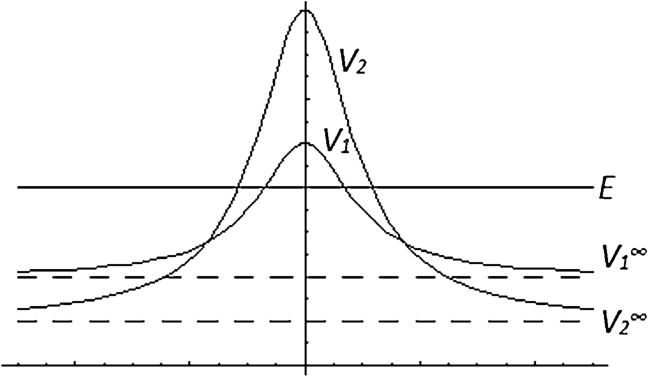
As example of potentials satisfying our hypotheses we take and , see Figure 1.
Potentials.
Jost solutions
By analogy with the usual argument for the scalar Schrödinger operator, see [18], Theorem XI.57, the authors in [3] studied the behavior, at infinity, of the solutions of the system . Taking into account the assumption (H2), it was proven the existence of the so called Jost solutions.
Consider the free hamiltonian. Letbe a solution of the free differential system. There exist two solutionsandof the problemsatisfying
Let . We define and we denote by:
and the solutions given by Proposition 2.1 corresponding respectively to and in a neighborhood of .
and the solutions given by Proposition 2.1 corresponding respectively to and in a neighborhood of .
The are called outgoing Jost solutions while the others are called incoming Jost solutions. We denote by M the matrix relating the outgoing solutions to the incoming ones (see Proposition A.3).
Let denote the scattering matrix associated with P and (see Definition A.1). The coefficients of S are related to those of the matrix M via the formulaes in Proposition A.3. The next objective is to compute the semiclassical behavior of the matrix M. To this end, we need to connect the left Jost solutions and the right ones . For this, we shall construct some transition solutions of the differential system . We begin with the construction of formal asymptotic solutions.
Formal solutions
Construction of formal solutions
In order to construct formal solutions near the turning points, we shall use the solutions of the Airy equation
Let us recall briefly some useful results (see for example [6,15]). There exists a unique solution of (3.1) having the asymptotic expansion as x tends to
with and , . Moreover,
with and , .
Also, recall that near , up to multiplication by a constant, there exists a unique exponential increasing solution
Observe that u is real and that the following expansions hold.
A second real solution of the Airy equation (3.1) is given by
For large positive x we get
Clearly, the wronskians and . We have
Next, following [5] and [19], we construct, near each turning point, formal solutions of the system
Consider ω a solution of the Airy equation. We shall construct solutions, associated with ω, as follows.
with
where
Substituting (3.4) in (3.3) yields
By annihilating the coefficients of ω and one gets
Annihilating the leading terms in and yields two eiconal equations,
First, we construct formal solutions associated to the eiconal equation (3.5). This construction is valid inside and , with small enough to assure that the second corresponding turning point respectively , as well as the crossing points , lie outside this interval. The same construction is also valid in the left interval , respectively in the right one . We fix a determination of and define the function
that is a solution of (3.5) which is regular in .
Thus the equations and imply necessarily that .
The equation yields , which implies that
Since should be continuous it follows that and hence .
Likewise yields and therefore
It follows from (3.5) that
On the other hand implies that . Thus
The equation yields which implies that
By annihilating the coefficient of , it follows from that which gives .
Likewise, it follows from that , which gives .
By annihilating the coefficients of in and , we are led to the following system of equations.
This inductive process gives successively and . Notice that the expressions of and D are actually independent of the considered Airy solution.
Analogous constructions yield formal solutions corresponding to the eiconal equation (3.6) that are valid inside the intervals and with small enough.
Connection formulas for formal solutions
Consider the formal solutions of the equation (3.3) constructed as in the preceding section corresponding to the turning points
associated respectively with the Airy solutions .
By taking into consideration the expansions of the Airy solutions at , one gets
in a neighborhood of as and
in a neighborhood of as .
Exact solutions
In this section we construct exact solutions, with known asymptotic expansions on some fixed interval, of the problem that we can write
First, observe that, for , and , with and . Now, let be a smooth unit partition, where, for some , .
Define the functions
which are formal solutions of the equation (4.1). Introduce the notations
It is clear that
Consider the finite sums of the asymptotic expansions of and denote them . According to the definition of and , we have
As usual, for a vector means the .
Let be the cut series of . A simple computation yields
Introduce four new almost solutions.
According to (4.2), we deduce that for ,
Since it follows that there exist analytic functions such that all of satisfy the system
Now, we construct solutions of the differential system (4.1) in the form
where and for , is the differential operator given by
with and are analytic functions satisfying, for arbitrary ψ,
The existence of the analytic functions follows since . One can easily see that if we take ψ in the form (4.4), then by using (4.5) it follows that ψ is a solution of the differential system (4.1). Let K be the matrix operator given by
The equation (4.4) writes
where is some fixed point and . The solution of the integral equation (4.6) satisfies the differential equation (4.1), its initial data in coincide with the initial data of Y. Now, we construct the exact solution , . We define the sequence of functions
By taking into account that the coefficients of the differential matrix are we deduce from (4.3) and (4.5) that
It follows that
It is easily shown by induction that
which implies that the sequence converges uniformly for and . The limit function satisfies the integral equation (4.6). Furthermore, we have
It follows that
with . Hence, has the same asymptotic development as up to the order on . It is clear that on
With the same method, we construct the exact solutions so that
Moreover,
We have constructed on the interval four solutions and , , with a known asymptotic behavior and with a known Wronskian. As a result, on finite vicinities of the turning points, we have four linearly independent solutions with a known asymptotic behavior. Introduce now, on these vicinities, sets of canonical solutions. Consider on a vicinity of two solutions
We have . Let us normalize these solutions
Notice that
∙ .
Considering the formal solutions , on and then on leads to analogous constructions of exact solutions and and then and , with
∙ .
∙ .
Analogous constructions provide exact solutions and on the right hand side so that
∙ ,
∙ ,
∙ .
The asymptotic formulae (3.11) and (3.12), and also the analogous asymptotic expansions for , , and lead to the following theorem.
Letbe small enough, the following expansions hold as h tends to 0.
, on.
, on.
, on.
, on.
, on.
, on.
, on.
, on.
, on.
, on.
, on.
, on.
Transition matrices
Observe that and are two fundamental systems of solutions of the differential system . We consider the interaction matrix defined by
Connection at infinity
In this section, we shall connect the Jost solutions and to the systems of solutions and . The first step toward this is to introduce the right and the left actions and .
where . Thanks to the assumption (H2), these quantities are well defined. Next, we compare the asymptotic expansions of and with et . Following [7], Appendice B, we get:
with, and.
According to Proposition A.3 together with Proposition 5.1, we get the following result.
Letbe the scattering matrix. Then
Connection near the turning points
Equation (3.10) and Theorem 4.1 yield the following proposition.
Consider,andthe transition matrices defined byThen,wherewith.
The are expressed in terms of the as follows
It follows from Proposition 5.3 that
whence the result follows easily. □
Microlocal reduction
In order to describe the asymptotic expansion of the coefficients of the scattering matrix, we need to determine the matrix M (see Proposition A.3). In view of Proposition 5.4 and Lemma 5.2, all that remains to do is to connect the to the on the right, and the to the on the left. Notice that by symmetry, the computation on one side is analogous to that on the other side. For the sake of simplicity we shall assume that the and the are even functions. However, we are going to try not to lose the generality in the final results.
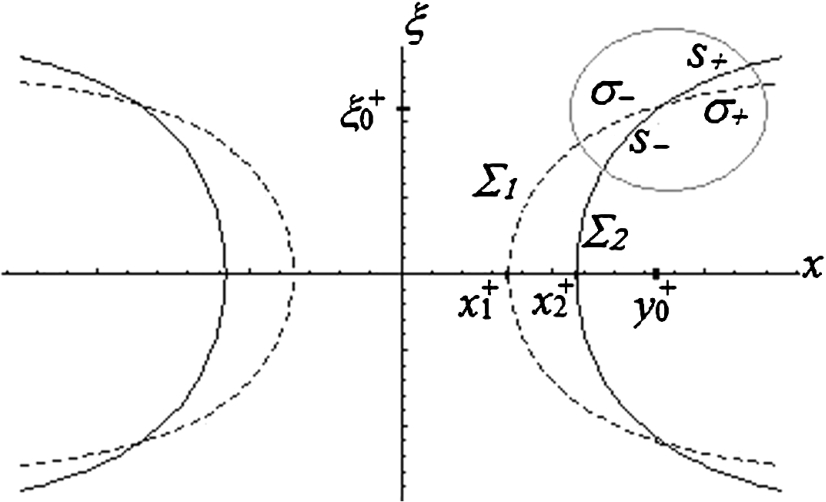
First, we develop a microlocal analysis on the operator P near the crossing points. Recall that the real characteristic manifold of , is the union of two components and that cross at the real points and with and . We make an ellipticity assumption on the coupling term near the crossing points .
(H5): .
Under the condition (H5), the operator R has a microlocal inverse near the point . Writing the system as follows
the second equation yields (microlocally near the point )
Substituting this into the first equation of (6.1), we obtain
Observe that the operator has a real principal symbol having a saddle point at which is non-degenerate since . Applying the microlocal reduction theorem ([11], Theorem b1) reduces the study of the operator Q near to that of near the point . More precisely, one obtains the following proposition.
Under the hypotheses (H1), (H4), (H5), there exist a classical analytic symbol of order twoand a unitary formal Fourier integral operator H related to a canonical transformation κ defined nearwithsuch that the following equivalence holds.
A microlocal distributiondefined in a neighborhood ofis a solution of the model equationif and only ifis a microlocal solution nearof the system.
For simplicity we shall use x for and ξ for . Then the principal symbol of Q writes near , with . Observe that by (H4), . By [11], Theorem b1 there is a unitary Fourier integral operator H, with canonical transformation κ defined near with , and a classical analytic symbol of order 0 such that
One can write formally
with
The canonical transformation κ is defined near by
One gets with
By (6.3) the equation is microlocally, in a neigborhood of , equivalent to the equation
Writing yields , which in turn implies that and further that
Using the functional calculus developed in [11], Appendix a, we see that the Weyl symbol of is , where denotes the Weyl symbol of Q. It follows from (6.3) that
On the other hand by writing we see that
Then and therefore
where is a classical analytic symbol of order two. The proposition follows from (6.2). □
In the following lemma we compute the principal symbol of .
Let ω be a function defined near solution of satisfying the initial conditions and . The existence of ω is well known, see [17], Proposition 2, for the construction of such solution. It follows immediately that
Now, we move to the point by using a translation. According to (6.3) we get
Writing yields
This identity is valid microlocally near . By applying a FBI transform and then taking we get
Now, write , then by (6.4)
By using the fact that operators commute up to an factor, it follows that
In combination with (6.6) the last equation yields
Thus
It follows from (6.8) that
On the other hand combining (6.5) with (6.7) gives, near ,
with c a constant which is non null since ω is not and H is unitary. By moving back to we get easily
□
Solutions of the model equation
Consider the differential equation arising in the above proposition.
Let Y denotes the Heaviside function. A fundamental system of solutions of the equation (6.9) in the space of microlocal distributions defined near is provided by
Let denotes the operator of complex conjugation and denotes the semi-classical Fourier transform. It’s easy to observe that and are commuting. Using this fact yields a second fundamental system of solutions of (6.9) given by
Define the interaction matrix connecting the system to in the following way. If , then . To compute this matrix we follow [10]. Let λ be a complex and consider . These distributions exist for and extend analytically in (see [10], Chapter 1, Section 3.2). Now, consider the distributions which are analytic in the hole complex plane. From ([10], Chapter 1, Section 3.6) we have, for ,
These formulas remain true, by analytic continuation, for . Also, from ([10], Chapter 2, Section 2.3), we have
where Γ denotes the Gamma function.
Since is non zero and it is small, for small h, it follows by applying the formulas (6.11) for and then (6.10) for that
We shall need below some knowledge about the microsupport (for short MS) of the distributions and . We have the following lemma, see [16], Proposition 8.1.
and.
Microlocal solutions
In view of Proposition 6.1, we get four microlocal solutions of the equation , namely , where
Combining Lemma 6.3 with (6.12) immediately yields the following result.
The microsupports of the solutions defined microlocally in the ballare included respectively in the closure of
Connection near the crossing points
In order to connect the solutions and to the and we need to analyze these distributions close to the microsupport. First, notice that along this text we choose the principal branch of the square root, that is positive on . Following [13], Section 4, we show that for , with small, the contribution of on is obtained by a stationary phase expansion. More precisely, write
where, , with , and
Note that we use here the reduced coordinates in place of . Observe that has one critical point with respect to y, satisfying . By the stationary phase expansion one gets, at the level of principal symbols and microlocally near
Back to the initial coordinates and define
then
where is an analytic symbol of order 0 defined near the interval with principal symbol .
Now observe that is also a unitary Fourier integral operator that we can write formally
where , with , and
By arguing as above, we get the microlocal value of near .
where is an analytic symbol of order 0 defined near the interval with principal symbol .
Now, we need to know the microlocal value of near . Observe that at the level of principal symbols and microlocally near we have
By applying on the last equation, it follows from (6.14) that
where is an analytic symbol of order 0 defined near the interval with principal symbol .
Similarly, there exist two analytic symbols and , of order 0 defined near the real interval , with principal symbols such that
Let , . By normalizing the solutions at it follows from the expansions (6.16) together with Theorem 4.1 that
where are two classical analytic symbols of order 0 with principal symbols
Recall that the are normalized at . By observing that has no microsupport on and that has no microsupport on it follows from (6.13, 6.15) that
where and are two classical analytic symbols of order 0, with principal symbols
By using the interaction matrix in combination with (6.12), we get
Thus, by taking into account that is a classical analytic symbol of order 0 and principal symbol 1, we infer from (6.17), (6.18) the following results.
There exist classical analytic symbolsandof order 0 each having principal symbol 1 such that
,
.
where.
By a similar analysis near , we obtain the following proposition.
There exist classical analytic symbolsandof order 0 each having principal symbol 1 such that
,
,
where.
By taking into consideration the symmetry of the problem, analogous formula hold for .
There exist classical analytic symbolsandof order 0 each having principal symbol 1 such that
We notice that if is a holomorphic solution of the problem then the functions given by and are holomorphic solutions of a similar problem obtained from P by replacing the function by . This observation confirms the results in the Propositions 6.7 and 6.6.
Now, let and denote the interaction matrices defined as follows.
Then, it follows from Propositions 6.5 and 6.6 that, up to multiplying each term by ,
where we use for . Also, up to multiplying each term by , we can write
Recall that
which implies that . Thus we get the following proposition.
Let. Then, up to multiplication byterms forin a neighborhood of 0, we have
Recall that is a classical symbol of order 2 which implies, see [15], Part 2, that . Then
Hence
while
According to Proposition 6.8 and by using Lemma 5.2, we get the following theorem.
(Scattering matrix).
Assume (H1)–(H5). Then forin a neighborhood of 0, we have:
The upper diagonal block:
The lower diagonal block:
The upper off-diagonal block:
The lower off-diagonal block:
is the classical action between the two turning pointsand. We have also writtenand. For, we writeand useandfor the action on the right and on the left respectively.
An important observation is that the quantity is real and positive for t on the real axis between the turning points and . Choosing the usual determination of the square root makes . On the other hand, since the is a positive real for all real t between and , it follows that ϕ is real. Also, it is clear that the actions and are real.
Notice that for the uncoupled problem, that is, the situation where the coupling term R is assumed to be null, the scattering matrix is block diagonal, . The expansions of these blocks are familiar. Indeed with, see [17], Theorem 1,
Actually, the expansion of in Theorem 6.9 is quite similar to (6.19). Also, concerning , we observe that the expansions of the reflection coefficients and are similar to that ones corresponding to the uncoupled problem, while the transmission coefficient are considerably perturbed by the tunneling. Regarding the off diagonal blocks we get the following estimate.
The main significance of the above corollary lies in the fact that it provides us with an explicit formula showing, in particular, that the off-diagonal blocks of the scattering matrix are not exponentially small with respect to the semi-classical parameter h. In fact the hypothesis (H5) guarantees that are non vanishing real numbers. Without the assumption (H5), the interaction becomes of higher order. For more details, the reader could consult [2], Section 3.
Footnotes
Scattering matrix
In this section, we define the scattering matrix. Using Jost solutions and the fact that, for , there is no incoming or outgoing solutions, we prove the existence of solutions and for the system , satisfying:
We use the notation in a neighborhood of if the limit at of and vanish.
We have the following proposition
Now we introduce a matrix M which plays an important role in the computation of the coefficients of the scattering matrix.
Acknowledgements
The authors would like to express their cordial gratitude to the referee for valuable suggestions.
References
1.
H.Baklouti, Asymptotique des largeurs des résonnances pour un modèle d’effet tunnel microlocal, Ann. Inst. H. Poincaré2(68) (1998), 179–228.
2.
H.Baklouti, Asymptotic expansion for the widths of resonances in Born–Oppenheimer approximation, Asymptotic Analysis69 (2010), 1–29.
3.
H.Baklouti and S.B.Abdeljalil, Asymptotic expansion of the scattering matrix associated with matrix Schrödinger operator, Asymptotic Analysis80(1–2) (2012), 57–78.
4.
M.Benchaou and A.Martinez, Estimations exponentielles en théorie de la diffusion pour des opérateurs de Schrödinger matriciels, Ann. Inst. H. Poincaré6(71) (1999), 561–594.
5.
V.Buslaev and A.Grigis, Imaginary part of Stark–Wannier resonances, J. of Math. Phys.39 (1998), 2519–2550.
S.Fujiié and T.Ramond, Matrice de Scattering et résonnace associée à une Orbite Hétrocline, Ann. Inst. H. Poincaré1(69) (1998), 31–82.
8.
A.Grigis and A.Martinez, Resonances widths for molecular predissociation, Analysis and PDE7(5) (2014), 1027–1055. doi:10.2140/apde.2014.7.1027.
9.
A.Grigis and A.Martinez, Resonances widths in a case of multidimensional phase space tunneling, Asymptotic Analysis91(1) (2015), 33–90.
10.
I.M.Guelfand and G.E.Chilov, Les Distributions, Tome1, Dunod, Paris, 1962.
11.
B.Helffer and J.Sjöstrand, Semiclassical analysis for Harper’s equation III, Bulletin de la SMF, Mémoire1 (1989).
12.
A.Martinez, S.Nakamura and V.Sordoni, Phase space tunneling in multistate scattering, J. Funct. Analysis191 (2002), 297–317. doi:10.1006/jfan.2001.3868.
13.
C.März, Spectral asymptotic near the potential maximum for the Hill’s equation, Asymptotic Analysis5 (1992), 221–267.
14.
S.Nakamura, Tunneling effects in momentum space and scattering Ikawa, in: Spectral and Scattering Theory, Notes Pure Appl. Math, Vol. 161, 1994, pp. 131–151.
15.
F.W.J.Olver, Asymptotic and Special Functions, Academic Press, New York, 1974.
16.
T.Ramond, Intervalles d’instabilité pour une équation de Hill à potentiel méromophe, Bulletins de la SMF121 (1993), 403–444.
17.
T.Ramond, Semiclassical study of quantum scattering on the line, Commun. Math. Phys.177 (1996), 221–254. doi:10.1007/BF02102437.
18.
M.Reed and B.Simon, Methods of Modern Mathematical Physics, Vol. III, Academic Press, 1972–1980.
19.
E.Servat, Résonances en dimension un pour l’opérateur de Schrödinger, Asymptotic Analysis39(3–4) (2004), 187–224.
D.R.Yafaev, The semiclassical limit of eigenfunctions of the Schrodinger equation and the Bohr–Sommerfeld condition, revisited, St Petersburg Math. J.22(6) (2011), 1051–1067. doi:10.1090/S1061-0022-2011-01183-5.