In this research, we study the global existence of solutions to the compressible Navier–Stokes–Korteweg system around a constant state. This system describes liquid-vapor type two-phase flow with a phase transition with diffuse interface. Previous works assume that pressure is a monotone function for change of density similarly to the usual compressible Navier–Stokes system. On the other hand, due to phase transition the pressure is in fact non-monotone function, and the linearized system loses symmetry in a critical case such that the derivative of pressure is 0 at the given constant state. We show that global solutions are available for the critical case of small data, whose momentum is in its derivative form, and obtain parabolic type decay rate of the solutions. This is proved based on the decomposition of solutions to a low frequency part and a high frequency part.
We study global existence of solutions to the following compressible Navier–Stokes–Korteweg system in ():
Here and denote the unknown density and momentum, respectively, at time and position ; and denote given initial data; and denote the viscous stress tensor and the Korteweg stress tensor that are given by
where ; μ and are the viscosity coefficients that are assumed to be constants satisfying
κ denotes the capillary constant that is assumed to be a positive constant. Note that if in the Korteweg tensor, the usual compressible Navier–Stokes equation (the abbreviation is used by “CNS” below) is obtained; is the pressure that is assumed to be a smooth function of ρ. Here we assume that P satisfies
where is a given positive constant and denotes a given constant state. We consider solutions to (1.1) around the constant state.
(1.1) is the system describing motion of two-phase flow between liquid and vapor which allows phase transition in a compressible fluid. The phase transition is described by a diffuse interface, whose phase boundary is regarded as a narrow transition zone. Thus, in this system the fluid state is governed by a phase parameter, density change. Due to the diffuse interface, it is enough to handle one system in a single domain. Difficulties stemming from the topological change of the interface do not occur opposite to the case of a model with a sharp interface. Historically, Van der Waals [20] studied the diffuse interface model as a sharp gradient of the density in the liquid-vapor type two-phase flow. Korteweg [13], who was a student of Van der Waals, provided the Korteweg type stress tensor according to the Van der Waals theory. The stress tensor includes similarly to (1.2). Dunn and Serrin [3] strictly provided the system (1.1) with (1.2). Recently, Heida and Málek [6] derived (1.1) by the entropy production method that does not require difficult concepts such as multipolarity or interstitial working, which are used in [3].
Our aim is to show the global existence of solutions to (1.1) and study the convergence rate of the solution to the given constant state under the condition (1.3). Concerning the global existence of solutions to (1.1) on , our research finds that all studies assume that , which is the same condition as in CNS [14]. Hattori and Li [4,5] obtain the global existence of solutions with small initial data , where denotes the usual Sobolev space and N is an integer satisfying that and denotes the integer part of . Danchin and Desjardins [1] consider (1.1) in critical spaces. They show the global existence of solutions with small initial data , where denotes the usual homogeneous Besov space. Tan and R. Zhang, X. Zhang and Tan and Tan, Wang and Xu [17,18,22] show global existence for small initial data in some Sobolev spaces which have lower regularity that that of [4,5] in three dimensional case. In addition, Wang and Tan [21] study the decay rate of the solutions. They show that if initial data satisfy (), where v denotes the velocity field , it holds that for
However, as shown in J. Daube [2], the pressure is a non-monotone function due to the phase transitions. The Van der Waals equation gives the pressure P as
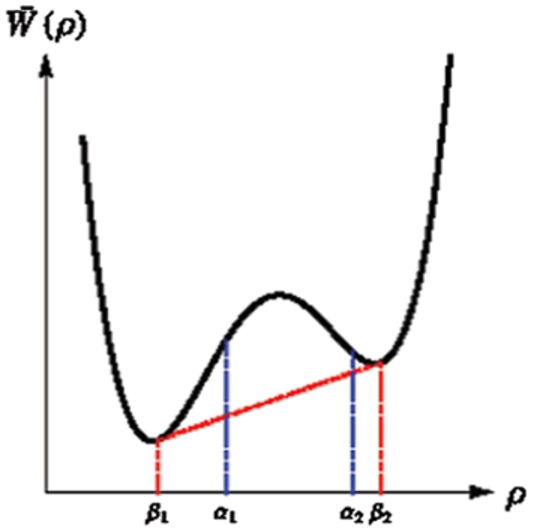
for a given Helmholtz energy . In order to model phase transitions, it is assumed that the Helmholtz free energy has a double-well sharp (Fig. 1). Hence, as shown in [2], the Helmholtz free energy of double-well sharp together with the relation between P and ;
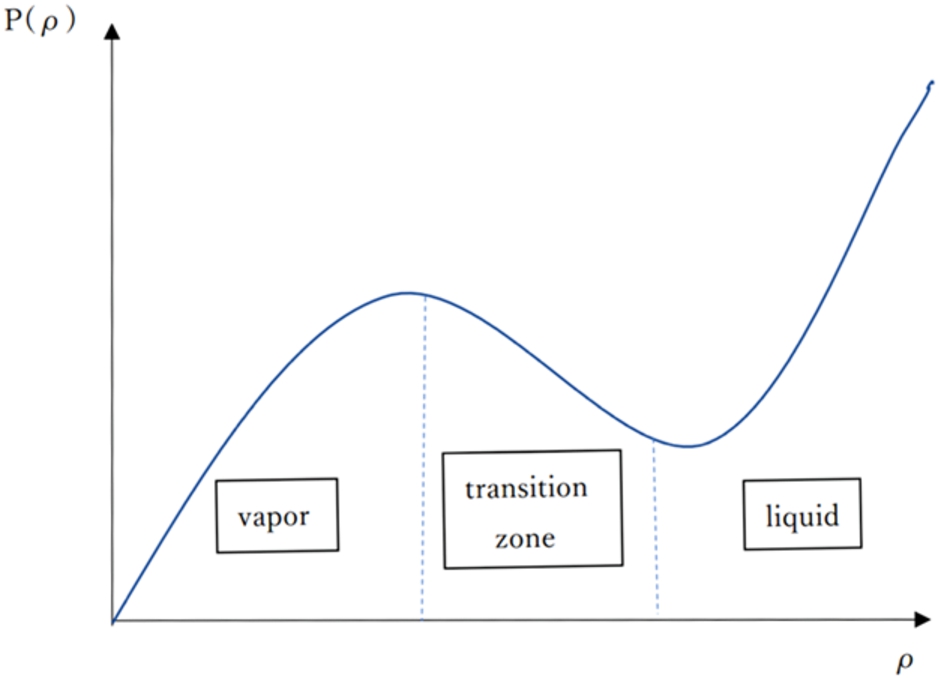
show that pressure is a non-monotone function with respect to density (Fig. 2).
Consequently, we should consider not only the case, but also in (1.1). When , Fig. 2 shows that the fluid state is in a phase transition, which is a mixed state between liquid and vapor. In this case, the leading part of the linear system has an accretive operator . Hence, we cannot expect the constant state to be stable and have a global existence of solutions around the constant state. On the other hand, if , we note above that previous results show that the constant state is stable. Therefore, we propose to study whether or not the critical case has a global existence of solutions around the constant state. When , the linear system loses symmetry for a linear derivative operator of spacial variables even if we assume that . This introduces mathematical difficulties. It is well known that symmetry contributes to stability and decay estimate in solutions of general hyperbolic conservation systems with relaxation terms, which includes CNS, as in Kawashima, Shizuta, and Umeda and Kawashima and Shizuta [10,11]. Furthermore, due to the momentum part of the fundamental solutions to linear system in a low frequency has worse order terms in the Fourier space, as shown in (3.6) below than that of Kobayashi and Shibata [12] for linearized CNS. This fact prevents us from getting the parabolic type time decay estimate of solutions.
We shall show that for (1.1) there exist global solutions for small data with a regularity assumption such that has the derivative form . Furthermore, the solutions decay to the constant state with the parabolic type decay rate;
for . This rate coincides with those of [21] for the case and [14] for CNS in three dimensional space.
To prove the global existence theorem, we introduce the decomposition of solutions to a low frequency part and a high frequency part as in Okita [15] and Tsuda [19]. For the linear estimate of the low frequency part, we use a similar method to that of [12] for CNS, and Shibata [16] for the linear viscoelastic system. By virtue of combining explicit forms of the fundamental solutions with the regularity assumption, we overcome worse order terms which appear in the density part than that of [12], and we can get the estimate with the same decay order as that of solutions to the heat equation. Note that by using the conservation form, the nonlinearity satisfies the regularity assumption and we can also estimate the nonlinear problem.
On the other hand, as for the high frequency part, we use the energy method in the Fourier space. As the linear system loses symmetry in the conservation of momentum, obtaining a closed estimate for -norm of the density is a key point. To get the closed estimate, we combine Hattori and Li [4,5] type energy method and the Poincaré type estimate, which holds in the high frequency part. Then we can derive the linear estimate for both the density and momentum in the usual Sobolev spaces. Concerning nonlinear estimates, note that ρ has the smoothing effect from the Korteweg tensor. Therefore, as opposed to CNS, even if we consider the conservation form (1.1), no derivative loss occurs in the energy method for the nonlinear problem.
Using linear estimates and the iteration argument in time weighted spaces, we show both existence of time global solutions for small data and the decay rate of the solutions as in [14].
This paper is organized as follows. In Section 2 notations and fundamental lemmas used in this paper are stated. In Section 3, the main result is stated. In Section 4, the proof of existence of global solutions and the decay rate is stated.
Preliminaries
In this section notations are introduced. We also present some lemmas for the proof of the main result.
Let X be a given Banach space. Then the norm on X is denoted by .
Let . We denote by the usual Lebesgue space which are the set of p-th powered integrable functions on with a finite p and essentially bounded functions on with . Let be an integer. We denote by and the usual and Sobolev space of order k respectively. (As usual, is defined by .)
Let on . We denote simply by the set of all vector fields
with the defined norm . Similarly we denote by a function space X the linear space of all vector fields on satisfying (), and is the norm if no confusion will occur.
Let with and . We denote by the norm of u on ;
If , let
Similarly, for with , we put
and if , simply we define that
We denote the Fourier transform of f for the space variables x using the symbols and ;
and its inverse is
Let be an integer and let be a positive constant. is defined by the set of all with , and is defined by the set of all with .
To decompose into a low frequency part and a high frequency part operators () on are introduced by
where
where is any positive number.
Let . A solution space is defined by
with the norm
Similarly, when , is defined by
For operators and , the commutator of and is represented as ;
For a nonnegative number s, stands for the Gaussian symbol.
The symbol “∗” stands for the convolution on the space variable x.
Here we state some fundamental Lemmas.
The following Sobolev type inequality is well known.
Letand s be an integer satisfying. Then it holds true thatfor.
For estimates of nonlinearity, some estimates are stated below. The latter lemma is the commutator estimate.
Let s be an integer satisfying. Suppose that F is a smooth function on I, where I is a compact interval of. Then for a multi-index α with, there holds thatforwithfor alland; andforwithfor alland.
Concerning the projections and , the following properties hold true.
Letbe an integer. Then on,is a bounded linear operator.
It holds true that
Main results
In this section, a main result is stated for (1.1). (1.1) is reformulated as follows. Hereafter we may assume that without loss of generality. We set . Substituting ϕ into (1.1), the following system is obtained;
where , , , ,
Note that (3.1) is not symmetric in contrast to the usual compressible Navier–Stokes system as in [14]. Therefore, the general theory for symmetric hyperbolic conservation law, as in [10,11], cannot be applied.
(1.1) is linearized and we have
Taking the Fourier transform of (3.4) with respect to the space variable x yields that
with a parameter ξ. Therefore, the solutions of (3.4) are given by the following formulas. We define that , . If and the Fourier transforms of ϕ and m are given by
where
If ,
Set
Then (3.1) is written as follows.
where . Due to the Duhamel principle, (3.8) is transformed to the integral equations;
where denotes the solution operator of the system whose definition is given by (3.6);
where for
and for
We obtain global solutions to (3.9) for small data with a regularity assumption of m and decay rate of the solutions. The primary result is stated as follows.
Letwhere s is an integer satisfyingand. We also assume that. We setThen there exists a positive constantsuch that ifthere exists a global solutionto (
3.9
) and we obtain the following decay rate of the solution:In addition, the uniqueness of the solution holds in the class
Concerning the norm of , note that as , if satisfies the decay estimate (3.11) then ; therefore, we have that .
Existence of global solutions
In this section, we show the existence of global solutions to (3.9) and the decay rate of the solutions. Let
To solve (3.9), we look for a fixed point of Γ for a given . Since
and
for each , we shall estimate projections of Γ on and respectively.
Estimates of Γ; the low frequency part
In this subsection, we estimate Γ on the low frequency part. In the low frequency part, solution operators and are defined by
We show that the solution operator is a bounded linear operator on for an initial data with with decay estimate of . We have
Letand. For eachand all,satisfiesand it holds true thatwhereis any given positive number and C is a positive constant independent of T.
Ifunder the assumption of (i),satisfies the decay estimateforand, where C is a positive constant independent of t.
We consider the case . Due to (3.10), we see that
for some . We prove (ii) before (i). Concerning part in , we set
A cut-off function with is introduced by
Since , we see that . We estimate by (3.7) as follows.
where we used change of variables as . Hence we get that
Similarly, we see that
Therefore, it holds by the Young inequality that
As the other part of and the case can be similarly estimated, we have (ii). The estimate of (i) can also be estimated as in (ii) and we omit this proof. Note that by definition of and the Lebesgue convergence theorem, we obtain that . This completes the proof. □
We set
for . By direct application of Proposition 4.1, we can derive the estimate of .
Letand. For each,withand all,satisfiesandwhere C is a positive constant independent of t.
If in addition,andthenis estimated byforand, where C is a positive constant independent of t.
Estimates of Γ; the high frequency part
In this subsection, we estimate Γ on the high frequency part. In the high frequency, the solution operators, and , are defined by
We first show that is a semigroup on .
Letand s be an integer satisfying. Thenis asemigroup onwithforandfor, whereis any positive number and C is independent of t.
Let . The resolvent problem is
for , where . Taking the Fourier transform of (4.3),
where
A similar manner to the proof of Proposition 4.4 below yields that
for , where and are the same constants in (4.8). Thus is well defined on for each and is represented by . Here the norm stands for
on the Sobolev space . We see from (4.5) and definition of that
and if ,
Hence
where is the resolvent set of the operator and it holds true that
This together with the Hille–Yoshida theorem imply that generates , semigroup on , and we obtain (4.3). This completes the proof. □
Set
By the Duhamel principle is a solution operator for the linearized problem
for . Furthermore, we obtain the following
forand it holds thatfor, whereis any positive number and C is independent of t and T.
We use the energy estimate in the Fourier space. Our claim is to show
where and are positive constants. Let and . Taking the Fourier transform of (4.6), we see that
where . For a multi-index α satisfying , taking the complex inner product of with and taking the sum of α and from the real part for we have that
where C is some positive constant. Note that due to (4.9) we obtain that
Therefore, we derive the inequality
where ϵ is a positive constant satisfying , and are defined below. On the other hand, we take the complex inner product of with to obtain
Since
by , we see from (4.12) that
Let be suitable large constant satisfying that , and
Considering we get (4.8). Integrating (4.8) on time and by the Plancherel theorem and Lemma 2.5 it holds that
This implies (4.7). This completes the proof. □
In the proof of Proposition 4.4, we obtain the following energy estimate.
Letbe an integer with. Suppose thatfor all. We suppose thatsatisfiesandfor all. Then an energy functionalexists and it holds true thatonfor all. Here d is a positive constant; C is a positive constant independent of;is equivalent to, i.e,andis absolutely continuous infor all.
We set
By direct application of Propositions 4.3–4.6, we can derive the estimate of .
Letand s be an integer satisfying. For each,and all,satisfiesandwhere C is a positive constant independent of T. Furthermore,satisfies the estimate (
4.16
), i.e.,where.
Iteration argument to show the existence of global solutions
In this subsection, we show the existence of global solutions for small data by the iteration argument. Recall that
where , and denotes the nonlinearity terms of (1.1). The iteration scheme is given as follows. We define () by
and is given by . Applying () to (4.19) respectively, we obtain that
where , and ().
For any we define a time weighted function space by
and the norm is defined by
where a and are positive constants independent of k and T and are defined below respectively. Note that the space has completeness with the norm . By Proposition 4.1(ii), for and it holds that
We estimate the second term of right hand side in (4.21). Due to the conservation form can be represented by the divergence form, that is,
where is suitable nonlinear terms given from (3.3). (For example, each component of .) Hence we see from Theorem 4.1(ii), the fact and direct computation for norm of the nonlinearity that for
Owing to (4.21), (4.22) and (4.23) we get that for , and
where constants and are independent of k and T. Obviously, it holds that
We use the estimate (4.18) for . Note that the following estimate related to the nonlinearity is obtained by direct computations based on Lemmas 2.1–2.5.
It holds that forand
We estimate which is one of the nonlinear terms. For we see from Lemmas 2.1, 2.3, and 2.5 that
Hence, it is derived that
As another nonlinear term can be estimated similarly, we get Lemma 4.8. This completes the proof. □
Let . By (4.18) and Lemma 4.8, there exists a positive constant such that for and and are defined by
We see from (4.25) that
where the constant is independent of k and T. Furthermore, due to Proposition 4.7 and Lemma 4.8 we derive that
when , where is a positive constant independent of k and T.
Now we are in a position to prove the main result. Let and . We see from (4.24), (4.26) and (4.27) that there holds that
for and inductively. Furthermore,
where . Therefore, when in addition it holds that
Since T is any number satisfying and the constants which appear in (4.24), (4.26), (4.27), (4.28) and (4.29) do not depend on T, from the iteration there exists a unique global solution u in the class
and u satisfies the decay estimate
This completes the proof.
Footnotes
Acknowledgements
The first author is partly supported by Grants-in-Aid for Scientific Research with the Grant number: 16H03945. The second author is partly supported by Grant-in-Aid for JSPS Fellows with the Grant number: A17J047780.
References
1.
R.Danchin and B.Desjardins, Existence of solutions for compressible fluid models of Korteweg type, Ann. Inst. Henri Poincaré Anal. nonlinear18 (2001), 97–133. doi:10.1016/S0294-1449(00)00056-1.
2.
J.Daube, Sharp-Interface Limit for the Navier–Stokes–Korteweg Equations, Doktorarbeit, Universitat Freiburg, 2017.
3.
J.E.Dunn and J.Serrin, On the thermomechanics of interstitial working, Arch. Rational Mech. Anal.88 (1985), 95–133. doi:10.1007/BF00250907.
4.
H.Hattori and D.N.Li, Solutions for two-dimensional system for materials of Korteweg type, SIAM J. Math. Anal.25 (1994), 85–98. doi:10.1137/S003614109223413X.
5.
H.Hattori and D.N.Li, Global solutions of a high dimensional system for Korteweg materials, J. Math. Anal. Appl.198 (1998), 84–97. doi:10.1006/jmaa.1996.0069.
6.
M.Heida and J.Málek, On compressible Korteweg fluid-like materials, Internat. J. Engrg. Sci.48 (2010), 1313–1324. doi:10.1016/j.ijengsci.2010.06.031.
7.
Y.Kagei and S.Kawashima, Stability of planar stationary solutions to the compressible Navier–Stokes equation on the half space, Commun. Math. Phys.266 (2006), 401–430. doi:10.1007/s00220-006-0017-1.
8.
Y.Kagei and T.Kobayashi, Asymptotic behavior of solutions of the compressible Navier–Stokes equation on the half space, Arch. Rational Mech. Anal.177 (2005), 231–330. doi:10.1007/s00205-005-0365-6.
9.
Y.Kagei and K.Tsuda, Existence and stability of time periodic solution to the compressible Navier–Stokes equation for time periodic external force with symmetry, J. Differential Equations258 (2015), 399–444. doi:10.1016/j.jde.2014.09.016.
10.
S.Kawashima and Y.Shizuta, Systems of equations of hyperbolic-parabolic type with applications to the discrete Boltzmann equation, Hokkaido Math. J.14 (1985), 249–275. doi:10.14492/hokmj/1381757663.
11.
S.Kawashima, Y.Shizuta and T.Umeda, On the devay of solutions to the linearized equations of electro-magneto-fluid dynamics, Japan J. Appl. Math.1 (1984), 435–457. doi:10.1007/BF03167068.
12.
T.Kobayashi and Y.Shibata, Remark on the rate of decay of solutions to linearized compressible Navier–Stokes equations, Pacific Journal of Mathematics207 (2002), 199–234. doi:10.2140/pjm.2002.207.199.
13.
D.J.Korteweg, Sur la forme que prennent les équations du mouvement des fluides si lfon tient compte des forces capillaires causées par des variations de densité considérables mais continues et sur la théorie de la capillarite dans lfhypothèse dfune variation continue de la densité, Archives Néerlandaises des sciences exactes et naturelles2(6) (1901), 1–24.
14.
A.Matsumura and T.Nishida, The initial value problem for the equations of motion of compressible viscous and heat-conductive fluids, Proc. Japan Acad. Ser. A Math. Sci.55 (1979), 337–342. doi:10.3792/pjaa.55.337.
15.
M.Okita, On the convergence rates for the compressible Navier–Stokes equations with potential force, Kyushu J. Math.68 (2014), 261–286. doi:10.2206/kyushujm.68.261.
16.
Y.Shibata, On the rate of decay of solutions to linear viscoelastic equation, Math. Methods Appl. Sci.23 (2000), 203–226. doi:10.1002/(SICI)1099-1476(200002)23:3<203::AID-MMA111>3.0.CO;2-M.
17.
Z.Tan, H.Wang and J.Xu, Global existence and optimal decay rate for the strong solutions to the compressible fluid models of Korteweg type, J. Math. Anal. Appl.390 (2012), 181–187. doi:10.1016/j.jmaa.2012.01.028.
18.
Z.Tan and R.Zhang, Optimal decay rates of the compressible fluid models of Korteweg type, Z. Angew. Math. Phys.65 (2014), 279–300. doi:10.1007/s00033-013-0331-3.
19.
K.Tsuda, Existence and stability of time periodic solution to the compressible Navier–Stokes–Korteweg system on , J. Math. Fluid Mech.18 (2016), 157–185. doi:10.1007/s00021-015-0244-3.
20.
J.D.Van der Waals, Théorie thermodynamique de la capillarité, dans lfhypothèse dfune variation continue de la densité, Archives Néerlandaises des sciences exactes et naturelles XXVIII1893, 121–209.
21.
Y.Wang and Z.Tan, Optimal decay rates for the compressible fluid models of Korteweg type, J. Math. Anal. Appl.379 (2011), 256–271. doi:10.1016/j.jmaa.2011.01.006.
22.
X.Zhang and Z.Tan, Decay estimates of the non-isentropic compressible fluid models of Korteweg type in , Commun. Math. Sci.12 (2014), 1437–1456. doi:10.4310/CMS.2014.v12.n8.a4.