



Abstract
We discuss inverse resonance scattering for the Laplacian on a rotationally symmetric manifold
Asymptotics of counting function of resonances at large radius. The rotation radius is uniquely determined by its eigenvalues and resonances. There exists an algorithm to recover the rotation radius from its eigenvalues and resonances.
The proof is based on some non-linear real analytic isomorphism between two Hilbert spaces.
Introduction and main results
Geometry
We consider a rotationally symmetric manifold
Let us recall simple examples.
The case when Y has no boundary. For example, if
The case when Y has a boundary. For example, if Y is a compact interval in
Introduce the Hilbert spaces
Below we fix an index ν arbitrarily, and omit it. We consider the operator
The Jost function
The S-matrix is defined by
The asymptotics (1.10) and the fact that ψ is entire imply that the number of eigenvalues is finite, since the zeros of ψ in
For each
Since
We shortly discuss well known facts about 1dim inverse scattering for Schrödinger operators with decaying potentials. Bargmann [3,4] constructed explicit examples, where two distinct potentials give the same S-matrix and the same eigenvalue (only one). This showed that a potential cannot be reconstructed uniquely from very natural spectral data: S-matrix
We describe a preliminary result about eigenvalues of the Laplacian
Let
If
There exist a radius function
each operator
the Laplacian
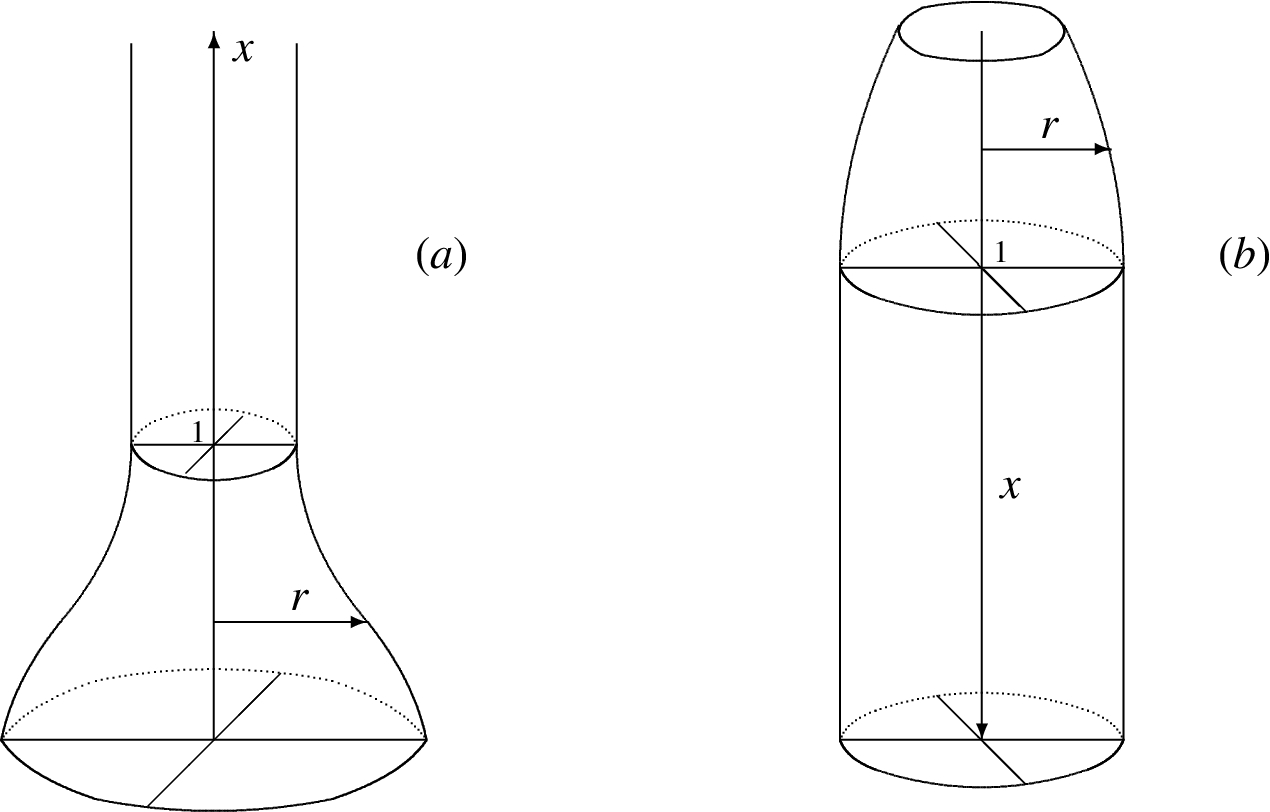
(a) Δ has eigenvalues, (b) Δ has not eigenvalues.
We consider the distribution of resonances of
Let
Let
Let
Using zeros of the Jost function ψ we determine the phase shift The constant
We sometimes write
The main result of this paper is the following inverse problem.
Let
Let
Any
The proof is based on the two mappings, since the mapping q to a Jost function ψ is the composition of two mappings. The first one is the mapping from potentials
There is an abundance of works devoted to the spectral theory and inverse problems for the surface of revolution from the view points of classical inverse Strum–Liouville theory, integrable systems, micro-local analysis, see [1,5,14,19,41] and references therein. For integrable systems associated with surfaces of revolution, see e.g. [24,46,48] and references therein.
Isozaki–Korotyaev [21,22] solved the inverse spectral problem for rotationally symmetric manifolds (finite perturbed cylinders), which includes a class of surfaces of revolution, by giving an analytic isomorphism from the space of spectral data onto the space of functions describing the radius of rotation. An analogue of the Minkowski problem was also solved. In another paper [23] Isozaki–Korotyaev studied inverse problems for Laplacian on the torus. Moreover, they obtained stability estimates: the spectral data in terms of the profile (the radius of the rotation) and conversely, the profile in term of the spectral data.
In our paper we use inverse resonance theory for Schrödinger operators with compactly supported potentials on the half-line [28]. We use also results on perturbed Riccati mappings from [22,26,27].
A lot of papers are devoted to resonances of one-dimensional Schrödinger operators. See Froese [17], Hitrik [20], Korotyaev [28], Simon [47], Zworski [49] and references therein. Inverse problems (uniqueness, reconstruction, characterization) in terms of resonances were solved by Korotyaev for a Schrödinger operator with a compactly supported potential on the real line [30] and the half-line [28]. See also Zworski [50], Brown-Knowles-Weikard [6] concerning the uniqueness. The resonances for one-dimensional operators
Resonances for specific cases of surfaces of revolution are discussed in [8,11–13]. As far as the authors know, the results in this paper about resonances for Laplacian on surfaces of revolution for the case (1.1)–(1.4) are new.
Preliminaries
Entire functions
We recall some well-known facts about entire functions (see [25]). An entire function there exists the limit
the following sum is finite
Let a function From (2.5) we obtain the identity
In our paper, we make use of following functions from
Unitary transformations
Recall that the Laplacian on
The following support property of the non-linear mappings Let Define the norm in
Resonance scattering
We consider the Schrödinger operator on
If
the function
Let
The identity (3.4) was proved in [28]. Asymptotics in (i) follows from (3.4), it is the same as (1.10). The properties (2)–(5) are well know, see e.g., [43] or [15].
Note that (2) holds true, since it comes from the solution of differential equation with real coefficients.
Recall that
Item (4) follows from
Recall that
The property (6) was proved in [28]. In fact it this follows from the Wronskian
Introduce the set
By the function all zeros
We recall the well-known Marchenko result [43] about the inverse problems for our case
Now we consider the mapping
The mapping
For any
where
We recall the following trace formula from [35]:
uniformly on compact subsets of
We divide the inverse problem for the mapping
Uniqueness. Do the eigenvalues and the resonances determine uniquely p?
Reconstruction. Give an algorithm for recovering p from the sequence
Characterization. Give necessary and sufficient conditions for the sequence
Theorem 3.2 gives the solution of I and II. Moreover, it gives a characterization of
Eigenvalues and resonances
(i) Let
(ii) Consider the case
(iii) Consider the case
Theorem 1.1, (i) gives that
Theorem 1.1, (i) gives that
We introduce the Sobolev spaces of real functions
We rewrite (1.8) in the form, omitting ν for simplicity,
The mapping
We consider the inverse problem: to determine a coefficient
(i) Let
(ii) Let
(iii) Let
Footnotes
Acknowledgements
E. Korotyaev was supported by the RSF grant No. 18-11-00032. H.Isozaki is partially supported by Grants-in-Aid for Scientific Research (S) 15H05740, and Grants-in-Aid for Scientific Research (B) 16H03944, Japan Society for the Promotion of Science. We thank Natalia Saburova for Fig.  . Finally, we would like to thank the referees for thoughtful comments that helped us to improve the manuscript.