In this paper, we propose a time-dependent viscous system and by using the vanishing viscosity method we show the existence of solutions for the Riemann problem to a particular system of conservation laws with linear damping.
In this paper, we study the existence of solutions to the Riemann problem for the following hyperbolic system of conservation laws with linear damping
where is a constant, k is an odd natural number and the sign of v is assumed to be unchanging. Thus for convenience, we assume throughout this paper. The initial data is given by
for arbitrary constant states with . It is well known that the system (1) is not strictly hyperbolic with eigenvalue and right eigenvector . Moreover, and therefore the system is linearly degenerate. When , the homogeneous case of the system (1) is used to model the evolution of density inhomogeneities in matter in the universe [19, B. Late nonlinear stage, 3. Sticky dust]. The system (1) belongs to the class of triangular systems. The triangular systems of conservation laws arises in a wide variety of models in physics and engineering, see for example [10,17] and the references therein. For this reason, the triangular systems have been studied by many authors and several rigorous results have been obtained for this.
In 1993, Joseph [11] considered the Riemann problem for the homogeneous case of the system (1) with . He used a parabolic regularization system to obtain an explicit formulae of the Riemann solutions. So, he constructed the weak limit of the approximation solution and this is defined as a delta shock wave type solution. Recently, De la cruz [5] solved the Riemann problem to the system (1) when . His work include classical Riemann solution and delta shock wave solution.
In this paper, we are interested in finding solutions to the Riemann problem for the system (1) with inital data (2). Therefore, we propose the following time-dependent viscous system
(where is a constant) with initial data (2). In general, regularization methods are important because one can construct an approximate solution near the Riemann solution, opening the way to further works in areas such as numerical analysis, stability of solutions and many others. The viscous system (3) is well motivated by scalar conservation law with time-dependent viscosity
where for . When the scalar equation is called the Burgers equation with time-dependent viscosity. The Burgers equation with time-dependent viscosity was studied as a mathematical model of the propagation of the finite-amplitude sound waves in variable-area ducts, where u is an acoustic variable, with the linear effects of changes in the duct area taken out, and the time-dependent viscosity is the duct area [2,7,24]. The reader can find results concerning to the existence, uniqueness and explicit solutions to the Burgers equation with time-dependent viscosity with suitable conditions for in [2,3,7,18,24,25,28,29] and references cited therein. The Burgers equation with time-dependent viscosity and linear damping was studied in [14] and their results include explicit solutions for differents .
When and , for systems of hyperbolic conservation laws with time-dependent viscosity we refered the works developed by Tupciev in [22] and Dafermos in [4]. The results obtained in [4] and [22] do not include delta shock waves solutions. For systems of hyperbolic conservation laws with delta shock solutions the reader may consult [6,8,21,26,27].
When is nonlinear, for systems of balance laws we refer to the work [5].
Note that our proposal of the time-dependent viscous system (3) is a special case of the general systems of conservation laws with time-dependent viscous system. Observe that if solves
with initial condition
then defined by solves the problem (3)–(2). We denote as when there is no confusion. In order to solve the problem (4)–(5), we introduce the similarity variable ξ and solutions to (4) should approach for large times a similarity solution to (4) of the form , and for some suitable smooth function for (more details on the similarity methods can be found in [1,9,13,15,16,20] and references therein). Therefore, we introduce the similarity variable and the system (4) can be written as follows
and the initial data (5) changes to the boundary condition
Note that when , the similarity variable ξ converges to which is well used in many methods to study the behavior and structure of solutions of nonlinear hyperbolic systems of conservation laws. Notice that when , the system (4) becomes
Using the vanishing viscosity method, and following works by Tan, Zhang and Zheng [21] and Ercole [8] with some appropriate modifications, we show the existence of solutions for system (6) with boundary condition (7). After, we study the behavior of the solutions as to obtain classical Riemann solution and delta shock wave solution for the system (8). Finally, as , the solutions of (8) are used to obtain solutions of the original system (1).
The outline of the remaining of the paper is as follows. In Section 2, we show the existence of solutions to the viscous system (6) with boundary condition (7). In Section 3, we study the behavior of the solutions as and we solve the Riemann problem to the system (4) without viscosity. In Section 4, we show classical Riemann solution and delta shock solution for the nonhomogeneous system (1). Final remarks are given in Section 5.
Existence of solutions to the viscous system (6)–(7)
Considering the first equation in (6) with boundary conditions, we have
Now, based on the ideas of Dafermos [4], we consider the following boundary value problem with parameters and ,
Letbe a solution of (
10
) onfor some. Suppose that. Then,is a strictly monotonic function on.
Observe that from (10) we have that
for any . Suppose is a critical point of , which implies . Then, from (11) we have that for all , and therefore is constant on . But, this contradicts the fact that . Thus, is monotone. The monotonicity of depends on the value of . If , then is strictly decreasing on . When , we have that is strictly increasing on . □
Suppose that. For every, there exists a smooth and monotone solution (not necessarily unique) of (
9
).
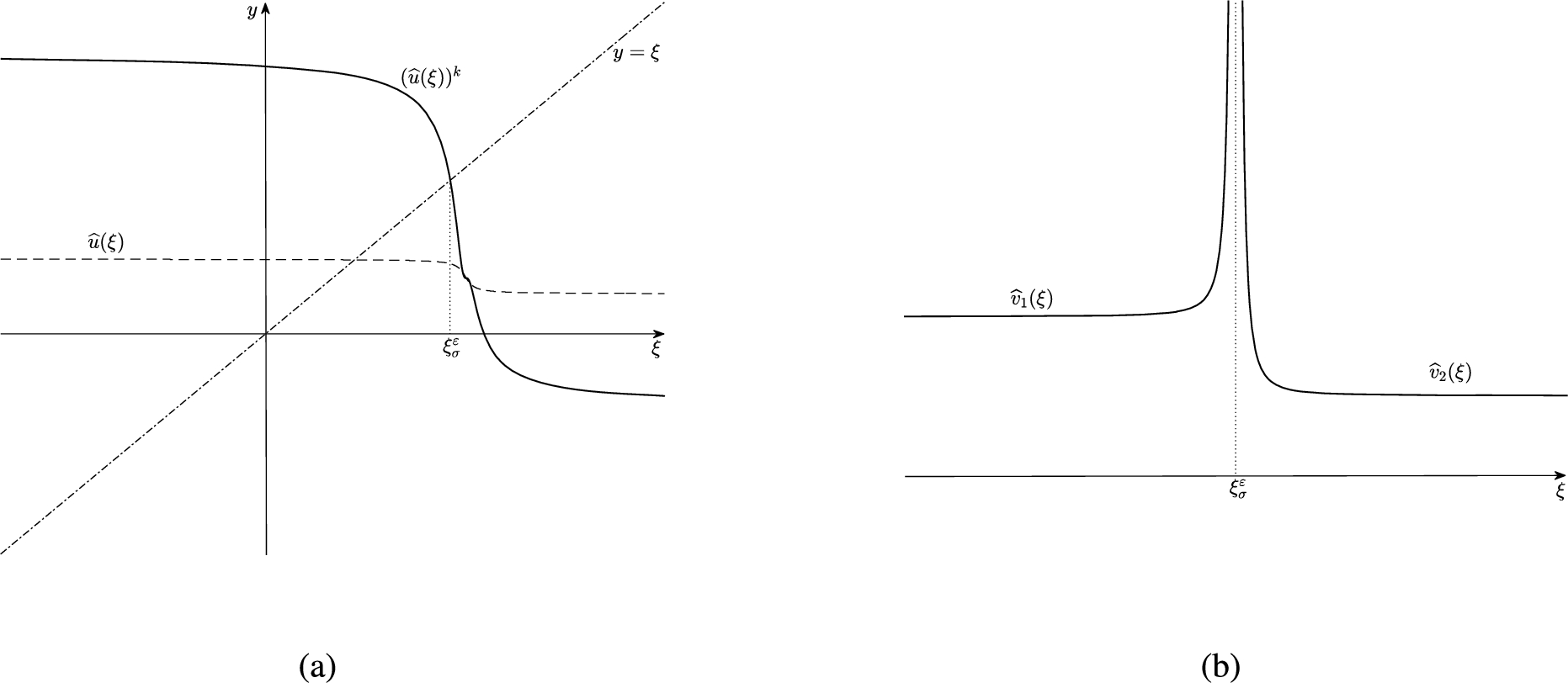
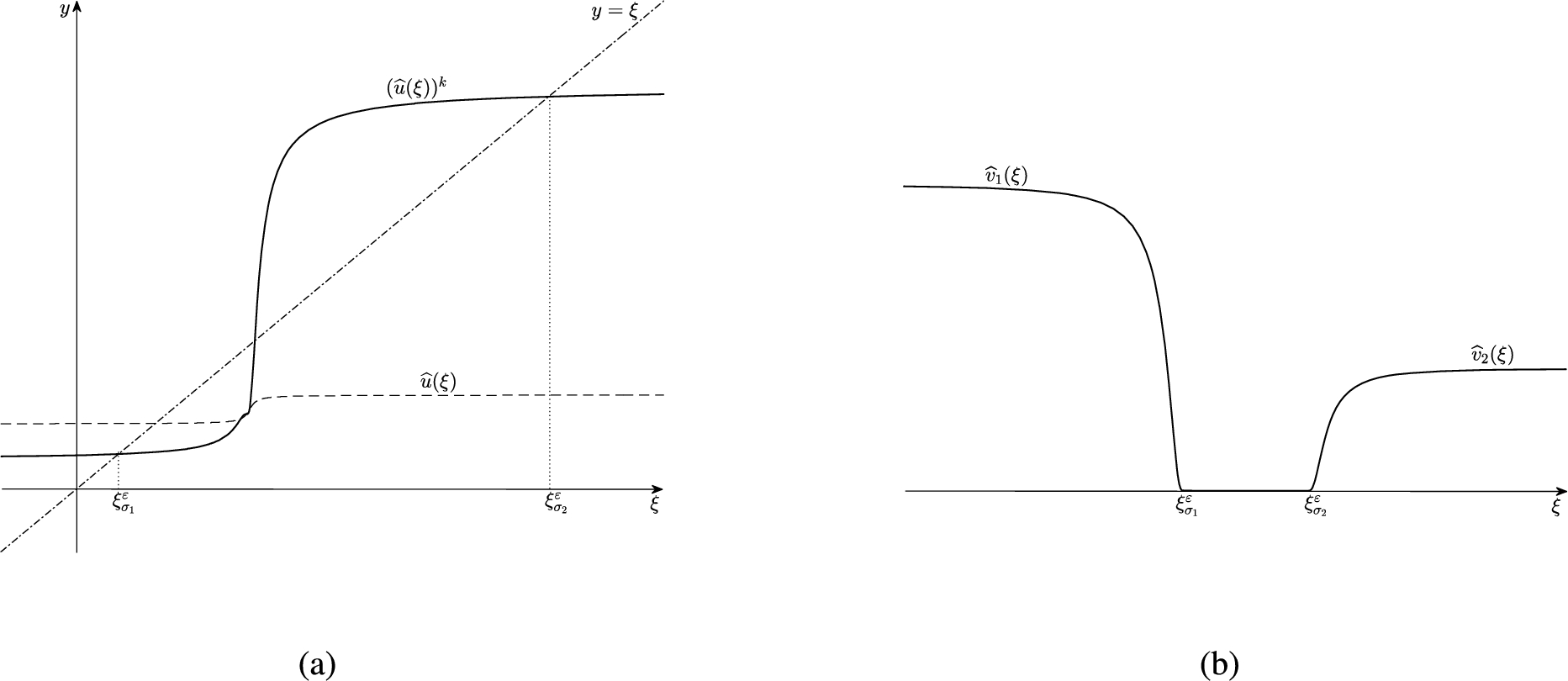
From Lemma 2.1, we have which does not depend on μ and R. Now, from Theorem 3.1 in [4] we conclude that there exists a solution of (9). Again combining the Lemma 2.1 and Theorem 3.1, we can take and for the monotonicity of the solution in the previous lemma, we conclude that if , then the solution is decreasing on , see Fig. 1(a). For , the solution is increasing on , see Fig. 2(a). □
Graphs of the functions and in Theorem 2.2 and Lemma 2.5. (a-Left) For , the functions and are monotonically decreasing. (b-Right) Graphs of the functions and .
Graphs of the functions and in Theorem 2.2 and Lemma 2.7. (a-Left) For , the functions and are monotonically increasing. (b-Right) Graphs of the functions and .
As w is a solution of (9), then . Now, multiplying the equation of (9) by , we have
and integrating from 0 to ξ, we get,
From Theorem 2.2, we know that w is monotone and we have and for all ξ. Therefore, from (12) we obtain
and using Gronwall’s inequality, we get the estimate
□
Let and be solutions of the problem (9) and . Then, from (9) we have that is a smooth solution of the boundary value problem
where . We note that is bounded. Observe that from Proposition 2.3, we have
and decays rapidly to zero when for each fixed . Therefore, when we have .
Let us suppose that is not the null function. Let a and b be consecutive zeros of with . So, integrating (13) by parts on we find
Now, if on , then and . But, we have a contradiction with (14) because in this case (14) implies . In similar way, if on , then and , which again contradicts with (14). Thus, we conclude that . □
Putting into the second equation of (6) with boundary conditions (7), we get
The singularity point of (15) is given by the unique solution of and it is denoted by . Observe that the solution of (15) can be obtained by pasting together the two solutions in the regions and . Now integrating (15) from to ξ for , we obtain
On the other hand, integrating (15) from ξ to for , we obtain
Suppose. Letwhereis the unique solution of the equation(which solution exists becauseandis decreasing),andare defined by (
16
) and (
17
), respectively. Then,is continuous inand it is a weak solution for
Note that from the formula (16), is monotonically increasing when in the interval , and from (17) that is monotonically decreasing when in the interval (see Fig. 1(b)). Also, we have
The equation (19) can be rewritten as
Now, we can show that for any interval containing . In fact, integrating (20) on for , we get
Let
Then (21) can be written as
It follows that
Noting that and as , we obtain
Hence
Similarly, one can get
where . The equalities (22) and (24) imply that .
Given an arbitrary function , we can show that
Indeed, for any such that we can write , where
Observe that
By (23), we have that
In similar way, we show that
Since ,
But I is independent of and , so . Therefore, defined in (18) is a weak solution. □
Observe that in Lemma 2.5, the function is monotonically decreasing in the interval when , while the function is monotonically increasing in the interval for . Moreover, if , and , we have and .
Suppose. Letwhereandare defined by (
16
) and (
17
), respectively,satisfying,and. Then,is decreasing in,is increasing in,is continuous on the intervalsand, and it is a weak solution for.
As , thus is increasing. Consider now the function which is continuous and approaches as . Hence, there exist finite quantities and . One has on and on . Moreover, we can get . We now claim that
In fact, for R fixed and we have
where . Now, from (17) and (25) we get
In a similar way, we can obtain . The monotonicity of and is obvious, see Fig. 2(b). When , from (20) we have
or
which implies that . □
The limit solutions of (4)–(5) as viscosity vanishes
In this section, we are interested in analyzing the behavior of the solutions of (6)–(7) as to stablished the solutions of (4)–(5).
Case 1.
Letbe the unique point satisfying, and letbe the limit(passing to a subsequence if necessary). Then for any,uniformly in the above intervals. Moreover,and.
To simplify the notation in this proof, we shall use , instead of , .
Take , and let ε be so small such that .
Now, integrating the first equation of (6) twice on , we get
Letting , we get
for , where is a constant independent of ε. Thus
So
Noticing that
for and from (26) we have
which implies that
Now, we choose ξ and such that . From
we get
where . When , we obtain
which implies that
The results for can be obtained analogously.
In fact, let where , From (9) we have
Passing limit in (27), we get
or
which yields for arbitrary ϕ. □
For any,uniformly, with respect to ξ.
Take so small such that whenever . For any and , we have
and
For any , we have
As is decreasing, we have that , and
Now, in the last inequality, integrating on we have
so
By Lemma 3.1 we have that , and from (28) we have
and
Similarly, we obtain also , uniformly for . □
Letbe the solution of the Riemann problem (
6
)–(
7
) DenoteThenwhereconverges in the sense of the distributions to the sum of a step function and a Dirac measure δ with weight. Moreover,.
From Lemma 3.1 we have that and . Moreover, observe that for all and for all . Then, as , we have . Now, we need to study the limit behavior of in the neighborhood of σ. Let and be real numbers such that and such that for ξ in a neighborhood Ω of σ, .1
The function ϕ is called a sloping test function [21].
Then whenever . From (6) we have
For , near σ such that , we write
and from Lemmas 3.1 and 3.2, we obtain
Then taking , , we arrive at
where and
From (29) and (30), we get
for all sloping test functions .
For an arbitrary , we take a sloping test function ϕ, such that and
for a sufficiently small . As uniformly, we obtain
Then, when , we find that
holds for all test functions . Thus, converges in the sense of the distributions to the sum of a step function and a Dirac delta function with strength . In similar way, we can show that
for all test functions and where
Thus, converges in the sense of the distributions to a step function. □
Then we get the following theorem.
Suppose. Letbe the similarity solution of (
4
)–(
5
). Then the limitexists in the measure sense andsolves (
8
)–(
5
). Moreover,whereand. Moreover, σ satisfies the entropy condition.
Case 2.
For any,uniformly in the above intervals.
Since is a increasing smooth function in , then or .
The proof of this lemma is basically similar to that of Lemma 3.1. Take and let ε be so small such that . Integrating the first equation of (6) twice on , we get
Letting , we get
for , where is a constant independent of ε. Thus
Noticing that
for and from (26) we have
which implies that
Now, we choose ξ and such that . From
we get
where . When , we obtain , which implies that
The results for can be obtained analogously.
Now, noticing that for ,
By Lemma 2.7, is decreasing for and from (31) we have
Thus,
Analogously, we obtain , uniformly for . From Lemma 2.7, on we have that . Now, choose and let where . From (15) we have
Thus, we have which yields for arbitrary ϕ and arbitrary . Analogously, we obtain .
For , denote . Thus, from the chain rule of Volpert for BV functions [12,23], Eq. (9) and (15), we have that with and . Also, (with Lemma 2.7) we have . □
Now, we study the limit behavior of as .
Suppose. Letbe the solution of the Riemann problem (
6
)–(
7
). Then,exists in the sense of distributions andsolves (
8
)–(
5
). Moreover,
In this section, we study the Riemann problem to the original system (1). When , the solution of (1)–(2) is directly obtained from the corresponding ones to (8)–(5) by performing the transformation of state variables , in which the positions of the contact discontinuities remain unchanged. Then, we have the following result for classical Riemann solutions.
Assume that. Then the solution for the Riemann problem is
It is clear that the above theorem generalizes the Theorem 3.1 in [5]. Now, we study the case when . We need recall the following definition:
A two-dimensional weighted delta function supported on a smooth curve , for , is defined as
Now, we define a delta shock wave solution for the system (1) with initial data (2).
A distribution pair is a delta shock wave solution of (1) and (2) in the sense of distribution if there exist a smooth curve L and a function such that v and u are represented in the following form
and
for all the test functions , where and
With the previous definitions, we are going to find a solution with discontinuity for (1) of the form
where , are piecewise smooth solutions of system (1), is the Dirac measure supported on the curve , and , and are to be determined.
Since and , from Theorem 3.4, we can establish a solution of the form (33) to the system (1) with initial data (2). Thus, we have the following result.
Assume that. Then the Riemann problem (
1
)–(
2
) admits one and only one measure solution of the formwhere,,and. Moreover,satisfies the entropy conditionfor all.
We need show that (34) is a solution to the problem (1)–(2) which can be found with and the result obtained in Theorem 3.4. Therefore, for any test function we have
which implies the second equation of (32). A completely similar argument leads to the first equation of (32).
□
Final remarks
From Theorem 4.1, we can observe that when , the solution converges to
which is the classical Riemann solution for the homogeneous system associated to (1). In similar way, from Theorem 4.4, we can observe that when , the solution converges to
where and . This solution is a delta shock wave solution for the homogeneous system associated to (1). The Riemann problem for the homogeneous system associated to (1) with was solved by K.T. Joseph (see main theorem in [11]).
Footnotes
Acknowledgement
We thank the editor whose insightful suggestions helped improve this work.
References
1.
G.I.Barenblatt, Scaling, Self-Similarity, and Intermediate Asymptotics, Cambridge University Press, 1996. doi:10.1017/CBO9781107050242.
2.
D.G.Crighton, Model equations of nonlinear acoustics, Annu. Rev. Fluid Mech.11 (1979), 11–33. doi:10.1146/annurev.fl.11.010179.000303.
3.
D.G.Crighton and J.F.Scott, Asymptotic solution of model equations in nonlinear acoustics, Phil. Trans. Koy Sot.A292 (1979), 101–134.
4.
C.M.Dafermos, Solutions of the Riemann problem for a class of hyperbolic systems of conservation laws by the viscosity method, Arch. Ration. Mech. Anal.52 (1973), 1–9. doi:10.1007/BF00249087.
5.
R.De la cruz, Riemann problem for a hyperbolic system with linear damping, Acta Appl. Math.170 (2020), 631–647. doi:10.1007/s10440-020-00350-w.
6.
R.De la cruz and M.Santos, Delta shock waves for a system of Keyfitz–Kranzer type, Z. Angew. Math. Mech.99 (2019), e201700251.
7.
J.Doyle and M.J.Englefield, Similarity solutions of a generalized Burgers equation, IMA Journal of Applied Mathematics44 (1990), 145–153. doi:10.1093/imamat/44.2.145.
R.N.Henriksen, Scale Invariance: Self-Similarity of the Physical World, Wiley-VCH, 2015. doi:10.1002/9783527687343.
10.
E.L.Isaacson and B.Temple, Analysis of a singular hyperbolic system of conservation laws, J. Differential Equations65 (1986), 250–268. doi:10.1016/0022-0396(86)90037-9.
11.
K.T.Joseph, A Riemann problem whose viscosity solution contain δ-measures, Asymptot. Anal.7 (1993), 105–120. doi:10.3233/ASY-1993-7203.
12.
P.G.LeFloch, Entropy weak solutions to nonlinear hyperbolic systems under nonconservative form, Communications in Partial Differential Equation13 (1988), 669–727. doi:10.1080/03605308808820557.
13.
Y.Q.Lou and W.G.Wang, New self-similar solutions of polytropic gas dynamics, Mon. Not. Roy. Astron. Soc.372 (2006), 885–900. doi:10.1111/j.1365-2966.2006.10908.x.
14.
B.Mayil Vaganan and M.Senthil Kumaran, Kummer function solutions of damped Burgers equations with time-dependent viscosity by exact linearization, Nonlinear Anal.: Real World Appl.9 (2008), 2222–2233. doi:10.1016/j.nonrwa.2007.08.001.
15.
A.D.Polyanin and V.F.Zaitsev, Handbook of Nonlinear Partial Differential Equations, Chapman & Hall/CRC, 2003. doi:10.1201/9780203489659.
16.
P.L.Sachdev, Self-Similarity and Beyond: Exact Solutions of Nonlinear Problems, Monographs and Surveys in Pure and Applied Mathematics 113, Chapman & Hall/CRC, 2000. doi:10.1201/9781420035711.
17.
C.Sackand and H.Schamel, Nonlinear dynamics in expanding plasmas, Phys. Lett. A110 (1985), 206–212. doi:10.1016/0375-9601(85)90125-2.
18.
J.F.Scott, The long time asymptotics of solution to the generalized Burgers equation, Proc. Roy. Sot. Land. A373 (1981), 443–456.
19.
S.F.Shandarin and Y.B.Zeldovich, Large-scale structure of the universe: Turbulence, intermittency, structures in a self-gravitating medium, Rev. Modern Phys.61 (1989), 185–220. doi:10.1103/RevModPhys.61.185.
20.
Y.Suto and J.Silk, Self-similar dynamics of polytropic gaseous spheres, Astrophys. J.326 (1988), 527–538. doi:10.1086/166114.
21.
D.Tan, T.Zhang and Y.Zheng, Delta shock waves as limits of vanishing viscosity for hyperbolic systems of conservation laws, J. Differential Equations112 (1994), 1–32. doi:10.1006/jdeq.1994.1093.
22.
V.A.Tupciev, On the method of introducing viscosity in the study of problems involving decay of a discontinuity, Dokl. Akad. Nauk SSR211 (1973), 55–58.
23.
A.I.Volpert, The space BV and quasilinear equations, Math. Sbornik.73 (1967), 225–267. doi:10.1070/SM1967v002n02ABEH002340.
24.
J.Wang and H.Zhang, Existence and decay rates of solutions to the generalized Burgers equation, J. Math. Anal. Appl.284 (2003), 213–235. doi:10.1016/S0022-247X(03)00336-6.
25.
J.H.Wang and H.Zhang, A new viscous regularization of the Riemann problem for Burger’s equation, J. Partial Diff. Eqs.13 (2000), 253–263.
26.
H.Yang, Riemann problems for a class of coupled hyperbolic systems of conservation laws, J. Differential Equations159 (1999), 447–484. doi:10.1006/jdeq.1999.3629.
27.
H.Yang and Y.Zhang, New developments of delta shock waves and its applications in systems of conservation laws, J. Differential Equations252 (2012), 5951–5993. doi:10.1016/j.jde.2012.02.015.
28.
H.Zhang, Global existence and asymptotic behaviour of the solution of a generalized Burger’s equation with viscosity, Computers Math. Applic.41 (2001), 589–596. doi:10.1016/S0898-1221(00)00302-3.
29.
H.Zhang and X.Wang, Large-time behavior of smooth solutions to a nonuniformly parabolic equation, Computers Math. Applic.47 (2004), 353–363. doi:10.1016/S0898-1221(04)90030-2.