In this paper we consider a model of laminated beams combining viscoelastic damping and strong time-delayed damping. The global well-posedness is proved by using the theory of semigroups of linear operators. We prove the lack of exponential stability when the speed wave propagations are not equal. In fact, we show in this situation, that the system goes to zero polynomially with rate . On the other hand, by constructing some suitable multipliers, we establish that the energy decays exponentially provided the equal-speed wave propagations hold.
In this work, we are interested in studying the following laminated beams with strong time delay in ,
subject to boundary conditions given by
and initial conditions
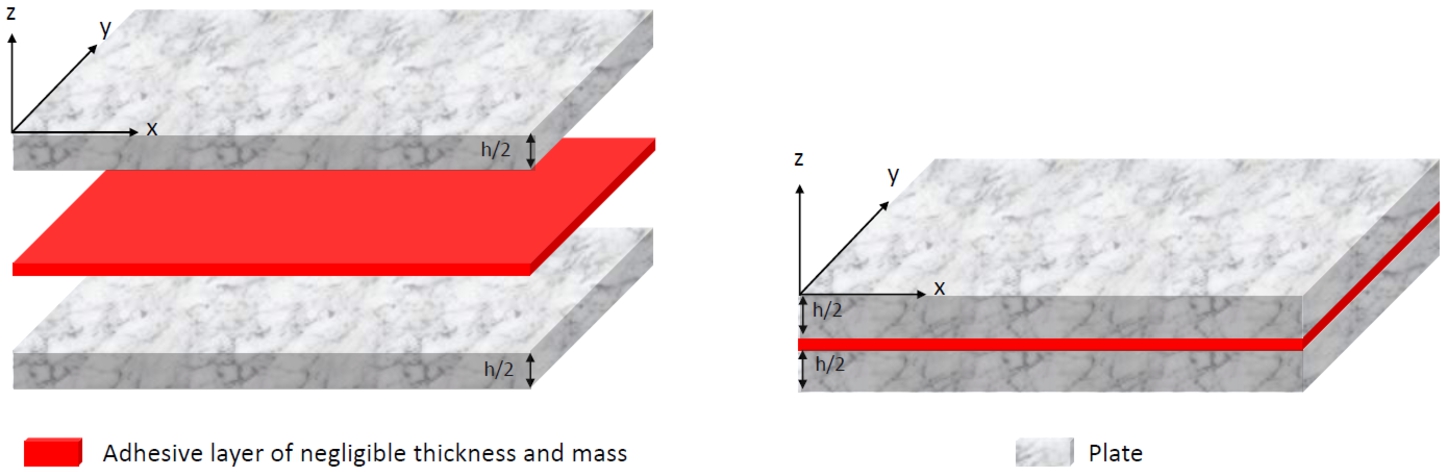
The laminated beam is a mathematical model given by two plates connected by an adhesive layer of negligible thickness and mass. An example of applying an adhesive to glue two plates (layers) is shown in Fig. 1.
Adhesive application (left) and plate in the press (right).
The model was derived from Timoshenko’s theory by S. Hansen and R. Spies [15,16] and is given by the following three equations
where the coefficients ρ, G, , D, γ, β are positive constants and represent density, shear stiffness, mass moment of inertia, flexural rigidity, adhesive stiffness, and adhesive damping parameter, respectively. The function is the transversal displacement, is the rotational displacement and is proportional to the amount of slip along the interface. The third equation describes the dynamics of the slip.
For laminated beams without time delay, we start citing the contribution in [36], where the authors considered (1.4) with the following boundary control,
and obtained that the energy decays exponentially by assuming , , where
This result was improved by Mustafa, who established the exponential decay for and extended these results to cases of nonlinear functions in the boundary control, see [25]. We can also find some stability results on the system (1.4) with boundary damping in [7,33,35], etc. Raposo [32] investigated (1.4) by adding frictional damping terms on the transverse displacement and rotation angle, respectively. He established the exponential stability of the system without any restrictions on the coefficients. The result was extended to a nonlinear framework by Feng et al. [12]. More results on (1.4) with other kind of damping mechanisms, one can refer to [1,2,8,21,22,26] to cite but a few.
The delay effects often appear in many practical problems, for instance, chemical, physical, thermal and economic phenomena, and so on, and the presence of an arbitrarily small delay may destabilize a system which is uniformly or asymptotically stable in the absence of delay. For example, Nicaise and Pignotti [27] considered the system
and proved that the energy decays exponentially under the assumption , otherwise the system is unstable. Similar results can be found in [28,29].
For laminated beams with time delay, there are few results. Feng [11] studied system (1.4) with three internal constant time delays and boundary feedback. He proved that the system is exponentially stable if the coefficients of time delay are small. Mpungu et al. [24] considered (1.4) with frictional damping and an internal constant delay term in the transverse displacement. They obtained the system is exponentially stable if the assumption of equal wave speeds holds, otherwise, the energy decays polynomially. Choucha et al. [9] studied a thermoelastic laminated Timoshenko beam with distributed delay. They proved the same stability results as in [24]. Note that the system (1.4) reduces to Timoshenko system if . Said-Houari and Laskri [34] investigated a Timoshenko system with a delay of the form
and established the exponential energy decay provided . The result was extended by Kirane et al. to the case of the time-varying delay, see [20]. Makheloufi et al. [23] studied a Timoshenko system with a strong damping and a strong delay given by
They proved that the system is not exponentially stable even if the equal-speed wave propagations hold. For more results on stability of Timoshenko with time delay, one can refer to [3,10,14,18], etc.
Motivated by the above scenario, in the present paper, we consider the laminated beams with strong time delay . We aim to study the well-posedness and results of stability for the system taking into account the stability number
The well-posedness is proved by semigroup of linear operators, see Section 2. In Section 3, by using the Gearhart-Herbst-Prüss-Huang Theorem, we prove that system (1.1)–(1.3) is not exponentially stable if . Finally, the Section 4 is devoted to energy decay of the system, where we prove that the energy decays exponentially in the case of equal wave speeds of propagation, that is, . Otherwise, if , the system goes to zero polynomially with rate .
Well-posedness
We introduce a new dependent variable z to deal with the delay feedback term, i.e.,
It is easily verified that the z satisfies
Following the idea of [36], we denote the effective rotation angle by . By (2.2), the differential equations (1.1) can be rewritten as follows:
subject to boundary conditions given in (1.2), that is,
and initial conditions
In the following, using the semigroup theory found in [30], a result of existence, uniqueness and regularity will be obtained for the problem (2.3)–(2.5).
Now, consider the following Hilbert space:
where
For ζ a positive constant satisfying
the inner product on is
for any , in . The norm induced by the inner product is
Introducing and , the system (2.3)–(2.5) can be written as the following abstract initial value problem in
where the operator is given by
with
Note that is dense in and is easy to show that is dissipative since (for more details, see Theorem 4.2), and for each , we have
where since (2.8) hold.
Our existence and uniqueness result reads as follows.
(Existence and uniqueness).
Assume that, then for any, there exists a unique solutionof problem (
2.11
). Moreover, if, then
Since the operator is dissipative. Now, we will prove that operator is surjective for . For this purpose, let , we seek which is solution of , that is, the entries of U satisfy the system of equations
Suppose that we have found u, ξ and S with the appropriated regularity. Therefore, from (2.16), (2.18) and (2.20) we have
It is clear that and . Furthermore,
is solution of (2.22) satisfying
Taking into account (2.24) we have
Substituting (2.23) into (2.17), (2.24) and (2.28) into (2.19), and (2.25) into (2.21), we obtain
where
In order to solve (2.29), we use a standard procedure, considering the sesquilinear form
given by
for every followed by the continuous linear functional
for every .
It is not difficult to show that B is continuous. To prove that B is coercive, let us note that, applying Hölder’s, Poincaré’s and Young’s inequalities, we obtain
So, by applying the Lax–Milgram’s theorem, we obtain a solution for for (2.29). In addition, it follows from (2.17), (2.19) and (2.21) that and so . Consequently, the result of Theorem 2.1 follows from the Lumer–Phillips theorem. □
The lack of exponential stability
In this section, using the Gearhart–Herbst–Prüss–Huang Theorem 3.1 (see [13,17,31]), we prove that system (2.3)–(2.5) is not exponentially stable if .
Letbe a-semigroup of contractions on a Hilbert spacegenerated by a linear operator. Thenis exponentially stable if and only ifwhereis the resolvent set of the differential operator.
The main result of this section is given by the following theorem.
Suppose that, then the semigroup associated to the system (
2.3
)–(
2.5
) is not exponentially stable.
To prove this result we will argue by contradiction, that is, we will show that there exists a sequence with and for , such that
where is bounded in , but tends to infinity. Rewriting the resolvent equation (3.2) in term of its components with and where , we have
From (3.3), (3.5) and (3.7), we get , and . So we can write
Due to the boundary conditions (2.4), the functions given by
solve the system (3.10)–(3.13) if only if , , and satisfy
From (3.5) and z we have and solving (3.17), we get
Therefore, system (3.14)–(3.17) is equivalent to
We choose sequence of real numbers
which gives . Therefore,
where
with
Solving the equations (3.23)–(3.24) we have
and
Substituting the equations (3.27) and (3.28) into (3.22), we obtain
Substituting (3.29) into (3.27) and (3.28), we obtain
and
Finally, we have
Then as , we have
Applying the Theorem 3.1, we conclude that the semigroup associated with the system (2.3)–(2.5) does not have exponential decay when . □
Asymptotic behavior
This section is dedicated to study of the asymptotic behavior. We show that, under the assumption and , the solution of problem (2.3)–(2.5) is exponentially stable using the multiplier technique. Otherwise the energy decays polynomially.
Energy dissipation
We define the energy associated to the solution of problem (2.3)–(2.5) by the following formula
The following result states that the energy is a non-increasing and uniformly bounded function above by .
Letbe a solution of (
2.3
)–(
2.5
). For, the energy of the system satisfies the dissipation law, given bywhere.
Multiplying by , by , by and integrating each of them parts over , we get
Now differentiating with respect to x and multiplying the result by and integrating over , we obtain
Combining (4.3), (4.4), (4.5) and (4.6), we obtain
Applying Young’s inequality and taking into account (2.8) the proof is complete. □
Technical lemmas
In the previous section we observe that the energy functional restores some energy terms with a negative sign. We are interested in building a Lyapunov functional that restores the full energy of the system with a negative sign, and for this goal, we consider the following lemmas.
Ifis a solution of (
2.3
)–(
2.5
), then the functional, defined bysatisfies the estimatefor some constant, whereis Poincaré’s constant.
Taking the derivative of , using (2.3) and integrating by parts, we arrive at
It follows Young’s and Poincaré’s inequalities that
Consequently, from (4.10)–(4.13), we obtain (4.9). □
Assume thatholds. Ifis a solution of (
2.3
)–(
2.5
), then the functional, defined bysatisfies the estimatefor some constant, whereis Poincaré’s constant.
Taking the derivative of , using (2.3), integrating by parts and the fact that , we obtain
Since the term is actually zero. Exploiting Young’s and Poincaré’s inequalities, we estimate the non-square terms of (4.16) as follows
Substituting the above three estimates with (4.16) completes our proof. □
Ifis a solution of (
2.3
)–(
2.5
), then the functional, defined bysatisfies the estimatefor anyand some.
Taking the derivative of , using (2.3) and integrating by parts, yield
Using Young’s and Cauchy-Schwarz inequalities, we estimate that
The estimate (4.21) follows from (4.22)–(4.24). □
Ifis a solution of (
2.3
)–(
2.5
), then the functional, defined bysatisfies the estimatefor anyand some, whereis Poincaré’s constant.
Taking the derivative of , using (2.3), integrating by parts and the fact that , we obtain
By using Young’s and Poincaré’s inequalities, the third and fourth terms in (4.27) can be estimated as follows
The assertion of the lemma follows from the two above estimates and (4.27). □
Ifis a solution of (
2.3
)–(
2.5
), then the functional, defined bysatisfies the estimate
Differentiating and using (2.3), we have
Next, exploiting the inequality for any , we arrive at the estimate (4.31). □
Exponential stability
We are now in a position to prove our main result, which is the following stability result.
(Exponential decay).
Letbe a solution of (
2.3
)–(
2.5
) with initial dataandthe energy of U. Assume thatandholds, then there exist positive constants M and σ such that
We will construct a suitable Lyapunov functional satisfying the following equivalence relation
for some and prove that
for some , which implies
Let us define the Lyapunov functional
where , are positive real numbers which will be chosen later. We have that
It follows from (4.1), to Young’s, Poincaré’s and Cauchy-Schwarz inequalities, and from the fact that for any that
for some constant . So, we can choose N large enough that and , then
holds.
Now, taking the derivative , substituting the estimates (4.2), (4.9), (4.15), (4.21), (4.26), (4.31) and setting
we obtain that
First, let us choose large enough such that
Next, we select large enough so that
Now, choosing N large enough, i.e.,
and applying Poincaré’s inequality, we obtain
for some positive constant . Therefore, from (4.1), we have
In view of (4.39) and (4.46), we note that
which leads to
The desired result (4.33) follows by using estimates (4.39) and (4.48). Then, the proof of Theorem 4.7 is complete. □
Polynomial stability
In this section, we will show that the semigroup related to the laminated beam system (2.3)–(2.5) decays polynomially with rate if . But first, we need to remember an intermediate notion of stability, known as semiuniform stability. By definition, we say that the semigroup is semiuniformly stable if there exists a nonnegative function vanishing at infinity such that
The notion of semiuniform stability produces a stronger concept than stability. More precisely, it ensures convergence for all , and since is bounded, it immediately follows convergence for all .
Regarding semiuniformly stable, we have the following result:
The semigroupis semiuniformly stable if and only if.
In order to guarantee that , we need the result given in the proposition below.
, i.e., the embeddingis compact.
Let be a sequence bounded in . In particular, we have
Consequently, there are , and such that, up to a subsequence,
and
It remains to prove the convergence in for some ξ in . Indeed, knowing that
we get the convergence, up to a subsequence
From (4.51), we obtain in . □
Since, the inverseis compact. It follows immediately from Lemma
4.10
(below) that the spectrum ofconsists entirely of isolated eigenvalues.
Leta closed linear operator acting on a complex Banach space X. Ifis invertible and the inverse operatoris compact, then the spectrum ofconsists entirely of isolated eigenvalues.
Under the above notations we have that.
Since the spectrum of consists entirely of isolated eigenvalues, we can assume by contradiction that has an imaginary eigenvalue, i.e.,
where . In coordinates, we have
From estimate (2.14) we get . Using Poincaré’s inequality we have , which implies that (see Eq. (4.55)). From we have (see Eq. (4.57)) and implies that . On the order hand, from Eq. (4.56) we have
Consequently . From Eq. (4.54) we infer that . This implies that . But this is a contradiction, therefore there are no imaginary eigenvalues. □
Letbe a contraction semigroup on a complex Hilbert space X. Suppose that. Then, for every fixed,if and only if
To prove the polynomial rate of decay we consider here the resolvent equation written as
where and . In coordinates, we have
On the other hand, it follows from (2.14) that
By considering system (4.62)–(4.68), the following lemmas are obtained.
Letbe a solution of system (
4.62
)–(
4.68
). There then exists a positive constant C independent of λ such that
Multiplying Eq. (4.65) by and integrating over we obtain
From Eq. (4.63) and (4.64) we have
On the other hand, using Eq. (4.63) in and we have
and
Consequently, from (4.70), (4.71), (4.72) and (4.73) obtain
By using the Young’s inequality and estimate (4.69), we obtain
This concludes the proof. □
Letbe a solution of system (
4.62
)–(
4.68
). There then exists a positive constant C independent of λ such that
Multiplying Eq. (4.67) by and integrating over we obtain
By using the Cauchy–Schwarz, Young, Poincaré inequalities and estimate (4.69) we get
and
Finally, using the Lemma 4.13 we obtain
This completes the proof of Lemma. □
Letbe a solution of system (
4.62
)–(
4.68
). There then exists a positive constant C independent of λ such that
Multiplying Eq. (4.65) by and integrating over we obtain
Using Eq. (4.66) in and the Cauchy–Schwarz, Young, Poincaré inequalities and estimate (4.69) we get
Finally, using the Lemma 4.13, 4.14 we have
This concludes the proof. □
Letbe a solution of system (
4.62
)–(
4.68
). There then exists a positive constant C independent of λ such thatsince.
Multiplying Eq. (4.63) by and integrating over we obtain
From (4.62) we have and consequently,
By using the Cauchy–Schwarz and Young inequalities and Lemma 4.13, 4.14 and 4.15 we have
and
This completes the proof of lemma. □
Letbe a solution of system (
4.62
)–(
4.68
). There then exists a positive constant C independent of λ such thatsince.
Now differentiating (4.68) with respect to x and multiplying the result by and integrating over , we obtain
Consequently, taking the imaginary part we have
This concludes the proof. □
We are now in a position to prove the polynomial decay.
(Polynomial decay).
Let us suppose that. Then the semigroupassociated to systems (
4.62
)–(
4.68
) satisfies
From Lemma 4.11, we have . Then we will use Theorem 4.12 to show the polynomial stability. It follows from Lemmas 4.13, 4.14, 4.15, 4.16 and 4.17 that
Using Poincaré’s inequality in estimate (4.69) we have
Adding (4.88), (4.89) we have
Consequently we have
We choose ε small enough such that . Then we get after using (4.61)
Therefore, from Borichev and Tomilov theorem (see Theorem 4.12), we prove that the solution decays polynomially (slow) as as time goes to infinity. □
Footnotes
Acknowledgements
The authors express their gratitude to the anonymous referees for their constructive reports that improve this manuscript. C.A. Nonato thanks CAPES (Brazil) for funding the doctoral scholarship. A.J.A. Ramos thanks the CNPq for support through Grant 310729/2019-0.
Conflict of interest
The author declares no competing interests.
References
1.
T.A.Apalara, Uniform stability of a laminated beam with structural damping and second sound, Z. Angew. Math. Phys.68 (2017). doi:10.1007/s00033-017-0784-x.
2.
T.A.Apalara, On the stability of a thermoelastic laminated beam, Acta Math. Sci. Ser. B.39 (2019), 1517–1524. doi:10.1007/s10473-019-0604-9.
3.
T.A.Apalara and S.A.Messaoudi, An exponential stability result of a Timoshenko system with thermoelasticity with second sound and in the presence of delay, Appl. Math. Optim.71 (2015), 449–472. doi:10.1007/s00245-014-9266-0.
4.
C.J.K.Batty, Asymptotic behaviour of semigroups of operators, in: Functional Analysis and Operator Theory, Vol. 30, Banach Center Publ. Polish Acad. Sci, Warsaw, 1994.
5.
C.J.K.Batty and T.Duyckaerts, Non-uniform stability for bounded semi-groups on Banach spaces, J. Evol. Equ.8 (2008), 765–780. doi:10.1007/s00028-008-0424-1.
6.
A.Borichev and Y.Tomilov, Optimal polynomial decay of functions and operator semigroups, Math. Ann.347 (2010), 455–478. doi:10.1007/s00208-009-0439-0.
7.
X.G.Cao, D.Y.Liu and G.Q.Xu, Easy test for stability of laminated beams with structural damping and boundary feedback controls, J. Dyn. Control Syst.13 (2007), 313–336. doi:10.1007/s10883-007-9022-8.
8.
Z.Chen, W.J.Liu and D.Chen, General decay rates for a laminated beam with memory, Taiwanese J. Math.23 (2019), 1227–1252.
9.
A.Choucha, D.Ouchenane and S.Boulaaras, Well posedness and stability result for a thermoelastic laminated Timoshenko beam with distributed delay term, Math. Meth. Appl. Sci.43 (2020), 9983–10004. doi:10.1002/mma.6673.
10.
L.Djilali, A.Benaissa and A.Benaissa, Global existence and energy decay of solutions to a viscoelastic Timoshenko beam system with a nonlinear delay term, Taiwanese J. Math.18 (2015), 1411–1437.
11.
B.Feng, Well-posedness and exponential decay for laminated Timoshenko beams with time delays and boundary feedbacks, Math. Meth. Appl. Sci.41 (2018), 1162–1174. doi:10.1002/mma.4655.
12.
B.Feng, T.F.Ma, R.N.Monteiro and C.A.Raposo, Dynamics of laminated Timoshenko beams, J. Dyn. Diff. Equat.30 (2018), 1489–1507. doi:10.1007/s10884-017-9604-4.
13.
L.Gearhart, Spectral theory for contraction semigroups on Hilbert space, Trans. Amer. Math. Soc.236 (1978), 1088–6850. doi:10.1090/S0002-9947-1978-0461206-1.
14.
A.Guesmia, Some well-posedness and general stability results in Timoshenko systems with infinite memory and distributed time delay, J. Math. Phys.55 (2014), 127–150.
15.
S.W.Hansen, A model for a two-layered plate with interfacial slip, in: Control and Estimation of Distributed Parameter Systems: Nonlinear Phenomena. International Conference in Vorau, Austria, 1994, pp. 143–170. doi:10.1007/978-3-0348-8530-0_9.
16.
S.W.Hansen and R.Spies, Structural damping in a laminated beams duo to interfacial slip, J. Sound Vibration204 (1997), 183–202. doi:10.1006/jsvi.1996.0913.
17.
F.Huang, Characteristic condition for exponential stability of linear dynamical systems in Hilbert space, Ann. Differ. Equ.1 (1985), 43–56.
18.
M.Kafini, S.A.Messaoudi, M.I.Mustafa and T.A.Apalara, Well-posedness and stability results in a Timoshenko-type system of thermoelasticity of type III with delay, Z. Angew. Math. Phys.66 (2015), 1499–1517. doi:10.1007/s00033-014-0475-9.
19.
T.Kato, Perturbation Theory for Linear Operators, Springer-Verlag, New York, 1980.
20.
M.Kirane, B.Said-Houari and M.N.Anwar, Stability result for the Timoshenko system with a time-varying delay term in the internal feedbacks, Commun. Pure Appl. Anal.10 (2011), 667–686. doi:10.3934/cpaa.2011.10.667.
21.
A.Lo and N.E.Tatar, Stabilization of laminated beams with interfacial slip, Electron. J. Differ. Equ.129 (2015), 1.
22.
A.Lo and N.E.Tatar, Uniform stability of a laminated beam with structural memory, Qual. Theory Dyn. Syst.15 (2016), 517–540. doi:10.1007/s12346-015-0147-y.
23.
H.Makheloufi, M.Bahlil and B.Feng, Optimal polynomial decay for a Timoshenko system with a strong damping and a strong delay, Math. Meth. Appl. Sci.44 (2021), 6301–6317. doi:10.1002/mma.7183.
24.
K.Mpungu, T.A.Apalara and M.Muminov, On the stabilization of laminated beams with delay, Appl Math66 (2021), 789–812. doi:10.21136/AM.2021.0056-20.
25.
M.I.Mustafa, Boundary control of laminated beams with interfacial slip, J. Math. Phys.59 (2018), 051508. doi:10.1063/1.5017923.
26.
M.I.Mustafa, Laminated Timoshenko beams with viscoelastic damping, J. Math. Anal. Appl.466 (2018), 619–641. doi:10.1016/j.jmaa.2018.06.016.
27.
S.Nicaise and C.Pignotti, Stability and instability results of the wave equation with a delay term in the boundary or internal feedbacks, SIAM J. Control Optim.45 (2006), 1561–1585. doi:10.1137/060648891.
28.
S.Nicaise and C.Pignotti, Interior feedback stabilization of wave equations with time dependent delay, Electron. J. Differ. Equ.2011 (2011), 41.
29.
S.Nicaise, C.Pignotti and J.Valein, Exponential stability of the wave equation with boundary time-varying delay, Discrete Contin. Dyn. Syst. Ser.4 (2011), 693–722.
30.
H.Pazy, Semigroups of Linear Operators and Applications to Partial Differential Equations, Springer, New York, 1983.
31.
J.Prüss, On the spectrum of -semigroups, Trans. Amer. Math. Soc.284 (1984), 847–857.
32.
C.A.Raposo, Exponential stability for a structure with interfacial slip and frictional damping, Appl. Math. Lett.53 (2016), 85–91. doi:10.1016/j.aml.2015.10.005.
33.
C.A.Raposo, O.V.Villagran, J.E.Mũnoz Rivera and M.S.Alves, Hybrid laminated Timoshenko beam, J. Math. Phys.58 (2017), 101512. doi:10.1063/1.4998945.
34.
B.Said-Houari and Y.Laskri, A stability result of a Timoshenko system with a delay term in the internal feedback, Appl. Math. Comput.217 (2010), 2857–2869. doi:10.1016/j.amc.2010.08.021.
35.
N.E.Tatar, Stabilization of a laminated beam with interfacial slip by boundary controls, Bound. Value Probl.169 (2015). doi:10.1186/s13661-015-0432-3.
36.
J.Wang, G.Q.Xu and S.Yung, Exponential stabilization of laminated beams with structural damping and boudary feedback controls, SIAM J. Control Optim.44 (2005), 1575–1597. doi:10.1137/040610003.