This article deals with the asymptotic behavior of a mathematical model for laminated beams with Kelvin–Voigt dissipation acting on the equations of transverse displacement and dimensionless slip. We prove that the evolution semigroup is exponentially stable if the damping is effective in the two equations of the model. Otherwise, we prove that the semigroup is polynomially stable and find the optimal decay rate when damping is effective only in the slip equation. Our stability approach is based on the Gearhart–Prüss–Huang Theorem, which characterizes exponential stability, while the polynomial decay rate is obtained using the Borichev and Tomilov Theorem.
In 1824 Fourier [11] studied the problem of heat conduction in solid bodies, which is also associated with linear transport equations. Since then, these equations have been used in describing such problems in heat conduction theory. This theory guarantees that the heat flux in a homogeneous body is proportional to the temperature gradient (Fourier’s law), i.e.,
where , κ, denote the thermal flow, thermal conductivity, and temperature gradient, respectively. On the other hand, keeping in mind the equilibrium equation given by
(where ρ is the mass density, c is the specific heat capacity) and combining with equation (1.1), we get the heat equation given by
where β is the thermal diffusivity coefficient. Due to the importance of studies associated with the theory of heat conduction, we found several works in the literature [15–17,19,31,32] that describe the thermoelastic behavior of hyperbolic systems coupled to Fourier’s law. For example in [15], Kim considered the problem
where , , . The dependent variables u and θ denote vertical plate deflection and temperature, respectively. He used energy method combined with the multiplier techniques to prove the exponential decay of the system energy. On the other hand, the same problem was investigated by Liu and Zheng in [23] by adopting more general boundary conditions to obtain an exponential decay result.
In the context of Timoshenko beams, we highlight the pioneering work of Rivera and Racke [33] where the dynamics of heat conduction with wave propagation is described by
where φ, ψ and θ denote the transverse displacement, angle of rotation, temperature of the beam and moreover, , , b, κ, γ are positive constants. Using energy method, the authors proved exponential decay depending on the known speed equality relationship, i.e.,
Other results on the dynamics of heat conduction in Timoshenko systems with Fourier’s law can be found in [1,2]. However, we are interested in the dynamics of laminated beams (composite laminated in the form of beams) subject to heat conduction.
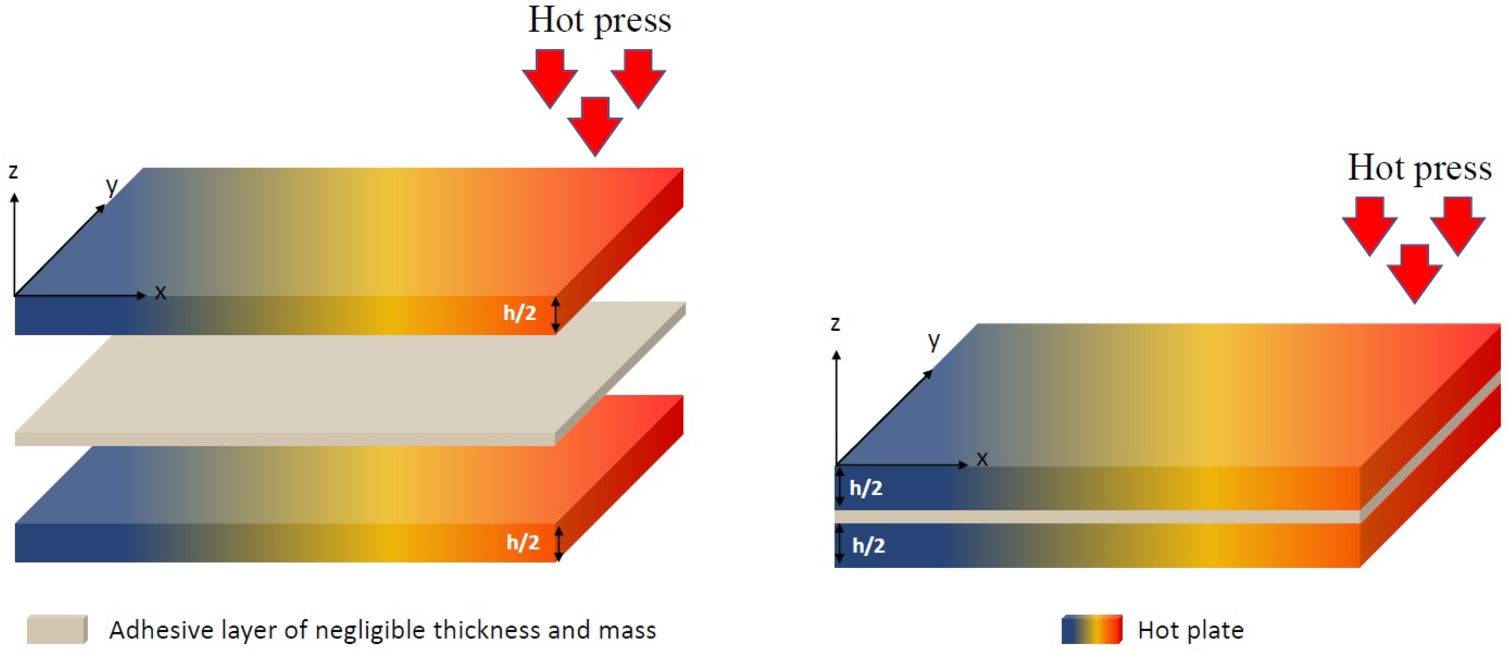
The term laminated composite is used to designate the combination of two or more materials distinct in their physical properties. It is a heterogeneous environment whose main objective is to obtain a material that, matching its components’ characteristics properly, presents a structural performance better than the components under specific conditions of use. In addition, in many of these materials, as part of the assembly process, the materials are subjected to the curing process with a hot press [25]. This motivates us to consider the problem of heat conduction in laminated beams (see Fig. 1).
Adhesive application with hot press (left) and plate in the hot press (right).
The laminated beam model was introduced by Hansen and Spies [13] and is described by the following system
where l represents the length of the beams.
This model consists of a two-layer beam, which is bonded together by an adhesive layer so that bonding them together gives rise to a restoring force that is assumed to be proportional to the amount of slip. The adhesive layer is assumed to have negligible mass and thickness, and thus does not contribute to the system’s kinetic energy. According to Hansen and Spies [13], the first and second equations in (1.10) are derived from the Timoshenko theory [34], while the third equation describes the dynamics of the interaction between the two layers and includes internal frictional damping, also known as structural damping.
In (1.10), the functions and represent the transverse displacement and the angle of rotation. In addition, is proportional to the amount of slip along with the interface at time t and longitudinal spatial variable x, respectively. The positive parameters ρ, G, , D, , and , represent the density, shear stiffness, mass moment of inertia, flexural rigidity, adhesive stiffness, and the adhesive structural damping parameter, respectively.
There is extensive literature about the system’s stability (1.10) under various damping mechanisms (frictional, Kelvin–Voigt, delay, history, etc.). We can also find some studies about the stability of the system (1.10) under thermal effects (see, for instance [3,4,8–10,20–22,26,29,30], etc.)
Recently, Liu and Zhao [22] studied the laminated beam system with and without structural dissipation, considering the thermal effect described by Fourier’s law. Specifically, the authors addressed the following system
where θ represents the temperature difference. The authors studied the stability of system (1.11) with structural damping (β) and without structural damping (), proving in both cases that the system is exponentially stable when the wave propagation speeds are equal (i.e., when ), for which they used the perturbed energy method. When the wave propagation speeds differ, they demonstrate the lack of exponential stability when . Additionally, they obtained a polynomial stability result in the case β.
Motivated by the cited works and mainly by [22], we wonder what would happen if we introduce a Kelvin–Voigt dissipation on the transverse displacement in the model (1.11) without the presence of the structural damping (i.e., with ). That is,
To be more explicit, according to the results proved in [22], the system
is exponentially stable. Usually, Kelvin–Voigt damping is known as strong damping, so if the system (1.13) is exponentially stable, the system (1.12) should also be so. However, surprisingly, the presence of Kelvin–Voigt damping in the first equation of (1.12) destroys the exponential stability of the system, even when the wave propagation speeds coincide.
More generally, we study the asymptotic behavior of the laminated beam system with Fourier’s law given by
with and . In the last system, with ψ denoting the rotation angle of the filament. If we make the variable changes , , , , , , the system (1.14)–(1.17) takes the form
For the above system, we will consider the initial conditions
and the mixed boundary conditions
where , , , , , and are functions given in appropriate spaces and the parameters , , , , k, b, γ, α and δ are positive constants and . We notice that the dampings and correspond to Kelvin–Voigt type damping. According to Lazan [18], the materials with Kelvin–Voigt damping are characterized by the following constitutive equation
where σ, ϵ represent the stresses and strains, respectively and the constants a, b are positive numbers. This paper deals with the stability of the system (1.18)–(1.23). We will use the semigroup theory of linear operators and the frequency domain method approach to address the following problems:
The well-posedness of the system (1.18)–(1.23), see Section 2;
The exponential stability of system (1.18)–(1.23) when and , independent of the wave propagation speeds, see Section 3;
The lack of exponential stability of system (1.18)–(1.23) when and , see Section 4.
The polynomial stability and optimal polynomial decay rate of the system (1.18)–(1.23) when and , see Section 5.
Setting of the semigroup
To prove the well-posedness of system (1.18)–(1.21) using semigroup theory (see Liu and Zheng [24]), we define , , and set
Then, system (1.18)–(1.21) can be written as the following abstract Cauchy problem
where the operator is defined by
para and in .
To define the phase space , we consider the Lebesgue space whose usual inner product and norm will be denoted, respectively, by and . We will also use the following Hilbert spaces
and
Then, we define the phase space as
endowed with the inner product
and induced norm
for , .
The domain of operator is defined by
Next, we will prove that the operator is dissipative and that system (1.18)–(1.22) is well-posed.
The operatordefined in (
2.2
)–(
2.3
) is dissipative. Moreover, forwe have
Using the definition of the inner product in and integration by parts, a straightforward calculation leads us to (2.4). □
Ifis the resolvent set of the operator, then.
To begin with, let us prove that is a bijective operator. For this, let us show that for any , there exists a unique such that . This is equivalent to solving the system
From (2.5), (2.7) and (2.9), we have
Therefore, the problem (2.5)–(2.11) reduces to solving the system
with mixed boundary conditions
The system (2.13)–(2.14) admits the following weak formulation
for all , , where ϑ is a positive constant that will be defined later in a convenient form. These equations motivate us to define the forms and by
and
where is the space defined by
Then, the system (2.15) can be written in the following variational form
Applying Hölder’s, Poincaré’s and Young’s inequalities, we obtain
where is the optimal constant of Poincaré’s inequality. To prove the continuity of seaquilinear form and antilinear form we proceed in the usual way. In order to obtain the coercivity of , let us note that
Then, if we choose , we conclude that is coercive.
The Lax-Milgram Theorem (ver Dautray and Lions [6]) guarantees the existence of a unique weak solution of the problem (2.13)–(2.14). From (2.6), (2.8), (2.10) and (2.11), we conclude that
and
From (2.17), we obtain and . On the other hand, replacing in (2.16), we get
And, taking in (2.16), we obtain
Applying integration by parts formula in (2.18), using (2.6) and since , it results
This implies
and then
Proceeding analogously in (2.19) and applying (2.11), we get
Therefore, there is a unique solution of system (2.5)–(2.11), and consequently, is bijective.
Let us prove the boundedness of . Given , let be the unique vectorial function that satisfies . Taking in the fourth equation of (2.15) and using Poincaré’s inequality, it follows that
and
where C denotes a generic positive constant, whose value may differ from one line to another.
If we take , , and in (2.16), integrate by parts and use Poincaré and Young’s inequalities with , we obtain.
Taking and employing (2.21), we have
Using (2.5), (2.7) and (2.9), we get
Adding (2.21), (2.22) and (2.23), from Young’s inequality leads us to
Then
This means that is bounded. Therefore, . □
The well-posedness of (1.18)–(1.22) is ensured by the following theorem.
For each, there exists a unique weak solution U of problem (
2.1
) satisfyingMoreover, if, thenIn this case, U is called the strong solution of (
2.1
).
From Theorem 4.6, chapter 1, of Pazy [27], we have that is dense in . From Propositions 2.1 and 2.2, is a dissipative operator and . Then, applying Theorem 1.2.4 of Liu and Zheng [24] we conclude that the operator is the infinitesimal generator of a -semigroup of contractions in the space . Finally, is the unique solution of problem (2.1). □
Exponential stability when and
In this section, we will prove that the system (1.18)–(1.23) with and is exponentially stable. As we will see, our exponential stability result does not depend on the wave speeds. Our proof is based on Gearhart-Prüss-Huang’s theorem (see [12,14] and [28]). This theorem states the following
Letbe the-semigroup of contractions on a Hilbert space. Thenis exponentially stable if and only ifandwhereis the resolvent set of the differential operator.
We will prove that the semigroup associated with our problem satisfies conditions (3.1) and (3.2) of Theorem 3.1.
Letbe the resolvent set of the operatordefined in (
2.2
)–(
2.3
) withand. Then
We will prove this inclusion using a contradiction argument. Since is the infinitesimal generator of a -semigroup of contractions, then is a closed operator. We already know that . Hence if (3.3) is not valid, then there exists with , a sequence such that , and a sequence , denoted by , with such that
Denoting
with , then
and it follows that
Taking the real part, using the dissipativity identity (2.4) of the operator and (3.5), we have
then
and thanks to Poincaré’s inequality, we have
Decomposing (3.4) in terms of its components, we obtain the system:
Since is a bounded sequence, replacing (3.5), (3.6) and (3.7) in equations (3.8) and (3.12) yield
Multiplying (3.13) with in we yield
Applying convergences (3.5), (3.7) and (3.15) we obtain
Since
from (3.15) we conclude that
and from (3.5) and (3.10) follows that
Convergences (3.15) and (3.16) imply
Finally, multiplying (3.11) by , and using all the previous convergences, we get
From convergences (3.7), (3.15), (3.17), (3.18) and (3.19), we get , which is a contradiction because . Therefore, condition (3.3) is proved. □
The operatorwithandsatisfies the following resolvent estimate
We again use a contradiction argument. If the above condition does not hold, then there is a real sequence , with and a sequence with such that
Setting and
where
Although the proof will be made by contradiction, as in Proposition 3.1, here the situation is more delicate because the sequence is not bounded.
Taking the inner product of (3.20) with in and using, once again, the estimation (2.4) of dissipativity, we obtain
Then, by Poincaré inequality, we have
If we rewrite the spectral equation (3.20) in terms of its components, we obtain the system (3.8)–(3.14) with (3.5) again. From (3.8), we get
Since is a bounded sequence in and , we have
Analogously, from (3.10) and (3.12) we have
Since and are bounded sequences in and , respectively, we get
It follows directly from (3.23) and (3.24) that
Multiplying (3.11) by in , we obtain
Then, convergences (3.21), (3.22) and (3.25) imply
Since is bounded in , equation (3.10) implies that sequence is also bounded in . Then, to conclude that in it will suffice to prove that in . In fact, multiplying (3.11) by in , we obtain
From (3.21), (3.22) and boundedness of sequence follows that
Now, if we multiply (3.11) by in give us
Again, from (3.21), (3.22) and (3.25) follows that
Subtracting equation (3.28) from equation (3.27) it follows that
Replacing (3.14) we have
that is
From (3.21), (3.22) and since , are bounded in we get
Then
Convergence (3.22), again, implies that
Returning to the convergence (3.26), we see that this can be written as
Then, since is a bounded sequence in , the convergence (3.29) implies that
Finally, thanks to convergences (3.22), (3.24), (3.25), (3.29) and (3.30), we conclude that , which is absurd, since . This contradiction completes the proof. □
Now, we establish our exponential stability result.
The semigroupgenerated bywhenandis exponentially stable.
From Proposition 3.1 and Proposition 3.2, it follows that the conditions of Theorem 3.1 are satisfied, and then our semigroup generated by is exponentially stable. □
Lack of exponential stability when and
The exponential stability result obtained in the preceding section leads us to ask whether it is possible to obtain exponential decay when single damping acts on the system. In this section, we will prove that this is not possible. We will prove that the system (2.1) with single damping acting on the transverse displacement equation is not exponentially stable. This lack of exponential stability is independent of the wave propagation speeds. To prove this result, we will use Theorem 3.1, showing that condition (3.2) is not satisfied.
Ifand, the semigroupgenerated byis not exponentially stable.
Once again, we will prove by reductio ad absurdum. Our strategy consists in proving that condition (3.2) of Theorem 3.1 is not satisfied. Thus, we will prove that there exists a sequence such that
and
This is equivalent to finding a sequence in such that
and
If we denote , , the last limit is written as
and
Putting and the resolvent equation (4.5) gives the system
Let us define the sequences
and by
where c is a constant satisfying
For (4.14) and (4.15) we have that and
so (4.2) is satisfied. On the other hand, the system (4.6)–(4.12) is transformed into the system
Then, we choose the sequences , , and of the following form
where , , and are sequences of real numbers to be fixed later. Choice (4.22)–(4.23) together with equations (4.17) completes the definition of the sequence . Then , , and must satisfy equations (4.18)–(4.21). By replacing (4.22)–(4.23) in (4.18)–(4.21) we obtain the system:
If we choose
we see that (4.1) is verified and then it remains to identify the coefficients , , and that solve the system (4.24)–(4.27). Replacing (4.28) in (4.24)–(4.27), we get
where
By solving the system (4.29)–(4.32), we obtain
Since , the formula for and the definition of in (4.13), allow us to obtain
and consequently
Then, we have
Then (4.38) and (4.39) imply the limit (4.4). Therefore, the -semigroup associated with problem (1.18)–(1.23) is not exponentially stable. This completes the proof. □
Polynomial stability when and
In the absence of exponential decay of the system (1.18)–(1.23) when and , we wonder if it decays in some other way. In this section, we will prove that the aforementioned system decays polynomially when and with rate , and that this decay rate is the best rate that can be obtained. In our proof we use two results: the first one due to Borichev and Tomilov [5] will help us to obtain the polynomial decay, while the second one, due to Fatori and Muñoz [7], will allow us to prove the optimality of our decay rate. In the sequel, we state these two results.
Letbe a bounded-semigroup of contractions on Hilbert spacewith infinitesimal generatorsuch that. Then, for fixed, the following conditions are equivalent:
for any.
There exists a constantsuch that, for any.
Letbe a-semigroup of contractions of linear operators on Hilbert spacewith infinitesimal generator A and such that. Ifthen, for any, there exists a constantsuch that
As we can see, to apply either of these two results, we need to prove that the resolvent set of the operator associated with problem (1.18)–(1.23) with and contains the imaginary axis.
Letbe the resolvent set of the operatorassociated with the system (
1.18
)–(
1.23
) withand. Then
Let us suppose, by contradiction, that . Since is an infinitesimal generator of a -semigroup of contractions in , then is closed, see Pazy [27, Corollary 2.5]. Moreover, since , there exists a sequence and a sequence with such that
and
Putting
where and , we have
Taking the inner product of (5.3) with in , considering the real part and using (2.4), we get
Then, the convergence (5.4) and Poincaré’s inequality imply that
The resolvent equation (5.3) and the convergence (5.4), give origin to the system
Since , the sequences , , , , , , and are bounded in . From (5.9), (5.5), (5.7) and Poincaré’s inequality, it follows that
Consider the function defined by
We note that is a bounded sequence in and . Moreover, since , then and . That is, , . Then, multiplying equation (5.13) by in we get
Since is a bounded sequence in , convergences (5.4) and (5.6) imply that
From (5.6), in , then we conclude that
Replacing (5.4) and (5.16) in (5.9) it follows that
Multiplying (5.10) by in and applying convergences (5.4), (5.16) and (5.17) we get
Now, taking the inner product of (5.10) with in and integrating by parts gives
where . By the above convergences, the first, second, fourth and fifth terms of this expression go to zero when . Then
Then, convergences (5.14) and (5.17) yield
From (5.4), (5.11), (5.14) and (5.19) we conclude that
and
Finally, taking the inner product of (5.12) with in using the above convergences, we obtain
Convergences (5.5), (5.6), (5.16), (5.18), (5.19), (5.20), (5.21) and (5.22) imply that , which is a contradicction with . Therefore, . □
From Proposition 5.1, for every there exists a unique such that
Denoting and , the resolvent equation (5.23) gives us the following system of equations
Our polynomial stability result is based on six lemmas, which we will present below. Hereafter, we will use the letter C to denote a generic positive constant whose value may not be the same from one line to another. For short, we will denote .
There exists a constantindependent of λ such thatwith.
Taking the inner product of (5.23) with U in , considering the real part and using (2.4), we get
From this estimate and Poincaré’s inequality, it follows (5.31) and (5.32). Equation (5.24) and estimate (5.32) yield
One more application of Poincaré’s inequality leads us to (5.33). □
There exists a constantindependent of λ such thatwith.
Taking the inner product of (5.30) with v in , and integrating by parts, we get
where . Similar to what we observed in the proof of Proposition 5.1, and moreover . Applying Cauchy-Schwarz, and Young’s inequalities we get
Then, inequality (5.31) yields
Taking we obtain the desired inequality. □
There exists a constantindependent of λ such thatwith.
We begin by defining the function
Since Φ is an element in , then ψ also belongs to and moreover
Then, multiplying both sides of equation (5.25) by ψ, we get
Applying Cauchy-Schwarz and Young’s inequalities we obtain
Replacing (5.32) we obtain
Taking we obtain (5.35). □
There exists a constantindependent of λ such thatwith.
Taking the inner product of (5.27) with ξ in and integrating by parts we get
Then, replacing (5.26), and applying Cauchy-Schwarz and Young’s inequalities we get
Applying (5.31), (5.34), (5.35) and taking we have
Since , inequality (5.36) follows. □
There exists a constantindependent of λ such thatwith.
Taking the inner product of (5.29) with in , integrating by parts and replacing (5.25), we get
Let us estimate the first, third and seventh terms of (5.38). Integrating by parts and replacing (5.28), we obtain
Replacing (5.26) and (5.28) in the first term of (5.38), give us
and replacing (5.28) in the seventh term of (5.38) yields
Substituting (5.39), (5.40) and (5.41) in (5.38), we obtain
and applying Cauchy-Schwarz inequality we get
From (5.32), (5.33), (5.34), (5.35) and Young’s inequality we have
Choosing , we obtain (5.37). □
There exists a constantindependent of λ such thatwith.
Multiplying (5.29) by s in we get
By Cauchy-Schwarz, Young’s inequalities and estimates (5.35) and (5.37) we have
The choice leads us to (5.42), and the proof is complete. □
If, the-semigroupassociated to problem (
1.18
)–(
1.23
) withandis polynomially stable with decay rate. That is, there exists a constantsuch thatFurthermore, this decay rate is optimal.
From the definition of the norm in , applying the Lemmas 5.3–5.8, we get
Applying Young’s inequality yields
and consequently
The relationship (5.44) is equivalent to write
where the constant is independent of λ. In addition, the estimate (5.45) can be expressed as
Applying Theorem 5.1, we obtain
and this means that there exists a constant such that
From (5.1) we know that , then
From (5.47) and (5.48) we conclude that
and this means that the -semigroup decays polynomially with a rate of .
To prove the optimality of the decay rate, we will once again argue by contradiction. Suppose that the decay rate can be improved, say to , for some . For , Theorem 5.2, implies
On the other hand, from (4.35), we obtain
where
and
From (4.16), (4.39) and (5.50), we get
This inequality implies
Since
we have
The limit (5.52) is a contradiction with (5.49). Therefore, the decay rate cannot be improved. This completes the proof of the Theorem. □
Footnotes
Acknowledgements
The authors would like to thank the anonymous referees for their careful comments and suggestions that helped to improve this paper.
References
1.
D.S.AlmeidaJr., M.L.Santos and J.E.M.Rivera, Stability to 1-D thermoelastic Timoshenko beam acting on shear force, Z. Angew. Math. Phys.65 (2014), 1233–1249. doi:10.1007/s00033-013-0387-0.
2.
D.S.AlmeidaJr., M.L.Santos and J.E.M.Rivera, Bresse system with Fourier law on shear force, Adv. Differential Equations21(1/2) (2016), 55–84. doi:10.57262/ade/1448323164.
3.
T.A.Apalara, Uniform stability of a laminated beam with structural damping and second sound, Angew. Math. Phys.68(41) (2017). doi:10.1007/s00033-017-0784-x.
4.
T.A.Apalara, On the stability of a thermoelastic laminated beam, Acta Math. Sci.39 (2019), 1517–1524. doi:10.1007/s10473-019-0604-9.
5.
A.Borichev and Y.Tomilov, Optimal polynomial decay of functions and operator semigroups, Mathematische Annalen347(2) (2010), 455–478. doi:10.1007/s00208-009-0439-0.
6.
R.Dautray and J.L.Lions, Mathematical Analysis and Numerical Methods for Science and Technology: Volume 2 Functional and Variational Methods (Vol. 2), Springer Science & Business Media, 1999.
7.
L.H.Fatori and J.E.M.Rivera, Rates of decay to weak thermoelastic Bresse system, IMA Journal of Applied Mathematics75(6) (2010), 881–904. doi:10.1093/imamat/hxq038.
8.
D.Fayssal, On the stabilization of a type III thermoelastic laminated beam with structural memory, SeMA (2022). doi:10.1007/s40324-022-00318-w.
9.
D.Fayssal, Well posedness and stability result for a thermoelastic laminated beam with structural damping, Ricerche di Matematica (2022), 1–25. doi:10.1007/s11587-022-00708-2.
10.
B.Feng, On a thermoelastic laminated Timoshenko beam: well posedness and stability, Complexity (2020), 1–13. doi:10.1155/2020/5139419.
11.
J.B.J.Fourier, Théorie de la propagation de la chaleur dans les solides, Mém. Acad. R. Sci. (1824), 185–555.
12.
L.M.Gearhart, Spectral theory for contraction semigroups on Hilbert spaces, Trans. Amer. Math. Soc.236 (1978), 385–394. doi:10.1090/S0002-9947-1978-0461206-1.
13.
S.W.Hansen and R.Spies, Structural damping in a laminated beams due to interfacial slip, J. Sound Vibration204 (1997), 183–202. doi:10.1006/jsvi.1996.0913.
14.
F.L.Huang, Characteristic condition for exponential stability of linear dynamical systems in Hilbert spaces, Ann. Diff. Eqns.1 (1985), 43–56.
15.
J.U.Kim, On the energy decay of a linear thermoelastic bar and plate, SIAM-Journal on Mathematical Analysis23(4) (1992), 889–899. doi:10.1137/0523047.
16.
J.E.Lagnesea and J.L.Lions, Modeling Analysis and Control of Thin Plates, Masson, New York, 1988.
17.
I.Lasiecka and R.Triggiani, Analyticity, and lack thereof, of thermo-elastic semigroups, ESAIM: Proceedings4 (1998), 199–222. doi:10.1051/proc:1998029.
18.
B.Lazan, Damping of Materials and Members in Structural Mechanics, Pergamon Press, Oxford, 1968.
19.
K.Liu and Z.Liu, Exponential stability and analyticity of abstract linear thermoelastic systems, Z. fur Angew. Math. Phys.48(6) (1997), 885. doi:10.1007/s000330050071.
20.
W.Liu, Y.Luan, Y.Liu and G.Li, Well-posedness and asymptotic stability to a laminated beam in thermoelasticity of type III, Mathematical Methods in the Applied Sciences43(6) (2020), 3148–3166. doi:10.1002/mma.6108.
21.
W.Liu and W.Zhao, Stabilization of a thermoelastic laminated beam with past history, Appl. Math. Optim.80 (2019), 103–133. doi:10.1007/s00245-017-9460-y.
22.
W.Liu and W.Zhao, Exponential and polynomial decay for a laminated beam with Fourier’s law of heat conduction and possible absence of structural damping, Front. Math. China16 (2021), 997–1021. doi:10.1007/s11464-021-0964-z.
23.
Z.Liu and S.Zheng, Exponential stability of the Kirchhoff plate with thermal or viscoelastic damping, Q. Appl. Math.55(3) (1997), 551–564. doi:10.1090/qam/1466148.
24.
Z.Liu and S.Zheng, Semigroup Associated with Dissipative Systems, Res. Notes Math., Vol. 394, Chapman & Hall/CRC, Boca Raton, 1999.
25.
A.Masuda, Q.-Q.Ni, A.Sone, R.-X.Zhang and T.Yamamura, Preliminary Characterization and Modeling of SMA-Based Textile Composites, Smart Structures and Materials 2004: Modeling, Signal Processing, and Control, Vol. 5383, SPIE, 2004. doi:10.1117/12.540256.
26.
C.Nonato, C.Raposo and B.Feng, Exponential stability for a thermoelastic laminated beam with nonlinear weights and time-varying delay, Asymptotic Analysis126(1–2) (2022), 157–185. doi:10.3233/ASY-201668.
27.
A.Pazy, Semigroups of Linear Operators and Applications to Partial Differential Equations, Springer, New York, 1983. doi:10.1007/978-1-4612-5561-1.
28.
J.Prüss, On the spectrum of -semigroups, Trans. Amer. Math. Soc.284 (1984), 847–857.
29.
T.Quispe Méndez, V.R.Cabanillas and A.J.A.Ramos, Stability results for a laminated thermoviscoelastic system with Fourier’s law, Zeitschrift für angewandte Mathematik und Physik73 (2022), 152. doi:10.1007/s00033-022-01787-9.
30.
C.Raposo, C.Nonato, O.Villagran and J.Chuquipoma, Global solution and exponential stability for a laminated beam with Fourier thermal law, Journal of Partial Differential Equations33(2) (2020), 142. doi:10.4208/jpde.v33.n2.4.
31.
J.E.M.Rivera and R.Racke, Smoothing properties, decay, and global existence of solutions to nonlinear coupled systems of thermoelastic type, SIAM-Journal on Mathematical Analysis26(6) (1995), 1547–1563. doi:10.1137/S0036142993255058.
32.
J.E.M.Rivera and R.Racke, Large solutions and smoothing properties for nonlinear thermoelastic systems, J. Differ. Equ.127(2) (1995), 454–483. doi:10.1006/jdeq.1996.0078.
33.
J.E.M.Rivera and R.Racke, Mildly dissipative nonlinear Timoshenko systems-global existence and exponential stability, J. Math. Anal. Appl.276 (2002), 248–278. doi:10.1016/S0022-247X(02)00436-5.
34.
S.Timoshenko, On the correction for shear of the differential equation for transverse vibrations of prismatic bars, Philisophical Magazine41 (1921), 744–746. doi:10.1080/14786442108636264.