



Abstract
The aim of this paper is to establish the asymptotic expansion of the eigenvalues of the Stark Hamiltonian, with a strong uniform electric field and Dirichlet boundary conditions on a smooth bounded domain of
Keywords
Introduction
A Stark Hamiltonian
Consider a system of one particle moving in a uniform electric field ℏ is Planck constant divided by
The Hamiltonian in (1.1) describes an important phenomenon in semiconductor physics which is the quantum confined Stark effect, which has been considered in many remarkable works [4,5,16,19,21–24]. The recent paper [6] provides more details on the physical orientation of this phenomenon.
In this paper, we work in the simplest case where we model the confinement potential as infinite potential walls, i.e. we consider the first two terms of the Hamiltonian in (1.1) restricted to the confinement domain with Dirichlet boundary condition. We are interested in the study of the low-lying eigenvalues of the following N-dimensional Hamiltonian restricted to an open set Ω of
This operator appears in the physics semi-conductors where h is given by
The low-lying eigenvalues of this operator have been studied, partially numerically, for different geometries in several papers such as in [20,22] for squares, in [24] for rectangles, in [16,18,21] for disks, and in [11] for annuli. Concerning the analysis in the case of imaginary electric fields, the reader might also want to consider [1,2,10].
For now, we will work with domains satisfying the following conditions, see Fig. 1.
Let Ω be an open bounded and connected domain of
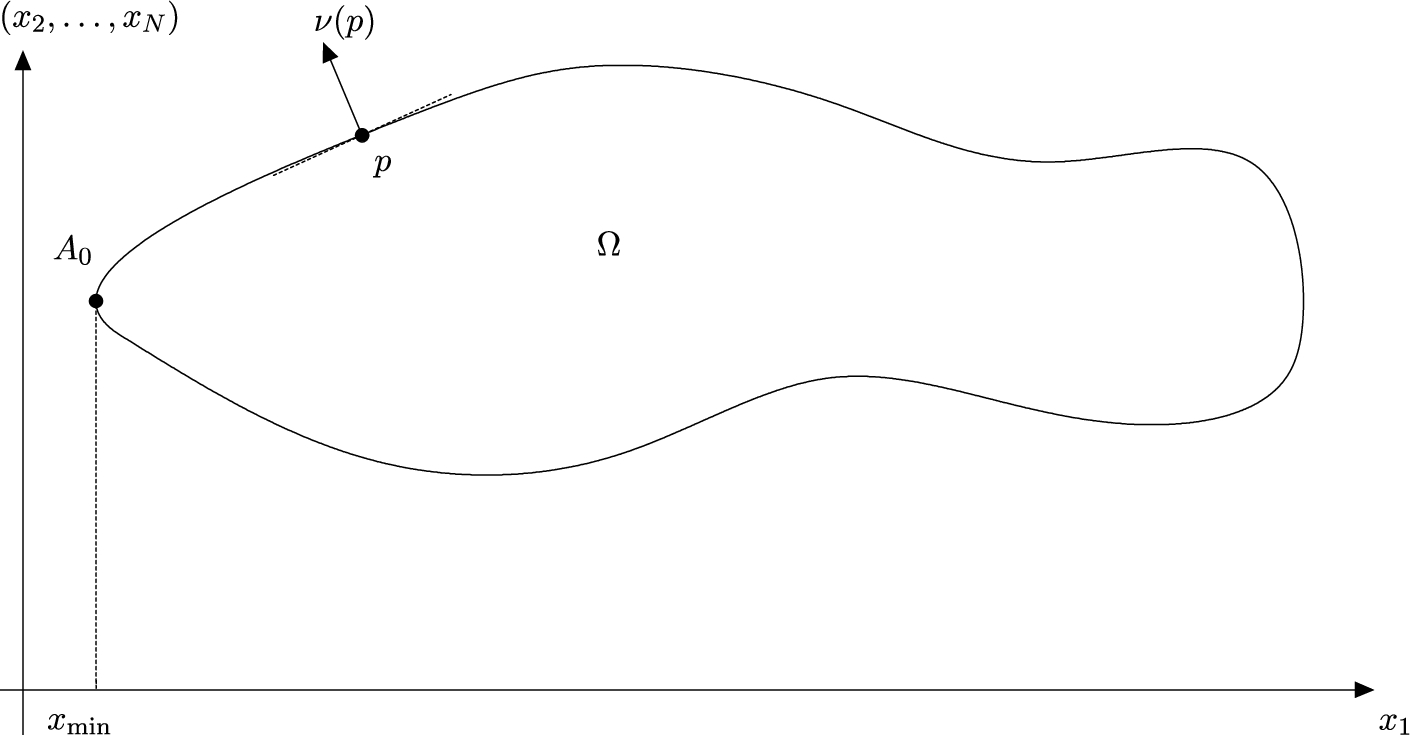
The domain Ω.
To be more precise, the operator
In [5], by constructing suitable test functions, and applying the min-max principle, the authors found a three-term asymptotic expansion of the low-lying eigenvalues. It is proved that, in
The aim of this paper is to improve the asymptotic expansion in (1.3) and to give asymptotic completeness of
From Section 7.2, the assumption on Ω induces that the matrix of The
The main result in this paper is:
For any positive n, there exists a real sequence
This result is essentially a generalization of that stated in (1.3), but the proof presented here, is based on the construction of quasimodes. The “optimality” of our constructions is then established thanks to decay estimates and the reduction to model operators involving a 1-dimensional Airy operator in The notation Since Theorem 1.1 is valid for all Our strategy can be adapted to deal with a finite number of non-degenerate minima, and it would even be possible to study the tunnel effects when these minima have symmetries. It is possible to prove asymptotic expansions of the low-lying eigenvalues of the Hamiltonian Firstly, we can show that the low energy eigenfunctions will be localized around Secondly, we can introduce local boundary coordinates in the neighborhood of Thanks to the Agmon estimates in coordinates We assume the following:
Under these conditions, our analysis can be adapted to get
This paper is organized as follows: In Section 2.1, we show that low energy eigenfunctions and their derivatives are exponentially localized around the potential minimum
Preliminaries
Concentration of bound states near the potential minimum
The following proposition states that the eigenfunctions associated with the low-lying eigenvalues are localized in
Let
For all
Let
Let
Since Ω is bounded then the set
As a consequence, for small h, the ground states of the operator
Let
Let
The inequality (2.10) follows from the fact that The inequality (2.9) follows from the Agmon estimates. Let
In this section, we introduce local coordinates in the neighborhood of
The coordinates and the metric
We fix
Let
This defines a diffeomorphism of

where
We conclude that
The operator in boundary coordinates
For
The operator
After a dilation and a translation of the s coordinates of the Section 3.1, we may assume that
Agmon estimates in tubular variables
The following proposition is a slight adaptation in coordinates
Let
The proof is a directly adaptation in coordinate
Let us consider the operator
Let
By shrinking the spectral window, we can even get a localization with respect to the s variable, as stated in the next proposition.
Let
We let First, we drop the tangential derivative:
This section aims to explain how the following proposition follows. For the proof, we will follow the same strategy as in [14]. For any positive n, there exists a sequence
We recall that
Formal expansion
We have the formal expansion of the operator
For
We have the following asymptotic expansions:
Then, we have
In this section, we construct trial states that will give with the lower bounds in Section 5, an accurate expansion of the eigenvalues of the operator
The functions
For all
∙ For the first equation, the natural choice is then to choose
∙ The second equation is equivalent to
∙ For the third equation, we can select
The iteration process. Here we suppose that we have to select
Notice that we have
End of the proof
Consider a smooth function
Lower bound
The following proposition provides a lower bound of the eigenvalue
For any positive n, the eigenvalue
Let
Let
We also have
From Section 7.1 and 7.2, we show that, for h small enough,
From Proposition 5.1, we have the following lower bound of
Imagine that, there exist
1. 
2. They differ modulo There exist There exist There exist
Now, if (6.1) is not satisfied:


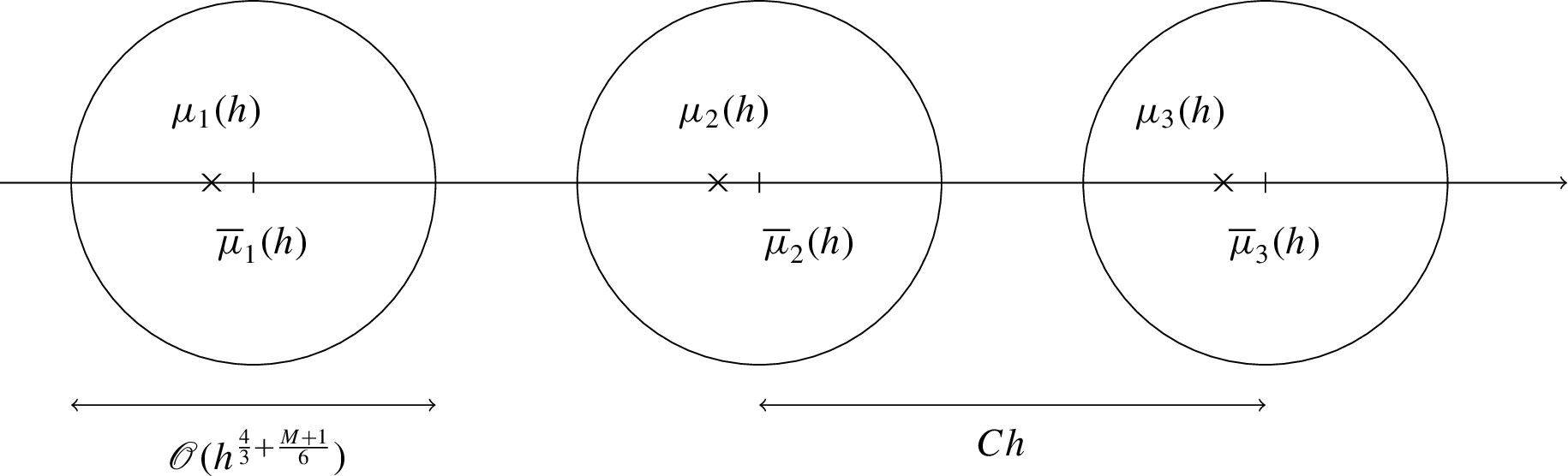
Thus, by (3.4) and Proposition 2.2, we have shown Theorem 1.1. □
The model operator
In this section, we want to study the spectrum of the operator defined by
We define a quadratic form on
Considering
Relation to the Weingarten map
We recall from Section 3.1, the coefficients of the first and second fundamental form, in the base
Thanks to (7.3), we obtain
Footnotes
Acknowledgement
I would like to express my deep gratitude to Nicolas RAYMOND for his patient guidance, enthusiastic, encouragement and useful critics of this research work. I would also like to thank Ayman KACHMAR for his reading. The author thanks also the Centre Henri Lebesgue, program ANR-11-LABX-0020-0 for their support.