In the present paper, we study the influence of oscillations of the time-dependent damping term on the asymptotic behavior of the energy for solutions to the Cauchy problem for a σ-evolution equation
where and b is a continuous and positive function. Mainly we consider damping terms that are perturbations of the scale invariant case , with , and we discuss the influence of oscillations of b on the energy estimates according to the size of β.
Let us consider the Cauchy problem
If for any , then the energy is given by
Although the energy is conserved for the classical wave equation with , oscillations of the time-dependent coefficient may have a deteriorating influence on the energy behavior of solutions, see [3] and [11]. On the other hand, if and
(so only very slow oscillations are allowed), then the so-called generalized energy conservation property holds [7,10]. This means, there exist positive constants and such that the inequalities
are valid for all , where the constants are independent of the data.
We address the interested reader to [1,6,7] for other results concerning (1).
Let us consider some known results for the following linear Cauchy problem to the wave equation with time-dependent dissipation:
where . We mention some statements about special classes of the models (2) and explanations about the influence of the dissipation term on asymptotic properties of the solutions.
If with a constant , that is, the scale-invariant case, in [14] the author obtained the decay estimates and showed that the parameter μ influences the decay rate. Therefore, this dissipation term is called critical.
Later, in [15] and [16], the author proposed a classification of the time-dependent dissipation : effective dissipation and non-effective dissipation. Assuming a suitable control on the oscillations of , namely,
he proved that the asymptotic profile of the solutions strongly changes according to this classification. If , it is easy to conclude the so-called generalized energy conservation (see [7])
for some positive constants , . Moreover, a scattering result to the free wave equation holds (see [15]). Else, if (see [15]) or in the case for (see [14]), the profile of the energy for the damped wave is given by
This latter case is called non-effective dissipation. If , the dissipation is called effective and the profile of the energy is similar to the one for the classical damped wave equation, namely,
exception given for the case . Indeed, in this latter case, an overdamping effect appears and the energy no longer decays for .
In the case of non-effective dissipation, the control on the oscillations of were weakened in the spirit of [7] to allow faster oscillations. More precisely, in [8] the authors assumed that , where is a monotonically decreasing shape function and carries the oscillations. The theory and stabilization condition were used with non-effective time-dependent dissipation. They proved that, under the so-called stabilization condition, namely, if there exists a suitable (uniquely determined) and a function such that
satisfying
with , together with the following compatibility condition between (4) and (5):
Then, has no influence on the decay rates. As far as we know, it is still an open problem to discuss about the necessity of such conditions.
Nowadays, it is well known that for some classes of wave equation with time-dependent dissipation, oscillations on the damping term b do not have any influence on the profile of the energy for solutions to (2). As far as we know, this effect was first observed in [17], where b assumed to be continuous, of bounded variation, periodic and almost everywhere positive. Recently in [13] the authors extended this conclusion to general dissipation terms satisfying without further assumptions on derivatives of b.
Now, let us consider some known results for the following linear Cauchy problem to the so-called structurally damped σ-evolution equation with time-dependent dissipation:
where and .
In the case , the authors in [5] introduced a classification distinguishing between effective damping and non-effective damping for the model of interest with and . In particular, in the effective damping case, the authors proved that the asymptotic profile of Sobolev solutions to (7) is the same as that to an anomalous diffusion equation under a suitable choice of data. This means there appears the diffusion phenomenon.
Recently, in [12] and [13] the authors studied the Cauchy problem (7) with considering low regularity in the coefficient . In other words, without further assumptions on derivatives the authors classified general dissipation term as non-effective dissipation and effective dissipation in [12] and [13], respectively. They derived decay estimates with for the solution and its first derivative in time to (7) employing the energy method in Fourier space and zones with energy multipliers. Precisely, they assume that there exist and such that for all , where . Under suitable assumptions on δ, σ and α, in [12] with and , they studied the non-effective dissipation, whereas in [13] with and , they studied the effective dissipation. One can see that here in both cases, in the same time and cannot be considered. This case implies to a perturbation of the scale-invariant case, which is a more delicate problem, because it is somehow a threshold between the effectiveness and the non-effectiveness. This is exactly the situation we want to examine in this paper.
Main purpose of the paper
In the present paper, we consider the following Cauchy problem for a linear σ-evolution equation with a time-dependent damping term :
The term , , stands for possibly non-integer powers of the Laplace operator. In the non-integer case, , for and its action is extended by density. Equations whose “principal part” is
like the plate equation which is attained for , are called σ-evolution equations in the sense of Petrowsky, since their symbols have only pure imaginary, distinct, roots for all . The set of 1-evolution operators coincides with the set of strictly hyperbolic operators. However, several properties of the hyperbolic operators are missing when .
The term represents a damping, a term whose action may dissipate the energy
Indeed, if then
Our purpose in this paper is to study the energy behavior of solutions to the Cauchy problem (8) depending on the properties of time-dependent coefficient , where is a shape function and is an oscillating function. To achieve this we use the energy method in the phase space (see [2,12] and [13]) and method of the zones similarly as considered in the diagonalization procedure (see [5,10,15] and [16]). This method allows us to have less regularity on b without further control on the oscillations. Since the case was considered in [13], our goal is to understand if oscillations on the time-dependent coefficient satisfying have any influence in the energy behavior of solutions to (8). We split our analysis in two cases. If , we may consider with arbitrary oscillations, but we have to assume . In this case the energy behavior of solutions to (8) is determined at high frequencies of the phase space and may be dependent of the damping term (see Theorem 1). If is a perturbation of the scale-invariant case satisfying , then no further control on the oscillations is required and the energy solution to (8) is determined at low frequencies of the phase space and is independent of the damping term (see Theorem 2). Finally, in Section 4.1, we consider the limit case , with .
In this paper, we use the following notations.
Let be two strictly positive functions. We use the notation if there exist two constants such that for all . If the inequality is one-sided, namely, if (resp. ) for all , then we write (resp. ).
Main results
Models with the behavior of energy solutions determined at high frequencies
We assume that the function b is positive, continuous and can be written as, whereis a shape function andis an oscillating function. These functions satisfy the following conditions:
,
,
,
,,and there existssuch thatis a non-decreasing function for any, withsufficiently large.
As a simple example we may take
It is clear that and
We stress that conditions (4)–(6) are not satisfied for some values of α and γ in Example 1. Indeed, let us consider first the stabilization condition (4) with and :
where we applied the change of variables with and used that . Moreover, we have
Choosing , we may see that the compatibility condition (6) with
does not hold if , since if . In other words, we have shown an example which is not in the class of [8].
Let,and let us assume Hypothesis
1
. Then, the energy solution to the Cauchy problem (
8
) satisfies the estimatewhereis defined in (
9
).
We consider
with if and satisfies Hypothesis 1. Then, Theorem 1 implies the following estimates of the energy:
A model with the behavior of energy solutions determined at low frequencies
In this section we are interested in damping terms satisfying and . For this reason, in the following we restrict ourselves to the case that is a perturbation of the scale invariant case with .
We assume that the function b is positive, continuous and can be written as, wherewill determine the shape of the coefficient, whilecontains oscillations. These two functions satisfy the following conditions:
,,
there existssuch thatandfor all.
Let,and let us assume Hypothesis
2
. Then, the energy solution to the Cauchy problem (
8
) satisfies the estimatewhereis defined in (
9
).
Conditions (B1) and (B2) imply that . In this case, the asymptotic behavior of the energy solution is mainly determined at low frequencies in the phase space and the decay rate is the same for all damping terms .
Let us consider
where , with . From Theorem 2 we conclude the same decay rate for the energy of solutions to (8) for a class of effective damping that does not satisfy the condition , assumed in [16] in order to apply the diagonalization procedure.
Proof of the main results
We perform the partial Fourier transformation with respect to the spatial variables to (8)
We define the pointwise energy to the solution of the Cauchy problem (10) as follows:
Due to the damping term we have
First we recall that if and , then the pointwise energy is bounded, in particular, for all . In the following, our goal is to prove that the energy of solutions may have a decay behavior.
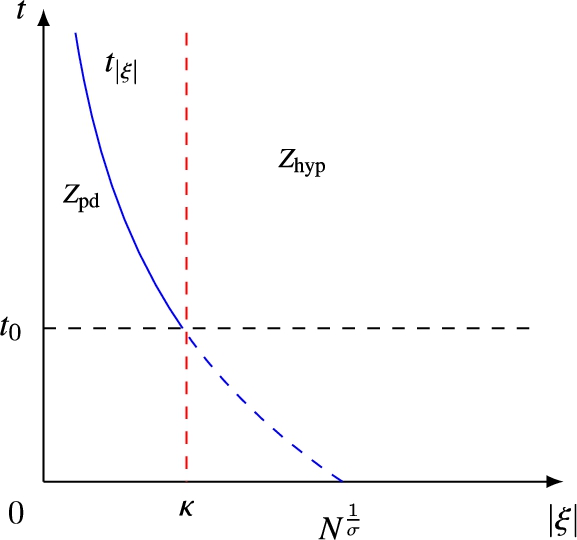
We define hyperbolic zone and pseudo differential zone respectively on the phase space as follows:
with the positive constants and N to be chosen later (see Fig. 1).
Sketch of the zones.
We define
where is the separating line between the zones is defined by
We assume Hypothesis
1
. Then, we have the following estimate in:whereis defined by (
11
) and S is given by (
12
).
Let us introduce
First, we multiply our equation (10) by and extract the real part as follows:
Using
we can rewrite the last statement as follows:
Then, we have
We may rewrite the last equality in the following way:
and by using (13), we have
If write the statement of explicitly on the right hand-side of the last equality, we get
Now we multiply (10) by , with the function to be chosen later, and extract the real part in the following way:
where . Here we can use
Here we have
Inserting (17) into (16), we find
Let us insert (18) into (15). This implies
Using in the last statement, we arrive at
By adding (14) and (19), we find
Let us choose , where μ satisfies condition (A4) in Hypothesis 1. Since we have,
Integrating the last inequality on we have
Thanks to condition (A3) for given , there exists such that for all . Hence, employing condition (A4), for sufficiently small we get
Therefore
where
Now, by using (A2)–(A3), for given , there exist and such that we may estimate
and
for all and . By conditions (A2)–(A4), we may estimate
for all and . Hence, we get
Therefore, we have
This implies
where S is defined in (12). Applying Gronwall’s inequality (cf. Lemma A.2) to (20), we get
Thus, since , we may conclude
where is defined in (13). □
Considerations in
We consider the micro-energy
Then, by (10) we obtain that satisfies the following system of first order:
Since we can estimate the pointwise energy in (11) by
and, on the other hand,
we have to prove a pointwise estimate for the fundamental solution to (21), i.e.
According to Lemma 8 in [15] and Lemma 3.9 in [18], we have to split our analysis in two cases, and , see Lemma 2 and Lemma 3, respectively. We present the proof of both Lemma in order to make the paper self-contained.
The exceptional case , with , for which , can be treated as in the case .
We introduce the following auxiliary functions that will be used to derive the estimates in .
Let be a positive real-valued function. We define
If , then
where C is a positive constant. Indeed, by hypothesis, for any given , there exists such that for all sufficiently large. Integration by parts yields
Then, we arrive at
which gives the desired estimate
thanks to be an increasing function for all .
Let us assume Hypothesis
1
. If, then it holds the following estimates of the energyinfor all:The same conclusion holds in the limit case.
We put
with and λ as in Definition 1, such that
Since , it remains to prove that the fundamental solution to (22), i.e.
is bounded. If we put , then we can write for the following integral equations:
with if and otherwise.
By replacing (24) into (23) we get
Thanks to Remark 3, the terms (I) and (II) in (25) are bounded. We consider the term (III) in (26), that is, integrating by parts,
Since λ is a decreasing function and using that in we get
The estimate of immediately follows from Lemma A.2 since
By the boundedness of and using again that λ is a decreasing function, we can estimate (24) by
We proved that is bounded, that is, , therefore
□
We assume that. This impliessuch thatMoreover,is monotonously decreasing for large.
The proof of this proposition may be found in Proposition 3.7 of [18].
We assumeand. Then, we have the following energy estimate in:
We are interested in the fundamental solution
to the system (21). Thus, the solution is represented as
Then, by direct calculations we get for
Plugging the representation for into the integral equation for gives
It follows
By setting and applying Gronwall’s inequality we get
where we used the definition of . Hence, we may conclude that . Now we consider . By using the estimate for we obtain
Plugging the representation for into the integral equation for gives
Then, we have
where we used Proposition 1. Then, applying Gronwall’s inequality from Lemma A.2 we get the estimate
where we used the definition of . Thus, we get . Finally, let us consider by using the estimate for . It holds
Then, we have
This shows that . This completes the proof. □
By using the Parseval–Plancherel theorem and the pointwise estimates of the partial Fourier transform of solutions in the Fourier space, the proof of Theorem 1 follows immediately from the following Corollary.
Under the assumption of Hypothesis
1
we have the following estimates of the energyinfor all:where S is given by (
12
) with sufficiently large. In, we have for allThen, for allwe arrive at
First, we recall that the pointwise energy is bounded for , i.e. for all . By Hypotheses of and , there exists sufficiently large such that
For the conclusion follows from the estimate in zone. For and for we use the estimate in zone, whereas for we have to glue the estimates in both zones, namely,
□
Under the assumption of Hypothesis
2
, we have the following estimate in:whereis defined in (
11
).
If we multiply both sides of (10) by , we get
If we integrate the equation (27) on , we arrive at
Let and define . Now we multiply both sides of (27) by . Then, we have for
Let us integrate (28) on . Then, we may write
where
We define the multiplier of the energy in as follows:
We get for the estimate
where due to condition (B2) we have used . The estimate for satisfies
for any and . Now, using the estimate
for , then we arrive at the following estimate for :
where we have the last estimate, because the energy is decreasing. Finally, we estimate as follows:
with . Therefore, using the derived estimates from to , we get
where with is sufficiently small. Consequently, we conclude
Then, applying Lemma A.1 we can get the following estimate:
for all , for any and . Here from conditions (B1)–(B2) we used that with . □
We may conclude the proof of Theorem 2 easily by Lemma 3 and Lemma 4 after using the Parseval–Plancherel theorem.
1. Case:
Then, the statement of Lemma 4 implies immediately
2. Case:
We may use Lemma 3 for , whereas the statements of Lemma 4 and Lemma 3 give immediately
This completes the proof of Theorem 2.
Concluding remarks
The limit case
For the sake of simplicity, let us consider the Cauchy problem (8) with
where
If we use the transformation
then solves the following Cauchy problem
Since , then the energy for solutions to (30) is bounded, see Theorem 2 in [4]. Therefore, if and , the energy solution to (29) satisfies
Footnotes
Acknowledgements
The authors thank Edson Cilos Vargas Júnior (UFSC), Cleverson Roberto da Luz (UFSC) and Michael Reissig (TU Freiberg) for theirs numerous hints and discussions in the preparation of the paper. The authors also would like to thank the referees for their careful reading of the paper and valuable comments.
Halit S. Aslan has been supported by Grant 2021/01743-3 from “Fundação de Amparo à Pesquisa do Estado de São Paulo (FAPESP)”. Marcelo R. Ebert is partially supported by Grant 2020/08276-9 from “FAPESP” and Grant 304408/2020-4 from “Conselho Nacional de Desenvolvimento Científico e Tecnológico (CNPq)”.
Appendix
The following lemma plays a fundamental role in order to prove our main theorems. The proof may be found in Lemma 2.1 of [12].
C.Boiti and R.Manfrin, On the asymptotic boundedness of the energy of solutions of the wave equation , Ann. Univ. Ferrara58 (2012), 251–289. doi:10.1007/s11565-012-0148-6.
2.
R.C.Charão, C.R.da Luz and R.Ikehata, Sharp decay rates for wave equations with a fractional damping via new method in the Fourier space, J. Math. Anal. Appl.408 (2013), 247–255. doi:10.1016/j.jmaa.2013.06.016.
3.
F.Colombini, Energy estimates at infinity for hyperbolic equations with oscillating coefficients, J. Differential Equations231(2) (2006), 598–610. doi:10.1016/j.jde.2006.05.014.
4.
M.D’Abbicco and M.R.Ebert, A class of dissipative wave equations with time-dependent speed and damping, J. Math. Anal. Appl.399 (2013), 255–278.
5.
M.D’Abbicco and M.R.Ebert, A classification of structural dissipations for evolution operators, Math. Methods Appl. Sci.39 (2016), 2558–2582. doi:10.1002/mma.3713.
6.
M.R.Ebert and M.Reissig, The influence of oscillations on global existence for a class of semi-linear wave equations, Math. Methods Appl. Sci.34 (2011), 1289–1307. doi:10.1002/mma.1430.
7.
F.Hirosawa, On the asymptotic behavior of the energy for the wave equation with time depending coefficients, Math. Ann.339(4) (2007), 819–838. doi:10.1007/s00208-007-0132-0.
8.
F.Hirosawa and J.Wirth, -theory of damped wave equations with stabilisation, J. Math. Anal. Appl.343(2) (2008), 1022–1035. doi:10.1016/j.jmaa.2008.02.024.
9.
B.G.Pachpatte, Inequalities for Differential and Integral Equations, Mathematics in Science and Engineering, Vol. 197, Academic Press, Inc., San Diego, CA, 1998.
10.
M.Reissig and J.Smith, estimate for wave equation with bounded time-dependent coefficient, Hokkaido Math. J.34(3) (2005), 541–586. doi:10.14492/hokmj/1285766286.
11.
M.Reissig and K.Yagdjian, About the influence of oscillations on Strichartz-type decay estimates, in: Partial Differential Operators (Torino, 2000), Rem. Sem. Mat. Univ. Politec. Torino, Vol. 58, 2000, pp. 375–388.
12.
E.C.Vargas Júnior and C.R.da Luz, σ-evolution models with low regular time-dependent non-effective structural damping, Asymptotic Analysis119 (2020), 61–86. doi:10.3233/ASY-191566.
13.
E.C.Vargas Júnior and C.R.da Luz, σ-evolution models with low regular time-dependent effective structural damping, J. Math. Anal. Appl.499(2) (2021), 125030. doi:10.1016/j.jmaa.2021.125030.
14.
J.Wirth, Solution representations for a wave equation with weak dissipation, Math. Methods Appl. Sci.27(1) (2004), 101–124. doi:10.1002/mma.446.
15.
J.Wirth, Wave equations with time-dependent dissipation I. Non-effective dissipation, J. Differential Equations222(2) (2006), 487–514. doi:10.1016/j.jde.2005.07.019.
16.
J.Wirth, Wave equations with time-dependent dissipation II. Effective dissipation, J. Differential Equations232(1) (2007), 74–103. doi:10.1016/j.jde.2006.06.004.
17.
J.Wirth, On the influence of time-periodic dissipation on energy and dispersive estimates, Hiroshima Math. J.38(3) (2008), 397–410. doi:10.32917/hmj/1233152777.
18.
J.Wirth, Asymptotic properties of solutions to wave equations with time-dependent dissipation, PhD thesis, TU Bergakademie Freiberg, 2004, 146 pp.