By bifurcation and topological methods, we study the existence/nonexistence and multiplicity of one-sign or nodal solutions of the following k-th mean curvature problem in Minkowski spacetime
As a previous step, we investigate the spectral structure of its linearized problem at zero. Moreover, we also obtain a priori bounds and the asymptotic behaviors of solutions with respect to λ.
It is well known that the Minkowski space is the space equipped with the metric
A hypersurface in the Minkowski space is said to be spacelike if its induced metric is a Riemannian one. Clearly, if a function u is defined over a subdomain Ω of (), then is a spacelike hypersurface in if and only if in Ω. The induced metric on is given by
where , (0) if (). The second fundamental form of is
where . The principal curvatures , …, of are the eigenvalues of matrix relative to matrix . The k-th mean curvature of is defined to be the k-th elementary symmetric function of the principal curvatures,
In particular, is the usual mean curvature, is the scalar curvature and is the Gauss–Kronecker curvature. So the k-th mean curvature equation can be regarded as an extension of the mean curvature equation and the Gauss curvature equation. The k-th mean curvature is also related to General Relativity. A spacelike hypersurface with given k-th mean curvature is a suitable subset of the spacetime where the initial value problems for the different field equations are naturally stated. Each k-th mean curvature function intuitively measures the time evolution towards the future or the past of the spatial universe.
For , Calabi [13] showed that for the equation has the Bernstein property that the only entire solutions are linear. This was later extended to all dimensions by Cheng–Yau [14]. Then, Treibergs [43] constructed and classified the entire solutions of the constant mean curvature spacelike hypersurface equation. An important universal existence result was proved by Bartnik–Simon [5]. Further, Bartnik [3] proved the existence of maximal surfaces in asymptotically flat spacetimes. The Dirichlet problem in a more general spacetime was solved by Gerhardt [29] and Bartnik [4]. Recently, there are more contributions, and the interest is many times focused on the existence and multiplicity of solutions, by using a combination of variational techniques, critical point theory, sub-supersolutions, topological degree and bifurcation (see, for example, [2,9–12,15–17,19,21,25] and the references therein).
When , Bayard [6,7] established the classical solvability of the Dirichlet problem with and the constant mean curvature, which was extended to higher dimensions by Urbas [44]. Later, Bayard–Delanoë [8] proved the existence and uniqueness of entire spacelike radial hypersurfaces contained in the future of the origin O and asymptotic to the light-cone. And Gerhardt [30] obtained the existence of closed hypersurfaces of prescribed scalar curvature in Lorentzian manifolds provided there are barriers.
The Gauss–Kronecker curvature has also been quite well studied. Here we highlight the work of Li [35] on spacelike hypersurfaces with constant Gauss–Kronecker curvature. And Delanoë [27] proved that there exists a unique smooth solution of the Dirichlet problem with a given Lorentz–Gauss curvature function defined on a bounded convex domain, which was extended to general (non-convex) domain by Guan [31]. Further, Guan, Jian and Schoen [32] studied the entire spacelike convex hypersurfaces of positive constant or prescribed Gauss curvature in Minkowski space . More recently, Huang, Jian and Su [33] proved an existence theorem for spacelike convex hypersurfaces of prescribed Gauss curvature in exterior domain.
However, little attention has been paid to hypersurfaces with prescribed k-th mean curvature with . In 2003, Urbas [45] derived interior curvature bounds for strictly spacelike hypersurfaces of prescribed k-th mean curvature in Minkowski space.
If with and u is radially symmetric, very recently, Fuente, Romero and Torres [28] have shown that
where with , , and is the combinatorial constant. Then, by the Schauder Point Fixed Theorem, under some suitable assumptions on , they proved the existence of rotationally symmetric solution of the associated Dirichlet problem. Furthermore, they showed that such graph can be extended to the whole space and may be unique.
To the best of our knowledge, there is no result on nonexistence or multiplicity spacelike hypersurfaces of prescribed k-th mean curvature in Minkowski space except the case of . It is clear that a good understanding of the nonexistence/existence and multiplicity of such surfaces is needed.
Motivated by the above interesting and important studies, in this paper we continue the investigations on the nonexistence/existence and multiplicity of one-sign or nodal solutions of the following problem
where λ is a nonnegative parameter which may indicate the strength of . It follows from that any spacelike solution v of problem (1.1) is uniformly bounded by R and . Hence, the image of v must lie in . So, from now on, we assume that is a real continuous function defined on . The solution of problem (1.1) is understood in the sense that and satisfies problem (1.1).
As a previous step, we investigate the spectral structure of the following eigenvalue problem
for any , which has its own interest. In [20, Lemma 4.5], we have shown that problem (1.2) possesses a principal eigenvalue . Here we further obtain the spectral structure as follows.
Problem (
1.2
) has a sequence of simple eigenvaluesand no other eigenvalue. Moreover, for each,is continuous with respect to p and any eigenfunctioncorresponding tohas exactlysimple zeros in.
When k is odd and , we can easily check that problem (1.2) is equivalent to
According to Theorem 1.1, problem (1.3) possesses a sequence of simple eigenvalues such that , , and any eigenfunction corresponding to has exactly simple zeros in .
When k is even, applying the results of [20, Lemmas 4.5–4.9] with , we know that problem (1.3) possesses a unique principal eigenvalue with a positive eigenfunction , which is minimal, simple and isolated. So, we can choose δ small enough such that there is no eigenvalue of problem (1.3) in .
Since problem (1.1) has only one-sign nontrivial solutions when k is even (see [28]), we study the existence and multiplicity of one-sign nontrivial solutions when k is even. While, we investigate the existence and multiplicity of nodal solutions when k is odd.
If k is odd (even) and uniformly in , we shall show that the necessary condition for being a bifurcation point of problem (1.1) is that for some () (see Sections 4–5). To realize our goal, the key is to show the sufficiency of being a bifurcation point for every (). It is well known that the index formula of an isolated zero (see [26, Theorem 8.10]) plays a key role in the applications of bifurcation theory. While, this index formula is only involving linear map which cannot be directly applied to problem (1.3). Naturally, we can think of using the invariance of the topological degree under a compact homotopy to obtain an index jumping result. Since k is an integer, it is difficult to obtain a compact homotopy via k, which is why we introduce problem (1.2).
Let
with the norm . Since , the norm is equivalent to the usual norm . Set and . Let denote the set of functions in which have exactly interior nodal (i.e. non-degenerate) zeros in and . It is clear that () and () are disjoint and open in X. Let under the product topology. Following [41], we add the point ∞ to our space .
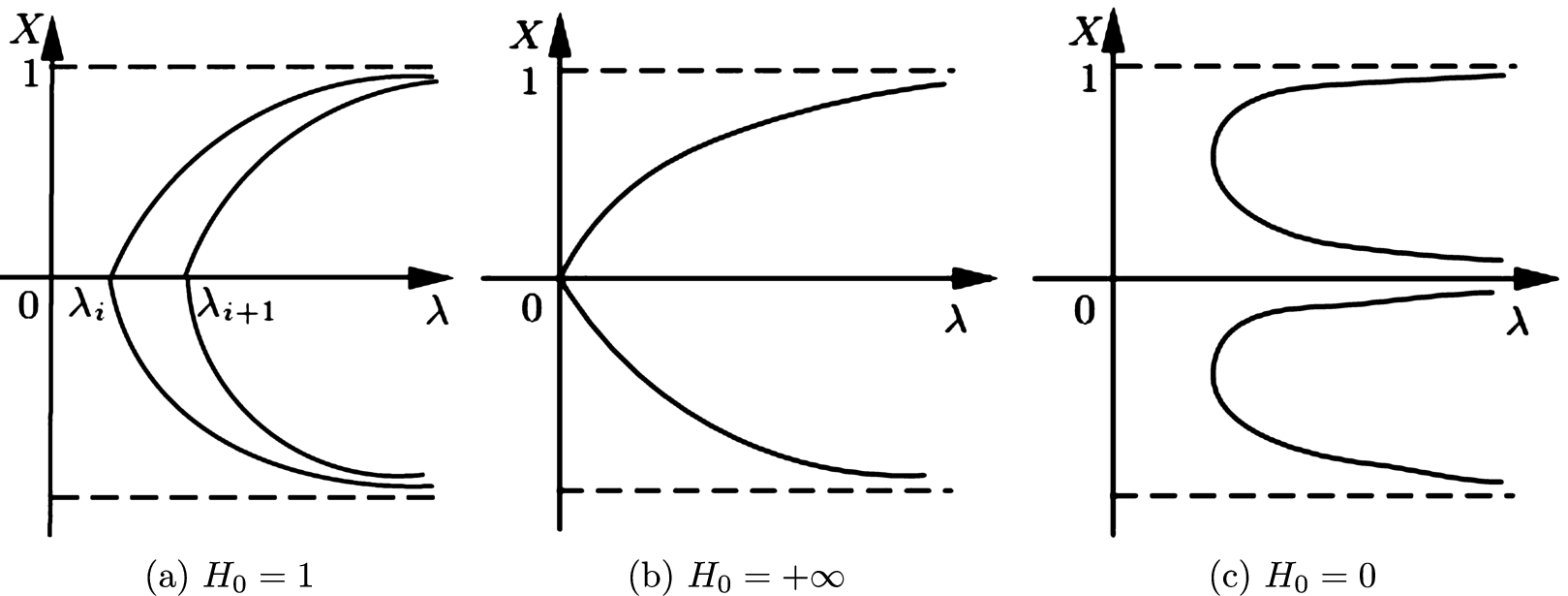
Then, we have the following three theorems, which are the main results of this paper. The first one is global bifurcation result for k being odd.
Let k be odd. Assume thatis continuous,for anyandand there existssuch thatuniformly in. For any,
if, there are two unbounded continua,and, of the set of nontrivial solutions of problem (
1.1
) bifurcating fromsuch that,,andfor, whereanddenotes the projection ofon,
if, there are two unbounded continua,and, of the set of nontrivial solutions of problem (
1.1
) emanating fromand joining tosuch thatandforwith, where,
if, there are two unbounded continua,and, of the set of nontrivial solutions of problem (
1.1
) such that, joinsto,andfor anywith.
The existence and multiplicity of nodal solutions of problem (1.1) can be easily seen from these bifurcation diagrams in Fig. 1. In particular, if , for , problem (1.1) possesses at least i pairs solutions with ; if , problem (1.1) has at least one pairs solutions ; if , there exits such that problem (1.1) possesses at least two pairs solutions with .
For , solutions obtained in Theorem 1.2 must change sign, which is different from the case of . So, it is very difficult to study the asymptotic behavior of solutions with respect to λ. We shall introduce some new techniques to overcome this difficulty. Theorem 1.1 extends the corresponding results of [17, Theorems 1.1–1.3] where only the case of and is considered. Up to the authors’ knowledge, Theorem 1.2 is the first result involving the existence of sign-changing spacelike hypersurfaces of prescribed k-th mean curvature in Minkowski space with .
When k is even, we have that
Let k be even. Assume thatfor any,, and there existssuch thatuniformly in. Then,
if, there are two unbounded continuaandof the set of nontrivial solutions of problem (
1.1
) bifurcating fromsuch that,,andfor,
if, there are two unbounded continuaandof the set of nontrivial solutions of problem (
1.1
) emanating fromsuch that, joins toandfor anywith,
if, there are two unbounded continuaandof the set of nontrivial solutions of problem (
1.1
) such that, joinstoandfor anywith.
Finally, we present a result concerning the nonexistence of one-sign solution.
Assume that there exists a positive constant ϱ such thatfor anyand. Then there existssuch that problem (
1.1
) has not one-sign solution for.
The outline of the rest of this article is as follows. In Section 2, we show the existence and uniqueness result for problem (1.1), give a priori bounds estimate of derivatives for any solution of problem (1.1) and two Whyburn type topological lemmas. The proof of Theorem 1.1 will be given in Section 3. The proof of Theorem 1.2 will be given in Section 4. In the last Section, we present the proofs of Theorems 1.3–1.4.
Preliminaries
Firstly, we have the following existence and uniqueness result for problem (1.1), which will be used later.
Assume that there exists a constantsuch thatfor anyand. For any solution v of problem (
1.1
) having a double zero, then.
Let v be a solution of problem (1.1) and be a double zero. If k is even, we must have
for any . Indeed, otherwise, we easily find that
for some , which is a contradiction. So, we have that
where denotes the inverse function of , () if k is odd (even). It is easy to show that
Hence, we have that
If , we have that
Hence, we have that
By the Gronwall–Bellman inequality [20, Lemma 2.1], we have that on .
Next, we assume that . We first consider . Reasoning as the above, we obtain that
It follows from the Gronwall–Bellman inequality [20, Lemma 2.2] that on . It follows that on . On the other hand, for , in the same manner, we have that
Again by the Gronwall–Bellman inequality [20, Lemma 2.1], we have that on . Therefore, we have that on . □
Clearly, if v is nonnegative, we only need that for any and . To prove our main results, we need the following global derivatives estimate.
For any solution v of problem (
1.1
) with any fixed λ, there exists a positive constantsuch that, where.
We assume that . If , the conclusion is done since . Next, we assume that . By Lemma 6.1 of [28], we know that . Integrating the first equation of problem (1.1) from 0 to ρ, we obtain that
It follows that
which implies that
Then, by some elementary calculations, we obtain that
Clearly, we can see that . The desired conclusion is immediately obtained by taking . □
Note that if v is nonnegative in Lemma 2.2, we only need that is continuous on , which is also valid for Theorems 1.2–1.3. We end this section by presenting two Whyburn type topological lemmas, which will be used to prove Theorems 1.2–1.3.
([18, Theorem 2.1]).
Let X be a normal space and letbe a sequence of unbounded connected subsets of X. Assume that:
Let , and be the real Banach space obtained by completing E under the following norm
From Proposition 4.3 [20], we know that the embedding of is continuous and compact, where with the norm
Since is separable, using Theorem 1.21 of [1], one has that is separable. Further, we have that is separable.
For any , define
Use to denote the dual space of . It is obvious that the functional Φ is continuously Gâteaux differentiable whose Gâteaux derivative at the point is the functional , given by
for any , where denotes the pairing between and . Firstly, we have the following properties about the operator .
Let. Then, we have that
is a continuous and strictly monotone operator;
ifinand, thenin.
(i) Let in , i.e. . For any , by using of the Hölder inequality, we have that
where . It follows that L is a continuous operator. The monotonicity of L can be easily derived from the following inequalities (see [34,36])
where .
(ii) From (i), if and , then we have that
It follows that converges in measure to in . Further, by Riesz’s Theorem, we get a subsequence (which we still denote by ) satisfying , a.e. . Applying the Lebesgue Dominated Convergence Theorem, we find that
From (3.1) it follows that the integrals of the functions family possess absolutely equi-continuity on (see [37, Chapter 6, Section 3]). Since
the integrals of the family are also absolutely equi-continuous on . By the Vitali convergence theorem, we obtain that
Therefore, in . □
Then, by the Ljusternik–Schnirelmann theory, we can show the existence of a sequence eigenvalues of problem (1.2) as follows.
The eigenvalue problem (
1.2
) has a sequence of eigenvaluesMoreover, one has that.
Set . It is obvious that is a closed symmetric -submanifold of with , and is even, bounded from below. It follows from the Lagrange multiplier rule that is a critical point of Φ if and only if
Taking , we see that the Lagrange multiplier λ equals the corresponding critical value and the eigenvalues of problem (1.2) are precisely the critical values of the functional on .
Now, we check that Φ satisfies the Palais–Smale condition at any level set . Suppose that , and . For any constant , we have that
Since , is bounded. Without loss of generality, we may assume that in . Then, one has that . Hence, we find that
By Proposition 3.1, we conclude that .
Define
where is the genus of K. We claim that for any . Set . Assume that be the standard orthogonal basis of and let . Clearly, and is a bounded and symmetric neighbourhood of . According to (f) of [42, Proposition 2.3], we have that . Since is symmetric and compact, we have that , which verified the desired claim.
Applying Corollary 4.1 of [42], we obtain that problem (1.2) possesses a sequence of positive eigenvalues
with
For , taking , we have that
which is just the desired conclusion. □
From [20, Lemma 4.5], we know that . For the consistency of symbols, from now on, we write as . Let S denote the unit sphere of . From Proposition 3.2, we see that
In particular, we have that
By [20, Lemmas 4.5–4.9], we know that is simple, isolated, continuous with respect to p and the unique positive principal eigenvalue. Further, Corollary 4.1 of [42] implies that .
We write to denote that λ is depending on some interval J. Any connected component of is called a nodal domain of v. To prove Theorem 1.1, we first show the following technical lemma.
The restriction of a nontrivial solution v of problem (
1.2
), on a nodal domain ω, is an eigenfunction of problem (
1.2
) on ω. And we have.
verifies the strict monotonicity property with respect to the domain I, i.e, if J is a strict subinterval of I with nonzero measure, then.
(i) Without loss of generality, we assume that . Clearly, v satisfies the following problem
where if and if . By arguments similar to those of Proposition 3.2 and [20, Lemmas 4.5–4.9] with obvious changes, we can show that problem (3.3) has a unique positive, simple, isolated, minimal principal eigenvalue which is continuous with respect to p. Define
which is called the extension by zero of v on I. It is obvious that . Multiplying (3.3) by , we reach that
It follows that the restriction of v on ω is a (weak) solution of problem (3.3) with constant sign. Thus, we have that .
(ii) Let be an eigenfunction corresponding to with . Then, we see that
Define as that of . Since vanishes in , it cannot be an eigenfunction corresponding to the principal eigenvalue . Then, we obtain that
So, is strictly decreasing with respect to the domain I. □
Let . From [20], we know that any eigenfunction corresponding to is classical solution of problem (1.2). On the basis of Lemma 3.1, we next show that any eigenfunction corresponding to has a unique zero in I.
For any eigenfunction v corresponding to, there exists a unique real numbersuch that.
By [20, Lemma 4.5], v must change its sign. By Lemma 4.1 of [20], we have that and v has a finite number of zeros in . Without loss of generality, we assume that be the first zero and be the last zero.
It is enough to show that . By contradiction, we assume that . Choose and put , , , . Clearly, strictly for . From the argument of Lemma 3.1, we see that the strict monotonicity property of with the domain is also valid for problem (3.3). So, using Lemma 3.1, we obtain that
and
For , let be an eigenfunction corresponding to . By Proposition 3.2 and the argument of Lemma 3.1, we see that
Let be the extension by zero of on I, . Consider the two dimensional subspace and set . For , obviously, there exist α, such that and . By (3.2) and (3.4)–(3.6), we have that
for some constants and with , which is a contradiction. Therefore, every eigenfunction corresponding to has one and only one zero in , which is denoted by .
Let w be another eigenfunction corresponding to . Let d be the unique zero in . It suffices to show that . Suppose, on the contrary, that . Without loss of generality, we assume that . By Lemma 3.1, we have that
which is absurd. □
Further, we can show that is simple, isolated and strictly decreasing with respect to the domain I.
is simple and. Moreover,verifies the strict monotonicity property with respect to the domain I.
Let u and v be any two eigenfunctions corresponding to . Lemma 3.1 shows that the restrictions of u and v on are eigenfunctions corresponding to . So, we have on for some constant . Similarly, we have on for some constant . It follows that
By Lemma 4.1 of [20], we have that . So, we must have , that is to say is simple. If , we have that for some constant , which contradicts Corollary 4.1 of [42]. Therefore, we must have .
Let be a strict subinterval of I. Analogously to that of Lemma 3.2, we can show that any eigenfunctions corresponding to has a unique zero in J, which is denoted by . If , we must have that is a strict subinterval of . Note that the conclusions of Lemma 3.1 are also valid for problem (3.3). By Lemma 3.1, we have that
If , without loss of generality, letting and using Lemma 3.1, we reach that
Therefore, is strictly monotonous with respect to the domain I. □
Moreover, we shall show that problem (1.2) has no other eigenvalue except such that the corresponding functions have exactly one zero.
If any eigenfunction u corresponding to some positive eigenvalueis such thatfor some real number c, then.
If , we have that . If , without loss of generality, assume that . [20, Lemma 4.5] implies . Then, it follows from Lemma 3.1 that
which is a contradiction. □
For with , we can use a recurrence argument. For any and with , we assume that the following conclusions hold:
For any eigenfunction v corresponding to the i-th eigenvalue , there exists a unique , , such that .
is simple such that .
verifies the strict monotonicity property with respect to the domain I.
If is a solution of problem (1.2) such that , then .
Then, we shall show that the above conclusions are also valid for .
For any eigenfunction v corresponding to, there exists a unique familysuch that.
Let v be an eigenfunction corresponding to . By (A1), (A2) and (A4), v has at least n zeros. By Lemma 4.1 of [20], we know that v has a finite number of zeros in and the first zero is positive. Let c be the last zero of v in . Then, we consider the nodal domains , , …, and . Clearly, the restrictions of u on , , has i zeros. Then, by (A4), we have that .
We claim that . Otherwise, . Choose d in and set , . Then is a strict subinterval of and is a strict subinterval of . It follows from (A3) that
and
Let be an eigenfunction corresponding to and be an eigenfunction corresponding to . Denote by the restrictions of on for and the extensions of on I for . Letting and , by an argument similar to that of Lemma 3.2 with obvious changes, we can derive a contradiction.
Let w be any eigenfunction corresponding to . Denote by , , …, the zeros of w. If , then , an absurd. Hence, one has . Similarly, we can check that for all . □
By an argument similar to that of Lemma 3.3 and in view of our assumptions, it is not difficult to establish the following lemma.
is simple such thatand verifies the strict monotonicity property with respect to the domain I.
It is sufficient to prove that for all . If , without loss of generality, assuming , by Lemma 3.1, (A3) and (A4), we obtain that
which is a contradiction. □
In view of Lemmas 3.1–3.7, it is enough to show that () is continuous with respect to p. From Lemma 3.1, we have that . It follows from Lemma 4.8 of [20] that is continuous with respect to p. Therefore, is continuous with respect to p. □
We first give a Sturm-type comparison result, which will be used later.
Letforwithand,. Also letbe solution of the following equationsrespectively, wheresatisfies,and. Ifin, then either there existssuch that, orandonfor some constant.
If in , without loss of generality, we assume that , in . By the Picone–Hessian identity (see [20]), we obtain that
The left-hand side of (4.1) equals
Let
As that of [20, Lemma 2.3], we can show that . Since in , and , one has that and . It follows that . Then, reasoning as that of [20, Lemma 2.3], we can obtain that and on for some constant . □
Then, for any α, with , we consider the following eigenvalue problem
We shall use the following Krein–Rutman theorem to obtain a principal eigenvalue of problem (4.2).
Letbe a Banach space and K be a closed cone in E with a vertex at 0. Letbe a compact operator such thatfor all; then there exists an unbounded, connected componentofof solutionsand starting from.
Then, we have that
Problem (
4.2
) possesses a principal eigenvaluewith a positive eigenfunction.
Let and . Define
for any . Then, it is not difficult to check that problem (4.2) is equivalent to and is compact such that for all .
Taking , we claim that there exists such that . Suppose, by contradiction, that for all . Letting , we have that , which is a contradiction.
For any , consider . Applying Proposition 4.1, we obtain a component of the solution to . For any , we have that
Acting on the both sides of the above inequality, we have that
Since , we obtain that
By recurrence, we find that
It follows that . So, is unbounded in the direction of K. In particular, there exists such that . By the compact of , up to a subsequence, we find and with such that . Clearly, and is positive in . □
For any and k being odd, define
From the construct of (see [28]), we know that is completely continuous. It is not difficult to check that v is a solution of problem (1.1) if and only if v is a fixed point of .
(a) Since , one has that in . For any , we have that
Then, by the Implicit Function Theorem, the necessary condition for being a bifurcation point of problem (1.1) is that
By Theorem 1.1, for some .
Obviously, is a completely continuous vector field. So, the Leray–Schauder degree is well defined for arbitrary ρ-ball and for any . For any , define
By the Arzelè-Ascoli Theorem, it is not difficult to check that is completely continuous. Clearly, the equation is equivalent to problem (1.2). Then, by an argument similar to that of [23, Lemma 3.2] and in view of Theorem 1.1, we can obtain the following index formula
In particular, taking , we have that
Letting for any , we have that
uniformly in . Then, problem (1.1) is equivalent to
For any , we consider the following problem
Obviously, problem (4.3) is equivalent to
Clearly, is completely continuous.
Let
Then, we have that is nondecreasing with respect to v and
Further, it follows from (4.4) that
uniformly in .
We claim that the Leray–Schauder degree is well defined for and ρ small enough. Suppose, on the contrary, that there exists a sequence such that and as . Letting , we have that satisfies
From the compactness of , up to a subsequence, we have that in X as . Letting in the above equality, using (4.5) and the continuity of , we obtain that
It follows that
Clearly, one has that . So, λ is an eigenvalue of problem (1.3), which is absurd. By the invariance of the degree under homotopies, we find that
Furthermore, for any , we consider
Then, clearly, one has that and . Obviously, is completely continuous. Reasoning as the above, we can show that the Leray–Schauder degree is well defined for and ρ small enough. So, using the invariance of the degree under compact homotopies, we obtain that
By Lemma 2.2, we know that if is a nontrivial solution of (1.1) with any fixed , . So, applying Proposition 2.1 of [24] with for each , there exists a maximum continuum of nontrivial solutions of problem (1.1) bifurcating from which satisfies at least one of the following three properties:
is unbounded in ,
meets ,
.
By virtue of Lemma 2.2, the case (ii) does not occur. Similarly as Lemma 1.24 of [40], we can show that if and is near , then with for α near . Thus, there exists an open neighborhood of such that
Furthermore, we claim that cannot touch . Otherwise, there exists such that is the limit of in . Hence, v has a double zero in . In view of and our signum condition, we can see that there exists a constant such that for any and . It follows from Lemma 2.1 that . Thus, , which is a contradiction. Therefore, we have that . Clearly, if (iii) happens, will touch , which is absurd. So, (iii) is also impossible. So, is unbounded in . Since is the only solution of problem (1.1) for and 0 is not an eigenvalue of problem (1.2), we have that . It follows that and for any with .
Finally, we show the asymptotic behavior of with respect to λ. We suppose, by contradiction, that there exist a constant and with as such that for any .
Let
denote the zeros of in . For convenience, let and . Up to a subsequence, we have that
for some . Note that and
as . It follows that there exists such that
Without loss of generality, assume that in . Clearly, there exists such that .
Integrating the first equation of problem (1.1) from to any , we have that
Clearly, is an odd and increasing diffeomorphism. The signum condition on implies in . Analogously, we also have that on .
For any fixed , (4.7) implies that there exists such that
for any . Letting and , we must have that either (i) or (ii) .
We first consider the latter case. Taking a subsequence if necessary, we have for some . It follows that
So, we can choose α, with . Hence, there exists with such that
for any .
We expand the left term of the first equation of problem (1.1) as the following
where we used the fact of
Further, by some elementary calculations, we have that
It follows that
Since is positive and decreasing in α, β, we have that
The signum condition on combining implies that there exists a positive constant such that
for any and . Thus, we obtain that
Taking n large enough such that and applying Lemma 4.1 on and , we conclude that changes its sign, which contradicts the fact of on .
Now, we consider the former case. Clearly, we have that
Then, choose α, β, with . Clearly, we have that
for n large enough.
For any , from the first equation of problem (1.1), we get that
It follows that
Furthermore, for any , noting k being odd, we have that
As that of (4.9), we see that there exist two constants ρ, such that
for any and . For some calculations, in view of , we find that
where
Hence, is concave on . It follows that
for any . Clearly, for and n large enough, one has that
Then, some simple estimates give that
For n large sufficiently, we have that
So, we obtain that
Let denote the first eigenvalue of the following problem
Reasoning as that of Lemma 3.1, we can check that is strictly decreasing with respect to the domain . This implies that , where is the first eigenvalue of the following problem
Let be a positive eigenfunction corresponding to . Multiplying equation (4.10) by , we obtain after integrations by parts that
Therefore, we obtain that
which is impossible because as .
To obtain another component, we consider the following auxiliary problem
It is not difficult to verify that satisfies the same assumptions as . The previous argument shows that an unbounded continuum bifurcates from , such that , , for any with and meets . Letting , clearly, is a nontrivial solution component of problem (1.1) emanating from , which satisfies the desired conclusions.
(b) For any , define
Clearly, we have that and . Consider the following approximation problem
By (a), for each and , there exists a sequence unbounded continua of the set of nontrivial solutions of problem (4.11) emanating from and joining to the point such that
Taking , clearly, one has that . The compactness of implies that is pre-compact, where for any . By Lemma 2.3, is unbounded and connected such that and .
From the definition of superior limit (see [46]) and the continuity of , it is not difficult to see that v is a solution of problem (1.1) for any . Obviously, for any . By the definition of inferior limit (see [46]) and the fact of , we can derive that . Therefore, by Lemma 2.1 and the definition of superior limit, we have that for any . It follows from Lemma 2.2 that for any with .
(c) For any , define
Then, we consider the following approximation problem
Obviously, we have that and
It follows from the conclusion of (a) that there exists a sequence unbounded continua of nontrivial solutions set of problem (4.12) in emanating from for any and joining to .
Taking , clearly, we have that . We claim that . It suffices to show that the projection of on is nonempty. From (a), we have known that has unbounded projection on for any fixed . By Proposition 2.3 of [17], for each fixed there exists an m such that for every , . It follows that
It implies that . So the projection of is nonempty on . The compactness of implies that is pre-compact.
Applying Lemma 2.4, we obtain that is connected. Applying the argument in the proof of (b), we can show that , is a solution of problem (1.1) and for any with . □
If k is even, we always assume that for any and . For any and k being even, we define
According to the construct of (see [28]), we see that is completely continuous. It is easy to see that v is a solution of problem (1.1) if and only if v is a fixed point of .
(a) As that of Theorem 1.2(a), if is a bifurcation point of one-sign solutions of problem (1.1), one have that . Define
Reasoning as that of [20, Lemma 5.2] with obvious changes, we obtain that
where is arbitrary ρ-ball of . Let for any . Then, we define
Modifying the proof of Theorem 1.2(a) with small changes, we obtain that
Applying Proposition 2.1 of [24] with , there exists a continuum of nontrivial solution of problem (1.1) bifurcating from which satisfies one of the following three properties:
is unbounded in ,
meets ,
.
In view of Lemmas 2.1–2.2, by a similar argument as Theorem 1.2(a), we can show that is unbounded in and .
From equation (4.8), we have that
Noting that
like that of Theorem 1.2(a), we can obtain the desire asymptotic behavior of v with respect to λ.
(b) For any , define
and consider the following approximation problem
Then, using an argument similar to that of Theorem 1.2(b), we can derive the desired conclusion.
(c) For any , define
Consider the following problem
Applying the argument as the proof of Theorem 1.2(c), we can obtain the desired conclusion. □
Suppose that v is an one-sign solution of problem (1.1) with some . If k is odd, multiplying the first equation of problem (1.1) by v, in view of Lemma 2.2, we obtain after integrations by parts that
which follows that .
On the other hand, when k is even, we claim that for any . Otherwise, we get that
for some , which is impossible. Thus, we have that
It follows that v and have the opposite signs. If v is positive, reasoning as the odd case, we can show that
which implies that . While, if v is negative, analogously, we have that
which still shows that . □
Footnotes
Acknowledgement
Research supported by NNSF of China (No. 12031015, 12371110) and National Key R&D Program of China (2022YFA1005601).
A.Azzollini, Ground state solution for a problem with mean curvature operator in Minkowski space, J. Funct. Anal.266 (2014), 2086–2095. doi:10.1016/j.jfa.2013.10.002.
3.
R.Bartnik, Existence of maximal surfaces in asymptotically flat spacetimes, Comm. Math. Phys.94 (1984), 155–175. doi:10.1007/BF01209300.
R.Bartnik and L.Simon, Spacelike hypersurfaces with prescribed boundary values and mean curvature, Comm. Math. Phys.87 (1982), 131–152. doi:10.1007/BF01211061.
6.
P.Bayard, Problème de Dirichlet pour la courbure scalaire dans , C.R. Acad. Sci. Paris Sér. I Math.332 (2001), 219–222. doi:10.1016/S0764-4442(00)01807-3.
7.
P.Bayard, Dirichlet problem for spacelike hypersurfaces with prescribed scalar curvature in , Calc. Var. Partial Differential Equations18 (2003), 1–30. doi:10.1007/s00526-002-0178-5.
8.
P.Bayard and F.Delanoë, Entire spacelike radial graphs in the Minkowski space, asymptotic to the light-cone, with prescribed scalar curvature, Ann. Inst. H. Poincaré Anal. Non Linéaire26 (2009), 903–915. doi:10.1016/j.anihpc.2008.03.008.
9.
C.Bereanu, P.Jebelean and J.Mawhin, Radial solutions for some nonlinear problems involving mean curvature operators in Euclidean and Minkowski spaces, Proc. Amer. Math. Soc.137 (2009), 161–169. doi:10.1090/S0002-9939-08-09612-3.
10.
C.Bereanu, P.Jebelean and J.Mawhin, The Dirichlet problem with mean curvature operator in Minkowski space-a variational approach, Adv. Nonlinear Stud.14 (2014), 315–326. doi:10.1515/ans-2014-0204.
11.
C.Bereanu, P.Jebelean and P.J.Torres, Positive radial solutions for Dirichlet problems with mean curvature operators in Minkowski space, J. Funct. Anal.264 (2013), 270–287. doi:10.1016/j.jfa.2012.10.010.
12.
C.Bereanu, P.Jebelean and P.J.Torres, Multiple positive radial solutions for a Dirichlet problem involving the mean curvature operator in Minkowski space, J. Funct. Anal.265 (2013), 644–659. doi:10.1016/j.jfa.2013.04.006.
13.
E.Calabi, Examples of Berstein problems for some nonlinear equations, in: Proc. Sym. Global Analysis, Berkeley, Univ. of Calif., 1968.
14.
S.-Y.Cheng and S.-T.Yau, Maximal spacelike hypersurfaces in the Lorentz–Minkowski spaces, Ann. of Math.104 (1976), 407–419. doi:10.2307/1970963.
15.
C.Corsato, F.Obersnel, P.Omari and S.Rivetti, Positive solutions of the Dirichlet problem for the prescribed mean curvature equation in Minkowski space, J. Math. Anal. Appl.405 (2013), 227–239. doi:10.1016/j.jmaa.2013.04.003.
16.
C.Corsato, F.Obersnel, P.Omari and S.Rivetti, On the lower and upper solution method for the prescribed mean curvature equation in Minkowski space, Discrete Contin. Dyn. Syst.Special Issue (2013), 159–168.
17.
G.Dai, Bifurcation and positive solutions for problem with mean curvature operator in Minkowski space, Calc. Var. Partial Differential Equations55 (2016), 72. doi:10.1007/s00526-016-1012-9.
18.
G.Dai, Two Whyburn type topological theorems and its applications to Monge–Ampère equations, Calc. Var. Partial Differential Equations55 (2016), 97. doi:10.1007/s00526-016-1029-0.
19.
G.Dai, Global bifurcation for problem with mean curvature operator on general domain, NoDEA Nonlinear Differential Equations Appl.24 (2017), 30. doi:10.1007/s00030-017-0454-x.
20.
G.Dai, Bifurcation and admissible solutions for the Hessian equation, J. Funct. Anal.273 (2017), 3200–3240. doi:10.1016/j.jfa.2017.08.001.
21.
G.Dai, Bifurcation and nonnegative solutions for problem with mean curvature operator on general domain, Indiana Univ. Math. J.67 (2018), 2103–2121. doi:10.1512/iumj.2018.67.7546.
22.
G.Dai, Generalized limit theorem and bifurcation for problems with Pucci’s operator, Topol. Methods Nonlinear Anal.56 (2020), 229–261.
23.
G.Dai, X.Han and R.Ma, Unilateral global bifurcation and nodal solutions for the p-Laplacian with sign-changing weight, Complex Var. Elliptic Equ.59 (2014), 847–862. doi:10.1080/17476933.2013.791686.
24.
G.Dai, A.Romero and P.J.Torres, Global bifurcation of solutions of the mean curvature spacelike equation in certain Friedmann–Lemaître–Robertson–Walker spacetimes, J. Differential Equations264 (2018), 7242–7269. doi:10.1016/j.jde.2018.02.014.
25.
G.Dai and J.Wang, Nodal solutions to problem with mean curvature operator in Minkowski space, Differential Integral Equations30 (2017), 463–480. doi:10.57262/die/1489802422.
F.Delanoë, The Dirichlet problem for an equation of given Lorentz–Gauss curvature, Ukrainian Math. J.42 (1990), 1538–1545. doi:10.1007/BF01060827.
28.
D.Fuente, A.Romero and P.J.Torres, Existence and extendibility of rotationally symmetric graphs with a prescribed higher mean curvature function in Euclidean and Minkowski spaces, J. Math. Anal. Appl.446 (2017), 1046–1059. doi:10.1016/j.jmaa.2016.09.022.
C.Gerhardt, Hypersurfaces of prescribed scalar curvature in Lorentzian manifolds, J. Reine Angew. Math.554 (2003), 157–199.
31.
B.Guan, The Dirichlet problem for Monge–Ampère equations in non-convex domains and spacelike hypersurfaces of constant Gauss curvature, Trans. Amer. Math. Soc.350 (1998), 4955–4971. doi:10.1090/S0002-9947-98-02079-0.
32.
B.Guan, H.Y.Jian and R.M.Schoen, Entire spacelike hypersurfaces of prescribed Gauss curvature in Minkowski space, J. Reine Angew. Math.595 (2006), 167–188.
33.
Y.Huang, H.Y.Jian and N.Su, Spacelike hypersurfaces of prescribed Gauss–Kronecker curvature in exterior domains, Acta Math. Sin. (Engl. Ser.)25 (2009), 491–502. doi:10.1007/s10114-008-6010-1.
34.
S.Kichenassamy and L.Veron, Singular solutions of the p-Laplace equation, Math. Ann.275 (1985), 599–615. doi:10.1007/BF01459140.
35.
A.M.Li, Spacelike hypersurfaces with constant Gauss–Kronecker curvature in the Minkowski space, Arch. Math.64 (1995), 534–551. doi:10.1007/BF01195136.
36.
P.Lindqvist, Univ. Jyväskylä, Report 161, in: Notes on the p-Laplace Equation, 2nd edn, 2017.
37.
I.P.Natanson, Theory of Functions of a Real Variable, Nauka, Moscow, 1950.
38.
A.Quaas, Existence of positive solutions to a “semilinear” equation involving the Pucci’s operator in a convex domain, Differential Integral Equations17 (2004), 481–494.
39.
P.Rabinowitz, Théorie du degré topologique et applications à des problèmes aux limites non linéares, Lectures Notes Lab. Analyse Numérique Universite PARISVI (1975).
40.
P.H.Rabinowitz, Some global results for nonlinear eigenvalue problems, J. Funct. Anal.7 (1971), 487–513. doi:10.1016/0022-1236(71)90030-9.
41.
P.H.Rabinowitz, On bifurcation from infinity, J. Funct. Anal.14 (1973), 462–475. doi:10.1016/0022-1236(73)90051-7.
42.
A.Szulkin, Ljusternik–Schnirelmann theory on -manifolds, Ann. I. H. Poincaré, Anal. non linéaire5 (1988), 119–139. doi:10.1016/s0294-1449(16)30348-1.
43.
A.E.Treibergs, Entire spacelike hypersurfaces of constant mean curvature in Minkowski space, Invent. Math.66 (1982), 39–56. doi:10.1007/BF01404755.
44.
J.Urbas, The Dirichlet problem for the equation of prescribed scalar curvature in Minkowski space, Calc. Var. Partial Differential Equations18 (2003), 307–316. doi:10.1007/s00526-003-0206-0.
45.
J.Urbas, Interior curvature bounds for spacelike hypersurfaces of prescribed k-th mean curvature, Comm. Anal. Geom.11 (2003), 235–261. doi:10.4310/CAG.2003.v11.n2.a4.
46.
G.T.Whyburn, Topological Analysis, Princeton University Press, Princeton, 1958.