Ground state of the energy-critical Gross–Pitaevskii equation with a harmonic potential can be constructed variationally. It exists in a finite interval of the eigenvalue parameter. The supremum norm of the ground state vanishes at one end of this interval and diverges to infinity at the other end. We explore the shooting method in the limit of large norm to prove that the ground state is pointwise close to the Aubin–Talenti solution of the energy-critical wave equation in near field and to the confluent hypergeometric function in far field. The shooting method gives the precise dependence of the eigenvalue parameter versus the supremum norm.
We consider the stationary Gross–Pitaevskii equation with a harmonic potential,
where , , and . Existence of its ground state (a positive and radially decreasing solution) has been addressed by using variational methods in the energy subcritical [12,19] and critical [25,26] cases, where the critical exponent is if . Uniqueness of the ground state was proven in the energy subcritical [16,17] and critical [28] cases.
Variational methods are not applicable in the energy supercritical case if for which a more efficient shooting method was developed in our previous work [3,22] (see also [9] for study of the Schrödinger–Newton–Hooke model). The shooting method is based on the reformulation of the existence problem after the Emden–Fowler transformation [10,18] and construction of two analytic families of solutions, one family gives a bounded solution near with parameter and the other family gives a decaying solution as with parameter
The shooting method gives robust results in the large-norm limit as . In an asymptotic region, where both solution families coexist, the matching condition gives a condition on as a function of b which determines the solution curve . The c-family of solutions is defined in a local neighborhood of the limiting singular solution constructed in [27] for such that as along the solution curve. As follows from the shooting method [3] under some non-degeneracy assumptions, the convergence is oscillatory for and monotone for , where
The same shooting method was extended in [22] to compute the Morse index of the ground state in the monotone case from the Morse index of the limiting singular solution. It was recently proven in [23] by using comparison with the stationary Schrödinger equation solvable in terms of the confluent hypergeometric functions (see [1] for review) that the Morse index of the limiting singular solution is infinite in the oscillatory case and is equal to one in the monotone case for large values of .
Properties of the energy-supercritical Gross–Pitaevskii equation with a harmonic potential are very similar to those for the energy-supercritical nonlinear Schrödinger equation in a ball. See [5,6,8] for the developments in the shooting method, [21] for convergence to the limiting singular solution, and [13,20] for computation of the Morse index.
The purpose of this work is to extend the shooting method to the energy-critical case and to obtain the asymptotic representation of as . As far as we are aware, the shooting method has not been previously developed in the context of the energy-critical case, for which the variational approximations are more common.
For the shooting method in the energy-critical case with , we introduce the same two analytic families of solutions, the b-family is defined by parameter and the c-family is defined by parameter c in the asymptotic behavior (1.2). Contrary to the energy-supercritical case, the c-family exists in a local neighborhood of a spatially decaying solution to the stationary Schrödinger equation
which is satisfied by , where is arbitrary and is the Tricomi function (see [1]) with
Furthermore, contrary to the energy-supercritical case, the b-family exists in a local neighborhood of the algebraic soliton
where the parameter b has been introduced from the condition . The algebraic soliton (also called the Aubin–Talenti solution [2,29]) satisfies the nonlinear wave equation for every . It has been used in many studies of the energy-critical wave equations in bounded domains as in the pioneering work [4] and in follow-up works [7,11,14,15,24]. In the context of the stationary Gross–Pitaevskii equation (1.1), it was used in [25] in order to obtain the lower bound on the dependence from a variational method. Recently in [23], the variational methods and the elliptic estimates were extended in order to get the upper bound on the dependence . We will use the shooting method to justify the relevance of the algebraic soliton (1.4) for the asymptotic behavior of as .
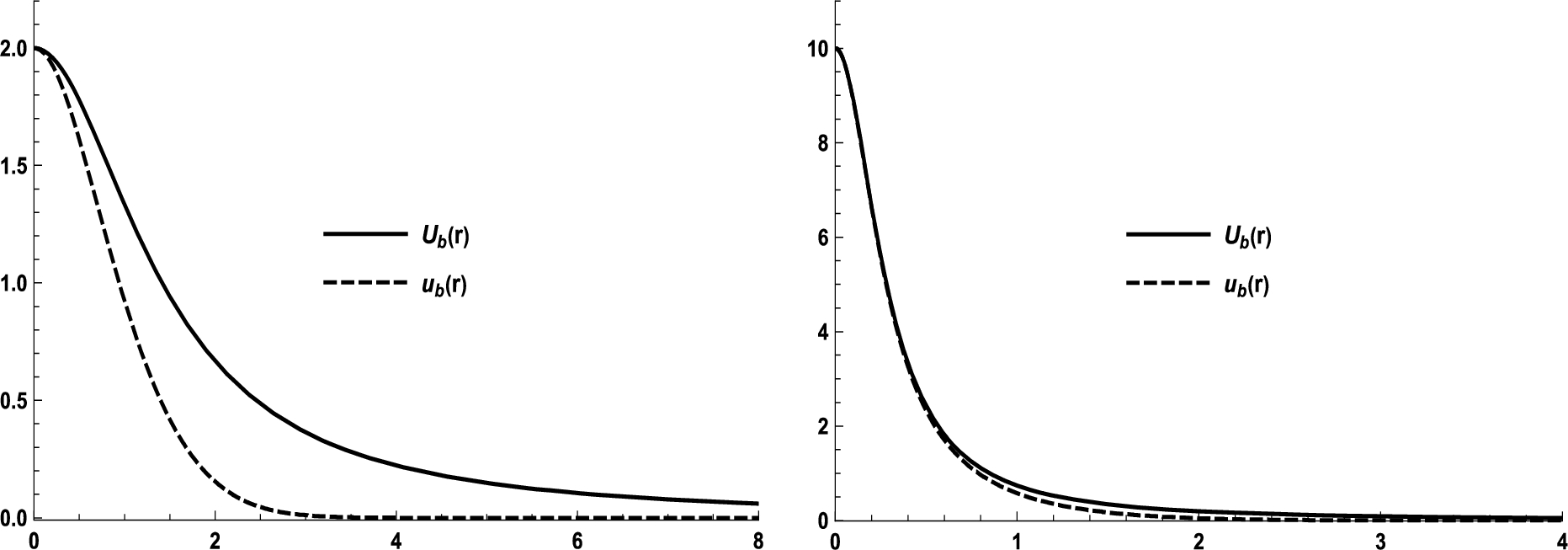
Ground states of the stationary equation (1.1) with and compared with the algebraic soliton (1.4) for (left) and (right).
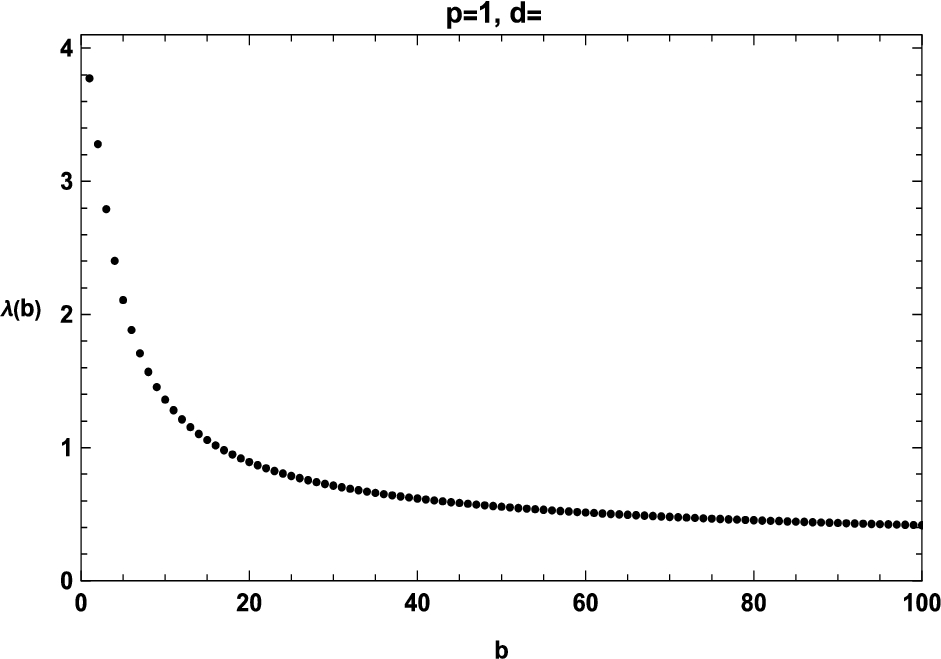
The dependence for and .
Figure 1 shows the numerically obtained profile versus r in comparison with the profile for (left) and (right). Visualization is given for (that corresponds to ). Results for other values of are similar. The two profiles are different for but the discrepancy gets smaller for and becomes invisible for larger values of b. The values of λ are uniquely defined in terms of b along the curve which is shown in Fig. 2 for .
The following theorem presents outcomes of the shooting method, which is the main result of this work. We use the following notations:
denotes the asymptotic equivalence in the sense ,
denotes the order of magnitude in the sense that for some and all sufficiently large b.
Fixforand letbe the solution curve for the ground stateof the stationary Gross–Pitaevskii equation (
1.1
) satisfying,for, andas. Then,withMoreover, for every, there existsuch that for every, we haveandwhereasfor some.
The asymptotic result (1.5) coincides with Theorem 1.1 in [23] obtained by the variational theory and elliptic estimates. It follows from Remark 1.2 in [23] that there exists such that
where is defined from the algebraic soliton (1.4). The case corresponds to as in (1.5). For , we have so that as in (1.5). For , we have so that as in (1.5).
It also follows from Remark 1.2 in [23] that for and for . In our notations with , this would correspond to for and for . However, we have found that the shooting method based on the b-family and the c-family can be applied for but needs some further modifications for .
Since as , bound (1.7) shows that as . This is smaller than as in the bound (1.6). Since as , bound (1.8) shows that satisfies the asymptotic behavior (1.2) with as .
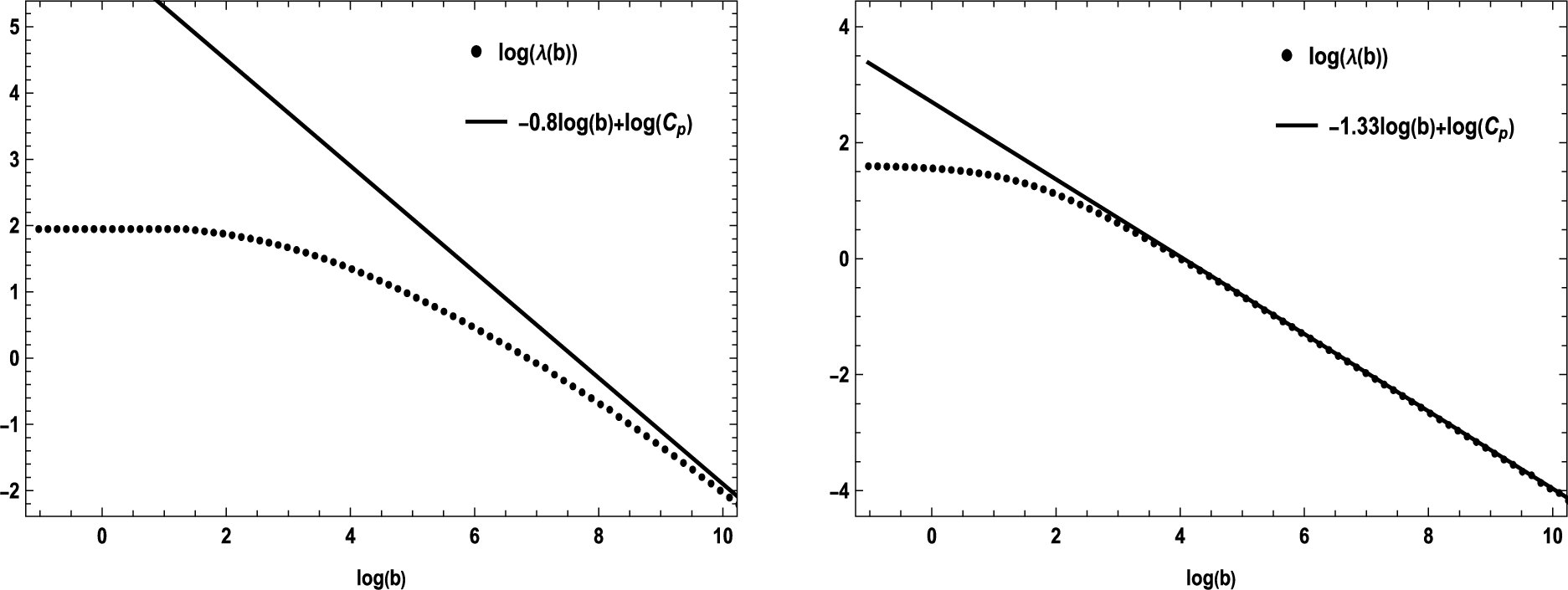
Figure 3 illustrates relevance of the asymptotic result (1.5) for the solution curve . For a given dimension d and the critical exponent , we numerically find and plot it versus b in comparison with the asymptotic dependence (1.5). The left and right panels show the plots for when and and for when and , where is obtained from the best least square fit. The proximity between the numerical and analytical curves becomes obvious in the log-log plot for larger values of b.
Log-log graphs of versus b for the ground state of the stationary equation (1.1) for (left) and (right) compared with the analytical dependence given in (1.5).
Our strategy to prove Theorem 1.1 is as follows. Section 2 contains preliminary results where the existence problem is reformulated after the Emden–Fowler transformation and the two solution families and their truncated limits are clearly identified. Section 3 gives analysis of the b-family in a local neighborhood of the algebraic soliton (1.4) which becomes the exponentially decaying soliton after the Emden–Fowler transformation. Section 4 describes analysis of the c-family in a local neighborhood of the confluent hypergeometric functions. Theorem 1.1 is proven in Section 5 where the two families are considered in the common asymptotic region with parameters c and λ obtained uniquely in the asymptotic limit . Besides the asymptotic dependence (1.5) which recovers independently the result (1.9) obtained in [23] with different methods, the main outcome of this work is the precise asymptotic construction of the ground state with pointwise estimates (1.6), (1.7), and (1.8) near the Aubin–Talenti solution and the confluent hypergeometric function.
Preliminary results
As in our previous works [3,22], we reformulate the existence problem for the ground state of the stationary Gross–Pitaevskii equation (1.1) as the following initial-value problem:
where is the free parameter and is defined in terms of in the energy-critical case. We say that the solution of the initial-value problem (2.1) is a ground state if for and as . Similarly to Lemmas 3.2 and 3.4 in [3] obtained in the particular case , the existence of a unique classical solution to the initial-value problem (2.1) can be concluded by using the integral equation formulation and the Lyapunov function method. We skip the proof since it is standard and state that for every , , and , there exists a unique classical solution to the initial-value problem (2.1) satisfying the asymptotic behavior:
The singularity of the stationary equation (2.1) at is unfolded by introducing the Emden–Fowler transformation:
After the transformation of variables, Ψ satisfies the second-order nonautonomous equation
We say that the b-family of solutions to Eq. (2.4) is defined by applying the transformation (2.3) to the unique solution of the initial-value problem (2.1). The corresponding b-solution, denoted as , satisfies the asymptotic behaviour
which follows from (2.2). Thus, the b-family of solutions decays to zero as . We will show in Section 3 that the b-family stays close to the positive homoclinic orbit of the truncated version of Eq. (2.4) given by the second-order autonomous equation
The second-order equation (2.6) is integrable with the first-order invariant
where E is constant along the classical solutions of Eq. (2.6). The origin in the -plane is a saddle point. The unique (up to translation) positive homoclinic orbit exists at the energy level for every . The homoclinic orbit can be found explicitly in the form
where is an arbitrary parameter of translation. Since
it follows by comparison with (2.5) that as for which the translation parameter in (2.8) is uniquely selected as . With this choice for , we observe that after transformation (2.3) coincides with the algebraic soliton given by (1.4).
Next, we introduce another analytical family of solutions to Eq. (2.4) that decay to zero as , which we call the c-family and denote as . We show in Section 4 that the c-family stays close to the decaying solutions of the linearized version of Eq. (2.4) given by the linear second-order nonautonomous equation
By using the change of variables
the second-order equation (2.10) becomes the confluent hypergeometric equation (also known as the Kummer equation):
with parameters α and β given by (1.3). Two special solutions of the Kummer equation (2.12) are given by the Kummer function and the Tricomi function , which are defined as follows [1]. The Kummer function is defined by the power series
hence it is bounded as . The Tricomi function satisfies the asymptotic behavior
hence it is decaying as if . In fact, for every , we have
so that is satisfied in the energy-critical case. By [1, 13.1.3], the Tricomi function can be represented in the superposition form
which is true for but can also be used in the limit . By using the identity
we can rewrite (2.16) for as
By [1, 13.1.6], if , then
where .
By means of the transformation (2.11), Tricomi function determines a suitable solution of the linear equation (2.10):
This solution is considered to be the leading-order approximation of the c-family such that as satisfies the asymptotic behavior
The ground state of Theorem 1.1 is the connection of the unique solution of the initial-value problem (2.1) satisfying (2.2) with the unique solution satisfying the decay behavior
which follows from (2.3) and (2.21). The connection between (2.2) and (2.22) only exists for some specific values of and . Thus, the main question is to find and to justify the analytical expressions for and in the asymptotic limit .
Persistence of the b-family of solutions
The b-family of solutions of the differential equation (2.4) satisfying (2.5) is considered in a neighborhood of the homoclinic orbit of the differential equation (2.6) satisfying (2.9). Since the comparison gives as , we translate by and introduce the perturbation term
which satisfies
where ,
and
Since is positive for all and is shown to be positive in the region of t where we analyze persistence of the b-family of solutions, we can neglect writing modulus signs in and .
The nonlinear term is superlinear in γ if and quadratic if , according to the following proposition.
Fixand. Ifis defined asthen there exists a positive constant, such that for all
Without the loss of generality, we assume that due to the scaling transformation:
Note that , so that if , then is bounded on , and the second line of (3.2) follows from Taylor’s theorem. If , then is bounded on so that
for some positive constant C. For , we have so that
for another positive constant C. The two estimates above give the first line of (3.2). □
The homogeneous equation admits two linearly independent solutions. The first one is given by due to the translation symmetry of the autonomous equation (2.6). The other solution denoted by can be obtained from the Wronskian relation
where is constant. We take for normalizing . Using (2.9) in (3.3), we obtain that
Using the two linearly independent solutions and Σ of the homogeneous equation , we rewrite (3.1) as an integral equation for γ:
where the free solution has been set to zero from the requirement that decays to zero as faster than .
The perturbation term γ can be estimated to be small in the norm on the semi-infinite interval with fixed and , where the right end point diverges asymptotically to as . The following lemma gives the persistence result for the solution to stay close to the leading-order term for .
Fixand. For any fixedandthere existandsuch that the unique solutionto the second-order equation (
2.4
) with asymptotic behaviour (
2.5
) satisfies forand all:where the bound can be differentiated in t.
The remainder term in the bound (3.6) is small on for every for which as . At the same time, on the same interval so that the remainder term is smaller than the leading-order term for if for which for sufficiently large b.
In order to eliminate the divergence of the integral kernel in the integral equation (3.5) as , we introduce a change of variables: and . The new integral equation for can be considered as the fixed-point equation , where
where the integral kernel is defined as
It follows from the asymptotic behaviours (2.9) and (3.4) for and Σ that the integral kernel is bounded for every by
for some positive constant C. Thus, as the integration in (3.7) is done in from to t, the kernel is bounded. In addition, the lower bound on follows from (2.9):
for some positive constant that depends on T and a for all large b. We shall prove that the integral operator A is a contraction in a small closed ball in the Banach space equipped with the norm .
Case. Since is bounded from below for , it follows by Proposition 3.1 if for all large b, then
for some positive constant C. We use and estimate
where the positive constant C can change from one line to the other line. If , then
where we have used if . Since if with , the bound ensures validity of the bound for which the bound (3.8) can be used. Similar calculations show that for two functions and in the same small closed ball in , we have
so that A is a contraction for sufficiently large b. By the Banach fixed-point theorem, there exists a unique fixed point of A such that
Since , we obtain the bound (3.6) for the unique solution to the integral equation (3.5).
Case. The only difference in the proof is that, by Proposition 3.1, the bound (3.8) is replaced by the bound
if for all large b. In this case, we get the estimate
where we have used if . Since if with , the bound ensures validity of the bound for which the bound (3.9) can be used. The rest of the proof is verbatim to the case of . □
The bound (3.6) can be extended for every if the values of a are restricted to as follows from the proof of Lemma 3.1 in the case of .
The result of Lemma 3.1 allows us to justify the validity of
due to (2.9) and (3.6). In order to obtain the correction term which behaves like in the same asymptotic region, we need to analyze γ in more details and obtain the leading-order part of γ. To do so, we write , where the leading-order term satisfies and is given explicitly by
whereas the correction term δ satisfies
The following lemma gives a sharper bound on compared to the bound (3.6). The sharper bound holds on , where the asymptotic behavior of and as is relevant.
Fixand. For any fixedandthere existandsuch thatin (
3.10
) satisfies forand all:
if, then
if, then
where the bounds can be differentiated in t.
Since is bounded for every independently of b, the second integral term in (3.10) is controlled by
This estimate yields the first term in the bounds (3.12) and (3.13) due to the asymptotic behavior (2.9). On the other hand, since as , the first integral term in (3.10) is controlled by
where for and for . This yields the second term in the bounds (3.12) and (3.13) due to the asymptotic behavior (3.4), where we have also used that . □
The sharper bounds (3.12) and (3.13) are compatible with the bound (3.6) on the semi-infinite interval , which can be rewritten in the form:
The correction term δ is estimated to be smaller than according to the following lemma.
Fixand. For any fixed,, there existandsuch that forand all:
if, then
if, then
where the bounds can be differentiated in t.
If for , we have
so that comparison (3.14) and (3.15) shows that δ is smaller than for sufficiently large b. Similarly, if for , we have
so that the comparison of (3.14) and (3.16) shows that δ is smaller than for sufficiently large b. In both cases, by Lemma 3.1, we also have being smaller than if , where if .
Equation (3.11) for δ can be written similarly to (3.5) as the integral equation
We proceed in a similar way to the proof of Lemma 3.1. Using the change of variables
we rewrite the integral equation for δ as the fixed-point equation , where
The only essential difference between A in (3.7) and B in (3.18) is the source term which dictates the size of the closed ball in , where the fixed-point iterations are closed. In (3.18), it consists of the linear term and the contribution from nonlinearity term . The linear term is estimated from (3.14) as
Estimates for the nonlinear term depend on the value of p. To proceed with the estimates, we decompose
where
Case. By Proposition 3.1, we have
Since and
we obtain by a minor modification of the proof of Proposition 3.1 that
Putting together estimates (3.19), (3.20), and (3.21), we obtain that
Since for every , we have for sufficiently large b, hence the source term coming from the nonlinearity is much larger than the source term coming from as . As a result, if , then . Moreover, B is a contraction in the same small closed ball for sufficiently large b. Hence, there exists a unique fixed point of B satisfying , which yields (3.15) for .
Case. By Proposition 3.1, we have
and similarly,
Proceeding similarly to the previous computations, we obtain
Since , we have for sufficiently large b, hence again the source term coming from the nonlinearity is much larger than the source term coming from as . Proceeding similarly, for sufficiently large b, there exists a unique fixed point of B satifying , which yields (3.16) for . □
Similarly to Lemma 3.2, we can find a sharper bound on δ compared to the bounds (3.15) and (3.16). This is given by the following lemma, the proof of which follows from the estimates obtained in Lemma 3.3.
Fixand. For any fixedandthere existandsuch that δ in (
3.17
) satisfies forand all:
if, then
if, then
where the bounds can be differentiated in t.
For , the first term in the bound (3.12) with is much smaller than the second term with on . As a result, it can be neglected. On the other hand, the second term in the bound (3.12) can be extended for the semi-infinite interval such that the sharper bound compared to (3.6) can be written in the form
The bound (3.23) follows from analysis of the integral equation (3.17) by using the transformation to the tilde variables in the proof of Lemma 3.3 and the estimate (3.20) on the nonlinear term N which is much larger than the source term from .
For , the proof is analogous but we use
and the estimate (3.22) on the nonlinear term N which is still much larger than the source term from . Thus, we get (3.24). □
Persistence of the c-family of solutions
The c-family of solutions of the differential equation (2.4) satisfying (2.21) is considered near the solution of the linear equation (2.10) given by (2.20). The comparison gives as . The correction term satisfies
where
The homogeneous equation has two linearly independent solutions. One solution is given by (2.20). The other solution, denoted as , can be obtained from the normalized Wronskian relation
Since it follows from (2.21) that
integrating the Wronskian relation (4.2) yields
With two linearly independent solutions and , we rewrite (4.1) as an integral equation for η:
where the free solution has been set to zero in order to guarantee that decays to zero as faster than .
The following lemma describes the size of for .
Fixand. Then, there exist some constantsand, such that forand, we havewhere the bound can be differentiated term by term.
In order to obtain a bounded kernel in the integral equation (4.5), we first introduce the change of variables
which applied to (4.5) results in the integral equation , where
and where the kernel and the nonlinearity are given by
and
Using asymptotic behaviours (4.3) and (4.4), we get that there exists such that
where . Since as and has an extremum in at , which does not belong to if and is located on if , we conclude that for . Hence, the kernel is bounded for every . On the other hand, since is a function for every , the nonlinear term satisfies the following bound:
where the constant is independent of c.
In order to use the Banach fixed-point theorem, we first estimate the size of for in a small closed ball in . Since in (4.7) is absolutely integrable on , we obtain by using (4.8) and (4.9) that
where the constant is independent of c. Thus, the operator E maps a closed ball of radius into itself as long as is chosen sufficiently small.
Similarly, by Proposition 3.1, we get for every and in the same small closed ball in that is a Lipschitz function satisfying
which yields
so that the operator E is a contraction for sufficiently small values of . By the Banach fixed-point theorem, there exists a unique solution of the integral equation satisfying . This estimate yields (4.6) after unfolding the transformation for . □
Using the result of Lemma 4.1, we can now extend the estimates for for large negative values of t.
Fix,, and. Then, there existand, such that for everythere exists, such that forand, we havewhere the bound can be differentiated term by term.
We rewrite equation (4.1) as an integral equation for :
where by Lemma 4.1. By using the scattering relation (2.18) and the transformation (2.20), we obtain the following asymptotic behavior for :
where by (2.15). Wronskian relation (4.2) implies the following asymptotic behavior for :
The divergent behaviour of as dictates the correct form of the transformation to use, which in this case is given by:
Applying it to the integral equation (4.12) results in the fixed point equation , where
where
and is the same as in the proof of Lemma 4.1.
We proceed by estimating each term of in the space . Since and are bounded for and , we obtain
Furthermore, if , asymptotics (4.13) and (4.14) allow us to estimate size of the last term in (4.15) as
where we have used the property of satisfying (4.9). These two estimates yield
for sufficiently large values of b. The divergent behaviour of for large b is controlled by appropriately reducing the value of satisfying for sufficiently small . Thus, we see that the operator maps the closed ball of the radius in into itself. Moreover, since is a Lipschitz function satisfying (4.10), we get that if , belong to the same ball, then
so that the operator is a contraction as long as for sufficiently small . By the Banach fixed-point theorem, there exists a unique satisfying
which yields the bound (4.11) due to the transformation . □
We are now equipped with all the necessary estimates to prove Theorem 1.1. The ground state of the stationary Gross–Pitaevskii equation (1.1) in the Emden–Fowler variables (2.3) exhibits decaying behaviour both as and as for every if . In other words, it appears at the intersection of the two solution families with
for some and . This allows us to use the asymptotic behaviours (3.15) and (3.16) for , and the asymptotic behavior (4.11) for at the times with varying and sufficiently large values of b. Equaling the asymptotic behaviors due to (5.1) yields two implicit equations for parameters λ and c.
Bound (1.6) follows from the bound (3.6) with after the transformation (2.3). Bounds (1.7) and (1.8) follow from the bounds (4.6) and (4.11) in the reversed order after the transformation (2.3). The proof of Theorem 1.1 is completed after obtaining the asymptotic representation for and for large b.
We fix , , and . For sufficiently large , we consider in the rectangle for which both Lemmas 3.4 and 4.2 can be applied.
By Lemma 3.4, we have for ,
where
and the asymptotic expansion can be differentiated in t. Using (3.10), we can write (5.2) as
Evaluating these expressions at and using the asymptotic relations (2.9) and (3.4) for and as , we obtain
where . Since
is obtained in the proof of Lemma 3.2, we finally obtain the asymptotic formula:
By Lemma 4.2, we have for ,
where is given by (2.20) and the asymptotic expansion can be differentiated in t. Since the expansion (5.4) is used for , we can use either (2.18) or (2.19) for asymptotic expansions of the Tricomi function in (2.20), where due to (2.15) and . If with , then the asymptotic formula for the solution evaluated at is obtained with the help of (2.18), (2.20), and (5.4) in the form:
If with , then the asymptotic formula for the solution evaluated at is obtained with the help of (2.19), (2.20), and (5.4) in the form:
where .
When we use the connection equation (5.1), it sets up the system of two equations for two unknowns λ and c. These two equations can be obtained by equaling and as well as their first derivatives at the time . Alternatively, since the asymptotic expansions are differentiable in t term by term, we can set up the system by equaling coefficients in front of the exponential functions and . Equaling the coefficients for the terms in (5.3) with either (5.5) or (5.6) yields the following equation:
The nonlinear equation (5.7) is defined for and the remainder terms are functions with respect to . Since the leading-order part of the nonlinear equation (5.7) is linear in c and suggests the solution , which clearly exists inside , we have by an application of the implicit function theorem the existence of a function for and sufficiently large , which is given asymptotically as
Equaling the coefficients for the terms in (5.3) with either (5.5) or (5.6) and substituting the expression (5.8) for c yields a nonlinear equation for λ, which we can also solve with an application of the implicit function theorem. However, details of computations depend on the value of and hence are reported separately for different values of p.
Case. If for every , we use (5.3) and (5.5) in (5.1), equal the coefficients for the terms, and substitute the expression (5.8) for . This yields the nonlinear equation for λ:
If , both integrals in the left-hand-side of (5.9) converge due to the asymptotic expansion (2.9) so that they can be expanded as
which implies that the nonlinear equation (5.9) for λ can be rewritten in the equivalent form:
If for every , then for every so that the arguments of the Gamma functions at are away from their pole singularities. Hence, all terms of the nonlinear equation (5.10) are functions of λ at . For , we have for sufficiently large b. Since the leading-order part of the nonlinear equation (5.10) is linear in λ and suggests the solution , we have by an application of the implicit function theorem the existence of a function for sufficiently large b which is given asymptotically by
The integrals in (5.11) can be computed by using the explicit expression for given by (2.8) with . Using the substitution we express the integrals in terms of the Beta function
and obtain
Substituting these expressions into (5.11) yields the final formula for and for every :
where we have used the property .
If for some , we use (5.3) and (5.6) in (5.1), equal the coefficients for the terms, and substitute the expression (5.8) for . This yields the nonlinear equation for λ:
After dividing it by , this equation can be rewritten in the form (5.10), where the right-hand side has the order of
which is much smaller than the leading-order term of the order of for . For even n, the final formula (5.11) for is modified as follows:
For odd n, we also have . Since
and , we have
which modifies the final formula (5.11) for according to
In both formulas for , we have with either even or odd . In all cases, for suffiently large values of b.
Case. Since for every if , the nonlinear equation (5.9) can be used. However, the integral diverges exponentially in the upper limit since as . Consequently, there is a positive constant such that for all , we have
The nonlinear equation (5.9) can be rewritten in the equivalent form:
where the second term on the left-hand side is of the order of as since for , which is satisfied automatically, since for . Moreover, since for and , the right-hand side dominates in the nonlinear equation (5.14). Solving the nonlinear equation (5.14) by an application of the implicit function theorem, we have the existence of a function for sufficiently large b which is given asymptotically by
Since and if , we have and . Hence, for sufficiently large values of b.
Case. This case corresponds to in the nonlinear equation (5.13), which we can rewrite in the equivalent form:
where . The second integral diverges linearly in the upper limit since as . The exact computations with the help of the explicit formula (2.8) yield the following asymptotic expression:
On the other hand, we use (2.17) and obtain
so that the leading-order terms of the nonlinear equation (5.16) can be collected together as
By using the implicit function theorem, we have the existence of a function for sufficiently large b which is given asymptotically by
where we have used , , and
Hence, for sufficiently large values of b.
Theorem 1.1 is proven. For details in Remark 1.2, we give the following computations.
Case. This case corresponds to in the nonlinear equation (5.13), which we can rewrite in the equivalent form:
where . Since
and
the leading-order terms contain only , which are not balanced by the terms of the order of to get the asymptotic balance according to Remark 1.2. This failure of the shooting method is due to only one exponential term that appears in (5.6) for and . The way to handle the asymptotic balance is to obtain the second exponential terms from the higher-order (nonlinear) terms of the expansion for beyond the leading order. However, this adds complexity to the shooting method beyond the scopes of this work.
References
1.
M.Abramowitz and I.A.Stegun, Handbook of Mathematical Functions with Formulas, Graphs, and Mathematical Tables, Dover, New York, 1972.
2.
T.Aubin, Equations differentielles non lineaires et probleme de Yamabe concernant la courbure scalaire, J. Math. Pures Appl.55 (1976), 269–296.
3.
P.Bizon, F.Ficek, D.E.Pelinovsky and S.Sobieszek, Ground state in the energy super-critical Gross–Pitaevskii equation with a harmonic potential, Nonlinear Analysis210 (2021), 112358. doi:10.1016/j.na.2021.112358.
4.
H.Brezís and L.Nirenberg, Positive solutions of nonlinear elliptic equations involving critical Sobolev exponents, Commun. Pure Appl. Math.36 (1983), 437–477. doi:10.1002/cpa.3160360405.
5.
C.Budd and J.Norbury, Semilinear elliptic equations and supercritical growth, J. Differential Equations68 (1987), 169–197. doi:10.1016/0022-0396(87)90190-2.
6.
C.J.Budd, Applications of Shilnikov’s theory to semilinear elliptic equations, SIAM J. Math. Anal.20 (1989), 1069–1080. doi:10.1137/0520071.
7.
M.Coles and S.Gustafson, Solitary waves and dynamics for subcritical perturbations of energy critical NLS, Publ. RIMS Kyoto Univ.56 (2020), 1–53. doi:10.4171/PRIMS/56-4-1.
8.
J.Dolbeault and I.Flores, Geometry of phase space and solutions of semilinear elliptic equations in a ball, Trans. AMS359 (2007), 4073–4087. doi:10.1090/S0002-9947-07-04397-8.
9.
F.Ficek, Schrödinger–Newton–Hooke system in higher dimensions: Stationary states, Phys. Rev. D103 (2021), 104062, (13 pages). doi:10.1103/PhysRevD.103.104062.
10.
R.H.Fowler, Further studies of Emden’s and similar differential equations, Quart. J. Math.2 (1931), 259–288. doi:10.1093/qmath/os-2.1.259.
11.
R.Frank, T.König and H.Kovar˘ík, Energy asymptotics in the Bresic–Nirenberg problem. The higher-dimensional case, Math. Eng.2 (2020), 119–140. doi:10.3934/mine.2020007.
12.
R.Fukuizumi, Stability and instability of standing waves for the nonlinear Schrödinger equation with harmonic potential, Discrete Cont. Dynam. Syst.7 (2002), 525–544. doi:10.3934/dcds.2001.7.525.
13.
Z.Guo and J.Wei, Global solution branch and Morse index estimates of a semilinear elliptic equation with super-critical exponent, Trans. AMS363 (2011), 4777–4799. doi:10.1090/S0002-9947-2011-05292-X.
14.
Z.-C.Han, Asymptotic approach to singular solutions for nonlinear elliptic equations involving critical Sobolev exponent, Ann. Inst. H. Poincaré Anal. Non Linéaire8 (1991), 159–174. doi:10.1016/s0294-1449(16)30270-0.
15.
E.Hebey and M.Vaugon, From best constants to critical functions, Math. Z.237 (2001), 737–767. doi:10.1007/PL00004889.
16.
M.Hirose and M.Ohta, Structure of positive radial solutions to scalar equations with harmonic potential, J. Differential Equations178 (2002), 519–540. doi:10.1006/jdeq.2000.4010.
17.
M.Hirose and M.Ohta, Uniqueness of positive solutions to scalar field equations with harmonic potential, Funkcial. Ekvac.50 (2007), 67–100. doi:10.1619/fesi.50.67.
18.
D.Joseph and T.Lundgren, Quasilinear Dirichlet problems driven by positive sources, Arch. Ration. Mech. Anal.49 (1973), 241–269. doi:10.1007/BF00250508.
19.
O.Kavian and F.Weissler, Self-similar solutions of the pseudo-conformally invariant nonlinear Schrödinger equation, Michigan Math. J.41 (1994), 151–173.
20.
H.Kikuchi and J.Wei, A bifurcation diagram of solutions to an elliptic equation with exponential nonlinearity in higher dimensions, Proc. Roy. Soc. Edinburgh A148 (2018), 101–122. doi:10.1017/S0308210517000154.
21.
F.Merle and L.Peletier, Positive solutions of elliptic equations involving supercritical growth, Proc. R. Soc. Edinburgh A118 (1991), 40–62. doi:10.1017/S0308210500028882.
22.
D.E.Pelinovsky and S.Sobieszek, Morse index for the ground state in the energy super-critical Gross–Pitaevskii equation, J. Diff. Eqs.341 (2022), 380–401. doi:10.1016/j.jde.2022.09.016.
23.
D.E.Pelinovsky, J.Wei and Y.Wu, Positive solutions of the Gross–Pitaevskii equation for energy critical and supercritical nonlinearities, Nonlinearity36 (2023), 3684–3709. doi:10.1088/1361-6544/acd90a.
24.
O.Rey, The role of the Green’s function in a non-linear elliptic equation involving the critical Sobolev exponent, J. Funct. Anal.89 (1990), 1–52. doi:10.1016/0022-1236(90)90002-3.
25.
F.Selem, Radial solutions with prescribed numbers of zeros for the nonlinear Schrödinger equation with harmonic potential, Nonlinearity24 (2011), 1795–1819. doi:10.1088/0951-7715/24/6/006.
26.
F.Selem and H.Kikuchi, Existence and non-existence of solution for semilinear elliptic equation with harmonic potential and Sobolev critical/supercritical nonlinearities, J. Math. Anal. Appl.387 (2012), 746–754. doi:10.1016/j.jmaa.2011.09.034.
27.
F.H.Selem, H.Kikuchi and J.Wei, Existence and uniqueness of singular solution to stationary Schrödinger equation with supercritical nonlinearity, Discr. Contin. Dynam. Systems33 (2013), 4613–4626. doi:10.3934/dcds.2013.33.4613.
28.
N.Shioji and K.Watanabe, A generalized Pohozaev identity and uniqueness of positive radial solutions of , J. Diff. Eqs.255 (2013), 4448–4475. doi:10.1016/j.jde.2013.08.017.
29.
G.Talenti, Best constant in Sobolev inequality, Ann. Mat. Pura Appl.110 (1976), 353–372. doi:10.1007/BF02418013.