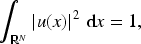
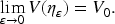
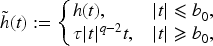
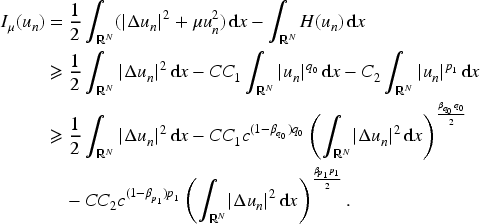
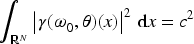
In the present paper, we study the existence and concentration of multiple normalized solutions to the following nonlinear biharmonic Schrödinger equation:
where is a positive parameter, is unknown and appears as a Lagrange multiplier, and V is a positive potential such that for some open bounded subset . Applying the penalization techniques and Ljusternik–Schnirelmann theory, we obtain multiple mormalized solutions . When , these solutions concentrates around a local minimum of V.
This paper extends the results of Alves and Thin (2023), which considered the nonlinear Schrödinger equations with general nonlinearities, to the biharmonic Schrödinger equations. We develop a truncated skill to obtain the minimum via careful analysis. Moreover, we also obtain orbital stability of the solutions.
In this paper, we investigate the existence of normalized solutions for the following nonlinear biharmonic Schrödinger equation:
where is a positive parameter, is unknown, the function and V is a positive potential such that for some open bounded subset .
For the classical operator Δ, when , problem (1.1) boils down to the following Schrödinger equation
The model was proposed as a result of expanding the Feynman path integral, from the Brownian like to the Lévy like quantum mechanical paths. In the past few years, it has attracted wide attention from scholars and obtained many interesting results.
For the biharmonic operator, we consider following time-dependent equation:
As everyone knows, if we set in (1.3), then we can get that u is a solution of (1.1). In magnetic materials, [18,32] considered (1.3) to study the stability of solitons. For the relevant results of equation (1.3), please refer to [12,24,25,27,34] and its references. In [19,20], for fourth-order Schrödinger equations of the mixed dispersion, the biharmonic operator was used to indicate the effects of higher order dispersion term.
As the case of in (1.3), Cardoso et al. [6] studied the local well-posedness and established a Gagliardo–Nirenberg type inequality of equation
where and . They used compact embedding of into a weighted space to study the phenomenon of - norm concentration for finite time blow up solutions. When , (1.3) is -supercritical if , -critical if and -subcritical if . Not so long ago, Phan [28] studied the following biharmonic nonlinear Schrödinger functional
under constraint
where . When the potential function is coercive and the nonlinear term is -critical nonlinearity, the author got that there exists normalized solutions for biharmonic equation. Furthermore, Ma and Chang in [24] considered the mixed nonlinear term, which involving a -subcritical term and a Sobolev critical term. For the prescribed mass, according to discuss the behavior of the minimum energy, they obtained normalized ground state solutions.
Liang and Zhang [23] dealt with the existence and multiplicity of solutions for the following equation
Under some proper assumptions on V and h, combining concentration-compactness principle and variational method, the authors proved that for any , above equation has at least m pairs of solutions. He et al. [17] considered the concentration and existence properties of standing waves for the following singularly perturbed equation with mixed dispersion:
They first established a local -estimate which is very important to get the global and uniform -estimate, and then, under some appropriate assumptions on parameter and the potential, they proved that these solutions concentrate around a local minimum of V. When in (1.5), by using a penalization-type method which first introduced by del Pino and Felmer [9], Pimenta and Soares obtained the existence of ground state solution and concentration of nontrivial solutions when was replaced by a general nonlinearity h.
In the view of physical, it’s more worthy to study the semi-classical normalized solutions of Schrödinger equation with λ arising as a Lagrange multiplier. Very recently, Alves and Thin in [2] studied multiple normalized solutions to equation
including non-autonomous cases by variational methods. It is worth mentioning that, h in (1.6) satisfies the -subcritical growth, and V satisfies global potential conditions. After that, they concerned with (1.6) under the local potential conditions in [3]. Since the conditions of V is not same, the method in [3] needs to be improved. To be precise, in this case, they used penalization-type method and Ljusternik–Schnirelmann theory to obtain the multiplicity of normalized solutions to the related problem.
The existence of multiple solutions for the following equation
has been proved in [10] when is small enough. Here is a smooth bounded domain, f satisfied a critical exponential growth. When , Mehdi–Selmi [10] got that if are solutions of (1.7) concentrating around a point when , then is a critical point of the Robin’s function ϕ. On the other hand, they also got that any nondegnerate critical point of ϕ can generates multiple solutions of (1.7) concentrating around as . Using Ljusternik–Schnirelman category throey, the authors proved that (1.7) has multiple solutions. When , Selmi [30] constructed multiple solutions concentrating around the well defined points depending on f. We refer to the recent papers [8,11,15,22] for related concentration properties.
Motivated by the above fact, it is quite natural to ask, does (1.1) have multiple normalized solutions? In this paper, we will give an affirmative answer. We are very interested in the numbers of solutions for (1.1) which is respect with the topology of the set . As far as we know, there are very few results about (1.1) for each . Our idea is to extend the conclusion in [3] to biharmonic operators. In addition, to make the research more interesting, the orbital stability of the solutions is also investigated. Therefore, we need to introduce new techniques and more precise analysis.
In the present paper, we give some hypothesis about V
there exists a bounded open set such that
Moreover, we assume that without lost of generality.
is continuous and satisfying the following assumptions:
h is odd and for some ;
there exist constants and such that, for all
is increasing for .
Now we give a useful Lions’ type lemma in which can be obtained as that in [33]:
Ifis bounded inand satisfies
then for all,in.
Next, we recall a well-known Gagliardo–Nirenberg inequalities for functions , (see, for instance, [13,26]), namely,
where is an optimal constant and
The main results of this paper read as follows:
Suppose that h satisfies the conditionsand that V satisfies. Then for eachsuch that, there existandsuch that forand, (1.1) admits at leastcouplesof weak solutions with, and. Moreover, ifis the global maximum of one of these solutions, then
Assumeandhold. Then, under the flow associated with
Ω defined in (7.5) is orbitally stable.
The structure of this document is as follows. In Section 2, we get a variational setting for (1.1) and the associated functional. After that, we consider the autonomous case of problem (1.1) in Section 3. In Sections 4 to 6, we consider the non-autonomous cases of problem (1.1), then get multiplicity and concentration phenomena of solutions for the modified problem. Finally, we obtain orbital stability of the solutions in the last section.
The following notations will be used in the sequel.
;
is a norm on which is equivalent to the standard one ;
denotes Lebesgue space with ;
, where ;
denote positive constants whose value can change from line to line.
.Variational frameworks
It is easy to see that, after a change of variable, (1.1) is equivalent to
From now on, we shall refer to it. Once we get a solution of (2.1), then is a solution of (1.1). Moreover, the maximum point of is related to the maximum point of simply by . Consequently, we need to prove that
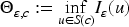
First, we assume that there exist satisfying , define
where q was fixed in . Then we introduce a penalized nonlinear term
where is the characteristic function on .
In view of , we can get following properties: similar to the proof of [3].
uniformly in ;
for each and ;
there is such that for all and ,
for each and , and for all and ,
.
We now remarkable that, if is a solution of the equation
with for all , then we get and so, is also a solution of (1.1), where
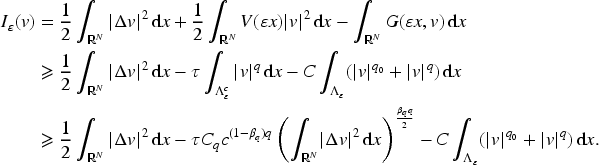
The weak solutions of (2.2) are the critical points of given by
restricted to the sphere , here . It is easy to get that and
.The limit problem
In this section, we consider the limit problem associated to (2.2) as follows
A solution u of (3.1) is according to a critical point for functional
restricted to the restrain sphere defined by
Now we give our main result in the present section read as follows:
Assume thathold. Then, there is asuch that for, (3.1) has solution, where.
Compared with the Theorem 2.2 of [3], we can not get that the normalized solution is radial Schwarz’s Symmetrization directly because of the biharmonic operator. But combing Fourier transform with Schwarz’s Symmetrization, we also can get the solution of (3.1) is radially symmetric if , where are given in respectively. Precisely speaking, for , let
be the Fourier rearrangement of where and denote the Fourier transform and the inverse Fourier transform respectively, and stands for the Schwarz rearrangement of Note that is radial and Moreover, when Lemma A.1 in [5] implies that
Thus, if we denote as the Fourier rearrangement of where is a minimizer of it follows from (3.2) that
which indicates that is also a minimizer of Hence, if (3.1) admits a ground state solution which is radially symmetric.
Theorem 3.1 considers the autonomous case, which is simpler than Theorem 1.1. To be precise, we first show that the energy functional of (3.1) is bounded from below (see Lemma 3.1), which can ensure that the energy functional has a global minimum. Next, in order to obtain the compactness theorem on , we need to study the properties of global minimum, that is Lemmas 3.2, 3.3 and (3.5). Finally, we use Lagrange multiplier method to obtain the solution.
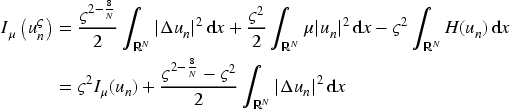
Since , we can get that there exists such that Thus,
By using (4.6) and (1.8), there is a independent of satisfing
From now on, we fix .
Decreasing if necessary. Letbe as in Lemma4.2, thensatisfies thecondition if.
Let be a sequence of . By Lemma 3.1, is a bounded sequence, so there is satisfying in . Noting that . According to Lemma 4.2, . Define . If in , we finish our proof. On the other hand, if in , from Lemma 4.2,
Since is a sequence of , for any , there exists from the Lagrange multipliers rule such that
Test (4.7)–(4.8) with , we obtain . That is , which is absurd. Hence, in .
.Multiple normalized solutions for the modified problem (2.2)
Let w be a solution of the following problem
with . Let be fixed and
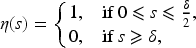
which is a smooth function defined in . For any , we define
Letting as , then we get that, for any , has compact support.
If the conclusion is not true, there is with and satisfying
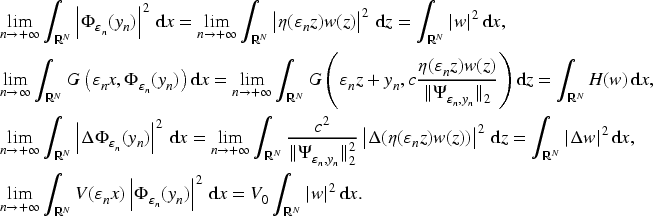
Considering the change of variable , if , then and . According to the Lebesgue’s theorem,
Consequently,
which is absurd.
Let for any satisfying that , is defined as if if . Set as following,
Since , we conclude that
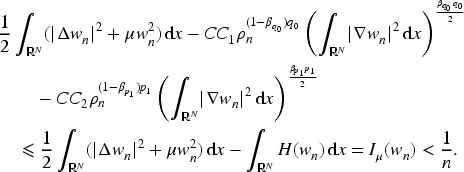
Let, for all,and. There exists a sequencesatisfying thathas a strongly convergent subsequence. Moreover,up to a subsequence.
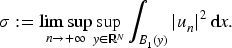
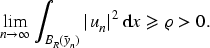
Similar to Lemma 3.1, we obtain that . Notice that , and would implies , we can argue as (3.6) to obtain that there are constants and a sequence satisfying
Setting , since the boundedness of , is also bounded. Therefore, up to a subsequence,
Hence
which implies , then according to Lemma 4.3 we have in . Moreover,
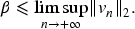
Next, we will prove that has a subsequence, still denoted by , satisfying . First we prove that is a bounded sequence. In fact, if not, there is a subsequence, still denoted by , satisfying . From , we have
where satisfies
So, we can get that there is and such that . Taking into account , we have that
It follows from that
Then by the definition of , we obtain that
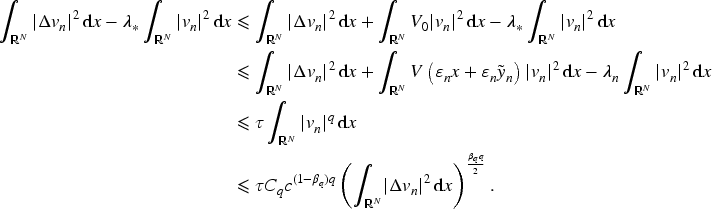
Let , then it follows from that there is satisfying . Therefore,
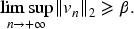
A direct computation obtains that as , . Since independent on τ, decreasing τ if necessary, we have , which is absurd. Therefore, up to a subsequence if necessary.
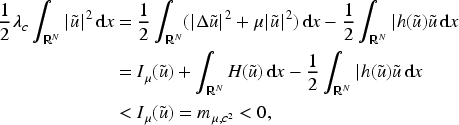
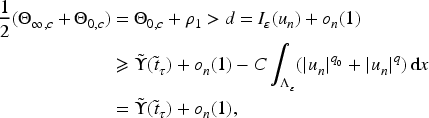
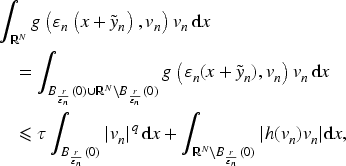
Next we want to prove that . If , since in , it follows from Fatou’s lemma and that
which is a contradiction.
Let such that as . Define
Thanks to Lemma 5.1, as , the function . Hence, for all , .
Let and such that
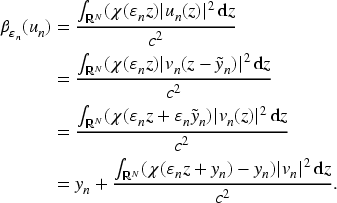
From the equality above, it is necessary to find a sequence satisfing
Since ,
where satisfies as by Lemma 5.1. And so
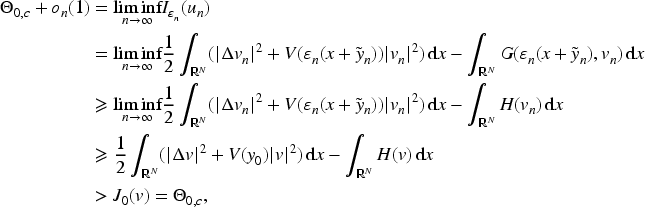
From Proposition 5.1, there is a sequence satisfying that has a strongly convergent subsequence. Moreover, up to a subsequence if necessary. Therefore,
Consequently, there exists satisfying that since , the we finish the proof of the lemma.
We would like to point out that if Y is a closed subset of a topological space X, the Lusternik–Schnirelmann category is the least number of closed and contractible sets in X which cover Y. If , we use the notation . We aim to prove that there are at least couples critical points for the energy functional when study the concentration phenomina when .
Before proving the multiplicity result, we recall the following useful abstract result from Benci and Cerami [4].
Letandbe closed with,andbe non continuous maps satisfying thatis homotopically equivalent to. Then.
Asume that,hold. Then, for the given, there existssuch that there exist at leastpositive solutions to (2.2) for any.
From Proposition 5.1, there exists satisfying the diagram of continuous mappings is well defined if . From (5.1), choosing a function with uniformly in such that for all . Define , then we have is continuous. It is easy to check that for all . And then, is a homotopy between and the inclusion map , which implies that
It follows from Lemma 4.3 and from the abstract category Lemma 5.3, Lemma 3.1, we have that is bounded from below and for , satisfies the condition. From the Lusternik–Schnirelmann category of critical points ([14]), there are at last critical points for .
.Multiplicity and concentration phenomena of solutions for problem (2.1)
In the present section we shall prove the main result by showing that the solutions obtained in Theorem 5.1 are indeed solutions of the original problem (2.1) if for small enough.
By the uniform estimates to solutions given in [29], we deduce a fundamental -estimate.
Letasand,be the sequence defined as in Theorem5.1. Then,and there issuch that for all,.
asuniformly in n.
Through Theorem 5.1, we have for all , then by [[1], Theorem 7.1],
If , the imbedding is continuous for . Hence, by lemma 6.1,
It follows from the convergence in that as , uniformly in n.
Proof of Theorem 1.1.
Assume that is a solution of (1.1) with , where ξ was given in (5.2). Arguing as the same as that in Proposition 5.1, there exists satisfying with as . Set , we get that there is in such that in . Since is a solution of
with
lemma 6.2 shows that, there are and satisfying
Now, according to the fact , if , there exists satisfying that
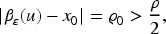
We claim that . Otherwise we will have that in , which is impossible since for all . Now, let us fix such that and satisfying for all . The above analysis ensures that for all . Now, let us consider such that . Then, and
this proves the desired result.
.Orbital stability of the solutions
We will consider problem
and get the orbital stability.
Recalling that
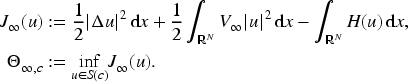
in what follows, we define:
,
,
,
.
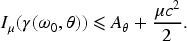
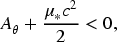
Assume. Decreasing if necessary, we have
and
for all.
Let such that
Then, consider the function as follows:
with and . Next, we will prove that
Indeed, according to a simple change of variable, we get
so
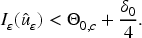
Due to , , we know that for all small enough, . Moreover, by using (7.4), we get that, for small enough,
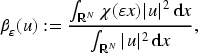
Next we prove the stability of the sets Ω. With the initial data , we denote be the solution to (7.1) and its maximal existence interval is , then either as , or for positive times, is globally defined, see ([31], Section 3).
First of all, we show that is globally defined. Assuming that satisfies , by using and the definition of Ω, we have
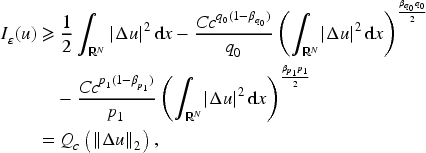
Note that, since is monotonically decreasing with respect to c, we can take to satisfy . There is such that if and , then
Let . Note that by the conservation of the mass, for all . If there is satisfying , then
which is a contradiction to . Thus,
so we get that for positive times, is globally defined.
Next we prove that Ω is orbitally stable. Using Theorem 3.1 in [16], we can get that for complex valued function, Lemma 4.2 is also true. Therefore, by modifying the classical Cazenave–Lions argument [7,21], we will obtain the orbital stability of . Assume that the conclusion is invalid, there exist sequences and and a constant satifying
and
here with initial data , is the solution of (7.1). Due to (7.6), there is such that for all .
That contradicts (7.8). Hence Ω is orbitally stable.
References
1.
AgmonS., The approach to the Dirichlet problem, Ann. Sc. Norm. Super. Pisa13 (1959), 405–448.
2.
AlvesC.O.ThinN.V., On existence of multiple normalized solutions to a class of elliptic problems in whole via Lusternik–Schnirelmann category, SIAM J. Math. Anal.55(2) (2023), 1264–1283. doi:10.1137/22M1470694.
3.
AlvesC.O.ThinN.V., On existence of multiple normalized solutions to a class of elliptic problems in whole via penalization method,Potential Anal.61 (2024), 463–483. doi:10.1007/s11118-023-10116-2.
4.
BenciV.CeramiG., Multiple positive solutions of some elliptic problems via the Morse theory and the domain topology, Calc. Var. Partial Differ. Equ.2 (1994), 29–48. doi:10.1007/BF01234314.
5.
BoulengerT.LenzmannE., Blowup for biharmonic NLS, Ann. Sci., Ec. Norm. Supér50(3) (2017), 503–544. doi:10.48550/arXiv.1503.01741.
6.
CardosoM.GuzmànC.M.PastorA., Global well-posedness and critical norm concentration for inhomogeneous biharmonic NLS, Monatsh. Math.198 (2022), 1–29. doi:10.1007/s00605-021-01667-w.
7.
CazenaveT.LionsP.L., Orbital stability of standing waves for some nonlinear Schrödinger equations, Commun. Math. Phys.85 (1982), 549–561. doi:10.1007/BF01403504.
8.
CostaG.FigueiredoG., Existence and concentration of positive solutions for a critical equation, Adv. Nonlinear Anal.11(1) (2022), 243–267. doi:10.1515/anona-2020-0190.
9.
Del PinoM.FelmerP.L., Local mountain passes for semilinear elliptic problems in unbounded domains, Calc. Var. Partial Differ. Equ.4 (1996), 121–137. doi:10.1007/BF01189950.
10.
El MehdiK.SelmiA., Concentration and multiplicity of solutions for a fourth order equation with critical nonlinearity, Nonlinear Anal. TMA64 (2006), 417–439. doi:10.1016/j.na.2005.06.020.
11.
FengS.ChenJ.HuangX., Critical fractional Schrödinger-Poisson systems with lower perturbations: The existence and concentration behavior of ground state solutions, Adv. Nonlinear Anal.13 (2024), 20240006.
12.
FibichG.IlanB.PapaniclaouG., Self-focusing fourth order dispersion, SIAM J. Appl. Math.62 (2002), 1437–1462. doi:10.1137/S0036139901387241.
13.
GagliardoE., Caratterizzazioni delle tracce sulla frontiera relative ad alcune classi di funzioni in n variabili, (Italian), Rend. Sem. Mat. Univ. Padova27 (1957), 284–305.
14.
GhoussoubN., Duality and Pertubation Methods in Critical Point Theory, Cambridge University Press, Cambridge, 1993, p. 16.
15.
GiacomoniJ.dos SantosL.M.SantosC.A., Multiplicity for a strongly singular quasilinear problem via bifurcation theory, Bull. Math. Sci.13 (2023), 2250013. doi:10.1142/S1664360722500138.
16.
HajaiejH.StuartC.A., On the variational approach to the stability of standing waves for the nonlinear Schrödinger equation, Adv. Nonlinear Stud.4 (2004), 469–501. doi:10.1515/ans-2004-0407.
17.
HeY.LuoX.RădulescuV.D., Nodal multi-peak standing waves of fourth-order Schrödinger equations with mixed dispersion, J. Geom. Anal.32 (2022), 1–36.
18.
IvanovB.A.KosevichA.M., Stable three-dimensional small-amplitude soliton in magnetic materials, So. J. Low Temp. Phys.9 (1983), 439–442.
19.
KarpmanV.I., Stabilization of soliton instabilities by higher-order dispersion: Fourth-order nonlinear Schrödinger-type equations, Phys. Rev. E.53 (1996), 1336–1339. doi:10.1103/PhysRevE.53.R1336.
20.
KarpmanV.I.ShagalovA.G., Stability of soliton described by nonlinear Schrödinger-type equations with higher-order dispersion, Phys. D.144 (2000), 194–210. doi:10.1016/S0167-2789(00)00078-6.
21.
LiX.ZhaoJ., Orbital stability of standing waves for Schrödinger type equations with slowly decaying linear potential, Comput. Math. Appl.79 (2020), 303–316. doi:10.1016/j.camwa.2019.06.030.
22.
LiY.ZhangB.HanX., Existence and concentration behavior of positive solutions to Schrödinger–Poisson–Slater equations, Adv. Nonlinear Anal.12 (2023), 20220293.
23.
LiangS.ZhangJ., Existence and multiplicity of solutions for fourth-order elliptic equations of Kirchhoff type with critical growth in , J. Math. Phys.57 (2016), 111505. doi:10.1063/1.4967976.
24.
MaZ.ChangX., Normalized ground states of nonlinear biharmonic Schrödinger equations with Sobolev critical growth and combined nonlinearities, Appl. Math. Lett.135 (2023), 108388. doi:10.1016/j.aml.2022.108388.
25.
MiaoC.XuG.ZhaoL., Global well-posedness and scattering for the focusing energy-critical nonlinear Schrödinger equations of fourth order in the radial case, J. Differential Equations246 (2009), 3715–3749. doi:10.1016/j.jde.2008.11.011.
26.
NirenbergL., On elliptic partial differential equations, Ann. Scuola Norm. Sup. Pisa Cl. Sci.13 (1959), 115–162.
27.
PausaderB., The cubic fourth-order Schrödinger equation, J. Funct. Anal.256 (2009), 2473–2517. doi:10.1016/j.jfa.2008.11.009.
28.
PhanT.V., Blow up for biharmonic Schrödinger equation with critical nonlinearity, Z. Angew. Math. Phys.69 (2018), 31.
29.
RamosM., Uniform estimates for the biharmonic operator in and applications, Commun. Appl. Anal.8(4) (2004), 435–457.
30.
SelmiA., Concentration phenomena in a biharmonic equation involving the critical Sobolev exponent, Adv. Nonlinear Stud.6 (2006), 591–616. doi:10.1515/ans-2006-0406.
31.
TaoT.VisanM.ZhangX., The nonlinear Schrödinger equation with combined power-type nonlinearities, Commun. Partial Differ. Equ.32 (2007), 1281–1343. doi:10.1080/03605300701588805.
32.
TuritsynS.K., Three-dimensional dispersion of nonlinearity and stability of multidimensional solitons, Teoret. Mat. Fiz.64 (1985), 226–232.