



Abstract
The physical properties of biocompatible titanium surfaces were modified using different techniques of surface treatment. Particularly the measurements of roughness and wetting ability were controlled using six different techniques: polishing, sandblasting, acid attack, laser ablation, ion implantation and nanoparticle deposition. The titanium surface wetting can be modified drastically depending on the used treatment to enhance the hydrophilic or the hydrophobic behaviour of the metallic biocompatible surface. The study demonstrates that a linear relation between roughness and contact angle occurs. Possible applications to permanent or removable prosthesis titanium based are presented and discussed.
Introduction
Titanium represents the most used metallic biomaterial employed to build prosthesis and biomedical devices. The high biocompatibility of its surface is demonstrated by many biologic and medicine studies. Titanium, titanium oxides and some titanium alloys, have high ability to bind to living tissues, to induce osseointegration and to stimulate tissue adhesion and growth without producing inflammation and rejection [1]. Titanium produces a TiO2 oxide surface layer reactively that can provide chemical bonding through various electron interactions as a possible explanation for biocompatibility. Its ability to physically bond with bone gives titanium an advantage over other materials that require the use of an adhesive to remain attached. The osteoblast adhesion and proliferation depends on the titanium surface water wettability. The bone anchorage to the surface depends on titanium adhesion to calcium phosphate deposited on its surface and on the interface properties [2]. The main physical properties of titanium, responsible for the high biocompatibility, are due to the low electronic conductivity, high corrosion resistance, high mechanical resistance, hemodynamic state at physiological pH values, low ion-formation tendency in aqueous environments, iso-electric point of the oxide and dielectric constant comparable to that of water [3].
Ti has a density of 4.5 g/cm3, a low thermal conductivity (17 W/m °C), and a Young’s modulus of 110 GPa, properties very useful to realize different type of prosthesis for human body. In medicine, titanium based materials, such as the Ti–6Al–4V alloy, are used for implant devices replacing failed hard tissue. Examples include artificial hip joints, artificial knee joints, bone plates, screws for fracture fixation, cardiac valve prostheses, pacemakers, artificial hearts, and dentistry devices.
Titanium and its alloys oxidize immediately upon exposure to air and react with oxygen at 1200°C in air forming titanium dioxide. It is slow to react with water and other compounds at room temperatures because it forms a passive oxide coating that protects the bulk metal from further oxidation. Generally this protective layer is only 1–2 nm thick but continues to grow slowly reaching a thickness of 25 nm in times of the order of one year at 20–30°C [4]. This layer passivation gives titanium excellent resistance to corrosion, attack by dilute acids, and most organic acids. However, titanium is corroded by concentrated acids. As indicated by its negative redox potential (
The titanium dioxide is also a well-known catalyst able to degrade by oxidation numerous organic compounds. Exploiting this property may obtain materials that, through activation from sunlight, are able to destroy the organic compounds deposited on them. Titanium surfaces shows optimal Antibacterial Effects that can be developed at high wetting ability [5].
The titanium surface morphology can be modified using many physical and chemical treatments, such as polishing, sandblasting, laser irradiation, ion sputtering, chemical etching, thermal processes, etc.
The more or less marked tendency of a solid to let wet evenly and in a stable manner from a liquid takes the name of wettability. The degree of wetting depends on the balance of the forces of adhesion and cohesion of the liquid itself. The contact angle θ, of a perfect surface, is determined by the balance of forces at the interface of the three phases and is defined by the Young equation [6]:
A drop of liquid placed on the flat surface of a solid will tend to widen when the surface is wettable, or may assume a spherical shape when instead the surface is not wettable. In practice, when this angle is lower that 90° the surface is wettable (hydrophilic) at different degrees, while when the angle is higher than 90° the surface is not-wettable (hydrophobic) at different degrees. The wetting is favoured by relatively low interfacial free energy, high solid surface energy and low liquid surface free energy (surface tension) [7].
The wetting ability and the cellular adhesion to titanium and titanium oxide surfaces depends on different physical, chemical and biological parameters, to being function of different physical aspects, such as roughness, electrical charge, morphology and porosity, of the chemical reactivity between the biological liquids and of the solid surface, and of the cellular growth velocity on the biocompatible substrate. The chemical-physical-biological characteristics, the liquid and solid composition and presence of anodic oxidation of titanium surface modify the growth of osteoblasts [8].
The presence of TiO2 layers on the titanium substrate influences the cell activity and the titanium acts as molecule absorber incorporating elements. The surface wettability, initially, plays a major role in adsorption of proteins onto the surface, as well as cell adhesion, which can be controlled by the high hydrophilic surfaces. The presence of Ca and P molecular groups on the TiO2 surface improves the cell adhesion, thus often thin films of hydroxyapatite can be employed to enhance the anchorage of titanium prosthesis to tissues and bones [2,9].
Thus, although many factors influence the adhesion between a liquid and the solid surface, the study presented in this paper demonstrates that the surface morphology, and in particular the roughness represents a main factor, controlling the wetting ability of the titanium surface submitted to different treatments that can be employed to enhance or to reduce it. Thus the investigated treatments, for example, permit to accelerate the process of osteoblasts growth, osseointegration with tissues or cell proliferation on the surface, in the case of permanent prosthesis to be implanted permanently in the body, or, on the contrary, to reduce the wetting ability in the case to realize removable prosthesis to be implanted only for a limited period of time.
Materials and methods
Pure titanium sheets, 2 cm × 2 cm area and 1 mm thickness were employed for this investigation. Six different techniques were employed to modify the surface morphology: polishing, sandblasting, acid etching, laser ablation, ion sputtering and nanoparticle deposition. Surface treatments were performed using different times and parameters, and measuring the surface roughness before and after each procedure. Roughness was evaluated with a surface profiler (Tencor P10) having a depth resolution of 1 nm, a scansion length of 1 mm, 1 mg force scanning the sample surface and a scan speed of 100 μm/s [10].
The wetting ability of the metal surface before and after the treatment was measured depositing a water drop of 1 μl, with a micro-syringe, on the surface and observing the drop shape with an optical microscope in order to evaluate the contact angle with the horizontal substrate, according to the know procedure so called “Sessile drop” [11].
Optical and electronic (SEM) microscopy investigation was employed to study the surface morphology of the studied titanium substrates.
Polishing treatments: Titanium samples were mirror polished with SiO2 abrasive papers having micrometric grit. Sandpaper microgrit was used from P100 up to P4000, corresponding to an average abrasive particle diameter from 160 μm up to 5 μm, respectively. The polishing duration of the prepared Ti samples ranged between 5 and 20 minutes. The final surface was cleaned in isopropyl alcohol.
Sandblasting treatments: This process has been obtained spraying SiO2 micrometric particles, with an average diameter of 10 micron, against the titanium surface in air, inside a sandblasting chamber. The abrasive microparticles were accelerated by a fast nitrogen gas flux to about 100 m/s and directed toward the substrate with an incidence angle of about 0°. The treatment time was varied from 1 min up to 3 min. Many particles adhere to the surface, thus after the sandblasting procedure targets were submitted to a cleaning using a jet of compressed air and finally with isopropyl alcohol.
Acid etching treatments: Chemical etching was obtained using H2SO4 at 10% concentration in water deposited on the Ti substrate at room temperature (22°C) for different times from 3 min up to 60 min and just after removed by current water. Because the Ti surface is oxidized, the produced reaction is the following:
Laser ablation treatments: A Q-switched Nd:YAG laser, operating at the fundamental wavelength of 1064 nm (IR), with pulse duration of 3 ns, acting at pulse energy selectable between 10 mJ and 200 mJ, operating in single mode or up to 10 Hz repetition rate was used in such treatment. The titanium surface was irradiated without laser focusing lens, by using a circular spot 10 mm in diameter and 100 laser shots incident orthogonally to the Ti surface, and with a Gaussian beam profile. The final surface was cleaned in isopropyl alcohol.
Ion sputtering treatments: An Ar+ ion gun of 2.5 keV with a current of 15 μA was employed to irradiate in high vacuum (10−5 mbar) Ti target using an incidence angle of 45° and a spot of 2 cm2. The sputtering yield was calculated using SRIM code [12]. It indicates that with the used geometry the ion range is of about 160 Angstroms and the sputtering yield is Y = 2.3 atoms/ion. The ion sputtering generates in the irradiated layers high concentration of Ti recoils, high Ti atom displacements and high replacement collisions with a maximum at about 100 Angstroms depth. The sputtering dose per 30 min ion irradiation was
Nanoparticles use: Ti nanoparticles (NP) were produced by using the Nd:YAG laser above described irradiating Ti targets placed in water at room temperature [13]. Nanoparticles have an average dimension of 100 nm, a large size distribution from about 10 nm up to about 200 nm and a spherical shape. They agglomerate easily with the time of permanence in water and after some days at room temperature produce black microparticles which sediments in the liquid solution. Nanoparticles have been deposited on the titanium substrate in two different ways: as solution drop to measure its contact angle with respect to pure water; as a thin solution film deposited on the entire sample surface, let dry to 50°C and 2 h, permitting the water evaporation and changing the Ti surface properties, on which successively was placed the distilled water drop to measure its wetting ability with respect to the clean Ti surface. It is expected that they are enclosed in the micro and nanofessures of the surface and in the grain boundaries of the metal material reducing the surface roughness.
SEM investigations of Ti surface morphology were peformed during the different treatments. In particular Fig. 1(a) shows the cleaned pristine surface of the pure Ti used as starting substrate at low magnification (×120). The surface is uniform showing sub-micrometric roughness, as observed at high magnification in Fig. 1(b) (×6000).

SEM image of Ti surface before treatments at low (a) and high (b) magnifications.
Figure 2 shows the typical surface roughness profile in the pristine (a) and in the polished for 20 min (b). The average roughness was 0.045 μm and 0.015 μm in the two cases, respectively. In the bottom figure it is possible to observe the photo comparison between the water drop (1 μl) deposited on the pristine (c) and on the polished surface (d). The contact angle was
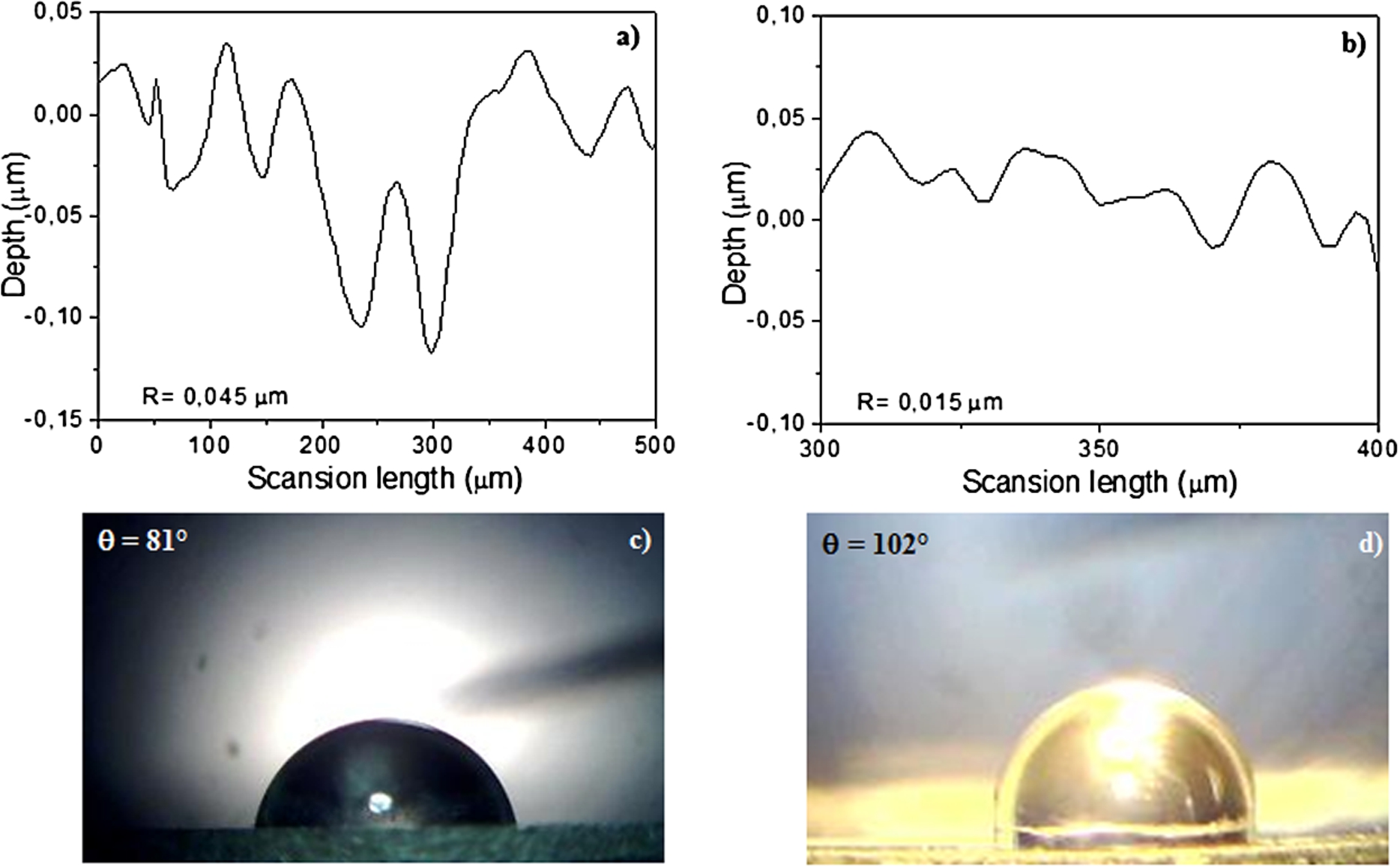
Typical roughness profile in the pristine (a) and polished surface (b), the water drop on the pristine (c) and on the polished surface (d).
Figure 3 shows typical profiles of sandblasting treatments. The average roughness is 1.76 μm and 3.52 μm for 1 min and 3 min sandblasting, respectively (Fig. 3(a) and 3(b)), while the water contact angle from the initial 81°, measured in the pristine surface, decreases to 74° at 1 min sandblasting treatment (Fig. 3(c)) and to 58° at 3 min process (Fig. 3(d)). Measurements demonstrate that the long sandblasting treatments, using micrometric SiO2 grains accelerated at high velocity, increase the hydrophilicity properties of the Ti surface.

Measure of surface roughness after 1 min (a) and 3 min (b) sandblasting treatment and relative contact angle measurement (c) and (d), respectively.
The chemical etching performed with diluite H2SO4 acid produces removing of the surface TiO2 layers modifying the surface morphology as a function of the time of attack and of the temperature. Figure 4(a) shows the variation of contact angle of Titanium varying the etching time at room temperature. It is possible to observe an initial phase of angle decreasing with the time, from the initial pristine value of 81° up to a value of about 61° at 20 min attack time, due to a first initial chemical attack of the surface protuberances and grain boundaries, enhancing the roughness and decreasing the contact angle. However, prolonging the chemical attack time, up to 60 minutes, the roughness decreases because chemical reaction smooth the surface making it more mirror and consequently the contact angle growth. The contact angle increment at 1 hour reaches the pristine value or higher values, decreasing the wetting ability. Figure 4(b) and 4(c) show the roughness measurements at 20 min and 60 min, evaluted to 3.06 μm and 1.68 μm, respectively. Figure 4(d) and 4(e) show the microscope water drops contact angle photos of 61° and 83° for the measurements at 20 min and 60 min, respectively. Thus in this case the treatment may produce hydrophilicity only for etching times lower than 20 min, and hydrophobicity for higher chemical attack times, which reduce the roughness making specular the surface. Of course high etching times produce also a different composition of the surface layers that change from TiO2, as in the prisine, to Ti(SO4)2. Thus the real wetting ability is referred to a Ti surface rich in this compound.
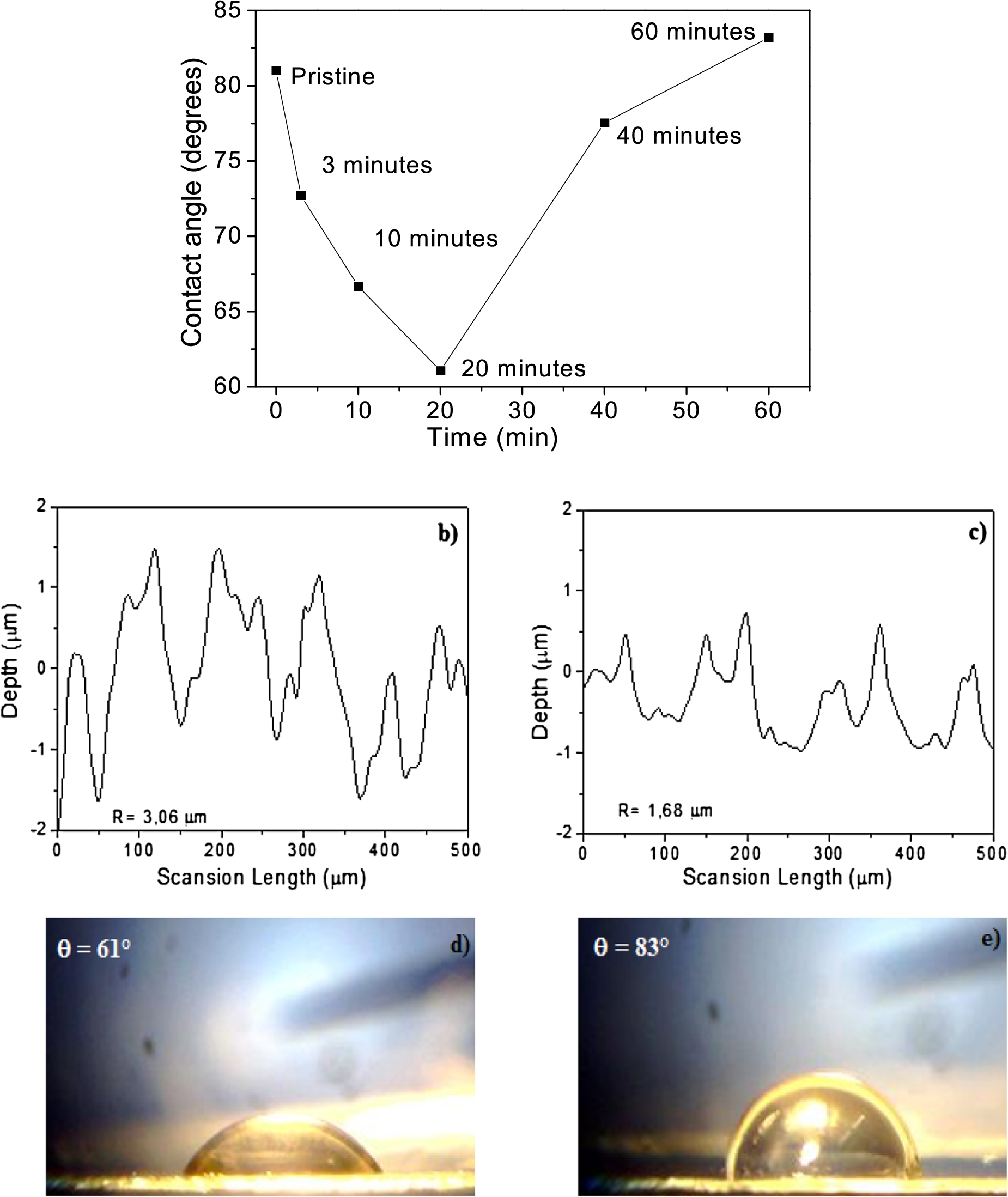
Ti contact angle vs. acid etching time (a) and roughness surface profiles with etching of 20 min (b) an of 60 min (c) and corresponding contact angle photos at 20 min (d) and 60 min (e).
The pulsed IR laser ablation modifies the surface roughness vaporizing the surface layers in dependence of the laser pulse energy, penetration depth and number of laser shots. Thermal processes are promoted by the high thermal conductivity and high laser intensity. Measurements, performed increasing the laser pulse energy, using a constant number of 100 laser shots, demonstrate that the surface roughness increases exponentially tending to a value of saturation, as reported in Fig. 5(a).
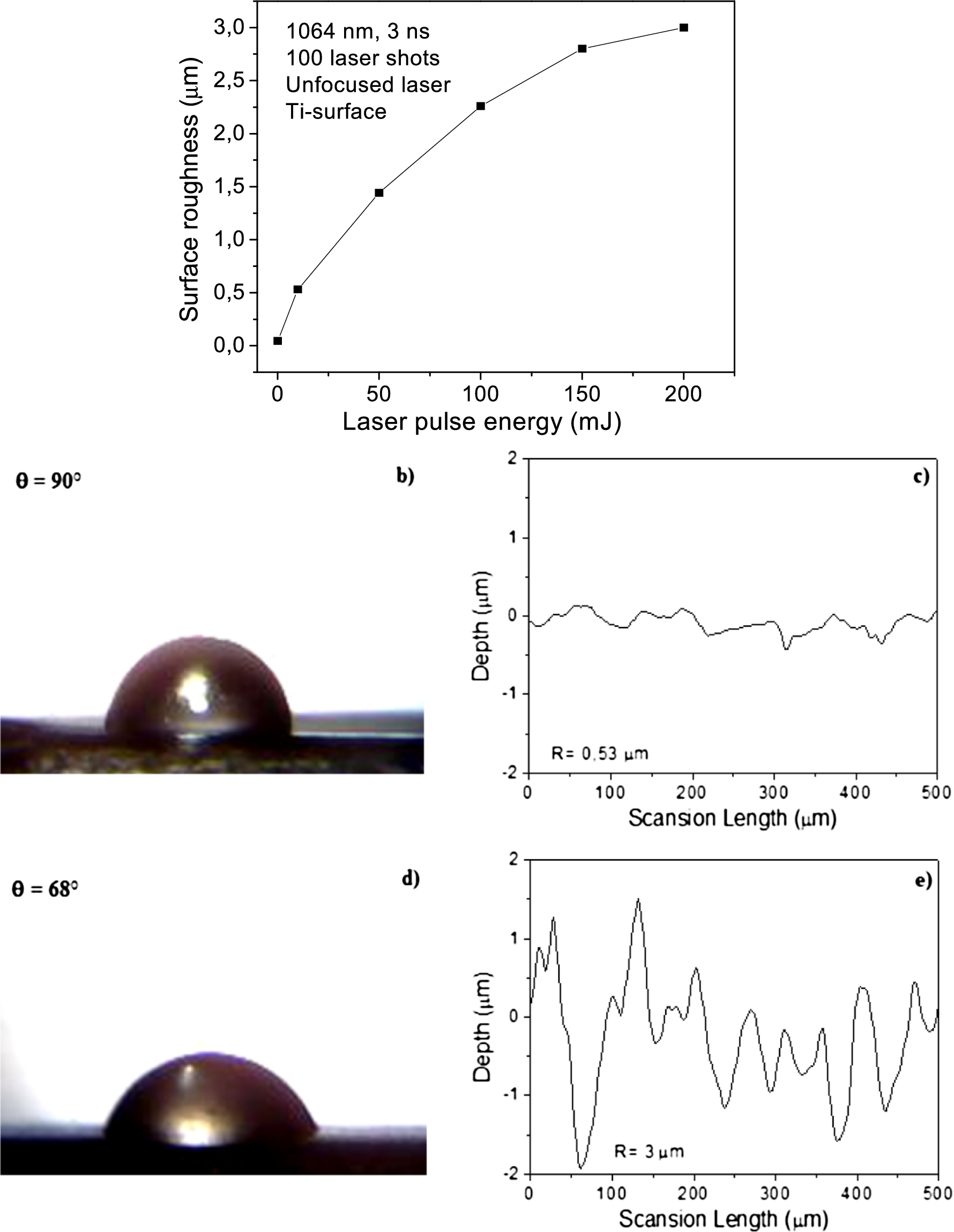
Ti roughness vs. laser pulse energy (a), contact angles using 10 mJ (b) and 200 mJ (c) and roughness profiles after laser irradiation at 10 mJ (d) and 200 mJ (e) for 100 laser shots.
The roughness profiles obtained using pulse energy of 10 mJ and 200 mJ are reported in Fig. 5(b) and 5(c), respectively. The average roughness of 0.53 μm and 3 μm is measured in the two cases, respectively. The corresponding photos of the water drop wetting are reported in Fig. 5(d) and 5(e), at which the contact angle of 90° and 68° is evaluated in the two cases, respectively. Thus measurements demonstrated that the pulse energy enhances the roughness and the wetting ability making the surface more wettable.
Using the Ar+ ion sputtering at low energy atoms are sputtered and removed in high vacuum from the surface. This process induces in the Ti target a flattening and surface leveling reducing the roughness with the irradiation dose enhancement. The surface reduction produces a less water wetting making the material hydrophobic properties. At the maximum ion dose of

Ti ion sputtered surface roughness (a) and relative contact angle measure (b).
Ti NP were produced in water by laser at a concentration of 5 mg/15 ml. They were employed in two different ways. The first way as solution drops, deposited by microsyringe on the Ti surface to measure the wetting ability of the solution with respect to the pure water. The second way consists in a thin solution layer deposition before the water evaporation. In this second case water drops were successively deposited to measure the contact angle with the new dry interface. In both cases measurements indicated a decrement of the contact angle up to about 50% with respect to the case without NP. Moreover the expected reduction of the surface roughness was not obtained. In fact the roughness of the surfaces containing Ti NP was increased. Figure 7(a) shows the pristine roughness (0.045 μm) while Fig. 7(b) that of this surface containing dry NP (
Recently literature reports interesting results on the wetting ability changes due to the use of different metallic nanoparticles embedded in the liquid or deposited at the solid-liquid interface [14].
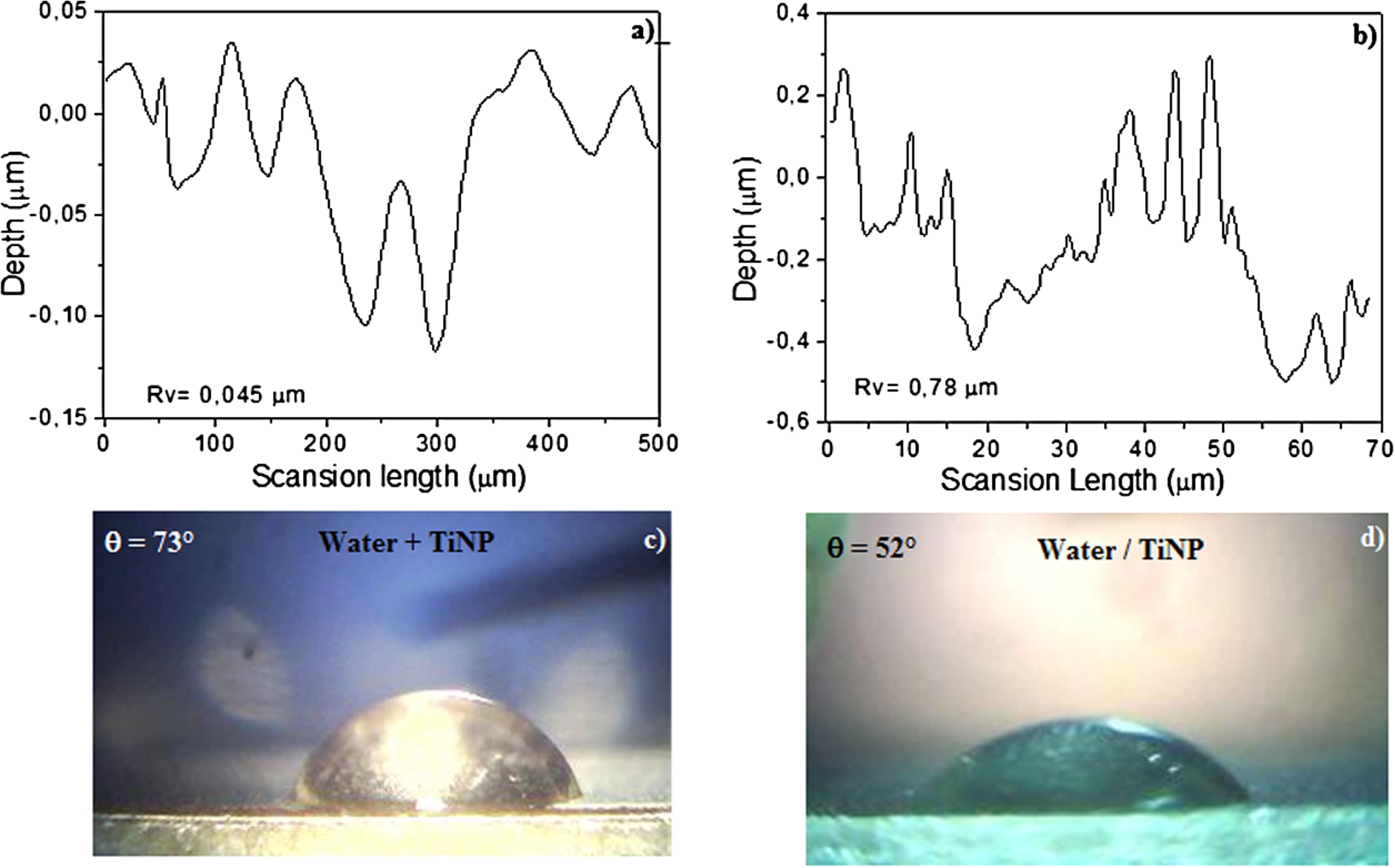
Roughness in the pristine Ti (a) and in the Ti on which Ti NP were deposited (b) and evaluation of the contact angle using the water + Ti NP solution (c) and of the distilled water on the Ti + NP dried surface (d).
The titanium wet-ability and adhesion to biological tissues depends on different parameters concerning physical, chemical and biological aspects. Not only the solid-liquid-gas interfaces play an important role in the determination of the contact angle, but also the chemical reactivity between the solid-liquid interface and the biological response to the osteoblasts colonization and their attachment to the metal surface have a determinant role. Moreover the action as catalyser may influence the growth of cells on the substrate titanium based, the activation of chemical reactions between titanium, oxygen, chlorine and other species, the absorption of gases in the metal at the body temperature, the charge accumulation during reactions and mechanical stress, the thermal expansion of grain contours and the wear may also generate morphological microscopic changes on the metal surface.
In this paper mainly only the physical aspects influencing the wetting ability of titanium are investigated.
The different surface treatments performed on titanium have demonstrated that it is possible to enhance the hydrophobicity using techniques of polishing, ion sputtering and prolonged chemical attacks, while it is possible to enhance the hydrophilicity using laser ablation, sandblasting, brief acid attacks and use of Ti NP in solution or deposited on the Ti surface. It was demonstrated that generally increasing the surface roughness increases the wetting ability, in agreement with similar investigations published on Aluminum substrates [15].

Contact angle as a function of the average roughness for different methods of titanium surface treatments (continuum line) and for wetting ability of water solution containing Ti NP (dashed line) and empirical relations between the two parameters.
Figure 8 reports a general trend of the result summary in terms of contact angle obtained by the different techniques of treatment as a function of the average roughness R of the titanium substrate. It is possible to observe that the contact angle, θ, is approximately linearly dependent on the average roughness, R, produced by the different treatments according to the empirical relation:
These results indicate that the biocompatible titanium surface submitted to appropriate treatment can be better adapted to the biological environment where it is implanted. This permits to enhance the efficiency of the implantable devices based on titanium. For example if implantable prosthesis must be used for long periods, such as for all life, and securely attached to the biological tissues, then the anchor with biological tissues must be promoted and better wettable surfaces allow more rapid and resistant cell colonization. In this case the decrement of the contact angle promotes the wettability and cell growth and tissue on the surface making it very firmly to surrounding tissues, thus treatments of brief acid attaches, sandblasting and laser ablation may result very useful to reach this goal. This is the case of knee prosthesis, hip replacement, orthopedic screws and brackets and dental implants [16].
On the contrary, if implantable prosthesis must be used for limited periods, such as for temporal tissue reconstruction, for fluid drainage, of for mobile prosthesis, which must guarantee the mobility of surfaces in the time, then it is best to use un-wettable surfaces, in order to reduce and slow cell growth on the prosthesis itself. It is the case, where Ti and its allows are employed for removable prosthesis construction, such as orthopedic screws, catheters, joints of mobile prosthesis and electrodes [17]. In this case the techniques of polishing, ion sputtering and prolonged acid attack can be employed to prepare titanium surfaces with high specularity and low wetting ability. Of course the titanium wetting ability or not ability is essentials in many other applications, such as for example in the welding processes (Ti–Ti, Ti–metal, Ti–ceramics), to enhance the melting adhesion, or in the use of containers of foods, liquids and medicines, in which case a maximum hydrophobicity is requested. Also the aspects concerning the physical-chemical effects influencing the wetting ability, correlated to the processes of oxydation, nitridation and titanium carbonization, electrical conduction in titanium, optical properties of Ti surface, porosity and grain contours depends strongly on the state of the Ti surface and must be considered for a greater understanding of wettability phenomena that the surface can arise in respect of a given liquid. Finally the biocompatibility and the response to the insertion of the titanium in the biological environment must be considered to know if the cell colonization is improved or inhibited depending on the Ti surface conditions.
The used treatments play a main role in the control of such aspects accurately, as further measurements in progress are demonstrating.
Conflict of interest
The authors have no conflict of interest to report.