



Abstract
BACKGROUND:
The chemical properties of the oral environment have an appreciable influence on the in vivo degradation of CAD/CAM materials.
OBJECTIVE:
The aim of the present study was to investigate the effect of organic acids, heptane and ethanol (the food-simulating liquids) on CAD/CAM restorative materials.
METHODS:
Four CAD/CAM materials were selected: (1) 3M ESPE LAVA Ultimate, (2) VITA Enamic, (3) IPS e.max CAD, (4) VITA Suprinity. Seven different samples were fabricated in 15 × 4 × 1.2 mm dimensions from each material (n = 7, N = 140). The materials were conditioned for 7 days at 37 °C as follows: artificial saliva, 75% ethanol, heptane, 0.02 N citric acid, 0.02 N lactic acid in aqueous solution and were tested to obtain flexural strength, surface micro-hardness and wear characteristics. After conditioning, the flexural strength values were assessed using a universal testing machine (1 mm/min crosshead speed) and the fractured samples were used for determination of Vickers hardness values using a digital micro-hardness tester (100 g/10 s) and determination of wear using a chewing simulator. Two factor analysis of variance with interaction model and Tukey’s post hoc test were used for statistical analysis.
RESULTS:
The highest mechanical property values were found for IPS e.max and VITA Suprinity and the lowest values were found for LAVA Ultimate. Organic acids negatively affected the mechanical properties of e.max CAD and Suprinity. Ethanol and heptane were more effective on LAVA Ultimate and Enamic. There were significant differences among groups (p < 0.05).
CONCLUSION:
The mechanical properties of CAD/CAM restorative materials are influenced by food-simulating liquids.
Introduction
In recent years, various CAD/CAM materials with superior aesthetic properties have been brought into use [1]. Besides aesthetics, ceramics have many advantages such as biocompatibility, wear resistance and chemical stability [2,3]. Ceramics produced for CAD/CAM systems are divided into 3 groups: 1: glass-matrix ceramics, 2: polycrystalline ceramics, and 3: resin-matrix ceramics [4]. As well as enhanced mechanical properties, it is necessary to constantly research and develop ceramics with appropriate aesthetics [5]. Glass- matrix ceramics, containing lithium disilicate and zirconia-reinforced lithium silicate materials, are presented to the market in pre-crystallised structure. The milling process becomes faster and easier due to the soft form of the materials. Crystallization by firing after the milling process increases mechanical properties [6,7]. Lithium disilicate and zirconia-reinforced lithium silicate ceramics are monolithic ceramics that have gained popularity in partial restorations and production of anterior-posterior single crowns due to their superior physical properties. It is suggested that 10% zirconia addition to zirconia-reinforced lithium silicate ceramics strengthens the ceramic structure by stopping crack formation and propagation [8].
In order to save clinical time, materials which have sufficient durability that do not need firing are produced. One of these materials is prefabricated polymerized resin composite blocks. LAVA Ultimate is produced as resin nano ceramic consisting of 20% resin matrix, 80% nano filler in weight. This restorative material is produced under high temperature and pressure leading to higher flexural strength and fracture toughness in comparison to light-polymerized resin composites [3,9]. Another resin-matrix ceramic is VITA Enamic, which is produced by polymer infiltration into ceramic network. Unlike resin composites, this material also has two interlocking network structures, one of which is a ceramic and one which is polymer. Low viscosity polymer is infiltrated into the network made by sintered ceramic particles [6,10].
Restorations are reported not only to pass through mechanical forces, but also to undergo chemical degradation. Restoratives are exposed to chemical agents in food and beverages in the mouth. Intermittent exposure occurs during eating and drinking, until the teeth are cleaned. Permanent exposure occurs in consequence of absorption of chemical agents by adherent debris present in the restoration margin and in consequence of bacterial degradation of debris (by lactic acid production). Diffusion of chemical agents to micro-cracks on the restoration surface can result in a faster deterioration [11].
In in-vitro studies, food-simulating liquids are used to evaluate chemical degradation of restoratives. The liquids approved by the FDA (Food and Drug Administration) are: heptane, which imitates fatty meat and meat products; vegetal fatty foods; ethanol, which imitates alcoholic beverages; and citric acid, which imitates foods such as fruits and vegetables. These fluids affect the mechanical properties of restorative materials [12].
Flexural strength is regarded as a basic parameter when fragile materials such as ceramics are evaluated. The 3-point bending test is still used as a standard test for measuring flexural strength [13]. Other important characteristics of dental materials include surface hardness and wear. The wear rate is defined as the loss of restorative material due to antagonist in contact. Surface hardness is the material’s resistance indicator to external forces [14].
In the literature, mechanical properties of CAD/CAM ceramics such as flexural strength, wear resistance and surface hardness have been investigated. However, the effect of chemicals in the mouth on the mechanical properties of CAD/CAM ceramics is unknown.
In this study, mechanical properties (i.e. flexural strength, wear resistance, surface hardness) of 4 different CAD/CAM materials are analysed in 4 different chemical solutions. The null hypothesis is defined as: different chemical solutions have no effect on the mechanical properties of different CAD/CAM materials.
Materials and methods
The CAD/CAM ceramics investigated in this study are listed in Table 1. The prefabricated CAD/CAM ceramic blocks were cut (15 mm length, 4 mm width, 1.2 mm depth) to a total of 140 samples from each ceramic using a low-speed diamond saw (Isomet 1000, Buehler, Lake Bluff, IL, USA). IPS e.max CAD and VITA Suprinity samples were fired for crystallization (Programat P100; Ivoclar Vivadent) according to the manufacturer’s recommendations. All sample surfaces were polished by using SiC emery paper with 1200 and 2000 mesh grit with an electric handpiece at 300 rpm under with hand pressure and water cooling, respectively.
Ceramics used in the study
Ceramics used in the study
Samples were randomly divided into five groups according to chemical solutions. The solutions were: distilled water, 0.02 N citric acid, 0.02 N lactic acid, 75% ethanol-water solution and heptane.
Randomly assigned samples were immersed into their solutions for 1 week at 37 °C. Chemically degraded samples were tested with three-point bending test to obtain flexural strength. Then the samples were used for wear and surface hardness tests. Seven samples from each group were placed on metal fixture with a 12 mm wing span and samples were fractured with 1 mm diameter cylindrical tip mounted on a universal testing machine (Instron 3344, Instron Corporation, Canton, MA, USA). The crosshead speed of the tip was 1 mm/min. The fracture loads were recorded and flexural strength values were calculated according to the following formula:
The hardness values of samples were measured by using a micro-hardness tester (Future-Tech FM-800e, Future-Tech Corp., Kanagawa Prefecture, Japan) under 100 g load with 10 seconds dwell time using Vickers method.
Finally, CAD/CAM ceramic samples and steel antagonists (4 mm in diameter) were mounted in a dual-axis chewing simulator (MOD Dental Chewing Simulator, Esetron, Ankara, Turkey). A loading force of 49 N with 40 mm/s vertical speed, 20 mm/s lateral speed, 2 mm vertical movement, and 0.7 mm lateral movement (frequency ∼1 Hz) was applied to each ceramic sample and 240,000 loading cycles were performed. Cold/hot (5 °C/55 °C) water was pumped respectively to sample containers during the chewing test with 60 seconds dwell time. 3D images of the worn surfaces were obtained with a stylus profilometer (P7, KLA-Tencor, San Jose, CA, USA). The vertical material loss (μm) of each sample was recorded.
Data were analyzed with two factor analysis of variance with interaction model using a statistics software (SPSS 20, IBM Corp., Armonk, NY, USA).
Mean surface hardness, wear, and flexural strength values after degradation are shown in Figs 1–3. The highest mechanical property values were found for IPS e.max and VITA Suprinity and the lowest values were found for LAVA Ultimate. Organic acids negatively affected the mechanical properties of ceramics except Lava Ultimate. The flexural strength values of Lava Ultimate were not significantly different among all groups (p > 0.05). Distilled water and citric acid were not different for Lava Ultimate surface hardness groups (p > 0.05). There were significant differences among other groups (p < 0.05). In heptane solution, surface hardness and flexural strength of e.max CAD and VITA Suprinity was increased. (p < 0.05).
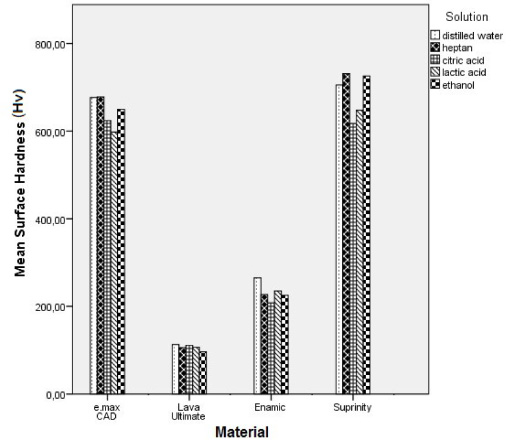
Mean surface hardness (Hv) of CAD/CAM materials immersed in different solutions.
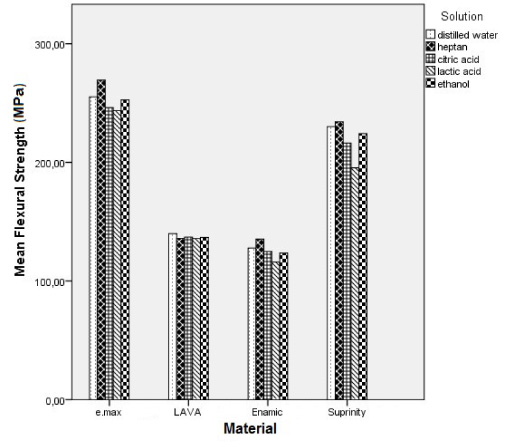
Mean flexural strength (MPa) of CAD/CAM materials immersed in different solutions.
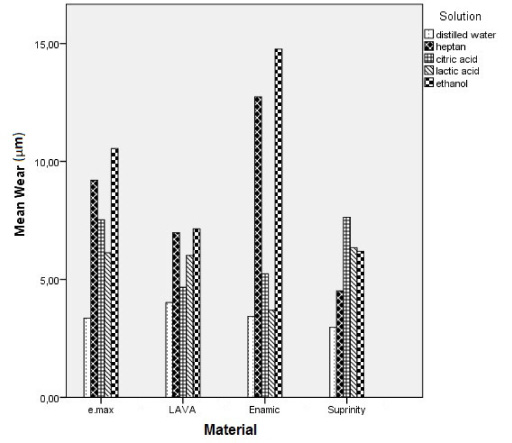
Mean wear (vertical loss-μm) of CAD/CAM materials immersed in different solutions.
In this study, chemical agents recommended in the FDA Guidelines (i.e. heptane, ethanol, citric acid, lactic acid) are used as food simulators. Distilled water is used as the control group. Hardness of a material is defined as resistance to permanent indentation and penetration.
Hardness in ceramics affects polishability, wear resistance and milling ease [15]. Chemical softening of restorative materials may result in a decrease in the physico-mechanical properties and operating time [16,17]. Despite the fact that restorative materials are not exposed to any mechanical forces, dissolution and chemical reaction may cause a decrease in their hardness [11]. The greatest change in the hardness occurs within the first 7 days [18]. For this reason, samples are immersed for 7 days in food-simulating liquids in this study.
Flexural strength is another important mechanical property in evaluating the strength of fragile structured ceramics. Ceramics are weaker to tensile forces in comparison to compression forces [5]. Wear resistance depends on the structure of the dental material and is regarded as a property that affects the life and quality of the material against abrasive forces [19,20].
To the authors’ knowledge, there are studies that investigate the mechanical properties of different types of ceramics, but no studies have investigated the effects of food-simulating liquids to mechanical properties of ceramics in the literature. In the present study, it has been seen that food-simulating liquids have some adverse effects on the mechanical properties of CAD/CAM ceramics when compared to distilled water, but there may be exceptional cases. This exception is seen as an increase in the surface hardness and flexural strength of glass- matrix ceramics that are immersed in heptane solution. Similarly, 75% ethanol-water solution increases the surface hardness of the VITA Suprinity. It is acceptable that these two organic solvents (heptane and ethanol) may not have a negative effect on glass-matrix ceramics. The positive effect on mechanical properties may depend on the number of carbon atoms in the solution. Yoshida et al. [21] have found that hardness values of different ceramics in the heptane solution are higher than those in the water and suggested that hardness is directly proportional to the increase of the carbon atoms in the solution. In the present study, heptane (C7H16) has also increased surface hardness in glass-matrix ceramic materials. Ethanol (C2H5OH) increases the surface hardness of VITA Suprinity while reducing surface hardness of e.max CAD.
Glass-matrix ceramic samples that are immersed in distilled water have presented more superior mechanical properties than resin-matrix ceramics. Similar to the findings of our study, Lawson et al. [6] and Goujat et al. [22] have investigated surface hardness and flexural strength values of different CAD/CAM ceramics. Consequently, they have found that e.max CAD>Enamic>LAVA Ultimate in terms of surface hardness, and e.max CAD>LAVA Ultimate>Enamic in terms of flexural strength. Likewise, Leung et al. [15] have found that e.max CAD exhibits better mechanical properties than Enamic. A study by Elsaka and Elnagy [5] has concluded that the VITA Suprinity has superior flexural strength and surface hardness compared to e.max CAD. In the present study, while the surface hardness of the VITA Suprinity has been higher than e.max CAD, its flexural strength has been lower than e.max CAD. The hardness is only related to surface, flexural strength is an indicator that can be used to measure the whole material. The presence of more micro-cracks in the structure of VITA Suprinity may explain this result.
In the present study wear resistance has formed as VITA Suprinity>e.max CAD>Enamic>LAVA Ultimate. While it is evident that glass-matrix ceramics are more resistant, Lawson et al. [6] suggested that resin-matrix ceramics are less abrasive than e.max CAD (LAVA Ultimate>Enamic>e.max CAD). However, Nauvoma et al. [23] concluded that the VITA Suprinity is more resistant to wear than the LAVA Ultimate, but is more sensitive to wear than the Enamic. Mormann et al. [24] have found no significant difference in wear resistance among e.max CAD, Enamic and LAVA Ultimate. All these complex results can emerge depending on the different wear tests and different antagonists used in the tests. Wear tests conducted in the laboratory may not show the exact clinical condition. Vanoorbeek et al. [25] have found in 36-month clinical follow-up study that composite CAD/CAM crowns fail due to poor aesthetic and wear resistance. While five of 59 composite CAD/CAM crowns have failed due to excessive wear, ceramic CAD/CAM crowns have not failed in terms of wear.
In this study, the effect of weak acids has increased depending on the proportion of ceramics in the structure. The greater influence of glass-matrix ceramics from acids may occur due to the fact that the polymer structures of the resin-matrix ceramics are relatively unaffected by the acids. Acids cause the structure to become weaker reaching the inner zone along the micro-cracks in the structure of the glass-matrix ceramics, as well as causing a limited degradation on the surface. Kukiattrakoon et al. [26] have concluded that 4% acetic acid has significantly reduced surface hardness of different ceramics in their study.
LAVA Ultimate showed the greatest reduction in hardness in 75% ethanol-water solution compared to other materials. This can be explained by Bis-GMA included in its structure. Ethanol solution causes accelerated aging of restorations including Bis-GMA [27,28]. Absence of Bis-GMA in the structure of Enamic enables ethanol solution not to be very effective in terms of surface hardness. Heptane, another organic solvent like ethanol solution, has also reduced surface hardness of resin-matrix ceramics, unlike glass-matrix ceramics [11]. Ethanol causes partial degradation in the material surface, softening polymer matrix [27]. This degradation causes deterioration in matrix and filler interface, resulting in a decrease in hardness value. Also in the present study, surface hardness values of LAVA Ultimate and Enamic decreased after waiting in ethanol solution. This can be explained by the material surface degradation caused by ethanol.
Conclusion
According to the results obtained from samples immersed in distilled water, mechanical properties of glass-matrix ceramics are more superior than those of resin-matrix ceramics. While weak acids weaken the structure in glass-matrix ceramics, they do not cause a significant difference in resin ceramics when compared to other solutions. While heptane and ethanol affect mechanical properties of resin-matrix ceramics negatively, they are occasionally observed to increase mechanical properties of glass-matrix ceramics.
Footnotes
Conflict of interest
None to report.