



Abstract
BACKGROUND:
The selection and validation of age- and gender-specific criterion-referenced cut-points for abdominal endurance are still unclear.
OBJECTIVE:
To stablish normative values for abdominal endurance in adolescents by age and gender using the Bench Trunk Curl-up Test (BTC). Additionally, the reliability of the BTC was analyzed.
METHODS:
Two hundred and sixteen untrained high school students (104 males
RESULTS:
Males showed higher BTC scores than females (males: 90.07
CONCLUSIONS:
Gender, but not age, is an important factor when abdominal endurance is compared between adolescents. Finally, the BTC is a reliable test, supporting the findings of this study. However, an extensive familiarization period to reduce the learning effect is necessary.
Introduction
Trunk field tests are common elements in educational, clinical and sport settings, as trunk muscle function has been related to low-back pain prevention/rehabilitation [1, 2, 3, 4, 5, 6, 7] and sport performance [8, 9, 10]. In general, these protocols require minimal and inexpensive equipment, do not need sophisticated data processing, and are simple to employ in groups of subjects.
Due to the fact that trunk muscle strength/power protocols normally require the use of a dynamometer (e.g., isokinetic dynamometer) [11, 12, 13, 14, 15], which is not common in field settings, most trunk field tests have been developed to measure trunk muscle endurance [1, 2, 5, 16, 17, 18, 19]. There are three main kinds of trunk endurance field tests: a) “timed” protocols, which consist in performing the maximum number of trunk motions possible (e.g., curl-ups, cross-curl-ups, or sit-ups) in a given time (30–120 s) [16, 18, 19, 20, 21]; b) “cadence” protocols, consisting in the maintenance of a certain cadence while executing trunk flexion or extension motions for as long as possible [20, 22]; and c) “isometric” protocols, which basically consist of maintaining a prone, supine, or lateral posture against gravity until exhaustion [5, 23, 24].
Based on the relationship between trunk muscle endurance and low back health [5, 25], trunk curl-up or sit-up tests are common components of most international batteries of youth fitness tests [26, 27, 28, 29, 30, 31]. These batteries show normative data stratified by age and percentiles for both genders [30, 32, 33, 34, 35], which are normally used to assess and compare the health-related trunk muscle performance of young people according to test scores and ages. Although this may provide important information to coaches, physical educators, and health professionals for prescribing abdominal exercise programs according to the participants’ ages, scientific evidence supporting the relationship between trunk test scores, health status, and age is lacking [36]. In this sense, Dejanovic et al. compared the trunk flexion endurance of a sample of adolescents between ages and genders [37] and interestingly, they found no significant differences by age or gender, nor significant age*gender interaction. This does not seem to support the stratification of the trunk muscle endurance test scores by age and gender used in the international batteries of youth fitness tests.
In this study, a timed curl-up test, i.e., the Bench Trunk Curl-up Test (BTC test) [16, 18] was used to assess the abdominal dynamic endurance of male and female adolescents between 14 and 18 years of age. The main purpose of this study was to compare the BTC test scores between ages and genders, in order to clarify if abdominal muscle endurance changes throughout adolescence in males and/or females. Additionally, as only relative reliability of the BTC test has been previously analyzed [intraclass correlation coefficient (ICC)
Descriptive characteristics of the participants by age and gender
Descriptive characteristics of the participants by age and gender
Participants
Two hundred and sixteen high school students (104 males and 112 females; 16.26
A lateral view of a participant performing the bench trunk-curl test: a) Initial position; b) The forearms touch the thighs in the lifting of the trunk.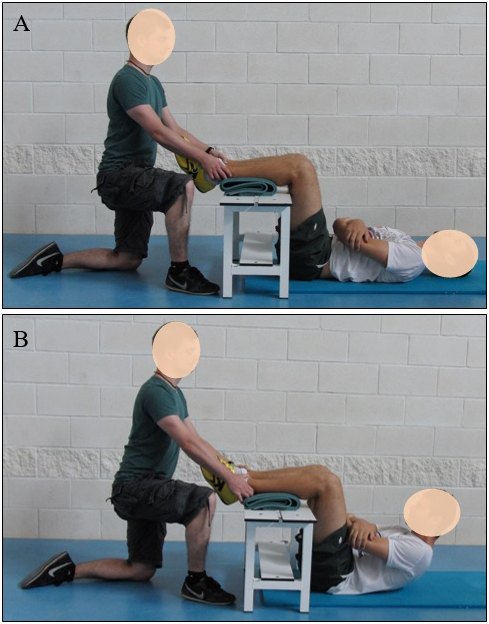
The BTC test is a timed protocol [18] which consists in carrying out the maximum number of trunk curl-ups possible in 2 min. To perform the test, the subject is lying supine on a semi rigid mat, with knees and hips flexed to 90°, arms crossed over the chest and hands grasping above the opposite elbow (Fig. 1A). In this position, the subject performs an upper trunk flexion, sliding their forearms over the abdomen until they touch their thighs (Fig. 1B) and then returns to the starting position. Participants were neither encouraged nor informed about the number of repetitions accomplished until the end of the study.
Procedures
Before test administration the participants performed
a 60-min familiarization session in which the main researcher showed the proper achievement of the most usual trunk exercises (crunch, cross-crunch, planks, etc.) and explained the experimental protocol and demonstrated the correct test execution. In this session, participants did not perform the test, but they only carried out 10 repetitions to familiarize themselves with the basic technique of the test. One week later, the BTC test was performed in two different sessions (T1, T2), separated by 72 h and conducted at the same time of the day for each participant. All sessions were conducted by a physical education teacher and a researcher who controlled the correct execution of the test in the fitness rooms of three Spanish high schools during the first semester of the Physical Education program. Therefore, a registration schedule considering the student’s high school calendar was established.
In order to reduce the interference of uncontrolled variables, the participants were encouraged to maintain their usual lifestyle and a good sleep routine throughout the study. In addition, they were told not to perform a work-out session at least 12 h before each testing session and not to eat-drink excessively prior to testing.
Statistical analyses
Standard statistical methods were used to calculate the mean and standard deviation of the number of repetitions achieved in the BTC test (abdominal endurance) for each testing session. The 216 adolescents were subsequently grouped into four levels of endurance capacity: less than the 25th percentile represented poor endurance, between the 25th and 49th percentile represented an average endurance, between the 50th and 74th percentile was considered as good and above the 75th percentile was considered as optimal endurance. The mean, standard deviation and percentile scores were calculated by gender, age and age
Between-subject two-way ANOVA (age * gender) was used to determine if there were baseline differences among the participants’ characteristics (height and mass) before test administration. Where applicable, Bonferroni’s post hoc analyses were used.
A 3-way repeated-measures ANCOVA, with session (T1 and T2) as the within-subjects factor, age (14, 15, 16, 17, and 18 years) and gender (male, female) as the between-subject factors and mass and height as covariates, was calculated to explore the differences between males and females and between age groups throughout the sessions (T1 and T2). Where applicable, post hoc analyses were performed using the Bonferroni test.
Reliability analyses
The relative reliability was analyzed though the ICC
The absolute reliability of the BTC test was measured through the change in mean, typical percentage error (% within-subjects variation) and the minimum detectable change which was calculated as 1.5 times the typical error with a chance of 75% (MDC
Mean (
standard deviation) scores and percentile reference values for BTC test by gender
Mean (
Reps: repetitions.
Absolute and relative reliability values for BTC test by gender
Reps: repetitions; CL: Confident limits; MDC: Minimum detectable change; ¥ very likely positive; *Significance
A magnitude-based inference analysis based on the test and sex, through a paired samples t-student test was used to interpret the change in mean in a qualitative way, using a spreadsheet previously designed by Hopkins [42]. The change in the mean between sessions for each participant and sex was expressed as a percentage of initial scores through the analysis of log-transformed data to reduce the non-uniformity of error. In addition, the analysis determines the chances that the true effects are substantial or trivial when a value for the smallest worthwhile change is entered. The standardized difference of 0.2 multiplied by between-subject standard deviation obtained has been previously suggested as the smallest worthwhile change to interpret changes in athletes [43]. However, based on the authors’ extensive practical experience, this difference of 0.2
An alpha level of 0.05 was considered significant for these analyses. Statistical analyses were performed with PASW Statistics v.18 (SPSS Inc., Chicago. IL).
Regarding the participants’ anthropometry (Table 1), males showed higher mass (
Number of repetitions in the BTC test by gender and age group. *Significance: 
The ANCOVA showed no differences in the mean BTC test scores between age groups (
As there were no significant differences by age groups, mean and standard deviation test scores, percentile reference values (Table 2), and absolute and relative reliability data (Table 3) for the BTC test are only displayed by gender.
Concerning the reliability of the protocol (Table 3), the ANCOVA found significant differences for the mean BTC test scores between sessions (T1
Regarding the between gender comparison, males showed higher BTC test scores than females (
Although most international batteries of youth fitness tests show normative data of trunk flexor endurance by age and gender [30, 32, 33, 34, 35], no significant differences were found for the BTC test scores between age groups, nor gender
Consistency analyses were performed to determine whether the lack of differences between age groups could be due to low levels of BTC test reliability and also to improve the knowledge about the characteristics of this protocol. In this sense, the ICC values calculated between both assessment sessions were high (ICC
On the other hand, the absolute reliability analysis reported a typical error test-retest of 17.21% for the whole sample (males: 18.23%; females: 16.21%). This value is similar to those found in most absolute reliability studies of abdominal endurance field tests [19, 21, 22, 24, 52]. According to the minimum detectable change (25.32% for all participants; males: 27.34%; females: 24.31%), relatively large changes would be necessary in the BTC test scores to ensure with certainty that a real change in trunk flexor endurance has occurred as a result of an intervention rather than a measurement error. This is a common limitation of most field tests in sport science [19, 21, 22, 24, 52], which might question the absolute consistency of these protocols. Therefore, the BTC test does not seem appropriate to monitor the trunk muscle endurance progress in high performance athletes, whose fitness increases are normally low [54]. However, analyzing the moderate worthwhile effect (0.6
Timed curl-up tests generally require a long familiarization period to learn the technique, mainly the optimal cadence [19]. Although a familiarization session was performed one week before testing sessions, the change in mean BTC test scores between T1 and T2 was 12.66% (males: 14.64%; females: 10.86%), being significant in all cases and thus, showing a small learning effect in test-retest execution. Consequently, a familiarization session seems not to be sufficient to obtain stable BTC test results that allow decisions to be made on the basis of the participants’ real fitness status. On the contrary, a longer familiarization period and perhaps, a shorter time between familiarization and testing session appears to be necessary to allow participants to learn the correct BTC test technique as well as their optimal execution cadence before the testing session. In this sense, in a previous study on a similar abdominal endurance timed test (Flexion-rotation trunk test), participants needed three test executions to render the learning effect negligible [19].
Several limitations exist as to the interpretation of the data in this study. Differences in number of participants between age groups (Table 1) and the great between-subject variability in the BTC test scores (see Fig. 2), could have affected between-group comparison. In addition, as mentioned in the previous paragraph, a familiarization session was not enough to control the learning effect, therefore deficiencies in the execution technique and/or cadence of some participants might have affected the comparison between age groups. Finally, during the execution of the BTC test, it was observed that some participants had to flex the hip and raise the lumbar area from the mat in order to touch their thighs with their forearms, while others only required a trunk flexion. These differences between participants could have affected the comparison between age groups or sex because the subjects who had to flex the hip required a greater effort to perform each repetition. Therefore, caution should be taken when interpreting the results of this study.
Conclusions
The BTC test is a reliable test for assessing dynamic abdominal endurance and safer than sit-up tests [21, 25, 55] because it allows the isolation of the abdominal muscles minimizing iliopsoas activity, although a slight adaptation of the test to the participants’ anthropometrics characteristics would be recommended. This study provides a normative database of trunk flexor endurance in male and female adolescents aged 14–18 years. We found significant differences in BTC test scores between genders, but not between age groups, which does not support the stratification of the trunk flexor endurance test scores by age used in the international batteries of youth fitness tests. Further research with a larger population is needed to understand the relationship between trunk muscle fitness and health better and to establish age- and gender-specific criterion-referenced cut-points for trunk flexion endurance measures.
Regarding the consistency of the BTC test, the relative reliability of this protocol was high, which allows us to rank the trunk muscle performance level of each participant relative to those of others with similar characteristics [39]. However, as in most trunk field tests [17, 24], the lack of absolute reliability of the BTC test does not support the use of this protocol in high-performance sport, in which it would be difficult to distinguish between real changes and measurement errors. Due to the increase in the BTC test score from T1 to T2, it seems necessary to perform an extensive familiarization period to reduce the learning effect.
Footnotes
Acknowledgments
This study was made possible by financial support from: Ministerio de Ciencia e Innovación (Plan Nacional de I
Conflict of interest
None to report.