



Abstract
BACKGROUND:
Core-strength is vital for Greco-Roman wrestling, although studies have yet to establish the effectives of core-specific training in this sport.
OBJECTIVE:
To examine the effect of core-specific strength training on determinants of Greco-Roman wrestling performance in elite junior athletes.
METHODS:
Twenty state-level, junior, Greco-Roman wrestlers were randomized into a core-specific training group (COR;
RESULTS:
The COR group demonstrated significantly greater improvement in bridges (
CONCLUSION:
Accordingly, core-specific training programs should be combined with wrestling-specific conditioning programs to improve back and hip extensor performance in junior Greco-Roman wrestlers.
Introduction
Greco-Roman wrestling originated during the early 19th century as a martial art sport, and has since gained global popularity, with millions of athletes participating in various international competitions from children to seniors [1]. The match of Greco-Roman wrestling involves a range of repetitive, explosive maneuvers for a ‘take down’ (i.e., driving the opposition wrestler onto the mat) to receive a score. Thus, Greco-Roman wrestlers require a substantial level of upper and lower body strength and muscular endurance, muscular power and efficient recovery dynamics to perform optimally [2]. Moreover, core strength and endurance has been considered as one of the key physiological attribute for wrestlers in order to resist the sheer forces acting on the spine during carrying, pushing, pulling and swaying movements [3]. This phenomenon is supported by the ‘serape effect’, where the orientation of the core musculature (i.e., rhomboids, serratus anterior, external obliques and internal obliques) links the upper extremity, trunk and lower extremity anteriorly to execute trunk rotational motions via the stretch-shortening cycle mechanics [4]. In addition to dynamic movements, sustaining body control through means of isometric core strength in challenging positions also augments the defensive performance of wrestlers [3]. Subsequently, Greco-Roman wrestlers may benefit from additional core-strengthening programs to optimize performance and reduce risks of injuries.
Core-specific exercises are in fact becoming increasingly popular amongst fitness professionals, with several studies supporting that these exercise modes increases core strength, reduces the risks of injuries, and assists with rehabilitation [5, 6, 7]. However, the effects of core exercises on athletic performance in sports are still relatively underresearched, and there is limited information available to assist with the development of core-strengthining programs. Indeed, Parkhouse and colleagues [8] compared the effects of a 6-week dynamic versus static core-strengthening program on field-based fitness measures. The results showed that both core-strengthening program increased core strength measures (i.e., plank and back extensions), although these improvements were not transferred to field-based testing measures (i.e., medicinal ball throw, vertical jump and sprint). However, the authors highlighted that the lack of transfer to field-based performance measures may be due to limited sample size, as they only assigned 6 participants in each group. In addition, the sample was heterogenous, with participants of various sporting backgrounds. Incorporating a homogenous sample of athletes that efficiently utilize the ‘serape effect’ similarly (e.g., martial arts athletes), may improve transferability of improved core strength to skill-specific performance.
In a recent martial arts study, Lee and McGill [9] examined the effects of a 6-week core-strengthening program on distal limb performance during ballistic strike maneuvers. In this study, Muay Thai fighters were separated into an isometric core-strengthening group, dynamic core-strengthening group and a control group who were exempt from core-specific exercises. The results showed that both the isometric and dynamic core-strengthening groups improved limb velocity and force production during ballistic strike maneuvers. This was further supported by increased activation of the core musculature during the strike maneuvers, suggesting that greater engagement of the core may have contributed to improvement in striking performance. However, Lee and McGill [9] only examined speed and muscular force production measures of the upper limbs, with no reference to muscular endurance (i.e., the ability to repeated perform explosive tasks using the core musculature). In addition, applying these findings to Greco-Roman wrestling is difficult given that the sport primarily requires grappling, rather than striking maneuvers, thus the biomechanical demands are quite distinct. To date, no study has examined the benefits of core-strength and endurance exercises in Greco-Roman wrestlers. Therefore, this study aimed to investigate whether inclusion of a progressive, 4-week core-strengthening program improves determinants of wrestling performance in state-level youth Greco-Roman wrestlers. It was hypothesized that the core-strength and endurance program will significantly improve determinants of wrestling performance in state-level youth Greco-Roman wrestlers.
Materials and methods
Research design
The current study was a randomized controlled study, in which twenty-four state-level Greco-Roman wrestlers were randomly assigned into a core-specific training group (COR;
The pictures display the Suplex performance test with the following steps: A) wrapping the arms around the opponent’s midsection slightly above the umbilicus from behind; B) assuming a ‘seated’ position by flexing at the hips and knees to position the lower extremity and hips under the opponent’s hips; C) extend through the ankles, knees and hips to lift the opponent off the floor while hyper-extending the lower back, trunk and cervical region to create and ‘arch’; and D) drive the opponent’s body overhead while maintaining the weight on the toes, while maintaining the ‘arched’ position in the lower back, trunk and cervical region. 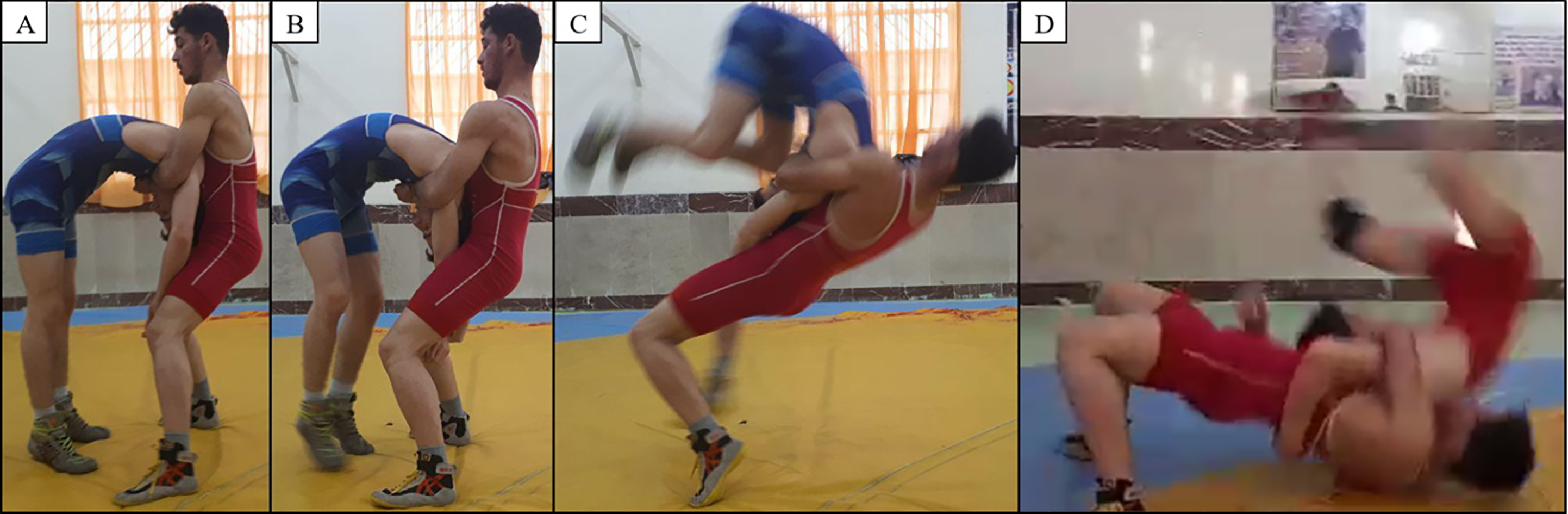
Twenty state-level male Greco-Roman junior wrest- lers (age
Core stability exercises performed three times a week after every wrestling sessions
Core stability exercises performed three times a week after every wrestling sessions
The pictures display the exercises performed as part of the core-strengthening program, including the following: A) forearm plank with added weights on lumbar region; B) side plank with added weights on hips; C) reverse plank with added weights on abdomen; and D) standing one-arm lateral dumbbell hold. 
Prior to the commencement of the experimental intervention, all participants were familiarized with the full body muscular power and wrestling-specific performance measures, which included: overhead med- icine ball throw (OMBT) using a 5 kg medicine ball; medicine ball chest throw (MBCT) using the same medicine ball as OBMT; the maximum number of Suplexes performed in 30 seconds; and maximum number of Bridges completed in 30 seconds. In addition, each testing session was preceded by a standardized 5-minute warm-up by jogging for 2-minutes, followed by dynamic stretches and completed with sport-specific exercises that replicated movement patterns specific to the physical assessments. Following consensus with 6 different state-level Greco-Roman coaches in Iran, these physical performance tests were selected as determinants of Greco-Roman wrestling-specific performances. For example, the Suplex is an important maneuver in Greco-Roman wrestling as this technique requires athletes to lift, bridge and slam the opponent on his/her back [10], ultimately leading to a score. This technique requires powerful extensors of the ankles, knees and hips, and the ability to optimize transfer of force from the lower to the upper body in Greco-Roman wrestlers [11]. Given that assessing the explosive power (i.e., Watts) of Suplexes was not logistically possible, and that Greco-Roman wrestlers are expected to repeatedly perform this type of maneuver during a match [10], the current study assessed Suplex performance based on the number of repetitions completed in 30-seconds for muscular endurance (refer to Fig. 1 for description of the assessment). To allow equivalent task constraints across testing sessions, the same opponent was used during the pre-post testing periods. Furthermore, all athletes were completely familiar with this type of exercise, as they undertake this specific movement execution during practice and match. For the Bridges, the number of repetitions completed in 30-seconds was recorded to further assess muscular endurance of the hip and back extensors, as this movement pattern is an essential component of performing a Suplex [3]. The OMBT was conducted consisting of downward and upward phases of the movement [12]. In the starting position, the participants stood upright with their feet shoulder width apart and heels aligned at the starting line whilst carrying the medicine ball. During the downward phase of the movement, the participants slightly flexed at the knees and trunk whilst positioning the medicine ball in-between their lower limbs. During the upward phase, the participants undertook a triple extension maneuver through their ankles, knees and hips whilst thrusting the medicine ball overhead. The participants were encouraged to minimize the time in-between the downward and upward phases of the movement to optimize the stretch-shortening cycle mechanics. For the MBCT, the participants sat on a chair and threw the medicine ball using a chest press maneuver [13]. During this protocol, the participants were encouraged to extend and flex at the hips to optimize the stretch-shortening cycle mechanics. The athletes were allowed three attempts for both the OMBT and MBCT, with approximately 1-minute of rest in-between, and the greatest distance recorded. Both the OMBT and MBCT are physical performance tests that are typically used in Iran to evaluate athletic performance of Greco-Roman wrestlers. Furthermore, medicine ball throw is shown to be a valid and reliable test for assessing explosive power and general athletic ability in volleyball players, who also require explosive power [14].
Mean
standard deviation of front throw, backward throw, Suplexes and Bridges for the core training (COR) and control (CON) group
Mean
Effect size calculations between time points (pre vs post) for the core training (COR) and control (CON) group and between groups (COR vs CON)
Both experimental and control group athletes completed their routine wrestling training three times per week for the entire study period. In addition to the routine wrestling sessions, the experimental group completed core-training exercises after each wrestling session. The core-training exercises included forearm plank, side plank, reverse plank, and standing one-arm lateral dumbbell hold (refer to Fig. 2 displaying each exercise) with the training intensity and/or volume gradually progressing during the course of the training period (Table 1). Side plank and standing one-arm dumbbell hold were completed for both right and left sides. An external load was placed on the gluteus maximus during forearm plank, on the lateral side of hips during side plank, and at the front of hips during reverse plank. Each participant in the experimental group completed three sets of each core exercise with approximately 1–2 minutes of rest in-between each set.
Statistical analysis
Data were analysed using SPSS version 25.0 (SPSS Inc, Chicago, IL, USA). A two-way (group x time) repeated measures analysis of variance (ANOVA) with LSD to determine differences in performance measures between group (i.e., CON and COR groups), time points (i.e., baseline vs post-intervention) and the interaction of these factors. Effect sizes (Cohen’s d) were calculated to determine the magnitude of differences between pre- and post-intervention time points and between groups using pre-post percentage change with 0.2 considered as a small ES, 0.5 as a moderate ES and
Results
The mean
The mean 
Whilst no interaction effects were found for Suplex (
The results of the current study showed that a 4-week core-specific training program improved muscular power and endurance during overhead and chest press, thrusting maneuvers, which are pertinent for Greco-Roman wrestling. Thus, core-specific training combined to a wrestling-specific periodized conditioning program may provide Greco-Roman wrestlers with an avenue to optimize match performance.
The results of the current study demonstrated that isolated, core-specific training improved OMBT and Suplexes, which require explosive, backward thrusting movements considered essential during wrestling [15]. Parkhouse and colleagues [8] also examined the effects of core-specific training on various field-based tests, including OMBT. According to their findings, an improvement (2.9%) in backward overhead medicine ball throw was observed for the static group, with no changes in the dynamic group. Contrarily, the magnitude of improvement in the current study was substantially greater in OMBT (21.9%), and at a statistically significant level. Several differences in the methodological approach may justify the discrepancies in findings between the current study and that by Parkhouse et al. [8]. Firstly, the current study incorporated 12 highly trained junior wrestlers for the COR group, with identical training sessions for all athletes given that they were part of the same team. On the other hand, Parkhouse and colleagues [8] only incorporated half the number of participants in the static (
The improvement in OMBT measures for the COR group suggests that the core-specific training intervention increased muscular power during back extension maneuvers. This is an important finding for Greco-Roman wrestlers, given that a high level of muscular power transferred from the lower to the upper extremity is required to push and lift the opponent off the floor during wrestling [17], which necessitates explosive, resistive, back extension maneuvers [11]. Moreover, greater OMBT performance have been reported among anaerobically trained athletes, compared to their lesser trained counterparts, for sports that require transfer of explosive power from the lower to the upper extremity, including: volleyball and basketball [18, 19]; baseball [20]; handball [21]; Cricket [22]; and American football [23]. In addition, core strength, in combination with upper and lower extremity explosive power, has previously been reported to discriminate between successful and less successful junior Greco-Roman wrestlers [1]. Thus, considering the improvement in explosive measures observed by the COR group in the current study, isolated-core specific training may induce adaptations essential for Greco-Roman wrestling success.
Other than the current study, and the one by Parkhouse et al. [8], no other study has examined the transferability of core-specific training on performance measures that replicate movement patterns commonly observed in Greco-Roman wrestling (i.e., OMBT, bridges and Suplexes). However, several studies have reported improvement in other explosive measures requiring transfer of anaerobic power from the lower to the upper extremity, including kicking and punching maneuvers [9] and throwing velocity [24] following 4–6 weeks of core-specific training. Whilst still not fully understood, several mechanisms have been speculated to explain factors underpinning improvement in transfer of muscular power generated from the lower to the upper extremity. These include: 1) enhanced load bearing capacity in the spinal column, thereby minimizing buckling of the torso [25]; and 2) increased intra-abdominal pressure to minimize dissipation of energy in the torso [15]. Thus, the observable increase in core strength amongst the wrestlers in the current study may have improved transfer of anaerobic power up the kinetic chain.
The improvement observed in the bridges and Suplexes, with moderate to large effects, for the COR group in the current study suggests that a core-specific program consisting of both static and dynamic exercises also improves core muscular endurance for Greco-Roman wrestlers. These findings are in contrast to those reported by Tse et al. [26], with no changes found in back extensor muscular endurance following 8-weeks of core-specific training in rowers. The disparity in our findings, and those by Tse and colleagues [26], may be due to distinct methodological designs. In their study, collegiate rowers undertook 8 weeks of core-specific training progressing from static to dynamic exercises. The authors suggested that changes in back extensor muscular endurance may not have been observed as rowers are highly acquainted to stress induced by sub-maximal back extensor exercises during their normal training. Whilst Greco-Roman wrestlers repeatedly execute hip and lower back extensor maneuvers by thrusting their opponent over their head during matches and training, these movement patterns are performed at substantially higher intensities and fewer frequencies than sub-maximal back extension movements typically observed in rowing. In addition, Tse et al. [26] measured core endurance using isometric contractions (e.g. duration of plank holds), as opposed to dynamic core performance measures included in the current study (i.e., bridges and Suplexes). Shinkle and colleagues [27] previously indicated that core strength measures in static positions lack ecological validity as opposed to dynamic assessments which replicate sport-specific movement patterns. Subsequently, given that core-specific training in the current study consisted of dynamic exercises, and the wrestlers were familiar with the movement patterns associated with the assessments, training adaptations may have been optimized for the COR group.
Conclusions
According to the current findings, an isolated, 4-week core-specific training program consisting of both static and dynamic exercises improved overhead medicine ball throw, bridges and Suplexes. These findings suggest that anaerobic power and muscular endurance involving extension of the back and hips are increased, which are considered essential biomechanical characteristics in Greco-Roman wrestling. Thus, coaches should include core stabilization exercises as a part of a training program for junior Greco-Roman wrestlers.
Footnotes
Conflict of interest
The authors have no conflict of interest to report.