



Abstract
BACKGROUND:
Hyperkyphosis (HKP) and forward head posture (FHP) occur due to prolonged poor postures and repetitive activities.
OBJECTIVE:
The present study aimed to compare the effects of the National Academy of Sports Medicine (NASM) and Sahrmann corrective exercises on HKP and FHP correction.
METHODS:
This quasi-experimental study was conducted on 30 subjects with HKP and FHP, who were randomly assigned to the NASM (
RESULTS:
FHP improved more significantly in the Sahrmann group compared to the NASM group (
CONCLUSION:
According to the results, the Sahrmann corrective exercises that focused on the correction of imbalanced muscle stiffness had more significant effects on the correction of FHP, neck and shoulder muscle strength and neck extension ROM.
Introduction
Spinal deformities occur due to prolonged improper postures and repetitive activities [1]. Over time, these factors could cause changes in tissue characteristics and lead to posture disorders [2]. Hyperkyphosis (HKP) is a common poor posture associated with increased thoracic curvature, which occurs due to muscle imbalance, reducing the spinal range of motion [3]. HKP could also cause compensatory deformities in the spinal column (e.g., forward head and hyperlordosis), reduces the movement of the ribs, and causes weak pulmonary function [4].
Flowchart selection of subjects.
Increased neck curvature or forward head posture (FHP) is another postural deformity, which occurs along with HKP in many cases. Peterson Kendal defines FHP as the position in which the tragus is in front of the plumb line at the sagittal plane [5]. Spinal deformities affect the adjacent areas through a chain reaction. Leaving the head forward due to the increased torque arm places extra force on the cervical vertebrae, exposing the individual to disorders such as nerve impingement, glenohumeral joint range of motion (ROM) limitation, increased thoracic kyphosis, and respiratory disorders [6, 7]. In addition, they may also give rise to chronic joint pain in the shoulders and spine [8, 9]. Therefore, corrective strategies must be used for the alleviation of these issues. Today, designing the optimal interventions for the effective correction of postural deformities is a major concern of corrective exercise specialists. The National Academy of Sports Medicine (NASM) of the United States has recently introduced a corrective intervention to correct musculoskeletal disorders, which has gained relative acceptance by experts. This protocol emphasizes four techniques, including overactive muscle inhibition, tight muscle lengthening, weak muscle activation, and integration exercises [10].
On the other hand, Shirley Sahrmann has proposed that the source of postural deformities is the imbalance in muscle stiffness and believes that correcting imbalanced muscle stiffness could result in the correction of postural deformities. In fact, a major source of stiffness in muscle fibers is an intracellular contractile protein known as titin, which attaches the myosin filament to the Z-line of the sarcomere. Therefore, muscle hypertrophy leads to the parallel increase in the number of sarcomeres and myosin, as well as higher muscle stiffness [11]. Based on Sahrmann’s theory, the application of strength training to weak muscles is as effective in the correction of deformities as NASM exercises. To date, few studies have investigated spinal deformities. For example, Feng et al. have reported that functional exercises could significantly improve HKP [12], while González-Gálvez et al. have claimed that exercise programs could positively influence kyphosis correction. In addition, the current review suggested that strength training may be more effective than stretching exercises in this regard [13].
Currently, the number of computer users and working hours with communication devices are increasing rapidly, which has in turn increased the incidence of FHP and HKP among the youth. Therefore, optimal corrective approaches with the least complexity are required for the correction of these deformities. Most of the studies in this regard have been based on NASM exercises to correct deformities. However, no study has used only the phase of muscle strengthening and improvement of muscle stiffness to correct deformities such as FHP and HKP. The present study aimed to determine whether Sahrmann exercises are significantly different from NASM (the most popular method) in the correction of FHP and HKP and improving neck and shoulder ROM, neck and shoulder muscle strength, and respiratory function.
NASM exercises protocol for HKP and FHP used during the 8-week intervention program
This assessor-blinded trial was conducted with a pretest-posttest design on two parallel groups from 2 November 2019 to 9 February 2020 at a Sports Rehabilitation Laboratory. The FHP and HKP angles and secondary outcomes were measured at baseline and eight weeks after the interventions.
Participants
After the postural screening of 300 male university students using a posture gird, 60 subjects were invited for further evaluation, which was performed by an experienced corrective exercise specialist. The inclusion criteria of the study were as follows: 1) age range of 1825 years; 2) body mass index of 20–25 kg/m
NASM corrective exercise samples: A, Inhibitory techniques for: A1, pectoralis muscles; A2, spinal erectors; A3, sternocleidomastoid; A4, upper trapezius. B, Lengthening technique for: B1, levator scapula; B2, sternocleidomastoid; B3, pectoralis muscles; B4, upper trapezius. C, Activation techniques for: C1, deep flexors; C2, rhomboid and trapezius. D, Integration techniques: D1, Squat and D2, Lunge.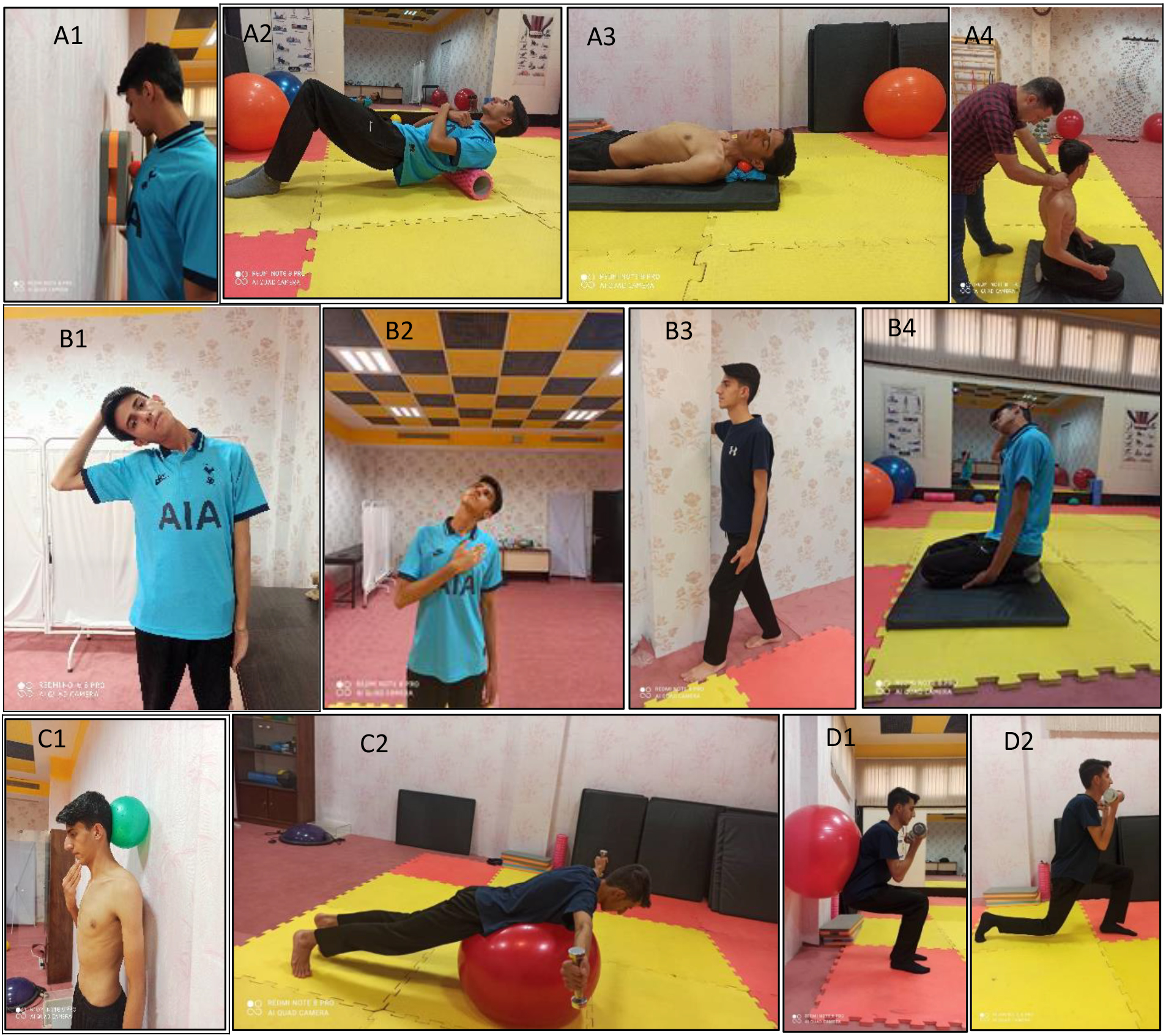
Initially, a list of numbers was provided by the random number allocation software version 2.0, each of which was randomly assigned to the interventions based on Sahrmann and NASM corrective exercises. Afterwards, the NASM or Sahrmann corrective exercise interventions were assigned to each participant based on their recruitment order. At the next stage, a fixed-size design with the concealed allocation ratio of 1:1 was used for randomization.
Sahrmann corrective exercises protocol for HKP used during the 8-week intervention program
Sahrmann corrective exercises protocol for HKP used during the 8-week intervention program
Sahrmann corrective exercises samples: A1-3, Thoracic extension and rotation strengthening. B1-2, Gluteus medius strengthening; C: Thoracic, lumbar, and hip extensor strengthening. D: Lower trapezius, spinal extensor, multifidus strengthening. E1-2, Thoracic extension with scapulothoracic retraction/depression strengthening.
The exercises were performed for eight weeks, three sessions per week (60 minutes each) in both groups under the supervision of an experienced physiotherapist and two corrective exercise specialists. The participants in both groups were retrained each session via mirror feedback and trained on the neutral status of the cervical and thoracic spine. Prior to the training, the participants warmed up for 10 minutes by walking and jogging.
National academy of sports medicine (NASM)
The NASM corrective exercises included released, stretching, activation, and integration phases. A hard foam roller was used for the inhibition and release techniques to increase the pressure on the soft tissue structures. In this technique, the subjects used the foam over the desired area for 30 seconds. Furthermore, stretching was maintained at the first point of resistance for 30 seconds. Activation techniques were also used to retrain or increase the activity of the less active tissues. The integration technique was applied to retrain and coordinate the neuromuscular function through progressive functional movements (Table 1, Fig. 2) [10].
Sahrmann corrective exercise protocol for FHP and HKP
Kyphosis strength training was progressed in intensity to maintain the Borg scale intensity of 10–12 based on 70–80% of the perceived exertion of the subjects. In this group, deep neck flexor strengthening was performed in a neutral state using a biofeedback pressure device. The cuff of the biofeedback pressure was placed under the neck, and air entered the cuff (20 mmHg). The subjects contracted the deep neck flexors to increase the pressure to 30 mmHg. The exercise was performed for three sets of 15 repetitions at a two-minute rest between the sets. Notably, we increased the load by adding two mmHg of pressure per week to change the cuff pressure of the device [16]. Kyphosis-specific exercises and posture training were also implemented, targeting the spinal extensor muscle strength (Table 2, Fig. 3) [17, 18].
Primary outcomes
FHP Measurement
In this study, side imaging was used to evaluate FHP, and C7 and tragus landmarks were used for this purpose. With the subjects standing next to the wall, the camera (Sony-Cyber-shot DSC-RX100VI, Japan) was located at 256 centimeters from the wall on the surface of the participant’s shoulder. After two minutes, three photos were taken, and the Image J software (National Institutes of Health, Bethesda, MA, USA) was used as the ’gold standard’ to determine the FHP angle. The angle between the vertical line passing through the C7 and the connecting line between the tragus and C7 were calculated as the FHP angle (Fig. 4) [19].
Evaluation of FHP angle using photography and calculation of angles using Image-J software.
A spinal mouse device (model: 3.32, made in Switzerland) was used to measure the thoracic kyphosis and spinal curves angles at the sagittal plane; the validity of the device was confirmed (ICC
Secondary outcomes
Strength of the neck and shoulder muscles
The Baseline pull-push dynamometer (model: 12-0343, Fabrication Enterprises Inc., NY, USA) was used to assess muscle strength. According to the findings of Krause et al., the neck muscle strength of the subjects in the supine position was relatively more valid [21]. To measure the shoulder muscle strength, the subjects initially warmed up the shoulder joints for five minutes. Afterwards, they sat on a chair, with the torso in a neutral position. To measure the flexor strength, the shoulder was placed in a 90-degree flexion with an extended elbow and palm facing inward. The dynamometer was located slightly above the elbow joint and resistance to flexion was applied by the assessor. To evaluate the strength of the shoulder extensors, the mentioned stages were repeated, except that the subjects were in a prone position with the arms next to the body. To assess the strength of the shoulder abductors, the subjects were placed in 90-degree shoulder abduction and 90-degree elbow flexion, the dynamometer was placed right above the elbow, and resistance was applied against raising the hand [22]. To assess the strength of the shoulder adductors, the subjects were in a sitting position while the head of the device was placed slightly above the elbow joint inside the arm, and the tester resisted the movement of the shoulder adductor. Each test was performed in triplicate with one minute of rest between the tests. Finally, an average of three repetitions was recorded as the strength of the mentioned muscle groups.
Neck and shoulder joint ROM evaluation
The Baseline bubble inclinometer (Fabrication End Inc, NY, USA) was used to evaluate the ROM of the neck and shoulders. For this test, the subjects sat on a chair without an armrest and the inclinometer was placed on their head in a neutral position to assess the range of the flexion and extension of the neck at the sagittal plane. The instrument was calibrated to zero, and the subjects were asked to actively move their head to the end of the flexion and extension range. The observed number was recorded, and each test was performed in triplicate to record the mean value for analysis [23]. To assess the range of the flexion/extension of the shoulder at the sagittal plane, the subjects sat on a chair without a backrest, and the inclinometer was placed in the distal part of the arm with tape. The subjects were asked to actively move their arm to the ultimate range of flexion, extension, abduction, and adduction. At the ultimate ROM, the desired angle was recorded, and the average of the three executions was recorded as the ROM [24].
Pulmonary function assessment
At the beginning of the tests when the participants were comfortably seated on the chair, their nose was closed by a nasal bandage. After selecting the start option, the participants held the instrument in their mouth and took a few slow, normal breaths on the instrument. When the Maneuver sign appeared on the computer screen, the participants were asked to exhale as deeply as possible, take a deep breath, and exhale as far as they can. After the respiratory operation, data were recorded on the inspiratory vital capacity, forced vital capacity (FVC), forced expiratory volume in the first second (FEV1), and tidal volume (TV) as the main indicators of the study.
Ethical considerations and consent statements
Written informed consent was obtained from all the subjects, and the research procedures were entirely carried out per the Declaration of Helsinki. The study’s protocols were approved by the research ethics committee (IR.REC.2019.006). The protocols were also registered in the Registry of Clinical Trials (IRCT20190426043377N2).
Statistical analysis
Data analysis was performed in SPSS version 21.0 (SPSS Inc., Chicago, USA).The Shapiro-Wilk test was used to assess the normality of data distribution (
Results
The results of the Shapiro-Wilk test indicated the normal distribution of the data. Table 3 shows the demographic data of the subjects in the study groups. No significant differences were observed in the demographic characteristics of the groups at baseline. The subjects in both groups completed eight weeks of exercise with no dropouts. No significant differences were denoted in the FHP, HKP, neck and shoulder muscle strength, neck and shoulder ROM, pulmonary function, and lordosis before the exercise interventions between the study groups (
Participant characteristics at baseline (
30)
Participant characteristics at baseline (
According to the obtained results, the correction of the FHP values was more significant in the Sahrmann corrective exercise group compared to the NASM group (
Neck and shoulder muscle strength
According to the findings, the improvement in the values of neck extensors, shoulder flexors, shoulder extensors, shoulder abductors, and shoulder adductors strength was more significant in the Sahrmann group compared to the NASM group (
Neck and shoulder ROM
The improvement in the neck extension ROM values was more significant in the Sahrmann group compared
Comparison of outcome measures
Comparison of outcome measures
Notes: p1, paired sample t-test; p2, 2
to the NASM group (
The findings indicated significant differences between the pre- and post-intervention phases in the study groups regarding the FEV1/FVC and FEV1 values (
Discussion
According to the results of the present study, the improvement in FHP of the Sahrmann group was more significant than the NASM group, while the HKP of the study groups was significantly different from the pretest after the eight-week intervention. The applied corrective exercise protocol was designed to strengthen the deep flexor muscles of the neck in a different way than the strengthening technique in the NASM exercises. Therefore, the difference could be due to the variable protocols used for deep neck muscle strengthening exercises in the two groups. As for HKP correction, the spinal extensor training protocol was almost similar in both groups. The findings suggested that training with the aim of correcting muscle stiffness in weak and elongated muscles could be a simple, cost-efficient strategy to correct positional abnormalities [11]. By providing strengthening exercises for the muscles with low stiffness in the present study their degree of stiffness could increase and the deformities were corrected. To date, most studies have applied combined stretch-strength exercises, and few studies have used separate strengthening exercises to correct postural deformities. For instance, Singh et al. investigated the effects of a strength training program on the correction of FHP and thoracic extension, reporting that strengthening exercises changed the angle of the FHP and spinal extension [26]. In another research, Park and Lee reported the effects of lower trapezius muscle strengthening on posture, pain, muscle dysfunction, and contraction rate in patients with neck pain [27]. Furthermore, Katzman et al. reported that the strengthening of spinal extensors and postural exercises were effective in reducing thoracic kyphosis in the elderly [28]. The aforementioned studies are consistent with the current research.
Another finding of the present study demonstrated that the improved strength of the neck extensor muscles, flexors, extensors, abductors, and shoulder adductors in the Sahrmann corrective exercise group were more significant compared to the NASM group. However, the neck flexor strength improved similarly in both groups after the eightweek training. According to the literature, postural deformities such as FHP and HKP could cause changes in ROM and neck and shoulder muscle strength imbalances. In the present study, Sahrmann corrective exercises, which were used to strengthen the deep cervical flexors and spinal extensors, the significant improvement in the strength of these muscles was predictable. Previous findings have suggested correlations between FHP and spinal deformities with back muscle strength and shoulder ROM [29]. For instance, Šarčević et al. investigated the associations between the isometric strength of the four muscles of spinal extensors and spinal deformities, reporting the correlation between the isometric strength of the spinal extensors and spinal deformities [3]. Furthermore, Katzman et al. examined the effects of 12 weeks of two-session multidimensional training on flexed posture (FHP and HKP) on the strength and ROM in the affected women, reporting that by improving the flexed posture in these individuals, the strength of the spinal extensors and ROM improved [31].
In terms of the neck and shoulder ROM in the present study, only the improvement in the neck extension ROM differed between the groups, so that the improvement in the Sahrmann group was more significant compared to the NASM group. This could be attributed to the greater effectiveness of Sahrmann corrective exercises in the reduction of the FHP angle compared to NASM In other cases, the improvement of neck and shoulder ROM was observed to be the same in both groups. According to the literature of rehabilitation, HKP and FHP deformities limit the ROM of the neck and shoulder joints by disrupting the scapular kinetics [29]. Therefore, the reduced FHP and HKP angles might have affected the ROM of the neck and shoulders by affecting the scapula movements in the current research. The findings of Quek et al. also attest to this matter; the mentioned authors examined the correlations between HKP and FHP with neck ROM in the elderly, reporting the associations of HKP with the flexion and rotation ROM of the neck [32]. Also, Gong et al. investigated the correlations between cervical lordosis, neck ROM, and the strength and endurance of the neck muscles, reporting that the neck posture could affect the neck ROM, as well as the strength and endurance of the neck muscles [33]. These findings are in line with the results of the present study. In the present study, the ROM of neck extension had a significant improvement in the Sahrmann corrective exercise group than the NASM group, which could be due to the variable effects of Sahrmann corrective exercises compared to the NASM in correcting the FHP In fact, Sahrmann strength training is performed using a biofeedback pressure device and chin tuck technique, which strengthen the deep cervical flexors and erectors and significant resolve the shortening of the tight muscles (scalene and levator scapula) [11]; this could be the reason for the better improvement of the neck extension ROM in the Sahrmann group. The results obtained by Boro and Nagrale are consistent with our findings in this regard. The mentioned study indicated a positive, significant association between the number of years of using a smartphone and the incidence of FHP and neck extension disorders [34].
Another finding of the current research demonstrated that the improvement of the pulmonary function in terms of FEV1/FVC and FEV1 was similar in both groups. However, the improvement in the FVC of the NASM group was more significant compared to the Sahrmann group. According to our findings, FHP not only affected the neck function, but it also reduced the strength of the neck muscles, thereby leading to chest instability, changes in the chest extensibility mechanics, and reduced lung capacity [26]. On the other hand, the correction of muscle imbalances and FHP and HKP deformities in both interventions resulted in the improved function of the FEV1 and FEV1/FVC of the lungs, which is consistent with the findings of Lorbergs [35].
One of the limitations of the present study was that the research units were male, which was for the control of the gender effect on the response to the exercises. Although the researchers used random stratification to select the subjects, the number of the female participants might have been higher in one group, influenced by the different response of the males to the exercises compared to the females.
Conclusion
According to the results, the improvement of the FHP angle was more significant in the Sahrmann corrective exercises, which were only focused on the strengthening of the weak and long muscles, compared to the NASM intervention. However, no significant difference was observed between the groups in terms of HKP. The neck and shoulder muscle strength improved more significantly in the Sahrmann group compared to the NASM group, except for the neck flexor strength. In addition, the neck extension ROM was significantly higher in the Sahrmann group compared to the NASM group. Finally, the improvement in the FVC of the NASM group was more significant compared to the Sahrmann group.