



Abstract
BACKGROUND:
The Y exercise is a therapeutic exercise facilitating lower trapezius muscle activity.
OBJECTIVE:
To identify the effects of scapular movement cues (posterior tilt vs. posterior tilt with adduction/depression) on trapezius muscle activity during Y exercise.
METHODS:
Fifteen healthy men without current shoulder pain performed general Y exercise; Y exercise with cues for scapular posterior tilt; and Y exercise with cues for scapular posterior tilt, adduction, and depression. Electromyography (EMG) data for the trapezius muscles were collected during Y exercise. The posterior tilt angle of the scapula was measured in the prone position with and without cues for scapular posterior tilt using an inclinometer application.
RESULTS:
The greatest lower trapezius muscle activity was observed during Y exercise with cues for scapular posterior tilt, while the greatest EMG activity of the upper trapezius was observed during Y exercise with cues for scapular posterior tilt, adduction, and depression (
CONCLUSION:
Cues for scapular posterior tilt were most effective in facilitating lower trapezius muscle activity during Y exercise.
Introduction
Upward rotation and posterior tilting of the scapula are crucial movements for correct arm elevation [1, 2]. Insufficient upward rotation and posterior tilt of the scapula can cause narrowing of the subacromial space, mechanical abrasion of the rotator cuff muscles, and altered glenohumeral joint alignment, leading to shoulder injuries such as subacromial impingement, rotator cuff tears, and superior labral injuries [3]. Indeed, several articles have reported that reduced scapular upward rotation and posterior tilt are related to shoulder injuries and scapular dyskinesia [1, 4, 5, 6].
The upper and lower trapezius muscles produce scapular upward rotation movements via force-coupling with serratus anterior [2]. The lower trapezius contributes not only to the scapular upward rotation but also to scapular adduction, depression, and posterior tilt [2, 3]. However, abnormal muscle activation patterns, including increased upper trapezius activity and decreased lower trapezius activity, have often been observed in patients with shoulder injuries [7, 8]. Although the upper trapezius contributes to scapular upward rotation, excessive upper trapezius muscle activation, in turn, leads to excessive clavicle elevation and scapular anterior tilt, which interrupts the correct kinematics of the shoulder complex required for arm elevation [1, 9]. Thus, therapeutic exercises facilitating selective activation of the lower trapezius have been emphasized for shoulder rehabilitation [6, 10, 11, 12, 13].
The Y exercise is frequently utilized as a therapeutic exercise in clinical settings. It effectively facilitates lower trapezius muscle activity as the shoulder is positioned parallel to the direction of lower trapezius muscle fibers [10, 11, 14]. Cues that induce functional actions (e.g., scapular adduction, depression, and posterior tilt) of the lower trapezius have been proposed as alternative strategies for facilitating lower trapezius muscle activity [15, 16, 17]. However, a previous study reported no differences in lower trapezius muscle activity between Y exercise with and without verbal and tactile cues for scapular adduction and depression [15]. Others [10, 18] have reported that Y exercise with cues for scapular posterior tilt resulted in greater lower trapezius muscle activity than general Y exercise or the backward rocking diagonal arm lifting exercise, which is an effective exercise for strengthening of the lower trapezius [19].
Based on previous findings [6, 10, 18], researchers have inferred that additional scapular posterior tilt may be effective for increasing lower trapezius muscle activity. However, most previous studies emphasized on the cues for scapular adduction or depression only [15, 16, 17]. To identify the effects of exercises combined with functional lower trapezius actions on muscle activation, exercises that include cues for scapular posterior tilt as well as scapular adduction and depression should be examined as well. Moreover, considering that the upper and middle trapezius muscles act in conjunction with the lower trapezius to determine the alignment and motion of the scapula during shoulder movements [1, 2, 20], the influence of exercises combined with functional lower trapezius actions on activity in all three areas of the trapezius should be identified. Therefore, the present study aimed to examine how additional cues for scapular posterior tilt influence electromyography (EMG) activity of the trapezius muscles during Y exercise with and without scapular adduction and depression.
Materials and methods
Study design
This cross-sectional study examined the effects of scapular motion cues (scapular posterior tilt or a combination of scapular posterior tilt, adduction, and depression) on EMG of trapezius muscles during Y exercise. The study was approved by the Catholic University of Pusan Institutional Review Board in accordance with The Code of Ethics of the World Medical Association (Declaration of Helsinki). The study was registered in the Clinical Research Information Service (registration number KCT0005311).
Participants
Fifteen healthy men (mean age
Procedures
Measures of muscle activity
The Noraxon surface EMG system (wireless miniDTS and MyoResearch 3 software; Noraxon, Inc., Scottsdale, USA) was used to collect muscle activity data from the upper, middle, and lower trapezius muscles on the side of the dominant arm. EMG electrodes were attached to the landmark of each muscle fiber [22] (Fig. 1). Raw data were collected at 1,500 Hz with a common-mode rejection ratio of
Placement of electromyography electrodes.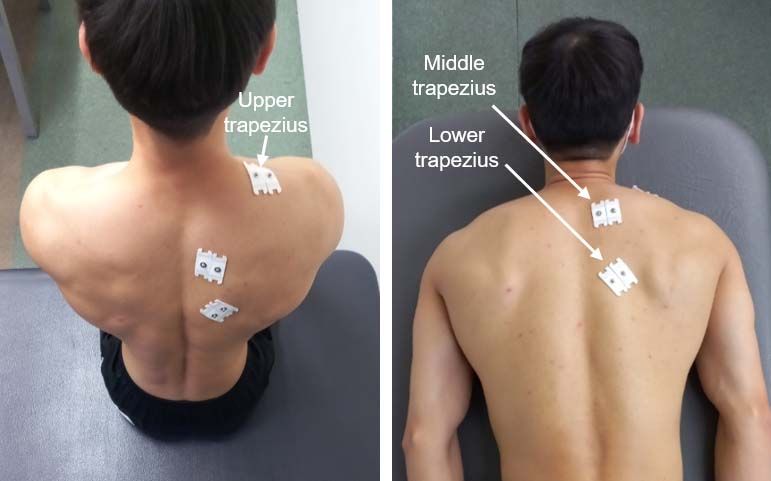
All participants performed two maximum voluntary isometric contraction (MVIC) trials against manual resistance by an examiner for 5 s each, and manual muscle testing maneuvers were used to normalize the EMG data collected during exercises [23, 24]. For the upper trapezius, participants performed an action combining shoulder elevation, cervical rotation to the opposite side, and cervical bending to the same side. Participants performed Y exercise with 90
Scapular posterior tilt angles were measured in the prone shoulder abduction positions with and without cues for scapular posterior tilt using smartphone support to verify whether posterior scapular movement occurs when providing cues for scapular posterior tilt, as suggested by Scibek and Carcia [25]. In their study, Scibek and Carcia [25] reported moderate to good correlation of scapular posterior tilt angles during shoulder movement between measurements obtained using an inclinometer with smartphone support and an electromagnetic tracking system. The smartphone support system consists of a wooden plate, an acrylic board perpendicular to the wooden plate, and two movable feet embedded in the wooden plate. In this study, an examiner adjusted the arrangements of the two feet such that they were placed on the root of the scapular spine and scapular inferior angle, respectively [25], when participants took the position of prone shoulder abduction at 125
Measurement of the scapular posterior tilt angle in the prone position.
Scapular posterior tilt angles were measured with the participant performing prone shoulder abduction at 125
Before performing Y exercise with scapular movement cues, participants practiced the scapular posterior tilt strategy. Participants were asked to pull the coracoid process backward while pulling the scapular inferior angle forward without scapular adduction or downward rotation as if rolling the scapula when sitting, to induce scapular posterior tilt movements [10, 18, 26]. For effective training, visual biofeedback for scapular posterior tilting was performed using a Smart KEMA motion sensor with a sampling rate of 25 Hz and Smart KEMA software (Korea Tech Co, Ltd, Seoul, Korea). The Smart KEMA motion sensor includes a tri-axillar gyroscope, and information from the sensor is transmitted to a tablet PC with Smart KEMA software installed. The software calculates the rotation angle of the sensor in real-time [27]. In this study, the examiner attached the Smart KEMA motion sensor on the midpoint between the root of the spine and the inferior angle of the scapula. During scapular posterior tilt training, participants were asked to monitor the tablet PC screen for visual biofeedback of scapular posterior tilt movements. When correct active scapular posterior tilting was possible in a sitting position, participants practiced correct active scapular posterior tilting in a prone position with 125
The Y exercise.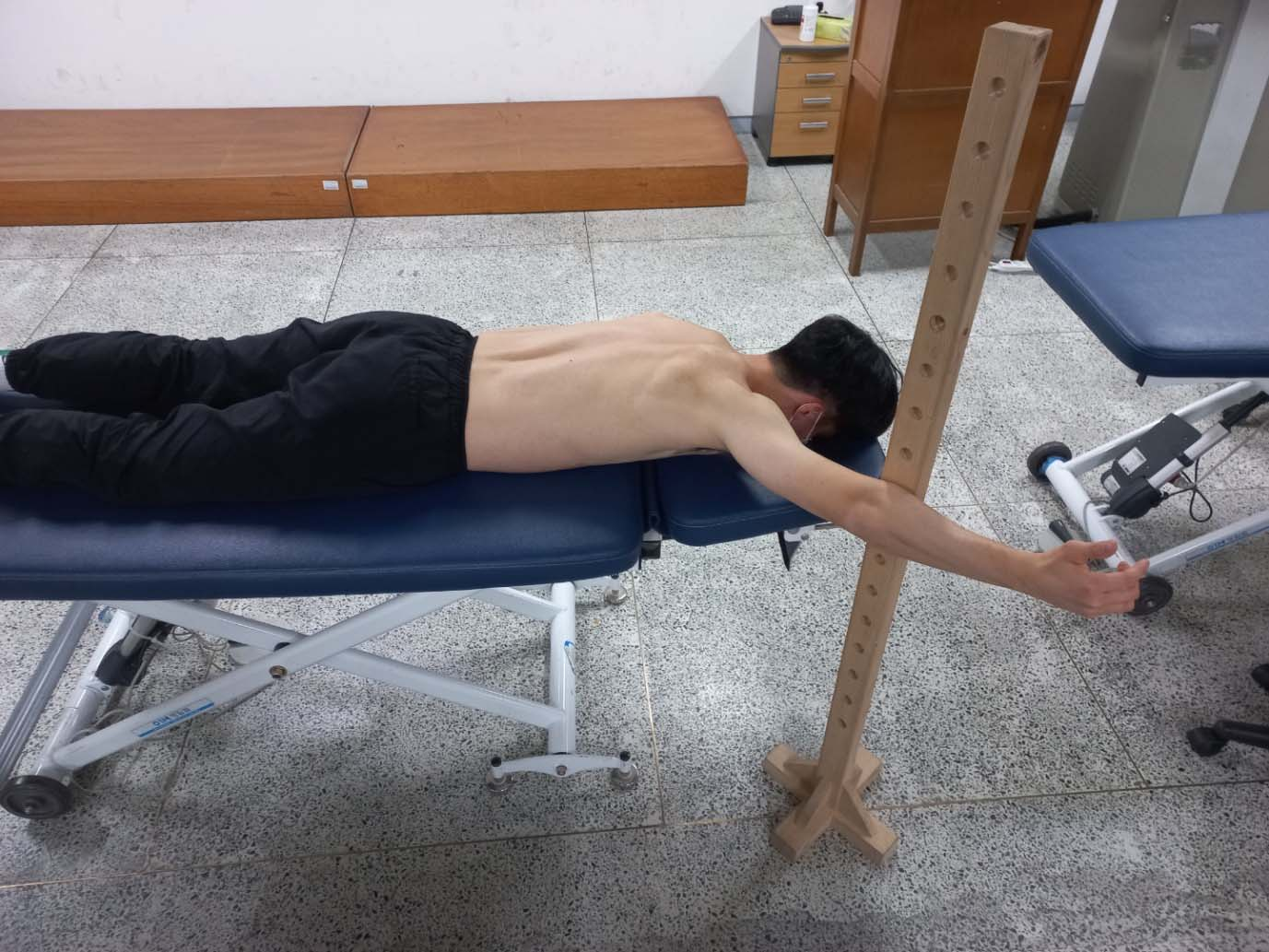
Participants performed three types of Y exercise: general Y exercise; Y exercise with cues for scapular posterior tilt; and Y exercise with cues for scapular posterior tilt, adduction, and depression. In this study, all Y exercises were performed in a 125
Experimental procedures
In the present study, the scapular posterior tilt was first measured in the position of prone shoulder abduction, and then general Y exercise was performed. After scapular posterior tilt training, the scapular posterior tilt angle was measured in the prone shoulder-abduction position during active scapular posterior tilting. Y exercise with cues for scapular posterior tilt and Y exercise with cues for scapular posterior tilting, adduction, and depression were performed in a randomized order.
Statistical analyses
SPSS version 26.0 (IBM Corp., Armonk, USA) was used for statistical analysis. The Shapiro-Wilk test was used to verify the normality of the distribution for all outcome variables (
Muscle activity during each exercise
Muscle activity during each exercise
Electromyographic measurement of upper and lower trapezius activity during Y exercise.
Significant main effects of EMG activity in the lower (
The posterior tilt angle of the scapula in the prone shoulder abduction position was significantly greater when scapular posterior tilt cues were provided than when they were not (23.38
Discussion
In this study, we examined the influence of scapular movement cues on trapezius muscle activity during Y exercise. Our findings indicated that Y exercise with cues for scapular posterior tilt could effectively facilitate lower trapezius muscle activity without an excessive increase in upper trapezius muscle activity during Y exercises.
In the current study, lower trapezius muscle activity (
Interestingly, additional cues for scapular adduction and depression during Y exercise with scapular posterior tilt cues decreased lower trapezius muscle activity (
In our study, upper trapezius muscle activity was greatest during Y exercise with cues for scapular posterior tilt, adduction, and depression (
There are several limitations to this study. First, we did not measure the EMG activity of other synergists for scapular adduction and depression. Second, we only measured the scapular posterior tilt angle in prone shoulder abduction positions with and without cues of scapular posterior tilt but not during active Y exercises, as it is difficult to find accurate landmarks of the scapula due to muscle belly movement during active Y exercise. Thus, future studies should measure scapular kinematics using an electromagnetic tracking system during active Y exercise. Third, we only recruited healthy men and had a relatively small number of participants; thus, future studies should include a larger number of patients with shoulder injuries or scapular dyskinesia to extend the clinical implication of our findings. Lastly, because the armraising range was not accurately measured in this study, it is possible that differences in the armraising range during repeated trials influence our results.
Our findings showed that cues for scapular posterior tilt contribute to significantly lower trapezius muscle activity without increasing the upper trapezius muscle activity. However, incorporating cues for scapular posterior tilting, adduction, and posterior tilting increased upper trapezius muscle activity during Y exercise. Considering that increasing lower trapezius muscle activity without increasing upper trapezius muscle activity is the goal of rehabilitation and aids in preventing shoulder injuries, Y exercise with cues of scapular posterior tilt may aid in facilitating selective activation of the lower trapezius during shoulder rehabilitation.
Conclusion
The present study demonstrates that scapular posterior tilt cues are ideal for facilitating activation of the lower trapezius muscle without increasing activation of the upper trapezius muscle when incorporating functional actions of the lower trapezius during Y exercise.
Footnotes
Conflict of interest
The authors declare that they have no conflict of interest.
Funding
This work was supported by the National Research Foundation of Korea (NRF) grant funded by the Korean government (MSIT) (No. 2021R1F1A1047329) and a research fund offered by the Catholic University of Pusan.