We consider sets without subsets of higher m- and -degree, that we call m-introimmune and -introimmune sets respectively. We study how they are distributed in partially ordered degree structures. We show that:
each computably enumerable weak truth-table degree contains m-introimmune -sets;
each hyperimmune degree contains bi-m-introimmune sets.
Finally, from known results we establish that each degree a with covers a degree containing -introimmune sets.
The question of the existence of sets of natural numbers without subsets of higher Turing degree, from now on degree, was posed for the first time by Miller in his Master’s Thesis [21]. Soare [27] and Cohen (unpublished) solved the problem by showing their existence. By [17] we know that such sets cannot be arithmetical and by [26] we know that they cannot even be hyperarithmetical. Namely, define an infinite set A rich if every degree above that of A is represented by a subset of A. Then:
Let A be not rich. Then every hyperarithmetical set is A-computable.
Given a reflexive and transitive reducibility , an r-degree is the class for some , where A is r-equivalent to B, in symbols , if and only if and . The class of infinite sets having no subsets of higher r-degree includes the following class of sets:
In [9] the term r-introimmune was introduced to denote each set in the class displayed in (1). The existence of sets with a certain property suggests the natural question of understanding how they are distributed in some structure. In our case this includes, e.g., to discover the lowest possible complexity of an r-introimmune set in a given structure for a given reducibility . For example, if we consider the arithmetical hierarchy we know that for many-one reducibility there are m-introimmune sets in [6,7], which is the smallest class of the hierarchy that can contain such sets. For weak truth-table reducibility we proved in [8] that there exists a -introimmune set in . This means that for every reducibility that implies there are r-introimmune sets in ; apart from , we do not know if there are such r-introimmune sets in . In this paper we try to study the distribution of m- and -introimmune sets in the partially ordered degree structure. We say that a degree is r-introimmune if it contains an r-introimmune set. For example, from Simpson’s result quoted above [26] we know that does not cover any T-introimmune degree for every . While from [8] we know that covers a -introimmune degree. In general we can formulate the following problem: Given a reducibility, to classify the r-introimmune degrees. Or more weakly: Given a reducibility, what are the degrees that cover r-introimmune degrees. For one-one reducibility we observe in Corollary 3.3 that the class of 1-introimmune degrees coincides with the class of non-zero degrees. While for weak truth-table reducibility we observe in Section 5 that is a -introimmune degree. We say that a set is bi-r-introimmune if both the set and its complement are r-introimmune. In this paper we give the following results:
each non-zero computably enumerable -degree contains an m-introimmune -set;
each hyperimmune degree contains a bi-m-introimmune set;
each degree a with covers a -introimmune degree.
In Section 3 we compare the class of m-introimmune sets with some other common classes of sets studied in computability theory. In Section 4 we prove both 1) and 2), in Section 5 we establish 3).
Notations and terminology
Our terminology is standard. For undefined notions we refer to any monograph on computability theory as, for example, [14,22,24,28]. We consider sets of naturals numbers, unless otherwise stated. The symbol denotes the set of natural numbers. Given two sets ,
denotes the set difference of A and B,
denotes ,
.
We identify each set A with its characteristic function, namely
We fix an acceptable enumeration of all the partial Turing computable unary functions. For every we define if the e-th Turing machine on input x halts in t or fewer steps and outputs y, undefined otherwise. Given two sets we say that:
A is many-one reducible to B, in symbols , if there is a computable function f such that
for every . If f is one-one then A is one-one reducible to B, in symbols ;
A is weak truth-table reducible to B, in symbols , if there is an oracle Turing machine M and a computable function such that
M with oracle B computes A, and
for every , M on input x asks oracle B only numbers less than .
The degree of a set A is denoted by . denotes the degree of all the computable sets. and denote respectively the first and second Turing jump of degree a. We say that a degree b covers the degree a if , where ⩽ is the partial order on degrees induced by Turing reducibility. A degree is high1 if . A degree or -degree is computably enumerable (c.e.) if it contains a computably enumerable set. We will give further notations where needed.
A comparison between m-introimmunity and some other properties
For one-one reducibility we have a characterization of 1-introimmunity in terms of a classical immunity property, while for many-one reducibility there is no a similar characterization.
(Immune set).
An infinite set is immune if and only if it does not include any infinite c.e. set; equivalently, if and only if it does not include any infinite computable set.
A set is 1-introimmune if and only if is immune.
Let A be an infinite set and let be such that (it is not necessary here ). Let f be a one-one computable function witnessing that . Fix ; then is an infinite c.e. subset of A, so A is not immune.
This part has been proved in Proposition 3.1 in [8]. □
Eachcontains a 1-introimmune set.
A degree a contains an immune set if and only if [12] (see also [24], page 498). □
For many-one reducibility we preliminarily observe that each class of sets closed with respect to the unary operator is not contained in the class of m-introimmune sets, because is not m-introimmune for any set A. Now, for the class of m-introimmune sets we prove that:
it strictly includes the class of r-cohesive sets and is strictly included in the class of immune sets;
it is incomparable with the classes of q-cohesive sets and hyperimmune sets;
it is incomparable with the class of effectively immune sets.
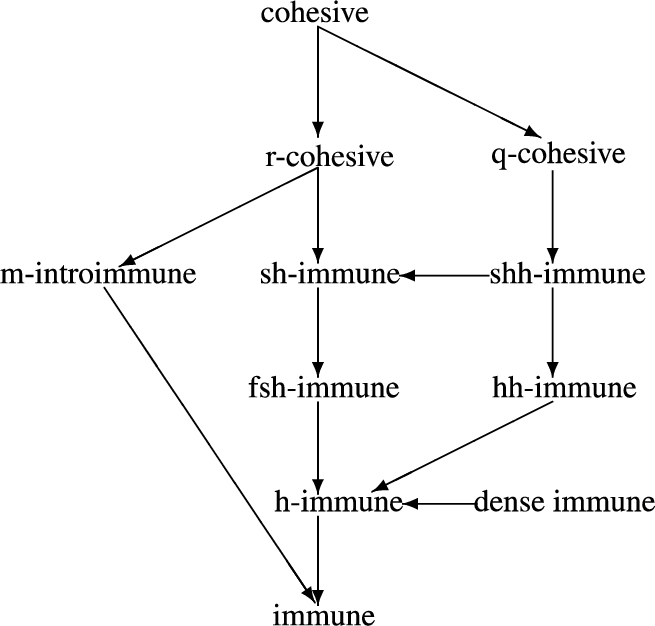
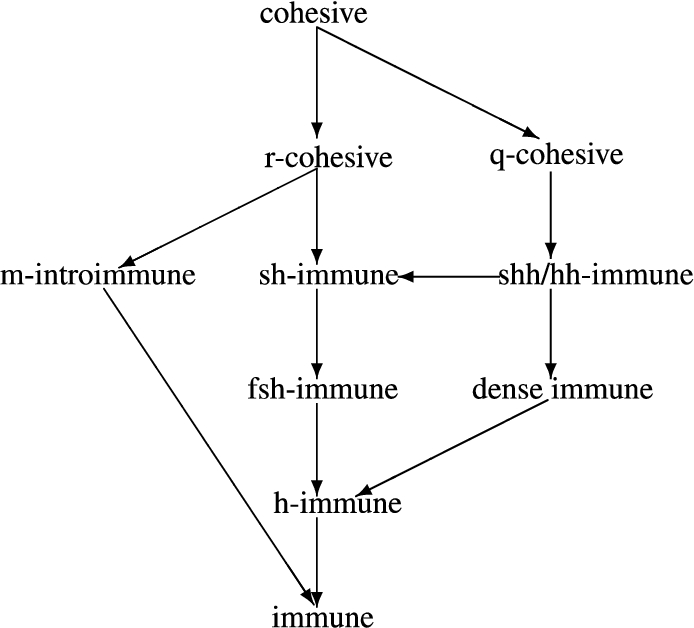
From (B) we conclude that the class of m-introimmune sets is incomparable with some other common classes of sets studied in computability theory; namely, is incomparable with the classes of strongly hyperimmune sets, strongly hyperhyperimmune sets, hyperhyperimmune sets, finitely strongly hyperimmune sets and dense immune sets. For the definitions of these sets we refer to [3,24,25,28]. We display in Diagram 1 and Diagram 2 the inclusions between these classes, in order to deduce the incomparability just listed.
The general case.
For -sets.
We recall the definitions of the sets concerning (A), (B) and (C).
cohesive if there is no c.e. set W such that and are both infinite;
r-cohesive if there is no computable set R such that and are both infinite;
q-cohesive if it is a finite union of cohesive sets;
r-maximal if it is c.e. and its complement is r-cohesive.
(Hyperimmune set).
For every let be the finite set with canonical index n. A disjoint strong array is a sequence where
f is a one-one computable function, and
for every , .
An infinite set H is hyperimmune if there is no disjoint strong array such that for every n.
(Effectively immune set).
Fix a standard enumeration of all the c.e. sets. An infinite set E is effectively immune if there is a computable function φ such that for every , if then .
(A)
The class of m-introimmune sets is strictly included in the class of immune sets.
The inclusion is proved in Theorem 8(c) in [9]. The inclusion is strict because if A is immune then is immune and not m-introimmune. □
The class of r-cohesive sets is strictly included in the class of m-introimmune sets.
The inclusion is an immediate consequence of the proof of the following theorem due to Degtev:
(Degtev [10]; see also [23], Theorem 4.4).
If R is r-maximal then for every nontrivial superset S of R it holds that R and S are m-incomparable.
The proof of Theorem 3.9 shows that if C is any r-cohesive set and B is any infinite subsets of C such that , then C and B are m-incomparable. The inclusion is strict because bi-r-cohesive sets do not exist, while there are bi-m-introimmune sets (Theorem 4.10). Also, because the degree of an r-cohesive -set is , while by Theorem 4.1 there are m-introimmune -sets whose degree is not . □
(B)
The class of m-introimmune sets is incomparable with the class of hyperimmune sets.
In the proof of Theorem 4.1 we construct an m-introimmune -set which is not hyperimmune. Furthermore, if A is hyperimmune then is hyperimmune and not m-introimmune. □
The class of m-introimmune sets is incomparable with the class of q-cohesive sets. In particular, the class of m-introimmune sets is not closed with respect to finite unions.
Let C be a cohesive set and consider the two cohesive sets and . Since cohesive implies r-cohesive, by Proposition 3.8 and are both m-introimmune; it follows that is q-cohesive and not m-introimmune.
The class of m-introimmune sets is not included in the class of q-cohesive sets, because otherwise it would be included in the class of hyperimmune sets, contrary to Proposition 3.10. □
(C)
There are m-introimmune sets that are not effectively immune.
There are effectively immune sets that are not m-introimmune.
An effectively immune -set can be only in [20] (see also Lemma 2.19.16 in [14], or Proposition III.2.18 in [24], or Theorem V.4.1 in [28]). By Theorem 4.1 there are m-introimmune -sets not in .
If A is effectively immune then is effectively immune and not m-introimmune. □
m-Introimmune and bi-m-introimmune sets
A degree is hyperimmune if it contains a hyperimmune set. In this section we prove that:
each non-zero c.e. -degree contains an m-introimmune -set which is not hyperimmune, and
each hyperimmune degree contains a bi-m-introimmune set.
Computably enumerable -degrees and m-introimmune sets
Every non-zero c.e.-degree contains an m-introimmune-set which is not hyperimmune.
Proof.
We recall that a c.e. set is simple if its complement is immune. From [30] we know that every non-zero c.e. -degree contains a simple set (see [22], Theorem 1.7.3; see also either Proposition 2.13.1 in [14], or Proposition III.3.18 in [24], or Theorem V.3.2 in [28], taking into account that the c.e. permitting method used preserves reducibility ).
Therefore, to prove the statement of the theorem it is enough to fix any simple set A and build a c.e. set B such that with m-introimmune and not hyperimmune.
Let A be a simple set and fix a computable one-one enumeration
of A. Moreover, let
where and
for every . The construction of B is a combination of the finite-injury method with the c.e. permitting method that preserves reducibility . Precisely, we employ the permitting method based on Proposition 4.2 (see also either [14], or Theorem 1.7.2 in [22], or pp. 68 and 80 in [23], or Proposition V.3.1 in [28]).
(C.e. permitting method preserving ).
Letandbe two computable enumerations of the c.e. sets X and Y respectively. Ifthen.
Strategy
The construction of B is by infinitely many stages. At every stage t we define a finite approximation of B. The final set is .
To make
We divide into infinitely many nonempty intervals , where
,
for every , is the interval of numbers from onwards.
Then, we guarantee that
for every , iff some element of is enumerated in B, and
we enumerate in a number y if permitted by A, that is if .
Thus by i) and by ii) .
To makenot hyperimmune
Let f be a one-one computable function such that for every . We will ensure that at most elements of will be enumerated in B, obtaining for all n.
To makem-introimmune
If φ is a computable function with for almost every x, then φ does not m-reduce an infinite set to any of its co-infinite subsets, so we do not care about this kind of functions. Hence in our construction we are interested in diagonalizing the computable functions φ with for infinitely many x.
Therefore we construct B in such a way that for every the following requirement is satisfied:
: if is computable and for infinitely many x, then
either there is a number with , or
there are two numbers v, with , and .
Actions to satisfy each requirement
We informally describe the actions to satisfy each requirement. Fix and let us suppose that is computable and for infinitely many x. To satisfy we wait for a stage at which we discover that there are two distinct numbers x, y not yet in and such that
Then we would like to keep x out of B and enumerate y in . In this way would be satisfied because does not many-one reduce to any of its subsets. To keep x out of B we put a restraint on x. To enumerate y in we have to check that y is not restrained by a higher priority requirement, i.e.
Furthermore, we must also ensure , that is A must permit to enumerate y in . In our case the permitting condition is that there is with
which implies . Accordingly, we enumerate y in only if all the above conditions (2), (3) and (4) hold.
If at stage A has not yet permitted to enumerate a number in B then we put, if possible, a restraint on a number of a pair of which both x and y are greater than all the numbers so far used by and such that (2) holds. In this way we start the generation of a sequence of pairs satisfying (2), with on each , and
As we are assuming that for infinitely many x, the sequence (5) is potentially infinite. Since A is not computable, it will permit to enumerate some of (5) in B. In this way is diagonalized and is satisfied if not later injured by some higher priority requirement by enumerating in B. However, the finite-injury priority method guarantees that eventually enumerates some element of (5) in B without being injured anymore.
Formalization of the construction of B
Every stage of the construction consists of iterations, in each of which we try to satisfy requirement , , by putting the restraint on a number and enumerating in B another number, when possible. Furthermore, we must also guarantee that at the end of stage is , in order to make . If no number of is enumerated in B by the end of all the iterations , then we choose the minimum number of with no restraints and enumerate it in B. To be sure that there exists such a number we impose that each requirement can put the restraint only on at most one element of each interval with ; in this way, at any time of the construction in each interval there can be at most elements with some restraint. Initially no restraint is used.
Construction ofB
Stage 0. Set .
Stage . Let be the set constructed by the end of stage t.
For do
Begin of the For-Loop
Let be the set of elements enumerated into B before running the iteration e of the loop. Go to the first case which applies. If there are several pairs satisfying the premises of the chosen case, then choose the length-lexicographical first such pair ; if no case applies, then just continue with the next iteration of the loop.
Case (a). If there are such that:
x has the restraint ,
and ,
either or ,
then do nothing (that is set ) and go to the next iteration of the loop.
Case (b). If there are distinct with on x and there is with such that:
and ,
no restraint with is on y,
either or ,
then set and remove all the restraints on y. Go to the next iteration of the loop.
Case (c). Let a be the maximum of e and all b for which the interval contains some element used by at some previous stage. If there are distinct with:
,
,
either or ,
then declare x and y used by at this stage. Put the restraint on x, set and go to the next iteration of the loop.
End of the For-Loop
If no element of has been enumerated in , then choose the least with no restraints and set ; otherwise set .
End of Stage.
End of construction ofB
Set .
Verification
Clearly B is computably enumerable.
is not hyperimmune.
Recall that for every s. Fix . An element of is enumerated in B at some stage only if . Condition can be true for at most values of t. At each stage for which there are at most requirements , , that can enumerate in B an element of , therefore
This implies that because , hence is not hyperimmune. □
.
. If , say , then at the end of stage it is . Furthermore, only elements of with are enumerated in B. It follows that if and only if , which implies .
is infinite because for every . We have to prove that each requirement is met. We say that requirement requires attention at stage if in the iteration one of the cases (b) or (c) of the construction of B applies. We prove in Proposition 4.7 that each requirement requires attention at most finitely often and in Proposition 4.9 that each requirement is met. To prove Proposition 4.7 we need the following result first.
is simple.
Clearly is computably enumerable. It is not computable because
via the computable function , in particular is infinite. For the sake of contradiction, let us suppose that is not immune. Let W be an infinite c.e. subset of and define the c.e. set
is infinite because is a partition of and each is finite. Furthermore is a subset of , contradicting A simple: given ,
from which
then for every , and . □
Each requirement requires attention at most finitely often.
Assume by way of contradiction that e is the least index for which requires attention infinitely many often and let be the minimum stage after which no requirement with requires attention. If at some stage in the iteration e one of cases (a) or (b) applies then at the end of stage there is a pair satisfying the following conditions:
By hypothesis on the restraint on x is not removed, that to say that after stage only case (a) can apply and does not require attention anymore, contradicting the hypothesis that requires attention infinitely often.
Therefore the iteration e goes in infinitely many stages through case (c). This means that there is an infinite sequence such that each carries the restraint and
that to say that is an infinite computable set. As is simple, for every it holds that
By hypothesis on we can choose in such a way that no restraint with is on for every . Then
A is computable.
Given , find a stage such that there is with and for some . Then we show that
For the sake of contradiction, if then there exists such that . Thus at stage there is with and . Observe that there is no an intermediate stage between and at which is enumerated in B. Otherwise, by hypothesis on , from onwards the pair will satisfy the premises of case (a) of the algorithm in each iteration e, contradicting the generation of the infinite sequence . By hypothesis on no restraint with can be on , hence in the iteration e of stage it holds that and satisfy the premises of case (b) of the algorithm, i.e.:
Consequently is enumerated in . After stage no requirement can eliminate on . Thus, after stage the pair will satisfy the premises of case (a). This means that does not require attention after , contradicting the generation of the infinite sequence . This concludes the proof of Fact 4.8. □
But A computable contradicts A simple. This concludes the proof of Proposition 4.7. □
Every requirement is met.
For the sake of contradiction, let e be the minimum such that is not met and let C be a subset of such that and via . Since , it is necessarily for infinitely many x. Let be the minimum stage after which no requirement with requires attention. As many-one reduces to C, there are infinitely many distinct for which either or . The second case occurs if infinitely many are mapped to the same element, while the first case occurs if the mapping is only finite-to-one on the elements of . If at some stage one of cases (a) or (b) of the construction of B applies then there is a pair with , , on x and either or . By hypothesis on no requirement enumerates x in B after , which implies that does not many-one reduce to C, contradicting via .
Therefore after stage case (c) would apply infinitely often, but this contradicts Proposition 4.7. □
Since m-introimmunity implies immunity, not all degrees contain a bi-m-introimmune set because there is a non-zero degree such that every degree covered by a is bi-immune free (Jockusch [15], cf. Theorem 1). Here we show that every hyperimmune degree contains a bi-m-introimmune set. Precisely, we show that each Kurtz random set is bi-m-introimmune; the result follows since every hyperimmune degree contains a Kurtz random set. The class of degrees containing a bi-m-introimmune set is wider than the class of hyperimmune degrees, because there are hyperimmune free degrees containing Kurtz random sets: see the discussion immediately after Corollary 8.11.8 in [14]. At the moment we do not know what the exact extension of the class of degrees containing a bi-m-introimmune set is.
Every Kurtz random set is bi-m-introimmune.
We introduce first a couple of concepts.
A function is one-one almost everywhere if and only if the set
is finite.
(Balcázar, Díaz and Gabarró [4], Balcázar and Schöning [5]).
A set S is strongly bi-immune if and only if every many-one reduction of S to any set is one-one almost everywhere.
We prove first that each Kurtz random set is strongly bi-immune. Then we prove that each strongly bi-immune set is bi-m-introimmune. There are several characterizations of the notion of Kurtz randomness [13]; here we use the martingale characterization. Let us introduce first the following terminology. A string is a finite, possibly empty, sequence of 0’s and 1’s. If α is a string and , then denotes the concatenation of α followed by b. For every set and for every positive we denote with the string
is the empty string.
(Martingale).
Let be the set of nonnegative real numbers and let be the set of strings. A martingale is a function
such that for all
In the following definition we give the characterization of Kurtz randomness in terms of martingales. This characterization has been proved in [29] (see also Theorem 4 in [13], or Theorem 7.2.13 in [14]).
(Kurtz random set).
A set is Kurtz random if and only if there is no computable martingale F such that for almost all n, where is an unbounded, non decreasing, computable function.
Every Kurtz random set is strongly bi-immune.
Let us suppose that A is not strongly bi-immune. Then A is many-one reducible to some set via a computable function with
Fix such an f.
Betting strategy
A betting strategy to win an infinite gain on A is the following. Let us suppose that we saw the first n values
and that our capital is . We have to decide how to bet on the -th value . We first compute and then we check whether or not there is such that . If such a j exists then we know that the -th value is equal to , because f is a many-one reduction of A to some set. In this case we bet on , increasing our capital to . Otherwise we bet 0, keeping the capital . By (6) we have infinitely many chances to double our capital; since f is a many-one reduction of A to some set, we have no chances to loose it.
Formalization
For every let us define
Let us define the computable function as follows: ; for every , for every and every
F is a martingale.
Fix and distinguish two cases on .
. In this case .
. In this case let us suppose first that the -th element of is 0. Then
and
The case in which the -th element of is 1 is symmetric. Thus in both cases (a) and (b) it holds that
Let us define the computable function as and for every
Clearly h is non decreasing; by (6) there are infinitely many n with , hence h is unbounded. Furthermore,
for every.
By induction on n. Clearly . Fix and let us suppose that . Distinguish two cases on .
. For all is since f is a many-one reduction of A to some set. Then the -th element of is . We have that
But , thus
In conclusion, martingale F and h certify that A is not Kurtz random. This concludes the proof of Proposition 4.15. □
Every strongly bi-immune set is bi-m-introimmune.
Let A be strongly bi-immune; then A cannot be computable. For the sake of contradiction and without loss of generality let us suppose that A is not m-introimmune. Let with and via g. By hypothesis g is one-one almost everywhere, so there are at most finitely many with finite. Let be such that is infinite; such set is c.e., which means that there is an infinite computable set . Fix . Then A is many-one reducible to via
Function f is not one-one almost everywhere because
is infinite. This concludes the proof of Proposition 4.18. □
Each hyperimmune degree contains a bi-m-introimmune set. In particular, each non-zero c.e. degree contains a bi-m-introimmune set.
Each hyperimmune degree contains a Kurtz random set [18] (see also either Corollary 8.11.8 in [14], or Remark 3.5.3.(i) in [22]). Furthermore, each non-zero c.e. degree contains a hyperimmune set [11] (see also either Proposition 1.7.6 in [22], or Proposition III.3.13 in [24], or Theorem V.2.5 in [28]). □
-Introimmune degrees
In this last section we continue with our general project to understand how r-introimmune sets are distributed in the partially ordered degree structure for a given reducibility . This project includes, for example, understanding how low can the complexity of an r-introimmune set be.
In [8] we constructed a -introimmune set A with . Actually the construction automatically shows that by extending the notion of dominating function to all the partial computable functions, namely replacing Definition 3.3 in [8] with the following
(Dominating function).
A function is dominating if for every partial computable function φ,
holds for almost every n.
The above set A is a subset of , where h is an increasing dominating function. Let be the principal function of A, that is
then is dominating, thus too. However, we do not know if the bound can be lowered. For truth-table reducibility the bound can be lowered down to each degree at least in a weaker form, in the sense that each degree covers a -introimmune degree. Let us first give the definition of truth-table reducibility. Fix an effective enumeration
of all the propositional formulas on the propositional variables . A set satisfies a propositional formula σ, in symbols , if σ is true with interpreted as “”.
(Truth-table reducibility).
Given two sets , A is truth-table reducible to B, in symbols , if there is a computable function f such that for every
More generally it is possible to establish that each degree a with covers a -introimmune degree. This result is a corollary of a theorem in [1]. We say that an oracle Turing machine M is total if is defined for every oracle X and every input x.
Let be a reducibility defined by
where is a (computable) enumeration of total oracle Turing machines. Then is (computably) presentable and is a (computable) presentation of .
Proof.
We give a detailed proof. Let us recall the notion of an a-uniform enumeration for a class of unary functions (see also either [16] or Definition XII.3.3 in [28]).
(a-uniform enumeration).
Given a degree a, an enumeration
of unary functions is a-uniform if there is a function of degree such that
for every .
Fix a degree a with and take an a-uniform enumeration
of all the computable unary functions, whose existence has been proved by Jockusch [16] (see also Exercise XI.1.4.(b) in [25], or Theorem XII.3.4 in [28]). Enumeration (7) provides an a-computable presentation of by posing
for every and , where the numbers asked to the oracle X do not depend on X. These considerations allow us to obtain our result, which refines the existence of -introimmune -sets ([1], cf. Corollary 6). Let us consider the function defined as and
Function h is a-computable, is increasing and satisfies the following property: for every
We construct an infinite set by the finite extension method. At every stage s we define a finite set and the final set is . The requirements are the following:
: ,
: for every with , is not a -reduction of A to X.
Strategy
To satisfy we put an element in A at e stages. To satisfy we wait for a stage such that the following conditions i) and ii) hold:
for some it seems that via :
.
Then we make wrong by putting in . Note that by (8) the condition implies that
From (9), for every the computation of does not depend on . To facilitate the construction of A and subsequent proofs we introduce further notations on strings.
For a string α we denote with its length. If α is a string and , then is the n-th value of α. We identify a string α with the finite set
We write:
if α is a prefix of β, that is
for every ;
if and ;
if and , that is
for every .
In the construction of the set A at every stage s we define a string of length s denoting the set .
Requirements requiring attention
Fix a stage and let be the string of length s constructed by the end of stage s. We say that:
requires attention at stage if it is still not satisfied.
requires attention at stage via the string , α of length s, if and the following conditions hold, which are the formalizations of the conditions i) and ii) described above:
C1: ,
C2: .
Construction of A
Begin of construction
Stage 0. Set .
Stage . Let be the string of length s constructed by the end of stage s and let n be the minimum such that requires attention. If then set , otherwise set .
End of construction
Set .
Verification
We prove that each requirement is met. The proof is similar to that of Lemma 3.5 in [8] and is based on [2].
Every requirement requires attention at most finitely often and is met.
Fix and let us suppose that the statement is true for each requirement with . Let be a stage after which no requirement , , requires attention. Distinguish two cases on .
. If , then an element is added to A at each stage . Then and does not require attention at any stage and is met.
. The proof that is finitary is distributed in the following four facts.
For every string α andof length at least, ifthen for all
Let with . By (8) and by it holds that
where
On the other hand, means that is equal to up to , from which
for every . □
In the next facts we will repeatedly make use of the equality
for every .
Ifrequires attention at stagevia α, then for everywithit holds that.
Let be the string constructed by the end of stage s. For the sake of contradiction, let be the minimum such that and . By hypothesis requires attention via α at stage ; this means that , that is
in particular
Let us consider the string with
Recall that is the string of length obtained by the end of stage . We prove that requires attention at stage via β, and this implies , that is ; but , from which
contradicting in (11). First of all, it is because , and . To prove that requires attention at stage via β we show that conditions C1 and C2 hold for β and .
C1: since with both the lengths of β and α at least , by Fact 5.8 for every
Moreover, for every
because C1 holds at stage w.r.t. α. From (12) and (13) we have that
for every .
C2: implies . Furthermore, by (11) it is also , hence
because .
Then by Fact 5.8
But by hypothesis requires attention at stage via α, which means that at stage condition C1 holds for every , in particular for ; since by (11) it is , we have that
from which
and C2 is satisfied. In summary, conditions C1 and C2 are satisfied by β and , consequently requires attention at stage via β. But as before observed this causes , contradicting (11). □
Let us suppose thatrequires attention via α at stage. Thendoes not require attention at any stageviawith.
By hypothesis, at the end of stage is
Let , with the string obtained by the end of stage . For the sake of contradiction, let us suppose that is a string with and requires attention via at stage , which implies . First of all, note that it cannot be , otherwise, as , it would be
but by (15) it is , from which , contradicting . So it must be
Since by hypothesis requires attention via α at stage it follows that C2 is satisfied, that is
From (16), (17) and Fact 5.8 it follows that
By hypothesis at stage requires attention via , therefore C1 holds for every ; in particular for we have that
which contradicts of (15). □
For every string α of lengththere is at most one stringproperly extending α such thatrequires attention via.
Let α be a string such that , and let and be two strings properly extending α. Let us suppose that requires attention via at stage and via at stage . Without loss of generality let us suppose that . By Fact 5.9, for every t with it is
If , then . Otherwise , but this contradicts Fact 5.10. □
Ultimately, requires attention after at most times. Now we prove that is met. For the sake of contradiction, let us suppose that is not met and let with
and via . By (18) and by the fact that is finitary we can choose in such a way that does not require attention at stage and
Let α be the string of length s such that for every . It is because . Moreover, at stage α satisfies C1 and C2:
C1 holds because by hypothesis via ,
C2 holds because
where the last implication is true because
If A is the set constructed in the proof of Theorem
5.5
then we have that.
First of all, observe that the function h dominates every computable function. Indeed, fix a total oracle machine M such that asks z, for every and independently of the oracle. Let φ be any computable function and let be the e-th total oracle machine of the presentation of such that
for every . asks for every and if then
that is h dominates φ. Let be the principal function of A. Then dominates every computable function and is A-computable, thus [19] (see also Theorem 2.23.7 in [14], or Proposition XI.1.2 in [25], or Theorem XI.1.3 in [28]). □
Footnotes
Acknowledgements
In the preliminary draft we obtained weaker versions of Theorem 4.1 and Corollary 4.19; namely, they were formulated in terms of covering degrees. We are very grateful to an anonymous referee who suggested us how to get Theorem 4.1 and suggested us to consider Kurtz randomness to obtain Corollary 4.19. We are also grateful to a second anonymous referee for useful suggestions. We wish to thank Klaus Ambos-Spies for sending us the typescript [].
References
1.
K.Ambos-Spies, Problems which cannot be reduced to any proper subproblems, in: Proc. 28th International Symposium, MFCS 2003, B.Rovan and P.Vojtáš, eds, Lectures Notes in Computer Science, Vol. 2747, Springer, Berlin, 2003, pp. 162–168.
2.
K.Ambos-Spies, Private communication.
3.
E.P.Astor, Asymptotic density, immunity and randomness, Computability4(2) (2015), 141–158. doi:10.3233/COM-150040.
4.
J.L.Balcázar, J.Díaz and J.Gabarró, Structural Complexity II, Vol. 2, Springer-Verlag, 1990.
5.
J.L.Balcázar and U.Schöning, Bi-immune sets for complexity classes, Mathematical System Theory18(1) (1985), 1–10. doi:10.1007/BF01699457.
6.
P.Cintioli, Sets without subsets of higher many-one degree, Notre Dame Journal of Formal Logic46(2) (2005), 207–216. doi:10.1305/ndjfl/1117755150.
7.
P.Cintioli, Low sets without subsets of higher many-one degree, Mathematical Logic Quarterly57(5) (2011), 517–523. doi:10.1002/malq.200920043.
8.
P.Cintioli, Sets with no subsets of higher weak truth-table degree, Reports on Mathematical Logic53 (2018), 3–17.
9.
P.Cintioli and R.Silvestri, Polynomial time introreducibility, Theory of Computing Systems36(1) (2003), 1–15. doi:10.1007/s00224-002-1040-z.
10.
A.N.Degtev, m-Powers of simple sets, Algebra and Logic11 (1972), 74–80. doi:10.1007/BF02219737.
11.
J.C.E.Dekker, A theorem on hypersimple sets, Proc. Amer. Math. Soc.5 (1954), 791–796. doi:10.1090/S0002-9939-1954-0063995-6.
12.
J.C.E.Dekker and J.Myhill, Retraceable sets, Canadian Journal of Mathematics10 (1958), 357–373. doi:10.4153/CJM-1958-035-x.
13.
R.G.Downey, E.J.Griffiths and S.Reid, On Kurtz randomness, Theoretical Computer Science321(2–3) (2004), 249–270. doi:10.1016/j.tcs.2004.03.055.
14.
R.G.Downey and D.R.Hirschfeldt, Algorithmic Randomness and Complexity, Theory and Applications of Computability, Springer, 2010.
15.
C.G.JockuschJr., The degrees of bi-immune sets, Z. Math. Logik Grundlagen Math.15 (1969), 135–140. doi:10.1002/malq.19690150707.
16.
C.G.JockuschJr., Degrees in which the recursive sets are uniformly recursive, Canadian Journal of Mathematics24 (1972), 1092–1099. doi:10.4153/CJM-1972-113-9.
17.
C.G.JockuschJr., Upward closure and cohesive degrees, Israel Journal of Mathematics15 (1973), 332–335. doi:10.1007/BF02787575.
18.
S.A.Kurtz, Randomness and genericity in the degrees of unsolvability, PhD dissertation, University of Illinois at Urbana–Champaign, 1981.
19.
D.A.Martin, Classes of recursively enumerable sets and degrees of unsolvability, Z. Math. Logik Grundlagen Math.12 (1966), 295–310. doi:10.1002/malq.19660120125.
20.
D.A.Martin, Completeness, the recursion theorem, and effectively simple sets, Proc. Amer. Math. Soc.17 (1966), 838–842. doi:10.1090/S0002-9939-1966-0216950-5.
21.
W.Miller, Sets of integers and degrees of unsolvability, Master’s thesis, University of Washington, Seattle, WA, 1967.
22.
A.Nies, Computability and Randomness, Oxford Logic Guides, Vol. 51, Oxford University Press, Oxford, 2009.
P.Odifreddi, Classical Recursion Theory, Studies in Logic and the Foundations of Mathematics, Vol. 125, North-Holland Publishing Co., 1989.
25.
P.Odifreddi, Classical Recursion Theory II, Studies in Logic and the Foundations of Mathematics, Vol. 143, North-Holland Publishing Co., 1999.
26.
S.G.Simpson, Sets which do not have subsets of every higher degree, The Journal of Symbolic Logic43(1) (1978), 135–138. doi:10.2307/2271956.
27.
R.I.Soare, Sets with no subset of higher degree, The Journal of Symbolic Logic34(1) (1969), 53–56. doi:10.2307/2270981.
28.
R.I.Soare, Recursively Enumerable Sets and Degrees: A Study of Computable Functions and Computably Generated Sets, Perspectives in Mathematical Logic, Springer-Verlag, 1987.
29.
Y.Wang, Randomness and complexity, PhD dissertation, University of Heidelberg, 1996.
30.
C.E.M.Yates, Three theorems on the degrees of recursively enumerable sets, Duke Mathematical Journal32 (1965), 461–468. doi:10.1215/S0012-7094-65-03247-3.




 ].
].