We demonstrate that, within any computable presentation of the Banach space , computing is no harder than computing the halting set. Additionally, we prove that the modulus operator is -computable and use this to show that is -categorical when we restrict ourselves to the presentations in which at least one homeomorphism of the unit interval onto itself is computable.
It has been a long-standing goal of computable structure theory to understand the connection between effective representations of a given mathematical object and what can be computed in one representation versus another. This dates back to 1956 where Fröhlich and Shepherdson demonstrated the existence of a computably representable field in which one representation possessed an effective polynomial splitting algorithm and another did not [9]. Since then, many results have emerged investigating these sorts of relationships for algebraic and order-theoretic structures. For a survey of several of these results, see [7,10].
We can define a computable metric structure to be computably categorical if for any pair of computable presentations , of there is a computable isometric isomorphism mapping onto ; i.e. an isomorphism that preserves distances between points. This definition can be relativized in the usual way.
A program was initiated in 2013 by Melnikov and Nies with the purpose of leveraging the tools of computable analysis and computable structure theory to investigate the categoricity of metric structures. Specifically, among other results, Melnikov and Nies proved that every computable compact metric space is -categorical, and proved the existence of a computable compact Polish space that is not -categorical [13].
Since this program’s inception a number of results have emerged aiming to classify computable Banach spaces up to their degrees of categoricity (cf. [8]), which, in the case of Banach spaces, is the least Turing degree that computes isometric isomorphisms from any computable presentation of a given space onto any other. Let be a computable real no less than 1. In 2017, T. McNicholl classified the purely atomic spaces up to their degrees of categoricity, and showed in particular that such spaces are no more than -categorical [11]. Later, Clanin, McNicholl, and Stull classified all of the purely nonatomic -spaces up to their degrees of categoricity, showing that such spaces are all computably categorical [4]. Brown and McNicholl completed the classification of the -spaces in 2019 by determining the degrees of categoricity of the semiatomic -spaces, that is, -spaces classically isomorphic to either or . The former have degree of categoricity whereas the latter have degree of categoricity , making the latter the first example of a computable Banach space with such a degree [3]. In the case where , the -spaces described above are Hilbert spaces, which were proved by Pour-El and Richards to be computably categorical [15].
More pertinent to the work herein, in 2013 Melnikov and Ng demonstrated that , the Banach space of continuous functions defined on the unit interval with the usual supremum norm, is not computably categorical. They proved this by defining a computable presentation of the space in which the constant unit vector is not a computable vector, contrasting with their standard computable presentation in which is indeed a computable vector [12].
This paper is based on several results of the author’s dissertation [2]. We first demonstrate that in any computable presentation of , computing the vector is no harder than computing the halting set. Specifically, we prove the following theorem.
Letbe a computable presentation of. Then,is-computable with respect to.
We then use this result to aid us in proving that computing the modulus (absolute value) operator is no harder than computing the jump of the halting set.
Letbe a computable presentation of. Then, the modulus operatoris-computable with respect to.
Then, in the proof of the following theorem, we demonstrate, for some computable presentation of , how we can use the -computable modulus operator and an X-computable homeomorphism of the unit interval with itself to define an -computable isometric isomorphism from onto the standard presentation, which we will define in Section 2.
Letbe a computable presentation of. If X computes a homeomorphism of the unit interval with itself thencomputes an isometric isomorphism fromonto.
This result immediately gives rise to an oracle upper bound for the degree of categoricity of a special case of where we restrict ourselves to computable presentations of in which some homeomorphism of the unit interval with itself is computable.
Letandbe computable presentations ofin whichandare homeomorphisms of the unit interval with itself computable with respect toand, respectively. Then, there is an-computable isometric isomorphism mappingonto.
The organization of this paper is as follows. In Section 2 we first cover preliminaries from classical analysis and, in particular, material pertinent to the Banach space . Second, we cover necessary background from computable analysis, specifically notions surrounding computability on Banach spaces. Since Theorem 1.2 depends on Theorem 1.1, and Theorem 1.3 and its corollary depend on Theorem 1.2, we devote one section to each of our main results in the order in which they are stated above.
Preliminaries
Classical world preliminaries
Let be a Banach space. When we write for the linear span of X over a subfield ; i.e.
We will also denote the topological closure of the linear span of X over a field , , by . A set X is said to be linearly dense in if . Note that is linearly dense in if and only if . If a Banach space has a countable linearly dense subset, we say the space is separable. We will also refer to any countable linearly dense subset of a space as a generating set. A presentation of a Banach space is defined as the pair where D is a surjection of onto a generating set F of . A vector is said to be a rational vector of.
In the case of , the generating set often used – especially within discussions regarding the Stone–Weierstrass Approximation Theorem – is the set of monomials . However, from a computability-theoretic standpoint, this generating set tends to be unwieldy when it comes to the level of control one might like to have in effectively approximating specific functions. Melnikov and Ng made use of, and altered, a more easily-controlled generating set to prove that is not computably categorical; namely, the set of all continuous piecewise-linear functions defined on the unit interval with finitely many rational breakpoints [12]. In general, as there are many generating sets for a given Banach space, it often is helpful to designate one as “standard.” Below we give the standard generating set of , which is a slight alteration to the Faber–Schauder system of “tent” functions with maxima at the dyadic rational points (cf. [5]). However, we first define the meet and join of two functions, respectively, as
(cf. [14]). We will often omit the argument x when writing meets and joins of functions for the sake of space economy.
For a given , recursively define the double sequence as follows:
, ,
For each and ,
We will assume when or .
The standard generating set of is given by letting f be the identity function, which henceforth we will refer to as .
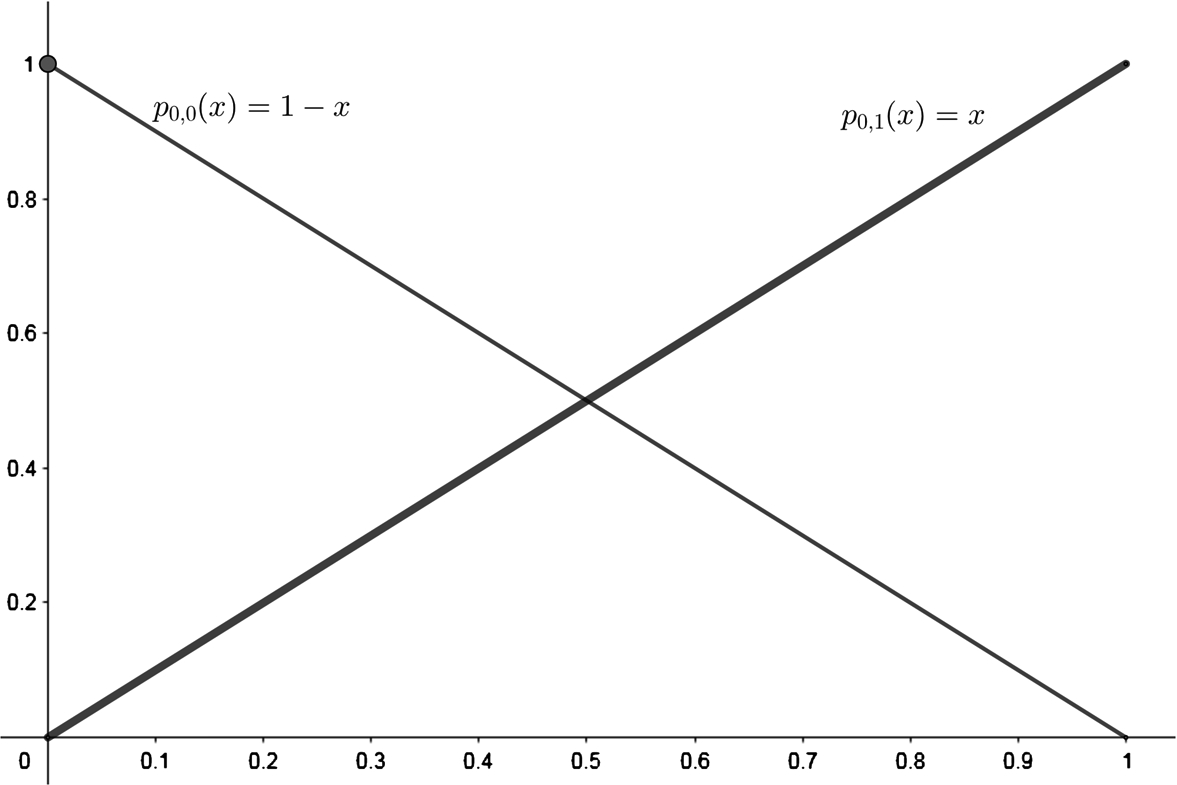
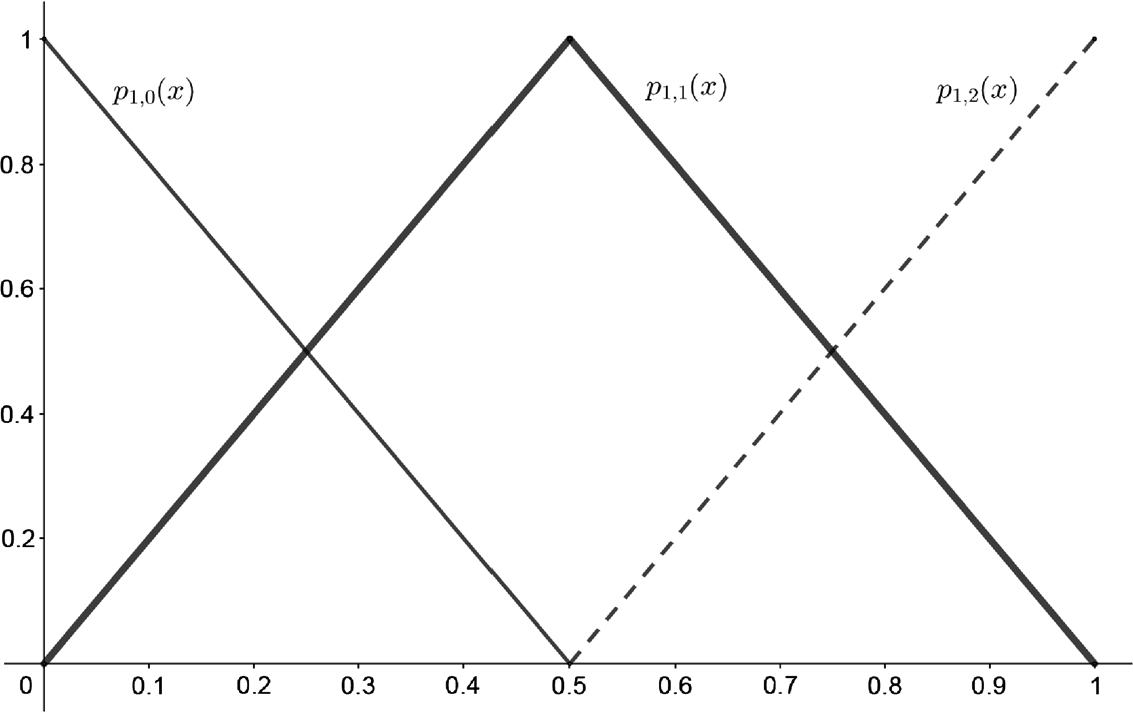
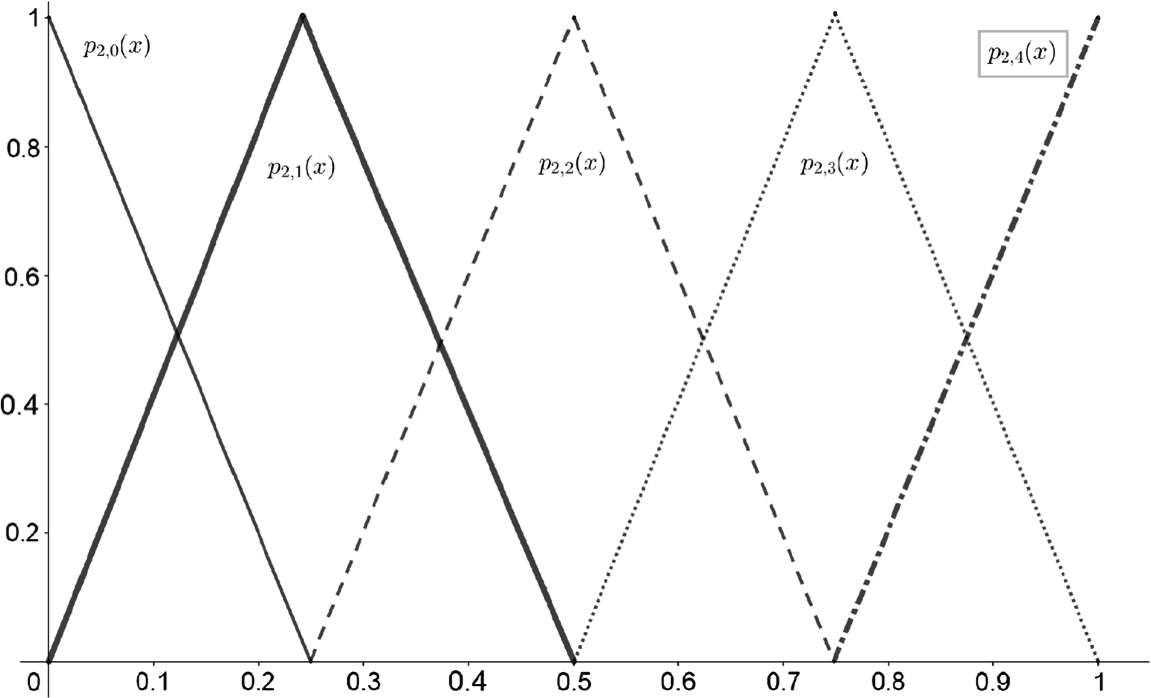
Figures 1, 2, and 3 demonstrate the first several of these “tent” functions generated from .
and .
, , and .
, , , , and .
To show that the functions defined in Definition 2.1 forms a generating set, we need only note that each member of the Faber–Schauder system for is included in, or is a linear combination of the functions listed in Definition 2.1. It is well-known that the Faber–Schauder system is linearly dense in with respect to the supremum norm. It follows readily that the standard generating set described above is linearly dense in as well. We prove in Section 6 that a generating set for can be built from any homeomorphism of the unit interval with itself according to the above recipe.
The following theorem is a classical result of analysis that characterizes the isometric isomorphisms between spaces of continuous functions. We will make use of this theorem in Section 6 to prove Proposition 6.1 and subsequently Theorem 1.3.
If Q and K are compact metric spaces then for the spaces of real continuous functionsandto be isometrically isomorphic it is necessary and sufficient that Q and K be homeomorphic. In this case, an isometric isomorphism T fromontomust be given bywhere ϕ is a homeomorphism from K onto Q and h is a real-valued unimodular function on K.
Computable world preliminaries
We assume that the reader is familiar with the notation, terminology, and basic concepts of computability theory as can be found in [16]. Here we cover concepts from computable analysis that are pertinent to the results of this paper. A more expansive treatment of these concepts can be found in [1,15], and [17]. We use the framework for effective metric structure theory of Banach spaces as developed in [4] and [11].
Let be a presentation of a Banach space . is a computable presentation of if there is an algorithm that, given any rational vector f of and nonnegative integer k, computes a rational number r so that . In terms of , it can be shown that the set of all continuous piecewise-linear functions on with finitely many rational breakpoints can be used to form a computable presentation of ; similarly for the standard generating set as defined in the previous section.
We now define vectors and sequences computable with respect to some computable presentation of a Banach space . We say that a vector is computable with respect to if there is an algorithm that, given nonnegative integer k as input, computes a rational vector u of such that . In other words, there is an algorithm that returns arbitrarily good rational vector approximations of . A sequence of vectors in is said to be computable with respect to provided there is an algorithm that, given nonnegative integers n, k as input, produces a rational vector u of such that .
Suppose is a Banach space with , and let r be a positive real number. We define the open ball centered at f with radius r (denoted ) to be the set of all vectors so that . If f is a rational vector of the computable presentation of and is rational, then we refer to as a rational ball of. A code for a rational ball of can be obtained from codes for its center and radius.
The next definition will be explicitly referenced in the proof of Theorem 1.2.
Suppose for each that is a computable presentation of the Banach space . A map is a computable map ofinto if there is a computable function P that maps rational balls of to rational balls of such that the following two properties hold.
For rational a ball of , , whenever is defined.
Whenever U is a neighborhood of for , there is a rational ball b of such that and .
The next theorem, which can be found in [15], will be useful in our proof of Theorem 1.3.
Suppose for eachthatis a computable presentation of the Banach space, and thatis bounded and linear. Then, T is computable if and only if T maps a linearly dense computable sequence ofto a computable sequence of.
We say that a Banach space is computably categorical provided that for any two computable presentations and of there is a computable isometric isomorphism T from onto .
The prior definitions and theorem can all be relativized in the usual way.
Overview
Our main results follow a linear progression in the sense that Theorem 1.1 helps us prove Theorem 1.2, which in turn helps us prove Theorem 1.3 and its corollary.
Let be a computable presentation of and assume, without loss of generality, that every vector in is a unit vector. In Section 4 our chief aim is to develop a procedure that searches for a rational vector of that is within any desired precision of . We do this by developing classical criteria that give us the ability to effectively test how “uniformly tall” a unit vector is on the unit interval. Since, with respect to , all we can compute is addition, scalar multiplication, and norms of rational vectors of , we cannot access any ‘x-value’ information directly. Loosely speaking, what we must do is take advantage of the linear density of to find a rational unit vector f of that ‘almost’ shares a global max with every other rational unit vector of (that is sufficiently close to f). Knowing that unity is -computable gives us the means by which we can test a rational unit vector v of for strict positivity over the unit interval; just use the halting set to compute the result of .
In Section 5 we show that the modulus (or absolute value) operator is -computable. We know from basic analysis that any unit vector can be decomposed as , where and represent the negative and nonnegative parts of f respectively. As such, . Thus, the key idea for proving Theorem 1.2 comes down to finding a pair of positive rational unit vectors of that approximate and sufficiently well. Notice that and are disjointly supported vectors; that is, for all where and vice versa. The challenge of finding such vector approximations to and is ensuring that said approximations are also disjointly supported, or at least ‘almost’ disjointly supported. We handle all of this explicitly in Section 5.
Lastly, in Section 6, we prove Theorem 1.3 and Corollary 1.4. By the definitions of meet and join, as given in Section 2 and by Theorem 1.2, it follows that meets and joins of rational vectors of are -computable. Thus, if we have an X-computable homeomorphism ϕ of the unit interval with itself, the oracle can define (cf. Definition 2.1) with respect to any given computable presentation of . Via the Banach–Stone Theorem mentioned in Section 2, we can then build an -computable map that takes each vector of to its corresponding vector of . This map in turn can be extended to an isometric isomorphism. Corollary 1.4 follows immediately from the above.
Unity
In this section we begin by providing classical conditions for finding approximations of the constant unit function , or unity. These will be used to define a search procedure, as outlined in Section 3, which allows the halting set to compute with respect to any computable presentation of .
The following definition is at the heart of every proposition that follows.
Let be unit vectors. We define the peak defect of f and g to be
Peak defect, in a sense, is a manner of measuring how far two unit vectors are from sharing global extrema. It is fairly straightforward to see that for unit vectors there is an such that if and only if .
We now develop the conditions that, given any , allow us to search for a rational vector of a computable presentation of that is within of the constant unit function .
Letbe a unit vector. Then,for allif and only if one of the following conditions holds for all unit:
,
,
.
Let f be a unit vector such that for all . Suppose g is a unit vector of . We can suppose that g does not satisfy conditions (1) and (2). Let be such that . Since , and have the same sign. It follows that
Therefore, it follows that
We prove the reverse direction by contrapositive. Suppose for some . We now define a vector such that and . We handle this in two cases.
First suppose, without loss of generality, that for all . Suppose also that for some . Let
for all . We claim . For, for all , which implies
Therefore g is a unit vector. Furthermore, is maximized when ; that is, at . Thus,
Also, notice that for all , which implies . Thus our requirements for g are satisfied.
Now, suppose there exists an such that . By continuity, there exists an interval so that and
for all . We will assume without loss of generality that for all . We define g as follows. Set and . Let and set . Connect and with a line segment; do the same with and as well. For all so that , set . Lastly, for all so that , set where appropriate so that g is continuous.
We claim . When so that , . Since f attains its maximum value on this set, it follows that when . On , and g attains its maximum value at . Therefore
Lastly, when and , . Therefore by all the above it follows that .
We now claim that . When such that , . Since f attains its maximum value on this set, it follows by the definition of g that . When , and g attains its maximum value at . Note also that . Therefore
Note that when and ,
Thus, it follows from the above that . □
Here we demonstrate that the constant unit vector is -computable with respect to any computable presentation by leveraging the conditions found in Proposition 4.2.
We begin by defining a procedure P that, on input , searches for a rational unit vector f of so that for all .
First, define S to be the procedure that on input and nonzero rational vector f of searches for a nonzero rational vector g of such that
and returns g if such a g is found.
Now, suppose we are given an as input for P. Using oracle , search for a nonzero rational vector f of such that S fails to halt on input m and f, returning if such an f is found.
Since the set of rational vectors of is dense in we are guaranteed that there is a rational vector f of such that . Thus, by the conditions specified in the proof of Proposition 4.2 and by the density of the rational vectors of , for any given we will indeed find a nonzero rational vector f of such that S does not halt on input m and f. Therefore, P is a procedure, and it produces a rational vector such that .
Now, to compute one of or , we define two -computable sequences and such that one of or converges uniformly to or .
To this end, we begin by computing a list where each is the result of running P on input k. Now, we construct and in stages.
Stage 0
Set and .
Stage
Let and be the least i and j, respectively, such that and have not been defined. Now, if set . If set . Note one of these conditions must occur, for otherwise we have which implies the existence of an such that . This is impossible by how we defined the elements of R.
Now, to compute one of either or up to precision , return if it is defined. Otherwise, return .
By how we constructed our sequences and , which was done by sorting the sequence elements, one of or must be an infinite sequence. Suppose without loss of generality this sequence is and that . We claim that converges uniformly to . Since , by definition is a sequence of unit vectors that are all greater than 0. Recall that for all , . Recall also that, in the above, we defined for each , for some . Thus, let be given and note that for some ,
Since the are unit vectors, it follows that converges uniformly to .
Note that since P is -computable, it follows by the above procedure that is also -computable. □
Note that since is -computable with respect to any computable presentation of , we can use the halting set to determine whether or not a rational vector f of is strictly positive. This can be done by checking the condition . This will prove useful in the next section.
Modulus
Here we first demonstrate that the modulus operator is -computable with respect to any computable presentation of . We then show that meets and joins are also -computable with respect to . This then gives us a means of proving Theorem 1.3 in Section 6.
Naturally, we can decompose any vector f in into two disjointly supported vectors , and , representing the negative and nonnegative parts of f, respectively. Having this decomposition in hand allows us to easily reconstruct from its constituent parts. However, from an effective standpoint, given a computable presentation of , we might not be able to find rational vectors computable with respect to that both approximate the negative and nonnegative parts of f and are “perfectly” disjointly supported. Hence, we settle for an approximation of disjointness of support.
Let and let . f and g are said to be ϵ-almost disjointly supported if whenever and whenever .
The following proposition gives us a means by which we can determine if two positive unit vectors are ϵ-almost disjointly supported.
Letbe strictly positive unit vectors and let. If for all nonnegative h such thatandwe havethen f, g are ϵ-almost disjointly supported.
We prove this by contraposition. Suppose f, g are not ϵ-almost disjointly supported. Then there is a point such that . It then follows that , where . Let be where achieves a global maximum. Let . Then since it follows that as well. Note that attains a global maximum at . Since ,
Thus we have shown f, g must be ϵ-almost disjointly supported. □
The next proposition indicates how we can use two strictly positive -almost disjointly supported vectors, whose difference approximates , to approximate . We will make use of these conditions in the proof of Theorem 1.2.
Letbe unit vectors so that g, h are nonnegative,-almost disjointly supported for some, and. Then,.
Note first that
We show that and note that follows analogously. Here, we denote the support of a vector as . Now, let
where , . Note that is equal to the maximum value of . We show that for each j.
First, note that on ,
It then follows that for all , . Thus, for each . By the -almost disjointness of support of g and h,
Note that on ,
Since for any , this implies
for all . We have that so from the above . Thus, for all ,
which implies
On , notice
Since g and h are -almost disjointly supported, this implies for all
Since on we have from the above
Since on , it follows that
Lastly, on we have and . It follows immediately that
Therefore, from the above arguments we can conclude that . □
In light of Propositions 5.2 and 5.3 we prove is -computable by defining a procedure P that maps rational balls of to rational balls of so that the properties of Definition 2.3 are met. We define P as follows.
First define S to be a procedure that, on input and rational vectors , of , searches for a nonnegative rational vector h of such that the following conditions hold:
,
,
and then returns h if found.
Now, compute the least such that . Using , search for a pair of positive rational unit vectors , of such that , , and such that S does not halt on inputs , , . If no such vector is found, return where .
Note that the conditions found in procedure S require the use of the halting set (particularly, to determine whether properties (2) and (3) hold). Furthermore, S may not halt on inputs , , . Thus it follows that procedure P is .
Now note by the density of the rational vectors of and by Propositions 5.2 and 5.3 we are guaranteed to find positive rational unit vectors , such that on inputs , , S fails to halt. It follows by Proposition 5.2 that . From this and by how we defined P, property (1) of Definition 2.3 immediately follows.
To show that (2) of Definition 2.3 holds, let and let U be a neighborhood of . Then let . Let f be a rational vector of such that . We claim where and . Note for some rational vector w of . By Proposition 5.2, . Then, by the triangle inequality,
which implies, by Proposition 5.2, that
Thus, if , we note that the above and the triangle inequality imply
Therefore and property (2) of Definition 2.3 is satisfied. □
The result above combined with the definitions of meets and joins of vectors in gives us the following.
Letbe a computable presentation of. Then, the binary operations ∧ and ∨ are-computable with respect to.
This follows immediately from the definition of ∧ and ∨ and Theorem 1.2. □
Categoricity
In this section, we prove Theorem 1.3 and Corollary 1.4 by leveraging Corollary 5.4 and the following proposition, whose proof relies upon the Banach–Stone characterization of the isometric isomorphisms of with itself (cf. Theorem 2.2).
Letbe a homeomorphism ofwith itself. Then, the linear span ofas in Definition
2.1
is dense inwith respect to the supremum norm.
Define a surjective linear isometry T from onto as
Notice that and so for all i, j as in Definition 2.1
for all . Thus T maps the vectors in injectively onto those of . Since is uniformly dense in , it follows by the Banach–Stone theorem that is uniformly dense in as well. □
The following lemma, which is a corollary of the above, will be helpful in the proof of Theorem 1.3.
Let f, g be homeomorphisms ofwith itself, and suppose thatandare generating sets forconstructed from g and f respectively as in Definition
2.1
. Letbe the map defined so thatfor all i, j. Then, T extends to an isometric endomorphism T of.
The proof of the above can be easily adapted from that of Proposition 6.1.
Use to compute a homeomorphism of the unit interval with itself ϕ with respect to . Then, it follows from Corollary 5.4 that computes the generating set as explicated in Definition 2.1. Letting be the standard generating set of , we have from Lemma 6.2 that the identity map T taking for all , extends to an isometric isomorphism from onto . Call this isometric isomorphism T as well. Furthermore, since T maps a linearly dense -computable sequence to an -computable sequence, it follows that T is an -computable isometric isomorphism by relativization of Theorem 2.4. □
It is easy to see that Corollary 1.4 follows immediately from Theorem 1.3.
Conclusions
In summary, we have shown that computing unity with respect to any computable presentation of is no more difficult than computing the halting set. Furthermore, we have demonstrated that the modulus operator is -computable with respect to and, as a corollary, proved that meets and joins of rational vectors of are also -computable. In turn, we have shown that if an oracle X computes a homeomorphism of the unit interval with itself with respect to , then computes an isometric isomorphism from the standard computable presentation of onto . This then gives us a categoricity result for the restricted class of computable presentations of as described in Corollary 1.4. The former two theorems by no means directly access ‘x-value’ information of any vector in the space, as we have been working effectively in the signature of Banach spaces. That is, what we accomplished with respect to these results relied only upon ‘y-value’ (i.e. ‘maximum height’) information, and whatever ‘x-value’ information could be garnered from the linear density of a computable presentation of . The inability to access the ‘x-value’ information of vectors in likely puts severe limitations what else can be done from an effective standpoint. The following questions come as a natural result of this apparent limitation.
What other common operations on vectors in the Banach space are arithmetical?
Is there an arithmetical Turing degree d that computes a homeomorphism with respect to any given computable presentation of the Banach space ?
If such a degree d can be determined, then much more information can likely be gathered by d regarding the overall shape of graphs of functions in .
Footnotes
Acknowledgements
I thank Timothy McNicholl and Diego Rojas for many inspiring conversations. I also thank the former, in addition to the anonymous reviewer, for suggestions that improved the composition of the paper.
References
1.
C.J.Ash and J.Knight, Computable Structures and the Hyperarithmetical Hierarchy, Studies in Logic and the Foundations of Mathematics, Vol. 144, North-Holland Publishing Co., Amsterdam, 2000.
2.
T.Brown, Computable structure theory on Banach spaces, Graduate theses and dissertations, Iowa State University, 2019.
3.
T.Brown and T.H.McNicholl, Analytic computable structure theory and -spaces part 2, Arch. Math. Logic59 (2020), 427–443. doi:10.1007/s00153-019-00697-4.
4.
J.Clanin, T.McNicholl and D.Stull, Analytic computable structure theory and -spaces, Fundamenta Mathematicae. 244 (2019), 255–285. doi:10.4064/fm448-5-2018.
5.
M.P.H.Fabian, P.Hájek, V.Montesinos and V.Zizler, Banach Space Theory, the Basis for Linear and Nonlinear Analysis, CMS Books in Mathematics, 2011.
6.
R.J.Fleming and J.E.Jamison, Isometries on Banach Spaces: Function Spaces, Monographs and Surveys in Pure and Applied Mathematics, CRC Press, 2002.
7.
E.B.Fokina, V.Harizanov and A.G.Melnikov, Computable model theory, in: Turing’s Legacy: Developments from Turing’s Ideas in Logic, R.Downey, ed., Cambridge University Press, Cambridge, 2014.
8.
E.B.Fokina, I.Kalimullin and R.Miller, Degrees of categoricity of computable structures, Archive for Mathematical Logic49(1) (2009), 51–67. doi:10.1007/s00153-009-0160-4.
9.
A.Fröhlich and J.C.Shepherdson, Effective procedures in field theory, Philosophical Transactions of the Royal Society of London. Series A. Mathematical and Physical Sciences248 (1956), 407–432.
10.
D.R.Hirschfeldt, K.Kramer, R.Miller and A.Shlapentokh, Categoricity properties for computable algebraic fields, Transactions of the American Mathematical Society367(6) (2015), 3981–4017. doi:10.1090/S0002-9947-2014-06094-7.
11.
T.H.McNicholl, Computable copies of , Computability6(4) (2017), 391–408. doi:10.3233/COM-160065.
12.
A.G.Melnikov and K.M.Ng, Computable structures and operations on the space of continuous functions, Fundamenta Mathematicae233(2) (2014), 1–41.
13.
A.G.Melnikov and A.Nies, The classification problem for compact computable metric spaces, in: The Nature of Computation, Lecture Notes in Comput. Sci., Vol. 7921, Springer, Heidelberg, 2013, pp. 320–328.
14.
C.Pilar and J.Mendoza, Banach Spaces of Vector-Valued Functions, Lecture Notes in Mathematics, Vol. 1676, Springer-Verlag, Berlin, 1997. MR 1489231.
15.
M.B.Pour-El and I.Richards, Computability in Analysis and Physics, Perspectives in Mathematical Logic, Springer Verlag, Berlin, New York, 1989.
16.
R.Soare, Turing Computability Theory and Applications, Springer, Berlin, Heidelberg, 2016.
17.
K.Weihrauch, Computable Analysis: An Introduction, Texts in Theoretical Computer Science, Springer, Berlin, New York, 2000.