



Abstract
Decisional bias (false alarm rate) when judging the guilt/innocence of a suspect is offered as an implicit measure of moral judgment. Combining two data sets, 215 participants, ages 10–12, 13–15, and 16–18 watched the visually identical film involving a person setting a fire, framed either as (a) intentional but not resulting in a fire (BI-NF), (b) unintentional but resulting in a major fire (NI-F), or (c) intentional and resulting in a major fire (BI-F). After watching the film, participants identified seriatim who of six individuals was the perpetrator and how certain they were. The data were subjected to a signal detection analysis. Participants also explicitly judged “how bad” the perpetrator and act were. The implicit measure fit Piaget’s claim of moral realism, shifting from judging wrongness according to the outcome to judging according to the actor’s intentions, better than the explicit traditional measures.
Early in his career, Piaget (1965/1932) reported research on children’s moral judgments when playing games, such as marbles, and judging right and wrong about everyday transgressions. The best-known finding was that young children frequently ignore the actor’s intentions when making moral judgments, and instead judge primarily according to the material outcome of the act, a phenomenon Piaget termed moral realism.
Subsequent studies of children’s attention to the intentions behind the act as distinguished from the outcome of the act when making moral judgments have not consistently supported Piaget’s claim of a developmental shift from attention to the outcome of the act to the intentions behind the act (e.g., Armsby, 1971; Boehm, 1962; Chandler, Greenspan, & Barenboim, 1993; Costanzo et al., 1973; Gutkin, 1972; Karniol, 1978; Rule & Duker, 1973). Furthermore, moral realism, as a developmental phenomenon, has largely disappeared from the research scene although it is central to the criminal justice system as mens rea or the state of mind of the accused whose job it is the juries to determine. In this report, we offer the possibility that eyewitness identification provides an alternative measure of moral judgment, which we believe better supports Piaget’s original claim, but at an implicit level of thinking. However, first some background is needed regarding the distinction between explicit and implicit decision-making and how it relates to this phenomenon and report.
In recent years, there has been a general recognition that there are two ways of processing information, one deliberate, comprehensive and slow, termed explicit, and the other, intuitive, and fast but incomplete, termed implicit (e.g., Kahneman, 2003; Tversky & Kahneman, 1981). Although different modes of thinking have a long history in psychology, what is meant in recent literature by the terms is that one (implicit) is not deliberate but rather “impulsive” in the sense that it is not consciously thought out, whereas the other (explicit) is more subject to deliberation and conscious awareness and planning. In addition to the research by Tversky and Kahneman, this dichotomy has given rise of much research in the areas of decision-making, as cited above, and even social and moral judgments (e.g., Eskine, Kacinik, & Prinz, 2011). However, these studies have not been developmental either in theoretical focus or method whereas this study is decidedly developmental in both theory and method.
Specifically, we believe that our previously published research on children’s eyewitness identification (e.g., Spring, Saltzstein, & Peach, 2012; Spring, Saltzstein, & Vidal, 2015) extends that effort in that it offers what we have come to believe is an implicit measure of moral intentionality, which rests on a Signal Detection (SD) analysis of eyewitness identification. In this research, our focus has been on decisional bias, the tendency to make false alarms, termed bias in signal detection analysis, rather than general accuracy. The underlying assumption of the research is that, in addition to relying on cognition and memory, the eyewitness is making a moral judgment in that a false alarm/positive risks sending an innocent person to jail whereas a miss/false negative risks letting a guilty person to go free, perhaps to commit another crime.
This recognition, certainly common in the law and even in public discourse, has somehow eluded researchers in the area of eyewitness identification, who have for the most part focused on eyewitness identification as an exercise solely or primarily of memory and (general) cognition, although sometimes as subject to suggestibility, whereas we would argue that, in addition to those phenomena, it also involves an exercise of moral judgment but at an implicit level of functioning. Our more specific hypothesis is that an implicit measure of moral judgment, in the form of decisional bias in eyewitness identification, of intended and unintended acts resulting in minor or major material damage, may conform to Piaget’s claim of moral realism even when the overt explicit moral judgments of the guilt of the person and act do not.
In this research, we have presented children and adolescents with the identical filmed event, which have been described or ‘framed’ as to the intentions of the actor and the consequences of the act (damage done) by means of a voice-over. Note that the visual information remains identical across conditions whereas its moral meaning and significance is systematically varied by means of the different meanings conveyed by voice-overs. The voice-over describes the act at the end of the film differently, as to the actor’s intention and the outcome of the act. In this way, the same visual information can systematically have different moral meanings. Then, the participants, either individually (for the younger children) or in small groups (the older children) make individual judgments identifying who is the perpetrator or perp. Our main interest and critical findings lie not in their accuracy (in Signal detection terms, sensitivity) but in their decisional bias, the term for the relative balance of false positives and false negatives, corrected for chance. Thus, by comparing the patterns of findings re: age and condition (describing the actor’s intentions and the act’s outcome) for the two kinds of measures: one, the traditional explicit moral judgment and the other the new implicit decisional bias measure derived from the eyewitness identification we propose to see contrasting explicit and implicit judgments of moral transgressions.
Method
Participants
Aggregated data from two previously published studies that included 215 participants who were recruited from a public elementary and junior high school in New York City and from private schools on Long Island and in Queens, NY, with the usual parental and child informed consent. 1 The participant pool consisted of: 57 10–12-year-olds (M = 11.3), 93 13–15-year-olds, (M = 14.0), and 65 16–18 year olds (M = 16.5).
Design and Stimulus Materials
The film consists of four young men sitting around a table with cake resting on it with lit candles in the center, obviously celebrating one of their birthdays. After a short time, a waiter comes over to tell them that they must immediately vacate the restaurant, thus cutting short their celebration. One of them takes the cake with the lit candidates over to a trash can and throws it away. The identical film was presented in all conditions. What varied was the verbal (voice-over) description of the later part of the film. The first portion of the script is visually and aurally identical describing the event as a birthday celebration gone awry. Then, the voice-over at the end of the film provides the critical variation in the meaning of the act.
Throwing away the cake was described or framed by voice-over in three different ways: (a) as an unintended act, i.e., throwing away the cake just to dispose of it, but which results in a fire that ruined (‘burned down’) the restaurant, i.e., as an unintended act which results in a fire causing major damage (NI-F), (b) as an intended act, angrily throwing away the cake in order to set a fire, but the fire fizzles out causing no damage (BI-NF), and (c) as a bad intended act, angrily throwing away the cake in order to start a fire, and which results in a fire that burned down the restaurant (BI-F). The film lasted approximately 127 seconds. Judging from their recital of the events immediately after seeing the film, it was very understandable even for the youngest participants.
Participants were randomly assigned to one of the conditions. Immediately after viewing the film, the participants were asked to describe what happened to the restaurant (outcome), how bad was the man (man) and how bad was his act. Participants explicitly judged “how bad” for each of the following: the perpetrator, act and outcome as portrayed in the film along a 4-point scale. The participants were asked choose from a scale that included: not bad, a little bad, pretty bad, and very, very bad. After it was clear that the children understood the film and rated the act, actor and outcome, they began the eyewitness identification task.
The participants were asked to identify seriatim who of six individuals was the perpetrator and how certain they were that he was the man who started (or tried to start) the fire along a four-point scale, from ‘very sure it was not the man’ to ‘a little sure it was not the man’ to ‘a little sure it was the man’ to ‘very sure it was the man’. There was a total of 54 judgments, which resulted from 6 individuals (the four individuals at the party, the waiter, who announces the closing of the restaurant, and a man not in the film at all) were each presented from 3 perspectives (frontal, right and left profiles) = 18 photos, which were presented in three identical sequences, thus 18×3 = 54 presentations. 2 The sequences were random except that the same person never appears consecutively.
These data were subjected to a signal detection analysis with a focus on the tendency to make false alarm or false positive judgments using criterion (C3), i.e., contrasting the alternative, very sure it is the man with the other three alternatives, corrected for chance. As noted, this criterion was chosen because past research (Pozzulo & Lindsay, 1999) has found that young children are particularly prone to very confidently identify the perp and because in past studies we have consistently found clearest results when using this criterion.
The first study featured (a) bad intentions with neutral outcome, i.e., no fire (BI-NF) vs. (b) neutral (non-malevolent) intentions with bad outcome, i.e., a fire, he was just trying to get rid of the cake, with bad outcome, a fire that burned down the restaurant (NI-F); the second study featured (c) bad intentions, he was trying to start a fire because he was angry, with bad outcome, a serious fire that burned down the restaurant (BI-F) vs. (d) neutral intentions but with a bad outcome (also, NI-F). After establishing that the two research samples were comparable by demonstrating that there was no difference in the critical decisional bias scores (C3) for the common condition, where the fire was unintended (NI-F), we combined the data sets from both studies. As noted, our primary measure of decisional bias rested on the divide between ‘very very sure’ and ‘sure’ ‘it is the man’, termed C3.
Results
Implicit Measure
The aggregated data set shows a highly significant main and interaction effects between age group and condition on C3, the decisional criteria for being “very, very sure it was the man”, Levene’s Test indicated that the assumption of homogeneity of variance for ANOVA was satisfactorily met, F (8, 186) = 1.367, p = 0.214 (see Fig. 1 and Table 1). There was a significant main effect for condition, F (2, 186) = 5.144, p < 0.01, partial eta squared = 0.052 and also a main effect for age group, F (2, 186) = 9.089, p < 0.001, partial eta squared = 0.089. More critically, there was a significant interaction between the age group of participants and condition, F (4, 186) = 4.572, p < 0.01, partial eta squared = 0.09. For 10–12 year- old participants, C3 was significantly related to condition, F (2, 186) = 10.95, p < 0.001, partial eta squared = 0.105, but C3 was not related to condition for 13–15 year olds F (2, 186) = 1.615, p = 0.202, partial eta squared = 0.017, or 16–18 year olds, F (2, 186) = 0.293, p = 0.747, partial eta squared = 0.003. Using the Tukey-Kramer adjustment to control for multiple mean comparisons, C3 for 10–12 year olds in the NI-F condition was significantly lower than in the BI-NF condition (p < 0.002) and marginally lower (p < 0.07) than in the BI-F condition. No other statistically significant differences were found in C3 between conditions within age groups. (Please note that a lower bias score indicates a higher rate of false positives/false alarms).
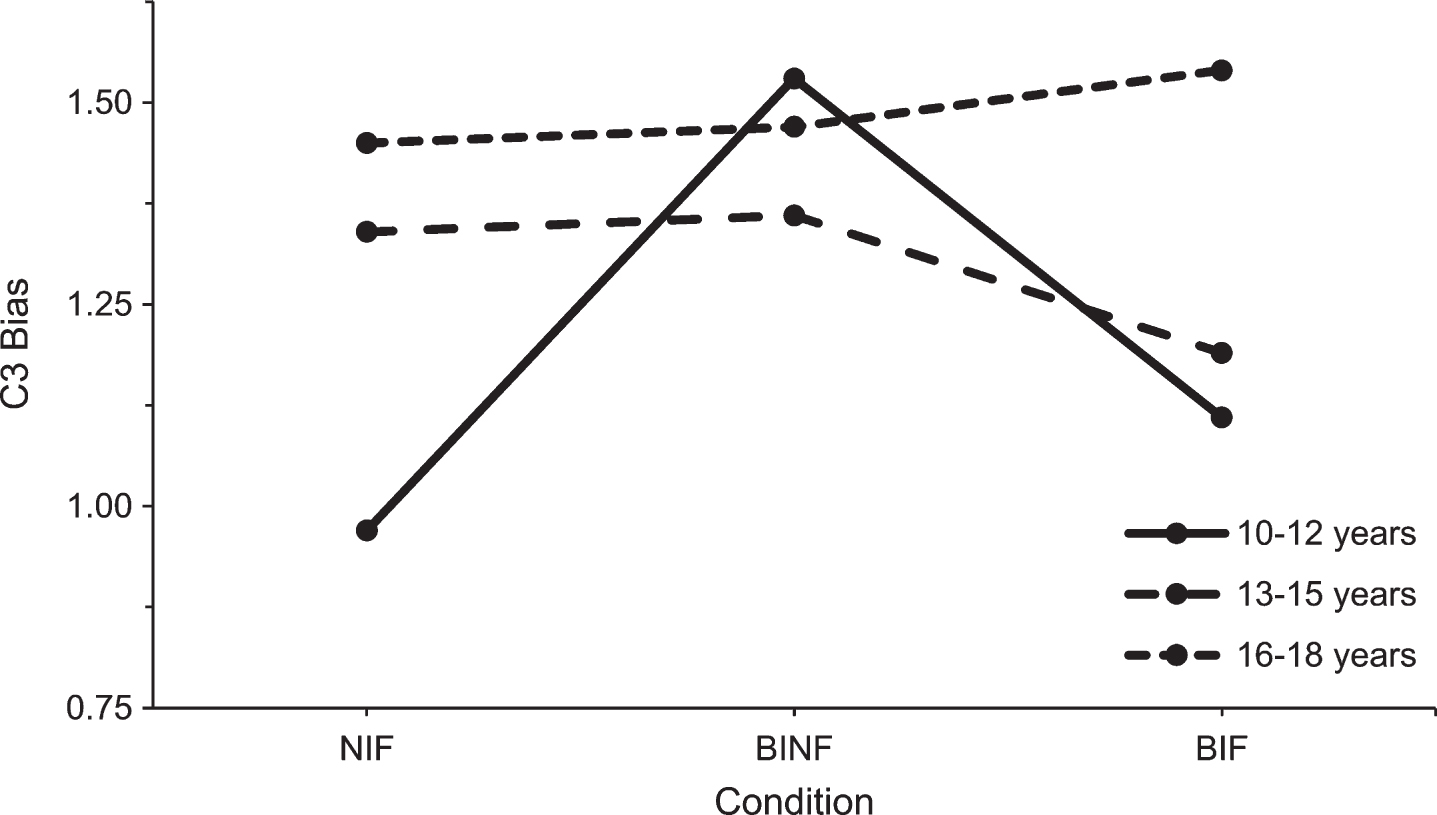
Relationship between bias (C3) and condition. Note: NIF indicates an unintended fire; BINF indicates a failed intention to start a fire, and BIF indicates a (bad) intended fire.
Descriptive Statistics of Outcome Variables
Note. Decisional Bias measured by C3 “very sure it is the man”. Moral Judgment measured by “how bad was the man and how bad was what the man did”. NIF = an unintended fire. BINF = a failed intention to start a fire. BIF = a bad intended fire.
These scores, in general, support the conclusion that the children in the 10–12-year-old age group make more false alarms when there is a fire, even if unintended than if there is a bad intention but no fire. The difference between the unintended fire condition and the intended no fire condition is marginally significant. In general, this pattern partially supports Piaget’s claim of moral realism but at the implicit level for the 10–12 year olds.
Explicit Measure
We now turn to the traditional/explicit moral judgment measures (how bad was the act plus how bad was the actor). A Levene’s Test indicated that the assumption of homogeneity of variance for ANOVA was satisfactorily met, F (8, 206) = 0.854, p = 0.556 (see Fig. 2). There was a significant main effect for age group, F (2, 206) = 5.255, p < 0.01, partial eta squared = 0.049, and for condition, F (2, 206) = 8.924, p < 0.001, partial eta squared = 0.08, and also a significant interaction between the age group of participants and condition F (4, 206) = 2.756, p < 0.05, partial eta squared = 0.051. The explicit moral judgment measure was significantly related to condition for the 13–15 year olds, F (2, 206) = 6.40, p = 0.002, partial eta squared = 0.058, and for the 16–18 year olds, F (2, 206) = 8.848, p < 0.001, partial eta squared = 0.079 such that moral judgments became more severe as intentions went from innocent to malevolent when there was a fire. There was not a significant difference between the conditions when there was (1) an unintended fire (NI-F) and a bad intention but no fire (BI-NF) or (2) between a bad intention but no fire and a bad intention resulting in a fire (BI-F). However, there was a significant difference unintended fire and a bad intention resulting in a fire. Thus, for the older children, moral condemnation came when there was a bad intended fire, not when there was just a bad intention. Thus, there is a clear general tendency, although not one reaching statistical significance, for blame to go up when there is a bad intention and further when there is a bad intention followed by a bad outcome. In contrast, participants ages 10–12, explicit moral judgments were not at all related to condition (F (2, 206) = 2.08, p = 0.127, partial eta squared = 0.02.
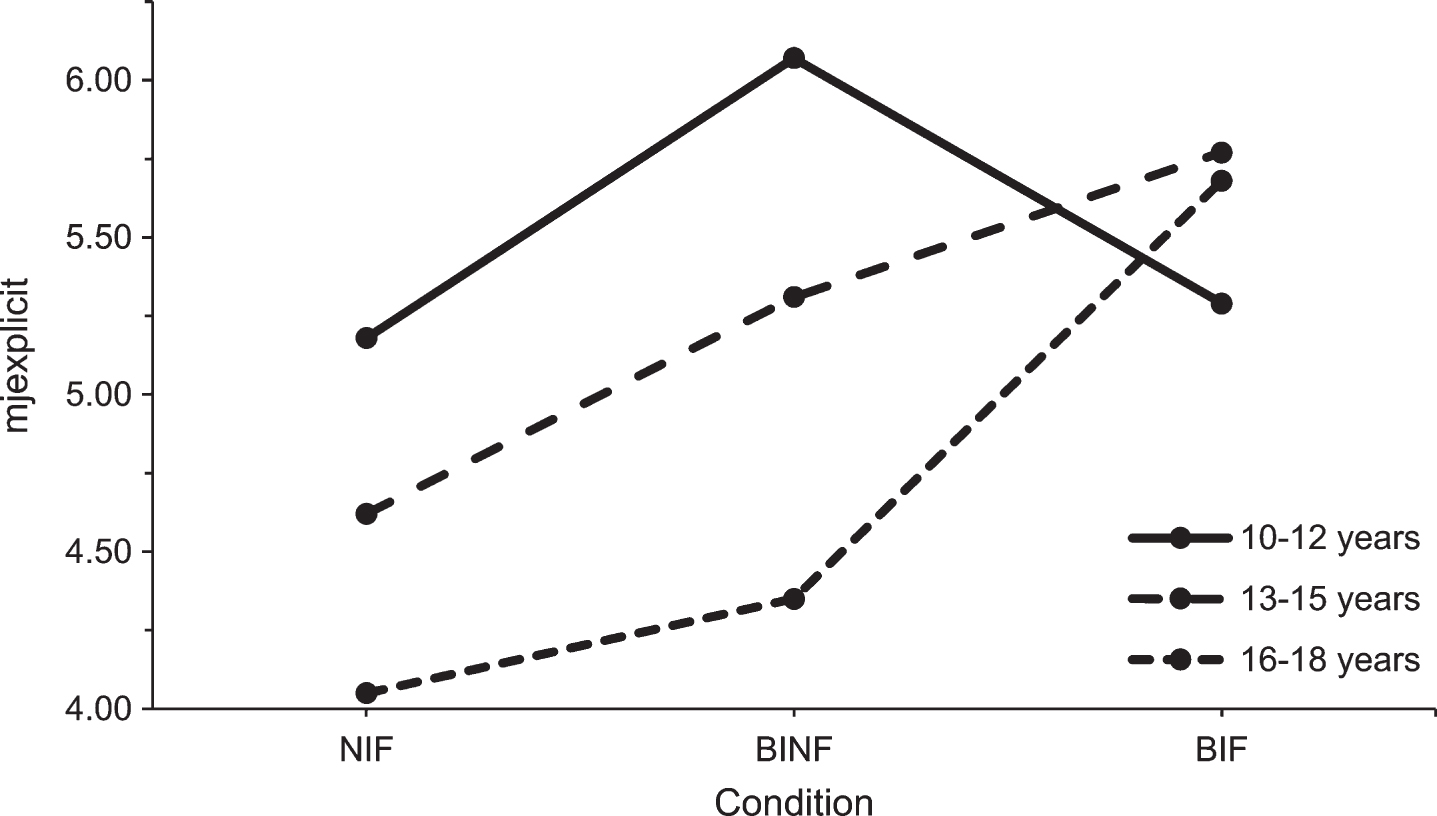
Relationship between moral judgment and condition. Note: NIF indicates an unintended fire; BINF indicates a failed intention to start a fire, and BIF indicates a (bad) intended fire.
Thus, the two older age groups seem to have partially used an explicit intentionality criterion when assigning moral blame in that they do differentiate between an intended fire (Bad Intention/Fire Condition) and an unintended fire (No Intention/Fire Condition) but not between an intended fire (Bad Intention/Fire Condition) and an intended fire that failed (Bad Intention/No Fire condition). In contrast, the youngest age group (10–12 year olds) do not appear to use either intentionality or outcome (material damage) in making explicit moral judgments.
Discussion
What are we to conclude from this analysis of the aggregated data? The 10–12-year-old children exhibited more implicit ‘blame’, indicated by a lower bias score, i.e., relatively more false alarms, when the outcome was bad, i.e., resulting in a fire, regardless of whether it was intended or unintended whereas the older participants (13–15 and 16–18 year olds) did not. In contrast, the explicit moral judgment measure does not fit with the developmental expectations formulated by Piaget and others. However, the explicit judgments do confirm the importance of intentionality and the relative unimportance of outcome/damage for the two older groups.
We can conclude that different kinds of moral judgments, explicit judgments of the moral act or the actor and implicit judgments of the decisional criteria for guilt, exhibit different effects of (patterns for) age, intentions and outcome on judgments. Note, however, that the implicit measure appears to fit better, although not perfectly, then the explicit moral judgment measure, with Piaget’s initial claim of moral realism at least at pre-adolescence. One possibility is that the adoption of intentionality as a criterion for moral judgments first occurs at the explicit level and only gradually is used at the implicit level. In any case, we present this report to highlight what we believe to be a novel way of testing some long-standing claims about developmental changes in moral judgments with implicit measures of judgment, and of more general interest, that explicit and implicit measures yield somewhat different patterns of findings across age groups and conditions. However, the main point to be noted is not whether Piaget’s claim of moral realism is or is not correct, but rather that explicit and implicit measures detect different developmental patterns of judgment.
Some readers may note a connection of our research and explanation to the work of Jon Haidt (2001) and others, as presented in Social Intuitionist Theory. However, we would emphasize that our approach is different in that it is decidedly developmental, not only in our choice of children and adolescents as social cognizers, but in our belief, that a developmental approach to phenomena of looking at fundamental change with age (as a marker of psychological growth) offers the best strategy for understanding the nature of phenomena, here moral judgments, whether in their explicit or implicit form.
The research also shows the connection between moral judgments and eyewitness identification, which rests on what we believe to be self-evident, that at least for eyewitnesses over the age of nine, an eyewitness identification involves not just memory and (nonsocial) cognition, but also a moral judgment. This, we believe, has important implications for researchers into both areas: children’s moral development and children’s eyewitness identification, and perhaps practitioners in the legal system.
Footnotes
Data were also collected from 7–9 year olds, but in five separate studies, we have discovered from post-session interviews conducted after the eyewitness task completion that children in this age range do not think of the eyewitness identification task as involving a moral decision, i.e., as having consequences for others. Therefore, they do not differentiate between different moral settings of the event.
The relatively large number of presentations was based on the advice we received from an expert in signal detection methodology that signal detection requires a large number of presentations in order to provide valid measures of decisional bias. We should add that although initially we were concerned about the number of judgments (identifications) required which we were afraid might be too much especially for the younger participants, we encountered no problems with even the youngest participants completing the task. Their main concern was who was the man who did it?
Acknowledgments
We wish to thank Dr. Janet Kamin and Jennifer Chmielewski for their expert advice and assistance in analyzing the data.