




Abstract
Action processing is a crucial aspect of cognition and perception. It provides a window into the way we understand others and learn about the world. During the preschool years, there are significant developments in how children process actions. Here, we systematically review tasks investigating action processing in preschoolers, employing the electronic databases PubMed, Scopus and PsycINFO. We extracted 680 studies on action processing in preschoolers and identified 66 papers that focused on typically developing children. The studies employed various tasks, which we categorized based on their complexity and the cognitive abilities they demand. This review not only sheds light on the intricate developmental nuances of action processing during the preschool period but also serves as a valuable resource for researchers. By providing insights into the emergence of different ways how children process actions, it aids in selecting appropriate tasks for investigating action-related skills in preschool children.
Introduction
A striking difference between human behavior and the behavior of other species relates to humans’ ability to generate and represent complex behavior across several domains, including language, action, and music (e.g., Fitch et al., 2012; Fitch & Martins, 2014; Jackendoff & Lerdahl, 2006). A key aspect underlying complex behavior in different domains might be its reliance on hierarchical representation (e.g., Botvinick, 2008; Fitch, 2011; Jeon, 2014; Koechlin & Jubault, 2006): Unlike linear sequences, where elements connect to only one adjacent element, hierarchical sequences organize elements into superior clusters (Uddén et al., 2020). In the realm of action, hierarchical structuring has been argued to afford adaptivity and flexibility (Martins et al., 2019) as it enables an agent to choose between different sub-actions to reach an overarching goal. As a consequence, humans are able to adapt their goal-related behavior depending on different complex and multi-dimensional environments (Eckstein & Collins, 2020; Martins et al., 2019).
The question of how the understanding of complex action structures emerges in humans has become a central topic in developmental psychology (e.g., Corballis, 2014; Gönül et al., 2018; Maffongelli et al., 2019; Melzel & Paulus, 2021; Verschoor et al., 2015). Some theories suggest that human action should be conceived as being constituted by an action syntax (Maffongelli et al., 2019) and that recursion – a notion suggesting that cognitive functions exhibit repetitive and recursive patterns – plays a fundamental role not only in language (Hauser, et al., 2002) but also in human action (Corballis, 2014). Others proposed that actions are represented by their goals, and that action and perception share overlapping event codes (Hommel, et al., 2001). Others stressed the role of language in structuring and organizing human action (Carpendale & Lewis, 2004) and highlighted the impact of caregivers (e.g, through scaffolding; Hammond et al., 2012).
Yet, the empirical basis for the investigation of different theoretical claims is sparse. Unlike research areas with standardized measures, for example, the Theory of Mind (ToM) scale (Wellman & Liu, 2004), research on the representation of complex action used a variety of tasks in different sub-domains of action. Most notably, researchers have used imitation tasks (Flynn & Whiten, 2008), tool-use tasks (Gönül et al., 2018), and action planning tasks (Freier, et al., 2017). Assessments of hierarchical structures in human action are thus scattered (Bekkering et al., 2000; Gattis et al., 2002; Wohlschläger et al., 2003) and a standardized assessment for action processing tasks seems critical to further investigate possible connections between action processing and other cognitive domains, such as Theory of Mind (ToM) (Perner & Lang, 1999; Wade et al., 2018).
In this paper we provide a systematic review on tasks designed to measure complex action processing in early childhood, emphasizing those with a hierarchical rather than serial organization. Note, however, that complex actions do not necessarily need to rely on hierarchical organization (Flynn & Whiten, 2008). Furthermore, it might depend on the level of description whether an action is considered to be sequentially or hierarchically organized. Consistent with recent literature, an action structure is considered hierarchical when single basic elements of the overarching goal are subordinated to other units (Botvinick, 2008; Maffongelli et al., 2019). For example, if the overarching action goal is to drink a glass of water, the sub-actions of reaching out for a bottle, open it, reaching for a glass and pouring water into the glass, would be all sub-actions units subordinated to the action goal of drinking.
It has been proposed that hierarchical structures are central to action, and that hierarchical structure processing is a domain-general capacity (e.g., Fitch & Martins, 2014). Children show remarkable improvement with respect to hierarchical structure processing in language (de Villiers, 2000; Skeide et al., 2016) and higher-order perspective taking in ToM (de Villiers, 2005; Grosse Wiesmann et al., 2020) across the preschool period. In case one assumes a domain-general capacity, one could anticipate a parallel developmental progression in action processing, expecting preschoolers to enhance their understanding of hierarchical actions. Such enhancement may manifest in their representation of higher-level goals. Notably, the majority of behavioral studies conducted in preschool-aged children reviewed here investigates their ability to obey and coordinate goals at various levels (e.g., the coloring task by Freier et al., 2017). As hierarchies have been identified in various sub-domains of human action, the present review categorizes behavioral action tasks into lower-level and higher-level action goals. This classification, based on abilities in task performance and various action processing domains (planning, imitation, execution, and action imagery), aligns with a recent meta-analysis by Papitto et al. (2020). It is, however, important to point out that this classification does not always align with the distinctions made in the early developmental literature by other researchers. As there is no general agreement on the definition of key constructs, different scholars use the same terms differently. Moreover, categories often overlap. For example, action imitation also includes elements belonging to action execution and action planning. Similarly, action processing often includes socio-cognitive aspects. Thus, while we adopt the categories used by Papitto et al. (2020) for our systematic search, one needs to be aware that other researchers have used different distinctions that do not necessarily match this classification. Nevertheless, providing an initial structure for this emerging and occasionally confusing research field will help in gaining an overview.
The current review focuses specifically on the preschool years as this developmental stage is crucial for acquiring complex structures across cognitive domains (de Villiers, 2000; Greenfield, 1991; Schipke et al., 2012). Between three and six years of age, children acquire the ability to plan complex actions (e.g., Freier et al., 2015), use sophisticated linguistic structures (Greenfield, 1991; Lieven et al., 2003), and adopt others’ perspectives (for a review see Wellman et al., 2001). The intertwined development of language and ToM is often suggested (e.g., de Villiers, 2005; Ebert, 2020; Milligan at al., 2007), although recent work challenges this link once a non-verbal ToM test is used (Grosse Wiesmann et al., 2020; Grosse Wiesmann et al., 2017). However, while the relation between language and ToM has been of major interest in the developmental literature, the link between action processing and other cognitive functions is less explored (but see, e.g., Aschersleben et al., 2008). Many studies investigate the emergence of action understanding examining infants’ goal attribution (Woodward, 1998; but see Ganglmayer et al., 2019, for contradicting evidence) and predicting others’ actions (e.g., Falck-Ytter et al., 2006; Hunnius & Bekkering, 2010), focusing on the development of action understanding (Gredebäck & Melinder, 2010; Gredebäck et al., 2009; Libertus & Needham, 2011). Work with preschoolers, on the other hand, uses tasks in which children are supposed to act themselves (e.g., Flynn & Whiten, 2008; Freier et al., 2017; Jovanovic & Schwarzer, 2011; Spruijt et al., 2017). Given that actions are complex and multifaceted, a variety of behavioral tasks have been used to study specific aspects of action processing. Often, tasks assess imitative behavior to clarify how children process others’ actions because the way children reproduce an action presumably allows inferences about how they structure and interpret what they observed (Williamson & Markman, 2006). For instance, when children understand an action’s goal like drinking, they may replicate it by grasping the cup handle instead of the top, regardless of the model they observed. Studies further explored how children plan their grasp differently for actions like drinking compared to placing the cup elsewhere (e.g., Cox & Smitsman, 2006; Weigelt & Schack, 2010), thus gaining insights into children’s abilities to predict the consequences of an upcoming action.
In summary, this systematic review explores the developmental trajectory of children’s proficiency in solving complex action tasks during the preschool period. Examining task performance in children aged three to six allows us to identify developmental patterns in complex action processing and to isolate tasks that are mastered at different points in development. This marks the first attempt to provide an overview of behavioral tasks adopted in research on complex action processing with children in the preschool period. It aims to highlight commonalities and differences among tasks, experimental stimuli, experimental manipulations, and the age at which children start to perform and master a specific task, contributing to conceptual clarity and theory development in this emerging field of research.
Methods
Aim of the Current Literature Review
In this systematic literature review we provide an overview on behavioral tasks used to assess complex action processing in preschoolers. We aim to investigate the complexity of the action tasks and cognitive abilities needed in order to solve the task. Further, we associate these tasks with action domains, drawing on the framework proposed by Papitto and colleagues (2020). We provide a detailed description of tasks, including information on action complexity, the type of experimental stimuli used, and the age at which children are usually able to perform each task (cf. Table 2). This outline will help researchers working in the developmental field to get an overview over established tasks in the literature, to find a suitable task for the investigation of a given action ability in preschoolers and to compare results to the existing literature.
Literature Search
The selection of studies occurred in two stages. We first identified studies by searching the electronic databases PubMed, PsycINFO and Scopus. Second, we performed an analysis of the references in the articles identified in the first stage in order to find additional studies on the topic. Relevant articles found in the references were attached to the list of papers we created in the first stage. As for the wide range of different approaches on action processing, the databases were searched in four different categories of action (action planning, action imitation, action execution, and action imagery) based on Papitto et al. (2020) using the following search queries for each action domain:
(1) Action planning: action/motor [Title/Abstract] AND action planning [Title/Abstract]; (2) Action imitation: action imitation [Title/Abstract]; AND imitation [Title/Abstract]; (3) Action execution: action [Title/Abstract] AND execution [Title/Abstract]; (4) Action/Motor imagery: motor imagery [Title/Abstract] OR action imagery [Title/Abstract]. Please note that, considering motor imagery, we also searched for “action imagery”. Contrarily to Papitto et al. (2020), we didn’t consider the categories “motor learning” and “motor planning” because this area of research is not primarily concerned with goal-directed behavior but mainly refers to procedural motor processes. Here, instead, we looked at action planning that goes beyond perceptual-motor processes (e.g., kinematics) and that involves cognitive processes such as goal setting and hierarchical planning. To classify the tasks in our search, we used action planning and action execution as two distinct categories. In addition, as the primary focus of the current review lies on behavioral aspects of action processing, we did not consider the “action observation” category in our investigation. Indeed, action observation research focuses on the psychological processes subserving perception and processing of others’ actions and is mostly assessed by means of imaging techniques (Cuevas et al., 2014; Marshall & Meltzoff, 2011).
The basic search was refined through the use of the search term: AND (children [Title/Abstract] OR childhood [Title/Abstract] OR preschool [Title/Abstract] OR young age [Title/Abstract])) NOT (autism [Title/Abstract] OR disorders [Title/Abstract]) OR infancy [Title/Abstract]. Through our search, which was performed in October 2023, we overall identified 680 papers, of which 621 remaining after removing duplicates (cf. Table 1).
Database Search
Note. Overview of the considered papers in different databases presented with each individual search term on their date of retrieval and the total number of identified articles without further selection.
Inclusion and Exclusion Criteria
For each action category we created a pool of papers. Our query also identified papers that were not relevant to our topic and that had to be excluded a posteriori (e.g., title of papers containing single words of our search terms that belonged to other fields of interest). In the first selection stage we screened the abstract of each paper to exclude those articles that were not directly investigating action processing or in which the age group of interest differed from our requirements. After this first screening, 141 papers were left which were carefully read in the second selection stage. Due to potential challenges in matching experimental criteria between clinical and control groups, we excluded papers dealing with a clinical sample (e.g., papers related to the autism spectrum, and studies comparing healthy children with clinical samples). After this second screening a total of 66 papers remained in our dataset including 9 papers we extracted by manual search through references (cf. Fig. 1).
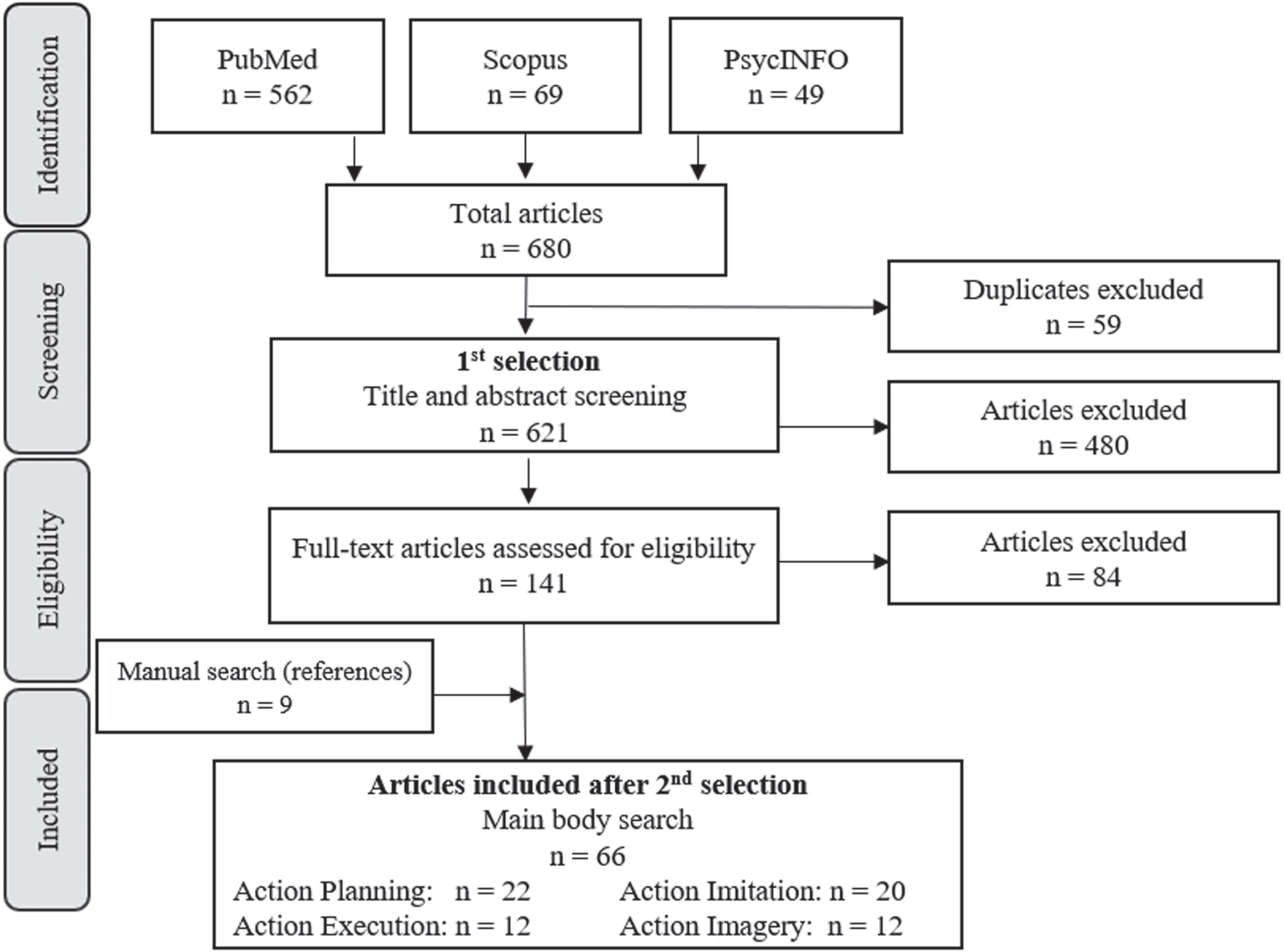
Literature Search and Selection Process
Papers were distributed as follows on the different categories: (1) action planning = 22 papers; (2) action imitation = 20 papers; (3) action execution = 12 papers; (4) action imagery = 12 papers (Table 1). We stored referential information, age of the sample tested, ability (e.g., from which age children are able to perform a given task), type of task, population (e.g., sometimes children and adults) and experimental question (Table 2).
Overview of Tasks
Note. Studies included in this review are organized by lower-, higher-level action goals and imagery related tasks. Tasks are linked to the action domains (planning, imitation, execution, imagery) and their required cognitive ability. The table provides references and sketches the task as well as children’s performance. *These studies also considered adults in their sample.
To highlight overlap in key terms and action domains, we employed VOSviewer, a program for creating bibliometric maps that visualize similarities using various approaches (Van Eck & Waltman, 2010). VOSviewer facilitates the display of connections in text data through co-citation, bibliographic coupling, and co-occurrence, such as authors and keywords (Van Eck & Waltman, 2010). The generated maps are distance-based, where a smaller distance indicates a stronger relation between terms. Here, we used the label view which highlights key terms with a higher number of connections in circles of larger size to create a map based on text data obtained from our database search including all papers from PubMed (56 papers). Papers from Scopus and PsycINFO (10 papers) were not included because not every database is created for bibliometric analysis and output variables from various databases differ (Donthu et al., 2012). The terms were drawn based on co-occurrence of keywords within the title and abstract fields with a minimum occurrence number of 5 terms and then statistically mapped (cf. Fig. 2). This map demonstrates the challenge faced by analyzing the various action domains, as categories scatter and overlap.
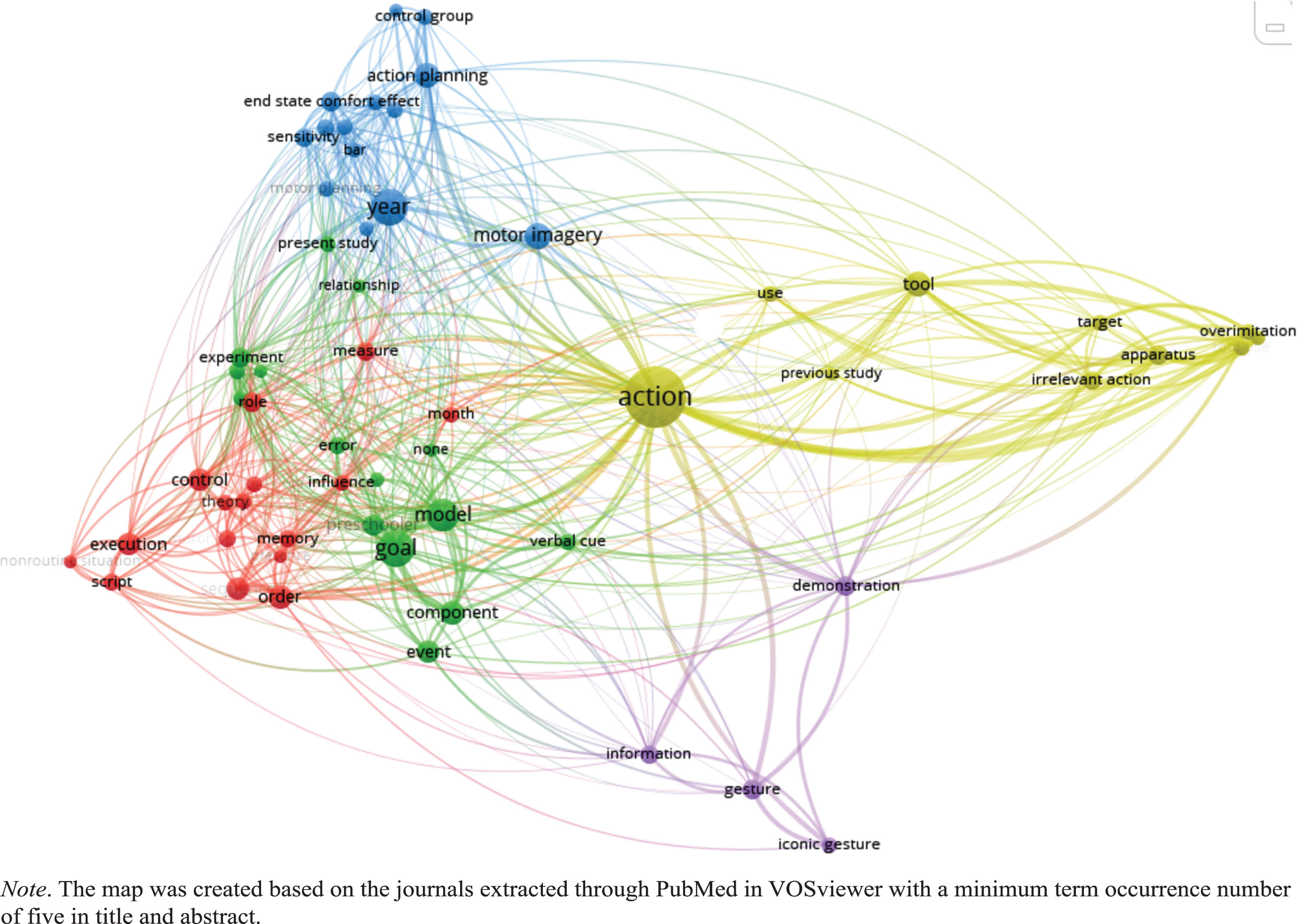
Mapping of Term Occurrence. Note. The map was created based on the journals extracted through PubMed in VOSviewer with a minimum term occurrence number of five in title and abstract.
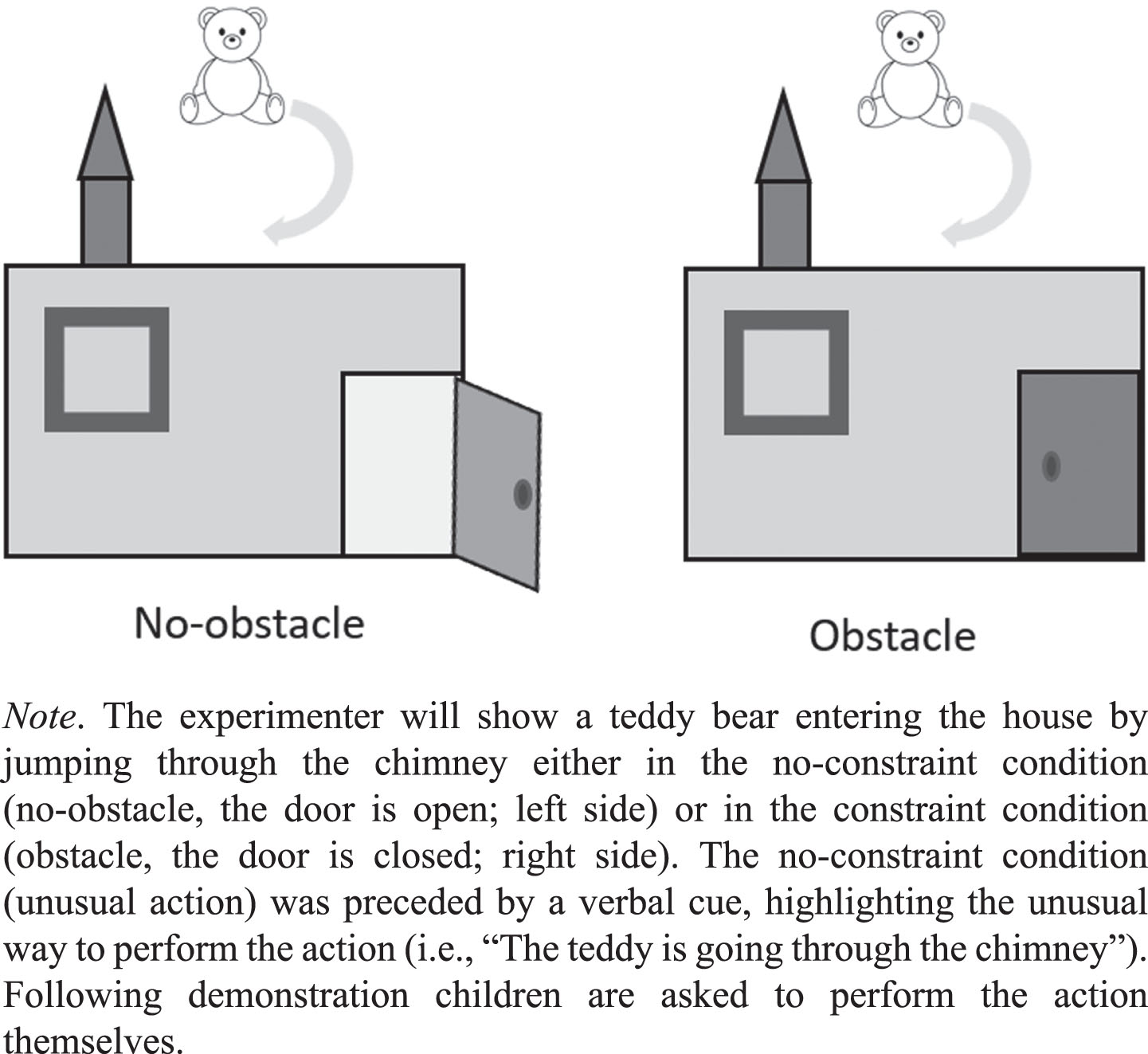
Schematic Description of a Version of a Selective Imitation Task as Represented by the House Task (Adapted from: Pfeifer & Elsner, 2013). Note. The experimenter will show a teddy bear entering the house by jumping through the chimney either in the no-constraint condition (no-obstacle, the door is open; left side) or in the constraint condition (obstacle, the door is closed; right side). The no-constraint condition (unusual action) was preceded by a verbal cue, highlighting the unusual way to perform the action (i.e., “The teddy is going through the chimney”). Following demonstration children are asked to perform the action themselves.
Results
Table 2 summarizes the studies included in this review. It provides an overview of tasks used in behavioral experiments in preschoolers categorized by the complexity of the action task in relation to the cognitive abilities required to perform the task. We classified each task with respect to the four different action domains of planning, imitation, execution, and imagery based on Papitto et al. (2020). We further assigned them to two main categories representing the complexity of the task in relation to its goal (lower-level and higher-level). We defined tasks as belonging to the low-level goal category as those in which the action goal is directly bound to the motor act itself (e.g., to turn a cup upside down, see Fig. 4) and/or in which the task can be solved by the mere reproduction of an observed action. In contrast, we classified a task to have a high-level goal if it requires to plan and carry out a sequence of action subunits to fulfill a semantically meaningful action goal (e.g., preparing a sandwich, see Fig. 5), i.e., a more abstract and complex cognitive goal. We considered a third main category for imagery-related tasks, as they are bound to the motor act, making them low-level tasks by our definition. Yet, at the same time they rely on cognitive abilities such as mental manipulation and the representation of an abstract end state. Arguably, this distinction is not clear-cut and comes with limitations as it is artificially constrained. Nevertheless, it might be fruitful for understanding the development of high-level, hierarchical action processing. We do not mean to claim that high-level actions do not involve motor acts or that low-level actions do not involve abstract goals. However, when considering the tasks included in this review, some are more directly bound to motor acts and movements, while other require a conceptual understanding of a more abstract, remote goal state.
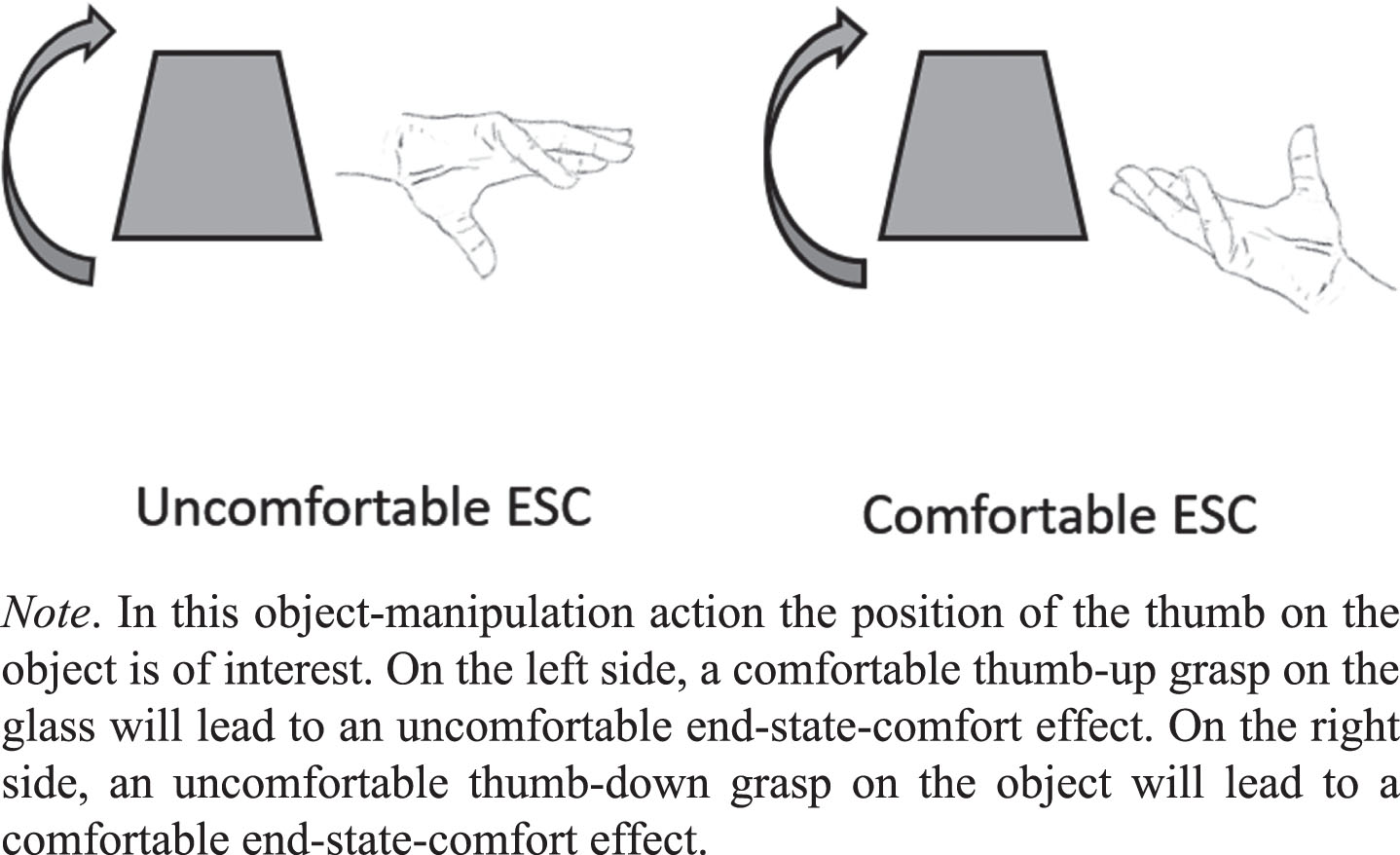
Schematic Description of the End-State-Comfort-Effect (ESC) in the Overturned Cup Task. Note. In this object-manipulation action the position of the thumb on the object is of interest. On the left side, a comfortable thumb-up grasp on the glass will lead to an uncomfortable end-state-comfort effect. On the right side, an uncomfortable thumb-down grasp on the object will lead to a comfortable end-state-comfort effect.
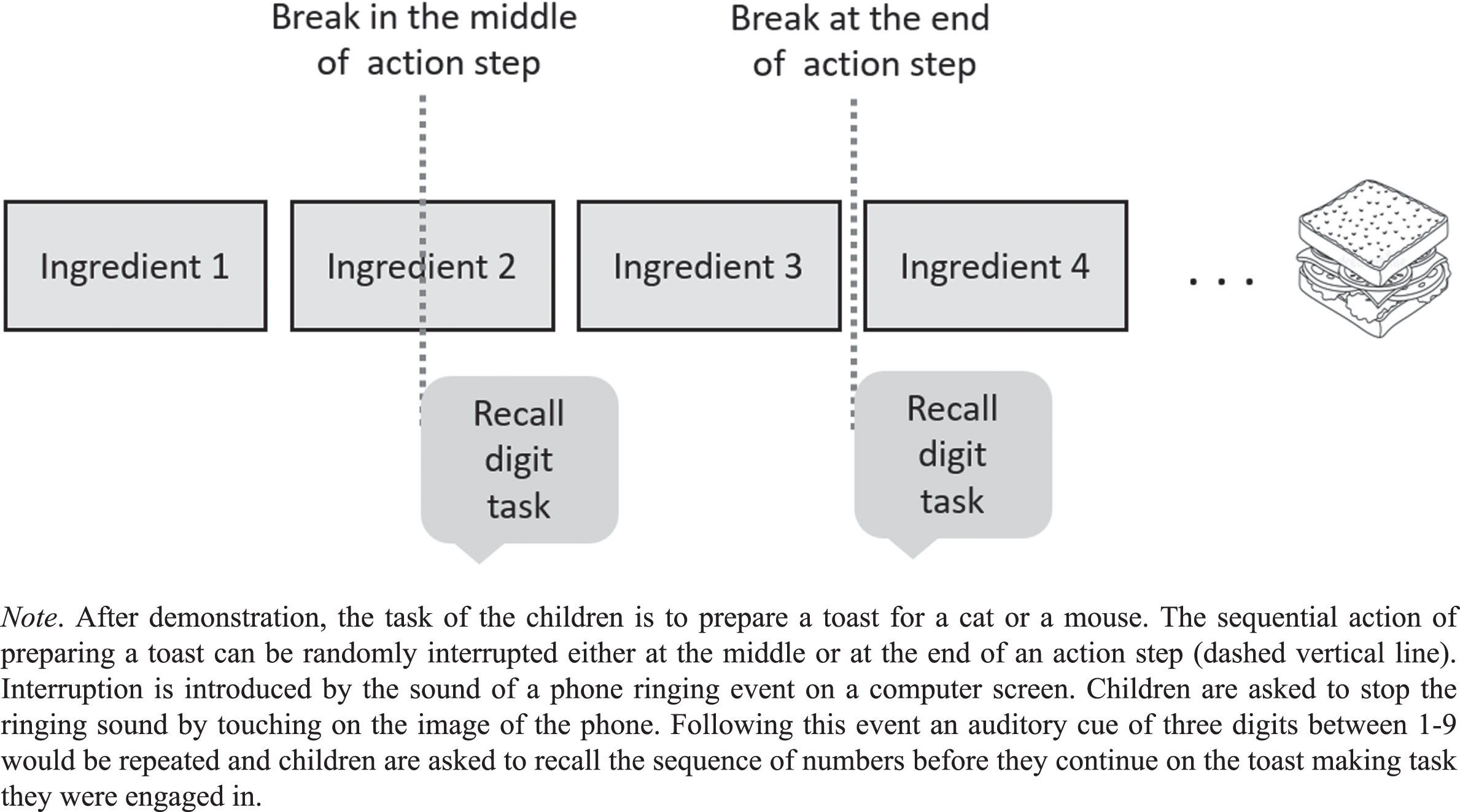
Schematic Description of the Toast-Making Task as Employed by Yanaoka & Saito, 2019. Note. After demonstration, the task of the children is to prepare a toast for a cat or a mouse. The sequential action of preparing a toast can be randomly interrupted either at the middle or at the end of an action step (dashed vertical line). Interruption is introduced by the sound of a phone ringing event on a computer screen. Children are asked to stop the ringing sound by touching on the image of the phone. Following this event an auditory cue of three digits between 1-9 would be repeated and children are asked to recall the sequence of numbers before they continue on the toast making task they were engaged in.
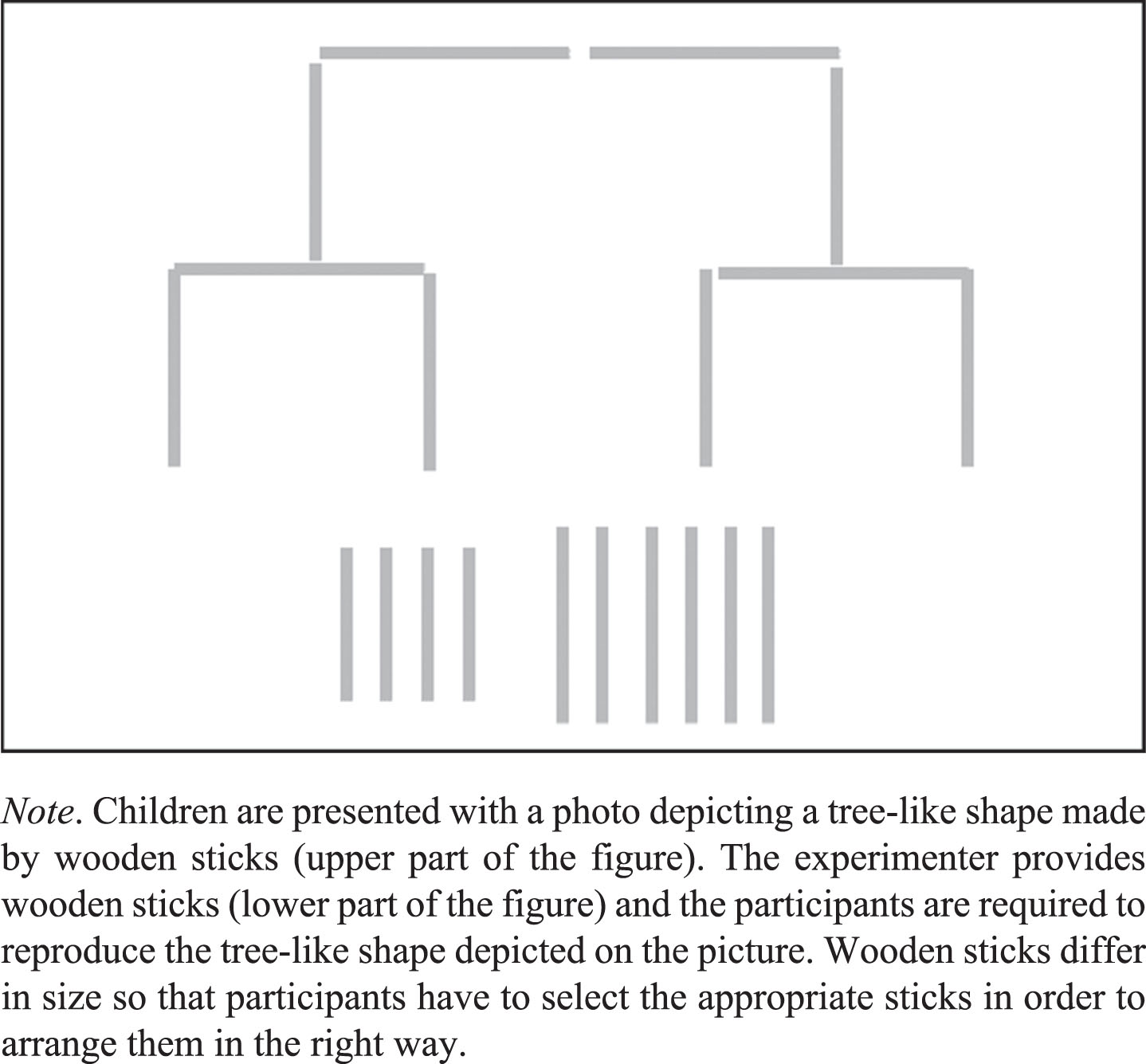
Schematic Description of the Hierarchical Tree Structure Task (Adapted from: Gönül et al., 2019). Note. Children are presented with a photo depicting a tree-like shape made by wooden sticks (upper part of the figure). The experimenter provides wooden sticks (lower part of the figure) and the participants are required to reproduce the tree-like shape depicted on the picture. Wooden sticks differ in size so that participants have to select the appropriate sticks in order to arrange them in the right way.
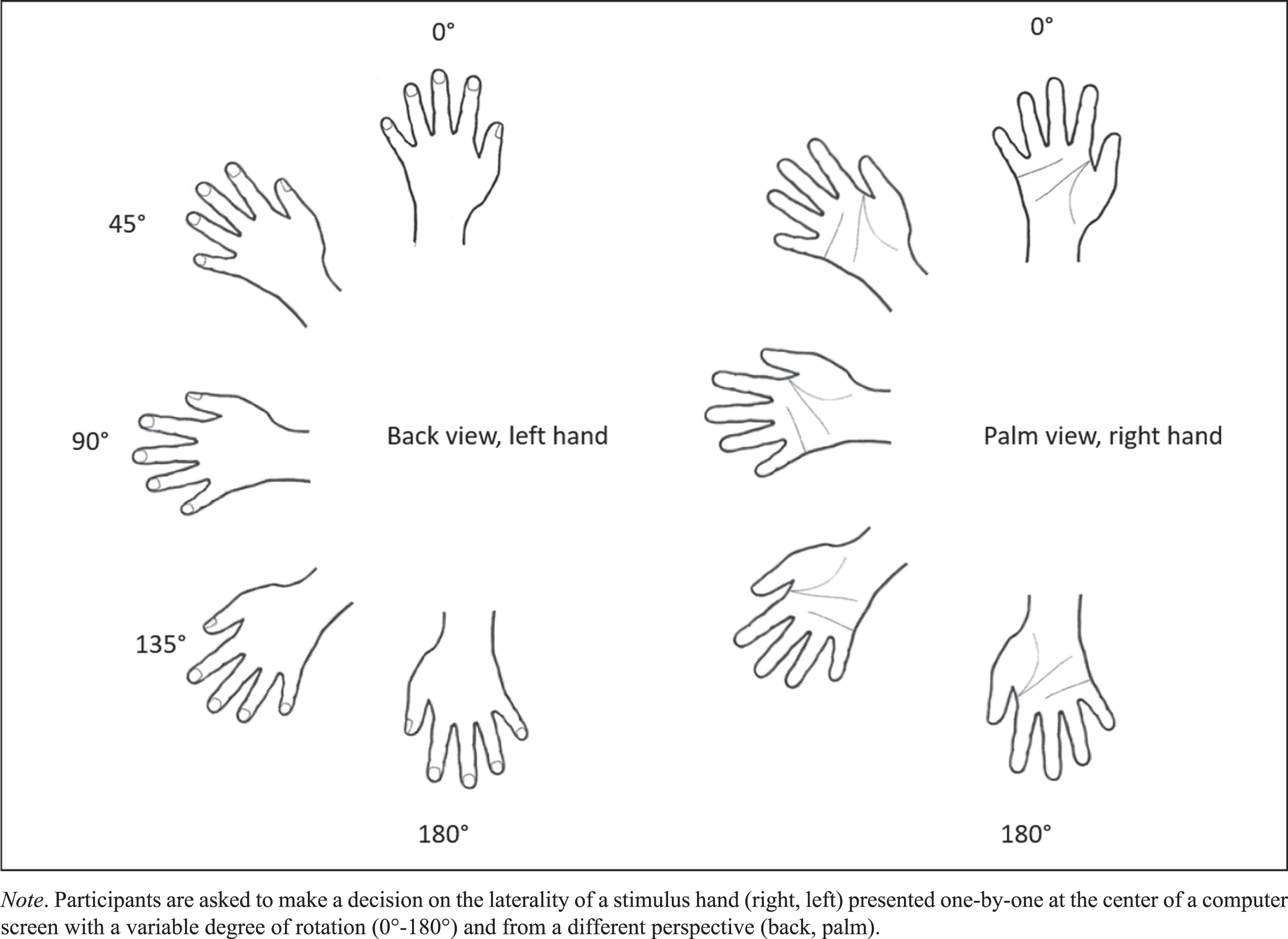
Example of a Laterality Judgement task. Note. Participants are asked to make a decision on the laterality of a stimulus hand (right, left) presented one-by-one at the center of a computer screen with a variable degree of rotation (0°– 180°) and from a different perspective (back, palm).
Next to categorical information on task complexity and action domain, the table further reports the reference, the description of the task/stimuli, the sample tested in the studies, the age at which children start to be able to perform the task and the age at which children fully master the respective tasks, that is when the child is skilled in successfully solving a given task. In the remainder of this section, we will describe the action tasks we identified in our search. We will not discuss the details of each experiment since this would be out of scope of our literature review. Instead, we will focus on the kind of task participants performed and on the general experimental procedure. Trends and patterns with respect to task demands and development in task performance will be considered in the general discussion.
Tasks Relating to Lower-Level Goals
Imitation Tasks
Overimitation tasks. Overimitation (i.e., the imitation of a series of actions including superfluous ones) has been investigated by employing different kind of actions, including stimuli or tools that are irrelevant to the main task (e.g., Taniguchi & Sanefuji, 2017) or conventional/instrumental verbal framing (e.g., Moraru et al., 2016) that can influence the extent to which unnecessary steps are imitated. Other stimuli include spatial alignment of objects required to imitate a given sequence (e.g., Freier et al., 2015), iconic vs. point gestures (Novack et al., 2015), and the fidelity of the model executing an action (McGuigan, 2013; McGuigan et al., 2011), as well as re-enacting manual gestures (Gleissner et al., 2000). The tasks in the studies show that children as young as 3 years old are able to successfully imitate action sequences. In order to do so, observation as well as retrieval abilities are required and might be allocated to the domain of action imitation.
Selective imitation task/Imitation choice task. In action imitation, research further focused on the aspect of selective imitation, that refers to the imitation of only some parts of the observed action (e.g., Elsner & Pfeifer, 2012; Pfeifer & Elsner, 2013). In this context, research asks how the salience of specific aspects of an action, such as its goal or its trajectory, and the verbal behavior of the model influence children’s reproduction of actions. For example, in the study by Elsner and Pfeifer (2012) children watched how the experimenter moved a toy sheep up or down a ramp to reach a specific object that was either socio-functionally high-salient (boat or bench) or low-salient (red or green bowl). The model either did or did not use verbal cues to highlight the movement path, the goal, both, or none. Critically, objects were placed differently on the child’s ramp, so the child had to make a selective choice to focus on either movement or goal when imitating the action.
Other tasks assess if children alter an action based on the necessity of different action steps. For instance, in the study by Pfeifer and Elsner (2013) children observed an adult model executing an unusual action and are then asked to perform the action themselves. Tasks were adapted from the infant literature and included the observation of an adult model who bends forward and illuminates a lamp with her forehead (touch light task), observation of a model making a teddy bear entering a house by jumping through the chimney (house task) and observation of a model who moves a teddy bear from a starting position to a cup with an unusually big leap (obstacle task). Critically, all tasks include no-constraint vs. constraint conditions (i.e., in the touch light task the model has her hands free or not, in the house task the door is open or closed, and in the obstacle task the way is free or blocked) and the restrictions are either highlighted by verbal cues or not. Selective imitation is assessed by measuring which aspects of the action is reproduced by the children depending on condition. The main finding in these studies is that by three years of age preschool children’s imitation is modulated by context-specific information, such as verbalized intentions of the model, salience of movement and goal, and constraints of the model (see Gellén & Buttelmann, 2019, for a discussion related to the use of constraints in imitation tasks).
End-State-Comfort Effect (ESC)
As for the investigation of action planning and for the study of anticipatory behavioral control, the most commonly employed paradigm is the End-state-comfort effect (ESC). This task refers to the tendency to avoid an uncomfortable posture at the end of goal-directed movements and describes the phenomenon that people begin a first action (e.g., grasping a cup) with an uncomfortable position to finish a second action (e.g., rotating the cup) in a comfortable position (Rosenbaum et al., 1990). The ESC effect demonstrates that the first action was planned with respect to the end position of the second action. It is a traditional approach to reveal children’s developing action planning abilities (e.g., Wunsch et al., 2013) and has been investigated by applying different tools, such as cups (Adalbjornsson et al., 2008; Jongbloed-Pereboom et al., 2016; Knudsen et al., 2012; Melzel & Paulus 2022; Rosenbaum et al., 1990; Scharoun et al., 2018), swords (Craje et al., 2010; Jongbloed-Pereboom et al., 2013; Jongbloed-Pereboom et al., 2016; Wunsch et al., 2016) and spoons (Melzel & Paulus, 2022). Depending on its specific requirements, children start to successfully master the tasks around three years of age (e.g., Jovanovic & Schwarzer, 2011), but performance shows substantial development until early school age (Wunsch et al. 2013).
Grasp-height-paradigm (Cohen & Rosenbaum, 2004; Jovanovic & Schwarzer, 2017; Wunsch et al., 2016). This paradigm assesses how people adjust their grasping actions according to situational constraints, including physical or task-related factors. Children are asked to grasp and transport objects from one place to another. The position of the hand on the to-be-grasped object depends on the type of object. In the studies assessed children start to perform well on this task around the age of three years and increase in their performance with age. This is attributed to the task demands with respect to executive functions, such as strategic organization and inhibition (Wunsch et al., 2016), related to both action planning and motor execution. Older children perform more successfully on this task, as their motor execution ability is further developed than in younger children.
Bar-transport task (Rosenbaum et al., 1990). In this version of the task participants are asked to reach for a horizontal bar and place it (either with the left or right end) in a vertical position into a target. The position of the palm is assessed, depending on whether children are asked to place down the right or left end of the bar. If they are right-handed and have to place down the bar with the left end, participants have to sacrifice the initial-state comfort and rotate their grip to allow an end-state comfort of the hand at the end of the action. This task has been often employed in developmental research and many different stimuli have been used (Jongbloed-Pereboom et al., 2016; Jovanovic & Schwarzer, 2011; Knudsen et al., 2012; Manoel & Moreira, 2005; Thibaut & Toussaint, 2010; Toussaint et al., 2013; Wunsch et al., 2016). Depending on the different stimuli, the age at which children successfully master a given task, differ between three years (Jovanovic & Schwarzer, 2011), 6- to 8-year-olds (Toussaint et al., 2013, Knudsen et al. 2012) and 10-year-olds (Jongbloed-Pereboom et al., 2016; Thibaut & Toussaint, 2010; Wunsch et al., 2016).
The Dowel placing task (Rosenbaum et al., 1990) is an adapted version, where participants are instructed to reach for a horizontally placed dowel and insert one of its ends (black or white) into a target hole. Depending on which end of the dowel has to be grasped, it is assessed which hand posture children use to execute the action and whether they end the action with a comfortable posture (Weigelt & Schack, 2010). Children begin to perform these tasks at the age of three with performance improvement depending on the motor execution required for different varieties of these task.
Another widely used version is the Overturned cup task (Adalbjornsson et al., 2008; Jongbloed-Pereboom et al., 2016; Knudsen et al., 2012; Melzel & Paulus 2022; Rosenbaum et al., 1990; Scharoun et al., 2018). Participants are asked to pick up a drinking glass placed upside-down on a surface, turn it over and pour some water from a jug of water into it (Rosenbaum et al., 1990). During grasping the posture of the thumb is of interest. An uncomfortable thumb-down grasp during turning of the glass allows a comfortable end-posture when placing the glass, evidencing the ESC and prospective action planning. Generally, children aged two years old successfully perform the task, gradually increasing in their overall performance with age.
In the Spoon task children are asked to place a spoon into a target tube, with their grasping strategy being assessed in terms of comfortable or uncomfortable efficiency (Melzel & Paulus, 2022). Children as young as two years start to engage in this task.
In the Sword task (Craje et al., 2010; Jongbloed-Pereboom et al., 2013; Jongbloed-Pereboom et al., 2016; Wunsch et al., 2016) a wooden sword is used as stimulus, which can be presented in different orientations. Participants’ task is to insert the sword into a target hole and in the critical condition, participants have to use an uncomfortable start posture position to end the action in a comfortable posture. Children as young as three years start to solve this task (e.g., Jongbloed-Pereboom et al., 2013).
In general, ESC tasks address mainly the domain of action planning. Next to control in motor execution, executive functions are needed in order to perform the task successfully as a comfortable position at the beginning of the action has to be sacrificed for a comfortable end position. This might considerably contribute to children’s increase in task performance with age.
Tasks Relating to Higher-Level Goals
Pretend Play (In an Imitation Context)
Studies focus on the ability of children to make use of their knowledge about familiar events to plan new events in the context of pretend play. It is suggested that children recall and recombine activities they have previously observed, thus that they imitate behavior in pretend play. In these paradigms, children are typically asked to plan and execute shopping trips to a pretend grocery store (Hudson & Fivush, 1991; Hudson et al., 1995). It is in general reported that the older the children are, the more complex the planning of the event becomes. Although already 3-year-olds are able to plan single goal events (Hudson et al., 1995), it is not before the age of four that children fully master the task. As these tasks require different sub-actions in order to perform the task, children are faced with hierarchically organizing action steps. This task requires the cognitive ability to not only narrate action scripts but also relates to general knowledge of events (Hudson et al., 1995). However, this task also focuses on cognitive abilities such as imitation and execution and may therefore be subsumed under imitation.
Higher-Level Goal Imitation Tasks
Another branch of studies in the imitation context focuses on whether children imitate higher-level goals compared to just copying chains of events (e.g., Flynn & Whiten, 2008; Loucks et al., 2017; Loucks & Price, 2019; Mizuguchi et al., 2010; Whiten et al., 2006). These studies assess whether children extract the action goal and perform the action by using their own means or whether they simply copy the means demonstrated by the model. The tasks used are often similar, ranging from asking the participants to learn and imitate the temporal order of novel actions sequences (e.g., Loucks & Price, 2019), or to learn novel event sequences either via hands-on experience or through storybooks (Loucks et al., 2017).
Keyway fruit box task. This task was employed to investigate the level of information children incorporate in their imitation while observing a model executing complex, hierarchically organized actions (Flynn & Whiten, 2008; Whiten et al., 2006). In this task participants are asked to observe a model who executes a complex series of different actions aiming at opening a box in order to remove a reward from inside. The model performs the action in a hierarchical fashion (using functional actions), including or leaving out component action details (i.e., non-functional actions, such as tapping or twisting on the box). After video demonstration children are asked to imitate the model. Different behavior such as copying an action at a hierarchical level or copying (single) events is analyzed. This task requires cognitive abilities such as observation, memory skills and retrieval as well as execution and assessment of different action details to imitate the action (e.g., Flynn & Whiten, 2006). While children as young as three years begin to organize action hierarchically, the task is successfully mastered by the age of five.
Deferred imitation task. Here, participants observe a model and then replicate the model’s behavior after some time without any perceptual support (e.g., Labiadh et al., 2013). In general, such studies find that, with age, children extract the goal of the action by mostly copying the action’s higher hierarchical level (Flynn & Whiten, 2008; Loucks & Price, 2019). Next to showing that action representation is organized according to higher level goals, results suggest that in action imitation prioritizing the action’s goal structure results in event memory enhancement. Although this task is suitable for children starting around the age of three years, it is in general reported that children fully master the task by five years of age.
In general children’s performance is considered to increase with age because these tasks demand cognitive abilities such as reconstructing hierarchically organized actions (e.g., Labiadh et al., 2013), observation (e.g., Loucks 2019; Mizuguchi et al. 2009, 2010; Williamson & Markmann, 2006) and event memory (e.g. Labiadh et al., 2013; Loucks 2017; Mizuguchi et al. 2009, 2010).
Script- and Routine-Related Tasks
The Toast-making task has been employed to explore the learning mechanisms supporting the acquisition of sequential actions as routines and children’s use of knowledge about familiar events in the planning of new events (Yanaoka & Saito, 2019). After initial demonstration, children are asked to repeatedly prepare a toast for a cat or a mouse with toy objects that act as substitutes of real ingredients. The event of preparing a toast is interrupted either in the middle or at the end of a subtask by a different activity, such as performing a digit span task. Error rate in action steps occurring at the branch point of subtasks is calculated. In general, findings suggest that three-year-old children already show fidelity in imitating goal-related actions, i.e., they are more likely to use the functional than the non-functional information. Yet, performance is reported to increase with age and to stabilize at the age of five years (e.g., Yanaoka & Saito, 2017).
The Doll task has been used to investigate whether young children can maintain hierarchical goal representation during script execution (Yanaoka & Saito, 2017). Children are asked to help a doll put on cloths and other items to attend kindergarten. The order of the items can be either invariant, that is the items are unchangeable (e.g., first put on a blazer and then a school bag) or variant, that is the order of items are changeable (e.g., first put on a shirt or pants). When asking them to put on items from each shelf of the closet, children encounter errors in the order of items in the unchangeable category. In order to fulfill the goal of dressing the doll children need to correct the order of the items. Results suggest that it is only by the age of five years that children correct the order of items, indicating that they controlled the script execution by maintaining goal representation. This task addresses executive functions such as inhibition and the ability to execute actions in a scripted order (Yanaoka & Saito, 2017).
Joint Action Task
The ESC effect (see 3.1.2) has also been used to investigate the development of action planning in a joint action context. For example, Paulus (2016) asked children to hand the experimenter a tool with which he could activate different effects on an apparatus. In this joint action activity, it was important to grasp and hand over the tool in a particular orientation (i.e., anticipate the final end state of the action) so that the experimenter could handle the tool in an efficient way. It was assessed if children planned their action (reach and grasp) with respect to the experimenter or not.
The Joint cup-stacking task also refers to the ability to plan action sequences in respect to their partner. Children are asked to build a tower of cups with a partner who only has one hand available (Meyer et al. 2010; Meyer, Braukmann et al., 2016). Critically, children have to hand over the cup and it is measured if they orient the handle towards the partner or not. The task seeks to measure whether children consider their partners in their action plans in order to facilitate the partner’s action as the partner’s action execution is influenced by the way in which the children pass them the building blocks of the tower.
The Tool transfer task (Jovanovic et al., 2021) uses a similar approach, where children were presented with three different tools (two familiar ones, one unfamiliar) and asked to use these tools for their specific action (e.g., brushing a toy lion). In a second task children were then asked to hand the tool over to the experimenter investigating children’s ability to represent the grasping comfort of another person.
While some studies report that children as young as three years start to take the partner into consideration in their action planning (Meyer et al., 2010), others find that children at the age of five years are able to successfully engage in the task (e.g., Jovanovic et al, 2021; Meyer et al., 2016). That is because children are not only challenged to monitor their own actions but also the actions of others.
Coloring Task
This has been used to investigate hierarchical action control in preschoolers and assess children’s abilities to organize a set of sub-actions over the course of a sequential activity (Freier et al., 2017). On a piece of paper, the drawings of six animal shapes are arranged horizontally. At the bottom of the drawings an arrow cueing from left to right is depicted. Following the direction of the arrow, children are requested to color-in the shape of the animals, by using each of the provided three colors equally often. The use of the colors represents the overarching goal of the task. Hierarchical action control is assessed by the degree of maintenance of the abstract goal representation and by the strategy used to achieve the goal. Both 3⋯ and 5⋯year⋯olds demonstrated good abilities to access goals at the lowest level of the representational hierarchy and were able to color the animals but neglected the color criterion. The color criterion indicated the equal use of three colors as the higher-level goal. Only 5⋯year⋯olds consistently aligned their response choices with goals at this superordinate level. This may be because this task requires monitoring of own actions as well as the ability to control higher level sequential goals, e.g., including the color criterion (e.g., Freier et al., 2017).
Hook Task/Hierarchical Tree Structure Task
These tasks investigate the hierarchical structuring of action and assess preschool children’s competence in building hierarchical representations for action execution. The hook task (Beck et al., 2011; Beck et al., 2014) assesses the ability to create a tool in order to solve a problem. Children are asked to bend a pipe cleaner to retrieve a bucket with a sticker lying in a jar. In the hierarchical tree structure task (Beck et al., 2011; Gönül et al., 2018; 2019; Greenfield & Schneider, 1977) participants are presented with a photo depicting a tree-like shape made by wooden sticks. The participants are required to reproduce the shape of the tree construction depicted on the photo. They have to select sticks of the appropriate size and arrange them according to the photo. It is suggested, that in this way one can measure the ability of build up a hierarchical relation between elements (Greenfield, 1991; Gönül et al. 2018).
Although these tasks are employed with children starting at the age of three years (e.g., Gönul et al., 2018; 2019) it is in general reported to be very difficult for children younger than 7 years of age, as these tasks relates to the ability to internally represent the structure and coordinate the following execution (e.g., Greenfield & Schneider, 1977).
Tower of Hanoi Task/Tower of London Task
In this task participants are required to move disks from one tower to another; the execution of the task is constrained by some rules, such as only the upper disc can be moved, and no disk can be placed on the top of a smaller disk. (Bull et al., 2004; Carlson et al., 2004; Luciana & Nelson, 1998; Simon, 1975; see Welsh, 1991; Welsh et al., 1991). In the task variant Tower of London three to five discs or balls placed on three pegs of different heights are involved (Bull et al., 2004; Korkman et al., 1998; Luciana & Nelson, 1998; Shallice, 1982). The participant is asked to move one ball at a time and the movements of the balls are constrained by the dimension of the pegs (they can hold a maximum number of balls, McCormack & Atance, 2011). In both tasks participants are asked to mentally plan and then change the initial state of objects to a goal state that is depicted on a picture by employing a minimal number of moves. Children are, thus, faced with a problem they need to solve stepwise, keeping the desired end state in mind and evaluating each action step with respect to the final goal. Following the studies considered in our search the ability of children to perform such a task emerges around the age of four years, as these tasks require both motor execution and planning abilities. However, it is also suggested that children in this age range are more likely to produce incomplete solutions of the tasks when compared with older children (5- to 6-year-olds) (e.g., Baughman & Cooper, 2007). Performance is reported to increase with age, but children do not seem to be successful in mastering these tasks within the preschool period but only show stable performance around the age of eleven (e.g., Welsh, 1991). The extended developmental trajectory presumably arises because of the task’s complexity, requiring problem solving strategies (e.g., Simon, 1975), executive functions such as shifting mental sets flexibly (e.g., Bull et al., 2004), control of inhibition (e.g. Carlson, Moses & Claxton, 2004), the ability of mental rotation (e.g., Welsh, 1991) and working memory (e.g. Luciana & Nelson, 1998).
Imagery-Related Tasks
Motor Contagion Task
This task has been used to explore the overlap between action observation and action execution in preschool children (Marshall et al., 2010; Saby et al., 2011). The motor contagion effect is a phenomenon suggesting that others action observation influences and affects the observer’s own movements. In this task the observation of an action is in conflict with the execution of a different action that the child has to perform themselves (Kilner et al., 2007; Kilner et al., 2003). The experimental paradigm is usually based on an actor making movements along one dimension (horizontal or vertical) while observing another person performing similar movements either in the congruent or incongruent plane (e.g., performing horizontal movements while observing other’s movements in the horizontal or vertical plane). The resulting interference effect is the product of movement variance. Different factors influencing motor contagion have been studied, among others the observation of biological vs. non biological movements (e.g., Kilner et al., 2003). For instance, Saby and colleagues (2011) instructed participants to move a stylus on a graphics tablet. While performing the task a background video was displayed in which a bear executing arm movements with a biological or non-biological movement profile was shown. The bear performed movements in one direction that were either congruent or incongruent to the instructed participant’s stylus movement. Thus, the influence of two different movement conditions (incongruent or congruent to the bears movement) on children’s action movement was measured. The motor contagion effect was greatest when the movements observed by the children violated their expectations. The motor contagion task has been successfully administered to children from four years of age onwards (Marshall et al., 2010; Saby et al., 2011) and it has been shown that already children at four years are able to master the task. In general, this task requires control abilities such as action perception and observation (e.g. Marshall et al., 2010, Saby et al., 2011).
Water Tilting Task
This kind of task has been first designed to investigate action mental simulation in adults by Schwartz & Black (1999). Participants are presented with two drinking glasses with different diameter but same heights. They are required to imagine both glasses filled to the same level of water. The task is to tilt the glass filled with different quantity of imaginary water so that the imagined water would reach the glass rim. Frick et al. (2009) employed this task by examining children’s ability to transform mental representations of water inside a container and the influence manual movement might have on this mental transformation. Following this study, children starting from age of five years are able to engage in such a task, although they only performed well with active visual feedback of the ongoing action, whereas children starting around 8 years old do not require visual feedback anymore (see differences in conditions, Frick et al., 2009). This task is difficult for younger children, as abilities such as the mental representation of actions and motor activities (e.g. Frick et al., 2009) is required in order to solve this task.
Mental Rotation Task
This paradigm, first reported by Shepard and Metzler (1971) and explained as a mental transformation process, represents a well-established task for the investigation of the internal action representation and the assessment of the cognitive processes underlying the mental rotation of objects. In this paradigm participants are usually presented with two images that represent the same object or an object and its mirror image from a different perspective. The objects are rotated a specific number of degrees. Participants have to compare the pictures and judge (by button press) if they are the same or if they are the mirror image of the object depicted. Accuracy and response times are the experimental variables. Often higher reaction times are reported when angular disparities of the depicted object are greater, that is the more the angles of the objects differ the longer the reaction times. It is reported that children aged 4 start to perform this task successfully. Children’s task performance improves with age as they develop better abilities to understand explicit verbal instructions and to build accurate mental representations.
The mental rotation task is adopted in different laterality judgement paradigms in which participants are asked to judge different stimuli, such as the laterality of body parts (Butson et al., 2014; Funk et al., 2005; Krüger & Krist, 2009; Sekiyama et al., 2014; Spruijt et al., 2017), the rotation of a shape (Kosslyn et al., 1990; Levine et al., 1999; Marmor, 1975) as well as the rotation of numbers (Toussaint et al., 2013). In general, the ability of children to solve such a task emerges around the age of five and results of different studies systematically show that performance increases during development, presumably because children’s ability to represent a movement internally and understand verbal instructions expand until it stabilizes around the age of seven years (e.g., Toussaint et al., 2013).
Mental Chronometry Task
This paradigm allows to determine the temporal congruence between a performed and an imagined movement. Participants are required to perform a movement and to subsequently imagine themselves performing exactly the same movement (e.g., Sirigu et al., 1996). To determine whether temporal congruence between performed and imagined movement may be solely ascribed to motor imagery or also results from other non-motor strategies, such as motor memory (e.g., Sharma et al., 2008), it has to be controlled that what is imagined coincides with the motor constraints of the performed movement (Sirigu et al., 1996). This can be verified by systematically manipulating task difficulty and assessing its effect on both performed and imagined movement performance. To do so, performance in this task is often measured by Fitt’s low (Fitts, 1954) predicting that the time required to move to a target area is a function of the ratio between the distance to the target and target width. For example, participants perform consecutively goal-directed pointing movements toward several targets shown in a radial configuration (Virtual Radial Fitts Task-VRFT, see Smits-Engelsman & Wilson, 2013 for the use of this paradigm in children). Width and distance of the target vary between trials. A linear relation between duration of the movement and difficulty of the task (i.e., increase of imagined distance) is evidence for the use of motor imagery (see Fitts, 1954). Examples of the employment of this paradigm in preschool children is given by Molina and colleagues (2008) who adapted the mental chronometry task by asking children to walk or imagine themselves walking while they bring back a puppet into its house. Investigating the duration of walking time and grasp pressure in both conditions, results suggest, that imagery requires advanced cognitive abilities such as imagining the performance of a movement (e.g. Spruijt et al., 2015). Others used the Fitts’ task to evaluate the ability of children to use motor imagery in a goal-directed pointing task (Spruijt, van der Kamp, & Steenbergen, 2015), comparing duration of the actual pointing and imagined pointing. Following the studies considered in our search the ability of children to perform such a task emerges around the age of seven years.
Second-Order Planning Task
This task is used to assess whether children are able to plan a reach-to-grasp action depending on the forthcoming actions. For example, in a reach-to-grasp action with the goal of placing something on a surface, adults show a decrease in velocity in reaching compared to throwing movements (McCarty, Clifton, & Collard, 1999). In an adapted version, Wilmut et al. (2013) considered three types of actions performed on a cylinder (throw, tight and loose place) to represent object manipulation in regard to precision and movement requirements. Children are asked to reach out and perform the required action as fast and accurately as possible. In the throw condition, the required action differs significantly from those of placing the cylinder. In the tight condition, children are asked to place the cylinder into a specific location precisely, while in the loose condition the placing of the cylinder does not require the same accuracy or precision. Results indicate that already four-years-old children show sensitivity to the task requirements by planning an initial movement based on the forthcoming actions as, for example, deceleration of velocity is shown when the action requires a high precision. Nevertheless, it seems that it takes until the age of eleven before children are able to fully master this task as children’ skills on motor execution and internal modeling of actions increases with age (e.g., Wilmut et al., 2013).
Taken together, this systematic review shows that action tasks assessing action processing require various cognitive abilities, including imitation, observation, executive functions, and motor execution. However, hierarchically more complex actions, such as higher-level goal-directed tasks, necessitate advanced cognitive abilities like understanding verbal instructions, the internal representation of a remote goal, and more elaborated executive functions.
General Discussion
Our review illustrates that the study of action processing is manifold and that researchers addressed children’s developing complex action processing through a variety of tasks. Despite these challenges, we aim to outline some overarching developmental trends observed in the studies we reviewed. Figure 8 serves as overview of the tasks included in the review, categorized by goal level (low/high/imagery), and arranged by the age at which children begin to perform a task and the age at which they achieve mastery.
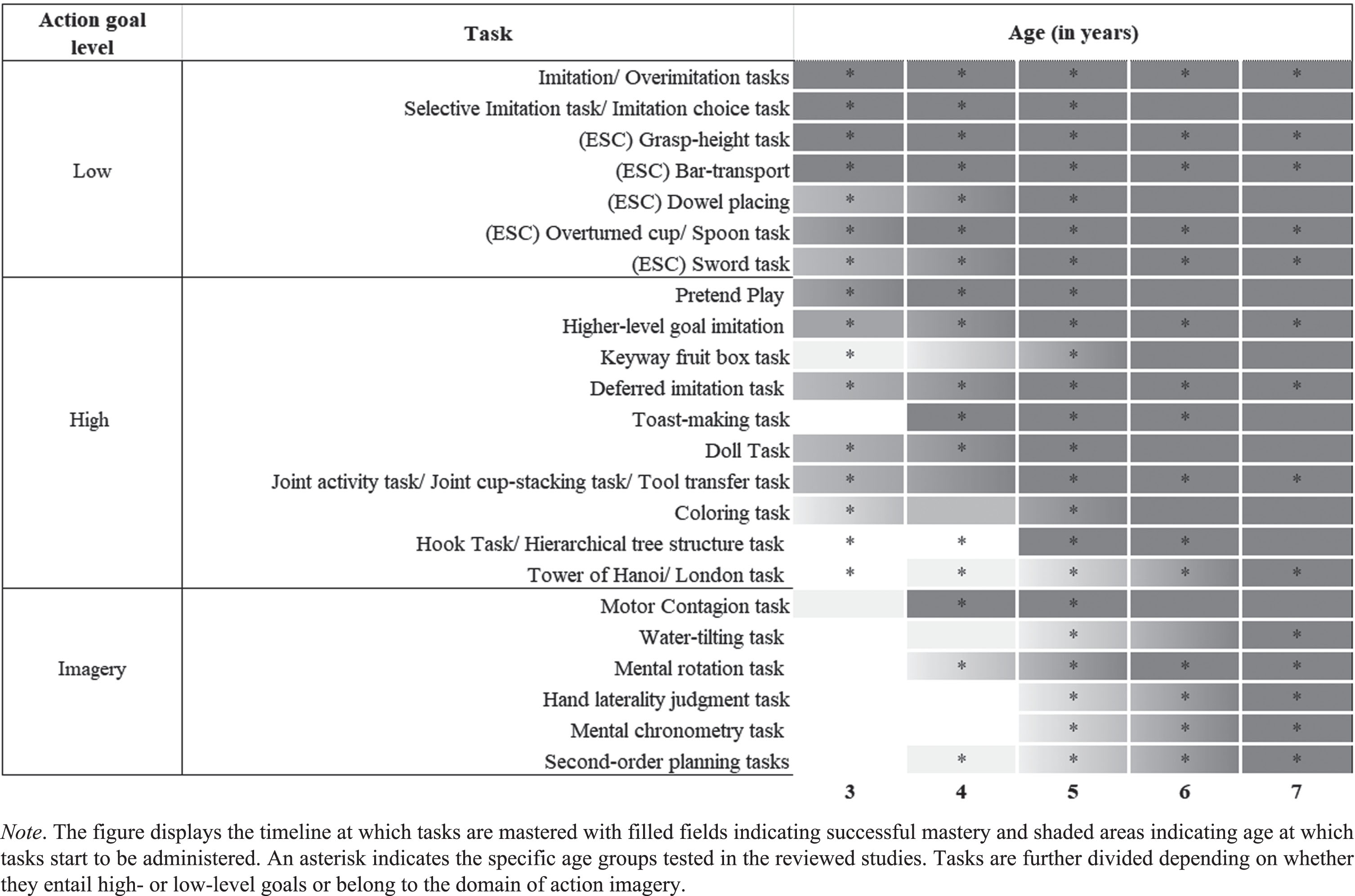
Overview of Task Performance. Note. The figure displays the timeline at which tasks are mastered with filled fields indicating successful mastery and shaded areas indicating age at which tasks start to be administered. An asterisk indicates the specific age groups tested in the reviewed studies. Tasks are further divided depending on whether they entail high- or low-level goals or belong to the domain of action imagery.
Looking at Fig. 8, successful task mastery does not straightforwardly correlate with the mere presence or absence of higher-level goals at first sight. Instead, we observe a widespread and diverse pattern of performance across and within various types of behavioral action tasks. Still, tasks assessing lower-level action goals are typically mastered earlier compared to more complex action tasks, involving higher-level goals and imagery related tasks. Indeed, the latter might require more complex cognitive abilities such as access to and manipulation of internal mental representations as well as more sophisticated understanding of verbal instructions.
Lower-Level Goal
Concerning lower-level cognitive goals, children take context-specific factors into account in selective imitation tasks by three years of age (e.g., Elsner & Pfeifer, 2012; Pfeifer & Elsner, 2013). Further, most researchers adopt the ESC task in different variants and with different instruments (Adalbjornsson et al., 2008; Craje et al., 2010; Jongbloed-Pereboom et al., 2016; Jovanovic & Schwarzer, 2017; Knudsen et al., 2012; Manoel & Moreira, 2005; Melzel & Paulus, 2022; Meyer et al., 2010; Meyer, van der Wel, & Hunnius, 2016; Paulus, 2016; Scharoun et al., 2018; Thibaut & Toussaint, 2010; Toussaint et al., 2013; Weigelt & Schack, 2010; Wunsch et al., 2016) to assess executive functions on a lower level scale. Although the ESC task has been used with children at the age of two years (e.g., overturned cup task Adalbjornsson et al., 2008), most studies suggest it is suitable for children from age three (e.g., Jovanovic & Schwarzer, 2011). Proficiency in this task varies significantly during the preschool period depending on assessment tools and shows fewer changes after age ten (e.g., Jongbloed-Pereboom et al., 2016; Melzel & Paulus, 2022; Wunsch et al., 2016), extending beyond the preschool period.
Higher-Level Goal
Tasks with higher-level goals, like those involving pretend play such as shopping trips (e.g., Hudson et al., 1995) or toast making (e.g., Yanaoka & Saito, 2019) that rely on routines and scripted knowledge, are typically mastered around the age of four. Action tasks that use more complex and potentially less transparent goals, such as the keyway fruit box task (e.g., Whiten et al., 2006), are mastered by five years of age. Against the background of the ongoing debate on the locus of the processes leading to selective imitation (e.g., Paulus et al., 2011), one might indeed argue that early performed selective imitation and overimitation tasks rely less on higher-level goals. Similarly, the second-order planning tasks (McCarty et al., 1999), that arguably require more sophisticated problem-solving capacities and rely more heavily on a mental representation of the end state, are not mastered until the end of the preschool period. Furthermore, tasks such as the coloring tasks (Freier et al., 2017) or the hierarchical tree structure task (Gönul et al., 2018; 2019), are only successfully mastered by five to six years of age. The Tower of Hanoi/London tasks (Bull et al., 2004; Carlson et al., 2004 ; Luciana & Nelson, 1998; Welsh, 1991) show a particularly long developmental trajectory. In these tasks, participants are asked to mentally plan and then change the initial state of objects stepwise to finally match a goal state. Presumably, this does not only require sophisticated problem-solving abilities and executive functions but is also demanding in terms of the mental representation (and constant evaluation) of the end state. Even though these tasks are used with children starting at the age of 3 years, they seem to be extremely difficult for young children (Baughman & Cooper, 2007) and only show stable performance around the age of eleven (e.g., Welsh, 1991).
Imagery
Studies indicate that mental rotation tasks in which participants are requested to judge different stimuli (objects, shapes or body parts) (Butson et al., 2014; Funk et al., 2005; Kosslyn et al., 1990; Krüger & Krist, 2009; Levine et al., 1999; Marmor, 1975; Sekiyama et al., 2014; Spruijt et al., 2017; Toussaint et al., 2013) are particularly difficult for young children. This might be because these tasks require cognitive control abilities (Saby et al., 2010) and intricate internal representations of (imagined) actions. Further, children’s understanding of verbal instructions is crucial in order to master these tasks (Butson et al., 2014; Frick et al., 2009; Funk et al., 2005; Kosslyn et al., 1990; Krüger & Krist, 2009; Levine et al., 1999; Marmor, 1975; Saby et al., 2010; Sekiyama et al., 2014; Spruijt et al., 2017; Toussaint et al., 2013).
Seeking to set a Developmental Timeline is Questionable
Taken together, the mastery timeline for specific tasks in development remains heterogeneous. Yet, a consistent trend emerges across tasks, indicating that higher-level, conceptual goals tend to be mastered later compared to those with lower-level, motor-related goals. The differences may be attributed to important developmental changes in both cognitive and motor domains (e.g., Krüger & Krist, 2009; Casey et al., 2005) encompassing changes in executive functions (e.g., Ikeda et al., 2014) and the emergence of metacognitive abilities (Kloo & Rohwer, 2012). Our review emphasizes the challenge of finding a consistent developmental pattern across behavioral action tasks due to task diversity and performance differences. Most tasks show gradual improvement throughout the preschool period and into childhood, for example, in tasks related to the end-state comfort effect (Wunsch et al., 2013) and mental rotation (Spruijt et al., 2017).
In general, performance in action tasks might be influenced by sensory-motor processes supporting cognitive function development or additional cognitive abilities. The link between perceiving and executing an action is shaped by emerging cognitive control abilities (e.g., Saby et al., 2011) and the growth of children’s body, influencing sophisticated problem-solving (Piaget & Cook, 1952; von Hofsten, 2004). While gross and fine motor skills develop considerably over the preschool period (e.g., Piek et al., 2012), the discussed tasks seem less challenging in terms of motor skills and more so in cognitive demands. Thus, improvement across tasks is likely driven by a general growth spurt in preschool children’s cognitive functions.
Access to Mental Representation
Another important factor could be the reliance on mental representations to solve the task. A recent meta-analysis on neuroimaging data in adults (Papitto et al. 2020) highlights diverse brain structures underlying action processing, likely due to varying demands entailed in different action aspects. Interestingly, the analysis reports different activation patterns for different types of action tasks. In particular, action tasks related to action execution, imitation and imagery recruit the inferior frontal cortex, including Brodmann area 44 (motor-related network). In contrast, action observation, motor learning and motor preparation tasks are reported to show activation in Brodmann area 6 (premotor areas). Papitto and colleagues (2020) suggest that the observed distinction results from differences in how actions rely on mental-conceptual representation. For instance, in action observation, merely observing a video or picture of an action may not necessitate accessing a mental representation; rather, the focus is on contextualizing the observed action and using a forward model of the action and its outcome. In contrast, in imitation tasks, where subjects imitate a given action based on visual input, a mental representation of the action itself becomes essential.
In delineating factors promoting children’s performance across action categories in this review, it is challenging to systematically distinguish the suggested access to mental action representations. However, it could provide a hint towards a developmental trend. Early mastered tasks may not necessarily require access to a mental representation. For example, in the ESC task assessing action planning, one might assume that planning relies on motor routines rather than abstract action representation. Similarly, mere action observation may not demand an abstract representation. However, as soon as the action that has to be imitated is subject to changes, an abstract representation of action might come into play (see age differences in imitation tasks depending on demands). Late-mastered tasks like some action planning and execution tasks (e.g., second-order planning, Tower of London/Hanoi tasks) and action imagery tasks, may indeed rely on mental representation as a determinant factor.
Brain Development
The differences in functional brain activation observed by Papitto et al. (2020) and the resulting distinction between tasks is intriguing from a developmental perspective. Recent studies show that a trajectory links brain development with differences in performance in cognitive tasks, specifically ToM (Grosse Wiesmann et al., 2020) and language (Brauer et al., 2011; Fengler et al., 2016). For example, it has been shown that there is a relation between the development of particular white matter fiber bundles connecting language brain regions, such as Broca’s area and the posterior superior temporal gyrus, and the children’s understanding of complex linguistic structures (e.g., Brauer et al., 2011; Skeide et al., 2016). One might wonder whether a similar developmental trajectory is observable for action processing. As BA6 is myelinated at birth whereas BA44 develops later (Perani et al., 2011), this would lead to the prediction that BA6 related-tasks are mastered earlier in development than BA44 related-tasks. Based on Papitto et al. (2020), tasks requiring abstract mental representations may be mastered later than those not requiring such access. While so far, no suitable developmental brain imaging data are available, behavioral data could indicate a divide in the development of different action abilities. The current literature review provides a diverse picture but broadly supports a distinction between the complexity of action goals. It might, thus, be fruitful for future research to delineate the factors contributing to the development of hierarchical action processing and its relation to cognitive and neurobiological development.
Limitations
Despite this review’s attempt to provide a systematic categorization of the various tasks used to investigate action processing in preschoolers, one must acknowledge that categories are not clear-cut but overlap. We used the categories employed by Papitto et al. (2020) as key terms in our systematic search (planning, imitation, execution, and imagery) even though this classification neither always aligns with the distinctions made in the developmental literature, nor does it consistently distinguish different types of action tasks. Arguably, tasks often include elements of several categories, such as imitation tasks that also require planning and execution. For our categorization we therefore referred to the action goal and classified the tasks into higher- and lower-level goal tasks. This is a first attempt to assess tasks by their cognitive complexity that comes with limitations, though, as tasks are hardly just motor-related or unambiguously related to an abstract goal. Yet, as pointed out before, some tasks are more directly tied to motor acts, while other suppose the understanding of an abstract, remote goal state that might require more complex, hierarchically organized mental representations. Yet, this remains a speculative argument that will need further investigation.
It should also be noted that our review only considered studies testing typically developing pre-school aged children, excluding studies with clinical samples. This limits the scope of the review but in the light of the heterogeneity of tasks employed, it helped us to focus on typical developmental trajectories. Systematically assessing which aspects of action are impaired in clinical samples might reveal critical abilities that support action processing and representation. Similarly, a more detailed investigation of specific action domains entailing an in-depth comparison of task demands across studies might highlight specific aspects of action planning and execution that are central to the development of mature action understanding.
Conclusion
To conclude, with this first systematic literature review we provide an overview on the available and most commonly used tasks to investigate action processing in preschoolers. The preschool period represents a particularly interesting developmental period as children acquire cognitive abilities that foster their understanding of complex structures in different domains of cognition, such as action, language, and ToM (de Villiers, 2000; Greenfield, 1991). We described developmental patterns that are associated with different action tasks and related them to theoretical considerations on the development of hierarchical action processing. While there is not one single predictor for performance in the different action tasks in our systematic review, considering the representation of the action goal, a tendency emerges across categories: high-level tasks are mastered later compared to those with lower-level goals, suggesting an increasing reliance on mental-conceptual action representations across the preschool period. This literature review, thus, aligns with the intriguing debate on whether hierarchical action processing relates to the development of hierarchical processing in other domains. However, there is limited developmental research in this area, making it an important avenue for future research.
Footnotes
Bio Sketches
Laura Maffongelli, Ph.D. Research on the relation between language and action with respect to its syntactic mechanisms involved. She investigated the neurophysiological basis of the processing of complex action sequences during action observation in the infant and adult brain.
Lea Härms, M.A. Research on complex action processing and its neural substrates.
Markus Paulus, Ph.D. Professor of Developmental and Educational Psychology, since 2013 at Ludwig-Maximilians-Universität in München, Germany. Research on early development of prosocial behavior, morality, and social understanding.
Nicole Altvater-Mackensen, Ph.D. Professor of Psycholinguistics, since 2022 at University of Mannheim, Germany. Research on early cognitive development with a focus on language acquisition and language processing.