




Abstract
This research presents an exploratory and descriptive study on the use of knowledge organization processes and systems in the context of repositories, published in journals indexed in databases between 2015 and 2020. The authors of these papers do not necessarily publish in specific events and journals in the Knowledge Organization area, but rather in the Library and Information Science arena. The study has been carried out in four steps: 1. Search, retrieval and selection of articles; 2. Development of a data codebook; 3. Identification and codification of topics; and, 4. Analysis of the data extracted. A final sample of 33 articles was defined. The methodology applied to determine the theme of journal articles is presented in detail, including the use of the Classification System for Knowledge Organization Literature (CSKOL). The illustrative data of disciplinarity and interdisciplinarity present in the articles object of this study are shown and discussed, regarding the predominance of certain ranges of CSKOL and regarding the diversity of the representative themes of the contents. It is possible to conclude that the use of CSKOL proves to be a suitable lens for analysing and understanding the literature on the field of knowledge organization in institutional repositories. It is shown that, in these 33 articles the themes of knowledge organization are combined with interdisciplinary themes from other areas of knowledge. In our opinion, this enriches and improves theoretical support for research development.
Introduction
Knowledge Organization (KO) is a theoretical field whose epistemological foundations are related to human and social classification. Studies on classification and indexing in libraries and information systems, initiated in the 19th century, have given rise to the applied dimension of Knowledge Organization (Hjørland, 2016, 2021b).
According to Hjørland (2021b) the Knowledge Organization theoretical field was institutionalised in 1989 with the creation of the scientific society International Society for Knowledge Organization (ISKO). The origin of its name (Dahlberg, 2006) is linked to the classificationist Henry Bliss who entitled his two books as The Organization of Knowledge and the System of the Sciences (1929) and The Organization of Knowledge in Libraries (1933). The author, co-founder of ISKO, maintains that the concept of Knowledge Organization broadened its theoretical field and included “[…] the objects and activities of concept theory, classification and indexing and knowledge representation […]”. She clarifies that they “not only understood the logical structure of conceptual representation but also all issues of naming concepts by the fittest terms, whereby questions of terminology have to be considered also” (Dahlberg, 2006, p. 12).
Hjørland (2021b, p. 2) updates and expands this definition when he considers that KO is “about knowledge organization processes as indexing, tagging, classification, description and organization of documents and information; and about knowledge organization systems (KOS), such as classification systems, thesauri, and ontologies”.
The theoretical and applied developments of Knowledge Organization in Librarianship and Information Science, derive from professional practices in libraries, archives, and museums. Knowledge organization processes are, for Dahlberg (2006) and Hjørland (2016), performed intuitively, and knowledge organization systems are not necessarily related to theories. Hjørland (2016, p. 478) still considers that KO “should be understood as a knowledge base which can be applied to all technological platforms” and refers to physical libraries, archives, museums, databases, bibliographic data, and Internet.
Repositories are technological platforms created at the end of the 20th century. They differ from other bibliographic databases by promoting open access to knowledge. Repositories enable institutions to digitally archive their scientific, artistic, technological and administrative output.
Like digital libraries, academic repositories have specific approaches to information management. In these systems, it is fundamental to organize knowledge through representation techniques that are important for information retrieval and also contribute to the intellectual and social knowledge organization (Hjørland, 2002, 2021a). Its practices, tools and patterns of organization and representation of information, built over centuries, have been adapted, but always maintaining processes and systems traditionally used in Librarianship and Information Science. In the digital context, what brings digital libraries closer together to repositories, is the management of information resources. According to Finnemann (2020), the Web “is a mean of distribution, a platform for interconnections and interactions among all types of agencies, as well as a way with its own distinct types of content”. The content available on the Web has not been collected under a specific global policy and there are no specific procedures for collection, processing, and distribution such as in digital libraries and repositories. On the other hand, the storage capacity of the Web in relation to repositories and digital libraries is considerably greater, as is greater for repositories in relation to digital libraries. With the advent of the Web, the existence of institutional repositories became possible, with fair storage capacity and consequent digital preservation, which gave more visibility to the intellectual and scientific productions of institutions as well as favouring scientific communication between the academic community (Saini, 2018).
With the possibility of storing more content, libraries started to manage digital repositories, while maintaining digital libraries and catalogues of library collections. This situation causes difficulties in terms of interoperability, both technical and semantic, specially in vocabulary control. Even because we do not know if the concepts and practice of knowledge organization, core in Librarianship and Information Science, are applied.
Nowadays, academic libraries coexist with institutional repositories and often share administrative functions and structures. Whilst originally responding to different needs, this close coexistence in administrative structures produces synergies and mutual improvements. Thus, while libraries are highly oriented towards the technical process of collection management (bibliographic selection to support reference and cataloguing services, for the organization and availability of the bibliographic collection), repositories focus on digital preservation and availability and accessibility. However, both information systems develop common accessibility strategies and value interoperability and standards compatibility. Hence, they share basic knowledge organization processes, such as the attribution of metadata to support access to collections.
However, archiving is a different operation in library catalogues, digital libraries, and repositories and this means a differential in repositories. Ferreras-Fernández (2018, p. 40) clarifies that the archiving of “[…] documents in repositories constitutes the “green route” to achieve open access to knowledge. Repositories do not “publish” documents but make public documentation that often has already been published in scientific journals or through the usual editorial channels”. Evidently, scientific journals and other publication channels use this alternative to gain more visibility and achieve higher citation rates. Park and Richard (2011, p. 406) consider that institutional repositories are a new channel to support, transform and distribute academic content, and metadata protocols are a valuable tool to disseminate this content to the academic community.
Repositories, according to Villalobos and Gomes (2018), especially the institutional ones, emerged like a new strategy for institutions. They started to develop the role of publishers by updating the process of scientific communication. They also improved the dissemination of their intellectual production, through free access, in a digital environment. In open access to knowledge, a remarkable scientific growth has been observed. The number of repositories and the resulting availability of information have increased enormously, as can be seen at a multitude of sources, e.g. the OpenDOAR statistics (JISC, 2022).
As Navarro et al. (2018, p. 190) highlight, a repository allows to store huge amounts of documents (e.g. articles, books, theses, and dissertations), along with the metadata which describe these objects. Villalobos and Gomes (2018) state that there is a lack of efforts to standardise metadata in repositories. Knowledge Representation, with the support of machine learning and big data techniques, can help to improve the Knowledge Organization Systems in repositories (Navarro et al., 2018).
Ferreras-Fernández (2018) argues that the success of academic repositories lies in the possibility of offering digital preservation services, wider dissemination of the institution’s intellectual output, and increased credibility and accountability to funding agencies. Compared to scientific social networks, such as ResearchGate and Academia.edu, which also allow self-archiving, academic digital repositories add the advantage of knowledge organization processes.
Araújo and Silva (2021, p. 19) explain that the organization and representation of knowledge can be a means to enhance the value of digital repositories in the online environment. This discipline presents itself as a way of thematic systematization that aims at the achievement of a certain objective (Rodrigues & Cervantes, 2014).
Phillips et al. (2019) have presented in their study that, over the years, it was noticed that the use of natural language and keywords produces less effective results when compared with the search for controlled vocabulary. The authors cited research by Bates (2002), in which she warns that small-scale subject-controlled vocabularies and classification schemes fail due to the rapid expansion of databases. They have claimed that the bigger the collection of a repository, the more sophisticated the subject-driven vocabulary must be.
So that documents in the repositories can be searchable and findable, Villalobos and Gomes (2018), highlight the importance of developing repository policies, guidelines and procedure manuals. The authors quote the work of Sousa (2012), who points out that these tools should include aspects such as: metadata, information processing, controlled vocabularies, auxiliary tables and thesauri.
Objectives and methodology
This research presents a literature review on Knowledge Organization in academic repositories, published in journals indexed in databases between 2015 and 2020. It aims to extend and deepen a research line developed by the authors (Terra et al., 2021).
This is an exploratory and descriptive study on the use of knowledge organization processes and systems in the context of repositories. The authors of these papers do not necessarily publish in specific events and journals in the Knowledge Organization area, but rather in the Library and Information Science arena.
The study has been carried out in four steps: 1. Search, retrieval and selection of articles; 2. Development of a data codebook; 3. Identification and codification of topics; and, 4. Analysis of the data extracted.
In the first step, a search query was launched at Scopus; Web of Science; and through the platform CAPES (Brazil) at the databases: Library and Information Science Abstracts (LISA), Library, Information Science and Technology Abstracts (LISTA), Computers and Applied Sciences and Sciencedirect, SAGE Journals Online, Information Science and Technology Abstracts, OAIster and Directory of Open Access Journals (DOAJ). The query sentence, (“repository” OR “repositories”) AND (“Knowledge Organization” OR “Knowledge Organisation”), was launched in the title, abstract and keywords fields at Scopus and Web of Science databases, and in the subject and title fields in platform CAPES (Brasil. Ministério da Educação, 2022). A total of 150 articles were retrieved and analysed through the abstracts available in the databases, to verify if the terms used in the search query were semantically relevant. This selection operation, performed intellectually by all the signing authors, resulted in a final analysis corpus of 44 articles.
Second, the authors developed an ad hoc codebook for data extraction and processing. The categories used were: Disciplinary field, Objective of analysis, Methodology, Collection and analysis methods, Instruments and tools of analysis. An Excel spreadsheet was created for data gathering and processing.
In the third step, topic identification and codification was performed, based on the title, abstract and keywords. Classes and subclasses were assigned according to the Classification System for Knowledge Organization Literature (CSKOL), unique on the domain of Knowledge Organization (ISKO, 2018). The in-depth analysis performed by the research team, revealed the need to remove 11 articles from the sample, because they did not specifically address the organization of knowledge in repositories. Thus, the final sample submitted for analysis comprised 33 articles (see Appendix 1).
Lastly, the fourth step comprised three levels of analysis: disciplinarity and interdisciplinarity, thematic and methodology. Disciplinary and interdisciplinarity was verified by the authors’ institutional affiliation, then compared with the “UNESCO nomenclature for fields of Science and Technology”. In the thematic analysis, the assigned CKSOL themes and subthemes were verified. To observe the results, tabulation was performed (Tables 1 to 4), allowing a quantitative visualisation of the themes divided into classes, and to identify which themes were more frequently addressed. The last level comprised the following categories: Methodology used, Collection and analysis methods, and Instruments and tools.
Results
As mentioned in the methodology, to carry out the data analysis, themes representing the content of the articles were attributed based on the title, abstract and introduction.
The themes of the selected articles were analyzed and representative classes and subclasses of CSKOL were assigned, in which the relevance of the objectives of the articles was analyzed, observing the disciplinary and interdisciplinary areas.
To assign classes to the articles analyzed, the CSKOL was used. The classes are established as follows: 1 – Theoretical foundations and general problems, 2 – Classification systems and thesauri, structure and construction, 3 – Methodology of classification and indexing, 4 – On Universal Classification Systems and Thesauri, 5 – On special objects classifications – taxonomies, 6 – On special subjects classifications and Thesauri, 7 – Knowledge Representation by language and terminology, 8 – Applied Classing and indexing and 9 – Knowledge Organization Environment. Each class has a wide range of subclasses and topics assigned to them. The attribution of subclasses to the articles was carried out using as a basis the subclasses already attributed to the works available on the ISKO website.
The themes representing the content of the articles represented by CSKOL classes and subclasses can be seen in Table 1 and Fig. 1.
Articles represented by CSKOL classes and subclasses
Articles represented by CSKOL classes and subclasses
Number of articles by CSKOL classes.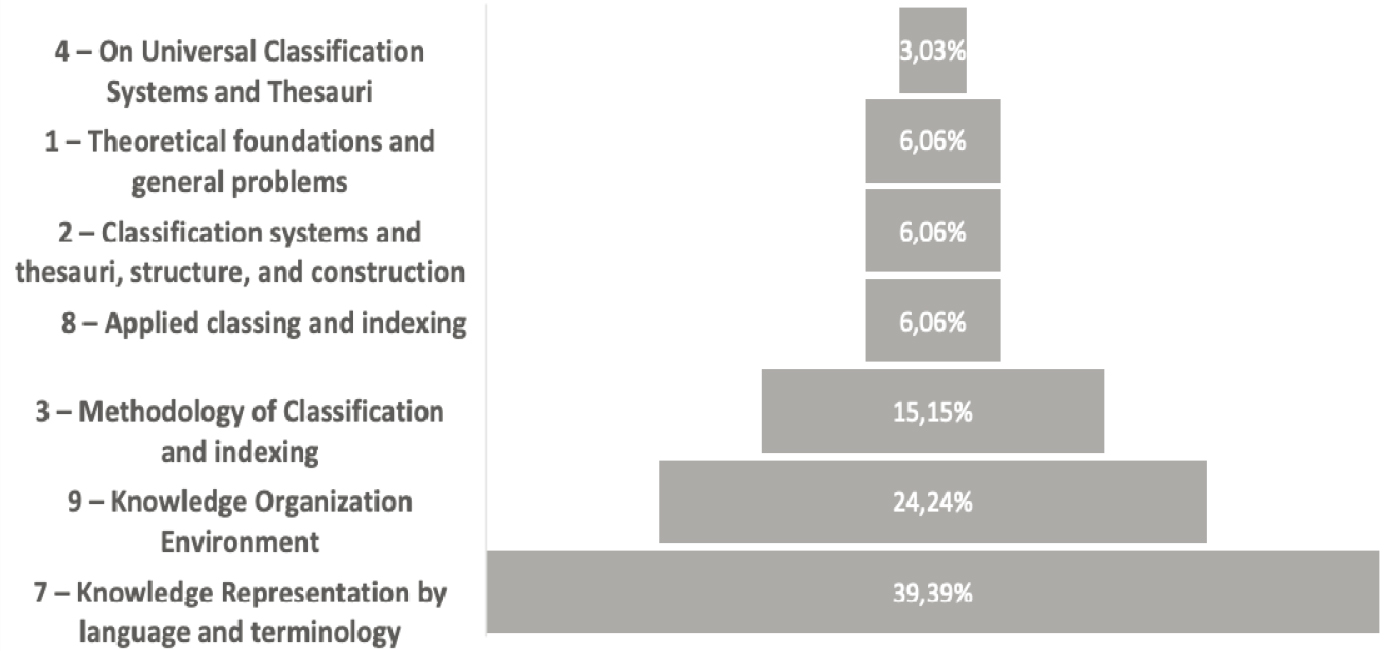
According to Table 1 and Fig. 1, the CSKOL classes that most represented the content of the articles were: “7 – Knowledge Representation by language and terminology” (13 works; 39.39%); “9 – Knowledge Organization Environment” (8 articles; 24.24%) and “3 – Methodology of Classification and indexing” (5 studies; 15.15%). Classes “1 – Theoretical foundations and general problems”, “2 – Classification systems and thesauri, structure and construction” and “8 – Applied classifying and indexing” had 2 articles assigned to each class, representing 6.06% of the samples each. The class with a single assigned work was “4 – On Universal Classification Systems and Thesauri”, which represented 3.03% of the sample.
Classes “5 – On special objects classifications – taxonomies” and “6 – On special subjects classifications and Thesauri” were not used to represent any article. Interestingly, in Tolare et al. (2021), a study on the representation of CSKOL classes and subclasses on GT2 works of ENANCIB (2016–2018), these same classes had none assigned works. In this way, it opens for questions about the reasons for not having works developed in the themes of classes 5 and 6 of the CSKOL. It is clear that there is a greater tendency to develop studies involving the themes of classes 7, 9 and 3.
The analysis of the articles also made it possible to identify their themes and to observe the topics covered (Table 2).
Theme of the articles
Analysing the abstracts, it was possible to identify that many of them contained scarce information considered essential to compose an abstract. Therefore, it was necessary to check, in addition to the keywords, the text itself. From this reading, it was observed that the papers address an important diversity of topics that have differences and similarities between them. Many studies have as their final product the development of a tool belonging to the Knowledge Organization area (such as an ontology), but the work itself is part of another area of knowledge, such as Knowledge Management, Geography, Repositories, Agronomy, Archives or Nuclear Information.
In order to identify the interdisciplinary themes and the specific knowledge organization themes, the theoretical foundation and bibliographical references of the articles were analysed. Articles were found in which the theoretical foundation was inserted in the introduction, as they lacked a specific rubric for its development.
Interdisciplinary theoretical foundation themes
Interdisciplinary theoretical foundation themes
Table 3 presents interdisciplinary themes found in the articles’ theoretical foundation, the number of appearances, and their percentage. It is possible to observe a large number of various topics such as “Semantic Web” (addressed by 8 articles, 10.96% of the sample), “Specific information system (Grammatical and Nuclear)” with 2 studies (2.74%), “State of the Art” (1 article, 1.37% of the sample), among other diversified themes.
Most of the interdisciplinary topics mentioned are related to the technology area, such as “Interoperability” (2 studies, 2.74%), “Repositories” (4 works, 5.48%) and “Validation of digital information metadata” (1 article, 1.37%). Other themes found were related to the area of Knowledge Management: “User knowledge management” (1 work, 1.37%), “Terminological management” (1 study, 1.37%) and “Knowledge management by libraries” (1 article, 1.37%). There is even a theme that addresses social movements such as “Organization of indigenous, feminist and post-colonial knowledge” (1 study, 1.37%).
The analysis of the articles’ themes highlights the quantity and diversity of non coincident representative themes. On the other hand, the coincident interdisciplinary themes, “Semantic Web” (11%) and “Linked open data” (6.22%) stand out, as well as the topics of knowledge organization with more incidence: “Knowledge organization systems” (19.4%), “Cataloguing” (9%) and “Indexing” (9%).
The themes of knowledge organization addressed in the papers’ theoretical foundation are presented in Table 4.
According to Table 3, the topic of knowledge organization that appeared the most was “Knowledge Organization Systems” (13 articles, 19.40%), followed by “Cataloguing” and “Indexing” (both with 6 works each, representing 8.96% of the samples). Information retrieval had 5 studies (7.46%) and Classification 4 articles (5.97%).
The least discussed topics, all with a single work (1.49% each), were: “Control of authority”, “Terminology”, “Archive analysis and treatment”, “CDD”, “Organization of archival texts”, “Descriptive Metadata”, “Metadata – Dublin Core”, “Critical Cartographic Cataloguing”, “Information and Communication Technology”, “Hierarchy of Knowledge”, “Taxonomies”, “FRBR” and “Bibliographic Systems”. Observing the themes pointed out, it was possible to perceive that many of these themes could be included as part of the theme “Knowledge Organization Systems”, but this inclusion did not occur due to the theoretical foundations having discussed the themes in a very specific way, not approaching in a general view.
Another pertinent and relevant point to quote as an example is the fact that there are works whose proposals were to create an ontology model within a certain context, but the theoretical foundation of knowledge organization was about information retrieval, information representation, technologies of information and communication, in the area of knowledge management, among others, but did not specifically address the theoretical foundation on ontology.
Themes of KO theoretical foundation
It is possible to conclude that the use of CSKOL proves to be a suitable lens for analysing and understanding the literature on the field of knowledge organization in institutional repositories. The framing of the works papers in the CSKOL classes and subclasses allows to identify the predominant approaches and trends, creating a structured representation of this area.
The classification of themes into classes and subclasses revealed that of the 33 papers analyzed and classified in CSKOL, three classes grouped most of them: namely class 7 (Representation of Knowledge through language and terminology) contains thirteen of the themes, followed by class 9 (Knowledge organization environment) with eight, and class 3 (Classification and indexing methodology) with five. At least in this period, 2015–2020, three quarters of the literature focused primarily on these three research themes.
Regarding the identification of interdisciplinary themes and Knowledge Organization specific themes (Tables 3 and 4), the quantity and diversity of themes without coincidences, and the interdisciplinarity are remarkable. On the other hand, overlapping themes stand out, such as: “Semantic Web” (11%) and “Linked open data” (6.22%) and the most frequent topics of knowledge organization, “Knowledge organization systems” (19.4%), “Cataloguing” (9 %) and “Indexing” (9%).
There is, therefore, consistency between Knowledge Organization topics of the theoretical foundation with the classes and subclasses, e.g.: theme “Knowledge organization system” with class 7 (Representation of knowledge through language and terminology). It is shown that, in these 33 articles the themes of knowledge organization are combined with interdisciplinary themes from other areas of knowledge. In our opinion, this enriches and improves theoretical support for research development.
In terms of limitations, we can mention that the interest in repositories and KO, in this period studied, is not only reflected in scientific articles, but in works of a professional nature, such as repository policies, guidelines and procedure manuals. Also, that the timeframes used in this research (2015–2020) left out interesting works done previously, such as the works by Zavalina (2011, 2014). Additionally, works presented at different ISKO events, international and national, were also excluded from the selection, as they were not indexed in the databases. Thus, in future works, these limitations can be overcome by extending the time limits of the research and the types of works considered.
This research, in order to draw a more complete picture of knowledge organization in repositories, could be extended with the study of the methodologies used, and the institutional and academic affiliation of the authors. Furthermore, expanding the analysis with the policies, guidelines and procedure manuals of the repositories.
Footnotes
Appendix 1: Corpus of articles analyzed
Bishop, B.W., Moulaison, H.L., & Burwell, C.L. (2015). Geographic Knowledge Organization: Critical Cartographic Cataloguing and Place-Names in the Geoweb. Knowledge Organization, 42(4), 199-210. doi: 10.5771/0943-7444-2015-4-199. Candela, G., Escobar, P., Carrasco, R.C., & Marco-Such, M. (2020). Evaluating the quality of linked open data in digital libraries. Journal of Information Science. doi: 10.1177/0165551520930951. Di Cresce, R., & King, J. (2017). Developing collaborative best practices for digital humanities data collection: A case study. College & Undergraduate Libraries, 24(2-4), 226-237. doi: 10.1080/10691316.2017.1326330. Díaz-Corona, D., Lacasta, J., Latre, M.Á., Zarazaga-Soria, F.J., & Nogueras-Iso, J. (2019). Profiling of knowledge organisation systems for the annotation of Linked Data cultural resources. Information Systems, 84, 17-28. doi: 10.1016/j.is.2019.04.008. Díaz-Corona, D., Lacasta, J., & Nogueras-Iso, J. (2018). Barriers for the access to knowledge models in Linked Data cultural heritage collections. Proceedings of the 5th Spanish Conference on Information Retrieval, 1-3. doi: 10.1145/3230599.3230615. Dragon, P.M. (2020). Form and Genre Access to Academic Library Digital Collections. Journal of Library Metadata, 20(1), 29-49. doi: 10.1080/19386389.2020.1723203. Eito-Brun, R. (2016). Remote access to EAC-CPF context and authority records for metadata indexing: A solution based on open information retrieval standards. Archival Science, 16(2), 149-165. doi: 10.1007/s10502-014-9239-8. Fenlon, K. (2017). Thematic Research Collections: Libraries and the Evolution of Alternative Digital Publishing in the Humanities. Library Trends, 65(4), 523-539. doi: 10.1353/lib.2017.0016. Gaona García, P.A., Fermoso García, A., & Sánchez Alonso, S. (2017). Exploring the Relevance of Europeana Digital Resources: Preliminary Ideas on Europeana Metadata Quality. Revista Interamericana de Bibliotecología, 40(1), 59-69. doi: 10.17533/udea.rib.v40n1a06. Gaona-García, P.A., Martín-Moncunill, D., Gaona-García, E.E., Gómez-Acosta, A., & Montenegro-Marin, C. (2018). Usability of Big Data Resources in Visual Search Interfaces of Repositories Based on KOS. Proceedings of the 2018 2nd International Conference on Cloud and Big Data Computing – ICCBDC’18, 33-37. doi: 10.1145/3264560.3264567. Gaona-García, P.A., Martín-Moncunill, D., & Montenegro-Marín, C.E. (2017). Trends and challenges of visual search interfaces in digital libraries and repositories. The Electronic Library, 35(1), 69-98. doi: 10.1108/EL-03-2015-0046. Gaona-García, P.A., Sánchez-Alonso, S., & Fermoso García, A. (2017). Visual analytics of Europeana digital library for reuse in learning environments: A premier systematic study. Online Information Review, 41(6), 840-859. doi: 10.1108/OIR-04-2016-0114. Gaona-García, P.A., Stoitsis, G., Sánchez-Alonso, S., & Biniari, K. (2016). An Exploratory Study of User Perception in Visual Search Interfaces Based on SKOS. Knowledge Organization, 43(4), 217-238. doi: 10.5771/0943-7444-2016-4-217. Golub, K., Tyrkkö, J., Hansson, J., & Ahlström, I. (2020). Subject indexing in humanities: A comparison between a local university repository and an international bibliographic service. Journal of Documentation, 76(6), 1193-1214. doi: 10.1108/JD-12-2019-0231. Haider, S. (2020). Library Cataloguing, Classification, and Metadata Research: A Bibliography of Doctoral Dissertations. Cataloguing & Classification Quarterly, 58(1), 28-43. doi: 10.1080/01639374.2019.1707338. Hakopov, Z., Mironov, D., Savić, D., & Svetashova, Y. (2018). Automated KOS-based Subject Indexing in INIS. CEUR Workshop Proceedings, 17-28. Huang, H. (2018). Big data to knowledge – Harnessing semiotic relationships of data quality and skills in genome curation work. Journal of Information Science, 44(6), 785-801. doi: 10.1177/0165551517748291. Jeng, W., He, D., & Chi, Y. (2017). Social science data repositories in data deluge: A case study of ICPSR’s workflow and practices. The Electronic Library, 35(4), 626-649. doi: 10.1108/EL 11-2016-0243. Jonquet, C., Toulet, A., Arnaud, E., Aubin, S., Dzalé Yeumo, E., Emonet, V., Graybeal, J., Laporte, M.A., Musen, M.A., Pesce, V., & Larmande, P. (2018). AgroPortal: A vocabulary and ontology repository for agronomy. Computers and Electronics in Agriculture, 144, 126-143. doi: 10.1016/j.compag.2017.10.012. Koutsomitropoulos, D.A., & Solomou, G.D. (2018). A learning object ontology repository to support annotation and discovery of educational resources using semantic thesauri. IFLA Journal, 44(1), 4-22. doi: 10.1177/0340035217737559. Maltese, V. (2018). Digital Transformation Challenges for Universities: Ensuring Information Consistency across Digital Services. Cataloguing & Classification Quarterly, 56(7), 592-606. doi: 10.1080/01639374.2018.1504847. Maltese, V., & Giunchiglia, F. (2017). Foundations of Digital Universities. Cataloguing & Classification Quarterly, 55(1), 26-50. doi: 10.1080/01639374.2016.1245231. Mambone, Z., Savadogo, M., Some, B.M.J., & Diallo, G. (2015). DServO: A Peer-to-Peer-based Approach to Biomedical Ontology Repositories. Studies in health technology and informatics, 216, 1103. Mi, X., & Pollock, B.M. (2018). Metadata Schema to Facilitate Linked Data for 3D Digital Models of Cultural Heritage Collections: A University of South Florida Libraries Case Study. Cataloguing &Classification Quarterly, 56(2-3), 273-286. doi: 10.1080/01639374.2017.1388894. Niu, J. (2016). Organisation and description of datasets. Archives and Manuscripts, 44(2), 73-85. doi: 10.1080/01576895.2016.1179585. Rentería-Agualimpia, W., López-Pellicer, F.J., Lacasta, J., Zarazaga-Soria, F.J., & Muro-Medrano, P.R. (2016). Improving the geospatial consistency of digital libraries metadata. Journal of Information Science, 42(4), 507-523. doi: 10.1177/0165551515597364. Roy, B.K., Biswas, S.C., & Mukhopadhyay, P. (2017). DDC in DSpace: Integration of Multi-lingual Subject Access System in Institutional Digital Repositories. International Journal of Knowledge Content Development & Technology, 7(4), 71-84. doi: 10.5865/IJKCT.2017.7.4.071. Suchowolec, K., Lang, C., & Schneider, R. (2019). An empirically validated, onomasiologically structured, and linguistically motivated online terminology: Re-designing scientific resources on German grammar. International Journal on Digital Libraries, 20(3), 253-268. doi: 10.1007/s00799-018-0254-x. Tartarotti, R.C.D.E., Dal’Evedove, P.R., & Fujita, M.S.L. (2020). Indexação em repositórios digitais. Scire: representación y organización del conocimiento, 26(2), 13-18. Thompson, S.D., & Muir, A. (2020). A case study investigation of academic library support for open educational resources in Scottish universities. Journal of Librarianship and Information Science, 52(3), 685-693. doi: 10. 1177/0961000619871604. Tosaka, Y., & Park, J. (2018). Continuing Education in New Standards and Technologies for the Organization of Data and Information: A Report on the Cataloguing and Metadata Professional Development Survey. Library Resources & Technical Services, 62(1), 4. doi: 10.5860/lrts.62n1.4. Ullah, A., Khusro, S., & Ullah, I. (2017). Bibliographic Classification in the Digital Age: Current Trends & Future Directions. Information Technology and Libraries, 36(3), 48-77. doi: 10.6017/ital.v36i3.8930. Wang, Z., & Wang, X. (2020). From information, to data, to knowledge – Digital Scholarship Centers: An emerging transdisciplinary digital knowledge and research methods integrator in academic and research libraries. IFLA Journal, 46(1), 5-14. doi: 10.1177/0340035219885145.