



Abstract
Education curricula need constant updates in response to job market requirements, which may be influenced by the changing technological environment. In the library and information science (LIS) job market there are dynamics brought about by the Fourth Industrial Revolution (4IR). These dynamics call for LIS schools to reconsider their curricula in line with the job market. The job markets expect the education system to reflect their demands, as they are the primary clients. This study explored the education and training of LIS professionals on digital scholarship in line with the LIS curriculum in higher education institutions of South Africa. This was to enable the development of a framework for incorporating digital scholarship into the LIS curriculum. Wolf’s (2007) curriculum development model and an aspect of the customer satisfaction model (Zeithaml et al., 1993) informed the study. The models assisted in producing a framework that can be used to incorporate digital scholarship content into the LIS curriculum in South Africa. The framework suggests that when developing digital scholarship, consultation with relevant stakeholders both internal and external should be considered. Relevant infrastructure and resources should also be in place when developing a digital scholarship curriculum. The relevant infrastructure should include the 4IR-driven infrastructure such as smart sensors, three-dimension (3D) modeling, and cybersecurity tools, among others. Relevant documentation such as resources in the form of policies, course outlines, and other curriculum-related documents should also be consulted. This model, if adopted, could assist LIS schools in developing a curriculum that is driven by digital scholarship, leading to the production of LIS graduates that meet the requirements of the current LIS job market.
Keywords
Introduction
At the dawn of the Fourth Industrial Revolution (4IR), libraries have a significant role to play in developing and sustaining effective practices through digital scholarship (Ogburn, 2012; Raju, 2013; Miller, 2017; Wood & Evans, 2018; Ayinde & Kirkwood, 2020). The nature of scholarly communication and other information-related functions have changed mostly because of the introduction of digital scholarship in library and information services (LIS). Sinclair (2014), Wexelbaum (2016) and Raffaghelli (2017) make the point that digital scholarship is an emerging trend in various disciplines that include, but are not limited to, the humanities, social sciences, and science, technology, engineering, and mathematics (STEM). Wexelbaum (2016) further indicates that academics are teaching students new forms of research, rhetoric, expression, and visualization of data using imaging media. In line with developments on the academic side, libraries are expected to have spaces to accommodate new emerging community needs of this kind (Ogburn, 2012; Sinclair, 2014; Wexelbaum, 2016; Raffaghelli, 2017; Ocran & Afful-Arthur 2021). In support of these views, Ogburn (2012) points out that technological advancements and evolving scholarly practices have encouraged librarians to dedicate resources to the curation of the digital assets, data management, publishing, and intellectual property assistance that form part of digital scholarship. Ippoliti (2016) notes that digital scholarship brings together subject expertise with technological advances and digital tools and processes such as data visualization, fabrication, GIS and data-mining. It is noted that this is a formative center with libraries in various institutions (Ippoliti, 2016).
According to Sharma (2005), LIS schools need to have a strong curriculum supported by facilities, curriculum updates, the awarding of degrees to successful students, the hiring of trained full-time faculty, research facilities, and accessible computer laboratories to draw in more students. The main issue is that developed countries are seeing these advancements first hand while developing ones are lagging. Si et al. (2013) claim that universities, library consortiums, and institutions that focus on scientific data curation are primarily found in the United States and the United Kingdom. In South Africa, few universities currently offer content on the rapidly growing field of digital scholarship (Wood & Evans, 2018). There are various definitions or perspectives of digital scholarship in the extant literature, nevertheless, the definition of digital scholarship by Rumsey (2011) was found suitable for this study. Rumsey (2011) perceives digital scholarship as the use of digital evidence and methods, authoring, electronic publishing, computational curation and preservation, and digital use and reuse of scholarship. This is in line with Ocran and Afful-Arthur (2021) who perceived digital scholarship as networked technologies used for teaching and research in everyday life. Digital scholarship content is crucial in the education of library and information science students as it is an important aspect of the LIS profession. Rumsey (2011) suggests that education and training based on the new skills, including conventional literacies, should be incorporated into graduate and postgraduate education programs to provide for the life-long learning needs of the LIS profession based on digital scholarship. This statement emphasizes the strong demand for digital scholarship in LIS education and training of librarians. As indicated by literature, other parts of the developed world have been doing excellently in developing their content to meet the need of the current industrial revolution. However, this has been a struggle in huge parts of developing continents like Africa. For instance, in Zimbabwe, Munyoro (2014) noted that LIS schools were failing to incorporate information communication technologies (ICTs) content in their curriculum due to the lack of workforce and laboratories. Few studies have been conducted in South Africa as far the paradigm shift is concerned based on digital scholarship (Raju, 2015). The study by Raju (2015) examined the inclusion of ICTs in the LIS curriculum and Raju (2017) examined the
However, the concern raised in the United States of America (USA) by Harris-Pierce and Liu (2012) regarding whether LIS schools were adequately addressing the growing need to educate future librarians on digital scholarship in the 4IR, remains pertinent for LIS schools in South Africa. In a study carried out in South Africa, Raju (2017b) suggests that LIS schools should embark on teaching digital scholarship content to prepare their information specialists to be competitive and to survive in the dynamic digital library environment.
Problem statement
Digital scholarship content as part of the LIS curriculum is fundamental to managing information services in the technology-driven digital age. However, evidence shows that education and training of LIS professionals in South Africa do not effectively incorporate digital scholarship content in the curriculum (Sibiya, 2022). Evidently, the majority of LIS schools in South Africa remain behind in offering digital scholarship programs and courses (Raju, 2017b; Wood & Evans, 2018). Considering this, a lack of digital scholarship programs and courses may have a negative impact on LIS professionals and the services they may offer in the digital age (Raju, 2015). The literature review made clear that by not offering the required courses that offer the competencies, skills, and knowledge to support digital scholarship, LIS professionals may lose their jobs to software engineers and computer or information communication technology (ICT) specialists who have the necessary know-how (Mathews & Pardue, 2009; Harris-Pierce & Liu, 2012; Raju, 2015; Ayinde & Kirkwood, 2020). The implication is that should LIS schools fail to teach digital scholarship to the LIS professional, LIS graduates would be rendered irrelevant to the job market. This study aimed at developing a framework to assist LIS schools in South Africa to incorporate digital scholarship contents into their curricula. This will equip LIS graduates with relevant skills, knowledge, and competencies to allow them to compete successfully in the job market.
Research objectives
The following objectives were formulated for this study:
To determine digital scholarship content in LIS schools in South Africa To identify key stakeholders in developing digital scholarship curricula in LIS schools in South Africa To establish the infrastructure required for teaching digital scholarship in LIS schools in South Africa To develop a framework for the implementation of digital scholarship in LIS schools in South Africa
The following research questions were addressed by the study:
What are digital scholarship contents in LIS schools in South Africa? Who are the key stakeholders to be involved when developing digital scholarship curricula in South African LIS schools? Which infrastructure required for teaching digital scholarship in the LIS schools in South Africa? What framework can be used to implement digital scholarship in LIS schools in South Africa?
The literature reviewed for this article was informed by the research objectives; which later informed the structure of the framework that was developed. The literature review covers topics on understanding digital scholarship, stakeholders involved in developing digital scholarship curricula, and infrastructure to be used when teaching digital scholarship content.
Understanding digital scholarship in the LIS profession
Though there are several authors who discuss digital scholarship in the extant literature, Rumsey (2011) seems to be one of the pioneer authors who discussed this concept sufficiently. Digital scholarship is defined as the use of digital evidence and methods, authoring, electronic publishing, computational curation and preservation, and digital use and reuse of scholarship (Rumsey, 2011). Digital scholarship is important and brings about many opportunities in LIS schools. Scanlon (2018) claims that digital scholarship enhances interdisciplinary learning and research among students and researchers using social media platforms. Digital scholarship among students or information specialists brings about the potential of novel solutions to problems through new ways of thinking (Klein, 2010; Scanlon, 2018; Schwab, 2018). Digital scholarship services are considered both highly practical and highly technical; therefore, LIS schools should offer education on digital scholarship. An experienced eResearch librarian is thus crucial to ensure quality services in the work environment. Swan and Brown (2008) and Si et al. (2013) caution that soon, the role of digital scholarship librarians who curate, preserve, and archive digital data will become increasingly important. Masenya and Ngulube (2019) also emphasize the importance of digital preservation resources in academic libraries as a result of the digital revolution in South Africa. The lack of skills and training was identified as the one shortcoming that hinders the preservation of digital resources, which are part of digital scholarship (Masenya & Ngulube, 2019). This calls for LIS schools in SA to understand and start introducing digital scholarship into their curricula.
Stakeholders involved in digital scholarship curriculum development
Wolf (2007) identifies Heads of Departments (HoDs), lecturers, employed graduates (alumni) and employers of graduates as important stakeholders to be included in the process of curriculum development. Wolf (2007) further indicated that involving these stakeholders was vital in the process of curriculum development. Nevertheless, digital scholarship collaboration with other disciplines, for instance, IT and computer science, is considered a cardinal exercise. Joseph (2019) also points to collaboration with STEM fields as a necessary step for LIS schools’ academics to consider when developing content on digital scholarship.
Coupled with collaboration with the STEM fields, Wolski and Richardson (2014) also appreciate the beauty of digital scholarship, as it is highlighted that electronic networks permit different scholars to communicate and collaborate. Collaboration between scholars ensures that, globally, relevant stakeholders tackle perspectives and challenges timely. Furthermore, it is emphasized that the collaboration between scholars in sister LIS schools could assist in benchmarking with the LIS schools that already have sustainability and relevant digital scholarship content (Wolski & Richardson, 2014). Although the initiative to collaborate with sister LIS schools is praised, Virkus (2012) criticizes this strategy as it may bring problems if institutions who were entering into a collaboration agreement had resources that are not complementary. As in collaboration, both collaborating institutions should benefit from the process.
On the other hand, King (2018) supports the idea of collaboration among digital scholarship librarians, digital humanists, and LIS academics. King (2018) asserts that digital scholarship librarians and digital humanists have advanced digital scholarship skills; therefore, academics in LIS schools would learn much from this collaboration, especially regarding the practical aspect of digital scholarship.
Infrastructure for teaching digital scholarship content
Manda (2006) and Edegbo (2011) mention that for LIS schools to provide proper education with digital scholarship influencing skills, knowledge and competencies, students must have access to hardware and software used for IT or ICT skills, knowledge, and competencies. The Commonwealth of Learning (2020) states that universities will have to acquire Internet of Things (IoT) technologies to enhance the infrastructure used for digital scholarship activities. The Commonwealth of Learning (2020) propose the acquisition of smart devices in order to offer digital scholarship content. McCullough (2014) identifies the following as facilities that should be used for teaching digital scholarship, namely, smart classrooms or laboratories, which comprise MacPro computers, scanners and software for media creation, and powerful personal computers for data services practical work. McCullough (2014) further indicates that peripherals for video production, including sound and light kits, were also considered key parts of facilities that are used for teaching digital scholarship. Lippincott et al. (2013) state that digital scholarship centers comprise of laboratories of twelve 55-inch LED screens, the high-definition visualization facility that supports innovative methods of teaching and research and enables new forms of student learning and interaction. This confirms that countries in the developed world are well equipped infrastructurally in contrast to those in the developing world like South Africa. Munyoro (2014) asserts that the reason for this might be that the LIS schools have not bought the infrastructure to offer proper skills in digital scholarship. Along the same lines Ocholla and Ocholla (2014) shared the same concerns that LIS schools in South Africa had limited ICT resources to support teaching and learning. Ashiq and Warraich (2022) cite limited training for data librarianship roles to equip them with skills, knowledge, and expertise; unavailable data policies, lack of financial benefits, lack of infrastructure and systems, and lack of organizational support for the initiation of data-driven services as challenges facing data librarian services. This was also declared by Liang and Chen (2018); they too, note the lack of infrastructure in other parts of the world as a setback for the development of digital scholarship initiatives.
Conceptual framework
In line with the suggestion by Ngulube (2020), the study adopted a conceptual framework from two models. The study used part of the constructs from Wolf’s (2007) model (addressing LIS education) and a construct from Zeithaml et al. (1993) (relating to perceptions of employers) to formulate the conceptual framework employed to address the research questions of this study (see Fig. 1). Wolf’s (2007) curriculum development model operates in three stages, namely, curriculum visioning, curriculum development and alignment, and coordination, and development. This framework owes its origins to education and it is used for action research. The Zeithaml et al. (1993) customer satisfaction model was used to inform the perceptions of employers about graduates from LIS schools.
Conceptual framework underpinning the study (Compiled by Authors).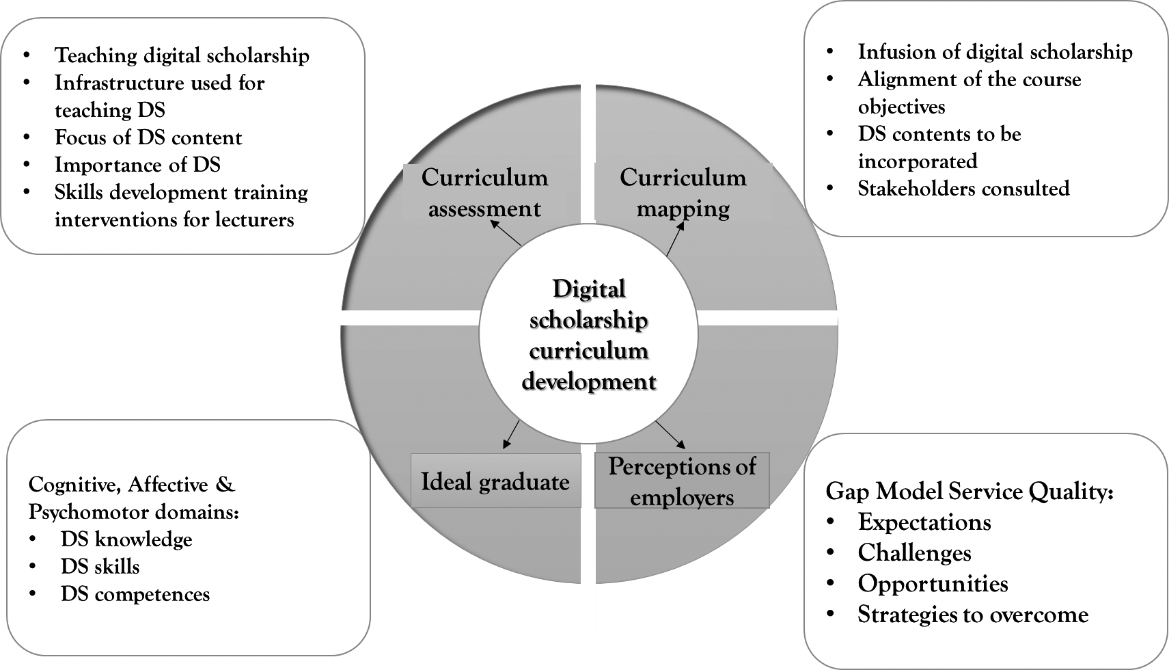
This study is an extract from a larger doctoral study aimed at exploring education and training of library and information science professionals on digital scholarship in South Africa. This study used an interpretive paradigm through a qualitative approach and case study design. The study used both semi-structured interviews and document analysis (course outlines) to collect data from LIS academics and digital scholarship librarians in both academic and special research council libraries in South Africa.
A total of 10 academics and 10 librarians were interviewed for this study. The interviewed lecturers submitted 8 course outlines from LIS schools. All these documents were thematically analyzed as guided by Braun and Clarke (2006), Braun and Clarke (2012), Miles et al. (2014), and Creswell and Guetterman (2018). The Braun and Clarke (2012) framework lists their steps as familiarizing oneself with data, generating initial codes, searching for themes, reviewing themes, defining and naming themes, and producing the report. These steps informed the use of ATLAS.ti 9 that assisted in the data analysis of this study. Owing to the challenges posed by COVID-19, the Microsoft Teams platform was used to collect data through semi-structured interviews that were later transcribed and uploaded into the ATLAS.ti 9 software for ease of analysis. Upon analyzing and discussing the findings in line with the conceptual framework, the study gave birth to the framework below (see Fig. 2). This study complied with the ethical considerations provided by the University of South Africa (University of South Africa 2013). The ethical clearance from the University of South Africa (Rec-02032020), research proposal, informed consent form and semi-structured interview guides were sent to the participating institutions for approval, and permission was granted to collect data.
To ensure anonymity of the participants, codes were coded in the ATLAS.ti 9 software. Heads of Departments were coded as HoDs, digital scholarship lecturers as DS L, digital scholarship directors as DS D and digital scholarship librarians as DS LBRN. There were 5 HoDs, 5 DS Ls, 5 DS Ds and 5 DS LBRNs that were interviewed for the purpose of this study. As data was collected via MS teams, noting the gestures of participants was limited where the camera was not always kept on due to various reasons. That information could have assisted in data analysis. Consequently, the interpretations were based on the voices behind the screen rather than the full observations of the interviewees.
Findings and discussions
The following section presents data on the findings and the discussion of the findings. The presentation of the findings is based on the themes that were derived from the objectives of the study. These themes include understanding digital scholarship by both LIS schools and academic and special research council libraries, key stakeholders involved in developing digital scholarship content, and infrastructure relevant for digital scholarship.
Understanding digital scholarship in the LIS profession
Prior to asking technical questions about a concept, it is paramount firstly to determine whether participants understand the concept under exploration. Digital scholarship is an emerging concept in the library environment (Verma, 2015; Mantoya, 2017; Dahl, 2018; Zhou et al., 2018; Ocran & Afful-Arthur, 2021); hence, it was vital to seek the participants’ understanding of the digital scholarship concept.
All participants in this study, including HoDs, lecturers, directors of libraries and digital scholarship librarians, were requested to define the concept “digital scholarship”, based on their understanding thereof. Participants had different understandings of the concept “digital scholarship”; however, there seemed to be common terms that appeared in most of the definitions across most participants. Most participants cited the advent of digital technologies, troubleshooting, digital literacies, ICTs, networking, and scholarly communication tools in the library environment as digital scholarship informed terms. In addition to that, interdisciplinarity, collaboration, and open scholarship were cited as being digital scholarship oriented. Data presentation ranges from academics to librarians. Table 1 below represents the responses from participants on this theme.
Understanding digital scholarship
Understanding digital scholarship
Based on the study findings, one could define digital scholarship as the use of digital tools and platforms for scholarly communication regarding research and teaching and learning among academic communities. Among other concepts that were evident from the study findings, digital scholarship was also related to the use of digital technologies for the promotion and advocacy of OA and collaboration activities in the library environment, which include electronic publishing, scholarship publishing, and electronic journal publishing, like OA journals or electronic journals and OERs.
The assertions made by the participants in this study were no different from the understanding of digital scholarship projected by the literature. Digital scholarship is perceived as the use of digital evidence and methods, authoring, electronic publishing, computational curation and preservation, and digital use and reuse of scholarship for research, tuition, and general communication (Lewis et al., 2015; Dahl, 2018; Iqbal & Yadav, 2021). More precisely, the University of Washington Library (2021) defines digital scholarship as the scholarly activity that uses the new possibilities for teaching and research paved by digital media, which include, but are not limited to, new forms of collaboration, new publication forms and new methods of visualizing and analyzing data. This definition summarized most of the definitions by participants as far as understanding of digital scholarship is concerned. Therefore, the findings of this study concurred with the previous studies that were conducted on digital scholarship. Along the same lines Su and Zhang (2022) on their longitudinal literature analysis study from 2005–2020 also cited similar concepts as those identified in this study as appearing most in the literature concerning digital scholarship. Ippoliti (2016) mentions that digital scholarship centers are meant to facilitate research, teaching and learning among disciplines through providing digital research needs which are RMD, digitization and scholarly communication issues.
All the participants that formed part of this study were asked to identify stakeholders relevant to the digital scholarship curriculum development process. Participants identified LIS schools academics, other scholars from other disciplines such as computer science, IT, humanities and software engineers, LIS practitioners, LIS schools’ current students, quality assurance committees, LIS professional bodies such as LIASA (Library and Information Association of South Africa), and benchmarking with other sister LIS schools national or international. Additionally, SAQA (South African Qualifications Authority) and the Department of Higher Education and Training (DHET) were also identified as key stakeholders to be consulted for any curriculum development. Table 2 provides the perceptions of the participants.
Stakeholders involved in digital scholarship
Stakeholders involved in digital scholarship
This study discovered that a combination of practitioners and academics played a crucial role in curriculum development for digital scholarship. It was found by the current study that collaboration and consultation between both parties to curriculum development were vital. Participants mentioned that it was important to consult interdisciplinary fields such as computer science, IT, humanities, software engineering, and data science when developing digital scholarship education. Moreover, the study revealed that LIS practitioners, LIS schools’ current students, SAQA, DHET, quality assurance committees and LIS professional bodies, such as LIASA and IFLA, were considered the essential parties in digital scholarship education. Additionally, benchmarking with national and international sister LIS schools was also hailed in this study as an important strategy to consider when developing digital scholarship education.
Wolf (2007) identifies HoDs, lecturers, employed graduates (alumni) and employers of graduates as important stakeholders to be included in the process of curriculum development. The current study’s findings support Wolf’s (2007) findings. According to Wolf (2007), including these, stakeholders was vital to the process of curriculum development. Along the same lines Zeithaml et al. (1993) contend that the researcher should mine the perceptions of employers to ensure customer satisfaction or dissatisfaction; in this case, customers are employers of LIS schools’ graduates (directors of LIS services). Nevertheless, digital scholarship collaboration with other disciplines, for instance, IT and computer science, was considered a cardinal exercise. Wolski and Richardson (2014) and Joseph (2019) also suggest that collaboration with STEM fields was a necessary step for LIS schools to consider when developing digital scholarship content.
As part of collaboration, LIS professionals should collaborate with digital humanities as they share similar goals (Zhang et al., 2015). In order for LIS professionals to remain relevant in the digital scholarship spaces it is essential for roles like creator and contributor, messenger and liaison, educator, innovator, and hybrid scholar to be evident in their daily activities in the library (Zhang et al., 2015). Zhu (2021) laments that the digital humanities centers are sometimes hosted by research libraries since skills for managing such centers partly emanate from the library services. Therefore, the study suggests that these new roles of a digital scholarship librarian could be well invested in LIS professionals when taught by LIS schools through a revamped LIS curriculum with digital scholarship content.
Virtual networks allow scholars to communicate and collaborate among each other. Furthermore, it was emphasized that the collaboration between scholars in sister LIS schools could assist in benchmarking with the LIS schools that already had sustainability and relevant digital scholarship content (Wolski & Richardson, 2014). Even though the initiative to collaborate with sister LIS schools is commanded, Virkus (2012) argued that this strategy may bring problems should schools entering into a collaboration agreement had uncomplimentary resources. Yadav (2021) notes that LIS schools’ staff should update their skills as far as technology is concerned as this could alleviate the lack of skills among LIS schools academics and facilitate tackling the collaboration challenges.
In like with the current study, King (2018) supports the idea of collaboration among digital scholarship librarians, digital humanists, and LIS academics. As per the current study, King (2018) asserts that digital scholarship librarians and digital humanists have advanced skills in digital scholarship; therefore, academics in LIS schools would gain much from this collaboration, exclusively regarding the practical aspect of digital scholarship. The findings of this study confirmed the assertions of King (2018) and further suggested that LIS schools could gain skills and knowledge from this partnership. Locally, Mugwisi and Hikwa (2015) request for a curriculum update to be more in line with new technological trends as a result of the disruptive technologies, to acquisition these technologies, the librarians would guide appropriately.
All participants of the study were asked about the infrastructure used for teaching digital scholarship. Those who were teaching in LIS schools were also asked whether the infrastructure or facilities at their respective schools were relevant. Practitioners were asked this question as most of them studied in LIS schools in South Africa or had access to LIS schools at their respective universities elsewhere. Almost all the participants identified hardware and software infrastructure as necessary for teaching digital scholarship. Among other things, interviewed participants mentioned computer laboratories (LANs), high-speed laptops and stable connectivity, open source or subscription software, access to online metadata standard resources such as Resource Description and Access (RDA) or web Dewey, innovative hubs, 3D scanners, and having access to websites that host journals. Notwithstanding the importance of laboratories, some participants, e.g., HoD-3 and DS LBRN 12, indicated that in the wake of COVID-19 it was impossible to use the laboratories (see Table 3).
Infrastructure for teaching digital scholarship
Infrastructure for teaching digital scholarship
Kaur (2015) emphases the need for LIS schools to have a proper infrastructure for teaching digital scholarship. The study identified technological infrastructure, including hardware and software infrastructure, as necessary to use as infrastructure for teaching digital scholarship. The study further elaborated that computer laboratories, high-speed laptops and stable connectivity, open source or subscription software, and access to online metadata standard resources, such as RDA or web Dewey, innovative hubs, 3D modeling and having websites that host journals, were considered relevant for teaching content on digital scholarship. Mulligan (2016) supports that GIS and 3D modeling should be acquisitioned for digital scholarship centers. The Commonwealth of Learning (2020) states that universities will have to acquire IoT technologies to enhance the infrastructure used for digital scholarship activities.
In agreement with this study, previous studies, such as the study done by the Commonwealth of Learning (2020) proposed the acquisition of smart devices in order to offer digital scholarship content. McCullough (2014) lists smart classrooms or laboratories, which comprise MacPro computers, scanners and software for media creation, and powerful personal computers for data services practical work as facilities required for digital scholarship. McCullough (2014) cites peripherals for video production, including sound and light kits, were also considered key parts of facilities that are used for teaching digital scholarship. Although these findings were related, they were very advanced compared to those identified in this study. The reason for this might be as asserted by Munyoro (2014) that the LIS schools have not acquired the infrastructure to offer proper skills in digital scholarship. Participants blamed this on the lack of budget allocated to LIS schools in South Africa to purchase the necessary infrastructure. This was also reported for other parts of the world by Liang and Chen (2018). It also evident in Zhou et al. (2018) that IT infrastructure is very important for digital scholarship services. As part of the concerns form participants, Lippincott (2017) indicated that the necessary tools, hardware, software and funding were lacking to secure relevant infrastructure used to support the teaching of digital scholarship.
Based on the findings, this section presents the proposed framework for the incorporation of digital scholarship into the LIS curriculum in South Africa. The framework consists of digital scholarship as a concept, internal stakeholders, external stakeholders, and the relevant infrastructure and resources. The LIS curriculum, which includes digital scholarship, needs digital scholarship lecturers to ensure that they conduct research on the emerging trends. Consultation with both internal and external stakeholders is vital to ensure that all the curriculum-related protocols are observed. These constructs are discussed in detail in this section. See Fig. 2 below for the framework.
Proposed curriculum development framework on digital scholarship.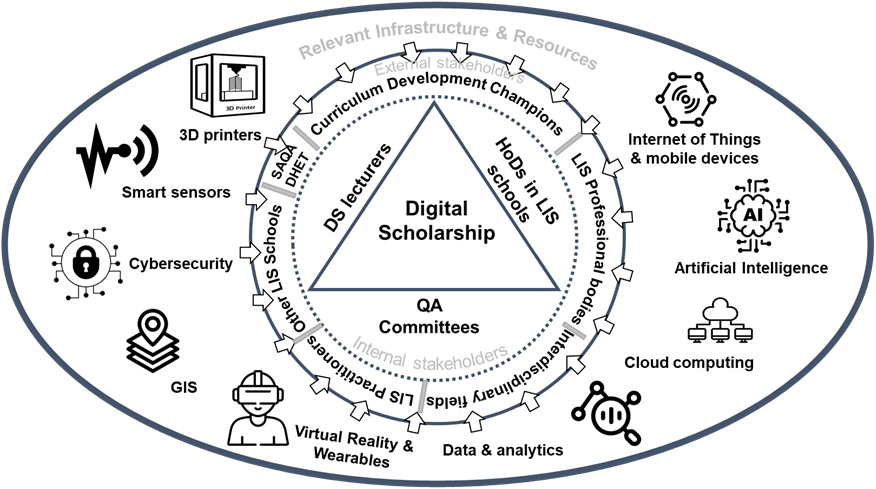
Based on the findings of this study, a framework should be used when developing digital scholarship content in the LIS curriculum. Internal stakeholders comprising digital scholarship lecturers, HoDs of LIS schools, and QA committees must work together in developing sound digital scholarship content for the LIS curriculum. Lecturers as content experts must ensure that relevant research on digital scholarship is used to inform the curriculum. The digital scholarship course objectives and themes from the literature can be used to structure the curriculum. HoDs of the LIS schools are expected to oversee the process of curriculum development and provide support in terms of funding for training workshops and procurement, where required. Quality assurance committees are mainly charged with the duty to ensure quality in the digital scholarship study materials that lecturers develop. Policies on curriculum development should be followed to ensure that a sound and relevant curriculum on digital scholarship is developed.
A collaborative approach is expected between internal and external stakeholders. Internal stakeholders should consult external stakeholders in the process of curriculum development. This can be done through workshops or seminars where a needs analysis in relation to digital scholarship is conducted with stakeholders. This study established those external stakeholders included LIS practitioners, LIS professional bodies such as LIASA and IFLA, interdisciplinary fields, other LIS schools, SAQA and the DHET, as well as curriculum development champions in the university. In South Africa, the LIASA conference takes place every year, most stakeholders in the LIS field attend it, and through this conference academics may engage practitioners from the wide LIS spectrum. LIS practitioners consist of digital scholarship librarians and directors of library services. These stakeholders perform digital scholarship activities daily and others also employ digital scholarship librarians. Digital scholarship librarians are aware of the trends in the library environment; hence, they should be consulted. Curriculum development champions in the university understand the process of developing the curriculum from its infancy stage to maturity; consequently, LIS academics should consider involving them in the process of curriculum development. This will ensure that a dynamic curriculum is developed that allows insertion of the latest changes from the job market.
LIS professional bodies, for instance LIASA, should be consulted, as it was discovered that LIASA had a special group of LIS professionals interested in digital scholarship, so they would be able to give guidance on the requirements of digital scholarship. Digital scholarship emanates from an interdisciplinary background, for instance IT, IS, computer science and software engineering were some of the fields that specialize in this area. Therefore, LIS academics must consult these fields when developing the curriculum to include digital scholarship. Benchmarking with other LIS schools that have advanced content on digital scholarship either national or international is also of particular importance.
SAQA and the DHET in South Africa are considered key in endorsing curriculum development. Therefore, after developing the relevant curriculum on digital scholarship, LIS schools should submit it to SAQA and the DHET for approval and endorsement.
Infrastructure for teaching digital scholarship
It is very important to consider procuring relevant infrastructure and resources when planning to teach digital scholarship content in the LIS curriculum. In the case of this study, the 4IR resources and infrastructure were cited as significant. LIS schools should procure resources that support the teaching of digital scholarship characterized by the IoT, AI, smart sensors, smart mobile devices, VR and wearables, data analytics, cybersecurity, and cloud computing. These facilities would ensure that students understand the practical component of digital scholarship. Adhering to this framework could result in LIS schools producing graduates with knowledge, skills, and competencies in digital scholarship activities. Linked to the infrastructure, institutions of higher education should have sufficient budgets to invest in the technological infrastructure. Academics who teach digital scholarship should be equipped with skills and knowledge to use the infrastructure effectively during teaching and learning. LIS schools should also partner with support units like digital scholarship centers and libraries. Students may be allocated into these support units as they have advanced infrastructure and experienced digital scholarship librarians. This would bridge the gap in South Africa as noted in the problem statement of this study that there is a limited pool of candidates for digital scholarship positions.
Implications of the study
This study has implications for both educators and employers of LIS graduates in the digital age. The findings of this study are expected to influence the LIS curriculum development with the view to improving practice in the LIS profession. As it stands, there is an outcry in the LIS job market that LIS schools produce poorly trained graduates when it comes to digital scholarship. It was recommended by previous studies that the curriculum should be recurriculated to include digital scholarship; however, there is no procedure or framework evident in the literature that would indicate how to embark on this recurriculation process. The implication is that should LIS schools follow the framework and the recommendations made in this study, LIS graduates would be sufficiently competent to perform digital scholarship activities. Lastly, the findings of this study will inform employers of LIS graduates about which skills and knowledge to look for when employing digital scholarship librarians and which training support they require. As a suggestion for further research, a study that investigates skills and development opportunities and issues for academics in LIS schools on digital scholarship will have to be explored. This suggestion is based on the fact that most participants indicated that LIS schools lacked capacity in terms of offering digital scholarship training.