



Abstract
Rapid urbanisation and industrialisation have led to a huge increase in the generation of municipal solid waste (MSW) across the globe. The world’s cities generate about 1.3 billion tons of solid waste per year and this is expected to increase to 2.2 billion tons by 2025. The most common method of waste management adopted by cities is to dispose of MSW in open dumps and oversaturated landfills. The improper management of MSW has become a threat to public and environmental health. However, this waste can also be perceived as an opportunity and a source of energy through Waste to Energy (WtE) technology. WtE technologies are used to produce various by-products like electricity, heat, biofuels and compost. In developed nations, it is primarily the non-organic elements of MSW that are used in WtE incineration. Developing nations are also investing heavily in WtE incineration, irrespective of the fact that their MSW consists primarily of biodegradables. The existing WtE incineration plants in India and China are not only causing heavy pollution but also posing a serious threat to the environment and human health. In this article, the author focuses on the current status and challenges of different WtE technologies used in Europe, US, China, Japan and India. Furthermore, the author recommends that waste incineration should not be treated as a source of renewable energy and suggests anaerobic digestion methods (biomethanation) as a solution for countries with more biodegradable waste.
Keywords
In 2017, Delhi’s Chief Minister, Arvind Kejriwal, called Delhi “a gas chamber” in an article by The New York Times. 1 In the same year, an avalanche of garbage, a mound as high as the Taj Mahal and the Qutub Minar in Delhi, slid down the Ghazipur Landfill site 2 killing two people on the spot and sweeping several vehicles from the road into the adjoining drain. 3 These examples of the current state of its landfills capture the seriousness and significance of the subject of India’s Municipal Solid Waste (MSW) management. Even while the whole world is under lockdown due to the COVID-19 outbreak, waste is still being generated on a daily basis. 4
With the increase in the world’s population, the production of MSW is also increasing rapidly. The urban population of the world is expected to increase from 3.6 billion in 2011 to about 4.6 billion in 2025. 5 The world’s cities generate about 1.3 billion tons of solid waste per year, and this is expected to increase to 2.2 billion tons by 2025. 6 By 2050, the world’s population is expected to reach 8.2 billion, mainly in developing nations and Africa, and the rate of waste generation would increase by 1.2–1.42 kg/person/day. 7
Obviously, it is advisable to reduce the amount of waste generated. However, if waste is inevitable, it is desirable to reuse or recover materials from the waste stream. Only 25 percent of the total quantity of MSW produced yearly in the world is recycled or recovered. 8 In developed countries, landfilling and thermal treatment are ways of disposing of waste that cannot be reused or recycled. 9 Wastes that cannot be practically reused or recycled or those that escape the predatory claws of scavengers in developing countries end up in open dumps and uncontrolled landfills. 10 As solid waste and energy demand continue to rise rapidly around the world, waste-to-energy (WtE) concepts have come to the fore. State-of-the-art WtE technologies, both thermal (gasification, pyrolysis and incineration/combustion) and biochemical (anaerobic digestion with biogas recovery), have utilised MSW as feedstock to generate electricity, heat and fuels. 11 Currently, more than 1,200 WtE plants are in operation in over 40 countries. 12
This article is a continuation and update of a 2015 article written by the author in conjunction with Professor Armin Rosencranz. 13 It describes WtE technologies around the globe and presents a societal perspective on what has occurred in the five years since the prior article. The author argues that issues such as non-segregation of waste and the presence of an informal waste sector in developing nations create obstacles to fulfilling WtE demands for waste of sufficiently high calorific value and low moisture content. Incineration technologies are not appropriate for India’s waste, which is mostly biodegradable; however, WtE anaerobic digestion technologies and biogas methods are a perfect fit for India. If used alongside effective policies, it could solve MSW management in India’s urban areas.
Following these summaries, the article explores the current status and recent developments of landfills and the development of WtE technologies in Europe, US, China, Japan and India, and highlights the risks to the environment and the public of WtE incineration. It offers recommendations for the achievement of the zero-waste goal and increased dissemination of WtE anaerobic digestion technologies in India’s cities. The article’s conclusion emphasises that without proper implementation of steps such as decentralisation of MSW management, waste segregation and recycling, WtE might not be able to help India achieve sustainability goals, and the future may remain grim.
Landfills
Increasing urbanisation has led to a rapid growth of MSW across the globe, leading to an urgent need for local governments to properly plan waste valorisation. 14 Landfilling is the most widely used method for MSW disposal. The amount of MSW generated worldwide is estimated to be around two billion tons per year with an anticipated increase to 9.5 billion tons per year by the year 2050. 15
Land is a big constraint in cities, particularly when the objective is to site a landfill, which most residents do not want near them, preferring not to live with ghastly sights of soaring scavenging birds, stray bovines, rag pickers, moving rickety trucks and smoking fires. 16 This is not to mention the foul smells and noxious gases drifting along the wind, public protests, and falling land prices and rentals around the particular site. 17
Methane, a potent greenhouse gas (GHG), has a global warming potential 28–34 times higher than that of carbon dioxide. 18 Around 30–70 million tons of methane gas are emitted per year from landfills throughout the world. 19 In world rankings, India stands 4th in aggregate GHG emissions after China, the US and Europe. 20
Europe
The European Union is forcing the closure of all landfills under the Landfill Directive issued in 1999. 21 The directive mandates that existing landfills meet new, more rigorous leachate and pollution control standards, thus diverting waste from landfill towards recycling and energy recovery.
In 2016, the total waste generated in the EU by all economic activities and households amounted to 2.5 billion tons. In 2016, slightly more than a half (53.2 percent) of that waste was treated in recovery operations: recycling (37.8 percent of the total treated waste), backfilling (9.9 percent) or energy recovery (5.6 percent). The remaining 46.8 percent was either landfilled (38.8 percent), incinerated without energy recovery (1.0 percent) or disposed of otherwise (7.0 percent). 22
Landfilling is almost non-existent in countries such as Belgium (1 percent), Netherlands (1 percent), Denmark (1 percent), Sweden (1 percent), Germany (1 percent), Austria (3 percent) and Finland (3 percent). 23 Here incineration plays an important role alongside recycling. Germany and Austria are also Europe’s top recycling countries. In Germany, about 37.8 percent of the MSW produced is incinerated, 44.5 percent is recycled and 17.3 percent is composted, while the remaining 0.4 percent goes to landfills. 24 Sweden is achieving 50 percent waste incineration and energy retrieval. 25 It has also made use of methane from landfills for central heating, fuelling cars, and power plants.
The practice of landfilling remains popular in the eastern and southern parts of Europe. In Malta, Greece, Cyprus and Romania, landfills account for more than 80 percent of MSW; in Croatia, Latvia, Slovakia and Bulgaria more than 60 percent; and more than 50 percent in Spain, Hungary, the Czech Republic and Portugal. 26 Other countries also use incineration and send a third or less of their waste to landfill: Estonia, Luxembourg, France, Ireland, Slovenia, Italy, the UK, Lithuania and Poland.
United States
In the US, the Environmental Protection Agency (EPA) regulates all waste material under the 1976 Resource Conservation and Recovery Act. 27 Solid waste can include garbage and sludge from wastewater and water-supply treatment plants, as well as other discarded materials from industrial operations. Landfill remains the conventional and most economically viable option for the US waste stream, due to land availability. 28
The EPA reported that the generation, recycling and disposal of MSW has changed substantially. Overall, the generation of MSW increased from 88.1 million tons in 1960 to 267.8 million tons in 2017. 29 Of the MSW generated, more than 94 million tons of MSW (35.2 percent) were recycled and composted, more than 34 million tons of MSW (12.7 percent) were combusted with energy recovery, and the remainder – more than 139 million tons of MSW (52.1 percent) – was landfilled.
The US previously sold large volumes of recycling waste to China. However, China halted its purchasing, citing contamination reasons, in 2018. 30 Due to the sudden change of policy, many industries in the US still do not have the ability to properly treat this new accumulating waste load and have incurred increasingly high rates to recycle waste and may have even halted recycling services. 31 A lot of US waste – now that it can’t be shipped to China – is just getting burnt. The infrastructure to deal with this problem simply is not there. 32
China
Historically, the Chinese garbage handling policy was landfill. Due to shortage of land around cities, however, the use of incineration has been increasing in recent years, despite the fact that incineration poses serious health problems by emitting various toxic by-products. 33 According to China’s National Bureau of Statistics, the country collected and transported 215 million tons of MSW in 2017, and 55.9 percent of garbage collected ended up in landfills whereas 39.3 percent was incinerated in 2017. 34
The Jiangcungou landfill in Xi’an city was built in 1994, occupies more than 160 acres and was designed to last until 2044. 35 This landfill is the size of around 100 football fields, and was designed to take 2,500 tons of rubbish per day. But instead it received 10,000 tons of waste per day – causing it to close 20 years earlier than anticipated. 36
In Shenzhen, the volume of MSW has skyrocketed from 50 tons a day in 1979 to 15,000 tons in 2017 – a 300-fold increase. 37 The region is expected to reach its landfill capacity by 2021. The waste management problem has become so acute in Shenzhen that, in December 2015, a mountain of construction debris and trash collapsed and cascaded into industrial and residential areas, killing at least 69 people.
The transition from landfills to incinerators is part of a five-year national plan released in 2017 that urges urban centres to reduce their use of dumps. The plan urges cities to rely on incineration in a bid to reduce waste-disposal costs in areas with little available land and relatively expensive transport. 38 In March 2017, the central government set out plans for a standardised system of sorting rubbish in 46 cities, including Shanghai. Under this 2017 plan, 35 percent of their combined waste was to be recycled by 2020. 39
India
Urban India generates more than 188,500 tons of MSW daily, which is around 68.8 million tons annually. 40 Only 43 million tons of the waste is collected; 11.9 million tons is treated and 31 million tons is dumped in landfill sites. This shows that only 65 percent of the municipal waste gets collected and only 22–28 percent of this waste is processed and treated. 41 Maharashtra generates the highest amount of waste, followed by Tamil Nadu, Uttar Pradesh, Gujarat and New Delhi. 42
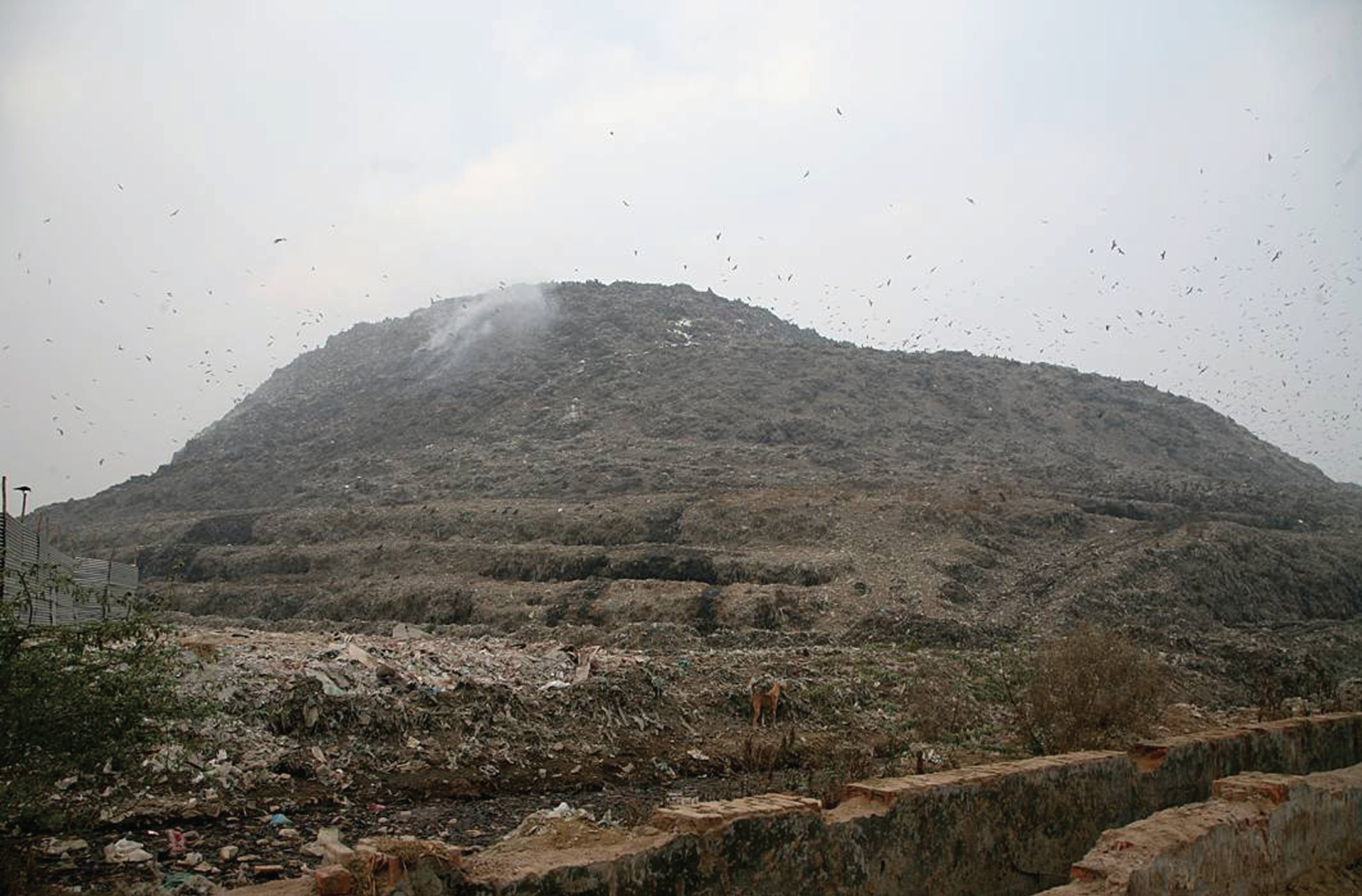
Delhi’s Ghazipur landfill had exhausted its capacity by 2008 but dumping continues. Photo by Anil Shakya.
In India, there is almost no segregation of MSW, plastic wastes, commercial wastes, industrial refuse and e-wastes. 43 If it could be undertaken, the diversion of organic waste, which is more than 65 percent of the total MSW in India, to composting plant(s) and anaerobic digestion plants may reduce load at the landfill sites by more than 50 percent; but due to an inconsistent supply of feed material and inadequate process management, composting on a large scale is currently not feasible. 44 The existing policies, programmes and management structure do not adequately address the imminent challenge of managing this waste which is projected to be 165 million tons by 2031 and 436 million tons by 2050. 45
Through the Municipal Solid Waste (Management and Handling) Rules 2000 as revised in April 2016, the Government of India notified municipal authorities to set up waste-processing and disposal facilities. 46 Thereafter, due to the rapid rate of urbanisation and the tremendous increase in population, communities have proliferated in the close vicinity of these dump sites. As a result, the waste disposal facilities in various cities, including Delhi, have faced opposition from nearby residents. 47
Delhi dumps 9,500 tons of garbage per day, consisting of food waste, sewage, plastics, paper, cardboard, textile and leather, plus construction and demolition waste. 48 Most of this (8,000 tons per day (TPD)) is collected and transported to landfill sites. The Municipal Corporations of Delhi (North Delhi Municipal Corporation (NDMC), South Delhi Municipal Corporation (SDMC) and East Delhi Municipal Corporation (EDMC)) are responsible for the management of all landfill sites in Delhi. 49
Today, there are four active landfill sites, namely Bhalswa (NDMC), Ghazipur (EDMC), Okhla (SDMC) and Narela-Bawana (NDMC) which cover more than 200 acres of land, in different zones of the city. 50 The Bhalswa landfill site was commissioned in the year 1994, Ghazipur in 1984 and Okhla in 1996. 51 All three of these landfill sites are over-saturated. The accumulated waste in these dumpsites has been estimated to be more than 40 million metric tons. However, these sites are still in operation and they receive waste from all over Delhi. 52
In 2018, the Parliamentary Standing Committee noted that the Government of Delhi’s current capacity would enable it to scientifically treat about 54 percent of the total MSW, leaving a gap of 46 percent to be bridged. 53 The laissez-faire attitude of the civic bodies of Delhi is also reflected in the fact that all three landfill sites have been declared saturated but untreated waste is still being dumped there. These sites have become hotspots for toxic gases due to frequent fires 54 and landslide accidents. 55 In the past few years, local municipalities have been experimenting in solving overfilled landfills with biomining and eco-parks in Delhi, 56 Mumbai 57 and Bengaluru. 58
Around the world, both developing and developed countries are paying more and more attention to WtE tools. 59 According to one research organisation, the global WtE market is expected to increase by nearly half, from US $25.3 billion in 2013 to US $37.6 billion in 2020. 60
There are now more than 1,200 WtE plants in operation across 40 countries. 61 WtE is a crucial element of MSW because it reduces the volume of waste and helps to convert the waste into energy and organic manure. In the flow-chart, WtE would ideally fall after segregation, collection and recycling, and landfilling. 62
As noted above, the most commonly used WtE technologies are thermal (incineration, pyrolysis, gasification, and refuse-derived fuel (RDF)), biochemical (composting and anaerobic digestion) and chemical. 63 Table 1 represents an overview of WtE technologies commonly used worldwide. 64 Dry MSW is the most suitable feedstock for WtE thermal technologies. The wet and biogenic fraction of MSW is more suitable for the biochemical technologies. 65 Thermochemical processes generate oxidised or reduced gaseous pollutants like hydrogen sulphide, carbonyl sulphide, SOx, NOx and solid ash, char or vitrified slag. The products of thermo-chemical processes have higher calorific values, non-combustible content having been eliminated from the waste materials. 66
An Overview of Waste-to-Energy Technologies
An Overview of Waste-to-Energy Technologies
Source: Gupta, B. and Arora, S.K. 2016. “A study on management of municipal solid waste in Delhi”. Journal of Environment and Waste Management 3(1): 131–138.
The quantity and composition of MSW generated vary depending on whether it is found in developed or developing countries, and may vary from city to city within the same country. 67 The majority of MSW in low-income or developing countries is biodegradable waste (approx. 64 percent), which is, in a few of these countries, utilised for anaerobic digestion and landfill gas recovery. 68 Upper-middle income populations (those with residential gross national incomes (GNI-R) between US $3,976–12,275) and high-income populations (GNI-R US $12,276 and higher) in countries like Japan, Taiwan, Singapore, South Korea, US and parts of Europe practice more source separation; reduction/reuse/recycling; and composting. 69 The higher-income countries generate larger quantities of MSW than low- and middle-income countries, with the non-organic parts of the MSW composition being a major driving force for implementation of WtE in higher-income countries. 70 Low-income or developing nations are also investing heavily in WtE technologies, irrespective of the fact that their MSW consists primarily of biodegradables. 71
In many European countries, WtE facilities are technologically more advanced than in the US. 72 Europe has 455 WtE plants in 18 European countries. Denmark, Sweden, Switzerland and Norway are the top four EU countries in the WtE sector.
The waste incineration directive in Europe has set standards to reduce air and groundwater pollution from WtE emissions. 73 In Germany, about 37.8 percent of the produced MSW is incinerated. 74 There are about 900 fermentation plants, 62 mechanical-biological waste treatment plants, 67 waste incineration plants, one pyrolysis plant, and about 36 RDF power plants. Sweden and Norway have evolved a highly specialised niche management in this regard. Sweden imports high-energy waste from the UK to keep the operations of their WtE plants running. These plants generate not only electricity but also energy for heating purposes. 75
United States
The use of incineration as a method of MSW disposal management dates back to the 19th century with the first municipal incinerator constructed near Pittsburgh, Pennsylvania, in 1885. 76 By the early 1990s, there were more than 200 MSW incinerators in operation. Due to the more stringent air pollution control requirements enacted in the Clean Air Act amendments of 1990, the number of incinerators decreased to 97 in 2001, and continued downward to 77 facilities in 2016. A second reason for this decrease in facility count is dropping electricity prices, as revenue is necessary to ensure the viability of these plants. 77 The currently existing facilities are spread across 22 states, more than half of which are located in the northeast.
Thirty-four US states (mostly northeastern states like New York, as well as one southern state, Florida – that is, states with the highest population density) classify incinerating MSW as a renewable energy source. 78 Most of these states use mass-burn technology to combust waste without much pre-processing. In the mid-western states, landfill is the dominant technology for waste disposal with negligible WtE. In the west coast states, municipalities favour more recycling and composting of their waste, rather than WtE.
The controversies around Wheelabrator’s and Covanta’s mass-burn facilities in Baltimore and Philadelphia are often cited in the media as examples of worst cases of the clash between WtE and environmental justice. 79 In 2015, the first new incinerator in 20 years was built and commissioned in Palm Beach County, Florida, and is considered the most advanced and cleanest WtE plant in North America due to its advanced combustion and pollution control measures; however, the construction of this facility came at a significant capital cost, with a total project cost of US $672 million. 80
A recent analysis of air emission violations concluded that the penalties imposed by the US provide a stronger incentive for more frequent updating of emission sources than the comparable EU emission structures.
The US has 58 mass-burn facilities, four modular facilities, 13 RDF-based facilities 81 and over 2,200 facilities producing biogas via anaerobic digestion. 82 There is, however, a need to further explore the potential of anaerobic digestion or biomethanation for large-scale energy generation.
China
China has the largest installed WtE capacity of any country, with more than 300 plants in operation. 83 This capacity has increased annually by 26 percent over the past five years, compared with just four percent average growth in capacity in the Organisation for Economic Co-operation and Development (OECD) countries. In 2016, China incinerated 37.5 percent of its MSW, while 60.3 percent was landfilled.
What once was a lush valley studded with small fish ponds, just north of one of Shenzhen’s major drinking water reservoirs, is now the construction site of the largest WtE incinerator plant on earth. 84 Its architects claim that it will be capable of incinerating one third of Shenzhen’s existing waste and generating energy. 85 It is estimated that it could produce around 550 million kWh per year and will also generate renewable energy via 44,000 m2 of solar panels on its roof.
While Shenzhen’s new WtE plant will offer an alternative to the city’s overloaded landfill sites, its green credentials have been called into question. A group of residents fears that landfill waste ash and airborne pollutants from the incinerator will end up in the nearby reservoir. This group launched a legal challenge to force the site to be relocated to a less densely populated area. 86
The Shenzhen Intermediate People’s Court ruled in the citizen group’s favour in 2016, requiring the municipal government to release a full environmental impact assessment, as well as the planning documents, and other data. 87 The Shenzhen government has appealed the decision, sending it to the Guangdong provincial Supreme People’s Court in Guangzhou, where it currently remains in limbo as construction on the site begins. 88
The Shenzhen citizens’ challenge is one of dozens of protests and lawsuits that have sprung up in China’s Hubei, Hunan, Guangdong, Shandong, Hainan, Jiangxi and Zhejiang provinces in recent years over the spread of WtE incineration plants. 89
An important aspect of WtE technology is the ability to provide waste with sufficiently high calorific value for the incinerators. This normally requires that sophisticated recycling programmes, including the collection of food waste for composting, be established and enforced at the household level. 90 China’s recycling programmes lag behind those of Europe and Japan, and so at present the waste streams in cities such as Shenzhen tend to have garbage with a higher moisture content. The higher temperatures needed to burn garbage with elevated moisture content and more organic material means that incinerators corrode faster and units need to be replaced sooner.
Japan
Along with the high levels of economic growth in the 1960s, the volume of MSW in Japan also increased, causing a strain on landfill plots. This increased volume yielded excessive dioxins from incineration. 91 As Japan’s landmass is limited, a reduction of waste volume and prompt disposal in landfill quickly became essential. Improved treatment of gas emissions enabled residents’ trust to be won, and heat recovery is now being sought from these operations. By fiscal year 2009, there were 1,243 incineration facilities in Japan, incinerating waste using several methods – stoker furnaces, fluidised bed furnaces, and gasification fusion resource furnaces with the objective of ash recycling. 92 Around 380 of these facilities are WtE plants. 93
Japan leads the world in recovering energy from waste, with almost 78 percent WtE conversion. The remaining 22 percent of MSW is mostly handled through recycling and composting. 94 Officially, Japan recycles 84 percent of its plastic waste. Although some parts of Japan certainly put a lot of effort into sorting recyclables, the majority of this plastic waste (approx. 60 percent) goes through “thermal recycling”, aka incineration, sometimes with energy as a by-product. 95
Japan has also been scrutinised for its plastic use – it has the second-highest plastic packaging waste per capita after the US – offering bags with the smallest of purchases and putting wrappers on single-use items like chopsticks. 96 However, the plastic waste has a high calorific value, which is suitable for incineration facilities in Japan. If done using modern “environmentally-friendly” incinerator technologies (ultra-high temperature furnaces and pollutant filters), incineration seems preferable to other alternatives.
Southeast Asian nations are now looking to adopt Japan’s WtE incineration technologies. 97 Ever since China’s “National Sword” policy came into force in January 2018, banning the import of many plastics and other materials, Southeast Asian countries, especially Viet Nam and Malaysia, have borne the brunt of the re-directed waste. Greenpeace has been cited as claiming that plastic waste imports to Malaysia increased from 168,500 tons in 2016 to 456,000 tons in the first half of 2018, mainly coming from the UK, Germany, Spain, France, Australia and the US. 98
India
The dearth of land for landfilling in megacities like Delhi has fostered a focus on waste incineration in WtE plants. Incineration-based WtE technologies have recently emerged as the preferred policy option for managing the growing problem of waste in India. 99 These technologies require a continuous supply of waste inputs of sufficient quantity and quality – high calorific value and low moisture content – to be viable.
The government’s preference with regard to methods of WtE contradicts the empirical evidence. First, the physical, chemical and biological characteristics of Indian waste render it technically unsuitable for incineration. 100 Second, to be viable, WtE technologies will require end-to-end control over the entire waste management chain, thus displacing waste pickers in the informal recycling sector from their means of subsistence. Far from being compatible, the two systems are in fact in competition with each other over the same set of material resources.
Even though WtE technology has been around for some time in Delhi and other parts of India, it still does not play a major role in waste disposal. 101 Three WtE plants have become operational in Delhi and many new plants are underway all across India under the framework of the Swachh Bharat Abhiyan (“Clean India Mission”) goals of the country. 102
Six WtE plants with a cumulative installed capacity of 66.75 MW are currently working or undergoing a trial run, and 53 WtE plants are under process with a proposal to generate cumulative 405 MW. 103 Table 2 shows the current WtE plants in Delhi and in India.
WtE incineration plants in India. Electricity from municipal solid waste [Source: MNRE, 2018]
WtE incineration plants in India. Electricity from municipal solid waste [Source: MNRE, 2018]
Source: Gupta, B. and Arora, S.K. 2016. “A study on management of municipal solid waste in Delhi”. Journal of Environment and Waste Management 3(1): 131–138.
In 1987, a large-scale biomethanation project (300 TPD, 250 million Indian Rupees (INR)) in Timarpur, New Delhi was out of operation within six months of installation. 104 In 1999, an RDF plant was commissioned (power generation 6.6 MW) which could handle 1,000 TPD but received only 700 TPD, and a plant in Vijayawada with a capacity of 500 TPD to produce six MW of energy was commissioned. 105 By 2019, none of these plants was in operation. Ten mechanical and biological treatment aerobic composting projects in the 1970s and two RDF projects in 2003 have also encountered initial failure. 106
The most commonly cited reason for the failure of the Timarpur plant was a mismatch between the plant’s waste input requirements and the quality of waste it received in terms of calorific value, moisture content and its physical composition. 107 Twenty-two years later, in early 2012, Timarpur-Okhla WtE plant, with a capacity to treat 1,950 TPD and generate 16 MW of electricity, became operational. The main challenge has been on environmental grounds, that the plant emits toxic gases (dioxins and furans) that are damaging the health of those who live in its vicinity.
Residents of the nearby communities filed a public interest litigation suit in the Delhi High Court. The case was subsequently transferred to the Principal Bench of the National Green Tribunal (NGT) in February 2013. 108 In February 2017, the NGT allowed the Timarpur Okhla WtE plant to function, subject to certain directions, 109 and directed it to pay environmental compensation of INR 25 lakh (2,500,000 rupees) for previous pollution violations. It noted that, in the absence of proper emission control systems, the plant’s burning of mixed waste could lead to emissions of toxic gases, including dioxins and furans.
The NGT further directed that the Timarpur-Okhla WtE plant link its online monitoring data to the Central Pollution Control Board (CPCB) and Delhi Pollution Control Committee (DPCC) and make emissions data available in the public domain. 110 At present, however, no online monitoring system is active or updated on the CPCB or DPCC websites for the public to scrutinise. 111
Even in the absence of exact data, the plant is known to have been causing pollution for years (at least until December 2014, the period till which NGT has determined liability) and emitting pollutants including human carcinogens. In this scenario, INR 25 lakh does little justice. 112
Eliminate the “Renewable Energy” Myth
Waste incineration is not a source of renewable energy. The perpetuation of this myth has deeply harmful ramifications. 113
In 30 US states, the renewable energy portfolio standards set benchmarks that stipulate what percentage of the state’s energy should be generated from renewable sources. 114 The non-profit Food and Water Watch analysed the 30 policies across the country and found that each one also included “dirty” sources such as mill residue, wood, waste incineration, poultry litter incineration and waste-methane burning. Some of these generation processes emit large amounts of carbon dioxide and many release other pollutants.
India is not lagging behind US, especially when it comes to promoting WtE as a renewable energy source. The Ministry of New and Renewable Energy has included WtE under India’s renewable energy capacity, 115 towards India’s “nationally determined contributions” under the 2015 Paris Agreement on climate change. 116
The European Commission’s Renewable Energy Directive defines “energy from renewable sources” as including only non-fossil sources, namely “wind, solar, aerothermal, geothermal, hydrothermal and ocean energy, hydropower, biomass, landfill gas, sewage treatment plant gas and biogases”. 117 Under this definition, a considerable amount of the material in India’s waste is not renewable. The UK Department for Environment, Food and Rural Affairs recognised the negative aspects of energy from waste in a guide stating that: “Energy from residual waste is only partially renewable due to the presence of fossil based carbon in the waste, and only the energy contribution from the biogenic portion is counted towards renewable energy targets (and only this element is eligible for renewable financial incentives)”. 118
Waste contains fossil-derived materials such as plastics. However, it also contains biogenic materials such as paper, card and food waste, which are arguably just as renewable as any other form of biomass. 119 That said, many of the biogenic materials found in the residual waste stream, such as food, paper, card and natural textiles, are derived from intensive agriculture, cotton fields and other “green deserts” (described as “a process of human-made reclamation of deserts for ecological reasons, farming and forestry such as monoculture tree plantation”). The ecosystems from which these materials are derived could not survive in the absence of human intervention, including energy inputs from fossil sources. It is, therefore, more than debatable whether such materials should be referred to as renewable. 120
Biomethanation
Biomethanation is a solution for processing biodegradable waste which remains underexploited in India. Decentralisation of the whole process of waste in urban cities in India could make waste collection more efficient, so that WtE anaerobic digestion methods could be put in use. It is believed that if we segregated biodegradable waste from the rest, it could reduce the challenges by half. 121 In fact, the major problem with WtE in India has typically been perceived to be inadequate source segregation. 122 This has resulted in failure of WtE facilities in India, and also shows how a landfill in Delhi could be higher than the Taj Mahal. 123
Some variation in calorific value for a short period may be tolerable but wide variation will affect operational costs and performance of the WtE facility. 124 This is identical to what has been observed by the NGT vis-à-vis the Timarpur-Okhla WtE plant. It also applies to the other WtE plants in India, bearing in mind that current estimates put the biodegradable component of India’s solid waste at a little over 50 percent. 125
It will be interesting to look into the WtE potential of anaerobic digestion technology and biogas in India. This could be a successful mechanism with a lot of future potential in the Swachh Bharat Abhiyan (“Clean India Mission”) initiative. 126
Monitoring
The road map for the next five years must have continuous and strict monitoring of the air quality in the WtE plants that are operational in India. Essentially, the monitoring must be institutionalised and should not depend on Court directives. 127
India needs an eco-innovation index like Sweden’s, under which less than one percent of the country’s rubbish gets sent to landfills. 128 Indicators that make up the indices include: health impacts, air quality, water and sanitation, water resources, agriculture, forests, fisheries, biodiversity and habitat, and climate and energy. India should focus on zero-waste practices and not try to sell the idea of WtE under the pretext of renewable energy.
Location Challenges
Setting up a WtE facility in close proximity to human settlements always raises environmental justice concerns, as noted above, with regard to the Wheelabrator and Covanta mass-burn facilities in Baltimore and Philadelphia 129 and the Timarpur-Okhla WtE plant in India. 130 These problems should be addressed and eliminated.
Conclusion
There is no doubt that WtE incineration technologies have to overcome pollution, financial and technical challenges around the globe, and must also address socio-economic factors such as unemployment for workers in the informal waste economy. WtE technologies provide safe and environmentally friendly disposal of MSW, only when waste with high calorific value reaches the WtE facilities after proper segregation of waste. However, the composition variability, high moisture content and low calorific value of MSW from developing countries affect its combustibility.
The author has tried to show that incineration is unsuitable for Indian waste and to suggest that anaerobic digestion and biogas are the most appropriate WtE solutions for India’s urban cities. Although they may require more land compared to WtE incineration facilities, they use far less than the land that the current exhausted landfill sites are already occupying in India. Moreover, this step would help improve the socio-political integration of waste pickers working in the informal sector.
The CPCB should create a national online monitoring framework for WtE facilities. State governments must make sure that segregation, collection and recycling take place as per the Solid Waste Management Rules, 2016. Citizen participation and their engagement would enable India to move from unsustainable practices to sustainable ones.
Until these actions are met, developing nations, including India, will suffer from improper waste management, toxic emissions from WtE incineration and adverse health impacts to the people.
Footnotes
Wolford, B. 2020. “Coronavirus could pose yet another risk - a surge of contaminated medical waste”. The News Tribune, 30 March. Online at https://www.thenewstribune.com/news/coronavirus/article241631346.html. See also, Sahagun, L. 2020. “Medical waste industry braces for flood of virus-contaminated trash”. Los Angeles Times, 30 March. Online at  .
.
Ibid.
Ibid.
Ibid.
Supra, note 5.
Rosencranz, A. and Bhati, H.V. 2015. “Waste-to-energy Projects: Comparing Approaches”. Environmental Policy and Law 45(3-4): 130–132.
Supra, note 11.
Ibid.
Supra, note 8.
Supra, note 15.
Ibid.
Ge, M. and Friedrich, J. 2020. “4 Charts Explain Greenhouse Gas Emissions by Countries and Sectors”. World Resources Institute, 6 February. Online at https://www.wri.org/blog/2020/02/greenhouse-gas-emissions-by-country-sector. See also .
El Sheltawy, S.T., Al-Sakkari, E.G. and Fouad, M.M.K. 2019. “Waste-to-Energy Trends and Prospects: A Review”. In: Ghosh, supra, note 5.
Supra, note 7.
Supra, note 23.
Supra, note 11.
Supra, note 27.
Ibid.
Ibid.
Supra, note 34.
Supra, note 41.
Supra, note 8.
Supra, note 46.
Gupta, B. and Arora, S.K. 2016. “A study on management of municipal solid waste in Delhi”. Journal of Environment and Waste Management 3(1): 131–138.
Ibid.
Supra, note 15.
Supra, note 51.
Mishra, S. 2019. “Civic bodies to tackle overfilled landfills with biomining in Delhi”. The New Indian Express, 3 September. Online at https://www.newindianexpress.com/cities/delhi/2019/sep/03/civic-bodies-to-tackle-overfilled-landfills-with-biomining-in-delhi-2028097.html. See also, Adak, B. 2019. “Delhi civic body floats tender for bio-mining and remediation of all 3 landfills”. Hindustan Times, 2 September. Online at https://www.hindustantimes.com/delhi-news/delhi-civic-body-floats-tender-for-bio-mining-and-remediation-of-all-3-landfills/story-jmo14mEuG71ByGSe2uA3xM.html; Zee Media Bureau. 2019. “Landfill in Delhi transformed into park with replicas of world’s wonders”. Zee News, 7 February. Online at https://zeenews.india.com/india/landfill-in-delhi-transformed-into-park-with-replicas-of-worlds-wonders-2178052.html; Bhatia, A. 2019. “Garbage Dump Turned In To A Biodiverse Park to Keep City Clean Under ‘IAmGurgaon’ Campaign”. NDTV, 4 July. Online at https://swachhindia.ndtv.com/garbage-dump-turned-biodiverse-park-keep-city-clean-iamgurgaon-campaign-23075/; and Singh, P. 2019. “The ugly face of Okhla gets a green lift, landfill to be eco park”. The Times of India, 16 June. Online at .
Damodaran, A. 2019. “BBMP plans to bio-mine its way out of garbage”. Bangalore Mirror, 30 July. Online at https://bangaloremirror.indiatimes.com/bangalore/others/bbmp-plans-to-bio-mine-its-way-out-of-garbage/articleshow/70440517.cms. See also, Katoch, M. 2017. “How This Bengaluru Quarry Went From Garbage Dump to Beautiful Park”. The Better India, 20 September. Online at https://www.thebetterindia.com/116053/bagalur-landfill-park-bbmp; and Banerjee, D. 2019. “Bengaluru Residents Turn Dump Yard into Green Park For Senior Citizens In 2 Yrs”. StoryPick, 13 November. Online at .
Supra, note 7.
Supra, note 24.
Supra, note 5.
Supra, note 46.
Supra, note 7.
Supra, note 41.
Supra, note 11.
Supra, note 24.
Supra, note 46.
Supra, note 11.
Ibid.
Supra, note 11.
Supra, note 11.
Ibid.
Supra, note 24.
Supra, note 46.
Ibid.
Supra, note 11.
Ibid.
Supra, note 76.
Supra, note 11.
Supra, note 76.
Supra, note 37.
Supra, note 83.
Ibid.
Supra, note 37.
Ibid.
Ibid.
Ibid.
Supra, note 11.
Supra, note 93.
Supra, note 93.
Ibid.
Supra, note 8.
Ibid.
Supra, note 46.
Supra, note 41.
Supra, note 42.
Ibid.
Ibid.
Ibid.
Sukhdev Vihar Resident Welfare Association and Ors. v. The State of NCT of Delhi and Ors. Original Application No. 22 (THC) of 2013, (February 2, 2017) National Green Tribunal (Principal Bench).
Ibid.
“Directive 2009/28/EC of the European Parliament and of the Council on the promotion of the use of energy from renewable sources and amending and subsequently repealing Directives 2001/77/EC and 2003/30/EC”. Official Journal of the European Union. Online at https://eur-lex.europa.eu/legal-content/EN/TXT/HTML/?uri=CELEX:32009L0028&from=EN.
Ibid.
Supra, note 40.
Supra, note 46.
Supra, note 5.
Supra, note 40.
Supra, note 8.
Ibid.
Ibid.
Supra, note 11.
The Bastion Staff. 2019. “‘We don’t want electricity at the cost of lives’: The Toxic Impact of Okhla’s Waste to Energy Plant”. The Bastion, 12 December. Online at https://thebastion.co.in/politics-and/we-dont-want-electricity-at-the-cost-of-lives-the-toxic-impact-of-okhlas-waste-to-energy-plant/; and Sirur, S. 2019. “Converting waste to energy is great, but also disastrous if done as here in Delhi”. The Print, 1 September. Online at .