




Abstract
This article analyzes the possibility of environmental obligations acquiring the status of jus cogens (peremptory) norms from six perspectives, namely, domestic legislation of States, national judicial decisions, academia and international organizations, United Nations documents and initiatives, treaties and international State practice, and international tribunals. Additionally, it is argued that the economic and political interests surrounding the military and fossil fuel industries and the vast resources dedicated to them hinder the world’s climate change efforts. Thus, the article presents two research questions. First, what are the possibilities of environmental obligations becoming peremptory norms of international law? Second, if these obligations currently do not meet the requirements to be recognized as jus cogens, what would be required for them to obtain this status?
Keywords
Introduction
Climate change is currently the largest threat to the environment and human rights.1 Global warming produces environmental impacts such as adverse effects on wildlife, natural resources, and ecological processes that support access to clean water, food, and other basic needs.2. Air pollution, which is primarily generated by the burning of fossil fuels, causes 13 deaths per minute worldwide.3 Events associated with climate change include extreme weather events, for example, the 2017 super hurricanes Irma and Maria in the Atlantic, and slow-onset events like desertification in the Sahel region of Africa.4 In 2019, 15 extreme weather events around the world, which were exacerbated by climate change, caused more than one billion USD in damage each.5
Climate change also has significant effects on human rights. In Canada, global warming is depleting indigenous peoples’ access to traditional food sources, while in Colombia, more frequent droughts are worsening malnutrition among indigenous children.6 In the United States, extreme heat is linked to adverse birth outcomes, including preterm birth.7. Moreover, one million species worldwide are facing extinction if ambitious action is not taken to deter climate change impacts.8 The International Panel on Climate Change suggested that a substantial increase in the world’s mean temperature would cause annual economic losses of up to 2 percent of global income.9
The environmental law-making process has been characterized by ad hoc, need-based responses.10. Sector-specific rules and principles have emerged in areas ranging from the atmosphere to the conservation of living resources.11. Multilateral environmental agreements are largely enacted due to the perceived need to take conservation or protection measures.12. Between 1857 and 2012, an estimated 747 instruments were concluded in the environmental field.13. Soft law agreements, such as the 1972 United Nations Declaration on the Human Environment (Stockholm Declaration) and the 1992 United Nations Declaration on Environment and Development (Rio Declaration) have also played an important role in the development of international environmental law and commonly evolve into hard law.14. Moreover, States are not the only protagonists in the making of international environmental law.15. Intergovernmental and non-governmental organizations, particularly think tanks, influence the shaping of international environmental norms.16. Specifically, think tanks assist in balancing scientific facts and research with the economic and political interests that are ever-present in international negotiations.17.
Multilateral Regulation of Climate Change
Thus far, the international community has regulated climate change action through multilateral environmental agreements and obligations established under the United Nations Framework Convention on Climate Change (UNFCCC).18 The Convention has 197 member parties; the only non-member State is Vatican City.19 The main pillars of the UNFCCC are equity, meaning benefits for present and future generations; common but differentiated responsibility among States; needs and special circumstances of developing countries; prohibition of using climate change measures as barriers to trade; access to resources for developing countries; precautionary measures; economic development; and the pursuit of States’ own environmental and development policies.20 Another significant treaty regarding climate change is the Paris Agreement, which commits parties to holding the increase of average global temperature to below 2°C above pre-industrial levels and pursuing efforts to limit the temperature increase to 1.5°C.21
Although the United Nations Human Rights Council (HRC) has not yet established a clear declaration on the obligations of governments regarding the human rights implications of climate change, there is evidence that certain obligations do exist.22United Nations Environment Programme, Climate Change, n.1. Human rights law imposes procedural obligations on governments to gather and disseminate information about the environmental impact of their activities and provide access to remedies for environmental harm.23. According to the Committee on Economic, Social, and Cultural Rights, regional courts, and United Nations special rapporteurs, States also have the duty to adopt legal and institutional frameworks that prevent and respond to environmental harm so as to protect the rights to life, health, and an adequate standard of living.24. This obligation includes the implementation of mitigation and adaptation measures and international cooperation.25.
Towards a Jus Cogens (Peremptory) Norm?
A peremptory norm of general international law, also called jus cogens, is a norm accepted by the international community of States as a norm from which no derogation is permitted and that can only be modified by a subsequent norm of general international law of the same character.26 Peremptory norms give rise to erga omnes obligations, in other words, duties owed by legal persons to the international community as a whole.27 The erga omnes concept was articulated by the International Court of Justice (ICJ) in the Barcelona Traction, Light and Power Company, Limited case of 1970, in which the Court recognized that certain obligations concern all States.28
Due to the recognition of the right to a healthy environment and subsequent obligations by the Inter-American Court of Human Rights (IACHR), numerous national courts, and in agreements throughout the world, it is predicted that erga omnes obligations to protect the environment will arise in the near future.29 Currently, some support exists to recognize the erga omnes character of the obligations to protect and preserve the marine environment, to notify other States of danger or damage to the marine environment, to inform the international shipping community of the existence of a minefield, and not to dispose of nuclear and radioactive wastes in the high seas.30
Additionally, jus cogens norms are binding upon all members of the international community, are superior to other norms of international law, and serve to protect values of the international community, also called international public order.31 Some norms that the International Law Commission (ILC) has recognized as having a peremptory character are the prohibition of aggression, genocide, crimes against humanity, racial discrimination and apartheid, slavery, torture, the right of self-determination, and the basic rules of international humanitarian law.32.
The consequence of a norm acquiring the status of jus cogens is that existing treaties conflicting with the norm are automatically void.33 Parties to a treaty that becomes void have the obligation to eliminate the effects of any act performed in compliance with the treaty and bring their mutual relations into conformity with the jus cogens norm.34 Any State is entitled to invoke the responsibility of another State for a breach of a jus cogens norm, in accordance with the rules on the responsibility of States for internationally wrongful acts.35.
Evidence of the acceptance and recognition of a peremptory norm may take diverse forms, including public statements made on behalf of States, official publications, government legal opinions, diplomatic correspondence, administrative and legislative acts, decisions of national courts, treaty provisions, and resolutions adopted by international organizations or at an intergovernmental conference.36. Subsidiary means for determining jus cogens norms are the decisions of international tribunals and the works of expert bodies established by the State, international organizations, and highly qualified publicists.37.
The UNFCCC indicates that climate change and its adverse effects are of concern to humankind, which implies that the failure to curb greenhouse gas emissions is of interest to the international community as a whole.38Quirico, Towards a Peremptory Duty, n.18. Moreover, the Convention underscores that States have the obligation to cooperate to reduce or prevent greenhouse gas emissions.39. The ILC has also stated that there is support for acknowledging the erga omnes character of the obligations pertaining to global atmospheric degradation.40.
A peremptory international obligation could be effective in creating a framework to address global warming.41. Affirming the universally non-derogable nature of the obligation to decrease greenhouse gas emissions would impede the withdrawal of countries from climate change instruments, as the United States did from the Paris Agreement in 2017.42. Norms related to the protection of the environment were identified in the report of a United Nations special rapporteur as possible norms of jus cogens which have not been recognized as such in the ILC’s previous works.43 Due to the importance of this issue and the catastrophic consequences of the environment’s destruction, the report mentioned that it might seem obvious that environmental norms would have the status of jus cogens.44. Nevertheless, the special rapporteur also considered that there is little evidence of the required acceptance and recognition of the international community that environmental norms have acquired jus cogens status.45.
Analysis of Domestic and International Evidence
The right to a healthy environment and, consequently, the obligations of States to address environmental threats such as climate change meet the requirements identified by the ILC to be considered peremptory norms.46 On the one hand, the right to a healthy environment is a norm of general international law acknowledged by the international community in numerous constitutions and cases resolved by judicial bodies. On the other hand, this right reflects and protects values of the international community, since environmental degradation and climate change in particular are a common concern of humankind. Climate change has been considered a common concern for the world since the United Nations General Assembly adopted the resolution “Protection of Global Climate for Present and Future Generations of Mankind” in 1988.47
An analysis of different international actors reveals an ambiguous approach to the possibility of the right to a healthy environment becoming a peremptory norm. National legislation and judicial decisions of numerous States and academic publications generally favor the recognition of the right to a healthy environment and the establishment of corresponding government obligations. Conversely, most documents issued by the United Nations, treaties, international practice, and international tribunals do not seem to promote the acknowledgement of this right and related duties.
Domestic Legislation of States
Most States have promulgated national environmental legislation. The right to a clean environment has also been recognized in many regional human rights agreements and national constitutions, including the African Charter on Human and People’s Rights, the Protocol of San Salvador, the Arab Charter on Human Rights, and the ASEAN Human Rights Declaration.48United Nations Environment Programme, Climate Change, n.1. In 2005, the French Constitution was amended to include a Charter of the Environment which affords citizens the right to live in a “balanced environment, favorable to human health”.49McInerney-Lankford, Darrow, and Rajamani, Human Rights, n.28. Other countries have instated legal mechanisms, for instance, Mexico reformed its constitution to recognize class actions which can be used to defend collective environmental rights and interests.50
The ILC has pinpointed that the development of general principles of law is a common basis for the establishment of jus cogens.51Quirico, Towards a Peremptory Duty, n.18. The creation of principles regarding environmental protection and the combat of climate change is reflected in the recognition of the right to a sustainable environment in constitutions, legislation, and court decisions around the world.52. More than 100 national constitutions recognize the right to a sustainable environment, while multiple national judicial bodies have ruled on the insufficiency of actions by States to reduce greenhouse gas emissions.53.
National Judicial Decisions
Thousands of cases decided in more than 50 national judicial systems have involved alleged violations of the right to a healthy environment in the last 40 years.54 The recognition and enforcement of the right to a healthy environment by judicial authorities increases the role of the public in environmental governance and encourages the development of environmental legislation and education.55. Moreover, as of July of 2019, 1,023 judicial cases in the United States have involved climate change action, while 305 more climate change cases were identified in another 28 countries.56Jorge Alejandro Carrillo Bañuelos, Litigio Sobre, n.50.
One such case was the 2018 ruling in Barragán vs. Colombia, in which the Colombian Supreme Court upheld the claim of 25 plaintiffs against the State and private corporations for depleting the Amazon rainforest and increasing carbon dioxide emissions.57Quirico, Towards a Peremptory Duty, n.18. In another landmark ruling, the Urgenda Climate Case, the Dutch Supreme Court found that the Netherlands has obligations to urgently and significantly reduce emissions in line with its human rights duties.58The Court ordered the Dutch government to cut its greenhouse gas emissions by 25 percent by the end of 2020 compared to 1990 levels.59.
View of the Scholars and International Organizations
Academics and international organizations broadly recognize the obligation of States to protect the environment. For instance, the head of the Mario Molina Center, a Mexican civil society organization dedicated to promoting energy and environmental public policies for sustainable development,60 expressed his concern that the need for environmental legislation would not be addressed in the COP26 global climate summit.61 He emphasized that a solid legal basis is needed to establish ambitious climate goals.62. At a civil society forum regarding COP26, a researcher from the Center for Research and Economic Teaching, a Mexican university, stressed that governments can no longer declare their support for climate policies while maintaining a regressive energy policy based on fossil fuels.63.
Greenpeace also recognizes that ecosystem degradation and the decline of biodiversity threaten the rights to life, health, food, culture, water, a healthy environment, and an adequate standard of living.64Furthermore, the organization promotes a rights-based approach to urgent climate action in four interrelated areas: carbon-neutral economic recovery plans from Covid-19, key drivers of zoonotic diseases, measures to protect and conserve nature, and the rights of indigenous peoples and rural communities.65.
Because climate change is caused by and affects all countries and economic sectors, collaboration between State and non-State actors is crucial.66 This cooperation can lead to the mobilization of technical knowledge, capacity-building, and the allocation of financial resources to address climate change.67. It can also promote policy innovations, increase the use of carbon-neutral sources, decarbonize energy production, and facilitate renewable energy research and development.68.
United Nations Initiatives
United Nations instruments such as the organization’s Charter and the Universal Declaration of Human Rights do not include the right to a healthy environment nor States’ corresponding obligations. Moreover, in the view of the ILC, although there are many treaties on the environment, none of them provide conclusive evidence of non-derogability.69International Law Commission, Fourth Report, n.43. On the other hand, United Nations Sustainable Development Goal (SDG) 13 aims for urgent action to combat climate change and its impacts. The SDGs, adopted by the United Nations General Assembly in 2015, require States and international organizations to work toward achieving 17 objectives in critical policy areas by 2030.70. Additionally, in 2016, a United Nations special rapporteur presented a report to the HRC on human rights obligations related to a safe, clean, healthy, and sustainable environment.71 The special rapporteur asserted that States have obligations to protect human rights from environmental harm, including climate change.72.
Specifically, the report highlights that States have procedural and substantive obligations, as well as obligations owed to vulnerable groups.73. Procedural obligations include assessing environmental impacts and making environmental information public, facilitating public participation in environmental decision-making, and providing access to remedies for harm.74. Substantive obligations involve the adoption of legal and institutional frameworks that protect against and respond to environmental harm that interferes with the enjoyment of human rights.75. Moreover, States have particular duties regarding groups that are most vulnerable to environmental harm, such as women, children, and indigenous peoples.76.
Also, in 2021, a HRC resolution recognized the right to a safe, clean, healthy, and sustainable environment and encouraged States to protect the environment so as to comply with their human rights obligations.77 The resolution, which received 43 votes in favor and four abstentions from China, India, Japan, and Russia, cited the efforts of more than 1,100 organizations that had advocated for the recognition and protection of this right.78Table 1 describes the positions of some States on the recognition of the right to a healthy environment prior to voting on this resolution.
Position of States on the recognition of the right to a healthy environment
Position of States on the recognition of the right to a healthy environment
The HRC organized negotiations, discussions, and seminars given by experts prior to the vote and resolution on the recognition of the right to a healthy environment.79. During a seminar, an environmental activist asserted that, every year, 1.7 million children die worldwide from inhaling contaminated air or drinking polluted water.80. HRC resolutions are considered “political expressions” that represent the majority of its members’ position on particular issues.81. Their objective is to provoke debate among States, civil society, and intergovernmental organizations and establish new standards or principles of conduct.82. Thus, although this resolution is not legally binding, it contains strong political commitments and could be a catalyst for more ambitious action on environmental issues.83. For example, after a 2010 United Nations resolution recognized the human right to water, governments all over the world added this right to their national constitutions.84. The United Nations Special Rapporteur on Human Rights and Environment cited Mexico, which, after including the right to water in its constitution, extended safe drinking water to over 1,000 rural communities.85.
The HRC established the mandate for the United Nations Special Rapporteur on Human Rights and Environment in 2012.86 The purpose of this mandate is to identify obstacles to the recognition of the human right to a healthy environment and corresponding obligations, promote human rights in environmental policymaking, conduct country visits, and respond to human rights violations.87.
Treaties and International State Practice
178 States have acknowledged the right to a healthy environment with corresponding obligations, while 36 other nations have signed non-binding international declarations that incorporate this right.88. The recognition of this right has led to stronger environmental laws and higher levels of public participation in environmental decision-making.89Boyd, Why All Human Rights, n.64. Nevertheless, there is no evidence that States acknowledge the non-derogable character of environmental duties.
Due to heterogeneous political and economic objectives within the international community and the absence of a supranational agency to enforce States’ compliance of environmental treaties such as the Paris Agreement, a regional approach to climate change action could be more effective.90Roeben and Azubuike, Climate Change, n.66. Geographic proximity, comparable political and economic systems, common goals, and cultural closeness can benefit the formation of regional coalitions for climate action. 91. For instance, the possibility of creating a coalition of Artic States to address climate change in the region has been analyzed.92.
Another course of action that could strengthen State obligations toward the environment is the recognition of the no-harm principle. Thus far, the climate change regime has been built on the principle of common but differentiated responsibilities.93. For instance, the Paris Agreement states that its adoption does not provide grounds for liability or compensation.94. This has led to spontaneous and voluntary commitments toward environmental protection rather than a legal regime based on rights and obligations.95. Crucial climate action could be more effectively promoted through the no-harm rule, which determines that States have the responsibility to ensure that activities within their jurisdiction or control do not cause damage to the environment of other States or to areas beyond their national jurisdiction.96. This principle, considered the cornerstone of international environmental law, was affirmed by an arbitral tribunal in the Trail Smelter case of 1941 and reaffirmed by Principle 21 of the 1972 Stockholm Declaration.97.
View of International Tribunals
The ICJ has ruled on few cases regarding the environment. For example, in the Pulp Mills on the River Uruguay case, the ICJ made several references to the principle of sustainable development and recognized that it is a requirement under general international law to conduct an environmental impact assessment when a proposed industrial activity poses a risk to the environment.98Pulp Mills on the River Uruguay (Argentina v. Uruguay) Judgement, I.C.J. Reports 2010. However, the ICJ has not expressly referred to peremptory norms related to the human right to a healthy environment and subsequent obligations. Contrastingly, in an advisory opinion regarding the relationship between human rights and the environment, the IACHR recognized that a healthy environment is a fundamental right necessary for the existence of humanity.99Environment and Human Rights, Advisory Opinion OC-23/17, Inter-American Court of Human Rights (15 November 2017) Additionally, the IACHR highlighted that this right entails obligations for States, namely, to guarantee a healthy living environment and basic public services to all people and to promote the protection, preservation, and improvement of the environment.100.
In 2011, Palau and the Marshall Islands presented an initiative at the United Nations regarding the possibility that the ICJ issue an advisory opinion on the responsibilities of States to ensure that activities within their jurisdiction do not cause environmental damage to other States.101 An academic present at the United Nations meeting stated his opinion that such a request could be unhelpful if the ICJ refused to provide an advisory opinion on the matter or issued an opinion that failed to assist the development of international environmental law.102. On occasion, the ICJ has been hesitant to clarify the nature of important international rules in the face of sharp political division within the international community.103. For example, in another advisory opinion, the ICJ ruled that it could not conclude whether the threat or use of nuclear weapons would be lawful or unlawful in a case of self-defense.104.
More recently, Vanuatu and some non-governmental organizations have revived the promotion of an ICJ advisory opinion to determine States’ climate change obligations.105 Vanuatu and other low-lying island nations are facing rising sea levels and more frequent storms which threaten their existence.106 A community in Fiji was the first in the world to have to be relocated due to rising sea levels, coastal erosion, and increased intensity of storms.107. The village was moved three kilometers inland, forcing residents to separate from the ocean that has sustained their culture and livelihoods for generations.108. An advisory opinion by the ICJ could reinforce the nexus between climate change and human rights in international law and clarify the obligations of States regarding the environment and climate action.109 Additionally, an advisory opinion would influence other international and domestic courts on the relevance of this issue and empower environmental activism.110.
Figure 1 demonstrates the previously explained positions of various international actors regarding the feasibility of the right to a healthy environment becoming a jus cogens norm.
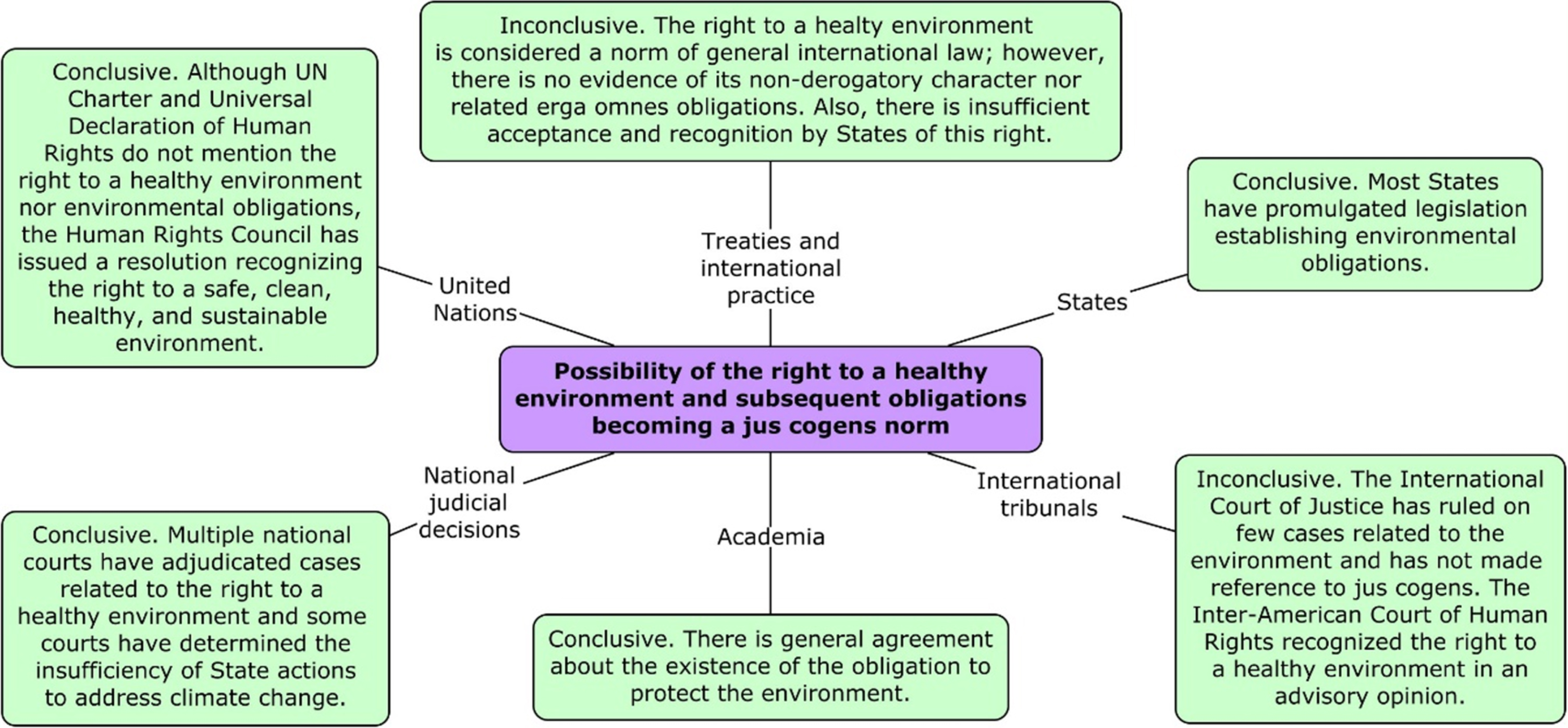
Possibility of the right to a healthy environment and subsequent obligations becoming a jus cogens norm.
Scientific studies indicate that commitments made by States to reduce emissions are insufficient to effectively address climate change.111 For instance, most experts estimate that countries’ pledges within the Paris Agreement will result in a 2.7 to 2.9°C rise in temperature by 2100. 112 Collectively, countries would have to increase their commitments threefold to maintain temperature rise below 2°C and fivefold to keep it under 1.5°C.113 Furthermore, the commitments set forth in the Paris Agreement have been inadequately implemented, meaning that most countries are not on track to meet its objectives.114. China, the world’s largest carbon emitter, vowed to achieve carbon neutrality by 2060 and reduce coal consumption.115. Nonetheless, the country continues to build and finance new coal-fired power plants both domestically and abroad.116.
The level of environmental devastation that will have to occur for countries to transform their loose promises into determined action is still unknown. In comparison, the peremptory character of the prohibition of aggression was not acknowledged by the ICJ until the Military and Paramilitary Activities in and against Nicaragua case of 1984.117. The Court affirmed that this prohibition is frequently referred to in statements by State representatives as a fundamental principle of customary international law.118. Additionally, the acceptance and recognition of the non-derogability of the prohibition of aggression was established in a General Assembly resolution which defined aggression and was adopted by consensus.119. Several States also explicitly identified the prohibition of aggression as an example of jus cogens at the Vienna Conference of 1968, in the Security Council, and in numerous national court decisions.120. The development of the prohibition of aggression and its eventual recognition by the ICJ as a jus cogens norm occurred decades after two catastrophic world wars and countless other military conflicts.
On the other hand, the peremptory character of the prohibition of genocide arose after the ICJ’s 1951 advisory opinion on the Reservations to the Convention on the Prevention and Punishment of the Crime of Genocide.121. In this advisory opinion, the Court did not expressly recognize the jus cogens character of the prohibition of genocide; however, the language used by the tribunal to determine the illegality of genocide reflects the nature of peremptory norms.122. It was not until 2006 that the ICJ confirmed the jus cogens character of this prohibition in the Armed Activities on the Territory of the Congo case.123. This recognition occurred years after the genocides of the Holocaust and in Armenia, Bosnia, Rwanda, among other countries, which claimed the lives of tens of millions of people.
Some concrete actions that would stem temperature rise include a price on carbon, which would charge emitters per every ton of carbon dioxide, and cutting subsidies for the fossil fuel industry.124. These two measures could cut emissions by as much as 50 percent worldwide.125. Factors that impede countries from implementing such policies include political challenges, for example, former United States president Donald Trump’s denial of the science of climate change and the country’s temporary withdrawal from the Paris Agreement.126. Other powerful economic interests, such as the defense and fossil fuel industries, anchor governments’ reluctance to implement critical climate policies.
In 2020, worldwide spending on the military, one of the primary climate change contributors, was 1.98 trillion USD.127 The United States’ military expenditure constituted 39 percent, or 778 billion USD, of this global amount, the equivalent of 3.4 percent of the country’s gross domestic product (GDP).128. Other countries, such as Saudi Arabia, Israel, and Russia, consumed higher percentages of their GDPs on the defense industry in 2020.129. China amounted to a distant second place regarding its military expenditure with 252 billion USD.130. The United States Congressional Budget Office estimates that the amount the United States will spend on the military will rise to 915 billion USD by 2031.131. Sales by the 25 largest arms producing companies reached 361 billion USD in 2019, an increase of 8.5 percent compared to 2018.132
Recent studies have concluded that the United States military is the largest institutional consumer of hydrocarbons in the world, purchasing more fuels and polluting more than most medium-sized countries.133 If the American defense industry were a country, its fuel usage alone would make it the 47th largest emitter of greenhouse gases in the world.134. Moreover, the Department of Defense is the United States’ largest governmental entity and is responsible for 77 percent of the federal government’s energy consumption.135 In 2020, the United States claimed that its armed forces were attempting to reduce their carbon footprint by introducing new supply chains with green initiatives and using more renewable energy at bases; however, no specific greenhouse gas reduction targets have been presented within the government’s policies.136.
Since the 1990s, the Pentagon has recognized climate change as a concern for the United States defense industry and national security.137. In a 2019 report published by the Department of Defense, most Air Force, Army, and Navy installations were identified as vulnerable to current and future climate change effects such as recurrent flooding, drought, desertification, and wildfires.138Additionally, the Department has developed programs to invest in research to improve the entity’s understanding of environmental risks to military installations and enhance the resilience of its infrastructure.139. The report shows that the Department is including climate resilience as part of its planning and decision-making processes, but has not set forth a specific set of actions.140. Also, the Department’s efforts appear to be solely focused on adaptation efforts to reduce the vulnerability of installations rather than decreasing the organism’s greenhouse gas emissions and other environmental impacts.
Although countries’ military sectors report that the main contributors to greenhouse gas emissions are energy use at military bases and fuel consumed in aircraft, vessels, and vehicles, independent research has revealed that military equipment procurement and other supply chains account for the majority of military emissions.141 The defense industry relies on a global network of planes, trucks, and ships to supply its operations with bombs, fuels, and humanitarian aid.142. The Pentagon’s budget usually equals more than half of the United States’ yearly discretionary spending.143 Contrarily, other interrelated threats that undermine national security go underfunded, such as the current public health contingency and the climate and environmental crises.144. The Pentagon has also been criticized due to gross mismanagement, including dysfunctional internal controls, lax congressional and executive oversight, and overpriced, botched projects, which have enabled it to waste tens of billions of dollars annually.145. For instance, in the first decade of the 21st century, the Pentagon cancelled a dozen inadequately planned and ineffective weapons programs that cost taxpayers 46 billion USD.146. These abandoned initiatives cost more than the federal government spent on the Environmental Protection Agency between 2015 and 2020.147.
Because military technology companies are not required to report on their greenhouse gas emissions, there are considerable gaps in the information regarding the environmental impact of the military sector.148 However, some corporations do disclose their emissions and other environmental data as part of their corporate social responsibility reports.149. In 2018, Lockheed Martin Corporation sold 47.2 billion USD in arms and reported emissions of 33 million tons of carbon dioxide equivalent (CO2e), while Boeing earned 29.1 billion USD in arms sales and emitted 2.5 million tons of CO2e.150.
Further, only some countries have greenhouse gas emission reduction targets for their defense sectors.151. It appears that nations reluctant to adjust their military industries to the growing effects of climate change fail to realize the impact of global warming on their military capabilities.152. Sea-level rise can endanger military infrastructure and increasing climate catastrophes will require a more frequent use of military resources.153. Between 2012 and 2018, the United States spent 195 billion USD in disaster relief assistance, which is provided by the armed forces at the request of the country’s Federal Emergency Management Agency.154.
United States president Joe Biden proposed spending 14 billion USD on climate change initiatives in 2022.155 Thus, the United States’ military expenditure is 55 times larger than what the president plans to invest on climate action, which would still have to be approved by a divisive Congress. Significant reductions in the Pentagon’s budget and decreasing its capacity to wage war would cause an enormous drop in demand from the biggest consumer of fuels in the world.156. Confronting the United States military’s carbon footprint would also have a substantial effect on battling global warming.157 Unfortunately, the American defense industry’s dependence on fossil fuels is unlikely to change.158. The life-cycles of existing military aircraft and vessels are locking them into hydrocarbons for years.159.
Considering that fossil fuels accounted for 89 percent of greenhouse gas emissions in 2018,160 scientists warn that 60 percent of oil and gas reserves and 90 percent of coal must remain in the ground to keep global warming below 1.5°C.161 This would require fossil fuel production to have peaked in 2020 and be on a steady decline of 3 percent every year until 2050.162. An alliance initiated by Costa Rica and Denmark to promote the phase out of fossil-fuel extraction will ask other States to stop issuing oil, gas, and carbon exploration permits.163. Unfortunately, most countries are far from shrinking their fossil fuel industries. According to the International Monetary Fund, this industry was subsidized by 5.9 trillion USD in 2020, the equivalent of 11 million USD every minute.164 The sector also benefits from lax environmental regulations and inadequate accountability for environmental harm.165 Setting fuel prices that represent the true cost of fossil fuels would reduce global carbon dioxide emissions by over 33 percent and prevent one million deaths a year due to polluted air.166. Proper pricing would make electric cars less expensive and motivate electricity generators to use renewable energy instead of coal.167.
In 2009, the G7 and G20 committed to phase out “inefficient” fossil fuel subsidies; nevertheless, neither group has made much progress.168 Countries justify the delay in part with a lack of definition for what constitutes an inefficient subsidy.169. As of 2019, the G20 governments had achieved a mere nine percent reduction in fossil fuels subsidies, while seven members, including Australia, Canada, China, and France, increased their support for the industry.170.
One factor that hampers climate action is the difficulty of transforming the multi-trillion-dollar fossil fuel industry that has been at the center of the economy and people’s lives since the 19th century.171. Furthermore, reducing humanity’s reliance on fossil fuels requires large-scale investments that would provide uncertain, long-term benefits.172. Politicians tend to focus on policies with immediate, tangible advantages.173. To address climate change, politicians would also need to collaborate with other political leaders, businesses, and civil society, all of whom have diverse perspectives on the urgency of this issue and how to resolve it.174. Moreover, politicians are lobbied by fossil fuel corporations, some of which are among the wealthiest companies in the world.175 Plentiful and inexpensive fossil fuels, along with advanced technology to develop them, also make transitioning away from oil, gas, and coal more difficult.176.
Conclusion
There appears to be insufficient evidence of the required acceptance and recognition by States of the non-derogable character of environmental obligations to be considered jus cogens norms. However, the report of a United Nations special rapporteur indicated that there is certain support for the acknowledgment of the erga omnes character of obligations regarding global atmospheric degradation. Moreover, the special rapporteur’s publications identified norms related to the protection of the environment as possible norms of jus cogens that have not previously been recognized by the ILC.
Thus, greater ambition among States to recognize their obligations toward the environment in light of the climate crisis would be necessary for environmental norms to reach the status of jus cogens. Additionally, legal activism at the local and international levels could be a useful tool to unify the international community’s consent that environmental protection is a crucial and universal value. In particular, States should promote the classification of environmental and climate change obligations as jus cogens norms. The peremptory character of such obligations should also be recognized in future international agreements. At the national level, lawyers involved with environmental and climate change cases could adopt an argument in favor the jus cogens status of environmental obligations. For instance, lawyers from around the world have signed the “World Lawyers’ Pledge on Climate Action.”177 This commits signatories to take personal and institutional responsibility within their respective fields of expertise to promote necessary changes to address the climate emergency.178 The pledge inspires lawyers not only to ask what activists, non-governmental organizations, or other stakeholders can do to combat climate change, but also how lawyers themselves can internalize their climate responsibility.179. Developed nations could also consider conditioning their foreign aid to taking ambitious action against climate change.
Additionally, political and economic interests and the vast percentage of national budgets spent on the fossil fuel and defense sectors significantly obstruct critical climate action. Countries’ commitments within the Paris Agreement are incompatible with subsidies that benefit the oil, gas, and coal industries. Moreover, the United States military, which is the largest institutional consumer of fuels, has not determined emission reduction goals. Rather, its environmental policies are aimed exclusively at decreasing the vulnerability of its installations to the effects of climate change. The lack of a comprehensive climate strategy not only delays the reduction of the sector’s climate impact, but also negatively affects the military industry’s capabilities and resources.
People across the world are already witnessing the disastrous consequences of climate change, especially in developing nations whose contributions to this global phenomenon are dwarfed by the United States and China’s greenhouse gas emissions. Combating climate change and protecting the environment is a common concern of humankind, as demonstrated in this paper. As such, the international community, including countries, businesses, and civil society, must take steps to gradually eliminate fossil fuel subsidies and downscale the military industry’s carbon footprint. Hopefully, countries will show more ambition to address climate change before its devastating effects equal those of the two world wars.
Footnotes
United Nations Environment Programme, Climate Change and Human Rights (UNEP 2015).
Ibid.

Ibid.
International Law Commission, ‘Provisional Summary Record of the 3460th Meeting’ 3 June 2019 A/CN.4/SR.3460
Benoit Mayer, ‘The Relevance of the No-Harm Principle to Climate Change Law and Politics’ (2016) 19 Asia-Pacific Journal of Environmental Law https://poseidon01.ssrn.com/delivery.php?ID=058084070020010124110065124108099011060015026002060023096117112071065092064094116111057059022025049040037107127107083107121098017070059022001120114016125120016109089033041040124073118093026110084010085064109025109015111119074096098099105106028067067004&EXT=pdf&INDEX=TRUE [3096117112071065092064094116111057059022025049040037107127107083107121098017070059022001120114016125120016][109089033041040124073118093026110084010085064109025109015111119074096098099105106028067067004&EXT=pdf&INDEX=TRUE] (accessed 12 October 2021).
Bharat H. Desai, ‘International Environmental Law-Making’ (2020) 50 Environmental Policy and Law 489. Also see, Bharat H Desai, “International Environmental Law-Making” (Chapter 5) in Bharat H. Desai, Ed., Our Earth Matters: Pathways to a Better Common Environmental Future (Amsterdam: IOS Press, 2021), pp.43-62
Ibid.
Ibid.
Ibid.
Ibid.
Ibid.
Ibid.
Ibid.
Ottavio Quirico, ‘Towards a Peremptory Duty to Curb Greenhouse Gas Emissions?’ (2021) 44 Fordham International Law Journal https://ir.lawnet.fordham.edu/cgi/viewcontent.cgi?article=2820&context=ilj (accessed 15 October 2021).
United Nations Treaty Collection, ‘7. United Nations Framework Convention on Climate Change’ (United Nations, 2021) https://treaties.un.org/pages/ViewDetailsIII.aspx?src=TREATY&mtdsg_no=XXVII-7&chapter=27&Temp=mtdsg3&clang=_en (accessed 10 October 2021).
Bharat H. Desai and Balraj K. Sidhu, ‘Climate Change as a Common Concern of Humankind: Some Reflections on the International Law-Making Process’ in Jordi Jaria Manzano and Susana Borràs (eds), Research Handbook on Global Climate Constitutionalism (Edward Elgar 2019) 11.
Quirico, Towards a Peremptory Duty, n.18.
United Nations Environment Programme, Climate Change, n.1.
Ibid.
Ibid.
Ibid.
Vienna Convention on the Law of Treaties (adopted 23 May 1969, entered into force 27 January 1980) 1155 UNTS 331 art 53
Quirico, Towards a Peremptory Duty, n.18.
Siobhán McInerney-Lankford, Mac Darrow, and Lavanya Rajamani, Human Rights and Climate Change: A Review of the International Legal Dimensions (The World Bank 2011).
McInerney-Lankford, Darrow, and Rajamani, Human Rights, n.28.
International Law Commission, ‘First Report on Jus Cogens by Dire Tladi, Special Rapporteur’ 8 March 2016 A/CN.4/693
Ibid.
International Law Commission, ‘Peremptory Norms of General International Law (Jus Cogens)’ 29 May 2019 A/CN.4/L.936
Ibid.
Ibid.
Ibid.
Quirico, Towards a Peremptory Duty, n.18.
Ibid.
Ibid.
Ibid.
Ibid.
International Law Commission, ‘Fourth Report on Peremptory Norms of General International Law (Jus Cogens) by Dire Tladi, Special Rapporteur’ 31 January 2019 A/CN.4/727
Ibid.
Ibid.
International Law Commission, Peremptory Norms, n.34.
Bharat H. Desai and Balraj K. Sidhu, ‘Climate Change as a Common Concern of Humankind: Some Reflections on the International Law-Making’ 3.
United Nations Environment Programme, Climate Change, n.1.
McInerney-Lankford, Darrow, and Rajamani, Human Rights, n.28.
Quirico, Towards a Peremptory Duty, n.18.
Ibid.
Ibid.
United Nations General Assembly, ‘Human Rights Obligations Relating to the Enjoyment of a Safe, Clean, Healthy and Sustainable Environment’ 19 July 2018 A/73/188.
Ibid.
Jorge Alejandro Carrillo Bañuelos, Litigio Sobre, n.50.
Quirico, Towards a Peremptory Duty, n.18.
Ibid.
Ibid.
Ibid.
Ibid.
Ibid.
Ibid.
International Law Commission, Fourth Report, n.43.
Ibid.
Human Rights Council, ‘Report of the Special Rapporteur on the Issue of Human Rights Obligations Relating to the Enjoyment of a Safe, Clean, Healthy and Sustainable Environment’ 1 February 2016 A/HRC/31/52.
Ibid.
Ibid.
Ibid.
Ibid.
Ibid.
United Nations Human Rights Council, ‘Human Rights Council Adopts Four Resolutions on the Right to Development, Human Rights and Indigenous Peoples, the Human Rights Implications of the COVID-19 Pandemic on Young People, and the Human Right to a Safe, Clean, Healthy and Sustainable Environment’ (Office of the High Commissioner for Human Rights, 8 October 2021) https://www.ohchr.org/EN/HRBodies/HRC/Pages/NewsDetail.aspx?NewsID=27634&LangID=E (accessed 15 October 2021).
United Nations, The Right, n.3.
Ibid.
Ibid.
Ibid.
Ibid.
Ibid.
Ibid.
Ibid.
Ibid.
Ibid.
Boyd, Why All Human Rights, n.64.
Roeben and Azubuike, Climate Change, n.66.
Ibid.
Ibid.
Mayer, The Relevance, n.9.
Ibid.
Ibid.
Ibid.
Ibid.
Pulp Mills on the River Uruguay (Argentina v. Uruguay) Judgement, I.C.J. Reports 2010.
Environment and Human Rights, Advisory Opinion OC-23/17, Inter-American Court of Human Rights (15 November 2017)
Ibid.
Ibid.
Ibid.
Ibid.
United Nations, The Right, n.3.
Ibid.
Ibid.
McInerney-Lankford, Darrow, and Rajamani, Human Rights, n.28.
McInerney-Lankford, Darrow, and Rajamani, Human Rights, n.28.
Lindsay Maizland, Global Climate Agreements, n.112.
Ibid.
International Law Commission, Fourth Report, n.43.
Ibid.
Ibid.
Ibid.
Ibid.
Ibid.
Ibid.
Justin Worland, The U.S, n.113.
Ibid.
Ibid.
Ibid.
Ibid.
Ibid.
Ibid.
Ibid.
Ibid.
Ibid.
Ibid.
Ibid.
Linsey Cottrell and Eoghan Darbyshire, The Military’s Contribution, n.132.
Neimark, Belcher, and Bigger, US Military, n.133.
Ibid.
Ibid.
Ibid.
Ibid.
Linsey Cottrell and Eoghan Darbyshire, The Military’s Contribution, n.132.
Ibid.
Ibid.
Van Shaik and others, Ready for Take-off? n.135.
Ibid.
Ibid.
Ibid.
Neimark, Belcher, and Bigger, US Military, n.133.
Ibid.
Ibid.
Human Rights Watch, Q&A, n.6.
Ibid.
Ibid.
Human Rights Watch, Q&A, n.6.
Damian Carrington, Fossil Fuel Industry, n.164.
Ibid.
Human Rights Watch, Q&A, n.6.
Ibid.
Ibid.
Samantha Gross, Why Are Fossil Fuels, n.5.
Ibid.
Ibid.
Ibid.
Samantha Gross, Why Are Fossil Fuels, n.5.
Saskia Stucki and others, ‘World Lawyers’ Pledge on Climate Action’ (2021) 51 Environmental Policy and Law 371.
Ibid.
Ibid.