



Abstract
The main problem in agriculture is the attack of diseases on the leaves of plants and the spread of agricultural pests. For this reason, we will present how to treat certain phenomena of disease in plants, or how to prevent and do the precautionary measures to adopt a modern method to diagnose the deficiency of the leaves elements of the diseased plants.
Thus, the deep learning is the most appropriate solution to detect the properties of the leaves and is essential in the tracking of large fields of crops as well as automatically detecting the symptoms of the leaves characteristics as soon as they appear on the plants leaves.
In this paper, we clarified the Transfer Learning (TL) architecture for VGG-16 and the other architecture like ResNet to detect plants that suffer from diseases in the sheet due to a lack of ingredient using a set of increased data based on the leaves of healthy and unhealthy plants alike. The experimental results show that significant detection accuracy improvement has been achieved thanks to our proposed model compared to other reported methods.
Introduction
Good nutrition depends on the balance of a group of elements that the plant needs. The more the degree of balance between these nutrients is proportional to the needs of the plant, the more we obtain a good production while providing the other necessary factors. When a deficiency of one of these necessary elements appears, its effect is clear on the plant, whether by visible external manifestations on the plant (change in color of the leaves) or indirectly by its effect on agricultural production.
Where these elements are divided into two parts:
We find major elements represented in carbon, oxygen, hydrogen, nitrogen, phosphorus, potassium, magnesium, sulfur and calcium. The plant draws carbon and oxygen from the air and hydrogen from the water. Then the minor elements include boron, iron, copper, zinc, manganese, molybdenum, chlorine and nickel. when burns appear on the edges of modern leaves or appear brown spots, it may have one or more other reasons, such as a lack of calcium in the plant, or the inability of the plant to absorb calcium, and therefore to move to modern cells and the high level of potassium and salts.
The cause of yellowing of the veins of large leaves mainly in those plants exposed to strong sunlight is due to a lack of magnesium or to its absence because of the high content of potassium. Treatment in this case is to reduce nutrients that contain a high proportion of potassium.
As for the pathological symptoms represented by an increase in leaves, that is, an increase in the percentage of leaves to the detriment of the flowers, especially in poorly lit areas, they are caused by an increase in nitrogen in the plant. The treatment to increase nitrogen in the plant is to adjust and improve the watering process, and reduce nutrition, so that the plant can grow normally.
Faced with these plant diseases problems, image processing and classification algorithms become a necessity to solve them in an automated way. In recent years, several machine learning algorithms have been proposed for decision support in the field of computer vision, more particularly in agriculture, and which used several analytical measures for features extraction, where there are intervention of experts in the field.
On the other hand, functionalities are directly learnt and represented consecutively by Deep Learning techniques in hierarchical architectures. This inspired an important Deep Learning (DL) approach for any prediction problem involving input image data and requiring minimal pre-processing.
Thanks to the development of DL, Transfer Learning (TL) has turned to be part of many applications, where the current standard is to take an existing architecture conceived for natural image datasets like “ImageNet”, with the corresponding pre-trained weights, then fine-tune the pattern to the intended imaging data [1, 2].
Contributions: This paper summarizes the use of a clear and important DL approach, like ResNet and VGG-16 with TL, based on the diagnostic method in order to identify the lack of elements from the leaves of diseased plants.
In this regard, we prepare a clean and original dataset of different leaf images of plants without diseases and with diseases by applying some Data Augmentation (DA) techniques.
The results indicate that when our model is better trained, the results of classification and recognition are very effective in obtaining superior performance.
Paper preview: The rest of this paper is organized as follows. Section 2 details some existing work carried out in this area. The proposed methodology of our research are described in Section 3, followed by an explanation various methods such as VGG-16 with transfer learning, ResNet and the various DA techniques. The results are presented and discussed in Section 4.
The paper ends in Section 5 followed by possible future work of work in progress.
Plant disease recognition is of a key importance in order to advocate and select the suitable remedy for diseased plants and also to tackle infections of healthy plants. As it shows different signs for different diseases, the plant leaf is the most mutual method to detect plant diseases (see Fig. 1). The discovery and treatment of plant diseases has been done with the naked eye of an expert through manually examining the plants on site but this process is expensive, not rapid and not approachable. Consequently, it has become a paramount in research area for either partially or fully automated plant disease detection systems.
The lack of elements from the leaves of diseased plants.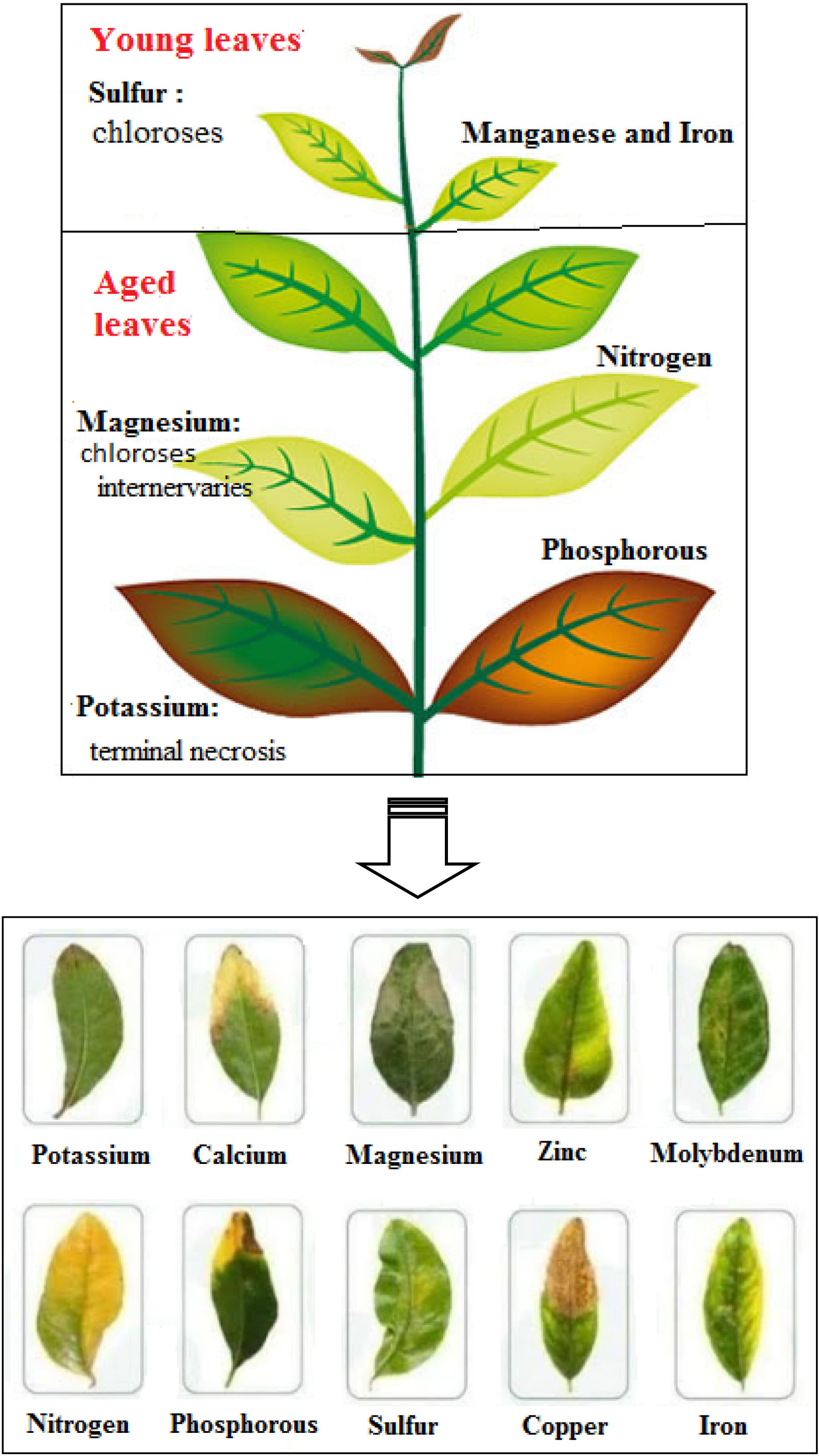
In Agriculture, Deep Learning is already widely explored and promises new answers to the questions asked:
Solutions to better monitor and predict changes in production factors (appearance of diseases in plant leaves due to a lack of ingredients, yield, equipment maintenance, etc.). Solutions to limit the environmental impact, compensate for the lack of manpower or reduce the arduousness of the work, in association with connected objects, robotics and agricultural machinery. Daily assistance and decision support solutions to simplify the lives of farmers and their advisers.
Consequently, to encourage better agriculture [3] and to ameliorate crop management quality [4], the use of DL has been investigated in the domain of agricultural and plant diseases [5, 6].
Several research works have been carried out, [7] to clarify the prediction models based on image processing and the importance of the Internet of Things (IoT), which are applied to identify, detect and quantify diseases of tomato plants.
The authors, Adedoja et al. [8], applied DL based on the NASNet architecture to recognize different categories of healthy and unhealthy plant leaf images with 93.82% accuracy.
Omkar Kulkarni [9] discovered that the model requires on segmented images works better than a model formed using color and gray scale images where it works better accurately 99.74% than MobileNet in the detection harvest task.
Singh et al. [10] have developed an examination of imaging techniques for the detection of plant diseases using the different techniques of premature determination of plants and classification (SVM, K-Means Clustering, Deep Learning and K-NN).
In paper [11] a deep learning model using VGG-16 architecture in the classification task with 95.08% accuracy based on more than 6000 images of the rice variety Mugad 101 then the performance of the trained model will be compared by ResNet, GoogLeNet, Inception-v3 and LeNet.
In the work of Sujatha [12]; it compared the performance of Machine Learning (ML) using Support Vector Machine (SVM), Random Forest (RF), Stochastic Gradient Descent (SGD) in plant leaf disease detection versus deep learning (DL) architectures (VGG-19, Inception-v3 and VGG-16) in addition to identifying citrus diseases.
The paper [13] shows the crucial role of early recognition and diagnosis of fruit plants. This inspired to introduce an approach based on the neuron network (D-CNN) for automatic detection of 98.74% accurate guide leaves by creating a four – category dataset set.
A second paper [14], presents a deep learning approach based on convolutional neural networks (CNN) for detection and recommendation of guava disease with an accuracy of 95.61%.
In [15], Abhinav et al. summarizes the concept of transfer learning for the detection of plant diseases. The authors used five pre-trained models: Inception v3, Inception ResNet v2, ResNet50, MobileNet and DenseNet169 based on a dataset “Plant Village” of 38 disease classes.
The model gives promising results using ResNet50 with precision of 0.982, recall of 0.94 and an F1 score of 0.94.
Proposed system process.
Samples of plant leaf.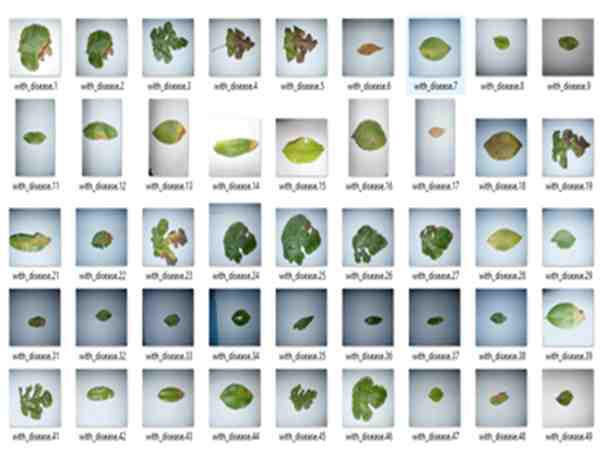
In this section, we present the plant leaf images dataset used for experiments. Thereafter, we detail the settings of three different models of convolutional neural network such as CNN, VGG-16 and ResNet.
Because a convolutional neural network is the largest applied approach to elicit logical information from an enormous data sets, the development of our model will be founded on CNN architectures especially VGG-16 and ResNet. In the “Train” learning process in our “dataset” the objective is to draw out models or characteristics from an image and characterize them utilizing our CNN models in order to be able to identify the shortage of elements in the leaves of diseased plants (see Fig. 2).
Dataset
We create our dataset officially containing synthetic and augmented images of leaves of healthy and unhealthy plants (see Fig. 3).
The images cover 05 categories, including: Grape leaves, tomato leaves, olive leaves, lemon leaves and orange leaves. The diseased leaf images also have basic diseases, especially bacterial and other viral diseases.
Convolutional neural networks (CNN)
LeCun [16], presented the first convolutional neural network (CNN) in which there are two genres of layers in alternating: a layer of convolution consisting of a number of filters having a limited field of perception and a layer of sub-sampling (pooling). These filters perform as detectors of features and defined by weights being adjustable during learning. The alternation between convolution and pooling gives a pyramid structure to CNN. Therefore, the upper layers represent increasingly global input characteristics as their perceptual field, despite the low dimensionality, matches to a larger part of the input.
CNN has become a powerful paradigm due to achieving great success in diagnosing various plant diseases.
In this work, we applied the CNN to find out whether the leaf contains disease or not.
Convolutional neural networks (CNNs) architecture.
The different methods of transfer learning.
It mainly contains three different blocks and fully connected layers (FCL) (see Fig. 4):
Block1; convolution layer (CONV). Block2; correction layer using Rectified Linear Unit (ReLU) activation function. Block3; pooling layer (POOL).
We apply another architecture called VGG based on the transfer learning which will diagnose the leaves of plants to know the missing ingredients source to those diseases. This system will be tested on the augmented images (see Fig. 6).
VGG is a convolutional neural network with a specific architecture. In this work, we focus on VGG-16 that contains 16 layers.
Transfer learning model
Transfer learning model
ResNet model
This method consists of transferring the parameters learned by a pre-trained CNN on a number of data necessary to another augmented data set often less necessary for another task to diagnose the leaves, namely the missing ingredients source of this disease (see Fig. 5). We note that the initial outcomes of transfer learning are as follows [17].
We obtain the finest training from varied and augmented datasets of the planned classes [18]. It is a defying work to find learning rate for the deeper layers [19]. There is only a minor effect on huge convolution architectures that the transfer learning has by utilizing a huge data set. In fact, we note that it has almost no effects on the small convolutional architectures [20]. Only if the learned weights of the deep layers of a proposed model match the image samples of the training dataset, we get the best representation of a feature [21]. The goal of pre-training on large benchmarks is to take advantage of the re-use of scaling pre-trained weights, which leads to better speed of convergence. And to know more, the characteristics belong to the leaf and not to the disease like venation and leaf blade [22].
The main objective of applying transfer learning is to detect the lack of elements in the leaves of diseased plants. So, the use of transfer learning is instead of starting the learning process from scratch, the model starts from models that were obtained when solving a certain problem similar in nature to that to be solved.
In this regard, the model takes advantage of previous learning and avoids starting from scratch.
Example for a plant which has diseases in the leaf due to a lack of ingredient.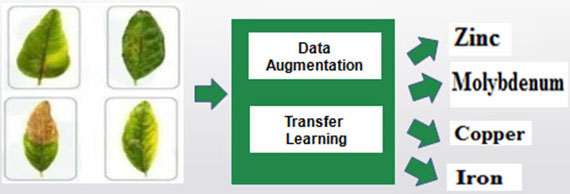
Transfer learning is expressed through the use of pre-trained models. The pre-trained model is a model that has been trained on an augmented dataset to solve a similar problem to the one we can solve [23].
We also use VGG-16, pre-trained model as pre-trained weights for our research. VGG-16 is a sequential model with a very simple architecture. This makes transfer learning using VGG-16 very easy.
ResNet which is the layer that revolutionized CNN’s architectural race by introducing the concept of residual learning into CNN is a continuation of deep networks. It has developed an efficient methodology for building deep networks [24]. It proposes a 152-layer deep CNN winning the 2015 ILSVRC competition award.
The process of defining our ResNet model is given in Table 2.
Performance of our proposed method
Performance of our proposed method
To avoid the over fitting, we can apply a method consisting of increasing the images of our own dataset according to different augmentation techniques such as: rotating the image, overwriting it, etc.
Effects of increasing data on a single image in our dataset.
The parameters of DA methods.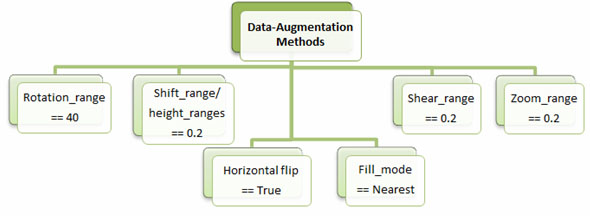
Training and validation accuracy/loss of (CNN with DA).
Rotation_range: A range in which to rotate images randomly. width_shift and height_shift: ranges due to flipping images vertically or horizontally. Shear_range: Consists of randomly applying shear transformations. Zoom_range: To zoom randomly inside the images. Horizontal_flip: Allows reducing half of the images horizontally. Fill_mode: A strategy applied to fill the newly created pixels, which should appear after the rotation and the width height offset.
Figure 7 illustrates an example of original photos and their augmented versions.
Indeed, there are many properties recently used to enhance the images of diseased leaves (see Fig. 8).
In this section, we detail and discuss the experimental settings. The obtained results are then presented and compared with the proposed systems in the state of the art.
Being created and released by Google and defined as an open-source machine learning algorithms, Python deep learning library TensorFlow implements the architecture. The database containing plant leaf images are used so that we can validate our suggested system which is based on CNN/VGG/ResNet and divided into two parts: training set and testing set. For performing experiments, the size considered of the input images shape is 64
The parameters used to build our model processes are enumerated as follows:
Keras ImageDataGenerator: used to augment the data. Number of epochs: 25. Optimizer (learning rate): Adam (lr: 0.0001, decay Batch_size Activation function: ReLU, Softmax. Other functions: Dropout (0.5), Dense.
After the experiment, we find that our first trained model, CNN with DA, achieves an accuracy of 97.2% after training for 25 epochs. However, with ResNet model the accuracy rate was improved to 98.96%. Finally, after implementation with the VGG-16 architecture using transfer learning technique, the complete detection performance reaches 99.2% (see Figs 9–11).
Table 3 compares the results of our approach with the previously published results [25]. We observed that the performance of VGG-16 with TL achieved a promising result, with an accuracy and validation accuracy rate of about 99.2 and 98.35%, respectively (see Fig. 11).
Training and validation accuracy/loss of ResNet.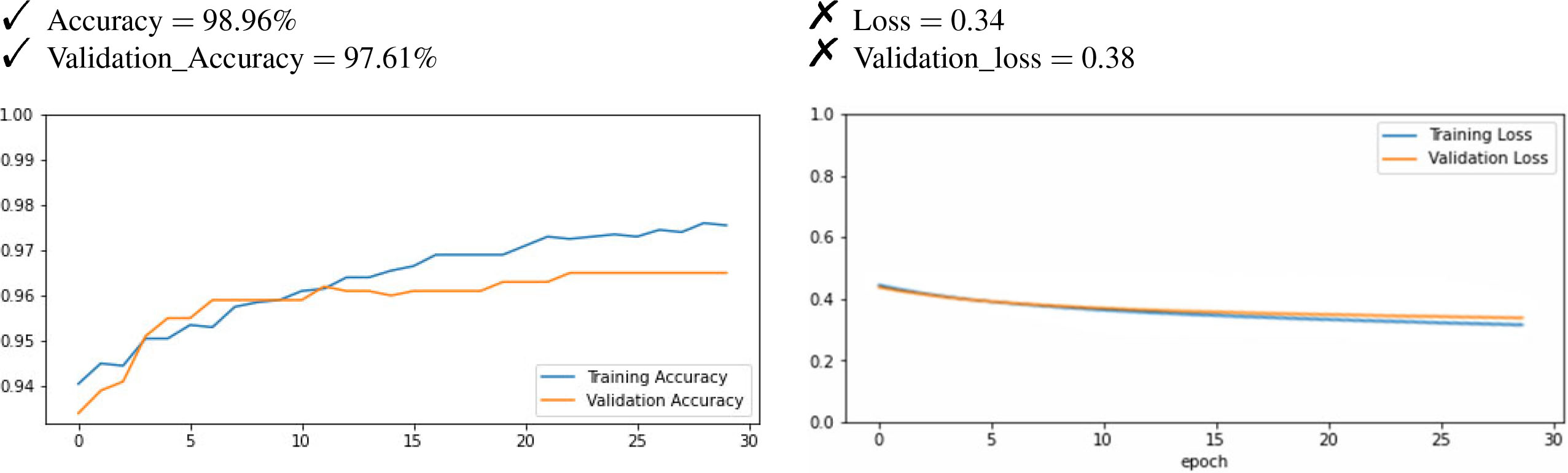
Training and validation accuracy/loss of VGG-16.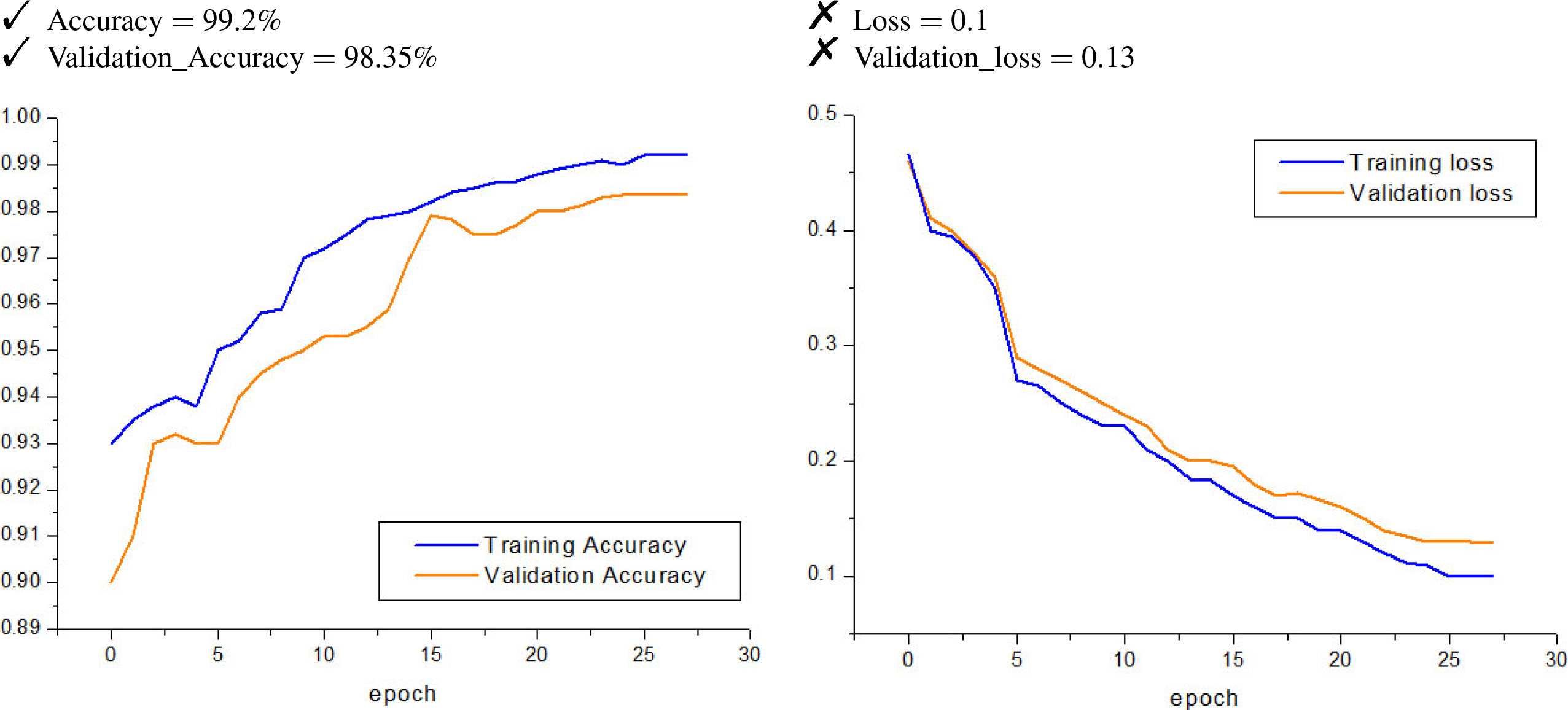
Performance comparison
We are evaluating our system on our dataset containing augmented images of the leaves of plants infected with certain diseases. Table 4 shows a comparison between our system and the existing ones.
We observed that the performance of our lack of ingredient detection system achieved a promising result, with an accuracy rate of about 99.2 % compared to other research works based on DL approaches [6, 8, 9, 11, 13, 14].
Our proposed system using TL shows its reliability and speed with a satisfactory accuracy of 99.2%. This represents an improvement of 0.24% compared to ResNet approach (see Table 5).
Furthermore the following table shows that the VGG-16 architecture with Transfer Learning achieves a promising result and requires less time for testing, than other previous work [26, 27].
Accuracy rate and test/time of our proposed method
Deep learning with its strong ability and high architecture is to give automatic classification based on the diagnostic method to detect the lack of elements in the leaves of diseased plants.
Practically, few researchers form their own convolutional network from scratch because they do not have a large set of sufficient data. Therefore, the most suitable technique to overcome this problem is to use transfer learning.
In this paper, we compared VGG-16 with transfer learning versus ResNet architecture. So VGG model achieves results of 99.2% precision, applied to a collection of images of the leaves of healthy and diseased plants.
In conclusion the proposed system based on the TL technique provided promising recognition results on the plant leaf image dataset, proving the effectiveness of the proposed approach for the recognition of plant diseases and its cause.
As perspective, we have to study other DL algorithms like reinforcement learning algorithms as deep Q-networks to boost the performance and to enhance more the recognition/detection accuracy rate.