



Abstract
Organizational studies uphold the association between information technology (IT) capability and organizational agility. However, this relation often yields mixed and inconclusive results. This study establishes the links among firms’ operational dynamic capability (OPDC), organizational agility and IT capability. Through snowball-sampling technique, data are collected from 298 respondents in the innovative sector of China. The data are analyzed using partial least squares (PLS) and the statistical technique PROCESS. The empirical evidence supports the mediating role that OPDC plays in the relation between IT capability and organizational agility. Moreover, the study identifies the positive moderating role of environmental dynamism in reinforcing the relation between IT capability and OPDC. The results can guide policy makers to enhance IT capability that enables OPDC, thereby leading to increased organizational agility. The study also provides avenues for future research.
Keywords



Introduction
Contemporary business firms are facing a highly turbulent environment, owed to factors such as, for example, intense competition, time-to-market pressures, technological advancements and complementary imperatives. This fast-moving environment has led to increasing pressure on business firms that must adapt to it or lose their competitive advantage. In such a situation, most useful and fruitful tools are that organizations need to develop the ability to sense and respond readily to changes or in other words, to be agile. Organizational agility (OA) is known as the ability of a firm to response environmental changes, leads firms to exploit emerging opportunities and open new avenues of competitive advantage [1]. The dynamic capability theory provides compelling rationale to consider OA as a vital strategy for firms to maintain their competitive advantage [2, 3] and to survive in the uncertain and unpredictable environment [4].
The topic of OA has been receiving the attention of research scholars since the mid-1990, and several approaches have been proposed to empower organizations in order to be agile. Most of them highlighted that information technology (IT) capability is a vital factor for OA. However, studies explaining the nature and impact of this connection are lacking in prior literature [5–7]. Few studies postulate that the relation between IT capability and OA could be more indirect through other organizational factors than direct [8–10].
Over the last decades, the focus of research is primarily on the technical or quantitative aspects of OA. Whereas, empirical work is still lacking that address other non-technological factors which may influence OA directly or indirectly [11]. Thus, the purpose of this study is to fill this gap which previous literature has not until covered, by exploring insight on the relation between IT capability and OA. Hence, this study suggests a framework that contains missing organizational factors, such as operational dynamic capabilities (OPDC) as a mediator and environmental dynamism (ED) as moderating factor in the relation between IT capability and OA. The study not only explores how these factors intervene the IT capability and OA link but also validities their existence through a quantitative analysis.
The study attempts to answer following research questions: (1) Is OPDC as a non-technological antecedent factor exists for OA? (2) What is the nature of such factors? Do IT capability affects OA more through indirect relation than direct? (3) What role can environmental factors play in achieving firm’s OA? (4) Could environmental factors such as ED become a moderator on the relation between the variables mentioned above?
The rest of the study proceeds as follows. Section II comprises the theoretical background and hypotheses of the study. Section III depicts the operationalization of constructs and the methodology. Section IV provides the results and analysis carried out. Section V discusses the results and brings together implication, limitations of the study, and suggests future directions.
Literature review and hypotheses development
The concept of organizational agility
The prior literature divides concept of organizational agility into two aspects: organizational adaptability (reactiveness) and organizational flexibility (reactiveness) [12]. In this way, OA consists of two components: (1) sensing environmental change and (2) responding readily [13]. Agility is comprised of three dimensions i.e. customer agility, partnering agility, and operational agility [8]. Therefore, following [14] OA is defined as firm’s ability of continuously improving work and the infrastructure to transfer, adjust, and respond to the turbulent environment.
Information technology capabilities and organizational agility
The emergence of resource-based theory in the research field of information technology (IT) brings the concept of IT capability into the light. This theory serves to realize the strategic importance of IT resources to the organization. From a resource-based perspective, IT resources that are valuable, rare, inimitable, and non-substitutable may lead to achieving sustainable competitive advantage [15]. [1] states IT capability as the firm’s ability to enhance business strategies and work processes by acquiring and exploiting IT resources. [16] categorizes IT capabilities into three broad classes: inside-out (deployment of infrastructure within the organization in order to meet market demand), outside-in (external environment focused, market responsiveness) and Spanning (IS planning and management to integrate capabilities above).
Is the impact of IT capability on OA is positive or negative? The prior literature has not until developed any mutual consensus in this regard. For instance, there are two schools of thought exist; one favors the negative influence which refers to the “dark side” of IT capability and other supports the positive impact of IT capability on OA. The former argues that constraints of rigid IT may bring about an inflexibility which in turn may impede the adaptation to market-related changes [13]. Whereas, the latter posits that provision of IT capability in the organization either raises OA directly or indirectly [7]. [17] categorically state that IT enables organizations to intelligently develop critical enterprise operations like collaboration, time, quantity, design, cost, and logistics. The theoretical perspective of [8] considers IT as an enabler of digital options which is an extraordinary dynamic capability that positively affects the OA. [18] considers IT capability as an enabler of OA, indicating that superior IT capability accelerates decision making and prompt response toward the environmental change.
In the light of prior literature, this study postulates that provision of an appropriate sphere of IT capability in the organization enables firms to detect and reciprocate to environmental changes, which leads to increase their OA. On the basis of these arguments, the study hypothesizes that
H1. Information technology (IT) capability relates positively to organizational agility (OA).
Operational dynamic capabilities as a mediator in the relation between IT capability and OA
Dynamic capabilities are defined as “processes to integrate, reconfigure, gain, and release resources to match and even create market change.” There is a general agreement that dynamic capability applies to both strategic and operational levels within a firm. The current study focuses dynamic capability at operational level namely operational dynamic capability (OPDC), which is defined as “the ability of a firm to perform a coordinated set of operations dynamically integrating and reconfiguring organizational resources” [19]. The OPDC mainly emphasizes on flexibility and leanness of firm’s operations such as procuring resources, manufacturing, quality controlling and delivering products [20]. The present study particularly focuses reconfigurability aspect of OPDC which addresses the effective and efficient action of the firm at the operational level in response to environmental changes. It allows firm to rapidly modify and redesign its existing process in response to the environmental condition. In this way, this aspect of OPDC is deemed critical to business.
IT capability provides sustainable competitive advantages to organizations unless it can be easily imitated. In addition, merely putting massive investment to build IT infrastructure and without knowing its efficient utilization is a waste of resources [21]. In this line, the scientific literature is lacking regarding the studies which highlight how IT investments can contribute in acquiring knowledge which further develops OA [5]. Several authors consider IT as an enabler of dynamic capabilities e.g. [8, 21] more precisely [22] claim that IT enables firms to utilize its IT resources to improve its OPDC. Similar facts highlighted by [23] that IT supports companies in assessing, integrating and developing internal and external competencies.
As for the OPDC-OA link, the existing literature shows inconsistent and ambiguous results regarding the tie between dynamic capabilities and OA. There are only a few studies available which address how dynamic capabilities contribute to achieving OA [5]. Recently, [24] proposes a dynamic capabilities framework which postulates that a presence of superior dynamic capabilities in an organization leads the firm to achieve a higher sphere of OA. He further posits that dynamic capabilities are set of principles and managers should understand how to exploit these capabilities in pursuit of agility.
To conclude, existing studies have been proposed that IT capability plays a significant role in improving OPDC whereas, strong OPDC are likely to increase the OA. Considering above mentioned direct links, this study theorizes OPDC as a mediator in the relation between IT capability and OA. In this way, IT capability indirectly influences OA through OPDC. On the basis of this logic, we hypothesize
H2. Operational dynamic capabilities (OPDC) positively mediates the association of information technology (IT) capability and organizational agility (OA).
Environmental dynamism as a moderator on the association of IT capability and OPDC
A recent tendency of research suggests that there is a need to investigate other factors such as “environmental factors” that can affect the OA [7]. The existing literature on information technology lacks regarding the possible effect of business environment on business processes [25]. Similarly, a traditional resource-based view (RBV) also suggests the empirical investigation to see the effect of exogenous factors on business processes [16]. In this vein, external environmental factors are considered to be vital exogenous factors. For instance, a theoretical framework proposed by [26] postulates that environmental factors may moderate the dynamic organizational capabilities.
ED describes the rate and unpredictability of changes in a firm’s external environment such as rate of technology change, the rate of product or service obsolescence, competitors’ moves, and shifts in customer preferences [27]. The organizations operating under high uncertain environment need more information and capability for survival. Therefore, the role of IT capability becomes more crucial in a dynamic environment as compared to relatively stable environment. IT capability enables firms to efficiently organize various types of IT assets and resources in a dynamic environment [25, 28]. The firm’s IT capability provides greater access to market information, acquiring and transferring customers’ and competitors’ data, and sharing timely information among departments and external partners e.g. supplier or distributors [29]. In this way, it is reasonable to claim that higher the sphere of ED is assumed to impose higher provision of IT capability in the organization. According to this line of the literature, this study postulates the following hypothesis
H3. Environmental dynamism moderates (increase) the positive association of IT capability and OPDC.
Methodology
Sampling and data collection
The population of the current study belongs to innovative sectors. A mutual consensus exists between academics and practitioners that innovative sectors operate under hyper competition, requiring flexibility and rapid response from firms. A classification developed by the ministry of industry and information technology of China for the high-medium technology industries is a base of the innovative sector. The researchers use their personal and professional contacts for data collection by employing snow ball sampling technique. A circulated email recruitment statement has guided respondents to click on a website link to fill the online survey. During survey, overall 298 respondents filled the questionnaires. The respondents participating belong primarily to computer manufacturing (30%), chemical industry (23%), and electronic component manufacturing enterprises (17%). Other industries belong to communication equipment manufacturer (14%), optical electronics (9%), and transportation equipment (7%).
Measurement of variables
The present study directed to prior literature in order to obtain estimates of the constructs that account for validation. We make necessary modification as per the purposefulness of the study and Chinese context (i.e. Chinese language). To ensure the content validity, the study conducts a pilot survey. The first variable of interest is OA, defined as “a firm’s ability to cope with rapid, relentless, and uncertain changes and thrive in a competitive environment of continually and unpredictably changing opportunities” [30]. The final revised scale consists of 6 items adapting from [30] to measure OA (Cronbach’s alpha = 0.91). The second variable of interest, OPDC, refers as “firm’s capability to quickly reallocate resources, combine existing resources, and timely redesign/reconfigure business processes” consists of 4 item scale adapting from [31] (Cronbach’s alpha = 0.88). Our third variable of interest, IT capability, this study adapts eight items scale propose by [16] for measuring IT capability (Cronbach’s alpha = 0.89). Finally, ED refers as “the existence of unfavorable external forces in a firm’s business environment” [32]. The survey adapts four-item scale (Cronbach’s alpha = 0.86) from the study of [27]. All responses appear on the five-point Likert scale, ranging from “1 = strongly disagree” to “5 = strongly agree.
Data analysis
The study uses partial least squares (PLS), a variance-based structural equation modeling (SEM) method to test the research model. PLS is a justified technique due to the following reasons: (i) it is more robust with fewer identification issues (ii) this study is focused toward the prediction of the main dependent variable; (iii) this study uses latent variables scores in the subsequent analysis for a predictive relevance (iv) a complex research model (direct, indirect, and moderated effect) [33]; (v) PLS is suitable when measurement models have few indicators (<6) or sample size (>100) proposed by [34]. As in current study, most of the indicators are less than six, and the sample size is greater than hundred i.e. 298 employees; (vi) finally, the measures are reflective [35]. This study employs SmartPLS v.3.2.6 software [36] and PROCESS [37] for PLS analysis and moderated mediation analysis respectively.
Results
We divide PLS analysis into two phases. The first step assesses the reliability and validity of the measurement model (outer model). Whereas, the second phase evaluates the structural model (inner model) [38].
Evaluation of measurement model
The reflective measurement model estimates reliability and validity of the model. The measurement model is entirely satisfactory. First, Table 1 shows all standardized loadings surpass the threshold level of 0.7. Second, all variables meet the requirement of construct reliability since their Dijkstra-Henseler’s rho indicators [39] are greater than 0.7 which confirms its construct reliability (Table 1). Third, latent variables meet the requirement of convergent validity because their average variance extracted (AVE) values are above 0.5 [40] (Table 1).
Measurement model results. Factor loadings, internal consistency and convergent validity
Measurement model results. Factor loadings, internal consistency and convergent validity
All loadings are significant at 0.001 level (2-tailed).
To measure the discriminant validity of all the variables current study follows three approaches simultaneously. (i) Fornell-Larker criterion, the confirmation of Fornell–Larcker’s standard comes from the comparison of the square root of AVE versus correlations. For adequate discriminant validity, the square root of each AVE (diagonal values bold) should be greater than the correlations (off-diagonal values) in the corresponding rows and columns (Table 2). (ii) Building on results, cross loadings are the typical approach to assess the discriminant validity of indicators. Specifically, an item’s outer loading on the associated construct is greater than all of its loadings on other constructs (i.e., the cross loadings) (Appendix 1). (iii) As for HTMT, all values are less than the threshold of 0.90 or 0.85 [41] (Table 2).
The measurement model. Discriminant validity
Notes: ITC: information technology capability; OPDC: operational dynamic capability; OA: organizational agility; ED: environmental dynamism. Fornell-Larcker criterion: Diagonal elements (bold) are the square root of the variance shared between the constructs and their measures (AVE). *p < 0.01.
Now it turns to analyze structural equation model. First, this study examines the issue of potential collinearity among constructs. The output of VIF below the threshold of 0.5 indicates minimal collinearity among the predictor constructs. Therefore, the structural model is free from the potential issue of collinearity.
The evaluation of structural model is based on four models as shown in Table 3. Table 3 provides a detail of all main direct paths. In this scenario, Model 1 (Fig. 1A) depicts the total effect (c = 0.71*) of IT capability on OA which is significant. Model 2 (Fig. 1B) shows how the direct link of IT capability and OA decrease when adding OPDC, although (c′= 0.38*) still significance and supports H1. Moreover, direct effects from IT capability to OPDC (a) and OPDC to OA (b) are significant. Accordingly, the decrement observed in the direct path (c′) along with the significance of direct effects (a) and (b), establish the basis for the indirect effect of IT capability on OA via OPDC (a mediator H2). Nevertheless, according to [42], to prove the mediating effect, an essential requirement is to test the significance of a x b. In order to fulfill this purpose, we obtain the latent variable scores for indirect effect (a x b) from Smart PLS. As shown in Table 4 the output of indirect effect (a x b) is also significant and supports H2. In addition, this work determines the type and magnitude of mediation. In the same fashion, the study assumes complementary partial mediation because direct effect (c′) and indirect effect (a x b) are significant and (a×b×c′) is positive [43]. Complementary mediation is a type of partial mediation which shows that a portion of the effect of IT capability on OA is mediated through OPDC, while IT capability still explains a part of OA that is independent of OPDC. In order to determine the size of mediation, this study considers the approach of variance accounted for (VAF) also known as indirect-to-total effect ratio. The rule of thumb is if the VAF is larger than 20% and less than 80%, this fact characterizes as a partial mediation [40]. In this scenario, this study reveals VAF for the indirect effect is (45.07%) (Table 4). In the end, this study goes ahead and estimates the standardized root mean square residual (SRMR) for the model with the total effect and indirect effect. The SRMR refers as “the root mean square discrepancy between the observed correlations and the model-implied correlations.” The rule of thumb is if the value of SRMR is less than 0.1, this fact reveals a good fit [44]. In the current studied case, both Model 1 (Total effect) and Model 2 (Indirect effect) achieve SRMR reflective models of 0.09, thus established a confirmatory factor analysis and implied a further support for OPDC as a mediator.
Significant testing results of the structural model path coefficients
Significant testing results of the structural model path coefficients
Notes: ITC: information technology capability; OPDC: Operational dynamic capabilities; OA: organizational agility; ED: environmental dynamism. t values in parentheses, bootstrapping 95% confidence intervals bias corrected in square brackets (based on n = 5000 subsamples). *p < 0.01 (based on t (4999), two-tailed test).
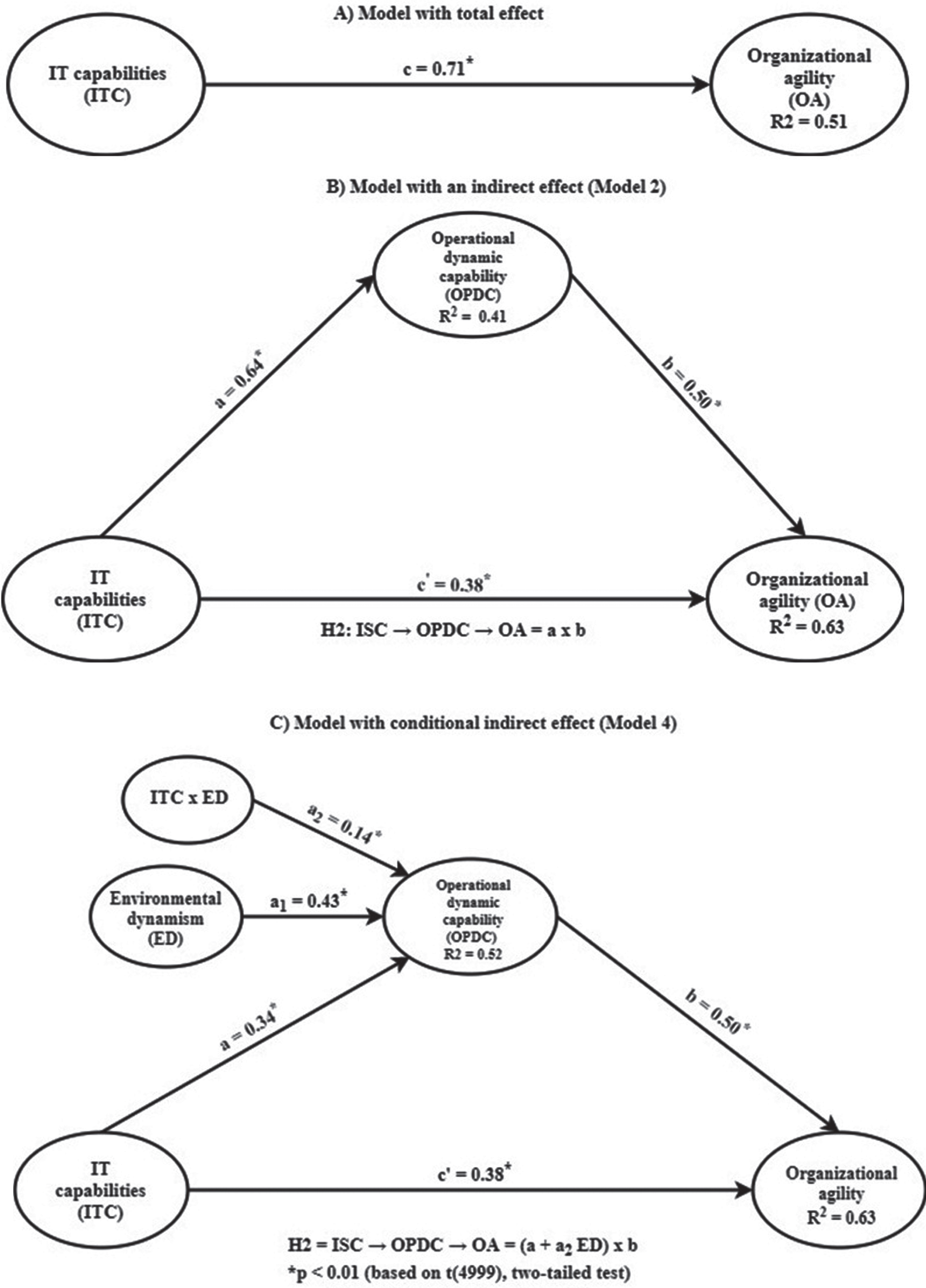
The structural model.
As for moderating effect, this study uses two-stage approach recommended by [36], to test the moderating effect (H3: a2) of ED in the way between IT capability and OPDC. This study includes (ED = a1) (Model 3) and interaction term (ED x ISC = a2) (Model 4) simultaneously. The results reveal that ED moderates (increase) the relation of IT capability and OPDC which support H3 (a2 = 0.14*) (Table 3, Model 4; Fig. 1C). As for effect size (f2), this study achieves a value of 0.04. According to [45], the values of 0.02, 0.15, and 0.35 represents as low, medium, and high effect size respectively. The significance of H3 together with the significant indirect effects (a x b) gives sufficient support for testing moderated mediation model [37]. The result shows that IT capability effects on OPDC are contingent on ED, which acts as a moderator. According to [37], such conditional indirect effect is a x (b + a1ED).
Accordingly, we estimated conditional indirect effect by applying PROCESS macro developed by [37]. This study uses latent variable scores from PLS as an input to carry out the procedure. The output of PROCESS not only provides the path estimates but also determines the bias corrected 95% bootstrap confidence interval (CI) for the indirect effect (OPDC) at different values of ED (a moderator). The results in Table 5A depict that indirect effect of IT capability on OA via OPDC is continuously positive and increases with the increment of ED. Moreover, for medium-to high values of ED, a 95% bias-corrected bootstrap CI for the conditional indirect effect is different from zero. Although, for a small value of ED, the point estimate is positive however the indirect effect is not different from zero (since zero falls in CI). Therefore, OPDC partially mediates IT capability influence on OA. Finally, in the case of the index of moderated mediation, it is also significant as shown in Table 4B (0.09) CI does not include zero.
Summary of mediating effect tests
Notes: ITC: information technology capability; OPDC: operational dynamic capabilities; OA: organizational agility; ED: environmental dynamism BCCI: bias corrected confidence interval. Bootstrapping based on n = 5000 subsamples. VAF: variance accounted for VAF >80% shows full mediation, 20% ≤ VAF ≥ 80% indicates partial mediation while VAF <20% represents no mediation. *p < 0.01 (based on t (4999), two-tailed test).
Conditional indirect effect analyses
Notes: Values for ED (moderator) are mean and plus/minus one standard deviation (SD) from the mean.
Notes: BCCI: Bias corrected confidence interval, bootstrapping based on n = 5000 subsamples.
Firstly, the findings of the study support the direct effect of IT capability on OA; a relation that shows contradiction regarding the conclusive results in the prior literature. Secondly, the study found that IT capability influences OA more through another organizational factor than direct. So, the finding of the study reveals that IT capability influences on OA more through OPDC than a direct effect. In another way, OPDC positively mediates the IT capability-OA link which means that OA depends on the extent IT capability boosts the sphere of OPDC. Thirdly, the study also provides evidence regarding moderating role of ED on the relation between IT capability and OPDC.
This study makes a significant academic contribution. Firstly, the study carefully observes the relation between IT capability and OA, a relation that deserves more attention and lacks in a theoretical model that explains how IT capability effects on firm’s OA. In order to address these present concerns, the study develops and tests a conceptual model, suggesting non-technical variables that may affect the IT capability-OA nexus.
Second, this study indicates how centralizing attention to the relation of IT capability and OPDC may act as a driving force behind OA. Apart from supporting the direct link of IT capability and OA; a relation that shows inconsistent results in the prior literature, this study suggests that IT capability influence on OA more through OPDC than a direct effect. In other words, OPDC positively mediates IT capability and OA link which means that OA depends on the extent IT capability boosts the degree of OPDC.
Third, this study steps forward and gives an in-depth depiction of environmental repercussions on the ISC-OPDC link. In this case, the study supports the indirect effect of IT capability on OA. However, the conditions to do with ED affect this indirect effect. If the ED in a firm is low it will weaken the mediating relation of OPDC. Hence, firms operating in a low sphere of ED reduces IT capability indirect effect on OPDC. This work recommends a conditional mediation relation. As per the hypothesis, ED moderates (increase) the IT capability-OPDC relation. Findings thus show that IT capability positively affects OPDC, particularly in high ED, revealing that OPDC outcomes depend on influence from external variables like ED.
Precisely, ED and IT capability jointly speed up firms’ ability to coordinate set of operations, dynamically integrate, and reconfigure organizational resources. An immediate change in environment raises the importance of IT capability. In order to survive and sustain, firms develop their IT capability that enables firms to adapt turbulent environment changes. IT capability boosts OPDC which leads to increase firm’s agility, a finding in line with prior research [6, 25].
Results provide useful managerial implication for firms. Organizations willing to raise their OA should improve their IT capability that leads to boost their OPDC. Although, the significance of IT capability as an antecedent of OA is gaining much attention, nevertheless how to turn these findings into work still not certain. The results indicate that managers should enhance OPDC by efficiently maximize the IT capability to accomplish agility. This work provides a powerful instrument for practitioners to face present turbulent environments. Moreover, the proposed model furnishes as a useful guide to raise the OA, which is vital for organizations to improve their competitive position and survive in the uncertain environment.
Conclusion
This study develops and empirically tested a conceptual model that explains the role played by IT capability under dynamic environment, to boost OPDC, and in achieving agility for firms. The role of IT capability in the model that relates to OA has identified using resource-based theory. This work uses the instrument of a questionnaire to collect data from the innovative sector of China. The study has employed variance based structural equation modeling and PROCESS to analyze the data and test the research hypotheses. In contrast to most of the prior research, this work contributes to the literature by developing a link between the IT capability and firm’s agility via the OPDC, while ED affects this mediation. This gives a theoretical depiction for how environmental dynamism influences the decision of enhancing IT capability in the firm.
The present study has several limitations which are the avenue for future research. Firstly, by the cross-sectional approach, this study emphasizes the mediating role of OPDC and moderating role of ED in strengthening the IT capability and OPDC relation. Nevertheless, in future longitudinal methods could be conducted to confirm these insights. Second, this study mainly focuses on the innovative sector, and geographical context (China). Therefore, one ought to be cautious in generalizing these results to other industries and geographies. The future researcher should consider this limitation and retest this model on other industries, and geographical context for more generalize results.
Footnotes
Appendix 1
Cross Loadings
| ED | ITC | OA | OPDC | |
| ED1 |
|
0.594 | 0.584 | 0.551 |
| ED2 |
|
0.535 | 0.568 | 0.563 |
| ED3 |
|
0.537 | 0.600 | 0.553 |
| ED4 |
|
0.581 | 0.539 | 0.501 |
| ITC1 | 0.569 |
|
0.732 | 0.585 |
| ITC2 | 0.428 |
|
0.352 | 0.370 |
| ITC3 | 0.410 |
|
0.328 | 0.335 |
| ITC4 | 0.471 |
|
0.385 | 0.457 |
| ITC5 | 0.554 |
|
0.723 | 0.584 |
| ITC6 | 0.536 |
|
0.433 | 0.459 |
| ITC7 | 0.539 |
|
0.383 | 0.476 |
| ITC8 | 0.498 |
|
0.556 | 0.510 |
| OA1 | 0.599 | 0.547 |
|
0.624 |
| OA2 | 0.577 | 0.556 |
|
0.638 |
| OA3 | 0.562 | 0.557 |
|
0.521 |
| OA4 | 0.552 | 0.628 |
|
0.628 |
| OA5 | 0.547 | 0.576 |
|
0.630 |
| OA6 | 0.586 | 0.622 |
|
0.662 |
| ED1 | 0.606 | 0.623 | 0.649 |
|
| ED2 | 0.536 | 0.550 | 0.610 |
|
| ED3 | 0.559 | 0.533 | 0.673 |
|
| ED4 | 0.508 | 0.487 | 0.603 |
|
Acknowledgments
A study under the umbrella of “Humanities and Social Science Fund of Ministry of Education of China (Reference No. 17YJAC30072)”.