



Abstract
A lot of research studies assess the effects of the so called ‘political’ violence on foreign direct investment (FDI). Yet the circumstances that, within reality, co-determine the FDI flows into Pakistan’s telecommunications remain tacit. This article investigates the simultaneous relation between FDI and so called ‘political’ violence, in Pakistan’s information and communications. It analyses the violence phenomenon and shows how that disrupts the smooth flows of FDI, commerce and trade. Pakistan’s telecommunications is one of its economic sectors that attract enormous foreign direct investment. After the 11 September 2001 attacks, Pakistan has become a frontline state in the so-called ‘War on Terror’, along with NATO and USA. This has resultantly disrupted Pakistan’s smooth trading activities. Namely, the demand for imports has declined, thereby drastically reducing the FDI inflow into the country. The results of the study highlight the reasons behind the decline in FDI into Pakistan and also lead to policy recommendations for improving the country’s economic self-development. The conclusion is drawn based on the literature review and analysis of data relevant to the telecom. Lastly, the study includes some suggestions for future research, to continually improve Pakistan’s economic and societal circumstances, by utilizing the resources FDI provides.
Keywords





Introduction
With the start of the new millennium, a new force came into being shaping up the future of the world by reducing geographic boundaries, bringing culture and societies closer to each other; is called ‘Information and Communication Technology’ (ICT). Particularly the developing states, which realized that wealth does not create, telephone density, but the telephone density creates wealth [1]. The developing states try to maintain and advance their communication technology that they become a part of global village and prove their selves to be an active member of global community. According to Ackoff [41], our world is well past the information systems age, and well into the truly societal systems age. In 21st century the transfer and exchanging of information’s are very much faster as compared to 20th century, a rapid development can be seen of the information and communication technology in the current century. The developing states realize the importance of the communication and equip themselves with the modern telecom technology to meet the globalized world challenges and to share their products, information in the world telecom market.
A comprehensive definition of technology is given by [40], he defined the technology as; technology is neither a thing, nor a tool; it is a form of social relationship and only it can be properly understood, discussed and managed. Furthermore, he argued that any technology consisted of three components, hardware, and software and brain ware. All these three components are inter related and equally important having circular relationship rather than linear or hierarchical. Moreover, at different stages of technology evolution and usage, these components are over emphasized by managers, but the circle must be kept balance in a spontaneous way.
By extending both Zeleny’s [40] technology definition and Ackoff’s [41] systems principles dynamically, Georgantzas [43] and Georgantzas and Zarifopoulou [46] delineate processes that degrade a technology into a ‘sequestered technique’, akin to degrading into technocracy science itself. Consequently, [44] and [45] provide the high technology of self-organization and self-management that all business enterprises and other societal organizations desperately need, local, regional and federal governments included.
The development is a phenomenon that has large implications on individuals and nations; it can be defined as [41]:
It is an increase in competence, the ability to satisfy one need and desires and those of others. It is a matter of learning, quality of life is an index of development. Development is not a matter of how much one has but how much one can do with whatever one has. Furthermore, development is a matter of learning and one cannot do it for another. The only kind of true development is self development. However, one can facilitate the development of another by encouraging their learning. Nations, like individuals, learn less from the successes of the others than from their own mistakes.
Whenever any Form of Government becomes destructive of these ends, it is the Right of the People to alter or to abolish it, and to institute new Government, laying its foundation on such principles [42].
During the 1980’s the importance of telecom were globally acknowledged and this area is considered as an active and major source of foreign investment and economic growth [2]. Both developed and developing states liberalize and open their boundaries for foreign investment, states attracts the foreign investment in telecom through different reforms e.g. de-regulation, privatization etc. Countries like Pakistan, foreign investment is enormously important for growth and development, it bring technological revolution and advancement, reduce poverty, create competitive environment that reduce the prices for users and raise the living standard. In fact the foreign investment in developing countries is a large source of capital, which results in economic growth. In South Asian region, Pakistan attracts bulk of foreign investment having attractive environment, particularly in information technology, agriculture, power, and service during the last two decades. The major investor states in Pakistan are United States of America, United Kingdom, and Middle East, each state is contributing approximately 25% of foreign direct investment in the agriculture, IT & Telecom and power [3]. After recognizing the important and growth-enhancing element of foreign investment in developing countries, Pakistan adopted liberal investment policy and opened her door for the foreign investors just about in all department of the economy including the telecom [4].
Before the 90’s the telecom was not much developed but after the 90’s, Government of Pakistan (GOP) liberalized its telecom and allow foreign investment in this, it bring a marvelous change in shape of advance ICT technology, fastest transmission of information and data e.g. Fiber optic, internet, DSL, VOIP, wireless telephony [6]. These things are now become common and easily accessible all over the country at low prices. Government of Pakistan has done a lot of work to attract FDI in telecom, and opened many avenues to attract more investment. This field got a massive foreign investment after the entry of cellular companies; now total five international cellular companies are working and make their investment in telecom. The ICT infrastructure in Pakistan is also improved significantly due to foreign investment in fixed (landline & Wireless) and cell phones networks. A survey conducted by Statesman declared Pakistan becomes the world’s third fastest emergent ICT market [5]. It also states that Pakistan cellular network adds an average of two million subscribers per month; it is just behind India, which has the second highest cellular growing market in the world, India contributes an average of more than eight million subscribers per month [7]. This survey also contributes that South Asian region is a fertile for telecom growth. Government of Pakistan after 1996 and during the 1st decade of 21st century adopts a liberal policy towards the foreign investment in telecom; as a result receive a massive foreign investment. But after the joining the war on terror in 2001 by president Musharraf, the decline of the investment starts and after the settlement of new political government in 2008 this ratio decreases abruptly.
This study shows a relation between political violence and FDI flows in telecom of Pakistan during the year 2001–2010. It reveals that there is an inverse relation between political instability and FDI, as violence increased investment decreased and vice versa. It gives detail information about the evaluation of telecom infrastructure in Pakistan as well as foreign investment attracted in this field. This research will also provide a blueprint for policy makers to adopt such policies that favor the investors by providing a favorable environment and stable political conditions in the country and, development in telecom can help the government to counter the terrorism.
This study has the following main objectives: To analyze the pattern of FDI in the Pakistan’s telecom. To find out changes in FDI from 2001–2010 and its impact on the telecom industry, particularly after the 9/11. To make the critical analysis of the economic policies of the government of Pakistan after the 2001 till date, regarding the liberalization of telecom. To provide a comprehensive conclusion based on these analyses. To propose possible policy options for increasing foreign direct investment in the telecom of the economy.
A review of previous related literature
Foreign direct investment (FDI) brings technological advancement and skill transfer into the host countries. It also highlights the determinants of FDI, define FDI with the help of analytic technique, and on the basis of collected data the results are presented. It concludes that FDI plays an important role in the development of and an important policy goal [8]. A survey presents by LIRNE Asia in five emerging Asian states, India, Pakistan, Sri Lanka, Thailand and Philippines. This survey gives a blueprint of the liberalization of Pakistan telecom and its impact on information economy with the help of different data, charts, and figures collecting during the survey. It concludes and attributes that the progress and success of telecom of Pakistan is the result of different regulatory reforms taken by the Government of Pakistan [9]. This survey was conducted by telecom regulatory & policy environment (TRE) gives its suggestions and results in telecom of Pakistan [10]. Another comprehensive study examines the growth of service including the telecom in five South Asian states India, Pakistan, Bangladesh, Sri Lanka and Nepal. The study suggests that South Asian states should follow the GATS terms and requirements and develop the domestic policies in all service s to prepare them for further liberalization and take advantages [11]. Zahra et al. proposes an empirical analysis of 24 different income countries for the periods of 18 years, i.e. 1985 to 2003. This study also concludes some suggestions for the developing states to improve their ICT infrastructure and get economic and societal development utilizing FDI. It also highlights the challenges that affect the foreign investment in developing states [12]. Hashim et al. examines the foreign direct investment in telecom of Pakistan, including the determinants of FDI in telecom. Data was taken from 2000–2006, in data the market size, competition and GDP was analyzed in a result of foreign investment in telecom. It concludes the determinants of FDI in telecom and the regression results of this study shows that telecom has a significant role in attracting the foreign investment and this can never be ignored in country economy and growth [13]. A research study presented by Zaman et al. depicts the effect of investment in telecom on trade, both on foreign and domestic trade. For this study the time series data has been analyzed from 1950 to 2007, total 58 years annual data has consider. This study concludes that the telecom has a significant role in promotion of trade and economy; this has effect the foremost and backward areas of Khyber Pukhtunkhwa and Baluchistan. It defines the approaches for an effective telecom policy and different approaches adopted by Pakistan, India and Malaysia. Telecom liberalization in Pakistan and the development of cellular companies under the liberal telecom policy of Pakistan adopted in 2004 called as cellular-mobile policy [14].
Most academic research is inadvertently promoting the mysticism that we, human beings, live and work in and about statically complicated and dynamically complex political systems or polities, while in fact we are subjugated under the bureaucratically-hierarchized authority and power artifice, of the totalitarian regime. Whenever any Form of Government becomes destructive of these ends, it is the Right of the People to alter or to abolish it, and to institute new Government, laying its foundation on such principles [42].
The characteristics of political violence theory have been analyzed and defined by number of authors. For example, [15] found that political instability had a negative effect on FDI flows however, [16] fails to find statistical association between political stability and FDI. In a cross sectional analysis of FDI flows to 36 countries for 1977 and 1982. [17] Found that political instability negatively affects economic growth and investment and furthermore, he found that measures of political instability, such as coups, revolutions, and political assassinations, are inversely correlated with the growth of gross domestic product (GDP) and investment share of the GDP. Busse contributed that the host countries having a more political stability are able to attract large amount of FDI [18]. Globerman & Shapiro conducted a two stage analysis of FDI inflows of US to 143 countries during 1994–1997. They found that an index of political instability and violence, including armed conflict, social unrest, terrorist threats, etc, did not influence the probability whether a country received any FDI inflow, but reduced the amount of FDI inflow to a country [19]. Li argues that uncertainty over the probability of political violence conditions the effect of violence on FDI flows. When conflict is predictable, investors adjust their behavior to preempt the shock, so the actual event has little or no effect on FDI inflows. Conversely, unexpected bursts of violence cause significant drops in FDI [20–22]. Concluded that, political stability is found to be negatively significant and confirms the hypothesis that politically unstable countries are unlikely to be attractive destinations for FDI. Mulali argued that political stability had a positive and significance impact on FDI in the MENA region [23, 47].
Methodology and theoretical framework
Political violence, an extreme form of political instability, affects foreign direct investment. Political stability is a significant concern of foreign investors and they analyze this component of political risk on high priority and it can be measured with monitoring of the following incidents in the host country: internal and external conflicts, social unrest, orderly political transfers, political violence, government stability, law and order, ethnic tensions, socioeconomic conditions, military in politics, religion in politics and international disputes. Most related to this discussion is the theoretical framework referred to as political violence and its effect on FDI. Quan Li, in his article entitled ‘Political violence and foreign direct investment’ out lines three characteristics of this theory:” First, the theory considers how rational expectations and uncertainty on the part of foreign investors affect the ways in which ‘political’ violence influences investment behaviors. Second, the new theoretical argument argues to find the effects of different types of political violence (civil war, interstate war, and transnational terrorism). Third, it consider FDI inflows as resulting from two distinct but related decisions, including the investment location choice and the decision on investment amount, and sort out the separate effects of political violence on these two processes. The presence of these three attributes affects the foreign investment in any country, particularly the second attribute is very much important, i.e. Political violence. In this theory three type of violence are given, i.e. civil war, interstate war and transnational terrorism. According to the theory, the transnational terrorism includes suicide bombing, terrorist threats, target killing, kidnapping, target bombings etc. The same like situation can be seen in Pakistan after entering into the “war on terror” and particularly after the settlement of new political government in 2008. All these acts of terrorism affect the foreign investment in all s of Pakistan badly as well as the telecomm. The main focus of the study is belonging to this attribute of the theory presented.
The data collected for the article is given in Appendix A, there were total 200 samples are taken for the study from different part of Pakistan. The sample included people from all aspects of life with both male and female genders.
Reforms and evaluation of foreign investment in telecom
Before the independence of Indo-Pak, telegraphy act 1876 was implemented under the British rule. Pakistan adopted legal system of British, “mutatis mutandis”, telegraphy act of 1885. In 1947, government of Pakistan has received a meager telecom system of 14000 lines, at that time telegraph and telephone were one department, but in 1962 it separated into two departments, i.e. telegraph and telephone department and postal department. During the 1990 s government of Pakistan realize the compensations of liberalization of the telecom so during this era Pakistan make reforms in telecom [24].
In 1990 the telegraph and telephone department (T&T) was converted into Pakistan Telecom Corporation (PTC). Before splitting of PTC, it a state owned corporation and had a monopoly in the telecom, it controls the entire market and got the desired prices from subscribers. In 1996, early reforms were introduced in the telecom of Pakistan. Pakistan Telecommunications Corporation (PTC) was split into four autonomous departments, Pakistan Telecommunications Company Limited (PTCL), National Telecommunications Corporation (NTC), Pakistan Telecommunications Authority (PTA), and Frequency Allocation Board (FAB). In 2003, due to the de-regulation policy the monopoly of PTCL was affected in fix line telephony. In year 2004, cellular policy was issued by the government of Pakistan via Pakistan Telecommunications Authority [25]. Broad band policy was also issued in 2004, which make the world a global village and bring a revolution in the field of fast data transformation. In 2006 the government of Pakistan conducted an open auction for and 26% of its shares hired by ETISALAT (UAE) company; ETISALAT pays 2.59 billion $ and become the owner of PTCL (Please See Table 1) [26]. This is another step towards the liberalization of the telecom. All the above reforms made the subscribers to have more choices.
Background of telecom
Background of telecom
Source: PTCL, PTA.
The big source of the foreign investment in Pakistan telecom since 2000-01 was the cellular companies that attract a huge amount of both local and foreign investment.
In 2010 annual report from PTA, the report has been stated that during the last five years, i.e. from 2005–2010 the total investment in telecom was recorded over 11 billion US$ while this area provided million of jobs in various departments [27]. This report shows that during the last five years the telecom of Pakistan attracted over 6.3 billion US$ and it show a positive response from the investors. However in the year 2009–10, the telecom invested less than 508 million US$ from the previous year investment. UAE, Norway, USA, China are the major investors in the telecom during these five years. In the total 6.3 billion US$ the UAE invested approximately over 2 billion US$ and contribute about 32%, while USA and Norway invested 890 million US$ and 639 million US$ respectively. China contributes FDI about 582 million US$ (Ibid) (Please See Fig. 1 & Table 2). The remaining FDI contributions were made by Singapore, Netherland, Malaysia, UK and Hong Kong.

FDI breakdown in telecom of Pakistan.
FDI Break up in telecom
Source: Pakistan Telecommunication Authority 2015. *Warid was auctioned by Singtel Company Singapore and was purchased by UAE Group Company in 2010.
In (Table 2 & Fig. 1) the details of the FDI in telecom show the blueprint of the increase and decrease in foreign investment. It reflex the government policies towards the FDI, the increase in FDI was due to the de-regulation, liberalization and opening of the telecom boundaries for the foreign investors. While the decrease in FDI was due to the increase in political violence, i.e. War on terror etc in the country, which frightened the foreign investors to invest their money in telecom of Pakistan.
Government of Pakistan established Pakistan Telecom Ordinance in 1994, for the purpose of de-regulation. Pakistan Telecommunications Authority (PTA) was established in 1996 due to this ordinance, after the establishment of Pakistan Telecom Authority (PTA), it is responsible for licensing to new operators, provision of telecom services, check the grade of services, quality of services [28]. After the liberalization of the telecom in 1996, PTCL is the largest service provider among the other operators. In 1996, the 12% shares of the PTCL was sold to the public through different stock exchanges, while in 2006 the 26% shares of PTCL was hired by ETISALAT (UAE) thorough an auction [29].
Pakistan has the 3rd largest land line and mobile network followed by India and China respectively [30]. This is due to that, there are almost null restrictions on foreign investment about the movement of capital and ICT infrastructure. The mobile phone subscribers has reached to 130 millions, it contributes 2 to 3% of total GDP and about 7% tax collection per year and generated a bulk of revenue Rs. 879.1 billion in 2008-09 and Rs. 291 billion in 2009-10. It contributes almost 35% of the total foreign investment in Pakistan during the last five years [31].
Liberalization of Pakistan telecom industry brings competition in the market instead of monopoly, this result in improved productivity, cheap prices, reliable services, greater choice of customers etc. The liberalization and de-regulation diminishes the monopoly of PTCL in providing the telecom services. There is a basic difference between the regulation and de-regulation;
“Regulation is to control the market failure while the de-regulation employed to avoid regulatory failure”.
Government of Pakistan received a bulk of foreign investment via cellular and broadband operators. Currently the real competition is in between the Ufone (PTCL owned company), Mobilink (Orascam group Egypt), Telenor (Norway Telecom company), Warid (ETISALAT UAE company), Zong (China Telecom company) (See Table 3 & Fig. 2). Norway telecom company Telenor contributes 290$ million in 2004 for fifth cellular license and UAE ETISALAT telecom company contributes 290$ for sixth cellular license. However China mobile company purchase the 100% shares of Paktel mobile company (USA group company), and contributes 460$ million in 2006. Among these mobile companies Mobilink has the largest share in FDI inflow in telecom of Pakistan (See Table 2 & Fig. 1).
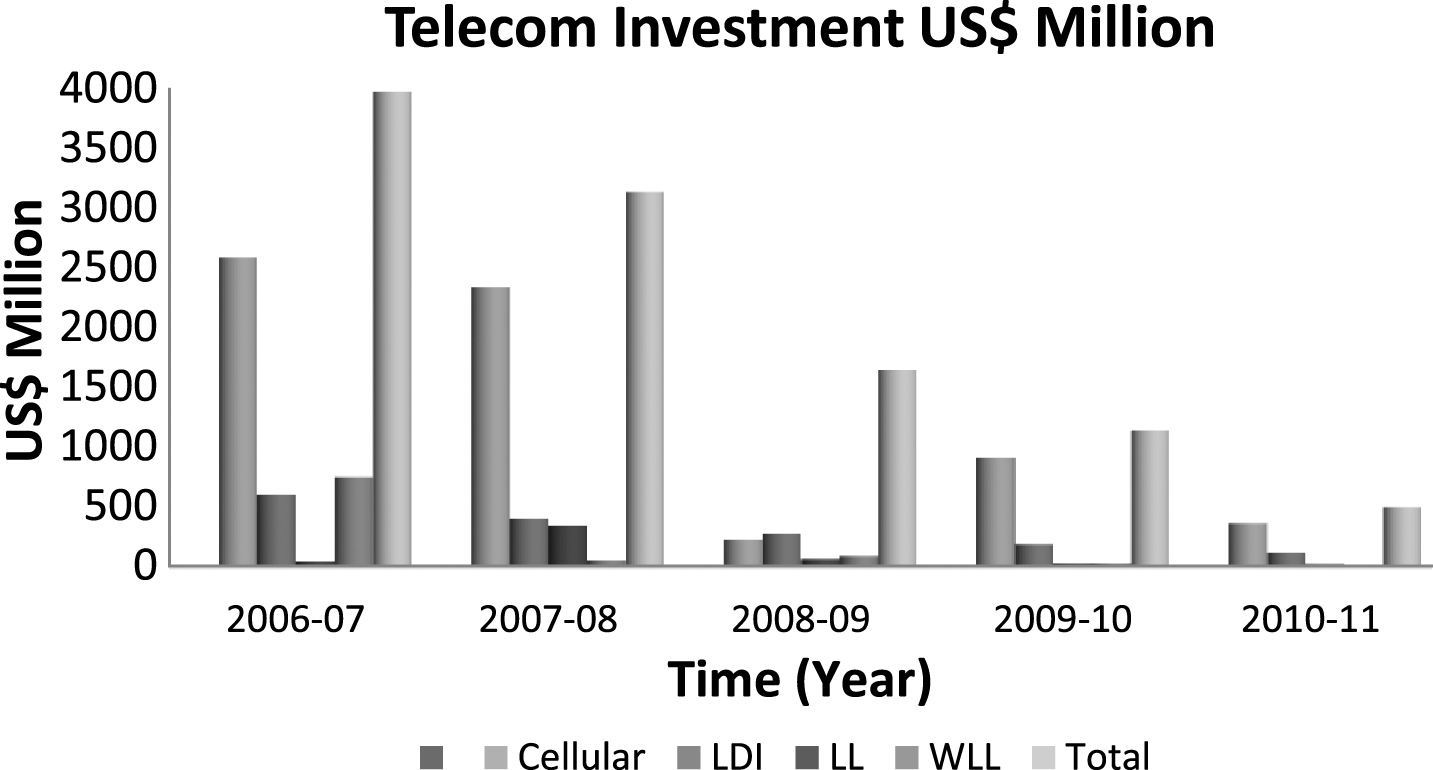
Telecom investment in million US$.
Telecom Investment
Source: State bank of Pakistan & PTA annual report, 2015.
Mobilink launch first private fiber optic undersea network contributes 60$ million and complete its fiber optic ring network in private division after the PTCL. Pakistan telecom launches 3 G services in the last couple of years in wireless communication that brings foreign and local investment in form of local loop and long distance international LDI licenses. In broadband the 3 G services of Wi-Max, VOIP, and Wi-Fi are the growing technologies attracting many people. Government of Pakistan receive massive income in the form of sales tax and withholding tax in mobile companies, mobile division pays 21.5% higher than the other South Asian countries, i.e. India 10.2%, Sri Lanka 17.9%, Bangladesh 15%, Malaysia 5% [34]. During the financial year 2005-06, the foreign investment in telecom division is about 1.8$ billion and it become the region that attract an enormous foreign investment and it contribute almost 54% of total country FDI (See Table 4). The increase in foreign investment in telecom during the year 2005-06 is due to the purchase of 26% shares of PTCL from ETISALAT [35]. During the last few years telecom industry of Pakistan capture one fourth of total foreign investment of the country. During the last five years, telecom attracted an average of 34% of total country FDI, but in 2008-09 the figure decrease and is about 22% of the total country foreign investment [36] (Please See Fig. 3 & Table 4). However effective competition between the telecom operators benefited consumers and as a result they enjoy the low tariff, good quality services at cheaper rate. Cellular phone companies provide not only the cheapest call rates but also offer wide range data services at reasonable rates. The ratio of teledensity of cellular phones found high as compared to the fixed telephony, and more people preferred the mobile telephony over the fixed one (In Table 3, the investment ratio can be seen). In 2004, according to “Mobile Cellular Policy” the expected demand of cellular phone will approximately be 25 million cellular subscribers by 2018 [37]. The present FDI status in telecom can be seen in Table 2 & Fig. 1:

Graphical analysis of FDI contribution in telecom.
Decline of foreign investment in Pakistan
Source: Board of investment government of Pakistan.
Figure 2 shows the graphical analysis of FDI in Pakistan’s telecom is given in Table 3, the amount is in million US$ also the percentage of the contribution of different operators also shown.
While the trajectories of the political violence as well as its effect on the foreign investment outlined above show an overall trend, the theoretical framework of political violence must be applied in order to truly understand the current state of the foreign investment in Pakistan’s telecom department. After showing that the conditions for political violence implications on foreign investment are clearly being met, this analysis will examine the applicability of the three different political violence attributes and to demonstrate that interstate terrorism is the most accurate in case of Pakistan economy in general and in telecom particularly.
Of the three political violence situations-rational expectations and uncertainty on the part of foreign investors, interstate war, transnational terrorism and investment location choice and the decision on investment amount have already been defined and its effects can be seen in the scenario of foreign investment in telecom of Pakistan. However the most relevant and appropriate application of the political violence on foreign direct investment in telecom is should be the second character, i.e. transnational terrorism. Pakistan has a large infrastructure, skilled labor, and professional expert of telecom industry due to, which it becomes one of the profitable organizations not only in a country but in the region of South Asia. Most of the foreign investors want to invest their money in this area. But unfortunately after joining the war on terror the foreigners freighted to invest their money because the terrorist attacks, target killing, suicide bombing jolt the country and also affect the foreign investment because nobody want to invest their money in Pakistan (See the Table 5 for details of “Cost of War” from 2001–2010).
Cost of War (2001–2010)
Source: Ministry of Finance, Pakistan.
This classification is the most applicable because Pakistan has an important role in the region, a front line state and an alloy of the US and NATO against the Al-Qaida and Taliban. Pakistan has a large population with less resources and employment opportunities. Foreign investment is a very important tool for the developing countries like Pakistan for economic growth and development. Being an alloy and front line state Pakistan cannot roll back their decisions, while Al-Qaida and Taliban continue their targeted attacks all over the country that probably increase the political violence in a country and make the investment decrease known as ‘transnational terrorism’.
Pakistan needs to improve the following areas to boost and reinstate the confidence of investors for greater amount of FDI in telecom. Government should improve the security conditions and decrease the violence in the country to attract more investments. Foreign investment could play an important role in the development and growth of the developing countries, so government should create a sound environment to gain more benefits from FDI. Make concrete and investment friendly environment for foreign investors. Stabilize the political instability in the country to gain the confidence of the investors. Government should promote the physical infrastructure in all service areas including the telecom. A well-established physical infrastructure is a reliable source for FDI attraction. The recommendations are consistent with [38], in which the author proposes that OBOR will become a game changer for Asian region; furthermore, this project helps in establishing the physical and IT infrastructure among the member countries. Government should improve the law and order situation, because peaceful environment is a guarantee of more investment. Government should needs to bring betterment in rules and regulations in telecom through the governing department PTA. Resolve the issue of energy shortfall on urgent and permanent basis to meet the challenges in all service areas including telecom. Moreover, improve the speedy and frequent connectivity of internet throughout the country both in urban and rural areas of Pakistan. This is consistent with the study [39].