



Abstract
This study investigates the relations among knowledge sharing, transformational leadership and personality traits. An organizational perspective allows exploring the moderating effects of transformational leadership on both knowledge sharing and personality traits. Based on a survey of 1,325 valid questionnaires, the empirical findings show knowledge sharing is significantly and positively influenced by openness to experience, agreeableness, and conscientiousness. Knowledge sharing is also significantly and positively influenced by transformational leadership, which increases knowledge sharing motivation among extroversion and conscientiousness traits. High transformational leadership may reduce knowledge sharing reluctance among individuals with neuroticism traits. To promote knowledge sharing effectively, teachers and manager ought to provide students and employees with transformational leadership, depending on observed personality traits and variations.


Introduction
The beginning of the 21st century is an era dominated by knowledge-based economy, and knowledge has become a major force for development. Knowledge management has become the most popular discussion topics in recent years [56]. Wu [58] also points out that “knowledge sharing is the most important activity for organizations”, naming knowledge sharing as a key for knowledge management [34]. Zeleny [61] states “knowledge is purposeful coordination of action”. In the past, research on knowledge sharing was mostly conducted on enterprise organizations, with subjects including research teams, human resource department [38], and information department [41, 54] etc. Knowledge sharing within academic and educational institutions, however, has seldom been the subject of studies [14, 44]. Zeleny [62] argues that only through some form of language, then socially divided or distributed knowledge can fulfill its human action coordinating function.
Eastern and western countries alike believe that education plays an important role in the overall development of the society and country. Higher education is tasked with the mission and responsibility to cultivate top talents for the country, in order to enhance human resource competitiveness for the promotion of sustainable national development. During the learning process, however, not every student is able to completely absorb or master the information provided in the classrooms. Knowledge sharing among peers will be able to sharpen individual student ability as well as enhance the overall effectiveness of education. Through empirical studies, this study hopes to analyze and discover key factors influencing university student’s knowledge sharing behavior, and make appropriate recommendations for higher-education institutions and teachers based on research results.
Many elements may influence knowledge sharing behavior [4, 51] and most scholars believe currently that causes may be divided between personal-level and organizational-level factors. The research for personal-level factors focuses on understanding the process and influencing factors for individual knowledge sharing, with research results used as foundation of knowledge management within the organization, and help to understand the overall organizational knowledge sharing activities [23]. Therefore, “personal-level” studies designed to explore knowledge sharing behavior at the individual level has a certain degree of importance. Scholars who conducted “personal-level” research have put forward many knowledge sharing individual behavior factors, including personal motivation, demographic variables, and personal characteristics, etc. [23]. This study believes that individual characteristics are unique combinations of personality traits, which may decide the interactive mode between man and the environment [50]. The first purpose of this study is to explore how personal characteristics may be linked to knowledge sharing behavior, to understand whether differences between university students’ personal characteristics would influence their knowledge sharing behavior.
“Organizational-level” knowledge sharing research is mostly done on business enterprises. This study would like to suggest that university teachers are the main force for dissemination of beliefs, skills and value system, and the crucial element influencing student behavior. In the Chinese essay “On Teaching”, Han Yu said that “Teachers, therefore, lecture, pass on professional skills, and dispel doubts. In terms of organizational-level, what matters is the student’s learning environment, which is the teacher’s leadership in class. Several studies have confirmed the significance of teacher’s leadership influence and importance in terms of setting the tone for the students’ learning environment. The second purpose of this study, therefore, is to explore the impact of teacher leadership style on student’s knowledge sharing behavior, with teachers’ leadership behavior as an important organizational-level variable.
In the study of organizational behavior, interactionism has become the mainstream point of view from which personal behavior could be understood. Person-Organization Fit (P-O Fit) proposed by Schneider [47] is the best interpretation for the interactionism theory. When an individual feels that he can easily fit in and adapt to an organization, positive behaviors are more likely to occur, while negative behaviors may appear when the situation is reversed. Another words, an organization could “promote or impede” the behavior of an individual. Organizational characteristics play a regulatory role for the behavior of members of the organization, and leaders of organizations play key roles in improving Person-Organization Fit. In terms of students’ knowledge sharing behavior, besides influence from their own personality traits, teachers’ leadership behaviors should impact and moderate students’ behavior. The third purpose of this study, therefore, is to explore whether teacher’s leadership behavior plays any role in regulating the process by which personality traits affect knowledge sharing behavior.
In summary, the purpose of this study is three folds. The first is to examine, on a personal-level, the relations between knowledge sharing behavior and student’s personality traits. The second is to examine, from an organizational-level, the relations between knowledge sharing behavior and teachers’ leadership behavior. The third is to explore, from a Person-Organization Fit point of view, whether teachers’ leadership behavior has any modifying effects for students with different personalities and their knowledge sharing behavior. This study extends knowledge sharing research to the behavior inside institutions of higher education, and considers students’ knowledge sharing behavior from “personal-level” and “organizational-level”, in hopes of finding more complete influencing factors from empirical data.
Literature review and hypotheses
Knowledge sharing
Knowledge sharing is the action in which individuals diffuse relevant information to others [23]. Knowledge interflow among individuals in workgroups enables them to enhance their competency and mutually generate new knowledge. This results in a synergistic effect [1, 52].
Knowledge sharing has become a popular topic since the last decades [30]. Scholars have different definitions and viewpoints about knowledge sharing behavior. Hendriks proposed that knowledge sharing implies that one of the two parties involved in the act of sharing possesses knowledge, while the other party acquires the knowledge [22]. Observing from a learning perspective, Senge believes that true knowledge sharing occurs when one party is willing to help another develop new motivation and to create a learning process [48]. His point of view is that knowledge sharing means helping another person learn - an act of “teaching” by the knowledge-provider. This study considers the basic unit in a school, a class, as an individual organization. Students’ knowledge sharing behavior indicates the sharing of knowledge to other classmates, helping them create a learning process. Knowledge sharing occurs through peer interaction, from knowledge provider to the receiver, shaping their capacity for action.
Personal traits
Personality is the sum of personal attributes, characteristics and qualities which makes us different from others. Therefore, “personality”, to certain extent, may be used to explain the reason behind an individual’s knowledge sharing behavior.
Is personality inherent when a person is born, or shaped by external environmental factors? Bonoma and Zaltman [7] proposed three viewpoints to address this issue, namely the Trait Theory point of view, Environmental Theory point of view, and Interactive Effects between traits and environmental factors. Among many personality theories, “Trait Theorists” believe that personality consists of a series of personal traits, and that traits are the basic building blocks underlying one’s personality, which influences personal external actions [3, 33]. Costa and McCrae [16] defined Personality Traits as Personality Characteristics which steadily appear under different situations. Since this study attempts to explore knowledge sharing behavior from a “personal-level”, “Trait Theory” shall be used as theoretical basis of personality, to explore the effect of personality differences on knowledge sharing behavior. Trait Theorists agree that personal traits are the major factors influencing psychological and behavioral tendencies. Most frequently used personal traits classifications include internal and external “Locus of Control”, “Type A and Type B” personalities, and the “Big Five” personal traits. The “Big Five” personality dimensions proposed by Costa and McCrae, describing personality contours from a general standpoint, have been widely used in applications and verified change by multiple studies. The “Big Five” theory has been proven applicable with little differences between different cultures, signifying such classification can provide clear and common language serving personality discussions across cultural differences, unlimited by region or different backgrounds [10, 57]. The International Personality Item Pool (IPIP) is a well accepted, widely assessed and extensively used scale to measure the Big Five personality dimensions [38, 45]. This study, therefore, uses the widely accepted Costa and McCrae’s “Big Five” personality traits as the basis to conduct “personal-level” research.
knowledge sharing and Personality traits
From the point of view of Traits Theory, it is reasonable to consider personality traits as major factors influencing an individual’s external behavior [20, 63]. Since knowledge sharing depends on the action of people, through individuals’ external behavior for knowledge transmission, the empirical research of connections between personality traits and knowledge sharing behavior has reasonable theoretical and practical basis [24, 35].
Big Five personality trait theory states that individuals high in the neuroticism trait tend to have low self-esteem and more worries, and feel anxious and moody with a lower sense of trust towards others. When a knowledge-owner has neuroticism personality traits, therefore, due to lack of trust for people and lack of mutual trust foundation, he or she is more likely to withhold information, unwilling to share knowledge with peers. It is possible to infer that neuroticism personality trait negatively impacts students’ knowledge sharing behavior. From the standpoint of human interaction, extraverts are sociable, proactive, optimistic and enthusiastic. Individuals with extraversion traits will more easily interact with their peers. It is possible to infer that extroversion traits have a positive impact on students’ knowledge sharing behavior. People who are open to experience are curious with a wide range of interests, and may possess creativity, originality, and imaginative qualities. Since knowledge sharing is one of the methods for individuals to obtain new information, to satisfy their curiosity and thirst for knowledge, people who are open to new experiences may have a tendency to share their own knowledge. It is possible to infer, therefore, that students open to experience are positively influenced by this trait to exhibit knowledge sharing behavior. People with Agreeableness trait tend to be compassionate, forgiving, helpful, and trusting. Since knowledge sharing is one way to help others learn [48], it may be inferred that Agreeableness personality trait positively impacts knowledge sharing behavior. People with high conscientiousness traits are responsible, hard-working, self – demanding, ambitious, and persistent [17, 22]. Knowledge owners who are highly conscientious are more likely to share their own expertise, because of the question of responsibility. It is possible to infer that Conscientiousness trait have a positive impact on students’ knowledge sharing behavior. To summarize, the following hypotheses may be derived from the above descriptions of personality traits’ impact on knowledge sharing behavior: the relation between personality traits and knowledge sharing behavior is positive. neuroticism traits negatively impacts students’ knowledge sharing behavior. extroversion traits positively impacts students’ knowledge sharing behavior. openness to experience traits positively impacts students’ knowledge sharing behavior. agreeableness traits positively impacts students’ knowledge sharing behavior. conscientiousness traits positively impacts students’ knowledge sharing behavior.
Leadership behavior
Leadership is a mutual influencing process undertaken by the leader and members who were led, with internal and external environmental factors, for the achievements of the group’ mutual intentionality through team members’ cooperation and hard work [2, 36]. Many scholars believe that leadership skills will influence organizational development [25, 42]. Consider a class as an organization, adequate leadership from teachers will shape better class atmosphere, thereby influencing individual students’ behavior, which contributes to the overall developments of the whole class. Therefore, teachers’ leadership behavior has major impact on student behavior [12].
The development of leadership theory can be roughly divided into four periods, including the Trait Theory period, Style Theory period, Contingency Theory period, and New Leadership Theory period [8]. As of now, New Leadership Theory is more complete and is able to explain the effectiveness of leadership behavior [11, 29]. Transformational leadership is a type of New Leadership style. Transformational leaders pay great attention to interacting with followers to create organizational collectivity. They attempt to understand followers’ needs and stimulate followers to achieve intentionality [26]. Transformational leaders can broaden and elevate the interests of their employees, and are able to stir their employees to look beyond their own self-interest for the good of the group by generating awareness and acceptance of the purposes and mission of the group [6, 60]. When followers equate their own success with that of their organizations’ and identify with the organizations values and intentionality, they become more willing to cooperate in order to make a positive contribution to the work context [43]. Thus transformational leadership is more likely to result in higher levels of performance [60].
Burns [9], Bass [5] and other scholars believe that leaders must grow continuously in order to enhance organizational members’ common ideals and moral values, so that they may surpass themselves to a higher level of performance. Transformational leadership is one of the major topics of leadership behavior research today. The “organizational-level” part of the study will use the degree of teachers’ transformational leadership behavior as the focus of research.
knowledge sharing and leadership behavior
Studies show that leadership styles which value subordinates usually obtain better leadership results [19, 59]. In view of this fact a teacher inside a classroom is like a leader in an organization, who should pay attention, care for, and satisfy students’ needs, through appropriate student-teacher interactions, to enhance knowledge sharing effectiveness.
Transformational leadership emphasizes personal charisma, replacing authority with professionalism to shape an organizational atmosphere based on trust and respect, encouraging individual participation through a rational decision-making process model, collecting everyone’s wisdom and consensus, working together to build the organizations vision and thus stimulate members’ knowledge sharing willingness [37]. Therefore, transformational leadership can make a positive impact on the transfer of knowledge, forming a favorable medium for knowledge dissemination [2, 46]. When a teacher is equipped with certain characteristics and behavior that can stimulate and enhance students’ positive value in higher level needs, the teacher may then guide the students to work together towards the achievement of class intentionality regardless of the interest of individuals. Therefore, in a university learning environments, teachers who provide such leadership style will enhance students’ knowledge sharing behavior. Based on the above, the relation between teachers’ transformational leadership behavior and students’ knowledge sharing behavior is positive.
Knowledge sharing, personality traits, leadership behavior
The concept of Fit plays an important role in psychology and organizational behavior study [40]. Scholars in related research studies emphasize that the question of Person-Organization Fit (P-O Fit) is an integral part or any exploration and prediction of personal behavior inside an organization. The better fit between individuals and organizations, individuals’ positive behavior are more likely to occur.
Research literature shows that a leader’s leadership behavior is an important factor shaping and influencing organizational atmosphere, and the key to influencing individuals’ external behavior. Personality trait, on the other hand, is a dynamic characteristic that produces different reactions based on different environments. In other words, if students personality traits and teachers leadership behavior maintain stable connection with enough Person-Organization Fit, students will feel a sense of satisfaction and achievement. Conversely, if the relation between students’ personality traits and teachers’ leadership behavior is unstable and inconsistent, then the students are likely to hold back in the class, feeling resentment and oppression. It is evidence that teachers’ leadership behavior should have a moderating effect for classroom knowledge haring behavior for students with different personality traits. Based on the above, transformational leadership behavior has a moderating effect on the relations between personal traits and knowledge sharing behavior. transformational leadership behavior has a moderating effect on the relations between individuals with Neuroticism personality trait and their knowledge sharing behavior. transformational leadership behavior has a moderating effect on the relations between individuals with Extroversion personality trait and their knowledge sharing behavior. transformational leadership behavior has a moderating effect on the relations between individuals with Openness to Experience personality trait and their knowledge sharing behavior. transformational leadership behavior has a moderating effect on the relations between individuals with Agreeableness personality trait and their knowledge sharing behavior. transformational leadership behavior has a moderating effect on the relations between individuals with Conscientiousness personality trait and their knowledge sharing behavior.
Research methods
Research targets and distribution of questionnaire
This study is structured as shown in Fig. 1, with student personality trait as independent variable for the personal-level. At the organizational-level, transformational leadership behavior of teachers is used as moderator, to explore its relations with knowledge sharing behavior. The pros and cons in success and failure of higher education is the key factor of country competitiveness. University students, therefore, are the subject of this study. To avoid large variance due to research subjects’ course differences, causing bias when judging teachers leadership behavior, the study focuses mostly on students in business school. To ensure the quality of survey data, before the distribution of questionnaires, information was obtained regarding teachers’ class schedule, subjects taught, and teaching style, with advance communication and scheduling with survey classes. Each questionnaire individually and clearly labels teachers’ names and the name of the class, with reminders to the survey students to base their answers all teachers actual classroom situation. While conducting the survey questionnaire, verbal communication was conducted with survey class, to obtain answers about knowledge sharing behavior and teacher leadership style based on the teachers actual classroom situation, to ensure that questionnaire data correctly reflects the purpose of verifying research hypotheses.

The framework of Research.
With help from classroom teachers and teacher assistants, this study distributed 1,558 surveys, with 1,469 surveys returned. After excluding invalid questionnaires, 1,325 valid questionnaires remain. Of all the questionnaires returned, 32.5% came from male students and 67.5% came from female students. The questionnaire return ratio was 42.3% for first-year students, 24.5% for sophomores, 17.2% for juniors, and 15.9% for seniors.
They are four parts to the questionnaire, namely, student personality traits, students’ knowledge sharing behavior inside the specified subject, the teachers’ transformational leadership behavior, and students’ basic information.
Knowledge sharing behavior
Combining scholars [48] proposals, this study showed defined knowledge sharing as “helping others to develop new capacity for action, plus interactive knowledge sharing for successful transferring of knowledge to another, becoming the other person’s capacity for action. In terms of measurement tools, since the subjects of this study are students, 10 questions were derived from measurement chart created by scholars [55]. Measurement for each question relies on the Likert scale [31], dividing answer into strongly disagree, disagree, no opinion, agree, strongly agree, with scores ranging from 1 to 5 according to the above order. After the questionnaire is complete, questions with high average scores reflect that the student is more likely to exhibit knowledge sharing behavior in the class. Conversely, low average scores indicate that the student has a low level of knowledge sharing behavior in class.
Personality trait
Students were divided into five different categories based on Costa and McCrae’s Big Five Personality Traits, including Neuroticism, Extroversion, Openness to Experience, Agreeableness, and Conscientiousness. This study references and revised International personality item pool (IPIP) established by Goldberg [21] into 50 questions. Since personality trait cannot be clearly delineated into one type or another, it may be impossible to clearly identify a single personality trait for an individual, but only once tendency towards a particular trait. This study, therefore, does not absolutely classify surveyed students into a particular personality trait, but to find an individual’s personality trait based on his or her tendencies. The average score for questions number 1 through 10 represents the surveyed student’ s tendency for neuroticism – a high score means the person surveyed has a high tendency for neuroticism. The average score for questions number 11 through 20 represents the surveyed student’s tendency for extroversion – a high average score is an indication that the survey person has a high tendency for extroversion, and so on. Average score for question 21 through 30 represents surveyed person’s tendency for openness to experience. Average score for question 31 through 40 represents surveyed person’s tendency for agreeableness. Last but not least, average score for question 41 through 50 represents surveyed person’s tendency for conscientiousness.
Teacher’s leadership behavior
Based on Lin [32] point of view for leadership behavior, leadership behavior constitutes four categories, including personal charisma, motivation, intellectual stimulation, and individual consideration. In terms of measuring scales, the first was Multifactor leadership questionnaire (MLQ) skill developed by Bass [5], which is often used by domestic scholars who use the scale as foundation, with modifications per environmental factors and research subjects. Since the target of research for this study are students, “Instructor Multidimensional Leadership Behavior” scale designed by Lin [32] for surveyed students will be used, which includes 16 questions. The method of measurement for each question within the survey uses Likert scale, given choices of, “never, seldom, sometimes, often, and always”, with scores ranging from one through five in the specified order. Survey students are asked to base their answers according to actual experience of the classroom teachers’ leadership style. A high average score represents a higher level of the teacher’s transformational leadership behavior. Conversely, a low average score represents a low level of student cognition of the teachers’ transformational leadership behavior.
Personal variables
According to related research literature, this study lists the student’s gender, year in school, and department as control variables.
Reliability analysis
Before analyzing factors, first conduct a review of the appropriateness of the model, to determine whether the data obtained is suitable for factor analysis. This research uses appropriate sampling numbers (Kaiser-Meyer-Olkin Measure of Sampling Adequacy) and Bartlett’s Test of Sphericity to conduct analysis. A large KMO value indicates that factor analysis is appropriate due to the high number of common factors between variables. For this study, KMO value for personality traits was 0.884, while KMO value for knowledge sharing behavior and leadership behavior was 0.938 and 0.961 respectively. Based on the above data, research data gathered by this study is suitable for factor analysis. Next the study shall utilize “Principle Component Analysis” and “Varimax Rotation” to extract the main factors with orthogonal rotation. The final retained eigenvalue is greater than one, the factor loading absolute value is greater than 0.4, and the cumulative explained variance amount was one and 40% of common factors.
Cronbach’s α value will be used for reliability analysis measurement, to measure the dimensions within the same factor, whether there’s internal consistency of each survey question and the effect of variable aggregation [18]. A higher Cronbach’s α value reflects a higher reliability. Usually, α value should reach the standard of 0.7. For questions regarding personal traits, the overall Cronbach’s α value became 0.800 after deleting questions A3, A28, A29, A33, A35. For questions on knowledge sharing behavior, the overall Cronbach’s α value was 0.907, therefore no questions will be deleted. Similarly, questions for leadership behavior overall Cronbach’s α value was 0.947, in no questions will be deleted.
Research results
The first step is to conduct a Descriptive Statistical Analysis based on each scale variables average, standard deviation, maximum value, and minimum value within the research structure. The second step is to use related analysis to provide initial estimate of the relations between each variables. The last step is to use a regressive analysis to examine the influencing relations between each variable.
Descriptive statistical analysis
Descriptive statistical analysis is as indicated in Table 1. For personality traits, only neuroticism and extra version variable average score is lower than the median value of three; all other variables average value is greater than three. The result is an indication that students tend towards the personality traits of openness to experience, agreeableness, and conscientiousness. The average value of knowledge sharing behavior is 3.9792, indicating a high level of knowledge sharing behavior between classmates. The average value for transformational leadership behavior is 3.5992, indicating that students experience their teachers leadership behavior a high score for transitional leadership style.
Descriptive statistics and correlation coefficients analysis
Descriptive statistics and correlation coefficients analysis
Note: *** and *indicate p < 0.01 and p < 0.1 respectively; N = 1,325.
Based on related analysis from Table 1, in terms of personality traits and knowledge sharing behavior, besides neuroticism (r = –0.142, p < 0.01), all other variables are positively and significantly related to each other. Transitional leadership behavior and knowledge sharing behavior are positively and significantly related (r = 0.400, p < 0.01). In terms of personality traits and transitional leadership behavior, besides neuroticism (r = –0.082. p < 0.01), all other variables are positively and significantly related to each other. The correlation coefficient between each variable in the table is less than 0.7, an indication that no collinearity problems exist.
Relations between knowledge sharing behavior and personality traits
Relying on regression analysis to explore whether students’ different personality tendencies exert significant relation with their knowledge sharing behavior, with gendered, year in school, and department as control variables. As shown in Table 2 model 1, the overall model F value for personality traits to knowledge sharing behavior is 37.728, reaching significance level (p < 0.01), with an adjusted R2 of 18.2%. “H1: the relation between personality traits and knowledge sharing behavior is positive” can be supported. However, people with Neuroticism personality trait (β= –0.040, p > 0.1) or Extroversion personality trait (β= 0.007, p > 0.1) had no significant relation with knowledge sharing behavior. H1-1 and H1-2, therefore, are not supported. For people with Openness to Experience personality trait (β= 0.066, p < 0.05), Agreeableness personality trait (β= 0.356, p < 0.01), and Conscientiousness personality trait (β= 0.091, p < 0.01), has significantly positive relation with knowledge sharing behavior. That is, the level of Openness to Experience, Agreeableness, and Conscientious personality trait was proportional to level of knowledge sharing behavior. H1-3, H1-4, and H1-5, therefore, are supported.
Impact of personality trait and transformational leadership behavior toward knowledge-sharing behavior
Impact of personality trait and transformational leadership behavior toward knowledge-sharing behavior
Note: *** and **indicate p < 0.01 and p < 0.05, respectively; N = 1,325.
This study relies on regression analysis to explore whether teachers’ transformational leadership behavior has significant relation with students’ knowledge sharing behavior, with knowledge sharing behavior as dependent variable, transformational leadership behavior as independent variable, gender, year in school, and department as control variables. As shown in Table 2 model 2, the overall model F value for transformational leadership behavior to knowledge sharing behavior is 65.213, reaching significance level (p < 0.01), with an adjusted R2 of 16.2%. “H2: the relation between teachers’ transformational leadership behavior and students’ knowledge sharing behavior is positive”, therefore, is supported. That is, when teachers’ leadership style exhibits more transformational leadership behavior, the higher of students’ knowledge sharing behavior inside the classroom.
The moderating effect of transformational leadership behavior
Relying on hierarchical regression analysis to examine “whether teachers’ leadership behavior have moderating effects on the relations between students’ personality traits and knowledge sharing behavior”, this study divided students’ personality traits into five major categories using questionnaires, including neuroticism, extroversion, openness to experience, agreeableness, and conscientiousness. To observe the moderating effects of teachers’ leadership behavior on different personality traits, tests were conducted on transformational leadership behavior’s moderating effect on each of the Big Five personality traits. Regarding three variables, neuroticism, leadership behavior, and knowledge sharing, the first step was to conduct regression analysis using knowledge sharing behavior as dependent variable, and neuroticism and transformational leadership behavior as independent variables, as shown in Model 3–1. Step number two adds “Neuroticism and transformational leadership behavior cross multiplying” as independent variable for regression analysis, as shown in Model 3–2. The analysis result is shown in Table 3, “neuroticism and transformational leadership behavior cross multiplying” has significant impact on knowledge sharing behavior (β= 0.302, p < 0.05). Therefore, transformational leadership behavior has moderating effect on knowledge sharing behavior for Neuroticism personality trait. This study includes Fig. 2 to illustrate the moderating effects of transformational leadership behavior, with X-axis as Neuroticism personality trait, and Y-axis as knowledge sharing behavior, solid line representing low transformational leadership behavior, dotted line representing high transformational leadership behavior. As seen in the Fig. 2, the negative slope of two regression lines show that when a student has a higher Neuroticism personality trait, the lower his knowledge sharing behavior. However, since “negative slope for high transformational leadership behavior” is more gradual than “negative slope for low transformational leadership behavior”, when teachers exhibit higher transformational leadership behavior, it is possible to reduce the extent of declining knowledge sharing behavior of students with Neuroticism personality trait. Teachers’ transformational leadership behavior, therefore, has moderating effects on neuroticism personality trait and knowledge sharing behavior.
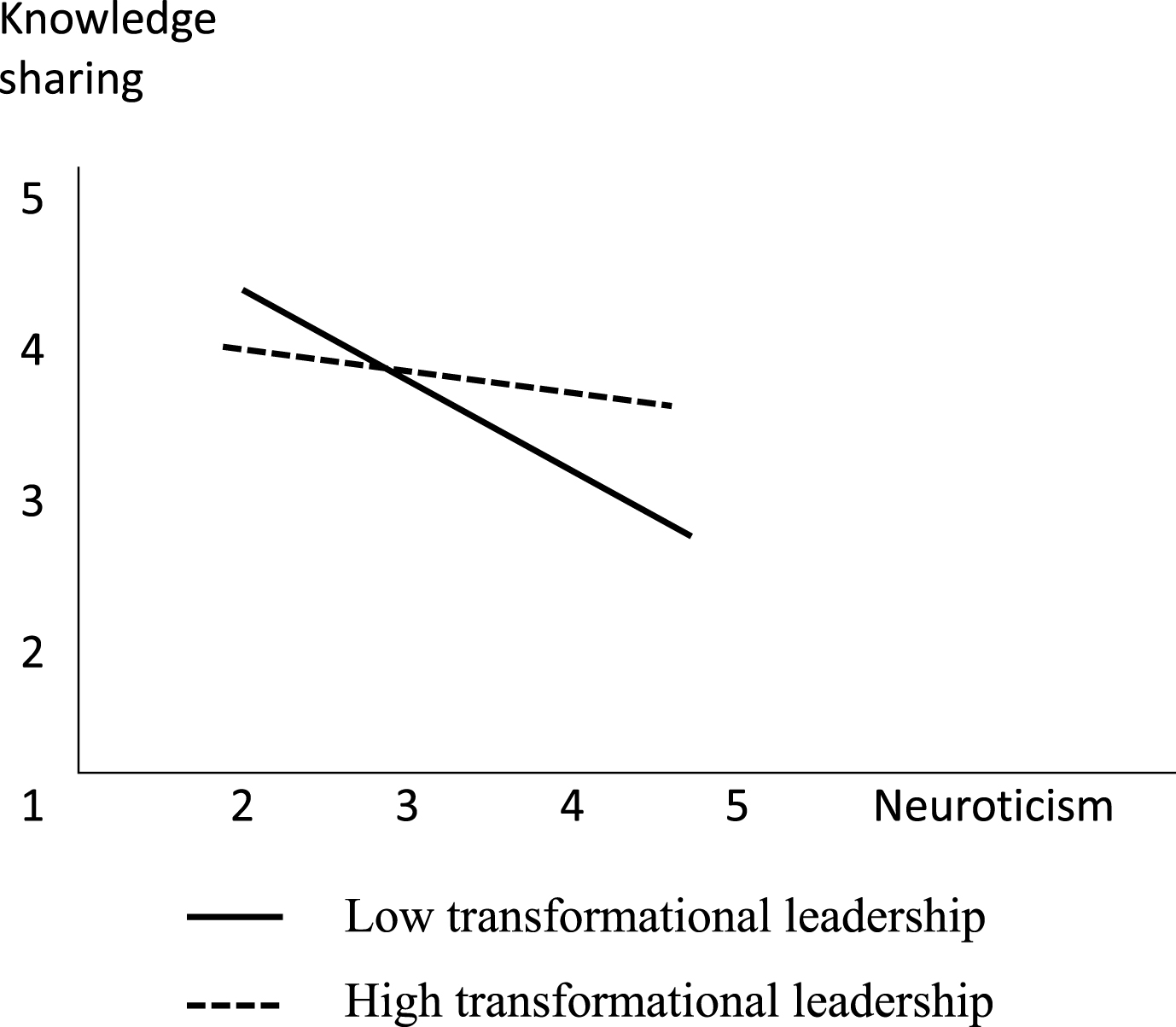
Transformational leadership behavior of teachers providing moderating effects on relations between neuroticism personality traits and knowledge-sharing behavior.
Impact of transformational leadership behavior on relations between personality trait and knowledge-sharing behavior
Note: ***, **, and *indicate p < 0.01, p < 0.05, and p < 0.1 respectively; N = 1,325.
Next, consider Extroversion, leadership behavior, and knowledge sharing behavior as three variables, perform regression analysis with knowledge sharing behavior as dependent variable, Extroversion personality trait and transformational leadership behavior as independent variables, as shown in Model 4–1. In addition, using “Extroversion and transformational leadership behavior cross multiplying” as independent variable, perform regression analysis as shown on model 4–2. The analysis result is shown in Table 3, “Extroversion and transformational leadership behavior cross multiplying” has significant impact on knowledge sharing behavior (β= 0.331, p < 0.1). Therefore, transformational leadership behavior has moderating effect on knowledge sharing behavior for Extroversion personality trait. This study includes Fig. 3 to illustrate the moderating effects of transformational leadership behavior, with X-axis as Extroversion personality trait, and Y-axis as knowledge sharing behavior, solid line representing low transformational leadership behavior, dotted line representing high transformational leadership behavior. As seen in the Fig. 3, the positive slope shows that when a student has a higher Extroversion personality trait, the higher his knowledge sharing behavior. In addition, “positive slope for high transformational leadership behavior” is steeper than “positive slope for low transformational leadership behavior”. When teachers exhibit higher transformational leadership behavior, it is possible to enhance the extent of increasing knowledge sharing behavior of students with Extroversion personality trait.
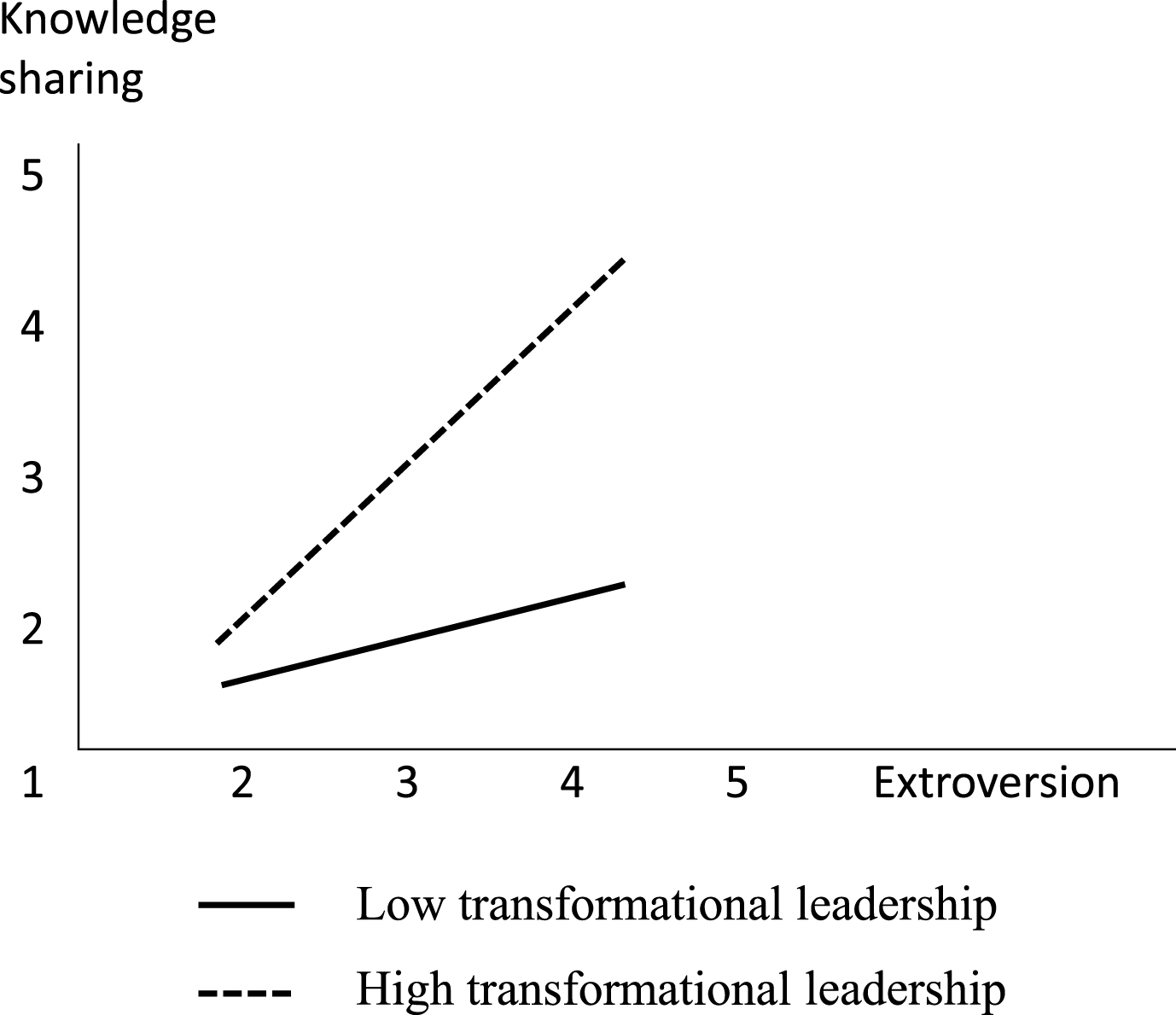
Transformational leadership behavior of teachers providing moderating effects on relations between extroversion personality traits and knowledge-sharing behavior.
This study also examined three other personality traits, Openness to Experience personality trait (model 5–1, model 5–2), Agreeableness personality trait (model 6–1, model 6–2), and Conscientiousness personality trait (model 7–1, model 7–2). Results demonstrate that “Openness to Experience personality trait and transformational leadership behavior cross multiplying” does not exhibit significant impact (β= 0.203, p > 0.1) on knowledge sharing behavior. Therefore, transformational leadership behavior does not have moderating effects for Openness to Experience personality trait. “Agreeableness personality trait and transformational leadership behavior cross multiplying” does not exhibit significant impact (β= 0.066, p > 0.1) knowledge sharing behavior. Therefore, transformational leadership behavior does not have moderating effects for Agreeableness personality trait. “Conscientious personality trait and transformational leadership behavior cross multiplying” has significant impact (β= 0.391, p < 0.05) on knowledge sharing behavior. Its moderating effect is the same as that for Extroversion personality trait, that is, high transformational leadership behavior teachers will enhance the extent of increasing knowledge sharing behavior of students with Conscientiousness personality trait. Therefore, teacher’ transformational leadership behavior, has a moderating effect on knowledge sharing behavior for Conscientiousness personality trait (in the Fig. 4).
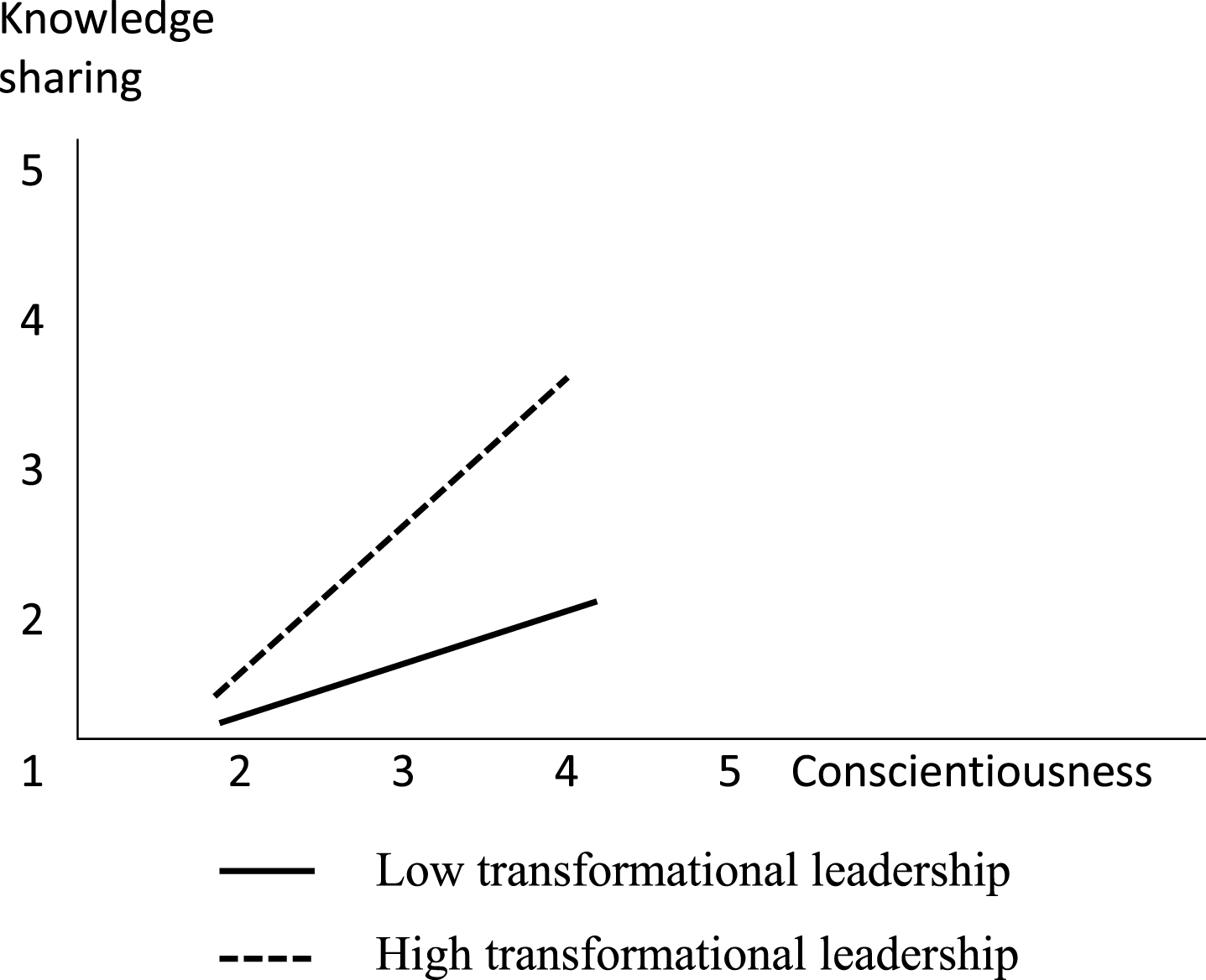
Transformational leadership behavior of teachers providing moderating effects on relations between conscientiousness personality traits and knowledge-sharing behavior.
Research conclusion
Knowledge is an important strategic asset for individuals and organizations. Therefore, it is necessary to conduct research to identify important factors that affect knowledge sharing behavior, and to provide effective incentives for knowledge sharing [13]. This study explored the nature of influencing factors on knowledge sharing behavior on three different levels, namely, the personal-level, organizational-level, as well as interaction between personal and organizational level.
In terms of personal-level, based on the theory of personality traits, individual personality traits differences would directly affect individual behavior. Therefore, students’ knowledge sharing behavior within the classroom should be affected by different personality traits. Empirical study shows: Openness to Experience personality trait, Agreeableness personality trait, or Conscientiousness personality trait has significant positive influence of students’ knowledge sharing behavior.
On the organizational-level, university teachers are the leaders in promoter of public education. Moos [39] also points out, teachers’ leadership behavior is the pivotal factor for the classroom environment. The study empirical research shows: teachers’ transformational leadership behavior severs as a positive influence for students’ knowledge sharing behavior. That is, when teachers create a classroom atmosphere full of trust and respect using their professionalism and personal charisma, they’re more likely to form a class consensus for integration of related class resources, enhancing students’ willingness for knowledge sharing behavior.
In terms of interaction between “personal-level” and “organizational-level”, when the Person-Organization Fit is greater, positive behavioral influence occurs more easily. The empirical results of this study shows: teachers’ transformational leadership behavior has moderating effects of different personality traits on knowledge sharing behavior. For students with Extroversion or Conscientiousness trait, teachers exhibiting higher transformational leadership behavior can significantly increase students’ knowledge sharing behavior. For students with Neuroticism traits who are less willing to share their own knowledge, teachers exhibiting higher transformational leadership behavior may significantly reduce their reluctance for knowledge sharing.
These results are essential as they extend existing literature on knowledge management by taking personal dispositions as influencing factors of knowledge sharing into account and presenting empirical evidence. It makes a relevant contribution to the literature on personality psychology and organization studies as well, as these links have not been studied before.
Research recommendations
According to the results of empirical research, the study proposes the following ideas: teachers should pay attention to individual students’ personality trait differences. People with different personality traits tend to exhibit different behavior and attitude, and may be better suited to different types of leadership behavior. If teachers could provide the most appropriate leadership behavior based on students’ personality traits, with diversified teaching methods, they should be able to establish appropriate organizational atmosphere, create better learning environment, present interaction and mutual knowledge sharing between students, to help the students learn effectively. While leading students, teachers are advised to gain a better understanding of students’ basic personality traits through appropriate channels, or make recommendation for the educational institution to gather students’ personality traits through appropriate methods ahead of time, and provide such information to teachers after analysis and summarization. Based on students’ characteristics, teachers shall provide the most appropriate leadership behavior to create the best teaching and learning environment.
Many past researches have proven that knowledge sharing is a valuable tool. The power of knowledge is enhanced when it is shared, making it a worthwhile activity. Therefore, it is a major task for teachers to learn how to establish mechanisms conducive to knowledge sharing among classmates, encouraging students through a stable and consistent knowledge sharing process, establish effective group knowledge, to enhance the effectiveness of students’ self-learning activities. The result of the study shows that teachers’ transformational leadership behavior is a key factor influencing students’ behavior. When a teacher proposes a clear, forward looking vision, and obtains the students’ endorsement to establish an excellent environment and interactive model which will enhance the students level of thirst for knowledge, teachers will be able to effectively develop information students’ knowledge sharing behavior, accomplishing learning results exceeding expectations.
The positive effects of teachers’ leadership behavior towards students’ knowledge sharing behavior cannot be overlooked. Therefore, educational institutions can regularly provide teachers leadership training types of forms and classes, to enhance teachers’ knowledge and techniques regarding leadership behavior. Teachers should also enhance their skills and strategies for transformational leadership behavior, such as enhancing personal charisma, design motivational enhancing mechanisms, and intellectual stimulation, etc. In addition teachers are advised to utilize intentionality management, that is, to establish intentionality to guide students to invest emotions to actively reach their purpose. Teachers should also actively cultivate personal leadership charisma. Teachers are also advised to have high confidence in high expectations from their students, frequently using verbal and action to support students, to stimulate students’ willingness to learn, motivation, and interests. Teachers also need to more actively guide their students to consider questions from diversified point of views, to evoke and change students’ awareness of problems and solutions, inspiring the students thought process, imagination, beliefs, and value system. Lastly, teachers should care about each student’s unique developmental needs, individual differences, and help students fulfill their personal potential, enhancing students’ self-growth capability.
Using questionnaire survey method, based on research literature and hypotheses models based on theoretical constructs, regression analysis was performed on relations between the big five personality traits, leadership behavior, and knowledge sharing behavior. Hopefully, this research will provide assistance to the review and improvement efforts for a new way to rethink the nature of higher education and educational methods.