



Abstract
This empirical study’s intent was to assess the role that remittances play in the economic growth and self-development of low-income country regions. The diverse results in previous studies necessitate using a proper methodological approach. Namely panel co-integration analysis allows gauging the long-run interactions among growth, remittances, and self-development. Having confirmed, via the augmented Dickey-Fuller (ADF) test, the dynamic equilibrium of the data, gleaned from 31 low-income countries over the 1991–2015 time period, the cointegration between economic growth and remittances was established through the Johansen panel test. Pertinent to heterogeneous cointegrated panels, the fully modified ordinary least squares (FMOLS) results show that remittances have a significant, positive effect on long-term economic growth. Besides, the study’s empirical results also unconceal the significant, long-term effects of economic growth and remittances, facilitating self-development in low-income regions, in terms of finance, savings, trade, and labor-force participation, except that of household consumption. And an endogeneity test strongly suggests the need for policymaking towards obtaining maximum benefits from the increased inflows of remittances. Despite its limitations, the study offers pragmatic policymaking recommendations, along with future research directions.


Introduction
Worker remittances are money transfers by migrants from abroad to their home countries, one of the biggest financial inflows into developing economies. Frequently, remittances exceed other inflows, such as, for example, those of investment capital and official development assistance [1]. Indeed, remittances have been providing financial assistance for generations, facilitating the self-development of human beings and organizations. Given that self-development is only way human beings and organizations can develop, by developing themselves, human beings and organizations enhance their performance [2]. In fact, remittances might even exceed foreign direct investment (FDI) in economies that are profoundly dependent on them [3].
Consequently, the effect of foreign remittances on economic progress and the catalyst role they play in increasing human and organization self-development wax the interest of policymakers and business researchers. Certainly, some research argues that foreign remittances have a significantly positive effect on economic growth [4]. In spite of their evident success, however, other research finds a deleterious effect on economic growth, owed to remittances’ compensatory nature [5]. Remittances may encourage the receiving country to decrease its trade deficit and external debt [6].
The importance of the increased flow of remittances has been explored widely in several studies. Numerous studies address the impact of foreign remittances on poverty reduction and on economic growth [7], while contrasting studies have shown a negative impact on economies, as recipient economies may face corruption [8]. As per the principle of economics, savings or earnings are not useful until they are invested well, that is, invested in productive sectors where they can create employment opportunities. Remittances provide financial support for small entrepreneurs while assisting them to innovate and gain business insights and finance their conversion of innovations into goods [9]. Foreign remittances as vital catalyst for speeding up and empowering human and economic development has been broadly scrutinized [10].
The effort to study remittances may be limited by senders’ transferring money by informal means due to high transaction cost of formal channels, reducing the sample available to study and skewing available data. However, this study determines the role of remittances in boosting economic growth and facilitating self-development using a logical framework to distinguish long-run effects from direct impact.
Figure 1 shows that the flow of remittances to low-income countries from 2006 to 2015 even exceeds FDI inflows. The figure shows a rise in remittances from 3.8 percent of gross domestic product (GDP) in 2006 to 4.2 percent in 2008 to 4.4 percent in 2009. From 2009 to 2014, remittances increase from 4.4 percent to 4.9 percent and then rise to 5.5 percent in 2015. Because of the expected increase in growth from rising remittance inflows, researchers have suggested that remittances play a noteworthy role in regions’ long-run economies by facilitating the development of people and companies.
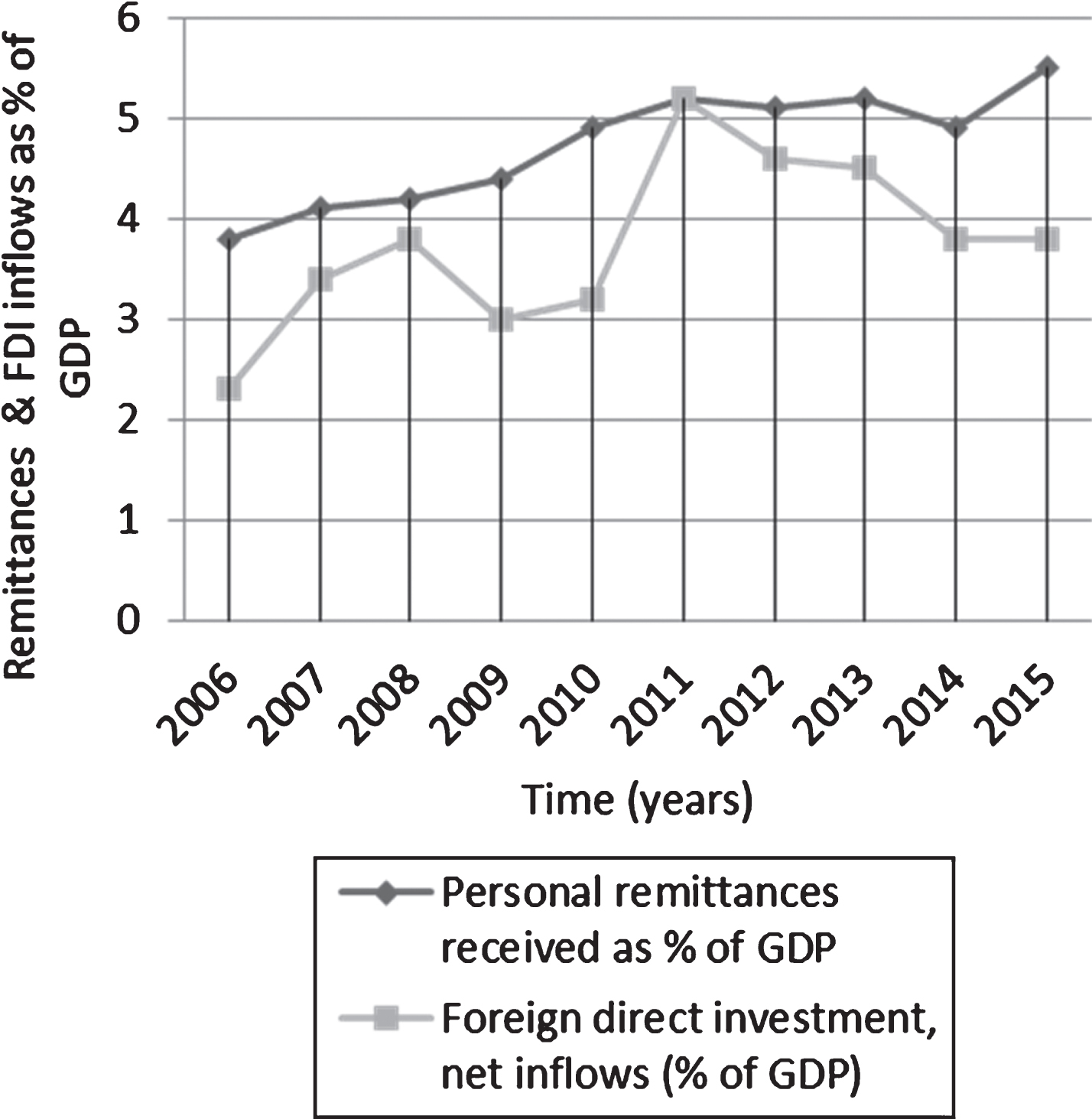
The inflow of remittances and FDI in low income region from 2006–2015 Source: World Bank 2016.
This study presents evidence for how remittances interact with growth while facilitating self-development in low-income regions—those with income per capita of $1,025 or less in 2015, measured through the World Bank’s Atlas method (WDI).
The remainder of the article proceeds as follows: Section 2 comprises a literature review and supporting theories, Section 3 deals with data and methodology, Section 4 presents and discusses the empirical results, Section 5 provides a conclusion, and Section 6 describes the study’s limitation, presents policy recommendation, and suggests direction for future research.
The literature on migration has revealed a positive effect of migration on human development, supported by theories based on the new economics of labor migration (NELM). Consequently, migration is a dependable strategy for inferring the risks incurred by foreign and local markets, particularly for developing countries, where public and cash credit services like health insurance are less available and more costly than they are in developed countries [11]. Remittances are often the only means of income for households in developing countries, so they can decrease poverty and improve living standards [12], and improve basic health care and nutrition [13], all of which are conditions for personal and economic development [14]. These impacts of remittances are reflected in the NELM viewpoint, which sees foreign remittances as unambiguous family loans (e.g., [15]).
Remittance encourage the development of “self-made” individuals through entrepreneurship. Several studies have addressed the aspects of entrepreneurship as they relate to remittances [16] and have examined the impact of entrepreneurship on economic growth. How remittances are invested and spent in recipient countries has significance for their economies. In the 1950s and 1960s, an influx of capital to developing countries contributed to their transformation and industrial progress, and emigrants moved to these countries for good-paying jobs and the chance to send money home. These inflows boosted the economies of their home countries [17].
The positive outcomes of these remittances and their positive association with growth are made clear when remittances are regressed with other control variables, as in [18]. Remittances interact positively with growth in the economy from decreased uncertainty, accumulation of assets to industry and households, and development of useful infrastructure. Research has found an inverse association of remittances with economic growth in 113 countries [5], but [5] also found the opposite interaction between growth and worker remittances because of moral hazard. Research has also suggested that the effect of remittances on economic development is boosted only in less financially developed economies [19].
Motivation theory addresses emigrants’ motivation to send remittances back to their homes, thereby increasing development in their home countries’ financial sectors and economic growth [17]. Remittances in a sample of seventy-one developing countries analyzed using ordinary least squares (OLS) indicated their significant role in decreasing poverty, along with its depth and severity [20]. Whether workers’ remittances encourage growth in the economy was addressed in [21]’s study by analyzing eighty-four economies for 1970–2004, and the authors found a negative association between economic growth and remittances. Another study, [22], applied the Johansen co-integration test to annual data from Turkey for 1970–2005 to determine whether worker remittances are linked in the long term with economic growth.
Measuring a panel of ninety-five emerging economies, [23] proposed that remittances have a basic role in impacting an adverse output shock. Remittances can be used to finance long-term projects, so financial markets can perform well when remittances boost development [24]. When remittances are used wisely, financial intermediaries can avoid any threat from them, as [25] found in an analysis of the association between economic growth and remittances in three Asian countries—Bangladesh, Sri Lanka, and India—using annual time series data for 1975–2006. The authors used Granger causality tests and co-integration to analyze short-term and long-term interactions and found a two-way association between remittances and economic development in Sri Lanka and Bangladesh but no such association in India.
In a recent study, [26] examined the link between workers’ remittances and economic growth in an analysis of sixty-four Asian, African, and Latin American-Caribbean countries for 1987–2007 by applying co-integration and panel unit root tests and found a direct and positive association between economic growth workers’ remittances in all countries. The authors analyzed a sample of seven developing African countries in Africa with a dynamic modeling approach using time series and co-integration analysis for 1986–2007, and proposed that the presence of a market-based financial sector encourages growth by increasing efficiency and productivity. Quantitative results from [27] showed that capital accumulation through development in the banking sector directly effects economic growth.
The literature has focussed primarily on the financial development of remittance-receiving countries [28] and their improved financial development and economic growth [29]. The research of [30] examined the effect of foreign remittances and development in the financial sector on economic growth by using Johansen’s vector autoregression (VAR) method for 1976–2011. The research postulated that remittances and financial sector expansion determining economic growth in the long run and act as shock absorbers for variations in income in the short run. Some studies have also found that remittances are inversely linked to the amount of income in recipient countries [31], where remittances have an opposing effect on variations in food prices and household consumption [32]. These remittances reduce instability in output growth for developing countries [33] and react positively to natural catastrophes too [34]. Research has also found a positive effect of foreign remittances on financial inclusion by measuring household survey data in EI Salvador because of the impact of using deposit accounts on financial inclusion [35]. The interaction between development and remittances was examined in [36], who used OLS and fixed- and random-effects models for panel data on ninety-nine developing countries. The study revealed a positive interaction between remittances and human development. Remittances’ effect on human development was analyzed in [37] using quantitative analysis on data from 1990 to 2005 and applying the OLS method. The analysis identified a positive effect of remittances on changes in human development, indicating remittances’ vital role in human development, especially compared to FDI and exports.
Remittances’ impact on Albania’s gross domestic product (GDP) and living standards was identified by [38], who used data from 1992 to 2012. Families in Albania use remittances for basic needs like health services and food, so with a decrease in remittances, the quality of life declines, which also affects the percentage of GDP accounted for by remittances [38]. Research has also analyzed the impact of remittances on youth participation, aspirations, and educational attainment in southern Mexico using logistic regression analysis and OLS with data from 2007 to 2008 [39] and the positive effect of remittances on financing in Fiji using data on expenditures and household income obtained from a 2002–2003 survey of 5,245 households [40]. A causal interaction between financial development and human development in Bangladesh was found by [41] with the help of data from 1980 to 2011.
The literature review reveals both positive and negative interactions among remittances, economic growth, and self-development, so the present study attempts to clarify the true contribution of remittances to economic growth and self-development.
Econometric methodology and data source
Model specification
The purpose of the current study is to use panel co-integration analysis to determine the long-run relation between remittances and economic growth in facilitating self-development, while incorporating savings, households, labor, financial development, and trade openness in low-income countries. The association among these variables determined using Equation (1):
The econometric specification of the link between remittances and economic growth in the context of self-development in terms of savings, household consumption, labor force participation, financial development, and trade openness is shown in Equation (2):
Data for all variables in the study are extracted from the World Development Indicator website (WDI 2016) for thirty-one low-income countries from 1991 to 2015. Economic growth is measured as GDP in constant US dollars. PR is calculated as the ratio of personal remittances to GDP. S is measured as the ratio of gross domestic savings to GDP. The association of savings to GDP can be direct, as a positive relation can boost the economy, while a negative association depresses it. H is measured as the ratio of household expenditures on consumption to the GDP. L is calculated as the percentage of the total population that are age 15–64. FD is used to analyze the association of growth with financial development and is measured using the ratio of the domestic credit provided by the financial sector to GDP. TO is measured as the ratio of trade to GDP.
Empirical results and discussion
The results show that remittances assist economic growth and facilitate self-development in developing countries whose people travel to richer countries to money to improve their standard of living. Eviews 8.0 software is used to estimate the results and to carry out a four-step empirical examination using panel unit root tests, Johansen’s panel cointegration, fully modified ordinary least squares (FMOLS), and Granger’s causality test.
Panel unit root tests
Before finding the cointegration between variables, we checked the stationarity of our data using panel unit root tests: the augmented Dickey-Fuller (ADF) test, the Fisher chi-square test, and the Levin, Lin and Chu test. The stationary quality of the variables was analyzed using panel unit root tests in [42], and the ADF panel unit root test was suggested by [43] based on [44]. The Levin, Lin and Chu test, which is based on the principle of the ADF, is used for the balanced panel, where we assume our autoregressive coefficients stay constant for all units of the panel. The generalized equation for the Levin, Lin, and Chu test is shown in Equation (3):
Where k i indicates p value for cross section i from an individual test of cointegration.
None of our variables are stationary at order (0), As shown in Table 1, the results of the Levin, Lin, and Chu test and the ADF show that the variables are integrated at order (1), so they hold unit root as reported, and all are stationary at the 1st difference.
Panel unit root estimates
Results are significant at the ***, **, * or 1%, 5% and 10% confidence levels, respectively.
To assess the long-run associations among the variables, we employ the Johansen panel co-integration test. We used [45]’s test for co-integration of heterogeneity based on residual dynamics and because of its ability to elaborate the endogeneity of all the regressors included in our relations. As shown in Equation (5), the test calls for the residuals’ assessment from the cointegrating static long-run association for a time series panel of a sample with observables Y
i
t.
Pedroni test results
P values are significant at the ***, ** and * or 1%, 5% and 10% confidence levels, respectively.
Pedroni test results
P values are significant at the ***, ** and * or 1%, 5% and 10% confidence levels, respectively.
While [44] developed a method with which to obtain outcomes of independent individual tests, [43] suggested an alternative method using the Fisher test’s result to test panel data cointegration by combining tests from each cross-section to acquire test statistics for the whole panel. If Si is the p-value from cross-section i of an individual cointegration test, then, according to the null hypothesis regarding the panel is shown in Equation (6):
By default, the N2 value in Eviews calculated on the basis of [46]’s p values meant for Johansen’s cointegration maximum eigenvalue test as well as trace test. The results of the Fisher test show equations of co-integrating vectors with significant p-values for maximum eigenvalue and trace tests till at most 6, as shown in Table 3.
Fisher test results
Probabilities are calculated via the asymptotic Chi-square distribution and are significant at the 1%, 5% and 10% or ***, ** and * confidence levels, respectively.
After confirming the long run co-integration among the variables, we move to assessments of their long-run association. In the presence of co-integration, OLS results do not show efficient outputs, so we use the method [47] proposed to analyze the long-run coefficients, the estimator of the panel FMOLS. We analyze the long-run interaction between remittances and economic growth, facilitating self-development in low-income region by applying the FMOLS estimator to the panel data. We chose the panel FMOLS (PFMOLS) over the OLS method because of the ability to solve both the potential endogeneity and the serial correlation problems we face in the application of OLS estimators. Our calculated long-run effect of remittances on the growth of the economy is totally with theoretical support for the region of our study, and the association of the control variables with economic growth is significant. Table 4 reports the results of the PFMOLS, where the coefficient of the association between economic growth and personal remittances has the anticipated positive sign, indicating a long-run positive association between economic growth and emigrants’ remittances. Self-development, including savings, participation in the labor force, financial development, and TO, also shows a positive long-run interaction with growth. Our savings variable has a positive and significant link with economic growth, suggesting that people who save money from foreign remittances focus on improving their standard of living, leading to self-development. Concerning the use of remittances for daily consumption purposes and necessities of life, our results indicate a negative but insignificant relation between expenditures on household consumption and economic growth because of recipients’ propensity to save money. However, the association between participation in the labor force and economic growth is positive and significant, indicating that flourishing industry is associated with people’s tendency to work. In the long run, people who receive remittances can improve their standard of living by investing in their education and not being idle. Industrial development also occurs when there is sufficient skilled labor. Financial development also has a positive and significant association with growth, as the financial sector flourishes when remittances are channeled to them from people’s increased savings. Our analysis also shows that TO has a significant and positive interaction with economic growth, indicating remittances’ role in increasing economic growth and facilitating self-development through increased savings, participation in the labor force, financial development, and TO. The R-square and adjusted R-square are high, at 0.902443 and 0.891248, respectively, suggesting that the model is good fit for our data.
Panel fully modified ordinary least square estimates
Panel fully modified ordinary least square estimates
P values are significant at the ***, ** and * or 1%, 5% and 10% confidence levels, respectively.
We performed the Granger causality test that [48] proposed to determine whether variable X Granger causes Y when the values of X from the past help to forecast Y after adjusting for the values of Y in the past, or when the coefficients with values lagged by X are statistically significant. Causality model for endogeneity test can be expressed as shown in Equations (7) and (8):
The results, shown in Table 5, suggest that, in low income regions, there is no causality effect of remittances on economic growth as well as growth also have no causality impact on remittances in the short run. As a result of the endogeneity test, we suggest that low-income regions establish policies that will to take full advantage of interaction between remittances and economic growth.
Pairwise test of Granger causality
n.s n = not significant.
This study uses panel data from 1991 to 2015 to analyze remittances’ effect on economic growth and self-development in terms of savings, financial development, participation in the labor force, and TO in low-income regions. Particularly in these regions, the flow of foreign remittances has increased over the last several decades. This study uses the Johansen co-integration test with FMOLS to reveal the long-run interaction between foreign remittances and economic growth and their combined effect on organizational and human development. A Granger causality test was employed to check the likelihood of an endogenous association between foreign remittances and growth in the economy. Our research shows a long-run, positive association between growth and remittances, indicating their long-run contribution to human and organizational development in low-income regions.
Foreign remittances contribute to developing economies especially when they contain a growing financial sector. In addition, there is considerable potential for human and business development with the interaction between remittances and economic growth. Analyzing the expected endogenous association between foreign remittances and economic growth and its facilitation of human and organizational development suggests the need for policies that channel remittances in productive ways because they have no endogenous association with growth in the short run. Therefore, we reveal the importance of policies to manage the use of remittances more proficiently to assist economic development and facilitate self-development in low-income regions. Our results are robust and stable, as shown in the use of various specifications, econometric methods, and samples. The study and its results have useful implications for the International Organization of Migration, governments, central banks, financial analysts, researchers, especially those who make decisions related to the interplay of foreign remittances with economic growth and self-development.
Limitation, policy recommendation and direction for future research
Our research is not without limitations, which provide an avenue for future studies. First, this study has taken only formal channels of money transfer into account. Therefore, future research should consider informal channels of money transfer to get the broader picture. Also, there is more need to gain insight into transfer mechanism with institutional development and feature of low cost transactions.