



Abstract
As a singularly important tourism group, women have unique perceptions and preferences, regarding the travel-information platforms that influence their tourism decisions. Based on the societal-development capital, technology acceptance and societal psychology constructs, this article proposes and empirically assesses an innovative research framework, in the tipping-points context. The empirical study discloses important effects by the pivotal virtual community, informational and environmental factors in China. The results show that collegial group centrality has a positive effect on participative behavior, while the latter, along with perceived usefulness and imitation of others, have positive effects on usage behavior. Besides, gender plays a moderating role in the relation between collegial group centrality and imitation of others-usage behavior. Despite the study’s limitations, these empirical results enable future researches to conduct comprehensive, dynamic studies of women tourists in the virtual tourism communities. And accurate perceptions of personalized needs of specific groups of tourists can substantially benefit travel application or ‘app’ operators.




Introduction
With the rapid development of China’s economy and improving living standards of the people, tourism, as a new industry, has gradually raised its strategic status in the increasingly fierce market economy. In 2017, China’s domestic tourists reached 5.01 billion, with a 12.8% increase over the last year. Domestic tourism revenues exceeded 4.5 trillion yuan, which has an increase of 15.9% compared with the previous year. Tourism has become an important part of people’s daily lives. Based on the rapid development and popularization of mobile communication and mobile Internet techniques [1], many companies such as online travel e-commerce companies, airline companies, tourist resorts, travel agencies and hotels have launched travel apps to build a virtual community based on tourists, attracting more and more visitors with common travel interests, hobbies and concerns to build and expand travel groups relationships, self-organizing team trips, share travel experiences and obtain information [2]. The socialization and mobilization of travel industry not only meets the needs of tourists for information sharing, communication, socialization and entertainment, but also promotes the formation and expansion of tourism virtual communities, and greatly enriches the Internet application environment of “user experience first”, bringing huge business opportunities for tourism industry and providing information service platforms.
With the continuous improvement of women’s social status, education level and economic income, the number of female tourists has increased, and it has become a special and important group in the tourism market. According to the “2018 Women’s Travel Demand Trend Report” released by Tongcheng Co. (one of the largest tourism companies), 71.5% of the respondents indicated that the family’s decision to travel is decided by the wife; The “2017-2018 Women’s Tourism Demand Analysis Report” released by Tuniu Co. (another large tourism companies) also shows that women account for 54% of the annual total tourists. Studies have shown that women’s perceptions, preferences and decisions in the process of tourism demand vary a lot from male tourists [3–6]. Since the 1980s, scholars have paid more attention on female tourists, most of them focus on tourism perceptions [3], experiences [5, 7], motivations [8] and gender differences, etc. [3, 9], as well as specific female tourist behaviors, such as business woman tourist’s choice on hotels [10], limitation factors of single or self-help female tourists [11], travel motivations of female college students [12], difficulties of older women tourists to travel abroad [13] and so on. However, there are few studies focus on the influencing mechanism of female tourists on the development of tourism informationization. Therefore, by integrating relevant important constructs of this area, we explored the effect of three important factors on women tourists’ participation in virtual tourism communities communications and their travel apps usage behaviours from the perspective of “tipping point”, these factors are important characteristics of spreading information, the information structure and the external environment, respectively. Due to time and data collection limitaions in this article, future studies can collect a more comprehensive and larger dataset to conduct more detailed analysis on behaviours of specific groups of tourists. It is of great theoretical and practical significance for tourism companies to deliver more efficient and accurate tourism product information, to create a perfect and effective social tourism virtual community platform, to attract tourists’ attention and to promote their enthusiasms for interactive participation.
Literature review
By combing domestic and foreign research literature, we find that in recent years, the research has been increasing on the participation behavior of tourism virtual community from the perspective of customer behavior, sociology, anthropology, psychology and other multi-disciplinary perspectives [14]. In the condition of tourism, the development of mobile and socialization has changed tourists’ demand for information content and communication mode. This will make their social behavior and unconsciously collective behavior more complicated with the change of environment.
The tipping point perspective
In the early 21st century, Malcolm Gladwell proposed in The Tipping Point that only by focusing on people’s psychology and behavior, thoughts, behaviors, information, products or behaviors can generate popular and spread rapidly so as to reflect the power of the tipping point [15, 16]. The concept of the tipping point is embodied in three aspects. The law of the few focuses on the pivotal influence of the “minority” in the dissemination of information. Among them, “expert” is relatively proficient in required knowledge and information and has certain expertise; The “contact person” is at the center of the group and has the instinct and talent to establish social relations so that it can spread information to various places. The “salesman” can easily gain the trust of others and can persuade others to accept the information with the rules and vision of the group members’ common cognitions. “Expert,” “ contact person “ and “salesman” started and drove the whole process of information dissemination. They also determine the depth and breadth of information dissemination. Adhesion factor method think that the message that starts a popular trend should be memorable, impressive and easy to accept and remember. Because only in this way can be more useful and share more with others. This is to strengthen the attachment of information so as to increase tourists’ initiative of interaction. The law of environmental power emphasizes the importance of the environment and the power of the surrounding groups at the time of the epidemic. This powerful effect may trigger a pandemic that make the individual’s crowd psychology and behavior become more complicate.
From the tipping point perspective, we can see that when companies try to get others to accept their ideas, concepts or products, it is actually changing or infecting them. This can be achieved through the influence of special groups of people who have extraordinary relationships. At the same time, this can be done by changing the content of the communication or making the message easy to comprehend. Of course, this can also be achieved through the influence of surrounding groups to facilitate their final actions. Therefore, it has been widely used in market economy and advertising after the construct of tipping point was proposed. This construct provides a huge impetus for the popular trend of commercial market, product and behavior pattern.
The law of the few
The law of the few focuses on the pivotal figures in information dissemination. In the process of obtaining tourist information, there are scenic spots “expert” that “know everything about tourist products and services” and actively share tourist information with tourists. There are also “contact persons” (such as opinion leaders) who “know a lot of people” and keep in touch and live in virtual community centers. There are “salesmen” who can persuade others to accept information. For tourists, information shared by virtual communities and other social groups is more valuable and objective and accurate. However, opinion leaders are an important and effective information source in the society [17], and they often act as important “contact person”. Opinion leaders can quickly recommend, share and spread information through virtual communities. Therefore, opinion leaders play an important role in process of information dissemination. Both of Van-Eck (2011) and Valente and Davis (1999) find that opinion leaders should be the center position in social networks or groups [18, 19]. The community core members who is located in “center” position are active. They have more opportunities to get better resources from others (such as sequestered techniques, property or management skills, etc.) [20], and more opportunities to publish valuable information, share experiences and opinions, provide suggestions and solve problems of others, guide strong information dissemination effect [21–23]. Leading more topics will help tourists have information superiorities, which will enhance their sense of cooperation and belonging. Therefore, this study chooses “centrality” [24] in structural capital as a variable to measure the importance of members in the central position of tourism virtual community.
The law of adhesion
The law of adhesion focuses on the transmission of information and the expression of information. The rule holds that information can be so strongly attached that it is impressive as long as the information is simply updated and personalized in terms of wording and expression, the structure of the information is adjusted and the feedback is timely and accurate. Such information will also have a huge impact, have a significant difference of effect and enhance the conductivity of tourism information. We can easily to see that it can make a piece of information more acceptable, easier to remember, use, share and more useful. Previous studies have shown that the use and convenience of information techniques can improve the efficiency of user processing [25]. This can provide the travel app with accurate matching of location and navigation, accurate search of information and full payment of travel. The services provided before, during and after tourism can improve the experience and subjective attitude of tourism customers towards tourism apps [26]. The information that visitors get should be relevant, useful, interesting and novel in form. Such information should not only maintain a high degree of correlation with tourism, but also meet their value demand for information content and recreation demand so as to improve information adhesion. Therefore, this study chose “perceived usefulness” in the technology acceptance model [27] as a variable to measure the degree of information adhesion of tourism virtual community.
The environmental impact of information dissemination
The environmental impact of information dissemination assumes that any small details of time, place, and population in the environment can be a tipping point, producing a powerful effect and causing or altering the movement of trends. Tourists’ choice of destinations, travel itineraries and local shopping and entertainment plans will be affected by the surrounding social groups. This is related to the individual’s crowd psychology. When using the tourism app, tourists only have incomplete or asymmetric information and uncertain decisions [28], or observe that many people (such as prestigious people or leaders and so on.) have made the same decisions, and people are more likely to have the popular mind. Therefore, this study selects the “imitation others” in the behavior of crowds area as the variable to measure the crowd behavior of tourists [29]. It describes the degree to which visitors follow others to make the same decisions or choices when using the travel app and participating in tourism virtual community activities.
Theoretical model and hypotheses
From the review and analysis of the above literature, it can be seen that in the tourism context, from the perspective of the tipping point, the research on the trend of information exchange and social behaviors in the tourism virtual community and the research on the use of tourism apps are still blank. In the context of mobile Internet, self-service tour, put many people together travel, exchange tour, holiday tour, graduation tour and other new forms of tourism have emerged one after another. The role of social media is broader. Tourists’ use of tourism apps and participation in tourism virtual communities is increasingly common, diversified and complicated. On this basis, this article constructs the theoretical model. See (Fig. 1). Here we explained the effects of travel app use and travel virtual community participation behavior.
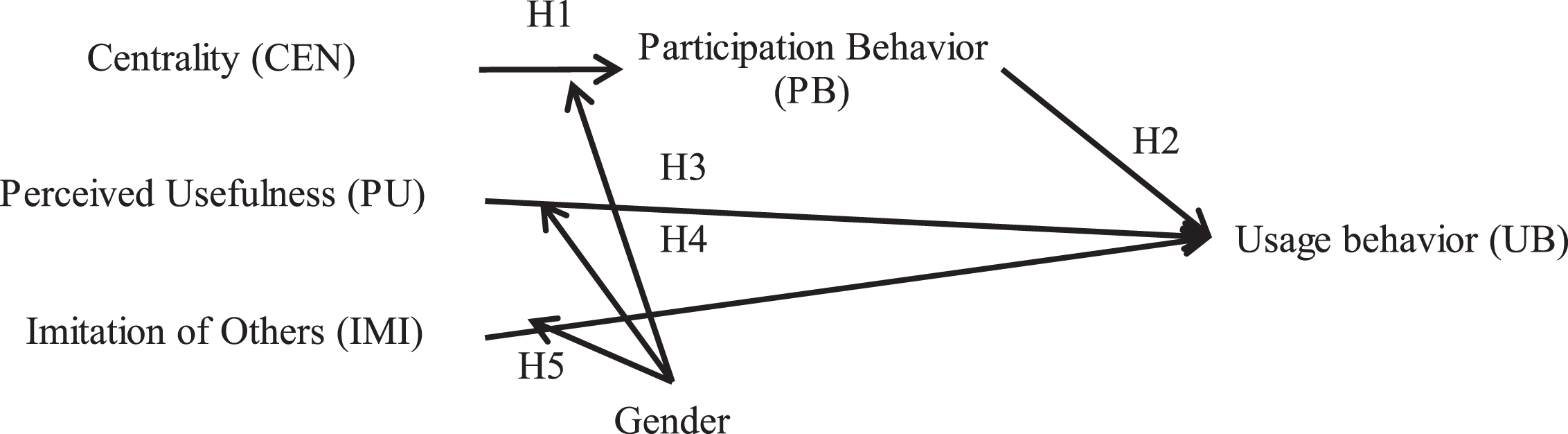
The empirical study model.
According to the perspective of social-development capital, centrality indicates the status of individuals in community relations. In this study, some opinion leaders (tourism talent) are at the center of the tourism virtual community. They are the core members of the community, having a direct connection with other members and influencing the depth and breadth of tourism information within the community. These “contact person” have a wealth of travel experience. At the same time, they like to lead discussions on related topics, initiate travel activities, share their travel experiences and answer questions for other members. This often attracts so much attention that other community members have a sense of trust, while opinion leader play a relative neutral role, representing customers’ own interests and needs, which might be easier to gain credibility [30]. It is possible that the tourist information obtained by tourists comes from the recommendation of these core members. This enables each visitor to feel the cohesion of the community team and has a positive impact on the behavior of tourists participating in the tourism virtual community. At the same time, it is also conducive to the dissemination of tourism information and highlight the impact of individual characters on the participation of virtual communities.
According to the study based on Dholaki and Bagozzi (2004) [31], the participation behavior of tourism virtual community can be interpreted as that tourists gather together to spend a certain amount of time to obtain information, share tourism experience and actively participate in the discussion topics in the community because they have the same interest, similar tourism information and travel demands. The mobile Internet covers a wide range, and visitors can connect the network anytime and anywhere during the whole process of tourism activities. On the one hand, this can meet their personalized travel and dynamic information search needs. On the other hand, it can also meet their needs in travel planning adjustment and information acquisition, booking and payment, travel experience sharing and entertainment socialization. To some extent, the participation behavior of tourists has a significant promoting effect on attracting new members to the virtual community, improving social interaction and promoting the sustainable use of tourism apps. Therefore, we propose the following hypotheses:
H1: The centrality of visitors’ participation in the tourism virtual community has a positive effect on their community participation behavior.
H2: Tourists’ participation behaviors in the tourism virtual community have a positive effect on their using behaviors of travel apps, and the participation behavior plays a mediating role in the “centrality-use behavior” process.
Perceived usefulness pertains to the tourist belief that a tourism app is useful and convenient. According to a survey, tourists describe abundant, timely, accurate and credible tourism information provided by the tourism app in the tourism context by using the term “useful” or “helpful” [32]. This can also add various forms of information transmission of sensory impact (such as video, photo and so on.) to meet the needs of tourists and enhance the sense of information attachment. The higher the efficiency and effectiveness of tourism affairs handled by tourism apps perceived by tourists, the stronger their perceived usefulness will be. As a result, they can use the travel app (UB) more actively.
At the same time, due to the asymmetric tourism information, tourists often feel that their own experience is limited and cannot make correct decisions. However, in the mobile and socialized environment, information forms are diverse and information transmission is rapid, and tourism virtual communities based on common interests can often provide highly feasible suggestions and recommendations. At the same time, the knowledge and opinions of others also strongly influence their acceptance and use of travel apps. This social environment will encourage tourists to follow the crowd mentality and imitate the behavior or decision-making of others (IMI). Mimicking the behavior of travel app users means avoiding the potential risks of making decisions on your own and having a positive and direct impact on the behavior of use (UB). Therefore, we propose the following hypotheses:
H3: The perceived usefulness (PU) of visitors’ participation in the tourism virtual community has a positive effect on their travel apps usage behaviors (UB).
H4: Imitation of others (IMI) of visitors’ participation in the tourism virtual community has a positive effect on their travel app usage behaviors (UB).
In the process of tourism, different physical characteristics, psychological characteristics and social roles of men and women will lead to differences in tourism demand behaviors. They will also show differences in the selection of tourism information platform and social group behaviors. Tourism apps and tourism virtual communities have become more extensive and comprehensive information platforms and social platforms in the tourism industry. When searching for information, women search more comprehensively than men [33]. Moreover, women are more sensitive to social environment and group attitudes than men. Young women have insufficient tourism experience and weak social practice ability, so they tend to believe that the subjective evaluation of tourist destinations by relatives, friends, colleagues and other members of the virtual community with rich tourism experience is more credible. The advice of opinion leaders in the tourism virtual community is more useful. Women are willing to communicate with others in the tourism virtual community in order to obtain more comprehensive information [34], establish a harmonious relationship and upload photos, upload video, and make comments, so as to attract the attention and approval of other community members [35]. This shows that women prefer experiential sharing. In conclusion, women believe that the rich, accurate and flexible information provided by tourism apps and tourism virtual communities can meet their needs in the process of tourism, make friends and get advice from others. If they feel this way, they will perceive the usefulness of the travel app and the tourism virtual community, the centrality of community opinion leaders and the role of imitating the behavior of others, and then they will be more active in constructing and participating in the tourism virtual community activities. Therefore, we propose the following hypotheses:
H5a: In the “Gender centrality (CEN)-Participation Behavior (PB)-Usage behavior (UB)” part, the first half has a moderating effect, that is, for young women, the centrality triggers a higher level of participation behavior, thus resulting in a positive impact on the usage behavior.
H5b: Gender has a moderating effect in the relation of “Perceived Usefulness (PU)-Usage Behavior (UB)”, that is, for young women, perceived usefulness triggers a higher level of usage behavior.
H5c: Gender plays a moderating role in the relation of “Imitating others (IMI)-usage behavior (UB), that is, for young women, imitating others triggers a higher level of usage behavior.
On the basis of reading and collating a large amount of studies, we explored the influencing factors of participation behaviors in virtual tourism community and usage behaviors of tourism app, and designed the scale and collected questionnaires.
Research design
According to the research content and questions, the questionnaire contains personal basic information and core concept measurement scale. The questionnaire items of all core concepts are all from the foreign classic literature, including 4 items of “perceived usefulness” (Davis, 1989) [27], 3 items of “centrality”(Tsai and Ghoshal, 1998; Wasserman and Faust, 1994)[36, 37], 3 items of “model others” (Sun, 2013) [29], 2 items of “participating behavior” (Dholakia, Bagozzi and Pearo, 2004) [31] and 2 items of “using behavior” (Davis, 1989; Malhotra and Gelletta, 1999) [27, 38]. All the scales used in the above studies were likert scale 5. Among them, 1 means completely disagree and 5 means completely agree.
In order to ensure the universality of the measurement of western scale in the context of China, the author invited four doctoral students majoring in tourism and academic experts to translate all the referenced measurement questions into English and Chinese. At the same time, they also deleted, revised and improved some questions to ensure the scientific, reliable and universality of the questionnaire in the Chinese context. Note the explanatory statements and declaration information in the questionnaire in the light of the Link and Mokdad (2005) study [39]. The final questionnaire is generated.
Sample and data collection
According to the purpose of this study and the research plan, the following two methods of questionnaire collection were selected: paper questionnaire and online questionnaire. The interviewees can fill in all the questions of the questionnaire as long as they have used any kind of tourism apps and participated in the activities of the tourism virtual community. In this study, a total of 700 questionnaires were issued and 640 questionnaires were recovered, with a recovery rate of 91.4%. In the questionnaire, the experience of using travel apps was set and the questionnaire with the result of “no” was rejected. At the same time, invalid questionnaires with incomplete information or filled out randomly were also excluded. Finally, 607 valid questionnaires were retained, with an effective questionnaire rate of 86.7%. That makes sense. At the same time, this meets the requirement that the sample size is at least 10 times the number of items in the scale. Therefore, the questionnaire recovery rate in this article is ideal. From the perspective of gender, males account for 36.9%, while females account for 63.1%. The proportion of males and females is relatively reasonable. In the past two years, 76.4% of respondents visited more than two times, and 66% of those who used travel apps for more than three months.
Data analysis method
In this study, we use SPSS 19.0 to conduct exploratory factor analysis, use AMOS 21.0 to conduct confirmatory factor analysis to determine the reliability and validity of the data, and calculate the path coefficient and goodness of fit of the model.
Results
Data reliability test and validity test
According to the requirements of scale analysis, the data to be investigated in this study were analyzed with the cronbach’s alpha for reliability, so as to evaluate the reliability, stability and consistency level of the observation topic option data of the core variables. The higher the coefficient value, the higher the reliability between the items. According to the statistical analysis of SPSS 19.0 (see Table 1), the cronbach’s alpha of each variable was above 0.740. The overall reliability of the questionnaire was 0.827. This fully shows that the scale has high reliability.
Result of exploratory factor analysis
Result of exploratory factor analysis
The validity analysis adopts the exploratory factor analysis method to investigate the validity of the measurement indexes in the scale. The correlation coefficient matrix, bartlett sphericity test and KMO test of the variables in this study showed that the KMO value of each latent variable in the scale was greater than 0.770. Bartlett test significance level p = 0.000 < 0.05. This indicates that the structure validity of the sample data is relatively good, and there is a strong clue relation between the topic options. This is suitable for exploratory factor analysis.The principal component analysis (pca) method is used to extract common factors and the maximum variance method is used to implement orthogonal rotation of factor loading matrix to make the factors have naming explanatory property. The rotation factor load matrix was obtained, and the standardized load coefficients were all greater than 0.78. This is evident at a P of 0.01. The results of exploratory factor analysis showed that the scale had good validity. Therefore, the option of measuring all the questions will be retained.
Confirmatory factor analysis was used to further determine the convergent validity and discriminant validity of the question options. The factor loading coefficient of each observation variable is above 0.50 and the height is obvious. The average variance extraction (AVE) values of latent variables are all over 0.50. The combined reliability (CR) values were all over 0.85. This indicates that the observed variables have convergent validity. Test the differential validity of the measured variables (see Table 2). The root mean square of AVE values of each potential variable is higher than the correlation coefficient between potential variables. This indicates that the observed variables have sufficient discriminant validity.
Test of discriminative validity
Test of discriminative validity
Note. **p < 0.1; **p < 0.01; Reliability value is in the parenthesis on the diagonal.
In order to verify the moderating effects of gender in the impact relation of perceived usefulness-use behavior, imitation of others-use behavior, and centrality-participation behavior, we first conducted a centralization of perceived usefulness, imitation of others, centrality and participation behavior, and gender (that is, variables minus their mean values) [40]. Then, we performed regression analysis on the variable relation, as shown in (Table 3).
The regression analysis results
The regression analysis results
Note: *p < 0.05; **p < 0.01; +non-significant.
In model 1, the influence coefficient of perceived usefulness on the use behavior was 0.241. This is positively significant, so the hypothesis H3 is validated. In model 2, the interaction coefficient of gender and perceived usefulness was 0.012. This result is not significant. This prescriptive regulation effect is not significant, so suppose H5b is not verified. In model 3, the influence coefficient of imitating others on using behavior is 0.359. This is positively significant, so H4 is validated. In model 4, the interaction coefficient between gender and imitation was 0.126. This is positive significance. This suggests that gender plays a moderating role in the imitation of other people’s use behaviors. So let’s say that H5c is validated.
Gender plays a moderating role between independent variables and intermediary variables in the relation of centrality, participation, and use. So this is a mediating model. The focus of the model lies in the mechanism of action of independent variables on dependent variables through intermediate variables. First, model 5 shows that the main effect coefficient of independent variable on dependent variable is 0.280, which is positively significant. Model 10 shows that the influence coefficient of the independent variable on the intermediate variable is 0.281, which is positively significant. So, hypothesis H1 is verified. Model 6 shows that the main effect coefficient of the intermediate variable to the dependent variable is 0.470, which is positively significant. Model 7 shows that the effect coefficients of independent variables and intermediate variables on dependent variables are respectively 0.244 and 0.457, both of which are positively significant. It can be seen that the participatory behavior has a partial mediating effect in the relation between centrality and use behavior. In the mediating action, the mediating effect is verified, that is, the hypothesis H2 is verified.
The mediators are regulated by the regulating variable. That is to say, what is the difference in the strength of the effect between men and women? The test procedure for regulating mediating effect recommended by Wen Zhonglin and ye Baojuan [41] was adopted. The first step is to test whether the direct effects of independent variables on dependent variables are regulated. Model 8 shows the result of direct central effect, showing the interaction coefficient is 0.117. This is not significant, so the direct effect is not regulated. Step 2: check the radius before adjusting. Model 11 shows that the coefficient of independent variable a1 in the forward regulation of gender is 0.312, which is significant, while the interaction coefficient a3 is 0.406, which is significant. Model 9 shows that the effect coefficient b1 of the mediator on the dependent variable is 0.457, which is significant. When U = 0 (male), the mediating effect was 0.143; when U = 1 (female), the mediating effect was 0.328, and the mediating effect was 0.185, assuming that H5a passed the test.
AMOS 21.0 software was used to verify the theoretical model and the structural equation model. The goodness of fit index of the model and data adopts chi-square/degree of freedom (edition 2/df), comparison fitting index (CFI), TLI, progressive residual mean square and square root (RMSE), and quasi-root residual (SRMR) as the main reference indexes (see Table 4).
The fitness index of SEM
The fitness index of SEM
First of all, centrality has a significant effect on participation behavior. Participation behavior has significant influence on usage behavior. Participation ACTS as a mediator between centrality and use. It can be seen from this that crucial members (such as opinion leaders) at the center of the tourism virtual community deliver more accurate information and more effective advice to tourists. This has a great promoting effect on the behavior of tourists participating in the virtual community. At the same time, it also forms a certain cohesion in the community, and improves the frequency of using the travel app.
Secondly, both perceived usefulness and imitation of others significantly influence use behavior. The impact of social groups on tourists’ use of tourism apps is the greatest and the crowd effect is obvious. This reflects the characteristics and influence of socialized environment in the process of tourism development. Because tourists can obtain accurate and effective tourism information and feel the usefulness of the information, this also encourages tourists to use the tourism app. This enables people to use the travel app habitually and continuously to complete booking, payment, adjust travel plans and make correct travel decisions.
Thirdly, gender has no moderating role in the relation of perceived usefulness - use behavior. Gender plays a moderating role in the relation of mimicking others-using behavior. Gender plays a moderating role in the first half of the mediating relation between centrality - participation - use behavior. Therefore, it can be seen that there is no obvious difference between women and men in the process of promoting the use of travel apps by the perception of information usefulness. However, women are more sensitive to social groups than men. Women are more trusting of opinion leaders. Women have greater willingness and attitude to use travel apps.
Conclusions
The use of tourism apps and the participation behaviors of virtual tourism community activities are complex psychological behaviors and technological impact processes. Therefore, in the context of tourism, this article has very important theoretical and practical implications.
Discussion and contribution
The theoretical model constructed in this study has two theoretical contributions. First, on the basis of mature social-development capital perspective, technology acceptance model and unconsciously collective behavior effect, from the perspective of tipping point, innovative theoretical model is proposed. This explores the critical role of the virtual community, the information itself and the environment. The results showed that gender played a moderating role in the relation between centrality-engaging behavior and imitative behavior—using behavior. Women, however, had a stronger effect on variable relations. This study not only expands the research perspective, but also enriches and improves the research content of tourism socialization. At the same time, this study has both rigorous theoretical support and scientific empirical analysis. Therefore, research has certain theoretical value. Secondly, this study has some applicability. In the context of the Internet, especially the mobile Internet, many scholars and industries in various fields are concerned about how to promote the participation behavior of users, trigger the popularity of products or behaviors, effectively grasping the behavioral characteristics of users and accurately analyzing their needs. The theoretical model constructed in this study is also applicable to the practical application of online education, online learning, financial investment, game and video user participation behavior. Therefore, the research has certain theoretical significance.
Limitations and future directions
Despite the above-mentioned contribution, this article also have few limitations: (1) Due to questionnaire collecting methods limitation, we choose to hand out paper questionnaire in Beijing area, future studies Future studies should expand the sample range, which can help to conclude more precise results. (2) Due to time limitation, this survey was conducted at a specific time point, so we didn’t collect data for the “observing others’ behavior” variable in the behavior of crowds, neither do we continue to record users’ following perception and satisfaction. Futher researches can continue to explore tourists’ behaviors on the social media platform, their continuous usage and the integration from online to offline, thus improving tourists’ demand experiences. (3) We didn’t explore the effect of age profoundly in this article because of data deficiency. Further studies can conduct more detailed analysis on the similarities and differences of women’s behaviours who are at different ages, focusing on their experiences of the usage of apps and virtual tourism communities.
Managerial implications
Women actively participate in the activities of the tourism virtual community and long-term effective use of the information search and booking payment functions of the tourism app can promote tourism enterprises to more accurately obtain tourists’ personalized needs. This is of great practical significance for improving the quality of tourism products and services. (1) when developing and popularizing tourism apps, tourism enterprises should fully consider tourists’ demand for information usefulness and pay attention to the effect of information dissemination. Therefore, it can easily and quickly satisfy the travel information search, travel itinerary planning and adjustment, positioning, mobile booking and payment, communication and sharing which can improve the actual use behavior of tourists [16, 43]. (2) pay attention to the role of core members of virtual communities (such as opinion leaders, travel talent, etc.). Social Media help tourists to share experiences and communicate with each other more easily [44], while many women lack independent opinions [45]. They believe that “first-hand experience is more reliable and important”. Therefore, they will have more confidence in the travel experience and advice provided by opinion leaders. Whether it’s choosing a travel companion, searching for information, completing a transaction or sharing a travel experience, women show a stronger preference than men. Therefore, they are more actively involved in the activities of the tourism virtual community. Therefore, it is important to seek the support and recognition of these indispensable members for corporate tourism products and services and encourage them to share and disseminate information on tourism virtual communities. Make full use of their influence to attract tourists’ attention and maintain good and harmonious inter-community relations [46]. The spreading ability of opinion leaders directly affect tourists’ demand behaviours [47], opinion leader marketing has become one of the new marketing trends, which is very important for tourism companies to promote new products, services and concepts [48]. (3) Widely publicizing tourism apps and tourism virtual communities can make potential users and important people around them more familiar and generate the willingness of adoption and recommendation [49]. Women are susceptible to external factors (information/channels) [50, 51]. Especially when making decisions, women’s influence is spread through groups. Therefore, tourism enterprises must comprehend the needs of female tourists, their actual demand behaviors and the characteristics of mobile Internet platforms, in order to create a suitable environment, stimulate the potential tourism needs of female tourists and enhance the sense of trust, providing personalized and diversified customized products and services that are more consistent with female tourists, which can effectively promote women tourists’ demand [52]. (4) Provide more functional tourism virtual social platform. Women were significantly more likely than men to communicate regularly and occasionally in their communities and to share more. Tourism enterprises should attract and maintain a large number of tourist networks. This can show the commercial and social value of the virtual community and promote the popularization and continuous use of tourism apps [53].
Footnotes
Acknowledgment
This study was supported by the China Women’s College (Grant No. KY2018-0205).