



Abstract
The People’s Republic of China (PRC) has become an international student destination, a phenomenon that requires researching its consequences and implications. This study investigates influences on international students’ decision to leave or to stay in China after completing their studies. Through a snowball sampling technique, empirical data were gleaned from 283 foreign students in different universities in China. Using a binary logit model, the results show that the majority of respondents wish to stay and to work in China. While most foreign students value high wages, many prefer the working conditions and lifestyle in China. Yet some students are cynical about the limited job opportunities for foreigners in China, which compel them to leave after completing their studies. Despite its limitations, this empirical study not only provides pertinent future-research paths but also policymaking recommendations.






Introduction
Since the 1950s, the skilled migration was a very hot issue for both developed and developing countries, and a long discussion over the brain-drain issue emerged in the 1960s. A different school of thought has a different view about killed migration: one school of thought argued that the skilled migration curbs human capital from sending countries and increase income inequality across the countries [1]. Furthermore, skilled migration is considered harmful for the developing countries and blessing for developed countries [2]. Another school of thought argued that skilled migration is beneficial for sending countries in the context of receiving a considerable amount of remittances and increase professional skills of migrants [3].
Internationalization makes it easy for everyone to move from one region to another region for the sake of knowledge exchange and socio-economic reasons [4]. Student migration plays a significant role to fill the labour gap in developed countries [5]. People’s Republic of China (PRC) is the world second biggest economy behind the USA. Recently, China is hosting a massive number of international students and encouraging them to participate in the labour market. According to the ministry of foreign affairs (MOFA), over 440,000 foreigner students in China in 2016, marking a 35% increase from 2012. China attracts more international students than any other Asian countries and ranks third globally, behind the United States and the United Kingdom [6]. Migration is a normal human activity/movement of the individual person or, people from one region or country to another region or country. Non-return intentions of students from host countries to their home countries after graduation is one kind of migration [3, 7]. The trend of student migration is prevalent these days, and students migration has both pro and cons for both receiving and sending countries [8].
From last the two decades, the People’s Republic of China (PRC) is attracting a significant number of students from all over the globe. During the state conference on international education held in Beijing on December 2014, both People’s Republic of China (PRC) current President, Xi Jinping and the Premier, Li Keqiang, addressed the importance of recruiting international students as a national strategy in strengthening the soft power and international competitiveness [6]. The People’s Republic of China (PRC) government’s ultimate intention is to host 500,000 international students, to become the biggest host country for international students in Asia, and a major study destination in the world [9]. The inflow of international students to China has increased from 1236 in 1978 to 328,330 from 189 countries in 2013 [10]. Over the past five years, international students studied in People’s Republic of China (PRC) increased to a large extent, hitting 440,000 in 2016, among the international students in China, 60 percent were from Asia, 18 percent Europe and 11 percent Africa [6]. According to the Chinese Ministry of Education, the recent patterns of international students are reported in (Table 1).
Number, percentage, region, and country of international students in China (2016)
Number, percentage, region, and country of international students in China (2016)
Source: Chinese Ministry of Education: http://en.moe.gov.cn/News/Top_News/201604/t20160420_239196.html.
For most rising destination countries in the globe, their successes depend basically on the development of neo-liberalism, characterized by its export-oriented and market-driven approach towards higher education [11]. People’s Republic of China (PRC) provides a counterexample to the argument for the success of neo-liberalism as a model for the internationalization of higher education. Moreover [12], acknowledge that People’s the Republic of China (PRC) approach towards internationalization fits somewhere between neo-liberalism and the development-state thesis. With the respective policies like “Belt and Road Initiative (BRI)”; Southeastern and Central Asian countries have become important markets for China’s international education and more opportunities. From last one decade, there has been a significant increase of international students coming from Belt and Road Initiative (BRI) countries such as Kazakhstan, Thailand, India, Vietnam, Pakistan, Mongolia, and Malaysia. Contrary to the increasing market share of Asia and Africa, the number of students from developed Western countries has increased rapidly [6]. It observed from the existing literature that there had been a few attempts to look at brain-drain migration in People’s Republic of China (PRC), but these have focused primarily on high-skilled immigration and not international student’s intentions to stay or leave People’s Republic of China (PRC) after graduation specifically. This article is an attempt to fill the gap mention above in the brain-drain migration literature. Therefore, this study empirically investigates the main predictors in predicting international student’s intentions to stay or leave the People’s Republic of China (PRC) after graduation.
This article is different from other studies in many ways: (i) prior studies mainly focused on the theoretical perspective of international student’s intentions to stay or leave People’s Republic of China (PRC) after graduation and to provide a new insight for the policymakers. (ii), to the best of our knowledge, this is the first study of its nature to empirically analyze the international students’ non-return intention in People’s Republic of China (PRC) (iii), and this study has used advanced regression techniques such as logistic regression approach to analyze the data.
The rest of the study is organized in a manner that; section 2 provides a detailed literature review, section 3, explains the methodology and data collection procedure. Section 4, discusses and analyzes the data, and finally, the article is concluded in section 5.
2.1. Theoretical perspective and Migration theories
This section reviews some of the theoretical explanations for skilled human capital migration. The different theoretical background has been proposed to know why international migration happens. Here four comprehensive theoretical background are used to explain why human capital migration: (i) the neo-classical economic model were presented by [13], according to him the wage difference among countries is the key driving player of migration. (ii) [14], presented the model of immigrant assimilation. According to him, migration processes by which people adopt new culture, tradition, and value in the new area. (iii) the new economies of labour model were presented by [15], According to him, migration is a collective decision of households and families for the sake of a better lifestyle. (iv) Standard models of migration presented by [16]. According to him, the income maximization is the key reason for migration from one region/country to another.
The researcher identified a set of predictors that push peoples to move from less developing countries and pull them into the advanced countries [1, 2]. Push predictors include a lack of career opportunities, lack of social security, poor working environments, low wages, safety, week management systems, corruption, and inadequate career development. While, pull predictors include better education, skill development, high wages, better health care, and better working conditions [17–21]. There are three different stages that play a key role when people are making migration decision: desire and intention to move, consideration to move, and expectation of movement behavior [7, 21]. To stay or return intention in host countries mostly influenced by attachment with family and friends in their home country. Moreover, the return intentions linked with their expectations of life in origin countries as compared with their expectation in destination receiving countries [2, 22–24].
High wages and a better lifestyle is the predictor that pull individuals to the destination country [8]. Push forces are very common in developing countries: such as lack of job opportunities, lack of social security. Pull predictor is very common in developed countries: such as high wages, better education, and better lifestyle, etc., [25, 26]. In both push-pull approaches, the pull predictor is more dominant as compared push predictor. Migration is a personal decision, and the importance of these two forces depends on the value a person gives to each of them [17, 27].
The decision to stay or leave the host country to depend on attachment bonds with the host country if the attachment bonds with host country are strong so the migrant will plan to stay at host country otherwise the will leave the host country [12]. The greater respect receives from the host country can increase the chances of foreign students to stay and work at the host country in the future. Moreover, the greater level of support foreign students receives from their teachers, fellow lab mates, and university administration can increase the chances to stay at the host country [10]. The better job opportunities, high wages, better education, and social bond increase the chances of foreign students to stay and work at the host country after completing their studies [28]. The greater the opportunities in the home country pull the foreign student to their home country. Additionally, the social ties of foreign students with their family and friends in the home country increase the chance to leave the host country and back to the home country [8, 9].
Methodology, data collection and model specification
A brief review of the theoretical methodology
The theoretical model presents a comprehensive perspective of the predictors influencing the intention of foreign students recently studying in the People’s Republic of China (PRC). The research model was developed from the predictors that influence international student’s intentions to stay or leave the People’s Republic of China (PRC) after graduation based on random utility theory [29]. The model comes from the family of probability models, known as a discrete choice model. According to the random utility theory, an individual is capable of evaluating the utility associated with a set of viable alternatives and subsequently selecting that he perceives will yield maximum utility [7]. The model is constructed by [28, 30].
Data and methodology
The analysis is based on primary data collected from international students recently studying in the People’s Republic of China (PRC). The new technology has eased the process of collecting responses, and thus in this article, we generated our own microdata based and collect the data online through survey monkey (https://www.surveymonkey.com/). As pointed out by [27], the advantages of the online survey are to minimize the cost, time, real-time access and convenience for respondent. The target population of our study is the group of international students currently studying in different universities in Beijing, People’s Republic of China (PRC). We collect data from different universities in international offices. The sampling frames used for this article are comprehensive, and short-term exchange students are excluded from the survey. The questionnaire was designed based on the following studies; such as [28, 31–33] and reviews of literature books, articles, and related. The questionnaires were measured on a five-point Likert Scale for all explanatory variables, ranging from one to five. A respondent is asked their current return intention, ranging from definitely return, probably return, probably not return and definitely not return. In order to estimate a binary logit model, the responses are then collapsed into two categories – return or not return.
This article employs three different sets of explanatory variables to explain the students’ return/non-return intentions. The set of demographic variables consists of gender, marital status, age. The second set of explanatory variables includes other individual-specific attributes, such as socio-economic background, level and year of study, years of residence in China and years of prior professional working experience. The final set of explanatory variables is composed of perception-related variables, measuring how respondents perceive different aspects of either their home country or the country in which they intend to reside; for example, perceptions of wages, working environment, opportunities to apply knowledge, lifestyle, family ties, network of friends and race equality.
Statistical computational tools, Statistics, and data (Stata), and Statistical Package for Social Sciences (SPSS) is used to evaluate and analyze the primary data. The respondents were asked to provide their demographic information, including gender, marital status, province, skills, the field of study, level of study, work experience, etc. The earlier research considered that some of these qualifications and occupations might have important effects on respondent’s intention toward international students to stay or return after graduation in China. The Correlation matrix applied to analyze the sample data, identifying the relation between independent variables and the dependent variable. Logit regression analysis was used to examine the predictive power of all predictors on the overall international students to stay or leave after graduation in the People’s Republic of China (PRC). The below figure shows the percentage trends of demographic variables, explanatory variables, and perception-related variables.
Predictors that influence foreign student’s decision to leave in the People’s Republic of China (PRC)
The below (Fig. 1) shows the predictor that influences the individual decision to stay or leave the People’s Republic of China (PRC) after graduation. The individual decision not only based on economic incentives but also non-economic predictors. The results of the survey shows that due to limited jobs opportunities 41% of the foreign students want to leave the People’s Republic of China (PRC) after graduation, while 21% respondent are not happy with restricted social life in the People’s Republic of China (PRC), and they want to fly back to their home countries after graduation.

Reasons that compel foreign students to leave China after studies.
When it comes to staying abroad, the individual decision based on economic incentive. The bellow (Fig. 2) shows the clear picture of how the respondents give weighted to economic invectives. Based on our survey results, the respondent wants to stay in People’s Republic of China (PRC) because they are satisfied with high salaries and working environment in People’s Republic of China (PRC), we can see in (Fig. 2).

Reasons that encourage foreign students to stay in China after their studies.
Figure 3 illustrates the Future intentions of foreign students to work in the People’s Republic of China. Studying abroad open door for to new opportunities and expanding labour market from domestic to an international market. Moreover, international degree the individual has two options, either to stay and work in the host country or back to home country. Based on our results, it is good news for People’s Republic of China (PRC), 34% of the survey respondent show willingness to stay and work in the People’s Republic of China (PRC) after their graduation. While the 32% of survey respondent are undecided either to stay and work in People’s Republic of China (PRC) or get back to their home country after graduation, in future, the undecided respondent can also play a vital role. If the Chinese government attract them to provide both economic and non-economic incentives so they can change their decision to stay and work in China.
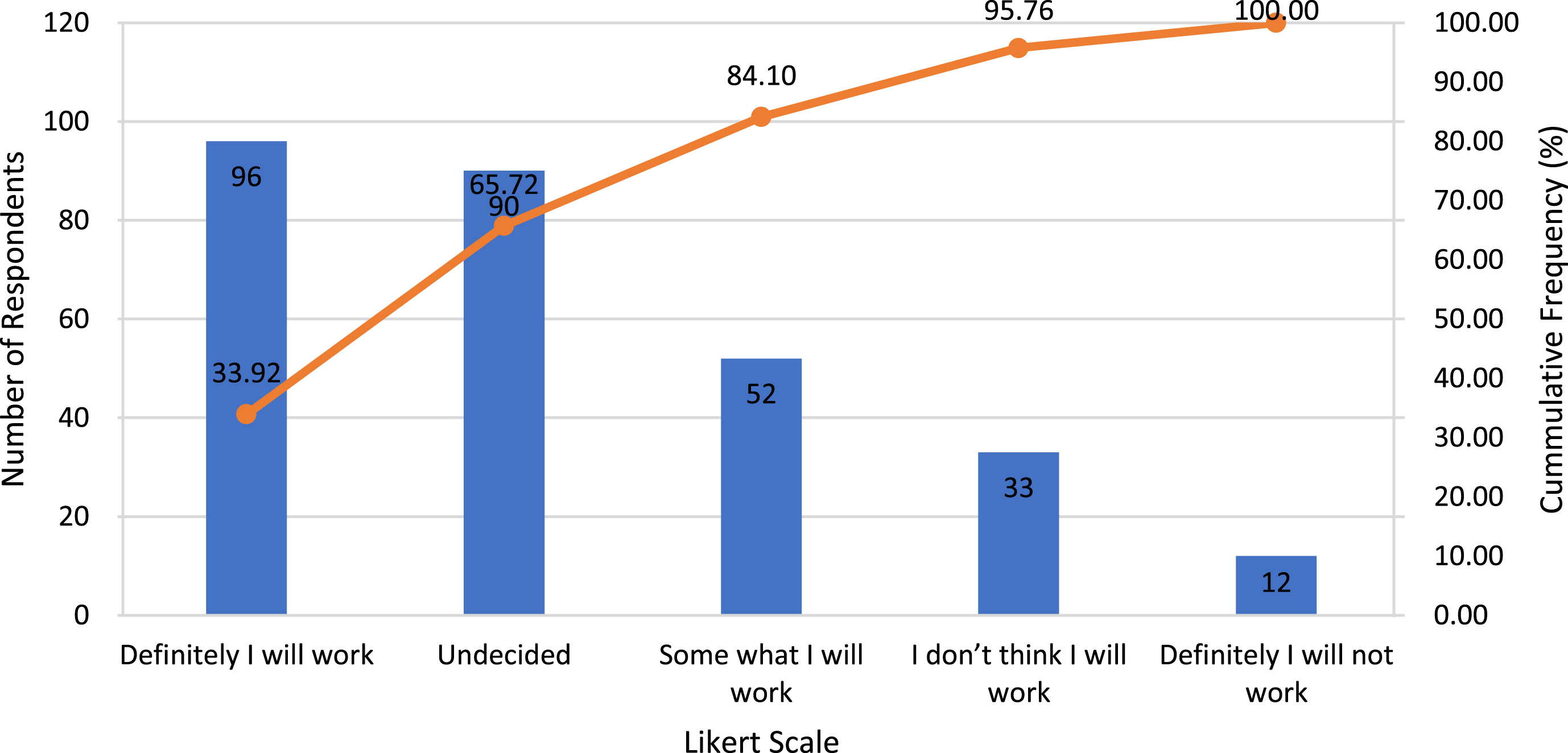
Future intentions to stay or leave.
The below (Fig. 4) depicts that the decent learning environment is very important in the host country to attract international students. In the survey, we asked from the international students either they are satisfied with the learning environment in the People’s Republic of China (PRC). 45% respondent express that learning environment in China is better, while 27% answer that learning environment in the People’s Republic of China (PRC) is much better. On the base of the survey results, we conclude that the learning environment is more suitable for foreign students in China.
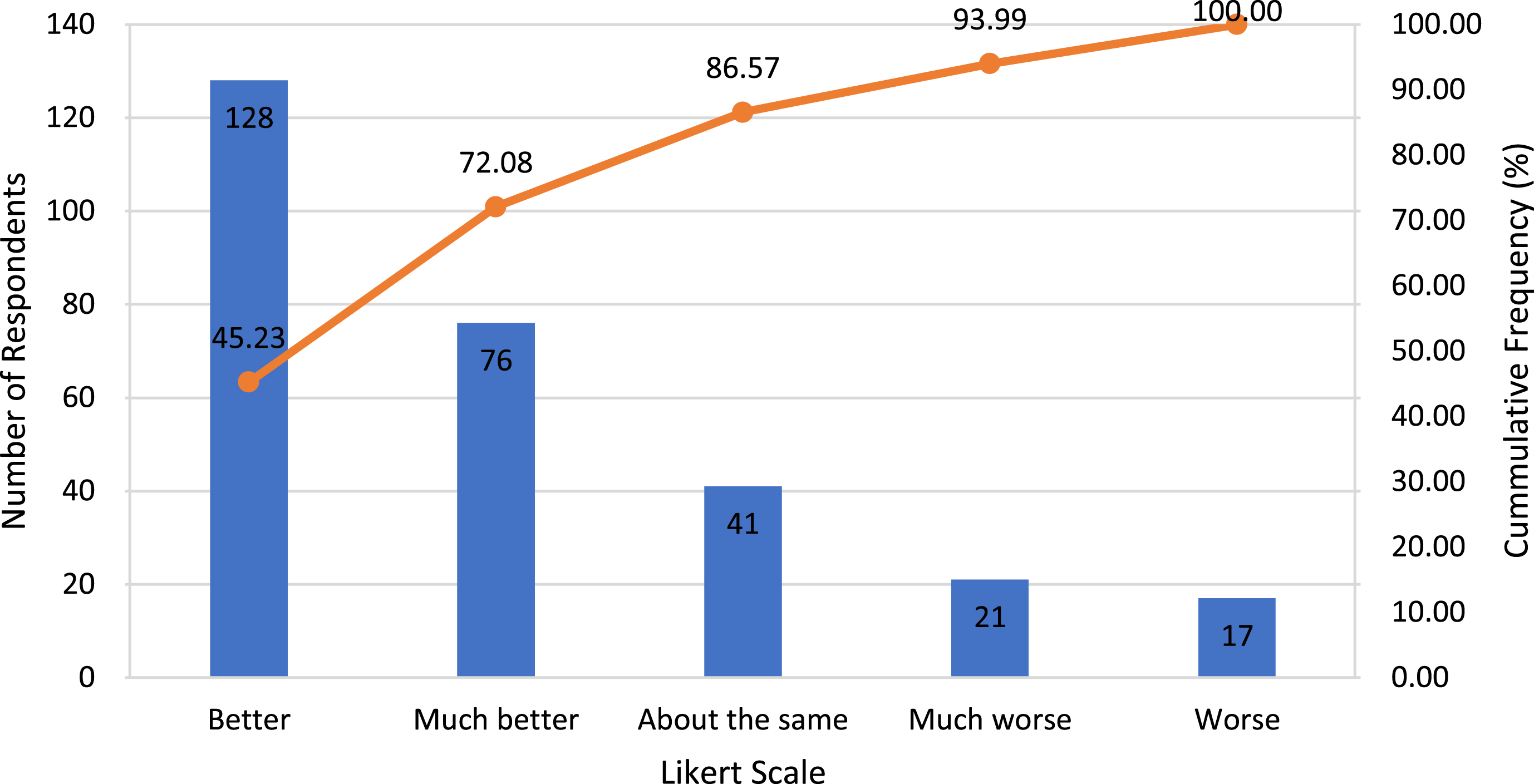
Learning environment in China for Foreigners.
This study uses the binary logit model estimated using the maximum likelihood technique. This model addresses the dichotomy of whether or not a student intends to return home and identifies the determinants of such intentions. Logistic regression model can be written as follow:
In Equation 1, e = natural logarithm base
Based on the literature review, this article dedicates to compute brain gain for China empirically. The functional form of models is as follows:
Dependent variables
FI: Future intentions to work in China.
Independent variables
LC: Life comparison of home country with the host country.
LE: Learning environment in China.
FCL: Predictors that compel to leave China.
FCS: Predictors that compel to stay in China.
Descriptive statistics
Statistics and Data (Stata) and Statistical Package for Social Sciences (SPSS) were used to conduct primary data analysis. Table 2 demonstrates the foreigner future intentions to stay or leave the People’s Republic of China (PRC)after graduation. The valid sample size is 283. By gender wise, 72% are male, and 27% are the female respondent. While marital status wise, the 63% are single, and 27% are married. When we are talking about education, the majority of respondent are enrolled in master (48%), Ph.D. (21%) and bachelors (22%) degrees. Furthermore, the majority of students belong to the mature age group, 25–30 (47%), 30–35 (30%), and 18–25 are 14%.
Descriptive statistics of future intentions
Descriptive statistics of future intentions
Table 3 spotlights the correlation matrix. A student’s career path after graduation was the most important predictor in determining whether he/she will stay at the host country or return to his/her home country. There is a negative correlation between individual future intentions (FI) and standard of living (LC) comparison between the home country with the host country. This relation shows that improved standard of living in home countries attract an individual to return to their home countries [7]. Whereas future intentions (FI) also negatively associated with learning environment (LE), and predictors compel to leave (FCL) China subsequently. The better education in home country attracts an individual to leave the host country and return to their home country [1, 2]. On the other hand, better standard of living (LC) is highly correlated with future intentions (FI) to stay and work in China, as compared to the learning environment (LE), predictors to compel to leave (FCL) predictors to compel to and stay (FCS) in China respectively. Host country with better lifestyle compels the individual to stay and work in the home country [17, 27]. Furthermore, a better standard of living is positively associated with the learning environment in China (LE). The survey respondent shows their confidence in a Chinese learning environment. This results also validated by the work of [10]. Predictors compel to stay (FCS) in China negatively associated with compelling predictors to leave the People’s Republic of China (PRC) (FCL). It infers that better life standard in host country increases the brain gain chances for the home country. Moreover, due to the better learning environment and predictors that compel the individuals to stay (FCS) in the People’s Republic of China (PRC) respectively [28].
Correlation Matrix
Correlation Matrix
The impact of future intentions is quantified through Logistics modeling due to the nature of the dichotomous dependent variable. The empirical results estimates are reported in (Table 4). The outcomes from logistics modeling signify that better living standard in the People’s Republic of China (PRC) compels the individual to stay in the People’s Republic of China (PRC), have a statistically significant negative impact on future intentions. It is enlightening that better life standard in the home country and addition in features to stay in the People’s Republic of China (PRC) are more likely to be brain gain for the People’s Republic of China (PRC), the findings of [10] consistent with our study. The better learning environment in the People’s Republic of China (PRC) compels the individual to stay in the People’s Republic of China (PRC), have a negative impact on future intentions, but it is statistically insignificant.
The goodness of fit (GOF) from logistics regression is statistically significant at 1 percent level. To overcome the functional form and omited variable problem, Link test has been applied. The prediction square (hatsq) of link test, is statistically insignificant which revealed that econometric model of the study had not functional form and omitted variable problem. Another problem of primary data analysis, there is a chance of multicollinearity. The estimated magnitudes become unstable and wildly inflated the standard errors in the presence of multicollinearity. To counter this, Variance inflating predictor (VIF) and tolerance (I/VIF) have been computed to identify the multi-co-linearity level in the model. As a rule of thumb, VIF and tolerance values are greater than 10 and 0.1 respectively, may need to be further investigated. Mean VIF is 1.01, 1.00 and 1.03 in push predictor model, pull predictor model and both predictor model respectively which is acceptable (See Table 4).
Logistics regression model Results
Logistics regression model Results
Note: * and ** indicate level of significance at 1% and 5% respectively.
To measure the estimated model validity and accuracy, sensitivity and specificity analysis are conducted to pinpoint the model accuracy. Sensitivity and Specificity analysis are reported in Table 5. True positive Pr (+| D) and true negative Pr (–|∼D) depict the accuracy of the model. Sensitivity measures the proportion of observed positives that were predicted to be positive” while specificity measures the proportion of observed negatives that were predicted to be negatives [8]. Ideally, the test will result in both being high, but usually, there is a tradeoff. The geometrical illustration of sensitivity and specificity is depicted in Fig. 9. It infers that model accuracy (correctly classified) is 63.25%.
Sensitivity and Specificity analysis
Sensitivity and Specificity analysis
For estimated model validation, we also applied the additional goodness of fit test, i.e., ROC. ROC summary index is famous and recently used to measure the goodness of fit of an estimated model. It is also known as the area under the ROC curve (AUROC). The AUROC is presented in (Figs. 5 and 6). This curve illustrates the pattern of hit rate cut-off value (HRC) and false rate cut-off value (FRC). A higher magnitude of AUROC depicts the better-estimated model. For an appropriate model, AUROC value must lie between 0.5 and 1.0 [34]. The current study estimated model has 0.6885 value of AUROC which infers that model is 68.85 percent correctly predicted.
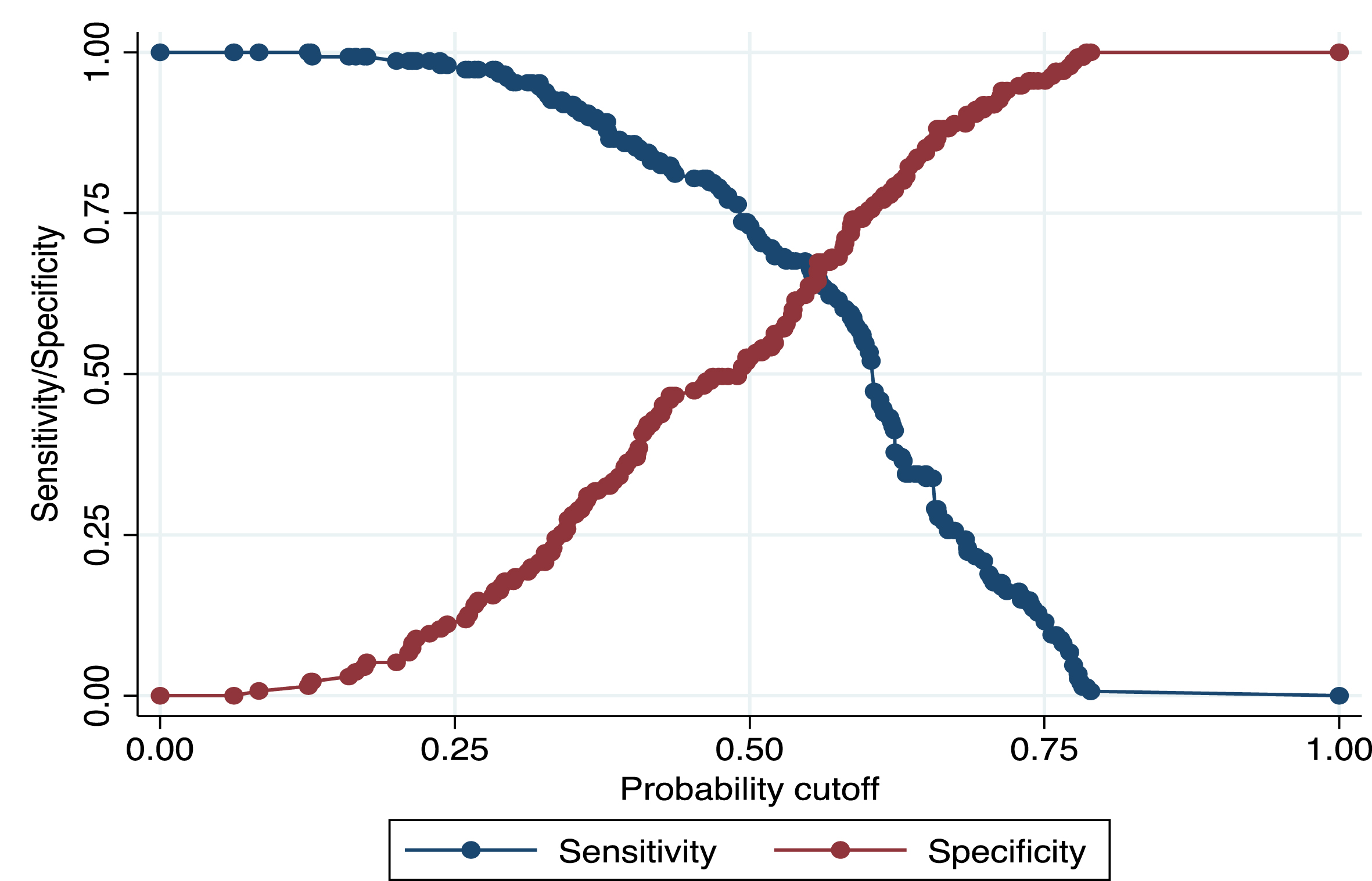
Model validity and accuracy analysis.

ROC analysis.
Main results
This article sets out to examine the predictors that play an important role in the individual decision after graduation, either to stay in the host country or return to home country after graduation. Based on our survey results a number of foreign students are willing to stay and work in the future in the People’s Republic of China (PRC), as the enormous number of survey respondent is happy with the high wages, better working conditions and a better lifestyle in China. While a group of sizable survey respondent is cynic about limited job opportunities for foreigners in the People’s Republic of China (PRC), the lack of opportunities for foreigners compels them to leave People’s Republic of China (PRC) after completing their studies.
Policy implications
The empirical results of the survey should be a high concern for the policy maker of the People’s Republic of China (PRC). This foreign student’s potential can be turned into an economic advantage (brain gain) if the People’s Republic of China (PRC) government makes sure to implement a labour friendly policy, making it one of the national priorities. Thus, the Chinese law enforcement agencies need to formulate and implement a strategy that: (a) the People’s Republic of China (PRC) need to implement suitable labour policy to use this foreign student’s potential efficiently. (b) the People’s Republic of China (PRC) needs an active migration monitoring system that focuses on and monitor migration movement. (c) the People’s Republic of China (PRC) needs to revisit migration policies and create more employment opportunities by promoting economic development, resolving employment problems, encouraging and guide non-state-owned businesses and increasing its employment capacity.
Limitation and future research direction
Although this study is greatly important for policymakers, it has two primary limitations that pave the way toward future research. First, the study is based on a cross-sectional research design; future research needs to apply a foreign-student, dynamic-cohort design. Second, the study employs a non-stochastic sampling technique, i.e., snowball sampling, which limits it generalizability. In future, probability sampling is recommended to increase the generalizability of results.
Footnotes
Acknowledgments
The authors are grateful to the HSM editorial board. Its constructive comments have substantially improved this work.