



Abstract
Customers engage in the word of mouth (WOM) diffusion and adoption process, owed to their satisfaction or dissatisfaction with the goods and services they purchase and use. WOM is crucial to making or breaking business enterprises and other societal organizations. A satisfied customer will spread favorable word of mouth, while a customer who is dissatisfied will spread unfavorable WOM. Using a non-recursive SPSS model, this study empirically tests how Xiaomi customers in China and a few other countries, such as, Australia, South Africa and United States of America, express their dissatisfaction through unfavorable WOM. Despite the study’s limitations, one of which entails assessing WOM through non-recursive statistics, the main findings and conclusions are discussed, along with future-research directions and policymaking recommendations.




Introduction
Customer dissatisfaction has become a very popular topic in recent literature as previous literature focused more on customer satisfaction. However, all the discussions and research go in different directions. With the emergence of internet and online platforms, companies have become much aware of the effect of customer dissatisfaction on their company profile and products and they try as much as possible to satisfy their customers. This notwithstanding, customer dissatisfaction is an unavoidable phenomenon since every customer is different with different expectations towards a particular product and/or service. Past research confirms that the more satisfied a customer is, the more loyal she/he is to the company and its products [1, 2] and most companies are well aware of this phenomenon. No matter how they try to satisfy their customers, there are still customers who are not satisfied. M Söderlund acknowledged the deficiencies in customer satisfaction and dissatisfaction literature in that the data used tends to be bias towards only customers who are highly satisfied or highly dissatisfied [3].
Dissatisfaction in the mobile phone industry is a very trending issue because of the influx of different kinds and brands of mobile phones which has led to a high competition in the industry. Sometimes companies have to come up with policies that can increase customer satisfaction. According to Oliver, when customers are dissatisfied, it means the product or service did not meet predictions prior to purchase [4]. Dissatisfaction can represent service failure as a result of incapacitation [5] and most customers base their satisfaction or dissatisfaction of a product or service on the experience they gain after using a product or service with the experience they had previously using the same product or service and this is examined by the “confirmation-disconfirmation” theory [6]. Which means that negative disconfirmation will lead to dissatisfaction since the customer expectation was not met in comparison with the basis of judgement [7]. Thus, it is the aspiration of every company to satisfy its customers so as to increase the profit margin.
Literature review and hypotheses
In this session we provide an overview of pertinent literature. This is based on customer dissatisfaction, feedback (customer and company) and negative word of mouth.
Feedback in this research is explained as the act of reprimanding a product or service from its performance so as to open up for improvements in the future. Therefore, when customers give out negative feedback, it is in a form of criticism, whiles positive feedback implies appreciation. As customers are constantly faced with problems in purchases of goods and services, positive and negative feedback helps to solve some of these [8].
Customer dissatisfaction
More often than not customers who are dissatisfied tend to let others become aware of their bad experience with a product or service. This is done easily since the introduction of online platforms and customer rating websites. Some researches mostly link customer satisfaction to positive WOM [9–11]. This means that dissatisfaction can lead to negative WOM, albeit, research that links dissatisfaction to negative WOM is not very steady as affirmed by Zhu and co-workers [12]. Their research found discrepancies in literature because some studies hypothesized a kind of confident correlation while others confirmed a negative or no correlation whatsoever between dissatisfaction and negative WOM. They further proposed that dissatisfaction and negative WOM are positively correlated as this is controlled by “social ties” [12]. According to Chon, marketing emphatically is all about knowing what consumers need at every point in time and making it available as and when they need it [38]. Several literatures have been written about consumer satisfaction over the last two decades. Researchers like Aggelidis& Chatzoglou, Bailey & Pearson, etc. all propose that a user’s satisfaction level can adequately be measured by a scale from highly dissatisfied to highly satisfied [13]. Even though Islam thinks is not in favor of this proposal because it is not satisfactory enough. Despite many literatures on consumer satisfaction, few exist on consumer dissatisfaction. Researchers like Renoux identified that dissatisfaction could be grouped into micro and macro marketing function that falls under three sub categories namely: shopping – scheme dissatisfaction, buying-scheme dissatisfaction and consuming-function dissatisfaction.
Customer and company feedback
Feedback is very important in marketing and management research. Customers usually give feedback on their experience with a product or service and companies give feedback in order to address customer concerns. Usually feedback is intended to be a two-way affair. However, not all companies respond to customer feedback and in most cases such companies tend to lose their customers over time, thereby decreasing their sales and profit margin. Before the customer will give feedback, there is usually a process (Fig. 1) from the point where the customer decides the need for a product or service until feedback after the experience encountered. In most cases customers give feedback when their experience with a product or service is usually negative, or when they are dissatisfied. Customer feedback can be in the form of reviews and or recommendations, questions, suggestions [14–16]. In the same manner, a customer who gives feedback after an experience will require the company to give their feedback as a way of addressing their concerns. It has been proven that customer feedback has a significant effect on sales and this means that companies should devote special attention to feedback from customers [14]. Customers through feedback are able to let firms know how they are affected by the behavior of a product or service. Customer feedback is a very important phenomenon as they help firms and provide them with alternatives that aids in giving better customer experience, offer satisfaction, improve a product or service, and retain customers. Customers give feedback in several ways such as online platforms, phone calls, oral or written survey. The influx of social media has made this process very easy and very attainable; in this regard Kio view the concept of feedback as a connected model where the receiver is connected not only to the provider but other receivers as well (Fig. 2) [17]. In his research, he describes that through the process of feedback, several networks can be created concurrently. Even though networks have been in rage for quite a long time, they are full of unresolved issues in relation to administrative rankings. Networks have not been well controlled as a result of some people in society who hold exceptional ranks in society.

The feedback process.
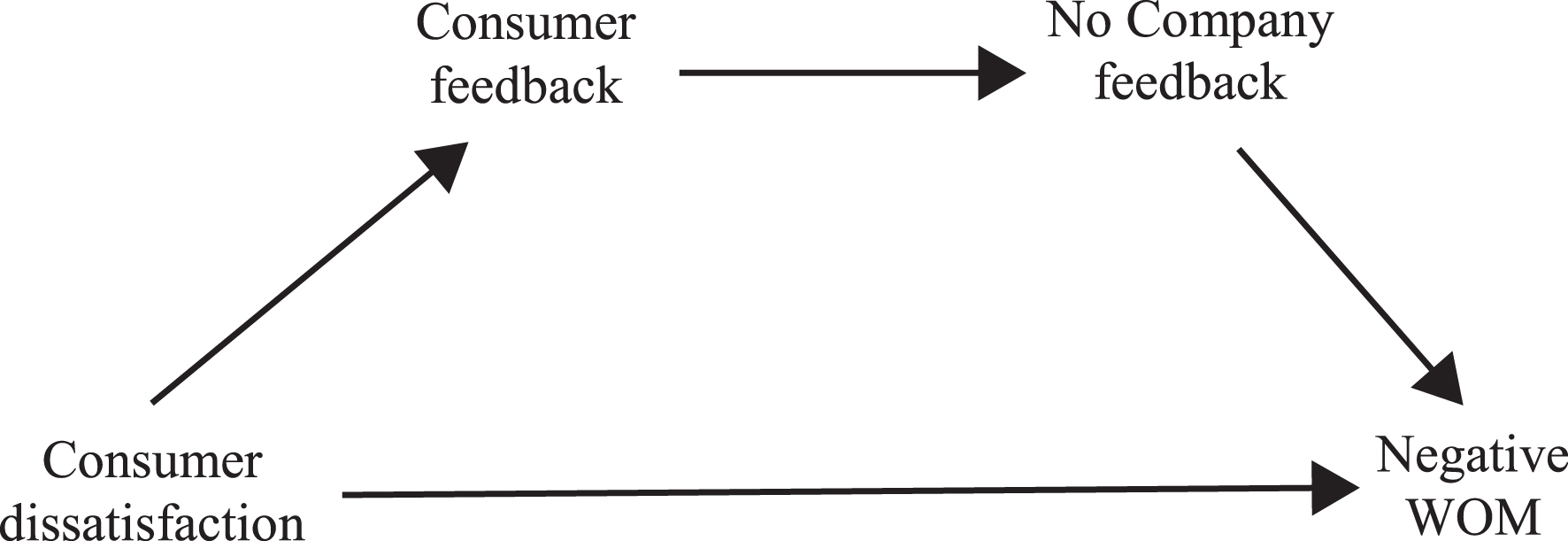
Conceptual model.
Several scholars have affirmed the importance of customer feedback. This is basically in an attempt to make customers offer better experiences to their clients [18–20].
Word of mouth (WOM) is very powerful so long as communication is involved. M Söderlund defines WOM as “the extent to which a customer informs friends, relatives and colleagues about an event that has created a certain level of satisfaction” [3]. Most customers express their satisfaction and dissatisfaction through WOM. However, research has affirmed that dissatisfied customers tell more people about their bad experience than those who are satisfied [21, 22]. WOM have also been linked to customer purchase decisions [23] as it plays a very important role is a customer’s purchase decision. WOM can be positive or negative depending on what the customer feels after the use of a product or service. WOM has a great influence on other non-users of a particular product or service as they rely on the information given out by others who have had prior experience on the same product or service. M Söderlund again made an assumption in his research that it is less likely for a satisfied customer to spread any news about the product or service [3] and this seems very logical. But based on the assumptions of Holmes and Lett he affirmed that when the outcome of the use of a product or service is very perfect then that customer is more likely to share the good news with others [24]. When customers are dissatisfied with a product, they feel so much cheated to the extent that they would not want their families and friends to encounter or go through what they have been through thus they are tempted beyond all reasonable doubts to tell the bad experience. Through social media and platforms electronic Word of mouth (eWOM) is more useful and tend spread faster than WOM [25]. Hennig-Thurau, Gwinner, Walsh, & Gremler refers to eWOM as any remark or comment, whether negative or positive to consumers make concerning a product or service mostly with the use of electronic media [26]. Thus, people prefer to use eWOM as opposed to traditional WOM, as the former is continual in nature and very handy in nature [27]. In their research, [28] agrees that consumers spend time talking about some products more than others. According to their research such products that are more talked about are “products that are publicly visible or cued more by the environment”. Word of mouth is very important in marketing because when customers gain better services, it increases their experience with the company’s brand and this influences purchasing decisions. Sometimes WOM has been expressed as powerful, in that it is dominant in a customer’s decision to purchase or use a particular product or service. This goes a long way to save the company lots of money they could have spent in advertising and product or service awareness [29, 30].
When customers gain enough experience, they tend to market products and services for companies consciously or unconsciously. With the influx of social media, emails, blogs etc., WOM has become very easy. This is true for both positive and negative experiences. WOM can be subdivided into positive and negative. Customers have the decision to choose the kind of service you give them, whether good or bad and this can affect WOM marketing. This is because, extant research has proven that a customer who is not satisfied will end up telling about 9–15 persons about their bad experience. This means that about 13% of customers who are dissatisfied tell more than 20 people. So when customer experience with the company is negative, then customers tend to spread to as twice as many people. In effect, people end up talking as much as twice of their negative experiences more than their positive experiences. Eventually 67% of people will buy a product or used a service based on recommendation from a friend or on social media [31, 32].
From the above literature and conceptual model (Fig. 2), we postulate the following hypotheses:
H1 Customer dissatisfaction has a positive influence on feedback
H2 Customer dissatisfaction positively affects negative WOM
H3 Customer feedback sometimes attracts no company feedback
H4 No company feedback has a positive influence on negative WOM
Methodology
This research used primary data from users of Xiaomi phone. With a self-administered questionnaire from 403 respondents who experienced any form of dissatisfaction in using Xiaomi phone. We concentrated on those who were dissatisfied and made one complain or the other but did not receive any form of feedback from the company. Most of the respondents were Chinese; however, there were few online interviews with other users other countries such as the United States of America (USA), Australia and South Africa. We adopted the multiple regression analysis to analyze the variables which included customer dissatisfaction, customer feedback, company feedback and negative WOM. The questionnaire was divided to measure all the variables including the demographic profile of the respondents. On a five-point Likert scale from strongly disagree to strongly agree, the scales used were carefully selected from existing literature and altered where necessary to fit the contents of our study. Using SPSS 20, we conducted multiple regression analysis to estimate the linear hypotheses to find out the effect of customer dissatisfaction, customer feedback and no company feedback on negative WOM.
Results
Demographics of respondents
There were a total number of 403 respondents. Out of these, 73% were from China, 13.9% were from the USA, 11.4% from Australia and 1.7% were from South Africa. Out of the respondents, 233 were males, representing 57.8% and 170 females representing 42.2%. Majority of the respondents were between the ages of 26–49 years making up 56.8% and 31% were between the ages of 18–25 years mostly bachelor and master degree holders (see Table 1).
Demographics
Demographics
This includes the means, standard deviation and bivariate correlations of customer dissatisfaction, customer feedback, company feedback and negative word of mouth. Customer dissatisfaction, customer feedback and no company feedback all had a positive correlations with negative word of mouth (0.24**, 0.010** and 0.036**) (Table 2).
Means, standard deviation and correlations
Means, standard deviation and correlations
In the multiple regression analysis, we tested to confirm whether or not customer dissatisfaction, customer feedback and no company feedback has any influence on negative WOM. Table 3 summarizes the regressions of the variables (customer dissatisfaction, customer feedback and no company feedback) on negative WOM. We tested four models in the regression analysis and it turned out that our models had significant positive effects on negative WOM. We recorded F-values of 0.626, 0.647 and 0.571. In model 1, we evaluated the effect of the control variables; age, gender, education and location on negative WOM. It turned out that gender and education had no significant influence on negative WOM ((β= –0.012 and –0.023 respectively). The results demonstrated in model 2, 3, and 4 that customer dissatisfaction and customer feedback and no company feedback are positively related to negative WOM (0.021, 0.009 and 0.317) at a significant level of 0.001 and this validates our hypotheses.
Multiple regression summary
Multiple regression summary
The findings of this study proved that customer dissatisfaction, customer feedback and no company feedback had a significantly positive effect on negative WOM. Therefore companies must do everything within their power to eliminate customer dissatisfaction. This is because as and when customers are dissatisfied they will definitely spread negative WOM and this could tarnish the image of the company as well as reduce sales.
According to Bass FM and Bass FM, Krishnan TV and Jain DC WOM has always been seen as an impromptu action in society coupled with repeated feedback, and this tends to be one major limitation of the study.
The study also revealed that sometimes when customers give feedback to companies expressing their dissatisfaction, they do not receive response and this irritates most of the customers who eventually tell others about their bitter experience. They do this sometimes to punish the companies or simply try to prevent friends, family members and the general public from going through their painful experience.
This study ignored customers who are satisfied with using xiaomi phone as well as customers who received feedback after making their complaints. Again we did not include users of other brands of phones such as Samsung or Apple IPhone. In this regard we propose a study to cut across a comparison of dissatisfaction among users of top phones such as Samsung, and IPhone with Xiaomi as Xiaomi is also gaining its stand in the smart phone market [33]. This authenticates the findings of M Söderlund that research on customer satisfaction and dissatisfaction are deficient in a way in that, it concentrates on customers who are very much satisfied or very much dissatisfied [3].
Conclusion
Companies have lost several customers through negative WOM as such it is in the interest of all companies to avoid customer dissatisfaction which can lead to negative WOM. Using three independent variables, customer dissatisfaction, customer feedback and no company feedback, we tested their effect on negative WOM. The results empirically demonstrated that all the variables have a significant positive effect on negative WOM and customers will always express their dissatisfaction irrespective of their geographical location. Although studies on negative WOM has been on the rise, none of them to the best of our knowledge studied the effect in the mobile phone industry. The study also treats feedback as a duo; customer feedback (complaints, suggestions, and questions) and company feedback (solving the problems of the customer). Word of mouth is most effective in marketing and companies rely on it for gaining market share.
Footnotes
Acknowledgments
The authors would like to thank the National Natural Science Foundation of China for providing funds for this research (Grant No. 71490722/71272173)